U.S. Pat. No. 10,434,406
VIDEO GAME PROCESSING APPARATUS AND VIDEO GAME PROCESSING PROGRAM PRODUCT
AssigneeSQUARE ENIX CO., LTD.
Issue DateSeptember 4, 2015
Illustrative Figure
Abstract
A video game processing apparatus selectably displays a plurality of panels within a predetermined area on a display screen with a predetermined array (for example, Step S101); receives, from a user, a selecting operation against any of the plurality of displayed panels (for example, Step S201); specifies continuously selectable panels in accordance with the panel for which the selecting operation is received from the user (for example, Step S202); and changes a display mode of each of the specified panels so as to become the display mode other than a display mode of each of the other panels (for example, Step S204).
Description
DESCRIPTION OF EMBODIMENT Hereinafter, an example of one embodiment according to the present invention will be described with reference to the drawings. FIG. 1is a block diagram showing a configuration example of a video game processing system100according to one embodiment of the present invention. As shown inFIG. 1, the video game processing system100includes: user terminals11to1N (“N” is an arbitrary integer) used by each of a plurality of users (players); and a video game processing server30. In this regard, a configuration of the video game processing system100is not limited to this configuration. The video game processing system100may be configured so that a plurality of users uses a single user terminal, or a plurality of servers are provided. Each of the plurality of user terminals11to1N is managed by a user (player) who plays a video game, and is configured by a mobile communication terminal, such as a cellular phone terminal, a PDA (Personal Digital Assistants), and a mobile game apparatus, by which the user can play a network delivery-type game, for example. Each of the plurality of user terminals11to1N includes hardware (for example, a display device for displaying a game screen, an audio output device and the like) and software to carry out the video game by connecting the plurality of user terminals11to1N to a communication network40and carrying out communication with the video game processing server30. In this regard, the plurality of user terminals11to1N may be configured so that the plurality of user terminals11to1N can directly communicate with each other without passing through the video game processing server30. Further, the display device of each of the plurality of user terminals11to1N has a touch panel function by laminating a touch panel portion on a surface of a display section, such as an LCD. In this regard, various kinds of structures, such as an ...
DESCRIPTION OF EMBODIMENT
Hereinafter, an example of one embodiment according to the present invention will be described with reference to the drawings.
FIG. 1is a block diagram showing a configuration example of a video game processing system100according to one embodiment of the present invention. As shown inFIG. 1, the video game processing system100includes: user terminals11to1N (“N” is an arbitrary integer) used by each of a plurality of users (players); and a video game processing server30. In this regard, a configuration of the video game processing system100is not limited to this configuration. The video game processing system100may be configured so that a plurality of users uses a single user terminal, or a plurality of servers are provided.
Each of the plurality of user terminals11to1N is managed by a user (player) who plays a video game, and is configured by a mobile communication terminal, such as a cellular phone terminal, a PDA (Personal Digital Assistants), and a mobile game apparatus, by which the user can play a network delivery-type game, for example. Each of the plurality of user terminals11to1N includes hardware (for example, a display device for displaying a game screen, an audio output device and the like) and software to carry out the video game by connecting the plurality of user terminals11to1N to a communication network40and carrying out communication with the video game processing server30. In this regard, the plurality of user terminals11to1N may be configured so that the plurality of user terminals11to1N can directly communicate with each other without passing through the video game processing server30.
Further, the display device of each of the plurality of user terminals11to1N has a touch panel function by laminating a touch panel portion on a surface of a display section, such as an LCD. In this regard, various kinds of structures, such as an optical type, a resistive film type, a pressure sensitive type and the like, can be adopted as the touch panel portion. In this regard, each of the user terminals11to1N according to the present embodiment is configured so as to have the touch panel function. However, each of the user terminals11to1N may be configured so as not to have the touch panel function.
FIG. 2is a block diagram showing an example of configuration of the user terminal11. The user terminal11includes a control section20, a communication section21, and a video game information storage section22. In this regard, in the present embodiment, the user terminal11will be described as an example. However, the other user terminals12to1N have the similar configuration to the configuration with which the user terminal11is provided.
The control section20includes a CPU, a ROM and the like, and has a function to carry out a control of the whole user terminal11in accordance with control programs stored in the video game information storage section22.
The communication section21has a function to communicate among the plurality of user terminals11to1N via the communication network40such as the Internet or the like.
The video game information storage section22is configured by a database apparatus, for example. The video game information storage section22is a storage medium in which various kinds of information related to the video game whose progress is controlled by the video game processing system100and various kinds of data such as a control program for the video game are stored. However, the video game processing system100may be configured so that part of the information related to the video game is managed by each of the plurality of user terminals11to1N.
The video game information storage section22includes: a game program storage section22a; a character information storage section22b; and a panel information storage section22c(seeFIG. 2).
The character information storage section22bis a storage medium for storing character information regarding various kinds of characters for carrying out battle processing.FIG. 3is an explanatory drawing showing an example of a storage state of the character information. As shown inFIG. 3, the character information contains: a character type indicating either a player character or an enemy character; a character ID for uniquely specifying a character; a character name; an appearance mode of the character; a job of the character; and a status of the character.
Here, the “job” is attribute information indicating an attribute of the player character. In the present embodiment, the player characters are classified into any of jobs including a fighter, a soldier, a wizard, a priest and the like. In this regard, the video game processing system100may be configured so that the job is set to only the player character, or so that the job is set to characters including the player character and the enemy character.
The panel information storage section22cis a storage medium for storing panel information regarding display objects that the user is caused to select for carrying out the battle processing.FIG. 4is an explanatory drawing showing an example of a storage state of the panel information. As shown inFIG. 4, the panel information contains a pattern, a job, and an action.
Here, the “pattern” is information indicating a display mode of a panel. The pattern according to the present embodiment is stored as a “fist”, a “sword”, a “stick”, or a “cloth”. In this regard, the pattern according to the present embodiment corresponds to the job indicating an attribute.
Here, action content is information indicating the content of an action that the player character is caused to carry out in the battle processing. The action content according to the present embodiment is stored as “attack a single enemy with a fist”, “attack a single enemy with a sword”, or “attack a single enemy with magic”. In this regard, the video game processing system100may be configured so that the action content is associated with the number of panels selected by the user in the battle processing, and so that: the control section20specifies the number of panels selected by the user; and refers to the panel information to determine the action content corresponding to the number of panels as the action content of the character.
Each of the video game processing server30and the plurality of user terminals11to1N is connected to the communication network40such as the Internet. In this regard, although it is not shown in the drawings, the plurality of user terminals11to1N is connected to the communication network40by carrying out data communication with a base station managed by a communication carrier by means of a wireless communication line.
The video game processing system100has various kinds of functions to control progress of a video game that each of a plurality of players plays in a virtual space or a virtual area (for example, so-called online game and a social game (i.e., a game provided in an SNS (Social Networking Service))).
The video game processing server30is managed by an administrator of the video game processing system100, and has various kinds of functions to provide (or deliver) information on the video game to the user terminals11to1N.
The video game processing server30is configured by an information processing apparatus such as a WWW server, and includes a storage medium for storing various kinds of information.
Next, an operation of the video game processing system100according to the present embodiment will be described. In this regard, the content of operations and/or processings with no relationship to the present invention may be omitted.
FIG. 5is a flowchart showing an example of the battle processing carried out by the user terminal11in the video game processing system100. In the present embodiment, when the control section20of the user terminal11receives a battle start operation from the user during progress of the video game, the battle processing is started. In this regard, the video game processing system100according to the present embodiment carries out a turn-based battle system. When a turn for the player character is started, the video game processing system100causes the user to play a puzzle game, and carries out attack processing for the player character in accordance with a result of the played puzzle game. In this regard, the video game processing server30may be configured so as to carry out part of the processing shown inFIG. 5, or the user terminals12to1N may be configured so as to carry out part of the processing shown inFIG. 5.
In the battle processing, the control section20first carries out battle screen generating processing (Step S101). Namely, the control section20generates a battle screen, and causes the display device of the user terminal11to display the generated battle screen.FIG. 6is a screen diagram showing an example of the battle screen. As shown inFIG. 6, a battle screen300includes a plurality of objects. Namely, the battle screen300includes player characters PC1to PC4, enemy characters EC1to EC2, and a plurality of panels P. The player characters PC1to PC4according to the present embodiment are displayed as cards. Further, the battle screen300includes a character arrangement region in which each of the characters is arranged, and a panel arrangement region in which each of the panels is arranged. Each of the panels arranged in the panel arrangement region is selectably arranged in a predetermined array. Namely, the user terminal11causes the display device to selectably display the plurality of panels within a predetermined area of the display screen in a predetermined array. In the panel arrangement region according to the present embodiment, total 42 panels constituted by 7 columns×6 panels are arranged.
When the battle screen generating processing is carried out, the control section20determines whether it is an attack turn for the player character or not (Step S102). In a case where it is determined that it is not an attack turn for the player character (“No” at Step S102), the control section20determines whether a victory condition is satisfied or not (Step S103).
On the other hand, in a case where it is determined that it is an attack turn for the player character (“Yes” at Step S102), the control section20carries out the player character turn processing (Step S200).
FIG. 7is a flowchart showing an example of the player turn processing. In this regard, in processes carried out in the player character turn processing according to the present embodiment, the control section20causes the display device to superimposedly display on the battle screen a track of the drag operation to the inside of the panel arrangement region received from the user.FIG. 8is a screen diagram showing an example of the battle screen on which an operation track by the user is displayed. As shown inFIG. 8, a track T of the drag operation to the inside of the panel arrangement region received from the user is displayed so as to be superimposed on the battle screen.
In an example of the player character turn processing, the control section20first receives a selecting operation for any of the plurality of displayed panels from the user (Step S201). Namely, the control section20receives, from the user, a touch operation to the panel arranged in the panel arrangement region on the touch panel. In this regard, in the present embodiment, the video game processing apparatus is configured so as to receive a drag operation based on a touch operation to the touch panel from the user. However, the video game processing apparatus may be configured so as to receive a drag operation by means of a mouse.
When an operation to select a panel is received from the user, the control section20specifies the selected panel as a starting point panel, and specifies continuously selectable panels (that is, panels that can be selected next time) in accordance with the starting point panel (Step S202). Namely, the control section20specifies the continuously selectable panels in accordance with the panel indicated by the selecting operation of the user.
In the present embodiment, the control section20refers to the panel information storage section22cin which the panel information containing the attribute information that indicates an attribute of a panel is stored, and specifies the continuously selectable panel on the basis of the attribute of the panel selected by the selecting operation receiving section from the user and the predetermined rule. The control section20according to the present embodiment is configured so as to specify a panel or panels whose attribute is the same as the attribute of the panel selected by the user and that neighbor(s) the panel selected by the user as continuously selectable panels. Namely, in the present embodiment, the control section20stores a rule “the same attribute as the attribute of the panel selected by the user and the panel neighboring the selected panel” as a predetermined rule. In this regard, the control section20may specify a panel whose attribute is the same as the attribute of the panel selected by the user as the continuously selectable panels. Further, the control section20may specify a panel or panels whose attribute is different from the attribute of the panel selected by the user as the continuously selectable panels. Further, the control section20may specify a panel or panels neighboring the panel selected by the user as the continuously selectable panels.
FIG. 9is a screen diagram showing an example of the battle screen on which the starting point panel is displayed. As shown inFIG. 9, a starting point panel301is determined from the plurality of panels displayed on the battle screen300by a selecting operation of the user. In this regard, the user terminal11according to the present embodiment is configured so as to carry out processing to change the display modes in order to distinguish between the starting point panel and the other panels. However, the user terminal11may be configured so as not to carry out the processing to change the display modes.
When the starting point panel is determined and the panel that can be selected next time is determined, the control section20determines whether a panel that can be selected next time exists or not (Step S203). In a case where it is determined that no panel that can be selected next time exists, the control section20determines whether the drag operation as the selecting operation for the panel received from the user is continued or not (Step S205).
On the other hand, in a case where it is determined that there is no panel that can be selected next time, the control section20largely displays (or enlarges and displays) the panel that can be selected next time compared with the other panels (Step S204).
FIG. 10is a screen diagram showing an example of the battle screen on which an enlarged panel is displayed. As shown inFIG. 10, a panel302that neighbors the starting point panel301whose “pattern” is a “sword” and has the same attribute (that is, has a “pattern” of a “sword”) is enlarged and displayed.
When the panel is enlarged and displayed, the control section20determines whether the drag operation as the selecting operation for the panel received from the user is continued or not (Step S205).
In a case where it is determined that the drag operation as the selecting operation for the panel received from the user is continued (“Yes” at Step S205), the control section20determines whether a drag operation for the panel that can be selected next time is received or not (Step S206).
In a case where it is determined that the drag operation for the panel that can be selected next time is not received (“No” at Step S206), the control section20causes the processing flow to proceed to Step S205, and determines whether the drag operation as the selecting operation for the panel received from the user is continued or not.
On the other hand, in a case where it is determined that a drag operation for the panel that can be selected next time is received (“Yes” at Step S206), the control section20updates the starting point panel and causes the display device to display the starting point panel (Step S207). Namely, the control section20updates a panel that becomes a target of the drag operation (that is, the panel selected by the user) as a next starting point panel and causes the display device to display the panel.
When the starting point panel is updated and displayed, the control section20updates the starting point panel and causes the display device to display the starting point panel (Step S208). Namely, the control section20refers to the panel information, and causes the display device to enlargedly display the panel corresponding to the starting point panel thus updated and displayed.
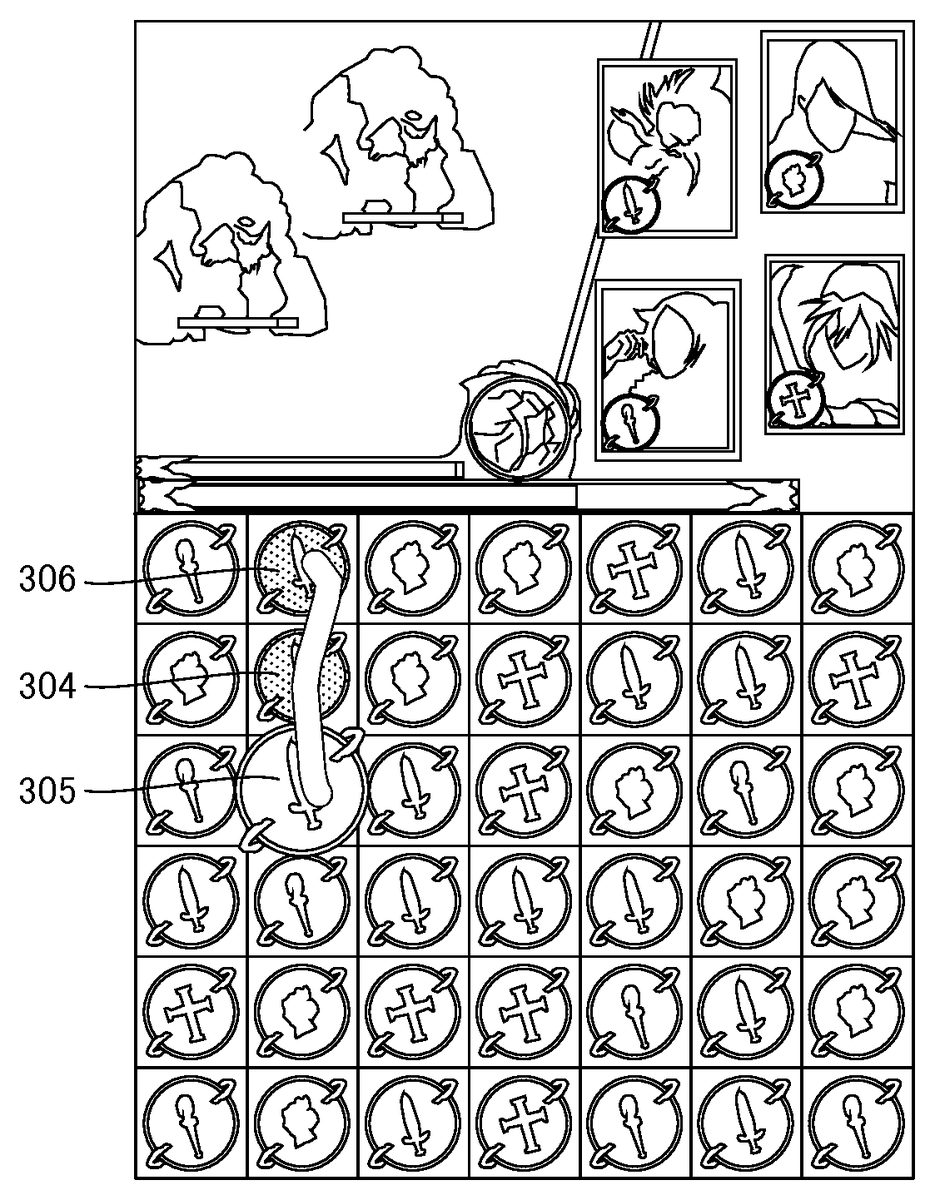
FIG. 11is a screen diagram showing an example of the battle screen on which the updated enlarged panel is displayed. As shown inFIG. 11, a panel305that has an attribute corresponding to the updated starting point panel304(that is, has a “pattern” of a “sword”) and neighbors the updated starting point panel304is enlarged and displayed. Further, a panel306that has already been selected from the user is excluded from panels each of which becomes a target to be enlarged and displayed. For this reason, even though the panel306is a panel that has an attribute corresponding to the starting point panel304and neighbors the starting point panel304, the panel is not to be enlarged and displayed.
When the enlarged panel is updated and displayed, the control section20causes the processing flow to shift to Step S205, and determines whether the drag operation as the selecting operation for the panel, which is received from the user, is continued or not (Step S205).
Subsequently, in a case where it is determined that the drag operation is not continued (“No” at Step S205), the control section20determines whether or not the number of selected panels becomes three or more (Step S209). In this regard, the video game processing system100according to the present embodiment is configured so as to shift to attack determining processing in a case where the number of the selected panels is three or more. However, it is not limited to three or more. For example, the video game processing apparatus may be configured so as to shift to the attack determining processing in a case where the number of the selected panels is three or less. Alternatively, the video game processing apparatus may be configured so as to shift to the attack determining processing in a case where the number of the selected panels becomes three.
In a case where it is determined that the number of selected panels does not become three or more (“No” at Step S209), the control section20carries out operation canceling processing (Step S210). Namely, the control section20cancels the processes that have already carried out in the player character turn processing, and causes the display device to display the battle screen when the player character turn processing was started.
On the other hand, in a case where it is determined that the number of selected panels becomes three or more (“Yes” at Step S210), the control section20carries out the attack determining processing (Step S211). In the attack determining processing according to the present embodiment, the control section20deletes the panel selected by the user; refers to the character information to calculate an attack character and a damage amount according to the number of selected panels; carries out an attack rendering against the enemy character on the basis of the calculated attack character and the damage amount; and refers to the character information to carry out processing to subtract an HP of the character.
When the attack determining processing is carried out, the control section20carries out panel replenishing processing (Step S212). In the panel replenishing processing according to the present embodiment, the control section20carries out a panel replenishing lottery for replenishing the deleted panel; determines a panel to be replenished by means of the replenish lottery; and arranges the determined panel on a column of the deleted panel. Further, the control section20causes the display device to display, when to arrange the panel, the panel so as to appear from an upper frame of the panel arrangement region; and carries out a falling display rendering in which the panel is falling-displayed so as to neighbor the panels that remains (or arranged) in the column to which the displayed panel is replenished. When the panels are replenished by the number of deleted panels, the control section20terminates the panel replenishing processing.
When the panel replenishing processing is carried out, the control section20terminates the player character turn processing, and causes the processing flow to shift to the battle processing.
When the panel is replenished and the player character turn processing is terminated, the control section20determines whether the victory condition is satisfied or not (Step S103).
In a case where it is determined that the victory condition is satisfied (“Yes” at Step S103), the control section20causes the display device to display a battle result (Step S107).
On the other hand, in a case where it is determined that the victory condition is not satisfied (“No” at Step S103), the control section20determines whether it is an attack turn for the enemy character or not (Step S104).
In a case where it is determined that it is not the attack turn for the enemy character (“No” at Step S104), the control section20determines whether a defeat condition is satisfied or not (Step S106).
On the other hand, in a case where it is determined that it is the attack turn for the enemy character (“Yes” at Step S104), the control section20carries out enemy character turn processing (Step S105). In the enemy character turn processing according to the present embodiment, the control section20specified an enemy character against which the player character carries out an attack; refers to the character information to calculate an attack target and a damage amount; carries out an attack rendering against the player character on the basis of the calculated attack target and the damage amount; and refers to the character information to carry out processing to subtract an HP of the player character.
When the enemy character turn processing is carried out, the control section20determines whether the defeat condition is satisfied or not (Step S106).
In a case where it is determined that the defeat condition is not satisfied (“No” at Step S106), the control section20causes the processing flow to shift to Step S102, and determines whether it is an attack turn for the player character.
On the other hand, in a case where it is determined that the defeat condition is satisfied (“Yes” at Step S106), the control section20causes the display device to display a battle result (Step S107). When the battle result is displayed, the control section20terminates the battle processing.
As explained above, in the embodiment described above, the video game processing apparatus (the user terminals11to1N or the video game processing server30) for controlling the progress of the video game by displaying an object on the display screen of the display device is configured so as to: selectably display the plurality of panels within a predetermined area on the display screen with a predetermined array (for example, Step S101); receive, from the user, the selecting operation against any of the plurality of panels thus displayed (for example, Step S201); specify the continuously selectable panels in accordance with the panel indicated by the selecting operation (for example, Step S202); and change a display mode of the continuously selectable panel thus specified so as to become the display mode other than a display mode of each of the other panels (for example, Step S204). Therefore, it becomes possible to display an object with a display mode in which it is easy for the user to operate and erroneous operations of the user becomes less.
In particular, in the embodiment described above, the video game processing apparatus is configured so as to: specify the continuously selectable panel in accordance with the panel selected by the user; and change a display mode of the specified panel so that a display mode of the specified panel becomes different from a display mode of each of the other panels. Therefore, it becomes possible to display an object with a display mode in which it is easy for the user to watch the object, and it becomes possible to provide the video game processing apparatus that causes the user to carry out progress of the video game by means of intuitive operations.
Further, in the embodiment described above, the video game processing apparatus is configured so as to specify panels neighboring the panel selected by the user as the continuously selectable panel. According to such a configuration of the video game processing apparatus, it becomes easy to continuously select the panel displayed on the display device. Therefore, it becomes possible to provide the video game processing apparatus in which it is easy for the user to operate, and it becomes possible to provide the video game processing apparatus that causes the user to carry out progress of the video game by means of intuitive operations.
Further, in the embodiment described above, the video game processing apparatus is configured so that a size of the continuously selectable panel thus specified becomes larger compared with that of each of the other panels. According to such a configuration, it becomes possible to easily grasp which panel the user can select next time. Therefore, it becomes possible to display an object with a display mode in which erroneous operations of the user becomes less.
Further, although it has not been mentioned particularly in the embodiment described above, the video game processing apparatus may be configured so as to change a display mode of each of panels other than the specified continuously selectable panel. According to such a configuration of the video game processing apparatus, it becomes possible to provide a video game processing apparatus that allows the video game to carry out progress of the video game by means of intuitive operations by emphasizing panels that can be selected continuously.
Further, although it has not been mentioned particularly in the embodiment described above, the video game processing apparatus may be configured so as to display the panel other than the continuously selectable panel thus specified in a dark change display mode. According to such a configuration of the video game processing apparatus, it becomes possible to provide a video game processing apparatus that allows the video game to carry out progress of the video game by means of intuitive operations by emphasizing panels that can be selected continuously.
Further, in the embodiment described above, the video game processing apparatus is configured so that the display device has a touch panel function and a drag operation is received from the user. According to such a configuration of the video game processing apparatus, it becomes possible to provide a video game processing apparatus that allows the video game to further carry out progress of the video game by means of intuitive operations.
In this regard, although it has not been mentioned in the embodiment described above, the video game processing apparatus may be configured so as to: change a display mode of each of all panels that can be selected continuously; and display all the panels in a case where a first selecting operation to the plurality of displayed panels is received from the user.FIG. 12is a screen diagram showing an example of the battle screen on which a display mode of each of all panels that can be selectable continuously is changed. Namely, the video game processing apparatus may be configured so as to: specify all panels that can be selected continuously by predicting panels that can be selected next time when the panel that can be selected next time is set as a starting point panel; and change a display mode of the specified panel so that the display mode of the panel is different from a display mode of each of the other panels. According to such a configuration of the video game processing apparatus, it becomes possible to grasp the number of panels that can be continuously selected and a position of each of the panels at first glance. For this reason, it becomes possible to provide a video game processing apparatus that allows the video game to carry out progress of the video game by means of intuitive operations.
In this regard, the configuration of the video game processing system100is not limited to the configuration described above. For example, the video game processing apparatus may be configured so that the video game processing server30carries out part or all of the processes that have been explained as the processes carried out by the user terminals11to1N. Further, the video game processing apparatus may be configured so that any of the plurality of user terminals11to1N (for example, the user terminal11) carries out part or all of the processes that have been explained as the processes carried out by the video game processing server30(in addition, including a configuration in which the plurality of user terminals11to1N is not connected to the video game processing server30). Further, the video game processing apparatus may be configured so that the user terminals11to1N includes a part or all of the storage sections included in the video game processing server30. Namely, the video game processing apparatus may be configured so that one of the user terminal11and the video game processing server30in the video game processing system100includes a part or all of the functions included in the other.
INDUSTRIAL APPLICABILITY
The present invention is useful for a puzzle game in which a user is caused to select an object.
DESCRIPTION OF REFERENCE NUMERALS
11to1N user terminal
20control section
21communication section
22video game information storage section
22agame program storage section
22bcharacter information storage section
22cpanel information storage section
30video game processing server
40communication network
100video game processing system
Claims
- A video game processing apparatus for controlling progress of a video game by causing a display device to display an object, the video game processing apparatus comprising: a processor;and a memory including a set of instructions that, when executed by the processor, causes the processor to perform operations including: selectably displaying a plurality of panels within a predetermined area on a display screen of the display device, the plurality of panels being arranged in a predetermined array;receiving, from a user, a selecting operation against any one of the plurality of panels displayed on the display screen;specifying, via the selecting operation, additional ones of the plurality of panels which are continuously selected after the one of the plurality of panels is selected, the one of the plurality of panels and the additional ones of the plurality of panels being continuously selected panels of the plurality of panels, the continuously selected panels being continuously selected in accordance with the selecting operation;and changing, after each of the continuously selected panels is selected via the selecting operation, a display mode of each of the plurality of panels which is configured to be continuously and directly selected next via the selecting operation so as to become a second display mode other than a first display mode of each of other panels of the plurality of panels which is not configured to be continuously and directly selected next via the selecting operation, the plurality of panels which is configured to be continuously and directly selected next via the selecting operation being continuously selectable panels, wherein, when a number of the continuously selected panels is not at least a predetermined number, the continuously selected panels are cancelled, and when the number of the continuously selected panels is at least the predetermined number, a value to advance the video game is determined according to the number of the continuously selected panels, wherein the value to advance the video game corresponds to at least one of an attack character and a damage amount.
- The video game processing apparatus according to claim 1 , wherein the processor specifies panels neighboring the continuously selected panels as the continuously selectable panels.
- The video game processing apparatus according to claim 1 , wherein the memory is configured to store panel information, the panel information containing attribute information that indicates an attribute of a panel, and the processor specifies the continuously selectable panels on a basis of an attribute of the continuously selected panels and a predetermined rule.
- The video game processing apparatus according to claim 1 , wherein the processor changes a size of each of the continuously selectable panels so as to become larger compared with a size of the other panels.
- The video game processing apparatus according to claim 1 , wherein the processor changes the first display mode of each of the other panels.
- The video game processing apparatus according to claim 1 , wherein the display device has a touch panel function, and the selecting operation includes a drag operation from the user.
- The video game processing apparatus according to claim 1 , wherein the processor changes the first display mode of all of the continuously selectable panels that are configured to be continuously selected from the one of the plurality of panels as a starting point.
- The video game processing apparatus according to claim 7 , wherein the processor changes the first display mode of all of the continuously selectable panels to the second display mode.
- The video game processing apparatus according to claim 1 , wherein, when the selecting operation is not continued and the number of the continuously selected panels is at least the predetermined number, the continuously selected panels are deleted from the display screen.
- The video game processing apparatus according to claim 9 , wherein, when the continuously selected panels are deleted from the display screen, the processor replenishes the continuously selected panels on the display screen.
- The video game processing apparatus according to claim 10 , wherein, when the continuously selected panels are deleted from the display screen, the processor carries out a panel replenishing lottery to determine panels to replenish the continuously selected panels on the display screen.
- A non-transitory computer-readable medium including a video game processing program product configured to control a video game processing apparatus, the video game processing apparatus controlling progress of a video game by displaying an object on a display screen of a display device, the video game processing program product causing the video game processing apparatus to execute: selectably displaying a plurality of panels within a predetermined area on the display screen of the display device, the plurality of panels being arranged in a predetermined array;receiving, from a user, a selecting operation against any one of the plurality of panels displayed on the display screen;specifying, via the selecting operation, additional ones of the plurality of panels which are continuously selected after the one of the plurality of panels is selected, the one of the plurality of panels and the additional ones of the plurality of panels being continuously selected panels of the plurality of panels, the continuously selected panels being continuously selected in accordance with the selecting operation;and changing, after each of the continuously selected panels is selected via the selecting operation, a display mode of each of the plurality of panels which is configured to be continuously and directly selected next via the selecting operation so as to become a second display mode other than a first display mode of the other panels of the plurality of panels which is not configured to be continuously and directly selected next via the selecting operation, the plurality of panels which is configured to be continuously and directly selected next via the selecting operation being continuously selectable panels, wherein, when a number of the continuously selected panels is not at least a predetermined number, the continuously selected panels are cancelled, and when the number of the continuously selected panels is at least the predetermined number, a value to advance the video game is determined according to the number of the continuously selected panels, wherein the value to advance the video game corresponds to at least one of an attack character and a damage amount.
Disclaimer: Data collected from the USPTO and may be malformed, incomplete, and/or otherwise inaccurate.