U.S. Pat. No. 10,076,708
GAME CONTROL METHOD, GAME SERVER, AND PROGRAM
AssigneeGREE, INC.
Issue DateDecember 18, 2014
Jury Awards GREE $92 Million in Damages for Supercell’s Patent Infringement
Jury Awards GREE $92 Million in Damages for Supercell’s Patent Infringement
GREE, Inc. v. Supercell Oy
Case No. 2:19-cv-00200
United States District Court for the Eastern District of Texas
Decided May 7, 2021

In yet another instalment in the series of patent disputes between Japanese game maker GREE Inc. (“GREE”), creator of Fishing Star, and Supercell Oy (“Supercell”) the creator of mobile game Clash of Clans, a jury in the U.S. District Court for the Eastern District of Texas awarded GREE $92.2 million. This patent infringement case follows a series of lawsuits between the two, GREE recently having been awarded $8.5 million for Supercell’s patent infringements in September of 2020.
Here, the jury found that Supercell infringed at least one of the asserted claims among several of GREE’s patents. The patents in the suit were U.S. Patent Nos. 9,079,107 (the ‘107 patent), 9,561,439 (the ‘439 patent), 10,076,708 (the ‘708 patent), 10,413,832 (the ‘832 patent), 10,328,346 (the ‘346 patent), and 10,335,689 (the ‘689 patent). These patents all have to do with improving “freemium” or Gacha games, games which are free but encourage the player to spend money for a better experience. The ‘107 and ‘439 patents concern communicating, storing, and grouping player communications, player-initiated events, and items. The ‘708 and ‘832 patents concern receiving, sending, displaying, and selecting item information and rarity. Lastly, the ‘346 and ‘689 patents relate to methods of selecting and controlling characters and units moving through a divided field when players do battle.
On May 7, 2021 the jury found that GREE had proven by a preponderance of the evidence that Supercell had infringed on at least one of the asserted claims and also had willfully infringed on at least one of the asserted claims. The jury also found that Supercell had not proven by preponderance of the evidence that any of the asserted claims were invalid and thus denied Supercell’s counterclaims of invalidity.
Supercell plans to appeal the decision.
We will continue to provide updates on lawsuits between GREE and Supercell.
Illustrative Figure
Abstract
A game control method, game server, and program can increase variations on methods for acquiring items, increase the predictability of acquisition of an item with a high rarity value or the like, and heighten interest in the game. Included are the steps of presenting a communication terminal, connected over a communication line, with acquirable item information that, for each item type, includes a total count and an acquisition count or a non-acquisition count of items when receiving, from the communication terminal, a request to present information related to items acquirable by the communication terminal, determining an item to provide to the communication terminal when receiving an item acquisition request from the communication terminal, and changing the acquirable item information when receiving a reset request from the communication terminal.
Description
DESCRIPTION OF EMBODIMENTS The following describes embodiments of the present invention. Embodiment 1 FIG. 1is a block diagram of a battle game server1in Embodiment 1 of the present invention. The battle game server1according to Embodiment 1 of the present invention includes a communication unit10, a memory unit11, an information presentation unit12, and a control unit13. The communication unit10communicates with a communication terminal2over either or both of a wireless and wired connection. In association with identification information uniquely allocated to each user that operates a communication terminal2(referred to below as user identification information), the memory unit11stores information on items to provide, a total count of items, item type, and an acquisition count. An “item” refers to any of a variety of objects used within a game, such as a battle card constituting a user's deck, a character, a weapon, armor, an ornament, a plant, food, and the like. The item type is a numerical value representing the rarity value of the item, a numerical value representing the category of the item, or the like. Specifically, the memory unit11stores this information by dividing the information among tables. A plurality of item information tables111ato111c, a user information table112, and item data113are stored in the memory unit11. While three item information tables are described here, this example is not limiting, and the number of item information tables may be two or fewer, or four or more. The item information tables111ato111care tables including information on the total count of items and the item type.FIGS. 2(a) to 2(c)illustrate examples of the item information tables111ato111c. As illustrated inFIGS. 2(a) to 2(c), for example the item information table111aincludes item identification information “UNI1”, an item name “item A”, and an item type “3”. The item identification information is an identifier for uniquely identifying an item in the present system. ...
DESCRIPTION OF EMBODIMENTS
The following describes embodiments of the present invention.
Embodiment 1
FIG. 1is a block diagram of a battle game server1in Embodiment 1 of the present invention. The battle game server1according to Embodiment 1 of the present invention includes a communication unit10, a memory unit11, an information presentation unit12, and a control unit13.
The communication unit10communicates with a communication terminal2over either or both of a wireless and wired connection.
In association with identification information uniquely allocated to each user that operates a communication terminal2(referred to below as user identification information), the memory unit11stores information on items to provide, a total count of items, item type, and an acquisition count. An “item” refers to any of a variety of objects used within a game, such as a battle card constituting a user's deck, a character, a weapon, armor, an ornament, a plant, food, and the like. The item type is a numerical value representing the rarity value of the item, a numerical value representing the category of the item, or the like.
Specifically, the memory unit11stores this information by dividing the information among tables. A plurality of item information tables111ato111c, a user information table112, and item data113are stored in the memory unit11. While three item information tables are described here, this example is not limiting, and the number of item information tables may be two or fewer, or four or more.
The item information tables111ato111care tables including information on the total count of items and the item type.FIGS. 2(a) to 2(c)illustrate examples of the item information tables111ato111c. As illustrated inFIGS. 2(a) to 2(c), for example the item information table111aincludes item identification information “UNI1”, an item name “item A”, and an item type “3”. The item identification information is an identifier for uniquely identifying an item in the present system. The item information tables111ato111care provided with table identification information for uniquely identifying an item information table in the battle game server1. Here, the item information tables111ato111care respectively provided with “TID1”, “TID2”, and “TID3” as the table identification information.
The user information table112is a table storing, for each user, the provided items and information for calculating an item acquisition count. The user information table112associates the user identification information, table identification information, and identification information of provided items.
FIG. 3illustrates an example of the user information table112. As illustrated inFIG. 3, the user information table112includes user identification information “UID1”, table identification information “TID1”, identification information of provided items “UNI2” and “UNI4”, and the like.
The item data113stores data on an image for an item provided to the user in association with item identification information.FIG. 4illustrates an example of the item data113. As illustrated inFIG. 4, the item data for example includes item identification information “UNI1”, an item image “item A image”, and the like. The image data may be in any image format, such as JPEG, GIF, PNG, or the like.
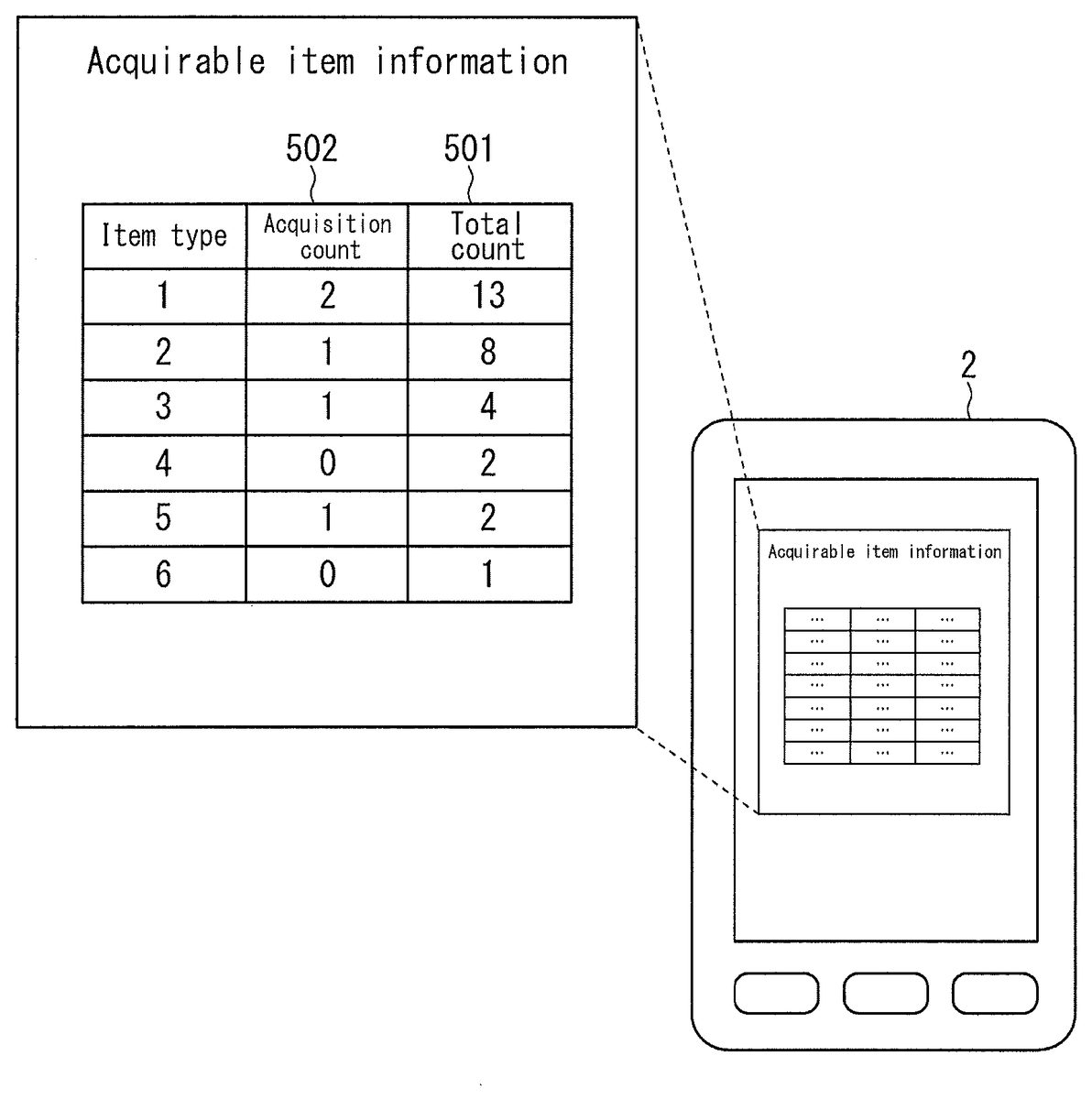
When receiving a request to present information from the communication terminal2, then based on information, stored in the memory unit11, that corresponds to the user identification information pertaining to the communication terminal2, the information presentation unit12presents the communication terminal2, via the communication unit10, with acquirable item information that includes information, for each item type, on a total count and an acquisition count of items.
Specifically, when a request to present information is received from the communication terminal2via the communication unit10, then based on the item information tables111ato111c, the information presentation unit12tallies the total count of items for each item type. The information presentation unit12also refers to the user information table112to calculate the acquisition count of items for each item type based on the identification information of provided items and the table identification information that correspond to the user identification information pertaining to the communication terminal2. The information presentation unit12then presents the communication terminal2, via the communication unit10, with the result of calculation as the acquirable item information.
FIG. 5is an example of the acquirable item information that the information presentation unit12presents.FIG. 5illustrates an example of the acquirable item information presented when a request to present information is received from the communication terminal2and the user identification information pertaining to the communication terminal2is “UID1”. As illustrated inFIG. 5, information501on the total count and information502on the acquisition count of items for each item type are presented to the communication terminal2. The case of presenting the acquisition count has been described above, yet this example is not limiting. For example, a non-acquisition count may be presented by subtracting the acquisition count from the total count of items.
The control unit13performs a variety of control pertaining to the battle game server1. For example, when receiving an item acquisition request from the communication terminal2, the control unit13determines one item to provide to the communication terminal2based on information corresponding to the user identification information pertaining to the communication terminal2.
Specifically, when receiving an item acquisition request from the communication terminal2via the communication unit10, the control unit13refers to the user information table112, and based on the table identification information that corresponds to the user identification information pertaining to the communication terminal2, retrieves the item information table. Next, the control unit13refers to the user information table112and retrieves the identification information of provided items that corresponds to the user identification information pertaining to the communication terminal2. Subsequently, the control unit13refers to one of the item information tables111ato111c, randomly selects an item not included in the identification information of provided items, and determines that the selected item is the item to provide to the communication terminal2.
The control unit13then provides the item to the communication terminal2via the communication unit10. Specifically, the control unit13refers to the item data113and provides the communication terminal2, via the communication unit10, with the item image corresponding to the item identification information pertaining to the item to be provided. The control unit13also adds the item identification information pertaining to the provided item to the user information table112as identification information of provided items.
For example, when an item acquisition request is received from the communication terminal2, and the user identification information pertaining to the communication terminal2is “UID1”, then the control unit13refers to the user information table112, and based on the table identification information “TID1” corresponding to UID1, retrieves the item information table111a. Next, the control unit13refers to the user information table112and retrieves the identification information of provided items that corresponds to “UID1”. Subsequently, the control unit refers to the item information table111a, randomly selects item identification information not included in the identification information of provided items (for example, “UNI1”), and determines that the selected item is the item to provide to the communication terminal2. The control unit13then refers to the item data113and provides the communication terminal2, via the communication unit10, with the item image “item A image” corresponding to the item identification information “UNI1” pertaining to the item to be provided. The control unit13also adds the item identification information “UNI1” pertaining to the provided item to the user information table112as identification information of provided items.
Furthermore, in the present invention, the battle game server1is configured to allow for receipt of a reset request at any time from the communication terminal2. In general terms, the reset request is a request for resetting the current user information table112. When receiving a reset request from the communication terminal2pertaining to predetermined user identification information, the control unit13changes and stores, in the memory unit11, the table identification information and identification information of provided items that correspond to the user identification information pertaining to the communication terminal2.
Specifically, when receiving a reset request from the communication terminal2via the communication unit10, the control unit13changes the table identification information that corresponds to the user identification information pertaining to the communication terminal2and that was stored in the user information table112of the memory unit11to other table identification information.
For example, when a reset request is received from the communication terminal2, and the user identification information pertaining to the communication terminal2is “UID1”, the control unit13changes the table identification information that corresponds to “UID1” of the user information table112randomly from “TID1” to “TID2” or “TID3”.
Next, operations by the battle game server1in Embodiment 1 of the present invention are described using the flowchart inFIG. 6. It is assumed that the tables illustrated inFIGS. 2(a), 2(b), and 2(c)throughFIG. 4have been stored in advance in the memory unit11at the time of operation by the battle game server1.
First, when a request to present information is received from the communication terminal2(step S1), then based on information, stored in the memory unit11, that corresponds to the user identification information pertaining to the communication terminal2, the information presentation unit12presents the communication terminal2, via the communication unit10, with acquirable item information that includes information, for each item type, on the total count and the acquisition count of items (step S2).
Specifically, when a request to present information is received from the communication terminal2via the communication unit10, then based on the item information tables111ato111c, the information presentation unit12tallies the total count of items for each item type. The information presentation unit12also refers to the user information table112to calculate the acquisition count of items for each item type based on the identification information of provided items and the table identification information that correspond to the user identification information pertaining to the communication terminal2. The information presentation unit12then presents the communication terminal2, via the communication unit10, with the result of calculation as the acquirable item information.
Subsequently, when receiving an item acquisition request from the communication terminal2(step S3), the control unit13determines one item to provide to the communication terminal2based on information corresponding to the user identification information pertaining to the communication terminal2(step S4).
Specifically, when receiving an item acquisition request from the communication terminal2via the communication unit10, the control unit13refers to the user information table112, and based on the table identification information that corresponds to the user identification information pertaining to the communication terminal2, retrieves the item information table. Next, the control unit13refers to the user information table112and retrieves the identification information of provided items that corresponds to the user identification information pertaining to the communication terminal2. Subsequently, the control unit13refers to one of the item information tables111ato111c, randomly selects an item not included in the identification information of provided items, and determines that the selected item is the item to provide to the communication terminal2.
Subsequently, the control unit13provides the item to the communication terminal2via the communication unit10(step S5). Specifically, the control unit13refers to the item data113and provides the communication terminal2, via the communication unit10, with the item image corresponding to the item identification information pertaining to the item to be provided. The control unit13also adds the item identification information pertaining to the provided item to the user information table112as identification information of provided items.
Subsequently, when receiving a reset request from the communication terminal2pertaining to predetermined user identification information (step S6), the control unit13changes and stores, in the memory unit11, the table identification information and identification information of provided items that correspond to the user identification information pertaining to the communication terminal2(step S7).
Specifically, when receiving a reset request from the communication terminal2via the communication unit10, the control unit13changes the table identification information that corresponds to the user identification information pertaining to the communication terminal2and that was stored in the user information table112of the memory unit11to other table identification information.
In this way, according to the battle game server1of Embodiment 1, based on information in the memory unit11, the information presentation unit12presents the communication terminal2with acquirable item information that includes information, for each item type of items, on a total count and an acquisition count of items, thereby increasing the predictability of acquisition of an item with a predetermined item type (for example, an item with a high rarity value or the like). Furthermore, the battle game server1receives a reset request at any time from the communication terminal2and changes information pertaining to items that are provided, the total count of items, and the item type and acquisition count for each item, thereby increasing the variations on methods for acquiring items, increasing the predictability of acquisition of an item for which the numerical value of the item type is at least a predetermined value, and heightening interest in the game.
After step S7, the information presentation unit12may present the communication terminal2with post-reset acquirable item information based on the item information tables111ato111cand the table identification information of the user information table112in the memory unit11. By doing so, the user can more easily grasp the number of items for each item type after the reset, thereby further increasing the predictability of acquisition of an item for which the numerical value of the item type is at least a predetermined value and heightening interest in the game.
The remaining number of all items may be included in the acquirable item information that the information presentation unit12presents. Specifically, the information presentation unit12may calculate the remaining number of items by subtracting the item acquisition count from the total number of items stored in the item information tables111ato111cand include the result of calculation in the acquirable item information.
In step S5, the control unit13may adopt a different method for presenting the acquirable item information to the communication terminal2for an item (first item) for which the numerical value of the item type is at least a predetermined value and an item (second item) for which the numerical value of the item type is less than the predetermined value. For example, the information presentation unit12may display an image for the first item yet display only the item name or the like, without displaying an image, for the second item. In other words, the acquirable item information that the information presentation unit12presents for the first item may include identification information (item name or the like) or an image for the item.
The information presentation unit12may present information related to another user who has acquired the first item.
Embodiment 2
The following describes Embodiment 2 of the present invention. Since the structure of the battle game server1according to Embodiment 2 is the same as the structure of the battle game server1according to Embodiment 1, the same reference numerals are used in the following description. In general terms, Embodiment 2 differs from Embodiment 1 in that the acquirable item information presented by the information presentation unit12includes a count of necessary attempts for acquisition for each item for which the numerical value of the item type is at least a predetermined value. The count of necessary attempts for acquisition is retrieved based on information corresponding to the user identification information pertaining to the communication terminal2.
Specifically, the information presentation unit12refers to the user information table112, and based on the table identification information that corresponds to the user identification information pertaining to the communication terminal2, retrieves the item information table pertaining to the user identification information. Next, the information presentation unit12refers to the user information table112and retrieves the identification information of provided items pertaining to the communication terminal2. Subsequently, the information presentation unit12randomly extracts, from the item information table, 19 pieces of item identification information not included in the identification information of provided items. The information presentation unit12stores the 19 extracted pieces of item identification information and stores provision sequence numbers (1 to 19) in the memory unit11. When receiving an item acquisition request, the control unit13determines the item to provide based on the provision sequence numbers stored in the memory unit. In other words, the numbers 1 to 19 each represent the count of acquisition attempts that are necessary in order to acquire the item corresponding to the item identification information (referred to below as the count of necessary attempts for acquisition).
Subsequently, the information presentation unit12retrieves the item and item type pertaining to each piece of item identification information from one of the item information tables111ato111c. Next, for the retrieved items, the information presentation unit12retrieves the count of necessary attempts for acquisition for each item for which the numerical value of the item type is at least a predetermined value. The information presentation unit12then presents the communication terminal2with acquirable item information that includes the retrieved count of necessary attempts for acquisition for each item for which the numerical value of the item type is at least a predetermined value.
FIG. 7(a)illustrates an example of acquirable item information presented by the information presentation unit12in Embodiment 2.FIG. 7(a)illustrates an example of displaying the provision sequence of items provided to the communication terminal2as a gauge when a request to present information is received from the communication terminal2. The gauge is composed of a plurality of boxes. Items are associated with the boxes201to219so that the respective counts of necessary acquisition attempts are 1 to 19. Each box is displayed with a pattern that differs in accordance with the item type of the corresponding item.
As illustrated in the example inFIG. 7(a), when the numerical value of the item type is at least a predetermined value, the pattern shown in box204and the like is displayed. Here, the case of the predetermined value being four is illustrated. Conversely, when the numerical value of the item type is less than the predetermined value, the pattern shown in box201and the like is displayed. In other words,FIG. 7(a)displays the count of necessary attempts for acquisition for each item for which the numerical value of the item type is at least a predetermined value.FIG. 8(a)also displays each count of necessary attempts for acquisition when the numerical value of the item type is less than a predetermined value.
When an item acquisition request is received from the communication terminal2, an item is provided, and the count of acquisition attempts increases by one, then the count of necessary attempts for acquisition decreases by one for all items. In this case, as illustrated inFIG. 8(b), the items corresponding to boxes201to219each shift (move) one box to the left. Accordingly, with this gauge, the user can intuitively grasp the predictability of acquisition of items for which the numerical value of the item type is at least a predetermined value.
In this way, according to the battle game server1of Embodiment 2, the information presentation unit12presents the communication terminal2with the count of necessary attempts for acquisition for each item for which the numerical value of the item type is at least a predetermined value, thereby increasing the variations on methods for acquiring items, increasing the predictability of acquisition of an item for which the item type is at least a predetermined value, and heightening interest in the game. Furthermore, displaying the count of necessary attempts for acquisition when the numerical value of the item type is at least a predetermined value further increases the user's sense of anticipation, enticing the user to continue to play the game longer.
The patterns for displaying the boxes201to219are not limited to these examples. The boxes201to219may be painted a predetermined color in accordance with the item type, or a predetermined icon, character, or the like may be displayed in the boxes201to219.
A certain percentage of the boxes for which the numerical value of the item type is less than a predetermined value may be displayed with the same pattern as boxes corresponding to items for which the numerical value of the item type is at least a predetermined value. In this way, items for which the numerical value of the item type is less than a predetermined value are mixed in among the boxes displayed with the pattern corresponding to items for which the numerical value of the item type is at least a predetermined value, thereby making the game more interesting and enticing the user to continue to play the game longer.
When the count of necessary attempts for acquisition is at most a predetermined value, detailed information on the item to be provided (referred to below as item detail information) may be presented. The item detail information is preferably the item name and item type. The predetermined value is, for example, two.FIG. 8is an example of presenting item detail information. The counts of necessary acquisition attempts for boxes201and202are respectively one and two. Accordingly, the item name is displayed as the item detail information in boxes201and202. With this configuration, the user can grasp the item detail information for items that can be acquired in a range in which the count of necessary attempts for acquisition is at most a predetermined value. Therefore, the user is provided with incentive to increase the occasions of an item acquisition request and is enticed to continue to play the game longer.
In the example inFIGS. 7(a) and 7(b), the boxes are displayed with two types of patterns, using the numerical value of the item type as a standard, yet this example is not limiting. A plurality of standard predetermined values may be established to display the boxes with three or more types of patterns. The patterns that are displayed may also be increased as the count of necessary attempts for acquisition is smaller. With this approach, as the count of necessary attempts for acquisition is smaller, the item type of the item to be acquired can be grasped in greater detail. Therefore, the user is provided with incentive to increase the occasions of an item acquisition request and is enticed to continue to play the game longer.
Note that while the gauges inFIGS. 7(a), 7(b), and8are composed of 19 boxes, the number of boxes is not limited to 19. The number may be 18 or less, or 20 or more. Furthermore, the approach gauge illustrated inFIG. 8has an I shape, yet this example is not limiting. Many variations are possible, such as a winding S shape, or a Y shape with a forking tip. In the forking variation, predetermined dummy boxes assigned randomly by the battle game server1may be displayed in one of the two forks.
InFIGS. 7(a), 7(b), and8, examples are illustrated in which information, for each item type, on the total count and the acquisition count of items is also displayed, yet these examples are not limiting. Display may be limited to the gauge, without displaying the information, for each item type, on the total count and the acquisition count of items. In other words, inFIGS. 7(a), 7(b), and8, examples are illustrated in which the acquirable item information includes information, for each item type, on the total count and the acquisition count of items and includes the count of necessary attempts for acquisition for each item for which the numerical value of the item type is at least a predetermined value, yet these examples are not limiting. The acquirable item information may be configured to include only the count of necessary attempts for acquisition for each item for which the numerical value of the item type is at least a predetermined value.
Embodiment 3
The following describes Embodiment 3 of the present invention. Since the structure of the battle game server1according to Embodiment 3 is the same as the structure of the battle game server1according to Embodiment 1, the same reference numerals are used in the following description. In general terms, Embodiment 3 differs from Embodiment 1 in that the acquirable item information presented by the information presentation unit12includes the total count of items, for each item type, among items for which the count of necessary attempts for acquisition is at most a predetermined value.
The acquirable item information presented by the information presentation unit12in Embodiment 3 includes the total count of items for which the numerical value of the item type is at least a predetermined value among items for which the count of necessary attempts for acquisition is at most a predetermined value, as retrieved based on the information corresponding to the user identification information pertaining to the communication terminal2.
Specifically, the information presentation unit12refers to the user information table112, and based on the table identification information that corresponds to the user identification information pertaining to the communication terminal2, retrieves the item information table pertaining to the user identification information. Next, the information presentation unit12refers to the user information table112and retrieves the identification information of provided items pertaining to the communication terminal2. Subsequently, the information presentation unit12randomly extracts, from the item information table, 25 pieces of item identification information not included in the identification information of provided items. The information presentation unit12stores the 25 extracted pieces of item identification information and stores provision sequence numbers (1 to 25) in the memory unit11. When receiving an item acquisition request, the control unit13determines the item to provide based on the provision sequence numbers stored in the memory unit. In other words, the numbers 1 to 25 each represent the count of necessary attempts for acquisition corresponding to the item identification information.
Subsequently, the information presentation unit12retrieves the item and item type pertaining to each piece of item identification information from one of the item information tables111ato111c. The information presentation unit12then tallies the total count of items for which the numerical value of the retrieved item type is at least a predetermined number and presents the communication terminal2with acquirable item information that includes the tallied total count of items for each item type.
FIG. 9illustrates an example of acquirable item information presented by the information presentation unit12in Embodiment 3. InFIG. 10, items for which the count of necessary attempts for acquisition is 25 or less are displayed with a sheet (scratch card) composed of 25 cells301to325. Each cell corresponds to an item for which the count of necessary attempts for acquisition is 25 or less. The items for which the count of necessary attempts for acquisition is 25 or less are randomly associated with the cells301to325.
As illustrated in the example inFIG. 9, when the numerical value of the item type is at least a predetermined value, the pattern shown in cell301and the like is displayed. Here, the predetermined value is four. Conversely, when the item type is less than the predetermined value, the pattern shown in cell302and the like is displayed. In other words,FIG. 8displays the total count of items for which the numerical value of the item type is at least a predetermined value among items for which the count of necessary attempts for acquisition is 25 or less.
In this way, according to the battle game server1of Embodiment 3, the information presentation unit12presents the communication terminal2with the total count of items for which the numerical value of the item type is at least a predetermined value among items for which the count of necessary attempts for acquisition is at most a predetermined value, thereby increasing the variations on methods for acquiring items, further increasing the predictability of acquisition of an item for which the numerical value of the item type is at least a predetermined value, and heightening interest in the game.
The patterns for displaying the cells301to325are not limited to these examples. The cells301to325may be painted a predetermined color in accordance with the item type, or a predetermined icon, character, or the like may be displayed in the cells301to325.
Furthermore, based on a selection request from the communication terminal2, the control unit13may select one item, from among items for which the count of necessary attempts for acquisition is at most a predetermined value, as the item to provide. In this case, the information presentation unit12may present the communication terminal2with a scratch card for selection in which all cells are displayed with the same pattern to prompt the communication terminal2to select one of the cells.
FIG. 10(a)illustrates an example of a screen for selecting an item to acquire. The screen displays the scratch card for selection. Each cell in the scratch card inFIG. 10(a)corresponds to an item for which the count of necessary attempts for acquisition is 25 or less. As illustrated inFIG. 10(a), the cells of the scratch card are displayed with the same pattern, and the user cannot tell what items corresponds to which cells.
The user can select any location on the scratch card using an operation unit (not illustrated) such as a key or a touch panel of the communication terminal2, and the communication terminal2transmits a selection request to the battle game server1based on the user operation. The control unit13of the battle game server1then determines that the item corresponding to the cell pertaining to the selection request is the item to provide to the communication terminal2.
FIG. 10(b)illustrates an example of cells308,316, and320being selected. The selected cells are displayed with the same pattern as the cells in the scratch card shown inFIG. 10. Note that the item detail information corresponding to the selected cells may be displayed in the selected cells.
In this way, the variations on methods for acquiring items can be further increased, the predictability of acquisition of an item with a high item type can be further increased, and interest in the game can be heightened.
The scratch cards inFIGS. 9, 10(a), and10(b) are composed of 25 cells in a sheet with 5 rows and 5 columns, yet this example is not limiting. The scratch card may be composed of M×N cells in a sheet with M rows and N columns (M and N being integers greater than or equal to 2). Furthermore, the scratch cards inFIGS. 10(a) and 10(b)are not limited to a square shape. For example, the scratch cards may be a polygon, or instead of being two-dimensional, the scratch cards may be in a three-dimensional rectangular shape of a die.
InFIGS. 9, 10(a), and10(b), examples are illustrated in which information, for each item type, on the total count and the acquisition count of items is also displayed, yet these examples are not limiting. Display may be limited to the scratch card, without displaying the information, for each item type, on the total count and the acquisition count of items. In other words, inFIGS. 10(a), 10(b), and11, examples are illustrated in which the acquirable item information includes information, for each item type, on the total count and the acquisition count of items and includes the total count of items, for each item type, among items for which the count of necessary attempts for acquisition is at most a predetermined value, yet these examples are not limiting. The acquirable item information may be configured to include only the total count of items, for each item type, among items for which the count of necessary attempts for acquisition is at most a predetermined value.
A computer is preferably used to function as the battle game server1. A program containing a description of the processing for achieving the functions of the battle game server1is stored in the memory unit of the computer, and the functions are achieved by the central processing unit (CPU) of the computer reading and executing the program.
Although the present invention has been described based on drawings and examples, it is to be noted that various changes and modifications will be apparent to those skilled in the art based on the present disclosure. Therefore, such changes and modifications are to be understood as included within the scope of the present invention. For example, the functions and the like included in the various units and steps may be reordered in any logically consistent way. Furthermore, units or steps may be combined into one or divided. For example, in Embodiments 1 to 3, a separate one of the item information tables111ato111cis associated with each user identification number, yet for example a plurality of users may share one of the item information tables111ato111c.
REFERENCE SIGNS LIST
1: Battle game server2: Communication terminal10: Communication unit11: Memory unit12: Information presentation unit13: Control unit111ato111c: Item information table112: User information table113: Item data201to219: Box301to325: Cell501: Information on the total count of items502: Information on the acquisition count
Claims
- A game control method comprising the steps of: (a) initializing a virtual game;(b) displaying, during the virtual game, a plurality of cells and acquirable item information that is received from a server over a communication line, the plurality of cells being displayed in the same size, wherein each of a plurality of items extracted from an item information table pertaining to a user is associated with each of the plurality of cells, the plurality of items being selected randomly only from items in the item information table, and at least one of the cells including a character which indicates a rarity value of an item associated with the at least one of the cells;(c) receiving, during the virtual game, a selection request selecting one of the plurality of cells and sending the selection request to the server;and (d) displaying, during the virtual game, an item associated with the selected cell, which is determined by the server based on the selection request.
- A computer comprising: a controller configured to initialize a virtual game;and a display configured to display, during the virtual game, a plurality of cells and acquirable item information that is received from a server over a communication line, the plurality of cells being displayed in the same size, wherein each of a plurality of items extracted from an item information table pertaining to a user is associated with each of the plurality of cells, the plurality of items being selected randomly only from items in the item information table, and at least one of the cells including a character which indicates a rarity value of an item associated with the at least one of the cells, wherein the controller is configured to (i) receive, during the virtual game, a selection request selecting one of the plurality of cells, and (ii) send, during the virtual game, the selection request to the server, wherein the display displays an item associated with the selected cell, which is determined by the server based on the selection request.
- A non-transitory computer readable recording medium having stored thereon instructions to be executed on a computer, the instructions causing the computer to perform the steps of: (a) initializing a virtual game;(b) displaying, during the virtual game, a plurality of cells and acquirable item information that is received from a server over a communication line, the plurality of cells being displayed in the same size, wherein each of a plurality of items extracted from an item information table pertaining to a user is associated with each of the plurality of cells, the plurality of items being selected randomly only from items in the item information table, and at least one of the cells including a character which indicates a rarity value of an item associated with the at least one of the cells;(c) receiving, during the virtual game, a selection request selecting one of the plurality of cells and sending the selection request to the server;and (d) displaying, during the virtual game, an item associated with the selected cell, which is determined by the server based on the selection request.
Disclaimer: Data collected from the USPTO and may be malformed, incomplete, and/or otherwise inaccurate.