U.S. Pat. No. 9,968,856
SYSTEMS AND METHODS OF VIDEO GAME STREAMING WITH INTERACTIVE OVERLAY AND ADDITIONAL DATA
AssigneeGenvid Technologies, Inc.
Issue DateNovember 15, 2016
Illustrative Figure
Abstract
Systems and methods to provide interactive overlays with video game streams can include a composing and broadcast system receiving a plurality of video game streams associated with a respective plurality of viewpoints of an online game from a game engine. The composing and broadcast system can select a video game stream of the plurality of video game streams, and transmit the selected video game stream to a live streaming system for streaming to a plurality of spectator client devices. The composing and broadcast system can stream game data indicative of positions of a graphical object in the selected video game steam receive to a plurality of spectator client devices. A client device receiving the selected video game stream and the game data can display an interactive overlay over displayed video frames. The interactive display can be temporally and spatially synchronized with a graphical object in the displayed video frames.
Description
Some or all of the figures are schematic representations for purposes of illustration. The foregoing information and the following detailed description include illustrative examples of various aspects and implementations, and provide an overview or framework for understanding the nature and character of the claimed aspects and implementations. The drawings provide illustration and a further understanding of the various aspects and implementations, and are incorporated in and constitute a part of this specification. DETAILED DESCRIPTION Following below are more detailed descriptions of various concepts related to, and implementations of, methods, apparatuses, and systems for interactive game streaming solutions. Interactive game streaming solutions relate to techniques and tools for enabling viewers or spectators watching a video stream of an online game to interact with and/or customize video objects in the video stream displayed on their client devices. The various concepts introduced above and discussed in greater detail below may be implemented in any of numerous ways as the described concepts are not limited to any particular manner of implementation. Examples of specific implementations and applications are provided primarily for illustrative purposes. Live game streaming platforms add another dimension to online gaming that can lead to a dramatic increase in online gaming communities. This potential interest in live game streams calls for improvements to user experience beyond video streaming quality. For example, providing interactivity and/or customization features can enable online video game spectators take a more active role with respect to their viewing experience. Existing live game streaming solutions provide the same content to various users. Some live game streaming platforms offer separate chat solutions with the streamed video, allowing spectators to comment on the game and interact with other spectators. However, the spectators' viewing experience is still passive with respect to the lack of spectator interactivity with the displayed video stream. Systems, ...
Some or all of the figures are schematic representations for purposes of illustration. The foregoing information and the following detailed description include illustrative examples of various aspects and implementations, and provide an overview or framework for understanding the nature and character of the claimed aspects and implementations. The drawings provide illustration and a further understanding of the various aspects and implementations, and are incorporated in and constitute a part of this specification.
DETAILED DESCRIPTION
Following below are more detailed descriptions of various concepts related to, and implementations of, methods, apparatuses, and systems for interactive game streaming solutions. Interactive game streaming solutions relate to techniques and tools for enabling viewers or spectators watching a video stream of an online game to interact with and/or customize video objects in the video stream displayed on their client devices. The various concepts introduced above and discussed in greater detail below may be implemented in any of numerous ways as the described concepts are not limited to any particular manner of implementation. Examples of specific implementations and applications are provided primarily for illustrative purposes.
Live game streaming platforms add another dimension to online gaming that can lead to a dramatic increase in online gaming communities. This potential interest in live game streams calls for improvements to user experience beyond video streaming quality. For example, providing interactivity and/or customization features can enable online video game spectators take a more active role with respect to their viewing experience.
Existing live game streaming solutions provide the same content to various users. Some live game streaming platforms offer separate chat solutions with the streamed video, allowing spectators to comment on the game and interact with other spectators. However, the spectators' viewing experience is still passive with respect to the lack of spectator interactivity with the displayed video stream. Systems, apparatuses, and methods described herein can provide another layer to live game streaming that allows spectators to start taking an active role in their viewing experience. For example, the systems, apparatuses, and methods described herein provide an overlay for display over the video streams displayed on spectator client devices. Among other things, the spectator users can interact with the overlay to customize their viewing experience with additional game data (also referred to herein as metadata) that they can choose to view or not view. Spectators can tailor extra game information based on their taste so that live game streaming is no longer a one-size-fits-all situation, but rather a personalized experience.
Providing a more active role to spectators in a live game streaming session by allowing customized or personalized viewing experience poses significant technical challenges. Video streams, by their nature, do not provide significant interactivity features to viewers, and streaming different streams to different spectators, for example, based on spectators' feedback, is technologically challenging with regard to processing load, communication load, and speed of coordinating or adapting streamed video based on spectators' commands or requests. Given that the number of spectators associated with any game broadcast session can dynamically vary during the session, scalability is also an important technological challenge to optimize the amount of computational resources used.
Novel concepts and technological advancements described herein allow for scalable and interactive live game streaming solutions. Systems, apparatuses, and methods described herein can support live game streaming for hundreds of thousands or millions of spectators while maintain healthy states.
Systems, apparatuses, and methods to provide interactive overlays with video game streams can include a composing and broadcast system receiving a plurality of video game streams (or video game sequences) associated with a respective plurality of viewpoints of an online game from a game engine. In some embodiments, the composing and broadcast system can select a video game stream (or video game sequence) of the plurality of video game streams (or video game sequences), and transmit an encoded version of the selected video game stream (or video game sequence) to a live streaming system. The live streaming system can stream the selected video game stream (or video game sequence) to a plurality of spectator client devices. In some embodiments, the composing and broadcast system can receive, from the game engine, game data associated with the online game. The game data can include positioning information for one or more graphical objects, such as a player avatar, in the online video game. The game data can generate a sequence of data frames (or data chunks) based on the received game data. In some embodiments, each data frame can include a respective time stamp and positioning information for the one or more graphical objects in a respective video frame of the video game stream (or video game sequence). The composing and broadcast system can then stream the sequence of data frames (or data chunks) to the plurality of spectator client devices.
In some embodiments, at each spectator client device of the plurality of client devices, an application (e.g., a browser or a gaming application) can play the video game stream (or video game sequence) received from the live game streaming system. Simultaneously, one or more software scripts (e.g., including a Java script) can cause that client device to display an interactive overlay over displayed frames of the video game stream (or video game sequence) based on the received sequence of data frames. The one or more software scripts can use, for example, the positioning information for the one or more graphical objects and the time stamps in each data frame and time stamps embedded in the received video game sequence to display the interactive overlay over frames of the video game sequence, such that a dynamic position of the overly depends on a position of a graphical object, of the one or more graphical objects, in each frame of the displayed video frames.
FIG. 1is a block diagram illustrating a computer environment100for streaming video games with interactive overlays, according to some embodiments. The computer environment100can include a plurality of player client devices110, a game engine120, a composing and broadcast system130, a live streaming system140, and a plurality of spectator client devices150. The game engine120can include a network engine122, a gameplay engine124and a render126. The composing and broadcast system130can include a session management component132, and a streaming component136. The streaming component136can include one or more video streaming engines137and one or more data streaming engines139.
The player client devices110can include an application, such as a browser or a gaming application to initiate and participate in an online game as a player. When participating in the online game, a player client application110can control one or more player avatars in the game. In a multi-player game, separate player client devices110can control separate or distinct player avatars. The application can allow initiating a live game streaming session to broadcast a game play online. The online game can be provided by the game engine120.
The game engine120can include a software, running on one or more computing devices, for creating and developing a video game. The game engine120can include a network engine122for communicating with player client devices110. The network engine122can establish communication channels between the game engine120and the player client devices110, upon the player client devices110initiating a game session. The network engine122can transmit video game streams (e.g., including a respective video sequence and a respective audio sequence) of the game from the renderer126to the player client devices110. Each player client device110can receive a respective video game stream over a communication channel between that player client device110and the game engine120. For each player client device110, the respective received video game stream can correspond to a viewpoint associated with a player avatar controlled by that player client device110. As a user of a player client device110interacts with the game, that player client device110can transmit signals indicative, or indications, of actions taken by the user to the network engine122. The network engine122can forward the received signals or indications the gameplay engine124.
The gameplay engine124can analyze the received signals or indications received from the player client device110to detect game events corresponding to the user actions. For example, the gameplay engine124can detect game events, such as motion, changes in player's viewpoint, collisions, kills, clicks on menu elements, or the like. The gameplay engine124can forward indications of the detected events to the renderer126. The gameplay engine124can also maintain game data, such as scores, equipment, or other information associated with various players or graphical objects in the game. The gameplay engine124can transmit the game data (also referred to herein as metadata) or indications of some of the detected events to the composing and broadcast system130.
The renderer126can generate a video game sequence (or video game stream) for each player (or each player client device110), based on the viewpoint and the detected events associated with that player client device110. The renderer126can forward generated video frames to the network engine122for steaming to the player client devices110. The renderer126may also generate other video sequences corresponding to additional viewpoints associated with virtual cameras (e.g., not associated with players or player avatars). The renderer126can transmit generated video frames from the various video sequences128, e.g., associated with players and virtual cameras, to the composing and broadcast system130.
The composing and broadcast system130can include one or more computer servers (e.g., Linux servers) for executing a cluster of virtual servers (both not shown inFIG. 1) for each video/audio stream, e.g., associated with a respective game and a group of players or player client devices110. The composing and broadcast system130can execute a plurality of clusters of virtual servers, associated with a respective plurality of video/audio streams (or game broadcast sessions), simultaneously. The cluster of virtual servers can handle three types of data; commands received either from the game engine120to create (or terminate) a game broadcast session or from spectator client devices150to access the game broadcast session, game and events data received either from the game engine120or collected from the spectator client devices110. The cluster of virtual servers can include three different types of virtual servers for running or executing different types of services (or processes). The three types of virtual servers can include supervisor servers, internal worker servers, and public worker servers. Services provided or executed by the cluster can include streaming services, control services, communication services, authentication services, event services, or a combination thereof.
The supervisor servers can supervise and coordinate the services (or processes) running on the worker servers (e.g., internal ad public worker servers). The supervisor servers can be a small group of micro servers that act as a point of registration and authority, or orchestration, for all the other services. While a single supervisor server may be enough, it may be desirable to have three or more supervisor servers are to achieve high availability of the cluster. The group of supervisor servers can keep the state of orchestration services consistent using, for example, a gossip protocol with a simple majority. The consistency between various supervisor servers with respect to the state of orchestration allows for half of the supervisor servers to go down without affecting the services provided or executed by the cluster. The supervisor servers can run or execute tasks such as, High-Available Key-Value store for configuration, registration service(s), monitoring service(s), scheduler service(s), or a combination thereof. The registration services relate to the mechanisms or tools provided to allow the game engine120or the player client applications110to register or initiate a game broadcast session. Registration service(s) can be exposed to the game engine120(or player client devices110) through a domain name system (DNS) and/or a hypertext transfer protocol (HTTP) application program interface (API). The supervisor servers can monitor other services (or processes) executed by internal and public worker servers and report the health of the different worker server instances. The scheduler service(s) can include scaling up and down the different services (e.g., executed by the worker servers) and restart them when they go down. The supervisor servers may be designed not to run or execute other tasks (e.g., beyond the tasks described above), instead the supervisor servers can delegate such other tasks to the worker servers.
The internal and public worker servers can be configured to execute and monitor the tasks scheduled by the supervisor servers. The difference between the public and internal workers is that only the public workers can be accessible from an external, unregistered Internet protocol (IP) address. The internal workers can be accessible to a limited set of pre-registered network range (e.g., IP addresses associated with the game engine120), as a security precaution. The public worker servers can be configured to execute processes and tasks related mainly to the spectator client devices150, whereas the internal worker servers can execute processes and tasks associated with the gaming engine120. Given that the number of spectator client devices150can be relatively large (e.g., compared to the number of player client devices110), the cluster can include a larger number of running instances of public worker servers than the internal worker servers. Both public and internal worker servers can run a client version of the orchestration services to report to the supervisor servers. The supervisor servers can be configured to automatically provision, allocate, or de-allocate worker servers as the load of processes (or services) goes up and down. Since, the internal worker servers handle mainly services related to the game engine120, the internal worker servers can have a more stable load than public worker servers. The load of public worker servers can be proportional to the number of spectator client devices150. As spectators connect or drop off, the load of public worker servers can vary dynamically over time.
The use of virtual servers, as described above, to implement the composing and broadcast system130can allow for dynamic system scalability whether in terms of the number of clusters running or the number of virtual servers in each cluster. The composing and broadcast system130may allocate a respective cluster of virtual servers for each initiated game broadcast session, and de-allocate that cluster once the game broadcast session is terminated. Also, as described above, the supervisor servers in each cluster can dynamically allocate or de-allocate worker servers as the load of running services (or the number of spectator client devices150) increases or decreases. In some embodiments, the composing and broadcast system130can be implemented as a software development kit (SDK) that is integrated with the game engine120.
While the implementation of composing and broadcast system described herein is based on virtual servers, such implementations should not be interpreted as limiting, and other implementations are contemplated by embodiments of this disclosure. For example, the composing and broadcast system130can run (or execute) on one or more player client devices110. The player client device(s)110can still transmit the video game stream(s) to the live streaming system140, and transmit game data (or metadata) to one or more engines associated with the live streaming system140for multicasting to the spectator client devices150.
The composing and broadcast system130can include a session management component132. The session management component132can be configured to provide and manage various services (or processes) including control service(s), user authentication service(s), and communication service(s). Control Service(s) can provide the point of entry for the game engine120to other services of the composing and broadcast system130. The control service(s) can allow the game engine120to register a new stream (or new game broadcast session) and request for new channel endpoint. The control service(s) can also provide information about the health of the cluster via an administrative interface associated with, for example, the game engine120. An administrator of the game engine120can monitor and administrate the cluster via the administrative interface. The control service(s) can also provide information related to registered streams (e.g., registered for live streaming) to be published for spectator client devices150or other client devices.
Authentication service(s) (or process(es)) can allow client devices to query the composing and broadcast system130about current streams playing (if any) and to request a new entry point for the streaming service(s) provided by the streaming component136. The communication service(s) (or process(es)) can include handling with the spectator client devices150. In particular, the communication service(s) can include establishing and/or terminating communication channels151with spectator client devices150as such devices connect to or disconnect from the composing and broadcast system130. The established communication channels151can be bi-directional and carry game data received, for example, from the gameplay engine124to spectator client devices150, or carry indications of user interactions from the spectator client devices150to the composing and broadcast system130.
The streaming component136can include a plurality of streaming engines including one or more video streaming engines137and one or more data streaming engines139. In some embodiments, the video streaming engine(s)137and the data streaming engine(s) can include (or can be implemented using) public worker servers. The video streaming engine(s)137can receive a plurality of video game streams128from the renderer126, each corresponding to a respective viewpoint. Each received video game stream can include a respective video stream (or video sequence) and a respective audio stream (or audio sequence). The video streaming engine(s)137can select one of the video game streams, encode respective video and audio frames into compressed video/audio frames, and transmit the video/audio frames to the live streaming system140. The video streaming engine(s)137can encode the video data of the selected video game stream, for example, using H.264/MPEG-4 AVC or some other video compression standard. The video streaming engine(s)137may also encode the audio audio of the selected video game stream, for example, using MPEG-2 Audio Layer iii (MP3), Advanced Audio Coding (AAC), or another audio coding format.
The data streaming engine139can be configured to receive game data received from the gameplay engine124. In some embodiments, the data streaming engine139can generate data frames, based on game data received from the gameplay engine124, according to a predefined format. The data streaming engine139may also filter the game data received from the gameplay engine124when generating the data frames. Each data frame can include a respective timestamp (or time code) to synchronize the data frame with a respective video game (or video/audio) frame. The timestamp associated with each data frame can allow placing that data frame within a game data stream and mapping that data frame to the corresponding video game frame. The data streaming engine139can communicate with the video streaming engine137to coordinate allocation of timestamps to video game frames and data frames. As discussed in further detail below, a data frame can include information indicative of positions(s) of one or more graphical objects within the corresponding video frame, viewpoint information, game event information, list of players or player avatars, or a combination thereof. The data streaming engine(s)139can stream the data frames carrying game data (or metadata) to the plurality of spectator client devices150through respective communication channels151. The data streaming engine(s)139can stream the data frames according to the respective time frames.
The live streaming system140can include a live game streaming platform such as Twitch, Ustream, YouTube Gaming, or the like. The live streaming system140can receive the video game frames from the video streaming engine137, and broadcast the video game frames, e.g., via a respective web page, to the spectator client devices150. The live streaming system140can modify the timestamps of the video game frames before broadcasting to the spectator client devices150.
Each spectator client device150can include an application152for playing the video game stream received from the live streaming system140, and one or more software scripts154for generating and displaying an overlay based at least on the data stream received from the data streaming engine139. The software script(s) can include, for example, a Java script and/or one or more other software modules. The software script154can cause the spectator client device150to scan each data frame received to retrieve the respective timestamp and position information for one or more graphical objects (e.g., one or more player avatars). The software script(s)154can compare the retrieved timestamp to one or more timestamps associated with the video game frames to map the scanned data frame to the corresponding video game frame. Since the data stream and the video game stream are received from distinct sources through distinct communications paths, the spectator client device150may apply techniques described synchronization techniques described in the Patent Application entitled “SYSTEMS AND METHODS FOR UTILIZING CLIENT-SIDE SYNCHRONIZATION OF VIDEO AND OVERLAY,” and having Ser. No. 15/352,433, which is incorporated herein by reference in its entirety.
Upon determining a video frame corresponding to the scanned data frame, the software script(s)154can cause the spectator client device150to display an interactive overlay over the determined video frame, based on the position of a graphical object in the determined video game frame. In some embodiments, the software script(s)154can cause the spectator client device150to display a plurality of interactive overlays, for example, each associated with a respective player avatar. The user of the spectator client device150can interact with the interactive overlay, for example, by clicking, touching, or hovering over the graphical object (or a screen area associated therewith) whose position is used to place the interactive overlay over the determined video frame.
As discussed in further detail below, the interactive overlay can allow the user of the spectator client device150to interact with the displayed video game frames in a variety of ways. Also, synchronizing the interactive overlay temporally and spatially with a graphical object (e.g., a player avatar) can allow the spectator users to customize or personalize their views of the game (e.g., local customization at the spectator client device150) in a meaningful an fun way. The interactive features provided by the overlay can provide spectator users a satisfying and entertaining viewer experience.
The software script(s)154can be configured to transmit indications of user interactions with the overlay and or indications of user comments (e.g., via chat) to the composing and broadcast system130. The composing and broadcast system130can use such indications, for example, to adapt or adjust the video game stream streamed to the spectator client devices150as described in the Patent Application entitled “SYSTEMS AND METHODS FOR VIDEO GAME STREAMING UTILIZING FEEDBACK AND AGGREGATION OF VIEWER INTERESTS AND INTERACTIONS,” and having Ser. No. 15/352,441, which is incorporated herein by reference in its entirety.
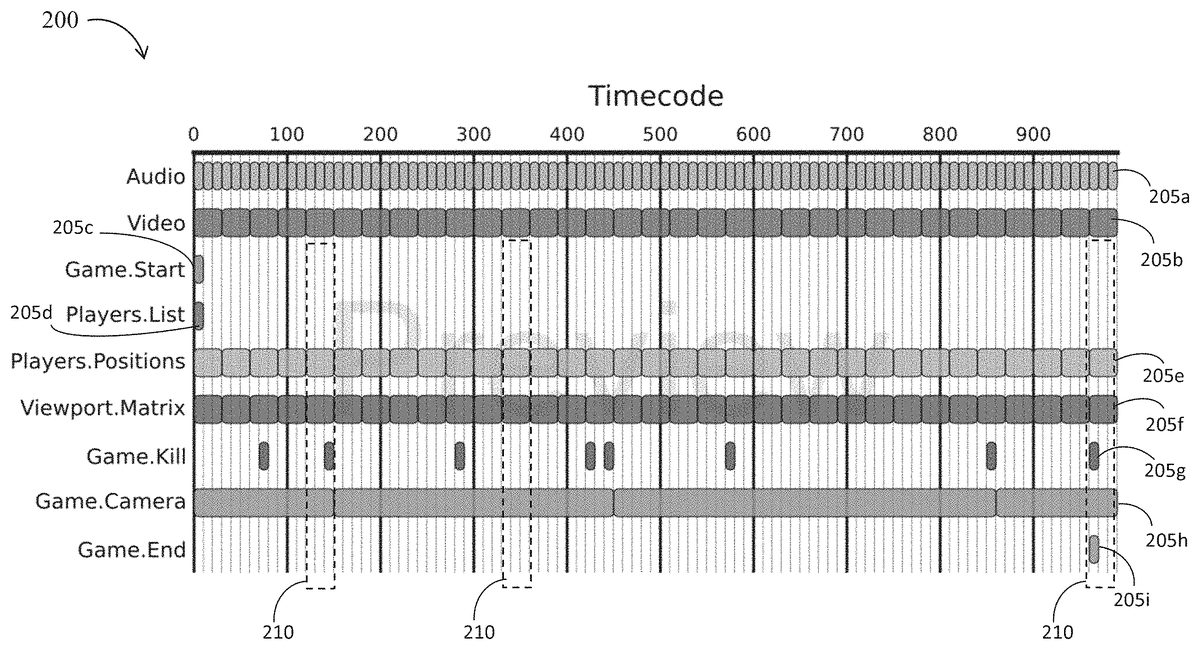
FIG. 2is a graphical representation200of several example data streams205a-205i(generally referred to as data streams205), according to some embodiments. The data streams205are shown along a time (or timecode) axis which starts from zero on the left hand side ofFIG. 2. Each data stream205can include one or more data chunks, each of which corresponds to a particular time instant/interval (or timecode). The video and audio streams205aand205bcan be generated and provided by the renderer126, whereas the streams205c-ican be transmitted by the gameplay engine124to the data streaming engine139.
Since the renderer126can generate and provide a plurality of video game streams (e.g., each including a video stream205aand an audio stream205b) associated with the plurality of viewpoints128, the gameplay engine124can provide a single instance of each the streams205c-ior can provide a plurality of instances of at least one of the streams205c-i. For instance, the gameplay engine124can provide a plurality of streams205f, each associated with a respective viewpoint128. In some embodiments, the gameplay engine124can provide the data streaming engine139with a separate set of streams205e-gor205e-ffor each viewpoint128.
Each of the streams205can include a common stream identifier (ID). The stream ID can be indicative of (or can identify) the stream registered, e.g., for live streaming, by the player client devices110or by the game engine120. For instance, upon request from one of the player client devices110to live stream the respective game play, the game engine120can initiate stream or game play) registration with the composing and broadcast system130. The game engine120may, for example, identify a video frame rate and/or a bit rate as part of the stream (or game play) registration process. The composing and broadcast system130can assign a stream ID to identify all streams205associated with game play. The composing and broadcast system130can provide the assigned stream ID to the game engine120, and the gameplay engine124and the renderer126can insert the stream ID in all streams205. The stream ID can allow the composing and the broadcast system130to map the streams205to one another and to the game play associated with the player client device(s)110.
Also, the gameplay engine124and the renderer126may insert a respective timestamp in each data chunk of the streams205. For example, the gameplay engine124and the renderer126may embed the timestamps (or timecode information) in a header associated with each data chunk. The time stamps can allow streaming video and audio frames as well as data chunks/frames to spectator client devices in the right order. Also, the timestamps can allow computing devices receiving the data streams205(or data associated therewith) to synchronize the data chunks across various data streams205. It should be understood thatFIG. 2is illustrative only, and that in some implementations, additional or different data streams205may be included without departing from the scope of this disclosure.
The data streaming engine139can generate one or more game data streams, for example, based on data in streams205c-i, for streaming to the spectator client devices150via the respective channels151. For example, the data streaming engine139can generate a single game data stream by combining concurrent data chunks from streams205c-i(or a subset thereof) into a single data frame210. The generated game data stream can include data frames210that coincide in time and duration with the video frames in the stream205b. The size of the data frames210can vary over time. For example, event data from stream205g, which indicates events occurring in the game, may not appear in each data frame210. Also, the Game.Start data stream205ccan include a single data chunk associated with timecode 0, which can mark the beginning of the video game. Similarly, the Players.List data stream205dcan include a single data chunk associated with timecode 0. The Players.List data stream205dcan include information such as a total number of players in the video game, as well as information relating to each of the players, such as unique identification information (e.g., respective avatar name) and character information for each player. The Game.Start data and the Players.List data may appear, for example, only in the first data frame210of the data stream generated by the data streaming engine139. The data streaming engine139can insert the stream ID and a single timestamp (e.g., timestamp from corresponding Players.Positions data chunk or corresponding Viewport.Matrix data chunk) in each data frame210. Also, the same stream ID can be embedded (e.g., by the rendered126or the video streaming engine137) in the corresponding game video stream provided to the live streaming system140.
The data streaming engine139can generate the game data stream in one of various other ways. For example, the data streaming engine139may generate a first game data stream including only Players.Positions data from stream205eand Viewport.Matrix data from stream205f. The Players.Positions data stream205ecan include data indicative of the positions of the various players (or player avatars) within a virtual environment of the video game. For a given player avatar (or graphical object) in the online game, the respective Players.Positions data can be indicative of a pixel region (e.g., a rectangle) representative of the location of that player avatar (or graphical object) in a specific video frame of the stream205b. The Viewport.Matrix data stream205fcan include information related to the viewpoint128associated with the video stream205a. The data streaming engine139may embed Viewport.Matrix data associated with various players (player avatars) and/or various virtual cameras in the online game in each data frame210.
Because the position of each player may change in every video frame, the Players.Positions data stream205ecan be updated at the same rate as the video data stream205b. This information also can be expected to change at the same rate as the video data stream205band the Players.Positions data stream205e. Like the Players.Positions data stream205e, the Viewport.Matrix data stream205falso can be updated at the same rate as the video data stream205b.
The Game.Kill data stream205gcan include information relating to the elimination (or killing) of players (or player avatars) from the video game. This data is asynchronous and non-continuous, because it is only updated as players are eliminated from the video game. In some implementations, each data chunk of the Game.Kill data stream205hcan include an identification of the player who has been eliminated. In some implementations, the information included in the Game.Kill data stream205gcan be used along with the information in the Players.List data stream205dto track the number of players who are still remaining in the game. In general, the data stream205gcan be indicative of game events (e.g., not necessarily restricted to killing events) and may be referred to as Events data stream205g. The game events' data can include additional information for various players, such as respective game scores, equipment, health states, emotional states, the like, or a combination thereof.
The Game.Camera data stream205hcan include information relating to the viewpoint128corresponding to the video game stream selected and transmitted from the composing and broadcast system130to the live streaming system140for display on the spectator client devices150. In some implementations, a new data chunk may be included in the Game.Camera data stream205heach time the selected video game stream or the corresponding viewpoint128(or camera perspective) provided to spectators changes. When the video game stream selected for broadcasting to client devices150changes, the video streaming engine137can halt transmission of video/audio frames from the previously selected video game stream and start transmitting video/audio frames from the new selected video game stream to the live streaming system140for broadcasting to the client devices150. In some implementations, the camera perspective shown to spectators may be the same as the perspective seen by one of the individual players as identified by the Viewport.Matrix data stream205f. However, in some instances, the camera perspective shown to spectators may correspond to a virtual camera that is not associated with any of the individual players.
The Game.End data stream205iincludes a single data chunk, which can mark the end of the video game. In some implementations, the data chunk for the Game.End data stream205ican be sent after every player has been eliminated from the game. In some other implementations, the data chunk for the Game.End data stream205ican be sent after a predetermined period of time has elapsed since the start of the game, even if there are players who have not yet been eliminated from the game.
In some embodiments, the data streaming engine139can generate a second game data stream based on the streams205c,205d, and205g-i. The data streaming engine139can combine data chunks from these streams to generate an asynchronous stream indicative of various events associated with the online game. In some embodiments, the data streaming engine139can stream the streams205c-iseparately to the spectator client devices150, for example, through various logic communication channels.
FIG. 3shows a diagram illustrating a user interface (UI)300for displaying video game data on a client device, according to some embodiments. The UI300can include a video display window310for displaying video frames302The video frame302can include a plurality of graphical objects306, each associated with a respective overlay304. The overlays304can be transparent (e.g., the dashed rectangles do not show up on the screen). Each interactive overlay304can be positioned over a respective graphical object306. Each interactive overlay304can include a respective cursor-like triangle308pointing to respective player avatars306. The cursor-like triangle308(or some other animation element) can indicate the presence of the corresponding overlay304, or can be indicate to a user of the client device150that the corresponding graphical object306is selectable. Upon the user of the spectator client device150selecting (e.g., clicking on, touching or hovering over) a pixel area (e.g., a rectangle including the player avatar) associated with one of the graphical objects306(e.g., player avatars), the one or more scripts154can cause the spectator client device150to display an animation object312(e.g., a disc) in the vicinity of (e.g., over, on top of, or adjacent to) the selected graphical object306(e.g., player avatar).
The one or more software scripts154can extract a timestamp from each game data frame received from the composing and broadcast system130, and compare the extracted timestamp to one or more video timestamps associated with video game frames received from the live streaming system140. To account for different time delays associated with game data stream and the video data stream, the one or more software scripts154can employ the synchronization techniques described in the in the Patent Application entitled “SYSTEMS AND METHODS FOR UTILIZING CLIENT-SIDE SYNCHRONIZATION OF VIDEO AND OVERLAY,” and having Ser. No. 15/352,433, which is incorporated herein by reference in its entirety. The one or more software scripts154can also extract the position information (e.g., coordinates of various vertices of a pixel region defining a location of a player's avatar) for various graphical objects306from the game data frame, and use the extracted position information to determine the position of each interactive overlay304. The overlay(s)304can include a HyperText Markup Language (HTML) overlay.
WhileFIG. 3shows the interactive overlay304to include a cursor-like triangle308, according to other implementations, the interactive overlay304can include various shapes or animation objects to show to the user the presence of an interactive overlay304associated with a given graphical object306, such as a player avatar. Also, when a player graphical object306(e.g., avatar) is selected, the one or more software scripts154can employ various other animation objects or visual features (e.g., apart from the disc shown inFIG. 3) in the corresponding interactive overlay304to indicate the selection of that graphical object306. Such animation object312and the corresponding overlay304can overlap the corresponding graphical object in each video following video frame. In some embodiments, upon selection of a given graphical object306(e.g., a player avatar), the one or more software scripts154can cause the spectator client device150to display game information associated with the selected graphical object306(e.g., a game score, equipment or armory, health state, emotional state, or a combination thereof). In some embodiments, the one or more software scripts154can cause the spectator client device150to enable customization of a selected graphical object306. For example, the client device150can display one or more animation objects (e.g., objects indicative of eye glasses, hat, mask, costume, gun, sword, etc.). Upon the user selecting one of the animation objects, the one or more software scripts154can cause the spectator client device150to add the selected animation object to the overlay associated with the selected graphical object306. To provide accurate customization, the game engine120may provide position and/or orientation information of a body part (e.g., head, eyes, arm, leg, etc.) for various player avatars as part of the game data. Using such information from the received game data, the client device150can accurately position the selected animation object relative to the avatar's body position and/or orientation in each video frame.
FIG. 4shows a flow diagram illustrating a method400of providing interactive overlays with video game streams, according to some embodiments. The method400can include receiving, from a game engine, a plurality of video game sequences associated with a respective plurality of viewpoints of an online game (ACT402), selecting a video game stream of the plurality of video game streams (ACT404), and transmitting a compressed version of the selected video game stream to a live streaming system (ACT406). The live streaming system can stream the selected video game stream to a plurality of client devices. The method400can include receiving, from the game engine, metadata associated with the online game (ACT408). The metadata can include positioning information for a graphical object in the online video game. The method400can include generating a sequence of data frames based on the metadata (ACT410). Each data frame can include a respective time stamp and positioning information for the graphical object in a respective frame of the video sequence. The method400can include a data streaming engine streaming the sequence of data frames to the plurality of client devices (ACT412). The method400can include a client device of the plurality of client devices displaying an interactive overlay over displayed frames of the video game stream based on the sequence of data frames (ACT414). The client device can display the interactive overlay at a screen position determined based on the position information of the graphical object.
The method400can include receiving, from a game engine, a plurality of video game streams associated with a respective plurality of viewpoints of an online game (ACT402). Upon receiving a request to register a game play for live streaming, the composing and broadcast system130can assign a stream ID to the game play and provide the stream ID to the game engine120. As the game is progressing, the game engine120can generate a plurality of video games streams, each associated with a respective viewpoint. Each viewpoint can be associated with a player of the game or a virtual camera in the virtual environment of the game. Each video game stream can include a respective video stream and a respective audio stream. The game engine120can provide the generated frames of the plurality of video game streams to the composing and broadcast system130as they are generated, in real time.
The method400can include selecting a video game stream of the plurality of video game streams (ACT404), and transmitting a compressed version of the selected video game stream to a live streaming system (ACT406). The video streaming engine137can receive video and audio frames of the plurality of video games streams. The composing and broadcast system130can select a video game stream among the plurality of video game streams for broadcasting to a plurality of client devices150for viewing. The video streaming engine137can compress video and audio frames of the selected video game stream to generate a compressed video/audio stream. The video streaming engine137can transmit compressed video/audio frames to the live streaming system140, for live streaming to the plurality of client devices150. The live streaming system can stream compressed video/audio frames of the selected video game stream to the plurality of client devices150.
The method400can include receiving, from the game engine, metadata (or game data) associated with the online game (ACT408), generating a sequence of data frames based on the metadata (ACT410). The metadata can include positioning information for a graphical object in the online video game. The data streaming engine139can receive game data from the gameplay engine124. The received game data (or metadata) can include multiple streams, for example, as depicted inFIG. 2. The game data can include information indicative of dynamic positions (e.g., changing from one video frame to another) of one or more player avatars or graphical objects in the plurality of video game streams. The game data can include information indicative of viewpoints, over time, for the plurality of video game streams received from the game engine120. The game data can also include information indicative of game events, information related to various players (or player avatars), such as game scores, equipment, health statuses, emotional statuses, the like, or a combination thereof. The game data can also include other information, for example, as discussed above with regard toFIG. 2.
The data streaming engine139can generate a sequence (or stream) of data frames based on the received game data. For example, the data streaming engine139can generate the data frames as described above with regard toFIG. 2. Each data frame can correspond to a respective video frame in the video game stream transmitted to the live streaming system140for broadcasting to the client devices150. Each data frame can include position information of one or more graphical objects (or player avatar(s)) indicative of the position(s) of the graphical object(s) in the respective video frame.
The method400can include the data streaming engine139streaming the data frames to the plurality of client devices (ACT412). Each data frame can include a respective timestamp based on a timeline associated with the composing and broadcast system130. For each data frame, the data streaming engine139can embed the respective timestamp in that data frame before streaming to client devices150. The data streaming engine139can stream the data frames to each client device150through a respective communication channel151established with that client device150(e.g., as described with regard toFIG. 1above).
The method400can include a client device150of the plurality of client devices150displaying an interactive overlay over displayed frames of the video game stream based on the sequence of data frames (ACT414). The client device150can display the interactive overlay at a screen position determined based on the position information of a respective graphical object (a graphical object with which the interactive overlay is associated). A software script (e.g., a Java script) running on the client device150can cause the client device to extract, from each received data frame, the respective time stamp and the respective position information for one or more graphical objects (e.g., player avatar(s)306). The client device150can use time stamps extracted from the data frames and video timestamps extracted from video frames received from the live streaming system140. The video timestamps associated with video frames can be set relative to a timeline of the live streaming system140. The client device150can map each data frame to a respective video frame. The client device150can use position information extracted from a given data frame to determine a screen position, over the corresponding video frame, for displaying the interactive overlay. The interactive overlay can be a HTML overlay. The interactive overlay can provide interactive features as described with regard toFIG. 3.
FIG. 5is a block diagram of a computer system500that can be used to implement the player client devices110, the game engine120or components thereof, the composing and broadcast system130or components thereof, the spectator client devices150, or other components described herein. The computing system500includes a bus505or other communication component for communicating information and a processor510coupled to the bus505for processing information. The computing system500can also include one or more processors510coupled to the bus for processing information. The computing system500also includes main memory515, such as a RAM or other dynamic storage device, coupled to the bus505for storing information, and instructions to be executed by the processor510. Main memory515can also be used for storing position information, temporary variables, or other intermediate information during execution of instructions by the processor510. The computing system500may further include a ROM520or other static storage device coupled to the bus505for storing static information and instructions for the processor510. A storage device525, such as a solid state device, magnetic disk or optical disk, is coupled to the bus505for persistently storing information and instructions. Computing device500may include, but is not limited to, digital computers, such as laptops, desktops, workstations, personal digital assistants, servers, blade servers, mainframes, cellular telephones, smart phones, mobile computing devices (e.g., a notepad, e-reader, etc.) etc.
The computing system500may be coupled via the bus505to a display535, such as a Liquid Crystal Display (LCD), Thin-Film-Transistor LCD (TFT), an Organic Light Emitting Diode (OLED) display, LED display, Electronic Paper display, Plasma Display Panel (PDP), or other display, etc., for displaying information to a user. An input device530, such as a keyboard including alphanumeric and other keys, may be coupled to the bus505for communicating information and command selections to the processor510. In another implementation, the input device530may be integrated with the display535, such as in a touch screen display. The input device530can include a cursor control, such as a mouse, a trackball, or cursor direction keys, for communicating direction information and command selections to the processor510and for controlling cursor movement on the display535.
According to some implementations, the processes or methods described herein can be implemented by the computing system500in response to the processor510executing an arrangement of instructions contained in main memory515. Such instructions can be read into main memory515from another computer-readable medium, such as the storage device525. Execution of the arrangement of instructions contained in main memory515causes the computing system5500to perform the illustrative processes or method ACTs described herein. One or more processors in a multi-processing arrangement may also be employed to execute the instructions contained in main memory515. In alternative implementations, hard-wired circuitry may be used in place of or in combination with software instructions to effect illustrative implementations. Thus, implementations are not limited to any specific combination of hardware circuitry and software.
Although an implementation of a computing system500has been described inFIG. 5, implementations of the subject matter and the functional operations described in this specification can be implemented in other types of digital electronic circuitry, or in computer software, firmware, or hardware, including the structures disclosed in this specification and their structural equivalents, or in combinations of one or more of them.
Some embodiments can be implemented in digital electronic circuitry, or in computer software embodied on a tangible medium, firmware, or hardware, including the structures disclosed in this specification and their structural equivalents, or in combinations of one or more of them. Some embodiments can be implemented as one or more computer programs, e.g., one or more modules of computer program instructions, encoded on one or more computer storage media for execution by, or to control the operation of, data processing apparatus. Alternatively or in addition, the program instructions can be encoded on an artificially-generated propagated signal, e.g., a machine-generated electrical, optical, or electromagnetic signal that is generated to encode information for transmission to suitable receiver apparatus for execution by a data processing apparatus. A computer storage medium can be, or be included in, a computer-readable storage device, a computer-readable storage substrate, a random or serial access memory array or device, or a combination of one or more of them. Moreover, while a computer storage medium is not a propagated signal, a computer storage medium can be a source or destination of computer program instructions encoded in an artificially-generated propagated signal. The computer storage medium can also be, or be included in, one or more separate components or media (e.g., multiple CDs, disks, or other storage devices). Accordingly, the computer storage medium is both tangible and non-transitory.
The operations described in this specification can be performed by a data processing apparatus on data stored on one or more computer-readable storage devices or received from other sources.
The terms “data processing apparatus,” “computing device,” or “processing circuit” encompass all kinds of apparatus, devices, and machines for processing data, including by way of example a programmable processor, a computer, a system on a chip, or multiple ones, a portion of a programmed processor, or combinations of the foregoing. The apparatus can include special purpose logic circuitry, e.g., an FPGA or an ASIC. The apparatus can also include, in addition to hardware, code that creates an execution environment for the computer program in question, e.g., code that constitutes processor firmware, a protocol stack, a database management system, an operating system, a cross-platform runtime environment, a virtual machine, or a combination of one or more of them. The apparatus and execution environment can realize various different computing model infrastructures, such as web services, distributed computing and grid computing infrastructures.
A computer program (also known as a program, software, software application, script, or code) can be written in any form of programming language, including compiled or interpreted languages, declarative or procedural languages, and it can be deployed in any form, including as a stand-alone program or as a module, component, subroutine, object, or other unit suitable for use in a computing environment. A computer program may, but need not, correspond to a file in a file system. A program can be stored in a portion of a file that holds other programs or data (e.g., one or more scripts stored in a markup language document), in a single file dedicated to the program in question, or in multiple coordinated files (e.g., files that store one or more modules, sub-programs, or portions of code). A computer program can be deployed to be executed on one computer or on multiple computers that are located at one site or distributed across multiple sites and interconnected by a communication network.
Processors suitable for the execution of a computer program include, by way of example, both general and special purpose microprocessors, and any one or more processors of any kind of digital computer. Generally, a processor will receive instructions and data from a read-only memory or a random access memory or both. The essential elements of a computer are a processor for performing actions in accordance with instructions and one or more memory devices for storing instructions and data. Generally, a computer will also include, or be operatively coupled to receive data from or transfer data to, or both, one or more mass storage devices for storing data, e.g., magnetic, magneto-optical disks, or optical disks. However, a computer need not have such devices. Moreover, a computer can be embedded in another device, e.g., a mobile telephone, a personal digital assistant (PDA), a mobile audio or video player, a game console, a Global Positioning System (GPS) receiver, or a portable storage device (e.g., a universal serial bus (USB) flash drive), to name just a few. Devices suitable for storing computer program instructions and data include all forms of non-volatile memory, media and memory devices, including by way of example semiconductor memory devices, e.g., EPROM, EEPROM, and flash memory devices; magnetic disks, e.g., internal hard disks or removable disks; magneto-optical disks; and CD-ROM and DVD disks. The processor and the memory can be supplemented by, or incorporated in, special purpose logic circuitry.
To provide for interaction with a user, implementations of the subject matter described in this specification can be implemented on a computer having a display device, e.g., a CRT (cathode ray tube) or LCD monitor, for displaying information to the user and a keyboard and a pointing device, e.g., a mouse or a trackball, by which the user can provide input to the computer. Other kinds of devices can be used to provide for interaction with a user as well; for example, feedback provided to the user can be any form of sensory feedback, e.g., visual feedback, auditory feedback, or tactile feedback; and input from the user can be received in any form, including acoustic, speech, or tactile input.
While this specification contains many specific implementation details, these should not be construed as limitations on the scope of what may be claimed, but rather as descriptions of features specific to particular implementations. Certain features described in this specification in the context of separate implementations can also be implemented in combination in a single implementation. Conversely, various features described in the context of a single implementation can also be implemented in multiple implementations separately or in any suitable subcombination. Moreover, although features may be described above as acting in certain combinations and even initially claimed as such, one or more features from a claimed combination can in some cases be excised from the combination, and the claimed combination may be directed to a subcombination or variation of a subcombination.
Similarly, while operations are depicted in the drawings in a particular order, this should not be understood as requiring that such operations be performed in the particular order shown or in sequential order, or that all illustrated operations be performed, to achieve desirable results. In certain circumstances, multitasking and parallel processing may be advantageous. Moreover, the separation of various system components in the implementations described above should not be understood as requiring such separation in all implementations, and it should be understood that the described program components and systems can generally be integrated in a single software product or packaged into multiple software products embodied on tangible media.
References to “or” may be construed as inclusive so that any terms described using “or” may indicate any of a single, more than one, and all of the described terms. References to at least one of a conjunctive list of terms may be construed as an inclusive OR to indicate any of a single, more than one, and all of the described terms. For example, a reference to “at least one of ‘A’ and ‘B’” can include only ‘A’, only as well as both ‘A’ and Where technical features in the drawings, detailed description or any claim are followed by reference identifiers, the reference identifiers have been included to increase the intelligibility of the drawings, detailed description, and claims. Accordingly, neither the reference identifiers nor their absence have any limiting effect on the scope of any claim elements.
Thus, particular implementations of the subject matter have been described. Other implementations are within the scope of the following claims. In some cases, the actions recited in the claims can be performed in a different order and still achieve desirable results. In addition, the processes depicted in the accompanying figures do not necessarily require the particular order shown, or sequential order, to achieve desirable results. In certain implementations, multitasking and parallel processing may be advantageous.
The claims should not be read as limited to the described order or elements unless stated to that effect. It should be understood that various changes in form and detail may be made without departing from the spirit and scope of the appended claims. All implementations that come within the spirit and scope of the following claims and equivalents thereto are claimed.
Claims
- A system to provide interactive overlays with video game streams, the system comprising: one or more computer servers and one or more software scripts executing on a plurality of client devices associated with a plurality of online spectators of an online game, the one or more computer servers comprising: a video streaming engine configured to: receive, from a game engine, a plurality of video game sequences associated with a respective plurality of viewpoints of the online game;select a video game sequence of the plurality of video game sequences;and transmit a compressed version of the selected video game sequence to a live streaming system, the live streaming system configured to stream the selected video game sequence to the plurality of client devices, and a data streaming engine configured to: receive, from the game engine, metadata associated with the online game, the metadata including positioning information for a graphical object in the online video game;generate a sequence of data frames based on the metadata, each data frame including a respective time stamp and positioning information for the graphical object in a respective video frame of the video game sequence;and stream the sequence of data frames to the plurality of client devices, at a client device of the plurality of client devices, the one or more software scripts configured to cause that client device to display an interactive overlay over displayed video frames of the video game sequence based on the sequence of data frames, the interactive overlay displayed in association with a dynamic position of a graphical object in the displayed video frames.
- The system of claim 1 , wherein each video game sequence includes a respective video sequence and a respective audio sequence.
- The system of claim 1 , wherein the graphical object includes a player avatar.
- The system of claim 1 , wherein the video streaming engine is configured to encode the selected video game sequence.
- The system of claim 1 , wherein the selected video game sequence is a first video game sequence and the video streaming engine is configured to: select a second video game sequence different than the first video game sequence;halt transmission of the encoded version of the first video game sequence to the live streaming system;and transmit a compressed version of the second video game sequence to the live streaming system, the live streaming system configured to stream the second video game sequence to the plurality of client devices.
- The system of claim 1 , wherein the one or more software scripts are configured to cause the client device to display game information associated with the graphical object responsive to interaction with the interactive overlay at the client device.
- The system of claim 1 , wherein the one or more software scripts are configured to cause the client device to display an animation object over, or in the vicinity of, the graphical object, upon interaction with the interactive overlay.
- The system of claim 1 , wherein the one or more software scripts are configured to cause the client device to: display one or more animation objects responsive to interaction with the interactive overlay at the client device;and upon selection of an animation object among the one or more animation objects, display the selected animation object over displayed video frames of the video sequence, the selected animation object displayed at a position dependent on the dynamic position of the graphical object in the displayed video frames.
- The system of claim 1 further comprising a session management component configured to establish communication channels with the client devices, the sequence of data frames streamed to the plurality of client devices over the established communication channels.
- The system of claim 1 , wherein at least two of the data frames in the sequence of data frames have different sizes.
- A method of providing interactive overlays with video game streams, the method comprising: receiving, by one or more processors, from a game engine, a plurality of video game sequences associated with a respective plurality of viewpoints of an online game;selecting, by the one or more processors, a video game sequence of the plurality of video game sequences;transmitting, by the one or more processors, a compressed version of the selected video game sequence to a live streaming system, the live streaming system streaming the selected video game sequence to a plurality of client devices;receiving, from the game engine, metadata associated with the online game, the metadata including positioning information for a graphical object in the online video game;generating, by the one or more processors, a sequence of data frames based on the metadata, each data frame including a respective time stamp and positioning information for the graphical object in a respective video frame of the video game sequence;and, streaming, by the one or more processors, the sequence of data frames to the plurality of client devices;wherein the streaming is capable of being displayed by a client device of the plurality of client devices including an interactive overlay over displayed video frames of the video game sequence based on the sequence of data frames, wherein the interactive overlay is capable of being displayed in association with a dynamic position of a graphical object in the displayed video frames.
- The method of claim 11 , wherein the graphical object includes a player avatar.
- The method of claim 11 comprising encoding the selected video game sequence.
- The method of claim 11 , wherein the selected video game sequence is a first video game sequence and the method comprising: selecting a second video game sequence different than the first video game sequence;halting transmission of the encoded version of the first video game sequence to the live streaming system;and transmitting a compressed version of the second video game sequence to the live streaming system, the live streaming system configured to stream the second video game sequence to the plurality of client devices.
- The method of claim 11 further comprising: displaying, by the client device, game information associated with the graphical object responsive to interaction with the interactive overlay at the client device.
- The method of claim 11 further comprising: displaying, by the client device, an animation object over, or in the vicinity of, the graphical object, upon interaction with the interactive overlay.
- The method of claim 11 further comprising: displaying, by the client device, one or more animation objects responsive to interaction with the interactive overlay at the client device;and upon selection of an animation object among the one or more animation objects, displaying the selected animation object over displayed video frames of the video sequence, the selected animation object displayed at a position dependent on the dynamic position of the graphical object in the displayed video frames.
- The method of claim 11 further comprising establishing, by the one or more processors, communication channels with the plurality of client devices, the sequence of data frames streamed to the plurality of client devices over the established communication channels.
- The method of claim 11 , wherein at least two of the data frames in the sequence of data frames have different sizes.
- A non-transitory computer-readable medium comprising computer code instructions stored thereon, the computer code instructions, when executed by one or more processors, cause one or more processors to perform the method including: receiving, from a game engine, a plurality of video game sequences associated with a respective plurality of viewpoints of an online game;selecting a video game sequence of the plurality of video game sequences;transmitting a compressed version of the selected video game sequence to a live streaming system, the live streaming system streaming the selected video game sequence to a plurality of client devices;receiving, from the game engine, metadata associated with the online game, the metadata including positioning information for a graphical object in the online video game;generating a sequence of data frames based on the metadata, each data frame including a respective time stamp and positioning information for the graphical object in a respective video frame of the video game sequence;and, streaming the sequence of data frames to the plurality of client devices, wherein such streaming of data frames is capable of causing display, at a client device of the plurality of client devices, of an interactive overlay over displayed video frames of the video game sequence based on the sequence of data frames, the interactive overlay displayed in association with a dynamic position of a graphical object in the displayed video frames.
Disclaimer: Data collected from the USPTO and may be malformed, incomplete, and/or otherwise inaccurate.