U.S. Pat. No. 9,908,045
MOBILE DEVICE INTERFACE FOR ONLINE GAMES
AssigneeZynga Inc.
Issue DateApril 12, 2016
Illustrative Figure
Abstract
The computer-implemented game comprises a plurality of user-initiated in-game actions for affecting game state information that includes a set of browser in-game actions which is available via a browser user interface and includes a set of convenience in-game actions which is unavailable via the browser user interface, a single convenience in-game action of the set of convenience in-game actions being capable of producing a particular game result that corresponds to a plurality of browser in-game actions from the set of browser in-game actions, the plurality of browser in-game actions being capable of collectively producing the particular game result. A mobile application allows access to a set of mobile in-game actions that includes at least a portion of the set of browser in-game actions and includes the set of convenience in-game actions, initiation of each convenience in-game action being a user-selectable option for a user only via the mobile application.
Description
DESCRIPTION OF EXAMPLE EMBODIMENTS Game Systems In an online game, players control player characters (PCs), a game engine controls non-player characters (NPCs), game elements, and other game features, and the game engine also manages player character state. A player character can engage in one or more in-game actions, wherein the game actions may effect game state. As used herein, the term “player character state” can refer to one or more in-game characteristics of a player character, such as location, assets, levels, condition, health, status, inventory, skill set, name, orientation, affiliation, specialty, and so on. As used herein, the term “game state” can refer to one or more in-game characteristics of any in-game element, including player character state, NPC state, virtual item state, game feature state, game environment state, etc. A game event may be an outcome of an engagement, a provision of access, rights and/or benefits, or the obtaining of some assets (e.g., health, money, strength, inventory, land, etc.). A game engine determines the outcome of a game event according to a variety of factors, such as the game rules, a player character's in-game actions, player character state, game state, interactions of other player characters, and random calculations. Engagements can include simple tasks (e.g., plant a crop, clean a stove), complex tasks (e.g., build a farm, run a café), or other events. An online game can be hosted by a game networking system320, which can be accessed over any suitable network with an appropriate client system330. A player may have a game system account on game system320, wherein the game system account can contain a variety of information about the player (e.g., the player's personal information, player character state, game state, etc.). In various embodiments, an online game can be embedded into a third-party website. The game can be hosted ...
DESCRIPTION OF EXAMPLE EMBODIMENTS
Game Systems
In an online game, players control player characters (PCs), a game engine controls non-player characters (NPCs), game elements, and other game features, and the game engine also manages player character state. A player character can engage in one or more in-game actions, wherein the game actions may effect game state. As used herein, the term “player character state” can refer to one or more in-game characteristics of a player character, such as location, assets, levels, condition, health, status, inventory, skill set, name, orientation, affiliation, specialty, and so on. As used herein, the term “game state” can refer to one or more in-game characteristics of any in-game element, including player character state, NPC state, virtual item state, game feature state, game environment state, etc.
A game event may be an outcome of an engagement, a provision of access, rights and/or benefits, or the obtaining of some assets (e.g., health, money, strength, inventory, land, etc.). A game engine determines the outcome of a game event according to a variety of factors, such as the game rules, a player character's in-game actions, player character state, game state, interactions of other player characters, and random calculations. Engagements can include simple tasks (e.g., plant a crop, clean a stove), complex tasks (e.g., build a farm, run a café), or other events.
An online game can be hosted by a game networking system320, which can be accessed over any suitable network with an appropriate client system330. A player may have a game system account on game system320, wherein the game system account can contain a variety of information about the player (e.g., the player's personal information, player character state, game state, etc.). In various embodiments, an online game can be embedded into a third-party website. The game can be hosted by the networking system of the third-party website, or it can be hosted on game system320and merely accessed via the third-party website. The embedded online game can be hosted solely on a server of game system320or using a third-party vendor server. In addition, any combination of the functions of the present disclosure can be hosted on or provided from any number of distributed network resources. For example, one or more executable code objects that implement all or a portion of the game can be downloaded to a client system for execution.
Virtual Currency
In various embodiments, players within the game can acquire virtual currency. In such games, the virtual currency might be represented by virtual coins, virtual cash, or by a number or value stored by the server for that player's benefit. Such virtual currency represents units of value for use in the online game system, and is analogous to legal currency. Virtual currency can be purchased in one or more actual cash or credit transactions by a player, where the legal currency is transferred using a credit/debit/charge card transaction conveyed over a financial network. In some embodiments, a player may earn virtual currency by taking action in the game. For example, a player may be rewarded with one or more units of virtual currency after completing a task, quest, challenge, or mission within the game. For example, a farming game might reward 10 gold coins each time a virtual crop is harvested.
In some embodiments, virtual currency can be used to purchase one or more in-game assets or other benefits. For example, a player may be able to exchange virtual currency for a desired level, access, right, or item in an online game. In one embodiment, legal currency can be used to directly purchase an in-game asset or other benefit. The player can select the desired in-game asset or other benefit. Once the necessary selections are made, the player can place the order to purchase the in-game asset or other benefit. This order is received by the game system320, which can then process the order. If the order is processed successfully, an appropriate financial account associated with the player can be debited by the amount of virtual currency or legal currency needed to buy the selected in-game asset or other benefit.
In some embodiments, multiple types of virtual currency may be available for purchase from the game system operator. For example, an online game may have virtual gold coins and virtual cash. The different types of virtual currency may have different exchange rates with respect to legal currency and each other. For example, a player may be able to exchange $1 in legal currency for either 100 virtual gold coins or $2 in virtual cash, but virtual gold coins may not be exchanged for virtual cash. Similarly, where in-game assets and other benefits can be purchased with virtual currency, they may have different exchange rates with respect to the different types of virtual currency. For example, a player may be able to buy a virtual farmhouse for $10 in virtual cash, but may not purchase the virtual farmhouse for virtual gold coins alone. In some embodiments, certain types of virtual currency can be acquired by engaging in various in-game actions while other types of virtual currency can only be acquired by exchanging legal currency. For example, a player may be able to acquire virtual gold coins by growing and selling virtual crops, but can only acquire virtual cash by exchanging legal currency.
Harvest Mechanic
In various embodiments, an online game can include a series of user-initiated in-game actions that comprise a harvest mechanic. The harvest mechanic generally has two components: a set of initiating actions and a set of collecting actions. In an initiating action, a player may “click” or otherwise interact with an element of the online game to initiate the harvest mechanic. In some games, multiple clicks or other actions may be necessary to complete the initiating action. For example, a player may have to click on a stove to clean it and click again to prepare ingredients and initiate cooking virtual food. In another example, a player may have to click on land to plow it and click again to plant seeds and initiate growing virtual crops.
Once the initiating action is complete, the online game may begin a processing action, wherein the game state of the element is modified by the game system during some time period. The time period can range from seconds to days, depending on the game system. For example, the game system may require an hour for virtual food to get cooked, or it may require three days for a virtual crop to grow. During the processing action, the player may be able to cancel the processing action, thereby resetting the entire harvest mechanic sequence. During the processing action, the player may also be able to interact with the element. For example, the player could add spice to his virtual food while it is cooking, or the player could add fertilizer to his virtual crops while they are growing. These interactions may or may not have an in-game effect on the element. In some embodiments, there is no processing action, and the collecting action is accessible immediately after the initiating action is complete. In other embodiments, the processing action is instantaneous.
After the processing action is complete, the game system can alter the game state of the element. At this point, the collecting action may be available. In a collecting action, a player may click or otherwise interact with the element to complete the harvest mechanic. For example, a player may have to click on the fully-cooked virtual food to serve it. In another example, a player may have to click on fully-grown crops to harvest them. In some games, multiple clicks or other actions may be necessary to complete the collecting action.
Once the collecting action is complete, the harvest mechanic may be reset with respect to that game element. In some embodiments, the player may have to click or otherwise interact with the element to reset the harvest mechanic. In other embodiments, the harvest mechanic may reset automatically once the collecting action is complete. Once the harvest mechanic is reset, the initiating action may be available again for that game element.
Two detailed examples of the harvest mechanic follow.
FarmVille Example
In one embodiment, a user controls a player character on a virtual farm in Zynga's FarmVille online game. The player (via his player character) can build and maintain the virtual farm. The player can plants seeds, which grow into crops, which can be harvested to earn virtual currency. Animals and trees can also be purchased and can also be raised and harvested for profits.
To grow crops, a player must first select a plot of land to plow. When the player clicks on the plot of land, his player character will move over to the plot of land and plow it. Once the player character finishes plowing the land, the player can select a type of seed to plant (e.g., pumpkin, wheat, etc.). Each type of seed indicates its cost in virtual currency and the time necessary for it to grow into a harvestable crop. For example, raspberry seeds have a two hour growth time and cost 20 virtual coins. Watermelon seeds have a four day growth time and cost 130 virtual coins. The player can then click on the land, and his player character will move to the plot of land and plant the seeds, thereby completing the initiating action. The player's game account is also debited by the amount of virtual coins needed to buy the seeds.
Once the seeds are planted, the processing action begins, and the game engine indicates that the seeds are growing. By clicking on the growing crop, the player can view how much time is remaining in the processing action.
Once the growth time has elapsed, the processing action will end and the game engine will modify the crops into fully-grown harvestable crops. The player can then click on the crops to harvest them and sell them for virtual coins. For example, raspberries yield 46 virtual coins per plot and watermelons yield 348 coins. This completes the collecting action.
If the crop is not harvested within a specific time, it will wilt and must be plowed again, unless the unwither feature is applied. For example, pumpkins will grow in 8 hours. If the pumpkins are not harvested within 16 hours of planting, they will wither and die, and the player will not be able to harvest them for virtual coins, unless the unwither feature is applied. To gain access to the unwither feature, the player may spend legal currency to buy virtual cash, which can then be used to buy the unwither feature.
Café World Example
In another embodiment, a user controls a player character in a virtual café in Zynga's Café World online game. The player (via his player character) can build and maintain the virtual café. The player can prepare and cook virtual food, serve it to virtual customers (NPCs), and build and modify the virtual café.
To prepare food, a player must first select a dirty stove. When the player clicks on the stove, his player character will move to the stove and clean it. Once the player character finishes cleaning the stove, the player can select the Dish Menu to choose the type of dish to prepare (e.g., pumpkin pie, cheesecake, soup, hamburgers, etc.). Each type of dish indicates its cost in virtual currency and the time necessary for it to cook into a servable dish. For example, cheeseburgers have a 5 minutes cooking time and cost 15 virtual coins. Cheesecake has a 12 hour cooking time and costs 400 virtual coins. The player can then click on the stove and his player character will move to the stove and begin cooking. The player's game account is also debited by the amount of virtual coins needed to buy the dish. Depending on the dish, the player may have to click one or more additional times to prepare ingredients for the dish. The initiating action to begin cooking will be complete once the player character has prepared the appropriate number of ingredients.
Once the dish begins cooking, the processing action begins, and the game engine indicates that the dish is cooking. By clicking on the cooking dish, the player can view how much time is remaining in the processing action. The player can also click on the cooking dish to cancel the dish and reset the harvest mechanic for that stove.
Once the cooking time has elapsed, the processing action will end and the game engine will modify the dish into a fully-cooked virtual dish that can be served. The player can then click on the cooked dish, which causes the player character to pick up the dish and move it to a serving counter. Serving the dishes is done automatically by the game engine, which controls waiters (NPCs), who serve the dishes to the virtual customers and thereby earn virtual coins. For example, a dish of cheeseburgers yield 52 virtual coins and cheesecake yields 1640 virtual coins. Moving the dish to the serving counter completes the collecting action and resets the harvest mechanic for that stove. After the dish is served, the game engine will indicate that the stove is dirty. If the dish is not served within a specific time, it will rot and the stove will have to be cleaned again, resetting the harvest mechanic.
Game Interfaces
FIG. 1illustrates an example of a webpage-based game interface for an on line game accessed by a browser client110(e.g., Firefox, Chrome, Internet Explorer, etc.). In various embodiments, a user of a client system330can use a browser client110to access the online game over the Internet (or other suitable network). The game interface170illustrated inFIG. 11may be automatically generated and presented to the user in response to the user visiting or accessing the game operator's website or a third-party's website from client system330with a browser client110. Game system320can transmit data to client system330allowing it to display game interface170, which is typically some type of graphic user interface. For example, the webpage downloaded to client system330may include an embedded call that causes client system330to download an executable object, such as a Flash .SWF object, which executes on client system330and renders the game within the context of the webpage. Other interface types are possible, such as server-side rendering and the like. Game interface170is configured to receive signals from the user via client system330. For example, the user can click on game interface170, or enter commands from a keyboard or other suitable input device. The game engine can respond to these signals to allow game play. The display of game interface170can change based on the output of the game engine, the input of the player, and other signals from game system320and client system330.
The game interface170can display various game components, such as the game environment, options available to the player (e.g., in-game actions, preferences, settings, etc.), game results, etc. Some components of the game interface may be static, while others may be dynamic (e.g., changing with game play). The user may be able to interact with some components (e.g., player character101, NPCs, etc.) and not interact with other components (e.g., the background of the virtual world, such as the virtual street or sidewalk). The user can control player character101and cause player character101to engage in specific in-game actions or activities by providing input to game interface170.
In the example online game illustrated inFIG. 1, the user controls player character101in a virtual café in Zynga's Café World online game. Game interface170shows the virtual café and various components of the café. Player character101can move around the café to interact with various elements of the café, such as the virtual stoves120and virtual serving counters130. The user can click on (or otherwise activate) various aspects of the game interface to provide instructions to the game engine. For example, by clicking on the virtual stove120, the user can cause player character101to move over to the stove and to begin preparing a dish. Once the dish if fully-cooked, the user can click on the virtual stove120, causing player character1010to take the prepared dish from stove120and to move it to a serving counter130.
The user can also click on various icons in game interface170to activate various game options. For example, if the user clicks on one of the icons in option bar160, the game engine will alter the game interface170to present the user with options for buying and selling virtual items for use in the virtual café. For example, the player could buy or sell virtual furniture, appliances, décor, windows, etc. Similarly, the user can click on other icons in option bar160to access other game options.
One skilled in the art would appreciate thatFIG. 1is presented merely as an example of an embodiment of one type of online game and that the present disclosure is intended to encompass a variety of game types, including gambling games, role-playing games, puzzle games, etc.
Game Interfaces on Mobile Devices
A player of an online game may want to have access to a particular online game on both an internet client system and a mobile client system. For example, a user may want to play an online role-playing game (e.g., Zynga's Café World) from his desktop computer while at home and from his cellular phone while travelling. Many mobile client systems have browser clients with the ability to access webpages on the Internet. However, certain limitations of mobile client systems (e.g., size, limited memory, limited data transfer rates, etc.) may make it desirable to a use a specially designed game interface to access the game from mobile client systems that accommodates these limitations.
FIG. 2Aillustrates an example of a game interface for an online game accessed by a client system330over a mobile network.FIG. 2Bshows a flowchart illustrating a process for accessing various in-game actions on mobile game interface215. The game interface215may be provided in a structured document and processed by a mobile browser of a client system, or may be provided by a dedicated client application hosted on the mobile device itself.
FIG. 2Aillustrates a client system210that is a smart phone, however any mobile client system may be used (e.g., cellular phones, personal digital assistants, computer tablets, etc.). In various embodiments, a user of mobile client system210can use a browser client or other application to access an online game over a mobile network (or other suitable network). The mobile game interface215illustrated inFIG. 2Amay be automatically generated and presented to the user in response to the user visiting or accessing the game operator's website, a third-party website, or executing an application on mobile client system210. Mobile game interface215operates analogously to game interface170. For example, the user can click, touch, or otherwise interact with mobile game interface215to select various in-game actions to perform at step265. If this in-game action is available, the game engine can perform the action at step280.
In various embodiments, mobile game interface215may limit the in-game actions and other options available to the user. For example, inFIG. 2A, the user controls his player character in a virtual cafe in Zynga's Café World online game. Unlike game interface170inFIG. 1, which shows the entire virtual café, mobile game interface215only shows certain components from the virtual café. Specifically,FIG. 2Ashows a representation of the stoves120fromFIG. 1. The user can interact with the stoves to initiate certain in-game actions. For example, by clicking on virtual stove220's action button225, the user can cause his player character to begin preparing a dish. Or by clicking on virtual stove240's action button245, the user can cause his player character to serve a prepared dish.
In some embodiments, certain in-game actions, such as the harvest mechanic, may be restricted or otherwise unavailable. These are so-called “restricted in-game actions.” Game system320can cause one or more in-game actions to be restricted in-game actions when the online game is played on game interface215. For example, inFIG. 2A, only the “serve” option may be available through mobile game interface215, while the “clean” and “prepare” options may be disabled. To activate these restricted in-game actions, the user may have to access the online game on the Internet through a browser client110. In one embodiment, one or more restricted in-game actions can be enabled or activated from mobile game interface215if the user exchanges some amount of virtual currency or legal currency. For example, the “prepare” action may be a restricted in-game action on mobile game interface215, but the user can pay $5 in virtual cash to enable a single use of the action on that interface.
In some embodiments, certain in-game actions may be available when accessing mobile game interface215that are not available when accessing game interface170. These in-game actions may allow the user to perform certain in-game actions more conveniently or quickly. These are so-called “convenience in-game actions.” For example, a user playing Zynga's Café World on mobile client system210may have a plurality of virtual stoves with dishes that are prepared and ready to serve. Normally, the user would have to click on each stove individually to have his player character perform the serve action for each dish. However, mobile game interface215may give the user the option to click on one button that causes the game engine to serve all dishes that are currently ready to serve. In one embodiment, one or more convenience in-game actions can be activated only if the user exchanges virtual currency or legal currency. For example, the “serve” action may normally require the user to click on each stove with a ready dish on mobile game interface215, but the user can pay $2 in legal currency to cause the game engine to serve all dishes that are currently ready to serve.
To access restricted in-game actions or convenience in-game actions, the game system can first determine whether the selected action is available at step275. If the selected in-game action is available, the game engine can perform the action at step280. However, if it is not currently available, game system320can then determine whether the user may purchase access to the in-game action by exchanging virtual currency or legal currency at step285. If access can be purchased, game system330can present an offer to the user to purchase access to the selected restricted in-game action or convenience in-game action at step290. If the user purchases access at step295, the game engine can then perform the action at step280and the user's account can be debited the appropriate amount of virtual or legal currency. However, if access cannot be purchased at step285, or if access is not purchased at step295, then the game system will not perform the action and may inform the user that the in-game action was not performed and/or that the selected in-game action is not available.
One skilled in the art would appreciate thatFIGS. 2A and 2Bare presented merely as an example of an embodiment of one type of online game on one type of client system and that the present disclosure is intended to encompass a variety of game types that offer a variety of in-game actions on a variety of client systems.
Data Flow
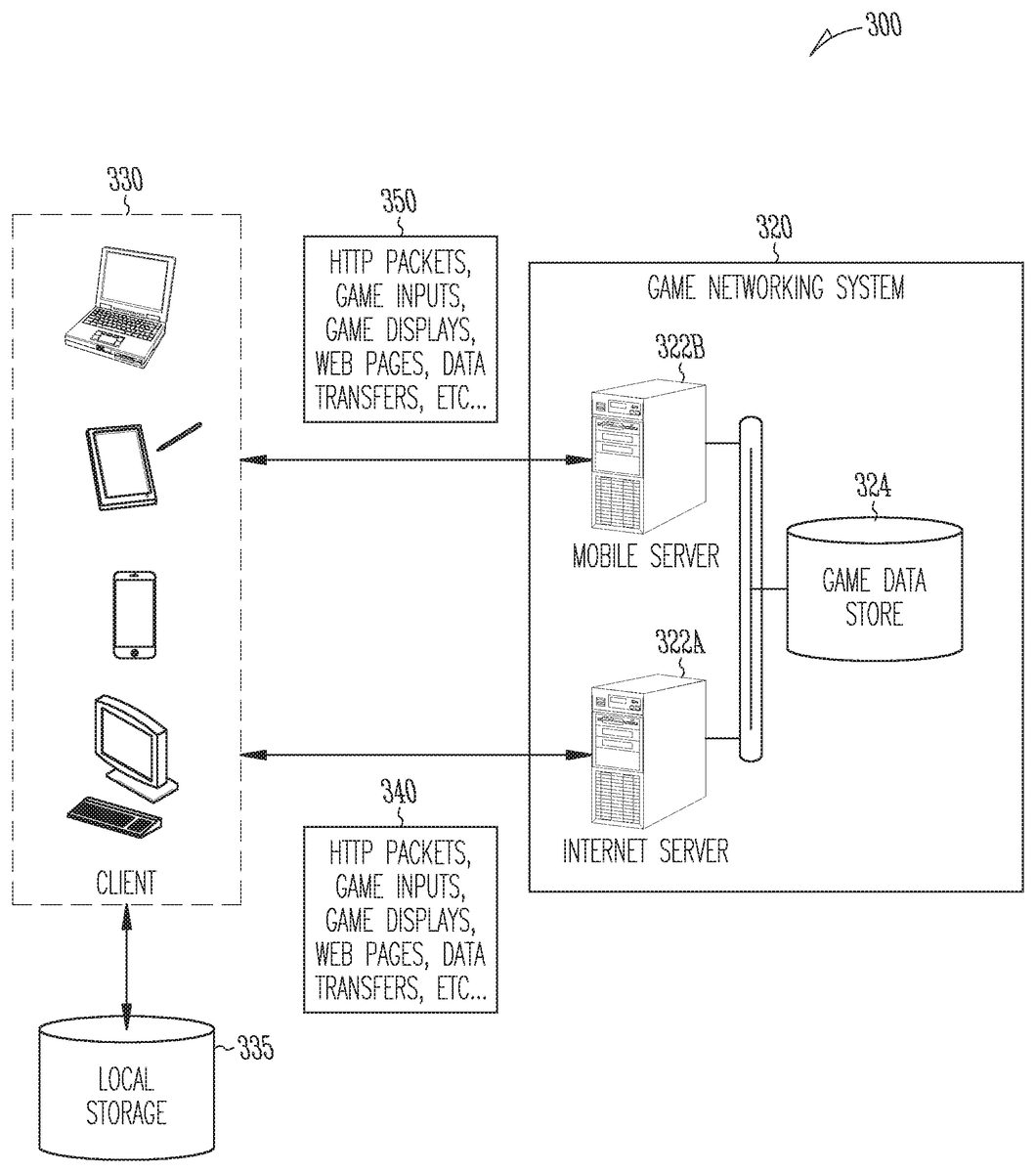
FIG. 3depicts a schematic of system300and data flow between the components of system300. System300can include a client system330and a game networking system320. Client system330and game networking system320can each have a corresponding data store such as local storage medium335and game data storage medium324, respectively. Game networking system320can also have one or more servers that can communicate with client system330over an appropriate network. Game networking system320can have an internet server322A for communicating with client system330the Internet. Similarly, game networking system320can have a mobile server322B for communicating with client system330via a mobile network (e.g., GSM, PCS, Wi-Fi, WPAN, etc.). In some embodiments, one server may be able to communicate with client system330over both the Internet and a mobile network. In other embodiments, separate servers can be used.
Client system330can communicate with game networking system320to receive webpages, messages, transmit data to and receive data340,350(e.g., game inputs, web pages, data transfers, etc.) from game networking system320. In a similar fashion, game networking system320can communicate data packets340,350, including HTTP packets, data requests, transaction information, updates, etc. At some other time, or at the same time, game networking system320can communicate data (e.g., game state information, game system account information, page info, messages, etc.) with other networking systems, such as a social networking system (e.g., Facebook, Myspace, etc.).
Communication between client system330and game networking system320can occur over any appropriate electronic communication medium or network using any suitable communications protocols. For example, client system330, as well as various servers of the systems described herein, may include Transport Control Protocol/Internet Protocol (TCP/IP) networking stacks to provide for datagram and transport functions. Of course, any other suitable network and transport layer protocols can be utilized.
In addition, hosts or end-systems described herein may use a variety of higher layer communications protocols, including client-server (or request-response) protocols, such as the HyperText Transfer Protocol (HTTP) and other communications protocols, such as HTTP-S, FTP, SNMP, TELNET, and a number of other protocols, may be used. In addition, a server in one interaction context may be a client in another interaction context. Still further, in particular implementations, the information transmitted between hosts may be formatted as HyperText Markup Language (HTML) documents. Other structured document languages or formats can be used, such as XML, and the like. Executable code objects, such as JavaScript and ActionScript, can also be embedded in the structured documents.
In some client-server protocols, such as the use of HTML over HTTP, a server generally transmits a response to a request from a client. The response may comprise one or more data objects. For example, the response may comprise a first data object, followed by subsequently transmitted data objects. In one implementation, for example, a client request may cause a server to respond with a first data object, such as an HTML page, which itself refers to other data objects. A client application, such as a browser, will request these additional data objects as it parses or otherwise processes the first data object.
Systems and Methods
In various example embodiments, one or more described webpages may be associated with a networking system or networking service. However, alternate embodiments may have application to the retrieval and rendering of structured documents hosted by any type of network addressable resource or web site. Additionally, as used herein, a “user” may be an individual, a group, or an entity (such as a business or third party application).
Particular embodiments may operate in a wide area network environment, such as the Internet, including multiple network addressable systems.FIG. 4illustrates an example network environment, in which various example embodiments may operate. Network cloud460generally represents one or more interconnected networks, over which the systems and hosts described herein can communicate. Network cloud460may include packet-based wide area networks (such as the Internet), private networks, wireless networks, satellite networks, cellular networks, paging networks, and the like. AsFIG. 4illustrates, particular embodiments may operate in a network environment comprising one or more networking systems, such as game networking system420, and one or more client devices430. Client devices430are operably connected to the network environment via a network service provider, a wireless carrier, or any other suitable means.
Game networking system420is a network addressable system that, in various example embodiments, comprises one or more physical servers422and data stores424. The one or more physical servers422are operably connected to computer network460via, by way of example, a set of routers and/or networking switches426. In an example embodiment, the functionality hosted by the one or more physical servers122may include web or HTTP servers. FTP servers, as well as, without limitation, webpages and applications implemented using Common Gateway Interface (CGI) script, PHP Hyper-text Preprocessor (PHP), Active Server Pages (ASP), Hyper Text Markup Language (HTML), Extensible Markup Language (XML), Java, JavaScript, Asynchronous JavaScript and XML (AJAX), Flash, ActionScript, and the like.
Physical servers422may host functionality directed to the operations of game networking system420. Hereinafter servers422may be referred to as server422, although server422may include numerous servers hosting, for example, game networking system420, as well as other content distribution servers, data stores, and databases. Data store424may store content and data relating to, and enabling, operation of the game networking system420as digital data objects. A data object, in particular implementations, is an item of digital information typically stored or embodied in a data file, database or record. Content objects may take many forms, including: text (e.g., ASCII, SGML, HTML), images (e.g., jpeg, tif and gif), graphics (vector-based or bitmap), audio, video (e.g., mpeg), or other multimedia, and combinations thereof. Content object data may also include executable code objects (e.g., games executable within a browser window or frame), podcasts, etc. Logically, data store424corresponds to one or more of a variety of separate and integrated databases, such as relational databases and object-oriented databases, that maintain information as an integrated collecting of logically related records or files stored on one or more physical systems. Structurally, data store424may generally include one or more of a large class of data storage and management systems. In particular embodiments, data store424may be implemented by any suitable physical system(s) including components, such as one or more database servers, mass storage media, media library systems, storage area networks, data storage clouds, and the like. In one example embodiment, data store424includes one or more servers, databases (e.g., MySQL), and/or data warehouses. Data store424may include data associated with different game networking system420users and/or client devices430.
Client device430is generally a computer or computing device including functionality for communicating (e.g., remotely) over a computer network. Client device430may be a desktop computer, laptop computer, personal digital assistant (PDA), in- or out-of-car navigation system, smart phone or other cellular or mobile phone, or mobile gaming device, among other suitable computing devices. Client device430may execute one or more client applications, such as a web browser (e.g., Microsoft Internet Explorer, Mozilla Firefox, Apple Safari, Google Chrome, and Opera, etc.), to access and view content over a computer network. In particular implementations, the client applications allow a user of client device430to enter addresses of specific network resources to be retrieved, such as resources hosted by networking system420. These addresses can be Uniform Resource Locators, or URLs. In addition, once a page or other resource has been retrieved, the client applications may provide access to other pages or records when the user “clicks” on hyperlinks to other resources. By way of example, such hyperlinks may be located within the webpages and provide an automated way for the user to enter the URL of another page and to retrieve that page.
A webpage or resource embedded within a webpage, which may itself include multiple embedded resources, may include data records, such as plain textual information, or more complex digitally encoded multimedia content, such as software programs or other code objects, graphics, images, audio signals, videos, and so forth. One prevalent markup language for creating webpages is the Hypertext Markup Language (HTML). Other common web browser-supported languages and technologies include the Extensible Markup Language (XML), the Extensible Hypertext Markup Language (XHTML), JavaScript, Flash, ActionScript, Cascading Style Sheet (CSS), and, frequently, Java. By way of example, HTML enables a page developer to create a structured document by denoting structural semantics for text and links, as well as images, web applications and other objects that can be embedded within the page. Generally, a webpage may be delivered to a client as a static document, however, through the use of web elements embedded in the page, an interactive experience may be achieved with the page or a sequence of pages. During a user session at the client, the web browser interprets and displays the pages and associated resources received or retrieved from the website hosting the page, as well as, potentially, resources from other websites.
When a user at a client device430desires to view a particular webpage (hereinafter also referred to as target structured document) hosted by game networking system420, the user's web browser, or other document rendering engine or suitable client application, formulates and transmits a request to networking system420. The request generally includes a URL or other document identifier as well as metadata or other information. By way of example, the request may include information identifying the user, such as a user ID, as well as information identifying or characterizing the web browser or operating system running on the user's client computing device430. The request may also include location information identifying a geographic location of the user's client device or a logical network location of the user's client device. The request may also include a timestamp identifying when the request was transmitted.
FIG. 5illustrates an example computing system architecture, which may be used to implement a server422or a client device430. In one embodiment, hardware system500comprises a processor502, a cache memory504, and one or more executable modules and drivers, stored on a tangible computer readable medium, directed to the functions described herein. Additionally, hardware system500may include a high performance input/output (I/O) bus506and a standard I/O bus508. A host bridge510may couple processor502to high performance I/O bus506, whereas I/O bus bridge512couples the two buses506and508to each other. A system memory514and one or more network/communication interfaces516couple to bus506. Hardware system500may further include video memory (not shown) and a display device coupled to the video memory. Mass storage518, and I/O ports520couple to bus508. Hardware system500may optionally include a keyboard and pointing device, and a display device (not shown) coupled to bus508. Collectively, these elements are intended to represent a broad category of computer hardware systems, including but not limited to general purpose computer systems based on the x86-compatible processors manufactured by Intel Corporation of Santa Clara, Calif., and the x86-compatible processors manufactured by Advanced Micro Devices (AMD), Inc, of Sunnyvale, Calif., as well as any other suitable processor.
The elements of hardware system500are described in greater detail below. In particular, network interface516provides communication between hardware system500and any of a wide range of networks, such as an Ethernet (e.g., IEEE 802.3) network, a backplane, etc. Mass storage518provides permanent storage for the data and programming instructions to perform the above-described functions implemented in servers422, whereas system memory514(e.g., DRAM) provides temporary storage for the data and programming instructions when executed by processor502. I/O ports520are one or more serial and/or parallel communication ports that provide communication between additional peripheral devices, which may be coupled to hardware system500.
Hardware system500may include a variety of system architectures; and various components of hardware system500may be rearranged. For example, cache504may be on-chip with processor502. Alternatively, cache504and processor502may be packed together as a “processor module,” with processor502being referred to as the “processor core.” Furthermore, certain embodiments of the present invention may not require nor include all of the above components. For example, the peripheral devices shown coupled to standard I/O bus508may couple to high performance I/O bus506. In addition, in some embodiments, only a single bus may exist, with the components of hardware system500being coupled to the single bus. Furthermore, hardware system500may include additional components, such as additional processors, storage devices, or memories.
An operating system manages and controls the operation of hardware system500, including the input and output of data to and from software applications (not shown). The operating system provides an interface between the software applications being executed on the system and the hardware components of the system. Any suitable operating system may be used, such as the LINUX Operating System, the Apple Macintosh Operating System, available from Apple Computer Inc. of Cupertino, Calif., UNIX operating systems, Microsoft® Windows® operating systems, BSD operating systems, and the like. Of course, other implementations are possible. For example, the functions described herein may be implemented in firmware or on an application specific integrated circuit.
Furthermore, the above-described elements and operations can be comprised of instructions that are stored on non-transitory storage media. The instructions can be retrieved and executed by a processing system. Some examples of instructions are software, program code, and firmware. Some examples of non-transitory storage media are memory devices, tape, disks, integrated circuits, and servers. The instructions are operational when executed by the processing system to direct the processing system to operate in accord with the invention. The term “processing system” refers to a single processing device or a group of inter-operational processing devices. Some examples of processing devices are integrated circuits and logic circuitry. Those skilled in the art are familiar with instructions, computers, and storage media.
Miscellaneous
One or more features from any embodiment may be combined with one or more features of any other embodiment without departing from the scope of the invention.
A recitation of “a”, “an,” or “the” is intended to mean “one or more” unless specifically indicated to the contrary.
The present disclosure encompasses all changes, substitutions, variations, alterations, and modifications to the example embodiments herein that a person having ordinary skill in the art would comprehend. Similarly, where appropriate, the appended claims encompass all changes, substitutions, variations, alterations, and modifications to the example embodiments herein that a person having ordinary skill in the art would comprehend.
For example, the processes described herein may be implemented using hardware components, software components, and/or any combination thereof. By way of example, while embodiments of the present disclosure have been described as operating in connection with a networking website, various embodiments of the present invention can be used in connection with any communications facility that supports web applications. Furthermore, in some embodiments the term “web service” and “website” may be used interchangeably and additionally may refer to a custom or generalized API on a device, such as a mobile device (e.g., cellular phone, smart phone, personal GPS, personal digital assistance, personal gaming device, etc.), that makes API calls directly to a server. The specification and drawings are, accordingly, to be regarded in an illustrative rather than a restrictive sense. It will, however, be evident that various modifications and changes may be made thereunto without departing from the broader spirit and scope of the invention as set forth in the claims and that the invention is intended to cover all modifications and equivalents within the scope of the following claims.
Claims
- A system, comprising: a data store of game state information corresponding to one or more instances of a computer-implemented game;a game engine comprising one or more computer processor devices configured to control elements of the computer-implemented game such that the computer-implemented game comprises a plurality of user-initiated in-game actions to affect the game state information, the plurality of user-initiated in-game actions including a set of browser in-game actions which is available via a browser user interface and including a set of convenience in-game actions which is unavailable via the browser user interface, a single convenience in-game action of the set of convenience in-game actions being capable of producing a particular game result, the single convenience in-game action corresponding to a plurality of browser in-game actions from the set of browser in-game actions, the plurality of browser in-game actions being capable of collectively producing the particular game result;and a mobile server that is implemented using at least one hardware processor that is in communication with the data store and to implement a mobile application for the computer-implemented game on a mobile client device over a computer network, wherein the mobile application allows access to a set of mobile in-game actions, the set of mobile in-game actions including at least a portion of the set of browser in-game actions and including the set of convenience in-game actions, initiation of each convenience in-game action being a user-selectable option for a user only via the mobile application on the mobile client device, each mobile in-game action being presented as one or more display elements via a graphical user interface on the mobile client device.
- The system of claim 1 , further comprising: an Internet server in communication with the data store and operative to implement the browser user interface for the computer-implemented game on one or more client systems over the computer network, wherein the browser user interface allows access to the set of browser in-game actions.
- The system of claim 2 , wherein the one or more client systems include the mobile client device, the browser user interface being accessible via an Internet browser of the mobile client device.
- The system of claim 1 , wherein the mobile application allows access to the set of convenience in-game actions subject to a debit charge to a user account of a user.
- The system of claim 4 , wherein the debit char is debiting of an amount of virtual currency from a game account of the user.
- The system of claim 4 , wherein the debit charge is a debiting of an amount of legal currency from a financial account of the user.
- The system of claim 1 , wherein the plurality of user-initiated in-game actions includes one or more initiating actions and one or more collecting actions.
- The system of claim 7 , wherein the set of convenience in-game actions excludes one or more initiating actions.
- The system of claim 8 , wherein the mobile application allows access to one or more excluded initiating actions subject to a debit charge to a user account of a user.
- A computer-implemented method, comprising: storing, using at least one of one or more hardware processors, game state information corresponding to one or more instances of a computer-implemented game;controlling, using at least one of the one or more hardware processors, elements of the computer-implemented game, the computer-implemented game comprising a plurality of user-initiated in-game actions for affecting the game state information, the plurality of user-initiated in-game actions including a set of browser in-game actions which is available via a browser user interface and including a set of convenience in-game actions which is unavailable via the browser user interface, a single convenience in-game action of the set of convenience in-game actions being capable of producing a particular game result, the single convenience in-game action corresponding to a plurality of browser in-game actions from the set of browser in-game actions, the plurality of browser in-game actions being capable of collectively producing the particular game result;and implementing, using a mobile server in communication with a data store, a mobile application for the computer-implemented game on a mobile client device over a computer network, wherein the mobile application allows access to a set of mobile in-game actions, the set of mobile in-game actions including at least a portion of the set of browser in-game actions and including the set of convenience in-game actions, initiation of each convenience in-game action being a user-selectable option for a user only via the mobile application on the mobile client device, each mobile in-game action being presented as one or more display elements via a graphical user interface on the mobile client device.
- The computer-implemented method of claim 10 , further comprising: implementing, using an Internet server in communication with the data store, the browser user interface for the computer-implemented game on one or more client systems over the computer network, wherein the browser user interface allows access to the set of browser in-game actions.
- The computer-implemented method of claim 11 , wherein the one or more client systems include the mobile client device, the browser user interface being accessible via an Internet browser of the mobile client device.
- The computer-implemented method of claim 10 , further comprising: providing, via the mobile application, access to the set of convenience in-game actions subject to a debit charge to a user account of a user.
- The computer-implemented method of claim 13 , wherein the debit charge is a debiting of an amount of virtual currency from a game account of the user.
- The computer-implemented method of claim 13 , wherein the debit charge is a debiting of an amount of legal currency from a financial account of the user.
- The computer-implemented method of claim 10 , wherein the plurality of user-initiated in-game actions includes one or more initiating actions and one or more collecting actions.
- The computer-implemented method of claim 16 , wherein the set of convenience in-game actions excludes one or more initiating actions.
- The computer-implemented method of claim 17 , further comprising: providing, via the mobile application, access to one or more excluded initiating actions subject to a debit charge to a user account of a user.
- A non-transitory computer-readable storage medium storing a set of instructions which, when executed by at least one processor, causes the at least one processor to perform operations, comprising: storing game state information corresponding to one or more instances of a computer-implemented game;controlling elements of the computer-implemented game, the computer-implemented game comprising a plurality of user-initiated in-game actions for affecting the game state information, the plurality of user-initiated in-game actions including a set of browser in-game actions which is available via a browser user interface and including a set of convenience in-game actions which is unavailable via the browser user interface, a single convenience in-game action of the set of convenience in-game actions being capable of producing a particular game result, the single convenience in-game action corresponding to multiple browser in-game actions from the set of browser in-game actions, the multiple browser in-game actions being capable of collectively producing the particular game result;and implementing, using a mobile server in communication with a data store, a mobile application for the computer-implemented game on a mobile client device over a computer network, wherein the mobile application allows access to a set of mobile in-game actions, the set of mobile in-game actions including at least a portion of the set of browser in-game actions and including the set of convenience in-game actions, initiation of each convenience in-game action being a user-selectable option for a user only via the mobile application on the mobile client device, each mobile in-game action being presented as one or more display elements via a graphical user interface on the mobile client device.
- The non-transitory computer-readable storage medium of claim 19 , the operations further comprising: implementing, using an Internet server in communication with the data store, the browser user interface for the computer-implemented game on one or more client systems over the computer network, wherein the browser user interface allows access to the set of browser in game actions.
Disclaimer: Data collected from the USPTO and may be malformed, incomplete, and/or otherwise inaccurate.