U.S. Pat. No. 9,895,613
FACILITATING MULTIGAME CURRENCIES IN MULTIPLE ONLINE GAMES
AssigneeAftershock Services, Inc.
Issue DateOctober 30, 2014
Illustrative Figure
Abstract
A system and method for facilitating multigame currencies in multiple online games and security therewith is disclosed. The multigame currencies may be “spent” and/or “earned” by the players in the individual ones of the multiple online games. A request to use the multigame currencies in a given player account in a given online game may be authenticated through a third party identity that has been associated with the given player for the given online game. In situations where such an association does not exist, a third party identity associated with the given player for any other online game may be used to authenticate the request. In situations where no third party identity is associated with the given player for any one of the online games, an association of a third party identity and the given player for the given online game may be facilitated for subsequent authentication of requests.
Description
DETAILED DESCRIPTION FIG. 1illustrates a system100for facilitating multigame currencies across multiple online games. Providing the online games may include hosting the online games over a network. In some implementations, as shown in this example, system100may include one or more online game hosting servers130configured to host online games. It should be understood although two game hosting servers130are illustrated in this example, this is merely illustrative. The number of game hosting servers130that may be included in system100may vary from one example to another. Likewise, the number of online games that may be hosted in system100may vary from one example to another, and are not limited to only two online games as shown in this example. Also shown in this example is that system100may include an online game management server102configured to manage online games hosted by servers130. The servers102and130may be configured to communicate with one or more client computing platforms104according to a client/server architecture, and with each other. The players may access system100and/or the game spaces associated with the online games via client computing platforms104. As shown, the servers102and130may comprise processors108, configured to execute computer-readable instructions to implement system components. The system components may include one or more of a first game component112, a second game component114, a player account component116, a first game level component118a, a second game level component118b, a game communication component120, a currency information update component122, a first request component124a, a second request component124b, a first authentication component126a, a second authentication component126b, and/or other components. The first game component112may be configured to execute an instance of a first online game. Within the instance of the first online game, players of the first online game may interact with elements in the first online game and/or with each other through gameplays provided by the first online game. The gameplays may include ...
DETAILED DESCRIPTION
FIG. 1illustrates a system100for facilitating multigame currencies across multiple online games. Providing the online games may include hosting the online games over a network. In some implementations, as shown in this example, system100may include one or more online game hosting servers130configured to host online games. It should be understood although two game hosting servers130are illustrated in this example, this is merely illustrative. The number of game hosting servers130that may be included in system100may vary from one example to another. Likewise, the number of online games that may be hosted in system100may vary from one example to another, and are not limited to only two online games as shown in this example.
Also shown in this example is that system100may include an online game management server102configured to manage online games hosted by servers130. The servers102and130may be configured to communicate with one or more client computing platforms104according to a client/server architecture, and with each other. The players may access system100and/or the game spaces associated with the online games via client computing platforms104. As shown, the servers102and130may comprise processors108, configured to execute computer-readable instructions to implement system components. The system components may include one or more of a first game component112, a second game component114, a player account component116, a first game level component118a, a second game level component118b, a game communication component120, a currency information update component122, a first request component124a, a second request component124b, a first authentication component126a, a second authentication component126b, and/or other components.
The first game component112may be configured to execute an instance of a first online game. Within the instance of the first online game, players of the first online game may interact with elements in the first online game and/or with each other through gameplays provided by the first online game. The gameplays may include role-playing, first-person shooter, real-time strategy, turn-based strategy, simulation, music or rhythm playing, social interaction, twitching, and/or any other gameplays. The execution of the instance of the first online game by first game component112may include determining a state associated with the first online game. The state may be communicated (e.g., via streaming visual data, via object/position data, and/or other state information) from server102to client computing platforms104for presentation to players. The state determined and transmitted to a given client computing platform104may correspond to a view for a player character being controlled by a player via the given client computing platform104. The state determined and transmitted to a given client computing platform104may correspond to a location in a first game space associated with the first online game. The view described by the state for the given client computing platform may correspond, for example, to the location from which the view is taken, the location the view depicts and/or other locations, a zoom ratio, a dimensionality of objects, a point-of-view, and/or view parameters of the view. One or more of the view parameters may be selectable by the player.
The instance of the first online game may be persistent. That is, the first online game may continue on whether or not individual players are currently logged in and/or participating in the online game. A player that logs out of the first online game and then logs back in some time later may find the first game space associated with the first online game has been changed through the interactions of other players with the first game space during the time the player was logged out. These changes may include changes to the simulated physical space, changes in the player's inventory, changes in other players' inventories, changes experienced by non-player characters, and/or other changes.
The instance of the first online game may comprise a simulated game space, e.g., a first game space that is accessible by players via clients (e.g., client computing platforms104) that presents the views of the first game space to a player. The first game space may have a topography, express ongoing real-time interaction by one or more players, and/or include one or more objects positioned within the topography that are capable of locomotion within the topography. In some instances, the topography may be a two-dimensional topography. In other instances, the topography may be a three-dimensional topography. The topography may include dimensions of the space and/or surface features of a surface or objects that are “native” to the space. In some instances, the topography may describe a surface (e.g., a ground surface) that runs through at least a substantial portion of the space. In some instances, the topography may describe a volume with one or more bodies positioned therein (e.g., a simulation of gravity-deprived space with one or more celestial bodies positioned therein). The instance executed by the computer components may be synchronous, asynchronous, and/or semi-synchronous.
The instance of the first online game may comprise game space entities automatically controlled in the instance of the first online game. Such game space entities may not be associated with any player. As such, the automatically controlled game space entities may be generated and/or developed by artificial intelligence configured with the server130by a provider, administrator, moderator, and/or any other entities related to the online game. These automatically controlled entities may evolve within the game space associated with the first online game free from player controls and may interact with the entities controlled by or associated with the players, other automatically controlled game space entities, as well as the topography of the first game space. Certain manifested traits may be associated with the automatically controlled entities in accordance with the artificial intelligence configured with the server130. As used herein, such automatically controlled game space entities in the instance of the online game are referred to as “AI entities”.
The above description of the manner in which state of the first game space associated with the first online game as determined by first game component112is not intended to be limiting. The first game component112may be configured to express the first game space in a more limited, or richer, manner. For example, views determined for the first game space representing the state of the instance of the first game space may be selected from a limited set of graphics depicting an event in a given place within the first game space. The views may include additional content (e.g., text, audio, pre-stored video content, and/or other content) that describes particulars of the current state of the place, beyond the relatively generic graphics. For example, a view may include a generic battle graphic with a textual description of the opponents to be confronted. Other expressions of individual places within the game space are contemplated.
In some implementations, the first game component112may be configured to implement the first game space by determining the state of the first game space at a given time. This may involve implementing results of gameplays (e.g., encounters, quests, skill challenges, treasure collection, and/or any other gameplays) in the first game space. The state change of the first game space determined by the game space component112may include state change(s) of one or more AI characters in the game space. For example, a state change of a given player character may be determined by the first game component112based on a result of a combat encounter between the given player character and a monster during an encounter in the game space. The state change of the monster may include adjustments of the one or more attributes associated with the player monster. By way of non-limiting example, hit points, strength, stamina, and/or any other attributes associated with the monster may be adjusted (e.g., reduced) as the result of the combat encounter.
Within the instance of the first online game executed by first game component112, the players may participate in the first online game by controlling one or more of an element in the first game space associated with the online game. The player-controlled elements may include avatars, game space characters, game space units (e.g., troops), objects (e.g., weapons, horses, vehicle, and so on), simulated physical phenomena (e.g., wind, rain, earthquakes, and/or other phenomena), and/or other player-controlled elements. The player-controlled avatars may represent the players in the first game space. The player characters may include heroes, knights, commanders, leaders, generals, and/or any other game space entities that may possess strength, skills, abilities, magic powers, knowledge, and/or any other individualized attributes. The game space units controlled by the player may include troops and/or any other game space entities that may be trained, recruited, captured, and/or otherwise acquired by the players in groups or en mass. The objects controlled by the players may include weapons, vehicles, projectiles, magic items, wardrobes, boots, armor, knapsacks, medicine, healing potions, and/or any other virtual items that may be employed by the players for interaction within the first online game.
In any case, the player-controlled elements may move through and interact with the first game space (e.g., AI entities, elements controlled by other players, and/or topography in the game space) associated with the first online game. The elements controlled by a given player may be created and/or customized by the given player. The given player may have an “inventory” of virtual goods and/or currency usable within the first game space.
Controls of virtual elements in the first game space may be exercised through commands input by a given player through client computing platforms104. The given player may interact with other players through communications exchanged within the first game space. Such communications may include one or more of textual chat, instant messages, private messages, voice communications, and/or other communications. Communications may be received and entered by the players via their respective client computing platforms104. Communications may be routed to and from the appropriate players through server102(e.g., through game component112).
A given player may input commands with specific parameters to undertake specific deeds, actions, functions, sphere of actions, and/or any other types of interactions within the first game space. For example, the given player may input commands to construct, upgrade, and/or demolish virtual buildings; harvest and/or gather virtual resources; heal virtual player-controlled elements, AI entities, and/or elements controlled by other players; train, march, transport, reinforce, reassign, recruit, and/or arrange troops; attack, manage, create, demolish, and/or defend cities, realms, kingdoms, and/or any other game space locations controlled by or associated with the players; craft or transport virtual items; interact with or compete against or along with AI entities and/or game space elements controlled by other players in combats; research technologies and/or skills; mine and/or prospect for virtual resources; complete missions, quests, and/or campaigns; exercise magic power and/or cast spells; and/or perform any other specific deeds, actions, functions, or sphere of actions within the game space. In some examples, the given player may input commands to compete against elements in an environment within the game space—i.e., Player vs. Environment (PvE) activities. In some examples, the given player may input commands to compete against each other within the game space—i.e., Player vs. Player (PvP) activities.
The first game component112may be configured to execute player actions to facilitate interaction of the players with the first game space and/or each other in response to receiving game space commands input by the players. Execution of the player action by the first game component112may produce changes to the game state, which may reflect progresses and/or results of the player actions. In some examples, state changes caused by the execution of the player actions may be recorded in the electronic storage110to facilitate persistency throughout the instance of the first online game. In some examples, execution of the player actions may not produce persistent changes to the game state (e.g., a player character jumping forward and backward successively may not produce any perceivable game state changes to other players).
Within the instance of first game space executed by the first game component112, player characters may encounter game space elements such as, without limitation, non-player characters including monsters, bosses, creatures, and/or any other non-player characters, objects, buildings, virtual items, virtual containers (e.g., mystery boxes), and/or any other game space elements. When player characters are exploring a specific area (such as a dungeon), moving through heavily patrolled territory (such as an armed camp or the border between unfriendly nations), or traveling through a heavily populated zone (such as a town), a monster or monsters associated with the area may appear and encounter the player character. For example, a given player character may encounter a group of monsters at a location within the first game space, e.g., in a dungeon. The encounter may result in one or more combative actions between the player characters and the group of monsters.
The player actions executed by the first game component112may include combat actions enabling players to direct player entities to compete against AI entities and/or against elements controlled by other players in combats. The combat actions may include real-time combat actions through which the players may direct player entities (e.g., avatars) to perform maneuvers in real or near-real time; may include turn-based combat actions through which the players may direct player entities (e.g., player character, troops, and/or combat equipment) to inflict damages and/or resist damages; may include strategy combat actions through which the players may position the player entities strategically in combats; and/or may include any other types of combat actions.
Within the first game space associated with the first online game hosted by the first game component112, an entity such as a game space location, a building, a resource core, a character, troop, an animal, and/or any other type of entity may exist. An entity in the first game space may be associated with one or more data values—i.e., attributes. For example, a building in the first game space may be described by its level, type, production, cost, upkeep, and/or any other building attributes. A player character may be described by its strength, health, abilities, skills, level, maneuvers, magic power, and/or any other character attributes. Some attributes associated with an entity in the first game space may affect the gameplay in the first game space. For example, a production rate (e.g., converting a type of resources in the first game space to another virtual entity or item) associated with a building controlled by a player may affect the gameplay by the player in the online game; a movement rate (e.g., a number of tiles the troop may traverse in one turn) associated with a unit of troops controlled by the player may affect the gameplay by the player in the online game; and so on.
Within the first game space associated with the first online game, the players may control game space locations to generate revenues, productions, resources, troops, culture, wonders, special units, and/or any other types of output enabled by the game space locations controlled by the players. The player-controlled game space locations may include game space towns, cities, kingdoms, castles, villages, fortresses, landmasses, resource cores, and/or any other types of game space locations. Typically, through controlling such virtual locations, the players may grow populations, construct infrastructures, conduct commerce, collect taxes, raise troops, train special units, train knights, and/or any other player characters, research technologies, gain skills and/or abilities, and/or undertake any other actions, functions, deeds, or sphere of actions as enabled by such game space locations. For example, a given player may control multiple cities in the game space and the cities may generate revenues to fund the given player activities within the game space; may generate troops; may generate growth in science; may produce weapons; may generate production; may produce food; and so on.
The players may control resource cores in the first game space associated with the first online game hosted by the first game component112. A resource core is a type of game space object that may provide specific raw materials, resources, currencies, substances, and/or any other game space elements when harvesting actions are performed by player characters with proper skills, equipment, gears, formulas, time duration, and/or any other harvesting parameters. Resource cores may or may not be visible to the players, depending on the players' skills. Resource cores may be depleted due to harvesting actions by players and in some examples may be destroyed in the game space associated with the online game. In some examples, new resource cores may be created to replace the destroyed ones in the game space at times determined by the provider, administrator, moderator, and/or any other entities related to the game space. Examples of resource cores may include mines, rivers, wells, oceans, swamps, mountains, forests, boxes, pets, plants, and/or any other game space locations or objects.
Within the instance of the first game space executed by the first game component112, virtual currencies. The players may earn the virtual currencies, for example through gameplays provided in the game space (e.g., PvP activities, PvE activities, in-game tournaments, tasks, quests, missions, and/or any other gameplays in the game space). By way of non-limiting example, a given player may earn a predetermined amount of virtual currencies after completing an in-game task in the game space. In some examples, the provider of the game space may simply make certain amount of virtual currencies available, for instance through treasure troves in the game space such that the players may gratuitously collect the virtual currencies by exploring for the treasure troves. The players may acquire virtual currencies by receiving gifts from other players. One of ordinary skills in the art will appreciate that there are other ways for the players to acquire virtual currencies in the game space.
Within the first game space, the players may use virtual currencies in performing various game actions and/or activities. Certain game activities in the first game space may require players to use certain amount of virtual currencies, e.g., 100 diamonds for building a marketplace, 400 gold for recruiting a hero, 5 gems to be eligible to play a quest and other game actions or activities. These game activities or actions are commonly known as “sinks” for the players to use (consume) virtual currencies in the first online game. Other common “sinks” in the first online game may include speedup actions or items, virtual item purchasing (e.g., weapon, wardrobe, equipment, boosts, power ups, mounts, scrolls, and/or any other items), resources acquisition, and/or any other types of “sinks” in the first online game. As will be described below, in the first online game, multigame currencies may be used and/or earned by the players in one or more ways consistent with the description about virtual currencies.
Within the first game space associated with the first online game hosted by the first game component112, player levels may be established to facilitate and/or incentivize player advancements. Players may receive virtual points for performing actions, participating in game space activities, interacting with game space elements and/or other players, and/or for engaging in any other interactions provided by the game space. A player may advance to a next level when a certain goal has been reached, an end condition has been fulfilled by the player in the online game, and/or the points acquired by the player have reached a threshold corresponding to the next level. Advancements in player levels typically result in attribute boosts, skill boosts, resistance boosts, higher status, and/or any other types of player progression in the game space. In some examples, for different categories of gameplays, skills, abilities, and/or any other areas that may be progressed by players, different levels may be established. For example, experience levels may be established in the online game to reflect overall experiences of the players, levels in certain skills may be established to reflect player progressions in acquiring or mastering these skills in the online game, and so on.
The second game component114may be configured to execute an instance of a second online game. The second game component114may be configured with functionalities similar to those described above for the first game component112. A second game space may be associated with the second online game. The second game space may provide gameplays similar to or different from those provided by the first game space. As shown in this example, the second game component114may be hosted by a server130(or servers) different from that (or those) hosting the first online game. However, this is only illustrative. In some examples, first and second online games may be hosted by the same server130.
In any case, the second game space may be separate and discrete from the first game space. For example, the first and second online games may involve separate client-side applications for invoking respective online games, separate game space interfaces, separate game states, separate game characters, separate game rules, separate game mechanics, separate game objectives, separate players, and/or any other separate properties that distinguish the first game space associated with the first online game from the second game space associated with the second online game. By way of non-limiting example, the first online game may be an online game in which players play kingdom lords in the first game space that simulates a medieval world; and the second online game may be an online game in which players play future characters within the second game space that simulates a future world. In that example, the first online game may be separate and discrete from the second online game such that players of the first online game may not interact with the second game space from the first online game (e.g., through a game space interface of the first online game); and the players of the second online game may not interact with the first game space from the second online game. As described above, this may involve, but not limited to, facilitating different game space interfaces for player interaction with the first online and second online games (e.g., a dedicated game space interface for the first online game and a dedicated game space interface for the second online game), maintaining separate state information corresponding to the first and second game spaces, maintaining separate player accounts associated with the first and second online games, providing different gameplays, characters, simulations, topography, and/or any other elements in first online game than in the second online game, and/or any other operations for operating the first and second online games separately and independently.
Players may participate in both the first game space associated with the first online game and the second game space associated with the second online game. Players participating in the first game space and second game space may control different characters in the respective games (e.g., characters from the first online game may not be present in the second online game, and vice versa), may be associated with different realms they are building in the different games (e.g., realms present in the first online game may not be present in the second online game, and vice versa), may have separate player inventories of virtual items and/or currency that are not transferable between the first and second online games, may be members of separate alliances in the different games, and/or may the games may be separate and discrete in other ways. Progress and/or gameplay by a player in the first online game may typically have no impact on progress and/or gameplay by the player in the second online game. The first online game and the second online game may be associated with different internet locations (e.g., URLs or IP Addresses), may have different game genres, may require access through different platforms (e.g., the first online game may be a mobile game and the second online game may be accessed through a website from a desktop computer). However, within the first and second online games, multigame currencies may be used to facilitate player participation in both first and second online games. That is, the multigame currencies described herein may be used in the first online and as well as in the second online game.
In some examples, the first and second online games may be developed and/or hosted by the same provider(s). In those examples, an interface may be implemented on a client computing platform104enabling a player to select which online game to participate in. For example, an icon representing the first online game and an icon representing the second online game may be presented in the interface side by side for the player to select which online game to participate in. In some other examples, the first and second online games may be accessed through webpages over the Internet such that players may be logged into the first or second online games through the webpages. Other examples of accessing first and second online games are contemplated.
The player account component116may be configured to manage player accounts for the individual players of the first and second online games. The player accounts may comprise one or more player profiles and/or player information stored by server102, one or more of the client computing platforms104, and/or other storage locations. The player information may include for example, information identifying players in system100(e.g., a username or handle, a number, an identifier, and/or other identifying information) within the virtual space, security login information in system100(e.g., a login code or password), subscription information, currency information (e.g., related to currency held in credit for a player), relationship information (e.g., information related to relationships between players in the virtual space), system usage information, demographic information associated with players, interaction history among players in the virtual space, information stated by players, purchase information of players, browsing history of players, a client computing platform identification associated with a player, a phone number associated with a player, and/or other information related to players.
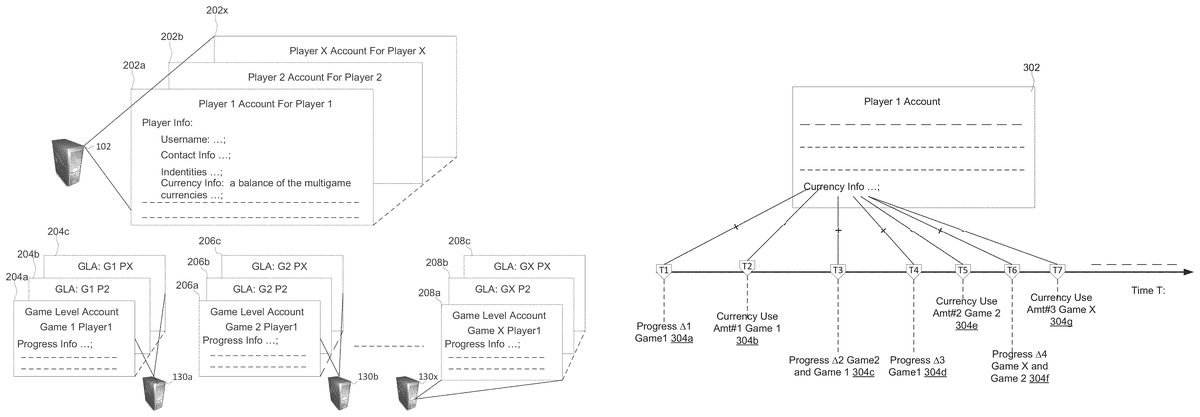
By way of illustration,FIG. 2shows one example of player accounts202managed by the server102, for example via the player account component116. As shown, individual player accounts202a,202b, and202xmay be managed for individual players in the system100. As shown, for example, the player account202afor player 1 may include player information regarding player 1, such as the name, contact information, identities, currency information regarding player 1 in system100.
The identity information in the player account202amay indicate a real-world identity of the player 1, such as a real-world name specified by player 1. The identity information in the player account202amay indicate one or more third party identities that have been associated with player 1 for various online games. The third party identities may include one or more of a social media identity, an electronic mail system identity, an identity in a third party web system, an identity provided by a telecommunication service provider, and/or any other identities facilitated by a third party affiliated with system100. By way of non-limiting example, a first social media identity such as a Facebook™ ID may be associated with player 1 for the first online game, a second social media identity such as a Google+™ ID may be associated with player 1 for the second online game, a first email address (e.g., Google, Yahoo, Hotmail, Sina, ATT.NET or any other email addresses) may be associated with player 1 for the third online game, and/or any other third party identities associated with player 1 for any other online games. As will be described further in detail, the associations of the third party identities with the players for the online games may be used to authenticate requests to use multigame currencies in the online games.
The currency information in the player account202amay indicate a balance of multigame currencies available for player 1 to use across the online games in system100such as the first online game and the second online game. Examples of the multigame currencies useable across the online games may include points, credits, gold, gem, silver, coins, tokens, and/or any other virtual currencies deemed as multigame currencies by the provider of system100. The multigame currencies in the player accounts may be consumed by the players across the online games to facilitate the player participation in the in the online games. Much like currencies specific to an online game, the multigame currencies may be used to fund in-game activities (e.g., to construct buildings, to speedup upgrades, to recruit heroes or troops, and/or any other in-game activities), to purchase virtual items in the online games, to facilitate transactions between the players in the online games, and/or for any other purposes in the online games. In this sense, the multigame currencies are much like “universal” currencies usable across the online games. For example, without limitation, the multigame currencies may be used in the first online game to acquire a weapon and/or any other virtual items, may be used in the second online game to participate in a quest (e.g., the quest may have an entrance fee), and/or may be used in any other online games in system100to facilitate player participation in those online games.
Returning toFIG. 1, first game level component118amay be configured to manage player game level accounts for the players of the first online game. The player game level accounts managed by the first game level component118amay comprise progress information indicating player progress in the first online game. Progress made by a given player in the first online game may reflect levels, status achieved, rank reached, events participated in, activities performed, actions performed, winnings achieved, losses incurred, purchases made, social interaction with other players made, play time logged, play sessions logged, and/or any other types of progress made by the given player in the first online game.
In some examples, the progress information may include information indicating historical purchase(s), purchases within one or more time periods, current balance, stored balance, and/or any other types of statistics regarding balances or purchases of virtual items, and/or any other elements in the first online game related to the given player. In some examples, the progress made by the given player in the first online game may reflect one or more in-game events encountered, awards received, statuses reached, records acquired, and/or any other types of statistics regarding play by the given player in the first online game. In some examples, the progress information may indicate progress made by the given player in the first online game by conveying one or more level attributes associated with the given player.
In some examples, the progress information may indicate progress made by the given player in the first online game by reflecting a number of friends connected and/or invited by the given player in the first online game, a number of virtual gifts given to other players or friends in the first online game, a number of virtual gifts received by the given player from other players in the first online game, and/or any other statistics related to social activities engaged in by the given player in the first online game. In some implementations, the given player's progress in an event, such as progress in a tournament or another promotional event provided in the first online game, may be captured and managed through the progress information included in the player game level account for the given player.
In some examples, the progress information may indicate an amount of play time played the first online game by the given player in a time period. For example, without limitation, the progress information may indicate that the given player has played the first online game for 100 hours in the last month, 25 hours in the past 10 days, 6 hours in the past 24 hours, and so on. In some examples, the progress information may indicate a quantity of play sessions logged by the given in the first online game in a time period. For example, without limitation, the progress information may indicate the given player has logged 10 play sessions in the last week, 30 play sessions in the last month, 100 play session in the last 3 months and/or any other number of play sessions in any time period. In some examples, the progress information may reflect a frequency of playing the first game by the given player in the time period. For example, without limitation, it may indicate that the given player has played the first online game every day in the last month, every other day in the last 2 month, at least 3 times a week in the last 3 month, or any other frequencies.
The second game level component118bmay be configured to perform the same or substantially similar functionalities as/to those provided by first game level component118a. The player game level accounts managed by the second game level component118bmay comprise progress information indicating progresses by the individual players in the second online game. The type(s) of progress information in the second online game by a given player may be the same as or substantially similar to those in the player level game account for the given player managed by the first game level component118a.
FIG. 2illustrates progress information may be included in the player game level accounts204managed for the players. As shown, a set of player game level accounts204may be managed for the players for participation in the first online game, a set of player game level accounts206may be managed for the players for participation in the second online game, a set of play game level accounts208may be managed for the players for participation in the second online game, and/or any other set of player game level accounts may be managed for the players for participation in any other online game in system100.
Returning toFIG. 1, the game communication component120may be configured to receive, obtain, and/or transmit information related to first online game, the second online game, and other online games (if any) from and/or to the respective online games. The information received and/or obtained by the game communication component120may include progress information in the player game level accounts managed by the game level components, such as first game level component118aand second game level component118b. As will be described further in detail, the progress information received and/or obtained from the online games may be used by the currency information update component122to intermittently update the currency information in the player accounts managed by the player account component116. The information received and/or obtained by the game communication component120may include requests to use, in the online game, multigame currencies in the player accounts. As will be described further in detail, such requests may be forwarded to server102by servers130so that the currency information (e.g., debit the balance of the multigame currencies in the player account) in the player accounts may be updated. In some examples, the request received and/or obtained by the currency information update component122may include indication whether the request has been authorized by the authentication component126, such as the first authentication component126aor the second authentication component126b.
The currency information update component122may be configured to intermittently update currency information in the player accounts based on the progress information in the player game level accounts for the players. The intermittent updates of the currency information by the currency information update component122may include increasing the balance of the multigame currencies in the player accounts based on certain progresses made by the players in the online games, decreasing the balance of the multigame currencies in the player accounts according to requests to use multigame currencies in the online games, and/or any other operations. The frequency of the updates by the currency information update component122may be configured in a number of ways. In one implementation, the updates of the currency information updates may be schedule-based such that the updates may take place at a predetermined cadence. By way of non-limiting example, such a cadence may be once every 5 minutes, every hour, every 12 hours, every 24 hours or any other cadence. For instance, the currency updates for the player accounts of the individual online games including the first and second online games may take place once every 24 hours such that the progress information in the player game level accounts for the 24 hours may be evaluated. In another implementation, the updates of the currency information may be event driven such that player events in the online games as reflected by the play progress information may be monitored, and in response to one or more player events, the update may be triggered by the currency information update component122accordingly. By way of non-limiting example, certain player events in the online games such as certain amount of play time logged, certain level achieved and/or any other player events in the online games may be monitored by the currency information update component122. In that example, response to occurrence of those player events in the online games, the currency information update component122may be configured to update the multigame currencies in corresponding player accounts.
In some implementations, the currency information update component122may be configured to evaluate progresses made by the given player in an online game and determine a value for increasing the balance of the multigame currencies in the player account associated with the given player. In implementations, progress metrics may be used to measure player progress for determining corresponding multigame currency increases (or decrease) in the player accounts. For example, without limitation, an progress metric may be used to evaluate play time for which a given online game is played by a given player such that if the actual playtime logged by the given player in the given online game breaches a threshold value, a corresponding quantity of multigame currencies may be awarded to the given player.
In some implementations, formulas may be used to evaluate player progresses in the online games for determining corresponding multigame currency increases (or decrease) in the player accounts. For example, without limitation, a formula #1 may be specified for progress metric #1 and a formula #2 may be specified for progress metric #2. The formulas may indicate how a multigame currency update value may be determined for a player as a function of the changes in player progress a given online game.
By way of non-limiting example, the provider(s) of the online games may desire the players to undertake military actions in the first and second online games during a certain period, for example on a given Sunday. In that example, a factor of 2 may be specified by the provider(s) of the online games, e.g., through the formulas, such that the changes values of military power by the players (i.e., the player progress) in the first online game and second online game on the given Sunday will be counted as double. An exemplary formula including such a factor is illustrated below:
Quantity of Multigame Currency Awarded=(Change in Military Power in the first or second game on the given Sunday)×2+(Change in Military Power in the first or second game on any other days)×1
In this way, the players of the online games may be incentivized to undertake military actions on the given Sunday.
FIG. 3illustrates updating currency information in a player account based on player progress and activities in the individual online games in accordance with the disclosure. As illustrated inFIG. 3, a given player, for example such as player number shown 1 shown in this example, may engage in various activities in the individual online games in system100. This illustrated by various activities or player events by the given player that take place in the respective online games along a time line T. As shown, the given player may, at time T1, make a progress304ain the first online game. As described above, the progress304amay be reflected from the progress information in the player game level account managed by a game level account for the first online game. As also described above, the progress information may be transmitted to server102, for example via the game communication component120. The progress304ain this example may be obtained from the progress information and evaluated by server102, for example via the currency information update component122. Based on the evaluation, the currency information in the player account302may be updated—i.e., the balance of the multigame currencies in the player account may be increased based on the progress304amade by the given player in the first online game.
As also shown in this example, the update of the currency information may include decreasing the balance of the multigame currencies in the player account, for example in response to a currency use request304bmade by the given player. As illustration, the currency use request304bindicates the given player requests to use 50 units of the multigame currencies in the given player account in the first online game. The server102may deduct the balance of the multigame currencies in the given player account by 50 units to register the currency use request in the first online game.
As still illustrated, the player progresses and the currency use requests based on which the currency information in the given player account302may be updated may be from different online games. In this way, the multigame currencies may be “spent” and “earned” across the multiple online games. It should be appreciated that the currency information update in the given player account is not only limited to player progress in a single online game. As illustrated by progress304cand304f, a single update of the currency information may be based on player progresses in multiple games.
Returning toFIG. 1, the first request component124amay be configured to receive requests from requesters. The requests received by the first request component124amay include a request to use multigame currencies in the player accounts in the first online game. Such a request may specify a quantity of the multigame currencies to be used in the first online game, identification of a player account from which the requested multigame currencies may be debited, and/or any other information. By way of non-limiting example, a player may request to use 50 units of the multigame currencies in the first online game, for example, to purchase a virtual item in the first online game. In that example, a request to use the 50 units of the multigame currencies in the first online game may be received, e.g., from a virtual store interface that facilitates players to purchase virtual items. In some implementations, the first request component124amay be configured to effectuate transmission of such a request to server102, for example via the game communication component120so that the currency information in the player account may be updated to reflect the use of the multigame currencies in the first online game as described above. This is illustrated inFIGS. 4-5.
In some implementations, the requests received by the first request component124amay include requests to remove association of third party identity and player for the online games. By way of non-limiting example, a request may be received by the first request component124ato remove a third party identity associated with a given player for the first online game. This is illustrated inFIG. 6.
The second request component124bmay be configured to provide the same or similar functionality with respect to first request component124a. That is, the second request component124bmay be configured to receive requests, effectuate a transmission of the request to server102so that the currency information in the player account may be updated to reflect the use of the multigame currencies in the second online game.
The first authentication component126amay be configured to authenticate requests to use currencies in the first online game as received by the first request component124a. This may involve challenging the requester to provide values for a username/password combination that has been associated with a player. By way of non-limiting example, a given request may request to use 50 units of multigame currencies in a given player account for purchase of a virtual item in a virtual store in the first online game. In that example, the first authentication component126amay be configured to authenticate the given request such that the requester is challenged to demonstrate he/she is indeed the given player before an authorization to use the requested multigame currencies may be granted. As described above, such authentication by the first authentication component126amay be performed through a third party identity associated with the given player for the first online game. For example, the given player may have associated a third party identity with him/herself for the first online game, and the authentication by the first authentication component126amay be performed through the third party identity. In this way, the security of the multigame currencies may be protected through the third party identity, which may provide stronger protection than that provided by the username/password combination used for the first online game.
By way of illustration, a given player may have associated a Facebook identity with him/herself for the first online game, and this association may be recorded in the given player account managed by the player account component116as described above. A request to use the multigame currencies in the given player account may be authenticated using this Facebook identity. That is, the requester may be challenged to provide a password associated with the Facebook identity before the request is authorized. In implementations, the password value provided by the requester may be forwarded to a third party server for authentication (e.g., an authentication server that can authenticate a Facebook identity/password combination). In response to a successful authentication, the request to use the multigame currencies may be authorized, and as described above the authorized request may be forwarded to server102, for example via the game communication component120so that currency information in the given player account may be updated to reflect the transaction.
FIGS. 4A-4Billustrate authenticating a request to use multigame currencies in a given player account in accordance with the disclosure. As shown inFIG. 4A, a request to use multigame currencies in the first online game may be received by server102, e.g., via first request component124a. As illustrated, the request may indicate the requested multigame currencies may be debited from player 1's account. As shown inFIG. 4B, in response to such a request, server102may authenticate the request using a third party identity associated with player 1 for the first online game. As shown in this example, the association of third party identity for the first online game may be determined through the player 1's account managed by the player account component116.
Returning toFIG. 1, in certain situations, a third party identity may not have been associated with the given player for the first online game, when a request to use the multigame currencies in the given player account in the first online game is received by the first request component124a. To address such situations, the first authentication component126amay be configured to search for a third party identity that has been associated with the given player for another online game. In the case where, one or more of such a third party identity exist, the first authentication component126amay be configured to use one of the one or more third party identities to authenticate the request, and upon a successful authentication, the first authentication component126amay be configured to facilitate the player to associate a third party identity with him/herself for the first online game.
FIGS. 5A-5Billustrate authenticating a request to use multigame currencies in a given player account in a given online game when no third party identity has been associated with the given player for the given online game. As shown inFIG. 5A, a request to use multigame currencies in the first online game may be received by server102, e.g., via first request component124a. In contrast to the situation illustrated inFIG. 4A, there does not exist a third party identity associated with the player 1 for the first online game. However, as illustrated, there exists a third party identifier associated with player 1 for the second online game, e.g., a Google+ ID. As illustrated inFIG. 4B, the server102may authenticate the request in this situation using the Google+ ID associated with the player 1.
Returning toFIG. 1, in some situations, there may not exist any third party identity associated with the given player for anyone of the online games. To address these situations, the first authentication component126amay be configured to facilitate a requester to associate a third party identity with the given player for the first online game in response to a request to use multigame currencies in the given player account in the first online game.
FIGS. 6A-6Billustrate authenticating a request to use multigame currencies in a given player account in a given online game when no third party identity has been associated with the given player in any one of the online games in system100. As shown inFIG. 6A, a request to use multigame currencies in the first online game may be received by server102, e.g., via first request component124a. In contrast to the situation illustrated inFIG. 5A, there does not exist any third party identity associated with the player 1 in anyone of the online games in system100. As illustrated inFIG. 4B, the server102, in this situation, may facilitate the requester to associate a third party identifier with the given player for the first online game. For example, the requester may be directed to a user interface through which the requester may provide a third party identity for association with the given player. As described above, the third party identity may be used by the first authentication component126ato authenticate subsequent requests to use multigame currencies in the given player account in the first online game.
In some implementations, the first authentication component126amay be configured to authenticate requests to remove associations of players and third parity identities for the first online game. Similar to the authentication of request to use multigame currencies, authentication of the requests to remove third party identity and player associations by the first authentication component126amay be performed through the third party identities to be removed. For example, the given player may have associated a third party identity with him/herself for the online game, and the authentication by the first authentication component126amay be performed through the third party identity. In this way, the security of the multigame currencies may be protected through the third party identity, which may provide stronger protection than that provided by the username/password combination used for the online game.
FIGS. 7A-7Billustrate authenticating a request to remove an association of a third party identity and a given player in the first online game in accordance with the disclosure. As shown inFIG. 4A, a request to remove an association of a third party identifier and a given player may be received by server102, e.g., via the first request component124a. As illustrated, the request may indicate the requested multigame currencies may be debited from player 1's account. As shown inFIG. 4B, in response to such a request, server102may authenticate the request using the third party identity to be removed.
In some examples, the first authentication component126amay be configured to effectuate merge of two player accounts managed by the player account component. In those examples, the first authentication component may be configured to determine multigame currency spending history associated with a particular third part identity of a give player, and determine if such history reflect another player account that has been “drawing” and/or acquiring (e.g., through “earning” or “purchasing”) the multigame currency using that particular third party identity. In response to a determination that another player has been “drawing” or acquiring the multigame currency using that particular third party identity, the first or second authentication component may be configured to effectuate the merge of the two player accounts.
By way of non-limiting example, the first authentication component126amay be configured to determine if a third party identity associated with a first player has had a history of spending multigame currencies via a player account that is not associated with the first player, e.g., a player account associated with a second player. For instance, as illustration, in response to the first player's (the first player is associated with the first player account) request to use multigame currencies in the first player account in a given online game using a Facebook identity (e.g., “John Smith”), the first authentication component126amay determine that that Facebook identity (e.g., John Smith) has been used by a second player (associated with a second player account) previously for authentication of requests to use multigame currencies in the second player account. In that instance, the first authentication component126amay be configured to effectuate the merge of the first and second player accounts.
The second authentication component126bmay be configured the same and/or substantially similar to the first authentication component126a. That is, the second authentication component126bmay be configured to authenticate requests to use multigame currencies in the second online game, requests to remove associations of third party identities and players for the second online, and/or any other requests in ways the same as or substantially similar to those described above for first authentication component126a.
The server102, client computing platforms104, and/or external resources106may be operatively linked via one or more electronic communication links. For example, such electronic communication links may be established, at least in part, via a network such as the Internet and/or other networks. It will be appreciated that this is not intended to be limiting, and that the scope of this disclosure includes implementations in which servers102, client computing platforms104, and/or external resources106may be operatively linked via some other communication media.
A given client computing platform104may include one or more processors configured to execute computer program components. The computer program components may be configured to enable an expert or player associated with the given client computing platform104to interface with system100and/or external resources106, and/or provide other functionality attributed herein to client computing platforms104. By way of non-limiting example, the given client computing platform104may include one or more of a desktop computer, a laptop computer, a handheld computer, a tablet computing platform, a NetBook, a Smartphone, a gaming console, and/or other computing platforms.
The external resources106may include sources of information, hosts, and/or providers of virtual environments outside of system100, external entities participating with system100, and/or other resources. In some implementations, some or all of the functionality attributed herein to external resources106may be provided by resources included in system100.
The servers102,130may include electronic storage110, one or more processors108, and/or other components. The servers102,130may include communication lines, or ports to enable the exchange of information with a network and/or other computing platforms. Illustration of server102inFIG. 1is not intended to be limiting. The servers102,130may include a plurality of hardware, software, and/or firmware components operating together to provide the functionality attributed herein to server102. For example, servers102,130may be implemented by a cloud of computing platforms operating together as servers102,130.
Electronic storage110may comprise electronic storage media that electronically stores information. The electronic storage media of electronic storage110may include one or both of system storage that is provided integrally (i.e., substantially non-removable) with server102and/or removable storage that is removably connectable to server102via, for example, a port (e.g., a USB port, a FireWire port, etc.) or a drive (e.g., a disk drive, etc.). Electronic storage110may include one or more of optically readable storage media (e.g., optical disks, etc.), magnetically readable storage media (e.g., magnetic tape, magnetic hard drive, floppy drive, etc.), electrical charge-based storage media (e.g., EEPROM, RAM, etc.), solid-state storage media (e.g., flash drive, etc.), and/or other electronically readable storage media. The electronic storage110may include one or more virtual storage resources (e.g., cloud storage, a virtual private network, and/or other virtual storage resources). Electronic storage110may store software algorithms, information determined by processor108, information received from server102, information received from client computing platforms104, and/or other information that enables server102to function as described herein.
Processors108are configured to provide information-processing capabilities in servers102,130. As such, processors108may include one or more of a digital processor, an analog processor, a digital circuit designed to process information, an analog circuit designed to process information, a state machine, and/or other mechanisms for electronically processing information. Although processors108are shown inFIG. 1as single entities, this is for illustrative purposes only. In some implementations, processors108may include a plurality of processing units. These processing units may be physically located within the same device, or processors108may represent processing functionality of a plurality of devices operating in coordination. The processors108may be configured to execute components112,114,116,118a,118b,120,122,124a,124b,126a, and126b. Processor108may be configured to execute components112,114,116,118a,118b,120,122,124a,124b,126a, and126bby software; hardware; firmware; some combination of software, hardware, and/or firmware; and/or other mechanisms for configuring processing capabilities on processor108.
It should be appreciated that although components112,114,116,118a,118b,120,122,124a,124b,126a, and126bare illustrated inFIG. 1as being co-located within single processing units, in implementations in which processor108includes multiple processing units, one or more of components112,114,116,118a,118b,120,122,124a,124b,126a, and126bmay be located remotely from the other components shown as co-locating with112,114,116,118a,118b,120,122,124a,124b,126a, and126binFIG. 1. The description of the functionality provided by the different components112,114,116,118a,118b,120,122,124a,124b,126a, and126bdescribed herein is for illustrative purposes, and is not intended to be limiting, as any of components112,114,116,118a,118b,120,122,124a,124b,126a, and126bmay provide more or less functionality than is described. For example, one or more of components112,114,116,118a,118b,120,122,124a,124b,126a, and126bmay be eliminated, and some or all of its functionality may be provided by other ones of components112,114,116,118a,118b,120,122,124a,124b,126a, and126b. As another example, processor108may be configured to execute one or more additional components that may perform some or all of the functionality attributed below to one of components112,114,116,118a,118b,120,122,124a,124b,126a, and126b.
FIG. 8illustrates one exemplary method800for facilitating multigame currencies in accordance with the disclosure. The operations of method800presented below are intended to be illustrative. In some embodiments, method800may be accomplished with one or more additional operations not described, and/or without one or more of the operations discussed. Additionally, the order in which the operations of method800illustrated inFIG. 8and described below is not intended to be limiting.
In some embodiments, method800may be implemented in one or more processing devices (e.g., a digital processor, an analog processor, a digital circuit designed to process information, an analog circuit designed to process information, a state machine, and/or other mechanisms for electronically processing information). The one or more processing devices may include one or more devices executing some or all of the operations of method800in response to instructions stored electronically on an electronic storage medium. The one or more processing devices may include one or more devices configured through hardware, firmware, and/or software to be specifically designed for execution of one or more of the operations of method800.
At an operation802, a first online game and a second online game may be hosted. The first online game may be associated with a first game space in which gameplays may be facilitated for players of the first online game. Within the first game space, players may control one or more of an element in the first game space. The second game component may be configured with functionalities described above for first game component. A second game space may be associated with the second online game. The second game space may facilitate gameplays similar to or different from those provided in the first game space. The second online game may be separate and discrete from the first online game such that players of the first online game may not interact with the second game space from the first online game. Within the first game space and second game space, the players may use multigame currencies in performing various game activities. In some implementations, operation802may be performed by a first game component and a second game component the same as or similar to first game component112and second game component114(shown inFIG. 1and described herein).
At an operation804, player accounts associated with the players of the first and second online games may be managed. The player accounts managed in operation804may include player information and/or player profiles. The player and/or the player profiles may include player identifying information, demographical information, time zone, and/or any other types of profile information related to the individual players. The player identifying information may include information indicating a third party identity associated with the player for a given online game. For example, for given player, the player identifying information may include information indicating a first social media (e.g., Facebook) identity is associated with the given player for the first online game, and information indicating a second social media (e.g., Google+) identity is associated with the given player for the second online game. The player accounts may comprise currency information indicating a balance of the multigame currencies available for the players to use across the first online game, the second online game and other online games (if any). In some implementations, operation804may be performed by one or more player components the same as or similar to player component116(shown inFIG. 1and described herein).
At an operation806, player game level accounts may be managed for the players. The player game level accounts managed in operations may include player game level accounts managed for the first online game, player game level accounts managed for the second online game and/or player game level accounts managed for other online game (if any). A given player game level account managed in operation896may comprise progress information indicating player progress in a given online game, e.g., the first or the second online game. The progress information may include certain amount of play time played by the player in the first online game within a time period, certain milestones, gameplay status, social status reached by the player in the first online game, certain number of play sessions logged by the player in the given online game during a time period, certain events completed by the player in the given online game and/or any other progress by the player in the given online game. In some implementations, operations806a first game level component the same as or similar to first game level component118a(shown inFIG. 1and described herein).
At an operation808, player progress information may be obtained for the players from the player game level accounts managed in operation806. In some implementations, operation808may be performed by a game communication component the same as or similar to game communication component120(shown inFIG. 1and described herein).
At an operation810, currency information in the player accounts managed in operation802may be intermittently updated. The intermittent updates of the currency information in operation810may include increasing the multigame currencies in the player account based on certain progress made by the player in a given online game, decreasing the multigame currencies in the player accounts according to requests to use multigame currencies in the online games, and/or any other operations. In some implementation, operation810may involve evaluating player progress for determining currency update value. In some implementations, operation810may be performed by currency information update component the same as or similar to currency information update component122(shown inFIG. 1and described herein).
FIG. 9illustrates one exemplary method900for facilitating security for using multigame currencies in multiple online games in accordance with the disclosure. The operations of method900presented below are intended to be illustrative. In some embodiments, method900may be accomplished with one or more additional operations not described, and/or without one or more of the operations discussed. Additionally, the order in which the operations of method900illustrated inFIG. 9and described below is not intended to be limiting.
In some embodiments, method900may be implemented in one or more processing devices (e.g., a digital processor, an analog processor, a digital circuit designed to process information, an analog circuit designed to process information, a state machine, and/or other mechanisms for electronically processing information). The one or more processing devices may include one or more devices executing some or all of the operations of method900in response to instructions stored electronically on an electronic storage medium. The one or more processing devices may include one or more devices configured through hardware, firmware, and/or software to be specifically designed for execution of one or more of the operations of method900.
At an operation902, a request is received from a first online game. The request received in operation902may include a request to use multigame currencies in a given player account in the first online game. The request received in operation902may include a request to remove an association of a third party identity and a given player for the first online game. In some implementations, operation902may be performed by a first request component the same as or similar to first request component124a(shown inFIG. 1and described herein).
At an operation904, a third party identity associated with the given player for the first online game may be obtained. In some implementations, operation904may be performed by first authentication component the same as or similar to first authentication component126a(shown inFIG. 1and described herein).
At a decision906, a determination whether a third party identity is associated with the given player for the first online game is determined. As shown, in cases where it is determined that a third party identity associated with the given player for the first online game exists, the method proceeds to operation908; and in cases where it is determined that a third party identity associated with the given player for the first online game does not exist, the method proceeds to decision910. In some implementations, operations906may be performed by first authentication component the same as or similar to first authentication component126a(shown inFIG. 1and described herein).
At an operation908, the request received in operation902may be authenticated using the third party identity obtained in operation906. In some implementations, operation908may be performed by first authentication component the same as or similar to first authentication component126a(shown inFIG. 1and described herein).
At a decision910, a determination whether a third party identity is associated with the given player for another online game, e.g., a second online game, is determined. As shown, in cases where it is determined that a third party identity associated with the given player for another online game exists, the method proceeds to operation912; and in cases where it is determined that a third party identity associated with the given player for another online game does not exist, the method proceeds to operation914. In some implementations, operations910may be performed by first authentication component the same as or similar to first authentication component126a(shown inFIG. 1and described herein).
At an operation912, the request received in operation902may be authenticated using the third party identity obtained in operation910. In some implementations, operation912may be performed by first authentication component the same as or similar to first authentication component126a(shown inFIG. 1and described herein).
At an operation914, an association of a third party and the given player may be facilitated for the first online game. In some implementations, operation914may be performed by first authentication component the same as or similar to first authentication component126a(shown inFIG. 1and described herein).
Although the present technology has been described in detail for the purpose of illustration based on what is currently considered to be the most practical and preferred implementations, it is to be understood that such detail is solely for that purpose and that the technology is not limited to the disclosed implementations, but, on the contrary, is intended to cover modifications and equivalent arrangements that are within the spirit and scope of the appended claims. For example, it is to be understood that the present technology contemplates that, to the extent possible, one or more features of any implementation can be combined with one or more features of any other implementation.
Claims
- A system for facilitating multigame currencies across multiple online games, the system comprising one or more physical processors configured by machine-readable instructions to: execute instances of game spaces in which corresponding online games take place, and implement the instances of the game spaces to facilitate player participation in the online games such that the players are facilitated to use virtual assets as consideration in the online games, the online games including a first online game and a second online game;manage player accounts for the individual ones of the players, the player accounts comprising player information regarding the individual ones of the players, the player information including currency information indicating a balance of the virtual assets available to the individual ones of the players for use as consideration, wherein the player accounts include a first player account comprising player information regarding a first player;manage player game level accounts for the players to participate in the online games, the player game level accounts comprising progress information indicating the players progress in the online games, wherein the player game level accounts include a first player game level account comprising progress information indicating the first player progress in the first online game and a second player game level account comprising progress information indicating the first player progress in the second online game;and intermittently update currency information in the player accounts based on the progress information in the player game level accounts for the players such that the currency information in the first player account is intermittently updated based on the progress information in the first player game level account and based on the progress information in the second player game level account, wherein a first amount of the virtual assets is provided to the first player based on progress of the first player in the first online game as indicated in the first player game level account, and a second amount of the virtual assets is provided to the first player based on progress of the first player in the second online game as indicated in the second player game level account, such that the currency information in the first player account is updated to reflect the first amount of the virtual assets and the second amount of the virtual assets.
- The system of claim 1 , wherein the progress information in the first player game level account indicates one or more of play time in the first online game by the first player during a time period, one or more events completed by the first player in the first online game, one or more gameplay statuses reached by the first player in the first online game, one or more play sessions logged by the first player during a time period, and one or more social statuses achieved by the first player in the first online game.
- The system of claim 1 , wherein facilitating the players to use the virtual assets in the online games includes authenticating the players in response to players requests to use the virtual assets such that in response to a request by a requester to use, in the first online game, the virtual assets in the first player account, the request is authenticated to verify the requester of the request is the first player.
- The system of claim 3 , wherein authenticating the requester is the first player includes: facilitating the requester to provide, in the first online game, a first identity, the first identity being a third party identity in a third party system;in response to receiving the first identity from the requester, determining whether there exists another third party identity associated with the first player in another one of the online games;and in response to the determination that there does not exist another third party identity provided by the first player previously, authenticating the requester through the first identity;and associating the first identity with the first player such that subsequent requests to use, in the first online game, the virtual assets in the first player account are authenticated through the first identity.
- The system of claim 4 , wherein authenticating the requester is the first player further includes: in response to the determination that there exists another third party identity, authenticating the requester through the another third party identity;and responsive to a successful authentication through the another third party identity, associating the first identity with the first player such that subsequent requests to use, in the first online game, the virtual assets in the first player account are authenticated through the first identity.
- The system of claim 4 , wherein the third party system includes a third party social media system, a third party authentication system, a third party electronic mail system, or a third party web system.
- The system of claim 4 , wherein the one or more processors are further configured to enable the players to remove previously provided third party identities associated with the players from the online games such that the first player is enabled to remove the first identity to be associated with the first player.
- The system of claim 6 , wherein removing the first identity includes receiving a removal request from a requester to remove the first identity to be associated with the first player in the first online game;and authenticating the requester is the first player through the first identity.
- A method for facilitating multigame currencies across multiple online games, the method being implemented one or more physical processors configured to execute computer programs, the method comprising: executing instances of game spaces in which corresponding online games take place, and implement the instances of the game spaces to facilitate player participation in the online games such that the players are facilitated to use the virtual assets as consideration in the online games, the online games including a first online game and a second online game;managing player accounts for the individual ones of the players, the player accounts comprising player information regarding the individual ones of the players, the player information including currency information indicating a balance of the virtual assets available to the individual ones of the players for use as consideration, wherein the player accounts include a first player account comprising player information regarding a first player;managing player game level accounts for the players to participate in the online games, the player game level accounts comprising progress information indicating the players progress in the online games, wherein the player game level accounts include a first player game level account comprising progress information indicating the first player progress in the first online game and a second player game level account comprising progress information indicating the first player progress in the second online game;and intermittently updating currency information in the player accounts based on the progress information in the player game level accounts for the players such that the currency information in the first player account is intermittently updated based on the progress information in the first player game level account and based on the progress information in the second player game level account, wherein a first amount of the virtual assets is provided to the first player based on progress of the first player in the first online game as indicated in the first player game level account and a second amount of the virtual assets is provided to the first player based on progress of the first player in the second online game as indicated in the second player game level account, such that the currency information in the first player account is updated to reflect the first amount of the virtual assets and the second amount of the virtual assets.
- The method of claim 9 , wherein the progress information in the first player game level account indicates one or more of play time in the first online game by the first player during a time period, one or more events completed by the first player in the first online game, one or more gameplay statuses reached by the first player in the first online game, one or more play sessions logged by the first player during a time period, and one or more social statuses achieved by the first player in the first online game.
- The method of claim 9 , wherein facilitating the players to use the virtual assets in the online games includes authenticating the players in response to players requests to use the virtual assets such that in response to a request by a requester to use, in the first online game, the virtual assets in the first player account, the request is authenticated to verify the requester of the request is the first player.
- The method of claim 11 , wherein authenticating the requester is the first player includes: facilitating the requester to provide, in the first online game, a first identity, the first identity being a third party identity in a third party system;in response to receiving the first identity from the requester, determining whether there exists another third party identity associated with the first player in another one of the online games;and in response to the determination that there does not exist another third party identity provided by the first player previously, authenticating the requester through the first identity;and associating the first identity with the first player such that subsequent requests to use, in the first online game, the virtual assets in the first player account are authenticated through the first identity.
- The method of claim 12 , wherein authenticating the requester is the first player further includes: in response to the determination that there exists another third party identity, authenticating the requester through the another third party identity;and responsive to a successful authentication through the another third party identity, associating the first identity with the first player such that subsequent requests to use, in the first online game, the virtual assets in the first player account are authenticated through the first identity.
- The method of claim 12 , wherein the third party system includes a third party social media system, a third party authentication system, a third party electronic mail system, or a third party web system.
- The method of claim 12 , further comprising enabling the players to remove previously provided third party identities associated with the players from the online games such that the first player is enabled to remove the first identity to be associated with the first player.
- The method of claim 12 , wherein removing the first identity includes receiving a removal request from a requester to remove the first identity to be associated with the first player in the first online game;and authenticating the requester is the first player through the first identity.
Disclaimer: Data collected from the USPTO and may be malformed, incomplete, and/or otherwise inaccurate.