U.S. Pat. No. 9,889,373
Multilayer Framework and Architecture With Variable Video Gaming Capabilities
AssigneeCp Studios LLC
Issue DateMay 7, 2013
Illustrative Figure
Abstract
A multilayer framework and architecture with variable video or digital gaming capabilities provides multiple levels of play, permitting players to engage in different ways. The different levels of play options include 1) a peer-to-peer competitive challenge level for “core” players, 2) a “follower” play option for players with restricted capabilities and access to portions of a game; and a 3) “bystander” play option that permits non-players in a network to either observe or play from a reactive perspective.
Description
DETAILED DESCRIPTION The present technology is directed to a multilayer or multi-tier architecture or framework for video games or video gaming applications with variable video gaming capabilities accorded to players or gamers. The video games are for play by users (players or gamers), accessed either via social networks, or directly, on games hosted by third party servers. The specification describes examples of systems and methods for providing this multilayer architecture, video gaming platforms, and user interfaces to facilitate a unique user experience. These video gaming applications may either be hosted by an online community, for example, one or more social networks, or alternatively, by third party servers that are wholly or partially dedicated to gaming applications. In some embodiments, the flexible and multilayer architecture provides a continuous game and visual experience for players across different platforms (platform agnostic) and engages them at different levels of play and capability. Each of the players may have a unique and different gaming experience, depending upon the level of play and capability accorded to each player. This flexible architecture facilitates access to video gaming applications in various ways, including 1) via social networks or sites, for example, accessed via personal computers (desk tops or lap tops); 2) via wall posts or via an online social networking service that enables its users to send and read text-based posts; 3) via mobile devices (iOS, Android, or Windows-based smart phones); and 4) via game consoles (for example, PS3, Xbox 360, or Wii). Video gaming applications may be purchased via platform application stores. These applications are supported by Android (Android is a Linux-based operating system for mobile devices such as smartphones and tablet computers—it is developed by the Open Handset Alliance), iOS (a mobile operating system developed by Apple Inc.) platforms, and phone operating windows. The user interface ...
DETAILED DESCRIPTION
The present technology is directed to a multilayer or multi-tier architecture or framework for video games or video gaming applications with variable video gaming capabilities accorded to players or gamers. The video games are for play by users (players or gamers), accessed either via social networks, or directly, on games hosted by third party servers. The specification describes examples of systems and methods for providing this multilayer architecture, video gaming platforms, and user interfaces to facilitate a unique user experience. These video gaming applications may either be hosted by an online community, for example, one or more social networks, or alternatively, by third party servers that are wholly or partially dedicated to gaming applications.
In some embodiments, the flexible and multilayer architecture provides a continuous game and visual experience for players across different platforms (platform agnostic) and engages them at different levels of play and capability. Each of the players may have a unique and different gaming experience, depending upon the level of play and capability accorded to each player. This flexible architecture facilitates access to video gaming applications in various ways, including 1) via social networks or sites, for example, accessed via personal computers (desk tops or lap tops); 2) via wall posts or via an online social networking service that enables its users to send and read text-based posts; 3) via mobile devices (iOS, Android, or Windows-based smart phones); and 4) via game consoles (for example, PS3, Xbox 360, or Wii).
Video gaming applications may be purchased via platform application stores. These applications are supported by Android (Android is a Linux-based operating system for mobile devices such as smartphones and tablet computers—it is developed by the Open Handset Alliance), iOS (a mobile operating system developed by Apple Inc.) platforms, and phone operating windows. The user interface of iOS is based on the concept of direct manipulation, using multi-touch gestures. Interface control elements consist of sliders, switches, and buttons. The response to user input is immediate and provides a fluid interface.
Video gaming applications may be hosted or accessed via social networks, other third party services or on third party servers, stand-alone platforms, tablets, smartphones, or the like. Multiple players (hundreds, thousands, if not millions) may access gaming one or more applications via any or all of these ways. In addition, the flexible architecture provides a scalable infrastructure with cross-platform pollination technology (achievements and rewards are transferred between platforms for particular players depending on their status) and secure data collection. Video gaming applications may be based on universal themes that appeal to a broad range of demographics and provides a continuous flow of data analytics. They offer opportunities for configuring advertisements and promotions to accomplish strategic goals.
In some embodiments, the flexible architecture provides multiple levels of play, permitting players to engage in different ways and at different levels. The different levels of play options include 1) a peer-to-peer competitive challenge level for “core” players, 2) a “casual” play option for play with friends with whom a particular player shares an affinity, for example, in a social network; and 3) a “spectator” mode that permits non-players in a network to assist friends. Feed-based triggers allow for greater rewards to players and ease of discovering games.
In yet other embodiments, which may include any or all of the aspects described above, the architecture permits play via mobile devices, extending the gaming arena or world to different environments, so achievements in a particular game may be earned and shared more easily across environments, depending upon player status. In addition, a player may earn location-based rewards.
Moreover, the system provides rewards at check-in, to coax players by providing greater incentives. The architecture permits for concurrent “solo” play by a player or gamer and collaborative and competitive play between multiple players. User interfaces are configured to provide different experiences for different players, including a three-dimensional user experience in some environments. In some embodiments, the video gaming applications include story-driven quests and game play, giving players more than just tasks and chores. As one example, a “core” player in an aviation gaming application, may utilize a collection of 250 aircrafts and include transactions relating to the aircrafts and its environment, to create an environment in which the aircrafts operate etc. In this particular application, “core” players may create and manage their experience (for example, by creating an aviation empire), enjoy the thrill of history (aviation's past), and travel the globe and fly through an open network of friendly and rival airports. Other players, for example, “followers” may be accorded more restricted play and capability.
The system provides variable features for player control (depending upon player status) of the virtual arena including control of “play” times, “gifts” and “rewards,” “collect” and “decorate,” monitor “play” (for example, acceleration progress), generate user content, etc.
In some implementations, the architecture accords variable status to players who can opt for different levels of play. A “core” game play status enables players to be “leaders” and play the entire game. A leader has control of all aspects of a particular gaming application. A “casual” or “follower” game play status enables players to play from a different perspective, providing access to only a portion of the entire game. A “spectator” or “bystander” game play enables players to play from a reactive perspective.
Players (with any status described above) may access game play via mobile devices, at any location, and receive location-based rewards. They may access a virtual game arena, their own or that of other players, via several platforms and take up play where they left off. They may link up friends for collaborative play. Players may also participate in standalone game play, via tablets, mobile devices, console-based gameplay, target-based game play or the like. In addition, the system permits cross-pollination game play, sending game objects from one game world or arena to another.
In the following description, for purposes of explanation, numerous specific details are indicated in order to provide a thorough understanding of the technology described. It should be apparent, however, to one skilled in the art, that this technology can be practiced without these specific details. In other instances, structures and devices are shown in block diagram form in order to avoid obscuring the technology. For example, the present technology is described with some embodiments below with reference to particular user interfaces or user platforms and particular hardware. However, the present technology applies to any type of computing device or platform that can receive data and commands, and any devices providing services. Moreover, the present technology is described below primarily in the context of video gaming applications configured to enhance and improve the quality of these gaming applications in order to facilitate synchronous play by hundreds, thousands, if not millions of players. The players may enjoy different user experiences based on their individual preferences and may enjoy seamless play across different gaming platforms or devices (desktop computer, mobile device or the like). However, those skilled in the art should understand that the present technology applies to any type of application and can be used for other applications beyond gaming applications.
Reference in the specification to “one embodiment,” “an embodiment,” or “some embodiments” means simply that one or more particular features, structures, or characteristics described in connection with the one or more embodiments is included in at least one or more embodiments that are described. The appearances of the phrase “in one embodiment” in various places in the specification are not necessarily all referring to the same embodiment.
Some portions of the detailed descriptions that follow may be presented in terms of algorithms and symbolic representations of operations on data bits within a computer memory of either one or more computing devices or gaming platforms. These algorithmic descriptions and representations are the means used by those skilled in the data processing arts to most effectively convey the substance of their work to others skilled in the art. An algorithm as indicated here, and generally, is conceived to be a self-consistent sequence of steps leading to a desired result. The steps are those requiring physical manipulations of physical quantities. Usually, though not necessarily, these quantities take the form of electrical or magnetic signals capable of being stored, transferred, combined, compared, and otherwise manipulated. It has proven convenient at times, principally for reasons of common usage, to refer to these signals as bits, values, elements, symbols, characters, terms, numbers, or the like.
It should be understood, however, that all of these and similar terms are to be associated with the appropriate physical quantities and are merely convenient labels applied to these quantities. Unless specifically stated otherwise, as apparent from the following discussion, it should be appreciated that throughout the description, discussions utilizing terms such as “processing,” “computing,” “calculating,” “determining,” or “displaying” or the like, refer to the action and processes of a computer system, or similar electronic computing device or platform, that manipulates and transforms data represented as physical (electronic) quantities within the computer system's registers and memories into other data similarly represented as physical quantities within the computer system memories or registers or other such information storage, transmission, or display devices.
The present technology also relates to an apparatus or one or more systems for performing the operations described here. This apparatus or one or more systems may be specially constructed for the required purposes, or it may comprise a general-purpose computer selectively activated or reconfigured by a computer program stored in the computer. Such a computer program may be stored in a computer-readable storage medium, such as, but not limited to, any type of disk including floppy disks, optical disks, CD-ROMs, magnetic disks, read-only memories (ROMs), random access memories (RAMs), EPROMs, EEPROMs, magnetic or optical cards, flash memories including USB keys with non-volatile memory or any type of media suitable for storing electronic instructions, each coupled to a computer system bus.
This technology can take the form of an entirely hardware embodiment, an entirely software embodiment, or an embodiment containing both hardware and software components. In some embodiments, this technology is implemented in software, which includes but is not limited to firmware, resident software, microcode, etc.
Furthermore, this technology can take the form of a computer program product accessible from a computer-usable or computer-readable medium providing program code for use by or in connection with a computer or any instruction execution system. For the purposes of this description, a computer-usable or computer-readable medium may be any apparatus that can contain, store, communicate, propagate, or transport the program for use by or in connection with the instruction execution system, apparatus, or device.
A data processing system suitable for storing and/or executing program code includes at least one processor coupled directly or indirectly to memory elements through a system bus. The memory elements may include local memory employed during actual execution of the program code, bulk storage, and cache memories, which provide temporary storage of at least some program code in order to reduce the number of times code must be retrieved from bulk storage during execution.
Input/output or I/O devices (including but not limited to keyboards, displays, pointing devices, etc.) can be coupled to the system either directly or through intervening I/O controllers.
Communication units including network adapters may also be coupled to the systems to enable them to couple to other data processing systems, remote printers, or storage devices, through either intervening private or public networks. Modems, cable modems, and Ethernet cards are just a few examples of the currently available types of network adapters.
Finally, the algorithms and displays presented in this application are not inherently related to any particular computer, gaming platform or other apparatus. Various general-purpose systems may be used with programs in accordance with the teachings here, or it may prove convenient to construct more specialized apparatus to perform the required method steps. The required structure for a variety of these systems is outlined in the description below. In addition, the present technology is not described with reference to any particular programming language. It should be understood that a variety of programming languages may be used to implement the technology as described here.
System Architecture Overview
FIG. 1is a high-level block diagram illustrating some embodiments of systems for providing gaming applications, either via social networks or on third party servers. The system100illustrated inFIG. 1provides gaming platforms106aor106bso that participants (players or gamers) may access one or more gaming applications, initiate a play on one device or gaming platform and continue play at another device or gaming platform, making transitions between devices or platforms essentially seamless and enabling a continuous playing experience.
The system100includes one or more social network servers102athrough102nthat may be accessed via user devices115a,115bthrough115n, which are used by users125a,125b, through125n, to connect to any one of the social network servers102athrough102n. The user devices115athrough115nmay be a desktop computer, a game system or a mobile phone. These entities (user devices115a-115nand social network servers102a-102n) are communicatively coupled via one or more networks105a,105b, and105n. Although only three user devices or platforms115a,115bthrough115nare illustrated, any numbers of user devices or platforms115nmay be used by any number of users (players, gamers, or the like)125n. Moreover, those skilled in the art should recognize that while the present disclosure is described below primarily in the context of providing gaming applications, the present disclosure may be applicable to other types of applications, for entertainment or otherwise. As one example, gaming applications may include operations for creating plays, participating in plays, etc.
The user devices115athrough115ninFIG. 1are illustrated by way of example. AlthoughFIG. 1illustrates only three devices, the present disclosure applies to any system architecture having one or more user devices115athrough115n, therefore, any number of user devices115n(hundreds, thousands, even millions or more) may be used.
Furthermore, while only three networks105a,105b, and105nare illustrated as coupled to the user devices115a,115bthrough115n, the social network servers102a-102n, the profile server130, the web server132, and one or more third party servers134athrough134n, in practice, any number of networks105nmay be connected, either directly or indirectly, to these entities. In addition, although only two third party servers134athrough134nare shown, the system architecture100may include one or more third party servers134n, each with a gaming platform106bthrough106n, operating one or more gaming applications that are similar or different.
In some embodiments, the social network server102ais coupled to the network105a, via a signal line110. The social network server102aincludes a social network application104, which comprises the software routines and instructions to operate the social network server102aand its functions and operations. Although only one social network server102ais described here, persons of ordinary skill in the art should recognize that multiple servers may be present, as illustrated by social network servers102n, each with functionality similar to social network server102aor different.
The term “social network” as used here encompasses its plain and ordinary meaning including, but not limited to, any type of social structure where the users are connected by a common feature or link. The common feature includes relationships/connections, e.g., friendship, family, work, a similar interest, etc. The common features are provided by one or more social networking systems, such as those included in the system architecture100, including explicitly-defined relationships and relationships implied by social connections with other online users, where the relationships form a social graph108.
The term “social graph” as used here encompasses its plain and ordinary meaning including, but not limited to, a set of online relationships between users (players and non-players), such as provided by one or more social networking systems, operating on social network servers102athrough102n, including explicitly-defined relationships and relationships implied by social connections with other online users, where the relationships form a social graph. In some examples, the social graph108may reflect a mapping of these users and how they are related.
It should be understood that social network server102aand the social network software/application104are representative of a single social network. Each of the plurality of social networks102athrough102nis coupled to any one of the networks105a,105b, and105n, each having its own server, application, and social graph. For example, a first social network system operated or hosted on a social network server may be directed to business networking, a second directed to or centered on academics, a third directed to local business, a fourth directed to dating or gaming, and yet others directed to other general interests or perhaps a specific focus. Yet, each may provide access to a gaming platform106afor operating or providing access to video gaming applications.
A profile server130is illustrated as a stand-alone server inFIG. 1. In other embodiments of the system architecture100, all or part of the profile server130may be part of the social network server102a. The profile server130is directly connected to the network105a, via a line131. The profile server130stores profiles for all the users that belong to a social network. A third party server134ais connected to the network105b, via a signal line135. A web server132is connected, via a line133, to the network105n. The web server132delivers access to content, via the internet, for example, by hosted websites or the like. Users may use the web browsers on their electronic devices or gaming platforms to browse for gaming applications and access websites hosting gaming applications. An online-live-gaming server140is connected to the network105aby line141and a cross-platform server142is connected to a network105nby line143. The cross-platform server142may serve as a gateway to different servers and accommodating access by different user platforms.
The user devices or player gaming platforms115athrough115ncan be a computing device, for example, a laptop computer, a desktop computer, a tablet computer, a mobile telephone (iOS, Android, or windows-based phone, a personal digital assistant (PDA), a mobile email device, a portable game player, a game console (PS3, Xbox 360, Wii or the like) a portable music player, a television with one or more processors embedded in the television or coupled to it, or any other electronic device capable of accessing a network and participating in a gaming application. The user devices115athrough115ninclude user-interface applications indicated by reference numerals117a,117b, through117n.
The network105a,105b, or105n, is of conventional type, wired or wireless, and may have any number of configurations, such as a star configuration, token ring configuration, or other configurations known to those skilled in the art. Furthermore, the network105may comprise a local area network (LAN), a wide area network (WAN, e.g., the Internet), and/or any other interconnected data path across which one or more devices may communicate.
In another embodiment, the network105a,105b, or105nmay be a peer-to-peer network. The network105a,105b, or105nmay also be coupled to or include portions of one or more telecommunications networks for sending data in a variety of different communication protocols.
In yet another embodiment, the network105a,105b, or105n, includes Bluetooth communication networks or a cellular communications network for sending and receiving data such as via short messaging service (SMS), multimedia messaging service (MMS), hypertext transfer protocol (HTTP), direct data connection, WAP, email, etc.
In some embodiments, the social network server102a, the profile server130, the web server132, the online-live-gaming server140, and cross-platform server142, and the third party servers134athrough134nare hardware servers including a processor, memory, and network communication capabilities. One or more of the users (players or gamers)125athrough125naccess any of the social network servers102athrough102n, or the third party servers134athrough134n, or any of the other servers, via browsers in their user devices or gaming platforms and via the web server132. The user devices115athrough115nhave user interface applications117a,117b, through117n, that manage access by particular players to select gaming applications or their choice.
FIG. 2is a block diagram illustrating some embodiments of the social network server102(athroughn) or third party server134(athroughn) or any other server hosting a gaming environment. InFIG. 2, like reference numerals have been used to reference like components with the same or similar functionality that has been described above with reference toFIG. 1. Since those components have been described above that description is not repeated here. The social network server102agenerally comprises one or more processors, although only one processor235is illustrated inFIG. 2. The processor is coupled via a bus220to memory237and database storage233, which stores user account data252, game options data254, user rewards/points256, user play/save data258, game options/preferences260, promotion data262and advertising data264.
In some embodiments, the database storage233is a database organized by the hosting server and the user or either one. For each user or player, the data storage233stores data on the user and user game plays etc. For example, this data may include related social network activity such as posts, shares, invitations, status changes etc., associated with each user engaged in a video gaming application.
A user or player125a, via a user or gaming device115a, communicates a request to initiate a gaming application or reacts to a keyword via communication unit239. The “set up” for a video gaming application is managed by the gaming platform106a. It should be recognized that the gaming platform106a(illustrated in the social network server102a) and106b(illustrated in the third party server134a) are shown separately, but include similar functionality, at least for purposes of operating the gaming applications. A user or player display25coupled to the user device115athroughn, is configured to provide the video source of the gaming application in one of many formats, high definition graphics, three dimensional formats etc.
Referring now toFIG. 3, like reference numerals have been used to reference like components with the same or similar functionality that has been described above with reference toFIG. 1. Since those components have been described above, that description is not repeated here. The gaming platform or environment106(aorb) includes various modules that are programmed to perform the functionalities described here. These modules may be variously distributed or may be in a single unit. The gaming platform106includes a user/player interface module301, a permissions module303, a user/player account module305, a user/player status module307, a promotion module309, a game initiation module311, and a social-network module313. Each of these modules is coupled to a software communication mechanism320to communicate the other modules. Examples of a software communications mechanism320may be an object bus (such as COBRA), direct socket communication (such as TCP/IP sockets) among software modules, remote procedure calls, UDP broadcasts and receipts, HTTP connections, function or procedure calls etc. Further, any or all of the communication could be secure (SSH, HTTPS, etc.). The software communication can be implemented on any underlying hardware, such as a network, the Internet, a bus220ofFIG. 2, or a combination thereof etc.
As one example, a particular user125acommunicates via a user device115a, to either initiate or react to a game play. The user interface module301facilitates a connection of the user device115awith the social network server102a, in the event the player wishes to engage or participate in a gaming application via the social network server102a. The permission module303ensures that the user device is compliant with protocols and any privacy concerns. Once a video gaming application has been set up, the user/player account module305makes a note of the user to determine if the user has an existing account or must create one. The user/player status module307considers the status of the various users (“leader,” “follower,” or “spectator”). A promotion module309operates the necessary promotions permitting players to earn rewards accorded by the promotions. The game initiation module311initiates play and the social network module313tracks the applications engaged by a particular player and updates the player's social profile accordingly.
Example Methods
FIG. 4is a flow chart illustrating one example method400for one or more users (players or gamers) to select a “main” game and branch off for playing a portion of the “main” game. The method400begins with selecting a “main” game at block402, and initiating a game play, for either “solo” play or collaborative or cooperative play, illustrated by block404. The method400proceeds to the next block406, at which point, one or more players (with their user devices) create one or more sub games based on the “main” game or branching off from the “main” game. As explained above, players may pursue a particular aspect of the “main” game, separately, either via the same player device, or via another user device (for example, move from a desktop or dedicated game console, to a mobile device, for example, a smartphone).
The method400proceeds to block408, at which stage, user information relating to the sub game is stored on the user device. At block410, the method400proceeds and transfers the user information to the “main” game. Finally, the method400proceeds to block412, at which stage, the “main” game is synchronized with the user information obtained from the sub game.
Referring now to the flow chart illustrated inFIG. 5, an example method for obtaining a promotion is described. As described above, video gaming applications may be used in conjunction with promotions or advertising in order to coax players to purchase products or services that are either related to the gaming applications or otherwise. The user interface is configured to provide rewards to players upon receiving the promotions or advertising. The example method500illustrated here begins at block502, where user or player accounts are created when a user or player decides to initiate play of a particular gaming application. The player then participates in the promotion, for example, by viewing the particulars of a promotion (advertising on a product or service), and receives additional points for creating an account, as indicated at block504. The method500proceeds to block506, where the promotion is stored into the particular player's account and at block508the player initiates game play.
Referring now to the flow chart illustrated inFIG. 6, some example operations for providing multiple levels of play are illustrated. In particular,FIG. 6illustrates an example method600for assigning a status to a player. The method600begins and proceeds to block602, at which point users are signed in. The user or player can indicate preferences for the level of play the user desires to participate at, which are received by the video gaming platform, as illustrated at block604. The video gaming platform assigns a status to the user, at block606, for example, designating the user as a “leader,” a “follower,” a “bystander” or any other designation used by the video gaming application. Each of these designations imposes limits on play associated with them. For example, as indicated above, a “leader” is permitted to play the entire game whereas a “follower” is permitted to play only a portion of the game. The video gaming platform modifies player capabilities based on user status, as illustrated at block608. User “status” accords full play capabilities to a “leader,” “restricted” or “limited” play capabilities to a “follower” and “viewing” and capability to “influence” play with keyword responses to a “bystander.”
FIG. 7illustrates an example method700for earning rewards/features within a game. The example method700begins and proceeds to block702, at which stage, a user or player signs in or is displayed log-in options. The method700proceeds to block704including one or more operations for initiating or accepting user game play. The method700proceeds to block706, at which stage, one or operations receive rewards and/or features for players based on game play. The method700proceeds to the next block708, which includes one or more operations for storing received rewards and/or features for player accounts.
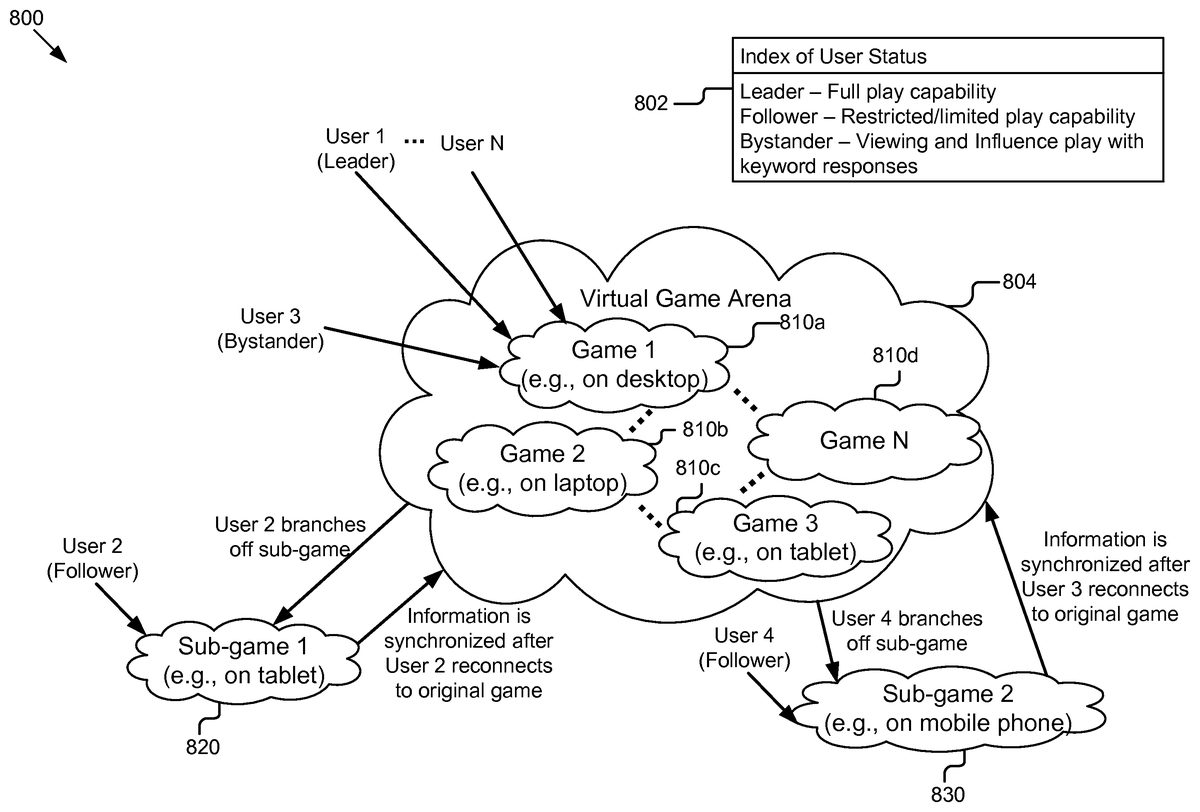
FIG. 8illustrates that multiple users, for example, Users 1, 2, 3, through N, each with a different status, for example, either “leader,” “bystander,” or “follower,” may initiate games, for example Game 1 (indicated by reference numeral810a), Game 2 (indicated by reference numeral810b), Game 3 (indicated by reference numeral810c), through Game N (indicated by reference numeral810d). Each of these games is played in a virtual game arena804, either individual or shared, hosted on a dedicated server or in a cloud. User 2 is illustrated as branching off a sub game 1 (indicated by reference numeral820), for separate play. Any information accumulated during the sub game is synchronized after User 2 reconnects to the original game. A user with “bystander” status may influence the game by responding to wall posts or responding with a key word. Reward or point allocation is based on the status of the player. For example, a player playing a game (for example, a follower), receives rewards or takes away from the main game player more than a bystander does. A bystander does not receive any rewards; its role is simply to assist a friend or influence game play by a “core” player.
FIG. 9illustrates a video gaming scenario, with two core players 1 and 2 (at A and D), who have a “leader” status, illustrated at902and908. A “casual” player or “follower” (at B) is illustrated by reference numeral904and has the capability to influence both the core players, as indicated by the arrows. Additionally, a “core” player, for example, Player 2, can participate as a “bystander” as well and influence another “core” player, Player 1. A non-player or “bystander” may also participate and provide keyword-based participation. All the various players interact with each other, some having larger impact (those that are “leader” or “core” players) on the play of another “core” player, whereas a “casual” player has a smaller or little impact on the play of others, and a “bystander” has even less impact.
As one example, a religious gaming application is described here. A “core” player may create his or her own church or organization. Another “core” player 2 may create his or her own church or organization as well. The “casual” player 3 may be a follower of both “core” Player 1 and Player 2, such that acts by the “follower” either enhance or detract a play by Player 1 or Player 2. For example, the “follower” Player 3 may give virtual money ($10 per day out of a $20) to each of the “core” players. Circumstances may change this flow of money, for example, “core” Player 2 upsets follower Player 3, who routes all of his virtual money to Player 1. Player 2 may retaliate against Player 3, by initiating an action against Player 1, creating a deficit in his or her account, thereby impacting the play by Player 1. Likewise, the bystander C may continue to influence plays by Player 1 or Player 2.
FIG. 10illustrates a gaming scenario with the virtual game arena804with Game 1 (indicated by reference numeral810a), Game 2 (indicated by reference numeral810b), Game 3 (indicated by reference numeral810c) through Games N (indicated by reference numeral810d) engaged by users. A user creates an account to play any of these games and may receive display of a promotion or advertisement. The user may acknowledge the promotion and instantly earn points or rewards from the game. These operations are controlled by a controller or processor1010. User information is recorded in memory1020. The user information may be user-game relationship data, user points (check-in rewards and points earned by play).
FIG. 11illustrates an example data storage configuration. The data storage233may include various types of data. In a first data cell252, the data storage233includes user-account data252, which may include a name, user name, age and birthdate, all of these items indicated generally by reference numeral1110. The data storage233in a second cell may include a game-options data, including data on sound, graphics, monitor, and controls, indicated generally by reference numeral1120. The data storage233may include in a third cell, user rewards/points including data on unlocked content, number of points, and rewards, all of these items indicated generally by reference numeral1130. In a fourth cell, the data storage233includes a user play/save data indicated by reference numeral258including as examples “game save” data or “location” data, both examples indicated generally by reference numeral1160. In a fifth cell, the data storage233includes game options/preferences, indicated by reference numeral260, including as one example game-specific options, indicated by reference numeral1150. In a sixth cell, the data storage233may include promotions data, indicated by reference numeral262, including as examples data on promotions, and unlocked promotion content, indicated generally by reference numeral1160. In a seventh cell, the data storage233includes advertising data, indicated by reference numeral264, which may include data on advertisements 1, 2, through N, all of this data indicated generally by reference numeral1170.
The foregoing description of the embodiments of the present technology has been presented for the purposes of illustration and description. It is not intended to be exhaustive or to limit the present technology to the precise form disclosed. Many modifications and variations are possible in light of the above teaching. It is intended that the scope of the present technology be limited not by this detailed description, but rather by the claims of this application. As should be understood by those familiar with the art, the present technology may be embodied in other specific forms, without departing from the spirit or essential characteristics thereof. Likewise, the particular naming and division of the modules, routines, features, attributes, methodologies, and other aspects are not mandatory or significant, and the mechanisms that implement the present invention or its features may have different names, divisions and/or formats. Furthermore, as should be apparent to one of ordinary skill in the relevant art, the modules, routines, features, attributes, methodologies and other aspects of the present technology can be implemented as software, hardware, firmware, or any combination of the three. Also, wherever a component, an example of which is a module, of the present technology is implemented as software, the component can be implemented as a standalone program, as part of a larger program, as a plurality of separate programs, as a statically or dynamically linked library, as a kernel loadable module, as a device driver, and/or in every and any other way known now or in the future to those of ordinary skill in the art of computer programming. Additionally, the present technology is in no way limited to implementation in any specific programming language, or for any specific operating system or environment. Accordingly, the disclosure of the present technology is intended to be illustrative, but not limiting, of the scope of the present invention, which is set forth in the following claims.
Claims
- A computer-implemented method for implementing a multilayer architecture for video gaming, comprising: providing a video gaming environment hosted on a server;providing access, using the server, to the video gaming environment by a plurality of user devices associated with a plurality of users;and designating, using the server, a status level from a plurality of status levels to each user of the plurality of users, wherein each status level of the plurality of status levels provides a different capability within the video gaming environment, the plurality of status levels including a first player status level that accords full access and play within the video gaming environment, a second player status level that accords restricted access and play within the video gaming environment;and a third player status level that accords reactive access and play within the video gaming environment, the reactive access specifying that a keyword response commented by a user having the third player status level on a social network post of a user having the first player status level or the second player status level affects elements of gameplay on the video gaming environment.
- A computer-implemented method according to claim 1 , wherein the plurality of users access the video gaming environment via the user devices including at least one of a group of a personal computer, a laptop, a mobile device, a gaming console, and a tablet.
- A computer-implemented method according to claim 1 , wherein the video gaming environment is hosted in association with a social network server.
- A computer-implemented method according to claim 1 , wherein the video gaming environment is hosted on a third party server.
- A computer-implemented method according to claim 1 , wherein the video gaming environment is hosted in a cloud of distributed servers.
- A computer-implemented method according to claim 1 , wherein the video gaming environment is hosted on a cross-platform server accommodating access by all the user devices.
- A computer-implemented method according to claim 1 , wherein the plurality of users access the video gaming environment for concurrent play.
- A system for implementing a multilayer architecture for video gaming, comprising a processor and a memory, wherein the memory provides instructions that cause the processor to: provide a video gaming environment hosted on a server;provide access to the video gaming environment by a plurality of user devices associated with a plurality of users;designate a status level from a plurality of status levels to each user of the plurality of users, wherein each status level of the plurality of status levels provides a different capability within the video gaming environment, the plurality of status levels including a first player status level that accords full access and play within the video gaming environment, a second player status level that accords restricted access and play within the video gaming environment;and a third player status level that accords reactive access and play within the video gaming environment, the reactive access specifying that a keyword response commented by a user having the third player status level on a social network post of a user having the first player status level or the second player status level affects elements of gameplay on the video gaming environment.
- A system according to claim 8 , wherein the plurality of users access the video gaming environment via the user devices including at least one of a group of a personal computer, a laptop, a mobile device, a gaming console, and a tablet.
- A system according to claim 8 , wherein the video gaming environment is hosted in association with a social network server.
- A system according to claim 8 , wherein the video gaming environment is hosted on a third party server.
- A system according to claim 8 , wherein the video gaming environment is hosted in a cloud of distributed servers.
- A system according to claim 8 , wherein the video gaming environment is hosted on a cross-platform server accommodating access by all of the user devices.
- A system according to claim 8 , wherein the plurality of users access the video gaming environment for concurrent play.
Disclaimer: Data collected from the USPTO and may be malformed, incomplete, and/or otherwise inaccurate.