U.S. Pat. No. 9,877,197
Secure Network Matchmaking
AssigneeDisney Enterprises Inc
Issue DateOctober 9, 2015
Illustrative Figure
Abstract
There is provided a method for use by a client device having a client address in a network for communication with a host device having a host address in the network. The method includes retrieving a first subset of a plurality of images, displaying the first subset of the plurality of images, receiving a selection of a second subset of the first subset of the plurality of images from a user of the client device, determining a number based on the second subset of the first subset of the plurality of images, replacing a portion of the client address with the number to obtain the host address, and connecting to the host device using the host address obtained by the replacing of the portion of the client address with the number.
Description
DETAILED DESCRIPTION The following description contains specific information pertaining to implementations in the present disclosure. The drawings in the present application and their accompanying detailed description are directed to merely exemplary implementations. Unless noted otherwise, like or corresponding elements among the figures may be indicated by like or corresponding reference numerals. Moreover, the drawings and illustrations in the present application are generally not to scale, and are not intended to correspond to actual relative dimensions. FIG. 1illustrates system100including local area wireless network120having plurality of wireless devices140/150/160in wireless communications with wireless base station130capable of communicating with a wide area network, such as Internet110, according to one implementation of the present disclosure. As shown inFIG. 1, the plurality of wireless devices include first wireless device140and second wireless device150, which may be a wireless phone, a wireless tablet or any other wireless computing device. The plurality of wireless devices may also include game console device160. The plurality of wireless devices140/150/160may communicate with each other and other devices, via Internet110, through wireless base station130. Local area wireless network120may be a WiFi network established using any of 802.11 standards. Wireless base station130is connected to Internet110either through a wired connection, such as DSL or cable, or through a wireless connection, such as 3G or Long-Term Evolution (LTE). FIG. 2presents components of wireless device200, which may be one of plurality of wireless devices140/150/160, for use in local area wireless network120ofFIG. 1, according to one implementation of the present disclosure. Wireless device200may include a medium access control (MAC) layer and a physical (PHY) layer, according to any of the 802.11 standards. As shown inFIG. 2, wireless device200includes baseband processor202, radio frequency (RF) transceiver220, antenna unit230, hardware processor250, memory260and display270. Baseband processor202performs baseband signal processing and includes MAC processor204and PHY processor210. MAC processor204may include a MAC software processing unit ...
DETAILED DESCRIPTION
The following description contains specific information pertaining to implementations in the present disclosure. The drawings in the present application and their accompanying detailed description are directed to merely exemplary implementations. Unless noted otherwise, like or corresponding elements among the figures may be indicated by like or corresponding reference numerals. Moreover, the drawings and illustrations in the present application are generally not to scale, and are not intended to correspond to actual relative dimensions.
FIG. 1illustrates system100including local area wireless network120having plurality of wireless devices140/150/160in wireless communications with wireless base station130capable of communicating with a wide area network, such as Internet110, according to one implementation of the present disclosure. As shown inFIG. 1, the plurality of wireless devices include first wireless device140and second wireless device150, which may be a wireless phone, a wireless tablet or any other wireless computing device. The plurality of wireless devices may also include game console device160. The plurality of wireless devices140/150/160may communicate with each other and other devices, via Internet110, through wireless base station130. Local area wireless network120may be a WiFi network established using any of 802.11 standards. Wireless base station130is connected to Internet110either through a wired connection, such as DSL or cable, or through a wireless connection, such as 3G or Long-Term Evolution (LTE).
FIG. 2presents components of wireless device200, which may be one of plurality of wireless devices140/150/160, for use in local area wireless network120ofFIG. 1, according to one implementation of the present disclosure. Wireless device200may include a medium access control (MAC) layer and a physical (PHY) layer, according to any of the 802.11 standards. As shown inFIG. 2, wireless device200includes baseband processor202, radio frequency (RF) transceiver220, antenna unit230, hardware processor250, memory260and display270.
Baseband processor202performs baseband signal processing and includes MAC processor204and PHY processor210. MAC processor204may include a MAC software processing unit and a MAC hardware processing unit (not shown). Memory260is a computer readable non-transitory storage device and may store software, such as MAC software, such as wireless protocol software262. Memory260may further store an operating system, such as iOS or Android operating systems, and software applications264for wireless device200. MAC processor204executes the MAC software to implement various functions of the MAC layer, and the MAC hardware processing unit may implement other functions of the MAC layer in hardware. PHY processor210may include a receive (RX) signal processing unit (not shown), which is connected to RF receiver224, and a transmit (TX) signal processing unit (not shown), which is connected to RF transmitter222.
The TX signal processing unit typically includes an encoder, an interleaver, a mapper, an inverse Fourier transformer (IFT), and a guard interval (GI) inserter. In operation, the encoder encodes input data, the interleaver interleaves the bits of each stream output from the encoder to change the order of bits, the mapper maps the sequence of bits output from the interleaver to constellation points, the IFT converts a block of the constellation points output from the mapper to a time domain block (i.e., a symbol) by using an inverse discrete Fourier transform (IDFT) or an inverse fast Fourier transform (IFFT), and the GI inserter prepends a GI to the symbol for transmission using RF transmitter222of RF transceiver220.
The RX signal processing unit typically includes a decoder, a deinterleaver, a demapper, a Fourier transformer (FT), and a GI remover. In operation, the GI remover receives symbols from RX receiver224of RF transceiver220. RF receiver224and the GI remover may be provided for each receive chain, in addition to one or more other portions of the RX signal processing unit. The FT converts the symbol (i.e., the time domain block into a block of the constellation points by using a discrete Fourier transform (DFT) or a fast Fourier transform (FFT). The demapper demaps the constellation points output from the FT, the deinterleaver deinterleaves the bits of each stream output from the demapper, and the decoder decodes the streams output from the deinterleaver to generate input data for framing.
Hardware processor250may be any microprocessor or any circuitry used in a computing device for executing software applications264, and controlling various components of wireless200, such as wireless components and display270. Display270may be an LED display, an organic light emitting diode (OLED) display, an LCD display, a plasma display, a cathode ray tube (CRT) display, an electroluminescent display (ELD), or other display appropriate for viewing text, images and videos. Display270may be a touch screen displaying for providing input to wireless device200, which may also use one or more additional input devices, such a keypad, voice, etc.
As discussed above, entering an IP (Internet Protocol) address for connecting to local area wireless network100, such as a WiFi network, is a cumbersome and an error prone task. This is especially true when the task of connecting a wireless device to a wireless network needs to be performed by a person who may be less experienced with technology, such as a young child. For example, a person may have a hard time entering a 32-bit IP address, such as 130.5.5.25, correctly when instructed to do so for connecting the person's wireless device140to local area wireless network100for joining another person using wireless device150to play a game. The IP address 130.5.5.25 is a 32-bit IP address, as each of the four number blocks separated by a dot is represented by eight binary digits. For example, the IP address 130.5.5.25 may be represented by 10000010.00000101.00000101.00011001. Although the 32-bit IP address is used for describing one implementation of the present disclosure, the present disclosure is not limited to the size of the IP address, and IP addresses of other lengths, such as 128-bit IP address may also be utilized. In addition, although the present disclosure discusses wireless devices and wireless networks, the present disclosure is also applicable to wired devices and wired networks.
In one implementation, software application264stored in memory260of each wireless device140and150may include a matchmaking software application for execution by hardware processor250. Further, memory260includes a plurality of images. Each image may be a picture, a letter, a number, a shape, a color or any displayable item that represents a digit without disclosing the digit that the image represents to a user or a viewer.
Turning toFIG. 3,FIG. 3illustrates method300for execution by wireless device140ofFIG. 1, where wireless device140is a host device, according to one implementation of the present disclosure. While playing certain games or sharing certain applications, users of wireless device140and wireless device150may wish to communicate via a local area network, which means that they need to share or use the same IP address. To this end, when a user of wireless device140desires to share the IP address of wireless device140with a user of wireless device150, wireless device140may launch the matchmaking application stored in the memory of wireless device140using hardware processor250of wireless device140. At step310, the matchmaking application obtains the last number block of the IP address of wireless device140. For example, if the IP address of wireless device140is 130.5.5.25, at step310, wireless device140obtains the base-10 number “25,” which may also be represented by eight digits 00011001, as a base-2 number.
Next, at step320, the matchmaking application converts the last number block of the IP address from a first base to a second base, e.g. from a base-2 or base-10 to a base-7 number, i.e. x*72+y*71+z*70. In this case, the base-7 number for “25” is “034.” When using base-7, the last number block of the IP address is represented by three digits, and three out of seven images need to be displayed, where each image is associated with one of the digits of the IP address in base-7, i.e. 0-6. In some implementations, conversion of the last number block of the IP address may be to a different base number, or a base number conversion may not occur.
At step,330, the matchmaking application selects a first subset of images of the plurality of images, e.g. selects three images for base-7, where each selected image is associated with one of the digits of the last number block of the IP address. For example, a first image is associated with “0,” a second image is associated with “3,” and a third image is associated with “4.” Next, at step340, the matchmaking application displays the first subset of images, e.g. the three images. The first subset of images may be displayed at a pre-defined order or sequence. In one example, the first image may be shown on the left, the second image may be shown in the center, and the third image may be showing on the right.
As stated above, in some implementations, the conversion may be to a base other than base-7, or no conversion may occur at step320. For example, if there is a conversion to base-6, the last number block may be represented by four digits, and four out of six images need to be displayed, where each image is associated with one of the digits in base-6, i.e. 0-5. As another example, if there is no conversion and base-10 is utilized, the last number block is represented by three digits, and three out of ten images need to be displayed, where each image is associated with one of the digits of the IP address in base-10, i.e. 0-9.
FIG. 4illustrates exemplary images shown on a display of wireless device140or the host device ofFIG. 3, according to one implementation of the present disclosure. As shown, a first subset of images480, e.g. three images, are displayed on display470of the host device, where the first image represents “0,” the second image represents “3,” and the third image represents “4.” As such, the user of wireless device140(the host device) may either show the images on display470to the user of wireless device150(the client device), or the user of the host device may tell the user of the client device what those images are, in sequence, e.g. a dog, a bird and a cow.
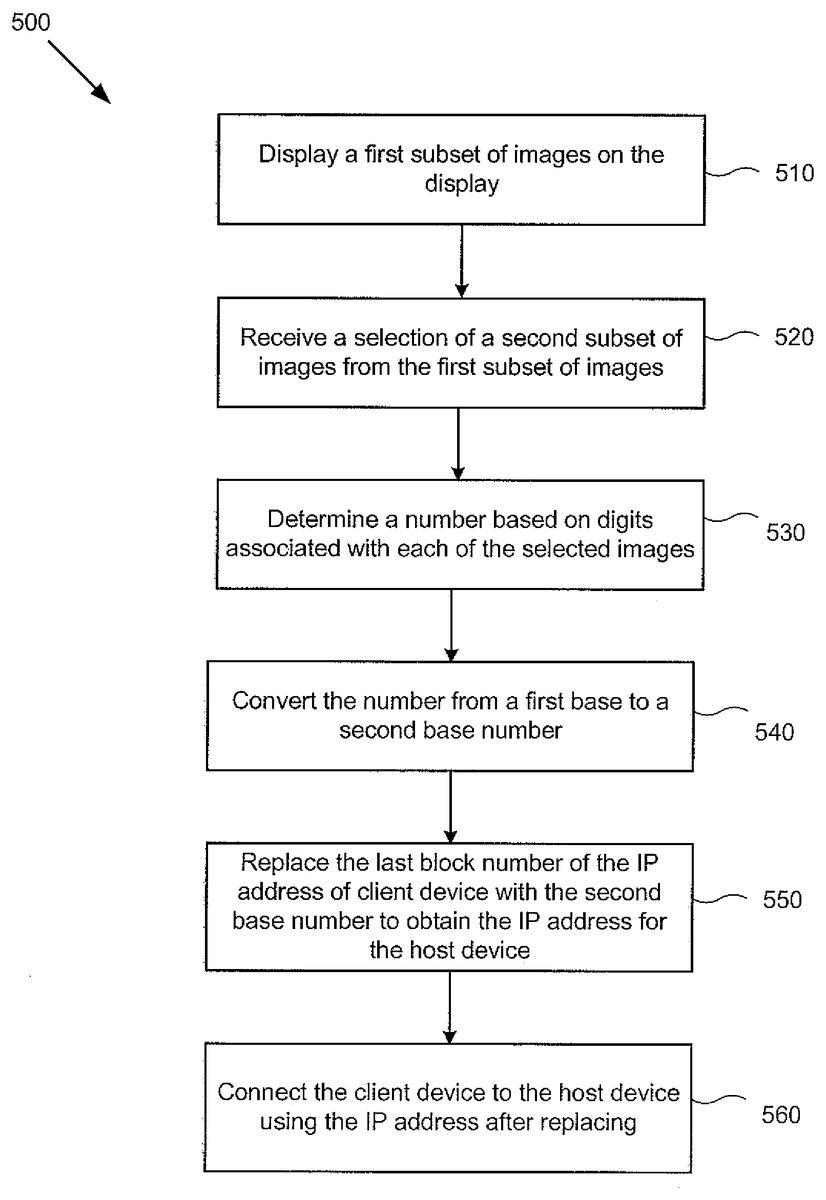
FIG. 5illustrates method500for execution by wireless device150ofFIG. 1, where wireless device150is a client device, according to one implementation of the present disclosure. When a user of wireless device150desires to share the IP address of wireless device140, wireless device150may launch the matchmaking application using hardware processor250of wireless device150. At step510, the matchmaking application displays a first subset of images. The number of images in the first subset depends upon the base number used for representing the last block number of the IP address. For example, at least seven images need to be shown on a display of wireless device150if the matchmaking application is operating at base-7 conversion, i.e. at least one image for each possible digit 0-6.
Next, at step520, the user of wireless device150either views the first subset of images shown on the display of wireless device140at step340or the user of wireless device140tells the user of wireless device150what those images are in sequence. In any event, at step520, the user of wireless device150selects a second subset of images from the first subset of images, e.g. three of seven images shown on the display of wireless device150in the same sequence as they appear on the display of wireless device140.
FIG. 6illustrates exemplary images shown on a display of wireless device150or the client device ofFIG. 4, according to one implementation of the present disclosure. As shown, a first subset of images680, e.g. seven images, are displayed on display670of the client device, where each image represents one of the numbers 0-6. In response to the user of the host device either showing the images on display470to the user of wireless device150(the client device), or the user of the host device telling the user of the client device what those images are in sequence, e.g. a dog, a bird and a cow, the user of the client device selects those images.FIG. 7illustrates exemplary selected images from the images ofFIG. 6, according to one implementation of the present disclosure. As shown inFIG. 7, a second subset of images790from the first subset of images680are selected by the user of the client device, which are the dog, the bird and the cow.
Turning toFIG. 5, at step530, the matchmaking application determines a number, e.g., a base-7 number, based on the selected images. Following the example above, the first selected image represents “0,” the second selected image represents “3,” and the third selected image represents “4.” It should be noted that the sequence of the numbers may not be required to be in the right digit order of “034,” as long as the matchmaking application can decode the sequence properly to obtain the last block number of the IP address. For example, the images may indicate “403” in the entered sequence, where the matchmaking application uses a decoding algorithm to derive the last block number of the IP address, such that the last number is selected first, the first number is selected second, and the first number is selected last, i.e. “403” is decoded as “034.” In such implementations, the decoding algorithm may be utilized for further security and would have a counterpart encoding algorithm in wireless device140.
Next, at step540, the matchmaking application converts the number, e.g. base-7 number to a base-2 or base-10 number. As an example, conversion of “034” to base-10 results in “25.” As stated above, in some implementations, a base conversion may not be needed.
In one implementation, the first subset of images may be a combination of pictures, colors, shapes, etc. In another implementation, the first subset of images may even be digits, such as 0-6, however, digit image “0” may represent “6,” digit image “1” may represent “3,” digit image “2” may represent “0,” or any other combination, as long as each possible digit has a representation. As explained above, the matchmaking application must determine the last block number of the IP address based on the selected images or the second subset of images. For example, if the last block number of the IP address is 45 in base-10, based on the representation of digital images above, a selection of digital images “2,” “0” and “1,” as the second subset of images by the user would result in “063” in base-7, which is 0×72+6×71+3×70“45” in base-10.
At step550, the matchmaking application obtains the IP address of wireless device150and replaces the last block number of the IP address of wireless device150with the last block number of the IP address of wireless140to obtain the IP address of wireless device140or the host device. For example, assuming the IP address of wireless device150is 130.5.5.xxx, step550replaces xxx with 25, which results in the IP address of wireless140, i.e. 130.5.5.25. It should be noted that because both wireless device140and wireless device150are on the same network, the first three block numbers of the 32-bit IP address remain the same. Next, at step560, wireless device150may use the IP address obtained at step550to connect to wireless device140.
From the above description it is manifest that various techniques can be used for implementing the concepts described in the present application without departing from the scope of those concepts. Moreover, while the concepts have been described with specific reference to certain implementations, a person of ordinary skill in the art would recognize that changes can be made in form and detail without departing from the scope of those concepts. As such, the described implementations are to be considered in all respects as illustrative and not restrictive. It should also be understood that the present application is not limited to the particular implementations described above, but many rearrangements, modifications, and substitutions are possible without departing from the scope of the present disclosure.
Claims
- A method for use by a client device having a client address in a network for communication with a host device having a host address in the network, the client device having a hardware processor, a display and a memory storing a plurality of images, the method comprising: retrieving, using the hardware processor, a first subset of the plurality of images from the memory;displaying, using the hardware processor, the first subset of the plurality of images on the display;receiving, using the hardware processor, a selection of a second subset of the first subset of the plurality of images by a user of the client device;determining, using the hardware processor, a number based on the second subset of the first subset of the plurality of images;replacing, using the hardware processor, a portion of the client address with the number to obtain the host address;and connecting, using the hardware processor, to the host device using the host address obtained by the replacing of the portion of the client address with the number.
- The method of claim 1 , wherein the client address is a 32-bit IP address, and wherein the replacing replaces the last eight bits of 32-bit IP address with the number.
- The method of claim 1 , wherein each of the first subset of the plurality of images is associated with a digit, and wherein the determining determines the number based on each digit associated with each selected image of the second subset.
- The method of claim 3 , wherein the determining obtains a first number based on each digit associated with each selected image of the second subset, and converts the first number from a first base to a second base to determine the number.
- The method of claim 4 , wherein the first base is base-7 and the second base is base-10, wherein the first number includes three digits, and wherein the determining converts the first number from base-7 to base-
- The method of claim 5 , wherein the first subset includes seven of the plurality of images.
- The method of claim 6 , wherein the second subset includes three of the seven of the plurality of images.
- A client device having a client address in a network for communication with a host device having a host address in the network, the client device comprising: a hardware processor;a display;and a memory storing a plurality of images and a software application;the hardware processor executing the software application to: retrieve a first subset of the plurality of images from the memory, display the first subset of the plurality of images on the display;receive a selection of a second subset of the first subset of the plurality of images by a user of the client device;determine a number based on the second subset of the first subset of the plurality of images;replace a portion of the client address with the number to obtain the host address;and connect to the host device using the host address obtained by the replacing of the portion of the client address with the number.
- The client device of claim 8 , wherein the client address is a 32-bit IP address, and wherein the replacing replaces the last eight bits of 32-bit IP address with the number.
- The client device of claim 8 , wherein each of the first subset of the plurality of images is associated with a digit, and wherein the determining determines the number based on each digit associated with each selected image of the second subset.
- The client device of claim 10 , wherein the determining obtains a first number based on each digit associated with each selected image of the second subset, and converts the first number from a first base to a second base to determine the number.
- The client device of claim 11 , wherein the first base is base-7 and the second base is base-10, wherein the first number includes three digits, and wherein the determining converts the first number from base-7 to base-
- The client device of claim 12 , wherein the first subset includes seven of the plurality of images.
- The client device of claim 13 , wherein the second subset includes three of the seven of the plurality of images.
- A method for use by a host device having a host address in a network for communication with a client device having a client address in the network, the host device having a hardware processor, a display and a memory storing a plurality of images, the method comprising: obtaining, using the hardware processor, a number representing a portion of the host address;retrieving, using the hardware processor, a first subset of the plurality of images from the memory, wherein the first subset of the plurality of images represent the number;and displaying, using the hardware processor, the first subset of the plurality of images on the display.
- The method of claim 15 , wherein the host address is a 32-bit IP address, and wherein the number is the last eight bits of 32-bit IP address.
- The method of claim 15 , wherein each of the first subset of the plurality of images is associated with a digit forming the number.
- The method of claim 17 further comprising: converting a first number representing the portion of the host address from a first base to a second base to obtain the number.
- The method of claim 18 , wherein the first base is base-10 and the second base is base-
- The method of claim 19 , wherein the first subset includes three of the plurality of images.
Disclaimer: Data collected from the USPTO and may be malformed, incomplete, and/or otherwise inaccurate.