U.S. Pat. No. 9,868,064
GAME SERVER AND SCENARIO CONTROL PROGRAM
AssigneeSquare Enix Co Ltd
Issue DateDecember 29, 2014
Illustrative Figure
Abstract
In a game server wherein a player can play a game online by operating a game terminal, and game program has two or more partial scenarios and the partial scenario has an event to be played by forming a party through two or more players, a unifier that unifies and controls scenario proceeding of the player as a challenger, a controller that controls to prohibit the unified player from executing another events, a processor that does a procedure corresponding to clearing on the player as the challenger to whom clearing of the event was judged, and a releaser that releases unification of the player classified into the challenger are provided.
Description
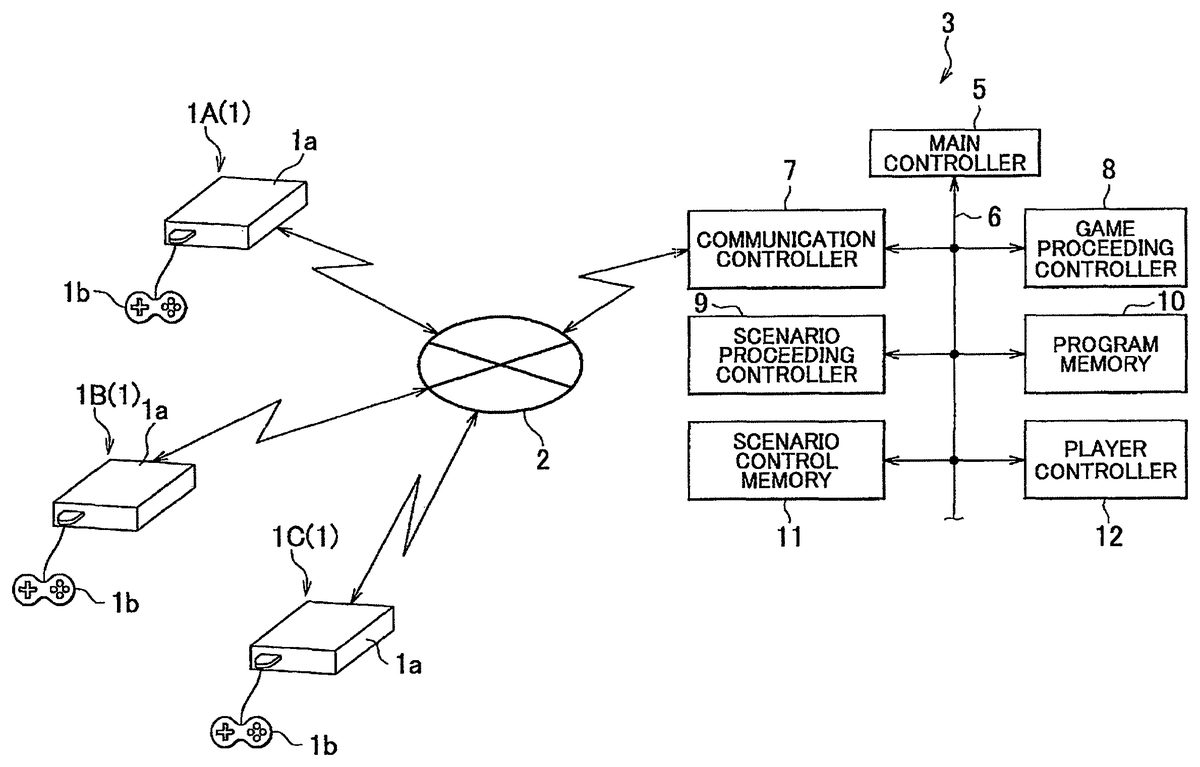
PREFERRED EMBODIMENT An embodiment of the invention is now explained, referring to appended drawings. FIG. 1shows two or more game terminals1A,1B,1C . . . . (Actually, extremely many game terminals1exist although the figure exemplarily shows only three game terminals1) and a game server3connected with the game terminals1A,1B,1C via a public communication line2, such as the Internet and a public telephone net. Each of the game terminals1A,1B,1C . . . has a main body1abuilding a computer therein and a controller1bas an input device is connected with the main body1a. The game server3as the game server computer has a main controller5, and a communication controller7connected with the public communication line2, a game proceeding controller8, a scenario proceeding controller9, a program memory10for storing game program of MMORPG, a scenario control memory11and a player controller12are connected with the main controller5via a bus line6.FIG. 1exemplarily shows only portions pertinent to the invention, but does not show the whole structure of an actual game server3. The game server3as shown inFIG. 1executes functions shown in respective blocks as shown inFIG. 1in such a manner that a computer reads and executes game program stored in a memory, such as the program memory10and the other well-known control program so that a CPU or a memory (not shown) time-dividedly operates by multitask. But, it is also possible to structure the game server3by hardwares corresponding to the respective blocks. Otherwise, it is also possible to control each block by a CPU or a MPU dispersedly provided in each block. The game terminals1and the game server3have the above-mentioned structures. In order to play an online game, such as a MMORPG for players, each player operates his (her) own game terminal1so as to connect with the game server3through the public communication line2, and executes the game in such a manner that the player ...
PREFERRED EMBODIMENT
An embodiment of the invention is now explained, referring to appended drawings.
FIG. 1shows two or more game terminals1A,1B,1C . . . . (Actually, extremely many game terminals1exist although the figure exemplarily shows only three game terminals1) and a game server3connected with the game terminals1A,1B,1C via a public communication line2, such as the Internet and a public telephone net. Each of the game terminals1A,1B,1C . . . has a main body1abuilding a computer therein and a controller1bas an input device is connected with the main body1a.
The game server3as the game server computer has a main controller5, and a communication controller7connected with the public communication line2, a game proceeding controller8, a scenario proceeding controller9, a program memory10for storing game program of MMORPG, a scenario control memory11and a player controller12are connected with the main controller5via a bus line6.FIG. 1exemplarily shows only portions pertinent to the invention, but does not show the whole structure of an actual game server3.
The game server3as shown inFIG. 1executes functions shown in respective blocks as shown inFIG. 1in such a manner that a computer reads and executes game program stored in a memory, such as the program memory10and the other well-known control program so that a CPU or a memory (not shown) time-dividedly operates by multitask. But, it is also possible to structure the game server3by hardwares corresponding to the respective blocks. Otherwise, it is also possible to control each block by a CPU or a MPU dispersedly provided in each block.
The game terminals1and the game server3have the above-mentioned structures. In order to play an online game, such as a MMORPG for players, each player operates his (her) own game terminal1so as to connect with the game server3through the public communication line2, and executes the game in such a manner that the player operates to move an operation character that is set corresponding to each player in a virtual space formed in a memory in the game server3so that the operation character take an action according to a predetermined scenario controlled by the game server3. The game program executed by the game server3is stored in the program memory10in the game server3, and domain controls in the online game by executing through the game server3. In each game terminal1, the game program for controlling the terminal for executing a desired online game is stored in a predetermined memory by connecting with the game server3.
Game scenario SN set in the game program is comprised of a partial scenario “A”, a partial scenario “B”, a partial scenario “C”, a partial scenario “D”, a partial scenario “E”, and a partial scenario “F”, as shown inFIG. 2. Each player is controlled to execute the partial scenarios A, B, C, D, E and F in these orders through the game proceeding controller8. But, the partial scenario “C” hasten sub scenarios C1 through C10 in parallel, and each player can execute the sub scenario at an optional point of time in an optional order in the partial scenario C. The scenario proceeding controller9watches an execution state of the sub scenario in the partial scenario “C” every each player and the player controller12controls the execution state of sub scenario C1 through C10 of each player, that is, a clearing state in the scenario control memory11every each player.
In each of the sub scenarios C1 to C10 of the partial scenario “C”, a battle with boss is lastly set as an event after a predetermined scenario development. Unless each player beats a boss that is set in the sub scenario after participating in the battle with boss, clearing of the sub scenario is not judged. The scenario proceeding controller9sets such an event, the battle with boss, as a cooperation play to be done by cooperation through two or more players. In order to clear the sub scenario, it is necessary for each player to contact with the operation character to be operated by another player in the virtual space in the game server and to find a partner who will fight together in the battle with boss.
That is, the player who plays an online game in the virtual space of the game server through the operation of each game terminal1gets the operation character operated by his (her) own to freely move and act in the virtual space so that the player can play the scenario fit for his (her) own favorites, and the game program generally controls that such actions can be executed by the operation character to be operated by each player alone. But, in the sub scenarios C1 to C10 comprising the partial scenario “C”, the battle with boss (event) is set in each of the sub scenarios C1 to C10 and the scenario proceeding controller9controls according to the game program that in the sub scenario Cx two or more players should act cooperating with each other by forming a party so as to execute and clear the battle with boss (event) (this is referred to as only “execution of cooperation game”).
Then, each player contacts with the operation character operated by another player in the virtual space in the game server through proper means, and finds partners who will fight together in the battle with boss, that is, who will play the cooperation game in order to form a party for participation in the battle with boss. If the partner who will fight together in the battle with boss is found and the party is formed, the player who participates in the party outputs a party formation notice from each game terminal1to the game server3through the public communication line2. The party formation notice is received by the scenario proceeding controller9and the player controller12in the game server that are receivers of such a notice and corresponding procedures are done according to the game program.
Receiving this, the game program starts event execution procedures in the cooperation play according to cooperation play processing program CTP that comprises a part of the game program. The cooperation play processing program CTP reads player information of members of the formed party out of a memory (not shown) through the player controller12based upon player ID of the members comprising the party shown in the party formation notices that was transmitted from the respective game terminals1, as shown inFIG. 4. And, whether or not the members of the party that was formed this time have participation qualification for the participation in the battle with boss (event) to be executed from now on that is stored in the party formation notice as attribution data is judged. In order to execute the partial scenarios C1 through C10 and to fight in the battle with boss that is the event set for clearing, it is necessary for all players comprising the party members to clear the partial scenarios A and B. This is because in order to prevent a failure of the scenario proceeding of the whole game program, the game proceeding controller8controls not to execute the partial scenario C unless the player clears the partial scenarios A and B. Even if the player who has already cleared the partial scenario C and proceeded to the partial scenario D or later, there may be a danger of failure of the scenario proceeding. Then, the execution of the partial scenario C by the player is restricted by the game proceeding controller8.
After judging the existence of the event participation qualification for all players (members) comprising the party in step S1, the program proceeds to Step S2of the cooperation play processing program CTP and the scenario proceeding controller9reads a state of event attainment of each of the players comprising the party members shown in the party formation notice out of a memory (not shown) so as to determine a category of each player in the event that the party tries to execute this time. In the category of the player, the players are classified into the players who have not yet cleared the event to be executed by the party this time and the players who have already cleared such an event, and the player who have not yet cleared is classified into a category of challenger PC1 and the player who have already cleared is classified into a category of observer PC2.
Subsequently, the cooperation play processing program CTP proceeds to Step S3, and the scenario proceeding controller9processes so as to prepare a party member table PMT in the scenario control memory11. As already mentioned above, it is possible to easily read the state of event attainment of each player since a memory (not shown) in the game server3stores the states of attainment (clearing) of the respective partial scenarios (events) A to F and the states of attainment (clearing) of the respective sub scenarios (events) C1 to C10 of the partial scenario C for all players accessible to the game server3as player information together with the player ID.
That is, the scenario proceeding controller9prepares the party member table PMT in the scenario control memory11as shown inFIG. 3, and the party member table PMT stores sub scenario name SUN of the event that will be executed from now on by the party shown in the party formation notice, the player ID of the player comprising the party, and the challenger PC1 and the observer PC2 as the categories of the players. The challenger PC1 is further classified into “R” that shows a leader and “SR” that shows a sub leader, and the observer PC2 is shown as “CA” and “CA” is stored. The leader and sub leader that are categories of the challenger PC1 show the players who have not yet cleared the sub scenario event that the party will execute from now on, and the observer PC2 is the player who has already cleared the sub scenario event (but, has not yet proceed to the partial scenario D or later. The players that comprise the party members can determine the leader and the sub leader upon deliberation and the leader and the sub leader are shown as the attribution data of the party formation notice transmitted from each game terminal1to the game server3. And, the scenario proceeding controller9judges whether the player is the challenger or the observer by referring to the above-mentioned player information.
After thus preparing the party member table PMT, the scenario proceeding controller9does a procedure for unifying the scenario proceeding in connection with the challengers in Step S4of the cooperation play processing program CTP for the players that are classified into the categories of the leader and the sub leader of the party member table PMT, that is, for the players who are regarded as the challengers. The scenario proceeding controller9controls the players whose scenario proceeding has been unified in such a manner that the respective players comprising the unit take actions as a unit and the action outcome can be equally distributed to the leader and the sub leader comprising the unit until the unification is released.
Concretely speaking, the scenario proceeding controller9controls such that the event of the sub scenario Cx (x=one of 1 to 10) to be executed from now on that has notified the game server3by the player who is the challenger (the operation character) through the party formation notice, that is, the event of the sub scenario Cx to be cleared as the challenger is fixedly set as the scenario (event) to be executed by the challenger and the executions of the other sub scenarios (events) and the partial scenarios D through F after the partial scenario C are prohibited to be executed. No unification of the scenarios is done and no action control in connection with the scenario proceeding is done for the player who was classified into the category of “observer” who has already cleared the sub scenario Cx, for example, for the player whose ID is “90438” inFIG. 3.
The players who thus formed the party (referred to as “party player”) enter Step S5ofFIG. 4, and start to execute the sub scenario shown in the formation notice, for example, the sub scenario C6 and fight in the battle with boss set in the sub scenario C6.
The scenario proceeding controller9judges whether the party player cleared the sub scenario C6 or not in Step S6of the cooperation play processing program CTP. If the clearing of the sub scenario C6 was judged, the program proceeds to Step S7, and a clear flag of the sub scenario C6 is given to all players who have been classified into the challengers of the party players as a lump. On this occasion, the clear flag is not given to the players who have classified into the observers since such players have already cleared the sub scenario C6 (on control, such a procedure is optional, the procedure that no clear flag is given to the players who have classified into the observers or the procedure that the clear flag is given to all, but the clear flag is not finally given to the player who has already cleared the sub scenario C6 since it means overwrite of the clear flag). At this time, distribution of an experience value due to the clearing of the sub scenario C6 is equally done to all party players, and there is no difference between the challenger and the observer.
After giving the clear flag to the leader ad the sub leader that are the challengers, the scenario proceeding controller9enters Step S8of the cooperation play processing program CTP, and the player information stored in the memory (not shown) in the game server3is updated for the players of the challengers, and the clear flag showing the clearing of the sub scenario C6 by such players is written in the memory. By doing so, one-time execution of the sub scenario C6 by the leader and the sub leader who were unified challengers means all persons comprising the unit have cleared the sub scenario C6. The player information of the player as the observer is not changed after update since the player is considered to have cleared the sub scenario C6.
Subsequently, the scenario proceeding controller9enters Step S9and does the procedure of releasing the unification in the scenario proceeding unified in Step S4. This is done by deleting party member table PMT in connection with the party members that have been prepared in the scenario control memory11. With such a procedure, the unification of the leader and the sub leader who are the challengers is released and the limitation of the scenario proceeding is released for each player who has been the challenger, so that the scenario proceeding controller9controls each player can execute the optional sub scenario Cx and the partial scenarios D through F which have not yet been executed. No procedure is done for the player who has been “the observer” since no limitation on execution of the scenario is originally given to such a person.
Receiving this, the scenario proceeding controller9returns the scenario proceeding of each player who was the party member to a normal scenario proceeding. By doing so, each player who was the party member can take actions alone freely in the virtual space in the game server3and execute the optional partial scenarios C through F by operating his (her) own operation character through each game terminal1.
In the above-mentioned embodiment, the leader and sub leader comprising the challengers are determined among the players comprising the party members upon deliberation, but the scenario proceeding controller9of the game server3can automatically determine the leader and the sub leader by referring to the state of clearing of the sub scenario of each player through the player information in the memory (not shown) with no deliberation between the players.
Besides, the partial scenario to be done through the party formed by two or more players in cooperation with these players is not always the partial scenario having the sub scenarios, but the cooperation play may be done when executing the partial scenario on which no sub scenario is set.
Claims
- A game server connected with a plurality of game terminals through a communication network, each game terminal executing an online game according to a game program of the game server through an operation of a player, each game terminal operating an operation character in a virtual space in the game server, the game program including a plurality of events, at least one of the plurality of events having a specific event configured to be played by at least one character included in a party, the game server comprising: a processor;and a memory including the game program that, when executed by the processor through the operation of each game terminal, causes the processor to perform operations including: forming the party of at least two characters;prohibiting, based on a state of event attainment of the characters included in the party, at least one of the characters included in the party from executing an event other than the specific event of the plurality of events until the party is released;allowing, based on the state of event attainment of the characters included in the party, at least one of the characters included in the party to execute the event other than the specific event of the plurality of events before the party is released;and releasing the event other than the specific event to the at least one of the characters prohibited from executing the event other than the specific event when the processor judges that the party has been released.
- The game server according to claim 1 , wherein the plurality of events is to be cleared in a predetermined order;and wherein the party is formed on the basis of a participation-condition to the specific event relating to the predetermined order being satisfied.
- A non-transitory computer readable medium storing a game program in a game server, the game server connected with at least two game terminals through a communication network, each game terminal executing an online game according to the game program of the game server through an operation of a player, each game terminal operating an operation character in a virtual space in the game server, the game program including a plurality of events, at least one of the plurality of events having a specific event configured to be played by at least one character included in a party, the game program causing the game server to perform operations including: forming the party of at least two characters;prohibiting at least one of the characters included in the party from executing an event other than the specific event of the plurality of events until the party is released based on a state of event attainment of the characters included in the party;allowing at least one of the characters included in the party to execute the event other than the specific event of the plurality of events before the party is released based on the state of event attainment of the characters included in the party;and releasing the event other than the specific event to the at least one of the characters prohibited from executing the event other than the specific event when the processor judges that the party has been released.
- A non-transitory computer readable medium storing a game program for execution by a computer, the computer configured to be connected with a game server, the game server connected with at least two game terminals through a communication network, each game terminal executing an online game according to the game program through an operation of a player, each game terminal operating an operation character in a virtual space in the game server, the game program including a plurality of events, at least one of the plurality of events having a specific event configured to be played by at least one character included in a party, the game program causing the computer to perform operations including: forming the party of at least two characters;prohibiting at least one of the characters included in the party from executing an event other than the specific event of the plurality of events until the party is released based on a state of event attainment of the characters included in the party;allowing at least one of the characters included in the party to execute the event other than the specific event of the plurality of events before the party is released based on the state of event attainment of the characters included in the party;and releasing the event other than the specific event to the at least one of the characters prohibited from executing the event other than the specific event when the processor judges that the party has been released.
- A game system including a game server and a plurality of computers, the game server connected with at least two game terminals through a communication network, each game terminal executing an online game according to a game program of the game server through an operation of a player, each game terminal operating an operation character in a virtual space in the game server, the game program including a plurality of events, at least one of the plurality of events having a specific event configured to be played by at least one character included in a party, the game system comprising: a processor;and a memory including the game program that, when executed by the processor through the operation of each game terminal, causes the processor to perform operations including: forming the party of at least two characters;prohibiting at least one of the characters included in the party from executing an event other than the specific event of the plurality of events until the party is released based on a state of event attainment of the characters included in the party;allowing at least one of the characters included in the party to execute the event other than the specific event of the plurality of events before the party is released based on the state of event attainment of the characters included in the party;and releasing the event other than the specific event to the at least one of the characters prohibited from executing the event other than the specific event when the processor judges that the party has been released.
- The game server according to claim 1 , wherein the operations further include: judging whether or not at least one of the at least two characters included in the party has cleared the specific event;executing a process corresponding to clearing of the specific event for all of the at least two characters included in the party when the processor judges that the specific event has been cleared;and updating player information of all of the at least two characters included in the party for which the specific event has not been judged as being cleared into a status having the specific event being judged cleared when the processor judges that the specific event has been cleared.
- The game server according to claim 1 , wherein the memory further includes a party member table, the party member table identifying each character of the characters included in the party in association with a category which indicates whether the character is prohibited from executing the event other than the specific event until the party is released or allowed to execute the event other than the specific event before the party is released.
- The game server according to claim 7 , wherein the category is selected from among categories including a challenger and an observer, the category of challenger indicates that the character is prohibited from executing the event other than the specific event until the party is released, the category of observer indicates that the character is allowed to execute the event other than the specific event before the party is released, the state of event attainment of each character which is associated with the category of challenger is not yet cleared, and the state of event attainment of each character which is associated with the category of observer is cleared.
- The game server according to claim 8 , wherein the party member table includes a single entry for the specific event, with each of the characters included in the party and the associated category of each character being unified with the single entry for the specific event.
Disclaimer: Data collected from the USPTO and may be malformed, incomplete, and/or otherwise inaccurate.