U.S. Pat. No. 9,844,729
Systems and Methods for Managing Video Game Titles and User Play Metrics for Video Game Titles Executing on a Game Cloud System
AssigneeSony Interactive Entertainment America LLC
Issue DateMarch 15, 2013
Illustrative Figure
Abstract
Methods for managing video game title and user play metrics for video game titles executed on a game cloud system includes determining that the video game title has been obtained from an online retailer, by a user. The method further includes enabling execution of game play of the video game title on the game cloud system. Game play metrics for the video game title during execution of game play, is monitored. Selected game play metrics for the video game title are identified. The selected game play metrics are communicated to the online retailer to enable classification of the user that obtained the video game title from the online retailer.
Description
DETAILED DESCRIPTION The following embodiments describe methods and systems for tagging content in a game that is executed by a cloud-based system, and enabling the sharing of games or parts of games having the tags with others. The sharing can include, for example, sharing game content with other users that may have access to the cloud-based system already or new users. The sharing of content can also be facilitated by enabling communications between users of similar games or friends of users. The friends of users can also be discovered by interfaces with third party social networks. Additional embodiments describe methods and systems for managing video game title and user play metrics for video game titles executed on a game cloud system. A user selects a video game title for game play. The game play is executed on the game cloud system. User play metrics are monitored during execution of game play and are used to rank the user and the video game title that is available at an online retailer. The embodiments provide a tool for users to influence their gaming skills in promoting video game titles to other users and the online retailer may use the users interactions to rank the users and the video game title and use the relative ranking to influence promotion of the video game titles at a webpage hosted by the online retailer and encourage users to procure and play the online video game titles. As discussed in this application, mini-game creation and tagging data associated with created mini-games is discussed. In one embodiment, a mini-game may be created by a user that owns or has access to a full version of the game. When a user plays the full version of the game, a video recording is created of the game play. From ...
DETAILED DESCRIPTION
The following embodiments describe methods and systems for tagging content in a game that is executed by a cloud-based system, and enabling the sharing of games or parts of games having the tags with others. The sharing can include, for example, sharing game content with other users that may have access to the cloud-based system already or new users. The sharing of content can also be facilitated by enabling communications between users of similar games or friends of users. The friends of users can also be discovered by interfaces with third party social networks.
Additional embodiments describe methods and systems for managing video game title and user play metrics for video game titles executed on a game cloud system. A user selects a video game title for game play. The game play is executed on the game cloud system. User play metrics are monitored during execution of game play and are used to rank the user and the video game title that is available at an online retailer. The embodiments provide a tool for users to influence their gaming skills in promoting video game titles to other users and the online retailer may use the users interactions to rank the users and the video game title and use the relative ranking to influence promotion of the video game titles at a webpage hosted by the online retailer and encourage users to procure and play the online video game titles.
As discussed in this application, mini-game creation and tagging data associated with created mini-games is discussed. In one embodiment, a mini-game may be created by a user that owns or has access to a full version of the game. When a user plays the full version of the game, a video recording is created of the game play. From this video recording, the user can select a portion of the video recording (e.g., a starting point and an ending point). This portion of the video is saved and associated to the user. In addition, this portion is used to identify game code (e.g., binary code and/or source code), metadata, and state data that was created or associated to the game play via the full version of the game, i.e., when the game was played to create the video recording. This information is in turn used to identify the portions of the code of the full game code that will be required to create an executable mini-game, that will encompass at least the functionality seen in the portion of the video that was selected from the video recording. In other embodiments, the functionality provided by the code of the mini-game may be limited in one or more ways, e.g., fewer controls, actions, characters, or options, as compared to the full version of the game. Once the mini-game is created, other users can view the video portion that was selected for the mini-game and will also be able to play an executable mini-game that parallels the code that created the video portion.
The mini-game can be shared in a social group, such as a website that displays mini-games made by many, including rankings of the mini-games. Sharing can also occur over a social network, wherein users can post their mini-games and tag data can be received by the users that wish to view or play the mini-game from the social network. The mini-games, in one embodiment, will include a video portion and an executable portion. In one embodiment, the video portion is a video of the game play of the original user that created the mini-game. In one embodiment, the executable portion is a mini-game created from the main game, for a section of the game that parallels the video portion. Once a user views the video portion, the user may wish to try the executable portion of the mini-game. While viewing the video portion, the user (and other users that view) may add tag content to the video. The tag data can also be added to the executable portion of the mini-game. Further examples and embodiments will now be described below with reference to the exemplary drawings.
It will be obvious, however, to one skilled in the art, that the present invention may be practiced without some or all of these specific details. In other instances, well known process operations have not been described in detail in order not to unnecessarily obscure the present invention.
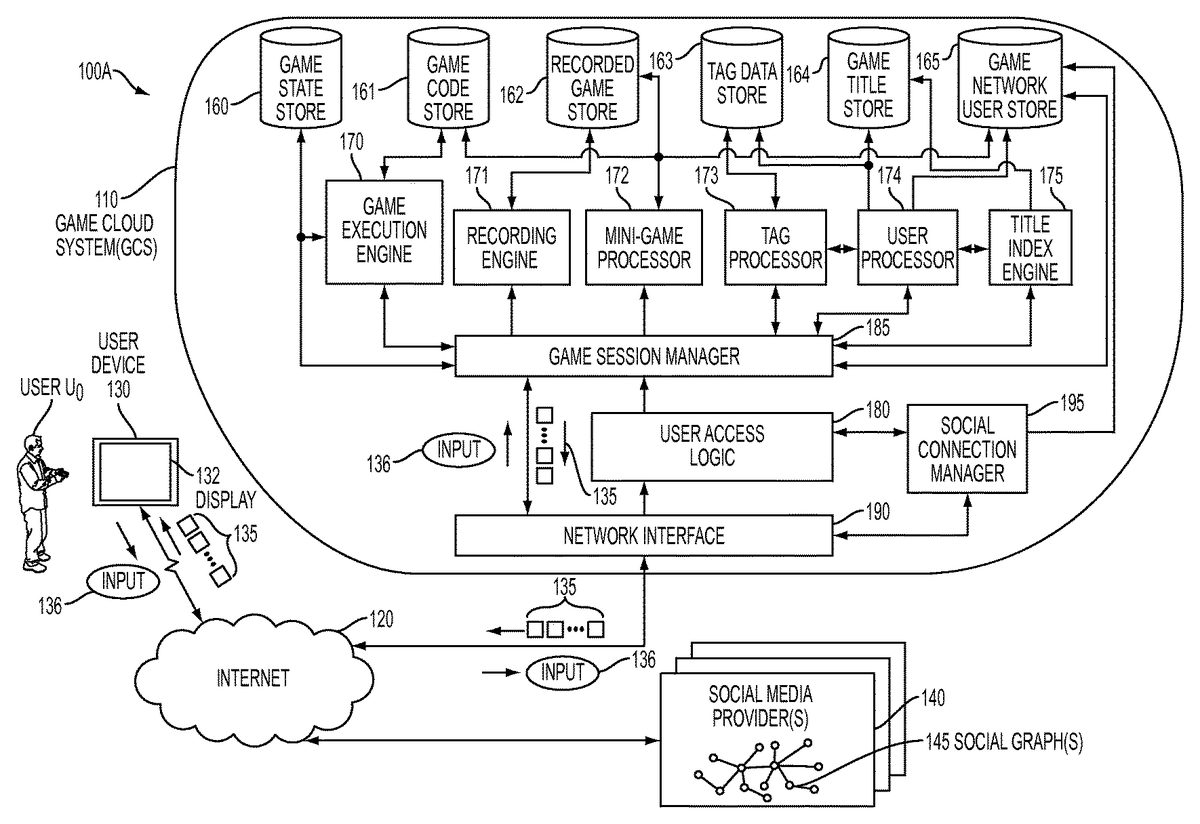
FIG. 1Aillustrates a system diagram100A for enabling access and playing of video games stored in a game cloud system (GCS)110, in accordance with an embodiment of the invention. General speaking, game cloud system (GCS)110may be a cloud computing system. System100A includes a game cloud system (GCS)110, one or more social media providers140, and a user device130, all of which are connected via Internet120. Although one user device130is illustrated in system diagram100A, it is to be understood that in practice, many more user devices may be connected to Internet120to access the services provided by GCS110and social media providers140.
In one embodiment, game cloud system110includes a game execution engine170, a recording engine171, a mini-game processor172, a tag processor173, a user processor174, a title index engine175, a game session manager185, user access logic180, a network interface190, and a social connection manager195. Game cloud system110may further include a plurality of gaming storage systems, such as a game state store160, a game code store161, a recorded game store162, a tag data store163, a game title store164, and a game network user store165. In one embodiment, game cloud system110is a system that can provide game applications, services, gaming related digital content, and interconnectivity among systems, applications, users, and social networks. Game cloud system110may communicate with user device130and social media providers140via network interface190that will enable wired and wireless communication methods. In one embodiment, each social media provider140includes at least one social graph145that shows user social network connections.
In one embodiment, a social media provider can be the game cloud system110itself, whereby user relationships are managed without the need for external social media providers140. In still other embodiments, the system can operate as a hybrid system, wherein social relationships are managed using social graph data from third party social media providers (via API interface accesses or the like) and user relationships with other users, as defined by the game cloud system.
In one embodiment, a user, e.g., user U0, can access the services provided by game cloud system110and social media providers140by way of user device130. User device130can include any type of device having a processor and memory, wired or wireless, portable or not portable. User device130, which is shown connected to Internet120, includes a display132that can be a touchscreen, or a display typically provided by a flat-panel display, a cathode ray tube (CRT), or other device capable of rendering a display. Alternatively, the user device130can have its display132separate from the device, similar to a desktop computer or a laptop computer. In one embodiment, user device130can be in the form of a smartphone, a tablet computer, or hybrids that provide touch screen capability in a portable form factor. One exemplary device can include a portable phone device that runs an operating system and is provided with access to various applications (apps) that may be obtained over Internet120, and executed on the local portable device (e.g., smartphone, tablet, laptop, desktop, etc.).
In one embodiment, user device130can install an application that enables execution or views of the games stored or shared by the game cloud system110. Further, user device130can be used to communicate with one or more social media provider(s)140via Internet120such that user device130may be used to play or view games posted and shared in one or more social media providers140. For example, user U0 may access a game posted in one of social media providers140by selecting a link on a page, stream, news-feed, or post of the social media provider, and then playing or viewing the game from user device130.
In one embodiment, the games posted and shared in social media providers140are mini-games generated based on video recordings of game plays. Those mini-games may be stored in recorded game store162of game cloud system110. A user U0 is therefore able to play or view games or mini-games stored in game cloud system110. In another embodiment, the games available in the game title store164are video game titles that are available at an online retailer. In this embodiment, a user may view and procure video game titles from the online retailer. The procured video game title is enabled for execution on the game cloud system110. Because game play is primarily executed in the game cloud system110, the user device130will be receiving a stream of game video frames135from game cloud system110, while user input136to drive the game play is transmitted back to the game cloud system110. The received game video frames135(representing the video from streaming game play) are therefore shown in display132of user device130.
In one embodiment, a user, e.g., user U0, may create a user account and register the created user account with game cloud system110. After the user account is registered with game cloud system110, game cloud system110may provide a user ID to this registered user account and save the user ID in a user profile associated with the registered user account. The user profile associated with a user account will be described in more detail with reference toFIG. 1C. In one embodiment, the user profile associated with a user account may be saved in a user database in game network user store165. The user ID and other user authentication data within the user profile are used to associate a video game title that the user procures from the online retailer. The user ID is also used to authenticate the user to ensure that the user has procured the video game title prior to enabling the user to game play the video game title on the game cloud system. Upon successful authentication, the procured video game title is associated with the user ID information and association is stored in the game network user store165and game title store164. As shown inFIG. 1A, the game title store164shows all the game titles that are available to the user for game play.
In one embodiment, user access logic180may be used to detect accesses made by user U0 either through user device130or other suitable devices, and to verify the user log-in information, e.g., the name and password for the user account of user U0. After user U0 logs into his or her user account, user access logic180may communicate the user login information with user processor174that in turn updates the user login information stored in the user profile. Further, user access logic180may communicate the user login information with social connection manager195, so that social connection manager195can pull the user's social network information from one or more social media providers140via network interface190. The social network information of the user may be received by social connection manager195, which in turn transmits the received social network information of the user to game network user store165to be saved in the user profile of user U0.
The social network information of a user may include, without limitation, the names of the user's social network friends, the social network activities of the user and his or her social network friends (e.g., mini-game tag data entered by the user and his or her social network friends), etc. In one embodiment, the names of the user's social network friends may be obtained from one or more social graphs145maintained by social media providers140.
After logging in, the user can access services provided by game cloud system110via game session manager185, including access to the video game title for executing game play. For example, game session manager185may inform user processor174of the user login information so that user processor174may record or update the user login information in the user profile (stored in game network user store165) associated with this user. In one embodiment, user processor174may communicate with title index engine175to identify game titles associated with the user account. The game titles associated with the user account may be previously purchased by the user, previously played by the user and/or free game titles identified and made available by the game providers. In this example, available game titles may therefore be stored in game title store164.
In one embodiment, after a user chooses an available game title to play, a game session for the chosen game title may be initiated by the user through game session manager185. Game session manager185first accesses game state store160to retrieve the saved game state of the last session played by the user (for the selected game), if any, so that the user can restart game play from a previous game play stop point. Once the resume or start point is identified, the game session manager185may inform game execution engine170to execute the game code of the chosen game title from game code store161. After a game session is initiated, game session manager185may pass the game video frames135(i.e., streaming video data), via network interface190to a user device, e.g., user device130.
During game play, game session manager185may communicate with game execution engine170, recording engine171, and tag processor173to generate or save recording (e.g., video) of the game play or game play session. In one embodiment, the video recording of the game play can include tag content entered or provided during game play, and other game related metadata. The video recording of game play may be saved in recorded game store162. Any tag content may be saved in tag data stored163, and the metadata may be saved in game state store160. More detail regarding the process of tagging content will be described below.
During game play, the game session manager185may communicate with the game execution engine170to obtain user interactive input that includes both user play metrics and game metrics. The user interactive input is provided by the user during game play and is used to influence an outcome of the game play. The game metrics along with any recording of the game play may be saved by recording engine in recorded game store162. The user play metrics may be processed by user processor174and stored in game network user store165. The game session manager may interact with the user processor174to identify select ones of the user play metrics stored in the game network user store165and with the recording engine171to identify select ones of game metrics from the recorded game store. The identified select ones of the user play metrics and game metrics are transmitted by the game session manager through the network interface190to a server of the online retailer (not shown) for updating relevant fields/information at the online retailer server. In one embodiment, the user play metrics provided by the game sessions manager are used to enable computation of relative ranking of the user at the online retailer. Similarly, the game metrics provided by the game sessions manager is used to enable computation of relative ranking of the video game title available at the online retailer.
The ranking of the user and the video game title are used to influence promotion, targeted discounts, incentives, etc., of one or more video game titles available at the online retailer's online store. The online retailer may be a different entity than the entity that developed the video game title. The entity that developed the video game title may be a different entity than the entity that hosts/markets the video game title. Further, the user play metrics and game metrics may be used to target a broader user base including users that are known to be active users in the gaming world and users that have purchased similar ones of the game titles. The online retailer may have data related to procurement of game titles by the users but may not have data related to actual use of the game titles. The current embodiments provide a tool that augments information that is not available in the procurement process alone. The actual use data provides a much richer data that can be used to identify and target a broader range of users. The actual use data can be analyzed to identify and promote other similar game titles to specific ones of the users. Some data can be confidential to the game title provider or business privileged, and still further some data can be sensitive to the privacy of the user (e.g., gamer). The GCS will take these privacy and confidential metric information and share only selective ones of the data with the online retailer. And further, the data that is shared with the online retailer may be anonymously provided to the retailer, such as only identifying the buyer ID or a token that identifies a type of buyer. This embodiment of confidential sharing of data regarding the user prevents dissemination of data or transfers of data that can be compromised or stored by parties that do not have security measures in place. In other embodiments, the data shared with retailers can be compartmentalized into a number of levels, which can be supplied to the retailer for a fee. A lower level of information can be, for e.g., how many minutes the user plays (i.e., user play metrics) the game per month. Another level can identify the number of sharing or social activity conducted using the game for periods of time. A still higher level can include actions completed in the games, levels of task completed in the game (i.e., game metrics), multi-player activity, and any purchases of in-game virtual goods. Accordingly, different levels of data can be provided to the online retailer, that can be set by agreement. The current embodiments provide an efficient marketing tool that can be used by the retailers and developers in identifying user groups.
In one embodiment, a mini-game may be created using information from the video recording of the game play, e.g., via mini-game processor172. For example, after a user plays a game and the video recording is created, the user can simply watch a replay of the video recording of his or her prior game play. When the user is watching a replay of the video recording, the user may find one or more parts to be particularly interesting. For example, the user may have achieved a high score or completed an interesting task during the game play. The user, in one embodiment, is provided with controls to select a portion of the video recording, which will then be used by mini-game processor172to construct a mini-game based on the selected portion of the video. In one embodiment, the mini-game will include the executable code necessary to render the functionality or part of the functionality that was used to create the content of the selected portion of the video recording.
Thus, a user wishing to play the mini-game will be provided with a substantially similar game play experience as the user that originally played the game that created the video recording. For instance, if the original game play included a scene where the user is riding a bike over a jump, and the user selects that portion from the video recording of his game play, the new mini-game would include code to enable similar or substantially similar game play. That is, the mini-game would enable the user or other users to play the mini-game, wherein game play would include riding a bike over a jump. In this case, the user playing the mini-game may or may not achieve the same game score for the jump.
The portion of the video recording associated with the created mini-game may be saved in recorded game store162and remaining portion of the video recording may be erased after a defined time period by recording engine171. If no mini-games are created for a video recording of a game play, the video recording of the game play may be erased after a defined time period by recording engine171.
In one embodiment, the created mini-game may be posted by user U0 to a webpage in a social network, via social connection manager195, to enable sharing with his or her social network friends. Alternatively, the created mini-game may be posted by user U0 to a webpage in a game network maintained by game cloud system110, for sharing with his or her game network friends. Sharing, however, should not be limited to friends. Sharing can also be extended to other users that may have similar likes or game play similarities.
In one embodiment, the game code that defines a mini-game can be the same code of the full game from which the mini-game was created. During the creation of the mini-game by mini-game processor172, game play metadata, which can include game state, is used to identify what parts of the game code of the full game are needed to make an executable mini-game. When the parts of the code of the full game are all identified, the code that defines the mini-game can, in one embodiment, be defined by pointers or references to the game code of the full game. By using points and/or references, the need to create new code packages for each produced mini-game is reduced. As user creates mini-games from their game titles, the code or pointers for the created mini-games can be associated to the creating user in the user store165. This way, each created mini-game can be defined by its original creator, and metrics regarding play of the mini-games can be attributed to the creating user. For instance, if a particular user creates mini-game that are played and/or shared often with other users; the popularity of the mini-game can be tracked and ranked against other mini-games and users.
Still continuing withFIG. 1A, in one embodiment, during a game play, user interactive input136entered by user U0 may be transmitted to game session manager185of game cloud system110. User interactive input136, besides input used to drive game play, may include tag content (e.g., texts, images, video recording clips, etc.). The tag content can include game tag data entered by user U0 while playing an available full game title, as well as mini-game tag data entered by user U0 while playing a mini-game.
As noted above, the mini-game may be a mini-game that is created by user U0 based on a video recording of the game play, or a shared mini-game posted by other users, e.g., social network friends of user U0. In one example, if user interactive input136is tag content, the tag content may be received by game session manager185, which in turn informs tag processor173and user processor174that the tag content is received. Tag processor173is used to save the tag content to tag data store163, and user processor174is used to associate the tag content with the user who entered the tag content, and to save a tag pointer that points to where the tag content is stored in tag data store163and the user profile associated with user U0.
In one embodiment, mini-game processor172may be used to analyze the tag content of a mini-game, and identify video frames with more tag content as a representative frame for the mini-game. For example, when a mini-game is created, the mini-game may be shown as an icon or still image. The still image may be, for example, one of the video frames of the mini-game. The more interesting the frame is, the more likely it is that the mini-game may be played by others. Thus, in this embodiment, the frame that is selected to be the still image may be automatically selected based on the tagging data associated with particular frames.
In another embodiment, mini-game processor172may rank the mini-games created from various video recordings of game plays, based on the tag content of the mini-games. For instance, if certain mini-games have a higher number of tag data, this may indicate that the content is interesting and/or is being shared the most. As such, some mini-games can be displayed more prominently on a website, relative to other mini-games, based on the degree of tagging that such mini-games experience.
FIG. 1Billustrates a game cloud network100B, in accordance with one embodiment of the present invention. For example purposes only, the game cloud network100B may include six game cloud systems (GCS1 to GCS 6), which are geographically distributed and interconnected. Also for purposes of example, eleven users (U1 to U11) are shown inFIG. 1Bwith different geographical distances to each of the six GCSs. To reduce latency, the GCSs are distributed and users that are more proximate to certain GCSs will be paired to the more local GCS.
As shown inFIG. 1B, users U1 and U2 are geographically located closer GCS3, user U3 is located about in the middle of the distance between GCS2 and GCS5, user U4 is located in between GCS 5 and GCS 6 but is closer to GCS 6, users U6 and U7 are located near GCS4, users U8 and U9 are located near GCS1, and users U5, U10, and U11 are located near GCS6. Although six game cloud systems and eleven users are shown, it is to be understood that in practice, more or less game cloud systems may be included in game cloud network100B, and more or less users may access the services provided by game cloud network100B.
In one embodiment, each GCS in game cloud network100B is located in a data center that houses computer systems and associated components to support multiple operating systems. As an example, the structure of each GCS may be similar to GCS110as shown inFIG. 1A. Although, it should be understood that a GCS may include fewer or more processing components or logic elements, depending on the processing desired. In one embodiment, each GCS in game cloud network100B may communicate with other GCSs so that the information for various user profiles stored in respective game network user stores of a GCS can get updated and synchronized. Through the communication among the GCSs, game cloud network100B can dynamically distribute the work load to provide load balancing and assign users based on the work load of each GCS and distance factors.
In one embodiment, when a user is trying to log into his or her user account online via a user device, depending upon the geographical location of the user, the user may be routed to a GCS that is closest to his or her user device. For example, because user U1 along with his or her user device is located near GCS3, user U1 utilizes the game services provided GCS3 after his or her user device is connected to GCS3. Similarly, user U2 may utilize the game services provided by GCS3, user U7 and user U6 may utilize the game services provided by GCS4, user U8 and user U9 may utilize the game services provided by GCS1, and user U5, user U10, and user U11 may utilize the game services provided by GCS6, based on geographical distance to respective CGSs.
In another embodiment, when a user is located approximately in the middle of two GCSs, the user may access the game services provided by both GCSs. For example, user U3 is located approximately in the middle of GCS2 and GCS5. When user U3 is trying to log into his account, the user device of user U3 may be connected to either GCS2 or GCS5, or both GCSs, depending upon the work load and latency of the GCSs. In still another embodiment, a user may be connected to a GCS that is not the closest one to this user because the GCS that is closest to this user is experiencing heavy work load. For example, user U4 may be initially connected to GCS6 because user U4 is located closest to GCS6. Due to heavy work load of GCS6, user U4 may be disconnected from GCS6 and be connected to GCS5. During the period of switching from GCS6 to GCS5, user U4 may be temporarily connected to both GCS6 and GCS5 for a while, and then get disconnected from GCS6 after GCS5 has replicated the game state of user U4 in GCS6. Thus, the switching from one GCS to another GCS is transparent to the user without affecting the user's experience with the game. In another example, user U4 may be directly routed to GCS5 because GCS5 has larger capacity than GCS6.
FIG. 1Cillustrates an exemplary user profile100C stored in a game cloud system110, in accordance with one embodiment of the present invention. In one embodiment, user profile100C may be saved in a user database stored in game network user store165of game cloud system110. In this example, user profile100C includes a “User Name” field, a “User ID” filed, a “User Password” field, a “User Login” field, a “User Level” field, a “User Awards” field, a “Friends” field, a “Game Titles” field, and a “User Tags” field.
In one embodiment, the “User Name” field, the “User ID” field, and the “User Password” field are used to record the name of the user, the ID assigned to the user when he or she created the user account in game cloud system110, and the password set up by the user. The “User Login” field is used to indicate whether this user is currently logged into his or her user account. As discussed above, the user login information may be updated by user processor174. The “User Level” field is used to indicate the game play levels of the user. The “User Awards” field shows the awards received by the user during previous game plays.
In one embodiment, the “Game Titles” field shows all available game titles for the user. The available game titles may be those that the user is able to freely play because either the user purchased the game or the game is free to play. In still other embodiments, the Game Titles field can show or identify the games that the user is able to see, such as, based on the rating of the games. If the play is a minor, only selected games would be made accessible for that player.
As discussed above, a user may create one or more mini-games based on a video recording of a game title played by the user. If one or more mini-games are created for the game title, the created mini-games will be shown under this game title. In this example, there are three available game titles for the user (Game Title 1, Game Title 2, and Game Title 3), and one mini-game (Mini-Game 1) is created from Game Title 2. In one embodiment, the user can start to play a game by selecting (clicking, selecting, touching, etc.) on the available game title shown in user profile100C. In still other embodiments, mini-games can be shown on a separate webpage, where a user can select to play mini-games created by the user or created by other users. The mini-games shown can be organized based on game-types, genres, age appropriate, etc. Mini-games having larger numbers of plays or tags maybe ranked higher or placed in a more prominent location on the webpage. From this webpage of mini-games, users can access to play such mini-games or share the mini-games with others within the game network or externally via social networks.
In one embodiment, the “User Tags” field in user profile100C lists tag content entered by users. As discussed above, the entered tag content is stored in tag data store163. For each tag content listed in the “User Tags” field, there is an associated tag pointer that points to the tag content stored in the tag data store163. The tag content stored under the “User Tags” field may be (a) game tag data entered by the user during a game play of the original full game title, (b) game tag data entered by the user while viewing the video recording from the game play of the full game title, or (c) game tag data entered by any user viewing the portion of the video recording used to make or define the mini-game, or (d) game tag data entered by any user while playing the mini-game the video portion (the portion being the portion that was selected from the video recording to define the mini-game).
In one embodiment, a mini-game may be created by a user that owns or has access to a full version of the game that is used to create the mini-game. When a user plays the full version of the game, a video recording is created of the game play. From this video recording, the user can select a portion of the video recording (e.g., a starting point and an ending point). This portion of the video is saved and associated to the user. In addition, this portion is used to identify metadata and state data that was created when the full version of the game was played to create the video recording. This information is in turn used to identify the code parts of the full game code that will be required to create an executable mini-game, which will encompass at least the functionality seen in the portion of the video that was selected from the video recording. In one embodiment, once the mini-game is created, the mini-game may have two parts.
For example, a first part is the portion of the video selected by the user, from the full video recording. This portion can be posted and shared, so that other users can see a video of the user's game play and the results (which may have been interesting). Once a person views the video portion, the person can elect to play a mini-game for that portion of video.
Also for example, a second part is the executable mini-game. As in the example above, if the portion of the video shows the user jumping an obstacle on a bike, the mini-game will provide code to allow another play to attempt the jump of the obstacle on the bike. The game scores achieved by the original player using the full game can then be compared to the score achieved by the other play. The other play may also get a good score, which may be interesting to share.
Thus, to provide further sharing, a third part may be the creation of a secondary video portion that is a recording of game play of the mini-game by other users. Thus, as more players play the mini-game, there will be many secondary recordings of those game plays, which will also be saved and associated with the original mini-game and to the players.
In this example, however, the creator of the mini-game is going to be the owner of the full version of the game. If the person playing the mini-game wishes to make a mini-game him or herself, that person can purchase the full copy (or full locked access) and produce his or her own mini-games that can be shared in the same way.
In one embodiment, the “Friends” field in user profile100C shows the user's friends in both game network and social network. In this example, the user's game network friends are shown under the “Game Network” sub-field and the user's social network friends are shown under the “Social Network” sub-field. The user's friends who belong to both the game network and the social network may be listed under the “Common” sub-field.
For a user profile stored in game network user store165, the “User Name” field, the “User Login” field, the “User Level” field, and the “User Awards” field may be viewable to other users in the game network, while the other fields in the user profile may not be viewable to other users. In one embodiment, a user may select whether to make the “Friends” field in his or her user profile to be viewable by other users.
FIG. 2Aillustrates mini-games created based on a video recording200, in accordance with one embodiment of the present invention. In this example, after a user (or a game player) has played an available game title, either the complete game or part of the game, the game played may be saved as video recording200. In this example, video recording200includes recorded video frames210for the game played, recorded tag content220, and recorded metadata230. Recorded tag content220includes tag pointers that pointer to game tag data225and225′ (represented as solid circles) added during the game play (e.g., tags added when the game is paused or the like), the time when the game tag data225and225′ was entered and associated video frames for game tag data225and225′. For example, game tag data225are respectively entered at time t2, t3, and t4, and is associated with video frames number760,812, and890of recorded video frames210. In one embodiment, game tag data225and225′ may be stored in tag data store163of game cloud system110, and be pointed by game tag data pointers stored in recorded tag content220.
In one embodiment, when a game player wants to enter game tag data during the game play or execution, the game player can send a pause indication to suspend the game play through a user interactive input, e.g., a tagging button displayed on a display of the user device used to play this game. When the game play is suspended, the game state in response to the pause indication may be stored in game state store160of game cloud system110. The solid squares235and235′ in recorded metadata230indicate the corresponding saved metadata (including game state) when game tag data225and225′ are entered, respectively. When video recording is viewed, the associated tag content may be shown along with the video frames in recorded video frames210.
In one embodiment, the game player may create a mini-game (MG) based on video recording200by indicating a start position and an end position of the mini-game, during a view of video recording200. For example, based on video recording210, the game player may choose video frame688as the beginning of MG1 and video frame974as the ending of MG1 by clicking and unclicking a mini-game creation check box displayed on a screen, respectively. The created MG1 is playable to view the video recording of MG1 that is a portion of video recording200, and is executable to play game code of MG1 that is a portion of the full game code of the original game title played by the game player. The video recording of MG1, in one embodiment, has associated therewith, game tag data225and metadata237. When the video recording of MG1 is viewed, game tag data225may be shown along with the associated video frames for MG1. In one embodiment, it can be an option to turn on or off the viewing of tags when viewing the recorded video of MG1.
In another embodiment, multiple mini-games can be created based on video recording200. As shown inFIG. 2A, MG1 is not overlapped with MG2 and MG3, and MG2 and MG3 are partially overlapped with each other. In one embodiment, the created mini-games, e.g., MG1, MG2, and MG3, may be saved in recorded game store162by mini-game processor172of game cloud system110.
FIG. 2Billustrates components of a created mini-game, e.g., MG1, in accordance with one embodiment of the present invention. MG1 includes MG1 game code270and MG1 overlay data270′. MG1 game code270is a portion of the game code for the game played (i.e., full game), and MG1 overlay data270′ includes MG1 beginning data280, MG1 ending data290, associated metadata237, and associated tag content275. Although not shown, the portion of video that was selected to define the start and end of the MG1, can also be provided or associated with the MG1. Tag content275may include game tag data225entered by the game player during the game play, and mini-game tag data entered during a view for MG1, by either the game player or other users after the game player posted MG1 for sharing in a network. The overlay data270′ is integrated with MG1 game code270. MG1 beginning data280may include a pointer pointing to the beginning of MG1 game code270, and MG1 ending data290may include a pointer pointing to the ending MG1 game code270. In one embodiment, MG1 beginning data280may further includes MG1 creation date, MG1 ownership, and other MG1 related information. MG1 may be saved in recorded game store162of game cloud system110.
FIG. 2Cillustrates video frames of a created mini-game integrated with tag content, in accordance with one embodiment of the present invention. In this example, the created mini-game includes a plurality of video frames (VF_1 to VF_N) and the shaded video frames (VF_2 and VF_6) represent the video frames integrated with tag content, indicating the quantities and locations of the tag content in corresponding video frames. As shown, video frame VF_2 is integrated with game tag data250and video frame VF_6 is integrated with both game tag data255and mini-game tag data240.
FIG. 2Dillustrates a cloud store295that saves the created mini-games (MGs) and associated mini-game-play videos (MGPVs), in accordance with one embodiment of the present invention. A MGPV is a secondary video that is a recording of game play by users that wish to play the mini-game that was earlier created. As such, the more plays that the mini-game gets, the more MGPVs will be created for that mini-game. Very popular mini-games will have more MGPVs and it may be possible to rank the MGPVs, such that the higher score MGPVs or most tagged MGPVs will be shown first or can be filtered into a particular order to search. In this example, three mini-games (MG1, MG2, and MG3) are stored in cloud store295. In one embodiment, cloud store295may be recorded game store162of game cloud system110, and the created mini-games are saved by mini-game processor172.
The stored mini-games can be posted and shared by the respective mini-game creators in either a game network or a social network. As shown inFIG. 2D, a plurality of MGPVs (MGPV_1, MGPV_2, MGPV_N) can be created based on the plays or executions of MG1, after one or more users play the shared MG1.
FIG. 2Eillustrates a webpage205displaying a shared mini-game (MG201) and associated mini game play videos (MGPVs)202, in accordance with one embodiment of the present invention. As shown, webpage205includes a MG201posted and shared, e.g., by the mini-game creator, a play button203for the shared MG201. The play button206may enable replay of the video portion of the originally played game by the creator of the mini-game. If after watching the mini-game video, the user wishes to try playing an executable version of the game that is created for mini-game201, the user may push the play button203to attempt to play the game that is substantially similar to the game play that is shown in the video portion, shown when pushing icon206.
If mini-game gets a lot of plays, either due to popularity or by sharing, the mini-game may get a history of plays. This history of plays will be represented by the mini-game play videos (MGPVs)202, which will have corresponding play buttons207. Users wishing to view the prior plays by others can browse through the prior plays, and then if the user wishes to attempt play themselves, the user can simply hit/select the play button203to play the mini-game.
In one example, webpage205may be a webpage in the mini-game creator's social network. The social network friends of the mini-game creator may simply view the shared MG201in website205by clicking the MG play icon206. As discussed above, during a view of mini-game201, the user can temporarily pause mini-game201to enter mini-game tag data, and then resume the view of mini-game201.
In one embodiment, the tag data can be assigned to a location in a video frame. The location can be a coordinate location of the display. The coordinate location is saved, and provided to the tag processor. The tag location being saved, enables later presentation of the tag data at the location identified by the entering user. The tag location can be set, for example, by allowing the user to place the tag data at a particular area of the screen, associate the tag data to an object shown in the screen, or link the tag data to some even shown in the screen. Once the user sets the location, the system will identify screen coordinates and associate the tag data to one or more frames.
For example, even though the tag data is set at one still video frame view, when the tag data is shown, it can be allows to stay in a viewable state for a period of time, which can encompass multiple frames of video. For example, tag data can be shown, during playback, for several seconds. If the frame rate of the video is, for example, 60 frames per second (other frame rates are possible, either slower or faster), it should be understood that tag data can be displayed for a period of time that will involve the display of many frames of video. It is also understood that frames will, in some embodiments, include compression to reduce transmission latency.
In one embodiment, the game manufacturer of the original game title based on which MG201is created may identify the users who frequently play the shared MG201or the users who got high play scores, and send target emails or advertisements to those identified users. In this example, Bob has played the posted MG201three times with decent scores. Thus, the game manufacturer may send an email, text, post or message to Bob to advertise the original game title and offer purchase discount. Alternatively, if MG201is a very popular shared mini-game in the cloud, the game manufacture may study the video frames and the actions associated with MG201and create new games that include video frames and actions similar to the ones in MG201.
FIG. 2Fillustrates a mini-game having user generated content (UGC) inserted at various locations of the mini-game, such as the beginning, the end, and dispersed at various locations in the mini-game, in accordance with one embodiment of the present invention. In this example, mini-game200F has been integrated with four UGC sections. The UGC sections can be added at various locations of the mini-game, such as the beginning, end and/or dispersed at particular locations within the mini-game. In one embodiment, the UGC sections can be video clips, images, separate micro-games, stores, animations, sound files, etc. In one embodiment, the UGC sections can be videos, such as an introductory video clip296, a user inserted/selected video clip298, user inserted/selected video clip299, and a finally video clip297. The UGC sections may include greetings from the user who created mini-game200F and/or a brief introduction of mini-game200F. In another example, video clip297, which is attached to the end of mini-game200F, may contain user summaries for mini-game200F or information on related mini-games by the same player or friends of a player. In yet another example, user video clips298and299, which are inserted in the middle of mini-game200F, may contain user comments and game play know-how for the mini-game play scene immediately after or before each of user video clips298and299. Again, as noted above, the UGC sections can be in the form of digital content, which can include video clips, audio clips, still images, sounds, image transitions, user voice data, training audios, or combinations thereof.
In still another embodiment, the mini-game play videos (MGPVs)202(shown inFIG. 2E), can be provided with UGC sections, in the same way as described for mini-games. For instance, the MGPVs can have an introductory content, content injected and integrated within the MGPV, and content at the end with concluding data. The ability to add UGC sections to mini-games and mini-game play videos allows users to customize their created content. Customization encourages users to share their created mini-games, such as in a social network or the like.
FIG. 3Aillustrates a game display300, in accordance with one embodiment of the present invention. The game display300includes a screen310that shows a video frame340A and a control panel320. In this example, control panel320includes six control check boxes: “Mini-game Creation” check box321, “Mini-game Play” check box322, “Mini-game View” check box323, “Tagging” check box324, “Show Tags” check box325, and “Hide Tags” check box326. Although six check boxes are shown in control panel320that is displayed vertically along the right edge of screen310for this embodiment, it is to be understood that in practice, more or less game control check boxes may appear in a control panel and the control panel may be shown in any position of a game display screen. Furthermore, the controls in control panel320may be implemented in other forms, such as radio buttons, push buttons, drop-down menus, voice inputs, gesture detection, touch input, etc. The current location of mouse cursor330in video frame340A is shown in screen310.
In this embodiment, the video frame340A is a video frame of a video recording of a game play. A user may create a mini-game during the view of the video recording. For example, the user may identify the beginning (or start position) of the mini-game by checking “Mini-game Creation” check box321when the beginning video frame of the mini-game appears on screen310, and identify the ending (or end position) of the mini-game by unchecking “Mini-game Creation” check box321when the ending video frame of the mini-game appears on screen310. The created mini-game may be posted for sharing in a webpage of a network. “Mini-game Play” check box322is used to play the shared the mini-game, and “Mini-game View” check box323is used to view the shared mini-game.
In one embodiment, “Tagging” check box324, “Show Tags” check box325, and “Hide Tags” check box326are tag controls for entering tag content for both the game and the mini-game. Tag content includes game tag data and mini-game tag data. For the original game title, game tag data may be entered either during a play of the game title or during a view of the video recording of the game play. For the mini-game created based on the video recording of the game play, mini-game tag data may be entered during a view of the mini-game.
FIG. 3Billustrates a tagging process for a shared mini-game in a cloud, in accordance with one embodiment of the present invention. During a view of the shared mini-game, a user may identify a video frame of the mini-game and enter mini-game tag data in a desired location in the identified video frame. The tagging process may be started or ended by checking or unchecking “Tagging” check box324in control panel320. When “Tagging” check box is checked, the video frame that is currently shown in screen310, e.g., video frame340B, may be suspended by a pause indication. Then, the user may move mouse cursor330(or other input form) from the original location (shown in dashed lines) to a desired tagging location in video frame340B. In one embodiment, the user may double click the mouse in the desire tagging location to open up a tagging window350to enter mini-game tag data351, e.g., the sentence of “I got the high score of 1000 for this jump.” Although mini-game tag data351in this embodiment is text, in other embodiments, mini-game tag data may be images, video clips, etc. The entered mini-game tag data351is associated with video frame340B.
During a play of the game or a view of the video recording of the game play, game tag data can be entered similar to the mini-game tag data entering method described above.
In this example, the user identifier (UID) of the user (“Bob Smith”) who entered mini-game tag data351is shown in user identifier display352underneath tagging window350. The user who entered mini-game tag data351may be the one who created the mini-game or other users who viewed the shared mini-game in the cloud. In another embodiment, user identifier display352may also show the time when the user entered mini-game tag data351and indicate whether the tag content in tagging window350is mini-game tag data. In still yet another embodiment, the user who entered the tag content may choose whether to display his or her identity.
FIG. 3Cillustrates a video frame340B that shows tag content during a view of a mini-game, in accordance with one embodiment of the present invention. When a user plays or views a game or mini-game, the user may choose to show or hide the tag content associated with various video frames of the game or mini-game. For example, the user may display the tag content or hide the tag content for the video frames by checking “Show Tags” check box325or “Hide Tags” check box326in control panel320. After the user checks “Show Tags” check box325, a pop-up window360appears, showing four tag display options: “Friends & Me,” “All,” “Local Proximity,” and “Tag Symbols.” The “Friends & Me” option will enable the display for all tag content entered by the current user and his or her friends. The “All” option will enable the display for all tag content. The “Local Proximity” option will enable the display for the tag content entered by users who are within a pre-defined local proximity around the user device having screen310. The “Tag Symbols” option will enable the display for all tag content in pre-defined symbols. In this example, the “Friends & Me” option is chosen, thus, six tagging windows (371_1,371_2,371_3,372, and373) with tag content entered by either the current user or his or her friends are shown in video frame340B. Tagging windows371_1,371_2, and371_3overlaps because the tag content associated with those three tagging windows are either entered at the same or proximately the same location in video frame340B. Tagging window372shows the tag content without showing user identity, while tagging windows371_1,371_2,371_3, and373show both the entered tag content and the user identifiers.
FIG. 3Dillustrates a video frame340B that displays entered tag content in tag symbols, in accordance with one embodiment of the present invention. InFIG. 3D, instead of showing the actual tag content in tagging windows (as shown inFIG. 3C), five tag symbols (381_1,381_2,381_3,382, and383) are shown in video frame340B in the form of star symbols. It is to be understood that other visual symbols may also be used to represent the actual tags in a game video frame. In one embodiment, the actual tag content associated with a tag symbol may be displayed in the form a pop-up window, if a mouse cursor is moved on the top of the tag symbol,
FIG. 4Aillustrates a mini-game410integrated with tag content, in accordance with one embodiment of the present invention. In this example, mini-game410is created and posted by user U1 in a network webpage to be shared with his or her friends. The network webpage may be a game network webpage or a social network webpage, and user U1's friends may be his or her game network friends or social network friends, who may view and play the shared mini-game410and enter mini-game tag data for mini-game410, without actually owning the game title for the original game.
As shown, mini-game410includes a mini-game beginning data420, mini-game ending data430, and a plurality of mini-game tag data440and game tag data445. As discussed above, mini-game410may also include other overlay data, such as game state data. Mini-game tag data440may be entered by the mini-game creator U1, U1's social network friends (U2, U3, and U4), and U1's game network friends (U5, U6, and U7), during a view of mini-game410. Game tag data445may be entered by the mini-game creator U1 during a play for the original game title or during a view of the video recording of the game play.
FIG. 4Bshows a mini-game data table400associated with mini-game410, in accordance with one embodiment of the present invention. In this example, mini-game data table400includes six columns: the “User” column, the “Title Owned” column, the “Game Network Friends” column, the “Social Network Friends” column, the “Tag Content” column, and the “Video Frame Number” column. The “User” column lists the mini-game creator U1 (noted with a start symbol) and all of his or her social network friends (U2, U3, and U4) and game network friends (U5, U6, and U7). The “Title Owned” column indicates which user owns the original game title (T1), based on which mini-game410is created. The “Game Network Friends” column and the “Social Network Friends” column respectively show which users are U1's game network friends and social network friends. The “Tag Content” column shows the tag content entered by the users listed in the “User” column. In this example, users U1, U2, U5, U6, and U7 entered text comments, user U3 entered a video clip, and user U4 did not enter any tag data. The “Video Frame Number” column shows the respective video frame numbers associated with the tag content shown in the “Tag Content” column.
In one embodiment, the tag content in the “Tag Content” column may be shown in different colors (not shown) to distinguish the game tag data and mini-game tag data. Alternatively, other methods may also be used to distinguish the game tag data and mini-game tag data in mini-game data table400.
FIG. 5illustrates a histogram500generated based on the tag content in a mini-game510, in accordance with one embodiment of the present invention. Mini-game510, which is a shared mini-game in a game cloud system, includes mini-game beginning data520, mini-game ending data530, tag content (represented by the triangle and solid dot symbols), and other metadata related to mini-game510(not shown). The tag content includes game tag data540(represented by the solid dot circles) and mini-game tag data545(represented by the triangle symbols). Game tag data540is entered by the creator of mini-game510while he or she is playing the game for the original game title based on which mini-game510is created, or during a view of the video recording of the game play. Mini-game tag data545is entered while mini-game510is viewed by either the mini-game creator or other users who have access to the shared mini-game510. In one embodiment, the other users are the social network friends of the mini-game creator. Alternatively, the other users are the game network friends of the mini-game creator.
Histogram500is plotted based on the quantities of tag content and the associated video frames of mini-game510. Histogram500can help game developers to identify which section of mini-game510that has the most tag content, and/or identify which video frame of mini-game510has the most tag content. Thus, based on user activity, e.g., tagging for a mini-game, game developers can analyze the history of tagging and the tag content for a shared mini-game. For example, if all or majority of tag content in section560of mini-game510is positive, section560of mini-game510is a popular section. Based on this information, game developers can make new games that contain theme or actions similar to the ones in section560of mini-game510. Further, game developers can also identify a popular video frame if the video frame has the most positive content tag in a shared mini-game.
In one embodiment, mini-games stored in a game cloud system, e.g., game cloud system110, may be ranked, e.g., by mini-game processor172, based on the tag content in the mini-games. For example, the mini-game with the more positive tag content can have the highest ranking among those mini-games stored in game cloud system110. In another embodiment, a mini-game video frame with the most tag content can be identified, e.g., by mini-game processor172, as the representative frame for the mini-game. In addition to just providing information that particular frames were tagged, additional data can be provided by the tagging entity, such as a rating (e.g., number of starts, positive points, rank, feedback, etc.).
FIGS. 6A and 6Billustrate the dynamic changes for the mini-game representative frames based on tag content of a shared mini-game in a game cloud system, in accordance with one embodiment of the present invention. As shown inFIG. 6A, the representative frame for mini-game610at time t0 is video frame620that contains the most tag content at time t0. As time goes by, more tag content is entered for mini-game610. At time t1, the representative frame for mini-game610is video frame630that contains the most tag content. The image of the representative frame for mini-game610may be displayed as the icon image. Alternatively, the image of the representative frame may be displayed as a mouse cursor is moved on top of the icon that represents mini-game610, or an input is detected (e.g., touch on a touch screen, gesture, voice, etc.).
FIG. 7is a flow chart illustrating an exemplary method700for tagging content in a video game title during a game play executed on a game cloud system, in accordance with one embodiment of the present invention. In one embodiment, the illustrated exemplary method700is described in relation to operations performed by game cloud system110as shown inFIG. 1A. Again, the system ofFIG. 1Ais only an example, and variations to the system components can exist so long as the desired functionality is processed.
At operation710, a game play is executed for a video game title by a user (or game player) and a user interactive input may be received from the user during the execution of the game play. In one embodiment, the game code of the video game title is stored in game code store161of game cloud system110and the game is executed by game execution engine170of game cloud system110. The video frames135of the executed game play is transmitted by game execution engine170via game session manager185and network interface190to user device130to be displayed. The user interactive input, e.g., input136, may be received from user device130by game session manager185. In one embodiment, the user interactive input is a control signal indicating the beginning of a tagging process. For example, the user may check a “Tagging” check box on the display screen to initiate the tagging process.
At operation720, a pause indication from the user interactive input is received. For example, after the user clicks or selects a tagging button on the display screen of user device130, game session manger185may send a pause indication to game execution engine170to suspend the execution of the game play. In one embodiment, the pause indication is sent by the user when he or she sees a particular video frame in which he or she would like to enter game tag data at a chosen location.
At operation730, the game play is suspended and the game state of the game play is stored, in response to the pause indication. The suspension results in a video frame that is current on display in the display screen of user device130to be on hold on the display screen.
At operation740, tag data is received for the current video frame, the tag data is associated to a location in the current video frame and to a user identifier (UID) of the user. In one embodiment, the tag data entered by the user is received by game session manager185from user device130(or any connected device, whether wired or wireless), and game session manager185may inform tag processor173that in turn saves the tag data in tag data store163. Game session manager185may also inform user processor174so that the “User Tags” field in the user profile associated with the user may get updated. In one embodiment, the user may choose a location in the current video frame for tagging by moving a mouse cursor to the desire location. After the mouse is double clicked (or selection is made by some input mechanism), a tagging window may pop up so that the user can enter game tag data into the tagging window. In one embodiment, game tag data may be text messages, images, video clips, etc.
At operation750, the execution of the game play is resumed. In one embodiment, the user may uncheck the “Tagging” check box on the display screen of the user device to resume the execution.
At operation760, whether there is any additional game tag data that needs to be entered will be determined. In one embodiment, a user may check the “Tagging” check box in the display screen to re-initiate the input for additional game tag data. If there is additional game tag data, the operations720,730,740, and750will be repeated. If there is no additional tag data, a video recording of the game play will be generated at operation770, and the video recording of the game play includes the tag data entered by the user.
At operation780, a mini-game is generated or created from a portion of the video recording. The mini-game may be generated by identifying a start position and an end position in the video recording. For example, a user may create a mini-game while he or she is viewing the video recording of the game play on a screen. When a desired beginning video frame appears on the screen, the user may check a mini-game creation check box in a control panel to identify this video frame as the start position of the mini-game and uncheck the mini-game creation check box to identify a video frame as the end position of the mini-game. As such, the video recording of the mini-game, which is a portion of the video recording of the game play, includes the game tag data associated with the video frames in the mini-game video recording.
The mini-game includes a playable portion to enable view of a portion of the video recording for the mini-game and an executable portion to enable play of game code for the mini-game that is a portion of the video game title. When the shared mini-game is viewed in the cloud, mini-game tag data can be entered. Similar the method described above for tagging content in the video game title during the game play of the original full game version, mini-game tag data entry may be started by pausing the view of the mini-game on a display and enabling a location on the display for tagging. After receiving the mini-game tag data at the enabled location, the mini-game tag data is integrated with or associated to the game code of the mini-game. Then, the view of the mini-game can be resumed. The above described mini-game tag data entry method can be repeated for additional mini-game tag data. Finally, a mini-game video frame with most tag content is identified to be the representative frame for the mini-game. The tag content includes game tag data and mini-game tag data associated with the identified mini-game video frame.
In one embodiment, the cloud gaming system is configured to detect the type of client device associated with the user, and also a type of controller available for the user to provide input to the cloud-based video game. For example, in one embodiment, when a user logs in to the cloud gaming system, they may be presented with an option to designate the type of client device with which they are accessing the cloud gaming system. In one embodiment, a series of client device options are presented from which the user may select one corresponding to their client device. The user may also be presented with an option to designate the type of controller device they will use to play a video game. In one embodiment, a series of controller options can be presented to the user, from which the user may select to designate a controller type corresponding to their controller hardware. In other embodiments, the cloud gaming system can be configured to automatically detect the client device type and/or the controller device type.
For example, at the time of login, the client device may send information to the cloud gaming server identifying itself as well as a connected controller device (e.g. in response to a request from the cloud gaming server). Based on this information, the cloud gaming server may determine an appropriate video game output configuration and input parameter configuration to provide a gaming experience optimized for the user's client device and controller device. In one embodiment, a look-up table is employed to determine video game configuration and input parameter configuration based on a detected client device and a detected controller device.
It should be appreciated that a given video game may be developed for a specific platform and a specific associated controller device. However, when such a game is made available via a cloud gaming system as presented herein, the user may be accessing the video game with a different controller device. For example, a game might have been developed for a game console and its associated controller, whereas the user might be accessing a cloud-based version of the game from a personal computer utilizing a keyboard and mouse. In such a scenario, the input parameter configuration can define a mapping from inputs which can be generated by the user's available controller device (in this case, a keyboard and mouse) to inputs which are acceptable for the execution of the video game.
In another example, a user may access the cloud gaming system via a tablet computing device, a touchscreen smartphone, or other touchscreen driven device. In this case, the client device and the controller device are integrated together in the same device, with inputs being provided by way of detected touchscreen inputs/gestures. For such a device, the input parameter configuration may define particular touchscreen inputs corresponding to game inputs for the video game. For example, buttons, a directional pad, or other types of input elements might be displayed or overlayed during running of the video game to indicate locations on the touchscreen that the user can touch to generate a game input. Gestures such as swipes in particular directions or specific touch motions may also be detected as game inputs. In one embodiment, a tutorial can be provided to the user indicating how to provide input via the touchscreen for gameplay, e.g. prior to beginning gameplay of the video game, so as to acclimate the user to the operation of the controls on the touchscreen.
In some embodiments, the client device serves as the connection point for a controller device. That is, the controller device communicates via a wireless or wired connection with the client device to transmit inputs from the controller device to the client device. The client device may in turn process these inputs and then transmit input data to the cloud gaming server via a network (e.g. accessed via a local networking device such as a router). However, in other embodiments, the controller can itself be a networked device, with the ability to communicate inputs directly via the network to the cloud gaming server, without being required to communicate such inputs through the client device first. For example, the controller might connect to a local networking device (such as the aforementioned router) to send to and receive data from the cloud gaming server. Thus, while the client device may still be required to receive video output from the cloud-based video game and render it on a local display, input latency can be reduced by allowing the controller to send inputs directly over the network to the cloud gaming server, bypassing the client device.
In one embodiment, a networked controller and client device can be configured to send certain types of inputs directly from the controller to the cloud gaming server, and other types of inputs via the client device. For example, inputs whose detection does not depend on any additional hardware or processing apart from the controller itself can be sent directly from the controller to the cloud gaming server via the network, bypassing the client device. Such inputs may include button inputs, joystick inputs, embedded motion detection inputs (e.g. accelerometer, magnetometer, gyroscope), etc. However, inputs that utilize additional hardware or require processing by the client device can be sent by the client device to the cloud gaming server. These might include captured video or audio from the game environment that may be processed by the client device before sending to the cloud gaming server. Additionally, inputs from motion detection hardware of the controller might be processed by the client device in conjunction with captured video to detect the position and motion of the controller, which would subsequently be communicated by the client device to the cloud gaming server. It should be appreciated that the controller device in accordance with various embodiments may also receive data (e.g. feedback data) from the client device or directly from the cloud gaming server.
Embodiments of the present invention may be practiced with various computer system configurations including hand-held devices, microprocessor systems, microprocessor-based or programmable consumer electronics, minicomputers, mainframe computers and the like. The invention can also be practiced in distributed computing environments where tasks are performed by remote processing devices that are linked through a wire-based or wireless network.
With the above embodiments in mind, it should be understood that the invention can employ various computer-implemented operations involving data stored in computer systems. These operations are those requiring physical manipulation of physical quantities. Any of the operations described herein that form part of the invention are useful machine operations. The invention also relates to a device or an apparatus for performing these operations. The apparatus can be specially constructed for the required purpose, or the apparatus can be a general-purpose computer selectively activated or configured by a computer program stored in the computer. In particular, various general-purpose machines can be used with computer programs written in accordance with the teachings herein, or it may be more convenient to construct a more specialized apparatus to perform the required operations.
The invention can also be embodied as computer readable code on a computer readable medium. The computer readable medium is any data storage device that can store data, which can be thereafter be read by a computer system. Examples of the computer readable medium include hard drives, network attached storage (NAS), read-only memory, random-access memory, CD-ROMs, CD-Rs, CD-RWs, magnetic tapes and other optical and non-optical data storage devices. The computer readable medium can include computer readable tangible medium distributed over a network-coupled computer system so that the computer readable code is stored and executed in a distributed fashion.
Although the method operations were described in a specific order, it should be understood that other housekeeping operations may be performed in between operations, or operations may be adjusted so that they occur at slightly different times, or may be distributed in a system which allows the occurrence of the processing operations at various intervals associated with the processing, as long as the processing of the overlay operations are performed in the desired way.
Although the foregoing invention has been described in some detail for purposes of clarity of understanding, it will be apparent that certain changes and modifications can be practiced within the scope of the appended claims. Accordingly, the present embodiments are to be considered as illustrative and not restrictive, and the invention is not to be limited to the details given herein, but may be modified within the scope and equivalents of the appended claims.
Claims
- A method for managing video game title and user play metrics for video game titles executed on a game cloud system, comprising: determining that the video game title has been obtained from an online retailer by a user for use on the game cloud system, wherein the online retailer is an entity that enables procurement of the video game title but does not enable execution of the video game title by the online retailer;enabling execution of game play of the video game title on the game cloud system after procurement from the online retailer;monitoring game play metrics of the user for the video game title during execution of game play;filtering select ones of the game play metrics of the user for the video game title from execution of game play, wherein the filtering includes selectively excluding confidential data that identifies the user by use of a token to identify one or more attributes of the user;and communicating, by the game cloud system via a network interface, the select ones of the game play metrics to a server of the online retailer with instructions to update fields associated with the video game title stored in a database at the online retailer, the updates to the fields used for classification of the video game title and the user that obtained the video game title from the online retailer, wherein the select ones of the game play metrics communicated to the server of the online retailer include use data of the user for the video game title that is a result of execution of the video game title by the game cloud system, wherein the fields that include the use data from the game cloud system are used to augment procurement related data of the video game title rendered on a webpage that has the video game title at the online retailer, wherein execution of game play of the video game title includes executing game code for the video game title on the game cloud system, the execution of game code produces a stream of video frames that are compressed at the game cloud system and transmitted to a client device for rendering, wherein the method is executed by processors of one or more servers within the game cloud system.
- The method of claim 1 , wherein determining includes, requesting and obtaining video game title authentication information from the user, the video game title authentication information used to activate game play of the video game title on the game cloud system for game play by the user.
- The method of claim 1 , wherein monitoring game play metrics includes, receiving user activity input at the video game title executing on the game cloud system, in response to the game play;and analyzing the user activity input to identify the game play metrics related to the user.
- The method of claim 1 , wherein classification of the user includes, computing a relative ranking of the user with reference to other users that purchased the video game title from the online retailer and used the video game title on the game cloud system, the relative ranking of the users used to rank specific ones of the video game titles at the online retailer.
- A method for managing video game title and user play metrics for video game titles executed on a game cloud system, comprising: detecting obtainment of the video game title by a user from an online retailer for use on the game cloud system, wherein the online retailer is an entity that enables procurement of the video game title but not execution of the video game title;enabling execution of game play of the video game title on the game cloud system after detecting obtainment of the video game title from the online retailer;receiving user interactive input from the user during game play of the video game title, the user interactive input used to update game metrics of the video game title and the user play metrics of the user at the game cloud system;filtering select ones of the game metrics and the user play metrics from the user interactive input received during the game play of the video game title, wherein filtering includes selectively excluding confidential data that identifies the user by use of a token to identify one or more attributes of the user;and transmitting, by the game cloud system via a network interface, the select ones of the user play metrics of the user and game metrics of the video game title to a server of the online retailer with instructions to update corresponding user play metrics of the user and game metrics of the video game title stored in a database at the online retailer that is accessible to the server, the updated user play metrics and the game metrics used for classification of the user and the video game title at the online retailer, wherein the select ones of the user play metrics and game metrics transmitted by the game cloud system to the online retailer includes use data by the user for the obtained video game title that is a result of execution of the video game title on the game cloud system, the updates of the use data provided by the game cloud system dynamically augmenting procurement related data of the video game title rendered on a webpage that has the video game title at the online retailer, wherein execution of game play includes executing game code of the video game title on the game cloud system, the execution of game play produces a stream of video frames that are compressed at the game cloud system and transmitted to a client device for rendering, and wherein the method is executed by one or more processors of the game cloud system.
- The method of claim 5 , wherein detecting obtainment further includes, requesting and obtaining video game title authentication information from the user, the video game title authentication information used to verify obtainment of the video game title from the online retailer, wherein the game title authentication information is used to activate the video game title on the game cloud system for game play by the user, upon successful verification.
- The method of claim 5 , wherein the classifying the user further includes, analyzing the selective ones of the user play metrics of a plurality of users at the online retailer to determine relative ranking of the plurality of users, the relative ranking of the plurality of users used to rank specific ones of the video game titles available at the online retailer.
- The method of claim 5 , wherein classifying the video game title further includes, analyzing the selective ones of the game metrics of the video game titles to determine relative ranking of the video game titles available at the online retailer, the relative ranking of the video game titles used to organize the video game titles on a webpage of the online retailer.
- A system for managing video game title and user play metrics for video game titles executed on a game cloud system, comprising: the game cloud system including, a virtual machine server to execute a game processor, the virtual machine server of the game cloud system communicatively connected to a server hosted by an online retailer, wherein the online retailer provides procurement related data for video game titles on a webpage of a website hosted by the online retailer, the game processor including programming logic to, determine that a video game title has been obtained by a user from the online retailer for use on the game cloud system, the online retailer being an entity that enables procurement of the video game title but not execution of the video game title on the server of the online retailer;enable execution of game play of the video game title on the game cloud system after procurement from the online retailer, wherein programming logic for execution of game play includes programming logic to execute game code on the game cloud system, the execution produces a stream of video frames that are compressed and transmitted to a client device for rendering;monitor game play metrics of the user for the video game title during execution of the game play;filter select ones of the game play metrics of the user for the video game title gathered during execution of the game play, wherein the programming logic to filter includes programming logic to selectively exclude confidential data that identifies the user by use of a token to identify one or more attributes of the user;and communicate, via a network interface, the select ones of the game play metrics to the online retailer server with instructions to update fields associated with the video game title stored in a database at the online retailer, the updates to the fields used to enable classification of the user and the video game title available at the online retailer server, wherein the select ones of the game play metrics includes use data of the user for the obtained video game title that is a result of execution of the video game title by the game cloud system, wherein updates that include the use data from the game cloud system are used to augment procurement related data of the video game title on the webpage at the online retailer.
- The method of claim 1 , wherein the game play metrics obtained during the game play of the video game title includes user play metrics and game metrics, the select ones of the game play metrics identified for sharing with the online retailer includes select ones of the user play metrics.
- The method of claim 1 , wherein communicating the select ones of the game play metrics further includes, verifying, by the game cloud system, that the select ones of the game play metrics include non-confidential data of a game title provider providing the video game title prior to communicating the select ones of the user play metrics to the online retailer.
- The method of claim 1 , wherein communicating the select ones of the game play metrics further includes, categorizing the game play metrics into distinct levels, wherein each level of the game play metrics includes different aspects of use data for the video game title obtained during the game play, the categorizing includes identifying use data that are confidential and use data that are non-confidential.
- The method of claim 12 , wherein communicating select ones of the game play metrics further includes communicating the game play metrics from a specific level, the specific level is identified based on a pre-defined agreement drawn between the online retailer and the game cloud system.
- The method of claim 13 , wherein communicating the game play metrics from the specific level is based on a compensation defined in the pre-defined agreement.
- The method of claim 1 , wherein the select ones of the game play metrics communicated to the online retailer are used to update corresponding fields of the user and the video game title.
- The method of claim 15 , wherein user play metrics included in the select ones of the game play metrics are used to compute relative ranking of the user at the online retailer.
- The method of claim 15 , wherein game metrics included in the select ones of the game play metrics are used to compute relative ranking of the video game title at the online retailer.
Disclaimer: Data collected from the USPTO and may be malformed, incomplete, and/or otherwise inaccurate.