U.S. Pat. No. 9,821,232
PERSONA-BASED MULTIPLAYER GAMING
AssigneeInternational Business Machines Corp
Issue DateAugust 7, 2015
Illustrative Figure
Abstract
Embodiments for fostering integration of a user in a multi-player gaming environment by a processor. Each of a plurality of user bioanalytics is recorded over a period of time as the user interacts in the multi-player gaming environment. The recorded bioanalytics are compared against a plurality of game analytics corresponding to aspects of game play in the multi-player gaming environment over the period of time. Based on the bioanalytics and game analytics, an avatar representation of the user is constructed for the multi-player gaming environment.
Description
DETAILED DESCRIPTION OF THE DRAWINGS With modern gaming, as previously mentioned, graphics, concepts, even sounds have increased dramatically in complexity over the years. However, Artificial Intelligence (A.I.) aspects of gaming environments have relatively stayed the same. From the beginnings of video gaming (e.g., the game “Pong”) an A.I. was developed to enable the game to “play back” with the user. Although these early A.I.'s would be considered primitive in comparison with modern A.I. concepts, essentially the original concept remains. The original concept as described previously generally encompasses the following. A game developer, or team of developers, sit down and determine what happens to the user if the user does action X, for example, and how the game will attempt, for example, to counter the user's action X. With enhancements to modern games and A.I. in general, there are capabilities that can be applied to today's gaming, particularly multiple player (or multi-player) environments. Now, for example, instead of waiting your turn to drive the yellow circle away from the ghosts, the user can now play in parallel with other users. In these multi-player environments, the users may share collective goals in which each of the players works as to collectively accomplish. Alternatively, for example, the users may work against each other collectively in a similar manner to accomplish certain individual goals. A key challenge in multi-player environments is the necessity of an additional user to share the gameplay experience with. Accordingly, as an example, game “centers” have grown up to allow teams of users to collectively play live against each other to achieve a certain multi-player experience. In addition, a challenge with A.I. development concerns the fact that the developer does not know who a particular user is playing with, or perhaps more importantly, who the instant user is. Instead, the ...
DETAILED DESCRIPTION OF THE DRAWINGS
With modern gaming, as previously mentioned, graphics, concepts, even sounds have increased dramatically in complexity over the years. However, Artificial Intelligence (A.I.) aspects of gaming environments have relatively stayed the same. From the beginnings of video gaming (e.g., the game “Pong”) an A.I. was developed to enable the game to “play back” with the user. Although these early A.I.'s would be considered primitive in comparison with modern A.I. concepts, essentially the original concept remains.
The original concept as described previously generally encompasses the following. A game developer, or team of developers, sit down and determine what happens to the user if the user does action X, for example, and how the game will attempt, for example, to counter the user's action X.
With enhancements to modern games and A.I. in general, there are capabilities that can be applied to today's gaming, particularly multiple player (or multi-player) environments. Now, for example, instead of waiting your turn to drive the yellow circle away from the ghosts, the user can now play in parallel with other users. In these multi-player environments, the users may share collective goals in which each of the players works as to collectively accomplish. Alternatively, for example, the users may work against each other collectively in a similar manner to accomplish certain individual goals.
A key challenge in multi-player environments is the necessity of an additional user to share the gameplay experience with. Accordingly, as an example, game “centers” have grown up to allow teams of users to collectively play live against each other to achieve a certain multi-player experience. In addition, a challenge with A.I. development concerns the fact that the developer does not know who a particular user is playing with, or perhaps more importantly, who the instant user is. Instead, the A.I. development process may be simply coding resistance or support, and some users may never receive the full experience that human beings offer by simply engaging in game play with the computer. In short, there is currently no mechanism to partake in multi-player benefits in gaming environments that the user receives by playing with another live human being, without playing with another live, human being.
To address the foregoing, the following illustrated embodiments implement mechanisms for producing, among other functionality, persona-based avatars that a user may interact with in a gaming environment. These avatars are based, in one embodiment, upon a prior user's play styles. By monitoring prior play styles, the mechanisms of the illustrated embodiments record, and analyze, a particular user's game play, so that the analyzed game play can then begin to predict and recreate the particular user's game playing style.
Continuing the mechanisms of the illustrated embodiments further, at a subsequent time, if the particular user is not able to directly participate in the gaming environment, the created avatar may simply be located, and loaded into the game. As a result, any user may then take advantage of the particular user's multi-player style in the gaming environment. For example, an additional user may play against the avatar recreation of the particular user. Or the particular user may use his avatar such that he is playing against himself, so-to-speak. As one of ordinary skill in the art will appreciate, once an avatar representation of the particular user is created, the avatar representation may be implemented into a host of particular gaming scenarios for various benefits.
In view of the foregoing, a variety of multi-player scenarios may then be implemented by the mechanisms of the illustrated embodiments to leverage the particular user in a gaming environment, with or without the user's direct participation. Further, these multi-player scenarios may be implemented without the necessity of a gaming development team creating and tailoring the user experience around their idea of what the game play should be. Rather, the users/players in the gaming environment retain the control to make these determinations. In addition, these avatar creations may later be shared to other systems, other games, other users, and other environments, or even purchased, such that other individuals can enjoy the experience of game play against other players that the individuals may not have typical access.
The mechanisms of the illustrated embodiments implement several portions of functionality to accomplish various aspects of the present invention. This functionality, as will be further described, includes a data capture function, an analysis function, and a usage function; each of these portions of functionality contributes to the overall invention as will be described.
The data capture functionality implemented by various embodiments of the present invention, may (among other functionality) be thought to accomplish a variety of purposes in furtherance of the present invention. In one embodiment, the game play of a particular user is recorded. As will be seen, this recording embodiment may encompass a variety of techniques, and/or involve a variety of hardware and/or software. One goal of the data capture process is to provide as much data as possible about the particular user's interaction with the gaming environment for later analysis. As such, this data may include data obtained from reactions, controller movements, play style (e.g., is the particular player aggressive or passive), biometric information such as auditory or sensory information, and even humor (e.g., data obtained from the user to indicate their emotional response to the gaming environment).
In view of the foregoing, in one exemplary embodiment, various biometric devices may record auditory information such as verbal cues, phrases, laughter, and even (as one of ordinary skill in the art will appreciate) nonverbal cues such as facial expressions, emotional responses, and the like. For example, various biometric sensors may be configured to monitor the emotional intensity and/or mood of the particular user as the game unfolds.
In one embodiment, the data collected from the particular user may measure how the user reacts to particular gaming scenarios in the gaming environment as a game unfolds. These reactions may be added to the other data to obtain a complete representation of how the particular user interacts in the gaming environment. Furthermore, the data may be compared against particular metrics of the game environment itself to gauge relative differences between the particular user and another user's interaction in the particular gaming environment.
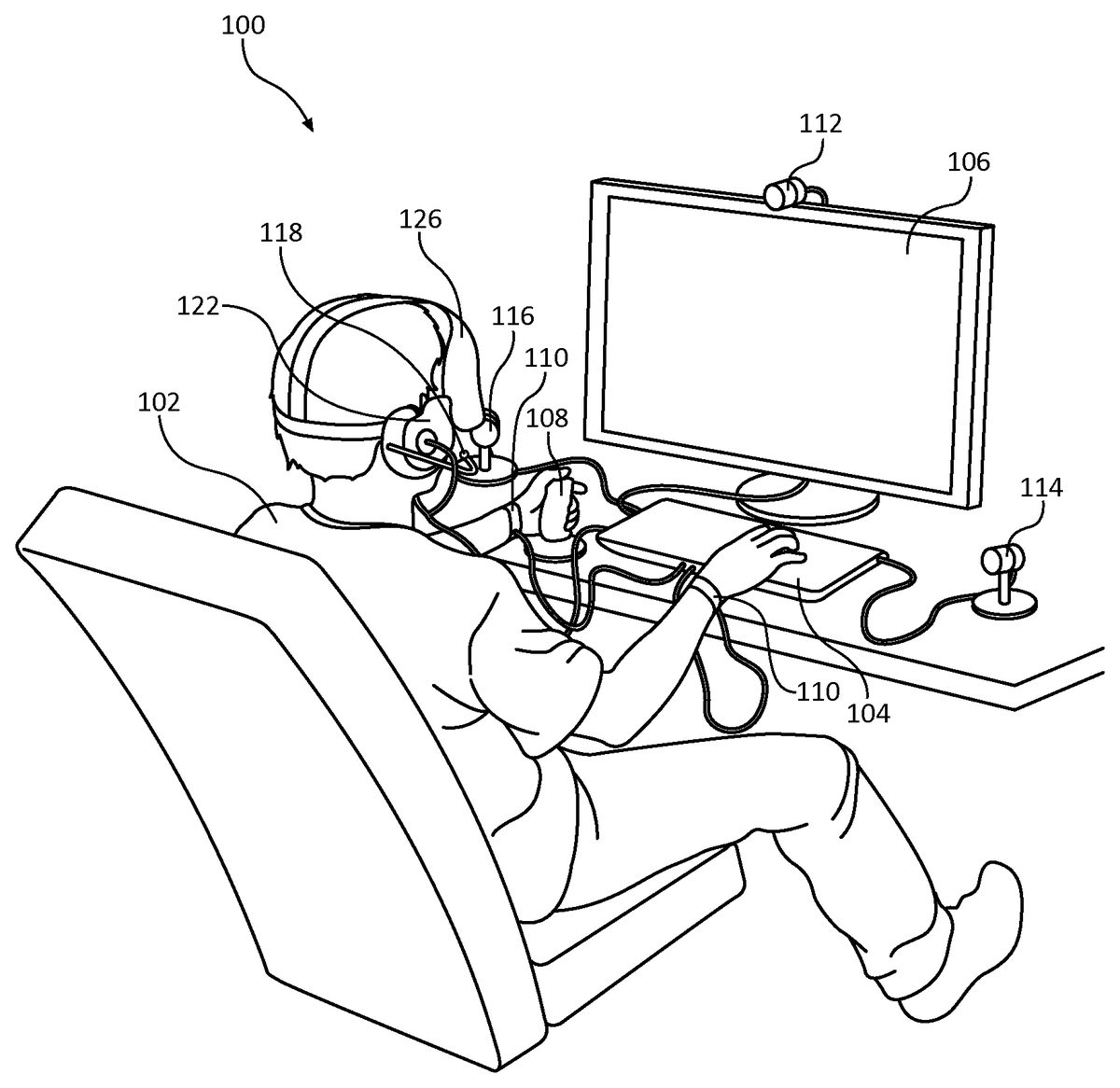
To further illustrate an exemplary embodiment for performing data capture functionality,FIG. 1, following, illustrates an exemplary gaming environment100in which various aspects of the illustrated embodiments may be implemented. In the gaming environment100shown, a user/player102is seated. A gaming console110provides the hardware component(s) for the gaming software, data collection, analysis, and shared functionality of various aspects of the illustrated embodiments as will be further described.
Various peripheral devices may be connected to gaming console110as one of ordinary skill in the art might appreciate. A graphical user interface (GUI)106is shown, which may render video information that the user102sees. The user102may use/implement joystick108to provide control information in the gaming environment for, for example, movement of a virtualized person throughout the environment.
A variety of sensors (biometric and otherwise, cameras, and data collection devices are shown attached to the gaming console110. As a first example biometric wrist sensor110may be attached to each of the user102's wrists, to, for example, record various biometric information (e.g., pulse, heart rate, breathing rate, and the like).
In addition to biometric sensors110, a camera112may be trained on the user102's face to collect facial recognition features (e.g., to identify the user or collect data representative of facial cues the user102provides as the user navigates the gaming environment100). An additional camera114is connected to the gaming console104and may be configured to provide additional biometric or other visual information. For example, the camera114may be an infrared camera designed to monitor the body temperature of the user102as the user102navigates the gaming environment100. In addition to cameras112and114, an additional camera116may also be trained on another portion of the user102to record visual cues.
A microphone118is shown connected to the gaming console104. The microphone118may monitor the user102and record auditory cues, such as language, phrasing, emotional cues such as laughter, and the like. An additional biometric sensor122may be coupled to the user102's head to record biometric information such as brainwaves. Finally, an additional sensor126may be mounted to a headset device in order to monitor eye movement of the user102. As one of ordinary skill in the art will appreciate, a variety of sensory devices may be used in a specific implantation or to obtain specific information in regards to a particular user in a certain gaming environment.
Turning now toFIG. 2, a block diagram of various hardware200implemented to accomplish various aspects of the illustrated embodiments, is depicted. The hardware200includes hardware unit202, in bidirectional communication with the various sensors104previously described. The various sensors are thereby in bidirectional communication with the user102as shown.
Examining the hardware unit202further, various modules are incorporated to accomplish certain functionality according to aspects of the present invention. Each of the certain functionality will be further described, following. First, an analysis/monitoring module208receives and/or sends data to the various sensors104in the gaming environment. The analysis/monitoring module208is in communication with a central processing unit (CPU)204, as well as memory206.
In addition to the foregoing, an analytics module210is shown connected to an avatar module212, with various avatars214,216, and218corresponding to particular users in the gaming environment. In one embodiment, the analytics module210observes various aspects of a particular gaming environment and studies the relationship between the user102and the particular game play underway. The hardware unit202may contain data pertaining to a particular game, that is stored in memory206or elsewhere. For example, the data may include information that indicates that any player faces a monumental decision at a certain geographical location in the game, requiring a decision to be made by the user102. The analytics module210, in combination with the analysis module208, and other components, may observe and record the particular user102's reaction to the monumental decision, comparing the user102's reaction with other users' reactions, and, for example, the modules' own predictions about what the user102's reaction would be.
Examining avatar module212further, the avatar module may, in combination with analysis/monitoring module208and analytics module210, use various information recorded from the user102(e.g., biometric data, user reactions, verbal and nonverbal cues, visual cues, and the like) to begin to construct an avatar representation (e.g., avatars214,216, or218) for the particular user102. Such avatar214,216, and218then becomes the accumulation of various data, responses, and predictive information to construct a virtualized personality of the user102in the particular gaming environment. The various avatars214,216, and218may be stored in memory206, elsewhere in the hardware unit202, or as one of ordinary skill in the art will appreciate, on another hardware unit in a local or remote location, or elsewhere.
A brief discussion as to further analytics functionality provided by various components (e.g.,204,206,208, and210) in the hardware unit202(or otherwise, according to various embodiments of the present invention) is of further use. In one embodiment, based upon the monitoring of the gaming environment, in conjunction with various aspects of the gameplay itself, the various components and modules may implement decision-making functionality based on scenarios that unfolded per the system's expectations (what worked), scenarios that unfolded differently than the system's expectations (what didn't work), and furthermore, how each of the scenarios affected the user (e.g., how did the scenarios make the user feel).
In an additional embodiment, the various components in hardware unit202or elsewhere may be configured to monitor multiple-users at one time. Additionally, the various components may continue to implement a “learning” functionality such that over time, the various responses of the user102continue to be studied and analyzed, and various determinations about the user102may be adjusted accordingly.
The components of hardware unit202may, based on prior game play, develop and determine common trends that the user takes part. Consider the following example. At a certain point in the gaming environment, it may be determined that the user102always “hugs a wall” structure, or always “charges into” a structure. These observations and trends may then be later recorded and applied to the avatar representation of the user102so as to describe particular aspects of the persona, play style, and/or personality of the user102.
Turning now toFIG. 3, a flow chart diagram of an exemplary method300for fostering integration of a user in a multi-player gaming environment by a processor, according to one embodiment of the present invention, is depicted. Method300begins (step302) with the recording of a plurality of user bioanalytics over a period of time as the user interacts in and within the gaming environment (step304). Use of the term “bioanalytic” is intended to refer to any data, biometric or otherwise, that would provide relevant information as to the behavior of a particular user in a gaming environment. Bioanalytics may also refer to assessment, decision, or predictive information that is formulated by the mechanisms of the present invention to describe user behavior in some way.
Once the various user bioanalytics are recorded, the bioanalytics are compared against various game analytics that correspond to various aspects of particular game play (step306). “Game analytics” is intended to refer to aspects of the game and gaming environment itself, and to distinguish these data from data collected from, by and for the user.
Turning to step308, once the user bioanalytics and game analytics are obtained, based on these data, an avatar representation of the user in the particular gaming environment is constructed as will be further described. Method300then ends (step310).
In one embodiment, once the user avatar is constructed, the various components of the mechanisms of the illustrated embodiments enable the avatar to continue to learn. However, the avatar remains playable and distributable to other players in the gaming environment and/or elsewhere. These avatars may be loaded into gaming environments to replace typical A.I. “bots,” to allow users to interact with play styles that they are familiar with (e.g., their friends and acquaintances), and/or choose the play style (represented by a particular avatar) that they wish. In addition, avatars may be traded and/or distributed as the user (or other “owner) sees fit, to allow for others to partake in a particular multi-player experience.
Turning now toFIG. 4, following, an additional exemplary method400for fostering integration of a user in a multi-player gaming environment according to certain aspects of the present invention. Method400begins (step402) as a particular user begins game play (step404). Various bioanalytics are observed and recorded as the user interacts in the game play (step404). A number of examples of these bioanalytics have been previously described, but may include without limitation, eye movement, facial recognition, auditory responses, play style, intensity, and user mood.
The recorded bioanalytics are then compared with game analytics (step408). Based on the various comparisons, an avatar is constructed to reflect play style, intensity, mood and other player characteristics (step410). The avatar is then saved/recorded for the user (step412).
In a following decision step, the method400queries whether additional users are detected in the gaming environment (step414). If so, the method400returns to step408to perform similar functionality for an additional user, moving to perform steps410and412, where an additional avatar for that additional user is constructed. If no other users are detected, the method400moves to step416, where at a subsequent time in the future, the avatar is supplanted by various analytics (such as predictive analytics for user reactions). In addition, sharing properties of the avatar then become apparent in step418, as the avatar is made available to the user, additional users, or elsewhere for game play as a virtualized player. In step420, continuing, the avatar is supplanted by additional analytics operations, as data is obtained from the user at a subsequent time, or, in additional embodiments, data is obtained from additional user interaction with the particular user. The method400then ends (step422).
The present invention may be a system, a method, and/or a computer program product. The computer program product may include a computer readable storage medium (or media) having computer readable program instructions thereon for causing a processor to carry out aspects of the present invention.
The computer readable storage medium can be a tangible device that can retain and store instructions for use by an instruction execution device. The computer readable storage medium may be, for example, but is not limited to, an electronic storage device, a magnetic storage device, an optical storage device, an electromagnetic storage device, a semiconductor storage device, or any suitable combination of the foregoing. A non-exhaustive list of more specific examples of the computer readable storage medium includes the following: a portable computer diskette, a hard disk, a random access memory (RAM), a read-only memory (ROM), an erasable programmable read-only memory (EPROM or Flash memory), a static random access memory (SRAM), a portable compact disc read-only memory (CD-ROM), a digital versatile disk (DVD), a memory stick, a floppy disk, a mechanically encoded device such as punch-cards or raised structures in a groove having instructions recorded thereon, and any suitable combination of the foregoing. A computer readable storage medium, as used herein, is not to be construed as being transitory signals per se, such as radio waves or other freely propagating electromagnetic waves, electromagnetic waves propagating through a waveguide or other transmission media (e.g., light pulses passing through a fiber-optic cable), or electrical signals transmitted through a wire.
Computer readable program instructions described herein can be downloaded to respective computing/processing devices from a computer readable storage medium or to an external computer or external storage device via a network, for example, the Internet, a local area network, a wide area network and/or a wireless network. The network may comprise copper transmission cables, optical transmission fibers, wireless transmission, routers, firewalls, switches, gateway computers and/or edge servers. A network adapter card or network interface in each computing/processing device receives computer readable program instructions from the network and forwards the computer readable program instructions for storage in a computer readable storage medium within the respective computing/processing device.
Computer readable program instructions for carrying out operations of the present invention may be assembler instructions, instruction-set-architecture (ISA) instructions, machine instructions, machine dependent instructions, microcode, firmware instructions, state-setting data, or either source code or object code written in any combination of one or more programming languages, including an object oriented programming language such as Smalltalk, C++ or the like, and conventional procedural programming languages, such as the “C” programming language or similar programming languages. The computer readable program instructions may execute entirely on the user's computer, partly on the user's computer, as a stand-alone software package, partly on the user's computer and partly on a remote computer or entirely on the remote computer or server. In the latter scenario, the remote computer may be connected to the user's computer through any type of network, including a local area network (LAN) or a wide area network (WAN), or the connection may be made to an external computer (for example, through the Internet using an Internet Service Provider). In some embodiments, electronic circuitry including, for example, programmable logic circuitry, field-programmable gate arrays (FPGA), or programmable logic arrays (PLA) may execute the computer readable program instructions by utilizing state information of the computer readable program instructions to personalize the electronic circuitry, in order to perform aspects of the present invention.
Aspects of the present invention are described herein with reference to flowchart illustrations and/or block diagrams of methods, apparatus (systems), and computer program products according to embodiments of the invention. It will be understood that each block of the flowchart illustrations and/or block diagrams, and combinations of blocks in the flowchart illustrations and/or block diagrams, can be implemented by computer readable program instructions.
These computer readable program instructions may be provided to a processor of a general purpose computer, special purpose computer, or other programmable data processing apparatus to produce a machine, such that the instructions, which execute via the processor of the computer or other programmable data processing apparatus, create means for implementing the functions/acts specified in the flowchart and/or block diagram block or blocks. These computer readable program instructions may also be stored in a computer readable storage medium that can direct a computer, a programmable data processing apparatus, and/or other devices to function in a particular manner, such that the computer readable storage medium having instructions stored therein comprises an article of manufacture including instructions which implement aspects of the function/act specified in the flowchart and/or block diagram block or blocks.
The computer readable program instructions may also be loaded onto a computer, other programmable data processing apparatus, or other device to cause a series of operational steps to be performed on the computer, other programmable apparatus or other device to produce a computer implemented process, such that the instructions which execute on the computer, other programmable apparatus, or other device implement the functions/acts specified in the flowchart and/or block diagram block or blocks.
The flowchart and block diagrams in the Figures illustrate the architecture, functionality, and operation of possible implementations of systems, methods, and computer program products according to various embodiments of the present invention. In this regard, each block in the flowchart or block diagrams may represent a module, segment, or portion of instructions, which comprises one or more executable instructions for implementing the specified logical function(s). In some alternative implementations, the functions noted in the block may occur out of the order noted in the figures. For example, two blocks shown in succession may, in fact, be executed substantially concurrently, or the blocks may sometimes be executed in the reverse order, depending upon the functionality involved. It will also be noted that each block of the block diagrams and/or flowchart illustration, and combinations of blocks in the block diagrams and/or flowchart illustration, can be implemented by special purpose hardware-based systems that perform the specified functions or acts or carry out combinations of special purpose hardware and computer instructions.
Claims
- A method for fostering integration of a user in a multi-player gaming environment by a processor, comprising: recording each of a plurality of user bioanalytics over a period of time as the user interacts in the multi-player gaming environment by using at least one biometric device to monitor and record user input, the at least one biometric device monitoring at least one of an auditory cue from the user and a visual cue from the user;wherein monitoring the auditory cue further includes monitoring and recording at least one of spoken information and laughter;and further wherein monitoring the visual cue further includes monitoring and recording emotive information based on recognition patterns identified from at least a portion of the user's face;comparing the recorded bioanalytics against a plurality of game analytics corresponding to aspects of game play in the multi-player gaming environment over the period of time;and based on the bioanalytics and game analytics, constructing an avatar representation of the user for the multi-player gaming environment.
- The method of claim 1 , wherein constructing the avatar representation further includes forming at least one prediction, for the user, of behavior during a certain game analytic in a future multi-player gaming environment.
- The method of claim 1 , wherein recording each of the plurality of user bioanalytics further includes recording a reaction of the user to a certain game analytic at a particular time.
- The method of claim 1 , wherein recording each of the plurality of user bioanalytics further includes recording at least one of a controller movement and play style of the user.
- The method of claim 1 , further including, subsequent to constructing the avatar representation: making the avatar representation accessible to the user, or additional users, in the multi-player gaming environment for use as a virtual representation of the user, and continuing to perform the recording of the bioanalytics for the avatar representation when the user is present, and comparing the recorded bioanalytics against the game analytics, in order to supplement the construction of the avatar representation over time.
- A system for fostering integration of a user in a multi-player gaming environment, comprising: a processor, operational in the multi-player gaming environment, that: records each of a plurality of user bioanalytics over a period of time as the user interacts in the multi-player gaming environment by using at least one biometric device to monitor and record user input, the at least one biometric device monitoring at least one of an auditory cue from the user and a visual cue from the user;wherein monitoring the auditory cue further includes monitoring and recording at least one of spoken information and laughter;and further wherein monitoring the visual cue further includes monitoring and recording emotive information based on recognition patterns identified from at least a portion of the user's face, compares the recorded bioanalytics against a plurality of game analytics corresponding to aspects of game play in the multi-player gaming environment over the period of time, and based on the bioanalytics and game analytics, constructs an avatar representation of the user for the multi-player gaming environment.
- The system of claim 6 , wherein the processor, pursuant to constructing the avatar representation, forms at least one prediction, for the user, of behavior during a certain game analytic in a future multi-player gaming environment.
- The system of claim 6 , wherein the processor, pursuant to recording each of the plurality of user bioanalytics, records a reaction of the user to a certain game analytic at a particular time.
- The system of claim 6 , wherein the processor, pursuant to recording each of the plurality of user bioanalytics, records at least one of a controller movement and play style of the user.
- The system of claim 6 , wherein the processor, subsequent to constructing the avatar representation: makes the avatar representation accessible to the user, or additional users, in the multi-player gaming environment for use as a virtual representation of the user, and continues to perform the recording of the bioanalytics for the avatar representation when the user is present, and comparing the recorded bioanalytics against the game analytics, in order to supplement the construction of the avatar representation over time.
- A computer program product for fostering integration of a user in a multi-player gaming environment by a processor, the computer program product comprising a non-transitory computer-readable storage medium having computer-readable program code portions stored therein, the computer-readable program code portions comprising: a first executable portion that records each of a plurality of user bioanalytics over a period of time as the user interacts in the multi-player gaming environment by using at least one biometric device to monitor and record user input, the at least one biometric device monitoring at least one of an auditory cue from the user and a visual cue from the user;wherein monitoring the auditory cue further includes monitoring and recording at least one of spoken information and laughter;and further wherein monitoring the visual cue further includes monitoring and recording emotive information based on recognition patterns identified from at least a portion of the user's face;a second executable portion that compares the recorded bioanalytics against a plurality of game analytics corresponding to aspects of game play in the multi-player gaming environment over the period of time;and a third executable portion that, based on the bioanalytics and game analytics, constructs an avatar representation of the user for the multi-player gaming environment.
- The computer program product of claim 11 , further including a fourth executable portion that, pursuant to constructing the avatar representation, forms at least one prediction, for the user, of behavior during a certain game analytic in a future multi-player gaming environment.
- The computer program product of claim 11 , further including a fourth executable portion that, pursuant to recording each of the plurality of user bioanalytics,records a reaction of the user to a certain game analytic at a particular time.
- The computer program product of claim 11 , further including a fourth executable portion that, pursuant to recording each of the plurality of user bioanalytics, records at least one of a controller movement and play style of the user.
- The computer program product of claim 11 , further including a fourth executable portion that, subsequent to constructing the avatar representation: makes the avatar representation accessible to the user, or additional users, in the multi-player gaming environment for use as a virtual representation of the user, and continues to perform the recording of the bioanalytics for the avatar representation when the user is present, and comparing the recorded bioanalytics against the game analytics, in order to supplement the construction of the avatar representation over time.
Disclaimer: Data collected from the USPTO and may be malformed, incomplete, and/or otherwise inaccurate.