U.S. Pat. No. 9,795,885
PROVIDING VIRTUAL CONTAINERS ACROSS ONLINE GAMES
AssigneeAftershock Services, Inc.
Issue DateMarch 11, 2014
Illustrative Figure
Abstract
System and method for providing cross-game virtual containers in online games are disclosed. Virtual items usable in multiple online games may be packaged in a cross-game virtual container. Instances of cross-game virtual container may be presented for purchase by user in a virtual store. The price of a given instance of cross-game virtual container may be set as a fraction of the total of the individual prices of the virtual items in the given instance of cross-game virtual container. After an activation of a purchased instance of cross-game virtual container by a user in one of the online games, virtual items in the purchased instance of cross-game virtual container may be made available for access to the user in respective online games. In some examples, a notification may be generated for informing the user of the availability of the virtual items in the activated instance of cross-game virtual container.
Description
DETAILED DESCRIPTION FIG. 1illustrates a system100for providing cross-game virtual containers in online games. Providing the online games may include hosting the online games over a network. In some implementations, as shown in this example, system100may include servers102configured for hosting online games. As shown, a given server102may be configured to communicate with one or more client computing platforms104according to a client/server architecture, and with each other. The users may access system100and/or the virtual space via client computing platforms104. As shown, the servers102may comprise processors108configured to execute computer readable instructions to implement system components. The computer program components may include one or more of a game component112, a store component, a cross-game virtual container activation component116, a notification component118, and/or other components. The game component112may be configured to execute an instance of a given online game. The given online game may include a first online game, a second online game, or any other online game. Within the instance of the first online game, users of the first online game may interact with elements in the first online game and/or with each other through gameplays provided by the first online game. The gameplays may include role-playing, first-person shooter, real-time strategy, turn-based strategy, simulation, music or rhythm playing, social interaction, twitching and/or any other gameplays. The execution of the instance of the first online game by game component112may include determining a state associated with the first online gam. The state may be communicated (e.g., via streaming visual data, via object/position data, and/or other state information) from server102to client computing platforms104for presentation to users. The state determined and transmitted to a given client computing platform104may correspond to a view for a user character being controlled by a user via the given client computing platform104. The state determined and transmitted to a given client computing platform104may ...
DETAILED DESCRIPTION
FIG. 1illustrates a system100for providing cross-game virtual containers in online games. Providing the online games may include hosting the online games over a network. In some implementations, as shown in this example, system100may include servers102configured for hosting online games. As shown, a given server102may be configured to communicate with one or more client computing platforms104according to a client/server architecture, and with each other. The users may access system100and/or the virtual space via client computing platforms104. As shown, the servers102may comprise processors108configured to execute computer readable instructions to implement system components. The computer program components may include one or more of a game component112, a store component, a cross-game virtual container activation component116, a notification component118, and/or other components.
The game component112may be configured to execute an instance of a given online game. The given online game may include a first online game, a second online game, or any other online game. Within the instance of the first online game, users of the first online game may interact with elements in the first online game and/or with each other through gameplays provided by the first online game. The gameplays may include role-playing, first-person shooter, real-time strategy, turn-based strategy, simulation, music or rhythm playing, social interaction, twitching and/or any other gameplays. The execution of the instance of the first online game by game component112may include determining a state associated with the first online gam. The state may be communicated (e.g., via streaming visual data, via object/position data, and/or other state information) from server102to client computing platforms104for presentation to users. The state determined and transmitted to a given client computing platform104may correspond to a view for a user character being controlled by a user via the given client computing platform104. The state determined and transmitted to a given client computing platform104may correspond to a location in a first game space associated with the first online game. The view described by the state for the given client computing platform may correspond, for example, to the location from which the view is taken, the location the view depicts, and/or other locations, a zoom ratio, a dimensionality of objects, a point-of-view, and/or view parameters of the view. One or more of the view parameters may be selectable by the user.
The instance of the first online game may be persistent. That is, the first online game may continue on whether or not individual users are currently logged in and/or participating in the online game. A user that logs out of the first online game and then logs back in some time later may find the first game space associated with the first online game has been changed through the interactions of other users with the first game space during the time the user was logged out. These changes may include changes to the simulated physical space, changes in the user's inventory, changes in other users' inventories, changes experienced by non-user characters, and/or other changes.
The instance of the first online game may comprise a simulated game space, e.g., a first game space that is accessible by users via clients (e.g., client computing platforms104) that present the views of the first game space to a user. The first game space may have a topography, express ongoing real-time interaction by one or more users and/or include one or more objects positioned within the topography that are capable of locomotion within the topography. In some instances, the topography may be a two-dimensional topography. In other instances, the topography may be a three-dimensional topography. The topography may include dimensions of the space and/or surface features of a surface or objects that are “native” to the space. In some instances, the topography may describe a surface (e.g., a ground surface) that runs through at least a substantial portion of the space. In some instances, the topography may describe a volume with one or more bodies positioned therein (e.g., a simulation of gravity-deprived space with one or more celestial bodies positioned therein). The instance executed by the computer components may be synchronous, asynchronous, and/or semi-synchronous.
The instance of the first online game may comprise virtual space entities automatically controlled in the instance of the first online game. Such virtual space entities may not be associated with any user. As such, the automatically controlled virtual space entities may be generated and/or developed by artificial intelligence configured with the server102by a provider, administrator, moderator, and/or any other entities related to the online game. These automatically controlled entities may evolve within the virtual space associated with the first online game free from user controls and may interact with the entities controlled by or associated with the users, other automatically controlled virtual space entities, as well as the topography of the first game space. Certain manifested traits may be associated with the automatically controlled entities in accordance with the artificial intelligence configured with the server102. As used herein, such automatically controlled virtual space entities in the instance of the online game are referred to as “AI entities”.
The above description of the manner in which state of the first game space associated with the first online game as determined by game component112is not intended to be limiting. The game component112may be configured to express the first game space in a more limited, or richer, manner. For example, views determined for the first game space representing the state of the instance of the first game space may be selected from a limited set of graphics depicting an event in a given place within the first game space. The views may include additional content (e.g., text, audio, pre-stored video content, and/or other content) that describes particulars of the current state of the place, beyond the relatively generic graphics. For example, a view may include a generic battle graphic with a textual description of the opponents to be confronted. Other expressions of individual places within the virtual space are contemplated.
Within the instance of the first online game executed by game component112, the users may participate in the instance of the first online game by controlling one or more of an element in the first game space associated with the online game. The user-controlled elements may include avatars, game space characters, game space units (e.g., troops), objects (e.g., weapons, horses, vehicle and so on), simulated physical phenomena (e.g., wind, rain, earthquakes, and/or other phenomena), and/or other user-controlled elements. The user-controlled avatars may represent the users in the first game space. The user characters may include heroes, knights, commanders, leaders, generals and/or any other virtual space entities that may possess strength, skills, abilities, magic powers, knowledge, and/or any other individualized attributes. The virtual space units controlled by the user may include troops and/or any other virtual space entities that may be trained, recruited, captured, and/or otherwise acquired by the users in groups or en mass. The objects controlled by the users may include weapons, vehicles, projectiles, magic items, wardrobes, boots, armor, knapsacks, medicine, healing potion, and/or any other virtual items that may be employed by the users for interaction within the first online game.
In any case, the user-controlled elements may move through and interact with the first game space (e.g., AI entities, elements controlled by other users and/or topography in the virtual space) associated with the first online game. The elements controlled by a given user may be created and/or customized by the given user. The given user may have an “inventory” of virtual goods and/or currency usable within the first game space.
Controls of virtual elements in the first game space may be exercised through commands input by a given user through client computing platforms104. The given user may interact with other users through communications exchanged within the first game space. Such communications may include one or more of textual chat, instant messages, private messages, voice communications, and/or other communications. Communications may be received and entered by the users via their respective client computing platforms104. Communications may be routed to and from the appropriate users through server102(e.g., through game component112).
A given user may input commands with specific parameters to undertake specific deeds, actions, functions, spheres of actions and/or any other types of interactions within the first game space. For example, the given user may input commands to construct, upgrade and/or demolish virtual buildings; harvest and/or gather virtual resources; heal virtual user-controlled elements, AI entities and/or elements controlled by other users; train, march, transport, reinforce, reassign, recruit, and/or arrange troops; attack, manage, create, demolish and/or defend cities, realms, kingdoms, and/or any other virtual space locations controlled by or associated with the users; craft or transport virtual items; interact with, compete against or along with AI entities and/or virtual space elements controlled by other users in combats; research technologies and/or skills; mine and/or prospect for virtual resources; complete missions, quests, and/or campaigns; exercise magic power and/or cast spells; and/or perform any other specific deeds, actions, functions, or sphere of actions within the virtual space. In some examples, the given user may input commands to compete against elements in an environment within the virtual space—i.e., Player vs. Environment (PvE) activities. In some examples, the given user may input commands to compete against each other within the virtual space—i.e., Player vs. Player (PvP) activities.
The game component112may be configured to execute user actions to facilitate interaction of the users with the first game space and/or each other in response to receiving virtual space commands input by the users. Execution of the user action by the game component112may produce changes to the game state, which may reflect progresses and/or results of the user actions. In some examples, state changes caused by the execution of the user actions may be recorded in the electronic storage110to facilitate persistency throughout the instance of the first online game. In some examples, execution of the user actions may not produce persistent changes to the game state (e.g., a user character jumping forward and backward successively may not produce any perceivable game state changes to other users).
It should be understood that individual servers102shown inFIG. 1may comprise corresponding game components112configured with functionalities described above and attributed to game component112. For example, an instance of a second online game may be executed by a game component in a server102. A second game space may be associated with the second online game. The second game space may provide gameplays similar to or different from those provided by the first game space. In some examples, the second online game may be hosted by a server102(or servers) different from that (or those) hosting the first online game. In some other examples, first and second online games may be hosted by the same server102.
In any case, the second game space associated with the second online game may be separate and discrete from the first game space associated with the first online game. Such a property of separation between the first and second online games may involve separate client-side applications for invoking respective online games, separate game space interfaces, separate game states, separate game characters, separate game rules, separate game mechanics, separate game objectives, separate users, and/or any other separate properties that distinguish the first game space associated with the first online game from the second game space associated with the second online game. By way of non-limiting example, the first online game may be an online game in which users play kingdom lords in the first game space that simulates a medieval world; and the second online game may be an online game in which users play future characters within the second game space that simulates a future world. In that example, the first online game may be separate and discrete from the second online game such that users of the first online game may not interact with the second game space from the first online game (e.g., through a game space interface of the first online game); and the users of the second online game may not interact with the first game space from the second online game. As described above, this may involve, but not be limited to, facilitating different game space interfaces for user interaction with the first online and second online games (e.g., a dedicated game space interface for the first online game and a dedicated game space interface for the second online game), maintaining separate state information corresponding to the first and second game spaces, maintaining separate user accounts associated with the first and second online games, providing different gameplays, characters, simulations, topography, and/or any other elements in first online game than in the second online game, and/or any other operations for operating the first and second online games separately and independently.
In some examples, the first and second online games may be developed and/or hosted by the same provider(s). In those examples, an interface may be implemented on a client computing platform104enabling a user to select in which online game to participate. For example, an icon representing the first online game and an icon representing the second online game may be presented in the interface side by side for the user to select in which online game to participate. In some other examples, the first and online game may be accessed through webpages over the Internet such that users may be logged into the first or second online games through the webpages. Other examples of accessing first and second online games are contemplated.
Within a given game space associated with a given online game executed by a server102, inventories of virtual items may be associated with users of the given online game. A given user inventory may provide an accounting of virtual items, such as virtual currencies, resources, objects, units, and/or any other game space elements that have been procured, controlled by, and/or otherwise associated with a given user in that game space. Such accounting of virtual items may reflect balances of the virtual items with associated the given user, e.g., a quantity of these virtual items, in the user inventory. The virtual items in a given user inventory may include virtual items, instances of virtual containers, virtual currencies, resources, objects usable in the game space (e.g., weapons, equipment, garments, etc.), units (e.g., troops), and/or any other virtual items under the given user's control in the given game space. By way of a non-limiting example, the given user may have an X number of virtual currencies, a Y number of a virtual resource (e.g., iron, ore, wood, coal, etc.), and a Z number of troops in the inventory associated with the given user. In that example, the X, Y, and Z may reflect a level of balance of the virtual currencies, resources, and troops associated with the given user respectfully.
Balances of virtual items in the user inventory may increase, replenish, or exhaust in response to the user acquiring or consuming the virtual items through a virtual store operated by the provider of the game space, user actions in the game space (e.g., acquiring virtual objects, harvesting resources, consuming resources for crafting, etc.), game space activities participated in by the user, and/or other events associated with the user in which the user may acquire and/or consume virtual items. For example, construction actions initiated by users may consume specific resources in accordance with resource requirements associated with the construction actions, and the user inventory may exhaust the specific resource in the user inventory during execution of the construction. Conversely, users may acquire virtual containers, resources, virtual items, and/or other game space elements in the instance of the game space, and the balance of the virtual items in the user inventory may increase accordingly to reflect the user acquisition.
A user may access (e.g., use or consume) virtual items in the user inventory associated with the user within a given game space. In some examples, an inventory interface may be presented to the user on client computing platform104upon the user's request to access virtual items in the user inventory associated with the user in the given game space. Through the inventory interface, the user may assign a virtual item in the inventory to a body slot of the user character such that the user character “wears” the virtual item in the given game space. As another non-limiting example, through the user inventory interface, the user may consume a virtual item such as potion to restore health of the user character. Still in another example, through the inventory interface, the user may retrieve a virtual item (e.g., a key) in the user inventory to complete a task (e.g., unlock a door). However, it should be understood this is merely illustrative. Other ways of accessing virtual items of a user in the given space are contemplated. For example, a quick access interface may be presented to the user on the client computing platform104as a part of the game space interface such that the user may use virtual items appearing in the quick access interface. In another example, a user may access virtual items in the user inventory through keyed-in commands (e.g., ctrl 1, 2, 3, 4 and so on) for switching equipment carried by the user character (e.g., switching weapons).
The store component114may be configured to present offers to sell instances of cross-game virtual containers to users. The store component may present offers of virtual items and/or services through a store interface representing a virtual store in a given game space. Such a store interface may be implemented on client computing platforms. Through the store interface, a user may be enabled to purchase an instance of the cross-game virtual container. For instance, through a store interface implemented on a client computing platform, a user may click on an offer of an instance of a cross-game virtual container presented in the store interface to purchase the instance of the virtual container.
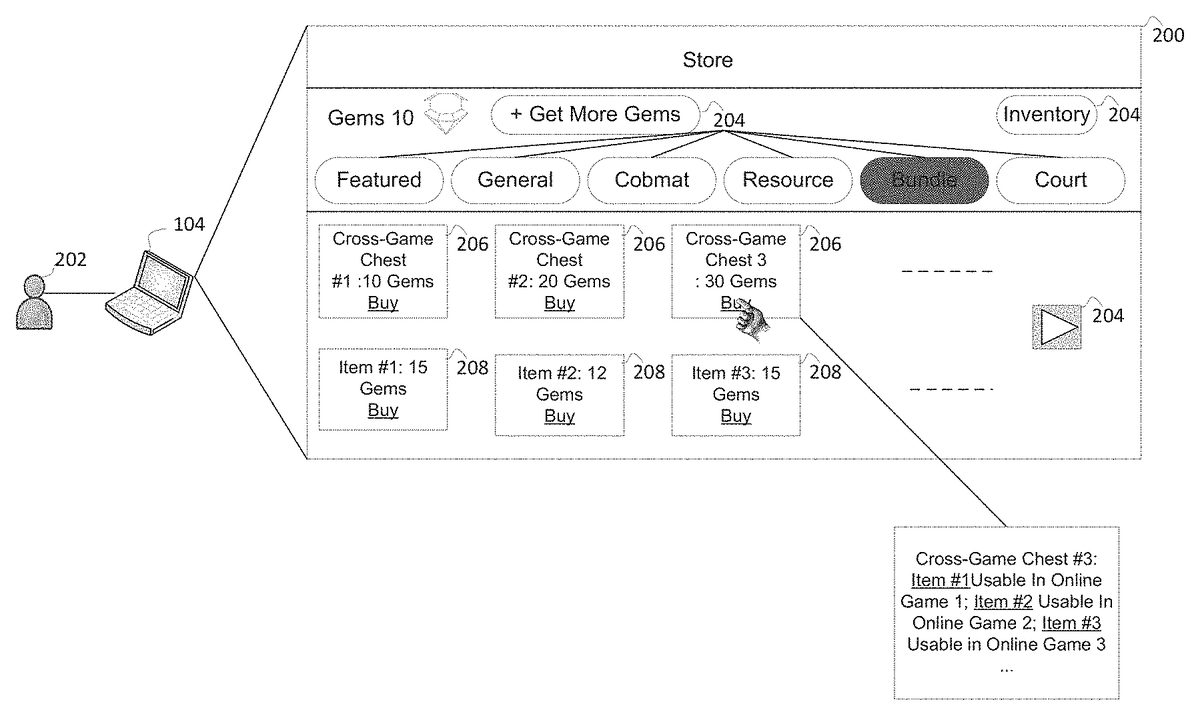
FIG. 2illustrates an example of a store interface associated with a given online game hosted by the system shown inFIG. 1as presented on a client computing platform. As can be seen inFIG. 2, a user202may be enabled to access the store interface200through a client computing platform104associated with the user202. As shown in this example, the store interface200may include field controls204, such as buttons, tabs, input boxes and/or any other filed controls204to enable the user to interact with the store interface200. As shown, the store interface200may include multiple sections of virtual items for sale to the users and each section may be organized by the functions the virtual items in that section serve, as suggested by the tabs204. It should be noted that the store interface200may include an indication or indications of user balance of virtual currencies in his/her account. In this example, as shown, the user202has 10 gems (virtual currency) left in his account. As also shown, the user may purchase additional gems by clicking the “Get More Gems” button204. As also shown in this example, the store interface200may include an “inventory” button204that will take the user to his/her inventory. It should be understood that the store interface200may be associated with the first online game, second online game, and/or any other online games hosted by system100shown inFIG. 1.
As illustrated in this example, a section of bundled package may be presented in the store interface200presenting instances of cross-game virtual containers206. As shown in this example, individual instances of cross-game virtual containers206in the store interface200may be offered for purchase in exchange for virtual consideration from users. In this example, the virtual consideration for the instances of the cross-game virtual container is in the form of virtual concurrency such as gems, as shown. However, this is not intended to be limiting. It should be appreciated that the instances of cross-game virtual containers206may be offered for real world money credit, virtual credit (e.g., such as points), and/or any other form virtual consideration.
As shown in this example, the bundle section of the store interface200presents instances of cross-game virtual containers206for user to purchase. In this example, the offers presented in the store interface200include offers of instances cross-game virtual chests206and individual virtual items208. As shown, instances of virtual containers206may be presented in exchange for virtual currencies from the user302, e.g., gems. As illustrated in this example, the user302may click on the “buy” button on an instance of the cross-game virtual container at a given time. As will be described below, the purchased instance of the instance of cross-game virtual container206may be activated by user.
As can be seen fromFIG. 2, a given instance of cross-game virtual container206may comprise virtual items usable in multiple online games. For example, without limitation, the cross-game virtual chest shown in this example comprises a first virtual item usable in the first online game, a second virtual item usable the second online game, and any other virtual items usable in other online games (if any). The virtual items included in an instance of the cross-game virtual container may include armor, weapon, speedup items, gears, magic items, decorative items, troops, and/or any other types of virtual items.
An armor item may provide a barrier for user characters during combats in a given game space. Common examples of an armor item may include, but not be limited to, leather armor, hide armor, chainmail (e.g., metal rings woven) armor, jackets, mantels, woven robes, padded vests, shields and any other types of armor.
A weapon item may provide attack prowess to the user character during combats within a given game space. Common examples of a weapon item may include melee weapon (e.g., sword, axe, knife, and any other types of melee weapons that can be used to attack enemies directly), ranged weapon (e.g., bow, spears, and any other types of ranged weapons that can be used to attack enemies some distance away), and other types of weapons.
A gear item may provide specific functionality to the user character within a given game space. Common examples of a gear item may include ammunition, backpack, pouch, belt, wand, chain, key, flask, lantern, rope, spell book, food, drink, tent, mounts, transport, and any other types of gear items.
A speedup item may speed up an amount of time left for user to complete a task in a given game space. For example, a construction speedup item may be used to speed up the amount of time left to complete a construction task by the user in the given game space. Common examples of speedup items may include construction, troop training, researching, leveling up, transportation, character advancing, farming, mining, harvesting, and/or any other types of speedup items for speeding up time-gated tasks in the given game space.
A magic item may provide magic power to user character in a given game space. Magic power may include super power that is not ordinarily possible. Examples of magic items may be in various forms. Some of them may include enchanted items, bloodlust items, invisibility items, attack power boost items, healing power items, necromancy items, hasting items, teleport items, fireball items, berserk items and any other types of magic items.
As should be clear, a given instance of the cross-game virtual container206may include virtual items usable in multiple online games. For example, an instance of a virtual chest may contain a first weapon item usable in the first online game, a second weapon item usable in the second online game, and other virtual items (if any). The instance of the cross-game virtual container may be provided for purchase in the store associated with the first online game, second online game, and/or any other online games.
In some examples, presenting offers of instance of cross-game virtual containers in the store interface by the store component114may include obtaining a price for an offer to sell an instance of a given virtual container. The prices obtained in those examples by the store component114may be such that they are perceived as bargains to users. For example, without limitation, an instance of cross-game virtual chest206offered for purchase in the interface200may contain a first virtual item usable in the first online game, a second virtual item usable in the second online game, and other virtual item(s) (if any). In that example, the price obtained by the store component114may be such that it is a fraction of a total of the prices for purchasing the first and second virtual items individually. For instance, the first virtual item may be offered for purchase in the interface200for X amount of virtual currency, and the second virtual item may be offered for purchase in the interface200for Y amount of virtual currency; and the instance of cross-game virtual container206comprising the first and second virtual items may be offered for purchase for X+Y−Z amount of virtual currencies, wherein Z>0. In another example, the second virtual item in the instance of cross-game virtual container206may be offered free or nearly free in the store associated with the first online game. That is, in that example, purchasing the first virtual item and the instance of cross-game virtual container206costs the user same amount of virtual currency. In this way, the user may be incentivized to purchase the instance of cross-game virtual container206and may incline to interact with the second online game some time later since the user has acquired the second virtual item through the purchased instance of cross-game virtual container206.
In some examples, offers of the individual virtual items in the cross-game virtual container206may be presented in the store interface200next to a given instance of cross-game virtual container206so that a user may be informed of the bargain price at which a given instance of the cross-game virtual container is being offering. This is illustrated inFIG. 2. As can be seen fromFIG. 2, items #1, #2, #3, which are included in the instance of cross-game virtual container206shown, may be offered for purchase in the same section where the instances of cross-game virtual containers206are presented to users. In this way, it may be clear to the user that the offer of an instance of cross-game virtual container206is a bargain. This may incentivize the user to purchase cross-game virtual containers206.
The cross-game virtual container activation component116may be configured to activate instances of the cross-game virtual containers purchased by the users in the store associated with a given online game hosted by a server102. To achieve this, the cross-game virtual container activation component116may receive an activation request from a user for activating a given instance of the cross-game virtual container purchased by the user in the given online game. For example, the user may be enabled to send an activation request (e.g., a mouse click or finger tap on the given instance of the cross-game virtual container) to activate the given instance of the cross-game virtual container purchased by the user.FIG. 3illustrates an example of activating an instance of the cross-game virtual container purchased by a user.
Responsive to receiving an activation request from a user to activate an instance of the cross-game virtual container, the cross-game virtual container activation component116may be configured to make the virtual items included in the activated instance of cross-game virtual container available for access by the user in respective online games. This may involve mapping user names in different online games, locating user accounts in those online games, distributing the virtual items to user inventories associated with the located user accounts in those online games, and/or any other operations.
By way of non-limiting example, responsive to receiving an activation by the user, in a first online game, to activate an instance of the cross-game virtual container containing a first virtual item usable in a first online and a second virtual item usable in the second online game, the cross-game virtual container activation component116may distribute the first virtual item to the user inventory in the first online game, locate a user account associated with the user in the second online game, and distribute (e.g., record) the second virtual item to the user inventory in the second online game. However, this is merely illustrative. Other examples of making the second virtual item available to the user upon user activation of the purchased instance of the cross-game virtual container are contemplated. For example, a centralized virtual item inventory may be managed for a given user and individual virtual items in the centralized virtual item inventory may be associated with a corresponding game space in which the individual virtual items are available for access by the user.
In some examples, activation of a given instance of the cross-game virtual container by the cross-game virtual container activation component116may include obtaining a period of time during which one or more virtual items are available for access by users. For example, a virtual item in the activated instance of the cross-game virtual container may be available for access by the user for one hour, one day, one week, one month, or any other period of time after the instance of the cross-game virtual container is activated by the cross-game virtual container activation component116. In some embodiments, such a period may be obtained from a user interface for the provider, administrator, moderator, and/or any other entities related to the server(s)102shown inFIG. 1. For instance, without limitation, an administrator of the server(s)102may set a period of time (e.g., one week) for a given virtual item (usable in a given game space) in an activated instance of the cross-game virtual container. In some other examples, obtaining such a period by the cross-game virtual container activation component116may include determining the period automatically based on one or more user metrics, game metrics, and/or any other types of metrics. For instance, the period of access may be set to span across a holiday or vacation period during which many users would have time to interact with online games hosted by system100. In another example, the period of access may be determined based on usage of an online game. For instance, if an online game is not engaged by users frequently, a long period of access may be determined to enable users to use virtual items usable in that online extensively.
In some examples, activation of a given instance of the cross-game virtual container by the cross-game virtual container activation component116may include some random factor for distributing virtual items associated with the given instance of the cross-game virtual container to the users. In those examples, the given instance of the cross-game virtual container may be associated with a set of potential virtual items that may be distributed to users. The individual ones of the set of the potential virtual items may be associated with a probability of distribution; and actual virtual items distributed to a user upon the user's activation of the instance of the cross-game virtual container may be based on such probabilities. Examples of such cross-game virtual containers may include, but not be limited to, a mystery box, random box, surprise treasure trove, and/or any other types of cross-game virtual containers that may include a random factor to distribute virtual items.
The notification component118may be configured to generate notifications for notifying users that virtual items in activated instances of the cross-game virtual containers by the user in a given game space have been made available for access by the users in one or more online games corresponding to the virtual items. The notifications generated by the notification component118may include notifications internal and/or external to online games hosted by system100. Internal notifications may include pop-up messages in a given online game, internal email messages through a mail system provided by the given online game, audible voice messages in the given online game announcing the notification, visual representations depicting the notification, and/or any other types of internal notifications presented to a user within a given online game. External notifications may include push notifications, external electronic messages facilitated by a third party, audible or visual notifications when users are not logged in the given game space, and any other types of external notifications.
The notifications generated by the notification component118may notify users that virtual items in the activated instance of the cross-game virtual container have been made available for the users to access in respective online games corresponding to those virtual items. By way of non-limiting example, after a given instance of the cross-game virtual container comprising a first virtual item usable in the first online game and a second virtual item usable in the second online game has been activated by a user in the first online game, the notification component118may generate a notification (e.g., a pop-up message) notifying the user that first virtual item has been made available for access (e.g., via the user inventory in the first online game), and the second virtual item has also been made available for access (e.g., via the user inventory in the second online game) by the user.
In some examples, the notifications generated by the notification component118may include information facilitating users to access the online games corresponding to virtual items in a given activated instance of the cross-game virtual container. For example, in some instances, the user may not have an account in the second online game although s/he activated a purchased instance of the cross-game virtual container containing a virtual item usable in the second online game. In that example, the notification component118may generate the notification to include information informing the user of means to acquire or activate an account in the second online game. For instance, without limitation, such information may include a location (e.g., a URL) where the user may register an account in the second online game.
In some examples, one or more virtual items in an activated instance of the cross-game virtual container may be made available for access within a period of time. In those examples, the notifications generated by the notification component118may include information indicating such a period of time. For example, without limitation, the second virtual item (usable in the second online game) in the activated instance of the cross-game virtual container may be made available for access by the cross-game virtual container activation component116within a determined period of time (e.g., for one week immediately after the activation of the purchased instance of cross-game virtual container). In that example, the notification component118may include information indicating such a period to the user. This may incentivize the user to interact with the second online game within the determined period of time.
The server102, client computing platforms104, and/or external resources106may be operatively linked via one or more electronic communication links. For example, such electronic communication links may be established, at least in part, via a network such as the Internet and/or other networks. It will be appreciated that this is not intended to be limiting, and that the scope of this disclosure includes implementations in which servers102, client computing platforms104, and/or external resources106may be operatively linked via some other communication media.
A given client computing platform104may include one or more processors configured to execute computer program components. The computer program components may be configured to enable an expert or user associated with the given client computing platform104to interface with system100and/or external resources106, and/or provide other functionality attributed herein to client computing platforms104. By way of non-limiting example, the given client computing platform104may include one or more of a desktop computer, a laptop computer, a handheld computer, a tablet computing platform, a NetBook, a Smartphone, a gaming console, and/or other computing platforms.
The external resources106may include sources of information, hosts and/or providers of virtual environments outside of system100, external entities participating with system100, and/or other resources. In some implementations, some or all of the functionality attributed herein to external resources106may be provided by resources included in system100.
A given server102may include electronic storage110, one or more processors108, and/or other components. The given server102may include communication lines, or ports to enable the exchange of information with a network and/or other computing platforms. Illustration of the given server102inFIG. 1is not intended to be limiting. The given server102may include a plurality of hardware, software, and/or firmware components operating together to provide the functionality attributed herein to server102. For example, the given server102may be implemented by a cloud of computing platforms operating together as server102.
Electronic storage110may comprise electronic storage media that electronically stores information. The electronic storage media of electronic storage110may include one or both of system storage that is provided integrally (i.e., substantially non-removable) with server102and/or removable storage that is removably connectable to server102via, for example, a port (e.g., a USB port, a firewire port, etc.) or a drive (e.g., a disk drive, etc.). Electronic storage110may include one or more of optically readable storage media (e.g., optical disks, etc.), magnetically readable storage media (e.g., magnetic tape, magnetic hard drive, floppy drive, etc.), electrical charge-based storage media (e.g., EEPROM, RAM, etc.), solid-state storage media (e.g., flash drive, etc.), and/or other electronically readable storage media. The electronic storage110may include one or more virtual storage resources (e.g., cloud storage, a virtual private network, and/or other virtual storage resources). Electronic storage110may store software algorithms, information determined by processor108, information received from server102, information received from client computing platforms104, and/or other information that enables server102to function as described herein.
Processor(s)108is configured to provide information processing capabilities in server102. As such, processor108may include one or more of a digital processor, an analog processor, a digital circuit designed to process information, an analog circuit designed to process information, a state machine, and/or other mechanisms for electronically processing information. Although processor108is shown inFIG. 1as a single entity, this is for illustrative purposes only. In some implementations, processor108may include a plurality of processing units. These processing units may be physically located within the same device, or processor108may represent processing functionality of a plurality of devices operating in coordination. The processor108may be configured to execute components112,114,116,118. Processor108may be configured to execute components112,114,116,118by software; hardware; firmware; some combination of software, hardware, and/or firmware; and/or other mechanisms for configuring processing capabilities on processor108.
It should be appreciated that although components112,114,116,118are illustrated inFIG. 1as being co-located within a single processing unit, in implementations in which processor108includes multiple processing units, one or more of components112,114,116,118may be located remotely from the other components. The description of the functionality provided by the different components112,114,116,118described below is for illustrative purposes and is not intended to be limiting, as any of components112,114,116,118may provide more or less functionality than is described. For example, one or more of components112,114,116,118may be eliminated, and some or all of its functionality may be provided by other ones of components112,114,116,118. As another example, processor108may be configured to execute one or more additional components that may perform some or all of the functionality attributed below to one of components112,114,116,118.
FIG. 4illustrates one exemplary method400for providing instances of cross-game virtual containers in an online game in accordance with the disclosure. The operations of method400presented below are intended to be illustrative. In some embodiments, method400may be accomplished with one or more additional operations not described, and/or without one or more of the operations discussed. Additionally, the order in which the operations of method400are illustrated inFIG. 4and described below is not intended to be limiting.
In some embodiments, method400may be implemented in one or more processing devices (e.g., a digital processor, an analog processor, a digital circuit designed to process information, an analog circuit designed to process information, a state machine, and/or other mechanisms for electronically processing information). The one or more processing devices may include one or more devices executing some or all of the operations of method400in response to instructions stored electronically on an electronic storage medium. The one or more processing devices may include one or more devices configured through hardware, firmware, and/or software to be specifically designed for execution of one or more of the operations of method400.
At an operation402, an instance of a first online game may be hosted. The users may interact with the game space by initiating game space commands to perform user actions. The instance of the first online game hosted in operation402may be associated with a first game space in which gameplays may be facilitated for users of the first online game. Within the first game space, users may control one or more of an element in the first game space. The users may input commands with specific parameters to undertake specific deeds, maneuvers, actions, functions, spheres of actions and/or any other types of interactions within the first game space. In some implementations, operation402may be performed by a game component the same as or similar to game component112(shown inFIG. 1and described herein).
At an operation404, offers to sell one or more instances of a cross-game virtual container may be presented in the first online game. The offers presented in operation404may be through a virtual store associated with the first online game. A given instance of the cross-game virtual container offered in the store interface may comprise virtual items usable in multiple online games. For example, without limitation, the given instance of the cross-game virtual container may include a first virtual item usable in the first online game, a second virtual item usable the second online game, and any other virtual items usable in other online games (if any). The virtual items included in an instance of the cross-game virtual container may include armor, weapons, speedup items, gear, magic items, decorative items, troops, and/or any other types of virtual items. In some implementations, operation404may be performed by a store component the same as or similar to store component114(shown inFIG. 1and described herein).
At an operation406, a request to activate a purchased instance of the cross-game virtual container may be received for a user in the first online game. This may involve mapping user names for the user in different online games, locating those user accounts for the user, and/or any other sub-operations. In some implementations, operation406may be performed by the cross-game virtual container activation component the same as or similar to cross-game virtual container activation component116(shown inFIG. 1and described herein).
At operation408, a first virtual item in the activated instance of the cross-game virtual container may be made available for access to the user in the first online game. This may involve distributing the first virtual item to a user inventory associated with the user in the first online game. In some implementations, operation408may be performed by the cross-game virtual container activation component the same as or similar to cross-game virtual container activation component116(shown inFIG. 1and described herein).
At an operation410, a second virtual item in the activated instance of the cross-game virtual container may be made available for access to the user in a second online game. This may involve distributing the second virtual item to a user inventory associated with the user in the second online game. The second online game may be separate and discrete from the first online game. In some implementations, operation410may be performed by the cross-game virtual container activation component the same as or similar to cross-game virtual container activation component116(shown inFIG. 1and described herein).
At an operation412, notification about the availability of the first and second virtual items in the first and second online games may be generated for presentation to the user. In some implementations, operation412may be performed by a notification component the same as or similar to notification component118(shown inFIG. 1and described herein).
Although the present technology has been described in detail for the purpose of illustration based on what is currently considered to be the most practical and preferred implementations, it is to be understood that such detail is solely for that purpose and that the technology is not limited to the disclosed implementations, but, on the contrary, is intended to cover modifications and equivalent arrangements that are within the spirit and scope of the appended claims. For example, it is to be understood that the present technology contemplates that, to the extent possible, one or more features of any implementation can be combined with one or more features of any other implementation.
Claims
- A first game server for facilitating cross-game virtual containers in multiple online games including a first online game and a second online game, the system comprising: one or more physical processors configured by machine-readable instructions to: host, by the one or more physical processors of the first game server, the first online game, the first online game being associated with a first game space in which the first online game is played;present, through a store interface in the first online game, offers to sell instances of cross-game virtual containers in exchange for consideration from the users of the first online game, individual ones of the instances of the cross-game virtual containers including virtual items usable in the first online game and virtual items usable in a second online game associated with a second game space in which the second online game is played, the second game space being separate and discrete from the first game space, wherein the second online game is hosted by a second game server that is separate and distinct from the first game server, the offers presented including a first offer of a first instance of a first cross-game virtual container including a first virtual item usable in the first online game and a second virtual item usable in the second online game;and receive activation requests from users for activating purchased instances of cross-game virtual containers purchased by the users in the first online game and responsive to such activation requests, make the virtual items in the purchased instances of the cross-game virtual containers available for access to the users such that responsive to a first activation request from the first user for activating the first instance of the first cross-game virtual container in the first online game, the first virtual item is made available for access to the first user in the first online game hosted by the first game server and the second virtual item is made available for access to the first user in the second online game hosted by the second game server, wherein the second virtual item included in the first instance of the first cross-game virtual container is a mystery item from a set of potential items associated with the first cross-game virtual container, individual ones of the set of potential items being usable in one or more online games other than the first online game, and wherein the one or more physical processors are further configured to, responsive to the first activation request, select the second virtual item from the set of the potential items associated with the first cross-game virtual container in accordance with a selection probability.
- The system of claim 1 , wherein the offers presented through the store interface in the first online game further include a second offer to sell an instance of the first virtual item at a first price, and a third offer to sell an instance of the second virtual item at a second price.
- The system of claim 2 , wherein the first offer to sell the instance of the first cross-game virtual container is presented through the store interface in the first online game at a third price that is a fraction of a total of the first price and the second price.
- The system of claim 3 , wherein the third price is equal to or nearly equal to the first or the second price.
- The system of claim 1 , wherein the one or more physical processors are further configured to, responsive to the first activation request, generate a notification for presentation to the first user in the first online game that the second virtual item has become available for access to the first user in the second online game.
- The system of claim 1 , wherein the second virtual item is made available for access to the first user in the second online game within a time period.
- The system of claim 6 , wherein the one or more physical processors are further configured to, responsive to the first activation request, generate a notification for presentation to the first user in the first online game that the second virtual item is available for access to the first user in the second online game for the time period.
- The system of claim 5 , wherein the notification generated includes information facilitating the user to access the second online game.
- A method for facilitating cross-game virtual containers in multiple online games including a first online game and a second online game, the method being implemented in one or more physical processors configured to execute computer programs, the method comprising: hosting, by a first game server, the first online game, the first online game being associated with a first game space in which the first online game is played;presenting, through a store interface in the first online game, offers to sell instances of cross-game virtual containers in exchange for consideration from the users of the first online game, individual ones of the instances of the cross-game virtual containers including virtual items usable in the first online game and virtual items usable in a second online game associated with a second game space in which the second online game is played, the second game space being separate and discrete from the first online game, wherein the second online game is hosted by a second game server that is separate and distinct from the first game server, the offers presented including a first offer of a first instance of a first cross-game virtual container including a first virtual item usable in the first online game and a second virtual item usable in the second online game;and receiving activation requests from users for activating purchased instances of cross-game virtual containers purchased by the users in the first online game and responsive to such activation requests, making the virtual items in the purchased instances of the cross-game virtual containers available for access to users such that responsive to a first activation request from the first user for activating the first instance of the first cross-game virtual container in the first online game, the first virtual item is made available for access to the first user in the first online game hosted by the first game server and the second virtual item is made available for access to the first user in the second online game hosted by the second game server, wherein the second virtual item included in the first instance of the first cross-game virtual container is a mystery item from a set of potential items associated with the first cross-game virtual container, individual ones of the set of potential items being usable in one or more online games other than the first online game, and wherein the one or more physical processors are further configured to, responsive to the first activation request, select the second virtual item from the set of the potential items associated with the first cross-game virtual container in accordance with a selection probability.
- The method of claim 9 , wherein the offers presented through the store interface in the first online game further include a second offer to sell an instance of the first virtual item at a first price, and a third offer to sell an instance of the second virtual item at a second price.
- The method of claim 10 , wherein the first offer to sell the instance of the first cross-game virtual container is presented through the store interface in the first online game at a third price that is a fraction of a total of the first price and the second price.
- The method of claim 11 , wherein the third price is equal to or nearly equal to the first or the second price.
- The method of claim 9 , further comprising, responsive to the first activation request, generating a notification for presentation to the first user in the first online game that the second virtual item has become available for access to the first user in the second online game.
- The method of claim 9 , wherein the second virtual item is made available for access to the first user in the second online game within a time period.
- The method of claim 14 , further comprising, responsive to the first activation request, generating a notification for presentation to the first user in the first online game that the second virtual item is available for access to the first user in the second online game for the time period.
- The method of claim 13 , wherein the notification generated includes information facilitating the user to access the second online game.
Disclaimer: Data collected from the USPTO and may be malformed, incomplete, and/or otherwise inaccurate.