U.S. Pat. No. 9,785,321
CONTROLLING A MASSIVELY MULTIPLAYER ONLINE ROLE-PLAYING GAME
AssigneeEMPIRE TECHNOLOGY DEVELOPMENT LLC
Issue DateMay 20, 2014
Illustrative Figure
Abstract
Briefly stated, technologies are generally described for controlling a massively multiplayer online role-playing game (MMORPG), using a user-interface (UI) selection unit, an action log unit, a pattern detector unit and/or an artificial intelligence (AI) player unit. In various examples, a system is described, where the system may be configured to control the action log unit to record logs of a user's actions input through a UI and associate the actions with status information of the user's character and opponent characters in the MMORPG. The system may control the pattern detector unit to extract correlation rules for the status information and the associated actions. The AI player unit may control a substitute player for the user based on the correlation rules, such that the substitute player can automatically reproduce actions of the user.
Description
all arranged in accordance with at least some embodiments described herein. DETAILED DESCRIPTION In the following detailed description, reference is made to the accompanying drawings, which form a part hereof. In the drawings, similar symbols typically identify similar components, unless context dictates otherwise. The illustrative embodiments described in the detailed description, drawings, and claims are not meant to be limiting. Other embodiments may be utilized, and other changes may be made, without departing from the spirit or scope of the subject matter presented herein. It will be readily understood that the aspects of the present disclosure, as generally described herein, and illustrated in the Figures, can be arranged, substituted, combined, separated, and designed in a wide variety of different configurations, all of which are explicitly contemplated herein. This disclosure is generally drawn, inter alia, to methods, apparatus, systems, devices and computer program products related to controlling a massively multiplayer online role-playing game (MMORPG). Briefly stated, technologies are generally described for controlling an MMORPG, using a user-interface (UI) selection unit, an action log unit, a pattern detector unit and/or an artificial intelligence (AI) player unit. In various examples, a system is described, where the system may be configured to control the action log unit to record logs of a user's actions input through a UI and associate the actions with status information of the user's character and opponent characters in the MMORPG. The system may control the pattern detector unit to extract correlation rules for the status information and the associated actions. The AI player unit may control a substitute player for the user based on the correlation rules, such that the substitute player can automatically reproduce actions of the user. In some embodiments, the UI selection unit may be further configured to report the user's actions to the action log ...
all arranged in accordance with at least some embodiments described herein.
DETAILED DESCRIPTION
In the following detailed description, reference is made to the accompanying drawings, which form a part hereof. In the drawings, similar symbols typically identify similar components, unless context dictates otherwise. The illustrative embodiments described in the detailed description, drawings, and claims are not meant to be limiting. Other embodiments may be utilized, and other changes may be made, without departing from the spirit or scope of the subject matter presented herein. It will be readily understood that the aspects of the present disclosure, as generally described herein, and illustrated in the Figures, can be arranged, substituted, combined, separated, and designed in a wide variety of different configurations, all of which are explicitly contemplated herein.
This disclosure is generally drawn, inter alia, to methods, apparatus, systems, devices and computer program products related to controlling a massively multiplayer online role-playing game (MMORPG).
Briefly stated, technologies are generally described for controlling an MMORPG, using a user-interface (UI) selection unit, an action log unit, a pattern detector unit and/or an artificial intelligence (AI) player unit. In various examples, a system is described, where the system may be configured to control the action log unit to record logs of a user's actions input through a UI and associate the actions with status information of the user's character and opponent characters in the MMORPG. The system may control the pattern detector unit to extract correlation rules for the status information and the associated actions. The AI player unit may control a substitute player for the user based on the correlation rules, such that the substitute player can automatically reproduce actions of the user.
In some embodiments, the UI selection unit may be further configured to report the user's actions to the action log unit if the user has selected a native UI. For example, the native UI may include at least one of a native UI for a game console and a native UI for a mobile device.
In some embodiments, the UI selection unit may be further configured to request the AI player unit to construct the substitute player if the user has selected a non-native UI. For example, the non-native UI may include at least one of a web-based UI and a mail-based UI.
In some embodiments, the pattern detector unit may be further configured to calculate frequencies of occurrence of all the user's action combinations and select co-occurrence patterns having frequencies exceeding a predetermined threshold as action patterns having high probabilities of co-occurrence. Also, the pattern detector unit may be configured to extract the correlation rules according to an Apriori algorithm.
FIG. 1schematically shows a block diagram of an illustrative example MMORPG control system, arranged in accordance with at least some embodiments described herein. As depicted, a MMORPG control system100may include a mobile device110, a game console120, a multi-stage user-experience control system130, and an MMORPG system140. Multi-stage user-experience control system130may be configured to learn game strategies of a user based on the user's actions input through various UIs and control an AI player (e.g., a substitute player for the user) to automatically reproduce actions for the user. For example, the game strategies may be learned based on the user's actions input through a native UI while the user plays the game on a game console. Also, the AI player may be controlled to reproduce the actions while the user cannot interactively play the game, e.g., while commuting to work on a train or working at offices.
In some embodiments, multi-stage user-experience control system130may include a message filtering mechanism132, a strategy selection mechanism134, an operation input support mechanism136, and a strategy learning mechanism138. As described below, these mechanisms132to138may be collectively configured to learn game strategies of a user based on the user's actions input through various UIs and provide different levels of automation of the AI player according to the complexity of the UIs selected by the user′ device such as a mobile device, a game console, etc.
In some embodiments, a user of a game console120may use a native UI122for connecting to a MMORPG system140through multi-stage user-experience control system130. Native UI122may allow the user to input various types of commands for controlling the actions of the user's virtual character (which may be referred to as an avatar) in the MMORPG. Such commands for controlling the actions of the user's virtual character may be input by selecting corresponding UI items provided on native UI122(e.g., movement keys and shoot buttons on a joystick of game console120, or buttons displayed on a screen of native UI122). Alternatively and/or additionally, the commands may be input by performing a macro command representing one or more actions or a combination thereof through native UI122.
The commands representing one or more actions of the user's virtual character may be forwarded to strategy learning mechanism138of multi-stage user-experience control system130. In response to the input commands, strategy learning mechanism138may be configured to extract correlation rules for the actions represented by the commands and the status information of the user's virtual character and environment (e.g., other cooperative user's virtual character, opponent's virtual character, a monster, etc.), which will be described in detail later.
In some embodiments, a user of a mobile device110such as a smartphone may also use a native UI116for connecting to MMORPG system140through multi-stage user-experience control system130. Native UI116may allow the user to input various types of commands for controlling the actions of the user's virtual character in the MMORPG, while native UI116may have a smaller number of UI items (e.g., a limited number of buttons arranged on several-inches long screen of native UI116, etc.) compared to UI122.
Similarly to UI122, commands for controlling one or more actions of the user's virtual character may be input by selecting corresponding UI items provided on native UI116. Again, the commands representing one or more actions of the user's virtual character may be forwarded to strategy learning mechanism138of multi-stage user-experience control system130, such that strategy learning mechanism138may extract correlation rules for the actions represented by the commands and the status information of the user's virtual character and environment.
Additionally, operation input support mechanism136may be configured to receive the correlation rules from strategy learning mechanism138and rearrange the UI items on UI116in its order or positions according to the correlation rules. In this manner, UI116may recommend some UI items representing commands preferred by the user based on the correlation rules. This may be useful in a situation where the user has a limited access to the game through the mobile device110and at the same time wants to enjoy an interactive control of the game. Further, operation input support mechanism136may receive commands from the user through any one of the UI items arranged on UI116, which may, in turn, forward the commands to MMORPG system140for further processing.
In some embodiments, a user of mobile device110may choose to use a web-based UI114for connecting to MMORPG system140through multi-stage user-experience control system130. Web-based UI114may allow the user to input a limited number of commands for controlling the actions of the user's virtual character in the MMORPG. For example, web-based UI114may be configured to display static images of the environment in the MMORPG and provide a smaller number of UI items compared to UI116. More specifically, the UI items arranged on UI114may be used to allow the user to select one of some representative game strategies for controlling an AI player. Additionally, the UI items may allow the user to select an interactive playing mode in which the user can play the game in such an interactive manner as provided by native UI116.
Strategy selection mechanism134may be configured to receive the correlation rules from strategy learning mechanism138and rearrange the UI items on UI114in its order or positions according to the correlation rules. Further, strategy selection mechanism134may receive a command from the user through any one of the UT items arranged on UI114, which may, in turn, forward the commands to MMORPG system140for further processing. Further, the command representing a game strategy may be forwarded to operation input support mechanism136for further processing as described above.
In some embodiments, a user of mobile device110may choose to use a mail-based UI112for connecting to MMORPG system140through multi-stage user-experience control system130. Mail-based UI112may allow the user to input a very limited number of commands for controlling the actions of the user's virtual character in the MMORPG. For example, mail-based UI112may display static images of the environment in the MMORPG and provide a smaller number of UI items compared to UI114. More specifically, message filtering mechanism132may be configured to allow the user to select one of some representative strategies for controlling an AI player, through the UI items arranged on UI112.
Message filtering mechanism132may be further configured to rearrange the UT items on UI112based on feedback from strategy selection mechanism134. Also, message filtering mechanism132may provide notification to the user through mail-based UI112when a significant change in the environment in the MMORPG. A command representing a game strategy input through UI112may be forwarded to MMORPG system140for further processing. Further, the command may be forwarded to strategy selection mechanism134for further processing as described above.
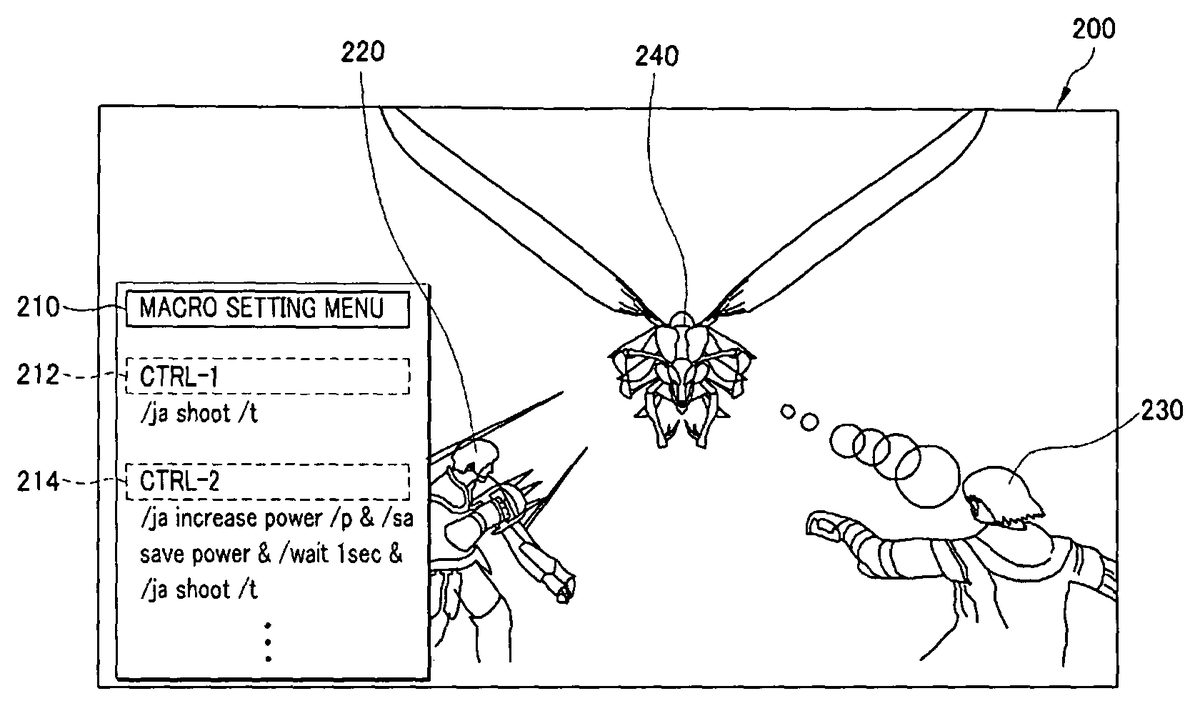
FIG. 2schematically shows an illustrative example screen provided by a native UT for a game console, arranged in accordance with at least some embodiments described herein. As depicted, a screen200provided by a native UI such as native UI122may show the user's virtual character220, another cooperative user's virtual character230, and an opponent character240. For example, when the user manipulates buttons on game console120, native UI122may receive commands associated with the buttons and send the commands representing one or more actions to strategy learning mechanism138.
In some embodiments, a sequence of commands may be input through native UI122by using a macro-type command. As shown inFIG. 2, a macro setting menu210may be provided, where the user may input macro keys212and214and a sequence of commands associated with each of macro keys212and214. For example, macro key212(“CTRL-1”) may be associated with a sequence of commands “/ja shoot /t” which represents a job ability (“/ja”) of shooting (“shoot”) against a target opponent (“/t”). Also, macro key214(“CTRL-2”) may be associated with a sequence of commands “/ja increase power /p & /sa save power & /wait 1 sec & /ja shoot /t” which represents a job ability (“/ja”) of increasing power (“increase power”) for the user (“/p”), a skill ability (“/sa”) of saving power (“save power” for about 1 second (“/wait 1 sec”), and an additional job ability (“/ja”) of shooting (“shoot”) against a target opponent (“/t”). Using such a macro-type command, the user may be able to input a combination of various commands in a convenient and efficient manner. Also, native UI122may receive a macro-type command when the user manipulates a macro key associated the macro-type command, and send one or more actions represented by the command to strategy learning mechanism138.
FIG. 3schematically shows an illustrative example screen provided by a native UI for a mobile device, arranged in accordance with at least some embodiments described herein. As depicted, a screen300provided by a native UI such as native UI116may show the user's virtual character310, and a plurality of UI items such as buttons320,322,324,326,328,330and/or332. In one embodiment, screen300may be a touch-sensitive screen. In this case, when the user touches any one of buttons320to332on screen300, native UI116may receive one or more commands associated with the selected button and send one or more actions represented by the commands to operation input support mechanism136or strategy learning mechanism138.
In some embodiments, the user of the mobile device may customize the arrangements of buttons320to332according to his/her preference. Also, as described above, operation input support mechanism136may rearrange buttons320to332on screen300in its order or positions and/or selectively arrange some of buttons320to332according to the correlation rules extracted by strategy learning mechanism138. Accordingly, screen300of the native UI may selectively arrange buttons320to332according to the user's preferred strategies and actions.
FIG. 4schematically shows an illustrative example screen provided by a web-based UI for a mobile device, arranged in accordance with at least some embodiments described herein. As depicted, a screen400provided by a web-based UI such as web-based UI114may show a static image frame410illustrating the current status of environment where the user's virtual character, any other cooperative user's character(s), and/or an opponent character are involved. In some embodiments, if a sufficient network bandwidth between the mobile device and an MMORPG system such as MMORPG system140is available, a moving image of the environment may be rendered in the image frame410. Further, if a web browser running on the mobile device supports for 3-dimensional graphic rendering functionality, a 3-dimensional image of the environment may be rendered in the image frame410.
In some embodiments, screen400of the web-based UI may include a list420of action logs showing a sequence of actions performed by the user's virtual character. Additionally, screen400may include an avatar's expected action430showing what next action (e.g., recover life) can be expected from the current action (e.g., sword attack). Such change of the avatar's action may be determined based on the user's selected strategy.
In some embodiments, the web-based UI may provide one or more modes for the user to select for playing the user's virtual character. For example, the web-based UI may provide two modes such as an avatar playing mode and an interactive playing mode. In the avatar playing mode, an AI player may substitute for the user to play the user's virtual character, which may be controlled according to the user's selected strategy or the correlation rules extracted by strategy learning mechanism138. As illustrated inFIG. 4, the user may be allowed to switch from the avatar playing mode to the interactive playing mode by selecting “YES” button in a UI item440.
Also, the web-based UI may selectively arrange buttons representing one or more game strategies. For example, the web-based UI may provide three buttons labeled as “OFFENSIVE,” “SUPPORTIVE,” and “DEFENSIVE,” respectively, in a UI item450such that the user can select one of the buttons for a preferred strategy. The user may select to interactively attend the game while watching the current status of the environment in the image frame410and the avatar's expected action in the UI item430.
FIG. 5schematically shows an illustrative example screen provided by a mail-based UI for a mobile device, arranged in accordance with at least some embodiments described herein. As depicted, a screen500provided by a mail-based UI such as mail-based UI112may show a static image frame510illustrating the current status of environment where the user's virtual character, any other cooperative user's character(s), and/or an opponent character are involved. In some embodiments, if the mail-based UI is enabled to process a dynamic content such as HTML, JavaScript, etc., a moving image of the environment may be rendered in the image frame510.
In some embodiments, screen500of the mail-based UI may include a list520of action logs showing a sequence of actions performed by the user's virtual character. Additionally, screen500may include an avatar's expected action530showing what next action (e.g., recover life) can be expected from the current action (e.g., sword attack). Such change of the avatar's action may be determined based on the user's selected strategy.
In some embodiments, the mail-based UI may selectively arrange buttons representing one or more game strategies. For example, the mail-based UI may provide three buttons labeled as “OFFENSIVE,” “SUPPORTIVE,” and “DEFENSIVE,” respectively, in a UI item540such that the user can select one of the buttons for a preferred strategy. The user may select to interactively attend the game while watching the current status of the environment in the image frame510and the avatar's expected action in the UI item530.
FIG. 6schematically shows a block diagram of an illustrative example MMORPG control system, arranged in accordance with at least some embodiments described herein. As depicted, a MMORPG control system600may include a mobile device110, a game console120, a multi-stage user-experience control system620coupled to mobile device110and game console120through a network610, and an MMORPG system640. Multi-stage user-experience control system620may be configured to learn game strategies of users based on the users' actions input through various UIs and control an AI player to automatically reproduce actions for the users in the MMORPG. For example, the game strategies may be learned based on the user's actions input through a native UI while the user plays the game on a game console. Also, the AI player may be controlled to reproduce the actions while the user cannot interactively play the game, e.g., while commuting to work on a train or working at offices.
In some embodiments, multi-stage user-experience control system620may include an UI selection unit622, an AI player unit624, a pattern detector unit626, an action log unit628, and an action log database630. As described below, these units622to630may be collectively configured to learn game strategies of a user based on the user's actions input through various UIs and provide different levels of automation of the AI player according to the complexity of the UIs selected by the user′ device such as a mobile device, a game console, etc.
In some embodiments, UI selection unit622may be configured to allow the user to select a UI depending on his/her lifestyles and current conditions such as TPO (time, place, and occasion). For example, if the user is available to interactively and constantly play the MMORPG through a game, console for several hours, the user may select a native UI such as UI122. Alternatively, the user may select a native UI provided on a mobile device such as native UI116. In such cases, UI selection unit622may report the user's actions to action log unit628so that action log unit628records the reported actions in action log database630. On the other hand, when the user selects a non-native UI such as web-based UI114or mail-based UI112through UI selection unit622, multi-stage user-experience control system620may control AI player unit624to construct a substitute AI player to reproduce actions for the user while the user is not available to interactively play the MMORPG.
In some embodiments, action log unit628may be configured to record the logs of the user's actions input through UI selection unit622in action log database630. Additionally, action log unit628may record, in action log database630, status information of the user's virtual character, other cooperative user's virtual character as well opponent characters along with its associated actions. For example, the status information may include at least one of power and skill levels, current life, armors possessed by the characters, etc.
In some embodiments, pattern detector unit626may be configured to extract correlation rules for the status information and the associated actions recorded in action log database630. For example, a correlation rule indicating that “action B is to be taken in status A” may be denoted as {A}→{B}. In each correlation rule, the left-hand side (LHS) of “→” may be referred to as an antecedent, while the right-hand side (RHS) of “→” may be referred to as a consequence. The correlation rules may be extracted using any suitable logic inference algorithm such as an Apriori algorithm.
Further, pattern detector unit626may calculate frequencies of occurrence of all the user's action combinations and select co-occurrence patterns having frequencies exceeding a predetermined threshold as action patterns having high probabilities of co-occurrence. For example, when there are n types of actions available in MMORPG control system600and the average number of actions taken before completion of a game is r, the total number of co-occurrence patterns of game actions may be represented byaHrindicating a repeated combination of choosing r actions from n types of actions.nHrmay be calculated according to the following formula:
nHr=n+r-1Cr=(n+r-1r)=(n+r-1)r(n-1).
Pattern detector unit626may calculate the frequencies of occurrence of all action combinations from the action log database630and select co-occurrence patterns having frequencies exceeding the predetermined threshold (e.g., 20%) as action patterns having high probabilities of co-occurrence. In this manner, it is possible to extract situation-dependent action patterns and combinations of actions preferred by the user (action patterns based on combinations of actions). These two types of action pattern information are forwarded to AI player unit624in multi-stage user-experience control system620.
In some embodiments, AI player unit624may be configured to construct an AI player to act as the user's substitute that automatically reproduces actions. This functionality of AI player unit624may be useful when the user may not be available to interactively play the MMORPG, e.g., while commuting to work or working in offices. Such actions may be reproduced according to the correlation rules extracted by pattern detector unit626.
FIG. 7illustrates an example flow diagram of a method adapted to control an MMORPG system, arranged in accordance with at least some embodiments described herein. An example method700inFIG. 7may be implemented using, for example, a computing device including a processor adapted to control an MMORPG system.
Method700may include one or more operations, actions, or functions as illustrated by one or more of blocks S710, S720, S730and/or S740. Although illustrated as discrete blocks, various blocks may be divided into additional blocks, combined into fewer blocks, or eliminated, depending on the desired implementation. In some further examples, the various described blocks may be implemented as a parallel process instead of a sequential process, or as a combination thereof. Method700may begin at block S710, “SELECT, BY A UI SELECTION UNIT, A UI IN A USER'S DEVICE.”
At block S710, an UI may be selected by a UI selection unit. As depicted inFIGS. 1 and 6, UI selection unit622of multi-stage user-experience control system620may allow the user to select a UI depending on his/her lifestyles and conditions. For example, if the user is available to play the MMORPG through a game console such as game console120for several hours, the user may select a native UI such as UI122. Alternatively, the user may select a native UI such as native UI116provided on a mobile device such as mobile device110. In some other instances, the user may select a non-native UI such as web-based UI114or mail-based UI112if he/she is not available to interactively play the game. Block S710may be followed by block S720, “RECORD, BY AN ACTION LOG UNIT, LOGS OF THE USER'S ACTIONS INPUT THROUGH THE UI.”
At block S720, logs of the user's actions input through the selected UI may be recorded by an action log unit. As illustrated inFIGS. 1 and 6, action log unit628may be configured to record the logs of the user's actions input through UI selection unit622in action log database630. Also, action log unit628may record, in action log database630, status information of the user's virtual character, other cooperative user's virtual character as well opponent characters along with its associated actions. Block S720may be followed by block S730, “EXTRACT, BY A PATTERN DETECTOR UNIT, CORRELATION RULES FOR THE STATUS INFORMATION AND THE ASSOCIATED ACTIONS RECORDED IN THE LOGS.”
At block S730, correlation rules for the status information and the associated actions recorded in the logs may be extracted by a pattern detector unit. As illustrated inFIGS. 1 and 6, pattern detector unit626may be configured to extract correlation rules for the status information and the associated actions recorded in action log database630. The correlation rules may be extracted using any suitable logic inference algorithm such as an Apriori algorithm.
In some embodiments, pattern detector unit626may calculate frequencies of occurrence of all the user's action combinations and select co-occurrence patterns having frequencies exceeding a predetermined threshold as action patterns having high probabilities of co-occurrence. In this manner, it is possible to extract situation-dependent action patterns and combinations of actions preferred by the user (action patterns based on combinations of actions). These two types of action pattern information are forwarded to AI player unit624in multi-stage user-experience control system620. Block S730may be followed by block S740, “CONTROL, BY AN AI PLAYER UNIT, A SUBSTITUTE PLAYER FOR THE USER.”
At block S740, a substitute player for the user may be controlled by an AI player unit. As depicted inFIGS. 1 and 6, AI player unit624may be configured to control the AI player to act as the user's substitute that automatically reproduces actions in the absence of the user. Such actions may be reproduced according to on the correlation rules extracted by pattern detector unit626.
One skilled in the art will appreciate that, for this and other methods disclosed herein, the functions performed in the methods may be implemented in differing order. Furthermore, the outlined steps and operations are only provided as examples, and some of the steps and operations may be optional, combined into fewer steps and operations, or expanded into additional steps and operations without detracting from the essence of the disclosed embodiments.
According to the above embodiments of the present disclosure, users having different lifestyles and/or different levels of skills may cooperatively attend a same MMORPG because various UIs are provided to the users according to their lifestyles and conditions. In some embodiments, a user who may not be available to interactively play the game may be notified by a MMORPG control system such as system100or600to encourage them to purchase charged-for items for improving the status of the game.
In some other embodiments, when it is detected that the number of users accessing to an MMORPG system is significantly increasing, the system may send a notification to the users indicating that free-of-charge items may be provided for switching from an interactive playing mode to an avatar playing mode. In this manner, the number of simultaneous network accesses can be reduced and thus the overload of the system can be prevented.
Additionally, in some embodiments, as users get accustomed to playing games with the assistance of AI players, the user may become hesitant to switch from the current game title to another provided by another MMORPG service provider. This leads to a lock-in effect of MMORPG service provided according to the present disclosure.
FIG. 8shows a schematic block diagram illustrating an example computing system that can be configured to perform methods for controlling an MMORPG system, arranged in accordance with at least some embodiments described herein. As depicted inFIG. 8, a computer800may include a processor810, a memory820and one or more drives830. Computer800may be implemented as a conventional computer system, an embedded control computer, a laptop computer, or a server computer, a smartphone, a tablet computer, a set-top box, a kiosk, a vehicular information system, a mobile telephone, a customized machine, or other hardware platform.
Drives830and their associated computer storage media may provide storage of computer readable instructions, data structures, program modules and other data for computer800. Drives830may include an MMORPG control system840, an operating system (OS)850, and application programs860. MMORPG control system840may be adapted to control an MMORPG system in such a manner as described above with respect toFIGS. 1 to 7.
Computer800may further include user input devices880through which a user may enter commands and data. Input devices can include an electronic digitizer, a camera, a microphone, a keyboard and pointing device, commonly referred to as a mouse, trackball or touch pad. Other input devices may include a joystick, game pad, satellite dish, scanner, or the like.
These and other input devices can be coupled to processor810through a user input interface that is coupled to a system bus, but may be coupled by other interface and bus structures, such as a parallel port, game port or a universal serial bus (USB). Computers such as computer800may also include other peripheral output devices such as display devices, which may be coupled through an output peripheral interface885or the like.
Computer800may operate in a networked environment using logical connections to one or more computers, such as a remote computer coupled to a network interface890. The remote computer may be a personal computer, a server, a router, a network PC, a peer device or other common network node, and can include many or all of the elements described above relative to computer800.
Networking environments are commonplace in offices, enterprise-wide area networks (WAN), local area networks (LAN), intranets, and the Internet. When used in a LAN or WLAN networking environment, computer800may be coupled to the LAN through network interface890or an adapter. When used in a WAN networking environment, computer800typically includes a modem or other means for establishing communications over the WAN, such as the Internet or a network895. The WAN may include the Internet, the illustrated network895, various other networks, or any combination thereof. It will be appreciated that other mechanisms of establishing a communications link, ring, mesh, bus, cloud, or network between the computers may be used.
In some embodiments, computer800may be coupled to a networking environment. Computer800may include one or more instances of a physical computer-readable storage medium or media associated with drives830or other storage devices. The system bus may enable processor810to read code and/or data to/from the computer-readable storage media. The media may represent an apparatus in the form of storage elements that are implemented using any suitable technology, including but not limited to semiconductors, magnetic materials, optical media, electrical storage, electrochemical storage, or any other such storage technology. The media may represent components associated with memory820, whether characterized as RAM, ROM, flash, or other types of volatile or non-volatile memory technology. The media may also represent secondary storage, whether implemented as storage drives830or otherwise. Hard drive implementations may be characterized as solid state, or may include rotating media storing magnetically encoded information.
Processor810may be constructed from any number of transistors or other circuit elements, which may individually or collectively assume any number of states. More specifically, processor810may operate as a state machine or finite-state machine. Such a machine may be transformed to a second machine, or specific machine by loading executable instructions. These computer-executable instructions may transform processor810by specifying how processor810transitions between states, thereby transforming the transistors or other circuit elements constituting processor810from a first machine to a second machine. The states of either machine may also be transformed by receiving input from user input devices880, network interface890, other peripherals, other interfaces, or one or more users or other actors. Either machine may also transform states, or various physical characteristics of various output devices such as printers, speakers, video displays, or otherwise.
FIG. 9illustrates computer program products900that can be utilized to operate an MMORPG control system in accordance with at least some embodiments described herein. Computer program product900may include a signal bearing medium902. Signal bearing medium902may include one or more instructions904that, when executed by, for example, a processor, may provide the functionality described above with respect toFIGS. 1 to 7. By way of example, instructions904may include at least one of: one or more instructions for selecting, by a UI selection unit, a UI in a user's device; one or more instructions for recording, by an action log unit, logs of the user's actions input through the UI, the actions being associated with status information of the user's character and opponent characters; one or more instructions for extracting, by a pattern detector unit, correlation rules for the status information and the associated actions recorded in the logs; or one or more instructions for controlling, by an AI player unit, a substitute player for the user based on the correlation rules, the substitute player automatically reproducing actions of the user. Thus, for example, referring toFIGS. 1 and 6, an MMORPG control system100or600may undertake one or more of the blocks shown inFIG. 7in response to instructions904.
In some implementations, signal bearing medium902may encompass a computer-readable medium906, such as, but not limited to, a hard disk drive (HDD), a Compact Disc (CD), a Digital Video Disk (DVD), a digital tape, memory, etc. In some implementations, signal bearing medium902may encompass a recordable medium908, such as, but not limited to, memory, read/write (R/W) CDs, R/W DVDs, etc. In some implementations, signal bearing medium902may encompass a communications medium910, such as, but not limited to, a digital and/or an analog communication medium (e.g., a fiber optic cable, a waveguide, a wired communication link, a wireless communication link, etc.). Thus, for example, computer program product900may be conveyed to one or more modules of MMORPG control system100or600by an RF signal bearing medium902, where the signal bearing medium902is conveyed by a wireless communication medium910(e.g., a wireless communication medium conforming with the IEEE 802.11 standard).
The present disclosure is not to be limited in terms of the particular embodiments described in this application, which are intended as illustrations of various aspects. Many modifications and variations may be made without departing from its spirit and scope, as will be apparent to those skilled in the art. Functionally equivalent methods and apparatuses within the scope of the disclosure, in addition to those enumerated herein, will be apparent to those skilled in the art from the foregoing descriptions. Such modifications and variations are intended to fall within the scope of the appended claims. The present disclosure is to be limited only by the terms of the appended claims, along with the full scope of equivalents to which such claims are entitled. It is to be understood that this disclosure is not limited to particular methods, reagents, compounds, compositions or biological systems, which can, of course, vary. It is also to be understood that the terminology used herein is for the purpose of describing particular embodiments only, and is not intended to be limiting.
The herein described subject matter sometimes illustrates different components contained within, or connected with, different other components. It is to be understood that such depicted architectures are merely examples, and that in fact many other architectures can be implemented which achieve the same functionality. In a conceptual sense, any arrangement of components to achieve the same functionality is effectively “associated” such that the desired functionality is achieved. Hence, any two components herein combined to achieve a particular functionality can be seen as “associated with” each other such that the desired functionality is achieved, irrespective of architectures or intermedial components. Likewise, any two components so associated can also be viewed as being “operably connected,” or “operably coupled,” to each other to achieve the desired functionality, and any two components capable of being so associated can also be viewed as being “operably couplable,” to each other to achieve the desired functionality. Specific examples of operably couplable include but are not limited to physically mateable and/or physically interacting components and/or wirelessly interactable and/or wirelessly interacting components and/or logically interacting and/or logically interactable components.
With respect to the use of substantially any plural and/or singular terms herein, those having skill in the art can translate from the plural to the singular and/or from the singular to the plural as is appropriate to the context and/or application. The various singular/plural permutations may be expressly set forth herein for sake of clarity.
It will be understood by those within the art that, in general, terms used herein, and especially in the appended claims (e.g., bodies of the appended claims) are generally intended as “open” terms (e.g., the term “including” should be interpreted as “including but not limited to,” the term “having” should be interpreted as “having at least,” the term “includes” should be interpreted as “includes but is not limited to,” etc.). It will be further understood by those within the art that if a specific number of an introduced claim recitation is intended, such an intent will be explicitly recited in the claim, and in the absence of such recitation no such intent is present. For example, as an aid to understanding, the following appended claims may contain usage of the introductory phrases “at least one” and “one or more” to introduce claim recitations. However, the use of such phrases should not be construed to imply that the introduction of a claim recitation by the indefinite articles “a” or “an” limits any particular claim containing such introduced claim recitation to embodiments containing only one such recitation, even when the same claim includes the introductory phrases “one or more” or “at least one” and indefinite articles such as “a” or “an” (e.g., “a” and/or “an” should be interpreted to mean “at least one” or “one or more”); the same holds true for the use of definite articles used to introduce claim recitations. In addition, even if a specific number of an introduced claim recitation is explicitly recited, those skilled in the art will recognize that such recitation should be interpreted to mean at least the recited number (e.g., the bare recitation of “two recitations,” without other modifiers, means at least two recitations, or two or more recitations). Furthermore, in those instances where a convention analogous to “at least one of A, B, and C, etc.” is used, in general such a construction is intended in the sense one having skill in the art would understand the convention (e.g., “a system having at least one of A, B, and C” would include but not be limited to systems that have A alone, B alone, C alone, A and B together, A and C together, B and C together, and/or A, B, and C together, etc.). In those instances where a convention analogous to “at least one of A, B, or C, etc.” is used, in general such a construction is intended in the sense one having skill in the art would understand the convention (e.g., “a system having at least one of A, B, or C” would include but not be limited to systems that have A alone, B alone, C alone, A and B together, A and C together, B and C together, and/or A, B, and C together, etc.). It will be further understood by those within the art that virtually any disjunctive word and/or phrase presenting two or more alternative terms, whether in the description, claims, or drawings, should be understood to contemplate the possibilities of including one of the terms, either of the terms, or both terms. For example, the phrase “A or B” will be understood to include the possibilities of “A” or “B” or “A and B.”
In addition, where features or aspects of the disclosure are described in terms of Markush groups, those skilled in the art will recognize that the disclosure is also thereby described in terms of any individual member or subgroup of members of the Markush group.
As will be understood by one skilled in the art, for any and all purposes, such as in terms of providing a written description, all ranges disclosed herein also encompass any and all possible subranges and combinations of subranges thereof. Any listed range can be easily recognized as sufficiently describing and enabling the same range being broken down into at least equal halves, thirds, quarters, fifths, tenths, etc. As a non-limiting example, each range discussed herein can be readily broken down into a lower third, middle third and upper third, etc. As will also be understood by one skilled in the art all language such as “up to,” “at least,” and the like include the number recited and refer to ranges which can be subsequently broken down into subranges as discussed above. Finally, as will be understood by one skilled in the art, a range includes each individual member.
From the foregoing, it will be appreciated that various embodiments of the present disclosure have been described herein for purposes of illustration, and that various modifications may be made without departing from the scope and spirit of the present disclosure. Accordingly, the various embodiments disclosed herein are not intended to be limiting, with the true scope and spirit being indicated by the following claims.
Claims
- A system to control a massively multiplayer online role-playing game (MMORPG), the system comprising: a processor configured to execute instructions in communication with a memory that stores the instructions to provide: a user-interface (UI) selection unit configured to allow a user to select a UI in a user's device;and an action log unit configured to record logs of inputs for user's actions through the UI, the user's actions being associated with status information of a user character and opponent characters;a pattern detector unit configured to: extract correlation rules for the status information and the associated user's actions recorded in the logs, calculate frequencies of occurrence of all user's action combinations, and select co-occurrence patterns that have frequencies which exceed a predetermined threshold as action patterns that have high probabilities of co-occurrence;and an artificial intelligence (AI) player unit configured to control a substitute player for the user based on the correlation rules and the selected co-occurrence patterns, such that the substitute player automatically reproduces actions of the user.
- The system of claim 1 , wherein the UI selection unit is further configured to report the user's actions to the action log unit if the user has selected a native UI.
- The system of claim 2 , wherein the native UI comprises at least one of a native UI for a game console and a native UI for a mobile device.
- The system of claim 1 , wherein the UI selection unit is further configured to request the AI player unit to construct the substitute player if the user has selected a non-native UI.
- The system of claim 4 , wherein the non-native UI comprises at least one of a web-based UI and a mail-based UI.
- The system of claim 1 , wherein the status information includes at least one of: power and skill levels, current life, and armors possessed by the user character and the opponent characters.
- The system of claim 1 , wherein the pattern detector unit is configured to extract the correlation rules according to an Apriori algorithm.
- A method to control a massively multiplayer online role-playing game (MMORPG), the method comprising: selecting, by a user-interface (UI) selection unit, a UI in a user's device;recording, by an action log unit, logs of inputs for user's actions through the UI, the user's actions being associated with status information of a user character and opponent characters;extracting, by a pattern detector unit, correlation rules for the status information and the associated user's actions recorded in the logs;calculating, by the pattern detector unit, frequencies of occurrence of all user's action combinations;selecting, by the pattern detector unit, co-occurrence patterns that have frequencies which exceed a predetermined threshold as action patterns that have high probabilities of co-occurrence;and controlling, by an artificial intelligence (AI) player unit, a substitute player for the user based on the correlation rules and the selected co-occurrence patterns, such that the substitute player automatically reproduces actions of the user.
- The method of claim 8 , wherein the selecting the UI comprises reporting the user's actions to the action log unit if the user has selected a native UI.
- The method of claim 9 , wherein the selecting the UI comprises selecting at least one of a native UI for a game console and a native UI for a mobile device.
- The method of claim 8 , wherein the selecting the UI comprises requesting the AI player unit to construct the substitute player if the user has selected a non-native UI.
- The method of claim 11 , wherein the selecting the UI comprises selecting at least one of a web-based UI and a mail-based UI.
- The method of claim 8 , wherein the extracting the correlation rules comprises extracting the correlation rules according to an Apriori algorithm.
- A non-transitory computer-readable storage medium which stores a program to cause a processor configured to control a massively multiplayer online role-playing game (MMORPG), the program comprising one or more instructions for: selecting, by a user-interface (UI) selection unit, a UI in a user's device;recording, by an action log unit, logs of inputs for user's actions through the UI, the user's actions being associated with status information of a user character and opponent characters;extracting, by a pattern detector unit, correlation rules for the status information and the associated user's actions recorded in the logs;calculating, by the pattern detector unit, frequencies of occurrence of all user's action combinations;selecting, by the pattern detector unit, co-occurrence patterns that have frequencies which exceed a predetermined threshold as action patterns that have high probabilities of co-occurrence;and controlling, by an artificial intelligence (AI) player unit, a substitute player for the user based on the correlation rules and the selected co-occurrence patterns, such that the substitute player automatically reproduces actions of the user.
- The medium of claim 14 , wherein the selecting the UI comprises reporting the user's actions to the action log unit if the user has selected a native UI.
- The medium of claim 15 , wherein the selecting the UI comprises selecting at least one of a native UI for a game console and a native UI for a mobile device.
- The medium of claim 14 , wherein the selecting the UI comprises requesting the AI player unit to construct the substitute player if the user has selected a non-native UI.
- The medium of claim 17 , wherein the selecting the UI comprises selecting at least one of a web-based UI and a mail-based UI.
- The medium of claim 14 , wherein the extracting the correlation rules comprises extracting the correlation rules according to an Apriori algorithm.
Disclaimer: Data collected from the USPTO and may be malformed, incomplete, and/or otherwise inaccurate.