U.S. Pat. No. 9,776,090
IMAGE PROCESSING METHOD, AVATAR DISPLAY ADAPTATION METHOD AND CORRESPONDING IMAGE PROCESSING PROCESSOR, VIRTUAL WORLD SERVER AND COMMUNICATION TERMINAL
AssigneeAlcatel Lucent
Issue DateApril 2, 2012
Illustrative Figure
Abstract
When processing images in a virtual environment in which a plurality of avatars respectively representing associated users evolve, an image processing method is employed comprising the following stages: an adaptation request is received for the display of the avatars on the terminal of a given user, the request comprising at least one adaptation criterion to distinguish the display of the avatars. The data representing the avatars is modified based on the adaptation criterion, and the modified data for an adapted display of the avatars is sent to the terminal of the given user. Additionally, the display of avatars in a virtual environment may be adapted. A corresponding image processing processor, virtual world server and communication terminal for implementing such methods are also provided.
Description
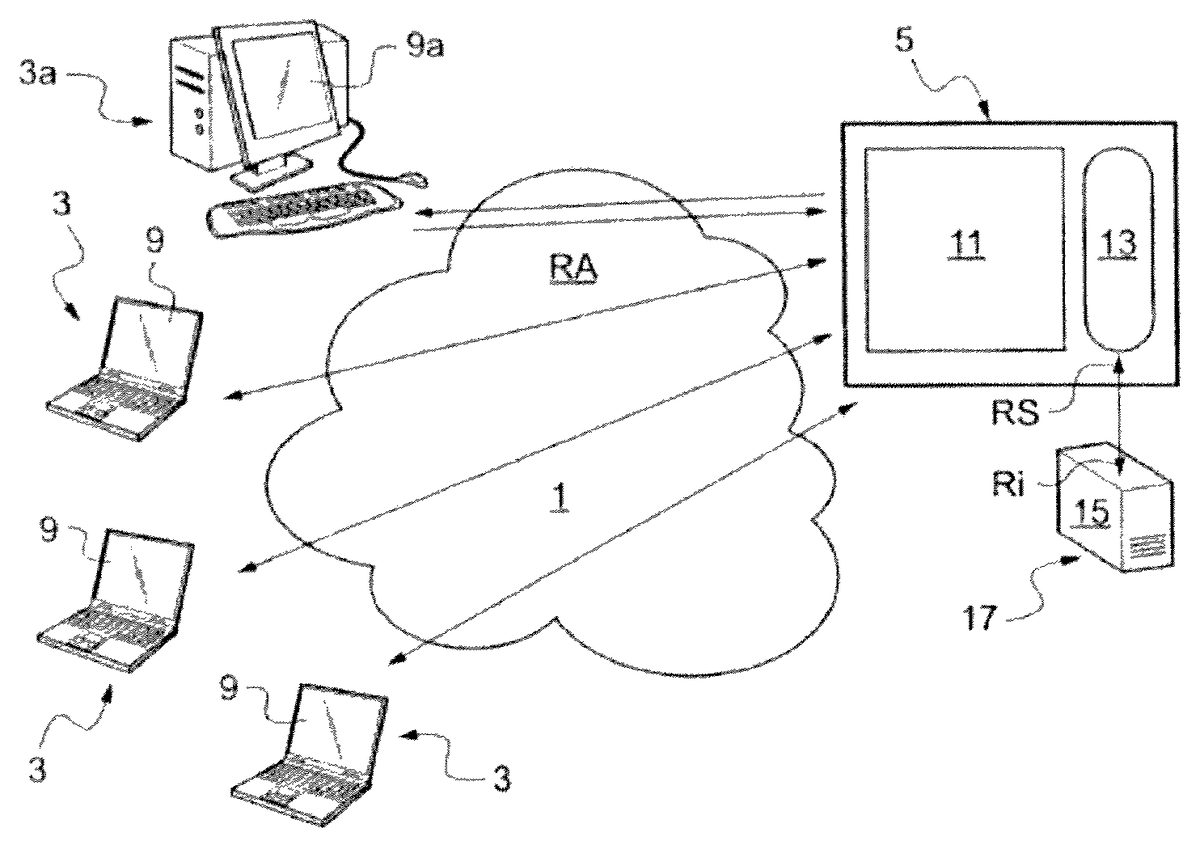
Identical elements in each of these figures have the same references. FIG. 1shows a communication network1, for example the Internet, a plurality of communication terminals3a,3and a virtual world server5. The terminals3a,3exchange data with the virtual world server5on the communication network1, so that the users of the terminals3a,3can connect to the virtual world and evolve in the virtual world. In this case “communication network”1shall mean any type of network capable of sending content to the terminals3a,3and exchanging data or messages with said terminals3a,3. Any method of transmission can be envisaged. Furthermore, in this case “communication terminal”3a,3shall mean any type of equipment capable of receiving content from the communication network1, and of exchanging data, messages and requests with said communication network1. It may for example be a mobile or landline telephone, a personal digital assistant (PDA), or a PC or laptop. With reference toFIGS. 1 and 2a, each user of a terminal3a,3has an associated avatar7a,7′,7″ to represent them in a virtual environment (EV) in the virtual world displayed on a display means9a,9of the terminal3a,3. Each user can therefore, through their avatar7a,7′,7″, evolve in this virtual environment (EV) and communicate with other avatars7a,7′,7″ representing other users. Furthermore, each user can have one or more social networks, such as friend networks, work group networks or gaming networks, in the virtual world or in another virtual exchange platform outside the virtual world. Each network brings together a group of users. Said group of users can comprise a list of pseudonyms of the users with, if desired, associated avatars or their corresponding profiles. The user may of course form part of a community in the virtual world which also forms a social network. In reference again toFIG. 1, the virtual world server5traditionally comprises at least one means11of managing the virtual environments in which the avatars evolve. ...
Identical elements in each of these figures have the same references.
FIG. 1shows a communication network1, for example the Internet, a plurality of communication terminals3a,3and a virtual world server5. The terminals3a,3exchange data with the virtual world server5on the communication network1, so that the users of the terminals3a,3can connect to the virtual world and evolve in the virtual world.
In this case “communication network”1shall mean any type of network capable of sending content to the terminals3a,3and exchanging data or messages with said terminals3a,3. Any method of transmission can be envisaged.
Furthermore, in this case “communication terminal”3a,3shall mean any type of equipment capable of receiving content from the communication network1, and of exchanging data, messages and requests with said communication network1.
It may for example be a mobile or landline telephone, a personal digital assistant (PDA), or a PC or laptop.
With reference toFIGS. 1 and 2a, each user of a terminal3a,3has an associated avatar7a,7′,7″ to represent them in a virtual environment (EV) in the virtual world displayed on a display means9a,9of the terminal3a,3.
Each user can therefore, through their avatar7a,7′,7″, evolve in this virtual environment (EV) and communicate with other avatars7a,7′,7″ representing other users.
Furthermore, each user can have one or more social networks, such as friend networks, work group networks or gaming networks, in the virtual world or in another virtual exchange platform outside the virtual world. Each network brings together a group of users. Said group of users can comprise a list of pseudonyms of the users with, if desired, associated avatars or their corresponding profiles.
The user may of course form part of a community in the virtual world which also forms a social network.
In reference again toFIG. 1, the virtual world server5traditionally comprises at least one means11of managing the virtual environments in which the avatars evolve.
The virtual world server5further comprises at least one image processing means13, for example an image processing processor13. As an alternative, the processor13may be integrated into each terminal3a,3.
Said processor13communicates with a database15of the social networks of the users, whether networks in the virtual world or in other virtual exchange platforms. To do this, users must have previously entered their corresponding identifier(s) for the platforms outside the virtual world, thus allowing the database15access to their social networks.
In the example illustrated inFIG. 1, an external server17comprises said database15. As a variant, it is the virtual world server5which comprises the database15.
According to a first embodiment, when a first user of the terminal3aconnects to the virtual world and their associated avatar7aevolves in a virtual environment (EV), the other avatars7′,7″ are initially displayed traditionally (FIG. 2a), and if the user so wishes, the display is adapted (FIG. 2b).
To that end, terminal3acomprises at least one processing means for sending to the processor13during stage A1an adaptation request Ra for the display of the avatars on the display means9a(FIGS. 1 and 3a). This request Ra comprises at least one adaptation criterion to distinguish between the display of the avatars.
This adaptation criterion may be a social link criterion, for example a criterion for belonging to a social network of the first user of terminal3a, where the social network may be inside or outside the virtual world. Of course, any other adaptation criterion may be used, such as those relating to interests or the frequency of exchanges.
In the example of a criterion of belonging to a social network, the avatar display must be adapted based on the social network of said first user. More precisely, second avatars7′ associated with the users of the social network are distinguished from the third avatars7″ associated with the connected users who do not belong to the social network of the first user (seeFIG. 2b).
The processor13then comprises at least one processing means to receive the adaptation request Ra with the adaptation criterion during a stage B1, modify the data representing the avatars based on the adaptation criterion in stage B2, and send to terminal3athe modified data in stage B3, for an adapted display of the avatars on the display means9a(FIGS. 1 and 3b).
Terminal3athen receives the data modified in stage A2and displays the avatars on the display means9ain stage A3(FIG. 3a).
By way of example, when the adaptation criterion is one of belonging to the social network of the first user of terminal3a, the processor13comprises at least one processing means for sending in stage B21an information request Ri to the database15concerning the social network(s) of the first user (FIGS. 1 and 3b).
The database15then sends the RS data on the social network(s) of the first user to the processor13configured to identify from said RS data the connected users that form part of the social network of the user and those who do not form part of said network in stage B22.
The processor13then modifies during stage B23the data representing the avatars so as to distinguish the second avatars7′ of the users of the social network of the first user from the third avatars7″ of the other users.
In the example illustrated inFIG. 2b, the processor13applies a blurring filter to the third avatars7″, so that the second avatars7′ are displayed with good definition in comparison to the third avatars7″, which are blurry.
As a variant, the third avatars7″ may be displayed transparently or shadows may be displayed for the third avatars7″. According to another alternative, the second avatars7′ may be adapted so that they are displayed larger than the third avatars7″.
The user of the first terminal3acan therefore easily distinguish the avatars7′ of the users of their social network.
Furthermore, the processor13resource requirements for only a few avatars with good definition are much lower than those for a crowd of avatars with good definition. Consequently, the computation effort of the processor13is reduced to keep only certain avatars with good definition.
Furthermore, when the processor13is in the virtual world server5, it sends less significant data on the communication network1to the terminal3a.
In addition, the avatars7′,7″ may be adapted differently based on the social proximity of the users associated with the first user. In this case, the user can define several hierarchized adaptation criteria.
By way of example, the first user can define:a first criterion, for example a criterion of belonging to a “Family” network of the first user,a second criterion, for example a criterion of interests, such as “museums”, anda third criterion, for example a criterion of interests, such as “sport”.
To illustrate this principle, refer toFIG. 4in which three circular zones, Z1, Z2, Z3, are shown in diagram form,the first zone Z1is associated with the first criterion,the second zone Z2is associated with the second criterion,the third zone is associated with the third criterion.
The avatars must therefore be adapted based on whether the users belong to one of the three zones Z1, Z2, Z3.
To that end, the processor13comprises at least one means of calculating a social link coefficient for each user based on the adaptation criteria and the social network information of the first user.
Therefore, users connected to the virtual environment (EV) and who belong to the “Family” network of the first user correspond to the first zone Z1and are associated with a strong first social link coefficient C1.
Users connected to the virtual environment (EV) and belonging to one or more social networks of the first user with for example museums in their profile as a criterion of interest, correspond to the second zone Z2and are associated with a second social link coefficient C2, lower than the first social link coefficient C1(C2<C1).
Users connected to the virtual environment (EV) and belonging to one or more social networks of the first user with for example sport in their profile as a criterion of interest, correspond to the third zone Z3and are associated with a third social link coefficient C3, lower than the second social link coefficient C2(C3<C2).
The users connected to the virtual environment (EV) and who do not belong to a social network of the first user with for example museums in their profile as a criterion of interest, correspond to the second zone Z2and are associated with a fourth social link coefficient C4, lower than the second social link coefficient C2(C4<C2).
Users connected to the virtual environment (EV) and who do not belong to a social network of the first user with for example sport in their profile as a criterion of interest, correspond to the third zone Z3and are associated with a fifth social link coefficient C5, lower than the third social link coefficient C3and the fourth social link coefficient C4(C5<C3; C5<C4).
Once the coefficients are calculated, the processor13adapts the users differently based on these calculated coefficients.
For example, for each second avatar7′, a sharpness factor proportional to the calculated social link coefficient is applied.
Therefore,the second avatars7′ of the users of zone1associated with the first coefficient C1may be displayed in very high-definition,the second avatars7′ of the users of zone2associated with the second coefficient C2may be displayed in high-definition (FIG. 5a), andthe second avatars7′ of the users of zone3associated with the third coefficient C3may be displayed in medium-definition (FIG. 5b).
Similarly, for each third avatar7″, a blurring factor inversely proportional to the calculated social link coefficient is applied.
Therefore,the third avatars7″ of the users of zone2associated with the fourth coefficient C4may be displayed in medium-definition (FIG. 5b), andthe third avatars7″ of the users of zone3associated with the fifth coefficient C5may be displayed in low-definition.
All other avatars associated with users for whom the calculated social link coefficient is null may be for example displayed in very low-definition (FIG. 5c).
A second embodiment differs from the first embodiment in that when a first user connects to the virtual environment (EV), the avatar display is directly adapted based on adaptation criteria defined by the user.
It is therefore understood that the display of the avatars in a virtual mode is adapted simply in order to quickly distinguish the avatars of the users of interest to a given first user at a precise location and time in the virtual environment, while reducing the resources required.
Claims
- Method for processing images in a virtual environment in which a plurality of avatars respectively representing associated users evolve, said image processing method comprising: an adaptation request is received for the display of the avatars on a terminal of a given user, said request comprising at least one adaptation criterion to distinguish the display of the avatars, wherein the at least one adaptation criterion is a social link criterion between the given user and the users connected to the virtual environment thereby distinguishing the display of the avatars associated with users of the social network of the given user from the display of avatars associated with users who do not belong to the social network;the data representing the avatars is modified based on said adaptation criterion, and the modified data for an adapted display of the avatars is sent to the terminal of the given user.
- Image processing method according to claim 1 , in which a blurring filter is applied to the avatars representing users who do not belong to a social network of the given user.
- Method according to claim 1 , wherein said image processing method comprises: for each user connected to the virtual environment, a social link coefficient is calculated from said adaptation criterion and social network information of the given user, the data representing the avatars is modified based on the calculated social link coefficient.
- Image processing method according to claim 3 , in which for each avatar representing a user belonging to a social network of the given user, a sharpness filter proportional to the calculated social link coefficient is applied.
- Image processing method according to claim 3 , in which for each avatar representing a user who does not belong to a social network of the given user, a blurring filter inversely proportional to the calculated social link coefficient is applied.
- Method for adapting the display of avatars in a virtual environment in which a plurality of avatars respectively representing associated users evolve, said adaptation method comprising: an adaptation request is sent for the display of the avatars on a terminal of a given user, said request comprising at least one adaptation criterion to distinguish the display of the avatars, wherein the at least one adaptation criterion is a social link criterion between the given user and the users connected to the virtual environment thereby distinguishing the display of the avatars associated with users of the social network of the given user from the display of avatars associated with users who do not belong to the social network;data representing the avatars modified based on said adaptation criterion is received, and the modified avatars are displayed on the terminal of the given user.
- Image processing processor adapted to: receive an adaptation request for the display of avatars on a terminal of a given user, said request comprising at least one adaptation criterion to distinguish the display of the avatars, wherein the at least one adaptation criterion is a social link criterion between the given user and the users connected to the virtual environment thereby distinguishing the display of the avatars associated with users of the social network of the given user from the display of avatars associated with users who do not belong to the social network;modify the data representing the avatars based on said adaptation criterion, and send the modified data for an adapted display of the avatars to the terminal of the given user.
- Virtual world server comprising an image processing processor adapted to: receive an adaptation request for the display of avatars on a terminal of a given user, said request comprising at least one adaptation criterion to distinguish the display of the avatars, wherein the at least one adaptation criterion is a social link criterion between the given user and the users connected to the virtual environment thereby distinguishing the display of the avatars associated with users of the social network of the given user from the display of avatars associated with users who do not belong to the social network;modify the data representing the avatars based on said adaptation criterion, and send the modified data for an adapted display of the avatars to the terminal of the given user.
- Communication terminal comprising an image processing processor adapted to: receive an adaptation request for the display of avatars on a terminal of a given user, said request (Ra) comprising at least one adaptation criterion to distinguish the display of the avatars, wherein the at least one adaptation criterion is a social link criterion between the given user and the users connected to the virtual environment thereby distinguishing the display of the avatars associated with users of the social network of the given user from the display of avatars associated with users who do not belong to the social network;modify the data representing the avatars based on said adaptation criterion, and send the modified data for an adapted display of the avatars to the terminal of the given user.
- Communication terminal of a user comprising: a display on which is displayed a virtual environment in which a plurality of avatars evolve, respectively representing associated users, and at least one processor adapted to: send an adaptation request for the display of the avatars on a display, said request comprising at least one adaptation criterion to distinguish the display of the avatars, wherein the at least one adaptation criterion is a social link criterion between the given user and the users connected to the virtual environment thereby distinguishing the display of the avatars associated with users of the social network of the given user from the display of avatars associated with users who do not belong to the social network;receive data representing the avatars modified based on said adaptation criterion, and display the modified avatars on the display.
Disclaimer: Data collected from the USPTO and may be malformed, incomplete, and/or otherwise inaccurate.