U.S. Pat. No. 9,757,657
INFORMATION PROCESSING DEVICE AND GAME PROGRAM FOR CONFIGURING VIDEO GAME SUPPORT CHARACTERS
AssigneeDeNA Co., Ltd.
Issue DateJune 16, 2015
Illustrative Figure
Abstract
The information processing device relating to the present invention configures, in association with a stage where each of a plurality of players can engage in battle play, a player character owned by the player as a support character that provides support in a stage where another player engages in battle play, generates a game screen displaying a list view of support characters associated with the selected stage once a first player among the plurality of players performs an operation to select a stage, directs the selected support character and a player character belonging to the first player to engage in battle with an enemy character configured in the selected stage once the first player performs an operation to select a support character from the list, and provides benefits to a second player, from among the plurality of players, who owns the selected support character.
Description
DETAILED DESCRIPTION At least the following will become apparent from this Description and the accompanying drawings. Specifically, this is an information processing device provided with a support character configuration processing module that configures, in association with a stage where each of multiple players can engage in battle play, a player character selected by each of the players from multiple characters owned by the players themselves as a support character that provides support in a stage where another player engages in battle play; a game screen generation module which, once a first player among the multiple players performs an operation to select a stage for battle play, generates a game screen displaying a list view of support characters associated with the selected stage; a battle processing module which, once the first player performs an operation to select a particular support character from the list, directs the selected support character and a player character belonging to the first player to engage in battle with an enemy character configured in the selected stage; and a benefit provision processing module that provides benefits to a second player, from among the plurality of players, who owns the selected support character. Such an information processing device makes it possible for each of the multiple players to configure stage-appropriate support characters. For this reason, it becomes easy for the first player to select a stage-appropriate support character from the list and gain an advantage in battle with enemy characters in that stage. In addition, it becomes easy for the second player to acquire more benefits because a support character that is likely to be selected by the first player can be configured for each stage. In addition, in such an information processing device, the support character configuration processing module may be adapted to configure a player character ...
DETAILED DESCRIPTION
At least the following will become apparent from this Description and the accompanying drawings.
Specifically, this is an information processing device provided with a support character configuration processing module that configures, in association with a stage where each of multiple players can engage in battle play, a player character selected by each of the players from multiple characters owned by the players themselves as a support character that provides support in a stage where another player engages in battle play;
a game screen generation module which, once a first player among the multiple players performs an operation to select a stage for battle play, generates a game screen displaying a list view of support characters associated with the selected stage;
a battle processing module which, once the first player performs an operation to select a particular support character from the list, directs the selected support character and a player character belonging to the first player to engage in battle with an enemy character configured in the selected stage; and
a benefit provision processing module that provides benefits to a second player, from among the plurality of players, who owns the selected support character.
Such an information processing device makes it possible for each of the multiple players to configure stage-appropriate support characters. For this reason, it becomes easy for the first player to select a stage-appropriate support character from the list and gain an advantage in battle with enemy characters in that stage. In addition, it becomes easy for the second player to acquire more benefits because a support character that is likely to be selected by the first player can be configured for each stage.
In addition, in such an information processing device, the support character configuration processing module may be adapted to configure a player character belonging to the first player as a support character associated with the selected stage after the first player completes battle play in the selected stage.
In such an information processing device, when the first player among the plurality of players configures a support character, a support character associated with that stage may be selected subsequent to experiencing actual battle play in the stage, thereby enabling configuration of a more stage-appropriate support character.
In addition, in such an information processing device, the support character configuration processing module may be adapted to configure the player character that is directed to engage in battle with the enemy character in the selected stage, from among the multiple characters owned by the first player, as a support character associated with said stage.
Furthermore, in such an information processing device, a player character that contributes to the battle with the enemy character configured for a particular stage may be selected as a support character associated with that stage, thereby enabling configuration of a more stage-appropriate support character.
Furthermore, in such an information processing device, the support character configuration processing module configures, in association with a stage where each of the plurality of players can engage in battle play, the support characters that correspond to each of the other players engaged in battle play in the above-mentioned stage.
Such an information processing device makes it possible to configure support characters that correspond to other players.
Further, this is a game program (e.g., a non-transitory computer readable medium having machine-executable instructions and including a computer having a storage and a hardware processor) that directs a computer to perform:
a support character configuration process that configures, in association with a stage where each of a plurality of players can engage in battle play, a player character selected by each of the players from a plurality of characters owned by the players themselves as a support character that provides support in a stage where another player engages in battle play;
a game screen generation process which, once a first player among the plurality of players performs an operation to select a stage for battle play, generates a game screen displaying a list view of support characters associated with the selected stage;
a battle process which, once the first player performs an operation to select a particular support character from the list, directs the selected support character and a player character belonging to the first player to engage in battle with the enemy character configured in the selected stage; and
a benefit provision process that provides benefits to a second player, from among the plurality of players, who owns the selected support character.
Such game program makes it possible for each of the multiple players to configure stage-appropriate support characters.
Embodiment
<>
FIG. 1is a diagram illustrating an example configuration of the entire game system1. The game system1provides various game-related services to the player over a network2(for example, the Internet) and includes a server device10and multiple player terminals20.
The game system1according to the present embodiment can offer players a battle game conducted using game media. The description below will discuss a battle-type card game conducted using character cards (hereinafter referred to simply as “characters”), which are an example of game media.
The battle-type card game of the present embodiment is a battle game in which player characters belonging to players are directed to engage in battle with enemy characters configured for each stage. In this battle game, player characters belonging to other players can be directed to participate as support characters in battles with enemy characters.
In the present embodiment, player characters respectively selected by the players from the multiple characters owned by the players themselves are configured as support characters respectively for each stage. When a player (a first player) selects a stage for battle play from multiple stages, a list view of the support characters (in other words, player characters owned by other players (by a second player)) configured in the selected stage is displayed on the game screen. Subsequently, when said player selects a stage-appropriate support character from the list, a battle deck is assembled. This is made up of the selected support character and player characters owned by the player. The player can use this battle deck to engage in battle play in the selected stage and gain an advantage in the battle game in cooperation with the support character acting as an assistant. At such time, friend points are awarded as benefits to the other player who owns the support character selected by said player.
<>
FIG. 2is a block diagram illustrating the functional configuration of the server device10. The server device10is an information processing device (e.g., a workstation, a personal computer, etc.) used by a system administrator to operate and manage various services. Upon receiving various commands (requests) from the player terminals20, the server device10transmits (responds by sending) game programs (e.g., non-transitory computer readable medium having machine-executable instructions and including a computer having a storage and a hardware processor) that are operational on the player terminals20, as well as various types of data and web pages (game screens, etc.) created using a markup language (HTML, etc.) compliant with the specifications of the player terminals20. The server device10has a control module11, a storage module12, an input module13, a display module14, and a communication module15.
The control module11, along with transferring data between the components, exercises overall control over the server device10, and is implemented using a CPU (Central Processing Unit) that runs a predetermined program stored in memory (e.g., a non-transitory computer readable medium having machine-executable instructions and including a computer having a storage and a hardware processor). The control module11of present embodiment is provided with at least a game progress module111and a game screen generation module112.
The game progress module111possesses functionality to carry out processing for directing the game to proceed in accordance with the game program. This game progress module111is provided with at least a lottery processing module111A, a deck assembly processing module111B, a battle processing module111C, a benefit provision processing module111D, and a support character configuration processing module111E.
The lottery processing module111A possesses functionality to carry out various types of lottery game-related processing. Upon receiving operation input from the player, the lottery processing module111A of the present embodiment spends the friend points belonging to the player, awards a character randomly selected from multiple characters, and updates the player's proprietary character information. The player can use the character awarded by a drawing to compose a battle deck used for battles with enemy characters.
The deck assembly processing module111B has the functionality to carry out processing required to assemble a deck composed of multiple characters. A “deck” is a group of characters produced by combining multiple characters into a single set. The deck assembly processing module111B of the present embodiment, which has multiple teams made up of multiple player characters pre-registered in the player's team information, assembles a battle deck by adding a support character owned by another player into a particular team selected from these multiple teams. The player can use this battle deck during battle play in the stage.
The battle processing module111C possesses functionality to carry out various types of battle game-related processing. The battle processing module111C of the present embodiment directs the player characters and the support character constituting the battle deck to engage in battle with the enemy characters configured in the stage.
The benefit provision processing module111D possesses functionality to carry out processing for providing benefits to the player. The benefit provision processing module111D of the present embodiment awards friend points as benefits as an example to the player who owns a support character which has been selected by another player.
The support character configuration processing module111E possesses the functionality to carry out processing required to configure support characters for each stage. The support character configuration processing module111E of the present embodiment configures, in association with a stage where each of the multiple players can engage in battle play, a player character, which is selected by each of the multiple players from the multiple characters owned by the players themselves, as a support character.
The game screen generation module112possesses functionality to carry out processing used to generate screen data for displaying a game screen on a player terminal20. The game screen generation module112of the present embodiment generates HTML data as screen data corresponding to game screens.
The storage module12, which has a ROM (Read Only Memory), i.e. a read-only storage area, in which operating system software is stored, and a RAM (Random Access Memory), i.e. a rewritable storage area used as a work area for arithmetic processing by the control module11, is implemented using a flash memory, a hard disk, or another non-volatile storage device. The storage module12of the present embodiment stores at least item information, character information, stage information, and player information. It should be noted that each of these information elements will be described in more detail below.
The input module13, which is used by a system administrator to enter various types of data (e.g., item information, character information, stage information, etc.), is implemented, for example, as a keyboard, a mouse, or the like.
The display module14, which is used to display an operation screen for use by a system administrator in response to commands from the control module11, is implemented, for example, as a liquid crystal display (LCD: Liquid Crystal Display), or the like.
The communication module15, which is used for communication with the player terminals20, has receiver functionality for receiving various types of data and signals transmitted from the player terminals20and transmitter functionality for transmitting various types of data and signals to the player terminals20in response to commands from the control module11. The communication module15is implemented, for example, as an NIC (Network Interface Card), or the like.
FIG. 3is a diagram illustrating an example data structure of item information. This item information has at least an item name and a price configured in conjunction with item IDs. The price represents information indicating the value of an item.
FIG. 4is a diagram illustrating an example data structure of character information. This character information has at least a character name, a character image, rarity, an initial attack strength, an initial defense strength, initial hit points, an upper attack strength limit, an upper defense strength limit, an upper hit point limit, and other initial values and maximum values of various parameters, item IDs, drop rates, and attribute information configured in conjunction with character IDs. The item IDs represent information that indicates items belonging to a character. The drop rates represent information indicating the probabilities of a player acquiring items belonging to a character. The attribute information represents information indicating the attributes of a character.
FIG. 5is a diagram illustrating an example data structure of stage information. This stage information has at least a stage name, attribute information, and appearing characters configured in conjunction with a stage ID. The attribute information represents information indicating the attributes of a stage. In the present embodiment, the attributes of stages and the attributes of above-described characters make use of common attribute data. The appearing characters represent information related to one or many characters appearing in the stage, with the rates of appearance configured in conjunction with the character IDs. In principle, the attributes of the appearing characters and the attributes of the stage are configured to be the same attributes (in exceptional cases, the attributes of the appearing characters and the attributes of the stage may be configured to be different attributes). The character IDs represent information indicating the type of the one or many characters appearing in the stage. The rates of appearance represent information indicating the probability of appearance of each character in the stage. It should be noted that each stage may be configured to be composed of multiple sub-stages. In such a case, one or many appearing characters are configured respectively for each sub-stage.
FIG. 6is a diagram illustrating an example data structure of player information. This player information has at least a player name, a level, friend players' player IDs, friend points, proprietary character information, proprietary item information, team information, support character information, and cleared stages information configured therein in association with a player ID.
FIG. 7is a diagram illustrating an example data structure of proprietary character information. The proprietary character information represents information relating to characters belonging to the players (hereinafter referred to as “proprietary characters”). This proprietary character information has configured therein, in association with the character IDs of the proprietary characters, the current values of various parameters, at least such as level, attack strength, defense strength, and hit points.
FIG. 8is a diagram illustrating an example data structure of proprietary item information. The proprietary item information represents information relating to items belonging to a player (hereinafter referred to as “proprietary items”). This proprietary item information has at least the number of proprietary items configured therein in association with item IDs.
FIG. 9is a diagram illustrating an example data structure of team information. The team information represents information relating to teams composed by the player. This team information has at least a team name, constituent characters, and a leader configured therein in association with a team ID. The constituent characters represent information indicating the character IDs of the player characters constituting the team. The leader represents information indicating a player character configured as the leader of the team.
FIG. 10is a diagram illustrating an example data structure of support character information. The support character information represents information relating to support characters. This support character information has at least support characters configured therein in association with the stage IDs. The support characters contain information indicating the character IDs of the support characters associated with the stage.
FIG. 11is a diagram illustrating an example data structure of the cleared stages information. The cleared stages information represents information indicating the history of the stages that the player has cleared so far. This cleared stages information has at least flag information configured therein in association with stage IDs. In the flag information, “TRUE” is configured in the stage IDs of the stages that have been cleared so far, and “FALSE” configured in the stage IDs of the stages that have not been cleared yet.
<>
FIG. 12is a block diagram illustrating the functional configuration of a player terminal20.
The player terminal20is an information processing device owned and used by the player (for example, a tablet terminal, a mobile phone terminal, a smartphone, etc.). Thanks to the web browser functionality it possesses, the player terminal20is capable of on-screen display of web pages (game screens, etc.) transmitted from the server device10. The player terminal20has a terminal control module21used for providing overall control over the player terminal20, a terminal storage module22used for storing various types of data and software programs (e.g., a non-transitory computer readable medium having machine-executable instructions and including a computer having a storage and a hardware processor), a terminal control module23used by the player for operation input, a terminal display module24used for displaying game screens and operation screens, and a terminal communication module25used for communicating information to and from the server device10.
<>
FIG. 13is a flow chart used to illustrate an example of operation of the game system1. The operation of the battle game, in which the player characters and support characters constituting the battle decks of the players are engaged in battle against enemy characters that are configured in the stages, will be illustrated in specific detail below.
First of all, the player terminal20uses screen data transmitted from the server device10to display a game screen used for stage selection on the terminal display module24, thereby allowing the player to specify a stage for battle play from among the multiple stages (Step S101). Subsequently, when the player performs an operation to select a particular stage, a command requesting transmission of a game screen (game screen transmission request) used for support character selection is transmitted by the player terminal20to the server device10based on such operational information.
Next, upon receiving the game screen transmission request transmitted from the player terminal20, the server device10extracts support character candidates (Step S102). Specifically, the game screen generation module112refers to the player information illustrated inFIG. 6and identifies the friend players associated with the player. Then, by referring to the support character information associated with each friend player, as illustrated inFIG. 10, the game screen generation module112extracts all the support characters that are associated with the stage selected by the player.
Next, after extracting the support characters in this manner, the game screen generation module112generates the screen data (HTML data) of a game screen used for support character selection, providing these support characters in a list view (Step S103). The server device10then transmits screen data corresponding to the thus generated game screen used for support character selection to the requesting player terminal20over the network2.
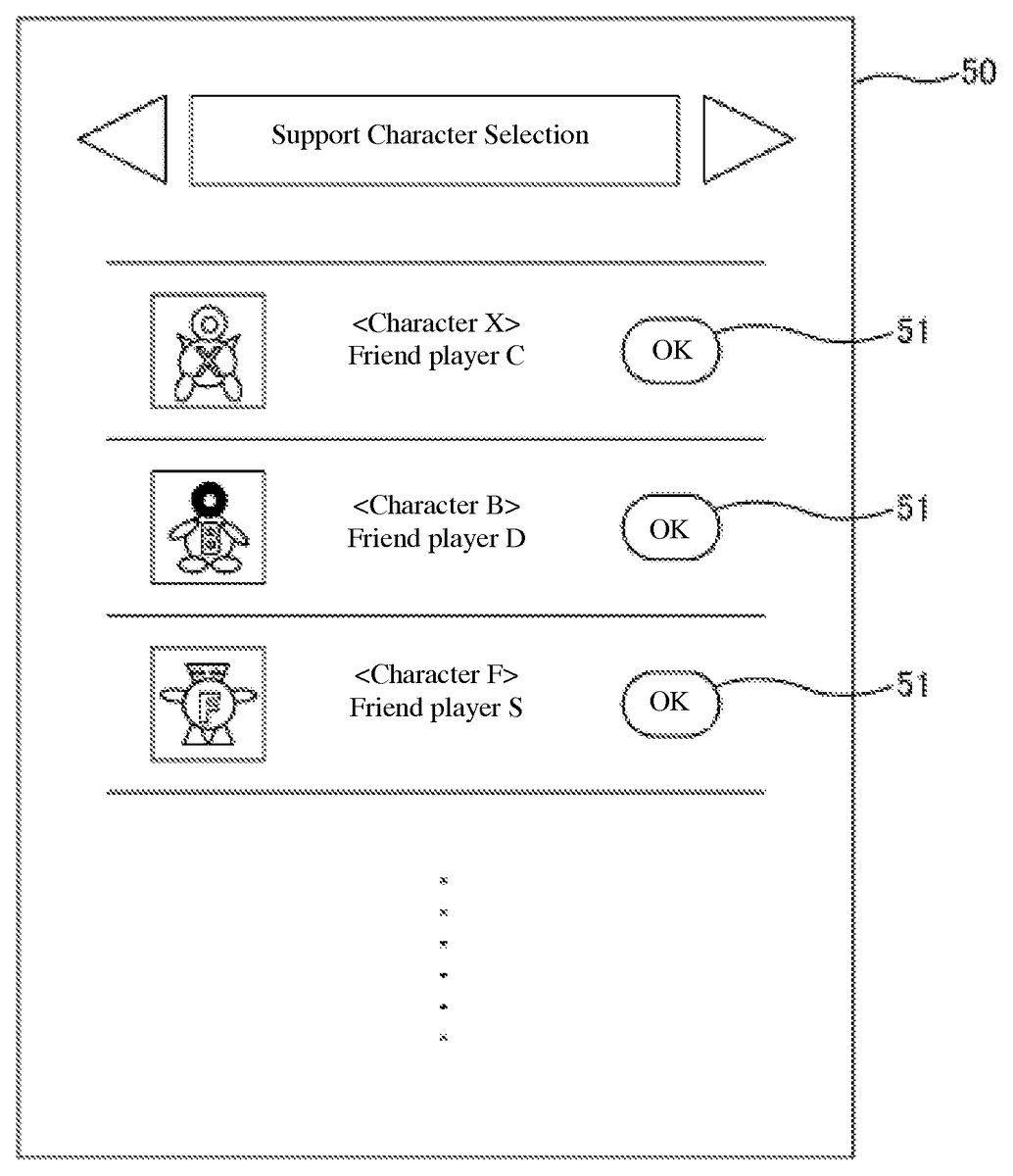
Next, when this screen data transmitted from the server device10is received, the player terminal20, upon analyzing the screen data, displays the game screen (web page) used for support character selection illustrated inFIG. 14on the terminal display module24. Subsequently, when the game screen50used for support character selection is displayed, the player terminal20allows the player to perform selection operations using the control buttons51, thereby specifying the desired support characters in the list (Step S104). Subsequently, when a selection operation is performed by the player using a particular control button51, the player terminal20transmits a command (deck assembly request) to the server device10, requesting that a battle deck to be used by the player in battle play be assembled based on such operational information.
Next, upon receiving the deck assembly request transmitted from the player terminal20, the server device10carries out processing to assemble the player's battle deck (Step S105). Namely, the deck assembly processing module111B refers to the player information illustrated inFIG. 6and identifies the team information associated with the player. Subsequently, by referring to the team information illustrated inFIG. 9, the deck assembly processing module111B selects a team having the initial team ID associated therewith (for example, “Team A”) and assembles a battle deck by adding the support character specified by the player in the list in Step S104to the constituent characters of that team.
Next, upon assembly of the battle deck in this manner, the server device10directs the game screen generation module112to generate screen data (an HTML file) used to display a start battle game screen (web page), which includes a display of this battle deck on the player terminal20(Step S106).
The server device10then transmits screen data corresponding to the thus generated start battle game screen to the requesting player terminal20over the network2. Subsequently, upon receiving the screen data transmitted from the server device10, the player terminal20analyzes the screen data and, as a result, displays the start battle game screen on the terminal display module24.
FIG. 15is a diagram illustrating an example of the start battle game screen60. This start battle game screen60includes a battle deck display area61, a control button62used to initiate a battle, and a control button63used to re-assemble the battle deck. The battle deck assembled by the deck assembly processing module111B is displayed in the battle deck display area61, thereby allowing the player to check the constituent characters of this battle deck. It should be noted that when the player enters a touch gesture in the battle deck display area61, the team having the top team ID associated therewith (e.g., “Team A”) may be replaced with a team having the next team ID associated therewith (e.g., “Team B”) as the battle deck displayed on the screen. In other words, a second battle deck may be displayed in which the support character is added to the constituent characters of the team corresponding to the next team ID (e.g., “Team B”). In such a case, the player may engage in battle play using the second battle deck. The teams may of course be switched in succession whenever the player enters a touch gesture, thus displaying a second battle deck, a third battle deck, a fourth battle deck, and so forth, on the screen.
Next, going back toFIG. 13, the player terminal20determines whether or not the selection operation was performed by the player using the control button62when the start battle game screen60was displayed on the terminal display module24(Step S107). Then, if the selection operation is performed using the control button63, and not the control button62(Step S107: NO), the player terminal20goes back to Step S104, and the subsequent processing is repeated. On the other hand, when the selection operation is performed using the control button62(Step S107: YES), the player terminal20transmits a command (battle initiation request) with a request to start battle play using the battle deck to the server device10via the terminal communication module25.
Next, upon receiving the battle initiation request transmitted from the player terminal20, the server device10carries out battle processing (Step S108). Specifically, the battle processing module111C determines one or many enemy characters appearing in the stage that is specified by the player based on the rate of appearance of the appearing characters configured in the stage information illustrated inFIG. 5. Subsequently, the battle processing module111C directs the player characters and the support character forming the player's battle deck to engage in battle with the enemy characters that were determined. Namely, along with acquiring various parameters configured in the player characters that constitute the battle deck (attack strength, defense strength, hit points, etc.) by referring to the team information illustrated inFIG. 9and the proprietary character information illustrated inFIG. 7, as well as acquiring various parameters configured in the support character (attack strength, defense strength, hit points, etc.) by referring to the support character information illustrated inFIG. 10and the proprietary character information illustrated inFIG. 7, the battle processing module111C acquires various parameters configured in the enemy characters (upper attack strength limit, upper defense strength limit, upper hit point limit, etc.) by referring to the stage information illustrated inFIG. 5and character information illustrated inFIG. 4. The battle processing module111C then determines the winner of the battle based on the various parameters of these characters.
Next, when the battle process ends in this manner, the server device10determines whether or not the stage has been cleared (Step S109). Namely, the game progress module111determines that the player has cleared the stage if it is decided by the battle processing module111C that the player has won. And if the player could not clear the stage (Step S109: NO), this process is terminated. On the other hand, if the player has cleared the stage (Step S109: YES), the cleared stages information illustrated inFIG. 11is updated and, at the same time, game play in the next stage is authorized, and the process advances to Step S110.
A benefit provision process is executed in Step S110. Namely, the benefit provision processing module111D awards the enemy character defeated by the player to said player as a benefit in accordance with a predetermined probability, and the proprietary character information illustrated inFIG. 7is updated. In addition, the benefit provision processing module111D awards the items belonging to this enemy character to the player as benefits in accordance with the drop rate of the enemy character defeated by the player (seeFIG. 4), and the proprietary item information illustrated inFIG. 8is updated. Furthermore, the benefit provision processing module111D awards friend points as benefits to the friend player who owns the support character specified by the player (i.e., the support character constituting the battle deck), and the player information illustrated inFIG. 6is updated.
Next, upon the player clearing the stage, the server device10executes a support character configuration process (Step S111).
Specifically, the support character configuration processing module111E directs the game screen generation module112to generate a game screen for support character configuration used to configure the support character corresponding to the stage that has been cleared. The server device10then transmits screen data (HTML files) corresponding to this game screen to the requesting player terminal20over the network2. Subsequently, upon receiving the screen data transmitted from the server device10, the player terminal20analyzes the screen data and, as a result, displays the game screen used for support character configuration on the terminal display module24.
FIG. 16is a diagram illustrating an example of a game screen70used for support character configuration. This game screen70displays the name of the stage that has been cleared and its attributes, and, in addition, provides a list view of the player characters constituting the battle deck used when clearing the stage, as well as their attributes. By performing selection operations using the control buttons71, the player configures a particular player character as a support character corresponding to this cleared stage. At such time, the player can configure a support character suitable for this stage by selecting a player character having advantageous attributes relative to the attributes configured for the stage and the attributes of the enemy characters that appear. For example, if “attribute A” is configured in the stage and “attribute B” is configured as an advantageous attribute relative to “attribute A”, a support character suitable for this stage can be configured by selecting a player character having “attribute B”. Accordingly, it becomes easier for other players to select a support character suitable for the stage used for battle play when selecting support characters. In addition, the player is likely to acquire more friend points because the likelihood of other players selecting a support character configured by said player increases. In addition, for the player, this creates a motivation to successively clear stages because as more stages are cleared, more support characters can be configured.
Subsequently, when a selection operation is performed by the player using a particular control button71while the game screen70used for support character configuration is displayed on the terminal display module24, the player terminal20transmits a command (support character configuration request) requesting support character configuration based on this operational information to the server device10.
Then, upon receiving the support character configuration request transmitted from the player terminal20, the server device10configures a support character corresponding to the stage cleared by the player. Namely, the support character configuration processing module111E configures and registers the support character selected by the player in association with the stage cleared by the player as the support character information illustrated inFIG. 10.
As described above, the game system1according to the present embodiment can direct the player to configure a stage-appropriate support character for each stage. For this reason, it becomes easy for the player engaged in battle play in the stage to select a support character suitable for this stage from a list and gain an advantage in the battle with enemy characters in the stage. Furthermore, it becomes easy for friend players to acquire more benefits because a support character likely to be selected by the player can be configured for each stage.
Other Embodiments
The foregoing embodiment was intended to facilitate the understanding of the present invention and is not to be construed as limiting of the present invention. The present invention can be modified and improved without departing from its spirit and the present invention includes equivalents thereto. In particular, the embodiments described below are also included in the present invention.
Although the present embodiment has been described with reference to an example in which the support character corresponding to the stage is configured after the player engages in battle play in the stage, the present invention is not limited thereto. For example, the support character may be configured at any time. Specifically, in response to the player's operations, as illustrated inFIG. 17, the player terminal20displays a game screen80used for support character configuration on the terminal display module24. This game screen80used for support character configuration displays a list of stages, with the stage name and attributes displayed for each stage. When the game screen80used for support character configuration is displayed on the terminal display module24, the player can perform selection operations using the control buttons81to change and re-configure support characters for stages that have support characters already configured. In addition, the player can perform selection operations using the control buttons82to configure a support character selected from multiple characters owned by the player herself or himself for stages that don't have a support character configured yet. It should be noted that, for stages that don't have a support character configured yet, the player's team information (seeFIG. 9) may be used such that a player character configured as the leader among the constituent characters of the team having the initial team ID associated therewith (e.g., “Team A”) is automatically configured as a support character and this support character is displayed on the game screen80used for support character configuration. Alternatively, the player character configured as the leader of the team constituting the battle deck used by the player during battle play in the cleared stage may be automatically configured as a support character and this support character may be displayed on screen.
Although the present embodiment has been described above with reference to a case in which a single support character is configured for a single stage, the present invention is not limited thereto. For example, two or more support characters may be configured for a single stage in advance and the player engaged in battle play in the stage may be allowed to select any support characters from the multiple support characters. Specifically, the support character configuration processing module111E configures and registers the multiple support characters selected by the player in association with the stage as the support characters illustrated inFIG. 10. In addition, for example, when two or more support characters are configured for a certain stage that has been cleared, the player may be allowed to select at least one or more player characters from the battle deck used by the player during battle play in the cleared stage and configure it as a support character corresponding to the stage and, at the same time, the player's team information (seeFIG. 9) may be used such that the player character configured as the leader among the constituent characters of the team having the initial team ID (e.g., “Team A”) associated therewith is configured as a support character. At such time, if the team constituting the battle deck used by the player during battle play and the team having the initial team ID associated therewith are the same team, the player character configured as the leader among the constituent characters of the team having the next team ID associated therewith may be configured as a support character.
In the present embodiment as described above, the player may be allowed to configure a support character corresponding to a friend player (another player). Specifically, the support character configuration processing module111E configures and registers support characters selected by the player for each friend player as the support character information illustrated inFIG. 10in association with the stages where the player can engage in battle play. It should be noted that, at such time, the game progress module111may use the cleared stages information (seeFIG. 11) of each friend player to identify the stages that the friend player has not cleared yet and direct the game screen generation module112to generate a game screen used for providing information about these stages to thereby notify the player of such information. Here, the number of times the player has failed to clear the stage as well as the period of time the player has been unable to clear the stage may be recorded for each stage in the cleared stages information. In such a case, the game progress module111may use this cleared stages information to identify stages that the friend player has failed to clear at least a predetermined number of times, or stages that the friend player has been unable to clear for at least a predetermined period of time, and notify the player of information relating to these stages. It should be noted that the stage-related information communicated to the player may include the number of times the friend player has failed to clear the stage and the period of time the player has been unable to clear the stage. In this manner, as a result of being notified, the player can configure support characters corresponding to the stages that have not yet been cleared for each friend player.
In the present embodiment as described above, support characters may be configured depending on the level of the friend player (another player). For example, if the level of the friend player is 21-30, Character A may be configured as a support character, and if the level is 31-40, Character B may be configured as a support character.
Although the present embodiment has been described above with reference to a case in which a player character is selected by the player on the game screen70used for support character configuration from a battle deck used by the player during battle play in a cleared stage, as illustrated inFIG. 16, and the player character is configured as a support character corresponding to that stage, the present invention is not limited thereto. For example, a player character selected from proprietary characters may be configured as the support character corresponding to the cleared stage.
Although the present embodiment has been described above with reference to a case in which, upon clearing a stage, the player can configure a support character corresponding to that cleared stage, the present invention is not limited thereto. For example, even if the stage could not be cleared, a support character corresponding to that stage may still be configured.
Although the present embodiment has been described above with reference to a case in which a list view of support characters, which are configured by friend players associated with a player engaged in battle play in a stage, is provided on the game screen used for support character selection illustrated inFIG. 14, the present invention is not limited thereto. For example, a support character configured by a player other than the friend players may be included in the list.
Although the present embodiment has been described above with reference to a game system1equipped with a single server device10as an example of a service device, the invention is not limited thereto and a game system1equipped with multiple server devices10, as an example of server devices, may also be used. In other words, multiple server devices10may be connected over a network2and these server devices10may perform various types of processing in a distributed manner. It should be noted that the server device is an example of a computer.
In the game system1used in the present embodiment as described above, the explanations are given with reference to a case in which various types of information processing are carried out by directing the server device10and the player terminals20to cooperate based on a game program (e.g., a non-transitory computer readable medium having machine-executable instructions and including a computer having a storage and a hardware processor). The invention, however, is not limited thereto and the above-mentioned various types of information processing may be carried out based on the game program using the server device10alone or the player terminals20alone as information processing devices.
In addition, a configuration may be used in which the player terminals20support part of the information processing device functionality. In such a case, the server device10and player terminals20constitute an information processing device.
It should be noted that the information processing device is an example of a computer equipped with a processor and a memory.
DESCRIPTION OF THE REFERENCE NUMERALS
1game system2network10server device11control module12data storage module13input module14display module15communication module20player terminal21terminal control module22terminal storage module23terminal input module24terminal display module25terminal communication module50game screen51control button60game screen61battle deck display area62control button63control button70game screen71control button80game screen81control button82control button111game progress module111A lottery processing module111B deck assembly processing module111C battle processing module111D benefit provision processing module111E support character configuration processing module112game screen generation module
Claims
- An information processing device, wherein said device is provided with a support character configuration processing module that configures, in association with a stage where each of a plurality of players can engage in battle play, a player character selected by each of the players from a plurality of characters owned by the players themselves as a support character that provides support in a stage where another player engages in battle play;a game screen generation module which, once a first player among the plurality of players performs an operation to select a stage for battle play, generates a game screen displaying a list view of support characters associated with the selected stage;a battle processing module which, once the first player performs an operation to select a particular support character from the list, directs the selected support character and a player character belonging to the first player to engage in battle with an enemy character configured in the selected stage;and a benefit provision processing module that provides benefits to a second player, from among the plurality of players, who owns the selected support character, and, after the first player completes battle play in the selected stage, the support character configuration processing module retains the player character belonging to the first player as a support character associated with said selected stage, and present the player character belonging to the first character as a selectable support character for the selected stage for subsequent selection of the selected stage.
- An information processing device, wherein said device is provided with a support character configuration processing module that configures, in association with a stage where each of a plurality of players can engage in battle play, a player character selected by each of the players from a plurality of characters owned by the players themselves as a support character that provides support in a stage where another player engages in battle play;a game screen generation module which, once a first player among the plurality of players performs an operation to select a stage for battle play, generates a game screen displaying a list view of support characters associated with the selected stage;a battle processing module which, once the first player performs an operation to select a particular support character from the list, directs the selected support character and a player character belonging to the first player to engage in battle with an enemy character configured in the selected stage;and a benefit provision processing module that provides benefits to a second player, from among the plurality of players, who owns the selected support character, and, the support character configuration processing module retains the player character that is directed to engage in battle with the enemy character in the selected stage, from among the multiple characters owned by the first player, as a support character associated with said selected stage, and present the player character that is directed to engage in battle with the enemy character in the selected stage as a selectable support character for the selected stage for subsequent selection of the selected stage.
- An information processing device, wherein said device is provided with a support character configuration processing module that configures, in association with a stage where each of a plurality of players can engage in battle play, a player character selected by each of the players from a plurality of characters owned by the players themselves as a support character that provides support in a stage where another player engages in battle play;a game screen generation module which, once a first player among the plurality of players performs an operation to select a stage for battle play, generates a game screen displaying a list view of support characters associated with the selected stage;a battle processing module which, once the first player performs an operation to select a particular support character from the list, directs the selected support character and a player character belonging to the first player to engage in battle with an enemy character configured in the selected stage;and a benefit provision processing module that provides benefits to a second player, from among the plurality of players, who owns the selected support character, and, the support character configuration processing module retains, in association with the selected stage where each of the plurality of players can engage in battle play, the support character corresponding to each of the other players engaged in battle play in the selected stage, and present the support character corresponding to each of the other players engaged in the battle play in the selected stage as a selectable support character for the selected stage for subsequent selection of the selected stage for the corresponding each of the other players engaged in battle play.
- A non-transitory computer readable medium having machine-executable instructions and including a computer having a storage and a hardware processor, wherein said instructions direct the computer to perform: a support character configuration process that configures, in association with a stage where each of a plurality of players can engage in battle play, a player character selected by each of the players from a plurality of characters owned by the players themselves as a support character that provides support in a stage where another player engages in battle play;a game screen generation process which, once a first player among the plurality of players performs an operation to select a stage for battle play, generates a game screen displaying a list view of support characters associated with the selected stage;a battle process which, once the first player performs an operation to select a particular support character from the list, directs the selected support character and a player character belonging to the first player to engage in battle with an enemy character configured in the selected stage;a benefit provision process that provides benefits to a second player, from among the plurality of players, who owns the selected support character;and, during the support character configuration process, after the first player completes battle play in the selected stage, retains the player character belonging to the first player as a support character associated with said selected stage, and present the player character belonging to the first character as a selectable support character for the selected stage for subsequent selection of the selected stage.
- A non-transitory computer readable medium having machine-executable instructions and including a computer having a storage and a hardware processor, wherein said instructions direct the computer to perform: a support character configuration process that configures, in association with a stage where each of a plurality of players can engage in battle play, a player character selected by each of the players from a plurality of characters owned by the players themselves as a support character that provides support in a stage where another player engages in battle play;a game screen generation process which, once a first player among the plurality of players performs an operation to select a stage for battle play, generates a game screen displaying a list view of support characters associated with the selected stage;a battle process which, once the first player performs an operation to select a particular support character from the list, directs the selected support character and a player character belonging to the first player to engage in battle with an enemy character configured in the selected stage;a benefit provision process that provides benefits to a second player, from among the plurality of players, who owns the selected support character;and, during the support character configuration process, retains the player character that is directed to engage in battle with the enemy character in the selected stage, from among the multiple characters owned by the first player, as a support character associated with said selected stage, and present the player character that is directed to engage in battle with the enemy character in the selected stage as a selectable support character for the selected stage for subsequent selection of the selected stage.
- A non-transitory computer readable medium having machine-executable instructions and including a computer having a storage and a hardware processor, wherein said instructions direct the computer to perform: a support character configuration process that configures, in association with a stage where each of a plurality of players can engage in battle play, a player character selected by each of the players from a plurality of characters owned by the players themselves as a support character that provides support in a stage where another player engages in battle play;a game screen generation process which, once a first player among the plurality of players performs an operation to select a stage for battle play, generates a game screen displaying a list view of support characters associated with the selected stage;a battle process which, once the first player performs an operation to select a particular support character from the list, directs the selected support character and a player character belonging to the first player to engage in battle with an enemy character configured in the selected stage;a benefit provision process that provides benefits to a second player, from among the plurality of players, who owns the selected support character;and, during the support character configuration process, retains, in association with the selected stage where each of the plurality of players can engage in battle play, the support character corresponding to each of the other players engaged in battle play in the selected stage and present the support character corresponding to each of the other players engaged in the battle play in the selected stage as a selectable support character for the selected stage for subsequent selection of the selected stage for the corresponding each of the other players engaged in battle play.
Disclaimer: Data collected from the USPTO and may be malformed, incomplete, and/or otherwise inaccurate.