U.S. Pat. No. 9,737,812
METHOD OF INTERACTING WITH AN INTERACTIVE GAME PROGRAM
AssigneeSizmek Technologies Ltd.
Issue DateFebruary 13, 2007
Illustrative Figure
Abstract
A software agent interfaces with an interactive game program allowing for dynamic conveyance of objects during runtime for receiving data indicative of at least one parameter relating to a player of the interactive game program and/or to the player station on which the program is run. The data is used to set a dynamic policy that is customized on-the-fly according to the at least one parameter, and which is adapted to determine one or more objects to be conveyed to the player station for dynamically embedding in the program. The dynamic policy is also adapted to determine one or more characteristics of the object and is capable of subsequent re-customization and revision during game play. The objects are retrieved and periodically conveyed to the interactive game program based on the dynamic policy for dynamically embedding in the interactive game program to interface with the game player of the interactive game program.
Description
DETAILED DESCRIPTION OF EMBODIMENTS FIG. 1is a pictorial representation of a system10comprising a client machine11on which a user (not shown) plays an interactive game program that has an interface to a policy management server12to which it is coupled via a data network, such as the Internet13. The interactive game program can itself be downloaded over the Internet or it can be an Internet game that is accessed from a remote game server. So far as the invention is concerned the source of the game is not important so long as it is provided with a software agent that provides an interface to the policy management server12, and allows dynamic conveyance of data into the interactive game program during runtime, according to a runtime customized and subsequently revisable advertisement policy. Also connected to the Internet13are a publisher ad server14and an agency ad server15that operate in known manner to serve advertisements to the client machine11. The software agent in the client is configured to download advertisements from the agency ad server15during running of the interactive game program based on an advertisement policy dictated by the policy management server12. Such advertisements can be downloaded in one of three ways: streaming, pre-fetching and progressive download, this being known per se. It will be understood that the client machine11may be any suitable device that is operative to run a game program either while coupled to the Internet (or other suitable network such as a VPN and the like) or in offline mode, as will be further specified below. Most commonly client machine11is a computer such as a PC but it may also be a PDA, mobile telephone, console game machines, IPTV and any other such game program device. FIG. 2is a block diagram showing functionality of a software agent20according to an embodiment of the invention ...
DETAILED DESCRIPTION OF EMBODIMENTS
FIG. 1is a pictorial representation of a system10comprising a client machine11on which a user (not shown) plays an interactive game program that has an interface to a policy management server12to which it is coupled via a data network, such as the Internet13. The interactive game program can itself be downloaded over the Internet or it can be an Internet game that is accessed from a remote game server. So far as the invention is concerned the source of the game is not important so long as it is provided with a software agent that provides an interface to the policy management server12, and allows dynamic conveyance of data into the interactive game program during runtime, according to a runtime customized and subsequently revisable advertisement policy. Also connected to the Internet13are a publisher ad server14and an agency ad server15that operate in known manner to serve advertisements to the client machine11. The software agent in the client is configured to download advertisements from the agency ad server15during running of the interactive game program based on an advertisement policy dictated by the policy management server12. Such advertisements can be downloaded in one of three ways: streaming, pre-fetching and progressive download, this being known per se.
It will be understood that the client machine11may be any suitable device that is operative to run a game program either while coupled to the Internet (or other suitable network such as a VPN and the like) or in offline mode, as will be further specified below. Most commonly client machine11is a computer such as a PC but it may also be a PDA, mobile telephone, console game machines, IPTV and any other such game program device.
FIG. 2is a block diagram showing functionality of a software agent20according to an embodiment of the invention that is suitable for interacting with the policy management server12. The interactive game program may be integrated with the software agent20as will typically be done in standalone game programs that are supplied by independent outlets, such as stores and the like. But it is sufficient for the interactive game program to have an interface to the software agent20so that once the software agent20is loaded in the client machine11one or more interactive game programs may interface with the same software agent20. This allows the client machine11to download multiple on-lines games from a common source while downloading the software agent20once only.
The software agent20comprises a game interface21that allows the software agent20to be directly interfaced to the game engine via a COM interface22or via a C++ interface23. For games that are not written in C++ suitable adapters may be provided that are coupled to the C++ interface23and allow interface conversion to the game engine technology. For example, some engines are built using higher level languages than C++ and in such case, the adapter will allow the software agent20to interface with the game engine. It will be appreciated that provision of the C++ interface23is by way of example only, and other programming language interfaces may be provided, particularly in cases where the software agent20is pre-installed with a purchased game program.
Likewise, the software agent20is provided with a JavaScript engine25that allows the software agent20to interface with external JavaScript objects. Java and JavaScript are registered trademarks of Sun Microsystems Inc., Santa Clara, Calif., USA. A serving scripts module26is coupled to the JavaScript engine25and allows external Java scripts to be loaded to the JavaScript engine25for execution thereby. The serving scripts module26is in charge of the serving decision for both the publisher ad server14and the client machine11. All serving logic is implemented in JavaScript. The JavaScript engine25is coupled to an HTTP client utilities module27that allows the software agent20to interface with the Internet using the HTTP protocol. By such means the software agent20can download Java scripts and instructions over the Internet and can upload data during the execution of the interactive game program. The HTTP client utilities module27also allows interface with data stored in the form of cookies28on the client machine11.
An extension manager29(constituting a flow coordination module) within the software agent20is coupled to the game interface21and to the JavaScript engine25and coordinates flow between various modules in the software agent20. A display driver30is likewise coupled to the JavaScript engine25and controls how an advertisement downloaded by the software agent20is displayed. The display driver30is described in greater detail below with reference toFIG. 3of the drawings.
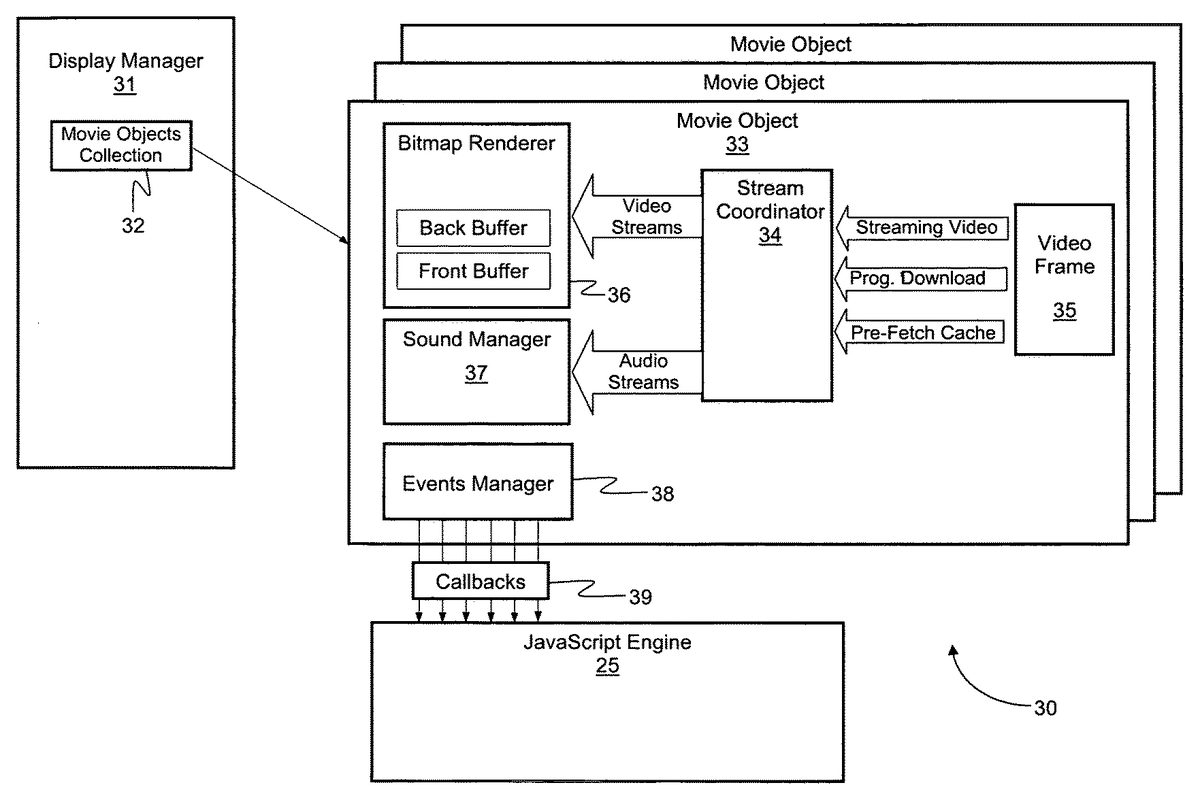
FIG. 3is a block diagram showing details of the display driver30. The display driver30includes a display manager31that contains a movie collection32which is a dynamic list of all advertisement movie objects33that are currently required to be played by the game. Each movie object33has an interface to the JavaScript engine25and thus can be manipulated by Java scripts that are downloaded by the software agent20. The display driver30comprises a segmentation module that segments the movie file into discrete frames and a stream coordinator34that is responsive to such a Java script for downloading a video frame35using a download mechanism dictated by the Java script, thus allowing the frame to be downloaded as streaming video, or via pre-fetching or progressive download as required. The stream coordinator34, constituting a buffering module, processes the video frame35to create separate but synchronized video and audio streams that are fed respectively to a bitmap renderer36and a sound manager37. An events manager38, constituting an emulation module, issues callbacks39that are processed by the JavaScript engine25and conveyed to the agency ad server and to the publisher ad server14for compiling usage statistics etc.
As will be described below with reference toFIG. 5, game objects are formed of polygons that are interconnected to give the impression of 3D objects. The software agent superimposes the bitmap frames on the polygon environment, one after the other, and further synchronizes the frame flow with the sound stream, thus creating an illusion of video and enabling display of video on the 3D environment. The game rate is higher than the required video rate. Therefore, not every time the platform refreshes, a new video frame has to, displayed, but rather once every few times. The video may be refreshed at a lower rate than the refresh rate of the game platform.
FIG. 4is a block diagram showing details of data flow between the extension manager29and the various ‘players’ in the ad scenario. The extension manager29is the public interface to the game engine and wraps the display modules, serving flow modules and all the other specialized modules. The game engine invokes the extension commands via the COM interface22and the DLL C++ interface23. The extension manager29also includes a Machine State Collector (not shown) which is in charge of collecting all the relevant information about the machine state (such as bandwidth, OS type, installed libraries etc. . . . ) for the sole purpose of determining the machine's display capabilities. The extension manager also contains the JavaScript interface classes for the remaining inner modules.
As will be described in greater detail below with particular reference toFIG. 7of the drawings, the extension manager29responds to events that are set by the game developer40and by the game publisher41as well as to an ad policy fed thereto by the policy management server12. To this end, the policy management server12receives the game ID from the extension manager29and returns to the extension manager29a respective ad policy JavaScript file42, which is retained and enforced by the extension manager29.
During play, ads are then served to the game according to the ad policy currently stored in the extension manager. When the game is initiated and consequently the extension manager is initiated, the policy management server communicates to the extension manager a corresponding ad policy JavaScript file (the mechanism for matching between a game and an ad policy is specified below). The ad policy file is cached in the extension manager for a predefined time period in order to optimize the number of calls to the policy management server. As the game proceeds from initiation onwards, each time the game engine calls the software agent20for an ad, the extension manager decides whether an ad should be displayed according to the ad policy and the then-current game event, as reported by the game wrapper, shown as45inFIG. 6. The communication between the extension manager and the wrapper depends on the manner of integration between them—either the extension manager draws the current status game event upon a request for an ad, or the wrapper actively reports the initial and, as the case may be, updated, status game event. The extension manager comprises, inter-alia, counters supporting time-related and history-related ad policies. A counter counting the time that lapsed from the previous ad display may support a time-based frequency policy (i.e. ad display every n minutes). A counter counting levels/stages may support an event-based frequency policy (i.e. ad display every n stages/levels).
Video Display on 3D Environment
FIG. 5is a pictorial representation of a car, constituting a 3D game object that may be used to display an advertisement in accordance with an embodiment of the invention. In order to allow such 3D objects to display video they are constructed from multiple 2D polygons that are interconnected in a lattice. The display driver30exploits the high frame rate at which known 3D engines can attach textures to these polygons. To this end, the display driver30splits the downloaded movie into frames from which it generates bitmaps. The bitmaps are then used on selected polygons in the 3D object. Each time the 3D object refreshes itself, the software agent20will return the bitmap representing the current frame in the movie. Repeating this mechanism at a high frame rate creates the illusion of video inside the polygon.
FIG. 6is a pictorial representation showing various objects that may be used to display video advertisements according to an embodiment of the invention. Thus selected surfaces of the cars may be used to display successive bitmap representations of a sequence of video frames at sufficiently high rate to avoid video flicker. According to another embodiment of the invention, video advertisements may also be displayed as a layer on top of the 3D game objects, without a particular 3D game object or a part thereof outlining the advertisement.
In-Game Advertising Flow and Advertising Policy
As noted above, the software agent20interfaces between the game engine and the policy management server12, so as to allow an advertising policy relating to the embedding of in-game advertisements to be customized on-the-fly according to one or more parameters, which are conveyed to the policy management server12by the game engine. Based on these parameters, the policy management server12customizes an ad policy on-the-fly, which, in turn, determines one or more advertising objects to be conveyed to the player station for dynamically embedding in the program and determines a frequency at which the advertising objects are conveyed.
The ad policy mechanism is implemented by means of a Java script file that inputs a parameter and outputs a true or false response—whether or not an ad should be served. During the game play, parameters are continuously conveyed to software agent20. The software agent20may, pursuant to some of the parameters, re-customize and re-set on-the-fly a new and different advertising policy for the game, as will be further illustrated below. Further, the advertising policies may at any time be accessed at the policy management server12, where they are stored, and revised according to changing needs and considerations. The advertising objects are stored in the agency ad server15.
A typical scenario will now be described with reference toFIGS. 7 and 8of the drawings. The game developer40(shown inFIG. 4) integrates the software agent20in a game, to create a game within which advertisements may be displayed (hereinafter: “enabled game”), and programs various locations in which advertisements may be displayed (including the possibilities of (i) within objects in the scenario of the game, (ii) between levels/stages in a layer on top of the game, (iii) an ad-reminder in a layer on top of the game, etc.).
The policy management server12sets a unique ID for the game, based, inter-alia, on data supplied by the game developer. The ID includes the following information: title, identity of developer, publisher and distributor, genre and sub-genre (sports {tennis, football}, trivia, first shooter, board game, etc.), language and rating (for what age range, whether containing violence, etc.).
The game publisher41carries out further integration by communicating to the software agent20definitions and settings regarding the game events. A game event provides information regarding the status of a game or an occurrence within a game. Examples of status game events—free trial version, extended trial version, discounted version, paid version. Examples of occurrence game events—game load, game starts, passage between game levels, end of game.
The game publisher41sets his ad policies42on the policy management server12. An ad policy is a mechanism that determines the frequency, instances and/or locations throughout the game in which ads are to be displayed, for example:when the game loads (on-load),before the game starts (pre game),after the games ends (post game);between levels/stages (commonly known as interstitials);within game objects; and/orad-reminders.
When a user initiates a game, the software agent calls the policy management server12with the game ID.
Based on the game ID, the policy management server12determines and sets an ad policy, and communicates it to the software agent20. The policy management server12also sends the URL of the publisher ad server14to the software agent.
The game wrapper reports to the software agent20the status game event and will subsequently report a new status game event, as the case may be, which in turn will cause a different ad policy to become effective.
As the game proceeds, status and/or occurrence events are reported from the wrapper to the software agent20, with a request for an ad, which is substantially in the form of a question—will an ad be served or not?. Based on the ad policy stored in the software agent20and the event that is reported thereto, the software agent20returns either a “TRUE” or a “FALSE”. For example, if, according to an ad policy, an on-load ad is to be delivered, then upon loading of the game, the game wrapper notifies an on-load event, the answer returned is “TRUE”, and as a result the game engine creates an ad container in the pre-programmed ad display location, into which an advertisement will be served.
The ad container calls the publisher ad server14at the URL previously provided to the software agent.
The call to the publisher ad server14includes information that enables the publisher server to deliver a targeted ad, for example:Placement of the ad container—on-load, pre-game, interstitial, post-game, and others;Game ID including, among others, game genre and sub genre, language, rating;User's platform—computer, cellular, console, IPTV and others;User registration info—if previously collected.Third party cookie information.
In response, the publisher ad server14returns HTML tags that call the agency ad server15and an ad is served to the ad container. When the ad is over, the container disappears.
A report regarding the ad delivery is sent back to the agency ad server15, including usage data indicating whether or not there were an impression, loading duration, ad duration, clicks, etc. This provides feedback of a player's interaction with the ad from which the ad agency server15can determine user interest and ad efficacy.
Based on the association between the impressions and the corresponding game ID, the agency ad server15allocates the revenues, according to a pre-defined revenue share, to all entities associated with that particular ad, i.e., game developer, game publisher and game distributor.
Some events may result in re-customizing the effective ad policy. For example, if a player responds to a certain partial or full purchase suggestion in the affirmative and performs the suggested purchase by providing requested credit card details, a corresponding status event will be communicated to the software agent20, that may result in on-the-fly allocation of a different ad policy that provides for a lower ad display frequency or no ad display at all.
At any time, any ad policy may be accessed at the policy management server12and revised, typically by a game publisher, according to then-current needs and considerations. The next time that this ad policy is set to a game, the revision will already be effective. As for games that will then be currently played under that policy, the revision will take effect when the ad policy file at the software agent20expires pursuant to a predetermined duration, at which time the software agent20will call the policy management server12requesting the-then current ad policy file.
Offline Messages
When a user goes online and downloads a game, cache ads are stored on a central location on the user machine. If the user plays in an offline mode, the cache ads are delivered across any enabled games played on this machine. The ads rotate and a frequency cap is activated. In the event the frequency cap prevents serving all the ads, a house ad (advertising, for example, the publisher) downloaded with the game is served (the same happens if the game is bought on a CD and played offline prior to connecting to the Internet). When the user goes online again, a report is delivered for every ad as described above.
Implementation
Having described the interaction between the different operators in the system10shown inFIG. 1that allows a dynamic advertising policy to be customized on-the-fly during actual game play, there will now be described with reference toFIGS. 9 and 10how the mechanism provided by the invention can allow enhanced marketing strategies to be employed so as to increase revenues.
FIG. 9is a pictorial representation showing a typical prior art strategy for on-line marketing of a game where an on-line user can play the game for a limited trial period. At the end of trial period he must either enter a license code indicating that he has purchased the game or he must purchase the game so as to obtain a license code. In effect this scenario facilitates direct communication between a prospective purchaser and an on-line vendor, but the only feedback that the vendor obtains is whether or not the user decides to purchase the game.
FIG. 10is a pictorial representation showing an enhanced strategy for on-line marketing of a game facilitated by the invention. When the game is downloaded and the player starts playing (not shown), a trial period is provided for, and an initial ad policy is allocated that may define display of some ads or no ad display at all, depending on the publisher's business concepts and strategies. During the trial period or when it has lapsed, a new screen is presented allowing the player to buy the game (as before) but also allowing him to continue running the game or a version thereof for free while permitting on-line advertisements to be displayed. If this option is selected, an ad policy corresponding to this option is allocated, which, in turn, determines the frequency at which such advertisements are displayed. The advertisers pay for the display of these ads and, in so doing, finance the continued free trial period. Alternatively, the player may opt to pay a modest sum that allows him to purchase the game or a version thereof for a reduced sum compared with outright purchase. The difference is at least partly financed by advertisers whose ads are served to the game during play, albeit at a lesser frequency than during the free trial option, such frequency being determined by the corresponding ad policy that was allocated.
The invention described herewith provides a mechanism for determining and subsequently revising ad display characteristics in a centralized automated manner for an entire game. This is very different from prior art disclosed methods that allow for setting characteristics separately and individually for different particular ad objects, such that editing any one specific preset characteristic necessitates particular manual and separate access to that specific characteristic at the specific ad object. Further, the mechanism allows for one particular game to be played by a number of different simultaneous players under different ad policies, since different publishers posting the game on their websites have defined different ad policies for that game, and/or since different players made different decisions regarding the amount to be paid for the game, if at all.
It will be appreciated that modifications may be made to the invention without departing from the scope as defined in the attached claims. Thus, while the in-game objects have been described with particular reference to advertising objects, it will be understood that the objects provide a communication channel from a server into the game and vice versa, and can transfer many types of media content for different purposes. Other possible applications could include for example, instant messaging, music streaming, game updates, etc. It will be understood that when the invention is used in such scenarios, real time monitoring of which objects are downloaded during game play for the purpose of revenue tracking may not be important. Likewise, there may be scenarios such as non-commercial applications where distribution or allocation of revenue shares is not necessary. This may be particularly true for applications where the objects are not related to advertising.
It will also be understood that while various embodiments have been described with regard to objects that are displayed by the interactive game program, the invention is also applicable to the embedding of other objects such as audio objects that are vocalized by the game program; as well as to audio/video objects having components that are both displayed and vocalized as appropriate.
It will also be understood that the software agent may be a separate software component for embedding within the game engine of a game program using a SDK. Alternatively, it may be provided as a separate component for interfacing with a pre-complied game allowing a game having a suitably formatted game engine to interface with the software agent.
It will also be understood that the system according to the invention may be a suitably programmed computer. Likewise, the invention contemplates a computer program being readable by a computer for executing the method of the invention. The invention further contemplates a machine-readable memory tangibly embodying a program of instructions executable by the machine for executing the method of the invention.
Claims
- A method of interfacing with an interactive game program allowing for dynamic conveyance of objects during runtime, said program interfacing with a software agent, wherein the method is performed by a computer including a processor and a memory, wherein the memory includes instructions for causing the processor to perform the method, the method comprising: prior to the runtime of the interactive game program, allocating a locally stored dynamic policy to the interactive game program by a policy management server, based, in part, on a game identification;during the runtime of the interactive game program, receiving feedback data indicative of at least one parameter relating to at least one of a player of the interactive game program, the interactive game program, and a player station on which the program is run;customizing the locally stored dynamic policy on-the-fly by the policy management server, during the runtime of the interactive game program responsive to said feedback data indicative of said at least one parameter, allocating the customized dynamic policy on-the-fly, during the runtime of the interactive game program, thereby enabling revising display characteristics of the objects in a centralized automated manner for the entire interactive game program;and during the runtime of the interactive game program, retrieving and periodically conveying, by the software agent, the objects to the interactive game program based on any of: the locally stored dynamic policy, and the locally stored customized dynamic policy for embedding in the interactive game program;wherein said dynamic policy is configured to determine one or more characteristics of the objects and locations throughout the interactive game program in which one or more objects are to be displayed, said dynamic policy being configured to globally determine and revise the frequency, instance, and locations throughout the interactive game program in which said one or more objects are to be displayed.
- The method according to claim 1 , including communicating with one or more servers external to the player station.
- The method according to claim 2 , wherein communicating with said servers employs the hypertext transfer protocol.
- The method according to claim 1 , wherein the software agent conveys one or more of said objects to the interactive game program at periodic intervals that are set by the dynamic policy.
- The method according to claim 1 , further including monitoring and recording data indicative of exposure of said objects and user interaction therewith.
- The method according to claim 5 , further including reporting a revenue share of one or more entities involved in the creation of the object for each object conveyed.
- The method according to claim 1 , wherein the objects are advertising objects.
- The method according to claim 2 , including locally storing downloaded objects to enable conveyance of said objects to the game program when the player station is not connected to the external servers.
- The method according to claim 1 , including retrieving and conveying the data to the software agent via a digital rights management component external to the interactive game program.
- A software agent for interfacing with an interactive game program run on a player station, wherein the software agent is executable by a computer including a processor and a memory, the software agent comprising: a display driver for acquisition and display by the interactive game program of a video sequence at a predetermined video stream rate and at a screen location configurable by the interactive game program, further synchronized with a sound stream, wherein the display driver includes a stream coordinator for processing video frames to create the synchronized video and audio streams;a flow coordination module for customizing on-the-fly, during the runtime of the interactive game program, a dynamic policy initially set by a centralized policy server;a JavaScript engine coupled to the display driver and to the flow coordination module and being configured to control the display of video streams according to any one of: the dynamic policy, and the customized dynamic policy;and a game interface that allows the software agent to be directly interfaced to a game engine within the interactive game program.
- The software agent according to claim 10 , further including an emulation module for receiving data relating to a player of the interactive game program and/or to the player station on which the program is run and for configuring said data to a web format for conveying to a non-dedicated web server.
- The software agent according to claim 10 , wherein the JavaScript engine further allows the software agent to interface with external JavaScript objects.
- The software agent according to claim 12 , including a serving scripts module that is coupled to the JavaScript engine for allowing external Java scripts to be loaded to the JavaScript engine for execution thereby.
- The software agent according to claim 13 , wherein the serving scripts module handles a serving decision for a publisher ad server and the player station.
- The software agent according to claim 12 , wherein the JavaScript engine is coupled to a hypertext transfer protocol (HTTP) client utilities module that allows the software agent to interface with the Internet using the HTTP.
- The software agent according to claim 15 , wherein the HTTP client utilities module also allows interfacing with data stored in the form of cookies on the player station.
- The software agent according to claim 10 , wherein the game interface is configured to interface the software agent to a game engine via a software agent interface of a different technology to that of the game engine, the software agent further comprising an interface adapter coupled to the software agent interface for adapting the software agent interface to the technology of the game engine.
- The software agent according to claim 10 , wherein the flow coordination module is coupled to the game interface for coordinating data flow.
- A computer program comprising computer program code means for performing the method of claim 1 when said program is run on the computer.
- A computer program as claimed in claim 19 embodied on a computer readable medium.
- A software agent for interfacing with an interactive game program run on a player station allowing for dynamic conveyance of objects during runtime, wherein the software module is executable by a computer including a processor and a memory the software agent comprising: a flow coordination module for conveying to a policy management server first data indicative of at least one parameter relating to at least one of a player of the interactive game program, the player station on which the program is run, and the interactive game program, so as to allow the policy management server to use said first data to set a dynamic policy that is customized on-the-fly according to said at least one parameter, said dynamic policy being configured to determine one or more objects to be conveyed to the player station for embedding in the interactive game program, said dynamic policy being further configured to determine one or more characteristics of the objects, said dynamic policy being configured to globally determine and revise the frequency, instance, and locations throughout the interactive game program in which said one or more objects are to be displayed, said flow coordination module further receiving second data indicative of at least one parameter relating to at least one of: a player of the interactive game program, the player station on which the program is run, and the interactive game program so as to allow the flow coordination module to use said second data to customize on-the-fly said dynamic policy according to said at least one parameter;and a game interface for retrieving and periodically conveying the objects to the interactive game program based on any of said dynamic policy and the customized dynamic policy for embedding in the interactive game program, wherein the game interface allows the software agent to be directly interfaced to a game engine within the interactive game.
- The software agent according to claim 21 , further including an emulation module for receiving data relating to a player of the interactive game program and/or to the player station on which the program is run and for configuring said data to a web format for conveying to a non-dedicated web server.
- The software agent according to claim 21 , further comprising a JavaScript engine that allows the software agent to interface with external JavaScript objects.
- The software agent according to claim 23 , including a display driver coupled to the JavaScript engine and being configured to control how an object downloaded by the software agent is displayed.
- The software agent according to claim 23 , including a serving scripts module that is coupled to the JavaScript engine for allowing external Java scripts to be loaded to the JavaScript engine for execution thereby.
- The software agent according to claim 25 , wherein the serving scripts module handles the serving decision for a publisher ad server and the player station.
- The software agent according to claim 23 , wherein the JavaScript engine is coupled to a hypertext transfer protocol (HTTP) client utilities module that allows the software agent to interface with the Internet using the HTTP.
- The software agent according to claim 27 , wherein the HTTP client utilities module also allows interfacing with data stored in the form of cookies on the player station client machine.
- The software agent according to claim 21 , wherein the game interface is configured to interface the software agent to a game engine via a software agent interface of a different technology to that of the game engine and there is further provided an interface adapter coupled to the software agent interface for adapting the software agent interface to the technology of the game engine.
- The software agent according to claim 21 , wherein the flow coordination module is further configured to receive the data from a digital rights management component external to the interactive game program.
Disclaimer: Data collected from the USPTO and may be malformed, incomplete, and/or otherwise inaccurate.