U.S. Pat. No. 9,731,206
Delegating Video Game Tasks Via a Sharing Service
AssigneeAmazon Technologies, Inc.
Issue DateFebruary 19, 2013
Illustrative Figure
Abstract
Video game tasks are delegated using a sharing service. A first computing device is configured to execute a game application. The first computing device can receive a request from a first user to delegate play of the game application to a second user so that the second user can attempt to complete a game task on behalf of the first user by controlling the game application from a second computing device that is associated with the second user. Control of the game application can be made available from the second computing device to the first computing device via a sharing session that is created and managed by a sharing service to which the first computing device and the second computing device are connected.
Description
DETAILED DESCRIPTION The following detailed description is directed to delegating video game tasks via a sharing service. According to one aspect disclosed herein, a first computing device is configured to execute a game application. The first computing device can receive a request from a first user to delegate play of the game application to a second user so that the second user can attempt to complete a game task on behalf of the first user by controlling the game application from a second computing device that is associated with the second user. Control of the game application can be made available from the second computing device to the first computing device via a sharing session that is created and managed by a sharing service to which the first computing device and the second computing device are connected. It should be also appreciated that the subject matter presented herein may be implemented as a computer process, a computer-controlled apparatus, a computing system, or an article of manufacture, such as a computer-readable storage medium. These and various other features will become apparent from a reading of the following disclosure and a review of the associated drawings. While the subject matter described herein is presented in the general context of program modules that execute on one or more computing devices, those skilled in the art will recognize that other implementations may be performed in combination with other types of program modules. Generally, program modules include routines, programs, components, data structures, and other types of structures that perform particular tasks or implement particular abstract data types. Those skilled in the art will appreciate that the subject matter described herein may be practiced on or in conjunction with other computer system configurations beyond those described below, including multiprocessor systems, microprocessor-based or programmable consumer electronics, minicomputers, ...
DETAILED DESCRIPTION
The following detailed description is directed to delegating video game tasks via a sharing service. According to one aspect disclosed herein, a first computing device is configured to execute a game application. The first computing device can receive a request from a first user to delegate play of the game application to a second user so that the second user can attempt to complete a game task on behalf of the first user by controlling the game application from a second computing device that is associated with the second user. Control of the game application can be made available from the second computing device to the first computing device via a sharing session that is created and managed by a sharing service to which the first computing device and the second computing device are connected.
It should be also appreciated that the subject matter presented herein may be implemented as a computer process, a computer-controlled apparatus, a computing system, or an article of manufacture, such as a computer-readable storage medium. These and various other features will become apparent from a reading of the following disclosure and a review of the associated drawings.
While the subject matter described herein is presented in the general context of program modules that execute on one or more computing devices, those skilled in the art will recognize that other implementations may be performed in combination with other types of program modules. Generally, program modules include routines, programs, components, data structures, and other types of structures that perform particular tasks or implement particular abstract data types.
Those skilled in the art will appreciate that the subject matter described herein may be practiced on or in conjunction with other computer system configurations beyond those described below, including multiprocessor systems, microprocessor-based or programmable consumer electronics, minicomputers, mainframe computers, handheld computers, personal digital assistants, tablet computers, electronic book readers, wireless telephone devices, special-purposed hardware devices, network appliances, or the like. The embodiments described herein may also be practiced in distributed computing environments, where tasks are performed by remote processing devices that are linked through a communications network. In a distributed computing environment, program modules may be located in both local and remote memory storage devices.
In the following detailed description, references are made to the accompanying drawings that form a part hereof, and that show, by way of illustration, specific embodiments or examples. The drawings herein are not drawn to scale. Like numerals represent like elements throughout the several figures.
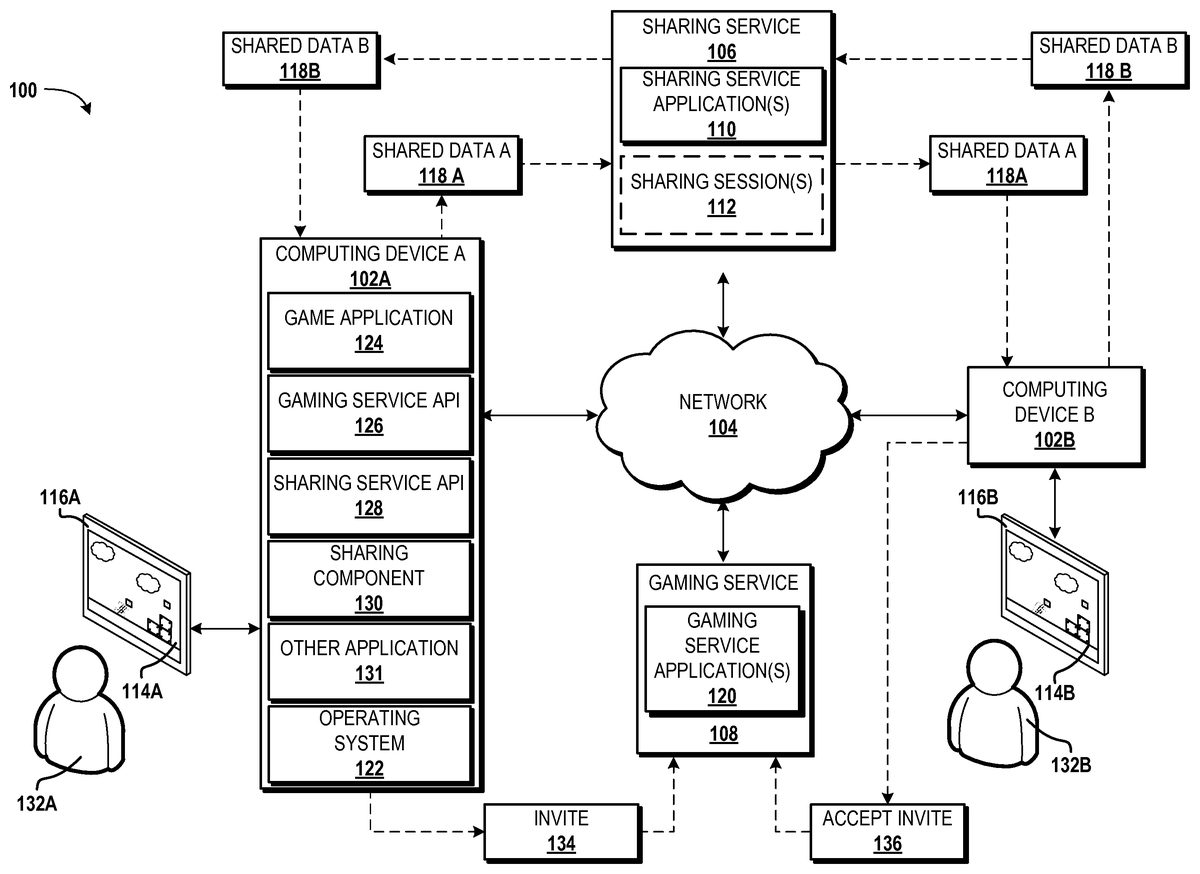
Referring now toFIG. 1, aspects of one operating environment100for the various embodiments presented herein will be described. The operating environment100shown inFIG. 1includes a computing device A102A and a computing device B102B, each operating as a part of and/or in communication with a communications network (“network”)104. According to some embodiments, the computing device A102A and the computing device B102B can each include a user computing device, such as a tablet computing device, a personal computer (“PC”), a desktop computer, a laptop computer, a notebook computer, a cellular phone or smartphone, other mobile computing devices, a personal digital assistant (“PDA”), video game system, set-top box, smart television, or the like.
According to some other embodiments, the functionality of the computing device A102A and/or the computing device B102B can be provided by a cloud-based computing platform that can be provided by one or more application servers, Web servers, data storage systems, network appliances, dedicated hardware devices, and/or other server computers or computing devices. In these embodiments, the computing device A102A and/or the computing device B102B can include minimal hardware for connection to the cloud-based computing platform via the network104. For purposes of illustrating and describing the concepts and technologies disclosed herein, the functionality of the computing device A102A and the computing device B102B is described herein as being provided by a user computing device. In light of the alternative embodiments of the computing device A102A and the computing device B102B described above, it should be understood that this example is illustrative, and should not be construed as being limiting in any way.
The computing device A102A and the computing device B102B can communicate via the network104to access various services described herein. For example, the computing device A102A and the computing device B102B can access a sharing service106and/or a gaming service108. The functionality of the sharing service106and the gaming service108can be provided by one or more application servers, Web servers, data storage systems, network appliances, dedicated hardware devices, and/or other server computers or computing devices.
The sharing service106can be configured to execute one or more sharing applications110to create and manage one or more sharing sessions112during which the computing device A102A can share the entirety or specific portions of a screen A114A that is being locally presented by the computing device A102A via one or more displays, such as a display A116A, with the computing device B102B over the network104. Likewise, during the sharing session112, the computing device B102B can share the entirety or specific portions of a screen B114B that is being locally presented by the computing device B102B via one or more displays, such as a display116B, with the computing device A102A over the network104. Although only two computing devices are shown, the sharing session112created by the sharing service106may support connections to any number of computing devices so that one or more users utilizing the various computing devices can share data with one another. As such, the illustrated example is merely illustrative, and should not be construed as being limiting in any way.
The sharing session112can be configured to support one-way communication whereby a designated source device is able to send data to one or more designated destination devices, but the one or more designated destination devices are unable to send data to the designated source device. Alternatively, the sharing session112can be configured to support two-way communication whereby two or more computing devices are able send data to and receive data from one another. As such, the sharing session112can be used for collaborative or sharing-only purposes.
In some embodiments, a user can provision another user with his or her security credentials, such as, but not limited to, username and password. For example, a first user can provide his or her security credentials so that the second user can control one or more applications executing on a device associated with the first user via the sharing service106and/or gain access to other services such as the gaming service108on behalf of the first user. It is contemplated that the security credentials may utilize any single-factor or multi-factor authentication scheme.
As used herein, a “screen” refers to the visual content and the arrangement of that content being output by a computing device for display on one or more displays. In other words, a “screen” is what is being displayed on one or more displays that are connected to or otherwise in communication with a computing device. A screen can include a snapshot of what is being displayed on one or more displays at a particular instance of time. A screen can additionally or alternatively include a data stream of what is being displayed on one or more displays over time. The latter case of a screen is sometimes referred to herein as a “screen stream.”
In addition to screen sharing, the sharing service106can provide application data sharing, whereby data associated with one or more applications that are being executed by a computing device can be shared with one or more other computing devices that are connected to the sharing session112. Application data can include, but is not limited to, data derived from user input to an application being executed by a computing device and other data output by the application in response to the input. Application data can be shared discretely or as a stream of application data. In some embodiments, application data includes game control data associated with input received to control a game application, as will be described in greater detail below.
The sharing service106can create the sharing session112so that the computing device A102A can share data (shown as shared data A118A) with the computing device B102B. Likewise, the sharing service106can create the sharing session112so that the computing device B102B can share data (shown as shared data B118B) with the computing device B102B. As explained above, however, the illustrated example is merely illustrative, and should not be construed as being limiting in any way.
The gaming service108can be configured to facilitate user interaction with one or more gaming service applications120that are executed by the gaming service108. The gaming service application(s)120can provide features such as, but not limited to, online cooperative multiplayer gaming, online competitive multiplayer gaming, chat features, messaging features, online leaderboards, achievement tracking features, advertising features, marketplace features, and friends list features. The gaming service application(s)120can additionally or alternatively provide or assist in providing a game task delegation feature, as will be described in greater detail below.
The computing device102A can be configured to execute an operating system122and one or more application programs such as, for example, a game application124, a gaming service application programming interface (“API”)126, a sharing service API128, a sharing component130, other application131, and/or other application programs or components. The operating system122is a computer program for controlling the operation of the computing device A102A. The application programs are executable programs configured to execute on top of the operating system122to provide various functionality described herein. Although the computing device B102B is not shown in the same configuration as the computing device A102A, it should be understood that the computing device B102B may be identically configured or may have more or less application programs and/or components than are illustrated for the computing device A102A.
The game application124can be configured to provide an interactive video gaming experience whereby one or more players can control or otherwise interact with visual content that is presented on a display. The visual content can include, but is not limited to, characters, levels, maps, areas, stages, worlds, spaces, shapes, and objects. The visual content can be two-dimensional, three-dimensional, or a combination thereof. The game application124can also provide audial content such as, but not limited to, music, speech, and sound effects. The game application124can also provide haptic feedback, such as vibration feedback.
The game application124can be designed to have one or more game tasks that the player(s) can complete. A game task can generally include anything one or more players can do by interacting with the visual content provided by the game application124. As a simple example, a game task might be for a player to control a virtual character to traverse a level from a pre-defined starting point to a pre-defined end point so as to complete or “beat” the level. A further game task using this example might be to control the virtual character to traverse a level while avoiding contact with certain objects or characters (e.g., enemies). It should be understood that these examples are illustrative, and should not be construed as being limiting in any way.
The game application124can also be designed to have one or more objectives that can be completed by the player(s). An objective is a game task that is defined by a developer of the game application124. In other words, an objective is a goal or purpose of the game application124. The game application124may have multiple objectives. An objective can be discrete in that it is not linked in any way to another objective. Alternatively, an objective can be linked or otherwise combined with one or more other objectives.
In some embodiments, the game application124provides a sandbox in which the player(s) can create their own game tasks, which may be ongoing or fleeting for the player(s). The sandbox may be provided in addition to established objectives or in lieu thereof.
The game application124can be designed to have one or more achievements. An achievement is an accolade provided to a player or group of players in recognition of a particular interaction with the game application124. An achievement can be as simple as starting the game application124for the first time (or some other number of times), interacting with certain features provided by the game application124(e.g., entering a certain menu or selecting a certain menu option such as a “hard” difficulty level), or completing one or more objectives. When a player performs a particular interaction that is tied to an achievement, the achievement becomes “unlocked.” The game application124may notify the player(s) of the “unlocked” achievement by presenting an achievement alert. An achievement alert can be presented in a visual, audial, and/or haptic manner. The act of unlocking an achievement may be a game task. Unlocking an achievement may enable the ability to unlock additional achievements.
Achievements can be defined by the developers(s) of the game application124, by the gaming service108, or by some other entity, including, for example, a player. In some embodiments, achievements are managed locally by the computing device A102A, for example, by the game application124, by the operating system122, or by some other application program being executed by the computing device A102A. In some other embodiments, achievements are managed remotely in a cloud-based configuration by the gaming service108. In these embodiments, a player can set up an account with the gaming service108. The account can include user identification and one or more security credentials to maintain security of the account. The achievements earned by a player can be associated with his or her account with the gaming service108so that, for example, if the player changes to a different computing device, the player can still access his or her achievements and be able to earn new achievements on the different computing device.
The game application124can be designed to have one or more leaderboards. A leaderboard can track the completion of an objective in a manner so as to rank the completion of an objective among players. For example, an objective may be to obtain the highest score in a finite amount of time or using a finite number of lives, and a leaderboard associated with this objective can include a ranking of scores in a particular order, such as a list of scores ranked in descending order. In some embodiments, leaderboards are managed locally by the computing device A102A, for example, by the game application124, by the operating system122, or by some other application program being executed by the computing device A102A. In some other embodiments, leaderboards are managed remotely in a cloud-based configuration by the gaming service108. In these embodiments, a player can elect to upload or the game application124can automatically upload scores achieved by the player to the gaming service108. The gaming service108may present leaderboards for public viewing and/or private viewing, such as by a group of players selected by the player that elected to upload the score. The scores earned by a player can be associated with his or her account with the gaming service108so that if the player changes to a different computing device, the player can still try to beat his or her high score on the leaderboard using the same user identification.
Input to the game application124can be provided via one or more input devices that are connected to or otherwise in communication with the computing device A102A. Input to the game application124can be used to control aspects of the game application124, such as, for example, controlling characters, navigating menus, and control towards completion of one or more game tasks. An input device can include, but is not limited to, a keyboard, mouse, joystick, game pad, touchpad, resistive touchscreen, capacitive touchscreen, multi-touch enabled touchscreen, still camera, video camera, microphone, infrared camera, motion control device, global positioning system (“GPS”) sensor, proximity sensor, motion sensor (e.g., accelerometer), ambient light sensor, moisture sensor, gyroscope, dance pad, steering wheel, flight yoke, pedal, musical instrument, toy musical instrument, and sports equipment. In some embodiments, one or more input devices are built-in to the computing device A102A, such as a tablet computing device with a multi-touch enabled touchscreen. In some other embodiments, one or more input devices are connected to the computing device A102A using hardwire and/or wireless connection. The physical components and/or protocols utilized to establish and maintain one or more connections between an input device and the computing device A102A can be standards-based, non-standards-based, or proprietary.
The computing device A102A can be configured to present the visual content provided by the game application124on one or more display devices that are built-in to or external to and in communication with the computing device A102A, such as the display A116A. The display A116A is an output device configured to present information in a visual form. In particular, the display A116A may present visual content provided by the game application124, graphical user interface (“GUI”) elements, text, images, video, notifications, virtual buttons, virtual keyboards, messaging data, Internet content, device status, time, date, calendar data, preferences, map information, location information, and any other information that is capable of being presented in a visual form. In some embodiments, the display A116A is a liquid crystal display (“LCD”) utilizing any active or passive matrix technology and any backlighting technology (if used). In some embodiments, the display A116A is an organic light emitting diode (“OLED”) display. Other display types are contemplated. In addition, the display A116A can include an input device such as a touchscreen or multi-touch enabled touchscreen. The display B116B can be likewise configured.
The game application124can be configured to call one more methods exposed by the gaming service API126to access the gaming service108via the network104to take advantage of one or more of the features provided by the gaming service108. The game application124can also be configured to call one or more methods exposed by the sharing service API128to access the sharing service106via the network104. The sharing service API128can access the sharing component130to provide data to the sharing service106and receive data from the sharing service106during a sharing session. The sharing component130is illustrated and described in greater detail with reference toFIG. 2.
As described above, the game application124can provide one or more game tasks that can be completed by one or more players. For one reason or another, a player may be unable to complete a game task. For example, the game task may be too difficult for the player to complete, the player may be disinterested in the game task but is interested in a subsequent game task, the player lacks the time required to complete the game task, or for any number of other reasons. As a solution, the player can elect to delegate the game task to another player so that the other player can complete the task on behalf of the player that delegated the game task.
In the illustrated example, a player A132A that is playing the game application124on the computing device A102A can elect to delegate the game task to a player B132B that is associated with the computing device B102B. The player B132B can accept or deny the game task. If the player B132B accepts the game task, the player B132B can attempt to complete the game task on behalf of the player A132A utilizing the computing device B102B.
In some embodiments, the computing device A102A communicates with the sharing service106to create the sharing session112to share the shared data A118A, wherein the shared data A118A includes a screen stream of the game application124being executed by the computing device A102A. In these embodiments, the player B132B can provide input to the computing device B102B via one or more input devices that are connected to or otherwise in communication with the computing device B102B to play the game application124in an effort to complete the game task delegated by the player A132A to the player B132B. In this manner, the player B132B can assist the player A132A to complete the game task, after which the sharing session112can be torn down and the player A132A can resume playing the game application124after the game task has been completed for him or her by the player B132B.
In some other embodiments, the computing device A102A communicates with the sharing service106to create the sharing session112to share the shared data A118A, wherein the shared data A118A includes a game state of the game application124before a delegated game task has been completed. In these embodiments, the computing device B102B receives the game state via the sharing session112and launches the same game application on the computing device B102B to load the game state. The game state is loaded and the player B132B can provide input to the computing device B102B via one or more input devices that are connected to or otherwise in communication with the computing device B102B to play the game application in an effort to complete the game task delegated by the player A132A. After the game task is completed, the computing device B102B can save a new game state of the game application124and can send the new game state as part of the shared data B118B over the shared session112to the computing device A102A. In this manner, the player B132B can assist the player A132A to complete the game task, after which the computing device A102A can load the new game state and the player A132A can resume playing the game application124from a state that includes the completed game task.
In some embodiments, the player B132B is provisioned to play the game application124on behalf of the player A132A using the user identification of the player A132A. As such, achievements, leaderboards, and other credits associated with the completion of a game task can be credited to the player A132A instead of the player B132B, although it is contemplated that both the player A132A and the player B132B may be acknowledged for completion of the game task. The player B132B may additionally or alternatively earn achievements, leaderboard position, and/or other credits that are not available to the player A132A for assisting the player A132A in completing the game task.
In some embodiments, the player B132B is given a finite amount of time to complete the game task. In some other embodiments, the player B132B is given an infinite amount of time to complete the game task.
In some embodiments, the player B132B is compensated for completing the game task. Compensation for completing the game task can include, but is not limited to, real currency, virtual currency, one or more in-game items for the game application124, one or more in-game items for another game application, and credit for the purchase of real or virtual products from an online merchant.
A virtual currency may be represented by units, such as, but not limited to, “coins,” “points,” “virtual dollars,” and the like. A “unit” of virtual currency, whether a coin, a point, a virtual dollar, or other unit, may have a value that is tied to a real currency, such as the U.S. dollar. A “coin” may represent, for example, 1/100 of a U.S. dollar or 1 U.S. cent within the gaming service108so that an item that costs $2.99 in U.S. dollars and cents would alternatively cost 299 coins. It should be understood that the value of a virtual currency unit may be changed from time to time to accommodate changes in the value of the real currency to which it is tied or for any number of other reasons, such as those particular to the entity that provides the gaming service108. It should also be understood that items may be made available for purchase via the gaming service108using virtual currency, real currency, or a combination thereof as the method for payment.
In some embodiments, the gaming service108provides a marketplace through which players can purchase content, such as, for example, applications, game applications, game add-ons, in-game items, music, e-books, movies, and the like. Virtual currency exchanged as compensation for completing a game task may be used to purchase such content from the marketplace.
In some embodiments, the player A132A can set up an auction to solicit the help of another player to assist the player A132A in completing a game task identified in the auction. The auction feature can be hosted by the gaming service108. Users of the gaming service108can bid on the auction and the player A132A can select a bid as the winning bid. A bid can include an amount of compensation for completing the game task. A bid can also include a deadline by which the game task will be completed. In this manner, the player A132A can choose a winning bid based upon his or her needs with regard to completing the game task.
In some embodiments, the player A132A can delegate a game task to two or more players. The first of the two or more players to complete the game task can be compensated. Alternatively, all players are compensated, but the first player to complete the game task in compensated the highest amount, the second player is compensated a lower amount, and so on.
In the illustrated example, the computing device A102A generates an invitation (“invite134”) and sends the invite134to the gaming service108. The invite134can be addressed to the player132B. For example, the player A132A and the player B132B may be in a friendship within the gaming service108, and the friendship allows the player A132A to send the invite134directly to the player B132B via a messaging feature provided by the gaming service108. A friendship in context of the gaming service108is a relationship between two users facilitated by the gaming service108that allows the users to connect to play multiplayer games, chat, and send messages to each other, including, for example, invites such as the invite134. The player B132B can then choose to accept or deny the invite134. In the illustrated example, the player B132B has accepted the invite134, and in response, the computing device B102B generates an invitation acceptance notification (“accept invite136”) and sends the accept invite136to the gaming service108. Once the invite134is accepted, the game application124can call the sharing service API128to establish the sharing session112to enable the player B132B to attempt to complete the game task utilizing one of the methodologies described above.
The other application131can include one or more Web browser applications, one or more productivity applications (e.g., word processing, spreadsheet, and/or presentation applications), one or more design applications, or any other applications. In some embodiments, the other application(s)131can be configured to call the sharing service API128to provide sharing features to users. For example, the shared data A118A can be data shared by the other application131and the shared data B118B can be data shared by the computing device B102B that is useable by the other application131.
FIG. 1illustrates one network104, one sharing service106, one gaming service108, one game application124, one gaming service API126, one sharing service API128, one sharing component130, one other application131, and one operating system122. It should be understood, however, that various implementations of the operating environment100include multiple networks104, sharing services106, gaming services108, game applications124, gaming service APIs126, sharing service APIs128, sharing components130, other applications131, and/or operating systems122. As such, the illustrated embodiment should be understood as being illustrative, and should not be construed as being limiting in any way.
Turning now toFIG. 2, additional aspects of the sharing component130will be described, according to an illustrative embodiment. In some embodiments, the sharing component130is provided as part as client-side functionality for accessing the sharing service106. In some embodiments, the sharing component130is provided as part of the operating system122(shown inFIG. 1). In some embodiments, the sharing component130is given permissions to access features of the operating system122such as a rendering pipeline to effectively detect and compress a buffer of screen and/or application data that is to be streamed to the sharing service106as part of the shared data A118A (shown inFIG. 1).
The illustrated sharing component130includes a screen sharing module202and an application data sharing module204. The screen sharing module202includes a screen data differential engine206, a screen data sender208, and a screen data receiver210. The screen data differential engine206is configured to calculate a difference between what screen data is currently being displayed and what screen data has already been sent to the sharing service106. The screen data differential engine206is also configured to send the difference to the sharing service106, thereby saving network and other resources. It is contemplated, however, that the sharing component130may share all screen data output by a computing device.
The screen data sender208is configured to communicate with the sharing service106to send screen data to the sharing session112. The screen data receiver210is configured to communicate with the sharing service106to receive screen data from the sharing session112.
The application data sharing module204includes a data compression engine212, an application data sender214, and an application data receiver216. The data compression engine212is configured to compress application data for sending to the sharing service106. The application data sender214is configured to communicate with the sharing service106to send application data to the sharing session112. The application data receiver214is configured to communicate with the sharing service106to receive application data from the sharing session112.
Turning now toFIG. 3, additional aspects of the sharing service106will be described. InFIG. 3, the sharing service106receives screen data302A-302N and application data304A-304N from a plurality of computing devices (not shown). The sharing service106provides the screen data302A-302N to a screen stream multiplexer306. The screen stream multiplexer306is configured to receive the screen data302A-302N and multiplex the screen data302A-302N to generate multiplexed screen data308, which is then provided to a stream compressor310. The stream compressor310is configured to compress the multiplexed screen data308for delivery to one or more computing devices during a sharing session. The compression technology utilized by the stream compressor310can be selected based upon the needs of the sharing service106in providing a particular quality of service via a sharing session. As such, the compression level may be increased to conserve network resources or decreased to consume network resources based upon the availability of network resources to support the sharing session.
The sharing service106provides the application data304A-304N to an application data stream multiplexer312. The application data multiplexer312is configured to receive the application data304A-304N and multiplex the application data304A-304N to generate multiplexed application data314, which is then provided to the stream compressor310for compression.
Turning now toFIG. 4, aspects of a method400for delegating a game task will be described in detail, according to an illustrative embodiment. It should be understood that the operations of the methods disclosed herein are not necessarily presented in any particular order and that performance of some or all of the operations in an alternative order(s) is possible and is contemplated. The operations have been presented in the demonstrated order for ease of description and illustration. Operations may be added, omitted, and/or performed simultaneously, without departing from the scope of the concepts and technologies disclosed herein.
It also should be understood that the methods disclosed herein can be ended at any time and need not be performed in its entirety. Some or all operations of the methods, and/or substantially equivalent operations, can be performed by execution of computer-readable instructions included on a computer storage media, as defined herein. The term “computer-readable instructions,” and variants thereof, as used herein, is used expansively to include routines, applications, application modules, program modules, programs, components, data structures, algorithms, and the like. Computer-readable instructions can be implemented on various system configurations including single-processor or multiprocessor systems, minicomputers, mainframe computers, personal computers, hand-held computing devices, microprocessor-based, programmable consumer electronics, combinations thereof, and the like.
Thus, it should be appreciated that the logical operations described herein are implemented (1) as a sequence of computer implemented acts or program modules running on a computing system and/or (2) as interconnected machine logic circuits or circuit modules within the computing system. The implementation is a matter of choice dependent on the performance and other requirements of the computing system. Accordingly, the logical operations described herein are referred to variously as states, operations, structural devices, acts, or modules. These states, operations, structural devices, acts, and modules may be implemented in software, in firmware, in special purpose digital logic, and any combination thereof.
The method400is described as being performed by a first computing device, such as the computing device A102A, via execution of one or more software modules such as, for example, the game application124, the gaming service API126, the sharing service API128, and/or the sharing component130. It should be understood that additional and/or alternative devices and/or network nodes can provide the functionality described herein via execution of one or more modules, applications, and/or other software including, but not limited to, the game application124, the gaming service API126, the sharing service API128, and/or the sharing component130. Thus, the illustrated embodiments are illustrative, and should not be viewed as being limiting in any way.
The method400begins at operation402, where the computing device A102A executes the game application124. From operation402, the method400proceeds to operation404, where the computing device A102A receives input from a first user, such as the player A132A. The input can be received via one or more input devices that are connected to or otherwise in communication with the computing device A102A. The input is provided by the first user towards the completion of a game task.
From operation404, the method400proceeds to operation406, where the computing device A102A receives a delegation request from the first user to delegate play of the game application124to a second user, such as the player B132B, for completion of the game task. In some embodiments, a delegation request option is provided as part of the game application124and can be selected by the first user if the first user needs assistance in completing a game task. In some embodiments, the delegation request option “pops up” after a pre-defined number of failed attempts by the first user in completing the game task. The pre-defined number may be set by a developer of the game application124. In some embodiments, a delegation request option is made accessible to the game application124by one or more methods exposed by the gaming service API126or the sharing service API128.
From operation406, the method400proceeds to operation408, where the computing device A102A generates an invitation for the second user to attempt to complete the game task in response to the delegation request. In some embodiments, invitation is generated by the game application124. In some embodiments, the invitation is made accessible to the game application124by one or more methods exposed by the gaming service API126or the sharing service API128.
From operation408, the method400proceeds to operation410, where computing device A102A causes the invitation to be made available to the second user. From operation410, the method400proceeds to operation412, where the computing device A102A receives notification of acceptance of the invitation.
From operation412, the method400proceeds to operation414, where the computing device A102A initiates establishment of a sharing session via the sharing service106. From operation414, the method400proceeds to operation416, where the computing device A102A transfers control of the game application124to a second computing device, such as the computing device B102B, that is associated with the second user, such as the player B132B, via the sharing session. In this manner, the player B132B can assist the player A132A to complete the game task, after which the sharing session can be torn down and the player A132A can resume playing the game application124.
From operation416, the method400proceeds to operation418. The method400ends at operation418.
Turning now toFIG. 5, aspects of a method500for accepting delegation of a game task will be described in detail, according to an illustrative embodiment. The method500is described as being performed by a second computing device, such as the computing device B102B, via execution of one or more software modules such as, for example, the game application124, the gaming service API126, the sharing service API128, and/or the sharing component130. It should be understood that additional and/or alternative devices and/or network nodes can provide the functionality described herein via execution of one or more modules, applications, and/or other software including, but not limited to, the game application124, the gaming service API126, the sharing service API128, and/or the sharing component130. Thus, the illustrated embodiments are illustrative, and should not be viewed as being limiting in any way.
The method500begins at operation502, where the computing device B102B receives input to accept an invitation to attempt to complete a game task. From operation502, the method500proceeds to operation504, where the computing device B102B generates a notification of acceptance of the invitation to complete the game task. From operation504, the method500proceeds to operation506, where the computing device B102B sends the notification to the first computing device, such as the computing device A102A.
From operation506, the method500proceeds to operation508, where the computing device B102B connects to a sharing session provided by the sharing service106. The sharing session can be initiated by the first computing device in response to the notification of acceptance of the invitation.
From operation508, the method500proceeds to operation510, where the computing device B102B receives control of the game application124via the sharing session. From operation510, the method500proceeds to operation512, where the computing device B102B receives input to control the game application to complete the game task. From operation512, the method500proceeds to operation514, wherein the computing device B102B sends the input to control the game application124to the first computing device102via the sharing session.
From operation514, the method500proceeds to operation516. The method500ends at operation516.
Turning now toFIG. 6, aspects of a method600for sharing game control data using the sharing service106will be described in detail, according to an illustrative embodiment. The method600begins at operation602, where a first computing device, such as the computing device A102A, and a second computing device, such as the computing device B102B both connect to a sharing session112provided by the sharing service106.
From operation602, the method600proceeds to operation604, where the computing device B102B receives game control input. For example, the player B132B may provide game control input to the computing device B102B using one or more input devices in an attempt to complete one or more game tasks delegated to the player B132B by the player A132A.
From operation604, the method proceeds to operation606, where the computing device B102B sends game control data that is associated with the game control input to the sharing service106via the sharing session112for delivery to the computing device A102A. The game control data can include, but is not limited to, instructions that are useable by a game application, such as the game application124, to perform one or more actions.
From operation606, the method600proceeds to operation608, where the computing device A102A receives the game control data from the sharing service106and provides the game control data to the game application124that is executing on the computing device A102A. From operation608, the method600proceeds to operation610, where the game application124utilizes the game control data to perform one or more actions. From operation610, the method600proceeds to operation612, where the game application124presents the one or more actions via the display A116A. In some embodiments, the game application124replays the one or more actions defined by instructions included in the game control data so that the player A132A can watch how the player B132B is attempting to complete one or more game tasks delegated to the player B132B by the player A132A. In this manner, the player A132A can decide whether or not the player B132B is performing in such a way that is acceptable to the player A132A, and if not, the player A132A can interrupt the replay, as will be described below in greater detail with reference toFIG. 7.
From operation612, the method600proceeds to operation614. The method600ends at operation614.
Turning now toFIG. 7, aspects of a method700for interrupting game control delegated by a first user to a second user will be described in detail, according to an illustrative embodiment. The method700begins at operation702, where the game application124utilizes game control data received from the computing device B102B via the sharing session112to perform one or more actions. From operation702, the method700proceeds to operation704, where the game application124determines if an interruption is received. In utilizing the game control data, the game application124can replay the game control input provided by the player B132B on the computing device A102A so that the player A132A can watch how the player B132B is performing. If the player A132A is not satisfied, the player A132A can decide to interrupt the replay. In some embodiments, the replay can be interrupted by the player A132A by providing some input to the game application124. For example, the game application124can provide an icon can be selected by the player A132A or designate some other input to be used if the player A132A desires to stop the action perform in response to the game control data.
If, at operation704, the game application124receives an interruption, the method700proceeds to operation706. At operation706, the game application124generates an abort request and sends the abort request to the sharing service106. From operation706, the method700proceeds to operation708, wherein the sharing service106receives the abort request and ends the sharing session112so that the computing device B102B can no longer provide the game control data to the computing device A102A. In this manner, the player A132A can monitor how one or more game tasks are being handled and disconnect from a player to which he or she has designated one or more game tasks if the player is misbehaving or otherwise not performing up to his or her expectations. From operation708, the method700proceeds to operation710, where the game application124returns control to the player A132A. From operation710, the method700proceeds to operation712. The method700ends at operation712.
If, at operation704, the game application124does not receive an interruption, the method700proceeds to operation714. At operation714, the game application124determines if the one or more actions have been completed. For example, the game application124is no longer receiving the game control data via the sharing session112. If not, the method700proceeds from operation714to operation702. If so, the method700proceeds to operation710, where the game application124returns control to the player A132A. From operation710, the method700proceeds to operation712. The method700ends at operation712.
Turning now toFIG. 8, aspects of a method800for sharing screen data will be described in detail, according to an illustrative embodiment. The method800begins and proceeds to operation802, where a first computing device, such as the computing device A102A, and a second computing device, such as the computing device B102B, both connect to a sharing session112provided by the sharing service108.
From operation802, the method800proceeds to operation804, where the computing device B102B receives game control input. For example, the player B132B may provide game control input to the computing device B102B using one or more input devices in an attempt to complete one or more game tasks delegated to the player B132B by the player A132A.
From operation804, the method800proceeds to operation806, where the computing device B102B generates screen data based at least in part upon the game control input received at operation804. In some embodiments, the screen data includes a screen stream of visual output provided by a game application executed by the computing device B102B in response to the game control input. For example, as the player B132B provides input via a controller or other input device, the game application may output data to a display that shows a character responding to the game control input, such as traversing a level, fighting an enemy, or performing some other action.
From operation806, the method proceeds to operation808, where the computing device B102B sends the screen data to the sharing service106via the sharing session112for delivery to the computing device A102A. The computing device B102B can provide the screen data to the sharing service106so that the computing device A102A can access the screen data via the sharing session112. In this manner, the player A132A can watch what the player B132B is doing towards completing one or more game tasks delegated by the player A132A to the player B132B.
From operation808, the method800proceeds to operation810, where the computing device A102A receives the screen data from the sharing service108. From operation810, the method800proceeds to operation812, where the computing device A102A presents the screen data on a display, such as the display A116A.
From operation812, the method800proceeds to operation814. The method800ends at operation814.
In some embodiments, the player A132A may be able to interrupt the screen session112to terminate the screen sharing session if for some reason he or she determines the player B132B is misbehaving or otherwise not performing up to his or her expectations. In some embodiments, the method600and the method800may be combined so as to share both game control data and screen data.
Turning now toFIG. 9, aspects of a method900for sharing game control data without the use of a sharing service will be described in detail, according to an illustrative embodiment. The methods described above with reference toFIGS. 4-8utilize a sharing service, such as the sharing service106, to share screen data and/or application data such as game control data. The method900allows players to share game control data without the use of a sharing service. The method900may be useful for situations in which network connectivity cannot support a sharing service due to latency issues, bandwidth issues, reliability issues, or other issues.
The method900begins at operation902, where a second computing device, such as the computing device B102B receives game control input. The game control input is received in response to a player associated with the second computing device, such as the player B132B who is associated with the computing device B102B, accepting an invite to complete one or more game tasks on behalf of another player, such as the player A102A. In some embodiments, the game task is delegated directly to the player B132B, such as via the gaming service108. In some embodiments, the game task is made available to a plurality of players via the gaming service108, and the player B132B selects the game task.
From operation902, the method900proceeds to operation904, where the computing device B102B sends game control data associated with the game control input to the computing device A102A via the network104. The game control data may be sent via a peer-to-peer connection established between the computing device A102A and the computing device B102B over the network104. Alternatively, the game control data may be sent to one or more servers configured to support delivery of the game control data. The one or more servers may or may not operate in at least partial support of the gaming service108.
From operation904, the method900proceeds to operation906, where the computing device A102A receives the game control data and provides the game control data to the game application124. From operation906, the method900proceeds to operation908, wherein the game application124utilizes the game control data to perform one or more actions.
From operation908, the method900proceeds to operation910, where the game application124determines if an interruption is received. In utilizing the game control data, the game application124can replay the game control input provided by the player B132B on the computing device A102A so that the player A132A can watch how the player B132B is performing. If the player A132A is not satisfied, he or she can decide to interrupt the replay. In some embodiments, the replay can be interrupted by the player A132A by providing some input to the game application124. For example, the game application124can provide an icon that can be selected by the player A132A or other input than can be used if the player A132A desires to stop the action performed in response to the game control data.
If, at operation910, the game application124receives an interruption, the method900proceeds to operation912. At operation912, the game application124returns control to the player A132A. From operation912, the method900proceeds to operation914. The method900ends at operation914.
If, at operation910, the game application124does not receive an interruption, the method900proceeds to operation916. At operation916, the game application124determines if the one or more actions have been completed. For example, the game application124is no longer receiving the game control data via the network104. If not, the method900proceeds from operation916to operation908. If so, the method900proceeds to operation912, where the game application124returns control to the player A132A. From operation912, the method900proceeds to operation914. The method900ends at operation914.
Turning now toFIG. 10, aspects of a method1000for sharing game state data will be described in detail, according to an illustrative embodiment. The method1000begins and proceeds to operation1002, where a second computing device, such as the computing device B102B, receives an invite to complete a game task. In some embodiments, the game task is delegated directly to the player B132B, such as via the gaming service108. In some embodiments, the game task is made available to a plurality of players via the gaming service108, and the player B132B selects the game task via the gaming service108, effectively accepting an invite.
From operation1002, the method1000proceeds to operation1004, where the computing device B102B determines if a game state has been received. A game state can include a state of a game application before the delegated game task has been completed. In some embodiments, a player delegating a game task may elect to provide a game state so that the player to whom the game task is delegated can begin his or her attempt to complete the game task in particular state of the game that has been achieved by the player delegating the game task. In this manner, the player to whom the game task is delegated can begin his or her attempt to complete the delegated game task from a state other than a beginning state of a game application or other state that may not be conducive to being able to complete the delegated game task within a specific amount of time or under some other constraint. For example, if the game application is a role-playing game, the player delegating the game task might have spent tens or even hundreds of hours developing his or her character and progressing through a storyline provided by the role-playing game. In this example, the player delegating the game task can provide a game state that captures the character's progression and place within the storyline so that the player to whom the game task is delegated can assume control of the character in an attempt to complete the game task with a character progressed in a certain manner and at a particular point in the storyline. Although the concept of game state is not referenced in the description of the methods illustrated inFIGS. 4-9, the concept of game state can be utilized in those methods to provide a game state from which to start the player to whom a game task has been delegated, for example.
If, at operation1004, the computing device102B determines that a game state has been received, the method1000proceeds to operation1006, where the computing device B102B loads the game state into a game application, such as copy of the game application124, thereby allowing the player B132B to start his or her attempt to complete the delegated game task from a state other than a beginning state (e.g., new game start) or a game state saved in association with previous play by the player B132B.
From operation1006, the method1000proceeds to operation1008. Also, if, at operation1004, the computing device102B determines that a game state has not been received, the method1000proceeds to operation1008. At operation1008, the computing device B102B receives game control input provided by the player B102B to complete the game task. From operation1008, the method1000proceeds to operation1010, where the computing device B102B generates a new game state that includes the completed game task. From operation1010, the method1000proceeds to operation1012, where the computing device B102B then sends the new game state to the computing device A102A. The computing device A102A can load the new game state into the game application124and resume play of the game application124at a state after the game task has been completed on his or her behalf.
From operation1012, the method1000proceeds to operation1014. The method1000ends at operation1014.
In some embodiments, game states that include one or more completed game tasks can be provided to the gaming service108. The gaming service108can offer a game state on behalf of the user or users that created the game state. In this manner, a particularly skilled player or groups of players can create game states that complete one or more game tasks which might be commonly difficult and therefore attractive to other players. A game state may be offered for free or for some compensation, such as one or more of the various compensations described herein above.
Turning now toFIG. 11, aspects of a method1100for exposing a sharing service API, such as the sharing service API128, will be described in detail, according to an illustrative embodiment. The method1100begins at operation1102, where a computing device, such as the computing device A102A exposes the sharing service API128so that one or more applications, such as the game application124and/or the other application131, can call the sharing service API128to access the sharing service106.
From operation1102, the method1100proceeds to operation1104, where the computing device A102A receives a call to a method exposed by the sharing service API128to request creation of a sharing session, such as the sharing session112. From operation1104, the method1100proceeds to operation1106, where, in response to the call, the computing device A102A initiates creation of the sharing session112by connecting to the sharing service106. From operation1106, the method1100proceeds to operation1108, where the computing device A102A joins the sharing session112created by the sharing service106. One or more other computing devices, such as the computing device B102B, can then connect to the sharing session112to share data, such as the shared data B118B.
From operation1108, the method1100proceeds to operation1110. The method1100ends at operation1110.
FIG. 12shows an example computer architecture for a computer1200capable of executing the software components described herein for delegating video game tasks via a sharing service in the manner presented above. The computer architecture shown inFIG. 12illustrates a conventional server computer, workstation, desktop computer, laptop, electronic book reader, digital wireless phone, tablet computer, network appliance, set-top box, or other computing device. The computer architecture shown inFIG. 12may be utilized to execute any aspects of the software components presented herein described as executing on the computing device A102A, the computing device B102B, the sharing service106, the gaming service108, or any other computing platform.
The computer1200includes a baseboard, or “motherboard,” which is a printed circuit board to which a multitude of components or devices may be connected by way of a system bus or other electrical communication paths. In one illustrative embodiment, one or more central processing units (“CPUs”)1202operate in conjunction with a chipset1204. The CPUs1202are standard programmable processors that perform arithmetic and logical operations necessary for the operation of the computer1200.
The CPUs1202perform operations by transitioning from one discrete, physical state to the next through the manipulation of switching elements that differentiate between and change these states. Switching elements may generally include electronic circuits that maintain one of two binary states, such as flip-flops, and electronic circuits that provide an output state based on the logical combination of the states of one or more other switching elements, such as logic gates. These basic switching elements may be combined to create more complex logic circuits, including registers, adders-subtractors, arithmetic logic units, floating-point units, or the like.
The chipset1204provides an interface between the CPUs1202and the remainder of the components and devices on the baseboard. The chipset1204may provide an interface to a random access memory (“RAM”)1206, used as the main memory in the computer1200. The chipset1204may further provide an interface to a computer-readable storage medium such as a read-only memory (“ROM”)1208or non-volatile RAM (“NVRAM”) for storing basic routines that that help to startup the computer1200and to transfer information between the various components and devices. The ROM1208or NVRAM may also store other software components necessary for the operation of the computer1200in accordance with the embodiments described herein.
According to various embodiments, the computer1200may operate in a networked environment using logical connections to remote computing devices and computer systems through a network, such as a local-area network (“LAN”), a wide-area network (“WAN”), the Internet, the network104, or any other networking topology known in the art that connects the computer1200to remote computers. The chipset1204includes functionality for providing network connectivity through a network interface controller (“NIC”)1212, such as a gigabit Ethernet adapter.
For example, the NIC1210may be capable of connecting the computer1200to other computing devices, such as the computing device A102A, the computing device B102B, the sharing service106, the gaming service108, a data storage system in, and the like, over the network104described above in regard toFIG. 1. It should be appreciated that multiple NICs1210may be present in the computer1200, connecting the computer to other types of networks and remote computer systems.
The computer1200may be connected to a mass storage device1212that provides non-volatile storage for the computer. The mass storage device1212may store system programs, application programs, other program modules, and data, which have been described in greater detail herein. The mass storage device1212may be connected to the computer1200through a storage controller1214connected to the chipset1204. The mass storage device1212may consist of one or more physical storage units. The storage controller1214may interface with the physical storage units through a serial attached SCSI (“SAS”) interface, a serial advanced technology attachment (“SATA”) interface, a FIBRE CHANNEL (“FC”) interface, or other standard interface for physically connecting and transferring data between computers and physical storage devices.
The computer1200may store data on the mass storage device1212by transforming the physical state of the physical storage units to reflect the information being stored. The specific transformation of physical state may depend on various factors, in different implementations of this description. Examples of such factors may include, but are not limited to, the technology used to implement the physical storage units, whether the mass storage device1212is characterized as primary or secondary storage, or the like.
For example, the computer1200may store information to the mass storage device1212by issuing instructions through the storage controller1214to alter the magnetic characteristics of a particular location within a magnetic disk drive unit, the reflective or refractive characteristics of a particular location in an optical storage unit, or the electrical characteristics of a particular capacitor, transistor, or other discrete component in a solid-state storage unit. Other transformations of physical media are possible without departing from the scope and spirit of the present description, with the foregoing examples provided only to facilitate this description. The computer1200may further read information from the mass storage device1212by detecting the physical states or characteristics of one or more particular locations within the physical storage units.
In addition to the mass storage device1212described above, the computer1200might have access to other computer-readable media to store and retrieve information, such as program modules, data structures, or other data. It should be appreciated by those skilled in the art that computer-readable media can be any available media that may be accessed by the computer1200, including computer-readable storage media and communications media. Communications media includes transitory signals. Computer-readable storage media includes volatile and non-volatile, removable and non-removable storage media implemented in any method or technology. For example, computer-readable storage media includes, but is not limited to, RAM, ROM, erasable programmable ROM (“EPROM”), electrically-erasable programmable ROM (“EEPROM”), flash memory or other solid-state memory technology, compact disc ROM (“CD-ROM”), digital versatile disk (“DVD”), high definition DVD (“HD-DVD”), BLU-RAY, or other optical storage, magnetic cassettes, magnetic tape, magnetic disk storage or other magnetic storage devices, or any other medium that can be used to store the desired information. Computer-readable storage media does not include transitory signals.
The mass storage device1212may store an operating system1216, such as the operating system122, utilized to control the operation of the computer1200. According to one embodiment, the operating system comprises the LINUX operating system. According to another embodiment, the operating system comprises the WINDOWS® SERVER operating system from MICROSOFT Corporation of Redmond, Wash. According to further embodiments, the operating system may comprise the UNIX or SOLARIS operating systems. It should be appreciated that other operating systems may also be utilized. The mass storage device1212may store other system or application programs and data utilized by the computer1200. For instance, when utilized to implement the computing device A102A, the mass storage device1212may store the gaming service API126, the sharing service API128, the sharing component130, the game application124, and/or the other application131. When utilized to implement the sharing service106, the mass storage device1212may store the sharing service application(s)110. When utilized to implement the gaming service, the mass storage device1212may store the gaming service application(s)120.
In one embodiment, the mass storage device1212or other computer-readable storage media may be encoded with computer-executable instructions that, when loaded into the computer1200, transform the computer from a general-purpose computing system into a special-purpose computer capable of implementing the embodiments described herein. These computer-executable instructions transform the computer1200by specifying how the CPUs1202transition between states, as described above. According to one embodiment, the computer1200has access to computer-readable storage media storing computer-executable instructions that, when executed by the computer, perform the various routines and operations described herein.
The computer1200may also include an input/output controller1218for receiving and processing input from a number of input devices, such as a keyboard, a mouse, a touchpad, a touch screen, an electronic stylus, or other type of input device. Similarly, the input/output controller1218may provide output to a display device, such as a computer monitor, a flat-panel display, a digital projector, a printer, a plotter, or other type of output device. It will be appreciated that the computer1200may not include all of the components shown inFIG. 12, may include other components that are not explicitly shown inFIG. 12, or may utilize an architecture completely different than that shown inFIG. 12.
Based on the foregoing, it should be appreciated that technologies for delegating video game tasks via a sharing service have been presented herein. Although the subject matter presented herein has been described in language specific to computer structural features, methodological acts, and computer readable media, it is to be understood that the invention defined in the appended claims is not necessarily limited to the specific features, acts, or media described herein. Rather, the specific features, acts, and mediums are disclosed as example forms of implementing the claims.
The subject matter described above is provided by way of illustration only and should not be construed as limiting. Furthermore, the claimed subject matter is not limited to implementations that solve any or all disadvantages noted in any part of this disclosure. Various modifications and changes may be made to the subject matter described herein without following the example embodiments and applications illustrated and described, and without departing from the true spirit and scope of the present invention, which is set forth in the following claims.
Claims
- A method comprising: executing, by a first computing device, a game application to provide audio or visual content;receiving, by the first computing device, a delegation request from a first user to delegate play of the game application to complete a game task;at least partly in response to the delegation request, generating, by the first computing device, an invitation to complete the game task on behalf of the first user;receiving, by the first computing device, a notification of acceptance indicating that the invitation has been accepted;transferring, by the first computing device, control of the game application from the first computing device to a second computing device by launching the game application on the second computing device and transferring a game state of the game application from the first computing device to the second computing device;receiving, by the first computing device, streamed screen data from the second computing device, wherein the screen data is generated by the second computing device at least partly in response to the second computing device receiving control input from a second user and utilizing the control input to execute the game application launched on the second computing device;displaying the streamed screen data on the first computing device;and receiving, by the first computing device, an interruption from the first user, wherein at least partly in response to receiving the interruption, the transmission of the streamed screen data from the second computing device to the first computing device is terminated.
- The method of claim 1 , further comprising initiating transfer of compensation from the first user to the second user.
- The method of claim 2 , wherein the compensation comprises currency, virtual currency, one or more in-game items for the game application, one or more in-game items for another game application, or credit for purchase of real or virtual products from an online merchant.
- The method of claim 1 , further comprising causing, by the first computing device, the invitation to be made available for acceptance by sending the invitation to the second computing device for acceptance by the second user.
- The method of claim 4 , wherein the first user and the second user are in a friendship facilitated by a gaming service.
- The method of claim 1 , further comprising causing, by the first computing device, the invitation to be made available for acceptance by sending the invitation to a gaming service that is configured to present the invitation on behalf of the first user in solicitation of assistance from the second user with completing the game task, the second user being one of a plurality of users associated with the gaming service.
- The method of claim 1 , further comprising initiating, by the first computing device, establishment of a sharing session between the first computing device and the second computing device.
- The method of claim 7 , wherein initiating, by the first computing device, establishment of the sharing session comprises the game application calling a sharing service application programming interface configured to initiate establishment of the sharing session with a sharing service.
- The method of claim 8 , further comprising: receiving, by the first computing device, a request to transfer the control of the game application back to the first computing device;sending, by the first computing device, the request to transfer the control of the game application back to the first computing device to the sharing service;and at least partly in response to sending the request to transfer the control of the game application back to the first computing device, receiving, by the first computing device, the control of the game application from the second computing device during the sharing session.
- The method of claim 1 , wherein the game task comprises: a developer-defined task defined by a developer of the game application;a user-defined task defined by the first user;completion of at least one level of the game application;unlocking an achievement of the game application;or attaining a position on a leaderboard associated with the game application.
- A method comprising: executing, by a first computing device, a game application;receiving, by the first computing device, a delegation request from a first user to delegate play of the game application to complete a game task;at least partly in response to the delegation request, generating, by the first computing device, an invitation to complete the game task on behalf of the first user;sending the invitation to a gaming service configured to present the invitation on behalf of the first user in solicitation of assistance from a second user with completing the game task, the second user being one of a plurality of users associated with the gaming service, wherein the invitation is associated with an auction configured to be used by at least a portion of the plurality of users to bid on helping the first user to complete the game task, the bidding comprising indicating a deadline by which the game task is to be completed;receiving, by the first computing device, a notification of acceptance indicating that the invitation has been accepted;transferring, by the first computing device, control of the game application from the first computing device to a second computing device by launching an instance of the game application on the second computing device and transferring a game state of the game application from the first computing device to the second computing device;and receiving, by the first computing device, streamed application data generated by the second computing device.
- The method of claim 11 , further comprising receiving, by the first computing device, a selection of a winning bid from the auction, the winning bid being associated with the second user, and sending, by the first computing device, notification of the selection of the winning bid to the second user;and wherein receiving, by the first computing device, the notification of acceptance comprises receiving, by the first computing device, the notification of acceptance in response to sending the notification of the selection of the winning bid to the second user.
- A non-transitory computer-readable storage medium to store computer-executable instructions which, in response to being performed by a first computing device, cause the first computing device to perform operations comprising: receiving game control data at the first computing device for controlling an action within a game application executing on the first computing device, the game control data being associated with game control input received by a second computing device for completion of a game task that is delegated by a first user associated with the first computing device to a second user associated with the second computing device, wherein the game control data includes a game state of the game application saved by the second computing device before completion of the action within the game application executing on the second computing device;utilizing the game control data to perform the action within the game application executing on the first computing device;receiving a request of the first user to interrupt the completion of the game task;and sending a command to stop receiving game control data for controlling the action within the game application executing on the first computing device from the second computing device before the completion of the game task by the second user.
- The non-transitory computer-readable storage medium of claim 13 , comprising further computer-executable instructions which, in response to being performed by the first computing device, cause the first computing device to perform further operations comprising connecting to a sharing session provided by a sharing service;wherein receiving the game control data for controlling the action within the game application comprises receiving the game control data via the sharing session provided by the sharing service.
- The non-transitory computer-readable storage medium of claim 14 , wherein sending a request to stop receiving game control data from the second computing device comprises: generating a request to abort the sharing session, and sending the request to abort the sharing session to the sharing service.
- The non-transitory computer-readable storage medium of claim 13 , comprising further computer-executable instructions which, in response to being performed by the first computing device, cause the first computing device to perform further operations comprising: replaying the action of the second player via the first computing device so that the first user can observe the action.
- The non-transitory computer-readable storage medium of claim 16 , comprising further computer-executable instructions which, in response to being performed by the first computing device, cause the first computing device to perform further operations comprising: receiving a request to interrupt replay of the action;and at least partly in response to the request to interrupt replay of the action, returning control of the game application to the first user.
- The non-transitory computer-readable storage medium of claim 13 , comprising further computer-executable instructions which, in response to being performed by the first computing device, cause the first computing device to perform further operations comprising resuming execution of the game application by the first computing device from a game state of the game application generated by the second computing device.
- The non-transitory computer-readable storage medium of claim 13 , comprising further computer-executable instructions which, in response to being performed by the first computing device, cause the first computing device to perform further operations comprising initiating transfer of compensation from the first user to the second user.
- A system comprising at least one computer-readable storage medium to store computer-executable instructions which, in response to being performed by one or more processors, cause the system to perform operations comprising: executing a game application;receiving a delegation request from a first user to delegate play of the game application to a second user;initiating a sharing session between the system and a second system associated with the second user;transferring, via the sharing session, control of the game application from the system to the second system so that the second user can, using the second system, complete the game task on behalf of the first user, wherein the transferring control comprises launching an instance of the game application on the second system and transferring a game state of the game application from the system to the second system, and wherein the instance of the game application on the second system is stored locally on the second system and launched from the second system;receiving, via the sharing session, application data generated by the second system as the second user is using the second system to complete the game task, the application data comprising game control data for controlling the game application executing on the system;displaying, on the system, a replay of how the second user is using the second system to complete the game task;and interrupting the second user from completing the game task.
Disclaimer: Data collected from the USPTO and may be malformed, incomplete, and/or otherwise inaccurate.