U.S. Pat. No. 9,704,344
Limiting Transfer of Virtual Currency in a Multiuser Online Game
AssigneeZynga Inc.
Issue DateMarch 18, 2013
Illustrative Figure
Abstract
Methods, systems, and computer programs are presented for limiting transfer of virtual currency in an online game. One method includes an operation for receiving, at a server, a purchase order for virtual currency from a first player. The purchase order is made with legal currency, and the virtual currency is usable within a computer-implemented gambling game. Further, the method includes operations for crediting an account of the first player with virtual currency, and for enabling the first player to make transfers of the virtual currency to other players. The transfers of virtual currency from the first player to other players are then limited, such as by limiting the amount, the frequency, or the recipients of the transfers.
Description
DETAILED DESCRIPTION Non-Redeemable Virtual Currency In embodiments of a multiplayer online game system, players within the game can acquire virtual currency. Such virtual currency represents units of value for use in the online game system, and is analogous to legal currency. Virtual currency can be purchased in one or more actual cash or credit transactions by a player. However, the virtual currency cannot be redeemed for legal currency. Consequently, the purchase is a one-way transaction that provides a benefit to the purchaser only in the context of the virtual environment. Virtual currency can also be earned within the context of the game. For example, a player may be rewarded with one or more units of virtual currency after completing a task, quest, challenge, or mission within the game. One advantage of the approached described herein is that virtual currency can be used to purchase virtual items, but neither the virtual currency nor the virtual items can be transferred or redeemed in such a way that would be considered gambling proceeds. Virtual currency can be used in multiplayer online games accessed via social networking servers. For example, social games such as Zynga Poker and Farmville offered by Zynga Game Network, Inc. of San Francisco, Calif. are examples of such games. In order to prevent fraud or other terms of service violations (e.g., the exchange of virtual currency for legal currency between players), a fraud detection system can be used to block such consummations, thereby defeating the market for secret transactions. Non-Redeemable Virtual Poker Chips In some embodiments, non-redeemable virtual currency is represented by virtual poker chips. Virtual poker chips are units of value for use in a virtual online multiplayer poker game. Within the context of a multiplayer online poker game, virtual poker chips are analogous to real world poker chips. ...
DETAILED DESCRIPTION
Non-Redeemable Virtual Currency
In embodiments of a multiplayer online game system, players within the game can acquire virtual currency. Such virtual currency represents units of value for use in the online game system, and is analogous to legal currency. Virtual currency can be purchased in one or more actual cash or credit transactions by a player. However, the virtual currency cannot be redeemed for legal currency. Consequently, the purchase is a one-way transaction that provides a benefit to the purchaser only in the context of the virtual environment. Virtual currency can also be earned within the context of the game. For example, a player may be rewarded with one or more units of virtual currency after completing a task, quest, challenge, or mission within the game. One advantage of the approached described herein is that virtual currency can be used to purchase virtual items, but neither the virtual currency nor the virtual items can be transferred or redeemed in such a way that would be considered gambling proceeds.
Virtual currency can be used in multiplayer online games accessed via social networking servers. For example, social games such as Zynga Poker and Farmville offered by Zynga Game Network, Inc. of San Francisco, Calif. are examples of such games. In order to prevent fraud or other terms of service violations (e.g., the exchange of virtual currency for legal currency between players), a fraud detection system can be used to block such consummations, thereby defeating the market for secret transactions.
Non-Redeemable Virtual Poker Chips
In some embodiments, non-redeemable virtual currency is represented by virtual poker chips. Virtual poker chips are units of value for use in a virtual online multiplayer poker game. Within the context of a multiplayer online poker game, virtual poker chips are analogous to real world poker chips. Virtual poker chips can be purchased in one or more actual cash or credit transactions by a player of such virtual poker game, as well as acquired from other parties by winning a hand in such virtual poker game or playing other games against other players (or between the players' characters in the game). Virtual poker chips can be used within the context of the virtual poker game to purchase virtual items. For example, a player can buy virtual drinks or other items for one or more other players to support their online social activities. However, unlike real world poker chips, virtual poker chips are not redeemable for legal currency. Similarly, virtual items purchased with virtual poker chips are not redeemable for legal currency.
In some embodiments, the virtual poker chips can have a unique game play mechanism. In one example embodiment, a first player can make transfers or gifts of virtual poker chips to a second player. However, to prevent fraud or other terms of service violations (e.g., the transfer of legal currency between players outside the context of the virtual poker game in exchange for the transfer of virtual poker chips within the virtual poker game), in-game transfers and gifts can be limited. These transfers and gifts can be limited in size (e.g., no more than 10,000 chips per transfer) and/or frequency (e.g., no more than one transfer per day). Furthermore, transfers can be limited to players who are friends or otherwise connected within the context of an online social network (e.g., transfers are only allowed between players who are also “friends” on Facebook (r)). Fraud detection systems can be used to prevent fraudulent transactions.
In another example embodiment, certain levels of purchases of virtual poker chips can correlate to the privilege to play with higher skilled or higher status players, not just players with similar amounts of chips. Thus, purchased virtual chips and won virtual chips might be treated differently and provide different access to the holder of such virtual chips. This mechanism allows new entrants to the game who are skilled in the real world or alternate online venues to play with players of similar skill without waiting to win multiple games/acquire status within the context of the virtual poker game. In another example, multiple types of virtual poker chips may be available for purchase from the game operator.
Some embodiments also include the use of virtual poker chips not just in poker, but in other online games as well, such as blackjack, keno and other casino-style gambling games.
Purchasing Non-Redeemable Virtual Poker Chips
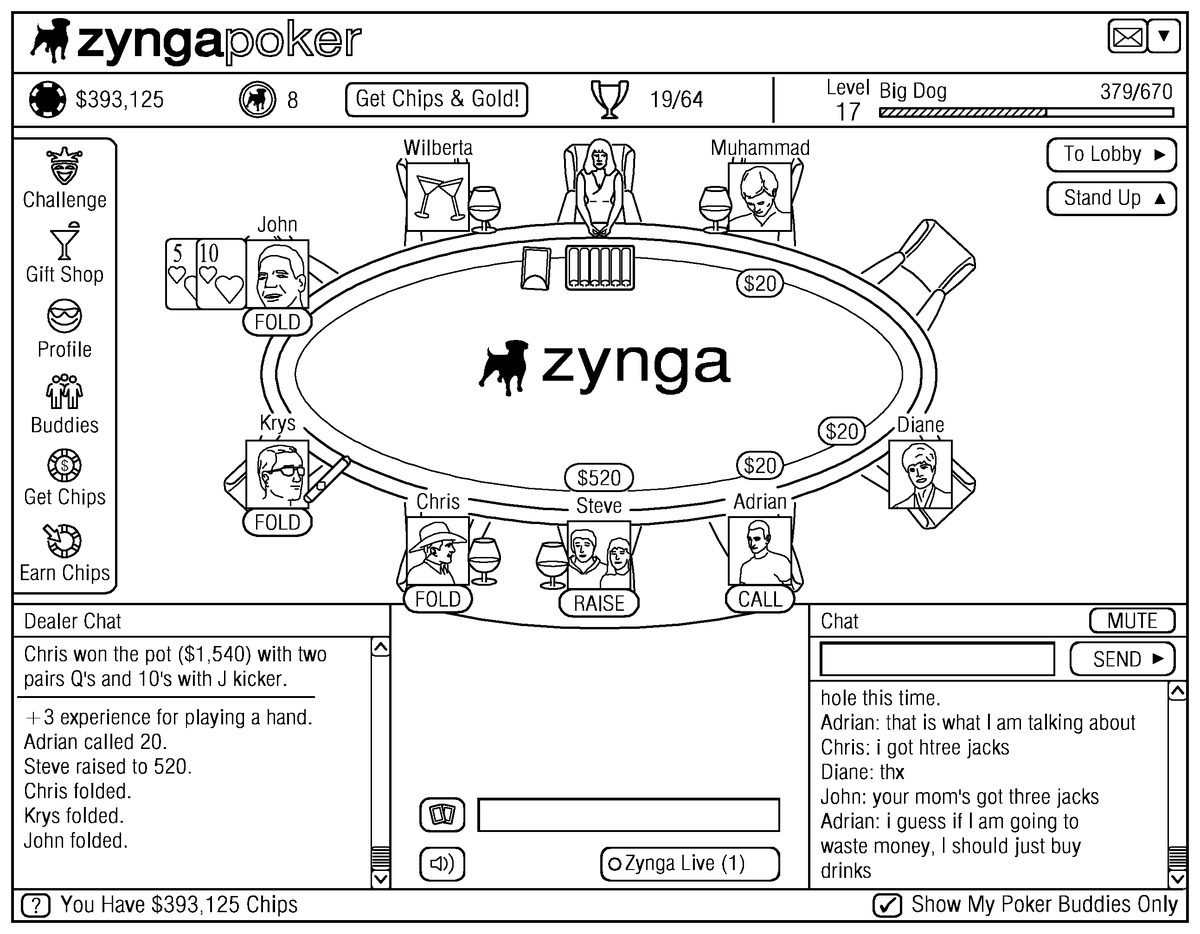
In some embodiments, virtual poker chips can be purchased online. One such embodiment is described in reference toFIGS. 3-7.FIG. 7shows a flowchart illustrating an example method for purchasing virtual currency.FIG. 3illustrates a webpage for accessing a fully operational online poker game according to embodiments of the present disclosure. This online poker game can either be accessed directly, or it can be embedded within the webpage of a social networking site. The illustrated page serves as a portal for accessing various features of the online poker game. In various embodiments, the website can include a hyperlink for accessing a webpage for purchasing virtual poker chips.
FIG. 4illustrates a webpage for purchasing virtual poker chips according to embodiments of the present disclosure. This page can be hosted by the online game server or another internet server. This page can include fields for selecting an amount of virtual poker chips to purchase and for selecting legal currency payment options (e.g., credit card, PayPal(r), bank draft, ACH, etc.). Once the necessary selections are made, the webpage can take the player to another webpage on the same server or a separate server to complete the purchase.
FIG. 5illustrates a webpage for inputting a player's personal and financial information to authorize the transfer of legal currency for the purchase of virtual poker chips according to embodiments of the present disclosure. This page can include fields for inputting a player's name, address, and credit card information. Alternatively, the player can already have a pre-established account where their personal and financial information is stored. Once the necessary information is inputted, the player can place the order to purchase virtual currency. This order is received by the server702, which can then process the order. If the order is processed successfully, the player's game account can be credited with the amount of virtual poker chips ordered. For example, if the player uses a credit card account, the server may credit the users account with the amount of virtual chips ordered upon receiving the purchase order, receiving an authorization from a transaction processing network, or receiving final settlement of the funds.
FIG. 6illustrates a webpage for confirming the purchase of virtual poker chips and the payment of legal currency. This page can include fields displaying the amount of legal currency the player has just paid and the amount of virtual poker chips the player has just purchased. This page can also include fields displaying the details of the legal currency payment method used and a confirmation number for the specific transaction. From this point, the player can choose to return to the virtual poker game or to purchase more virtual poker chips.
In some embodiments, a first player can make transfers or gifts of virtual items to a second player. However, to prevent fraud or other terms of service violations (e.g., the transfer of legal currency between players outside the context of the virtual poker game in exchange for the transfer of virtual items within the virtual poker game), in-game transfers and gifts can be limited. These transfers and gifts can be limited in size (e.g., no more than one item per transfer) and/or frequency (e.g., no more than one transfer per day). Furthermore, transfers can be limited to players who are friends or otherwise connected within the context of an online social network (e.g., transfers are only allowed between players who are also “friends” on Facebook (r)). For example, a game server, prior to allowing the gift or transfer, may access a social network to match the player wishing to gift an in-game value (e.g., currency, virtual objects, etc.) to another player. Social network platforms support APIs that allow for third-party applications to verify connections by providing one or more user identifiers associated with such players. Fraud detection systems can be used to prevent fraudulent transactions.
Purchasing Virtual Items with Virtual Poker Chips
In some embodiments, virtual poker chips can be used to purchase virtual items online. One such embodiment is described in reference toFIGS. 8-11.FIG. 11shows a flowchart illustrating an example method for purchasing virtual items using virtual poker chips.FIG. 8illustrates a webpage of a virtual online poker game with a plurality of players according to embodiments of the present disclosure. This online poker game can be accessed directly, or it can be embedded within the webpage of a social networking site. The illustrated page shows a virtual poker table, a virtual poker dealer, an icon of a first player and icons of a plurality of other players (“player icons”), the cards the first player is holding, the amount of virtual poker chips held by each player, the size of each player's bet, and the size of the pot for the current hand of poker. Associated with each player icon is an item icon where one or more virtual items associated with the player can be displayed. The page includes a separate hyperlink or other activatable user interface element for accessing a user interface for purchasing virtual items. In an alternative embodiment, the first player can access the user interface for purchasing virtual items by selecting the item icon for any player.
FIG. 9illustrates a webpage where virtual items can be selected and purchased. The illustrated page shows a variety of virtual items that can be selected. Each virtual item displays the number of virtual poker chips needed to purchase it. Some virtual items can be purchased permanently, meaning the item stays associated with the player in perpetuity. Other items are not permanent when purchased, meaning the item stays associated with the player for a limited duration (e.g., the item stays associated with the player as long as he remains at that virtual poker table, or as long as the player remains logged in to the virtual poker game). In some embodiments, items can remain associated with a player across games (e.g., if a player buys a box of cigars in a virtual online poker game, such as Zynga Poker, that item can remain associated with the player if he/she logs into a virtual online role-playing game, such as Zynga Mafia Wars).
From the page illustrated inFIG. 9, a player can select an item to purchase. A player can also select whether to purchase the item for himself, or for one or more other players (e.g., the player can select to purchase the item for all players at the virtual poker table, or for the player's friends who are playing virtual poker at other virtual poker tables). Once the necessary selections are made, the player can place the order to purchase the virtual item. This order is received by the server1102, which can then process the order. If the order is processed successfully, the player's game account can be debited by the amount of virtual poker chips needed to buy the virtual items selected1104. In the example illustrated, the first player selected to purchase a glass of wine for each player at the table.
FIG. 10illustrates the same virtual online poker game as illustrated inFIG. 8. Once a first player completes the purchase of a virtual item, the virtual item can then be associated with the first player or another player1106. In the illustrated example, the amount of virtual poker chips held by the first player has been decremented, and each player at the virtual poker table now has a virtual glass of wine associated with them. From this point1108, the player can choose to continue playing virtual poker or to purchase more virtual items.
Systems and Methods
In various example embodiments, one or more described webpages and functionality discussed above may be associated with a network gaming system or network gaming service. In one implementation, the virtual poker game can be implemented using FLASH(r)-based technologies. For example, the virtual poker game can be fully or partially implemented as a SWF object that is embedded in a web page and executable by a Flash(r) media player plug-in.
Particular embodiments may operate in a wide area network environment, such as the Internet, including multiple network addressable systems.FIG. 1illustrates an example network environment, in which various example embodiments may operate. Network cloud160generally represents one or more interconnected networks, over which the systems and hosts described herein can communicate. Network cloud160may include packet-based wide area networks (such as the Internet), private networks, wireless networks, satellite networks, cellular networks, paging networks, and the like. AsFIG. 1illustrates, particular embodiments may operate in a network environment comprising one or more network gaming systems120and one or more client devices130. Client devices130are operably connected to the network environment via a network service provider, a wireless carrier, or any other suitable means.
Network gaming system120is a network addressable system that, in various example embodiments, comprises one or more physical servers122and data store124. The one or more physical servers122are operably connected to computer network160via, by way of example, a set of routers and/or networking switches126. In an example embodiment, the functionality hosted by the one or more physical servers122may include web or HTTP servers, File Transfer Protocol (FTP) servers, as well as, without limitation, webpages and applications implemented using Common Gateway Interface (CGI) script, PHP Hyper-text Preprocessor (PHP), Active Server Pages (ASP), Hyper Text Markup Language (HTML), Extensible Markup Language (XML), Java, JavaScript, Asynchronous JavaScript and XML (AJAX), Flash, ActionScript, and the like.
Physical servers122may host functionality directed to the operations of network gaming system120. Hereinafter servers122may be referred to as server122, although server122may include numerous servers hosting, for example, network gaming system120, as well as other content distribution servers, data stores, and databases. Data store124may store content and data relating to, and enabling, operation of the network gaming system120as digital data objects. A data object, in particular implementations, is an item of digital information typically stored or embodied in a data file, database or record. Content objects may take many forms, including: text (e.g., ASCII, SGML, HTML), images (e.g., jpeg, tif and gif, graphics (vector-based or bitmap), audio, video (e.g., mpeg), or other multimedia, and combinations thereof. Content object data may also include executable code objects (e.g., games executable within a browser window or frame), podcasts, etc. Logically, data store124corresponds to one or more of a variety of separate and integrated databases, such as relational databases and object-oriented databases, that maintain information as an integrated collection of logically related records or files stored on one or more physical systems. Structurally, data store124may generally include one or more of a large class of data storage and management systems. In particular embodiments, data store124may be implemented by any suitable physical system(s) including components, such as one or more database servers, mass storage media, media library systems, storage area networks, data storage clouds, and the like. In one example embodiment, data store124includes one or more servers, databases (e.g., MySQL), and/or data warehouses. Data store124may include data associated with different network gaming system120users and/or client devices130.
Client device130is generally a computer or computing device including functionality for communicating (e.g., remotely) over a computer network. Client device130may be a desktop computer, laptop computer, personal digital assistant (PDA), in- or out-of-car navigation system, smart phone or other cellular or mobile phone, or mobile gaming device, among other suitable computing devices. Client device130may execute one or more client applications, such as a web browser (e.g., Microsoft Internet Explorer, Mozilla Firefox, Apple Safari, Google Chrome, and Opera, etc.) and plug-ins and/or other extensions (e.g, Flash(r) Media Player), to access content over a computer network. In other implementations, client device130may host a special-purpose client application that is specifically adapted to access network gaming system120in order to access a network game, such as a virtual poker game.
FIG. 2illustrates an example computing system architecture, which may be used to implement a server122or a client device130. In one embodiment, hardware system200comprises a processor202, a cache memory204, and one or more executable modules and drivers, stored on a tangible (i.e., non-transitory) computer readable medium, directed to the functions described herein. Additionally, hardware system200may include a high performance input/output (I/O) bus206and a standard I/O bus208. A host bridge210may couple processor202to high performance I/O bus206, whereas I/O bus bridge212couples the two buses206and208to each other. A system memory214and one or more network/communication interfaces216couple to bus206. Hardware system200may further include video memory (not shown) and a display device coupled to the video memory. Mass storage218, and I/O ports220couple to bus208. Hardware system200may optionally include a keyboard and pointing device, and a display device (not shown) coupled to bus208. Collectively, these elements are intended to represent a broad category of computer hardware systems, including but not limited to general purpose computer systems based on the x86-compatible processors manufactured by Intel Corporation of Santa Clara, Calif., and the x86-compatible processors manufactured by Advanced Micro Devices (AMD), Inc., of Sunnyvale, Calif., as well as any other suitable processor.
The elements of hardware system200are described in greater detail below. In particular, network interface216provides communication between hardware system200and any of a wide range of networks, such as an Ethernet (e.g., IEEE 802.3) network, a backplane, etc. Mass storage218provides permanent storage for the data and programming instructions to perform the above-described functions implemented in servers122, whereas system memory214(e.g., DRAM) provides temporary storage for the data and programming instructions when executed by processor202. I/O ports220are one or more serial and/or parallel communication ports that provide communication between additional peripheral devices, which may be coupled to hardware system200.
Hardware system200may include a variety of system architectures; and various components of hardware system200may be rearranged. For example, cache204may be on-chip with processor202. Alternatively, cache204and processor202may be packed together as a “processor module,” with processor202being referred to as the “processor core.” Furthermore, certain embodiments of the present disclosure may not require nor include all of the above components. For example, the peripheral devices shown coupled to standard I/O bus208may couple to high performance I/O bus206. In addition, in some embodiments, only a single bus may exist, with the components of hardware system200being coupled to the single bus. Furthermore, hardware system200may include additional components, such as additional processors, storage devices, or memories.
An operating system manages and controls the operation of hardware system200, including the input and output of data to and from software applications (not shown). The operating system provides an interface between the software applications being executed on the system and the hardware components of the system. Any suitable operating system may be used, such as the LINUX Operating System, the Apple Macintosh Operating System, available from Apple Computer Inc. of Cupertino, Calif., UNIX operating systems, Microsoft (r) Windows(r) operating systems, BSD operating systems, and the like. Of course, other implementations are possible. For example, the functions described herein may be implemented in firmware or on an application specific integrated circuit.
Furthermore, the above-described elements and operations can be comprised of instructions that are stored on non-transitory storage media. The instructions can be retrieved and executed by a processing system. Some examples of instructions are software, program code, and firmware. Some examples of non-transitory storage media are memory devices, tape, disks, integrated circuits, and servers. The instructions are operational when executed by the processing system to direct the processing system to operate in accord with the invention. The term “processing system” refers to a single processing device or a group of inter-operational processing devices. Some examples of processing devices are integrated circuits and logic circuitry. Those skilled in the art are familiar with instructions, computers, and storage media.
Miscellaneous
One or more features from any embodiment may be combined with one or more features of any other embodiment without departing from the scope of the disclosure.
A recitation of “a”, “an,” or “the” is intended to mean “one or more” unless specifically indicated to the contrary.
The present disclosure encompasses all changes, substitutions, variations, alterations, and modifications to the example embodiments herein that a person having ordinary skill in the art would comprehend. Similarly, where appropriate, the appended claims encompass all changes, substitutions, variations, alterations, and modifications to the example embodiments herein that a person having ordinary skill in the art would comprehend.
For example, the processes described herein may be implemented using hardware components, software components, and/or any combination thereof. By way of example, while embodiments of the present disclosure have been described as operating in connection with a networking website, various embodiments of the present disclosure can be used in connection with any communications facility that supports web applications. Furthermore, in some embodiments the term “web service” and “website” may be used interchangeably and additionally may refer to a custom or generalized Application Programming Interface (API) on a device, such as a mobile device (e.g., cellular phone, smart phone, personal GPS, personal digital assistance, personal gaming device, etc.), that makes API calls directly to a server. The specification and drawings are, accordingly, to be regarded in an illustrative rather than a restrictive sense. It will, however, be evident that various modifications and changes may be made thereunto without departing from the broader spirit and scope of the disclosure as set forth in the claims and that the disclosure is intended to cover all modifications and equivalents within the scope of the following claims.
Claims
- A method for managing game currency, the method comprising: receiving, at a server, a purchase order for virtual currency from a first player, wherein the purchase order was made with legal currency, and wherein the virtual currency is usable within a computer-implemented gambling game;crediting an account of the first player with virtual currency;enabling the first player to make transfers of the virtual currency to other players;and limiting transfers of virtual currency from the first player to other players, wherein limiting the transfers includes, receiving a transfer request to transfer virtual currency from the first player to a second player;accessing, after receiving the transfer request, a social network server to obtain information regarding players connected with the first player in an online social network;determining, after accessing the social network server, if the second player is connected with the first player in the online social network based on the information regarding players connected with the first player;approving, by the computer-implemented gambling game, the transfer request from the first player to the second player when the second player is connected with the first player in the online social network, wherein the transfer request is not approved when the first player is not connected with the second player;and transferring the virtual currency from the first player to the second player when the transfer request is approved, wherein operations of the method are executed by a processor.
- The method as recited in claim 1 , wherein limiting the transfers of virtual currency further includes: limiting an amount of virtual currency of each transfer.
- The method as recited in claim 1 , wherein limiting the transfers of virtual currency further includes: limiting, by the computer-implemented gambling game, a frequency of the transfers from the first player to other players by approving up to a maximum number of transfers from the first player within a predetermined period.
- The method as recited in claim 1 , wherein limiting the transfers of virtual currency further includes: limiting which ones of the other players may receive the transfers.
- A method for managing game currency, the method comprising: receiving, at a server, a purchase order for virtual currency from a first player, wherein the purchase order was made with legal currency, and wherein the virtual currency is usable within a computer-implemented gambling game;crediting an account of the first player with virtual currency;enabling the first player to make transfers of the virtual currency to other players;and limiting transfers of virtual currency from the first player to other players, wherein limiting the transfers includes, receiving a transfer request to transfer virtual currency from the first player to a second player;accessing a social network server to obtain information regarding players connected with the first player in an online social network;approving, by the computer-implemented gambling game, the transfer request from the first player to the second player when the second player is connected with the first player in the online social network, wherein the transfer request is not approved when the first player is not connected with the second player;and transferring the virtual currency from the first player to the second player when the transfer request is approved, wherein operations of the method are executed by a processor, wherein the computer-implemented gambling game assigns a status to each player based on player skill, wherein the computer-implemented gambling game limits which players may play with other players based on the skill of the players, wherein the first player is not allowed to play with the second player that has a higher status, wherein the computer-implemented gambling game allows the first player to play with the second player in response to receiving the purchase order from the first player.
- A computer program embedded in a non-transitory computer-readable storage medium, when executed by one or more processors, for managing game currency, the computer program comprising: program instructions for receiving, at a server, a purchase order for virtual currency from a first player, wherein the purchase order was made with legal currency, and wherein the virtual currency is usable within a computer-implemented gambling game;program instructions for crediting an account of the first player with virtual currency;program instructions for enabling the first player to make transfers of the virtual currency to other players;and program instructions for limiting transfers of virtual currency from the first player to other players, wherein limiting the transfers of virtual currency includes limiting, by the computer-implemented gambling game, a frequency of the transfers from the first player to other players by approving up to a maximum number of transfers from the first player to any other player within a predetermined period, wherein the other players are identified in accordance to privileges accorded to the first player based on a type of the virtual currency held by the first player, the privileges are interaction privileges accorded to the first player permitting the first player to interact with one or more of the other players that are at different levels of the computer-implemented gambling game than a level of the first player and wherein the type of virtual currency includes at least one of virtual currency that is purchased and virtual currency that is won during game play.
- The computer program as recited in claim 6 , wherein limiting the transfers of virtual currency further includes: limiting an amount of virtual currency of each transfer.
- The computer program as recited in claim 6 , wherein limiting the transfers of virtual currency further includes: limiting which ones of the other players may receive the transfers.
- The computer program as recited in claim 8 , wherein the transfers are limited to players who are connected within an online social network.
- The computer program as recited in claim 8 , wherein limiting which ones of the other players may receive the transfers further includes: receiving a transfer request to transfer virtual currency from the first player to a second player;accessing a social network server to obtain information regarding players connected with the first player in an online social network;approving, by the computer-implemented gambling game, the transfer request from the first player to the second player when the second player is connected with the first player in the online social network, wherein the transfer request is not approved when the first player is not connected with the second player;and transferring the virtual currency from the first player to the second player when the transfer request is approved.
- A computer program embedded in a non-transitory computer-readable storage medium, when executed by one or more processors, for managing game currency, the computer program comprising: program instructions for receiving, at a server, a purchase order for virtual currency from a first player, wherein the purchase order was made with legal currency, and wherein the virtual currency is usable within a computer-implemented gambling game;program instructions for crediting an account of the first player with virtual currency;program instructions for enabling the first player to make transfers of the virtual currency to other players;and program instructions for limiting transfers of virtual currency from the first player to other players, wherein limiting the transfers of virtual currency includes limiting, by the computer-implemented gambling game, a frequency of the transfers from the first player to other players by approving up to a maximum number of transfers from the first player to any other player within a predetermined period, wherein the computer-implemented gambling game assigns a status to each player based on player skill, wherein the computer-implemented gambling game limits which players may play with other players based on the skill of the players, wherein the first player is not allowed to play with a second player that has a higher status, wherein the computer-implemented gambling game allows the first player to play with the second player in response to receiving the purchase order from the first player.
- A game server comprising: a memory;and a processor, wherein the memory includes a computer program that when executed by the processor performs a method, the method including: crediting an account of a first player with virtual currency after receiving a purchase order for the virtual currency from the first player, wherein the purchase order was made with legal currency, and wherein the virtual currency is usable within a computer-implemented gambling game;enabling the first player to make transfers of the virtual currency to other players;and limiting transfers of virtual currency from the first player to other players, wherein the computer program limits the transfers of virtual currency by limiting a frequency of the transfers from the first player to other players by approving up to a maximum number of transfers from the first player to any other player within a predetermined period, wherein limiting transfers further includes providing access to specific ones of the other players in accordance to privileges accorded to the first player based on a type of the virtual currency held by the first player, wherein the privileges are interaction privileges accorded to the first player permitting the first player to interact with other players who are at different levels of the computer-implemented gambling game than a level of the first player and wherein the type of virtual currency includes at least one of virtual currency that is purchased and virtual currency that is won during game play.
- The game server as recited in claim 12 , wherein limiting the transfers of virtual currency further includes: limiting an amount of virtual currency of each transfer.
- The game server as recited in claim 12 , wherein limiting the transfers of virtual currency further includes: limiting which ones of the other players may receive the transfers.
- The game server as recited in claim 14 , wherein the transfers are limited to players who are connected within a context of an online social network.
- The game server as recited in claim 14 , wherein limiting which ones of the other players may receive the transfers further includes: receiving a transfer request to transfer virtual currency from the first player to a second player;accessing a social network server to obtain information regarding players connected with the first player in an online social network;approving, by the computer-implemented gambling game, the transfer request from the first player to the second player when the second player is connected with the first player in the online social network, wherein the transfer request is not approved when the first player is not connected with the second player;and transferring the virtual currency from the first player to the second player when the transfer request is approved.
- The game server as recited in claim 16 , wherein accessing the social network server further includes: utilizing a social network application programming interface (API) to obtain from the social network server the information regarding players connected with the first player in the online social network.
- The method as recited in claim 1 , wherein accessing the social network server further includes: utilizing a social network application programming interface (API) to obtain from the social network server the information regarding players connected with the first player in the online social network.
- The computer program as recited in claim 10 , wherein accessing the social network server further includes: utilizing a social network application programming interface (API) to obtain from the social network server the information regarding players connected with the first player in the online social network.
Disclaimer: Data collected from the USPTO and may be malformed, incomplete, and/or otherwise inaccurate.