U.S. Pat. No. 9,687,733
Game Apparatus, Storage Medium, Game Controlling Method and Game System
AssigneeNintendo Co., Ltd.
Issue DateOctober 9, 2015
U.S. Patent No. 9,687,733: Game apparatus, storage medium, game controlling method and game system
U.S. Patent No. 9,687,733: Game apparatus, storage medium, game controlling method and game system
Issued June 27, 2017, to Nintendo Co., Ltd.
Priority Date February 23, 2011
Summary:
U.S. Patent No. 9,687,733 (the ‘733 Patent) describes a video game that utilizes a step counter as a game mechanic. The player needs a device capable of counting steps and transmitting the information to the system or else the player can not utilize their steps. If the player does have the necessary device, then the player’s steps can be used as a means to advance the game. A player can choose how to spend their steps by selecting from a variety of in-game options such as currency, experience points, or even a hint. Unspent steps are utilized to advance supplemental areas of the game, so no step is wasted. The ‘733 Patent mainly lists a number of ways a player can spend the steps.
Abstract:
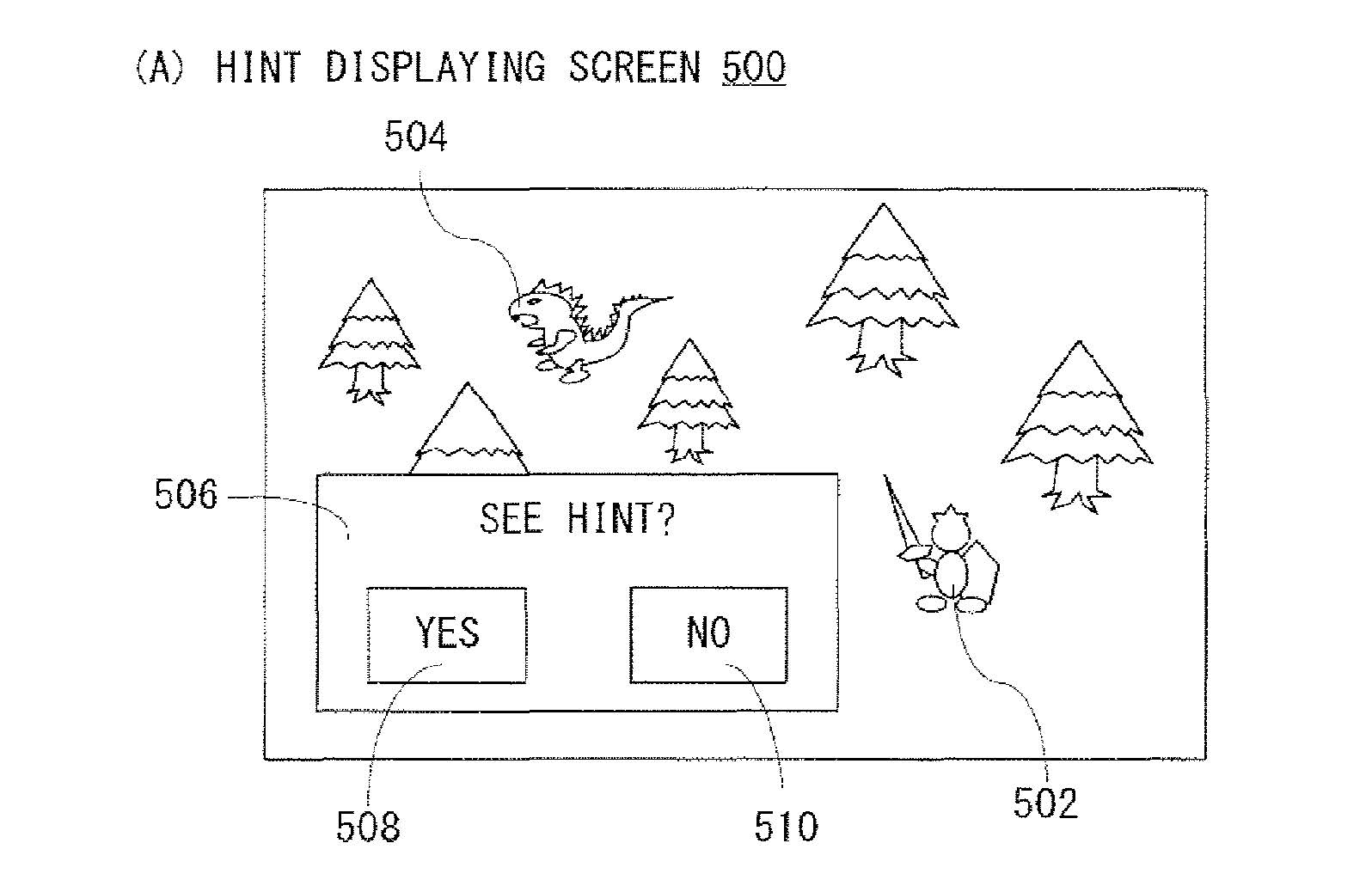
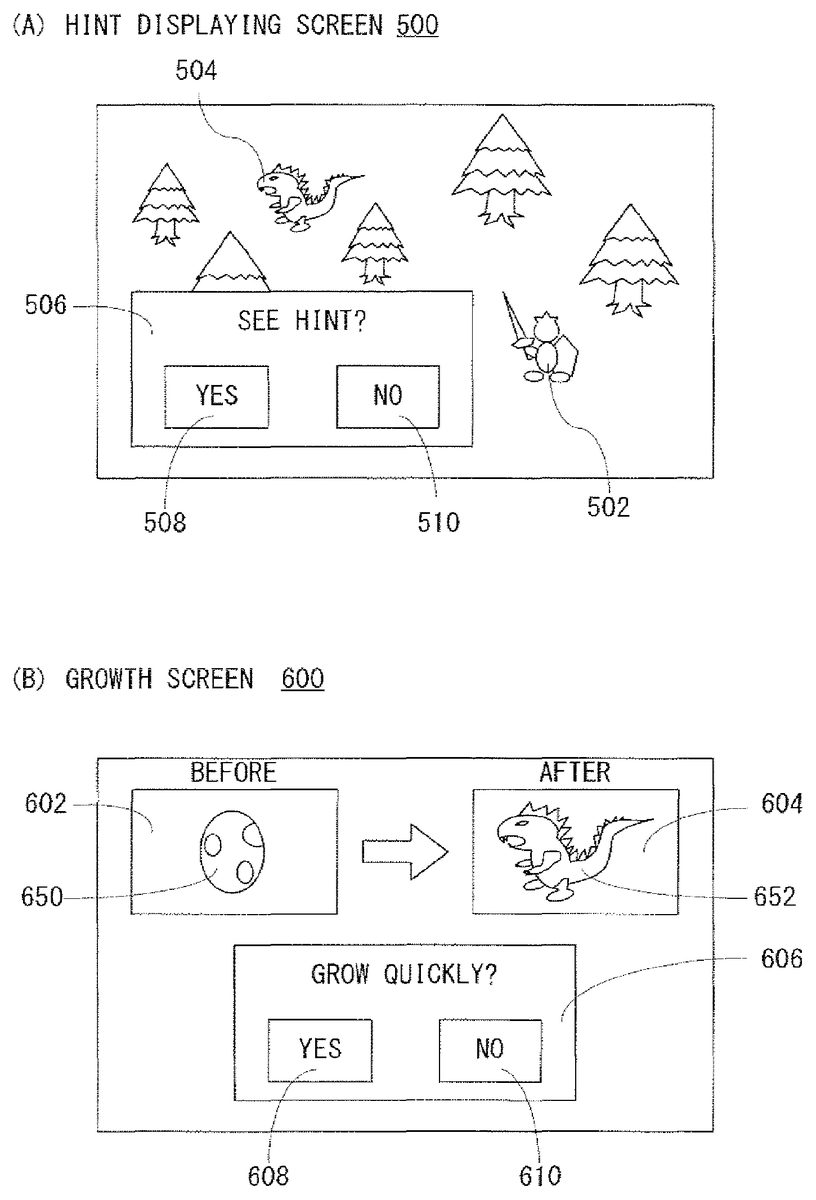
A game apparatus includes a micon, and the micon measures step counts in correspondence with the magnitude of accelerations indicated by acceleration data from an acceleration sensor when a user carries the game apparatus in a sleep mode in which the apparatus is closed. The step counts are converted into earned coins. In each of a plurality of games executed by the game apparatus, by using the earned coins, a special item is purchased, playing in a special course is permitted, a hint is displayed, and a game is played in fast-forward.
Illustrative Claim:
1. A game apparatus comprising an input device, the apparatus configured to at least: measure step counts using a motion detection device; advance a game on the basis of an input from said input device; and execute processing of supplementing advancement of said game by using the measured step counts during execution of the game, said game being advanceable independently from the measured step counts.
Illustrative Figure
Abstract
A game apparatus includes a micon, and the micon measures step counts in correspondence with the magnitude of accelerations indicated by acceleration data from an acceleration sensor when a user carries the game apparatus in a sleep mode in which the apparatus is closed. The step counts are converted into earned coins. In each of a plurality of games executed by the game apparatus, by using the earned coins, a special item is purchased, playing in a special course is permitted, a hint is displayed, and a game is played in fast-forward.
Description
DETAILED DESCRIPTION OF THE PREFERRED EMBODIMENTS Referring toFIG. 1, a game apparatus10of an embodiment of the present invention includes an upper housing12and a lower housing14, and the upper housing12and the lower housing14are connected with each other so as to be opened or closed (foldable). InFIG. 1example, the upper housing12and the lower housing14are constructed in the form of a horizontally long rectangular plate, and are rotatably connected with each other at the long sides of both of the housings. That is, the game apparatus10of this embodiment is a folding hand-held game apparatus, and inFIG. 1, the game apparatus10is shown in an opened state (in an open state). The game apparatus10is constructed such a size that the user can hold with both hands or one hand even in the open state. Generally, the user uses the game apparatus10in the open state. Furthermore, the user keeps the game apparatus10in a close state when not using the game apparatus10. Here, the game apparatus10can maintain an opening and closing angle formed between the upper housing12and the lower housing14at an arbitrary angle between the close state and open state by a friction force. etc. exerted at the connected portion as well as the aforementioned close state and open state. That is, the upper housing12can be fixed with respect to the lower housing14at the arbitrary angle. Additionally, the game apparatus10is mounted with a camera (32,34) described later, functioning as an imaging device, such as imaging an image with the camera (32,34), displaying the imaged image on the screen, and saving the imaged image data. As shown inFIG. 1, the upper housing12is provided with a first LCD16, and the lower housing14is provided with a second LCD18. The first LCD16and the second LCD18take a horizontally-long shape, and are arranged such that the directions of the long sides thereof are ...
DETAILED DESCRIPTION OF THE PREFERRED EMBODIMENTS
Referring toFIG. 1, a game apparatus10of an embodiment of the present invention includes an upper housing12and a lower housing14, and the upper housing12and the lower housing14are connected with each other so as to be opened or closed (foldable). InFIG. 1example, the upper housing12and the lower housing14are constructed in the form of a horizontally long rectangular plate, and are rotatably connected with each other at the long sides of both of the housings. That is, the game apparatus10of this embodiment is a folding hand-held game apparatus, and inFIG. 1, the game apparatus10is shown in an opened state (in an open state). The game apparatus10is constructed such a size that the user can hold with both hands or one hand even in the open state.
Generally, the user uses the game apparatus10in the open state. Furthermore, the user keeps the game apparatus10in a close state when not using the game apparatus10. Here, the game apparatus10can maintain an opening and closing angle formed between the upper housing12and the lower housing14at an arbitrary angle between the close state and open state by a friction force. etc. exerted at the connected portion as well as the aforementioned close state and open state. That is, the upper housing12can be fixed with respect to the lower housing14at the arbitrary angle.
Additionally, the game apparatus10is mounted with a camera (32,34) described later, functioning as an imaging device, such as imaging an image with the camera (32,34), displaying the imaged image on the screen, and saving the imaged image data.
As shown inFIG. 1, the upper housing12is provided with a first LCD16, and the lower housing14is provided with a second LCD18. The first LCD16and the second LCD18take a horizontally-long shape, and are arranged such that the directions of the long sides thereof are coincident with the long sides of the upper housing12and the lower housing14. For example, resolutions of the first LCD16and the second LCD18are set to 256 (horizontal)×192 (vertical) pixels (dots).
In addition, although an LCD is utilized as a display in this embodiment, an EL (Electronic Luminescence) display, a plasmatic display, etc. may be used in place of the LCD. Furthermore, the game apparatus10can utilize a display with an arbitrary resolution.
As shown inFIG. 1andFIG. 2, the lower housing14is provided with respective operation buttons20a-20kas input devices. Out of the respective operation buttons20a-20k, the direction input button20a, the operation button20b, the operation button20c, the operation button20d, the operation button20e, the power button20f, the start button20g, and the select button20hare provided on the surface (inward surface) to which the second LCD18of the lower housing14is set. More specifically, the direction input button20aand the power button20fare arranged at the left of the second LCD18, and the operation buttons20b-20e,20gand20hare arranged at the right of the second LCD18. Furthermore, when the upper housing12and the lower housing14are folded, the operation buttons20a-20hare enclosed within the game apparatus10.
The direction input button (cross key)20afunctions as a digital joystick, and is used for instructing a moving direction of a player object, moving a cursor, and so forth. Each operation buttons20b-20eis a push button, and is used for causing the player object to make an arbitrary action, executing a decision and cancellation, and so forth. The power button20fis a push button, and is used for turning on or off the main power supply of the game apparatus10. The start button20gis a push button, and is used for suspending (pausing), starting (restarting) a game, and so forth. The select button20his a push button, and is used for a game mode selection, a menu selection, etc.
Although operation buttons20i-20kare omitted inFIG. 1, as shown inFIG. 2(A), the operation button (L button)20iis provided at the left corner of the upper side surface of the lower housing14, and the operation button (R button)20jis provided at the right corner of the upper side surface of the lower housing14. Furthermore, as shown inFIG. 2(B), the volume button20kis provided on the left side surface of the lower housing14.
FIG. 2(A) is an illustrative view of the game apparatus10in a folded manner as seen from a top surface (upper housing12).FIG. 2(B) is an illustrative view of the game apparatus10in a folded manner when seen from a left side surface.
The L button20iand the R button20jare push buttons, and can be used for similar operations to those of the operation buttons20b-20e, and can be used as subsidiary operations of these operation buttons20b-20e. Furthermore, in this embodiment, the L button20iand the R button20jcan also be used for an operation of an imaging instruction (shutter operation). The volume button20kis made up of two push buttons, and is utilized for adjusting the volume of the sound output from two speakers (right speaker and left speaker) not shown. In this embodiment, the volume button20kis provided with an operating portion including two push portions, and the aforementioned push buttons are provided by being brought into correspondence with the respective push portions. Thus, when the one push portion is pushed, the volume is made high, and when the other push portion is pushed, the volume is made low. For example, when the push portion is hold down, the volume is gradually made high, or the volume is gradually made low.
Returning toFIG. 1, the game apparatus10is further provided with a touch panel22as an input device separate from the operation buttons20a-20k. The touch panel22is attached so as to cover the screen of the second LCD18. In this embodiment, a touch panel of a resistance film system is used as the touch panel22, for example. However, the touch panel22can employ an arbitrary push-type touch panel without being restricted to the resistance film system. Furthermore, in this embodiment, as the touch panel22, a touch panel having the same resolution (detection accuracy) as the resolution of the second LCD18, for example, is utilized. However, the resolution of the touch panel22and the resolution of the second LCD18are not necessarily coincident with each other.
Additionally, at the right side surface of the lower housing14, a loading slot (represented by a dashed line shown inFIG. 1) is provided. The loading slot can house a touch pen24to be utilized for performing an operation on the touch panel22. Generally, an input with respect to the touch panel22is performed with the touch pen24, but it may be performed with a finger of the user beyond the touch pen24. Accordingly, in a case that the touch pen24is not to be utilized, the loading slot and the housing portion for the touch pen24need not be provided.
Moreover, on the right side surface of the lower housing14, a loading slot for housing a memory card26(represented by a chain double-dashed line inFIG. 1) is provided. Inside of the loading slot, a connector (not illustrated) for electrically connecting the game apparatus10and the memory card26is provided. The memory card26is an SD card, for example, and detachably attached to the connector. This memory card26is used for storing (saving) an image imaged by the game apparatus10, and reading the image generated (imaged) or stored by another apparatus in the game apparatus10.
In addition, on the upper side surface of the lower housing14, a loading slot (represented by an alternate long and short dash lineFIG. 1) for housing a memory card28is provided. Inside the loading slot as well, a connector (not illustrated) for electrically connecting the game apparatus10and the memory card28is provided. The memory card28is a recording medium of recording an information processing program, necessary data, etc. and is detachably attached to the loading slot provided to the lower housing14.
At the left end of the connected portion (hinge) between the upper housing12and the lower housing14, an indicator30is provided. The indicator30is made up of three LEDs30a,30b,30c. Here, the game apparatus10can make a wireless communication with another equipment, and the first LED30alights up when a wireless communication with the equipment is established. The second LED30blights up while the game apparatus10is recharged. The third LED30clights up when the main power supply of the game apparatus10is turned on. Thus, by the indicator30(LEDs30a-30c), it is possible to inform the user of a communication-established state, a charge state, and a main power supply on/off state of the game apparatus10.
Although illustration is omitted, a switch (opening and closing switch42: secFIG. 3) that is switched in response to opening and closing of the game apparatus10is provided inside the hinge. For example, the opening and closing switch42is turned on when that the game apparatus10is in an opened state. On the other hand, the opening and closing switch42is turned off when that the game apparatus10is in a closed (folded) state. Here, it is only necessary to know that the game apparatus10is in the opened state or the closed state, and therefore, turning on and off of the opening and closing switch42may be reversed.
As described above, the upper housing12is provided with the first LCD16. In this embodiment, the touch panel22is set so as to cover the second LCD18, but the touch panel22may be set so as to cover the first LCD16. Alternatively, two touch panels22may be set so as to cover the first LCD16and the second LCD18. For example, on the second LCD18, an operation explanatory screen for teaching the user how the respective operation buttons20a-20kand the touch panel22work or how to operate them, and a game screen are displayed.
Additionally, the upper housing12is provided with the two cameras (inward camera32and outward camera34). As shown inFIG. 1, the inward camera32is attached in the vicinity of the connected portion between the upper housing12and the lower housing14and on the surface to which the first LCD16is provided such that the display surface of the first LCD16and the imaging surface are in parallel with each other or are leveled off. On the other hand, the outward camera34is attached to the surface being opposed to the surface to which the inward camera32is provided as shown inFIG. 2(A), that is, on the outer surface of the upper housing12(the surface turns to the outside when the game apparatus10is in a close state, and on the back surface of the upper housing12shown inFIG. 1). Here, inFIG. 1, the outward camera34is shown by a dashed line.
Accordingly, the inward camera32can image a direction to which the inner surface of the upper housing12is turned, and the outward camera34can image a direction opposite to the imaging direction of the inward camera32, that is, can image a direction to which the outer surface of the upper housing12is turned. Thus, in this embodiment, the two cameras32,34are provided such that the imaging directions of the inward camera32and the outward camera34are opposite with each other. For example, the user holding the game apparatus10can image a landscape (including the user, for example) as the user is seen from the game apparatus10with the inward camera32, and can image a landscape as the direction opposite to the user is seen from the game apparatus10with the outward camera34.
Additionally, on the internal surface near the aforementioned connected portion, a microphone84(seeFIG. 3) is housed as a voice input device. Then, on the internal surface near the aforementioned connected portion, a through hole36for the microphone84is formed so as to detect a sound outside the game apparatus10. The position for housing the microphone84and the position of the through hole36for the microphone84are not necessarily on the aforementioned connected portion, and the microphone84may be housed in the lower housing14, and the through hole36for the microphone84may be provided to the lower housing14in correspondence with the housing position of the microphone84.
Furthermore, on the outer surface of the upper housing12, in the vicinity of the outward camera34, a fourth LED38(dashed line inFIG. 1) is attached. The fourth LED38lights up at a time when an imaging is made with the inward camera32or the outward camera34(shutter button is pushed). Furthermore, in a case that a motion image is imaged with the inward camera32or the outward camera34, the fourth LED38continues to light up during the imaging. That is, by making the fourth LED38light up, it is possible to inform an object to be imaged or his or her surrounding that an imaging with the game apparatus10is made (is being made).
Moreover, the upper housing12is formed with a sound release hole40on both sides of the first LCD16. The above-described speaker is housed at a position corresponding to the sound release hole40inside the upper housing12. The sound release hole40is a through hole for releasing the sound from the speaker to the outside of the game apparatus10.
As described above, the upper housing12is provided with the inward camera.32and the outward camera34which are constituted to image an image, and the first LCD16as a displayer for mainly displaying the imaged image and a game screen. On the other hand, the lower housing14is provided with the input device (operation button20(20a-20k) and the touch panel22) for performing an operation input to the game apparatus10and the second LCD18as a displayer for mainly displaying an operation explanatory screen and a game screen. Accordingly, the game apparatus10has two screens (16,18) and two kinds of operating portions (20,22).
FIG. 3is a block diagram showing an electric configuration of the game apparatus10of this embodiment. As shown inFIG. 3, the game apparatus10includes electronic components, such as a CPU50, a main memory52, a memory controlling circuit54, a memory for saved data56, a memory for preset data58, a memory card interface (memory card I/F)60, a memory card I/F62, a wireless communication module64, a local communication module66, a micon68, a power supply circuit70, an interface circuit (Ii/F circuit)72, a first GPU (Graphics Processing Unit)74, a second GPU76, a first VRAM (Video RAM)78, a second VRAM80, an LCD controller82, etc. These electronic components (circuit components) are mounted on an electronic circuit board, and housed in the lower housing14(or the upper housing12may also be appropriate).
The CPU50is an information processing means for executing a predetermined program. In this embodiment, the predetermined program is stored in a memory (memory for saved data56, for example) within the game apparatus10and the memory card26and/or28, and the CPU50executes information processing described later (game processing in this embodiment) by executing the predetermined program.
Here, the program to be executed by the CPU50may be previously stored in the memory within the game apparatus10, acquired from the memory card26and/or28, and acquired from another appliance by communicating with the other equipment.
The CPU50is connected with the main memory52, the memory controlling circuit54, and the memory for preset data58. The memory controlling circuit54is connected with the memory for saved data56. The main memory52is a memory means to be utilized as a work area and a buffer area of the CPU50. That is, the main memory52stores (temporarily stores) various data to be utilized in the aforementioned information processing, and stores a program from the outside (memory cards26and28, and another equipment). In this embodiment, as a main memory52, a PSRAM (Pseudo-SRAM) is used, for example. The memory for saved data56is a memory means for storing (saving) a program to be executed by the CPU50, data of images imaged by the inward camera32and the outward camera34, etc. The memory for saved data56is constructed by a nonvolatile storage medium, and can utilize a NAND type flash memory, for example. The memory controlling circuit54controls reading and writing from and to the memory for saved data56according to an instruction from the CPU50. The memory for preset data58is a memory means for storing data (preset data), such as various parameters, etc. which are previously set in the game apparatus10. As a memory for preset data58, a flash memory to be connected to the CPU50through an SPI (Serial Peripheral Interface) bus can be used.
Both of the memory card I/Fs60and62are connected to the CPU50. The memory card I/F60performs reading and writing data from and to the memory card26attached to the connector according to an instruction form the CPU50. Furthermore, the memory card I/F62performs reading and writing data from and to the memory card28attached to the connector according to an instruction form the CPU50. In this embodiment, image data corresponding to the images imaged by the inward camera32and the outward camera34and image data received by other devices are written to the memory card26, and the image data stored in the memory card26is read from the memory card26and stored in the memory for saved data56, and sent to other devices. Furthermore, the various programs stored in the memory card28are read by the CPU50so as to be executed.
Here, the information processing program such as a game program is not only supplied to the game apparatus10through the external storage medium, such as a memory card28, etc. but also is supplied to the game apparatus10through a wired or a wireless communication line. In addition, the information processing program may be recorded in advance in a nonvolatile storage device inside the game apparatus10. Additionally, as an information storage medium for storing the information processing program, an optical disk storage medium, such as a CD-ROM, a DVD or the like may be appropriate beyond the aforementioned nonvolatile storage device.
The wireless communication module64has a function of connecting to a wireless LAN according to an IEEE802.11.b/g standard-based system, for example. The local communication module66has a function of performing a wireless communication with the same types of the game apparatuses by a predetermined communication system. The wireless communication module64and the local communication module66are connected to the CPU50. The CPU50can receive and send data over the Internet with other appliances by means of the wireless communication module64, and can receive and send data with the same types of other game apparatuses by means of the local communication module66.
Furthermore, the CPU50is connected with the micon68. The micon68includes a memory68aand an RTC68b. The memory68ais a RAM, for example, and stores a program and data for a control by the micon68. The RTC68bcounts a time. In the micon68, date and a current time, etc. can be calculated on the basis of the time counted by the RTC68b.
The micon68is connected with the power button20f, the opening and closing switch42, the power supply circuit70, and the acceleration sensor88. A power-on signal is given to the micon68from the power button20f. When the power button20fis turned on in a state that the main power supply of the game apparatus10is turned off, the memory68afunctioning as a BootROM of the micon68is activated to perform a power control in response to opening and closing of the game apparatus10as described later. On the other hand, when the power button20fis turned on in a state that the main power supply of the game apparatus10is turned on, the micon68instructs the power supply circuit70to stop supplying power to all the circuit components (except for the micon68). Here, the power supply circuit70controls the power supplied from the power supply (typically, a battery housed in the lower housing14) of the game apparatus10to supply power to the respective circuit components of the game apparatus10.
Furthermore, from an opening and closing switch42, a power-on signal or a power-off signal is applied to the micon68. In a case that the main power supply of the game apparatus10is turned on in a state that the opening and closing switch42is turned on (the main body of the game apparatus10is in an opened state), a mode in which a power is supplied from the power supply circuit70to all the circuit components of the game apparatus10under the control of the micon68(hereinafter referred to as “normal mode”) is set. In the normal mode, the game apparatus10can execute an arbitrary application and is in use by a user or a player (used state).
Furthermore, in a case that the opening and closing switch42is turned off in a state that the power supply of the game apparatus10is turned on (the main body of the game apparatus10is in a closed state), a mode in which a power is supplied from the power supply circuit70to a part of the components of the game apparatus10(hereinafter referred to as “sleep mode”) is set. However, depending on the kind of the applications and executing (progressing) situation of the applications, the sleep mode may not be set. Whether the sleep is executed or not is determined by the CPU50, and when execution of the sleep is determined, the CPU50instructs the micon68to execute sleep. Here, in a case that the opening and closing switch42is turned off, when it is determined that the sleep mode cannot be set, a power supply from the power supply circuit70to the first LCD16and the second LCD18are suspended according to an instruction from the micon68.
In the sleep mode, the game apparatus10cannot execute an arbitrary application and is not in use (unused state) by the user. In this embodiment, the part of the components is the CPU50, the wireless communication module64, and the micon68. Here, in the sleep mode (sleep state), the CPU50basically sets a clock in a stopped (inactivated) state, resulting in less power consumption. Additionally, in the sleep mode, a power supply to the CPU50may be stopped. Accordingly, in this embodiment, in the sleep mode, an application is never executed by the CPU50as described above.
It should be noted that in a case that a communication is executed by the wireless communication module64in the sleep state, the CPU50is activated by a control signal from the wireless communication module64. That is, by the wireless communication module64, the clock of the CPU50is operated, and then, the wireless communication module64instructs the CPU50to start a communication. This holds true hereunder. Then, the CPU50instructs the micon68to start supplying power to the memory controlling circuit54and the memory for saved data56. Accordingly, it is possible to transmit data stored in the memory for saved data56to another game apparatus10, etc. and store data received from another game apparatus10, etc. in the memory for saved data56, by a communication.
Furthermore, in a case that step count data (accumulative step count data152cdescribed later) is output from the micon68in the sleep state, the CPU50is activated by a control signal from the micon68. That is, the clock of the CPU50is activated by the micon68to notify the output of the step count data. Furthermore, the micon68controls the power supply circuit70to start supplying electric power to the memory controlling circuit54and the memory for saved data56. Accordingly, the step data output from the micon68is stored in the memory for saved data56.
In addition, when the sleep state is canceled (non-sleep state) due to the game apparatus10being opened, and so forth, a power-off signal is input to the micon68from the opening and closing switch42. Thus, the micon68activates the CPU50to notify the CPU50of the cancellation of the sleep state. In response thereto, the CPU50instructs the micon68to cancel the sleep state. That is, under the instruction from the CPU50, the micon68controls the power supply circuit70to start supplying electric power to all the circuit components. Thus, the game apparatus10shifts to the normal mode to enter the used state. Here, in a case that the sleep mode is not set, when the game apparatus10is opened, under the instruction from the CPU50, the micon68supplies electric power to the first LCD16and the second LCD18by controlling the power supply circuit70.
Moreover, as described above, the micon68is connected with the acceleration sensor88. For example, the acceleration sensor88is a three-axis acceleration sensor, and provided inside the lower housing14(the upper housing12may be possible). This detects an acceleration in a direction vertical to the surface of the first LCD16(second LCD18) of the game apparatus10, and accelerations in two crosswise directions (longitudinal and laterally) that are parallel to the first LCD16(second LCD18). The acceleration sensor88outputs a signal as to the detected acceleration (acceleration signal) to the micon68. The micon68can detect a direction of the game apparatus10, and a magnitude of the shake of the game apparatus10on the basis of the acceleration signal. Accordingly, it is possible to make the micon68and the acceleration sensor88function as a pedometer, for example. The pedometer using the acceleration sensor88is already known, and therefore, the detailed content is omitted, but the step counts are measured in correspondence with the magnitude of the acceleration.
Also, the game apparatus10includes the microphone84and an amplifier86. Both of the microphone84and the amplifier86are connected to the I/F circuit72. The microphone84detects a voice and a sound (clap and handclap, etc.) of the user produced or generated toward the game apparatus10, and outputs a sound signal indicating the voice or the sound to the I/F circuit72. The amplifier86amplifies the sound signal applied from the I/F circuit72, and applies the amplified signal to the speaker (not illustrated). The I/F circuit72is connected to the CPU50.
The touch panel22is connected to the I/F circuit72. The I/F circuit72includes a sound controlling circuit for controlling the microphone84and the amplifier86(speaker), and a touch panel controlling circuit for controlling the touch panel22. The sound controlling circuit performs an A/D conversion and a D/A conversion on a sound signal, or converts a sound signal into sound data in a predetermined format. The touch panel controlling circuit generates touch position data in a predetermined format on the basis of a signal from the touch panel22and outputs the same to the CPU50. For example, the touch position data is data indicating coordinates of a position where an input is performed on an input surface of the touch panel22.
Additionally, the touch panel controlling circuit performs reading of a signal from the touch panel22and generation of the touch position data per each predetermined time. By fetching the touch position data via the I/F circuit72, the CPU50can know the position on the touch panel22where an input is made.
The operation button20is made up of the aforementioned respective operation buttons20a-20k(except for the power switch22f. This hold true for the following), and is connected to the CPU50. The operation data indicating an input state (whether or not to be pushed) with respect to each of the operation buttons20a-20kis output from the operation button20to the CPU50. The CPU50acquires the operation data from the operation button20, and executes processing according to the acquired operation data.
Both of the inward camera32and the outward camera34are connected to the CPU50. The inward, camera32and the outward camera34image images according to instructions from the CPU50, and output image data corresponding to the imaged images to the CPU50. In this embodiment, the CPU50issues an imaging instruction to any one of the inward camera32and the outward camera34while the camera (32,34) which has received the imaging instruction images an image and transmits the image data to the CPU50.
The first GPU74is connected with the first VRAM78, and the second GPU76is connected with the second VRAM80. The first GPU74generates a first display image on the basis of data for generating the display image stored in the main memory52according to an instruction from the CPU50, and draws the same in the first VRAM78. The second GPU76similarly generates a second display image according to an instruction form the CPU50, and draws the same in the second VRAM80. The first VRAM78and the second VRAM80are connected to the LCD controller82.
The LCD controller82includes a register82a. The register82astores a value of “0” or “1” according to an instruction from the CPU50. In a case that the value of the register82ais “0”, the LCD controller82outputs the first display image drawn in the first VRAM78to the second LCD18, and outputs the second display image drawn in the second VRAM80to the first LCD16. Furthermore, in a case that the value of the register82ais “1”, the LCD controller82outputs the first display image drawn in the first VRAM78to the first LCD16, and outputs the second display image drawn in the second VRAM80to the second LCD18.
For example, such a game apparatus10executes in-passing (StreetPass) communication processing or unconscious (SpotPass) communication processing in the unused state (or when being set to a sleep mode). Here, the in-passing communication processing is briefly explained. In the sleep mode, the wireless communication module64automatically transmits (broadcasts) a signal (connection request signal, beacon) indicating a connection request to other game apparatuses10regarding a predetermined time (30 ms, for example) as a search period during the search period, and tries to receive a connection request signal from other game apparatuses10. The search period is repetitively set. That is, in-passing communication processing is automatically intermittently executed. Thus, other game apparatuses10in coverage of the short distance wireless communication are searched (sought, scanned). Here, the connection request signal includes identifying information of the game apparatus10being a transmission source.
At this time, when receiving the connection request signal, the game apparatus10transmits a connection admission signal to the game apparatus10being a transmission source of the connection request signal in response thereto. Here, the connection admission signal includes identifying information of the game apparatus10being a transmission source. This makes it possible to confirm each other's existences between the two game apparatuses10to thereby establish a connection or a communication state between them.
Here, in the game apparatus10that transmits the connection admission signal in response to the connection request signal, the wireless communication module64activates the CPU50to start supplying electric power from the power supply circuit70to the memory controlling circuit54and the memory for saved data56under the control of the micon68according to an instruction from the CPU50. Similarly, in the game apparatus10which receives the connection admission signal, the wireless communication module64activates the CPU50to start supplying electric power from the power supply circuit70to the memory controlling circuit54and the memory for saved data56under the control of the micon68according to an instruction from the CPU50.
When a communication state is established, data set (decided) in advance, such as game data, message data, etc. is transmitted or received, or transmitted and received between the two game apparatuses10.
Although the detailed description is omitted, when the in-passing communication is ended (when data transmission and data reception in relation to the in-passing communication are completed), each game apparatus10returns to the sleep state.
Also, the detailed description is omitted, in a case that in-passing communication is executed, out of the two game apparatuses10that establish the connection state, the game apparatus10that transmits a connection request signal functions as a parent machine, and the game apparatus10that transmits a connection admission signal in response to the connection request signal functions as a child machine.
Accordingly, when the user or the player carries the game apparatus10in the unused state (or, sleep state), a communication (in-passing communication) is automatically made with other game apparatuses10without any operation to thereby acquire data, such as game data, message data, etc. from the other game apparatus10.
Next, the unconscious communication processing is simply explained. The unconscious communication is to automatically connect to a predetermined server via a predetermined access point, and automatically make communication processing with this server. The wireless communication module64regards a period other than the search period for in-passing communication as a search period for unconscious communication, and tries to receive a beacon from the predetermined access point within the search period for the unconscious communication. The unconscious search period is repetitively set at regular time intervals. That is, the unconscious communication processing is executed automatically intermittently. Thus, predetermined access points in coverage of the short distance wireless communication are searched. Here, the beacon includes identification information of the access point.
At this time, when the game apparatus10receives a beacon from the predetermined access point, it automatically connects to this access point, and further automatically connects to the predetermined server via this access point.
Here, in the game apparatus10receiving the beacon, the wireless communication module64activates the CPU50to start supplying power from the power supply circuit70to the memory controlling circuit54and the memory for saved data56under the control of the micon68according to an instruction from the CPU50.
When a connection with the server is established, game data, message data, etc. are transmitted from the server, and these data are received via the predetermined access point.
Although the detailed explanation is omitted, when the unconscious communication is ended (or data transmission and data reception in relation to the unconscious communication are completed), each game apparatus10returns to the sleep state.
Accordingly, when the user or the player carries the game apparatus10in the unused state (or, sleep state), communications (unconscious communication) are automatically made with the predetermined access point and the predetermined server without any operation to thereby acquire game data, message data, etc. from this server via this access point.
Furthermore, as described above, in the sleep mode, the game apparatus10functions as a pedometer, and in a case that the user or the player walks with the game apparatus10, the number of step counts of the user or the player is counted. The counted step count is reflected on the processing of application programs to be executed in the game apparatus10as necessary.
For example, in the memory for saved data56shown inFIG. 3, application programs as to a plurality of applications can be stored. When the main power supply of the game apparatus10is turned on, a main menu screen200for selecting an application, etc. as shown inFIG. 4(A)is displayed on the second LCD18(first LCD16may be possible).
Here, although the detailed description is omitted, in a case that each application is ended as well, the main menu screen200is displayed.
As shown inFIG. 4(A), on the main menu screen200, a plurality of button images202,204, . . . for selecting an application are provided, and below it, button images210,212for selecting various settings and options are provided. The user or the player turns on the button images202,204, . . . to thereby select a desired application.
When the button image202is turned on, for example, a first application is selected. In a situation in which an item is purchased during the game according to a program (first application program) of the first application, a screen (item purchasing screen)300as shown inFIG. 4(B)is displayed on the second LCD18(even the first LCD16may be possible).
On the item purchasing screen300, button images302,304,306,308,310,312are displayed. For example, the button images302to308are provided for selecting an item (normal item: the first to fourth items) which the player (user) or the player character can purchase by using coins (hereinafter referred to as “normal coin”) acquired in the game. Furthermore, the button image310and the button image312are provided for selecting an item (special items A, B) by using the coin (hereinafter referred to as “earned coin”) earned depending on the measured step counts.
Here, the normal coins are coins which are arranged within the game space, are given as a reward for labor or training in the game, or are given in correspondence with a victory in the battle game, etc., and are acquired by the player or the player character in the game as described above. Also, the earned coins are coins earned by converting the measured step counts measured by the game apparatus10carried by the player, and cannot be acquired in the game.
Although the detailed description is omitted, the number of normal coins required to purchase the first to fourth items and the number of earned coins required to purchase the special items A, B are decided in advance. Naturally, in a case that the player (user) or the player character does not have the normal coins or the earned coins being equal to or more than the required number of normal coins or the required number of earned coins, he or she cannot purchase the first to fourth items or the special items A, B.
That is, the normal item is purchased and used to thereby advance the game, and the special item is purchased and used to thereby advance the game. Also, in a case that the purchased special item (purchased special item) is a tool, for example, the player character can use the tool. For example, by using the purchased item, the ability of the player character102is changed to thereby support the advance of the game. In such a case, the player characters102is increased in the remaining number, restored in the physical strength, is heightened in the attack power for a certain period of time, is made invincible for a certain period of time, or has more friends, for example. Moreover, if the number of attacks is restricted, the number of attacks is increased.
Furthermore, when the button image204is turned on on the main menu screen200shown inFIG. 4(A), the second application is selected. For example, at a start (restart) of the game according to the program of the second application (second application program), in the situation in which a course is selected, a screen (course selecting screen)400as shown inFIG. 4(C)is displayed on the second LCD18(the first LCD16may be possible).
On the course selecting screen400, button images402,404,406,408,410,412are displayed. For example, the button images402to408are provided for selecting the course (normal course: the first to fourth courses) capable of selecting without using the earned coins. Furthermore, the button image410and the button image412are provided for selecting the course (special course A, B) capable of playing with the use of the earned coins.
Although the detailed description is omitted, the number of earned coins required to play on the special courses A, B is decided in advance. Naturally, in a case that the player (user) or the player character does not have the required number of earned coins or more, he or she cannot play the game on the special course A, B.
Here, if a playable state on the special course A, B is established by using the earned coin once, the game may be playable without limitation, or the playable number and the playable period may be set.
Thus, the normal course is selected to thereby play the normal course, and the special courses A, B are selected to thereby play in the special courses A, B. For example, the special courses A, B are courses for training game technique and courses at level higher in the difficulty level than the normal course. That is, the special courses A, B are secondarily courses playable in accordance with walking by the player.
The earned coin acquired by converting the step counts can thus commonly be used in the processing of a plurality of different applications programs. Here, for simplicity, the explanation is made when the earned coins are used in the processing of the two application programs, but the earned coins can be used in the processing of the different three or more application programs. Here, the application programs need not be stored (installed) in the memory for saved data56, may be read from the memory cards26,28attached to the game apparatus10, or may be downloaded from the external equipment.
FIG. 5is an illustrative view showing a memory map of the memory for saved data56shown inFIG. 3. As shown inFIG. 5, the memory for saved data56includes a program memory area90and a data memory area100. In the program memory area90, a main body processing program92, a first application program94, a second application program96, . . . are stored.
The main body processing program92is made up of a main menu screen displaying program92a, a step count acquiring program92b, a coin earning program92c, etc.
The main menu screen displaying program92ais a program for displaying the main menu screen200shown inFIG. 4(A)in a case that the main power supply of the game apparatus10is turned on or in a case that the processing of the application is ended.
The step count acquiring program92bis a program for receiving data (step count data) as to step counts transmitted from the micon68, and storing the same in the data memory area100.
The coin earning program92cis a program for converting step counts indicated by the step count data (1020,1022, . . . ,102m) into earned coins. In this embodiment, conversion is made to the earned coins as a value correlated to step counts (correlation value), but there is no need of being restricted thereto, and conversion to other items or parameters may be possible.
Although illustration is omitted, in the main body processing program92, sound outputting program, etc. is also stored. The sound outputting program is a program for outputting a sound (sound effect), and music (BGM).
The first application program94is made up of an image displaying program94a, an item selecting program94b, a total earned coin count acquiring program94c, an item purchasing program94detc.
The image displaying program94ais a program for displaying a game image (game screen) on the first LCD16and the second LCD18. More specifically, the image displaying program94ais executed to generate a game image by using image data not shown (polygon data, texture data, etc.), and to output the same on the first LCD16and the second LCD18. This holds true hereunder.
The item selecting program94bis a program for determining whether or not an item is selected according to an instruction from the user or the player. More specifically, it is determined whether or not any button images302-312is turned on on the item selecting screen300shown inFIG. 4(B).
The total earned coin count acquiring program94cis a program for acquiring a total number of earned coins (hereinafter referred to as “total earned coin count”). More specifically, total earned coin count data1028included in the earned coin count data102bstored in a shared data memory area102described later is read.
The item purchasing program94dis a program for purchasing the normal item (the first to fourth items) or the special item (special items A, B) by using the normal coin or the earned coin.
Although illustration is omitted, the first application program includes a main processing program, sound outputting program, a backup program, a various processing program, etc. The main processing program is a program for processing a main routine of the first application. The sound outputting program is a program for outputting a sound (sound effect) and music (BGM) associated with execution of the first application program. Furthermore, the backup program is a program for storing (saving) game data (proceeding data, end data) stored in the main memory52in the first application memory area104(seeFIG. 6) of the memory for saved data56and the memory cards26,28according to an instruction from the user or the player, or according to a predetermined event. The various processing program is a program for making the player character move or make an action according to an operation by the player, making the non-player character (enemy character, for example) move or make an action, calculating scores, determining game clear and game over, executing processing according to a game event, and executing game screen displaying (updating) processing. This holds true for other application programs including the second application program.
In addition, the second application program96is made up of an image displaying program96a, a course selecting program96b, a total earned coin count acquiring program96c, a permission flag setting program96d, etc.
The image displaying program96aand the total earned coin count acquiring program96care the same as the above-described image displaying program94aand total earned coin count acquiring program94c, and a redundant explanation therefor is omitted.
The course selecting program96bis a program for determining whether or not any one of the button images402to412is turned on on the course selecting screen400as shown inFIG. 4(C)at a start (restart) of the game.
The permission flag setting program96dis a program for setting a flag (permission flag) as to whether or not game playing is performed at the special course (special courses A, B).
Although illustration is omitted, the second application program96includes a main processing program, a sound outputting program, a backup program, a various processing program, etc.
Also, although omitted inFIG. 5, in the program memory area90, other application programs are also stored.
As shown inFIG. 6, the data memory area100of the memory for saved data56includes the shared data memory area102, the first application memory area104, a second application memory area106, etc.
The shared data memory area102is an area accessible irrespective of the kind of an active application program. That is, this is an area capable of writing to and reading from even if either application is executed. In the shared data memory area102, accumulative step count data102a, earned coin count data102b, previous step count accumulative data102c, current step count accumulative data102d, previous-time day data102e, previous-time day step count data102f, etc. are stored. The accumulative step count data102aincludes first step count data1020, second step count data1022, . . . , m-th step count data102m. The step count data1020-102mis data as to step counts acquired by the micon68every unit of time, and includes information about a time (date and time (hour, minute, second)) when the step counts are acquired. Here, the step count data (1020,1022, . . . ,102m) is acquired from the micon68and stored in the data memory area100in a case that the main menu screen200is displayed on the second LCD18(or the first LCD16) of the game apparatus10.
The earned coin count data102bincludes the total earned coin count data1028and previously earned coin count data1030. The total earned coin count data1028is numerical value data as to a total earned coin count. The previously earned coin count data1030is numerical value data as to the number of earned coins when the step counts are previously converted into the earned coins.
The previous step count accumulative data102cis numerical value data as to an accumulative amount of step counts until the step counts are previously converted into the earned coins. The current step count accumulative data102dis numerical value data as to an accumulative amount of step counts until now. The previous-time day data102eis data as to a date (year, month and day) when the step counts are previously converted into coins (change to coins). The previous-time day step count data102fis numerical value data as to step counts before a change to coins is made out of the step counts at the date (year, month and day) when a change to coin is previously performed.
Furthermore, the first application memory area104is an area accessible only when the first application program94is executed. In the first application memory area104, item data104aand total normal coin count data104bare stored.
Although illustration is omitted, the item data104ais data indicating whether or not an item (normal item, special item) is acquired (possessed), and a flag is set by being brought into correspondence with each item. In a case that an “item” is simply referred, this means both of the normal item and the special item. In a case that the player (user) or the player character has (possesses) an item, the flag corresponding to the item is turned on. On the other hand, in a case that the player (user) or the player character does not have (possesses) an item, the flag corresponding to the item is turned off. Furthermore, the total normal coin count data104bis numerical value data indicating a total number of normal coins possessed (had) by the player or the player character in the game. The total number of normal coins indicated by the total normal coin count data104bis increased by being acquired by the player or the player character in the game, and decreased by being used by the player or the player character in the game.
Here, for simplicity, only two pieces of data like the item data104aand the total normal coin count data104bare described, but the game data including the item data104aand the total normal coin count data104bis actually stored.
In addition, the second application memory area106is an area accessible only when the second application program96is executed. In the second application memory area106, course permission data106ais stored. Although illustration is omitted, the course permission data106ais data of a permission flag as to whether or not playing on the special courses A, B is permitted. If playing on the special courses A, B is permitted, the flag corresponding to each of the special courses A, B is turned on. On the other hand, if playing on the special courses A, B is not permitted, the flag corresponding to each of the special courses A, B is turned off.
Here, only the course permission data106ais described for simplicity, but the game data including the course permission data106ais actually stored.
Additionally, in the data memory area100, a memory area for other applications is provided.
In addition, although detailed description is omitted, the main body processing program92and the application program (94,96, . . . ) to be executed by the CPU50are read (loaded) into the main memory52. Moreover, data generated or created during execution of the main body processing program92and the application program (94,96, . . . ) is stored in the main memory52, and stored (saved) in the memory for saved data56as necessary.
FIG. 7is a memory map of the memory68aprovided to the micon68. The memory68aincludes a program memory area150and a data memory area152. In the program memory area150, programs, such as a step count counting program150a, an electric power controlling program150b, etc. are stored.
The step count counting program150ais a program for counting step counts. In this embodiment, the step count counting program150ais a program for counting step counts on the basis of a change amount of accelerations (three-axis accelerations) indicated by the acceleration data from the acceleration sensor88. The electric power controlling program150bis a program for instructing the CPU50to switch between the normal mode (non-sleep state) and the sleep mode (sleep state) in response to an on and an off signal from the opening and closing switch42, and controlling electric power supply from the power supply circuit70to each of the circuit components according to an instruction from the CPU50. This makes it possible to switch between the used state and the unused state of the game apparatus10.
Although illustration is omitted, in the program memory area150b, other programs are also stored.
In the data memory area152, a timer152aand a step count counter152are provided. The timer152ais a timer for counting a time from the start of counting step counts. The step count counter152bis an up counter for counting step counts.
Furthermore, in the data memory area152, accumulative step count data152cis stored. The accumulative step count data152cincludes first step count data1520, second step count data1522, . . . , n-th step count data152n. Here, each step count data (1520,1522, . . . ,152n) is data as to step counts per first unit of time (one hour in this embodiment). For example, the first step count data1520, the second step count data1522, . . . , the n-th step count data152nare stored in this order. Additionally, in the sleep mode, the accumulative step count data152cstored in the data memory area152per second unit of time (three hours in this embodiment) due to the relatively low capacity of the memory68ais output to the CPU50, and moved (saved) to the memory for saved data56via the memory controlling circuit54. As explained in detail, the micon68operates a clock of the CPU50, controls the power supply circuit70to start supplying electric power to the memory controlling circuit54and the memory for saved data56, and then outputs the accumulative step count data152cto the CPU50. Then, the CPU50stores the accumulative step count data152cin the memory for saved data56via the memory controlling circuit54. Thereafter, the micon68stops the clock of the CPU50, and controls the power supply circuit70to stop supplying the electric power to the memory controlling circuit54and the memory for saved data56.
Each ofFIG. 8andFIG. 9is entire processing by the CPU50shown inFIG. 3. When the main power supply of the game apparatus10is turned on, the CPU50starts entire processing to display the main menu screen200as shown inFIG. 4(A)in a step S1as shown inFIG. 8. In a succeeding step S3, coin earning processing (seeFIG. 10-FIG. 12) described later is executed. Then, in a step S5, it is determined whether or not the first application is selected. That is, it is determined whether or not the button image202representing the first application is turned on on the main menu screen200.
If “YES” in the step S5, that is, if the first application is selected, first application executing processing (seeFIG. 15andFIG. 16) described later is executed in a step S7, and then, the process proceeds to a step S13. On the other hand, if “NO” in the step S5, that is, if the first application is not selected, it is determined whether or not the second application is selected in a step S9. That is, it is determined whether or not the button image204representing the second application is turned on on the main menu screen200.
If “YES” in the step S9, that is, if the second application is selected, second application executing processing (seeFIG. 17) described later is executed in a step S11, and then, the process proceeds to the step S13. On the other hand, if “NO” in the step S9, that is, if execution of the second application is not selected, the process proceeds to the step S13as it is.
Additionally, in this embodiment, if “NO” in the step S9, the process directly proceeds to the step S13. However, if another application is selectable, it is determined whether or not execution of the other application is selected.
Furthermore, in this embodiment, a case that one application is selectable from the two applications is shown, but only one application may be made selectable.
That is, depending on the number of application programs that is stored in the memory cards26,28and the memory for saved data56, and the number of downloaded application programs, the number of selectable applications is variably set.
Returning toFIG. 8, it is determined whether or not there is an instruction for sleep in the step S13. That is, the CPU50determines whether or not there is an instruction of sleep from the micon68. Here, in a case that the opening and closing switch42is turned off, the micon68instructs the CPU50of the sleep.
If “NO” in the step S13, that is, if there is no instruction for sleep, it is determined whether or not any one of the applications is being executed in a step S15. If “NO” in the step S15, that is, if no application is being executed, the process returns to the step S1as it is.
On the other hand, if “YES” in the step S15, that is, if any one of the applications is being executed, the application that is being executed is continued in a step S17. Successively, in a step S19, it is determined whether or not the application is to be ended. In the step S19, the CPU50determines whether or not there is an instruction for an application end from the user or the player.
If “NO” in the step S19, that is, if the application is not be ended, the process returns to the step S17as it is. On the other hand, if “YES” in the step S19, that is, if the application is to be ended, the execution of the application is ended although the illustration is omitted, and the process returns to the step S1.
Alternatively, if “YES” in the step S13, that is, if there is an instruction for sleep, the micon68is instructed to start counting step counts in a step S21. In a next step S23, the micon68is instructed to execute the sleep. Accordingly, the micon68stops the clock of the CPU50, and controls the power supply circuit70to stop supplying electric power to the circuit components except for the wireless communication module64. Here, the CPU50stores the game data of the main memory52in the memory area for application (104,106, . . . ), and then stops the application if the application is being executed.
It should be noted that the CPU50and the micon68are always supplied with the electric power as described above.
Successively, in a step S25, in-passing communication processing or unconscious communication processing is executed. Here, during the sleep, the clock of the CPU50has been stopped, and therefore, when the wireless communication module64receives a connection request signal and a connection admission signal from other game apparatuses10and access points, the wireless communication module64activates the CPU50to execute the in-passing communication processing or the unconscious communication processing. At this time, under the instruction of the CPU50, the micon68controls the power supply circuit70to start supplying electric power to the memory controlling circuit54and the memory for saved data56.
In a next step S27, it is determined whether or not there is an instruction for a sleep cancellation. That is, the CPU50determines whether or not a clock is operated by the micon68. If “NO” in the step S27, that is, if there is no instruction for a sleep cancellation, the process returns to the step S25.
Here, the description is made such that the processing in the steps S25and S27are executed by the CPU50, but the CPU50actually executes no processing during the sleep. In a case that the CPU50is activated by the wireless communication module64and the micon68, it executes in-passing communication, unconscious communication, and normal processing (game processing, etc.).
Alternatively, if “YES” in the step S27, that is, if there is an instruction for a sleep cancellation, the micon68is instructed to cancel the sleep in a step S29shown inFIG. 9. In a succeeding step S31, the micon68is instructed to stop counting the step counts. Then, in a step S33, a step count value is read from the memory68aof the micon68, and in a step S35, each of the step count values to which a date and time is added for every unit of time is stored.
That is, the CPU50reads the accumulative step count data152c(the first to the n-th step count data1520-152n) from the memory68aof the micon68in the step S33, and writes the same in the data memory area100of the memory for saved data56in the step S35. At this time, the CPU50writes (overwrites) a copy of the current step count accumulative data102dto the previous step count accumulative data102c, and then stores (overwrites) the numerical value data of the total value of step counts acquired by adding the total value of step counts currently read to the current accumulative amount of step counts (the previous accumulative amount of step counts) indicated by the current step count accumulative data102d(or previous step count accumulative data102c) as current step count accumulative data102d. Here, the current step count accumulative data102dmay be the numerical value data of the total value of step counts indicated by the accumulative step count data102a, that is, the total value of step counts indicated by the first step count data1020, the second step count data1022, . . . , the m-th step count data102m.
Returning toFIG. 9, in a step S37, it is determined whether or not any one of the applications is being executed. Here, the CPU50determines whether or not the execution of the application has been suspended due to the sleep during execution of the application. If “NO” in the step S37, that is, if no application is being executed, the process returns to the step S1shown inFIG. 8.
On the other hand, if “YES” in the step S37, that is, if any one of the applications is being executed, the process is restarted (returns) to the application that is being executed in a step S39. At this time, the CPU50reads the game data stored in the memory area for application (104,106, . . . ) before execution of the sleep, and writes (loads) the same in the main memory52. Successively, in a step S41, the execution of the application is continued, and in a step S43, it is determined whether or not the application is to be ended.
If “NO” in the step S43, that is, if the application is not to be ended, the process returns to the step S41as it is. On the other hand, if “YES” in the step S43, that is, if the application is to be ended, the execution of the application is ended although illustration is omitted, and the process returns to the step S1.
FIG. 10is a flowchart showing the coin earning processing shown in the step S3inFIG. 8. As shown inFIG. 10, when starting the coin earning processing, the CPU50determines whether or not the current total earned coin count is equal to or more than 3000 in a step S51. Here, as described above, the total earned coin count is a total number of earned coins indicated by the total earned coin count data1028. That is, the CPU50determines whether or not the total earned coin count is equal to or more than 3000 (upper limit or not) with reference to the total earned coin count data1028stored in the data memory area100of the memory for saved data56.
If “YES” in the step S51, that is, if the current total earned coin count is equal to or more than 3000, it is determined that the total coin count reaches the upper limit, and the process returns to the entire processing as it is. On the other hand, if “NO” in the step S51, that is, if the current total earned coin count is less than 3000, it is determined whether or not the current accumulative amount of step counts—the previous accumulative amount of step counts is equal to or more than 10 in a step S53. Here, the CPU50determines whether or not the user or the player walks by the minimum step counts required for conversion to a current earned coin. That is, in this embodiment, ten steps are converted into one earned coin. Here, the CPU50performs the determination processing in the step S53by subtracting the previous accumulative amount of step counts indicated by the previous step count accumulative data102cstored in the data memory area100of the memory for saved data56from the current accumulative amount of step counts indicated by the current step count accumulative data102dstored in the data memory area100of the memory for saved data56. Here, a ratio of converting the step counts into an earned coin is mere one example and is not restricted to it.
If “NO” in the step S53, that is, if the current accumulative amount of step counts—the previous accumulative amount of step counts is less than 10, the process returns to the entire processing. On the other hand, if “YES” in the step S53, that is, if the current accumulative amount of step counts—the previous accumulative amount of step counts is equal to or more than 10, a date when a change to coin is previously performed is substituted into a variable current in a step S55. Here, the date when a change to coin is previously performed means the date when the step counts are previously converted into the earned coins.
In a succeeding step S57, it is determined whether or not the date indicated by the variable current is a current day (today). If “YES” in the step S57, that is, if the date indicated by the variable current is a current day, it is determined whether or not the date indicated by the variable current is the date when a change to coin is previously performed in a step S59. Here, the CPU50determines whether or not the date indicated by the previous-time day data102eis coincident with the date indicated by the variable current.
If “NO” in the step S59, that is, if the date indicated by the variable current is not coincident with the date when a change to coin is previously performed, the date when a change to coin is previously performed is not identical with the current day, and therefore, in a step S61, (the current accumulative amount of step counts−the accumulative amount of step counts until the previous day)/10 is evaluated as the number of currently earned coins, and the process proceeds to a step S65shown inFIG. 11. Here, if the value is evaluated with a remainder, the earned coin is added by one. Or, if the value is evaluated with a remainder, the step count may be rounded down. This holds true hereunder. On the other hand, if “YES” in the step S59, that is, if the date indicated by the variable current is the date when a change to coin is previously performed, a change to coins is previously performed on the date the same as the current day, and therefore, (the current accumulative amount of step counts−the previous accumulative amount of step counts)/10 is calculated as the number of currently earned coins, and the process proceeds to a step S83shown inFIG. 12.
In the step S65shown inFIG. 11, it is determined whether or not the number of currently earned coins is equal to or more than 100. If “YES” in the step S65, the number of currently earned coins is set (corrected) to 100 to add it to the total earned coin count in a step S67, and the process proceeds to a step S71. Thus, by executing the processing in the step S67, the maximum number of earned coins that can be converted a day is restricted. If an unlimited number of earned coins that can be converted a day is allowed, a large difference occurs in the game processing between the users or the players who are different in amounts of walking. This is also because by restricting the number of earned coins that can be converted a day, it is possible to urge the user or the player to make moderate walking continuously. This holds true for a case that the number of earned coins is restricted hereunder. However, the unlimited number of earned coins that can be converted a day may be allowed. On the other hand, if “NO” in the step S65, that is, if the number of currently earned coins is less than 100, the number of currently earned coins is added to the current total earned coin count in a step S69, and the process proceeds to the step S71.
Additionally, as shown inFIG. 12, in the step S83, it is determined whether or not the sum of the number of previously earned coins and the number of currently earned coins is equal to or more than 100. Here, the number of previously earned coins is the number of earned coins indicated by the previously earned coin count data1030. If “YES” in the step S83, that is, if the sum of the number of previously earned coins and the number of currently earned coins is equal to or more than 100, 100 is added after the number of previously earned coins is subtracted from the current total earned coin count in a step385, and the process proceeds to the step S71shown inFIG. 11. That is, the maximum number of earned coins that can be earned a day is restricted. On the other hand, if “NO” in the step S83, that is, if the sum of the number of previously earned coins and the number of currently earned coins is less than 100, the number of currently earned coins is added to the current total earned coin count in a step S87, and then, the process proceeds to the step S71.
Returning toFIG. 11, in the step S71, the current accumulative amount of step counts is set to the previous accumulative amount of step counts, and in a step S73, the step counts on the current day is set to the step counts on the previous-time day. In addition, in a step S75, the current day is set to the previous-time day, and in a step S77, the number of currently earned coins is set to the number of previously earned coins. Here, the step counts on the current day is a total value of step counts indicated by the m-th step count data102mdated today out of the accumulative step count data102a. The current day is a today's date to be calculated on the basis of the time counted by the RTC68b.
Here, in this embodiment, in the step S77, the number of currently earned coins is set to the number of previously earned coins for simplicity, but strictly, the processing is different between a case that “YES” is determined in the step S59and a case that “NO” is determined in the step S59. More specifically, in a case that “NO” is determined in the step S59, the processing in the step S77is as it is, but in a case that “YES” is determined in the step S59, the sum of the number of previously earned coins and the number of currently earned coins is set to the number of previously earned coins in the step S77.
This is because that if the step counts are converted into earned coins three times or more a day, whether or not the sum of the earned coins at latest two times is above 100 is determined in the step S83described later, resulting in inconvenience.
Then, in a step S79, it is determined whether or not the current total earned coin count is equal to or more than 3000. If “NO” in the step S79, the entire processing is returned as it is. On the other hand, if “YES” in the step S79, the total earned coin count is set to 3000 in a step S81, and the process returns to the entire processing. That is, by executing the processing in the step S81, a restriction is imposed on the total earned coin count. The reason why the restriction is imposed on the total earned coin count is to prevent a large difference in the content of the game from occurring between the users or the players who frequently carry the game apparatus10and the users or the players who do not frequently carry the game apparatus10. That is, this is because of reducing unfairness between the users or the players.
Additionally, as shown inFIG. 10, if “NO” in the step S57, it is determined whether or not the date indicated by the variable current is the previous-time day in a step S89shown inFIG. 13. If “NO” in the step S89, that is, if the date indicated by the variable current is not the previous-time day, all the step counts on the date indicated by the variable current has not yet been converted into coins, the step counts on the date indicated by the variable current/10 is calculated as the number of currently earned coins in a step S91, and the process proceeds to a step S95. On the other hand, if “YES” in the step S89, that is, if the date indicated by the variable current is the previous-time day, out of all the step counts on the date indicated by the variable current, a part (step counts on the previous-time day) is converted into coins, and the rest is not converted into coins, and therefore, in a step S93, (the step counts on the date indicated by the variable current−the step counts on the previous-time day)/10 is calculated as the number of currently earned coins, and the process proceeds to a step S105shown inFIG. 14.
In the step S95, it is determined whether or not the number of currently earned coins is equal to or more than 100. If “YES” in the step S95, the number of currently earned coins is set to 100 which is added to the total earned coin count in a step S97, and the process proceeds to a step S101. On the other hand, if “NO” in the step S95, the number of currently earned coins is added to the current total earned coin count in a step S99, and the process proceeds to the step S101.
Additionally, as shown inFIG. 14, in the step S105, it is determined whether or not the sum of the number of previously earned coins and the number of currently earned coins is equal to or more than 100. If “YES” in the step S105, the number of previously earned coins is subtracted from the current total earned coin count, and 100 is added thereto in a step S107, and the process proceeds to the step S101shown inFIG. 13. On the other hand, if “NO” in the step S105, the number of currently earned coins is added to the current total earned coin count in a step S109, and the process proceeds to the step S101.
In the step S101, the number of currently earned coins is set to the number of previously earned coins. Then, in a step S103, 1 is added to the variable current, and the process returns to the step S57shown inFIG. 10.
That is, by repeating the processing in the steps S57, S89to S109, the step counts from the date when a change to coin is previously performed to the date previous to the current day (today) are converted into the earned coins every day.
FIG. 15andFIG. 16are flowcharts showing the first application executing processing shown in the step S7inFIG. 8. As shown inFIG. 15, when starting the first application executing processing, the CPU50determines whether or not purchasing the special item is selected in a step S111. Here, the CPU50determines whether or not any one of the button images310,312is turned on on the item purchasing screen300shown inFIG. 4(B)by the user or the player.
If “NO” in the step S111, that is, if the purchasing the special item is not selected, the process proceeds to a step S129shown inFIG. 16. On the other hand, if “YES” in the step S111, that is, if purchasing the special item is selected, the number of earned coins NAnecessary for purchasing the special item (special items A. B in this embodiment) is acquired in a step S113. Here, the number of earned coins NAnecessary for purchasing the special items (A, B) is decided in advance.
In a succeeding step S115, the current total earned coin count T indicated by the total earned coin count data1028is read. In a next step S117, it is determined whether or not the total earned coin count T is equal to or more than the necessary number of earned coins NA. If “NO” in the step S117, that is, if the total earned coin count T is less than the necessary number of earned coins NA, a message that purchasing the selected special item is impossible is displayed in a step S119, and the process proceeds to a step S127.
On the other hand, if “YES” in the step S117, that is, if the total earned coin count T is equal to or more than the necessary number of earned coins NA, T−NAis set to the total earned coin count T in a step S121, and the selected special item is stored in the first application memory area104as a purchased special item (possessed special item) in a step S123. That is, the flag as to the selected special item is turned on to thereby update the item data104a. In a next step S125, processing by using the purchased special item stored in the first application memory area104is executed, and the process proceeds to the step S127.
Here, in this embodiment, in a case that the special item is purchased, processing by using the special item (purchased special item) is immediately executed. However, this is a mere one example, and the processing by using the purchased special item may be executed when there is an instruction from the user or the player. This holds true for a case that the normal item described later is purchased.
Furthermore, the processing by using the purchased special item corresponds to the processing of, if the purchased special, item is a tool, performing a motion with the use of the tool by the player character. Also, this corresponds to the processing of making the player character invincible for a predetermined time by using the purchased special item, for example. These are mere examples, and there is no need of being restricted thereto.
Returning toFIG. 15, in the step S127, another processing is executed to return to the entire processing. Here, in the step S127, according to an instruction from the player, the CPU50makes the player character perform an arbitrary action, makes the player character move, etc. Furthermore, according to a control by the computer (CPU50), the non-player character moving and so forth independent of an operation by the player is made to perform an arbitrary action, and the non-player character is made to move, and etc. In addition, the CPU50calculates scores and determines game clear and game over. Then, the CPU50executes processing according to a game event, processing of outputting a sound (music), and processing of displaying (updating) the game screen.
As shown inFIG. 16, in the step S129, it is determined whether or not purchasing the normal item is selected. Here, the CPU50determines whether or not any one of the button images302-308is turned on on the item purchasing screen300shown inFIG. 4(B)by the user or the player. If “NO” in the step S129, that is, if the normal item is not to be purchased, the process proceeds to the step S127shown inFIG. 15as it is. On the other hand, if “YES” in the step S129, that is, if the normal item is to be purchased, the number of normal coins NZnecessary for purchasing the normal item (the first to fourth items in this embodiment) is acquired in a step S131. Here, the number of normal coins NZnecessary for purchasing each of the first to fourth items is decided in advance.
In a succeeding step S133, a current total number of normal coins W indicated by the total normal coin count data104bis read. In a next step S135, it is determined whether or not total number of normal coins W is equal to or more than the necessary number of earned coins NZ. If “NO” in the step S135, that is, if the total number of normal coins W is less than the necessary number of earned coins NZ, a message that purchasing the selected normal item is impossible is displayed in a step S137, and the process proceeds to the step S127.
On the other hand, if “YES” in the step S135, that is, if the total number of normal coins W is equal to or more than the necessary number of earned coins NZ, W−NZis set to the total number of normal coins W in a step S139, and the selected normal item is stored as a purchased normal item (possessed normal item) in the first application memory area104in a step S141. That is, the flag as to the selected normal item is turned on to thereby update the item data104a. In a next step S143, processing by using the purchased normal item stored in the first application memory area104is executed, and the process proceeds to the step S127. Thus, even without using the earned coins, the normal item can be purchased by using the normal coins. That is, without the earned coins, the first application (game) can be advanced.
FIG. 17is a flowchart showing second application executing processing in the step S11shown inFIG. 8. As shown inFIG. 17, when starting the second application executing processing, the CPU50determines whether or not the special course is selected in a step S161. Here, the CPU50determines whether or not the button image410or the button image412is turned on on the course selecting screen400shown inFIG. 4(C). If “NO” in the step S161, that is, if the special course is not selected, it is determined whether or not the normal course is selected in a step S163. Here, the CPU50determines whether or not any one of the button images402-408is turned on on the course selecting screen400shown inFIG. 4(C).
If “NO” in the step S163, that is, if the normal course is not selected, the process returns to the entire process as it is. On the other hand, if “YES” in the step S163, that is, if the normal course is selected, game processing in the selected normal course is executed in a step S165, and the process returns to the entire process.
Here, in the step S165, the CPU50moves the player character in the selected normal course according to an instruction by the user or the player. Furthermore, the computer (CPU50) moves the non-player character in the selected normal course. In addition, the CPU50calculates scores and determines game clear and game over. Then, the CPU50executes processing according to a game event, processing of outputting a sound (music), and processing of displaying (updating) the game screen. Thus, even without using the earned coins, it is possible to play in the normal course. That is, even without the earned coins, the second application (game) can be advanced.
On the other hand, if “YES” in the step S161, that is, if the special course is selected, it is determined whether or not the permission flag of the selected special course (special courses A, B in this embodiment) is turned on with reference to the course permission data106ain a step S167. If “YES” in the step S167, that is, if the permission flag of the selected special course is turned on, the process proceeds to a step S183. On the other hand, if “NO” in the step S167, that is, if the permission flag of the selected special course is turned off, the number of earned coins NBnecessary for permitting the selected special course is acquired in a step S169. Here, the number of earned coins NBnecessary for permitting each of the special courses A, B is decided in advance. In a next step S171, the current total earned coin count T is read with reference to the total earned coin count data1028.
Then, in a step S173, it is determined whether or not the total earned coin count T is equal to or more than the necessary number of earned coins NB. If “NO” in the step S173, that is, if the total earned coin count T is less than the necessary number of earned coins NB, a message that playing on the selected special course is impossible is displayed in a step S175, and the process returns to the entire processing. On the other hand, if “YES” in the step S173, that is, if the total earned coin count T is equal to or more than the necessary number of earned coins NB, T−NBis set to the total earned coin count T in a step S179, and the permission flag of the selected special course is turned on in a step S181. Accordingly, the course permission data106ais updated.
Successively, in the step S183, game processing on the selected special course is executed, and the process returns to the entire processing. In the step S183, the CPU50moves the player character on the selected special course according to an instruction from the user or the player. Furthermore, the computer (CPU50) moves the non-player character on the selected special course. In addition, the CPU50calculates scores and determines game clear and game over. Then, the CPU50executes processing according to a game event, processing of outputting a sound (music), and processing of displaying (updating) the game screen.
Here, as described above, the normal course (the first to fourth courses) is selectable irrespective of the number of earned coins, and thus, the processing of turning the permission flag on, etc. is not required.
FIG. 18andFIG. 19are flowcharts showing step count detecting processing by the micon68. As shown inFIG. 18, when starting the step count detecting processing, the micon68starts the timer152ain a step S201. In a next step S203, it is determined whether or not an acceleration being equal to or more than a predetermined value is detected. If “NO” in the step S203, that is, if an acceleration being equal to or more than a predetermined value is not detected, it is determined that the step counts are not detected, and the process proceeds to a step S213shown inFIG. 19as it is. On the other hand, if “YES” in the step S203, that is, if an acceleration being equal to or more than a predetermined value is detected, it is determined that step counts are detected, and the step count counter152bis incremented in a step S205.
Successively, in a step S207, it is determined whether or not a first unit of time has elapsed. Here, the micon68determines whether or not the first unit of time (one hour) has elapsed with reference to the count value of the timer152a. If “NO” in the step S207, that is, if the first unit of time has not elapsed, the process proceeds to a step S217shown inFIG. 19as it is. On the other hand, If “YES” in the step S207, that is, if the first unit of time has elapsed, a date and time is added to the count value of the step count counter152b, and the added one is written to the memory68ain a step S209. Here, in the step S209, the n-th step count data152nis collectively stored for each unit of time. At this time, the micon68calculates the date and time (date and time) from the time counted by the RTC68b, and adds the date and time data corresponding to the calculated date and time to the n-th step count data152n. In a next step S211, the step count counter152bis reset, and the process proceeds to the step S213.
As shown inFIG. 19, in the step S213, it is determined whether or not a second unit of time has elapsed. Here, the micon68determines whether or not the second unit of time (three hours) has elapsed with reference to the count value of the timer152a. If “NO” in the step S213, that is, if the second unit of time has not elapsed, the process proceeds to the step S217as it is. On the other hand, If “YES” in the step S213, that is, if the second unit of time has elapsed, the step count value to which the date and time is added is output to the CPU50in a step S215, and the process proceeds to the step S217. That is, even if the game apparatus10is in the sleep state, the accumulative step count data152cis stored (moved to) in the memory for saved data56every second unit of time. Although illustration is omitted, in the step S215, the micon68activates the CPU50, and controls the power supply circuit70under the instruction of the CPU50to start supplying the electric power to the memory controlling circuit54and the memory for saved data56as described above.
Then, in the step S217, it is determined whether to be ended or not. Here, the micon68determines whether or not there is an end instruction of counting the step counts from the CPU50. Here, strictly, when the opening and closing switch42is turned on, the micon68activates the clock of the CPU50, and controls the power supply circuit70to start supplying the electric power to each of the circuit components. Then, the CPU50that returns from the sleep state instructs the micon68to stop counting the step counts.
If “NO” in the step S217, that is, if it is not to be ended, the process returns to the step S203shown inFIG. 18as it is. On the other hand, if “YES” in the step S217, that is, if it is to be ended, the step count detecting processing is ended.
Furthermore, as described above, on the main menu screen200shown inFIG. 4(A), other applications (third application, fourth application, here) may sometimes be selected. For example, inFIG. 20(A), during a game according to a program of the third application (third application program), a hint displaying screen500to be displayed on the second LCD18(first LCD16may be possible) is shown. Also, inFIG. 20(B), during a game according to a program of the fourth application (fourth application program), a growth screen600to be displayed on the second LCD18(first LCD16may be possible) is shown.
As shown inFIG. 20(A), on the hint displaying screen500, a selection screen506for selecting whether or not a hint is seen is displayed on the game screen including a player character502, an enemy character504and a background. Although the detailed description is omitted, the selection screen506is automatically displayed according to the processing of the third application program (game program) or displayed according to an instruction from the player.
Furthermore, on the selection screen506, a text for inquiring whether a hint is to be seen is displayed, and a button image508and a button image510are displayed. When the button image508is turned on, seeing a hint is selected. Alternatively, if the button image510is turned on, not seeing a hint is selected.
When the button image508is turned on, a hint not shown is displayed. For example, hints, such as a way to defeat the enemy character504, a thing to be done next by the player are displayed in text, and a direction in which the player character502has to proceed is displayed by a designation image like an arrow. On the other hand, when the button image510is turned on, the selection screen506is erased (undisplayed).
Here, in a case that the hint is seen, the earned coins are required to be used, and unless the total number of earned coins is equal to or more than the number necessary for seeing the hint, the selection screen506is not displayed. Or, even if the selection screen506is displayed, displaying a hint cannot be selected. Thus, on the selection screen506(region different from the selection screen506), the current total number of earned coins and the number of coins necessary for seeing a hint may be displayed.
Thus, by using the earned coins, a hint can be displayed, and this makes it possible to play this game easily even if the game is a high difficulty level, and this makes it possible even for beginners who are unskilled in games to play this game easily. Also, the hint is not necessarily displayed, and this makes it possible for advanced players of games to have exhilaration and a sense of accomplishment by capturing this game without seeing the hint. Accordingly, irrespective of the level of proficiency with the game, it is possible for all the players to enjoy playing this game.
Here, by displaying a hint, the advancement of the game by the player is supported, but there is no need of being restricted thereto. For example, by using earned coins, the ability of the player character502is changed to thereby support the advancement of the game. In such a case, the player characters502is increased in the remaining number, restored in the physical strength, is heightened in the attack power for a certain period of time, is made invincible for a certain period of time, or is increased in the number of allies, for example. Moreover, if there is a restriction on the number of attacks, the number of attacks is increased. In addition, the computer (CPU50) may automatically clear a specific difficult course and mission, regard them as being cleared, and see the weak point of the enemy character. Also, an object which can be acquired after the advancement of the game without using the earned coins (object acquired through the normal route) may immediately be acquired without advancing the game by using the earned coins when there is not time to spend for the game, and so forth.
Alternatively, on the growth screen600shown inFIG. 20(B), a display pane602, a display pane604, and a display pane606are provided. In the display pane602, a character650before growing possessed by the player or the player character is displayed. In the display pane604, a grown character652from the character650is displayed. In the display pane606, a text for inquiring whether or not to heighten the growth rate is displayed, and a button image608and a button image610are displayed. When the button image608is turned on, heightening the growth rate is selected. When the button image610is turned on, not heightening the growth rate is selected.
When the button image608is turned on, the growth rate of the character650is changed. For example, whereas it generally takes several hours to several days in the game time (in the real time) for growing from the character650to the character652, the character is immediately grown, or it takes a time shorter than several times to several days for the growth. On the other hand, when the button610is turned on, not changing the growth rate is selected to thereby undisplay (erase) the growth screen600, returning to the game screen not shown.
Accordingly, by using earned coins, the game can be played in fast-forward, and similar to the third application program, the advancement of the game is supported. Here, the growth rate of the character is heighten (enhanced in the growth), but there is no need of being restricted thereto. As another example, the growth of crops and flowers may be enhanced. Also, a time until architecture like a building, etc. is completed may be shortened. In addition, in a game in which regular time intervals are required to make the player character perform actions (attack, defense, etc.), for example, the time intervals can be shortened. Moreover, in place of heightening the growth rate, the level of the player or the player character may be increased sooner than in normal playing.
Also, in this embodiment, the game (the third application) displaying the hint displaying screen500inFIG. 20(A)and the game (the fourth application) displaying the growth screen600inFIG. 20(B)are described as separates games, but they may be different scenes in the same game (application).
In a case that the third application and the fourth application are executable in the game apparatus10, a third application program700shown inFIG. 21(A)and a fourth application program750shown inFIG. 21(B)are stored in the memory for saved data56shown inFIG. 5.
As shown inFIG. 21(A), the third application program700is made up of an image displaying program700a, a display selecting program700b, a total earned coin count acquiring program700c, a hint displaying program700d, etc.
The image displaying program700aand the total earned coin count acquiring program700care the same as the above-described image displaying program94aand total earned coin count acquiring program94c, and thus, a redundant description is omitted.
The display selecting program700bis a program for displaying the hint displaying screen500as shown inFIG. 20(A)according to an instruction from the player or a predetermined event, and determining whether or not the button image508or the button image510is turned on on the hint displaying screen500. The hint displaying program700dis a program for displaying a hint in response to the button image508being turned on.
Although illustration is omitted, in the third application program700, a main processing program, a sound outputting program, a backup program, a various processing program, etc. are included.
Also, although illustration is omitted, in the data memory area100of the memory for saved data56, a memory area for third application is provided, and in the memory area for third application, game data including data for giving a hint is stored. Here, the data for giving a hint is text data, image data, audio data, etc. as to a hint.
Furthermore, as shown inFIG. 21(B), the fourth application program750is made up of an image displaying program750a, a growth selecting program750b, a total earned coin count acquiring program750c, a growth rate changing program750d, etc.
The image displaying program750aand the total earned coin count acquiring program750care the same as the above-described image displaying program94aand total earned coin count acquiring program94c, and thus, a redundant description is omitted.
The growth selecting program750bis a program for displaying the growth screen600as shown inFIG. 20(B)according to an instruction by the player or a predetermined event, and determining whether or not the button image608or the button image610is turned on on the growth screen600. The growth rate changing program750dis a program for changing the growth rate of the character in response to the button image608being turned on.
Although illustration is omitted, in the fourth application program750, a main processing program, a sound outputting program, a backup program, a various processing program, etc. are included.
Moreover, although illustration is omitted, in the data memory area100of the memory for saved data56, a memory area for fourth application is provided, and in the memory area for fourth application, game data including data of the growth rate as to a predetermined character is stored.
FIG. 22shows a flowchart showing third application executing processing, andFIG. 23shows a flowchart showing fourth application executing processing. Although illustration is omitted, similar to the steps S5to S11shown inFIG. 8, whether the third application or the fourth application is selected is determined, and the selected application is executed. Such selecting and executing processing is inserted between the steps S9and S13, or executed in place of the processing in the steps S5to S11.
As shown inFIG. 22, when starting the third application executing processing, the CPU50determines whether or not displaying a hint is instructed in a step S251. Here, the CPU50determines whether or not the button image508is turned on on the hint displaying screen500shown inFIG. 20(A). It should be noted that the hint displaying screen500is displayed not directly after the third application executing processing is started, but when a predetermined condition is satisfied, such as an occurrence of a predetermined event in the game, and an input of an instruction from the player, for example.
If “NO” in the step S251, that is, if the button image508is not turned on, it is determined whether or not undisplaying a hint is instructed in a step S253. That is, the CPU50determines whether or not the button image510is turned on on the hint displaying screen500shown inFIG. 20(A).
If “NO” in the step S253, that is, if the button image510is not turned on, the process proceeds to a step S269as it is. On the other hand, if “YES” in the step S253, that is, if the button image510is turned on, the selection screen506is undisplayed in a step S255, and the process proceeds to the step S269.
Alternatively, if “YES” in the step S251, that is, if the button image508is turned on, the number of earned coins NCnecessary for displaying the hint is acquired in a step S257. Here, the number of earned coins NCnecessary for displaying a hint is decided in advance.
In a succeeding step S259, the current total number of earned coins T indicated by the total coin count data1028is read. In a next step S261, it is determined whether or not the total number of earned coins T is equal to or more than the necessary number of earned coins NC. If “NO” in the step S261, that is, if the total number of earned coins T is less than the necessary number of earned coins NC, a message that displaying a hint is impossible is displayed in a step S263, and the process proceeds to the step S269. On the other hand, if “YES” in the step S261, that is, if the total number of earned coins T is equal to or more than the necessary number of earned coins NC, T−NCis set to the total number of earned coins T in a step S265, a hint as described above is displayed in a step S267, and the process proceeds to the step S269. That is, by using (consuming) a necessary number of earned coins, the hint can be displayed.
In the step S269, other processing is executed, and the process returns to the entire process shown inFIG. 8andFIG. 9. In the step S269, the CPU50makes the player character502perform an arbitrary action, move the player character502, and so forth according to the instruction from the player in response to the hint displayed in the step S267. Furthermore, according to a control by the computer (CPU50), the non-player character (enemy character504, etc.) moving and so forth independent of an operation by the player is made to perform an arbitrary action, and is made to move. In addition, the CPU50calculates scores and determines game clear and game over. Then, the CPU50executes processing according to a game event, processing of outputting a sound (music), and processing of displaying (updating) the game screen.
As shown inFIG. 23, when starting the fourth application executing processing, the CPU50determines whether or not the growth rate is heightened in a step S281. Here, the CPU50determines whether or not the button image608is turned on on the growth screen600shown inFIG. 20(B). Here, the growth screen600is displayed not directly after the fourth application executing processing is started, but when a predetermined condition is satisfied, such as an occurrence of a predetermined event in the game, and an input of an instruction from the player, for example.
If “NO” in the step S281, that is, if the button image608is not turned on, it is determined whether or not the growth rate is not heightened in a step S283. Here, the CPU50determines whether or not the button image610is turned on on the growth screen600shown inFIG. 20(B). If “NO” in the step S283, that is, if the button image610is not turned on, the process proceeds to a step S299as it is. On the other hand, if “YES” in the step S283, that is, if the button image610is turned on, it is determined that the growth rate is not heightened, the growth screen600is undisplayed in a step S285, and the process proceeds to the step S299.
Furthermore, if “YES” in the step S281, that is, if the button image608is turned on, the number of earned coins NDnecessary for heightening the growth rate is acquired in a step S287. Here, the number of earned coins NDnecessary for heightening the growth rate is decided in advance.
In a succeeding step S289, the current total number of earned coins T indicated by the total coin count data1028is read. In a next step S291, it is determined whether or not the total number of earned coins T is equal to or more than the necessary number of earned coins ND. If “NO” in the step S291, that is, if the total number of earned coins T is less than the necessary number of earned coins ND, a message that heightening the growth rate is impossible is displayed in a step S293, and the process proceeds to the step S299. On the other hand, if “YES” in the step S291, that is, if the total number of earned coins T is equal to or more than the necessary number of earned coins ND, T−NDis set to the total number of earned coins T in a step S295, the growth rate is changed (heightened) in a step S297, and the process proceeds to the step S299. That is, by using (consuming) a necessary number of earned coins, the game spending a time can be played in fast-forward.
In the step S299, other processing is executed, and the process returns to the entire processing shown inFIG. 8andFIG. 9. In the step S299, for example, the CPU50makes the character650grow on the basis of the growth rate changed in the step S297, makes the player character or the character650perform an arbitrary action, makes the player character or the character650move and so forth according to an instruction from the player. Furthermore, according to a control by the computer (CPU50), the non-player character (enemy character, etc.) moving independent of an operation by the player is made to perform an arbitrary action, and is made to move. In addition, the CPU50calculates scores and determines game clear and game over. Then, the CPU50executes processing according to a game event, processing of outputting a sound (music), or processing of displaying (updating) the game screen.
According to this embodiment, the earned coins evaluated through conversion as a correlation value of the step counts are stored in the shared data memory area, and this can commonly be used among a plurality of applications executed by the game apparatus. In addition, in this embodiment, by merely carrying the game apparatus in the sleep state, it becomes possible to acquire data from other game apparatuses and access points through the in-passing communication and the unconscious communication, and acquire the special item, play on the special course, gain a hint, and play the game in fast-forward depending on the number of step counts.
Here, in this embodiment, a game apparatus having an in-passing communication function and an unconscious communication function is explained, but a game apparatus with other functions (applications) may be possible.
Also, in this embodiment, when the main menu screen is displayed, the coin earning processing is executed, but there is no need of being restricted thereto. When the game apparatus shifts from the sleep state to the non-sleep state, this may be executed. Alternatively, this may be executed in both cases.
In addition, in this embodiment, in a case that the game apparatus is closed, a shift to the sleep mode is made, but there is no need of being restricted thereto. In a case that there is no operation for a certain period of time (10 minutes, for example) with the main power supply of the game apparatus turned on (normal mode), or in a case that a predetermined operation is executed, a shift to the sleep mode may be made. In such a case, if any operation is executed or if a predetermined operation is executed in the sleep state, a shift (return) to the non-sleep mode (normal mode) may be made.
In addition, in this embodiment, as one example of the power-saving mode, the sleep mode is shown to thereby perform a power control in the game apparatus as described above, but the power of the LCD may merely be turned off.
Furthermore, in this embodiment, the normal item and the special item are displayed on the same screen on which an item to be purchased is selected, but the normal item and the special item may be displayed on the different screens. This holds true for the normal course and the special course.
In addition, in this embodiment, when the special item is selected, the total earned coin count and the number of earned coins necessary for purchase are compared to determine whether or not the special item can be purchased. As another embodiment, when the item purchasing screen is displayed, the total earned coin count and the number of earned coins necessary for purchase are compared to determine whether or not the special item can be purchased. The special item that cannot be purchased may be non-displayed or grayed out. This holds true for the normal item and the special course (course selecting screen). Also, as to the display of a hint (hint displaying screen) and the change of the growth rate (growth screen), in a case that the total number of earned coins is less than the necessary number of earned coins, a message that displaying a hint is impossible or a message that changing the growth rate is impossible may be displayed without displaying the screen itself.
Also, in this embodiment, steps counts are converted into earned coins so as to commonly be used in a plurality of applications, but the step counts may be used as it is.
Moreover, the configuration of the game apparatus need not be restricted to that of this embodiment. For example, one camera or no camera may be appropriate. Additionally, the touch panel may be provided on the two LCDs.
Furthermore, in this embodiment, the micon starts or stops counting step counts according to an instruction from the CPU, but the micon may start counting step counts when the opening and closing switch is turned off, and stop counting step counts when the opening and closing switch is turned on.
Additionally, in this embodiment, the earned coin count data out of the shared data memory area is only necessary to be shared with a plurality of applications, and therefore, at least the earned coin count data is included in the shared data memory area, and the accumulative step count data, the previous step count accumulative data, the current step count accumulative data, the previous-time day data and the previous-time day step count data except for it may be included in another memory area (main body-dedicated memory area, for example) that cannot be shared.
In addition, in this embodiment, by opening and closing a foldable game apparatus, the normal mode and the sleep mode are switched. However, a cover capable of being opened and closed is provided to the game apparatus, and by opening and closing the cover, the normal mode and the sleep mode may be switched. Alternatively, a jacket capable of containing the game apparatus is provided, and by taking the game apparatus out from the jacket or putting it in the jacket, the normal mode and the sleep mode can be switched. That is, in a case that the user or the player does not use the apparatus, the sleep mode may be set to thereby execute an in-passing communication and the unconscious communication and to count step counts.
Moreover, the present invention can be applied to other hand-held information terminals implementing easy portability, such as cellular phone, a PDA, etc. without being restricted to the handheld game apparatus.
This invention can also be applied to a console game apparatus which is set at home to be used, or the like, a personal computer terminal, a game system in which respective processing for game processing are distributedly performed by each of a plurality of computers, etc.
Also, in the above-described embodiment, a pedometer function is provided to the game apparatus10, but a pedometer is provided separately from the game apparatus10, and step counts measured by the pedometer may be acquired by the game apparatus. For example, a game system1000shown inFIG. 24includes the game apparatus10and a pedometer1200. The game apparatus10and the pedometer1200transmit and receive data by a short distance wireless communication, such as IrDA, for example. They may be connected by wire so as to make communications.
It should be noted that the game apparatus10shown in the above-described embodiment is used here, but by eliminating and so forth the acceleration sensor88from the game apparatus10, the pedometer function may be lost.
In a case that the game system1000as shown inFIG. 24is configured, a memory card28for communicating with the pedometer1200is used. The electric configuration of the memory card28is shown inFIG. 25.
As shown inFIG. 25, the memory card28includes a connector1100to be coupled to a connector not shown connected to the memory card IF62, and the connector1100is connected with a ROM1104and a micon1106via a bus1102. The micon1106is connected with a backup memory1108and an Ir communication circuit1110.
The micon1106controls writing and reading to and from the backup memory1108under the control of the CPU core34, and controls an infrared rays communication (Ir communication) by utilizing the Ir communication circuit1110. That is, the CPU50writes and reads data to and from the backup memory1108via the micon106. Furthermore, the CPU50transmits and receives data with the pedometer1200via the micon1106and the Ir communication circuit1110. Here, although not illustrated, a communication port of the Ir communication circuit1110is provided at a position (on the top surface, for example) exposed when the memory card28is loaded into the game apparatus10.
The ROM1104, as described above, stores in advance a game program for a game to be executed by the game apparatus10, image data (character image, background image, item image, icon (button) image, message image, etc.), data of the sound (music) necessary for the game (sound data), etc. The backup memory1108stores (saves) proceeding data of the game, result data of the game, etc. As a backup memory1108, a nonvolatile memory, such as a flash memory, an SRAM to which power is supplied from a battery, etc. can be used.
Also, the game apparatus10may contain the Ir communication circuit1110, and may store the game program and the save data in the memory for saved data56within the game apparatus10. This makes it possible to eliminate the need for the memory card28to make communications with the pedometer1200and to make direct communications with the game apparatus10and the pedometer1200.
FIG. 26is a perspective view showing one example of the pedometer1200. The pedometer1200has a housing1202in a roughly rectangular parallelepiped shape, and the housing1202is made small enough to be put in a pocket, etc. of the player or the user, and has lengths longitudinally and transversely in the order of 3 to 4 cm, and a thickness of the order of 1 cm, as one example. The housing1202is provided with a push button1204on one main surface (top surface). In a case that the Ir communication circuit1110of the memory card28is in a communication standby state, when the push button1204is pushed by the user, the pedometer1200starts to communicate with the memory card28, that is, the game apparatus10. Furthermore, at the end of the push button1204, an LED1206is provided. The LED1206is two-color LED, for example, and represents an operating condition of the pedometer1200by a color, and a flashing pattern. Furthermore, on the side surface (tip-end surface) of the housing1202, an infrared communication port1208is provided. Additionally, as an operating power source of the pedometer1200, a coin shaped lithium cell (CR2032) is used, for example, and on the other main surface (bottom surface) of the housing1202, a battery cover is detachably provided.
FIG. 27is a block diagram showing one example of an electric configuration of the pedometer1200. The pedometer1200includes a micon1210, and the micon1210is connected with a shock sensor1214via an amplifying circuit1212. The micon1210is further connected with the push button1204, the LED1206, an EEPROM1216and an Ir communication circuit1218.
The micon1210is a low power consumption micon integrated with a step counter algorithm, and controls an entire operation of the pedometer1200, such as detection of output data from the shock sensor1214, writing and reading data to and from the EEPROM1216, flashing of the LED1206, and an infrared rays communication by utilizing the Ir communication circuit1218, etc.
The shock sensor1214is a sensor for detecting a motion according to walking by the player or the user, and a shock sensor (acceleration sensor) used for an impact detection of an HDD can be applied thereto. The shock sensor1214is arranged in two-axis directions in this embodiment, and this makes it possible for the user to count or detect a step count (the number of steps) with the pedometer1200in the pocket, the bag, etc. The output from the shock sensor1214is amplified in the amplifying circuit1212and then input to the micon1210. Since the micon1210contains an AD converter, the micon1210performs a sampling on the output from the shock sensor1214to acquire output data (acceleration data). The micon1210counts the step counts on the basis of the output data and the step counter algorithm, and sequentially stores an accumulated value (the number of counts) of the step counts per unit of time in the EEPROM1216. That is, the EEPROM1216stores a historical record of step count values per unit of time as step count data.
Here, there is a limit to the storage area for the step count data in the EEPROM1216. For example, in a case that a step count value is stored every minute, the EEPROM1216can store about seven day's historical records of the step counts. In a case that the storage area becomes full, the oldest-stored step count value is overwritten. Furthermore, in this embodiment, the unit of time for recording the step count value is set to one minute, but this may be changed to one hour, one day, etc., for example, as necessary.
The micon1210controls the color and the flashing pattern of the LED1206depending on the operating condition or state. For example, in a case that the number of steps on that day is above the step count set in advance, the color of the LED1206is changed from red to yellow green. Furthermore, when the push button1204is pushed, the micon1210starts communications with the game apparatus10(memory card28) by utilizing the Ir communication circuit1218, and blinks the LED1206for confirming the start of the communications and checking the operation.
When the push button1204is pushed to start communications, the micon1210reads an ID (identification information) of the pedometer1200from an internal ROM or the EEPROM1216, and transmits the data including the ID to the game apparatus10through the Ir communication circuit1218, Then, when receiving a request of step count data from the game apparatus10, the micon1210reads necessary step count data from the EEPROM1216and transmits the same to the game apparatus10.
Here, the game apparatus10stores the date and time information when the step count data is previously received from the pedometer1200, and requests the step count value for a necessary time or the necessary number of count values, so that the micon1210can read the step count value for a necessary time or the necessary number of count values as far back as the past from the current step count value, and transmit the same to the game apparatus10.
Also, in this game system1000, the game apparatus10need not to count step counts, and may convert the step counts into the earned coins when receiving the step count data. More specifically, in the above-described entire processing (FIG. 8andFIG. 9), the processing in the step S21, and steps S31to S35is deleted, and a step to determine whether or not step count data is received is provided between the step S1and the step S3, and when the step count data is received, the coin earning processing in the step S3may be executed. Furthermore, the micon68need not to execute the step counts detecting processing (FIG. 18andFIG. 19).
Here, processing of converting step counts into earned coins may be performed by the pedometer1200. If so, the game apparatus10is only necessary to receive the number of earned coins from the pedometer1200.
Although the present invention has been described and illustrated in detail, it is clearly understood that the same is by way of illustration and example only and is not to be taken by way of limitation, the spirit and scope of the present invention being limited only by the terms of the appended claims.
Claims
- A game apparatus comprising an input device, the apparatus configured to at least: measure step counts using a motion detection device;advance a game on the basis of an input from said input device;and execute processing of supplementing advancement of said game by using the measured step counts during execution of the game, said game being advanceable independently from the measured step counts.
- The game apparatus according to claim 1 , wherein said step counts in said game are used on the basis of an input from said input device, and game processing for advancing the game is executed on the basis of an input from said input device when said step counts are not used, and support processing for supplementing advancement of said game in addition to said game processing is executed when said step counts are used.
- The game apparatus according to claim 1 , wherein information being a hint for advancement of said game is output when said step counts are used.
- The game apparatus according to claim 1 , wherein processing of shortening a time required for advancing said game is executed when said step counts are used.
- The game apparatus according to claim 1 , wherein the apparatus is further configured to: convert the measured step counts into a step count correlation value correlating with said step counts and accumulate the step count correlation value;and utilize said accumulated step count correlation value.
- The game apparatus according to claim 5 , wherein the apparatus is further configured to: utilize said step count correlation value in said game in a case that said step count correlation value is equal to or more than a predetermined value;and perform a subtraction on said step count correlation value when said step count correlation value is utilized in said game.
- The game apparatus according to claim 1 , wherein the apparatus is further configured to: switch between an unused state and a used state of said game apparatus;determine whether or not said used state switches to said unused state;and measure step counts when a shift to said unused state is determined.
- The game apparatus according to claim 7 , wherein the apparatus is further configured to: switch between a power saving mode and a normal mode;and determine whether or not said used state shifts to said unused state by determining whether or not said normal mode shifts to said power saving mode.
- The game apparatus according to claim 7 , wherein the apparatus is further configured to: disable said advancement of said game;and switch from said used state to said unused state when said advancement of said game is disabled.
- The game apparatus according to claim 7 , wherein a game apparatus body has an openable and closeable mechanism, the apparatus is further configured to: switch between a closed state and an opened state of said game apparatus body, and determine whether or not said used state shifts to said unused state by determining whether or not said game apparatus body shifts from the opened state to the closed state.
- The game apparatus according to claim 1 , further comprising: a communication device, wherein said communication device automatically executes communication processing while step counts are measured.
- The game apparatus according to claim 11 , wherein said communication device automatically makes a search for another game apparatus, and automatically transmits and receives data with said other game apparatus when it is searched.
- The game apparatus according to claim 11 , wherein said communication device automatically makes a search for an access point, and automatically transmits and receives data via said access point when it is searched.
- A game apparatus comprising an input device, the apparatus configured to at least: acquire steps counts counted using a motion detection device;advance a game on the basis of an input from said input device;and execute processing of supplementing advancement of said game by using the acquired step counts during execution of the game, said game being advanceable independently from the acquired step counts.
- A non-transitory storage medium comprising a game program of a game apparatus having an input device, said game program causes a computer of said game apparatus to: measure step counts using a motion detection device;advance a game on the basis of an input from said input device;and execute processing of supplementing advancement of said game by using the measured step counts during execution of the game, said game being advanceable independently from the measured step counts.
- A non-transitory storage medium comprising a game program of a game apparatus having an input device, said game program causes a computer of said game apparatus to: acquire steps counts counted using a motion detection device;advance a game on the basis of an input from said input device;and execute processing of supplementing advancement of said game by using the acquired step counts during execution of the game, said game being advanceable independently from the acquired step counts.
- A game controlling method of a game apparatus having an input device, the method comprising: measuring step counts using a motion detection device;advancing a game on the basis of the input from said input device;and executing processing of supplementing advancement of said game by using the measured step counts during execution of the game, said game being advanceable independently from the measured step counts.
- A game controlling method of a game apparatus having an input device, the method comprising: acquiring step counts counted using a motion detection device;advancing a game on the basis of the input from said input device;and executing processing of supplementing advancement of said game by using the acquired step counts during execution of the game, said game being advanceable independently from the acquired step counts.
- A game system having an input device, the system comprising: a processing system having at least one processor, the processing system configured to at least: measure step counts using a motion detection device;advance a game on the basis of an input from said input device;and execute processing of supplementing advancement of said game by using the measured step counts during execution of the game, said game being advanceable independently from the measured step counts.
- A game system comprising: a game apparatus having an input device and a pedometer counting step counts, said game apparatus configured to at least: acquire steps counts counted using the pedometer;advance a game on the basis of an input from said input device;and execute processing of supplementing advancement of said game by using the acquired step counts during execution of the game, said game being advanceable independently from the acquired step counts.
- The game apparatus according to claim 1 , wherein supplementing advancement of said game comprises at least one of providing a hint to supplement progress of the game, supporting development of one or more features of a game character, allowing one or more items to be purchased, and/or allowing one or more courses to be accessible.
- The game apparatus according to claim 1 , wherein the measured step counts being stored in a memory of the game apparatus are accessible by a plurality of applications utilizing the step count in each application.
- The game apparatus according to claim 1 , wherein the game apparatus is configured to measure step count data using the motion detection device when the apparatus is in a low power mode.
- The game apparatus according to claim 1 , wherein the game apparatus is configured to measure step count data using the motion detection device when the apparatus is in a standby mode.
Disclaimer: Data collected from the USPTO and may be malformed, incomplete, and/or otherwise inaccurate.