U.S. Pat. No. 9,682,322
SERVER DEVICE, ELECTRONIC GAME DEVICE, AND NON-TRANSITORY COMPUTER-READABLE STORAGE MEDIUM STORING ELECTRONIC GAME PROGRAM
AssigneeDENA CO., LTD.
Issue DateSeptember 29, 2014
Illustrative Figure
Abstract
A display unit that displays a player character and a plurality of types of panels in a tile manner as a game image, and an input unit that receives an input of selecting the same type of adjacent panels of the plurality of types of panels starting from the player character as a starting point, in each turn. An effect on the game is provided according to the type of the panels, the input of which has been received in the input unit.
Description
DETAILED DESCRIPTION OF THE INVENTION An electronic game system in an embodiment of the present invention is configured from a game terminal100and a server102as illustrated inFIG. 1. The game terminal100and the server102are connected to mutually exchange information through an information network104, such as the Internet. The game terminal100is configured from, as illustrated inFIG. 2, a processing unit10, a storage unit12, an input unit14, an output unit16, and a network interface18. That is, the game terminal100includes a basic configuration of a computer, and can be a typical PC, smart phone, tablet, or mobile phone. The processing unit10includes a unit to perform calculation processing, such as a CPU. The processing unit10executes an electronic game program (regardless of a web application or a native application) stored in the storage unit12, thereby to realize the electronic game processing in the present embodiment. The storage unit12includes a storage unit, such as a semiconductor memory or a hard disk. The storage unit12is accessibly connected with the processing unit10, and stores an electronic game program, information necessary in an electronic game, input information input from a user, and the like. The input unit14includes a unit that inputs information to the game terminal100. The input unit14includes a touch panel, an operation button, a keyboard that receive an input from the user, and the like. The output unit16includes a unit that outputs a user interface image (UI) for receiving information from the user, and a game image. The output unit16includes a display that presents an image to the user. The network interface18connects the game terminal100to the information network104to input/output information. The game terminal100can exchange, with the network interface18, information with the server102through the information network104. Further, as illustrated inFIG. 3, the server102is configured from a processing unit20, a storage unit22, an input unit24, an output unit26, and a network ...
DETAILED DESCRIPTION OF THE INVENTION
An electronic game system in an embodiment of the present invention is configured from a game terminal100and a server102as illustrated inFIG. 1. The game terminal100and the server102are connected to mutually exchange information through an information network104, such as the Internet.
The game terminal100is configured from, as illustrated inFIG. 2, a processing unit10, a storage unit12, an input unit14, an output unit16, and a network interface18. That is, the game terminal100includes a basic configuration of a computer, and can be a typical PC, smart phone, tablet, or mobile phone.
The processing unit10includes a unit to perform calculation processing, such as a CPU. The processing unit10executes an electronic game program (regardless of a web application or a native application) stored in the storage unit12, thereby to realize the electronic game processing in the present embodiment. The storage unit12includes a storage unit, such as a semiconductor memory or a hard disk. The storage unit12is accessibly connected with the processing unit10, and stores an electronic game program, information necessary in an electronic game, input information input from a user, and the like. The input unit14includes a unit that inputs information to the game terminal100. The input unit14includes a touch panel, an operation button, a keyboard that receive an input from the user, and the like. The output unit16includes a unit that outputs a user interface image (UI) for receiving information from the user, and a game image. The output unit16includes a display that presents an image to the user. The network interface18connects the game terminal100to the information network104to input/output information. The game terminal100can exchange, with the network interface18, information with the server102through the information network104.
Further, as illustrated inFIG. 3, the server102is configured from a processing unit20, a storage unit22, an input unit24, an output unit26, and a network interface28. That is, the server102includes a basic configuration of a computer, and can be a typical server computer, or the like.
The processing unit20includes a unit that performs calculation processing, such as a CPU. The processing unit20executes an electronic game server program stored in the storage unit22, thereby to realize the electronic game processing in the present embodiment. The storage unit22includes a storage unit, such as a semiconductor memory or a hard disk. The storage unit22is accessibly connected with the processing unit20, and stores an electronic game server program, information necessary in the electronic game, and the like. The input unit24includes a unit that inputs information to the server102. The input unit24includes a keyboard, and the like that receives an input from a game administrator. The output unit26includes a unit that outputs an image for performing management of the game, and the like. The output unit26includes a display that presents an image to the user. The network interface28connects the server102to the information network104, and inputs/outputs information. The server102can exchange, with the network interface28, information through the information network104.
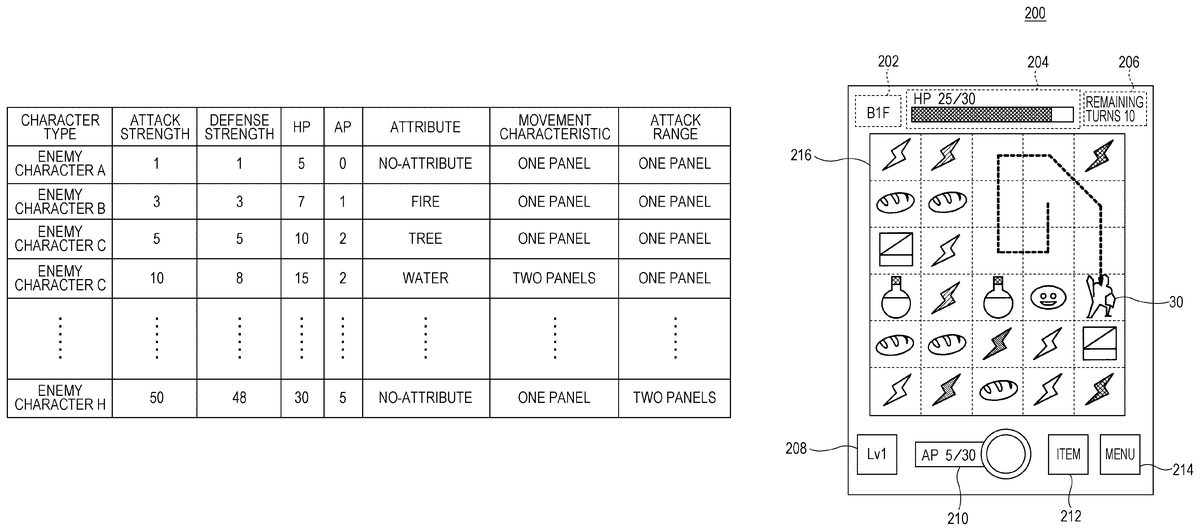
The electronic game system in the present embodiment displays a game image200as exemplarily illustrated inFIG. 4in the output unit16of the game terminal100, and executes a puzzle game. The game image200includes a player character30, a plurality of types of panels32to36, an enemy character38, and an obstacle40. The player (user) selects and traces the panels32to36and the enemy character38on the game image200using the input unit14of the game terminal100to obtain an effect on the game.
Hereinafter, the electronic game processing in the present embodiment will be described with reference to the flowchart ofFIG. 5.
In the present embodiment, the game terminal100executes an electronic game application, which is a web application downloaded from the server102in advance, thereby to receive data necessary for progress of the electronic game from the server102, and to transmit the input by the player to the server102. The server102executes the electronic game server program to receive information necessary for progress of the game from the game terminal100, performs processing of providing an effect on the game and processing such as generation of game image data, and the like according to the received information, and transmits the information necessary for progress of the game to the game terminal100. As described above, in the present embodiment, the game terminal100and the server102work together to realize providing of an electronic game to the player in the game terminal100.
In step S10, log-in processing from the game terminal100is performed. The player (user) who intends to start the electronic game inputs information for performing log-in to the server102, through the input unit14of the game terminal100. For example, the player inputs a URL to access the server102, the URL being for providing an electronic game in the server102, and inputs a user ID and a password. The information necessary for log-in is transmitted from the game terminal100to the server102.
In step S12, authentication processing of log-in is performed in the server102. The server102receives the information transmitted from the game terminal100in step S10, and determines whether permitting the player (user) to perform the log-in. For example, the server102determines whether the user ID has already been registered, and if having been registered, the server102determines whether the password has been registered in association with the user ID. Then, if the user ID and the password are matched, the server102permits the log-in. If the user ID and the password are not matched, the server102does not permit the log-in.
The log-in processing in steps S10and S12is not limited thereto, and any processing may be employed as long as the processing is capable of identifying the player who performs the electronic game. When the log-in is permitted, the server102is moved onto initial setting processing of step S14.
In step S14, the initial setting processing for starting the electronic game is performed. The server102reads information related to the game registered in association with the user ID of the player (user) who has performed the log-in processing, and performs initial setting.
In the puzzle game in the present embodiment, the information related to the game includes information related to a stage of the game, information related to a player character, and information related to equipment/item of the player character. The information related to a stage of the game is information for identifying which stage of the game has been cleared for each player, and which background image data or arrangement of puzzles of a stage should be used. For example, as illustrated in a registration example of a stage database ofFIG. 6, the information related to a stage includes a type of a dungeon and a floor number associated with the user ID. The information related to a player character is information that indicates a current characteristic of the player character operated by the player. For example, as illustrated in a registration example of a player character database ofFIG. 7, the information related to a player character includes a type of the player character, a level, the number of remaining turns, a remaining hit point (HP), a remaining ability point (AP), a job, coordinate values, and equipment, associated with the user ID. The information related to equipment/item of the player character is information provided to the player character, and related to equipment and an item that provides attack strength, defense strength, and a special effect in the game. For example, as illustrated in a registration example of an equipment item database ofFIG. 8, the information related to equipment/item includes information related to a weapon, a guard, and an item owned by the player character, associated with the user ID.
In step S16, the server102generates game image data. The server102reads the information related to a stage associated with the player from the stage database, and identifies data such as background image data, arranged locations of the panels, a position of the obstacle, and the like. These data may just be registered in an image database in advance.
For example, when the user ID of the player is “01”, the server102reads the type of a dungeon and the floor number associated with the user ID “01” from the stage database. Further, the server102reads the data of background image data, arranged locations of the panels, and a position of the obstacle40registered with respect to the read type of a dungeon and the floor number in advance from the storage unit22. The background image data can be an image as illustrated inFIG. 9. Note that, inFIG. 9, coordinate values of the arranged location of the panel are illustrated by (*, *) for description. However, the coordinate values are not actually displayed as the background image.
A panel arrangement database is a database in which characters and panels are registered with respect to respective coordinate values in a panel area216of the game image data, as illustrated inFIG. 10. When a game that has been stopped in the middle of the game is resumed, the server102reads the coordinate values of the player character30, the attack panel32, the recovery panel34, the magic panel36, and the enemy character38from the panel arrangement database.
Further, the server102reads data of the player character selected by the logged-in player from the player character database. The data of the player character includes a type of the player character, a level, the number of remaining turns, a remaining HP, and a remaining AP. Further, the server102reads the character image data registered with respect to the read player character in advance from the storage unit22.
Note that, when the logged-in player first plays a game, the information related to the stage, and the information related to the player character are newly set. For example, the type of a dungeon and the floor number may be set to predetermined initial values. Further, as for the player character, the player is prompted to select the type, and the level, the number of remaining turns, the remaining HP, and the remaining AP may be set to predetermined initial values determined with respect to the selected player character in advance. The set information related to the stage and the set information related to the player character are newly registered in the stage database and the player character database, respectively, in association with the user ID.
Further, when a game is newly started, or when the game is moved onto a new type of a dungeon and a new floor number, the coordinate values of the player character30, the attack panel32, the recovery panel34, the magic panel36, and the enemy character38are registered in the panel arrangement database. Hereinafter, a method of newly determining the coordinate values of the player character30, the attack panel32, the recovery panel34, the magic panel36, and the enemy character38will be described.
Initial coordinate values of the player character30may just be set to coordinate values other than the coordinate values of the obstacle40set in advance in each background image data of the arranged locations of the panels. For example, the initial coordinate values of the player character30may be set in each stage (the type of a dungeon, the floor number, and the like) of the game in advance, or may be stochastically or randomly set to coordinate values other than the coordinate values of the obstacle40.
Initial coordinate values of the enemy character38may just be set to coordinate values other than the coordinate values in which the obstacle40and the player character30are arranged. For example, the initial coordinate values of the enemy character38may be set in each stage (the type of a dungeon, the floor number, and the like) of the game in advance, or may be stochastically or randomly set to coordinate values other than the coordinate values of the obstacle40and the player character30.
Note that a plurality of types of the enemy characters38may be set. To respective types of the enemy characters38, mutually different attack strengths, defense strengths, HPs, APs, and attributes can be set. As illustrated in an enemy character database ofFIG. 11, characteristics of a plurality of types of enemy characters A to H (the attack strengths, defense strengths, HPs, APs, and the like) are set in advance. Note that, in the present embodiment, attributes may be set to the respective enemy characters A to H. Any of no-attribute and attributes of fire, tree, and water is allocated to each of the enemy characters A to H.
Further, what type of enemy character38is generated may be set for each game stage (a type of a dungeon, the floor number, and the like) in advance, or the enemy character38may be stochastically or randomly generated. For example, as illustrated in an enemy character arrangement database ofFIG. 12, the total number of enemy characters38and occurrence percentages of the respective enemy characters A to H are registered for each game stage (a type of a dungeon, the floor number, and the like), and the enemy characters A to H may just be stochastically generated within a range of the total number of enemy characters38. The generated enemy character38is registered in an enemy character status database ofFIG. 13. In the enemy character status database, a current status (the HP, AP, and the like) of the enemy character38currently appearing in the game is registered.
Initial coordinate values of the attack panel32may be set to coordinate values other than the coordinate values where the obstacle40, the player character30, and the enemy character38are arranged. For example, the initial coordinate values of the attack panel32may be set for each game stage (a type of a dungeon, the floor number, and the like) in advance, or may be stochastically or randomly set to coordinate values other than the coordinate values of the obstacle40, the player character30, and the enemy character38.
A plurality of types of attack panels32may be set. For example, one of the attributes may be allocated to the attack panel32. For example, the attack panels32may be divided into four attributes: an attack panel32aof no-attribute, an attack panel32bof an attribute of fire, an attack panel32cof an attribute of tree, and an attack panel32dof an attribute of water. Then, the attack panels32of the plurality of attributes may be mixed and arranged. Which attack panel32of an attribute is arranged may be set for each game stage (a type of a dungeon, the floor number, and the like) in advance, or may be stochastically or randomly set. For example, as illustrated in an attack panel database ofFIG. 14, the total number of attack panels32and occurrence percentages of respective attack panels32are registered for each game stage (a type of a dungeon, the floor number, and the like), and any of the attack panels32of an attribute may just be stochastically generated within the range of the total number of the attack panels32.
Coordinate values of the recovery panel34may be set to coordinate values other than the coordinate values where the obstacle40, the player character30, the enemy character38, and the attack panel32are arranged. For example, initial coordinate values of the recovery panel34may be set for each game stage (a type of a dungeon, the floor number, and the like) in advance, or may be stochastically or randomly set to coordinate values other than the coordinate values of the obstacle40, the player character30, the enemy character38, and the attack panel32. Further, the number of the recovery panels34may be set for each game stage (a type of a dungeon, the floor number, and the like) in advance, or may be stochastically or randomly set.
Coordinate values of the magic panel36may just be set to coordinate values other than the coordinate values where the obstacle40, the player character30, the enemy character38, the attack panel32, and the recovery panel34are arranged.
Note that the numbers of the attack panels32, the recovery panels34, the magic panels36, and the enemy characters38may be set for each of the types of a dungeon and the floor numbers like the present embodiment, or may be stochastically or randomly allocated every time the game image is updated. At this time, the numbers of the attack panels32, the recovery panels34, the magic panels36, and the enemy characters38are favorably set to enhance the enjoyment of the game according to the game stage (a type of a dungeon, the floor number, and the like), a level of the player character, or the like. For example, if the number of the enemy characters38is increased, and the numbers of the attack panels32, the recovery panels34, and the magic panels36are relatively decreased as the game progresses, the difficulty of the game is increased, and a sense of joy of when the player has cleared the game can be increased.
As described above, the server102determines the coordinate values of the obstacle40, the player character30, the enemy character38, the attack panel32, the recovery panel34, and the magic panel36, and registers the coordinate values in the panel arrangement database.
The server102generates game image data obtained such that the information such as image data of the characters and panels, the level of the player character, the number of remaining turns, the remaining HP, and the remaining AP is superimposed on background image data. That is, the image data of the player character30, the attack panel32, the recovery panel34, the magic panel36, the enemy character38, and the obstacle40is registered in the storage unit22in advance. The server102reads the image data of panels registered in the panel arrangement database, and writes the image data in an image area identified by the coordinate values of the panel area216of the background image data. Further, the server102writes the information of the floor number of the dungeon, the remaining HP of the player character, the number of remaining turns, the level, the remaining AP in a floor number display area202, an HP display area204, a turn display area206, a level display area208, and an AP display area210, respectively. In this way, the game image data as illustrated inFIG. 4is generated.
Note that the display format of each data is favorably a format that can be easily understood by the player. For example, the remaining HP, the remaining AP, and the like may be displayed as level indicators that indicate respective values in a bar graph manner.
The generated game image data is transmitted from the server102to the game terminal100. Note that the panel arrangement database, the player character database, the enemy character database, the enemy character arrangement database, the enemy character status database, the attack panel database, and the like may be transmitted to the game terminal100, in advance, as needed, or the game terminal100may access the server102and refer to the databases as needed.
In step S18, the game image is displayed in the game terminal100. The game terminal100receives the game image data from the server102, and displays the game image in the output unit16based on the game image data. Accordingly, the game image illustrated inFIG. 4is displayed in the touch panel, or the like.
In step S20, processing of a selection input of the panels is performed in the game terminal100. The selection input of the panels is received from the player using the input unit14of the game terminal100. The input is favorably performed through the touch panel in terms of operability. However, a keyboard, a cursor button, or the like may be used.
The selection of the panels is started from the player character30. That is, the player selects (touches in the case of a touch pane) the area where the player character30is displayed as a start point of the selection of the panels. Following that, the player continuously selects (flicks in the case of a touch panel) the same type of adjacent panels. The panels may be able to be selected if they are adjacent in at least one of vertical, horizontal, and diagonal directions. Alternatively, the panels may be able to be selected only if they are vertically adjacent, may be able to be selected only if horizontally adjacent, or may be able to be selected only if diagonally adjacent, or a combination thereof may be employed.
The game terminal100refers to the panel arrangement database, and determines whether the panels registered in the coordinate values selected by the player are the same type of panels. The game terminal100performs processing such that the panels can be continuously selected if the panels are the same type, and cannot be selected if the panels are not the same type. Note that the panel of the obstacle40cannot be selected.
For example, as illustrated inFIG. 15, the adjacent attack panels32can be traced and continuously selected. In the present embodiment, the attack panels32can be continuously traced and selected regardless of the attribute. When the attack panels32are selected, the attack panels32are continuously traced and selected starting from the player character30, and finally any of the enemy characters38is continuously traced. Accordingly, an attack can be made on the selected enemy character38.
Note that the attack panels32may be able to be continuously traced and selected only if the attack panels32have the same attribute. Further, the attack panels32may be able to be continuously traced and selected if the attack panels32have a plurality of predetermined types of attributes. For example, the attack panels32may be able to be selected if the attack panels32are the attack panels32bhaving the attribute of fire. The same applies to the non-attribute and the attributes of tree and water, or a combination of such conditions may be employed.
Similarly, the adjacent recovery panels34can be continuously traced and selected. In this case, the HP of the player character30can be recovered. Further, adjacent magic panels36can be continuously traced and selected. In this case, the AP of the player character30can be increased.
Note that the player can select the panels once in one turn. That is, one turn is consumed every time any of the attack panels32, the recovery panels34, and the magic panels36are continuously selected starting from the player character30as a starting point.
Further, when the panels are selected, a locus of the selection so far may be displayed, as illustrated by the arrow ofFIG. 15. Accordingly, the player can easily grasp which panels the player has selected, and the operability of the game can be improved.
Further, the selection of the panels may be able to be tried again. For example, it may be configured such that, when the player wishes to try the selection again in the middle of continuous selection of the panels, the player returns the selection to a region of a previously selected panel, so that the player can select another panel. Accordingly, the player can select the panels by trial and error, and the operability of the game can be improved.
The game terminal100transmits information indicating the coordinate values of the selected panels and a selection order to the server102. For example, in the case ofFIG. 15, the coordinate values (2, 4), (3, 4), (3, 3), (2, 3), (1, 3), (1, 4), (2, 5), (3, 5), and (4, 5) of the background image data ofFIG. 9are arranged in the selection order and transmitted.
In step S22, processing of determining an effect on the game according to the selection of the panels is performed. When having received the information indicating the coordinate values and the selection order of the selected panels from the game terminal100, the server102executes the processing of determining an effect on the game according to the information.
When the attack panels32are traced and the selection has been made, the server102refers to the panel arrangement database, and obtains the number of selected attack panels32and the coordinate values of the finally selected enemy character38from the received information. For example, in the case ofFIG. 15, the number of selected attack panels32is seven, and the coordinate values of the finally selected enemy character38are (4, 5).
At this time, the server102may refer to the enemy character status database and determine damage according to the number of attack panels32selected with respect to the enemy character of the extracted coordinate values. That is, it is favorable to make the damage to be provided to the enemy character38larger as the number of selected attack panels32is larger.
For example, the server102makes the damage to be provided to the enemy character38larger in proportion to the number of selected attack panels32. Further, for example, the server102makes the damage to be provided to the enemy character38exponentially larger as the number of selected attack panels32is increased. Further, the server102may determine the damage to be provided to the enemy character38by substituting the number of selected attack panels32into a predetermined function.
As described above, the damage to be provided to the enemy character38is increased/decreased according to the number of selected attack panels32, whereby the strategic characteristic of continuous selection of the attack panels32as many as possible is increased, and the enjoyment of the game can be improved.
Further, the damage to be provided to the enemy character38may be corrected according to the relationship between the attribute of the enemy character38and the attribute of the attack panel32selected immediately before the enemy character38is selected. For example, when the attack panel32bhaving the attribute of fire has been selected immediately before the enemy character38having the attribute of tree is selected, the damage to be provided to the enemy character38is doubled. Further, when the attack panel32bhaving the attribute of fire has been selected immediately before the enemy character38having the attribute of water is selected, the damage to be provided to the enemy character38is halved. Further, when either the enemy character38or the attack panel32is the no-attribute, the damage to be provided to the enemy character38is not changed.
As described above, the damage to be provided to the enemy character38is corrected according to the relationship between the attributes, whereby the strategic characteristic of consideration of the selection order of the attack panels32is increased, and the enjoyment of the game can be improved.
Further, a special weapon based on the attribute may be caused according to the number of attack panels32having the same attribute. For example, when the number of attack panels32having the same attribute is a predetermined number or more, the damage to be provided to the enemy character38is increased. Further, the special weapon based on the attribute may be caused according to the number of continuously traced and selected attack panels32having the same attribute. For example, when the number of continuously traced and selected attack panels32having the same attribute is a predetermined number or more, the damage to be provided to the enemy character38is increased.
Further, the damage may be corrected in consideration of the attack strength according to the type, the level and the job of the player character30. For example, an attack strength correction coefficient, which becomes a base, is determined according to the type, the level and the job of the player character30, and the damage to be provided to the enemy character38may be determined by being multiplied the attack strength correction coefficient.
Accordingly, the damage in which characteristics of the player character30selected by the player, such as the type and the job, are reflected is provided, and the strategic characteristic of the type and job selection of the player character30is increased, and the enjoyment of the game can be improved. Further, if the attack strength is made larger as the level of the player character30becomes higher, the incentive of the player to continue the game can be increased.
Further, the damage may be provided considering the attack strength according to a weapon that the player character30is equipped with. The player can select a weapon registered in the equipment item database and equips the player character30with the weapon. The attack strength correction coefficient is determined to each weapon, and the damage is corrected according to an accumulation value of the attack strength correction coefficients of the equipped weapons. For example, the damage to be provided to the enemy character38may be determined such that the damage without considering a weapon is multiplied by the accumulation value of the attack strength correction coefficients.
Further, an attribute may be set to a weapon, and the attack strength correction coefficient may be increased/decreased according to the relationship between the attribute of the enemy character38to be attacked and the attribute of the weapon. For example, when the weapon having the attribute of fire has been selected against the enemy character38having the attribute of tree, the attack strength correction coefficient is doubled. When the weapon having the attribute of fire has been selected against the enemy character38having the attribute of water, the attack strength correction coefficient is halved. Further, when either the enemy character38or the weapon is the no-attribute, the attack strength correction coefficient is unchanged.
Further, the damage to be provided to the enemy character38may be increased/decreased according to the relationship between the attribute of the selected attack panel32and the weapon that the player character30is equipped with. For example, when the attribute of the finally selected attack panel32and the attribute of the weapon that the player character30is equipped with coincide with each other, the damage to be provided to the enemy character38may be increased. Further, for example, when the attribute of the most selected attack panels32and the attribute of the weapon that the player character30is equipped with coincide with each other, the damage to be provided to the enemy character38may be increased.
Note that the number of weapons, protective guards, and items that the player character30can be equipped with may be limited, or exchange of the weapon, protective guard, and item may be limited within the same dungeon.
Accordingly, the strategic characteristic of selection of a weapon that might effectively provide the damage to the enemy character38is increased, and the enjoyment of the game can be improved. Further, the incentive of the player to continue the game to get a weapon that further increases the attack strength can be increased.
Further, correction to decrease the damage against the enemy character38may be performed according to the defense strength of the enemy character38. The server102refers to the enemy character database, and acquires the defense strength registered in association with the enemy character38to be attacked. Then, the server102performs processing of decreasing the damage against the enemy character38according to the acquired defense strength. For example, the server102performs correction by dividing the damage against the enemy character38by the acquired strength. Further, for example, the server performs correction by subtracting the defense strength from the damage against the enemy character38.
Further, similarly, the server102determines an effect on the game when the recovery panels34have been selected. In this case, it is favorable to recover the HP of the player character30according to the number of the recovery panels34. That is, it is favorable to make the recovery value of the HP of the player character30larger as the number of continuously selected recovery panels34is increased.
For example, the server102makes the recovery value of the HP of the player character30larger in proportion to the number of selected recovery panels34. Further, for example, the server102makes the recovery value of the HP of the player character30exponentially larger as the number of selected recovery panels34is increased. Further, the server102may determine the recovery value of the HP of the player character30by substituting the number of selected recovery panels34into a predetermined function.
Further, similarly, the server102determines an effect on the game when the magic panels36have been selected. In this case, it is favorable to increase the AP of the player character30according to the number of the magic panels36. That is, it is favorable to make an increase value of the AP of the player character30larger as the number of continuously selected magic panels36is larger.
For example, the server102makes the increase value of the AP of the player character30larger in proportion to the number of selected magic panels36. Further, for example, the server102makes the increase value of the AP of the player character30exponentially larger as the number of selected magic panels36is increased. Further, the server102may determine the increase value of the AP of the player character30by substituting the number of selected magic panels36into a predetermined function.
In step S24, processing of providing an effect on the game is performed. The server102executes processing of the effect on the game determined in step S22, that is, providing of the damage to the enemy character38, recovery of the HP or an increase in the AP of the player character30.
When providing the damage to the enemy character38, the server102refers to the enemy character status database, and subtracts a value by the determined damage from the HP of the enemy character38associated with the finally selected coordinate values.
For example, when the coordinate values of the finally selected enemy character38are (4, 5) and the determined damage is 3, in the example ofFIG. 13, the server102changes the HP of an enemy character B having the coordinate values of (4, 5) to 5−3=2.
If the HP of the enemy character38to which the damage is provided becomes 0, the enemy character38is considered defeated, and the server102deletes the enemy character38from the enemy character status database. Further, the server102also deletes the enemy character38registered in the same coordinate values in the panel arrangement database.
Further, when recovering the HP of the player character30, the server102refers to the player character database, and adds the recovery value of the HP determined in step S22to the remaining HP of the player character30associated with the user ID of the player. At this time, an upper limit of the remaining HP of the player character30is determined in advance, and when the remaining HP exceeds the upper limit as a result of the adding of the recovery value, the remaining HP is limited to the upper limit.
Further, when increasing the AP of the player character30, the server102refers to the player character database, and adds the increase value determined in step S22to the remaining AP of the player character30associated with the user ID of the player. At this time, an upper limit of the remaining AP of the player character30is determined in advance, and when the remaining AP exceeds the upper limit as a result of the adding of the increase value, the AP is limited to the upper limit.
Further, processing of changing the position of the player character30is performed. The server102moves the player character30from the coordinate values that are the starting point of the selected panels to the finally selected coordinate values. To be specific, the server102refers to the panel arrangement database, and registers the player character30in association with the coordinate values of the finally selected panel or character. Further, the server102deletes the panels or characters registered in association with the coordinate values other than the finally selected coordinate values, of the selected panels.
For example, in the selection example ofFIG. 15, the server102deletes the panels or characters associated with the coordinate values of (2, 4), (3, 4), (3, 3), (2, 3), (1, 3), (1, 4), (2, 5), and (3, 5) in the panel arrangement database, and registers the player character30in association with the coordinate values of (4, 5).
In step S26, the server102generates the game image data based on the updated panel arrangement database. The server102transmits the generated game image data to the game terminal100.
At this time, to display the state of movement of the player character30easily understood by the player, the server102may move and display an image of the player character30toward the final coordinate values while deleting the image of the panels displayed along the locus of the selected panels. When performing this processing, the server102transmits the game image data to the game terminal100while updating the game image data, and the updated game image data may be displayed in the output unit16in the game terminal100.
In step S28, processing of displaying the game image is performed. The game terminal100receives the game image data transmitted from the server102, and updates the game image displayed in the output unit16based on the game image data. For example, when the selection ofFIG. 15has been performed, the game image is updated to the game image as illustrated inFIG. 16.
Further, as described above, the game terminal100may display the game image such that the image of the player character30is moved along the locus of the selected panels.
In step S30, processing of an attack from the enemy character38is performed. In the present embodiment, the server102performs the processing of movement of the enemy character38and an attack from the enemy character38to the player character30.
The server102refers to the panel arrangement database, and acquires the coordinate values of remaining enemy character38. Further, the server102refers to the enemy character database, and acquires movement characteristics of the remaining enemy characters38. The server102determines new coordinate values that are moved from the coordinate values acquired for each remaining enemy character38by the movement characteristic. The moving direction may be a predetermined direction, or any of vertical (up and down), horizontal (right and left), and diagonal (upper left, lower left, upper right, lower right) directions may be randomly or stochastically determined as the moving direction. Note that, when the player character30or the obstacle40is registered to the new coordinate values, the movement is not possible, and the moving processing is performed again.
The server102refers to the panel arrangement database, and updates registration of the previous coordinate values with the newly determined coordinate values for each enemy character38. At this time, when another panel has been registered to the newly determined coordinate values, the server102exchanges the enemy character38registered to the previous coordinate values and the panel registered to the newly determined coordinate values. Alternatively, the server102registers a randomly selected panel to the previous coordinate values of the enemy character38.
Note that the method of moving the enemy character38is not limited to the above embodiment, and any method may be employed as long as the method is performed along predetermined processing.
Further, the server102performs attack processing from the enemy character38to the player character30. The server102refers to the panel arrangement database, and acquires new coordinate values of remaining enemy characters38. Further, the server102refers to the enemy character database, and acquires an attack range of the remaining enemy characters38.
The server102determines whether the player character30is registered within the attack range from the coordinate values acquired for each remaining enemy character38. When the player character30is within the attack range, the server102further refers to the enemy character database, acquires the attack strength of the appropriate enemy character38, and determines the damage to be provided to the player character30according to the attack strength. At this time, it is favorable to make the damage to be provided to the player character30larger as the attack strength of the enemy character38is larger.
Further, the server102may perform correction to decrease the damage against the player character30according to the defense strength of the player character30. The server102refers to the player character database, and acquires the defense strength of the player character30associated with the user ID of the player. Then, the server102performs the processing of decreasing the damage against the player character30according to the acquired defense strength. For example, the server102performs correction by dividing the damage against the player character30by the acquired defense strength. Further, for example, the server102may perform correction by subtracting the defense strength from the damage against the player character30.
Further, the damage may be provided in consideration of the defense strength according to the protective guard that the player character30is equipped with. The player can select a protective guard registered in the equipment item database and equip the player character30with the selected protective guard. A defense strength correction coefficient is determined for each protective guard in advance, and the server102corrects the damage according to an accumulation value of the defense strength correction coefficients of the equipped protective guards. For example, the server102may determine the damage to be provided to the player character30by dividing the damage without considering the protective guard by the accumulation value of the defense strength correction coefficients.
Further, an attribute is set to the protective guard, and the defense strength correction coefficient may be increased/decreased according to the relationship between the attribute of the enemy character38that is an attack source and the attribute of the protective guard. For example, when the protective guard having the attribute of fire has been selected against the enemy character38having the attribute of tree, the defense strength correction coefficient is doubled. Further, when the protective guard having the attribute of fire has been selected against the enemy character38having the attribute of water, the defense strength correction coefficient is halved. Further, when either the enemy character38or the protective guard is the no-attribute, the defense strength correction coefficient is unchanged.
The server102refers to the player character database, and subtracts the HP by the damage determined for each enemy character38from the remaining HP of the player character30associated with the user ID of the player.
If the HP of the player character30to which the damage is provided becomes 0, the player character30is considered defeated, and the game is over.
As described above, the processing is performed such that the enemy character38is moved and makes an attack on the player character30, whereby the strategic characteristic that the player predicts how the enemy character38is moved, and moves the player character30is increased, and the enjoyment of the game is improved. For example, the player is expected to select the panels such that the player character30is moved to a position not surrounded by the enemy characters38, and thus the strategic characteristic of the game is increased.
Further, the enemy character38may be able to acquire the attack panels32, and the damage provided to the player character30may be corrected according to the number of the attack panels32passed by the enemy character38while being moved or the attribute.
In step S32, processing of updating the game image data in consideration of a result of an attack from the enemy character is performed. The server102generates the game image data based on the panel arrangement database updated by the movement of the enemy character38. The server102transmits the generated game image data to the game terminal100.
At this time, the server102may update the image of the player character30with an image that shows a state of being received the damage according to the damage provided to the player character30(or the remaining HP of the player character30).
In step S34, processing of displaying the game image is performed. The game terminal100receives the game image data transmitted from the server102, and updates the game image displayed in the output unit16based on the game image data.
In step S36, post-processing is performed. The post processing means an attack by the player character30and processing other than the attack by the enemy character38.
The server102refers to the player character database, and subtracts 1 from the number of remaining turns of the player character30associated with the user ID of the player. Here, when the number of remaining turns becomes 0, further attack cannot be made, and the game may be made over.
Note that, when the number of remaining turns or the remaining HP of the player character30becomes 0, the game may be made over. If the game is made over, the game may be re-played from the beginning. Further, an item acquired in the game or a penalty such as losing currency used in the game may be imposed.
With such game-over processing, the player needs to efficiently defeat the enemy character38and to acquire the items while considering the number of remaining turns and the remaining HP. Therefore, the strategic characteristic of the game is increased, and the enjoyment of the game can be improved.
Further, the server102adds and sets new panels in place of the selected panels. As described above, the panels on the game image are erased due to the selection of the panels by the player and the movement of the enemy character38, and thus the server102adds and sets the panels to free areas on the game image before proceeding to the next turn. Alternatively, the server102may sequentially add and set panels to the free areas during movement of the player character30or the enemy character38.
The server102refers to the panel arrangement database, and extracts the coordinate values to which a panel or a character is not registered. Then, the server102sets a new panel to the extracted coordinate values. As the new panel, it is favorable to appropriately combine and set the attack panel32, the recovery panel34, and the magic panel36.
For example, the proportion of the attack panel32, the recovery panel34, and the magic panel36of the panels to be newly set may be set in advance, or may be stochastically or randomly set. Further, what proportion is set to the attack panel32, the recovery panel34, and the magic panel36may be determined according to the game stage (the type or the floor number of a dungeon) or the like.
Further, for example, when the attack panel32has been selected in this turn, a larger number of attack panels32may be included to the newly set panels than the recovery panel34and the magic panel36. Similarly, when the recovery panel34has been selected in this turn, a larger number of recovery panels34may be included in the newly set panels than the attack panel32and the magic panel36. Further, when the magic panels36has been selected in this turn, a larger number of magic panels36may be included in the newly set panels than the attack panel32and the recovery panel34.
When an attribute is set to the attack panel32, which attack panel32having an attribute is arranged to the panel to be newly set may be set for each game stage (a type of a dungeon, the floor number, and the like) in advance, or may be stochastically or randomly set. Similarly to the above, a total number of attack panels32and the occurrence percentage of each attack panel32are registered in the attack panel database ofFIG. 14for each game stage (a type of a dungeon, the floor number, and the like) in advance, and any of the attack panels32having an attribute may be stochastically generated.
The server102registers the attack panel32, the recovery panel34, and the magic panel36newly set to the free coordinate values in the panel arrangement database.
Further, the server102refers to the enemy character status database, and determines whether all of the enemy characters38have been defeated. If all of the enemy characters38have been defeated, the stage is considered cleared, and the server102performs processing of advancing the game to a new stage. In this case, the server102updates the information related to the stage (the type of a dungeon and the floor number) associated with the user ID of the player in the stage database with the next stage, and returns the processing to step S14.
Note that, when one stage has been cleared, the server102may recover the number of remaining turns of the player character30. The number of turns to be recovered may be set for each game stage (a type of a dungeon, the floor number, and the like) in advance, or may be stochastically or randomly set. Further, when one stage has been cleared, the server102may recover the remaining HP or the remaining AP of the player character30. Even in this case, the remaining HP or the remaining AP to be recovered may be set for each game stage (a type of a dungeon, the floor number, and the like) in advance, or may be stochastically or randomly set.
Further, the server102may change the level, the attack strength, and the defense strength of the player character30according to the progress of the game. For example, when one stage has been cleared, any of the level, the attack strength, and the defense strength of the player character30may be increased. While how the level, the attack strength and the defense strength are changed may just be appropriately determined, they may be set for each game stage (a type of a dungeon, the floor number, and the like) in advance, or may be stochastically or randomly set.
In step S38, new game image data is generated in consideration of the post-processing. The server102refers to the updated panel arrangement database, and writes the image data such as the character and the panel in the background image data and superimposes the information such as the level, the number of remaining turns, the remaining HP, and the remaining AP of the player character to generate new game image data for the next turn. The server102transmits the newly generated game image data to the game terminal100.
In step S40, processing of display of the game image is performed. The game terminal100receives the game image data transmitted from the server102, and updates the game image displayed in the output unit16based on the game image data.
Following that, the processing is moved onto the processing of the next turn. That is, the processing is returned to the processing of selection input of the panels of step S20, and the game terminal100receives panel selection of the player in the next turn, and executes the processing of the next turn.
In the present embodiment, processing of providing an effect on the game according to the ability point (AP) given to the player character30may be performed. That is, processing of putting a special ability provided to the player character30in motion by consuming the AP registered in the player character database may be performed.
Hereinafter, the processing of providing an effect on the game using the AP will be described with reference to the flowchart illustrated inFIG. 17.
In step S50, processing of accepting an instruction of the processing using the AP by the player is performed. The player selects (touches, in the case where the input unit14is a touch panel) an AP display area210on the game image displayed in the output unit16of the game terminal100, whereby the processing with the AP is accepted. The processing with the AP may be able to be performed anytime during the game, or some limitation, such as the processing being accepted only between turns, may be provided.
When the AP display area210on the game image has been selected, the game terminal100transmits the information that indicates start of the AP processing to the server102.
In step S52, a menu image for selecting the processing using the AP is generated. When having received the information that indicates start of the AP processing from the game terminal100, the server102refers to the player character database, and acquires the remaining AP of the player character30associated with the user ID of the player. The server102determines effects on the game that can be put in motion by the player character30using the AP, according to the remaining AP, and generates the menu image that includes choices of the effects.
As the effects on the game using the AP, for example, recovering the remaining HP of the player character30, an increase in the attack strength or the defense strength of the player character30, providing the damage to the entire enemy characters38, a decrease in the attack strength or the defense strength of the enemy character38, and the like. The effects on the game using the AP are not limited thereto, and an effect on the game that is provided when “magic” or the like is used in a typical role-playing game is applicable.
The effects on the game using the AP are registered in the AP database. The AP database is a database in which the effect on the game using the AP and a necessary number of APs to provide the effect are associated with each other, as illustrated in the registration example ofFIG. 18. The AP database may be common to all of the player characters30, or the effects on the game that can be selected may differ according to the type, the level, the job, or the like of the player character30.
The server102refers to the AP database and extracts the effects on the game using the AP executable by the remaining AP of the player character30. Then, the server102generates AP menu image data including choices that indicate the extracted effects on the game using the AP. Note that, if the remaining AP is 0, the server102cannot provide the effects on the game by the AP, and thus generates the AP menu image data indicating the fact that the remaining AP is 0. The server102transmits the generated AP menu image data to the game terminal100.
For example, the server102generates the AP menu image data for displaying an AP menu image220as illustrated inFIG. 19. The example ofFIG. 19includes a choice of “HP recovery” that indicates recovering of the remaining HP of the player character30and a choice of “entire attack” that indicates providing of damage to the entire enemy characters38.
In step S54, processing of selecting the effect on the game using the AP is performed. The game terminal100receives the AP menu image data from the server102, and displays the AP menu image220in the output unit16. Further, the game terminal100receives selection of the choices included in the AP menu image220by the player using the input unit14. The game terminal100transmits the selected choice to the server102.
For example, when the AP menu image220as illustrated inFIG. 19is displayed, the player can select one of the choices of “HP recovery” and “entire attack”.
In step S56, processing of providing the effect on the game according to the selected choice. The server102receives information of the choice from the game terminal100, and performs the processing of providing the effect on the game according to the choice.
For example, when the choice of “HP recovery” has been selected, the server102performs processing of recovering the remaining HP of the player character30by a predetermined number. In this case, the server102refers to the player character database, and increases the remaining HP associated with the user ID of the player by the predetermined number. Further, when the choice of “entire attack” has been selected, the server102performs processing of providing damage to all of remaining enemy characters38. In this case, the server102refers to the enemy character status database, and subtracts the predetermined number from the HPs of all of registered enemy characters38.
Note that the way of providing the effect on the game using the AP is not limited to the examples, and various effects can be applied.
Further, the server102decreases the remaining AP of the player character30according to the effect on the game based on the selected choice. That is, the server102refers to the player character database, and subtracts a predetermined number from the remaining AP associated with the user ID of the player.
Note that, as described above, the remaining AP can be recovered by tracing and selecting the magic panels36on the game image.
In the present embodiment, processing of providing the effect on the game may be performed according to an item provided to the player character30.
Hereinafter, the processing of providing the effect on the game using an item will be described with reference to the flowchart illustrated inFIG. 20.
Note that the items are selected by the player from the equipment item database illustrated inFIG. 8, and are held by the player character30. For example, a predetermined number of item slots are set for each player character30, and the items by the number of item slots may be able to be held by the player character30from among the items registered in the equipment item database in association with the user ID of the player. The items held by the player character30are registered in the player character database.
Note that the items may not be able to be added or changed until the game stage is changed. For example, the items held by the player character30may not be able to be changed until one dungeon is cleared.
In step S60, processing of receiving an instruction of processing using an item by the player is performed. The player selects (touches in the case where the input unit14is a touch panel) an item selection area212on the game image displayed in the output unit16of the game terminal100, whereby the processing with an item is accepted. The processing with an item may be able to be performed anytime during the game, or some limitation, such as the processing being accepted only between turns, may be provided.
When the item selection area212on the game image has been selected, the game terminal100transmits information indicating start of the item processing to the server102.
In step S62, a menu image for selecting the processing using an item is generated. When having received the information indicating start of the item processing from the game terminal100, the server102refers to the player character database, and acquires information of the items registered in the player character30associated with the user ID of the player. The server102generates a menu image including choices that indicate the items according to the acquired information of the items.
As the effects on the game using the item, for example, recovering the remaining HP of the player character30, an increase in the attack strength or the defense strength of the player character30, recovering the state of the player character30, providing the damage to the enemy character38, a decrease in the attack strength or the defense strength of the enemy character38, an increase in the number of turns, and the like. The effects on the game using the item are not limited thereto, and an effect on the game that is provided when “item” or the like is used in a typical role-playing game is applicable.
The effect on the game using the item is registered in the item database. The item database registers the item and the effect on the game using the item, as illustrated in the registration example ofFIG. 21.
The server102generates item menu image data including choices of the items. Note that, if the item is not registered with respect to the player character30in the player character database, the server102generates the item menu image data that indicates the player character30does not hold the item. The server102transmits the generated item menu image data to the game terminal100.
For example, the server102generates the item menu image data for displaying an item menu image230as illustrated inFIG. 22. The example ofFIG. 22includes a choice of an item “recovery agent” that indicates recovering of the remaining HP of the player character30and a choice of an item “bomb” that indicates providing of damage to the enemy character38.
In step S64, processing of selecting the choice that indicates the item is performed. The game terminal100receives the item menu image data from the server102, and displays the item menu image230in the output unit16. Further, the game terminal100receives selection of the choice included in the item menu image230by the player using the input unit14. The game terminal100transmits the selected choice to the server102.
For example, when the item menu image230as illustrated inFIG. 22is displayed, the player can select one of the choices of “recovery agent” and “bomb”.
In step S66, processing of providing the effect on the game according to the selected choice is performed. The server102receives information of the choice from the game terminal100, and performs processing of providing the effect on the game according to the choice.
For example, when the choice of “recovery agent” has been selected, the server102performs processing of recovering the remaining HP of the player character30by a predetermined number. In this case, the server102refers to the player character database, and increases the remaining HP associated with the user ID of the player by the predetermined number. Further, when the choice of “bomb” has been selected, the server102performs processing of providing damage to all of remaining enemy characters38. In this case, the server102refers to the enemy character status database, and subtracts the predetermined number from the HPs of all of registered enemy characters38.
Note that the way of providing the effect on the game using the item is not limited to these examples, and various effects can be applied.
Further, the server102performs processing of deleting the item of the selected choice. That is, the server102refers to the player character database and the equipment item database, and deletes the used item of the items associated with the user ID of the player.
Note that the weapon, the protective guard, and the item may be able to be acquired during the game. For example, it may be configured such that a panel such as “treasure box” is displayed on the game image when the enemy character38is defeated, and the player selects the panel, whereby a new weapon, protective guard, or item according to the type of the treasure box can be obtained. When having acquired the new weapon, protective guard, or item, the server102registers the new weapon, protective guard, or item to the player character database and the equipment item database.
At this time, an obtainable weapon, protective guard, or item may be changed according to the number of selected attack panels32when the enemy character38is defeated. For example, it is favorable to change the weapon, protective guard, or item that can be stochastically obtained according to the number of selected attack panels32. As illustrated inFIG. 23, a treasure box database in which an appearing percentage for each type of treasure box is associated with a range of the number of selected attack panels32is registered in advance, and the panel of each type of treasure box may just be caused to appear at the percentage determined in the treasure box database according to the number of selected attack panels32.
Further, the number of treasure boxes to appear may be changed according to the number of defeated enemy characters38. For example, it is favorable to increase the number of treasure boxes to appear when the number of defeated enemy characters38is increased, so as to increase the percentage to acquire the weapon, protective guard, or item.
While in step S20, the adjacent panels are traced and continuously selected, the attack panels32or another enemy character38may be able to be continuously selected through the enemy character38under a certain condition, as illustrated inFIG. 24.
For example, it may be configured such that, when the damage to the enemy character38by the already selected attack panels32exceeds the remaining HP of the enemy character38, the next attack panel32and another enemy character38can be continuously selected through the enemy character38. It is configured such that, if the damage by the attack panels32is less than the remaining HP of the enemy character38, the next attack panel32cannot be selected through the enemy character38.
In this case, the game terminal100transmits information of already selected attack panels32and the enemy character38to the server102before confirming the selection processing, and the server102calculates whether the damage exceeds the remaining HP of the enemy character38by the already selected attack panels32, similarly to the processing of step S22, and returns a result to the game terminal100. In the game terminal100, if the damage by the already selected attack panels32is the remaining HP of the enemy character38or more, the game terminal100continuously accepts selection of the next attack panel32and the enemy character38. If not, the game terminal100does not accept the selection of the next attack panel32and the enemy character38
Note that, when through the enemy character38, the attribute of an attack immediately after the selection may be the no-attribute or may take over the attribute of previously selected attack panel32.
Further, the attack panels32and another enemy character38may be able to be further continuously selected through the enemy character38according to the type or job of the player character30, the game stage, the type of the equipped weapon, protective guard, or item. Note that the condition of continuous selection of the attack panel32or another enemy character38through the enemy character38is not limited to the above, and other conditions may be applied.
With such processing, the player can attack a plurality of enemy characters38in one turn, and the strategic characteristics of the game, such as selecting of the attack panels32with an effective route against the plurality of enemy characters38, can be increased, while considering the attack strength of the player character30, the remaining HP of the enemy character38, the number of remaining turns, and the like.
The type and the characteristic (job) of the player character30may be able to be selected. The ability values (HP, attack strength, and defense strength), the weapon or protective guard that can be equipped, and the effect on the game (special effect) that can be exerted are changed according to the type and the job of the player character30, whereby the strategic characteristic of selecting the type and the job of the player character30is increased, and the enjoyment of the game can be improved.
For example, attack characteristics or movement characteristics of the player character30may be changed according to the type and the job of the player character30. As the attack characteristics, for example, it can be considered to change a condition, such as an available range of making an attack on the enemy character38(an attack range of one panel, two panels, or the like), or a condition of when selecting the enemy character38(continuous attack play is not available, continuous attack play is available even if the damage does not exceed the HP of the enemy character38, or the like). Further, an example of the movement characteristics includes a condition of selection of the panels (only the vertically/horizontally adjacent panels of the same type are selectable, only the diagonally adjacent panels of the same type are selectable, the panels of different types are selectable, or the like).
Further, processing of putting an advantage or a disadvantage to a specific type or job of the player character30may be performed according to the game stage (the type of the dungeon, or the floor number). For example, an area such as water or a poisonous pond is provided according to a stage, and only a specific type or job of the player character30may be able to pass through the area.
The type and the job of the player character30may be able to be arbitrarily changed, or may be able to be changed when the game proceeds to a certain level or when a new weapon is acquired. Further, the type and the job of the player character30may be able to be changed only at the time of starting the game or a stage. When the player character30is changed, the server102refers to the player character database, and updates the type and the job of the player character30associated with the user ID of the player.
As described above, a different characteristic is provided for each type and job of the player character30, whereby the strategic characteristic of performing a different operation for each type and job of the player character30is increased, and the enjoyment of the game can be improved. Further, the incentive of the player to play the game with different types and jobs of the player characters30can be increased.
In the present embodiment, the game is over when the number of remaining turns becomes 0. However, a time limit is provided in place of or in addition to the number of turns, and the game may be made over when the player cannot defeat all of the enemy characters38within the time limit.
In the above embodiment, the case of transmitting the input information to the server every time the input of the user is provided, and the case of receiving the game image data every time performing the display processing of the game image have been described. However, the embodiment is not limited to the examples, and the communication between the game terminal100and the server102can be performed based on predetermined timing. For example, the game image data is generated at the game terminal side based on the program stored in the storage unit12of the game terminal100, and information about the input of the player or a result of the input is stored in the storage unit12of the game terminal100. The status and the result of the game can be transmitted to the server every certain time or at timing when the stage is cleared, or the like.
Claims
- A server device comprising: a game image generation unit configured to: generate a game image including a player character and a grid of panels, the grid of panels including a plurality of attack panels, in each turn, receive an input continuously selecting a path through one or more selected panels among the grid of panels, the path starting from a panel occupied by the player character and intersecting a panel occupied by an enemy character, and cause damage to the enemy character according to a number of attack panels in the selected panels, wherein the processing unit is further configured to generate the enemy character, wherein each of the panels and the enemy character are associated with an attribute, and wherein the damage to the enemy character is caused according to a relationship between the attributes of the selected panels and the attribute of the enemy character.
- The server device according to claim 1 , wherein the enemy character is a first enemy character, and wherein the processing unit is further configured to, when a predetermined condition is satisfied, generate a second enemy character, the path intersecting a panel occupied by the second enemy character after the path intersects the first enemy character, and to cause damage to the second enemy character.
- The server device according to claim 1 , wherein the grid of panels includes one or more recovery panels and one or more magic panels, and wherein the processing unit is further configured to recover hit points of the player character according to the number of recovery panels in the path, and to increase ability points of the player character according to the number of magic panels in the path.
- The server device according to claim 1 , wherein a proportion of attack panels in the grid of panels is based on a current game stage.
- An electronic game device comprising: a display unit configured to display a game image including a player character and a grid of panels, the grid of panels including a plurality of attack panels;and an input unit configured to receive, in each turn, an input continuously selecting a path through one or more selected panels among the grid of panels, the path starting from a panel occupied by the player character and passing through a panel occupied by an enemy character, and wherein damage is caused to the enemy character according to a number of attack panels in the path, wherein the display unit displays the enemy character in the game image, wherein each of the grid of panels and the enemy character is associated with an attribute, and wherein the damage is provided to the enemy character according to a relationship between the attributes of the selected panels and the attribute of the enemy character.
- The electronic game device according to claim 5 , wherein the enemy character is a first enemy character, and wherein, when a predetermined condition is satisfied, the path intersects a panel occupied by the second enemy character after intersecting the panel occupied by the first enemy character and damage is caused to the second enemy character.
- The electronic game device according to claim 5 , wherein the grid of panels includes one or more recovery panels and one or more magic panels, and wherein hit points of the player character are recovered according to the number of recovery panels in the path, and ability points of the player character are increased according to the number of magic panels in the path.
- The electronic game device according to claim 5 , wherein a proportion of attack panels in the grid of panels is based on a current game stage.
- A non-transitory computer-readable storage medium storing an electronic game program for causing a computer to function as: a display unit configured to display a game image including a player character and a grid of panels, the grid of panels including a plurality of attack panels;an input unit configured to receive, in each turn, an input continuously selecting a path through one or more selected panels among the grid of panels, the path being in at least one of a vertical direction, a horizontal direction, and a diagonal direction, the path starting from a panel occupied by the player character and intersecting a panel occupied by an enemy character;and an effect providing unit configured to cause damage to the enemy character according to the number of attack panels in the path, wherein the display unit displays the enemy character in the game image, wherein each of the grid of panels and the enemy character is associated with an attribute, and wherein the damage is provided to the enemy character according to a relationship between the attributes of the selected panels and the attribute of the enemy character.
- The non-transitory computer-readable storage medium of claim 9 , wherein the grid of panels includes one or more recovery panels and one or more magic panels, and wherein the effect providing unit is further configured to recover hit points of the player character according to the number of recovery panels in the path, and to increase ability points of the player character according to the number of magic panels in the path.
- The non-transitory computer-readable storage medium of claim 9 , wherein a proportion of attack panels in the grid of panels is based on a current game stage.
Disclaimer: Data collected from the USPTO and may be malformed, incomplete, and/or otherwise inaccurate.