U.S. Pat. No. 9,682,314
METHOD AND SYSTEM FOR TEMPORARILY INCENTIVIZING USER PARTICIPATION IN A GAME SPACE
AssigneeAftershock Services, Inc.
Issue DateNovember 4, 2015
U.S. Patent no. 9,682,314: Method and system for temporarily incentivizing user participation in a game space
U.S. Patent no. 9,682,314: Method and system for temporarily incentivizing user participation in a game space
Issued June 20, 2017 to Electronic Arts Inc.
Priority Date June 14, 2013
Summary:
U.S. Patent No. 9,682,314 (the ‘314 Patent) relates to awards and incentive systems in video games. Many video games feature events where the player is incentivized to progress over one or more metrics. These include earning more of a specific resource or earning experience points or other in-game objectives. Certain gameplay mechanics may be temporarily increased to further encourage completion of in-game activities. These gameplay mechanics may also be linked with achievements. Users may earn achievements by completing in-game missions and quests or by interacting with other activities within a video game. During an in-game event these tracked metrics for achievements may be further increased to incentivize completing missions or may be limited in time to increase the prestige and incentives of earning the limited achievement. Rewards may then be distributed to those players who showed the largest increases in select metrics during the event. These aspects of the ‘314 Patent function to increase engagement in video games as well as increasing content available to play by incentivizing certain game activities.
Abstract:
A system and method for temporarily altering the determination of gameplay metric values in a game space, and distributing awards based on the relative change in gameplay metric values during the temporary time.
Illustrative Claim:
1. A system for providing offers in a game space, the system comprising: one or more processors configured by machine-readable instructions to: execute an instance of a shared game space that is common to users, and to implement the instance to facilitate the presentation of views of the shared game space to the users, wherein the shared game space is configured to facilitate interaction of the users with the shared game space and each other by performing operations in the shared game space in response to commands received from the users; determine gameplay metric values of a gameplay metric for users, wherein the gameplay metric values quantify achievement within the shared game space such that a first gameplay metric value determined for a first user quantifies achievement of the first user in the shared game space; alter determinations of the gameplay metric values during an event time period such that, during the event time period, the determination of the gameplay metric values is altered to magnify the impact of achievement in the shared game space; and determine, based on the relative increases in the gameplay metric values of the users during the event time period, awards to be provided to the individual users, wherein the awards include virtual items to be distributed for use in the shared game space such that a first award is determined to be provided to a first user based on a comparison of an increase in the game play metric value of the first user during the event time period in with increases in the game play metric values of the other users during the event time period.
Illustrative Figure
Abstract
A system and method for temporarily altering the determination of gameplay metric values in a game space, and distributing awards based on the relative change in gameplay metric values during the temporary time.
Description
DETAILED DESCRIPTION FIG. 1illustrates a system10configured to provide a game space to users. Providing the game space may include hosting the game space over a network. In some implementations, system10may include a server12. Server12may be configured to communicate with one or more client computing platforms30according to a client/server architecture. Users may access system10and/or the game space via client computing platforms30. The server12may be configured to execute one or more computer program modules. The computer program modules may include one or more of a game module16, a scoring module18, an event scoring module20, an event evaluation module22, an award distribution module24, a user module26, a store module27, and/or other modules. Game module16may be configured to implement an instance of the game space executed by the computer modules. In some cases, the instance of the game space may reflect the state of the game space. The instance of the game space may be used to push state information to clients (e.g., client computing platforms30) for implementation on the client, may be used to verify state information generated on client executing expressions of the instance locally, and/or for other purposes. State information may include information about the state of the game space such as, without limitation, position information of one or more objects, topography information, object status/shape information, battle information, score information, user or character progress information, user inventory information, user or character resource information, progress information for one or more activities or actions, view information describing a view of the game space, and/or other information that describes the state of the game space. Expressions of the instance executed on the client facilitate presentation of views on the client of the game space. Expressions of the instance executed on the client may be configured to simply present views of the game space based ...
DETAILED DESCRIPTION
FIG. 1illustrates a system10configured to provide a game space to users. Providing the game space may include hosting the game space over a network. In some implementations, system10may include a server12. Server12may be configured to communicate with one or more client computing platforms30according to a client/server architecture. Users may access system10and/or the game space via client computing platforms30.
The server12may be configured to execute one or more computer program modules. The computer program modules may include one or more of a game module16, a scoring module18, an event scoring module20, an event evaluation module22, an award distribution module24, a user module26, a store module27, and/or other modules.
Game module16may be configured to implement an instance of the game space executed by the computer modules. In some cases, the instance of the game space may reflect the state of the game space. The instance of the game space may be used to push state information to clients (e.g., client computing platforms30) for implementation on the client, may be used to verify state information generated on client executing expressions of the instance locally, and/or for other purposes. State information may include information about the state of the game space such as, without limitation, position information of one or more objects, topography information, object status/shape information, battle information, score information, user or character progress information, user inventory information, user or character resource information, progress information for one or more activities or actions, view information describing a view of the game space, and/or other information that describes the state of the game space. Expressions of the instance executed on the client facilitate presentation of views on the client of the game space. Expressions of the instance executed on the client may be configured to simply present views of the game space based on the state information (e.g., via streaming view information, object/position information, and/or other state information) received from game module16. Expressions of the instance executed on the client may include space logic that effectively provides for execution of a limited version of the instance on a client that is synchronized and/or verified with state information received from game module16. The view presented on a given client may correspond to a location in the game space (e.g., the location from which the view is taken, the location the view depicts, and/or other locations), a zoom ratio, a dimensionality of objects, a point-of-view, and/or view parameters. One or more of the view parameters may be selectable by the user.
The instance of the game space may comprise a simulated space that is accessible by users via clients that present the views of the game space to a user. The simulated game space may have a topography, express ongoing real-time interaction by one or more users, and/or include one or more objects positioned within the topography that are capable of locomotion within the topography. In some instances, the topography may be a 2-dimensional topography. In other instances, the topography may be a 3-dimensional topography. The topography may include dimensions of the space, and/or surface features of a surface or objects that are “native” to the space. In some instances, the topography may describe a surface (e.g., a ground surface) that runs through at least a substantial portion of the space. In some instances, the topography may describe a volume with one or more bodies positioned therein (e.g., a simulation of gravity-deprived space with one or more celestial bodies positioned therein). The instance executed by the computer modules may be synchronous, asynchronous, and/or semi-synchronous.
The instance of the game space may also comprise one or more user achievements. In a game space such as an online game, a user achievement may comprise, for example, developing a skill, building, crafting, modifying, upgrading, trading, selling, and/or repairing an item, an equipment, a building, and/or a structure; training, building, modifying, healing, requesting, upgrading, selling, and/or repairing an in-game unit; harvesting, refining, trading, selling, developing, spending, and/or consuming an in-game resource; using, performing, developing, modifying, upgrading, and/or training a skill, ability, and/or attribute; completing in-game travel, reloading a weapon, receiving assistance such as a hint and/or a clue, defeating an enemy or enemies, rescuing an ally or allies, completing a mission or quest, and/or other actions. For example, in a game space involving building virtual structures, a user achievement may be associated with building, upgrading, and/or repairing a building or buildings. In another example involving a game space with an aspect related to the development of a character, a user achievement may be associated with using melee attack or a spell; interacting with another player and/or a non-player character; defeating an enemy or enemies; and/or rescuing an ally or allies. In yet another example involving a game space with an aspect related to the development of an army, a user achievement may be associated with winning a battle, developing an army to a certain size, and/or sustaining a minimal number of losses during a battle.
In some cases, a user achievement may comprise completing a plurality of sub-achievements. In addition, a person of skill in the art will appreciate the requirements for a game space achievement may be static or dynamic depending on the conditions of the game space. For instance and without limitation, the requirements for an achievement may depend on the number of other players attempting the same achievement and/or other conditions.
A person of skill in the art will further appreciate that, in some instances, the requirements for obtaining an achievement may be augmented through the use of in-game power-ups. In-game power-ups may include, for example, a skill boost, an attribute boost, a damage multiplier, a healing buff, an item, a spell, and/or other power-ups. In-game power-ups may be acquired by making an in-game purchase, using real or virtual currency, defeating an enemy, assisting an ally, trade with other users, trade with a non-player character, discovering an item, discovering a resource, and/or other methods of acquiring power-ups. The embodiments described are not intended to be limiting.
Within the instance of the game space executed by game module16, users may control characters, objects, simulated physical phenomena (e.g., wind, rain, earthquakes, and/or other phenomena), and/or other elements within the game space to interact with the game space and/or each other. The user characters may include avatars. As used herein, the term “user character” may refer to an object (or group of objects) present in the game space that represents an individual user. The user character may be controlled by the user with which it is associated. The user controlled element(s) may move through and interact with the game space (e.g., non-user characters in the game space, other objects in the game space). The user controlled elements controlled by and/or associated with a given user may be created and/or customized by the given user. The user may have an “inventory” of virtual goods and/or currency that the user can use (e.g., by manipulation of a user character or other user controlled element, and/or other items) within the game space.
The users may participate in the instance of the game space by controlling one or more of the available user controlled elements in the game space. Control may be exercised through control inputs and/or commands input by the users through client computing platforms30. The users may interact with each other through communications exchanged within the game space. Such communications may include one or more of textual chat, instant messages, private messages, voice communications, and/or other communications. Communications may be received and entered by the users via their respective client computing platforms30. Communications may be routed to and from the appropriate users through server12(e.g., through game module16).
The above description of the views of the game space determined from the instance executed by game module16is not intended to be limiting. The game space may be presented in a more limited, or more rich, manner. For example, views of the game space may be selected from a limited set of graphics depicting an event in a given place within the game space. The views may include additional content (e.g., text, audio, pre-stored video content, and/or other content) that describes particulars of the current state of the place, beyond the limited set of graphics. For example, a view may include a generic battle graphic with a textual description of the opponents to be confronted. Other representations of individual places within the game space are contemplated.
A scoring module18may be configured to determine gameplay metrics associated with user achievement in the game space. In some instances, gameplay metrics may be used to quantify a user's achievements and/or progress in the game space. A person of skill in the art will appreciate that a gameplay metric is a type of measurement in the game space. A person of skill in the art will further appreciate that a gameplay metric value is a value of the measurement that may be associated with, for example, the benefit accorded to a gameplay metric for completing an achievement, the summation of a user's history with respect to a gameplay metric, and/or other uses. In some instances, for example, as a game space user completes achievements in the game space, gameplay metric values associated with the completed achievements are added to the total gameplay metric values for the user, with respect to the gameplay metrics that relate to the achievements. Thus, a person of skill in the art will appreciate that a user's achievements and/or progress in the game space may be associated with one or more gameplay metric values for the user. A person of skill in the art will further appreciate that a user of a game space may be associated with one or more gameplay metrics.
Gameplay metrics may represent types of acts in the game space and/or they may represent a measure of progression. For example, in some instances, gameplay metrics may measure total enemies defeated, total allies saved, total buildings created, total resources discovered, total area of map revealed, total experience, total might, total reputation, total influence, and/or other measurements. A single achievement may cause the user to accumulate points in various gameplay metrics. In one instance, for example, a user who defeats an enemy may gain a point for the gameplay metrics associated with that achievement, such as total enemies defeated, total experience, total might, and total reputation. Therefore, the gameplay metric values for the user will be incremented by one point. As described above, a gameplay metric is a type of measurement of a type of action in the game space and/or a measure of progression; a gameplay metric value is the value of the metric, which may correspond to a number of points relating to an achievement and/or the number of points accumulated by a user.
In yet other implementations, gameplay metric values may be determined based on one or more of log in frequency, amount of time logged in to the game space within a rolling time period (e.g., over the last day, week, month, or other rolling time period), average amount of time logged in to the game space over some length of time (e.g., per day, per week, and/or other length of time), average log in session time over a rolling time period, number of inter-user communications over a length of time, number of inter-user communications per log in, number of relationships with other users in the game space, number of new relationships with other users in the game space within a rolling time period, amount of real world money spent in the game space, amount of missions and/or quests accomplished, amount of enemies killed, amount of allies rescued, and/or other activity parameters.
The scoring module18may be configured to monitor interactions of the users with the game space and/or each other within the game space. This may include monitoring, for a given user, areas of the game space the given user views or interacts with or in, other users the given user interacts with, the nature and/or content of interactions of the given user with other users, activities participated in within the game space, level, powers, or skill attained in the game space, inventory items obtained in the game space, and/or other interactions of the given user with the game space and/or other users. Some or all of the information generated by scoring module18in monitoring the interactions of the users may be stored to the user profiles managed by user module26.
A person of skill in the art will appreciate that the scoring module may use a gameplay metric algorithm to determine gameplay metric values associated with users' achievements. The gameplay metric may use factors to determine the gameplay metric values associated with achievements; such factors may include a user's existing gameplay metric values, a difficulty level, and/or other factors.
An event scoring module20may be configured to alter the determination of the gameplay metric values determined by scoring module18. In some implementations, it may be advantageous to modify the gameplay metric values determined by scoring module18for a temporary period of time. The period of time may correspond with a game space event. A game space event may include, for example, a tournament, a holiday, a party, a celebration, and/or other events. In some instances, it may be a goal of the game space event to encourage user participation.
In one implementation, event scoring module20may alter the determination of the gameplay metric values determined by scoring module18so that they are double their unaltered amount in relation to the same achievement. In this manner, users of a game space may derive a benefit from completing achievements during the temporary period of time because an achievement will correspond to greater gameplay metric values than had the achievement been completed outside the temporary period of time. A person of skill in the art will appreciate that the modified gameplay metric values may be triple the unaltered value, quadruple the unaltered value, the unaltered value plus a fixed value, the unaltered value plus a variable value, and/or other modifications to the normal gameplay metric value.
In other implementations, event scoring module20may alter the gameplay metric values determined by scoring module18such that the alteration varies based other factors such as the existing gameplay metric values of a user, the time left in the temporary period, and/or other factors. For example, in one instance, event scoring module20may triple the gameplay metric values associated with the accomplishment of an achievement for users with gameplay metric values below a specified threshold, and it may double the gameplay metric values associated with the accomplishment of an achievement for users with gameplay metric values above the specified threshold. Conversely, event scoring module20may double the gameplay metric values associated with an achievement for users with gameplay metric values below a specified threshold, and it may triple the gameplay metric values associated with an achievement for users with gameplay metric values above the specified threshold. These implementations are not intended to be limiting.
An event evaluation module22may be configured to determine, based on the relative increases in users' gameplay metric values during the temporary period, a user who achieves the greatest increase in a gameplay metric. In instances where a user is associated with multiple gameplay metrics, event evaluation module22may be configured to determine a user who achieves the greatest increase in a category of gameplay metrics and/or the greatest overall increase amongst all gameplay metrics and/or categories of gameplay metrics.
In some instances, event evaluation module22may determine multiple users that achieve the greatest increase in a category of gameplay metrics such that a user with the greatest increase is ranked 1st, a user with the second greatest increase is ranked 2nd, and a user with the third greatest increase is ranked 3rd. A person of skill in the art will appreciate that this event evaluation module22is not limited to ranking the top 3 users of the game space. In other instances, event evaluation module22may determine, for example, the user with the greatest increase in a category of gameplay metrics, the ranking of the 10 users with the greatest increase in a category of gameplay metric values, the ranking of the 100 users with the greatest increase in a category of gameplay metric values, the ranking of all users for a category of gameplay metric values, and/or other numbers of rankings. A person of skill in the art will also appreciate that in a game space involving competing teams, factions, guilds, and/or other groupings, event evaluation module22may determine rankings such that the groupings are ranked in relation to each other and/or such that the members of the groupings are ranked in relation to the other members of the same grouping.
The award distribution module24may be configured to distribute awards to users identified by event evaluation module22. Award distribution module24may distribute various types of awards such as in-game items, virtual currency, real currency, real items, in-game power-ups, bonuses to gameplay metrics, and/or other awards. The distribution may be made through various delivery channels such as in-game mail, in-game transfer, email, physical mail, physical delivery, and/or other channels.
The user module26may be configured to access and/or manage one or more user profiles and/or user information associated with users of the system10. The one or more user profiles and/or user information may include information stored by server12, one or more of the client computing platforms30, and/or other storage locations. The user profiles may include, for example, information identifying users (e.g., a username or handle, a number, an identifier, and/or other identifying information) within the game space, security login information (e.g., a login code or password), game space account information, subscription information, virtual currency account information (e.g., related to currency held in credit for a user), relationship information (e.g., information related to relationships between users in the game space), game space usage information, demographic information associated with users, interaction history among users in the game space, information stated by users, purchase information of users, browsing history of users, a client computing platform identification associated with a user, a phone number associated with a user, and/or other information related to users.
A store module27may be configured to present a store interface to the users. The store interface may present offers to users to buy item instances of virtual items and/or power-ups. The virtual items may include a first virtual item and/or any other item. A virtual item may be an item that can be used in the game instance by the user. For example, a virtual item may be used to assist a player's character, and/or in other ways. Examples of virtual items include, but are not limited to, resources, currency, valuables (money, valuable metals or gems, etc.), weapons, spell components, defense components, armor, mounts, pets, attire, power ups, and/or other items.
A store module27may be configured to effectuate presentation to the users of offers to purchase resources. The offers may include a first offer for the first user to purchase a first set of one or more virtual items. The virtual items may include a virtual good, a virtual currency, and/or other virtual items as described above. For example, the store module27may be configured such that the offers presented to the first user may be restricted to offers having prices in a first price range. The first price range may be determined based on the user metric for the first user, and/or the user metric for other users. The store module27may be configured such that the first price range may change as participation by the first user in the game causes the user metric for the first user to change. The store module27may be configured such that the first price range may be bounded by one or more both of a minimum value and/or a maximum value. The store module27may be configured such that the offers having prices below the minimum value may not be available for purchase by the first user. The store module27may be configured such that offers having prices above the maximum value may be locked. This may mean the offers having prices above the maximum value may be unavailable for purchase by the first user independent from whether the first user has consideration sufficient to purchase such offers. Such offers may become unlocked as the maximum value of the price range is adjusted above the prices of such offers.
For example, players' experience with pricing of in-game goods may be associated with their progress in the game. In some implementations, the higher the level of the player, the lower the in-game goods may cost. Depending on the level of the player, the goods available to the player may change. Overall, the more the player advances in the game, new items may be unlocked to the player for purchase. Goods previously provided to the player for purchase may or may not be accessible to the player depending on the player's level.
In some implementations, the server12and client computing platforms30may be operatively linked via one or more electronic communication links. For example, such electronic communication links may be established, at least in part, via a network such as the Internet and/or other networks. It will be appreciated that this is not intended to be limiting, and that the scope of this disclosure includes implementations in which servers12and client computing platforms30may be operatively linked via some other communication media.
A given client computing platform30may include one or more processors configured to execute computer program modules. The computer program modules may be configured to enable an expert or user associated with the given client computing platform30to interface with server12, and/or provide other functionality attributed herein to client computing platforms30. By way of non-limiting example, the given client computing platform30may include one or more of a desktop computer, a laptop computer, a handheld computer, a tablet computing platform, a NetBook, a Smartphone, a gaming console, and/or other computing platforms.
Server12may include electronic storage28, one or more processors14, and/or other components. Server12may include communication lines, or ports to enable the exchange of information with a network and/or other computing platforms. Illustration of server12inFIG. 1is not intended to be limiting. Server12may include a plurality of hardware, software, and/or firmware components operating together to provide the functionality attributed herein to server12. For example, server12may be implemented by a cloud of computing platforms operating together as server12.
Electronic storage28may comprise non-transitory storage media that electronically stores information. The electronic storage media of electronic storage28may include one or both of system storage that is provided integrally (i.e., substantially non-removable) with server12and/or removable storage that is removably connectable to server12via, for example, a port (e.g., a USB port, a firewire port, etc.) or a drive (e.g., a disk drive, etc.). Electronic storage28may include one or more of optically readable storage media (e.g., optical disks, etc.), magnetically readable storage media (e.g., magnetic tape, magnetic hard drive, floppy drive, etc.), electrical charge-based storage media (e.g., EEPROM, RAM, etc.), solid-state storage media (e.g., flash drive, etc.), and/or other electronically readable storage media. Electronic storage28may include one or more virtual storage resources (e.g., cloud storage, a virtual private network, and/or other virtual storage resources). Electronic storage28may store software algorithms, information determined by processor14, information received from server12, information received from client computing platforms30, and/or other information that enables server12to function as described herein.
Processor(s)14is configured to provide information processing capabilities in server12. As such, processor14may include one or more of a digital processor, an analog processor, a digital circuit designed to process information, an analog circuit designed to process information, a state machine, and/or other mechanisms for electronically processing information. Although processor14is shown inFIG. 1as a single entity, this is for illustrative purposes only. In some implementations, processor14may include a plurality of processing units. These processing units may be physically located within the same device, or processor14may represent processing functionality of a plurality of devices operating in coordination. The processor14may be configured to execute modules16,18,20,22,24,26, and27. Processor14may be configured to execute modules16,18,20,22,24,26, and27by software; hardware; firmware; some combination of software, hardware, and/or firmware; and/or other mechanisms for configuring processing capabilities on processor14. As used herein, the term “module” may refer to any component or set of components that perform the functionality attributed to the module. This may include one or more physical processors during execution of processor readable instructions, the processor readable instructions, circuitry, hardware, storage media, or any other components.
It should be appreciated that although modules16,18,20,22,24,26, and27are illustrated inFIG. 1as being implemented within a single processing unit, in implementations in which processor14includes multiple processing units, one or more of modules16,18,20,22,24,26, and27may be implemented remotely from the other modules. The description of the functionality provided by the different modules16,18,20,22,24,26, and27described below is for illustrative purposes, and is not intended to be limiting, as any of modules16,18,20,22,24,26, and27may provide more or less functionality than is described. For example, one or more of modules16,18,20,22,24,26, and27may be eliminated, and some or all of its functionality may be provided by other ones of modules16,18,20,22,24,26, and27. As another example, processor14may be configured to execute one or more additional modules that may perform some or all of the functionality attributed below to one of modules16,18,20,22,24,26, and27.
FIG. 2illustrates a method40of hosting a game space to client computing devices for interaction by users. The operations of method40presented below are intended to be illustrative. In some embodiments, method40may be accomplished with one or more additional operations not described, and/or without one or more of the operations discussed. Additionally, the order in which the operations of method40are illustrated inFIG. 2and described below is not intended to be limiting.
In some embodiments, method40may be implemented in one or more processing devices (e.g., a digital processor, an analog processor, a digital circuit designed to process information, an analog circuit designed to process information, a state machine, and/or other mechanisms for electronically processing information). The one or more processing devices may include one or more devices executing some or all of the operations of method40in response to instructions stored electronically on an electronic storage medium. The one or more processing devices may include one or more devices configured through hardware, firmware, and/or software to be specifically designed for execution of one or more of the operations of method40.
At an operation42, an instance of a game space may be executed. Operation42may be performed by a game module that is the same as or similar to game module16, in accordance with one or more implementation.
At an operation44, view information may be determined from the executed instance of the game space. The view information may define a view of the game space for presentation to a user. Operation44may be performed by a module that is the same as or similar to game module16, in accordance with one or more implementation.
At an operation46, gameplay metric values for users may be determined. Operation46may be performed by a module that is the same as or similar to scoring module18, in accordance with one or more implementation.
At an operation48, the gameplay metric values may be altered. Operation48may be performed by a module that is the same as or similar to event scoring module20, in accordance with one or more implementation.
At an operation50, the altered gameplay metric values may be evaluated. Operation50may be performed by a module that is the same as or similar to event scoring module22, in accordance with one or more implementation.
At an operation52, awards may be distributed. Operation52may be performed by a module that is the same as or similar to award distribution module24, in accordance with one or more implementation.
Although the present technology has been described in detail for the purpose of illustration based on what is currently considered to be the most practical and preferred implementations, it is to be understood that such detail is solely for that purpose and that the technology is not limited to the disclosed implementations, but, on the contrary, is intended to cover modifications and equivalent arrangements that are within the spirit and scope of the appended claims. For example, it is to be understood that the present technology contemplates that, to the extent possible, one or more features of any implementation can be combined with one or more features of any other implementation.
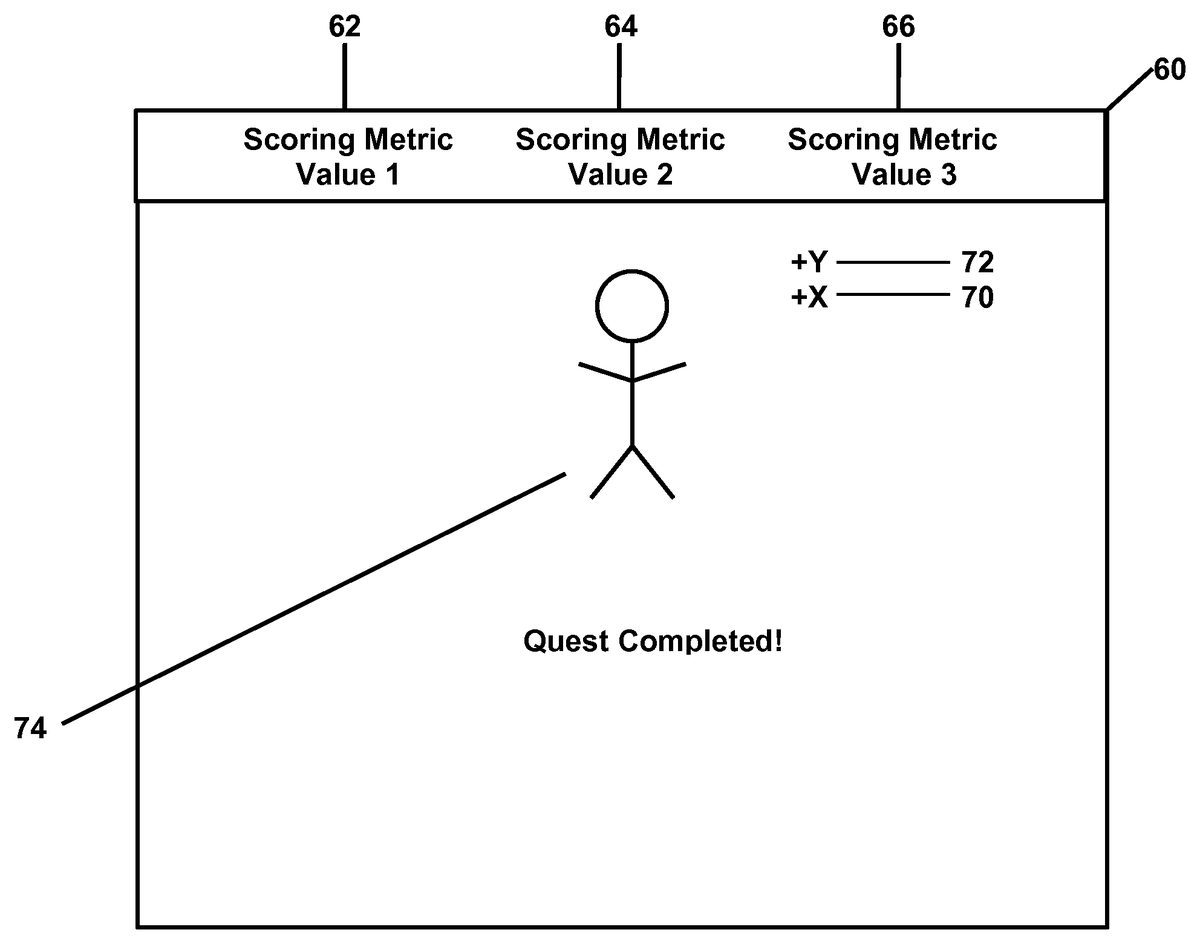
FIG. 3illustrates an embodiment of game space interface60after a user has completed an achievement during a non-event period. Game space interface60may be configured to display a game space74. Game space interface60may be configured to display a plurality of gameplay metric values associated with a user62,64, and66. Upon a user's accomplishment of an achievement, game space interface60may be configured to display gameplay metric values associated with the accomplishment of an achievement during a non-event period70and72.
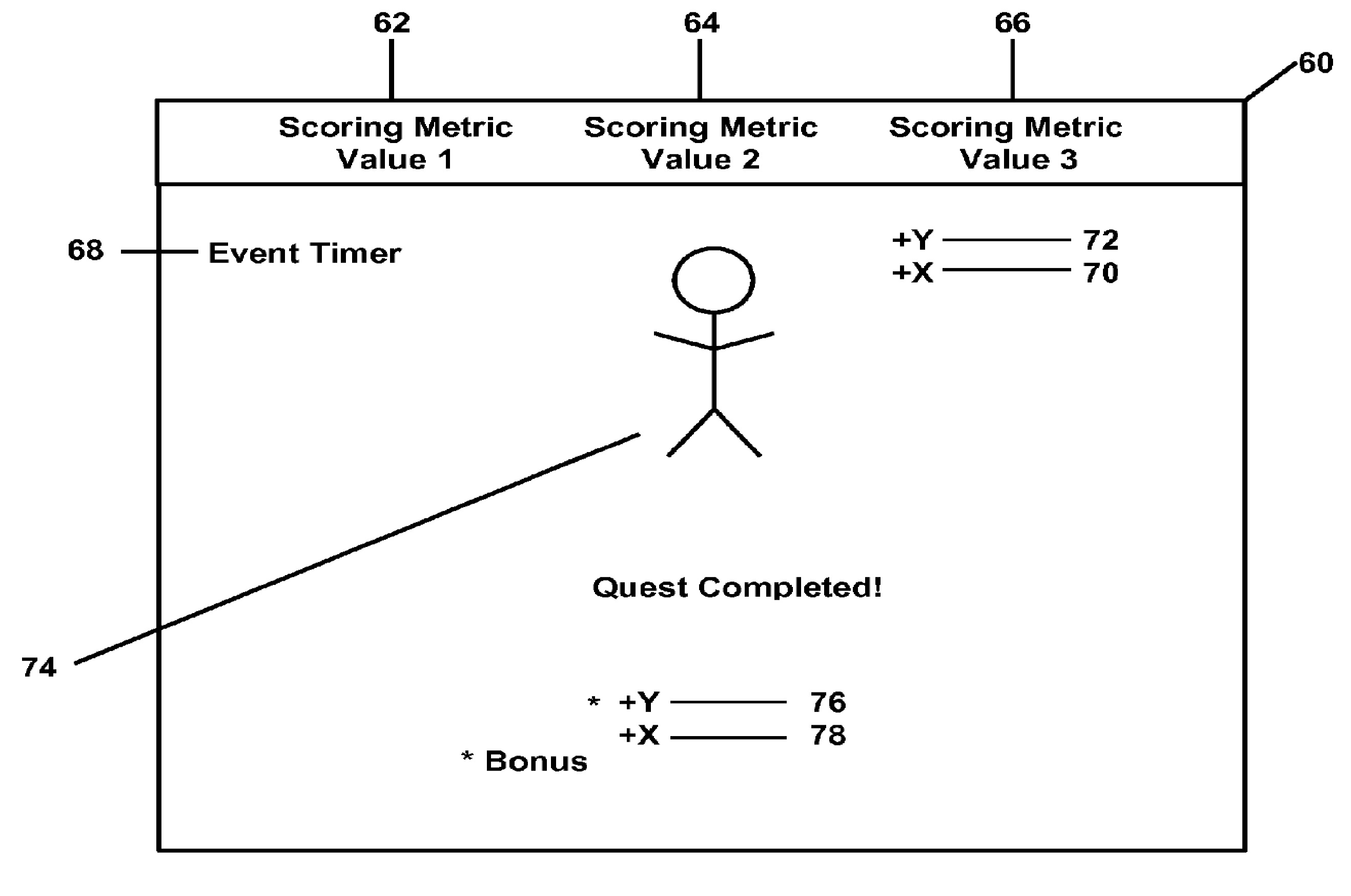
FIG. 4illustrates an embodiment of game space interface60after a user has completed an achievement during an event period. Game space interface60may be configured to display a game space74. Game space interface60may be configured to display a plurality of gameplay metric values associated with a user62,64, and66. Game space interface60may also be configured to display event time68showing the amount of time remaining in the event period. Upon a user's accomplishment of an achievement, game space interface60may be configured to display gameplay metric values associated with the accomplishment of an achievement during a non-event period70and72, as well as additional gameplay metric values corresponding to the same achievement, that are awarded to the user for accomplishing the achievement during the event period76and78.
Claims
- A system for providing offers in a game space, the system comprising: one or more processors configured by machine-readable instructions to: execute an instance of a shared game space that is common to users, and to implement the instance to facilitate the presentation of views of the shared game space to the users, wherein the shared game space is configured to facilitate interaction of the users with the shared game space and each other by performing operations in the shared game space in response to commands received from the users;determine gameplay metric values of a gameplay metric for users, wherein the gameplay metric values quantify achievement within the shared game space such that a first gameplay metric value determined for a first user quantifies achievement of the first user in the shared game space;alter determinations of the gameplay metric values during an event time period such that, during the event time period, the determination of the gameplay metric values is altered to magnify the impact of achievement in the shared game space;and determine, based on the relative increases in the gameplay metric values of the users during the event time period, awards to be provided to the individual users, wherein the awards include virtual items to be distributed for use in the shared game space such that a first award is determined to be provided to a first user based on a comparison of an increase in the game play metric value of the first user during the event time period in with increases in the game play metric values of the other users during the event time period.
- A system of claim 1 , wherein the one or more processors are further configured by machine-readable instructions such that the determination of the gameplay metric is reverted to its unaltered state after the event period.
- A system of claim 1 , wherein the one or more processors are further configured by machine-readable instructions such that, during the event period, the determination of the gameplay metric values for a first user is altered to magnify the impact of achievement such that the gameplay metric values are different than if achievement occurred outside the event period.
- A system of claim 1 , wherein the one or more processors are further configured by machine-readable instructions such that, during the event period, the determination of the gameplay metric values associated with achievements for a first user are altered to magnify the impact of the achievements such that the gameplay metric values are different than if the achievements occurred outside the event period.
- A system of claim 1 , wherein the one or more processors are further configured by machine-readable instructions to determine multiple awards for a single category of gameplay metric values, and multiple users are provided awards based on their ranking of relative increase in the single category of gameplay metric values.
- A system of claim 1 , wherein the one or more processors are further configured by machine-readable instructions to differentially alter the determination of the gameplay metric values of a first user responsive to the first user purchasing an in-game benefit.
- A system of claim 1 , wherein the one or more processors are further configured by machine-readable instructions to distribute at least an award.
- A computer implemented method for providing offers in a shared game space, the method being implemented in a computer system that includes one or more processors configured by machine-readable instructions, the method comprising: executing an instance of a shared game space that is common to users, and implementing the instance to facilitate the presentation of views of the shared game space to the users, wherein the shared game space facilitates interaction of the users with the shared game space and each other by performing operations in the shared game space in response to commands received from the users;determining gameplay metric values of a gameplay metric for users, wherein the gameplay metric values quantify achievement within the shared game space such that a first gameplay metric value determined for a first user quantifies achievement of the first user in the shared game space;altering determinations of the gameplay metric values during an event time period, wherein the determination of the gameplay metric values is altered to magnify the impact of achievement in the shared game space;and determining, based on the relative increases in the gameplay metric values of the users during the event time period, awards to be provided to the individual users, wherein the awards include virtual items to be distributed for use in the shared game space such that a first award is determined to be provided to a first user based on a comparison of an increase in the game play metric value of the first user during the event time period in with increases in the game play metric values of the other users during the event time period.
- A method of claim 8 , wherein the determination of the gameplay metric is reverted to its unaltered state after the event period.
- A method of claim 8 , wherein during the event period, the determination of the gameplay metric values for a first user is altered to magnify the impact of achievement such that the gameplay metric values are different than if achievement occurred outside the event period.
- A method of claim 8 , wherein during the event period, the determination of the gameplay metric values associated with achievements for a first user are altered to magnify the impact of the achievements such that the gameplay metric values are different than if the achievements occurred outside the event period.
- A method of claim 8 , wherein multiple awards are determined for a single category of gameplay metric values, and multiple users are provided awards based on their ranking of relative increase in the single category of gameplay metric values.
- A method of claim 8 , wherein the determination of the gameplay metric values of a first user are differentially altered responsive to the first user purchasing an in-game benefit.
- A method of claim 8 , further comprising distributing at least an award.
Disclaimer: Data collected from the USPTO and may be malformed, incomplete, and/or otherwise inaccurate.