U.S. Pat. No. 9,681,193
LOCALLY CONTROLLABLE INTERACTIVE GAME SYSTEM AND METHODS OF CREATING THE SAME
AssigneeDish Technologies LLC
Issue DateSeptember 26, 2014
Illustrative Figure
Abstract
Various embodiments facilitate multi-user gaming. In one embodiment, a locally controllable interactive game system is provided to support a plurality of users within a single household. The locally controllable interactive game system includes a host and a plurality of thin clients. The host and the plurality of thin clients allow respective users to play video games independently or together for multi-player video games. The host is coupled to a plurality of video game content providers by a world wide web. In one embodiment, the host consolidates video game content from the plurality of video game content providers. The plurality of thin clients is coupled to the host by a local area network. In one embodiment, each thin client obtains user video game content from the host and utilizes the user video game content to provide a video game to a respective user.
Description
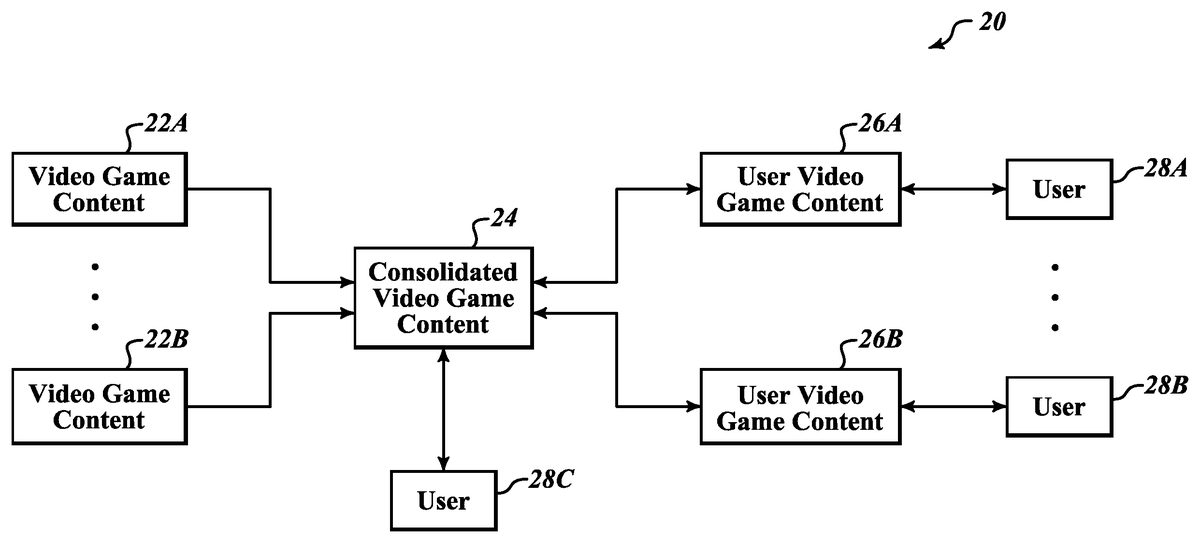
DETAILED DESCRIPTION A. Overview FIG. 1is an overview block diagram illustrating an example of data flow for a locally controllable interactive game environment20according to principles disclosed herein. In this example, the locally controllable interactive game environment20includes video game content22, consolidated video game content24, user video game content26, and users28. The video game content22includes information used to provide video games. For example, the video game content22may include programming data to create video games, configuration data for video games, coordination data for a multiplayer video games, and media for video games. The video game content22may be for a single video game or for a plurality of video games. As will be discussed in detail with respect toFIG. 2, the video game content22may be provided by a single video game content provider or a plurality of video game content providers. It should be noted that, although only the video game content22A and the video game content22B are shown inFIG. 1, the locally controllable interactive game system20may include any number of video game content. The consolidated video game content24is a compilation of the video game content22. The consolidated video game content24may be for a single video game or for a plurality of video games. As will be discussed in detail with respect toFIGS. 2 and 5, the consolidated video game content24is compiled by a host. The user video game content26provides video game content for particular users and may be a portion of or the entire consolidated video game content24. In one embodiment, the user video game content26A provides video game content for a first video game and the user video game content26B provides video game content for a second video game. In another embodiment, the user video game content26A and the user video game content26B provides video game content for a multiplayer video game. ...
DETAILED DESCRIPTION
A. Overview
FIG. 1is an overview block diagram illustrating an example of data flow for a locally controllable interactive game environment20according to principles disclosed herein. In this example, the locally controllable interactive game environment20includes video game content22, consolidated video game content24, user video game content26, and users28.
The video game content22includes information used to provide video games. For example, the video game content22may include programming data to create video games, configuration data for video games, coordination data for a multiplayer video games, and media for video games. The video game content22may be for a single video game or for a plurality of video games. As will be discussed in detail with respect toFIG. 2, the video game content22may be provided by a single video game content provider or a plurality of video game content providers. It should be noted that, although only the video game content22A and the video game content22B are shown inFIG. 1, the locally controllable interactive game system20may include any number of video game content.
The consolidated video game content24is a compilation of the video game content22. The consolidated video game content24may be for a single video game or for a plurality of video games. As will be discussed in detail with respect toFIGS. 2 and 5, the consolidated video game content24is compiled by a host.
The user video game content26provides video game content for particular users and may be a portion of or the entire consolidated video game content24. In one embodiment, the user video game content26A provides video game content for a first video game and the user video game content26B provides video game content for a second video game. In another embodiment, the user video game content26A and the user video game content26B provides video game content for a multiplayer video game. As will be discussed in detail with respect toFIGS. 2 and 5, the user video game content26are obtained by thin clients. It should be noted that, although only the user video game content26A and the user video game content26B are shown inFIG. 1, the locally controllable interactive game system20may include any number of user video game content.
In another embodiment, the user video game content26interacts with the consolidated video game content24. For example, the consolidated video game content24may be updated to include a portion of or the entire user video game content26A. As will be discussed in detail with respect toFIG. 2, this allows user video game content to be shared within the locally controllable interactive game environment20.
The user28A and the user28B are provided respective user video game content that the each user may interact with. For example, the user video game content26A may be used to provide a first video game for the user28A, and the user video game content26B may be used to provide a second video game for the user28B. As will be discussed in detail with respect toFIG. 2, the user video game content26is displayed to the users28through respective televisions (“TV”). It should be noted that, although only the user28A and the user28B are shown inFIG. 1, the locally controllable interactive game environment20may include any number of users.
The user28C directly interacts with the consolidated video game content24or a portion thereof. For example, a portion of the consolidated video game content24may be used to provide a video game for the user28C. As will be discussed in detail with respect toFIG. 2, the consolidated video game content24or a portion thereof is displayed to the user28C through a TV.
B. Example Locally Controllable Interactive Game System
FIG. 2is a block diagram illustrating an example of a locally controllable interactive game system30according to principles disclosed herein. In this example, the locally controllable interactive game system30includes a host36, thin clients38, and TVs40. The locally controllable interactive game system30is coupled to video game content providers32.
The video game content providers32are coupled to the host36. The video game content providers32are vendors that provide video game content. As discussed with respect toFIG. 1, video game content includes information used to provide video games. The video game content providers32and the host36are coupled to each other through a world wide web, such as the Internet34. It should be noted that, although only the video game content provider32A and the video game content provider32B are shown inFIG. 2, the locally controllable interactive game system30may include any number of video game content providers.
The host36is configured to consolidate video game content from the video game content providers32. For example, the host36may compile the consolidated the video game content24from the video game content providers32periodically, upon notification of video game content being updated, or on-demand. This results in video game content being compiled at a single physical location, such as a room of a household. In another embodiment the host36may act as an intermediary to facilitate communication between the thin clients38. For example, the host36may obtain the user video game content26A from the thin client38A and forward the user video game content26A to the thin client38B.
The thin clients38are coupled to the host36. In one embodiment, the thin clients38and the host36are coupled to each other through a local area network. For example, the local area network may be built using coaxial cable, Ethernet, or Wi-Fi. The thin clients38are configured to obtain user video game content from the host36. For example, the thin client38A and the thin client38B may obtain the user video game content26A and the user video game content26B, respectively from the host36. The thin clients28may obtain user video game content from the host36periodically, upon notification of consolidated video game content being updated, or on-demand. In one embodiment, each of the thin clients38is located at separate physical locations. For example, the thin client38A may be located in a separate room of a household from the thin client38B. It should be noted that, although only the thin client38A and the thin client38B are shown inFIG. 2, the locally controllable interactive game system30may include any number of thin clients.
The TVs40are coupled to the thin clients38and the host36. Particularly, the TV40A, the TV40B, and the TV40C are coupled to the thin client38A, the thin client38B, and the host36, respectively. The TVs40are configured to provide user video game content to respective users by displaying video games provided by the user video game content. For example, in one embodiment, the thin client38A may display a first video game on the TV40A for the user28A, the thin client38B may display a second video game on the TV40B for the user28B, and the host36may display a third video game on the TV40C for the user28C. In another embodiment, the thin client38A, the thin client38B, and the host36may display a multiplayer video game on the TV40A, the TV40B, and the TV40C, respectively.
As will be discussed in detail with respect toFIG. 3andFIG. 4, the thin client38A, the thin client38B, and the host36may be coupled to respective peripherals and remote controls.
FIG. 3is a schematic illustrating an example of a host, such as the host36of the locally controllable interactive game system30, according to principles disclosed herein. In this example, a host includes a tuner/input42, a network interface44, a video game content database46, a controller48, graphics hardware50, a display interface52, a peripheral interface54, and a remote control interface56.
The tuner/input42is configured to send and receive data, such as media signals and video game content. For example, the tuner/input42may be coupled to a satellite receiving antenna to receive a television signal, and may be coupled to the thin clients38to send and receive the user video game content26.
The network interface44is configured to send and receive data from a world wide web. For example, the network interface44may be connected the Internet34to obtain the video game content22from the video game content providers32.
The video game content database46is configured to store video game content. For example, the video game content database46may store the consolidated video game content24that was compiled from the video game content providers32.
The controller48is configured to manage the functions of the host36. For example, the controller48may determine what video game content is needed; determine the location of video game content providers; determine whether required video game content is stored in the video game content database46; coordinate the compilation of consolidated video game content; provide user video game content to users; and control the graphics hardware50, the display interface52, the peripheral interface54, and the remote control interface56.
The graphics hardware50is configured to create video games from video game content. For example, the graphics hardware50may use a portion of the consolidated video game content24to generate graphics for a video game to be displayed on the TV40C.
The display interface52, the peripheral interface54, and the remote control interface56are configured to couple various devices to a host. For instance, the display interface52may couple the TV40C to the host36, the peripheral interface54may couple peripherals to the host36, and the remote control interface56may couple a remote control to the host36. Peripherals may include game controllers, microphones, speakers, cameras, motion sensing devices, or the like.
FIG. 4is a schematic illustrating an example of a thin client, such as the thin client38A of the locally controllable interactive game system30, according to principles disclosed herein. A thin client is similar to a host, except that a thin client's functionality may be limited. For example, a thin client may not include a video game content database or a network interface. In this example, a thin client includes tuner/input58, a controller60, graphics hardware62, a display interface64, a peripheral interface66, and a remote control interface68. The tuner/input58, the controller60, the graphics hardware62, the display interface64, the peripheral interface66, and the remote control interface68have substantially the same functionality as the tuner/input42, the controller48, the graphics hardware50, the display interface52, the peripheral interface54, and the remote control interface56, respectively. In addition, as will be discussed in detail with respect toFIGS. 5-7, a thin client depends on a host to perform its own function. The limited functionality of thin clients results in lower costs.
It should be noted that each block shown inFIGS. 1-4may represent one or more such blocks as appropriate to a specific embodiment or may be combined with other blocks.
It should also be noted that the host36and the thin clients38may be any suitable electronic device that is operable to receive and transmit data. The host36and the thin clients38may be interchangeably referred to as a “TV converter,” “receiving device,” “set-top box,” “TV receiving device,” “TV receiver,” “TV recording device,” “satellite set-top box,” “satellite receiver,” “cable set-top box,” “cable receiver,” “media player,” and/or “TV tuner.”
In another embodiment, the TVs40may be replaced by other presentation devices. Examples include a virtual headset, a monitor, or the like. In many implementations, one or more presentation devices reside in or near the users'28premises and are communicatively coupled to the host36and the thin clients38. Further, the host36and a presentation device may be integrated into a single device. Similarly, the thin clients38and presentation devices may be integrated into respective single devices. Such a single device may have the above-described functionality of the host36, the thin clients38, and the TVs40, or may even have additional functionality.
In another embodiment, the Internet34may be replaced by other types of communication media, now known or later developed. Non-limiting media examples include telephony systems, cable systems, fiber optic systems, microwave systems, asynchronous transfer mode (“ATM”) systems, frame relay systems, digital subscriber line (“DSL”) systems, radio frequency (“RF”) systems, and satellite systems.
C. Example Video Game Content Consolidation Process for a Locally Controllable Interactive Game System
FIG. 5is a flow diagram illustrating an example of a video game content consolidation process70for the locally controllable interactive game system30according to principles disclosed herein.
At a first part of the sequence72, a host consolidates video game content from a plurality of video game content providers to form consolidated video game content. For example, the host36may consolidate the video game content22from the video game content providers32by gathering and packaging the video game content22at a single location, such as a household. The host36may obtain the video game content22by the video game content providers32pushing the video game content22to the host36, or by the host36pulling the video game content22from the video game content providers32. Step72may be performed periodically, upon notification of video game content being updated, or on-demand.
In a subsequent step74, the host stores the consolidated video game content in a video game content database. For example, the host36may store the consolidated video game content24in the video game content database46. This allows the consolidated video game content24to be buffered for future use. In another embodiment, the consolidated video game content24is not stored in the video game content database46. Rather, the host36streams the consolidated video game content24to the thin clients38as needed.
In step76, a plurality of thin clients obtains respective user video game content from the host. For example, the thin client38A may obtain the user video game content26A from the host36for the user28A, and the thin client38B may obtain the user video game content26B from the host36for the user28B. Similar to step72, the thin clients38may obtain the user video game content26from the host36by a push or pull method. Step76may be performed periodically, upon notification of consolidated video game content being updated, or on-demand.
In step78, each of the thin clients provides respective user video game content to respective users. For example, the thin client38A may provide the user video game content26A to the user28A by displaying a video game provided by the user video game content26A on TV40A, and the thin client38B may provide the user video game content26B to the user28B by displaying a video game provided by the user video game content26B on TV40B.
D. Example Video Game Content Demand Processes for a Locally Controllable Interactive Game System
FIG. 6is a flow diagram illustrating an example of a video game content demand process80for the locally controllable interactive game system30according to principles disclosed herein.
At a first part of the sequence82, a host receives a video game content demand from a thin client. For example, the thin client38A may send a video game content demand to the host36to request additional user video game content for user28A. In another embodiment, the host36does not receive a video game content demand from a thin client. Instead, in step82, the host36determines whether any user video game content is needed for any of the thin clients38.
In a subsequent step84, the host determines required video game content based on the video game content demand received in step82. That is, the host determines what video game content is needed to satisfy the video game content demand. For example, the video game content demand may be requesting video game content for a new video game that a user has selected, and the host36may determine what video game content is needed to provide the new video game.
In step86, the host determines whether the required video game content from step84is available in a video game content database. For example, the host36may determine whether the required video game content is stored in the video game content database46from a previous video game content consolidation process. If the host determines that the required video game content is available in the video game content database, the video game content demand process80moves to step88. If the host determines that the required video game content is not available in the video game content database, the video game content demand process80moves to step92. Step86prevents the host from connecting to a world wide web and obtaining additional video game content from video game content providers unnecessarily. Thus, conserving Internet bandwidth and increasing gaming performance.
In step88, the thin client from step82obtains the required video game content from the host when the required video game content is available in the video game content database. For example, the thin client38A may obtain the required user video game content from the host36for user28A. As discussed with respect toFIG. 5, the thin client38A may obtain the required video game content from the host36by a push or pull method.
In step90, the thin client from steps82and88provide the required video game content to a respective user. For example, the thin client38A may provide the required video game content to the user28A by displaying a video game provided by the required video game content on the TV40A.
In step92, the host obtains the required video game content from at least one video game content provider. For example, the host36may determine which of the video game content providers32have the required video game content and then obtain the required video game content from the appropriate video game content provider(s). As discussed with respect toFIG. 5, the host36may obtain the required video game content from the video game content providers32by a push or pull method. The video game content demand process80then moves to step88.
In an illustrating example of the video game content demand process80, in step82, the user28A makes a selection to start a new video game by using the thin client38A. Accordingly, the thin client38A sends a video game content demand to the host36. In steps84and86, the host36determines what video game content is required for the video game content demand and whether the required video game content is already stored in the video game content database46, respectively. If the required video game content is in the video game content database46, the host36provides the required video game content directly to the thin client38A. If the required the video game content is not in the video game content database46, the host36will obtain the required video game content from at least one of the video game content providers32and then provide the required video game content to the thin client38A. The thin client38A then utilizes the required video game content to display the new video game to the user28A on the TV40A.
FIG. 7is a flow diagram illustrating an example of a multiplayer video game content demand process94for the locally controllable interactive game system30according to principles disclosed herein.
At a first part of the sequence96, a host receives video game content demands from first and second thin clients. For example, the thin client38A and the thin client38B may both send video game content demands to the host36to request additional user video game content for the user28A and the user28B, respectively. In another embodiment, the host36does not receive a video game content demand from thin clients. Instead, in step96, the host36determines whether any user video game content is needed for any of the thin clients38.
In a subsequent step98, the host determines required video game content based on the video game content demands. For example, the host36determines what video game content is needed to satisfy video game content demands from the thin client38A and the thin client38B. For instance, the thin client38A and the thin client38B may each be requesting video game content for a new multiplayer video game that the user28A and the user28B have selected, respectively, and the host36may determine what video game content is needed to provide the new multiplayer video game.
In step100, the host determines whether the required video game content is available in a video game content database. For example, the host36may determine whether the required video game content is already stored in the video game content database46from a previous video game content consolidation process70. If the host determines that the required video game content is available in the video game content database, the multiplayer video game content demand process94moves to step102. If the host determines that the required video game content is not available in the video game content database, the multiplayer video game content demand process94moves to step106. Step100prevents a host from connecting to a world wide web and obtaining additional video game content from video game content providers unnecessarily. Thus, conserving Internet bandwidth and increasing gaming performance.
In step102, the first and second thin clients obtain the required video game content from the host when the required video game content is available in the video game content database. For example, the thin client38A and the thin client38B obtain the required user video game from the video game content database46of the host36. As discussed with respect toFIG. 5, the thin client38A and the thin client38B may obtain the required video game content from the host36by a push or pull method.
In step104, the first and second thin clients provide the required video game content to their respective users. For example, the thin client38A may provide the required video game content to the user28A by displaying the multiplayer video game on the TV40A, and the thin client38B may provide the required video game content to the user28B by displaying the multiplayer video game on the TV40B.
In step106, the host obtains the required video game content from at least one video game content provider. For example, the host36may determine which of the video game content providers32have the required video game content and then obtain the required video game content from the appropriate video game content provider(s). As discussed with respect toFIG. 5, the host36may obtain the required video game content from at least one of the video game content providers32by a push or pull method. The video game content demand process94then moves to step102.
It should be noted that the use of the first and second thin clients in the multiplayer video game content demand process94are only for illustrative purposes. The multiplayer video game content demand process94may be applied to any number of thin clients.
In an illustrating example of the multiplayer video game content demand process94, in step96, the user28A and the user28B both make a selection to start a multiplayer video game. Accordingly, the thin client38A and the thin client38B send video game content demands to the host36. In steps98and100, the host36determines what video game content is required for the video game content demands and whether the required video game content is already stored in the video game content database46, respectively. If the required video game content is in the video game content database46, the host36provides the required video game content directly to the thin client38A and the thin client38B. If the required the video game content is not in the video game content database46, the host36will obtain the required video game content from at least one of the video game content providers32and then provide the required video game content to the thin client38A and the thin client38B. The thin client38A and the thin client38B then utilize the required video game content to display the multiplayer video game to the user28A through the TV40A and to the user28B through the TV40B, respectively.
It should be noted that, althoughFIGS. 1-7are directed towards video game content, the principles disclosed herein may be applied to other types of content, such as application content, Internet content, and media content. For example, the host36may consolidate application content from a plurality of application content providers, and the thin clients28may obtain respective user application content from the host36. The thin clients28may then utilize respective user application content to provide applications to respective users. Application content may include programming data to provide applications, configuration data for applications, and coordination data for shared applications. Internet content may include programming and configuration data for websites. Media content may include media data to provide media, such as television shows, movies, pictures, and audio.
Claims
- A method comprising: obtaining, by a set-top box, video game content from a plurality of remote video game content providers, the set-top box being located in a first room of a household;storing, by the set-top box, the video game content from the plurality of remote video game content providers in a video game content database of the set-top box;receiving, at the set-top box and from a first thin client, a request to establish a multiplayer video game between the set-top box, the first thin client, and a second thin client, wherein the multiplayer video game includes consolidated video game content from the video game content stored in the video game content database;displaying, by the set-top box, a first video game to a set-top box user through a first display that is coupled to the set-top box, the first video game utilizing the consolidated video game content;obtaining, by the first thin client, first video game content for a second video game from the set-top box, the first video game content utilizing at least a portion of the consolidated video game content, the first thin client being located in a second room of the household;displaying, by the first thin client, the second video game to a first thin client user through a second display that is coupled to the first thin client, the second video game utilizing at least a portion of the first video game content;obtaining, by the second thin client, second video game content for a third video game from the set-top box, the second video game content utilizing at least a portion of the consolidated video game content, the second thin client being located in a third room of the household, the set-top box, the first thin client, and the second thin client being coupled to each other by a local area network and the first video game, the second video game, and the third video game being part of a multiplayer video game;displaying, by the second thin client, the third video game to a second thin client user through a third display that is coupled to the second thin client, the third video game utilizing at least a portion of the second video game content;receiving, by the set-top box, first coordination data for the first video game content from the first thin client and second coordination data for the second video game content from the second thin client;updating, by the set-top box, the consolidated video game content based on the first coordination data and the second coordination data;displaying, by the set-top box, the updated consolidated video game content to the set-top box user through the first display;and forwarding, by the set-top box, the first coordination data to the second thin client and the second coordination data to the first thin client to enable execution of the multiplayer video game by the set-top box, the first thin client, and the second thin client.
- The method according to claim 1 , further including: receiving, by the set-top box, a video game content demand for the first video game content from the first thin client;determining, by the set-top box, whether the first video game content for the video game content demand is stored in the video game content database;and providing, by the set-top box, the first video game content for the video game content demand to the first thin client, when it is determined that the first video game content for the video game content demand is stored in the video game content database.
- The method according to claim 2 , further including: obtaining, by the set-top box, the first video game content for the video game content demand from at least one of the plurality of video game content providers and providing, by the set-top box, the obtained video game content to the first thin client, when it is determined that the first video game content for the video game content demand is not stored in the video game content database.
- The method according to claim 1 , wherein the local area network includes coaxial cable, the first thin client obtains the first video game content through the coaxial cable, and the second thin client obtains the second video game content through the coaxial cable.
- A method comprising: obtaining, by a set-top box, video game content from a plurality of remote video game content providers, the set-top box being located in a first room of a household;storing, by the set-top box, the video game content from the plurality of remote video game content providers in a video game content database of the set-top box;displaying, by the set-top box, a first video game to a set-top box user through a first display that is coupled to the set-top box, the first video game utilizing consolidated video game content stored in the video game content database, the consolidated video game content being part of a multiplayer video game between the set-top box, a first thin client, and a second thin client;receiving, by the set-top box, a video game content demand for a second video game from the first thin client, the first video game utilizing at least a portion of the consolidated video game content, the first thin client being located in a second room of the household;determining, by the set-top box, whether first video game content for the video game content demand is stored in the video game content database;providing, by the set-top box, the first video game content for the video game content demand to the first thin client, when it is determined that the video game content for the video game content demand is stored in the video game content database;obtaining, by the set-top box, the first video game content for the video game content demand from at least one of the plurality of video game content providers and providing, by the set-top box, the obtained video game content to the first thin client, when it is determined that the first video game content for the video game content demand is not stored in the video game content database;providing, by the set-top box, second video game content for a third video game to the second thin client being located in a third room of the household, the second video game content utilizing at least a portion of the consolidated video game content, the set-top box, the first thin client, and the second thin client being coupled to each other through a local area network and the first video game, the second video game, and the third video game being part of the multiplayer video game;receiving, by the set-top box, first coordination data for the second video game from the first thin client and second coordination data for the third video game from the second thin client;updating, by the set-top box, the consolidated video game content based on the first coordination data and the second coordination data;displaying, by the set-top box, the updated consolidated video game content to the set-top box user through the first display;and forwarding, by the set-top box, the first coordination data to the second thin client and the second coordination data to the first thin client to enable execution of the multiplayer video game by the first thin client and the second thin client.
- The method according to claim 5 , further including: displaying, by the first thin client, the second video game to a first thin client user through a second display that is coupled to the first thin client the second video game utilizing at least a portion of the consolidated video game content.
- The method according to claim 5 , wherein the local area network includes coaxial cable, and the first thin client obtains the first video game content for through the coaxial cable.
- A method comprising: obtaining, by a set-top box, video game content from a plurality of remote video game content providers, the set-top box being located in a first room of a household;storing, by the set-top box, the video game content from the plurality of remote video game content providers in a video game content database of the set-top box;displaying, by the set-top box, a multiplayer video game to a set-top box user through a first display that is coupled to the set-top box, the multiplayer video game displayed by the set-top box being between the set-top box, a first thin client, and second thin client and utilizing consolidated video game content stored in the video game content database;obtaining, by the first thin client, first video game content for the multiplayer video game from the set-top box, the first video game content utilizing at least a portion of the consolidated video game content, the first thin client being located in a second room of the household;displaying, by the first thin client, the multiplayer video game to a first thin client user through a second display that is coupled to the first thin client, the multiplayer video game displayed by the first thin client utilizing at least a portion of the first video game content obtained by the first thin client;obtaining, by a second thin client, second video game content for the multiplayer video game from the set-top box, the second video game content utilizing at least a portion of the consolidated video game content, the second thin client being located in a third room of the household, the set-top box, the first thin client, and the second thin client being coupled to each other through a local area network;displaying, by the second thin client, the multiplayer video game to a second thin client user through a third display that is coupled to the second thin client, the multiplayer video game displayed by the second thin client utilizing at least a portion of the second video game content obtained by the second thin client;receiving, by the set-top box, first coordination data for the multiplayer video game from the first thin client and second coordination data for the multiplayer video game from the second thin client;updating, by the set-top box, the consolidated video game content based on the first coordination data and the second coordination data;displaying, by the set-top box, the updated consolidated video game content to the set-top box user through the first display;and forwarding, by the set-top box, the first coordination data to the second thin client and the second coordination data to the first thin client to enable execution of the multiplayer video game by the set-top box, the first thin client, and the second thin client.
- The method according to claim 8 , further including: receiving, by the set-top box, a video game content demand for the multiplayer video game from the first thin client;determining, by the set-top box, whether video game content for the video game content demand is stored in the video game content database;and providing, by the set-top box, the video game content for the video game content demand to the first thin client, when it is determined that the video game content for the video game content demand is stored in the video game content database.
- The method according to claim 9 , further including: obtaining, by the set-top box, the video game content for the video game content demand from at least one of the plurality of video game content providers and providing, by the set-top box, the obtained video game content to the first thin client, when it is determined that the video game content for the video game content demand is not stored in the video game content database.
- The method according to claim 8 , wherein the local area network includes coaxial cable, and the first thin client obtains the first video game content for the multiplayer video game through the coaxial cable and second thin client obtains the second video game content for the multiplayer video game through the coaxial cable.
- The method according to claim 1 , wherein the consolidated video game content for the first video game includes programming data to create the first video game on the set-top box, the first video game content for the second video game includes programming data to create the second video game on the first thin client, and the second video game content for the third video game includes programming data to create the third video game on the second thin client.
- The method according to claim 1 , wherein the consolidated video game content, the first video game content, and the second video game content include configuration data for the multiplayer video game.
- The method according to claim 1 , wherein the consolidated video game content, the first video game content, and the second video game content include media for the multiplayer video game.
- The method according to claim 8 , wherein the consolidated video game content for the multiplayer video game includes programming data, configuration data, and media to create the multiplayer video game on the set-top box, the first thin client, and the second thin client.
Disclaimer: Data collected from the USPTO and may be malformed, incomplete, and/or otherwise inaccurate.