U.S. Pat. No. 9,674,611
INFORMATION PROCESSOR, AUDIO PROCESSOR, AUDIO PROCESSING SYSTEM, PROGRAM, AND VIDEO GAME PROGRAM
AssigneeYAMAHA CORPORATION; KABUSHIKI KAISHA SQUARE ENIX
Issue DateFebruary 28, 2013
Illustrative Figure
Abstract
An information processor includes a generator that is adapted to generate original sound data indicating an original sound as a basis for a processed sound to be heard by a user and a parameter indicating a content of processing on the original sound data, an original sound data output section that is adapted to output the original sound data generated by the generator from any channel of a plurality of channels, and a control signal output section that is adapted to output a control signal including the parameter and a correspondence relationship between the parameter and the channel for the original sound data to be processed by means of the parameter.
Description
DESCRIPTION OF EMBODIMENTS 1. Configuration 1-1. Overall Configuration of System FIG. 1is a diagram showing the configuration of an audio system9according to an embodiment of the invention. The audio system9includes a video game machine1and an audio processor2. The video game machine1and the audio processor2are connected together by a multi-channel communication cable in accordance with a standard, such as HDMI (High-Definition Multimedia Interface; Registered Trademark). The term “channel” means a transmission path through which data is transmitted, and the term “multi-channel communication cable” means a communication cable which has a plurality of separate channels. The video game machine1is an example of an information processor which reproduces software or contents. The video game machine1and the audio processor2are able to exchange information with each other, and while the transfer of information from the audio processor2to the video game machine1can be performed as indicated by a broken line inFIG. 1, this will be omitted in the following description of the embodiment. 1-2. Configuration of Video Game Machine FIG. 2is a diagram showing the configuration of the video game machine1. A control unit11has a CPU (Central Processing Unit), a ROM (Read Only Memory), and a RAM (Random Access Memory), and controls the respective units of the video game machine1using the CPU which reads and executes a boot loader stored in the ROM or various programs stored in a storage unit12on the RAM. The control unit11includes a decoder which decompresses motion images and sound data compressed in accordance with the standard, such as MPEG2 or MPEG4, and generates uncompressed PCM (pulse code modulation) data. The decoder may be realized by a specialized processor which is hardware different from the CPU or may be realized by the CPU which executes a program. The control unit11functions as, for example, a video game progression unit110, an original sound data ...
DESCRIPTION OF EMBODIMENTS
1. Configuration
1-1. Overall Configuration of System
FIG. 1is a diagram showing the configuration of an audio system9according to an embodiment of the invention. The audio system9includes a video game machine1and an audio processor2. The video game machine1and the audio processor2are connected together by a multi-channel communication cable in accordance with a standard, such as HDMI (High-Definition Multimedia Interface; Registered Trademark). The term “channel” means a transmission path through which data is transmitted, and the term “multi-channel communication cable” means a communication cable which has a plurality of separate channels. The video game machine1is an example of an information processor which reproduces software or contents. The video game machine1and the audio processor2are able to exchange information with each other, and while the transfer of information from the audio processor2to the video game machine1can be performed as indicated by a broken line inFIG. 1, this will be omitted in the following description of the embodiment.
1-2. Configuration of Video Game Machine
FIG. 2is a diagram showing the configuration of the video game machine1. A control unit11has a CPU (Central Processing Unit), a ROM (Read Only Memory), and a RAM (Random Access Memory), and controls the respective units of the video game machine1using the CPU which reads and executes a boot loader stored in the ROM or various programs stored in a storage unit12on the RAM. The control unit11includes a decoder which decompresses motion images and sound data compressed in accordance with the standard, such as MPEG2 or MPEG4, and generates uncompressed PCM (pulse code modulation) data. The decoder may be realized by a specialized processor which is hardware different from the CPU or may be realized by the CPU which executes a program. The control unit11functions as, for example, a video game progression unit110, an original sound data generation unit111, or the like.
The storage unit12is high-capacity storage means, such as a hard disk drive, and stores various programs which are read into the control unit11. A video game program121is one of various programs. The storage unit12may be a recording medium, such as an external nonvolatile memory. In this case, the storage unit12is connected to the video game machine1through a connection interface (not shown) or the like. The storage unit12may include a reader which reads a recording medium, such as an optical disk. In this case, the storage unit12may read a recording medium loaded in the reader, and if the recording medium is rewritable, may perform rewriting on the recording medium.
An operation unit13includes an operator131which gives various instructions. The operation unit13receives user operation and supplies an operation signal according to the operation content to the control unit11.
The display unit14includes, for example, a display, such as a liquid crystal display, and displays video according to the progress of a video game under the control of the control unit11.
An output unit15is an interface which sends a plurality of pieces of sound data and control signals to the audio processor2such that a plurality of kinds of sound according to the progress of the video game are emitted to the audio processor2under the control of the control unit11. The output unit15includes a packet processing unit151. The packet processing unit151divides sound data in terms of audio frames as a unit of sound reproduction, and adds a header including a time stamp indicating a reproduction time, or the like to form packets.
The output unit15is connected to the audio processor2through the multi-channel communication cable. The communication cable has six channels. A control signal is output to one channel ct from among the channels, and the packetized sound data is transmitted to the remaining five channels ch1to ch5. The details of the control signal will be described below.
1-3. Functional Configuration of Video Game Machine
FIG. 3is a diagram showing the functional configuration of the video game machine1. The control unit11reads and executes the video game program121(seeFIG. 2) stored in the storage unit12to function as the video game progression unit110, the original sound data generation unit111, and the control signal generation unit112. The video game progression unit110progresses the video game in accordance with user operation along the video game program121. That is, the video game progression unit110functions as a video game progressing section that is adapted to progress the video game in accordance with user operation. Specifically, the video game progression unit110reads configuration information of the video game stored in the storage unit12, and determines the progress of the video game, the allocation of the operation signal, or the like in accordance with the configuration information. The video game progression unit110interprets the operation signal indicating user operation received by the operation unit13and progresses the video game. The video game progression unit110reads video data indicating video according to the progress of the video game from the storage unit12, sends video data to the display unit14, and displays video according to video data on the display unit14. The video game progression unit110reads sound data to be used in the video game from the storage unit12in accordance with the progress of the video game.
The original sound data generation unit111individually generates sound data (hereinafter, referred to as original sound data) indicating original sound on the basis of sound data read by the video game progression unit110. The term “original sound” means a sound as a basis for a processed sound to be heard by the user of the video game in accordance with the progress of the video game, and includes, for example, BGM, ambient sound, voice, system sound, and the like. BGM (Background Music) is music for increasing the emotion of the user. Ambient sound is sound, such as the footstep of a game character operated by the user or sound of wind and rain, which expresses a virtual space in the video game. Voice is voice of a game character which appears in the video game. System sound is sound for causing the user to recognize that the operation unit13receives operation, and includes, for example, clicking sound, chime sound, and the like. The original sound data generation unit111functions as a generator that is adapted to generate original sound data indicating original sound in accordance with user operation. In this case, in particular, the original sound data generation unit111functions as original sound data generator that is adapted to generate original sound data according to the progress of the video game progressed by the video game progressing section.
The output unit15packetizes a plurality of pieces of original sound data generated by the original sound data generation unit111, and outputs the packets to the audio processor2by means of the individual channels. Accordingly, the output unit15functions as an original sound data output section that is adapted to output original sound data generated by the generator from any channel of a plurality of channels.
The control signal generation unit112generates a control signal which describes each attribute of each piece of original sound data in association with each communication path in the output unit15of each piece of original sound data generated by the original sound data generation unit111. The attribute is information which designates how original sound indicated by original sound data is heard by the user, and specifically, a parameter indicating the content of processing. The parameter is defined in accordance with the progress of the video game. Accordingly, the control signal generation unit112functions as a generator that is adapted to generate a parameter indicating the content of processing on original sound data in accordance with user operation. In this case, in particular, the control signal generation unit112functions as a generator that is adapted to generate a parameter indicating a content of processing on original sound data according to the progress of the video game progressed by the video game progressing section.
In order to process original sound data in accordance with the parameter, various kinds of information in the audio processor2, such as the position or low-frequency reproduction ability of each speaker (or a sound emission device) in a sound emission unit24of the audio processor2described below. For this reason, the video game machine1uses the output unit15to packetize a plurality of pieces of original sound data generated by the original sound data generation unit111and to output the packets to the audio processor2by means of the channels ch1to ch5without processing original sound data, and also to output the control signal generated by the control signal generation unit112to the audio processor2by means of the channel ct in association with a plurality of pieces of original sound data. The association is made by means of a time stamp included in the control signal and a time stamp used when packetizing each piece of original sound data. Accordingly, the output unit15functions as a control signal output section that is adapted to output the control signal which includes the parameter indicating the content of processing on original sound data and the correspondence relationship between the parameter and the channel for original sound data to be processed by means of the parameter.
1-4. Configuration of Control Signal
FIG. 4is a diagram showing an example of a control signal which is transmitted from the channel ct of the output unit15. As shown inFIG. 4, the control signal describes the time stamp indicating the timing at which the control signal should be applied and parameter indicating four attributes of the type, localization, reverberation rate, and bit rate defined for each channel.
Here, the type refers to the type of original sound indicated by original sound data, and specifically includes BGM, ambient sound, voice, system sound, and the like.
The localization is the direction in which the user feels that there is a sound generation point. For example, 0 degree is the front direction of the user, and one circle to the left side (that is, a counterclockwise direction when viewed from above the head of the user) from the front direction is expressed in 360 degrees.
The reverberation rate is a value indicating the intensity of reverberation, which is a sound effect of applying reverberation to sound such that the user feels the width of the space, and when the volume of original sound as a basis is 100%, expresses the ratio of volume of reverberant sound applied to original sound in percentage. As the percentage is high, strong reverberation is applied, and the user feels the width of the space. The reverberation rate may be corrected by the audio processor described below in accordance with the audio characteristics of a room where the user listens to sound of the video game.
The bit rate expresses the amount of information per second of sound included in original sound data with the number of bits, and indicates quality of original sound data.
For example, in the control signal shown inFIG. 4(a), the time stamp is t=0.0 second, the type of original sound data which is transmitted from the channel ch1is BGM(L), and the localization is 45 degrees. In regard to original sound data which is transmitted from the channel ch5, the type is VO (voice), the localization is 0 degree, and the bit rate is 64 kbps.
1-5. Configuration of Audio Processor
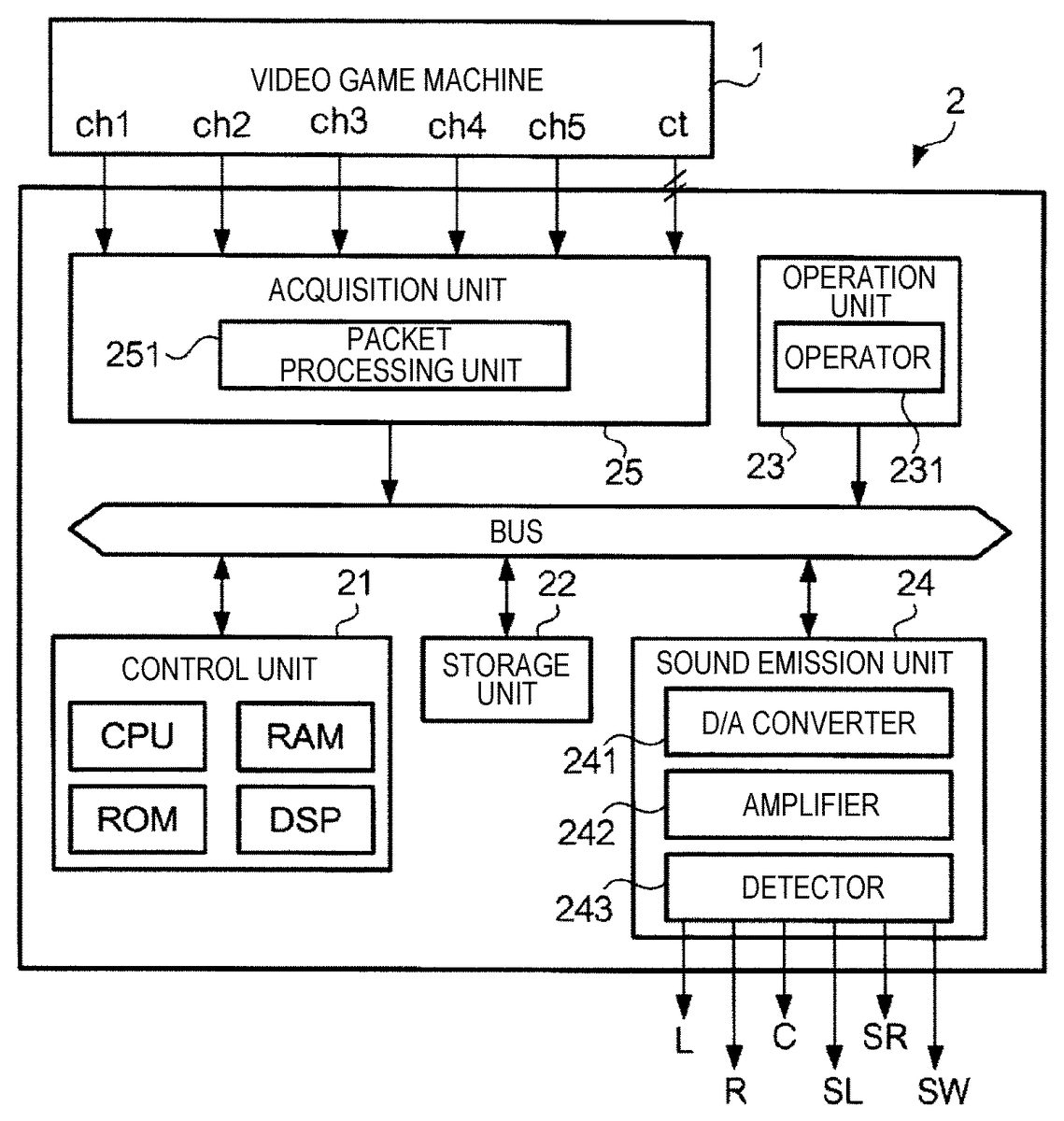
FIG. 5is a diagram showing the configuration of the audio processor2. A control unit21has a CPU, a ROM, and RAM, and controls the respective units of the audio processor2by the CPU which reads and executes a boot loader stored in the ROM or a control program stored in a storage unit22on the RAM. The control unit21includes a DSP (Digital Signal Processor) which processes original sound data acquired through an acquisition unit25on the basis of the acquired control signal. Specifically, the DSP improves sound quality of original sound indicated by original sound data, applies a sound effect, such as reverberation, to the original sound, or performs calculation for determining the localization of the original sound. Here, although the DSP is realized by hardware different from the CPU, the DSP may be realized by the CPU which executes a program. The control unit21functions as, for example, an interpretation unit210described below or the like.
The storage unit22is high-capacity storage means, such as a hard disk drive, and stores a control program which is read into the control unit21. The storage unit22may be a recording medium, such as an external nonvolatile memory. In this case, the storage unit22is connected to the audio processor2through a connection interface (not shown) or the like.
An operation unit23includes an operator231which gives various instructions. The operation unit23receives user operation and supplies an operation signal according to the operation content to the control unit21.
The acquisition unit25has a packet processing unit251. The packet processing unit251acquires a plurality of packets individually sent from the channel ch1to ch5, extracts divided original sound data from each acquired packet, and combines the divided original sound data to acquire original sound data. That is, the acquisition unit25having the packet processing unit251functions as an original sound data acquirer that is adapted to acquire original sound data indicating original sound from any channel of a plurality of channels.
The acquisition unit25acquires the control signal including the parameter of the attribute of each piece of original sound data described in association with each channel of original sound data transmitted from the video game machine1. That is, the acquisition unit25functions as a control signal acquirer that is adapted to acquire the control signal which includes the parameter indicating the content of processing on the original sound data and the correspondence relationship between the parameter and the channel for the original sound data to be processed by means of the parameter. The time stamp included in the header of the original packet is associated with the acquired original sound data. Accordingly, the DSP of the control unit21searches for original sound data associated with a time stamp corresponding to the time stamp described in the control signal or a time stamp indicating the time after the time indicated by the time stamp, and processes the original sound data on the basis of the control signal to generate processed sound data indicating a processed sound. That is, the control unit21functions as a processing section that is adapted to process original sound data acquired from each channel according to the content of processing indicated by the parameter associated with the channel by means of the control signal acquired by the control signal acquirer.
The sound emission unit24includes a D/A converter241, an amplifier242, and six output terminals. The D/A converter241converts processed sound data generated by the control unit21to analog data to acquire a processed sound. The amplifier242amplifies the acquired processed sound. The six output terminals are respectively connected to the six speakers (L, R, C, SL, SR, SW) on a one-to-one basis, and processed sound amplified by the amplifier242is transmitted to any one of the speakers and emitted. The six speakers are based on Dolby AC-3 (Registered Trademark), and function as a plurality of completely separate sound sources (sound sources corresponding to six channel signals in total of front left and right and central main signals L, R, and C, left and right surround signals SL and SR, and a subwoofer signal SW). The sound emission unit24includes a detector243which detects the directions in which the six speakers are placed centering on the position of the user. Information regarding the direction of each speaker detected by the detector243is transferred to the control unit21. Specifically, the detector243detects the directions in which the six speakers are placed centering on the position of the user. For example, the detector243acquires test sound using a sound acquirer placed at a listening point to calculate the disposition of the speakers from the delay time of the sound or the attenuation ratio of sound intensity or emits an infrared ray or the like toward a reflecting seal attached to the speaker while revolving from the listening point to measure the distance and angle, thereby detecting the direction in which each speaker is placed.
1-6. Functional Configuration of Audio Processor
FIG. 6is a diagram showing the functional configuration of the audio processor2. The control unit21reads and executes a control program stored in the storage unit22to function as an interpretation unit210, a synchronization unit211, a sound quality improvement unit212, a sound effect application unit213, and a localization processing unit214. The interpretation unit210interprets the control signal acquired by the acquisition unit25through the channel ct. That is, the interpretation unit210reads the time stamp included in the control signals and sends the time stamp to the synchronization unit211. The synchronization unit211searches for original sound data associated with a time stamp corresponding to the time stamp sent from the interpretation unit210or a time stamp indicating the time after the time indicated by the time stamp from among original sound data reconstructed from the packet using the packet processing unit251of the acquisition unit25. The synchronization unit211performs time adjustment of subsequent calculation processing such that the searched original sound data is emitted at the timing indicated by the time stamp.
The interpretation unit210reads the bit rate value, reverberation rate, and localization of original sound data transferred through the channels ch1to ch5and included in the control signal, and sends these values to the sound quality improvement unit212, the sound effect application unit213, and the localization processing unit214.
The sound quality improvement unit212acquires the bit rate value of original sound data transferred through the channels ch1to ch5from the interpretation unit210, and specifies the type of sound quality improvement processing corresponding to each bit rate value with reference to a correspondence table of the bit rate value stored in the RAM and the type of sound quality improvement processing. The specified type of sound quality improvement processing is performed on original sound data to generate sound data (first processed sound data) indicating a first processed sound.
The sound effect application unit213acquires the reverberation rate of each piece of generated first processed sound data from the interpretation unit210, and performs reverberation processing at the reverberation rate. That is, the reverberation at the reverberation rate is applied to the first processed sound data generated by the sound quality improvement processing unit212to generate sound data (second processed sound data) indicating a second processed sound.
The localization processing unit214acquires the localization of each piece of generated second processed sound data from the interpretation unit210, and with reference to information relating to the positions of the six speakers acquired in progress from the sound emission unit24, sets the volume of sound to be emitted from each of the six speakers such that the sound image is located at the localization. Accordingly, the localization processing unit214generates sound data (referred to as third processed sound data) indicating a third processed sound based on the second processed sound data.
The third processed sound data is converted to amplified analog sound signals by the D/A converter241and the amplifier242of the sound emission unit24, and the analog sound signals are respectively sent to the six speakers. Each speaker emits sound in accordance with the sent analog sound signal.
All of the sound quality improvement unit212, the sound effect application unit213, and the localization processing unit214to be realized by the control unit21are an example of a processing section that is adapted to process original sound data acquired from any channel according to the content of processing indicated by the parameter associated with the control signal acquired by the control signal acquirer.
2. Operation
Next, the operation of the audio system9will be described on the basis of the control signal shown inFIG. 4as an example.
The video game progression unit110reads a plurality of pieces of video data and sound data from the storage unit12along the video game program121to start the video game, and if the control signal shown inFIG. 4(a)is generated by the control signal generation unit112, the output unit15transmits the generated control signal to the audio processor2. If the control signal is received, the audio processor2searches for each piece of original sound data reconstructed from the packet corresponding to the time stamp (t=0.0) of the control signal, and processes each piece of original sound data on the basis of the control signal. For example, original sound which is transferred through the channel ch1is localized at an angle of 45 degrees from the user, the reverberation of 12% is applied, and sound quality improvement processing associated with 128 kbps is performed.
Next, when 2.5 seconds have elapsed from the start of the video game, the control signal shown inFIG. 4(b)is generated by the control signal generation unit112. When received the control signal, the audio processor2searches for and processes each piece of original sound data at t=2.5. A portion indicated by a thick frame inFIG. 4(b)is a portion which is changed from the control signal at t=0.0. Specifically, the localization and reverberation rate of the channel ch3and the localization of the channel ch5are changed. Accordingly, for example, at the time of t=2.5 seconds, original sound which is transferred through the channel ch3is localized at an angle of 30 degrees from the user, the reverberation of 12% is applied, and sound quality improvement processing associated with 64 kbps is performed.
Next, when 10.0 seconds have elapsed from the start of the video game, the video game machine1is temporarily in a state where operation is not received from the operation unit13. For example, for the time for explaining the story in the video game or the standby time for loading the video game program121corresponding to the next stage, the video game machine1does not receive any operation excluding the operator131for force-quit, and BGM is played as a motion image or a letter screen is displayed on the display unit14. At this time, since the game character on the video game does not have a talk, and ambient sound is not generated, the channel ch3which is heretofore allocated to “SE” as ambient sound or the channel ch4which is heretofore allocated to “SYS” as operation sound is empty. Accordingly, the video game progression unit110allocates BGM to all of the channels ch1to ch4, sets the localization of the channel ch3to 135 degrees, and sets the localization of the channel ch4to −135 degrees.
For example, when the video game machine executes video game software, such as a roll-playing game, a game character, words which are spoken by the game character, how sound echoes, and the direction in which sound is heard change depending on the progress of the video game, such as selection of a member who goes with the game character, selection of a dungeon, or selection of the direction of the face of the game character. There are various ways to listen to sound depending on the type of the sound, and if a sound effect is applied without exception, unintended sound may be heard by the user.
In the audio system9, as described above, the control signal including unprocessed original sound data and the parameter indicating the content of processing on the original sound data is sent to the audio processor2, and the original sound data is processed by the audio processor2on the basis of the corresponding parameter, thereby emitting each of a plurality of types of sound in accordance with the audio environment of the individual user.
3. Modifications
Although the embodiment has been described, the content of the embodiment may be modified as follows. Further, the following modifications may be combined.
(1) Although in the foregoing embodiment, the output unit15transmits original sound data as PCM data to the channels ch1to ch5, compressed original sound data may be transmitted. In this case, the control signal may include information indicating a compression format or a compression rate of original sound data transmitted through each channel.
(2) Although in the foregoing embodiment, the output unit15packetizes original sound data using the packet processing unit151as it is, encryption may be performed before packetization. For example, the output unit15may include a processor which performs encryption processing based on the HDCP (High-bandwidth Digital Content Protection) protocol, and the encryption function may be realized by the CPU. In this case, a mechanism for decrypting codes may be provided in the acquisition unit25of the audio processor2.
(3) Although in the foregoing embodiment, the detector243of the sound emission unit24detects the directions in which the six speakers are placed centering on the position of the user, the detector may detect information other than the direction of each speaker, may replace or add the information with the information of the direction, and may transfer the resultant information to the control unit21.
For example, the detector may detect low-frequency reproduction ability or the like of the speakers and may transfer information indicating the low-frequency reproduction ability or the like to the control unit21. In this case, the control unit21may localize the sound image on the basis of the transferred information. Specifically, in a standard configuration, when there is no speaker which should be placed at a certain position, the control unit21may control the sound emission unit24such that a plurality of speakers placed near compensate for the sound volume for the nonexistent speaker. The ratio of the sound volume of a low-frequency component to be sorted into the subwoofer may be determined in accordance with the low-frequency reproduction ability of each speaker.
(4) Although in the foregoing embodiment, the control signal generation unit112generates the control signal which describes the parameters of all attributes for original sound data output from all channels for each time stamp, a control signal which describes only a parameter for original sound data output from a channel with change may be generated. That is, only a portion indicated by a thick frame inFIGS. 4(b) and 4(c)may be transmitted to the audio processor2as a control signal in association with each time stamp. In this case, the audio processor2may not change channels and parameters which are not included in the transmitted control signal.
(5) Although in the foregoing embodiment, a configuration in which original sound data is transmitted to the audio processor2is the video game machine1, a configuration other than the video game machine may be provided. For example, a reproducer which reproduces a motion image recorded in a DVD video or the like may be provided. In this case, the reproducer switches video to be displayed in accordance with user operation, and switches the control signal corresponding to each piece of original sound data to be transmitted to the audio processor2in accordance with user operation. For example, where there is video data captured at a multi-angle, the localization of each piece of original sound data may be calculated in accordance with an angle selected by the user, and the control signal including the calculated localization may be transmitted to the audio processor2. Accordingly, when it is assumed that the face of the user is directed at the angle selected by the user, the audio processor2can localize each piece of original sound in a direction in which each original sound should be heard.
(6) Each program which is executed in the control unit11of the video game machine1and the control unit21of the audio processor2may be provided in the form of being stored in a computer-readable recording medium, such as a magnetic recording medium, for example, a magnetic tape or a magnetic disk, an optical recording medium, such as an optical disk, a magneto-optical recording medium, or a semiconductor memory. The program may be downloaded through a network, such as Internet. In regard to the control unit11and the control unit21, various devices other than the CPU may be applied as control means illustrated by the CPU, and for example, a specialized processor or the like may be used.
(7) Although in the foregoing embodiment, the video game machine1has the display unit14which displays video according to the progress of the video game, the video game machine1may not have the display unit14. For example, the video game machine1may execute video game software which deals with sound and does not display video, or may include a video terminal which is connected to an external display device and through which a video signal is supplied to a display device.
(8) Although in the foregoing embodiment, the sound emission unit24includes the six output terminals, the output terminals are respectively connected to the six speakers on a one-to-one basis, and so-called 5.1ch surround sound emission is realized, more output terminals or less output terminals may be provided. For example, output terminals corresponding to the 7.1ch system or the 2.1ch system may be provided.
(9) Although in the foregoing embodiment, the control signal generation unit112generates the parameter indicating the content of processing on original sound data according to the progress of the video game, the video game machine1may generate the parameter on the basis of information acquired from the audio processor2. In this case, the control unit11of the video game machine1has channels (hereinafter, referred to as acquisition channels) through which data is acquired from the audio processor2, as well as the channels through which data is output to the audio processor2. The control unit11acquires the sound emission conditions, such as the number of speakers of the sound emission unit24of the audio processor2, the position, or low-frequency reproduction ability, of the sound emission device which is forced to emit sound by the audio processor2through the acquisition channels. That is, the control unit11functions as a sound emission condition acquirer that is adapted to acquire the sound emission conditions of the sound emission device, which is forced to emit sound by the audio processor, from the audio processor as an output destination to which the original sound data output section outputs original sound data.
The control signal generation unit112may determine the content of processing according to the sound emission conditions acquired from the acquisition channels, and may generate the parameter.
For example, when the sound emission conditions acquired from the acquisition channels describe that no speakers corresponding to left and right surround speakers are prepared in the audio processor2, the control signal generation unit112may determine the content of processing on original sound data such that necessary sound output is constituted only by front speakers as speakers disposed on the front center, left, and right sides. Accordingly, processing which does not necessarily obtain desired effects is avoided, thereby producing stable sound.
In the above-described case, the control signal generation unit112can change control with the prospect that sound which is highly likely to be output to the left and right surround speakers is subjected to virtual processing (signal processing such that it is perceived as if there are speakers at the back by the two front speakers) in the audio processor2. Accordingly, the control signal generation unit112removes an unfavorable frequency band such that the localization at the back is perceived or provides processed sound data indicating processed sound for virtual processing in progress, for example, intentionally provides a phase difference between the left and right sides to increase a sense of width, thereby obtaining optimum effects.
When the sound emission conditions acquired from the acquisition channels describe that the low-frequency reproduction ability of the left and right surround speakers is lower than a threshold value, the control signal generation unit112may extract processed sound, which is likely to be emitted using the left and right surround speakers, using a low-pass filter, and may determine the content of processing on original sound data such that sound is emitted to the subwoofer. Accordingly, when moving the sound image, it is possible to avoid the occurrence of a sense of discomfort with a sense of direction in the middle-high range and the low range depending on the low-frequency reproduction ability of the speakers.
In short, the video game machine1may function as an information processor including a sound emission condition acquirer that is adapted to acquire the sound emission conditions of the sound emission device, which is forced to emit sound by the audio processor, from an audio processor as a destination to which original sound data output section outputs original sound data, and a generator that is adapted to generate the parameter in accordance with the sound emission conditions acquired by the sound emission condition acquirer and user operation.
Various configurations may be applied when the video game machine1acquires the device sound emission conditions of the sound emission device, which is forced to emit sound by the audio processor2, from the audio processor2through the acquisition channels. As such as configuration, for example, (i) a configuration in which, when the video game machine1is connected to the audio processor2or when the parameter is generated, a request signal indicating a request for the device sound emission conditions is sent to the audio processor2, and the audio processor2sends a reply signal indicating the device sound emission conditions as a reply to the request signal, (ii) a configuration in which the device sound emission conditions detected by the audio processor2are output to the video game machine1in advance when being connected to the video game machine1, (iii) a configuration in which the device sound emission conditions detected by the audio processor2are output to the video game machine1at a regular interval, or the like may be made.
That is, the audio processor2may function as an audio processor including an original sound data acquirer that is adapted to acquire original sound data indicating original sound from an information processor through any channel of a plurality of channels, a control signal acquirer that is adapted to acquire a control signal which includes a parameter indicating the content of processing of original sound data and the channel of original sound data to be processed by means of the parameter, a processing section that is adapted to process an original sound data acquired from the channel according to the content of processing indicated by the parameter associated with the channel by means of the control signal acquired by the control signal acquirer, and a condition output section that is adapted to output, to the information processor, the sound emission conditions when processed sound data obtained by processing the original sound data using the processing section is emitted to a sound emission device.
(10) Although in the foregoing embodiment, the video game progression unit110progresses the video game according to user operation along the video game program121, the content of the video game program121may be, for example, as follows.
The video game program121describes a virtual space, and a game character and a sound generating object disposed in the virtual space. Data which express the virtual space, the game character, and the sound generating object is stored in the RAM of the control unit11when the video game program121is read and executed by the control unit11. If received user operation, the video game progression unit110performs calculation according to the operation to change data on the RAM. Accordingly, the game character in the virtual space is operated in accordance with user operation, and the video game is progressed. The operated game character takes a posture according to user operation in the virtual space or moves to a position according to the operation.
For a game character which is disposed in the virtual space, the listening position where sound emitted in the virtual space is heard is defined. The original sound data generation unit111calculates and generates original sound data indicating original sound set for a sound generating object based on the relationship between the listening position defined for the game character and the sound generating object disposed in the virtual space. The output unit15packetizes a plurality of pieces of original sound data calculated and generated by the original sound data generation unit111, and outputs the packets to the audio processor2by means of the individual channels. The control signal generation unit112generates a control signal which includes a parameter indicating the content of processing of each piece of original sound data in association with each channel in the output unit15of each piece of original sound data. The parameter is determined in accordance with the progress of the video game and user operation, and how the user listens to original sound indicated by the original sound data is designated by means of the parameter. The output unit15outputs the generated control signal to the audio processor2.
(11) Although in the foregoing embodiment, the output unit15transmits original sound data to the channels ch1to ch5, the number of channels through which original sound data is transmitted is not limited to five. The number of channels may be equal to or smaller than four or may be equal to or greater than six.
REFERENCE SIGNS LIST
1: video game machine,11: control unit,110: video game progression unit,111: original sound data generation unit,112: control signal generation unit,12: storage unit,121: video game program,13: operation unit,131: operator,14: display unit,15: output unit,151: packet processing unit,2: audio processor,21: control unit,210: interpretation unit,211: synchronization unit,212: sound quality improvement unit,213: sound effect application unit,214: localization processing unit,22: storage unit,23: operation unit,231: operator,24: sound emission unit,241: D/A converter,242: amplifier,243: detector,25: acquisition unit,251: packet processing unit,9: audio system
Claims
- An information processor configured to be connected to an audio processor through a plurality of channels in parallel, the information processor comprising: a generator that is configured to generate original sound data indicating an original sound as a basis for a processed sound to be heard by a user and a parameter indicating a content of processing on the original sound data;an original sound data output section that is configured to output the original sound data generated by the generator from some channels of the plurality of channels;and a control signal output section that is configured to output a control signal in parallel with the original sound data from a channel of the plurality of channels other than the channels from which the original sound data is output, the control signal including the parameter indicating the content of processing on the original sound data and a correspondence relationship between the parameter and at least one of the channels from which the original sound data to be processed by way of the parameter is output;and a video game progressing section that is configured to progress a video game, wherein the generator is configured to generate the original sound data according to a progress of the video game progressed by the video game progressing section and the parameter for the original sound data, and wherein the information processor and the audio processor are separate and discrete units.
- The information processor according to claim 1 , wherein the generator is configured to generate plural pieces of original sound data, and an individual parameter indicating a content of processing on each piece of original sound data, and the original sound data output section is configured to output the plural pieces of original sound data generated by the generator to respective channels.
- The information processor according to claim 1 , wherein the video game progressing section is configured to progress the video game depending on user's operation.
- The information processor according to claim 1 , further comprising: a sound emission condition acquirer that is configured to acquire sound emission conditions of a sound emission device, which is forced to emit sound by an audio processor, the sound emission conditions being acquired from the audio processor serving as an output destination at which the original sound data output section outputs the original sound data, wherein the generator is configured to generate the parameter depending on the sound emission conditions acquired by the sound emission condition acquirer and the progress of the video game.
- An audio processing system, comprising an information processor and an audio processor connected to each other through a plurality of channels in parallel, wherein the information processor includes: a generator that is configured to generate original sound data indicating an original sound as a basis for a processed sound to be heard by a user and a parameter indicating a content of processing on the original sound data;an original sound data output section that is configured to output the original sound data generated by the generator from some channels of the plurality of channels;and a control signal output section that is configured to output a control signal in parallel with the original sound data from a channel of the plurality of channels other than the channels from which the original sound data is output, the control signal including the parameter indicating the content of processing on the original sound data and a correspondence relationship between the parameter and at least one of the channels from which the original sound data to be processed by way of the parameter is output, and the audio processor includes: an original sound data acquirer that is configured to acquire the original sound data through the channels from the original sound data output section of the information processor;a control signal acquirer that is configured to acquire the control signal from the control signal output section of the information processor via the channel other than the channels from which the original sound data is acquired;and a processing section that is configured to process the original sound data acquired from the at least one channel according to the content of processing indicated by the parameter associated with the at least one channel by way of the control signal acquired by the control signal acquirer.
- A non-transitory computer-readable storage medium in which is stored a program which causes a computer of an information processor, configured to be connected to an audio processor through a plurality of channels in parallel, to function as: a generator that is configured to generate original sound data indicating an original sound as a basis for a processed sound to be heard by a user and a parameter indicating a content of processing on the original sound data;an original sound data output section that is configured to output the original sound data generated by the generator from some channels of the plurality of channels;a control signal output section that is configured to output a control signal in parallel with the original sound data from a channel of the plurality of channels other than the channels from which the original sound data is output, the control signal including the parameter indicating the content of processing on the original sound data and a correspondence relationship between the parameter and at least one of the channels from which the original sound data to be processed by way of the parameter is output;and a video game progressing section that is configured to progress a video game, wherein the generator is configured to generate the original sound data according to a progress of the video game progressed by the video game progressing section and the parameter for the original sound data, and wherein the information processor and the audio processor are separate and discrete units.
- A non-transitory computer-readable storage medium in which is stored a video game program which causes a computer of a video game machine, configured to be connected to an audio processor through a plurality of channels in parallel, to function as: a video game progressing section that is configured to operate a game character in a virtual space depending on user's operation to progress a video game;an original sound data generator that is configured to calculate and generate original sound data indicating an original sound as a basis for processed sound to be heard by the user set for a sound generating object based on a relationship between a hearing position set in correspondence with the game character and the sound generating object disposed in the virtual space;a parameter generator that is configured to generate a parameter indicating a content of processing on the original sound data generated by the original sound data generator in accordance with the progress of the video game progressed by the video game progressing section;an original sound data output section that is configured to output the original sound data generated by the original sound data generator from some channels of the plurality of channels;and a control signal output section that is configured to output a control signal in parallel with the original sound data from a channel of the plurality of channels other than the channels from which the original sound data is output, the control signal including the parameter indicating the content of processing on the original sound data and a correspondence relationship between the parameter and at least one of the channels from which the original sound data to be processed by way of the parameter is output.
Disclaimer: Data collected from the USPTO and may be malformed, incomplete, and/or otherwise inaccurate.