U.S. Pat. No. 9,662,580
Video Game in which Groups of Players Earn Reward Boxes
AssigneeGREE, Inc.
Issue DateJune 24, 2014
Illustrative Figure
Abstract
A social game capable of adding or improving unexpectedness, dramatic impact, and taste when a reward is provided to a player, and hence capable of raising the player's motivation to participate in or continue the game. A unit for storing information related to a game in which multiple players can participate stores a reward providing condition, rewards, and reward box information, and a control unit for accessing information related to the game, performing computation on the game, and displaying images of the game on terminal devices operated by players allocates at least one reward out of the rewards to the reward box, determines whether the reward providing condition is met based on match-up situations or match-up results between players and first game characters in the game, and displays, on the terminal devices, a screen for providing the reward to players based on the determination results.
Description
DETAILED DESCRIPTION A first embodiment of the invention will be described in detail below. Note that the embodiment below is intended only to be by way of example to describe the invention, and the invention is not limited to the embodiment alone. Various modifications are possible as long as the gist of the invention is not changed. Further, those skilled in the art can adopt any other embodiment in which each component or element to be described below is replaced with an equivalent one, and such an embodiment is included in the scope of the invention. Positional relations, such as left, right, top, and bottom, indicated as needed are based on those shown in the drawings unless otherwise noted. Note further that various dimension ratios in the drawings are not limited to the dimension ratios shown. In order to facilitate the understanding, the following description will take, as an example, one embodiment in which the invention is carried out by using a game information processing apparatus, but as mentioned above, the invention is not limited thereto. FIG. 1is a schematic block diagram (system block diagram) showing one preferred embodiment of a server disclosed herein.FIG. 2is a schematic block diagram (system configuration diagram) showing one preferred embodiment of a game system disclosed herein. As shown in these figures, a server100is a server computer connected to a network200, and a predetermined server program is run on the server computer to fulfill a server function. Further, the server100and terminal devices2such as client computers21and mobile terminals22, connected by wire and/or wireless to the network200, are set up to be communicable with one another to configure a game system1. The network200is a communication line or a communication network relating to information processing such as the Internet, and a specific structure thereof is not particularly limited ...
DETAILED DESCRIPTION
A first embodiment of the invention will be described in detail below. Note that the embodiment below is intended only to be by way of example to describe the invention, and the invention is not limited to the embodiment alone. Various modifications are possible as long as the gist of the invention is not changed. Further, those skilled in the art can adopt any other embodiment in which each component or element to be described below is replaced with an equivalent one, and such an embodiment is included in the scope of the invention. Positional relations, such as left, right, top, and bottom, indicated as needed are based on those shown in the drawings unless otherwise noted. Note further that various dimension ratios in the drawings are not limited to the dimension ratios shown. In order to facilitate the understanding, the following description will take, as an example, one embodiment in which the invention is carried out by using a game information processing apparatus, but as mentioned above, the invention is not limited thereto.
FIG. 1is a schematic block diagram (system block diagram) showing one preferred embodiment of a server disclosed herein.FIG. 2is a schematic block diagram (system configuration diagram) showing one preferred embodiment of a game system disclosed herein. As shown in these figures, a server100is a server computer connected to a network200, and a predetermined server program is run on the server computer to fulfill a server function. Further, the server100and terminal devices2such as client computers21and mobile terminals22, connected by wire and/or wireless to the network200, are set up to be communicable with one another to configure a game system1.
The network200is a communication line or a communication network relating to information processing such as the Internet, and a specific structure thereof is not particularly limited as long as the network200enables the exchange of data between the server100and the terminal devices2. For example, the network200may comprise a base station wirelessly connected to the terminal devices2, a mobile communication network connected to the base station, the Internet connected to the server, and a gateway device for connecting the mobile communication network and the Internet.
The server100is configured to comprise an arithmetic processing unit101such as a CPU or an MPU, a ROM102and a RAM103as storage devices, an external interface104to which an input unit105and an external memory106are connected, and an image processing unit107to which a display monitor111is connected. The server100is also configured such that a slot drive108into or to which a disk or a memory device is loaded or connected, an audio processing unit109to which a speaker device112is connected, and a network interface110are connected to one another through a transmission path120such as a system bus, including, for example, an internal bus, an external bus, and an expansion bus. Note that devices responsible for input/output of the input unit105, the external memory106, the display monitor111, and the speaker device112may be omitted appropriately as needed, or even when these devices are included, they may not always be connected to the transmission path120.
The arithmetic processing unit101controls the entire operation of the server100not only to exchange control signals and information signals (data) with the other components mentioned above, but also to perform various arithmetic processing necessary to execute a game. Therefore, the arithmetic processing unit101is configured to be able to perform, on a fast-accessible storage area such as a so-called register, arithmetic operations such as addition, subtraction, multiplication and division using an arithmetic logical unit or the like, logical operations such as logical OR, logical AND, and logical NOT, bitwise operations such as bitwise OR, bitwise AND, bitwise invert, bitwise shift, and bitwise rotate, and if desired, a saturation calculation, a trigonometric function calculation, a vector operation, and the like.
An IPL (Initial Program Loader) first executed after power-on is generally recorded in the ROM102. This IPL is executed so that the arithmetic processing unit101will read a server program and a game program once into the RAM103to execute the programs, where the programs are recorded on a disk or in a memory device loaded in or connected to the slot drive108. An operating system program necessary to control the entire operation of the server100and other various data are also recorded in the ROM102.
The RAM103is to store the server program, the game program, and various data temporarily. In addition to the server program and game program read as mentioned above, data necessary to the progress of the game and communication between two or more terminal devices2are held in the RAM103. The arithmetic processing unit101sets a variable area in the RAM103to perform direct operations using the arithmetic logical unit on values stored in the variable area as well. Further, the arithmetic processing unit101once copies or moves the values stored in the RAM103to the register to perform direct operations on the register and further perform processing for writing these operation results back to the RAM103.
The input unit105connected through the external interface104is to accept various operations input by a user (game provider) of the server100. As the input unit105, a voice input unit can be employed as well as a keyboard, a touch pad, and a touch panel. The kind of device as the input unit105is not particularly limited as long as the device can input instructions, such as various operations, a confirmation operation, a cancel operation, and the display of a menu.
Rewritably stored in the RAM103and the external memory106, removably connected through the external interface104, are data indicative of the operating conditions of the server100, the access status of each terminal device2, and the game playing conditions and the status of progress (the results in the past, and the like) on each terminal device2, log (record) data on communication between terminal devices2, and the like.
The image processing unit107has the arithmetic processing unit101process the various data read from the slot drive108or processes the various data by itself, and records processed image information in a frame memory or the like. The image information recorded in this frame memory is converted to a video signal at predetermined synchronization timing, and output to the display monitor111connected to the image processing unit107. This enables various images to be displayed. Further, in cooperation with the arithmetic processing unit101, image information on a game is sent from the image processing unit107and/or the arithmetic processing unit101to each terminal device2.
The audio processing unit109converts the various data read from the slot drive108into audio signals, and outputs the audio signals from the speaker device112connected to the audio processing unit109. Further, in cooperation with the arithmetic processing unit101, audio information on the game (sound effects and music information) is sent from the audio processing unit109and/or the arithmetic processing unit101to each terminal device2.
The network interface110is to connect the server100to the network200. The network interface110is configured to comprise, for example, an analog modem, an ISDN modem, or an ADSL modem, which conforms to each standard used in establishing a LAN, a cable modem for connection to the Internet using a cable TV line, and the like, and an interface for connecting these to the arithmetic processing unit101through the transmission path120.
One preferred embodiment of a game (social game) implemented in the game system1configured as such and the server100according to a game program of the invention disclosed herein will be described below.
FIG. 3is a flowchart showing part of a game procedure performed on the server in the first embodiment of the invention, particularly showing a flow focused on the evolution of a game screen to be displayed on a terminal device2operated by a player.
Note that various processing (image or screen display, determination, calculation, and the like) in the procedure mentioned below is performed based on control instructions from the arithmetic processing unit101of the server100. In other words, the arithmetic processing unit101functions as a “control unit” in the present invention. Further, various storage media with game information recorded thereon in addition to the ROM102, the RAM103, and the external memory106mentioned above correspond to an “information storage unit” in the invention.
Here, when a player starts a game, the player first operates a terminal device2(a client computer21or a mobile terminal22, or a tablet terminal or a smartphone) to connect the terminal device2to the server100through the network200such as the Internet. The player further operates the terminal device2to select a game provided from the server100or enter login information such as an ID number or a personal identification number on a platform screen before the selection of the game. When recognizing the login information, the arithmetic processing unit101of the server100displays, on the terminal device2, my page unique to the player associated with the ID number (step S1shown inFIG. 3).
Next, when the player selects a desired event from a list of at least one event displayed on the terminal device2, a preparation screen for the event is displayed on the terminal device2as shown inFIG. 4(step S2shown inFIG. 3).
Note that the player can voluntarily select the event from the list of at least one event as mentioned above, or the player can automatically participate in a current ongoing event after logging in. Thus, there is no particular limitation on whether the participation of the player in the event is active or passive.
The name of a player character Ca is displayed at the top ofFIG. 4. A facial image and a comment about the player character Ca are displayed in the middle ofFIG. 4. For example, a comment to urge the player to participate in the event is displayed. Further, an image indicating what kind of event is taking place is displayed in a lower part ofFIG. 4. For example, as shown in the lower part ofFIG. 4, the player knows that a winner-take-all reward event is taking place, and that 300 medals are potentially acquired as the reward the winner can take all. A button image for confirming the participation in the event is also displayed. When selecting this button on the screen, the player can participate in the event.
Upon completion of the preparation for the selected event in the arithmetic processing unit101shown inFIG. 1, an introduction screen for the event is displayed on the terminal device2as shown inFIG. 5(step S3shown inFIG. 3).
As the event introduction screen displayed on the terminal device2, for example, a string of characters such as “Winner-take-all chance against enemy character A” is displayed on the terminal device2as shown at the top ofFIG. 5to let the player know that the reward can be acquired by defeating enemy character A. Treasure boxes B and C other than treasure box A corresponding to group A to which the player belongs are also displayed in the middle ofFIG. 5. A display that lets the player belonging to a group A know its own belonging group can also be provided. For example, treasure box A may be more brightened or displayed larger than the other treasure boxes B and C, or a character string may be attached near the image of treasure box A. Further, the name of any player character that has acquired a reward in a past event and acquired reward (medals and/or various items other than the medals) are displayed as shown at the bottom ofFIG. 5. The winner history may be displayed using a pop-up or a flash in addition to characters or an image.
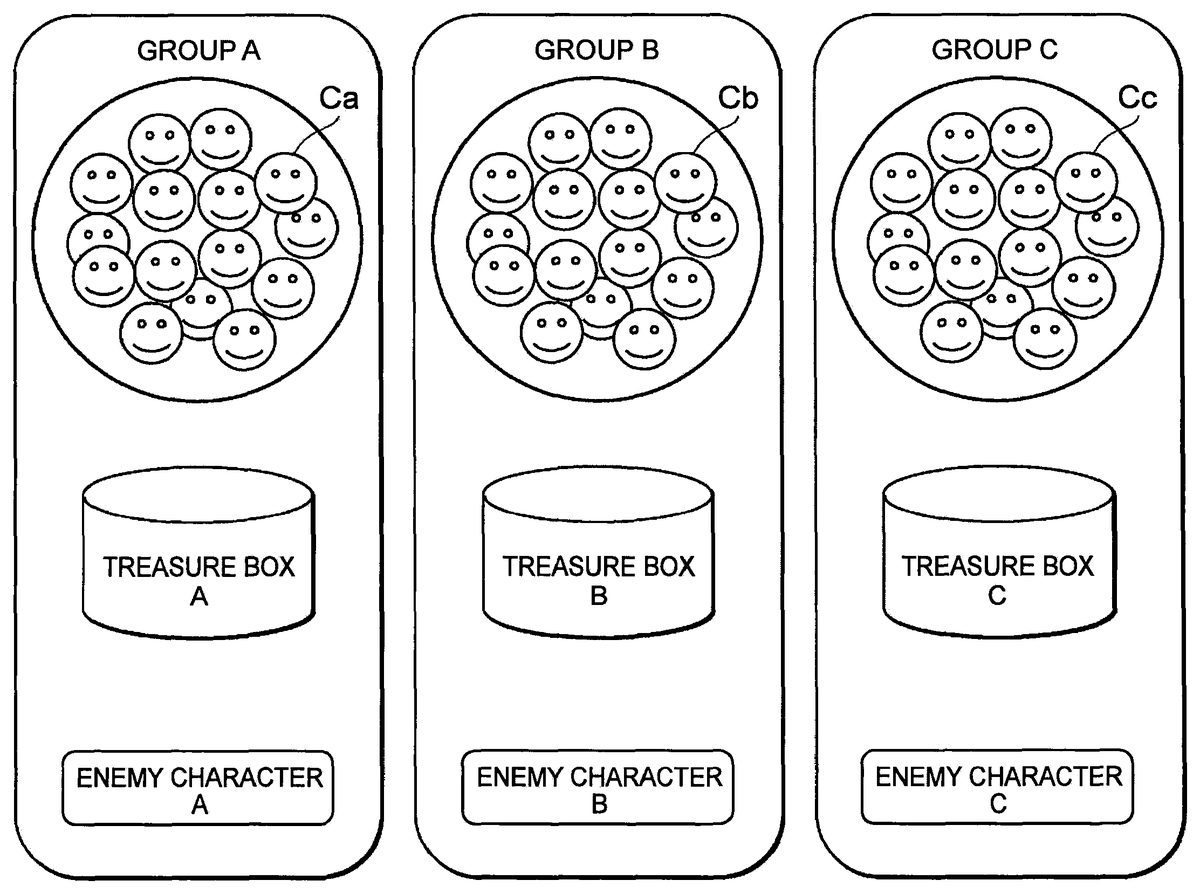
FIG. 6shows a conceptual diagram of grouping of groups, treasure boxes, and enemy characters. As shown inFIG. 6, a group A to which at least one player character belongs, a treasure box A, and an enemy character A are associated with one another. Like the group A, groups B and C are also associated with respective treasure boxes and enemy characters as shown inFIG. 6. As will be described in detail later, when a player (player character Ca) belonging to the group A defeats the enemy character A associated with the group A, the player can acquire a reward stored in the treasure box A.
There are more ways of association than the association among the group, the treasure box, and the enemy character mentioned above. For example, two or more groups may be associated with one kind of enemy character or one enemy character, or two or more groups may be associated with one treasure box, or a single group may be associated with at least one treasure box and enemy character.
Upon completion of the introduction of the event, a screen on which an enemy character associated with the event appears is displayed on the terminal device2(step S4shown inFIG. 3). This game is so configured that the enemy character and a player or a player character fight a battle with each other, and when the player or the player character wins the battle, the player can acquire a reward.
Therefore, after the enemy character is displayed, the player makes an attack on the enemy character or defends against an attack from the enemy character in the game. The player further uses various items (such as a summon card and a performance boosting card) that exhibit various other effects, or uses a player character such as an ally monster that makes an attack face to face with the enemy character to fight with the enemy character. A game screen of the fighting state may also be displayed on the terminal device2.
Next, the arithmetic processing unit101shown inFIG. 1determines whether the player or the player characters has defeated the enemy character (e.g., a boss character that is the last to appear) (a determination condition associated with a predetermined event) (step5shown inFIG. 3). The determination method is not particularly limited. For example, a numerical comparison operation can be performed to compare the numerical values of parameters, i.e., it can be determined that the enemy character has been defeated when the numeric value of a parameter corresponding to the physical strength (such as a hit point or life) of the enemy character becomes less than a predetermined threshold value or zero as a result of receiving an attack from the player or the player character.
FIG. 7is a conceptual diagram showing a flow of providing a reward. As shown inFIG. 7, the player (player character Ca) belonging to the group A can acquire the whole reward (take all) stored in the treasure box A by defeating the enemy character A. A flow of providing a reward to a player after an enemy character is defeated will be described in detail below by taking a case where the player belonging to the group A has defeated the enemy character A.
First, medals as a reward are allocated to each of the treasure boxes A, B, and C, respectively. In addition to the medals, prize items (such as player character's cards and various items available in the game) may also be allocated.
In this case, the medals allocated to the treasure box A and the medals allocated to the treasure boxes B and C may be set as reward groups (medal groups) different from each other. Further, the respective medal groups may be so set that the rarity of medals allocated to the treasure box A will be higher than the rarity of medals allocated to the treasure boxes B and C.
Specifically, the arithmetic processing unit101of the server100shown inFIG. 1allocates medals to respective treasure boxes based, for example, on at least any one of the following predetermined conditions: the game elapsed time, the number of enemy characters defeated by the player, the progress of the game (such as the number of events, dungeons, or quests completed), the kind of a predetermined event (such as the level of a selected event or the number of times of the event), the kind of treasure box, the state of the player character (such as physical strength, experience point, and the number of possessed items), and items possessed by the player character (such as the ability of each item and the number of items).
Then, the arithmetic processing unit101shown inFIG. 1determines whether there is at least one medal in the treasure box A (step6shown inFIG. 3). When there is any medal, the procedure proceeds to step7shown inFIG. 3, while when there is no medal, the player can acquire no medal, and hence the game is eventually ended. The determination as to whether to proceed to step7shown inFIG. 3may be made based on criteria to determine the game elapsed time or whether a predetermined number of medals or more are allocated to the treasure box A.
Next, the arithmetic processing unit101shown inFIG. 1determines the probability of providing the medals allocated to the treasure box A to the player (player character Ca) unconditionally or based on a predetermined condition prior to or when providing the medals to the player (player character Ca) defeating the enemy character A and belonging to the group A.
Specifically, the arithmetic processing unit101of the server100shown inFIG. 1determines the probability of providing the medals based, for example, on at least any one of the following predetermined conditions: the number of enemy characters defeated by the player (player character Ca), the state of the enemy character defeated by the player (player character Ca), and the state of the player (player character Ca) when a given number of medals are allocated to the treasure box A.
Then, the arithmetic processing unit101shown inFIG. 1determines whether the player (player character Ca) wins a winner-take-all medal lottery (step7shown inFIG. 3). When the player (player character Ca) wins, all the medals (300 medals as disclosed herein) allocated to the treasure box A are provided to the player (player character Ca), while when the player (player character Ca) does not win, the player (player character Ca) can acquire no medal, and hence the game is eventually ended. Note that the way to provide the reward may be to provide all the medals allocated to the treasure box A or to provide a large number of medals to such an extent that the player can win a come-from-behind victory in relation to the other players, rather than all the medals allocated to the treasure box A.
Next, when the player (player character Ca) wins the winner-take-all medal lottery and hence all the medals allocated to the treasure box A (300 medals as disclosed herein) are provided to the player (player character Ca), the arithmetic processing unit101shown inFIG. 1displays, on the terminal device2, a medal from the treasure box A providing screen is displayed as shown inFIG. 8(step8shown inFIG. 3).
Further, when all the medals allocated to the treasure box A (300 medals as disclosed herein) are provided to the player (player character Ca), the arithmetic processing unit101shown inFIG. 1displays, on the terminal device2, images including the other treasure boxes (treasure boxes B and C) after the medals are provided from the treasure box A as shown inFIG. 9(step9shown inFIG. 3). Specifically, the word “zero” is attached below the image of the treasure box A as shown in the middle ofFIG. 9. Then, the treasure boxes B and C are displayed to indicate that the medals remain in the treasure boxes B and C, and the “winner-take-all chance” event still continues.
The winner history is displayed together at the bottom ofFIG. 9. For example, when the player (player character Ca) won a prize and has just acquired the medals as shown at the bottom ofFIG. 9, a display is provided to let players know that the player (player character Ca) has acquired all the medals allocated to the treasure box A. Note that the winner history is not limited to the display of the most recent winner information alone, and the history of past winners may also be displayed. Specifically, the names of any player characters that acquired rewards in the past events and the acquired rewards (such as medals and/or various items other than the medals) are displayed. Further, the winner history may be displayed using a pop-up or a flash in addition to texts or an image.
Thus, according to the embodiment, unexpectedness, dramatic impact, and taste can be added or improved when medals or game items as a reward are provided to a player as mentioned above, and this can lead to providing a social game capable of raising the player's motivation to participate in the game or continue the game.
[Other Embodiments]
As mentioned above, the invention disclosed herein is not limited to the aforementioned embodiment and the variations already mentioned, and various modifications are possible without departing from the scope of the invention. For example, the disclosure shows that the player (player character Ca) belonging to the group A can acquire the whole reward (take all) stored in the treasure box A by defeating the enemy character A, but a player (player character Cb) belonging to the group B as shown inFIG. 6may be able to acquire the whole reward (take all) stored in the treasure box B by defeating an enemy character B. Further, a player (player character Cc) belonging to the group C may be able to acquire the whole reward (take all) stored in the treasure box C by defeating an enemy character C.
The configuration of the server100shown inFIG. 1is also adapted to the client computer21and the mobile terminal22as terminal devices2despite some differences in throughput and the like. In other words, the client computer21and the mobile terminal22can be used as servers100, i.e., any of computers connected through the network200can function as a server.
Further, in the server100, mass-storage devices such as a hard disk and an SSD may be used to perform functions equivalent to those of the ROM102, the RAM103, the external memory106, and the memory device loaded into the slot drive108. These storage devices may not be made redundant by a RAID, or may not be connected to the arithmetic processing unit101through the transmission path120. For example, these storage devices may be connected to any other external apparatus through the network200as part of cloud computing.
Further, the network interfaces in the server100and the terminal device2may be either of wireless LAN devices and wired LAN devices, and the network interfaces may be internally mounted, or may be of an external device type such as a LAN card. Further, a game machine connectable to the network200may be used as the terminal device2.
As described above, the control apparatus, the control method, the computer-readable recording medium, and the game system disclosed herein can add or improve unexpectedness, dramatic impact, and taste when game items or the like as a reward are provided to a player, and this can lead to providing a social game capable of raising the player's motivation to participate in the game or continue the game. Therefore, it is possible to make wide and effective use of the invention disclosed herein for games in general (particularly including social game elements), which are delivered, provided, and performed particularly in a server-client type network structure, software and hardware related technologies in general, which are related to delivering, providing, and performing the games, and further activities of designing, manufacturing, and selling the games.
DESCRIPTION OF REFERENCE NUMERALS
1: game system2: terminal device21: client computer (terminal device)22: mobile terminal (terminal device)100: server101: arithmetic processing unit (control unit)102: ROM (information storage unit)103: RAM (information storage unit)104: external interface105: input unit106: external memory107: image processing unit108: slot drive109: audio processing unit110: network interface111: display monitor112: speaker device120: transmission path200: network (communication line)
Claims
- A control method for a computer network, comprising: storing, by a memory for storing information related to a game in which a plurality of players can participate, information defining a plurality of groups to which said players belong, a reward providing condition, rewards, and reward box information for a plurality of reward boxes each associated exclusively with a respective one of said groups, as part of the information related to the game;and by an arithmetic processor, performing computation on the game, and displaying images of the game on terminal devices operated by the players allocating at least one reward out of the rewards to at least one of the reward boxes, determining whether the reward providing condition is met based on match-up situations or match-up results between the players and first game characters in the game, and displaying, on the terminal devices, a screen for providing the reward allocated to at least part of one of the reward boxes to at least one player in the group associated with the one of the reward boxes based on the determination results.
- The control method according to claim 1 , wherein each of the players belongs to at least one of groups, and each of the groups is associated with at least one of the first game characters in the game and a respective one of the reward boxes, and the arithmetic processor determines whether the reward providing condition is met based on a match-up situation or match-up result between one of the players and the first game character, and provides the whole of the reward allocated to the reward box associated with the group to which that player belongs to the player based on the determination result.
- The control method according to claim 1 , wherein the arithmetic processor controls the allocation of the reward based on at least any one of the following: an elapsed time of the game, the number of first game characters defeated by the player, progress of the game, the kind of event in the game, the kind of reward box, a state of a second game character corresponding to the player, and an item possessed by the second game character.
- The control method according to claim 1 , wherein the arithmetic processor determines a probability of providing, to the player, the reward allocated to the associated reward box unconditionally or based on a predetermined condition prior to or when providing the reward to the player.
- The control method according to claim 1 , wherein the predetermined condition is at least any one of the following: the number of first game characters defeated by the player, a state of the first game character defeated by the player, and a state of a second game character corresponding to the player when a fixed amount of the reward is allocated to the reward box.
- The control method according to claim 1 , wherein the arithmetic processor displays, on the terminal devices, a history of providing the reward to the player.
- A non-transitory computer-readable recording medium recording processes for causing a computer to perform, wherein the computer is accessible to a memory for storing information related to a game in which a plurality of players can participate, and storing a reward providing condition, rewards, and reward box information as part of the information related to the game: accessing the information related to the game, performing computation on the game, and displaying images of the game on terminal devices operated by the players;associating a plurality of reward boxes exclusively to respective groups of the players;allocating at least one reward out of the rewards to at least one of the reward boxes;determining whether the reward providing condition is met based on match-up situations or match-up results between the players and first game characters in the game, and displaying, on the terminal devices, a screen for providing the reward allocated to at least part of one of the reward boxes to at least one player in the group associated with the one of the reward boxes based on the determination results.
- A control apparatus comprising: a memory for storing information related to a game in which a plurality of players can participate;and an arithmetic processor for accessing the information related to the game, performing computation on the game, and displaying images of the game on terminal devices operated by the players, wherein the memory holds a reward providing condition, rewards, and reward box information relating to a plurality of reward boxes, each associated exclusively with a respective group of players, as part of the information related to the game, and the arithmetic processor allocates at least one reward out of the rewards to at least one of the reward boxes, determines whether the reward providing condition is met based on match-up situations or match-up results between the players and first game characters in the game, and displays, on the terminal devices, a screen for providing the reward allocated to at least part of one of the reward boxes to at least one player in the group associated with the one of the reward boxes based on the determination results.
- A game system comprising: a control apparatus further comprising a memory for storing information related to a game in which a plurality of players can participate, and an arithmetic processor for accessing the information related to the game, performing computation on the game, and displaying images of the game on terminal devices operated by the players, wherein the memory holds information defining a plurality of groups to which said players belong, a reward providing condition, rewards, and reward box information for a plurality of reward boxes each associated exclusively with a respective one of said groups as part of the information related to the game, and the arithmetic processor allocates at least one reward out of the rewards to the reward box, determines whether the reward providing condition is met based on match-up situations or match-up results between the players and first game characters in the game, and displays, on the terminal devices, a screen for providing the reward allocated to at least part of one of the reward boxes to at least one player in the group associated with the one of the reward boxes based on the determination results;and the terminal devices.
- A control apparatus comprising: a non-transitory memory for storing information related to a game in which a plurality of players can participate, and storing information defining a plurality of groups to which said players belong, a reward providing condition, rewards, and reward box information for a plurality of reward boxes each associated exclusively with a respective one of said groups as part of the information related to the game;an arithmetic processor for accessing the information related to the game, performing computation on the game, and displaying images of the game on terminal devices operated by the players, and for allocating at least one reward out of the rewards to the reward box, and determining whether the reward providing condition is met based on match-up situations or match-up results between the players and first game characters in the game;and a display controller for displaying, on the terminal devices, a screen for providing the reward allocated to at least part of one of the reward boxes to at least one player in the group associated with the one of the reward boxes based on the determination results.
Disclaimer: Data collected from the USPTO and may be malformed, incomplete, and/or otherwise inaccurate.