U.S. Patent no. 9,656,170: Game apparatus
Issued May 23, 2017 to Kabushiki Kaisha Square Enix
Priority Date June 27, 2013
Summary:
U.S. Patent No. 9,656,170 (the ‘170 Patent) relates to progression in a video game where a player character fights a virtual battle with a powerful enemy character. The current invention attempts to solve issues in role-playing video games associated with these character progression battles. The ‘170 Patent attempts to increase the realism and engagement with the game by increasing the variation in results of these battles. Reproducing the same actions will not necessarily reach the same result every time. This increases the difficulty and tension of the battle as the player struggles to overcome the enemy. A player may interact with an in-game object during this battle and it could have an effect on the player’s chances of winning the battle. For example, in a battle with an enemy dragon a player could drag a nearby chain to interact with the monster that would allow for an improved chance at victory. This chance at victory can be expressed using a gauge that displays on the screen which changes throughout the battle depending on the character’s actions. The game apparatus and controlling computer system would work together to increase realism and engagement with games thereby improving the end product overall.
Abstract:
The present invention provides a game apparatus in which the variation width of a computation result in a battle between a player character and an enemy character is increased, and a difference in result can be brought about even with the same attack by a player’s operation, and furthermore, a player can play a game while he/she feels the sense of realism and tension where he/she manipulates the character that is difficult to manipulate as intended. A chain used by a main character to manipulate a dragon is displayed on a display screen. A player manipulates the dragon by loosening or tightening the chain by performing an operation on a touch panel. The control level of the dragon is represented by an uncontrollability parameter. A status such as the offensive power of the dragon changes according to the uncontrollability parameter.
Illustrative Claim:
1. A game apparatus for progressing a game in which a player character does a virtual battle with an enemy character, the player character being a subject for operation performed by a player, the game apparatus comprising: a display; an input for receiving an operating instruction performed by the player; a processor; and a memory including a set of instructions that, when executed by the processor, causes the processor to perform operations including: determining a predetermined threshold, according to an item owned or carried by the player character or by a second player character being a companion of the player character; changing a parameter of the player character, according to the operating instruction received by the input from the player; specifying a status of the player character, based on a magnitude relation between the parameter changed by the changing and the predetermined threshold determined by the determining; and progressing the game according to the status of the player character specified by the specifying, wherein the player character controls a model character during the virtual battle with the enemy character, and the operating instruction manipulates the model character by the player character.
Illustrative Figure
Abstract
The present invention provides a game apparatus in which the variation width of a computation result in a battle between a player character and an enemy character is increased, and a difference in result can be brought about even with the same attack by a player's operation, and furthermore, a player can play a game while he/she feels the sense of realism and tension where he/she manipulates the character that is difficult to manipulate as intended. A chain used by a main character to manipulate a dragon is displayed on a display screen. A player manipulates the dragon by loosening or tightening the chain by performing an operation on a touch panel. The control level of the dragon is represented by an uncontrollability parameter. A status such as the offensive power of the dragon changes according to the uncontrollability parameter.
Description
DETAILED DESCRIPTION OF EMBODIMENTS A game apparatus of the present invention will be described. The game apparatus of the present invention is not particularly limited, and a portable terminal such as a smartphone, a mobile phone, or a portable dedicated game machine, a stationary game apparatus, or the like, can be used. In the present embodiment, the case in which a smartphone is adopted as the game apparatus will be described. FIG. 1is an external front view of a game apparatus according to an embodiment of the present invention. A game apparatus1includes a main body2, a liquid crystal monitor3, an input section4, and a speaker5. The liquid crystal monitor3is provided at the center of the front side of the main body2in a substantially rectangular shape. The liquid crystal monitor3is of a touch panel type. By touching the surface of the touch panel with a finger or touch pen, the touch location can be detected by a touch input detecting section. A player can allow a game to progress by performing an operation on the touch panel to change an uncontrollability parameter which will be described later. The input section4includes menu buttons4a, volume buttons4b, and a power button4c. The menu buttons4aare provided below the liquid crystal monitor3of the main body2. By pressing the menu buttons4a, a menu screen for performing various settings of the game apparatus1can be read. The volume buttons4bare provided on an upper part of the side of the main body2. Volume can be adjusted by the volume buttons4b. The power button4cis provided on the top side of the main body2. By pressing the power button4c, the power to the game apparatus1is switched to ON or OFF or the game apparatus1can be switched to sleep state. The speaker5is built in to the main body2. An output opening of the ...
DETAILED DESCRIPTION OF EMBODIMENTS
A game apparatus of the present invention will be described. The game apparatus of the present invention is not particularly limited, and a portable terminal such as a smartphone, a mobile phone, or a portable dedicated game machine, a stationary game apparatus, or the like, can be used. In the present embodiment, the case in which a smartphone is adopted as the game apparatus will be described.
FIG. 1is an external front view of a game apparatus according to an embodiment of the present invention. A game apparatus1includes a main body2, a liquid crystal monitor3, an input section4, and a speaker5. The liquid crystal monitor3is provided at the center of the front side of the main body2in a substantially rectangular shape. The liquid crystal monitor3is of a touch panel type. By touching the surface of the touch panel with a finger or touch pen, the touch location can be detected by a touch input detecting section. A player can allow a game to progress by performing an operation on the touch panel to change an uncontrollability parameter which will be described later.
The input section4includes menu buttons4a, volume buttons4b, and a power button4c. The menu buttons4aare provided below the liquid crystal monitor3of the main body2. By pressing the menu buttons4a, a menu screen for performing various settings of the game apparatus1can be read. The volume buttons4bare provided on an upper part of the side of the main body2. Volume can be adjusted by the volume buttons4b. The power button4cis provided on the top side of the main body2. By pressing the power button4c, the power to the game apparatus1is switched to ON or OFF or the game apparatus1can be switched to sleep state. The speaker5is built in to the main body2. An output opening of the speaker5is provided above the liquid crystal monitor3of the main body2.
FIG. 2is a block diagram showing a configuration of the game apparatus according to the embodiment of the present invention. The game apparatus1includes a CPU (Central Processing Unit)11, a RAM (Random Access Memory)12, a ROM13, an HDD14, a sound processing section15, a graphic processing section16, a touch input detecting section17, a communication interface18, and an interface section19, which are connected to each other by an internal bus.
The CPU11executes a game program stored in the ROM13and performs control of the game apparatus1. In addition, the CPU11includes an internal timer that keeps time. The RAM12is a working area of the CPU11. The HDD14is a storage area for saving programs and data.
The CPU11performs a process by reading a program and data necessary for a game to progress from the ROM13. The CPU11processes the program and data loaded into the RAM12, and thereby outputs a sound output instruction to the sound processing section15and outputs a rendering command to the graphic processing section16.
The sound processing section15is connected to the speaker5. When the CPU11outputs a sound output instruction to the sound processing section15, the sound processing section15outputs a sound signal to the speaker5.
The graphic processing section16is connected to the liquid crystal monitor3. When the CPU11outputs a rendering command to the graphic processing section16, the graphic processing section16expands an image in a frame memory (frame buffer)20and outputs a video signal for displaying the image on the liquid crystal monitor3. The graphic processing section16performs rendering of a single image in units of frames. One frame time of an image is, for example, 1/30 second.
The input section4is connected to the interface section19. Input information by the player from the input section4and the touch input detecting section17is stored in the RAM12. The CPU11performs various computation processes based on the input information.
The communication interface18is wirelessly connected to a communication network. In addition, the communication interface18wirelessly performs communication with other game apparatuses1through a communication unit having an antenna21to transmit game information, etc.
In the present embodiment, the case will be described in which the present invention is applied to a game in which a human model player character (hereinafter, referred to as the main character) rides on the back of a dragon model player character (hereinafter, referred to as the dragon) and manipulates the dragon using a chain connected to the dragon. The game progresses by the dragon, which is manipulated by the main character, doing a battle with an enemy character.
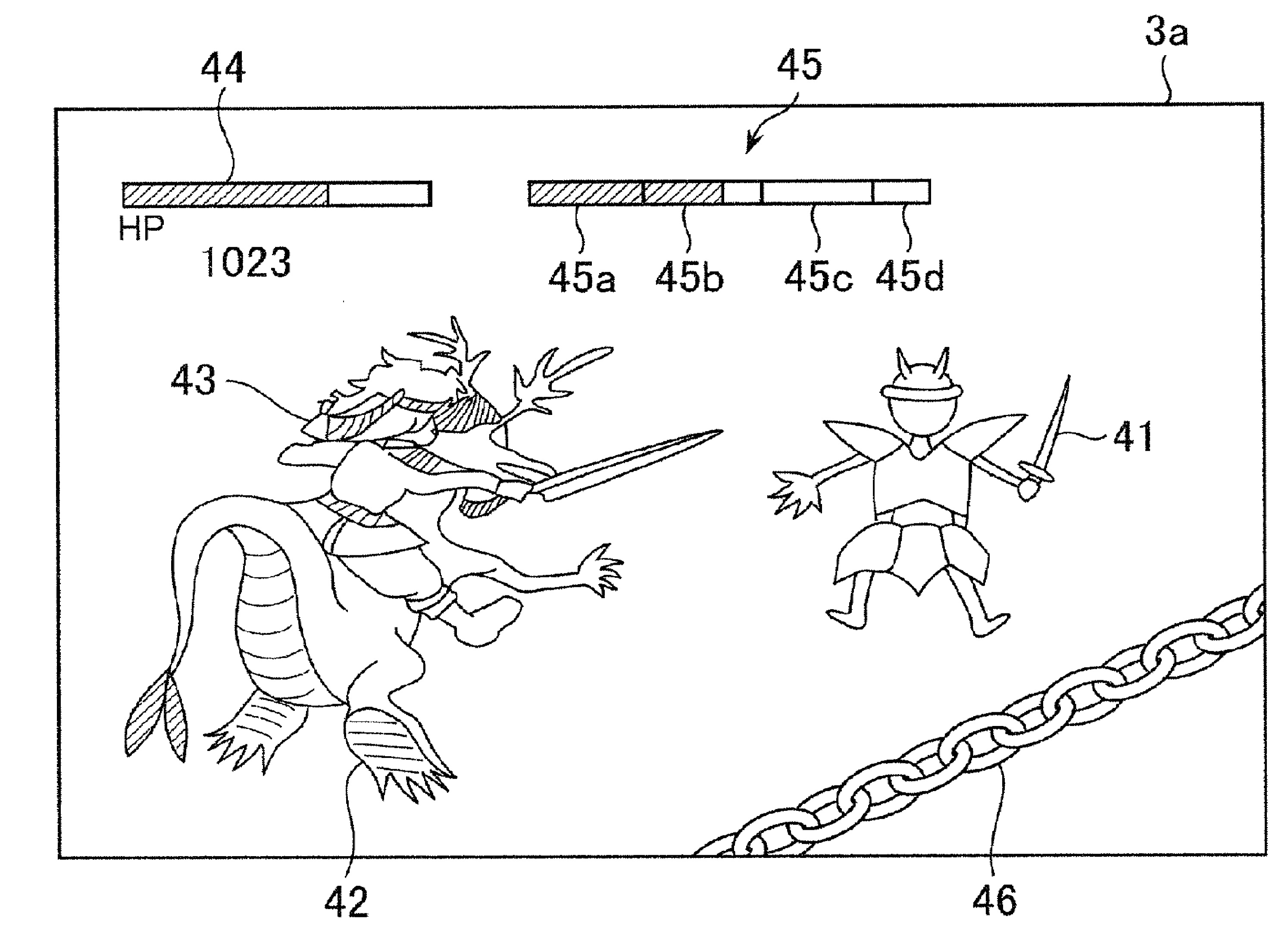
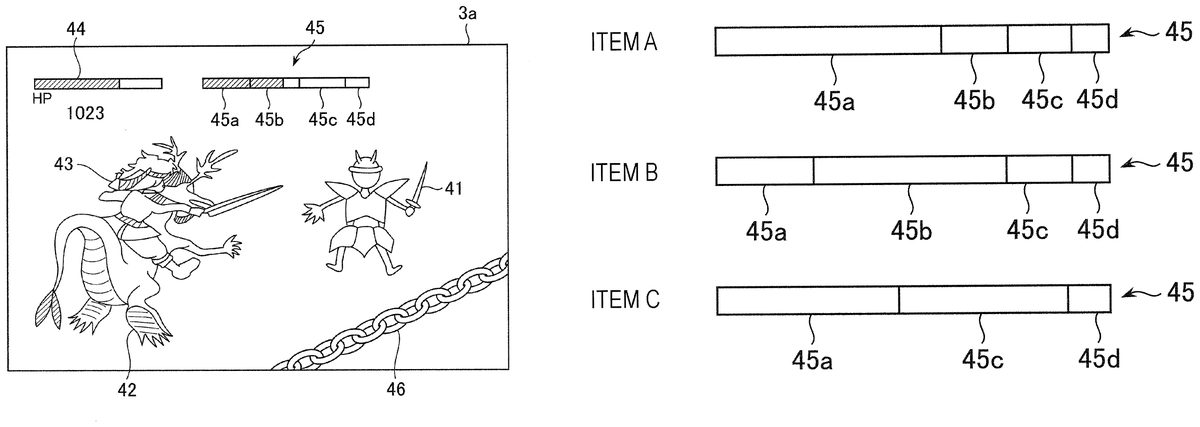
FIG. 3is an example of a display screen of the game apparatus according to the embodiment of the present invention. On a display screen3ais displayed a scene where a dragon42and a main character43riding on the back of the dragon42are doing a virtual battle with an enemy character41, facing the enemy character41. A hit point display gauge44that displays the physical strength value (hit points) of the player character is displayed on the upper left of the display screen3a.
In addition, a controllability parameter display gauge45that displays the value of a controllability parameter which will be described later is displayed on the upper center of the display screen3a. The controllability parameter display gauge45is divided into a blue zone45a, a green zone45b, a yellow zone45c, and a red zone45d. In the controllability parameter display gauge45ofFIG. 3, the controllability parameter belongs to the green zone45b.
A chain46is displayed on the lower right of the display screen3a. The chain46represents a chain that is connected to the dragon42to manipulate the dragon42by the main character43. In this game, the player manipulates the dragon42by loosening or tightening the chain46by performing a flick operation on the touch panel of the liquid crystal panel3. The control level of the dragon42is represented by an uncontrollability parameter. A status such as the offensive power of the dragon42changes according to the uncontrollability parameter. For example, when the chain46is loosened by a player's operation, the value of the uncontrollability parameter increases and thus the offensive power of the dragon42gets stronger and approaches berserk status. On the other hand, when the chain46is tightened by a player's operation, the value of the uncontrollability parameter decreases and thus the offensive power of the dragon42is weakened and approaches stable status.
Various statuses of the dragon42are managed by a player character management table which is set in the RAM12.FIG. 4is an example of the player character management table set in the game apparatus according to the embodiment of the present invention. A player character management table30stores a physical strength value (hit points)31, a magic power value (magic points)32, standard offensive power33, defensive power34, agility35, an uncontrollability parameter36, a controlling condition37, and a defending flag38of the dragon42.
The standard offensive power33of the dragon42is a standard value for specifying offensive power for when the dragon42does a normal attack on the enemy character41. The offensive power is specified by multiplying the standard offensive power33by a predetermined coefficient according to the controlling condition37. The controlling condition37specifies a level at which the player is able to control the dragon42. The controlling condition37is divided into levels 1 to 4 and is decided based on the uncontrollability parameter36.
For example, when the uncontrollability parameter36is in the range of 1 to 30, the controlling condition37is at level 4 which is the highest level. When the uncontrollability parameter36is in the range of 30 to 60 (not including 30), the controlling condition37is at level 3. When the uncontrollability parameter36is in the range of 60 to 90 (not including 60), the controlling condition37is at level 2. When the uncontrollability parameter36is greater than 90, the controlling condition37is at level 1. In this case, the uncontrollability parameters “30”, “60,” and “90” serve as thresholds that divide the controlling condition37.
The uncontrollability parameter36is displayed on the controllability parameter display gauge45on the display screen3aof the liquid crystal monitor3. The controllability parameter display gauge45is divided into a plurality of zones, the blue zone45a, the green zone45b, the yellow zone45c, and the red zone45d. Levels 4 to 1 of the controlling condition37correspond to the blue zone45a, the green zone45b, the yellow zone45c, and the red zone45d, respectively. Therefore, as the value of the uncontrollability parameter36increases, the controlling condition37changes in order from level 4 to level 1. Note that a special skill that can be used by the dragon42is decided according to which level the controlling condition37belongs to.
When the controlling condition37belongs to the blue zone45a(level 4), the offensive power for when the dragon42attacks the enemy character41, based on which damage to the enemy character41is calculated, is the same as the standard offensive power33. As shown inFIG. 5, the coefficient by which the standard offensive power33is multiplied to calculate offensive power is “1”. When the controlling condition37is at level 4, a special skill that can be used by the dragon42is a healing magic/healing skill that can recover the physical strength value31of the dragon42, or a support magic/support skill that can improve the defensive power34or agility35of the dragon42. Even if the value of the uncontrollability parameter36belongs to the blue zone45a, when the value of the uncontrollability parameter36increases and exceeds a predetermined threshold, the controlling condition37results in belonging to the green zone45b.
When the controlling condition37is in the green zone45b(level 3), the offensive power of the dragon42for when the dragon42attacks the enemy character41is higher than the standard offensive power33. Specifically, as shown inFIG. 5, the offensive power is calculated by multiplying the standard offensive power33by a predetermined coefficient larger than 1. When the controlling condition37belongs to the green zone45b, a special skill used by the dragon42is an attack magic/attack skill for attacking the enemy character41. When the controlling condition37belongs to the green zone45b, a healing magic/healing skill cannot be used. Thus, to use a healing magic or a support magic, there is a need to reduce the uncontrollability parameter36of the dragon42by performing an operation on the touch panel. Even if the value of the uncontrollability parameter36belongs to the green zone45b, when the value of the uncontrollability parameter36increases and exceeds a predetermined threshold, the controlling condition37results in belonging to the yellow zone45c.
When the controlling condition37is in the yellow zone45c(level 2), the offensive power of the dragon42for when the dragon42attacks the enemy character41is higher than the standard offensive power33and is still higher than that of the case in which the controlling condition37is in the green zone45b. Specifically, the offensive power is calculated by multiplying the standard offensive power33by a predetermined coefficient larger than 1. Therefore, the value of the coefficient by which the standard offensive power33is multiplied is larger in the case of the yellow zone45cthan the case of the green zone45b.
A special skill that can be used by the dragon42when the controlling condition37is in the yellow zone45cis an attack magic/attack skill for attacking the enemy character41. The attack magic/attack skill used when the controlling condition37belongs to the yellow zone45cis more powerful than the attack magic/attack skill used when the controlling condition37belongs to the green zone45band thus more damage can be done to the enemy character41. Even if the controlling condition37is in the yellow zone45c, when the value of the uncontrollability parameter36increases and exceeds a predetermined threshold, the controlling condition37changes to the red zone45d.
When the uncontrollability parameter36exceeds the predetermined threshold, resulting in the controlling condition37belonging to the red zone45d, the dragon42goes into berserk status and thus cannot be controlled by a player's operation on the touch panel. For example, the dragon42takes disadvantageous action in terms of the progress of the game, such as going berserk and attacking the main character43. In this case, the game may be configured such that the dragon42attacks the main character43, going into a state in which the dragon42and the main character43cannot battle, leading to game over.
Alternatively, when the dragon42goes berserk, instead of attacking the main character43, the dragon42may attack the enemy character41, but at the same time some kind of penalty may be imposed. For example, when the uncontrollability parameter36exceeds the predetermined threshold, resulting in the controlling condition37belonging to the red zone45d, the game may be configured such that the standard offensive power33is multiplied by a predetermined coefficient larger than 1, by which more powerful offensive power than that of the case of belonging to the green zone45bor the yellow zone45ccan be obtained, but every time the dragon42does an attack, the maximum HP of the dragon42decreases. In this case, the player can increase the offensive power of the dragon42and thus can give more damage to the enemy character41by increasing the uncontrollability parameter36to make the controlling condition37belong to the red zone45d; however, the maximum HP decreases and thus it is disadvantageous in terms of the progress of the game.
When the controlling condition37is in the red zone45dand thus the dragon42goes into berserk status, those zones displayed as the yellow zone45cand the green zone45bso far on the controllability parameter display gauge45are displayed also changed to the red zone45d. Hence, once the uncontrollability parameter36has become larger than the predetermined threshold at which the uncontrollability parameter36goes into the red zone45dand the controlling condition37has belonged to the red zone45d, those zones displayed as the yellow zone45cand the green zone45bturn into the red zone45d, and thus, the controllability parameter display gauge45only has the blue zone45aand the red zone45d.
In this case, to bring the dragon42back to normal stable status from berserk status, there is a need to move the value of the uncontrollability parameter36to the blue zone45aby further reducing the uncontrollability parameter36than those in the zones displayed as the yellow zone45cand the green zone45bso far. That is, once the dragon42has gone into berserk status, it takes time to bring the dragon42back to normal status. As such, after once the dragon42has gone into berserk status, by reducing the value of the uncontrollability parameter36, the portions of the yellow zone45cand the green zone45bthat are changed to the red zone45dreturn to their original states again.
The uncontrollability parameter36can be increased or reduced by a player's operation. For example, in the case of performing an input for the uncontrollability parameter36on the touch panel, when a flick operation is performed from the right to the left the uncontrollability parameter36increases, and when a flick operation is performed from the left to the right the uncontrollability parameter36decreases.
In addition, the uncontrollability parameter36can be changed by other elements than a player's operation on the touch panel. For example, the configuration may be such that the uncontrollability parameter36increases automatically as time passes, or such that every time the dragon42succeeds in attacking the enemy character41or every time the dragon42is attacked by the enemy character41, the uncontrollability parameter36increases.
In the game apparatus of the present invention, the controllability parameter display gauge45is divided into the blue zone45a, the green zone45b, the yellow zone45c, and the red zone45d. Every time the value of the uncontrollability parameter36exceeds a threshold set for each zone, a status such as the offensive power of the player character changes and thus a magic or skill that can be used also changes. The thresholds that divide the controllability parameter display gauge45into the respective zones may be fixed, but can also be determined according to, for example, the level of the player character (the dragon42or the main character43) or the item owned or carried by the player character.
Therefore, the division of the controllability parameter display gauge45is decided according to the owned or carried item, e.g., when the player character owns or carries item A, as shown inFIG. 6, the blue zone45ais the longest and the green zone45band the yellow zone45care short, and when the player character owns or carries item B, the blue zone45aand the yellow zone45care short and the green zone45bis long. When the player character owns or carries item C, the controllability parameter display gauge45may only include the blue zone45a, the yellow zone45c, and the red zone45dwithout the green zone45b. Although the length of the gauge where all zones are put together is normally fixed, the configuration may be such that the length of the controllability parameter display gauge45changes according to the level of the player character or the item owned or carried by the player character.
Next, a process performed when a player character takes action in a virtual battle, e.g., the player character attacks an enemy character or defends itself against the enemy character, will be described.FIG. 7is a diagram showing a flowchart of an attack process in a virtual battle on the game apparatus according to the embodiment of the present invention. A virtual battle between a player character and an enemy character begins when the player character and the enemy character run into each other on a field map. The virtual battle is turn-based. Each of the player character and the enemy character can take any of actions including a normal attack, defense, a special skill, and use of an item, a predetermined number of times per turn. A decision as to in what order the player character and the enemy character do attacks in each turn is made based on the agility35of each character.
When the attack turn of the player character starts (step S11), an uncontrollability parameter36for when the attack turn of the player character starts is specified (step S12). Then, the action contents of the player character are decided based on the uncontrollability parameter36or a controlling condition37(step S13).
Which one of the actions including a normal attack, defense, a special skill, and use of an item the player character takes is automatically specified according to a predetermined probability. In this case, the predetermined probability may change according to the value of the uncontrollability parameter36. For example, when the controllability parameter display gauge45belongs to the blue zone45a, the normal attack is 50%, the defense is 25%, the special skill is 15%, and the use of an item is 10%, and when the controllability parameter display gauge45belongs to the green zone45b, the normal attack is 55%, the defense is 15%, the special skill is 20%, and the use of an item is 10%. Alternatively, instead of automatically specifying the action contents of the player character, the player may select action contents.
When the action contents of the player character are decided to be “normal attack” (step S101), whether the normal attack of the player character hits the enemy character is decided randomly based on the agility35of the player character, the agility of the enemy character, the evasion ratio of the enemy character, etc. (step S102). If it is decided that the normal attack of the player character does not hit the enemy character (NO at step S102), then the attack process for this attack turn ends.
If it is decided that the nor mal attack of the player character hits the enemy character (YES at step S102), then the offensive power of the player character is decided based on the coefficient associated with the controlling condition37and the standard offensive power33(step S103). The offensive power of the player character is specified by multiplying the standard offensive power33of the player character by a predetermined coefficient. The predetermined coefficient changes according to the controlling condition37of the player character. As shown inFIG. 5, when the uncontrollability parameter36belongs to the blue zone45a, the coefficient by which the standard offensive power33is multiplied is “1”. The value of the coefficient becomes larger than “1” in the order of the green zone45b, the yellow zone45c, and the red zone45d.
When the offensive power of the player character is decided at step S103, the level of damage received by the enemy character is calculated (step S104). The damage received by the enemy character is decided randomly based on the offensive power of the player character and the defensive power of the enemy character. When the damage received by the enemy character is decided, the physical strength value of the enemy character stored in a table which manages the enemy character is updated (step S105), and the process for this attack turn ends.
When the action contents of the player character are decided to be “defense” (step S111), a defending flag38is set in a player character management table30which manages the player character (step S112), and the process for this attack turn ends. Note that when the player character is attacked by the enemy character while the defending flag38is set, the damage received by the player character is halved. Note that the set defending flag38is reset at the point in time when all of the actions of the player character and the enemy character in this turn are done.
When the action contents of the player character are decided to be “special skill” (step S121), the contents of a special skill51to be executed are decided referring to a special skill management table50set in the RAM12, such as that shown inFIG. 8(step S122).
In the special skill management table50, usable special skills51are set for each zone to which the uncontrollability parameter36belongs, i.e., for each controlling condition37. When the uncontrollability parameter36belongs to the blue zone45a, “healing magic1” can be used, and when belonging to the green zone45b, “special attack1” can be used. The special skills51stored in the special skill management table50can also be set beforehand by the player on a menu screen, etc. For example, when the controlling condition37is in the blue zone45a, a healing magic and a support magic can be set, and furthermore, the player can select which one of the healing magic and the support magic to set.
According to the contents of the special skill51decided at step S122, the effect thereof is calculated (e.g., in the case of the healing magic the amount of recovery of the physical strength value of the player character is calculated, and in the case of the attack magic the level of damage received by the enemy character is calculated) (step S123). When the effect of the special skill51is calculated, a status such as the physical strength value of the player character or the enemy character is updated by addition or subtraction according to the effect of the special skill51(step S124), and the process for this attack turn ends.
When the action contents of the player character are decided to be “use of an item” (step S131), the effect according to the used item is calculated (step S132). Then, according to the effect of the item, a status such as the physical strength value or magic power value of the player character or the enemy character is updated (step S133), and the process for this attack turn ends.
Every time an attack turn of the player character comes around, a series of these attack processes are performed and continue until the physical strength value31of the player character reaches zero, going into a state in which the player character cannot battle, or until the physical strength value of the enemy character reaches zero, going into a state in which the enemy character cannot battle, or until either the player character or the enemy character runs away and withdraws from the battle.
Next, the changing process of an uncontrollability parameter36will be described.FIG. 9is a diagram showing a flowchart of an uncontrollability parameter changing process which is performed by the game apparatus according to the embodiment of the present invention. First, by a player's operation on the touch panel, a changing input for an uncontrollability parameter36is accepted (step S21), and the uncontrollability parameter36is changed (step S22).
For example, in the case in which the longitudinal direction of the touch panel is a horizontal direction and the transverse direction is a vertical direction, when a flick operation is performed on the touch panel in the right direction from the left side, the uncontrollability parameter36increases and thus the player character becomes more offensive, resulting in a state in which the player character is difficult to control. When a flick operation is performed on the touch panel in the left direction from the right side, the uncontrollability parameter36decreases and thus the player character becomes more defensive, resulting in a state in which the player character is easy to control.
For example, in a game in which the dragon42serving as a player character is connected by the chain46and is allowed to battle with the enemy character41, when a flick operation is performed on the touch panel in the right direction from the left side, the chain46is loosened and thus the dragon42becomes offensive, approaching berserk status. On the other hand, when a flick operation is performed on the touch panel in the left direction from the right side, the chain46is tightened and thus the dragon42becomes defensive, going into stable status. Note that the amount of change in uncontrollability parameter36is determined according to the movement distance in the left/right direction where a finger or the like moves while touching the touch panel during a flick operation.
If the uncontrollability parameter36is changed and reaches a threshold at which a controlling condition37changes (YES at step S23), then the status of the controlling condition in a player character management table is updated (step S24), and the changing process of the uncontrollability parameter36ends. If the uncontrollability parameter36does not reach the threshold (NO at step S23), then the series of processes end without changing the controlling condition37. These processes are performed on a frame-by-frame basis until a virtual battle between the player character and the enemy character ends.
Although in the above-described embodiment the case is described in which the offensive power of the player character is decided according to the change in uncontrollability parameter, the configuration may be such that an increase in uncontrollability parameter not only increases offensive power but also changes defensive power, agility, etc., at the same time. For example, the configuration may be such that when the player character approaches berserk status by an increase in uncontrollability parameter, the offensive power increases but the defensive power decreases, increasing damage to be done to the enemy character; on the other hand, the risk of an increase in damage to be received by the player character also occurs. By such a configuration, the player needs to progress the game by strategically operating the controlling condition of the player character, which improves the interest of the game.
In addition, the configuration may be such that other statuses than offensive power such as the defensive power and agility of the player character are decided according to the change in uncontrollability parameter. For example, the configuration may be such that as the player character approaches berserk status, the speed of the player character increases, but the moving direction cannot be controlled.
In addition, the types of status influenced by the change in uncontrollability parameter can be changed according to the type of player character. For example, when the player character is a giant model monster characterized by the level of strength, the offensive power changes according to the change in uncontrollability parameter. When the player character is a bird model monster characterized by agility, the agility changes according to the change in uncontrollability parameter.
Although in the above-described embodiment the application of the present invention to an RPG is mainly described, the present invention can be applied to games of other genres than the RPG. For example, the present invention can also be applied to action games, racing games, etc. For example, in the case of a racing game, a human model character rides on an ostrich model character and the player manipulates the ostrich model character. By reducing an uncontrollability parameter by a player's operation, although the speed of the ostrich model character decreases, the moving direction obediently follows the player's operation. By increasing the uncontrollability parameter, although the speed of the ostrich model character increases, the moving direction is difficult to follow the player's operation.
REFERENCE SIGNS LIST
1GAME APPARATUS2MAIN BODY3LIQUID CRYSTAL MONITOR4INPUT SECTION5SPEAKER11CPU12RAM13ROM14HDD15SOUND PROCESSING SECTION16GRAPHIC PROCESSING SECTION17TOUCH INPUT DETECTING SECTION18COMMUNICATION INTERFACE19INTERFACE SECTION20FRAME MEMORY21ANTENNA30PLAYER CHARACTER MANAGEMENT TABLE50SPECIAL SKILL MANAGEMENT TABLE
Claims
- A game apparatus for progressing a game in which a player character does a virtual battle with an enemy character, the player character being a subject for operation performed by a player, the game apparatus comprising: a display;an input for receiving an operating instruction performed by the player;a processor;and a memory including a set of instructions that, when executed by the processor, causes the processor to perform operations including: determining a predetermined threshold, according to an item owned or carried by the player character or by a second player character being a companion of the player character;changing a parameter of the player character, according to the operating instruction received by the input from the player;specifying a status of the player character, based on a magnitude relation between the parameter changed by the changing and the predetermined threshold determined by the determining;and progressing the game according to the status of the player character specified by the specifying, wherein the player character controls a model character during the virtual battle with the enemy character, and the operating instruction manipulates the model character by the player character.
- The game apparatus according to claim 1 , wherein the display displays the parameter on a display screen, using a gauge divided into a plurality of zones, wherein the zones divide the gauge at locations, at least one of the locations corresponding to the predetermined threshold.
- The game apparatus according to claim 1 , wherein the player character executes a disadvantageous action when the parameter is larger than the predetermined threshold.
- The game apparatus according to claim 1 , wherein the display displays a controllability parameter display gauge that is divided into a plurality of color-coded zones, and the predetermined threshold separates two of the plurality of color-coded zones.
- The game apparatus according to claim 1 , wherein the operating instruction causes the player character to manipulate the model character, whereby the player character manipulates the object to change the parameter.
- The game apparatus according to claim 1 , wherein the display is a touch panel display and the operating instruction is to the touch panel display, whereby the player operates the touch panel display to change the parameter.
- The game apparatus according to claim 1 , wherein the status of the player character is specified by multiplying a standard status by a predetermined coefficient according to the operating instruction.
- The game apparatus according to claim 1 , wherein an availability of a special skill to the player character is decided according to the status of the player character.
- The game apparatus according to claim 1 , wherein an amount of change of the parameter is determined according to a movement distance of the operating instruction.
- The game apparatus according to claim 9 , wherein the display is a touch panel display, and the movement distance of the operation corresponds to a movement distance of a finger on the touch panel display during a flick operation.
- The game apparatus according to claim 1 , wherein the player character controls the model character during the virtual battle with the enemy character, and the status of the player character corresponds to an ability of the player character to manipulate the model character during the battle.
- The game apparatus according to claim 11 , wherein an offensive strength of the model character and the status of the player character, which corresponds to the ability of the player character to manipulate the model character during the battle, are inversely proportional.
- A non-transitory computer readable medium that stores a game program that causes a computer apparatus comprising a display and an input to execute a game in which a player character does a virtual battle with an enemy character, the player character being a subject for operation performed by a player, the game program causing the computer apparatus to perform operations including: receiving, by the input, an operating instruction performed by the player determining a predetermined threshold, according to an item owned or carried by the player character or by a second player character being a companion of the player character;changing a parameter of the player character, according to the operating instruction received by the input from the player;specifying a status of the player character, based on a magnitude relation between the parameter changed by the changing and the predetermined threshold determined by the determining;and progressing the game according to the status of the player character specified by the specifying, wherein the player character controls a model character during the virtual battle with the enemy character, and the operating instruction manipulates the model character by the player character.
- A game progress method performed by a game apparatus comprising a display and an input, the game apparatus progressing a game in which a player character does a virtual battle with an enemy character, the player character being a subject for operation performed by a player, the game progress method comprising: receiving, by the input, an operating instruction performed by the player;determining, by the game apparatus, a predetermined threshold, according to an item owned or carried by the player character or by a second player character being a companion of the player character;changing, by the game apparatus, a parameter of the player character, according to the operating instruction received by the input from the player;specifying, by the game apparatus, a status of the player character, based on a magnitude relation between the changed parameter and the determined predetermined threshold;and progressing, by the game apparatus, the game according to the specified status of the player character, wherein the player character controls a model character during the virtual battle with the enemy character, and the operating instruction manipulates the model character by the player character.
Disclaimer: Data collected from the USPTO and may be malformed, incomplete, and/or otherwise inaccurate.