U.S. Pat. No. 9,649,568
GAME SYSTEM FOR CHANGING A DIFFICULTY LEVEL OF A GAME
AssigneeKABUSHIKI KAISHA SQUARE ENIX
Issue DateMay 30, 2012
U.S. Patent no. 9,649,568: Game system for changing a difficulty level of a game
U.S. Patent no. 9,649,568: Game system for changing a difficulty level of a game
Issued May 16, 2017 to Kabushiki Kaisha Square Enix
Priority Date May 30, 2012
Summary:
U.S. Patent No. 9,649,568 (the ‘568 Patent) relates to difficulty levels of gameplay in a video game. In order to improve playtime in a video game it is normally necessary to simply develop new levels for the game. The ‘568 Patent attempts to address this problem in a more cost-efficient manner. Developing new levels may be costly, but the ability to dynamically adjust the difficulty of existing levels may allow for new playing experiences. As more people play a selected level the overall difficulty is increased. When a player attempts a level a selection of points is allocated from the player to the level they are playing. If they complete the level they are awarded the pot of points, but if they fail then another player may attempt the level to earn the available points. These systems work together to increase engagement and playtime of video games without having to develop new content entirely from scratch.
Abstract:
An object of the present invention is to provide a high-preference game system that can reduce a game development burden of a game system operator, can increase the desire of a player to iteratively play a game, and enables a player to play a game without aversion.
Illustrative Claim:
1. A server apparatus that is connectable to a plurality of client apparatuses by network communication, the server apparatus comprising: a memory that stores a game program for progressing a game, the game program for progressing the game not being stored in the plurality of client apparatuses; a game progress controller that controls a progress of the game according to the game program when receiving a game open request from one of the plurality of client apparatuses, the plurality of client apparatuses being operated by players, the game open request being received from the one of the plurality of client apparatuses via a network, the game configured to be executed by the plurality of client apparatuses in a same time period; and an interface for transmitting data of the progress of the game from the server to the one of the plurality of client apparatuses via the network when the game open request is received from the one of the plurality of client apparatuses, wherein the game progress controller controls the progress of the game by changing a difficulty level of the game for all of the plurality of client apparatuses according to a number of times of playing the game or an accumulated play time of the game by the players operating the plurality of client apparatuses, as the number of times of playing the game increases or the accumulated play time of the game increases, the difficulty level of the game becomes higher, when plural client apparatuses from among the plurality of client apparatuses execute the game in the same time period, the game is separately progressed by the server apparatus for each of the plural client apparatuses, and when a first client apparatus of the plural client apparatuses causes the difficulty level of the game to become higher, the difficulty level of the game for a second client apparatus of the plural client apparatuses which executes the game during the same time period as the first client apparatus does not change in real time.
Illustrative Figure
Abstract
An object of the present invention is to provide a high-preference game system that can reduce a game development burden of a game system operator, can increase the desire of a player to iteratively play a game, and enables a player to play a game without aversion. When a player requests a game open in a dungeon, 5 points among the points retained by the player is consumed, and 3 points are temporarily pooled in the dungeon. When the player succeeds in satisfying a clear condition of the dungeon, a total of 13 temporarily-pooled and not pooled points is added to a retention point of the player. Also, when the player fails to satisfy the clear condition of the dungeon, the temporarily pooled points are pooled in the dungeon.
Description
DETAILED DESCRIPTION OF EMBODIMENTS Hereinafter, embodiments of the present invention will be described with reference to the accompanying drawings.FIG. 1is a block diagram illustrating a configuration of a network game system according to an embodiment of the present invention. As illustrated inFIG. 1, the network game system includes a plurality of client apparatuses1(client apparatuses1a,1b, . . . to1z) operated by a plurality of players (player A, player B, . . . to player Z), a server apparatus3, and a communication network2. The client apparatuses1are connected to the server apparatus3through the communication network2. The client apparatuses1ato1zare connected to the server apparatus3, and the players may play the same game by operating a player character allocated to each of the client apparatuses1. Also, in this specification, the client apparatuses1include game apparatuses or computer apparatuses that enables players to play a game, and include, for example, a personal computer, a home video game machine, an arcade video game machine, a portable video game machine, a portable phone, a smart phone, a tablet, and the like. The client apparatuses1may not constantly be connected to the server apparatus3, and may be connected to the server apparatus3if necessary. Also, operation instruction information which is input into an input section in the client apparatuses1is transmitted to the server apparatus3, and a game progressing process is performed in the server apparatus3. Then, as a result of the game progressing, video data is transmitted from the server apparatus3to the client apparatuses1and is displayed on display devices of the client apparatuses1. In this case, it may not be necessary to store a game program in the client apparatuses1or install a storage medium, in which a game program is stored, in the client apparatuses1. Also, unlike this, each of the client apparatuses1may perform a game program execution process and transmit the ...
DETAILED DESCRIPTION OF EMBODIMENTS
Hereinafter, embodiments of the present invention will be described with reference to the accompanying drawings.FIG. 1is a block diagram illustrating a configuration of a network game system according to an embodiment of the present invention. As illustrated inFIG. 1, the network game system includes a plurality of client apparatuses1(client apparatuses1a,1b, . . . to1z) operated by a plurality of players (player A, player B, . . . to player Z), a server apparatus3, and a communication network2. The client apparatuses1are connected to the server apparatus3through the communication network2. The client apparatuses1ato1zare connected to the server apparatus3, and the players may play the same game by operating a player character allocated to each of the client apparatuses1. Also, in this specification, the client apparatuses1include game apparatuses or computer apparatuses that enables players to play a game, and include, for example, a personal computer, a home video game machine, an arcade video game machine, a portable video game machine, a portable phone, a smart phone, a tablet, and the like. The client apparatuses1may not constantly be connected to the server apparatus3, and may be connected to the server apparatus3if necessary.
Also, operation instruction information which is input into an input section in the client apparatuses1is transmitted to the server apparatus3, and a game progressing process is performed in the server apparatus3. Then, as a result of the game progressing, video data is transmitted from the server apparatus3to the client apparatuses1and is displayed on display devices of the client apparatuses1. In this case, it may not be necessary to store a game program in the client apparatuses1or install a storage medium, in which a game program is stored, in the client apparatuses1. Also, unlike this, each of the client apparatuses1may perform a game program execution process and transmit the execution result to the server apparatus3if necessary.
FIG. 2is a block diagram illustrating a configuration of a client apparatus according to an embodiment of the present invention. A client apparatus1includes a control section11, a random access memory (RAM)12, a storage apparatus (for example, a hard disk drive (HDD), a semiconductor memory, or the like)13, a sound processing section14, a graphic processing section15, a communication interface17, and an interface section18, each of which is connected by an internal bus. The control section11includes a central processing unit (CPU) and a read only memory (ROM). Also, the control section11includes an internal timer such as a hardware clock that measures time. The RAM12is a work area of the control section11. The storage apparatus13is a storage region that stores programs or data.
When video data or audio data is transmitted from a server apparatus1as a result of game progressing, the data is stored in the RAM12. By processing the data stored in the RAM12, the control section11outputs a sound output instruction to the sound processing section14and outputs a rendering command to the graphic processing section15.
Also, in the embodiment, although a description is mainly given of a case where the server apparatus3executes a game progressing process and the client apparatus1outputs video data and audio data transmitted from the server apparatus3, the client apparatus1may be configured to execute a game progressing process. In this case, the control section11controls the client apparatus1by executing a program stored or buffered in the storage apparatus13or by executing a program stored on a recording medium (not illustrated). A program and data necessary to progress a game are read from a recording medium25and loaded into the RAM12, and the control section11performs a process by reading the program and data, which are necessary to progress a game, from the RAM12.
The sound processing section14is connected to a sound outputting device22, which is a speaker. When the control section11outputs a sound output instruction to the sound processing section14, the sound processing section14outputs a sound signal to the sound outputting device22.
The graphic processing section15is connected to a display device23. The display device23has a display screen24. When the control section11outputs a rendering command to the graphic processing section15, the graphic processing section15develops an image in a frame memory (frame buffer)19and outputs a video signal that is used to display an image on the display screen24. The graphic processing section15executes rendering of one image in units of frames. 1-frame time of an image is, for example, 1/30 second.
An input section21is connected to the interface section18. Input information from the input section21by the player is stored in the RAM12or the like, and the control section11executes a variety of arithmetic processings based on the input information. Specific examples of the input section21may include not only a touch panel configured to also serve as the display screen24of the display device23, but also a button, a lever, a keyboard, a mouse, a touch pad, and the like.
The communication interface17is connected to a communication network2in a wireless or wired manner, and transmits and receives operation instruction information or information about a game progress status with the server apparatus3if necessary. Also, the communication interface17may perform wireless communication with other client apparatuses1through a communication unit having an antenna26.
Specific examples of the above-configured client apparatus1include a personal computer, a home video game machine, an arcade video game machine, a portable video game machine, a portable phone, a smart phone, a tablet, and the like, but the invention is not limited thereto.
FIG. 3is a block diagram illustrating a configuration of a server apparatus according to an embodiment of the present invention. A server apparatus3includes a control section31, a RAM32, a HDD33, and a communication interface34, each of which is connected by an internal bus.
The control section31includes a CPU and a ROM. The control section31controls the server apparatus3by executing a game program stored in the HDD33. Also, the control section31includes an internal timer that measures time. The RAM32is a work area of the control section31. The HDD33is a storage region configured to store programs or data. The control section31reads a program and data, which are necessary to progress a game, from the RAM32, and performs a game progressing process based on operation instruction information received from the client apparatus1.
A specific example of the server apparatus3includes a computer or the like. The server apparatus3may include one computer or the like, and may include a plurality of computers or the like.
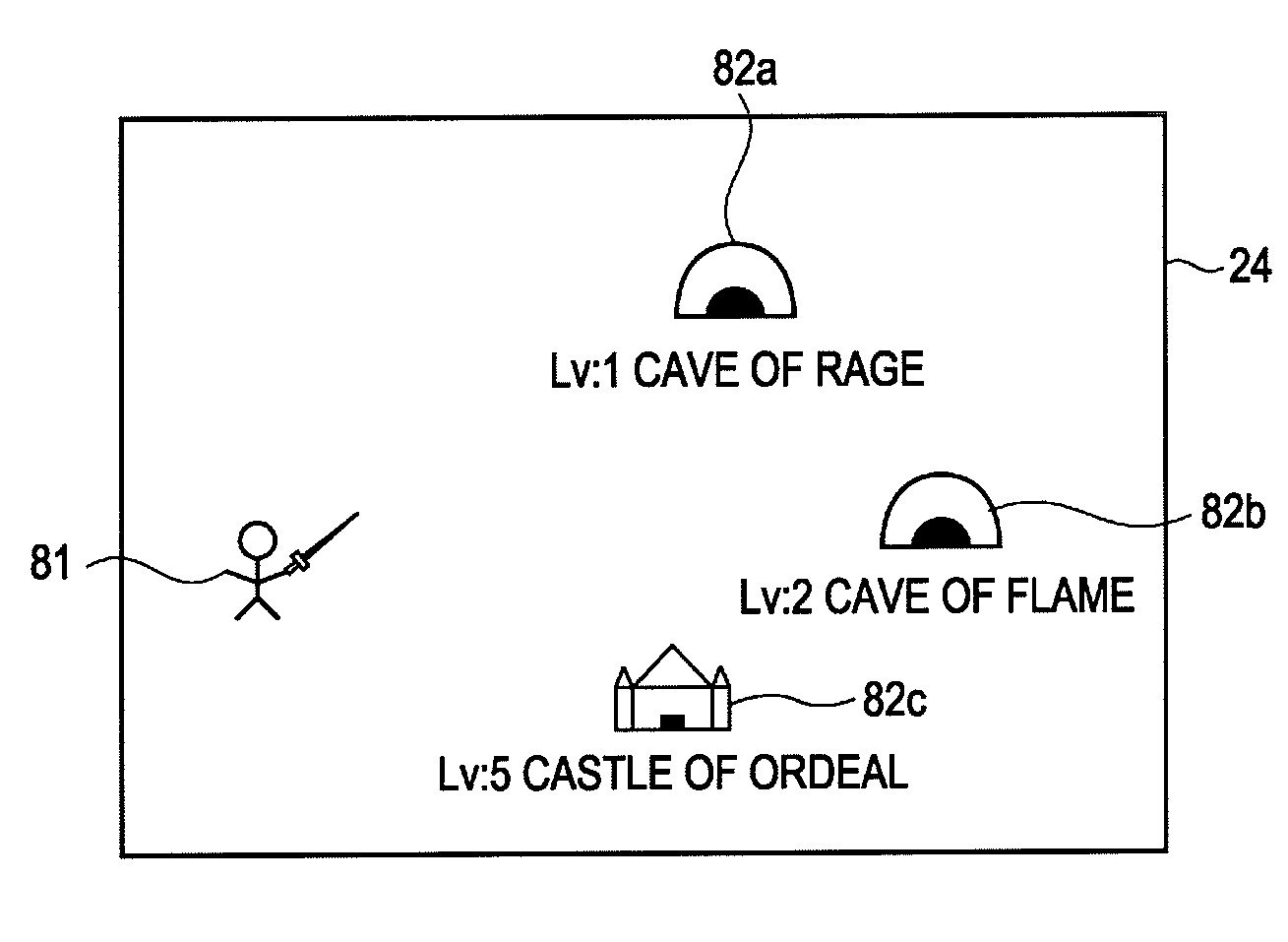
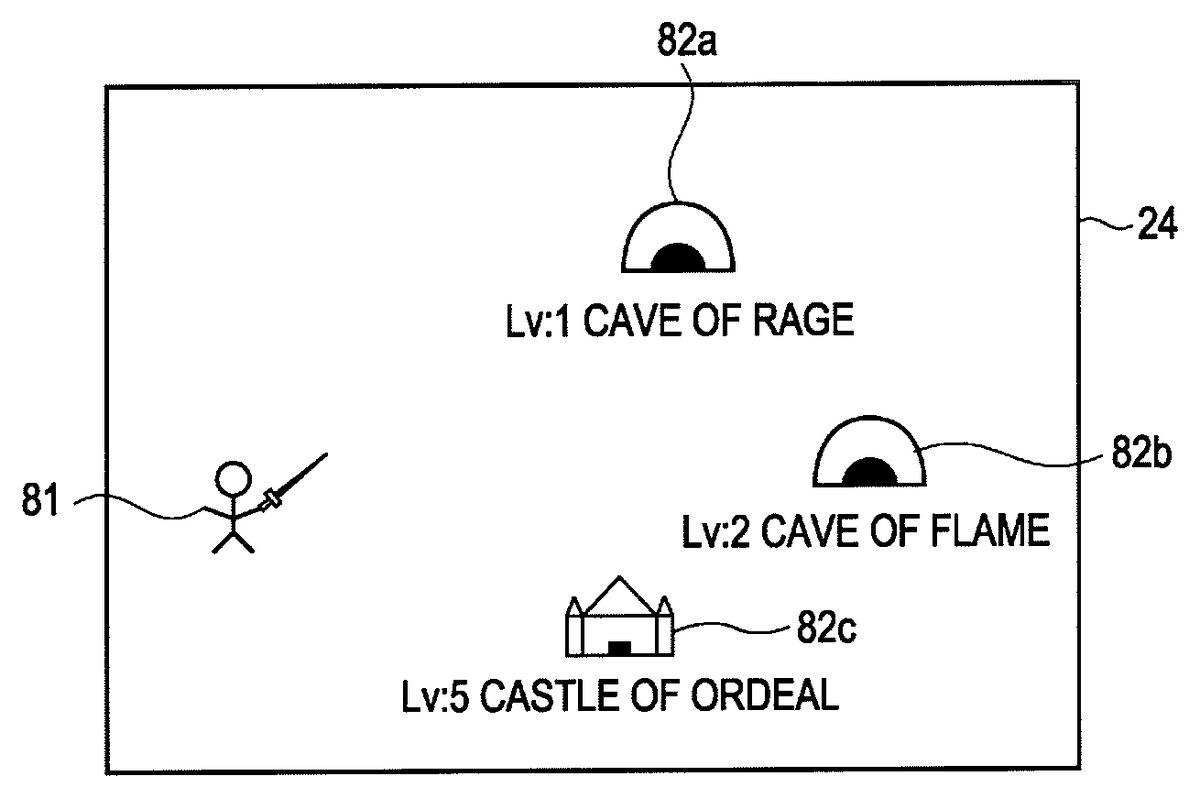
Next, a description will be given of a case of exploring a dungeon as a mini game in an RPG in the invention.FIGS. 4A and 4Billustrate an example of a display screen of a client apparatus according to an embodiment of the present invention. For example, as illustrated inFIG. 4A, dungeon or castle objects82ato82con a field map may be displayed on the display screen24. A player character81may move on the field map and touch the dungeon objects82ato82c, so that a map in a dungeon may be displayed and an exploration of the dungeon by the player character81may be started. By touching objects of towers, ruins, or the like, in addition to dungeons or castles, the player character81may explore in them. Also, an object82displayed on the display screen24may be selected by a cursor or the like, so that a dungeon status such as a dungeon level, a pool point, or the like, which will be described later, may be displayed.
Also, for example, as illustrated inFIG. 4B, buttons83ato83ccorresponding to dungeons explorable by a player may be displayed on a display screen24, and the player may select a button83among the plurality of the buttons83ato83c, which corresponds to a dungeon to explore, by a cursor84. A dungeon level or a pool point may be displayed on the button83.
FIG. 5is a diagram illustrating an example of a point management table according to an embodiment of the present invention. A point management table40is set in a storage region of a server apparatus3to manage points of a player. A retention point42is stored in the point management table40in relation to a player ID41. The player ID41is used to identify each player. The retention point42is an ID that is used to store a value of points retained by each player.
The retention point42may be virtual cash used in a game, and may also be converted into current money in the real world. Also, the retention point42may have a function of improving the capability of a player character. For example, when the retention point42is greater than or equal to a predetermined value, a special capability may be given to a player character. Also, when the retention point42can be converted into current money, the total amount of points consumed when a player logs out of a game may be settled and a payment may be made with a credit card or the like.
FIG. 6is a diagram illustrating an example of a dungeon point management table according to an embodiment of the present invention. A dungeon point management table50is set in a storage region of a server apparatus3to manage points pooled in a dungeon. A pool point52, a temporary pool point53, and a player management flag54are stored in the dungeon point management table50in relation to a dungeon ID51.
The dungeon ID51is an ID that is used to identify each dungeon. The pool point52is a point that is temporarily pooled in a dungeon when a player explores the dungeon and fails to satisfy a clear condition set for each dungeon. When a plurality of players fails to satisfy a clear condition of a dungeon, the pool point52is reserved so much more. When one player succeeds in satisfying a clear condition of a dungeon, the reserved pool point52is given to the player that satisfies the clear condition. In this way, a player competitively plays in order to clear a dungeon more quickly than any other players, which assists in increasing the communication between plural players.
Also, the temporary pool point53is a part or all of the points consumed by a player. The temporary pool point53is a point that is derived from a player that is in the midst of playing a game in a dungeon. That is, when a player is playing a game in a dungeon and it is not yet determined whether the player will satisfy a clear condition, it is not yet determined whether points of the player will be reserved as the temporary pool point52. When the player fails to satisfy the clear condition, the temporary pool point53is subtracted and added to the pool point52at that time. When the player succeeds in satisfying the clear condition, the temporary pool point53is subtracted and added to the retention point52of the character at that time.
The player management flag54is a flag that is set when a player owns and manages a dungeon. When a dungeon is not a dungeon that is owned and managed by a player, the player management flag54is not set.
FIG. 7is a diagram illustrating an example of a flow chart in processing points according to an embodiment of the present invention. A client apparatus1receives an input of a game open request for a dungeon by the player by selecting the dungeon or moving a player character to the dungeon, or the like (Step S1), then, the client apparatus1transmits the game open request for the dungeon to a server apparatus3(Step S2). In step S3, the server apparatus3receives the game open request from the client apparatus1. Then, with respect to the player that selected the dungeon, a retention point42of a point management table40set in the server apparatus3is subtracted in step S4, and a part or all of the subtracted points is added as a temporary pool point53in step S5.
For example, the retention point42of the point management table40is subtracted by 5 points, and 2 points are added to the temporary pool point. A value of the subtracted points may be constant regardless of which dungeon is explored, and may vary according to the difficulty levels of dungeons. In general, as the difficulty level of a dungeon becomes higher, the technique of a player challenging the dungeon becomes higher and the level of a player character also becomes higher. Therefore, it may be preferable that more points be needed.
Also, when a player management flag54is set in a dungeon point management table50, a retention point42of a player opening a game in the dungeon is subtracted and a part or all of the subtracted points is added to a retention point42of a player owing the dungeon, in step S4.
Thereafter, in step S6, a game in the dungeon is opened and progressed. The server apparatus3may execute a game progress control process while receiving necessary information, such as operation information used by a player to operate a player character, from the client apparatus1, and may transmit the result of the game progress control process to the client apparatus1. Also, the client apparatus1may download dungeon-related information and the like from the server apparatus3, if necessary, and the client apparatus1may execute a game progress control process. In this case, information as to whether a clear condition is cleared by the player is notified from the client apparatus1to the server apparatus3at the time when the clear condition is satisfied or at the time when a game in a dungeon is closed.
When the game is progressed in step S6and the player succeeds in satisfying the clear condition set in the dungeon (YES in step S7), the sum points of a pool point52and a temporary pool point53are added to a retention point42of the player in step S8. Then, a series of processing is ended.
On the other hand, when the player fails to satisfy the set clear condition, such as when the player becomes incapable of fighting due to a battle with an enemy character in the dungeon or when the player fails to satisfy a necessary condition within a predetermined time limit (NO in step S7), a temporary pool point53derived from the player is added to a pool point52in step S9. Then, a series of processing is ended.
FIGS. 8A to 8Care conceptual diagrams illustrating a flow of points according to an embodiment of the present invention. A series of processing in steps S1to S9ofFIG. 7may be applicable not only to a case where an owner of a dungeon is not specifically defined as illustrated inFIGS. 8A and 8B, but also to a case where a player purchases, owns and manages a dungeon as illustrated inFIG. 8C.
InFIG. 8A, for example, when a player81requests a game open in a dungeon82by operating a client apparatus1, 5 points among a retention point42of the player81are consumed. In this case, 3 points are temporarily pooled in the dungeon82. When the player81succeeds in satisfying a clear condition of the dungeon82, 8 points as the sum of temporarily pooled 3 points and 5 points pooled in the dungeon82as a result of the plays by other players are added to a retention point of the player81. Also, when the player81fails to satisfy the clear condition of the dungeon82, it is determined that temporarily pooled 3 points are pooled in the dungeon82as illustrated inFIG. 8B.
Also, among 5 points consumed by the player81to open a game, the remaining 2 points that are not temporarily pooled are lost. However, when the points can be converted into current money, the remaining 2 points that are not temporarily pooled become a profit of a game system operator.
InFIG. 8C, for example, when a player81boperates a client apparatus1to request a game open in a dungeon82owned by a player81a,5 points among a retention point of the player81bare consumed. In this case, 3 points are temporarily pooled in the dungeon82. Also, among 5 points consumed by the player81b,1 point is added to a retention point42of the player81a. Also, when the points can be converted into current money, the other remaining 1 point among the 5 points consumed by the player81bbecomes a profit of a game system operator.
When the player81bsucceeds in satisfying a clear condition of the dungeon82, 8 points as the sum of temporarily pooled 3 points and 5 points that have been pooled in the dungeon82are added to a retention point42of the player81b. Also, when the player81bfails to satisfy the clear condition of the dungeon82, it is determined that temporarily pooled 3 points are pooled in the dungeon82. Also, it may be configured such that only the player81aowning the dungeon can know the sum value of points that can be obtained by a player satisfying the clear condition, from the points pooled in the dungeon or from the points consumed by a currently playing player. An owner of the dungeon may detect that obtainable points increase to some extent. Also, as will be described later, the owner of the dungeon may personally play the dungeon, satisfy the clear condition, and obtain more points.
The player81aowing the dungeon may personally play in the dungeon in order to attract more players in the dungeon he owns. In addition, the player81amay edit the dungeon he owns, and may edit the type, level, name, status, design and the like of an enemy character appearing in the dungeon, or the type, name, status, design and the like of an item obtainable in the dungeon. In addition, the player81amay change the shape of a map in the dungeon. Also, the player81aowing the dungeon may change a clear condition for clearing the dungeon. Also, it may be set such that by clearing the dungeon, another player can obtain a specific item owned by the player81a, or can obtain virtual currency, which is owned by the player81a, as a prize.
When purchasing a dungeon, a player may select a dungeon that has a function of adding points to an owner when another player (non-owner) plays the dungeon, or a dungeon that does not have a function of adding points to an owner when another player plays the dungeon. In general, it takes more points to purchase a dungeon that has a function of adding points to an owner when another player plays the dungeon. A dungeon, which does not have a function of adding points to an owner when another player plays the dungeon, can be edited by the owner. However, when another player plays the dungeon, the points are processed as illustrated inFIGS. 8A and 8B.
Also, a dungeon to be purchased may be limited in the dungeon owning period of a player (dungeon lifetime). In this case, if a predetermined time has elapsed after a dungeon is purchased, the dungeon is disappeared or is owned by nobody (that is, the dungeon is owned by an operator of the game system). When purchasing a dungeon, a player may set a dungeon owning period. When a player sets a longer dungeon owning period, it takes more points to purchase a dungeon.
FIG. 9is a diagram illustrating an example of a dungeon management table according to an embodiment of the present invention. A dungeon name62, a dungeon level63, an experience point64, an enemy character level65, a clear condition66, a dungeon layer67, a map ID68, and the number of a trap69are stored in a dungeon management table60in relation to a dungeon ID61(corresponding to a dungeon ID51of a dungeon point management table).
The dungeon level63represents the height of a dungeon difficulty level. Like a player character, a dungeon also has an experience point64. Thus, when the experience point64exceeds a predetermined value (necessary experience points that will be described below), the dungeon level63increases and the dungeon difficulty level also increases.
A dungeon may acquire an experience point64in various ways. For example, a dungeon may acquire an experience point64at the time when a player character starts a dungeon exploration. As another example, a dungeon may acquire an experience point64when a player character battles with an enemy character in the dungeon. In this case, as a player character is stronger, that is, when the level is higher, the dungeon may acquire more experience points. Also, when an enemy character defeats a player character or when a player character fails to clear a clear condition of the dungeon, the dungeon may acquire more experience points64. Also, the dungeon may acquire an experience point64merely when a player character starts a dungeon exploration.
The enemy character level65represents the power (level) of an enemy character that appears in a dungeon. When the dungeon level63increases, the enemy character level65also increases. The clear condition66is a condition for clearing a dungeon. For example, that a player character wins a battle with a specific boss character, acquires a specific item, or reaches a specific place may be set as a condition for clearing the dungeon. Also, the clear condition may have a time limit such as ‘acquiring a specific item within 15 minutes’.
The dungeon layer67represents the depth of a dungeon. As the dungeon level63becomes higher, the dungeon becomes deeper and the dungeon clear difficulty level also becomes higher. Also, the number of the traps69is the number of the traps provided in a dungeon. As the dungeon level63becomes higher, the number of the traps69increases and the dungeon clear difficulty level also becomes higher.
A map is generated when a player character explores a dungeon. For example, like 1 to 100 layers, map information of up to the deepest layer is prepared in advance. As the dungeon level becomes higher, a pathway connected to a new layer may appear, or stairs or traps may be installed, so that an exploration to the deeper layer may be possible. As for the map information of all layers of 1 to 100 layers, a plurality of patterns may be prepared in advance, and which pattern of map information to use may be determined based on the map ID68.
Next, a dungeon generation process will be described.FIG. 10is a diagram illustrating an example of a flow chart of a dungeon generation process for generating a dungeon. A player may purchase, own, and manage a dungeon by using predetermined points.
First, in step S11, a player provides a dungeon purchase selection in a client apparatus1by controlling an input. Then, in step S12, the client apparatus1transmits a dungeon purchase request to a server apparatus3. Also, dungeons (contents) purchasable by players may include not only dungeons (contents) that are not at all played by players and have an initial value, but also dungeons (contents) that are already played by players and are changed from an initial state. Therefore, the player may select a desired one among a plurality of dungeons that are different in terms of the dungeon level63. Also, as will be described later, when an attribute such as ‘fire’ or ‘water’ is set to each dungeon, the player may select a desired one among a plurality of dungeons that have different attributes.
In step S13, the server apparatus3receives the dungeon purchase request. Then, in step S14, data related to a new dungeon is generated in a dungeon management table60that will be described later. A dungeon name62stored in a dungeon management table may be input by the player when a dungeon is purchased. A status in a dungeon is randomly specified according to a correspondence relation between a dungeon level and other dungeon parameters as illustrated inFIG. 11. For example, as for an enemy character level of a dungeon having a dungeon level of ‘1’, a random level of ‘1 to 5’ becomes an enemy character level of a newly generated dungeon. Likewise, as for a clear condition, a random condition among a plurality of clear conditions is specified according to the correspondence relation illustrated inFIG. 11. Also, a map shape is specified by specifying a random map ID68from a plurality of map information items, and in addition, determining a layer accessible by a player character according to the correspondence relation illustrated inFIG. 11.
Thereafter, in step S15, data related to the newly generated dungeon is generated in a dungeon point management table. In this case, the values of an initial pool point52and a temporary pool point53stored in a dungeon point management table50is generally 0 point. Also, a player management flag54is also set.
FIG. 11is a diagram illustrating an example of a correspondence relation between a dungeon level and other dungeon parameters. The dungeon level is related to the level of an enemy character generated in the dungeon, and the way how the dungeon will grow is determined according these correspondence relations.
The correspondence relation between a dungeon level and other parameters are preset in a storage region of the server apparatus3, in which necessary experience points, an enemy character level, a clear condition, a dungeon layer, and the number of traps are stored in relation to the dungeon level. The necessary experience points are experience points of a dungeon that are necessary to become a relevant dungeon level. Therefore, when the experience points are greater than or equal to 50, the dungeon level is ‘2’; and when the experience points are greater than or equal to 100, the dungeon level is ‘3’.
Next, a dungeon growth process will be described.FIG. 12is a diagram illustrating an example of a flow chart of a dungeon growth process for growing a dungeon according to an embodiment of the present invention. In step S21, a player explores a dungeon, and the dungeon acquires an experience point. Then, in step S22, it is determined whether experience points of the dungeon reach necessary experience points until the dungeon becomes a next level. When the experience points of the dungeon do not reach the necessary experience points (NO in step S22), the process returns to step S21.
When the experience points of the dungeon reach the necessary experience points (YES in step S22), the process proceeds to step S23. In step S23, as illustrated inFIG. 11, map information or parameters for generating a dungeon are specified according to the correspondence relation between a predetermined dungeon level and other dungeon parameters. For example, an enemy character level65, a clear condition66for clearing a dungeon, a dungeon layer67, or the like is specified. As for a map of the dungeon, 1 to 100 layers may be prepared, and traps or stairs for descending to lower layers may be installed according to the dungeon level63. When dungeon parameters after growth are specified in step S23, such information is stored in a dungeon management table in step S24. Then, a series of processing is ended.
Also, even the dungeons of the same dungeon level may have a variation in the appearing enemy character and boss character, the object displayed on a dungeon map, or the like. For example, an attribute may be preset for each player character; and when battling with a player character, a dungeon may acquire experience points related to the attribute of the player character, and the dungeon may grow according to the experience points. For example, when there are many battles with a player character having an attribute of ‘fire’, it becomes a dungeon having an attribute of ‘fire’ (that is, an enemy character related to fire appears, or a pillar of fire is generated on the map).
In addition, the dungeon may grow according to the type of an action taken by the player character. For example, when the ratio of a blow attack is high, an enemy character skillful at a blow attack is apt to appear; and when the ratio of a magic attack is high, an enemy character skillful at a magic attack is apt to appear.
Next, a relation between the game open time of a player and the growth of a dungeon will be described.FIG. 13is a diagram illustrating a relation between the game open time of a player and the growth of a dungeon. When a plurality of players play the same game (dungeon) in the same time period, a plurality of tasks for each player are generated in the server apparatus3, and a game is progressed for each task. In this case, unlike Massive Multiplayer Online Role Playing Game (MMORPG), a player character operated by another player does not appear in a game, and the game is progressed with only the player itself. The same is true of a case where a predetermined program for progressing the game or the like is downloaded in each client apparatus1, and the program is executed in each client apparatus1.
For example, it is assumed that a player A playing a client apparatus1astarts an exploration in a dungeon at 10:00 a.m., satisfies a clear condition set in the dungeon at 10:30 a.m., and ends the exploration of the dungeon. It is assumed that experience points of the dungeon reach a predetermined value at 10:30 a.m. in a game progress by a player A, and thus a dungeon level increases from ‘1’ to ‘2’. Herein, if it is assumed that a player B starts an exploration in a dungeon at 10:15 a.m., the player B plays a dungeon having a dungeon level of ‘1’, which is the same as the dungeon played by the player A. On the other hand, if it is assumed that a player C starts an exploration in a dungeon at 10:35 a.m., the player C plays a dungeon at the time of 10:30 a.m., that is, a dungeon having a dungeon level of ‘2’. In this manner, even when there are a plurality of players playing the same dungeon in the same time period, experience points may be given to a dungeon at a predetermined timing, such as the dungeon exploration end time of each player, to grow the dungeon. In this case, when another player starts a play before the growth of a dungeon, it may play in a dungeon before growth; and when another player starts a play after the growth of a dungeon, it may play in a dungeon after growth. By this configuration, it is possible to prevent a variation or inconsistency from occurring in the content of a dungeon due to a difference in play start time when there are a plurality of players playing the same dungeon in the same time period.
Also, in this case, although the player A satisfying a clear condition of a dungeon acquires a point pooled in the dungeon, the satisfaction of the clear condition by the player A may be notified to the player B or the player C, and the game in the dungeon may be stopped. In this case, all of the points consumed by the player B and the player C, or the temporarily pooled points may be returned to the player B and the player C, respectively. By stopping the game in the above manner, it is possible to prevent the points from being overlappingly added to a plurality of players, because the points are added not only to the player A but also to the player B and the player C when the player B or the player C satisfies the clear condition.
Also, when the player A satisfies a clear condition of a dungeon, the satisfaction of the clear condition by the player A may be notified to the player B or the player C, and then the player B or the player C may play a game in the dungeon to the last without stopping the game. In this case, even when the player B or the player C satisfies a clear condition of a dungeon, only the player A satisfying the clear condition at the first time may acquire the so far pooled point. In this way, it is possible to prevent the point from being overlappingly added to a plurality of players, because the points are added to the player B and the player C. In this case, all of the points consumed by the player B and the player C, or the temporarily pooled points are returned to the player B and the player C, respectively.
In the above embodiment, the case of adopting a dungeon with a predetermined clear condition as a game played by a player has been mainly described. These contents will be described by way of specific examples.
Content Example 1
An item ‘Excalibur’ is present in ‘fort’, and a content is cleared when a player obtains the item. A monster (enemy character) is present in a fort, and attacks a player character. The monster is mounted with an artificial intelligence (AI). Thus, the monster is strengthened by learning an advantageous battle progressing technique by a battle with the player character (for example, by learning which attack or magic is effective, according to the tribe or occupation of a player character). That is, based on an input such as an attack of a client, an attack pattern of the monster changes and thus a content is ‘modified’. Next, a client challenging the ‘fort’ challenges the content in the ‘modified’ state.
Content Example 2
A princess is imprisoned in the deepest portion of a dungeon, and a content is cleared when a player character rescues the imprisoned princess. Since the geography of the dungeon is complex, the player should progress the game in such a way that the player character jumps over a height difference and is not melted by molten lava. In this case, a movement history of the player character is ‘input’, and a dungeon generation AI learns by the details of a route passed by the player character. When a next player character enters the dungeon, the shape of the dungeon is changed by the dungeon generation AI. Accordingly, searching is difficult, and the content has been ‘modified’. For example, as for a route through which more player characters pass, it becomes more complicated as a result of the learning of the dungeon generation AI when a next player character challenges.
Content Example 3
In the above content example 2, a shape change of a dungeon is a movement history of a player character. However, it may be configured such that the shape of a dungeon changes based on data present on the Internet. In the data on the Internet, when the temperature of a predetermined region is below zero, a snowstorm occurs in the dungeon, thus reducing the visibility thereof. On the other hand, when a river of molten lava is frozen, the player character can go across a place that may not be gone across at normal times without a bridge. Also, when the temperature of a predetermined region is higher than 30°, an intermittent spring is generated from a rock near to molten lava, and the player character is damaged when contacting water vapor or boiling water generated from the intermittent spring. On the other hand, when the temperature is higher than 30°, because ice of an ice cave is melted, the player character can invade the ice cave. At normal times, the player character may not enter the ice cave because the player character is obstructed by the ice of the ice cave.
Content Example 4
In a dungeon, when a player character survives sequentially-attacking zombies during a predetermined period (for example, a period from sunset to daybreak), a content is cleared. When the player character fails to survive, the player character becomes a conscious zombie during some period before becoming a true zombie. In this period, the player character may modify the content by performing an input to the content (for example, leaving a recovery medicine or information about the zombie appearance place) so that a next player character can easily survive.
In the above embodiment, the difficulty level of a game is changed mainly according to the frequency of playing a game by a player, or according to whether a game is cleared by a player. However, for example, it may also be configured in such a way that the difficulty level of a game is changed according to a game play time of a player. For example, it may also be designed in such a way that a period from the open and close of a game in all the plays of the game is accumulated, and the difficulty level of the game is increased whenever the accumulated period exceeds a predetermined value.
In the above embodiment, it is configured in such a way that a player selects which game (dungeon) to play. However, according to the level, the occupation, the attribute, the action history, and the taste of a player character, a game suitable for a player may be specified in a server apparatus and introduced to the player. Also, a game played by a player may be automatically selected by a server apparatus according to the level, the occupation, the attribute, the action history, and the taste of a player character. For example, when the occupation of a player character is a white mage, before starting play of a dungeon, a dungeon that can be relatively easily explored by a white mage is introduced to a player, so that a game can be specified according to the occupation of a player character. Also, when a player frequently battles with an enemy character of a specific kind or tribe, a dungeon, which is high in the probability of appearance of the enemy character of the specific kind or tribe, is introduced to the player. Also, when a player frequently uses a specific attack or magic of a specific kind, a dungeon, which is high in the probability of appearance of an enemy character that is weak to the specific attack or magic, is introduced to the player, so that a game can be specified according to the action history of a player character operated by a player. In addition, the type of a game desired by a player may be registered in advance, and a game of the desired type may be specified in a server apparatus and introduced to the player. For example, the taste of a player with respect to a high-action game or a strategy-requiring game may be beforehand registered in a server apparatus, and a high-action game may be introduced to the player according to the taste of the player.
In the above embodiment, a plurality of mini games allowing a player character to explore a dungeon are provided, and a player selects a desired dungeon therein. However, the genres of games playable by players may also be diversified. For example, an RPG game or an action game may be played by using the same player character and consuming points, so that a game of a desired genre may be selected among games of a plurality of genres.
Also, in the above embodiment, an original game (for example, a dungeon), which can be purchased by a player character by consuming its own points, is not limited to one kind, but may be selected from a plurality of kinds. A player may purchase a game according to its own taste and grow the game according to its own taste.
In the above embodiment, the difficulty level of a game increases whenever a player closes the game (whenever ending an exploration of a dungeon). However, the difficulty level of a game may increase in real time even while a player is in the midst of playing the game. When the experience points of a dungeon increase and a predetermined experience points are acquired, even when a player is in the midst of exploring the dungeon, a dungeon progressing process may be executed. Thus, the level of an enemy character appearing in the dungeon may increase, or the frequency of an encounter with an enemy character may increase. Also, a map of a deeper layer may appear.
The difficulty level of a game does not increase in real time. However, for example, the difficulty level of a game may increase once a day, three times a week, or at a predetermined time in a predetermined day of the week. By this configuration, a player can easily detect the timing when the difficulty level of a game will increase, and can perform a play in accordance with the timing.
Also, in addition to increasing the difficulty level of a game according to the experience point or level acquired in the game, the difficulty level of the game may be increased or decreased according to the lapse of time or other parameters, in order to provide a variation or fluctuation within a predetermined range.
In addition, the difficulty level of a game may be changed in conjunction with an external server apparatus. For example, in a predetermined simple blog post site, a news site, or the like, when the ratio of the number of posts (reports) containing a specific keyword to the number of all the posts (reports) exceeds a predetermined value, the difficulty level of a game may be changed by generating an event corresponding to the specific keyword, or the like. For example, when the ratio of a keyword ‘revolution’ in a simple blog exceeds a predetermined value, a game that is low in the difficulty level at normal times may be increased in terms of the difficulty level, and a game that is high in the difficulty level at normal times may be decreased in terms of the difficulty level. Also, the difficulty level of a game may be increased or decreased according to parameters of a virtual world or the real world, such as stock price or weather such as clear, rainy, cloudy or the like.
In the above embodiment, a game of exploring in a dungeon when applying the present invention to an RPG has been mainly described. However, the invention is not limited thereto, and the genre is not limited if only it is a network game. Specifically, the present invention may also be applicable to an action game, a shooting game, a sports game, a race game, a fighting game, and the like.
For example, in the case of an action game or a shooting game, whenever a player clears a predetermined condition in the game, the number of obstacles in the game may be increased; the number of enemy characters appearing in the game may be increased; an enemy character appearing in the game may be strengthened; or the distance to a target point for clearing the game may be increased. That is, the difficulty level of the game may be increased whenever the player plays the game.
The present invention includes the first invention, the second invention, and the third invention. However, the first invention, the second invention, and the third invention may be executed independently. The invention may be executed in any one of a combination of the first invention and the second invention, a combination of the first invention and the third invention, a combination of the second invention and the third invention, and a combination of the first invention, the second invention, and the third invention.
REFERENCE SIGNS LIST
1Client apparatus11Control section12RAM13Storage apparatus14Sound processing section15Graphic processing section17Communication interface18Interface section19Frame memory21Input section22Speaker23Display device24Display screen26Antenna2Communication network3Server apparatus31Control section32RAM33HDD34Communication interface40Point management table50Dungeon point management table60Dungeon management table
Claims
- A server apparatus that is connectable to a plurality of client apparatuses by network communication, the server apparatus comprising: a memory that stores a game program for progressing a game, the game program for progressing the game not being stored in the plurality of client apparatuses;a game progress controller that controls a progress of the game according to the game program when receiving a game open request from one of the plurality of client apparatuses, the plurality of client apparatuses being operated by players, the game open request being received from the one of the plurality of client apparatuses via a network, the game configured to be executed by the plurality of client apparatuses in a same time period;and an interface for transmitting data of the progress of the game from the server to the one of the plurality of client apparatuses via the network when the game open request is received from the one of the plurality of client apparatuses, wherein the game progress controller controls the progress of the game by changing a difficulty level of the game for all of the plurality of client apparatuses according to a number of times of playing the game or an accumulated play time of the game by the players operating the plurality of client apparatuses, as the number of times of playing the game increases or the accumulated play time of the game increases, the difficulty level of the game becomes higher, when plural client apparatuses from among the plurality of client apparatuses execute the game in the same time period, the game is separately progressed by the server apparatus for each of the plural client apparatuses, and when a first client apparatus of the plural client apparatuses causes the difficulty level of the game to become higher, the difficulty level of the game for a second client apparatus of the plural client apparatuses which executes the game during the same time period as the first client apparatus does not change in real time.
- The server apparatus according to claim 1 , further comprising: an amenity storage that stores an amenity that is given to one of the players which progresses the game;a condition determiner that determines whether the game progressed by the game progress controller satisfies a predetermined condition;an amenity reserver that reserves an accumulated amenity by adding the amenity stored in the amenity storage, when the condition determiner determines that the predetermined condition is not satisfied;and an amenity adder that gives an award amenity stored in the amenity storage to the one of the players, when the condition determiner determines that the predetermined condition is satisfied.
- The server apparatus according to claim 1 , further comprising: an amenity storage that stores an amenity that is given to one of the players which progresses the game;a condition determiner that determines whether the game progressed by the game progress controller satisfies a predetermined condition;and an amenity adder that gives an award amenity stored in the amenity storage to the one of the players, when the condition determiner determines that the predetermined condition is satisfied, wherein the amenity adder increases the award amenity that is given to the one of the players, as the number of times of playing the game increases.
- The server apparatus according to claim 1 , further comprising: a retention point storage that stores retained points accumulated by the players operating the plurality of client apparatuses;wherein the game open request consumes a predetermined number of the retained points accumulated by a corresponding one of the players and stored in the retention point storage.
- The server apparatus according to claim 4 , further comprising: a temporary point storage that stores consumed points consumed by the players during the progress of the game, wherein at least a portion of the predetermined number of the retained points are transferred from the retention point storage to the temporary point storage when the game progress controller receives the game open request, and the consumed points are transferred from the temporary point storage to the retention point storage in response to a predetermined condition being satisfied by the players during the progress of the game.
- The server apparatus according to claim 5 , further comprising: a pool point storage that stores pooled points of a plurality of characters, the pooled points accumulating when any of the plurality of characters fails to satisfy the predetermined condition during the progress of the game, wherein the pooled points are transferred from the pool point storage to the retention point storage in response to the predetermined condition being satisfied by the players during the progress of the game, and the consumed points are transferred from the temporary point storage to the pool point storage when the players fail to satisfy the predetermined condition during the progress of the game.
- The server apparatus according to claim 6 , wherein an item associated with the predetermined condition in the game is configured to be purchased by the players with the retained points accumulated by the players.
- The server apparatus according to claim 7 , wherein a total number of the pooled points stored in the pool point storage is available to only the players owning the item associated with the predetermined condition.
- The server apparatus according to claim 7 , wherein a portion of the pooled points stored in the pool point storage are transferred to the retention point storage in response to each of the players owning the item associated with the predetermined condition.
- The server apparatus according to claim 7 , wherein an ownership period of the item associated with the predetermined condition is variable, and a purchase price of the item increases in accordance with the ownership period.
- The server apparatus according to claim 10 , wherein a portion of the predetermined number of the retained points is lost when being transferred from the retention point storage to the temporary point storage when the game progress controller receives the game open request.
- The server apparatus according to claim 11 , further comprising: a currency converter that converts the retained points accumulated by the players operating the plurality of client apparatuses into money in the real world.
- The server apparatus according to claim 5 , wherein wherein progressing the game by the plurality of client apparatuses consumes additional points of the retained points accumulated by the players and stored in the retention point storage, and at least a portion of the additional points is transferred from the retention point storage to the temporary point storage during the progress of the game.
- The server apparatus according to claim 4 , wherein the predetermined number of the retained points consumed by the game open request increases in accordance with the difficulty level of the game.
- The server apparatus according to claim 1 , wherein the game progress controller changes the difficulty level of the game by varying a depth of a map of the game.
- The server apparatus according to claim 1 , wherein the game progress controller changes the difficulty level of the game further according to a lapse of time.
- The server apparatus according to claim 1 , further comprising: a memory that stores the difficulty level of the game;a clock that measures time;wherein the difficulty level of the game increases whenever any of the plurality of client apparatuses closes the game, the difficulty level of the game further increases during the progress of the game in accordance with the accumulated play time of the game, and the game progress controller changes the difficulty level of the game in accordance with the difficulty level stored in the memory every predetermined period of time measured by the clock, and does not change the difficulty level of the game in real time.
- A non-transitory computer-readable medium that stores a program for causing a client apparatus which is connectable to a server apparatus by network communication to function as: a communication interface that transmits a game open request to the server apparatus via a network;wherein the server apparatus comprises: a memory that stores a game program for progressing a game, the game program for progressing the game not being stored in the client apparatus;a game progress controller that controls a progress of the game according to the game program when receiving the game open request from the client apparatus, the game configured to be executed by a plurality of client apparatuses in a same time period, the plurality of client apparatuses being operated by players;and an interface for transmitting data of the progress of the game from the server to the client apparatus via the network when the game open request is received from the client apparatus, the game progress controller controls the progress of the game by changing a difficulty level of the game for all of the plurality of client apparatuses according to a number of times of playing the game or an accumulated play time of the game by the players operating the plurality of client apparatuses, as the number of times of playing the game increases or the accumulated play time of the game increases, the difficulty level of the game becomes higher, when plural client apparatuses from among the plurality of client apparatuses execute the game in the same time period, the game is separately progressed by the server apparatus for each of the plural client apparatuses, and when a first client apparatus of the plural client apparatuses causes the difficulty level of the game to become higher, the difficulty level of the game for a second client apparatus of the plural client apparatuses which executes the game during the same time period as the first client apparatus does not change in real time.
- A non-transitory computer-readable medium that stores a program for causing a server apparatus which is connectable to a plurality of client apparatuses by network communication, to function as: a memory that stores a game program for progressing a game, the game program for progressing the game not being stored in the plurality of client apparatuses;a game progress controller that controls a progress of the game according to the game program when receiving a game open request from one of the plurality of client apparatuses via a network, the plurality of client apparatuses being operated by players, the game configured to be executed by the plurality of client apparatuses in a same time period;and an interface for transmitting data of the progress of the game from the server to the one of the plurality of client apparatuses via the network when the game open request is received from the one of the plurality of client apparatuses, wherein the game progress controller controls the progress of the game by changing a difficulty level of the game for all of the plurality of client apparatuses according to a number of times of playing the game or an accumulated play time of the game by the players operating the plurality of client apparatuses, as the number of times of playing the game increases or the accumulated play time of the game increases, the difficulty level of the game becomes higher, when plural client apparatuses from among the plurality of client apparatuses execute the game in the same time period, the game is separately progressed by the server apparatus for each of the plural client apparatuses, and when a first client apparatus of the plural client apparatuses causes the difficulty level of the game to become higher, the difficulty level of the game for a second client apparatus of the plural client apparatuses which executes the game during the same time period as the first client apparatus does not change in real time.
- A game system that is connectable between a plurality of client apparatuses and a server apparatus by network communication, the game system comprising: a memory that stores a game program for progressing a game, the game program for progressing the game not being stored in the plurality of client apparatuses;a game progress controller that controls a progress of the game according to the game program, the game configured to be executed by the plurality of client apparatuses in a same time period, the plurality of client apparatuses being operated by players;and an interface for transmitting data of the progress of the game from the server to the one of the plurality of client apparatuses via a network when the game open request is received from the one of the plurality of client apparatuses, wherein each of the plurality of client apparatuses comprises a communication interface that transmits a game open request to the server apparatus via the network when receiving a game open request from a corresponding one of the players, the game progress controller controls the progress of the game in each of the plurality of client apparatuses when the server apparatus receives the game open request, by changing a difficulty level of the game for all of the plurality of client apparatuses according to a number of times of playing the game or an accumulated play time of the game by the players operating the plurality of client apparatuses, as the number of times of playing the game increases or the accumulated play time of the game increases, the difficulty level of the game becomes higher, when plural client apparatuses from among the plurality of client apparatuses execute the game in the same time period, the game is separately progressed by the server apparatus for each of the plural client apparatuses, and when a first client apparatus of the plural client apparatuses causes the difficulty level of the game to become higher, the difficulty level of the game for a second client apparatus of the plural client apparatuses which executes the game during the same time period as the first client apparatus does not change in real time.
Disclaimer: Data collected from the USPTO and may be malformed, incomplete, and/or otherwise inaccurate.