U.S. Pat. No. 9,649,565
SERVER BASED INTERACTIVE VIDEO GAME WITH TOYS
AssigneeACTIVISION PUBLISHING, INC.
Issue DateMay 1, 2012
Illustrative Figure
Abstract
A video game system comprising a console (such as a game console, computer, mobile device or web site), a peripheral for a gaming platform, and a toy. The gaming platform is capable of identifying the toy and a character corresponding to the toy is depicted in the video game. The video game character corresponding to the toy has certain characteristics and/or attributes. The data for these characteristics and attributes is stored on a server accessible to each compatible gaming platform. As the user uses the character to play the video game, thereby altering the character's characteristics and attributes, the updated attributes are stored by the game system to the server connected to the game system. Updated character data is thereafter available to the user for subsequent game play via any gaming platform connected to the server.
Description
DETAILED DESCRIPTION FIG. 1is a block diagram illustrating an example of a video game system in accordance with aspects of the present invention. Referring toFIG. 1, an embodiment of a system in accordance with aspects of the present invention includes gaming platforms120,122,124with a processor for executing program instructions providing for game play and associated circuitry, I/O devices150,152,154(such as a video game controller, keyboard, mouse, joystick, touch-screen display, voice input or other known devices), a display devices140,142,144, a toy110and a server130(or plurality of servers). The gaming platforms120,122,124may be, in various embodiments, one, some, or any of a variety of processing devices capable of executing a video game program and communicating with a remote server, such as a traditional video game console (e.g. PlayStation, Xbox, Wii, WiiU), portable game console (e.g. Nintendo NDS, PlayStation Portable), a personal computer, a laptop, a mobile computing device (e.g. iPad or other tablet), or other mobile device (e.g. cell phone, iPhone, Blackberry, Droid operated phone, MP3 player). The platforms provide video images to display140,142,144coupled respectively thereto. The platform may also provide audio outputs either to display140,142,144, or to a separate audio device not depicted inFIG. 1. The display device is generally coupled to the gaming platform by a cable, although in some embodiments a wireless connection may be used. In many embodiments, the display device is a liquid crystal display. In some embodiments, the display device is a television. A display screen131of the display device displays video images of game play, generally as commanded by the processor or other associated circuitry of the gaming platform. The user may control the gaming platforms120,122,124and game play on the gaming platforms120,122,124via I/O device150,152,154coupled respectively thereto. Gaming platform120communicates with server130via known client/server models and networking techniques, including known internet and cellular communication protocols. In some embodiments, the gaming platforms120,122,124are each ...
DETAILED DESCRIPTION
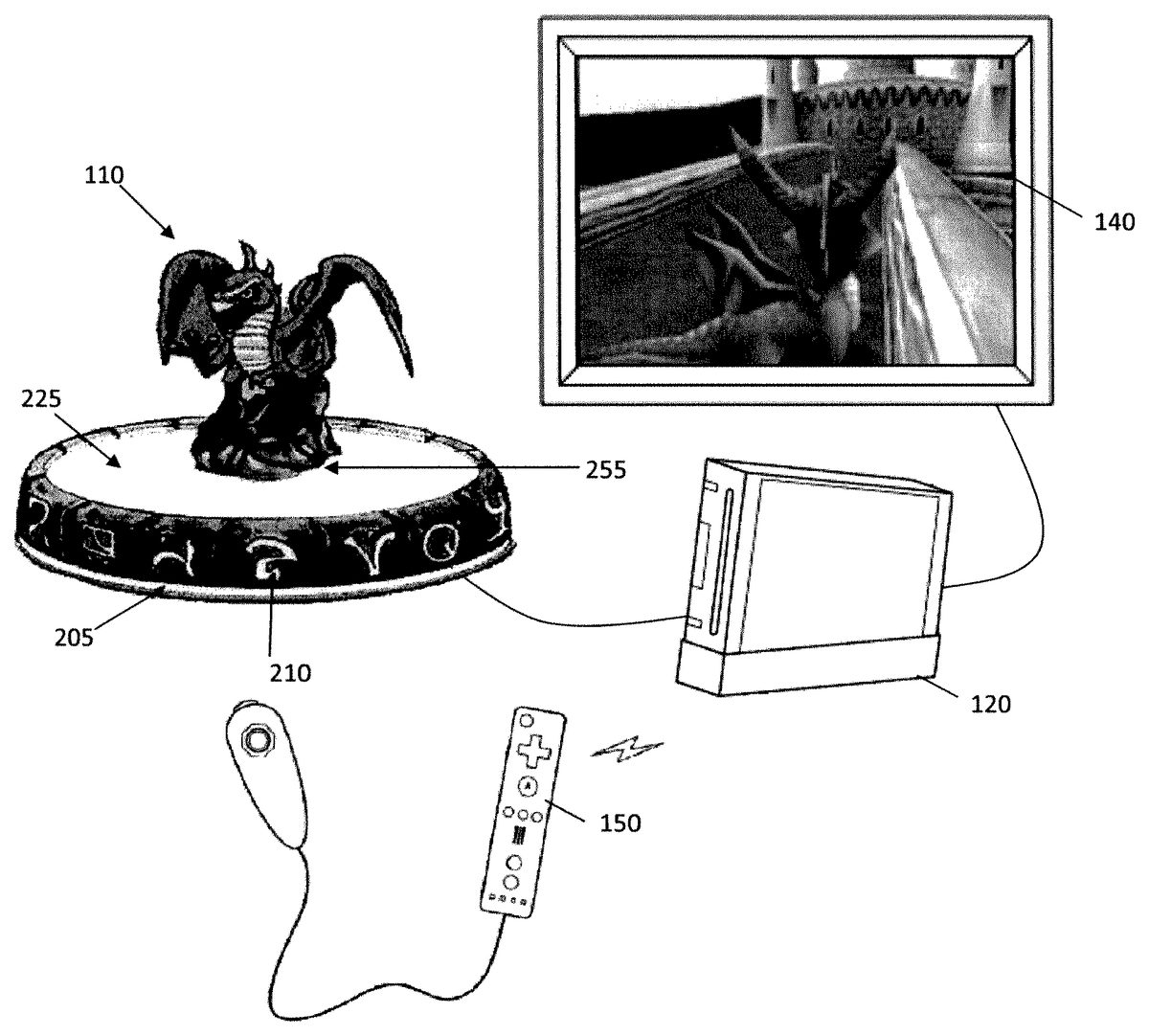
FIG. 1is a block diagram illustrating an example of a video game system in accordance with aspects of the present invention. Referring toFIG. 1, an embodiment of a system in accordance with aspects of the present invention includes gaming platforms120,122,124with a processor for executing program instructions providing for game play and associated circuitry, I/O devices150,152,154(such as a video game controller, keyboard, mouse, joystick, touch-screen display, voice input or other known devices), a display devices140,142,144, a toy110and a server130(or plurality of servers). The gaming platforms120,122,124may be, in various embodiments, one, some, or any of a variety of processing devices capable of executing a video game program and communicating with a remote server, such as a traditional video game console (e.g. PlayStation, Xbox, Wii, WiiU), portable game console (e.g. Nintendo NDS, PlayStation Portable), a personal computer, a laptop, a mobile computing device (e.g. iPad or other tablet), or other mobile device (e.g. cell phone, iPhone, Blackberry, Droid operated phone, MP3 player). The platforms provide video images to display140,142,144coupled respectively thereto. The platform may also provide audio outputs either to display140,142,144, or to a separate audio device not depicted inFIG. 1. The display device is generally coupled to the gaming platform by a cable, although in some embodiments a wireless connection may be used. In many embodiments, the display device is a liquid crystal display. In some embodiments, the display device is a television. A display screen131of the display device displays video images of game play, generally as commanded by the processor or other associated circuitry of the gaming platform.
The user may control the gaming platforms120,122,124and game play on the gaming platforms120,122,124via I/O device150,152,154coupled respectively thereto. Gaming platform120communicates with server130via known client/server models and networking techniques, including known internet and cellular communication protocols.
In some embodiments, the gaming platforms120,122,124are each able to uniquely identify toy110. The identification of toy110may be performed either through a direct coupling between toy110and the gaming platforms120,122,124, either through a wired connection (e.g. USB), through a wireless coupling (e.g. Bluetooth or WiFi) or other known object recognition methods, such as recognizing the toy110by capturing a visual image of the toy and determining identity, or by scanning a bar code or other code printed on the toy110. In other embodiments, the gaming platforms120,122,124are able to identify toy110via a peripheral coupled to platforms120,122,124.
The peripheral device210, in some embodiments and as shown inFIG. 2, has a substantially flat upper surface225for placement of toys thereon. The game player generally places game toys, for example, toy110in the form and representative of a dragon as shown inFIG. 2, on the flat surface225of the peripheral device210during game play. The toy110is generally in the form of and representative of a game item such as a game character or other game item. In most embodiments, the toy is associated with a game character during game play.
Each toy may include machine-readable information, for example, memory, a radio frequency identification (RFID) tag or a barcode. The machine-readable information may be sensed, read, and/or in some embodiments written, by the peripheral device, in some embodiments indirectly by way of sending data and commands to the toy to write the data to memory of the toy. The machine-readable information may include a numeric identifier. The machine-readable information allows the peripheral device, or the processor of the gaming platform, to distinguish one toy from other toys, and the machine-readable information may therefore be considered to include a toy identifier, and in some embodiments, each particular toy has its own distinct identifier. In addition, in many embodiments the machine readable information includes additional information about a corresponding game character, including in some embodiments, status of the game character in a game. In still other embodiments, the toy110may include readable/writeable memory such as RAM for storing information related to the toy or the game character corresponding to the toy.
When a toy110is read by the peripheral device210, the peripheral device210provides the gaming platform120an indication of the identifier and status information of the toy, and generally the processor of the gaming platform commands display of a corresponding game character or otherwise makes the corresponding game character available in game play. Likewise, when a toy in the form of an article such as a hat or weapon is placed on the peripheral device, the processor may make a corresponding article appear in the game and the article may affect changes or the ability to make changes in the game. For example, when a hat toy and a character toy are concurrently on the peripheral device, the corresponding character in the game may possess the corresponding hat. Thus, video game play may be affected by use of real world objects, objects which may also be utilized for play and/or observation separate from video game play.
Once a gaming platform120,122or124recognizes and identifies the toy110, a virtual representation of the toy110is presented in a game operating on gaming platform120,122or124and displayed on respective displays140,142, or144. The user may control the virtual representation of the toy110within the game via the respective I/O device150,152or154. The virtual representation of the toy110may have one or more characteristics and/or attributes associated with it, such as health, strength, power, speed, wealth, shield, weapons, or achievement level, for example. A toy110that has never been used within the gaming environment may have initial attributes and/or characteristics that are preprogrammed in the gaming software, gaming platform or server. As the user plays the game utilizing, at least in part, the virtual representation of the toy110, the one or more characteristics and/or attributes associated with toy110may be altered.
For example, as a user progresses through different challenges within the game using the virtual representation of toy110, the user may discover and collect various virtual items usable by the virtual representation of toy110that alter the characteristics and/or attributes of the virtual representation of the toy110. For example, the user may obtain, via his virtual representation of toy110, a new sword that may alter the weapons associated with the virtual representation of toy110, or virtual gold that may alter the wealth associated with the virtual representation of toy110. As another example, the user may obtain, via his virtual representation of toy110, a virtual portion to increase the strength the virtual representation of toy110. As another example, the reward for completing certain challenges within the game may be to increase the health, wealth, strength, speed, agility or other characteristics or attributes of the virtual representation of the toy110, and the penalty for failing to complete those tasks may be a decrease in one or more of those characteristics or attributes. These one or more characteristics or attributes may be altered in innumerable ways via game play, and these examples are only illustrative.
At the completion of a particular gaming session, or periodically throughout a gaming session, the changes in attributes to the virtual representation of toy110are stored by gaming platform120,122or124to server130. This attribute and/or characteristic data is stored on said server130, for example via a relational database, and is associated with the particular toy110for subsequent access by the user utilizing toy110in subsequent gaming sessions either on the same or different gaming platforms. Accordingly, the updated data pertaining to the one or more characteristics and/or attributes associated with the virtual representation of toy110may persist across platforms. These attributes may also be stored elsewhere, such as a memory associated with platform120,122or124or a memory associated with toy110.
In a subsequent gaming session on either the same gaming platform or a different gaming platform, the particular gaming platform is able to access the updated data pertaining to the one or more characteristics and/or attributes for use in the subsequent gaming session. The server is able to utilize the identification of toy110, described above, and retrieve the up to date data associated with the virtual representation of that toy110when prompted by a gaming platform120,122or124in response to an identification of toy110. The server130may then transmit that data to gaming platform120,122, or124for use in that game session.
The transmission of data pertaining to toy110from server130may happen at a number of stages in various embodiments. For example, the data transmission may begin immediately upon identification of toy110prior to the beginning of game play. In another embodiment, game play may be allowed to commence prior to complete or partial retrieval of data pertaining to toy110so as to allow game access more quickly. In still other embodiments, the data may only be retrieved in response to a user request.
Once retrieved from server130, the gaming console120,122,124may continue to communicate with server130or may, in alternative embodiments, store the data in a local memory associated with the platform or toy110. In such embodiments, the data may be updated to server130periodically, at the end of a gaming session, in response to a user request, or at any other interval or game play event.
In certain embodiments, the user may establish an account where the account information is also stored on server130and/or on gaming platforms120,122,124. The user may access the account by entry of a username and password, for example. The server130may subsequently create a linkage or association between the account and toy110reflecting that toy110has been used in connection with that account. The user account may have multiple toys or objects associated and/or linked to it. Such a system may be advantageous for various reasons. In one embodiment, a user may log into the user's account on a gaming platform120,122,124. Data for the various toys and objects associated and/or linked to that user account may be retrieved from server130in response to the user logging into the account or in response to the user having a first toy110identified by a gaming platform120,122,124, which may reduce possible delay resulting from data being retrieved from the server when a new toy is desired for game play.
In still other embodiments, a single toy110may have various virtual characteristics stored on server130for different user accounts. For example toy110may be associated with the accounts of User A and User B. User A may have played in the various gaming environments using toy110more than User B. When User A logs into his or her account and uses toy110in connection with a gaming platform120,122,14, the data associated with the characteristics of the representation of toy110resulting from User A's progression in the various gaming environments using toy110will be reflected, for example. User B may the also use toy110in connection with his or her account, but have data specific to User B's account with respect to toy110reflecting the characteristics of the representation of toy110resulting from User B's progression in the various gaming environments using toy110or other objects associated with User B's account.
For example, a user may have a toy110such as a dragon depicted inFIG. 2. In a first gaming session, a user may place the toy110on a peripheral connected to the user's gaming console120. The game console identifies the toy110as a particular toy110dragon or as a dragon that has been linked to a user account. The user plays the game using, in part, a virtual representation of the toy110dragon. In the course of that game play, the user accomplishes various tasks earning virtual toy110dragon increases in strength and speed. Data reflecting those increases are transmitted to and stored in a memory associated with server130. In a subsequent gaming session, for example on the user's same console, the user places the toy110dragon on the peripheral associated with that gaming device120. The gaming device is able to identify the toy110dragon and retrieve the up to date data regarding the increases in strength and speed accomplished in the prior gaming session for use in the subsequent gaming session. During the course of the second gaming session, the user accomplishes various tasks earning virtual toy110dragon still further increases in other attributes, for example, defense and agility. Data reflecting those increases are transmitted to and stored in a memory associated with server130so that a complete set of up to date data reflecting the virtual toy110is stored. In still another subsequent gaming session, for example, on the user's mobile device, the mobile device recognizes and identifies the toy110dragon and connects to server130to retrieve the up to date data reflecting the strength, speed, defense and agility associated with toy100dragon for use in that game session. The same sequence can be performed in various gaming sessions across any compatible gaming device, thereby preserving the user's progress associated with toy110across each session regardless of the gaming platform.
In alternative embodiments, the toy110may have an identification code associated with it. User may access for game play the data reflecting the one or more characteristics and/or attributes stored on server130associated with toy110by entering the identification code, rather than utilizing the toy110itself. In further alternative embodiments, the user may be able to link toy110to a user account, such that the user may access the data for game play the data reflecting the one or more characteristics and/or attributes stored on server130associated with toy110by entering the user's account credentials.
Referring toFIG. 2, the peripheral device210may also provide the capability to read and write information to a toyFIG. 110in alternative embodiments. The processor in gaming console120, responsive to inputs from the user input devices and the peripheral device, generally commands display on the display device140of game characters in and interacting with a virtual world of game play and possibly each other. In addition, the processor, responsive to inputs from the peripheral device210, may be used to add characters and objects to the virtual world, with the characters able to manipulate the added objects and move about the virtual world. For example, the processor may include characters in game play based on inputs from the peripheral device210, and the processor may control actions and activities of game characters based on inputs from the user input devices.
The instructions providing for game play are generally stored on removable media, for example, an optical disk. Accordingly, the game console may include an optical drive, for example, a DVD-ROM drive, for reading the instructions for game play. In some embodiments, the game console may be a personal computer, including similar internal circuitry as herein described, as well as, for example, a built-in display and built-in user input devices, such as a keyboard and a touch pad. In other embodiments, the instructions providing for game play may be stored in a remote server that are accessed by a computer or mobile device. In yet other embodiments, the instructions providing for game play may be stored locally on the gaming device memory.
In the embodiment ofFIG. 2, the display screen140shows a screen shot of video game play. As illustrated, the screen shot shows a display of a character, generally controlled by and animated in accordance with user inputs, approaching an inanimate item in the form of what may be considered a castle.
FIG. 3is an example of a block diagram of a processor and associated circuitry, for example, for a game console, useful in accordance with aspects of the invention. As shown inFIG. 3a processor311is connected to other components via a bus. The other components include a main memory313and a removable memory interface315generally coupled to a removable memory device, for example, a DVD-ROM drive. The processor may execute instructions retrieved from the removable memory device to control game play and store game state information in the main memory. For example, the instructions may be for determining possible movements, positions, and locations of a game character.
The processor is coupled to an audio driver321and a video driver323. The audio driver produces sound signals and the video driver produces image signals. The sound signals and image signals are transmitted from the game console via a display I/O device325. The display I/O device generally supplies the sound and image signals to a display device external to the game console. Sound signals may also be supplied to a peripheral device such as a toy reader.
The processor may also be coupled to a user I/O device317, a wireless transceiver319, an Internet I/O device327, and other circuitry329. The user I/O device may receive signals from a peripheral device and/or signals from a keyboard, a mouse, and/or a game controller, with generally the keyboard, mouse, and/or controller being used by a user and providing user inputs, for example, during game play. Alternatively or additionally, the game console may receive user inputs via the wireless transceiver. The Internet I/O device provides a communication channel that may be used, for example, for multiple player games.
FIG. 4is a block diagram of a video game peripheral in accordance with aspects of the invention. The peripheral may be used in some embodiments as the peripheral device210ofFIG. 2. The peripheral may be used to provide information from the toy to a gaming platform and, in some embodiments, from the gaming platform to the toy. Accordingly, the peripheral includes a universal serial bus (USB) interface411to communicate with the gaming platform. In some embodiments, the peripheral may use a different interface, for example, a wireless interface for communication with the gaming platform. The information communicated between the peripheral and the gaming platform may be encrypted, and the information read from or written to the toy by the peripheral may also be encrypted.
The peripheral also includes a radio-frequency interface421to communicate with toys. In many embodiments, the radio-frequency interface is an RFID interface. In other embodiments, the peripheral may include a different interface for communicating with toys, such as an optical interface or a wired interface. It is further understood that in some embodiments, the peripheral device (as depicted inFIG. 4) may be removed. For example, in certain embodiments of the present invention, the functionality of the peripheral device may already be included, in whole, or part, within the gaming platform, such as for example, NFC or RFID equipped mobile device.
In one embodiment of an optical interface the toy includes a light source, for example an LED, to provide information of the machine readable information and a photodiode to receive information of commands, with circuitry operable within the toy to provide for associated operation of the LED and photodiode in performing communication functions. Power may be provided to the toy by way of a battery, by way of RFID operations, or by other sources. In such an embodiment the peripheral device similarly includes a photodiode and LED for communication with the toy.
In another embodiment the peripheral device includes an imaging device, for example a CCD and associated circuitry. In such embodiments the imaging device may generate an image, for analysis by the peripheral device or in most embodiments by the gaming platform, with the image providing information related to the toy. In some embodiments identity of the toy may be determined by shape or other features, such as color or reflectivity, of the toy or portions of the toy. Similarly, identity and other information of the toy may be provided by image information placed on the toy, including, for example, information of stickers placed on the bottom of the toy, placed either prior to receipt of the toy by a user or by the user, in which case the information may be changed by the user in accordance with game play results. The toy may instead, or in addition may include bar code or bar code like information, with the peripheral device including bar code scanning components.
Further in some embodiments the toy may include a wired connection to the peripheral device, or in some embodiments, a wired connection to the gaming platform, possibly dispensing with the peripheral device. Similarly, in some embodiments the toy may include wireless communication capabilities of the type commonly used with computers, for example Bluetooth, NFC or Wi-Fi capabilities.
The peripheral may include a controller401that is coupled to the USB interface and the radio-frequency interface. The controller adapts the signals between protocols used by the two interfaces. In some embodiments, the controller communicates with the radio-frequency interface based on commands received over the USB interface. For example, the controller may receive commands to determine what toys are present on the peripheral or to read from or write to a particular toy. In other embodiments, the controller may independently communicate with the radio-frequency interface and supply resulting information to a gaming platform over the USB interface. For example, the controller may, via the radio-frequency interface, regularly detect what toys are newly present on the peripheral and report the detected toys to the gaming platform via the USB interface. The controller generally includes a programmable device such as a microprocessor performing program instructions. The program instructions may be stored in the peripheral as firmware or downloaded from the gaming platform.
The peripheral also includes, in some embodiments, a loudspeaker431. The loudspeaker provides audio signaling to game players and the signaling may relate to a particular toy present on the peripheral. In some embodiments, the peripheral includes visual indicators such as light-emitting diodes441a-c. The diodes may, for example, be illuminated with intensities or colors that signal performance in the video game of characters associated with toys on the peripheral. Both the loudspeaker and visual indicators are coupled to the controller. The controller signals the loudspeaker and visual indicators to operate according to commands received via the USB interface.
FIG. 5is a flowchart of a process for identification of a toy110and retrieval of data associated with toy110in accordance with aspects of the invention. The process may be implemented by a video game peripheral, a video gaming platform, or a combination of devices. Additionally, the process may be implemented using a processor configured by program instructions. The process may be performed utilizing a standardized protocol, for example, the ISO/IEC 14443 standard for Identification Cards. Accordingly, the process may communicate with toys via radio-frequency communication.
In block510, the process identifies toys in a defined region. For example, the process may determine what toy110is on the surface of a video game peripheral as shown inFIG. 2. In various embodiments, the toy110may be identified by RFID, barcodes, or optical recognition. In one embodiment, identification of toys includes a video game peripheral reading identifiers of the toys and supplying the identifiers to a video gaming platform.
In block520, the process determines if any additional toys must be identified. If so, further identification is conducted in accordance with block510. If no further toys require identification, the process proceeds to block530.
In block530, data corresponding to the identified toy is retrieved, for example, via a connection to a remote server, as depicted inFIG. 1. In alternative embodiments, data may be retrieved from memory on the gaming device, peripheral or the toy itself. In block540, the retrieved data for the one or more identified toys is used, at least in part, in conducting the game play on the gaming device.
FIG. 6is a diagram of data structure in accordance with aspects of the invention. The structure may be used to store data in a server or in alternative embodiments in a memory on the gaming device, in a memory on a peripheral to the gaming device or in a memory of a toy, or any combination thereof. Information about the toy, such as its characteristics and its status, are stored at various locations in the data structure. Although various fields of the data structure are shown in particular locations inFIG. 6, the data structure may use a different arrangement of the fields.
The data structure includes an area of fixed information605. The fixed information includes information that identifies a type of toy and a particular instance of the toy, for example, the fixed information may include a 32-bit serial number. The fixed information may also include an identification of objects related to the toy, such as an identification of a trading card. The fixed information generally includes a field for data verification, for example, a cyclic-redundancy check value or checksum. The fixed information is generally written when the toy is created and not thereafter changed.
The data structure also includes a first data area610and a second data area620. Each of the data areas contains corresponding fields for certain values representing status information about a game play character associated with the toy. However, the first data area and the second data area contain values that reflect the toy's status at different times. For example, the first data area may contain current values and second data area may contain previous values. How which of the data areas is current may be determined and controlled is described further below.
The first data area610includes a first header611. The first header includes information about the toy that may change frequently during game play, such as fields that store score values, experience levels, or money values. The first header may also include a field indicating how much cumulative time the toy has been used for game play. The first header also contains a sequence field that may be used to determine whether the first data area contains current data.
The first data area610includes a first initial information area612. The first initial information area includes information about the toy for use in adding the character associated with the toy to game play. For example, the first initial information area may include a field that stores a name for the toy. The first initial information area may include additional fields that store information useful for displaying a representation of the character associated with the toy in the game. For example, there may be information indicating upgrades that have been acquired for the character associated with toy or objects the character may be wearing, such as hats. In some embodiments, however, the fixed information may contain sufficient information for adding the character associated with to the toy to game play, with the fixed information used instead of the initial information.
The first data area610includes a first further information area613. The first further information area includes fields that indicate additional information about the character's status beyond the information contained in the first header and the first initial information area. The fields in the first further information area may include, for example, a value indicating when the character associated with the toy most recently joined the game, a value indicating when the toy was first used in the game, an indication of a player to which the toy belongs, and an indication of what challenges or skill tests the character associated with the toy has completed in the game.
The first data area generally includes one or more fields for data verification, for example, checksums. In one embodiment, the first header includes three checksums: a checksum for the entire first data area, a checksum for the initial information area and a checksum for the header itself. The inclusion of three checksums may allow the corresponding areas to be verified or updated without reading or writing other areas.
The second data area620includes a second header621, a second initial information area622, and a second further information area623. Each of the areas in the second data area corresponds to a like named area in the first data area. Two data areas may be advantageous to provide cycling areas on consecutive saves and also may add redundancy for the case of partial updates and write failures. In some embodiments, the data structure includes additional data areas, for example, a third data area and a fourth data area.
FIG. 7is a diagram of an embodiment of data flow between various gaming platforms utilizing aspects of the invention disclosed herein. In the embodiment illustrated inFIG. 7, toy710includes an RFID tag to provide unique identification of the toy710as described elsewhere in the specification. It is understood that in various embodiments other identification techniques may also be used consistent with the descriptions herein. Gaming platforms720(e.g. Wii, Xbox, Playstation, PC, mobile device) can receive the RFID tag, or other identification information, for example via a peripheral as described above or through other techniques described herein. During game play on gaming platforms720, information related to the toy710(referred to inFIG. 7as “Toy character data”) is updated. The updated toy character data is sent to and stored on a server database730. In subsequent gaming sessions, the up to date toy character data can be transmitted from server database730to any gaming console720in communication with server database730for use in gaming sessions. The toy character data may comprise one or more of the following: experience, nickname, money, challenge levels, last seen time, hat, cumulative time, birth time and platform use, art, animations, sounds, game parameters, scripts and AI algorithms.
In some embodiments, a web-based game740may also be provided for use in connection with toy710. The web-based game740may receive toy character data directly from a console720, or may also receive toy character data from the server database730. The toy character data may be transmitted between these various systems via known networks, such as internet networks, cellular data networks or LANs.
In still other embodiments, not depicted inFIG. 7, some or all of the character data may also be stored on toy710or on a memory associated with console720. This may be advantageous so that users may have access to certain character data in the absence of a server connection.
Although the invention has been discussed with respect to various embodiments, it should be recognized that the invention comprises the novel and non-obvious claims supported by this disclosure.
Claims
- A toy usable in connection with a gaming system, said toy comprising: a toy figure;and an electronic identification device within the toy figure containing a code uniquely identifying said toy;said gaming system comprising: a first game system configured to be coupled with a first peripheral device, wherein said first peripheral device is configured to read said code uniquely identifying said toy from said electronic identification device on said toy;wherein said first game system is configured by program instructions to provide for game play, including providing a representation of said toy figure for game play within a game environment, in which a user controls the representation of said toy figure via a first game system input/output (I/O) device, subsequent to reading of said code of said toy by said peripheral, wherein said representation of said toy figure has one or more attributes related to said representation of said toy figure, wherein at least some of said one or more attributes are capable of being altered for completing or failing to complete challenges during said game play within said game environment, wherein said attributes are one or more of said representation's: health, strength, power, or speed;a server subsystem configured to communicate data of said attributes related to said representation of said toy figure on a per user basis, the data of said attributes including data reflecting alterations to said attributes, with said first game system and a second game system, said server subsystem including storage for storing the data of said attributes related to said representation of said toy figure on the per user basis, said data being associated with said toy on the per user basis;wherein said server subsystem is configured to associate said code and said attributes with each of a plurality of user accounts each having a login and capable of being associated with codes for multiple toys and said attributes;and said second game system configured to receive said logins associated with said code uniquely identifying said toy from said electronic identification device on said toy;wherein said second game system is configured by program instructions to provide for game play, including providing a representation of said toy figure for game play within a game environment, in which the user controls the representation of said toy figure via a second game system I/O device, subsequent to receiving confirmation of said login and at least some of said attributes from said server subsystem by said second game system, said second game system further configured to communicate with said server subsystem and to receive from said server subsystem the data of said attributes, for a particular user account for which said login has been received, related to said representation of said toy figure for use in game play within said game environment in a subsequent gaming session on said second game system;said first game system configured to receive said logins and to communicate with said server subsystem and to receive from said server subsystem the data of said attributes, for a particular user account for which said login has been received, related to said representation of said toy figure for use in game play within said game environment in a subsequent gaming session on said first game system.
- A toy usable in connection with a gaming system as described in claim 1 , wherein said toy further comprises at least one memory device for storing data relating to characteristics of said representation of said toy figure within said game environment.
- A toy usable in connection with a gaming system as described in claim 2 , wherein said first game system comprises a game console and said second game system comprises a mobile device.
- A toy usable in connection with a game console and an associated peripheral, said toy comprising: a toy figure;and an electronic identification device containing a code uniquely identifying said toy;said peripheral coupled to said game console, wherein said peripheral is capable of reading said code from said electronic identification device and communicating said read code to said game console;said game console configured by program instructions to provide for game play, including providing a representation of said toy figure for game play within a game environment subsequent to receiving said read code of said toy from said peripheral, wherein said representation of said toy figure has associated therewith one or more related attributes, wherein said attributes are one or more of said representation's: health, strength, power, or speed, wherein at least some of said one or more attributes are capable of being altered during said game play within said game environment, and wherein said game console is configured to communicate with a server subsystem to identify a specific user account of a plurality of user accounts and to receive from said server subsystem data of said attributes associated with said representation of said toy for the specific user account;and wherein said server subsystem associates said code with each of the plurality of user accounts, each having a login and capable of being associated with multiple codes and said attributes, said server subsystem storing at least some different attributes associated with said code for each of the plurality of user accounts.
- A toy usable in connection with a game console as recited in claim 4 , wherein said game console is further configured to communicate with a control device to control said game play of said representation of said toy figure within said game environment.
- A toy usable in connection with a game console as recited in claim 4 , wherein said data relating to said attributes related to said representation of said toy are altered during said game play and said altered data is stored to said server subsystem.
- A game system comprising: a three dimensional figure having an electronic memory device embedded therein for storing a code uniquely identifying said figure and for storing attribute data reflecting characteristics of a representation of said figure within a game environment;a first gaming platform capable of receiving said code and said attribute data from said electronic memory device;a second gaming platform;said first gaming platform configured to provide said representation of said figure within said game environment, in which the representation of said figure is controlled via an input/output (I/O) device of the first gaming platform, subsequent to identifying said figure;said first gaming platform further configured to send data to and receive data from a server subsystem, including said code uniquely identifying said figure and said attribute data reflecting characteristics of said representation of said figure within said game environment, and an identification of a user account of a plurality of user accounts wherein said server subsystem stores said data associated with said three dimensional figure for the identified user account, each of said user accounts having a login and capable of being associated with data associated with multiple three dimensional figures, said first gaming platform configured to utilize said attribute data received from said server subsystem, after sending said code uniquely identifying said figure and said identification of the user account to said server subsystem, or utilize said attribute data from said electronic memory device embedded in said figure in absence of a connection to said server subsystem;said second gaming platform further configured to receive said attribute data for a particular user account from said server subsystem to provide said attribute data reflecting characteristics of said representation of said figure within a game environment after logging into a particular user account of the plurality of user accounts through use of a username and password, in which said representation of said figure is controlled via an I/O device of said second game system, operating on said second gaming platform in a subsequent gaming session.
Disclaimer: Data collected from the USPTO and may be malformed, incomplete, and/or otherwise inaccurate.