U.S. Pat. No. 9,623,335
ACCESS TO AN EXCLUSIVE VIRTUAL SECTION OF AN ONLINE GAME BASED ON PAST SPENDING BEHAVIOR
AssigneeKabam, Inc.
Issue DateJuly 11, 2013
Illustrative Figure
Abstract
This disclosure relates to a system and methodology for obtaining information associated with spend history of a first user in connection with playing an online game and processing the information associated with the spend history to assign the user spend parameter value to the first user which may be further used to provide selective access to an exclusive virtual section associated with an online game when the user spend parameter value meets the spend threshold.
Description
DETAILED DESCRIPTION FIG. 1illustrates a system100configured to provide a virtual space. System100is only one example of a suitable computing environment and is not intended to suggest any limitation as to the scope of use or functionality of the features described herein. Providing the virtual space may include hosting the virtual space over a network. In some implementations, system100may include one or more servers102. The server102may be configured to communicate with one or more client computing platforms104according to a client/server architecture. The users may access system100and/or the virtual space via client computing platforms104, for instance, to engage in one or more games. The server(s)102may be configured to execute one or more computer program modules. The computer program modules may include one or more of a game module106, a user profile management module108, a user spend parameter module110, an exclusive virtual access module112, a shop module114, and/or other modules. As noted, the client computing platform(s)104may include one or more computer program modules that are the same as or similar to the computer program modules of the server(s)102to facilitate in-game actions. The computer program modules may make up a system140, which is configured to provide select users with access to an exclusive virtual section of an online gaming system. An implementation of the system includes one or more of a game module106, a user profile management module108, a user spend parameter module110, an exclusive virtual access module112, a shop module114, and/or other modules. In an implementation, an advantage of providing select access to a separate exclusive virtual section or a very important person (VIP) store section may be that it prevents much of the negative publicity that comes with introducing and featuring relatively ultra-expensive virtual items for use in the online game. An implementation of providing the select access may also not discourage ...
DETAILED DESCRIPTION
FIG. 1illustrates a system100configured to provide a virtual space. System100is only one example of a suitable computing environment and is not intended to suggest any limitation as to the scope of use or functionality of the features described herein. Providing the virtual space may include hosting the virtual space over a network.
In some implementations, system100may include one or more servers102. The server102may be configured to communicate with one or more client computing platforms104according to a client/server architecture. The users may access system100and/or the virtual space via client computing platforms104, for instance, to engage in one or more games.
The server(s)102may be configured to execute one or more computer program modules. The computer program modules may include one or more of a game module106, a user profile management module108, a user spend parameter module110, an exclusive virtual access module112, a shop module114, and/or other modules. As noted, the client computing platform(s)104may include one or more computer program modules that are the same as or similar to the computer program modules of the server(s)102to facilitate in-game actions.
The computer program modules may make up a system140, which is configured to provide select users with access to an exclusive virtual section of an online gaming system. An implementation of the system includes one or more of a game module106, a user profile management module108, a user spend parameter module110, an exclusive virtual access module112, a shop module114, and/or other modules.
In an implementation, an advantage of providing select access to a separate exclusive virtual section or a very important person (VIP) store section may be that it prevents much of the negative publicity that comes with introducing and featuring relatively ultra-expensive virtual items for use in the online game. An implementation of providing the select access may also not discourage lower spenders from paying to advance in the game. In an implementation, the exclusivity of the store section may also provide a psychological benefit to users that are high spenders and may provide an incentive to some medium-sized spenders to hit relevant thresholds.
In an implementation, the game module106may be configured to execute an instance of an online game, and to implement the instance of the online game to facilitate participation of users in the online game. The game module106may be further configured to implement access to an exclusive virtual section, such as may be implemented by shop module114. The exclusive virtual section may be determined for individual users such that the access to the exclusive virtual section is implemented in the instance of the online game for a first user.
The game module106may be configured to execute an instance of an online game to facilitate presentation of the online game to users. The game module106may be configured to implement in-game actions in the instance of the game, in response to action requests for the in-game actions by the users.
The game may be provided via a virtual space, and may include a plurality of resource types and/or maps. An instance of the virtual space may be executed by computer modules to determine views of the virtual space. The views may then be communicated (e.g., via streaming, via object/position data, and/or other information) from server(s)102and/or sources to client computing platforms104for presentation to users. The view determined and transmitted to a given client computing platform104may correspond to a location in the virtual space (e.g., the location from which the view is taken, the location the view depicts, and/or other locations), a zoom ratio, a dimensionality of objects, a point-of-view, and/or view parameters. One or more of the view parameters may be selectable by the user.
The instance of the virtual space may comprise a simulated space that is accessible by users via clients (e.g., client computing platform(s)104) that present the views of the virtual space to a user. The simulated space may have a topography, express ongoing real-time interaction by one or more users, and/or include one or more objects positioned within the topography that are capable of locomotion within the topography. In some instances, the topography may be a 2-dimensional topography. In other instances, the topography may be a 3-dimensional topography. The topography may include dimensions of the space, and/or surface features of a surface or objects that are “native” to the space. In some instances, the topography may describe a surface (e.g., a ground surface) that runs through at least a substantial section of the space. In some instances, the topography may describe a volume with one or more bodies positioned therein (e.g., a simulation of gravity-deprived space with one or more celestial bodies positioned therein). The instance executed by the computer modules may be synchronous, asynchronous, and/or semi-synchronous.
The above description of the manner in which views of the virtual space are provided is not intended to be limiting. The virtual space may be expressed in a more limited, or more rich, manner. For example, views determined for the virtual space may be selected from a limited set of graphics depicting an event in a given place within the virtual space. The views may include additional content (e.g., text, audio, pre-stored video content, and/or other content) that describes particulars of the current state of the place, beyond the relatively generic graphics. For example, a view may include a generic battle graphic with a textual description of the opponents to be confronted. Other expressions of individual places within the virtual space are contemplated.
Within the instance(s) of the virtual space, users may control characters, objects, simulated physical phenomena (e.g., wind, rain, earthquakes, and/or other phenomena), and/or other elements within the virtual space to interact with the virtual space and/or each other. The user characters may include avatars. As used herein, the term “user character” may refer to an object (or group of objects) present in the virtual space that corresponds to an individual user. The user character may be controlled by the user with which it is associated.
User-controlled element(s) may move through and interact with the virtual space (e.g., non-user characters in the virtual space, other objects in the virtual space). The user-controlled elements controlled by and/or associated with a given user may be created and/or customized by the given user. The user may have an “inventory” of virtual goods and/or currency (e.g., resources of a plurality of resource types) that the user can use (e.g., by manipulation of a user character or other user-controlled element, and/or other items) to perform in-game actions within the virtual space.
The users may participate in the instance of the virtual space by controlling one or more of the available user-controlled elements in the virtual space. Control may be exercised through control inputs and/or commands input by the users through client computing platforms104. The users may interact with each other through communications exchanged within the virtual space. Such communications may include one or more of textual chat, instant messages, private messages, voice communications, and/or other communications. Communications may be received and entered by the users via their respective client computing platforms104. Communications may be routed to and from the appropriate users through server(s)102. In implementations, the game module106may also be configured to implement the access to the exclusive virtual section determined for the individual users as described herein.
The user profile management module108may be configured to manage user profiles of the users. The user profiles may include user spend parameter values for the users. The spend parameter values characterize past spending histories of the users within at least the game. The user profiles may include a first user profile of a first user. The first user profile may include a first user spend parameter value characterizing a past spending history of the first user in at least the game. Each user may be associated with their own respective past spending history and user spend parameter value.
The shop module114may be configured to present offers to sell virtual items for use in the game to users through a shop interface. The shop module114may be configured such that the offers to sell virtual items include one or more exclusive offers that are only presented to selected users. In an implementation, the shop interface provides for purchasing of the one or more exclusive offers. For example, a virtual item includes a resource that is used within the online game, such as a virtual good or currency. In an implementation, the shop interface may be a pop up window interface that is triggered by events during the game. In another implementation, the user may receive a notice of the existence of exclusive offers and the user may initiate the viewing of the exclusive offer presentation. There exists numerous implementations for presenting the exclusive offer to the user.
For example, the implementation of the access to the exclusive virtual section including the shop interface may be imperceptible to a second user during gameplay. For example, implementation of the access to the exclusive virtual section including the shop interface may be perceptible to the first user during gameplay. For example, implementation of the access to the exclusive virtual section including the shop interface may be imperceptible to users other than the first user during gameplay.
The exclusive virtual access module112may be configured to determine which users should be presented the one or more exclusive offers by the shop module114. A determination as to whether the first user should be presented the one or more exclusive offers by the shop module114may be based on a comparison of the first user spend parameter value with a spend threshold.
The user spend parameter module110may be configured to determine the user spend parameter value based on the past spending history. For example, the user spend parameter value may be a user lifetime spend history parameter or a user periodic spend history parameter. For example, the periodic spend history parameter may be a past purchasing amount that the user spent per a unit time. An example of a unit time includes any one or more of the last hour, last day, last week, last month, etc. or the last day after the user added value to the user's account. For example, the user lifetime spend history parameter may be the amount spent by the user for a particular account or character in a single game or all characters in one or more games, etc.
In an implementation, the user spend parameter value comprises one or more parameters associated with a spend velocity profile associated with the first user. In other implementations, the unit time may be used to determine a spend velocity profile per the user account. For example, the online game module may keep track of when the user spends at a fast rate or spend velocity. For example, the spend velocity may be highest when the user reaches a certain level or a time within a level, such as the last actions before reaching a new level in the online game. The online game module may keep track of all the information about the user, especially when the spend velocity is determined to be over a particular level. The user profile management module108or the user spend parameter module110may keep track of the spend history of the user. For example, the user profile management module108may be configured to obtain and maintain information about the spend history of a user. The user profile management module108may also be configured to determine a user spend parameter value. In an implementation, a user spend parameter module110may execute the functionality for determining the user spend parameter value alone or in combination with the user profile management module108. For example, when the amount of information monitored by the user profile management module108is great, then the user spend parameter module110may be used to distribute some of the processing. The distribution of the processing described herein may configured according to a specific hardware and software implementation of a system that implements the disclosure described herein. As such, when the term user spend parameter module110is used herein it may be replaced with the more general user profile management module108. As stated above,FIG. 1illustrates an implementation of the system described herein and, as such, is not to be limiting to the disclosure.
Referring back toFIG. 1, the user profile management module108or the user spend parameter110module may be configured to track historical spend information associated with a user. In an implementation, user spend parameter module110is configured to monitor and assess spend history information for users in connection with game play for one or more games. This may include, for example, the subject game which is to provide select users with access to the exclusive virtual section as described herein.
In an implementation, historical spend information associated with other games either alternatively or in addition to the subject game may be considered. For example, the user spend parameter value associated with the first user may be associated only with the first user's interaction with the online game. For example, the user spend parameter value associated with the first user may be associated with the first user's interaction with one or more games other than the online game. For example, the user spend parameter value associated with the first user may be associated with the first user's interaction with the online game and with one or more games other than the online game. In another implementation, the spend history associated with the user for purchases other than with respect to games may also be considered.
Referring back toFIG. 1, the user profile management module108or the user spend parameter module110may monitor and track various characteristics associated with the user's spend history. For example, spend velocity may be tracked and considered. Spend velocity may equate to the amount of money spent by the user per unit time. In an implementation, the user spend parameter module110may use the spend velocity to an assess an average spending velocity by the user at different points in time during game play. Alternatively or in addition, this may equate to average spending by the user at content driven points in one or more games. Examples of this may include, average spend during quest related in-game activities, average spend during player to player battles, etc. In other implementations, the user spend parameter module110may determine total spend, either on a game by game basis or total game spend in the aggregate, or both to generate a user spend parameter value, which may be compared to a respective spend threshold as described herein.
In an implementation, the user spend parameter module110may generate a user spend parameter value, based on one or more characteristics, as described above. This user spend parameter value may then be used by the exclusive virtual access module112, as described below, to implement access to an exclusive virtual section of the online game. Alternatively, in other implementations, the user spend parameter module110may generate a more detailed “spending pattern profile” which represents the various spend history patterns associated with a user. In this case, this profile may be mapped to one or more particular user spend parameter values as described below so that multiple levels of access are adjusted based on one or more aspects of the user spend characteristics.
In this disclosure, previous spending histories associated with users of online games, are detected, and various game characteristics relating to the game play and access to virtual items that may assist game play may be adjusted based on this information. Accordingly, implementations may be configured for determination and detection of previous spending characteristics of users such as spending velocity which is represented as money spent per unit time during game play. Other implementations may be configured such that spending history determination takes into account a typical spend profile of a user. In this case, average spending at different points of game play is monitored and assessed. For example, these points of game play may be related to temporal progress during game play or in the alternative, they may be driven by specific content which is active and/or available during gameplay.
In an implementation, the user spend parameter value comprises one or more parameters associated with a temporal historical spend profile associated with the first user. For example, the temporal historical spend profile characterizes spending at content driven points in the online game. A spend profile for the user may be monitored and tracked during game play. This may equate to an assessment of average spending by the user at different points in time during game play. Alternatively or in addition, this may equate to average spending by the user at content driven points in one or more games. Examples of this may include, average spend during quest related in game activities, average spend during player to player battles, etc. In other implementations, total spend, either on a game by game basis or total game spend in the aggregate, or both, may be considered. For example, the user spend parameter value may comprise one or more parameters associated with a total spend profile associated with the first user with respect to the online game. In other implementations, total spend history for the user, such as on an aggregate basis or on a game by game basis, may be tracked and assessed in order to make a determination concerning overall user spending history.
Implementations further provide access to an exclusive virtual section. The virtual section includes access to a shop module114that is configured to present offers to sell virtual items for use in the online game. In an implementation, the offers may be presented in a shop interface. The offers to sell virtual items include one or more exclusive offers that are only presented to selected users. A selected user may purchase an exclusively presented offer from the shop interface to progress further in the online game. For example, the exclusive offer may include the ability to execute a power of attacks, to provide resistance to attacks, to acquire speed and/or responsiveness of controlled units and/or spawn rates for units and/or resources as well as health recharge rates and other parameters.
In an implementation, an exclusive virtual access module112determines whether to provide a user with access to the exclusive virtual section depending upon whether the user has met a spend threshold. In an implementation, the exclusive virtual access module112compares a particular user spend parameter value with the associated spend threshold. For example, one type of user spend parameter value is determined by how much a user has spent during the lifetime of the user account. When the lifetime spend history parameter meets a respective spend threshold, the exclusive virtual access module112provides the user be with access to a virtual store.
In an implementation, the exclusive virtual access module112makes the virtual store visible only to the users that have met the particular spend threshold. In an implementation, the exclusive virtual access module112may associate each of the users that have met the particular spend threshold to a respective spend level. For example, the access to the exclusive virtual section may include different access levels based on a respective user spend parameter value. The shop module114may present exclusive offers that are associated with the particular spend level. For example, the exclusive offers associated with the different spend levels may be set to entice each of the different types of spenders to purchase at price points that have succeeded historically or that are determined to have succeeded by market or statistical research.
In an implementation, the exclusive virtual access module112provides access to the shop module114. The shop module114is an implementation of access to the exclusive virtual section that comprises access to the shop interface including access to the purchase of virtual items at price ranges associated with a spend velocity profile. For example, exclusive virtual access module112may determine a user spend parameter value that is based upon a spend velocity profile as described above. The shop module114may provide access to the purchase of virtual items for use in the online game. The shop module114may present price ranges to the selected users based on the particular user's spend velocity profile. For example, a user with a high spend velocity profile may be provided with an exclusive offer for a virtual item at a particular price point or may be provided with an exclusive offer of a value pricing. In an implementation, access to the exclusive virtual section comprises access to value pricing An implementation of value pricing includes sale prices for the virtual items or a discount rate or a bonus or a user reward program, etc. An implementation of value pricing includes changing the pricing or valuation of virtual currency. The price change may be based on payer bands, each may be determined by spend levels achieved based on the particular user spend parameter value of the respective user. Exclusive offers or value pricing may be a method of optimizing total payer conversion and overall revenue.
In some implementations, server(s)102, client computing platforms104, and/or external resources116may be operatively linked via one or more electronic communication links. For example, such electronic communication links may be established, at least in part, via a network such as the Internet and/or other networks. The network may be a wired or wireless network such as the Internet, an intranet, a LAN, a WAN, a cellular network or another type of network. It will be understood that the network may be a combination of multiple different kinds of wired or wireless networks. It will be appreciated that this is not intended to be limiting, and that the scope of this disclosure includes implementations in which server(s)102, client computing platforms104, and/or external resources116may be operatively linked via some other communication media.
A given client computing platform104may include one or more processors configured to execute computer program modules. The computer program modules may be configured to enable an expert or user associated with the given client computing platform104to interface with system100and/or external resources116, and/or provide other functionality attributed herein to client computing platforms104. By way of non-limiting example, the given client computing platform104may include one or more of a desktop computer, a laptop computer, a handheld computer, a tablet computing platform, a netbook, a smartphone, a gaming console, and/or other computing platforms.
External resources116may include sources of information, hosts and/or providers of virtual environments outside of system100, external entities participating with system100, and/or other resources. In some implementations, some or all of the functionality attributed herein to external resources116may be provided by resources included in system100.
Server102may include electronic storage118, one or more processors120, and/or other components. Server102may include communication lines, or ports to enable the exchange of information with a network and/or other computing platforms. Illustration of server102inFIG. 1is not intended to be limiting. Server102may include a plurality of hardware, software, and/or firmware components operating together to provide the functionality attributed herein to server102. For example, server102may be implemented by a cloud of computing platforms operating together as server102.
Electronic storage118may comprise non-transitory storage media that electronically stores information. The electronic storage media of electronic storage118may include one or both of system storage that is provided integrally (i.e., substantially non-removable) with server102and/or removable storage that is removably connectable to server102via, for example, a port (e.g., a USB port, a firewire port, etc.) or a drive (e.g., a disk drive, etc.). Electronic storage118may include one or more of optically readable storage media (e.g., optical disks, etc.), magnetically readable storage media (e.g., magnetic tape, magnetic hard drive, floppy drive, etc.), electrical charge-based storage media (e.g., EEPROM, RAM, etc.), solid-state storage media (e.g., flash drive, etc.), and/or other electronically readable storage media. Electronic storage118may include one or more virtual storage resources (e.g., cloud storage, a virtual private network, and/or other virtual storage resources). Electronic storage118may store software algorithms, information determined by processor120, information received from server102, information received from client computing platforms104, and/or other information that enables server102to function as described herein.
Processor(s)120is configured to provide information processing capabilities in server102. As such, processor120may include one or more of a digital processor, an analog processor, a digital circuit designed to process information, an analog circuit designed to process information, a state machine, and/or other mechanisms for electronically processing information. Although processor120is shown inFIG. 1as a single entity, this is for illustrative purposes only. In some implementations, processor120may include a plurality of processing units. These processing units may be physically located within the same device, or processor120may represent processing functionality of a plurality of devices operating in coordination. The processor120may be configured to execute modules106,108,110,112, and114. Processor120may be configured to execute modules106,108,110,112, and114by software; hardware; firmware; some combination of software, hardware, and/or firmware; and/or other mechanisms for configuring processing capabilities on processor120. As used herein, the term “module” may refer to any component or set of components that perform the functionality attributed to the module. This may include one or more physical processors during execution of processor readable instructions, the processor readable instructions, circuitry, hardware, storage media, or any other components.
It should be appreciated that although modules106,108,110,112, and114are illustrated inFIG. 1as being implemented within a single processing unit, in implementations in which processor120includes multiple processing units, one or more of modules106,108,110,112, and114may be implemented remotely from the other modules. The description of the functionality provided by the different modules106,108,110,112, and114described above is for illustrative purposes, and is not intended to be limiting, as any of modules106,108,110,112, and114may provide more or less functionality than is described. For example, one or more of modules106,108,110,112, and114may be eliminated, and some or all of its functionality may be provided by other ones of modules106,108,110,112, and114. As another example, processor120may be configured to execute one or more additional modules that may perform some or all of the functionality attributed below to one of modules106,108,110,112, and114.
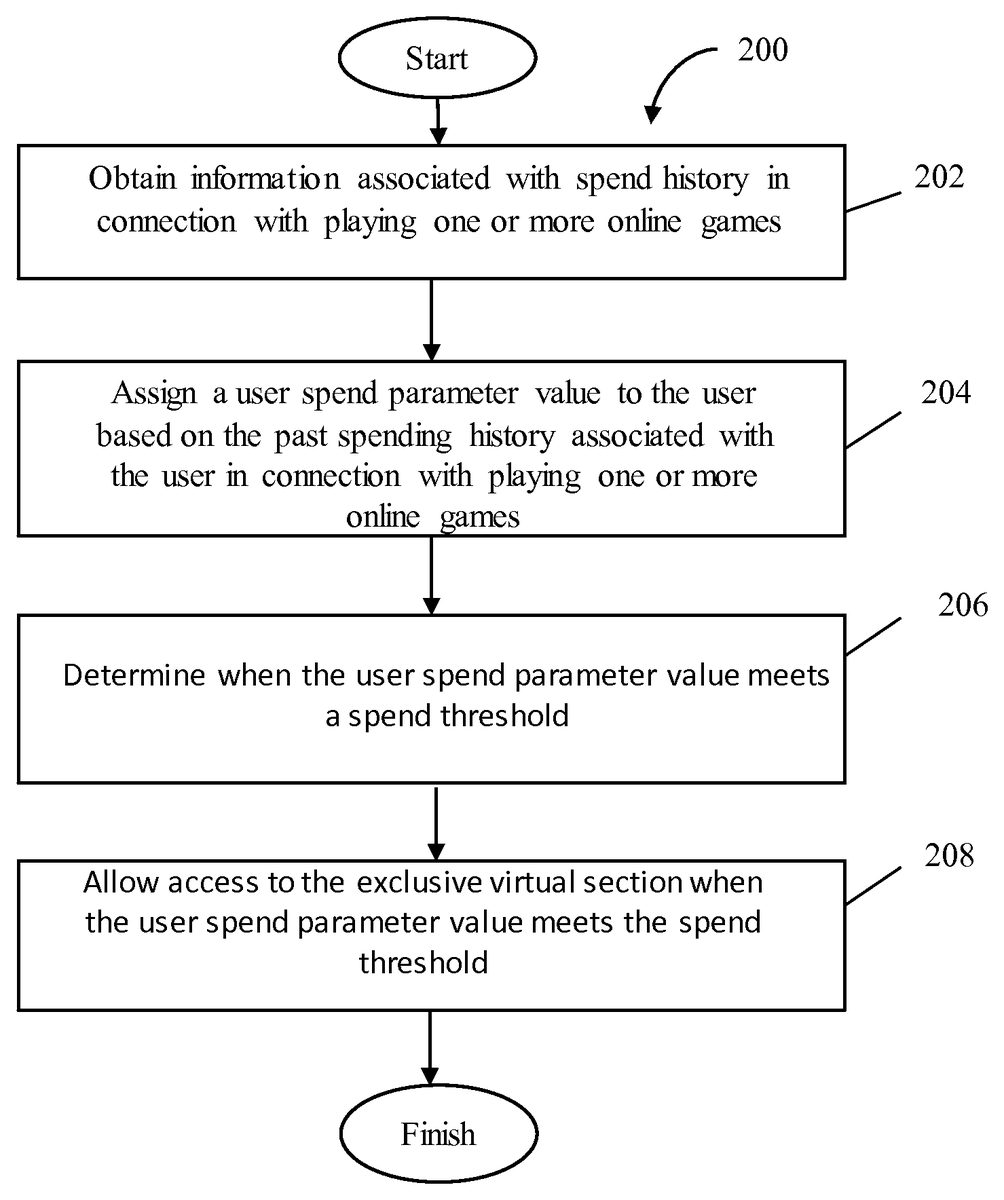
FIG. 2illustrates a method for selectively providing access to an exclusive virtual section of an online gaming system based upon a user spend parameter value, in accordance with one or more implementations. For example, method200includes obtaining information associated with spend history of a first user in connection with playing an online game and processing the information associated with the spend history to assign the user spend parameter value to the first user. Method200further includes determining when the user spend parameter value meets a spend threshold and allowing access to the exclusive virtual section when the user spend parameter value meets the spend threshold. The operations of method200presented below are intended to be illustrative. In some implementations, method200may be accomplished with one or more additional operations not described, and/or without one or more of the operations discussed. Additionally, the order in which the operations of method200are illustrated inFIG. 2and described below is not intended to be limiting.
In some implementations, method200may be implemented in one or more processing devices (e.g., a digital processor, an analog processor, a digital circuit designed to process information, an analog circuit designed to process information, a state machine, and/or other mechanisms for electronically processing information). The one or more processing devices may include one or more devices executing some or all of the operations of method200in response to instructions stored electronically on an electronic storage medium. The one or more processing devices may include one or more devices configured through hardware, firmware, and/or software to be specifically designed for execution of one or more of the operations of method200.
At an operation202, information associated with the spend history associated with a user in connection with game play is obtained. In an implementation, the user spend parameter value comprises a user lifetime spend history parameter or a user periodic spend history parameter. In an implementation, spend velocity may be tracked and considered. This may equate to the amount of money spent by the user per unit time. In an implementation, as describe above, a unit of time may be the lifetime of the user account or game character. In another implementation the unit of time may be a periodic unit of time. In implementations, a typical spend profile for the user may be monitored and tracked. This may equate to an assessment of average spending by the user at different points in time during game play. Alternatively or in addition, this may equate to average spending by the user at content driven points in one or more games. Examples of this may include, average spend during quest related in game activities, average spend during player to player battles, etc. In other implementations, total spend, either on a game by game basis or total game spend in the aggregate, or both, may be considered.
In some implementations, a single user spend parameter value may be generated based on one or more of the above described characteristics. Alternatively, in other implementations, a more detailed “spending pattern profile” which represents the various spend history patterns associated with a user may be generated. Operation202may be performed by a user profile management module, in accordance with one or more implementations. User profile management module may be the same as or similar to user profile management module108.
At an operation204, based on the information received as a result of operation202, the user is assigned a user spend parameter value which is indicative of the spend history determined in operation202. Operation204may be performed by a user profile management module or a user spend parameter module or a combination of the two modules, in accordance with one or more implementations. User profile management module may be the same as or similar to user profile management module108. User spend parameter module may be the same as or similar to user spend parameter module110.
At an operation206, the user spend parameter value associated with the user is used to determine whether the value meets a spend threshold. Operation206may be performed by an exclusive virtual access module, in accordance with one or more implementations. Exclusive virtual access module may be the same as or similar to exclusive virtual access module112.
At an operation208, access to an exclusive virtual section of the online game may be provided to a user that is associated with a user spend parameter value that meets a spend threshold. Operation208may be performed by an exclusive virtual access module112, in accordance with one or more implementations. Exclusive virtual access module may be the same as or similar to exclusive virtual access module112.
Although the present technology has been described in detail for the purpose of illustration based on what is currently considered to be the most practical and preferred implementations, it is to be understood that such detail is solely for that purpose and that the technology is not limited to the disclosed implementations, but, on the contrary, is intended to cover modifications and equivalent arrangements that are within the spirit and scope of the appended claims. For example, it is to be understood that the present technology contemplates that, to the extent possible, one or more features of any implementation can be combined with one or more features of any other implementation.
Claims
- A game server configured to provide access to an exclusive virtual section of an online gaming system, the game server comprising: one or more processors configured by machine-readable instructions to: execute an instance of an online game to facilitate presentation of the online game to users on client computing platforms associated with the users by transmitting view information associated with the instance of the online game over a network to the client computing platforms associated with the users, the view information causing the client computing platforms associated with the users to display views of the online game, and to implement the instance of the online game to facilitate participation of the users in the online game by executing actions in the instance of the online game in response to commands received over the network from the client computing platforms associated with the users;manage user profiles of the users, the user profiles including user spend parameter values for the users characterizing past spending histories of the users including spend velocities of the users within at least the online game, the user profiles including a first user profile of a first user, the first user profile including a first user spend parameter value characterizing a past spending history of the first user including a spend velocity of the first user in at least the online game;present offers to sell virtual items for use in the online game to users through a shop interface included in one or more of the views of the online game, wherein the offers to sell virtual items include one or more exclusive offers that are only presented within an exclusive virtual section presented via one or more of the views of the online game presented via one or more of the client computing platforms associated with selected users;determine which users should be provided access to the exclusive virtual section including the one or more exclusive offers such that a determination as to whether the first user should be provided access to the exclusive virtual section presented via the views of the online game and including the one or more exclusive offers is made based on a comparison of the first user spend parameter value with a spend threshold;and implement access to an exclusive virtual section determined for individual users by presenting views of the online game including the exclusive virtual section determined for the individual users such that, responsive to the determination that the first user should be provided access to the exclusive virtual section, access to the exclusive virtual section is implemented in the instance of the online game for the first user by presenting views of the online game including the exclusive virtual section to the first user via a client computing platform associated with the first user.
- The game server of claim 1 wherein the one or more processors are further configured by machine-readable instructions to determine the user spend parameter value based on the past spending history and the spend velocity.
- The game server of claim 1 wherein the shop interface provides for accepting of the one or more exclusive offers to purchase one or both of a virtual item and/or an ability within the online game.
- The game server of claim 1 wherein the user spend parameter value includes a user lifetime spend history parameter or a user periodic spend history parameter.
- The game server of claim 4 wherein the periodic spend history parameter comprises a past purchasing amount spent per unit time.
- The game server of claim 1 wherein implementation of the access to the exclusive virtual section including the shop interface is hidden from a second user during gameplay.
- The game server of claim 1 wherein implementation of the access to the exclusive virtual section including the shop interface is visible to the first user during gameplay.
- The game server of claim 1 wherein implementation of the access to the exclusive virtual section including the shop interface is hidden from users other than the first user during gameplay.
- The game server of claim 1 wherein the user spend parameter value associated with the first user is associated only with the first user's interaction with the online game.
- The game server of claim 1 wherein the user spend parameter value associated with the first user is associated with the first user's interaction with one or more games other than the online game.
- The game server of claim 1 wherein the user spend parameter value associated with the first user is associated with the first user's interaction with the online game and with one or more games other than the online game.
- The game server of claim 1 wherein the user spend parameter value comprises one or more parameters associated with a spend velocity profile associated with the first user.
- The game server of claim 1 wherein the user spend parameter value comprises one or more parameters associated with a temporal historical spend profile associated with the first user.
- The game server of claim 13 wherein the temporal historical spend profile characterizes spending during one or both of a quest related in game activity and/or a player-to-player battle in the online game.
- The game server of claim 1 wherein the user spend parameter value is one or more parameters associated with a total spend profile associated with the first user with respect to the online game.
- The game server of claim 1 wherein the access to the exclusive virtual section comprises different access levels based on a respective user spend parameter value.
- The game server of claim 1 wherein access to the exclusive virtual section comprises access to the shop interface including access to purchase of virtual items at price ranges associated with a spend velocity profile.
- A computer-implemented method for selectively providing access to an exclusive virtual section of an online gaming system based upon a user spend parameter value, the method being implemented in a game server that includes one or more physical processors and storage media storing machine-readable instructions, the method comprising: executing, by the one or more physical processors, an instance of an online game to facilitate presentation of the online game to users on client computing platforms associated with the users by transmitting view information associated with the instance of the online game over a network to the client computing platforms associated with the users, the view information causing the client computing platforms associated with the users to display views of the online game, and to implement the instance of the online game to facilitate participation of the users in the online game by executing actions in the instance of the online game in response to commands received over the network from the client computing platforms associated with the users;obtaining, by the one or more physical processors, information associated with spend history and a spend velocity of a first user in connection with playing an online game;processing, by the one or more physical processors, the information associated with the spend history and the spend velocity to assign the user spend parameter value to the first user;determining, by the one or more physical processors, whether the user should be provided access to an exclusive virtual section presented via one or more views of the online game presented via a client computing platform associated with the user, wherein the exclusive virtual section includes one or more exclusive offers, and where a determination of whether the user should be provided access to the exclusive virtual section is based on the user spend parameter value meeting a spend threshold;and implementing, by the one or more processors, access to the exclusive virtual section determined for individual users via the views of the online game presented to the individual users such that, responsive to the user spend parameter value meeting the spend threshold, access to the exclusive virtual section is implemented in the instance of the online game for the user by presenting views of the online game including the exclusive virtual section via a client computing platform associated with the user.
- The method of claim 18 further comprising determining, by the one or more physical processors, the user spend parameter value based on a past spending history and the spend velocity.
- The method of claim 18 wherein the access to the exclusive virtual section comprises access to the shop interface including access to purchase of virtual items.
- The method of claim 18 wherein the user spend parameter value comprises a user lifetime spend history parameter or a user periodic spend history parameter.
- The method of claim 21 wherein the periodic user spend parameter value comprises a past purchasing amount spent per unit time.
- The method of claim 18 wherein implementation of the access to the exclusive virtual section is hidden from a second user during gameplay.
- The method of claim 18 wherein implementation of the access to the exclusive virtual section is visible to the first user during gameplay.
- The method of claim 18 wherein implementation of the access to the exclusive virtual section is hidden from users other than the first user during gameplay.
- The method of claim 18 wherein the user spend parameter value associated with the first user is associated only with the first user's interaction with the online game.
- The method of claim 18 wherein the user spend parameter value associated with the first user is associated with the first user's interaction with games other than the online game.
- The method of claim 18 wherein the user spend parameter value associated with the first user is associated with the first user's interaction with the online game and with one or more games other than the online game.
- The method of claim 18 wherein the user spend parameter value comprises one or more parameters associated with a spend velocity profile associated with the first user.
- The method of claim 18 wherein the user spend parameter value comprises one or more parameters associated with a temporal historical spend profile associated with the first user.
- The method of claim 30 wherein the temporal historical spend profile characterizes spending during one or both of a quest related in game activity and/or a player-to-player battle in the online game.
- The method of claim 18 wherein the user spend parameter value comprises one or more parameters associated with a total spend profile associated with the first user with respect to the online game.
- The method of claim 18 wherein the access to the exclusive virtual section includes presentation of one of more of the views of the online game including different access levels based on a respective user spend parameter value.
- The method of claim 18 wherein the access to the exclusive virtual section comprises presentation of one of more of the views of the online game including the shop interface including access to purchase of virtual items at price ranges associated with a spend velocity profile.
Disclaimer: Data collected from the USPTO and may be malformed, incomplete, and/or otherwise inaccurate.