U.S. Pat. No. 9,604,146
Apparatus and method to play a multiplayer, online game
AssigneeInternational Business Machines Corporation
Issue DateJanuary 6, 2006
Illustrative Figure
Abstract
A method is disclosed to play a multiplayer online game. The method provides a handset and a multiplayer game stored on a server, where that server comprises (N) user profiles including the (i)th user profile comprising the (i)th game status and the (i)th digital signature assigned to the (i)th user, wherein the (i)th user is one of the (N) users. The method establishes a communication link between the handset and the server, such that the (i)th user can play the multiplayer game, using the handset and the (i)th game status, with one or more other users in communication with the server. The method downloads to the handset the game software and the (i)th user profile comprising the (i)th game status and the (i)th digital signature, before discontinuing the communication link between the handset and the server.
Description
DETAILED DESCRIPTION OF THE PREFERRED EMBODIMENTS This invention is described in preferred embodiments in the following description with reference to the Figures, in which like numbers represent the same or similar elements. Referring now toFIG. 1, server100comprises a multiplayer game110and (N) user profiles120. Server100comprises a computer system, such as a mainframe, personal computer, workstation, and combinations thereof, including an operating system such as Windows, AIX, Unix, MVS, LINUX, etc. (Windows is a registered trademark of Microsoft Corporation; AIX is a registered trademark and MVS is a trademark of IBM Corporation; UNIX is a registered trademark in the United States and other countries licensed exclusively through The Open Group; and LINUX is a registered trademark of Linus Torvald). As a general matter, in order to play multiplayer game110two or more users must be in communication with server100. In the illustrated embodiment ofFIG. 1, a first handheld device130is in communication with server100via a first communication link140, and a second handheld device150is in communication with server100via communication link150. Handheld device130may be, but need not be, identical to handheld device150. Handheld device130comprises a processor132, instructions134, and memory136. Instructions134are by processor132to operate device130. In certain embodiments, memory136comprises non-volatile memory, such as for example one or more EEPROMs (Electrically Erasable Programmable Read Only Memory), one or more flash PROMs (Programmable Read Only Memory), battery backup RAM, hard disk drive, one or more optical storage media (CD, DVD, and the like), combinations thereof, and the like. In certain embodiments, handheld device130further comprises a visual display device, built-in stereo speakers, one or more input/output ports/devices, a disk drive, a built-in battery, and terminals for charging said built-in battery. In certain embodiments, the visual display device comprises a 4.3 inch, 16:9 widescreen TFT LCD, 480×272 pixel (16.77 million colors), Max. 200 cd/m2(with brightness control). In certain embodiments, the built-in ...
DETAILED DESCRIPTION OF THE PREFERRED EMBODIMENTS
This invention is described in preferred embodiments in the following description with reference to the Figures, in which like numbers represent the same or similar elements. Referring now toFIG. 1, server100comprises a multiplayer game110and (N) user profiles120. Server100comprises a computer system, such as a mainframe, personal computer, workstation, and combinations thereof, including an operating system such as Windows, AIX, Unix, MVS, LINUX, etc. (Windows is a registered trademark of Microsoft Corporation; AIX is a registered trademark and MVS is a trademark of IBM Corporation; UNIX is a registered trademark in the United States and other countries licensed exclusively through The Open Group; and LINUX is a registered trademark of Linus Torvald).
As a general matter, in order to play multiplayer game110two or more users must be in communication with server100. In the illustrated embodiment ofFIG. 1, a first handheld device130is in communication with server100via a first communication link140, and a second handheld device150is in communication with server100via communication link150. Handheld device130may be, but need not be, identical to handheld device150.
Handheld device130comprises a processor132, instructions134, and memory136. Instructions134are by processor132to operate device130.
In certain embodiments, memory136comprises non-volatile memory, such as for example one or more EEPROMs (Electrically Erasable Programmable Read Only Memory), one or more flash PROMs (Programmable Read Only Memory), battery backup RAM, hard disk drive, one or more optical storage media (CD, DVD, and the like), combinations thereof, and the like.
In certain embodiments, handheld device130further comprises a visual display device, built-in stereo speakers, one or more input/output ports/devices, a disk drive, a built-in battery, and terminals for charging said built-in battery. In certain embodiments, the visual display device comprises a 4.3 inch, 16:9 widescreen TFT LCD, 480×272 pixel (16.77 million colors), Max. 200 cd/m2(with brightness control). In certain embodiments, the built-in battery comprises a built-in lithium-ion battery. In certain embodiments, the one or more input/output ports/devices comprise IEEE 802.11b (Wi-Fi) capability, one or more USB 2.0 ports, one or more Memory Stick™ PRO Duo, one or more IRDA devices/ports, and one or more IR Remote (SIRCS) devices.
In certain embodiments, handheld device130further comprises a plurality of keys and/or switches comprising directional buttons (Up/Down/Right/Left) analog pad, enter keys (triangle, circle, cross, square), left, right keys, START, SELECT, HOME, POWER On/Hold/Off switch, brightness control, sound mode, volume adjustment, wireless LAN on/off switch, and disk eject.
In certain embodiments, communication link140is selected from the group consisting of a Local Area Network (LAN), a private Wide Area Network (WAN), a public wide area network, Transmission Control Protocol/Internet Protocol (TCP/IP), the Internet, and combinations thereof.
Handheld device150comprises a processor152, instructions154, and memory156. Instructions154are used by processor152to operate device150.
In certain embodiments, memory156comprises non-volatile memory, such as for example one or more EEPROMs (Electrically Erasable Programmable Read Only Memory), one or more flash PROMs (Programmable Read Only Memory), battery backup RAM, hard disk drive, one or more optical storage media (CD, DVD, and the like), combinations thereof, and the like.
In certain embodiments, handheld device150further comprises a visual display device, built-in stereo speakers, one or more input/output ports/devices, a disk drive, a built-in battery, and terminals for charging said built-in battery. In certain embodiments, the visual display device comprises a 4.3 inch, 16:9 widescreen TFT LCD, 480×272 pixel (16.77 million colors), Max. 200 cd/m2(with brightness control). In certain embodiments, the built-in battery comprises a built-in lithium-ion battery. In certain embodiments, the one or more input/output ports/devices comprise IEEE 802.11b (Wi-Fi) capability, one or more USB 2.0 ports, one or more Memory Stick™ PRO Duo, one or more IrDA devices/ports, and one or more IR Remote (SIRCS) devices.
In certain embodiments, handheld device150further comprises a plurality of keys and/or switches comprising directional buttons (Up/Down/Right/Left) analog pad, enter keys (triangle, circle, cross, square), left, right keys, START, SELECT, HOME, POWER On/Hold/Off switch, brightness control, sound mode, volume adjustment, wireless LAN on/off switch, and disk eject.
In certain embodiments, communication link160is selected from the group consisting of a Local Area Network (LAN), a private Wide Area Network (WAN), a public wide area network, Transmission Control Protocol/Internet Protocol (TCP/IP), the Internet, and combinations thereof.
Plurality of user profiles120comprises (N) individual user profiles associated with (N) individual users. Referring now toFIG. 2, the (i)th user profile200comprises general information210pertaining to the (i)th user, wherein that (i)th user is one of the (N) users. This general information comprises, for example, the legal name of the (i)th user, one or more fictitious names used by the (i)th user in the game space, the amount of money the (i)th user has on deposit, how many times the (i)th user has played one or more games available on server100, and the like.
In addition, (i)th user profile200further comprises the (i)th digital signature220, and specific game-related information. In the illustrated embodiment ofFIG. 2, the (i)th user profile200further comprises the (i)th game status230for multiplayer game110(FIG. 1). The (i)th user profile200may optionally comprise a game status for each of a plurality of additional online games.
In certain embodiments, the (i)th digital signature220is assigned by server100. In other embodiments, the (i)th digital signature220is established by the manufacturer of the handheld device, such as device130(FIG. 1), used by the (i)th user to connect with, and play games stored on, server100. In these embodiments, the (i)th digital signature220is uploaded from the handheld device to server100.
Using prior art methods, the (i)th user can participate in multiplayer game110only when that (i)th user is in communication with server100. As an example, if the (i)th user is participating in multiplayer game110using handheld device130and communication link140, once communication link140is discontinued, the (i)th user cannot again participate in multiplayer game110until a communication link with server100is reestablished.
Using Applicants' method, however, the (i)th user can continue to participate in multiplayer game110even when that user's handheld device is not in communication with server100.FIGS. 4 and 5summarize the steps of Applicants' method.
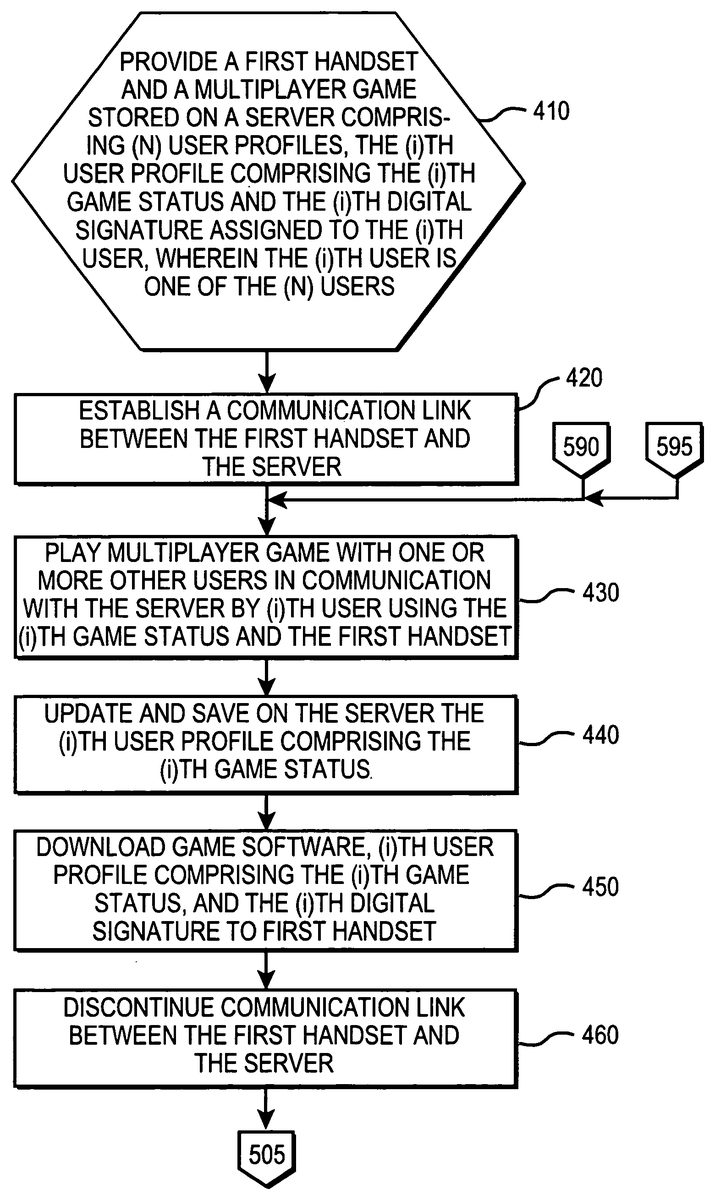
Referring now toFIG. 4, in step410Applicants' method provides a multiplayer game, such as multiplayer game110(FIG. 1), stored on a server, such as server100(FIG. 1), where that server comprises (N) user profiles including the (i)th user profile, such as (i)th user profile200, comprising the (i)th digital signature and the (i)th game status, wherein the (i)th user is one of the (N) users. Step410further comprises providing a first handset, such as for example handset130, wherein the (i)th user communicates with the game server using that first handset.
In step420, Applicants' method provides a first communication link, such as communication link140, between the first handset of step410and the server of step410. In step430, the (i)th user participates in the multiplayer game of step410along with one or more other users in communication with the server. The one or more other users each utilize a handset, wherein for example the (j)th user uses the (j)th handset, and wherein the (j)th handset need not be identical to the first handset utilized by the (i)th user.
In step440, as the multiplayer game proceeds the (i)th user profile comprising the (i)th user game status is updated to reflect an (i)th game status change each time the (i)th user achieves a certain result in the multiplayer game, such as for example locating a secret place, killing an opponent, being killed by an opponent, and the like. The updated (i)th user game status of step440is saved in the (i)th user profile, such as the (i)th user profile200(FIG. 2), stored on the game server, such as server100.
In step450, Applicants' method at a first time downloads to the first handset game software comprising all or a portion of the multiplayer game of step410, the (i)th user profile comprising the (i)th game status, and the (i)th digital signature. In step460, the method at a second time subsequent to the first time of step450discontinues the communication link between the first handset and the server.
Applicants' method transitions from step460to step505(FIG. 5) wherein at a third time subsequent to the second time of step460establishes a second communication link with a second handset comprising the game software and a second digital signature. In the illustrated embodiment ofFIG. 3A, first handset130is in direct communication with second handset330via communication link320.
In certain embodiments, communication link320comprises a wireless communication link, a serial interconnection, such as RS-232 or RS-422, an ethernet interconnection, a SCSI interconnection, an iSCSI interconnection, a Gigabit Ethernet interconnection, a Bluetooth interconnection, a Local Area Network (LAN), a private Wide Area Network (WAN), a public wide area network, Storage Area Network (SAN), Transmission Control Protocol/Internet Protocol (TCP/IP), the Internet, and combinations thereof. In certain embodiments, communication link320is compliant with one or more of the embodiments of IEEE Specification 802.11 (collectively the “IEEE Specification”). As those skilled in the art will appreciate, the IEEE Specification comprises a family of specifications developed by the IEEE for wireless LAN technology.
The IEEE Specification specifies an over-the-air interface between a wireless client, such as for example projector100, and a base station or between two wireless clients. The IEEE accepted the IEEE Specification in 1997. There are several specifications in the 802.11 family, including (i) specification 802.11 which applies to wireless LANs and provides 1 or 2 Mbps transmission in the 2.4 GHz band using either frequency hopping spread spectrum (FHSS) or direct sequence spread spectrum (DSSS); (ii) specification 802.11a which comprises an extension to 802.11 that applies to wireless LANs and provides up to 54 Mbps in the 5 GHz band using an orthogonal frequency division multiplexing encoding scheme rather than FHSS or DSSS; (iii) specification 802.11b, sometimes referred to as 802.11 High Rate or Wi-Fi, which comprises an extension to 802.11 that applies to wireless LANS and provides up to about 11 Mbps transmission in the 2.4 GHz band; and/or (iv) specification 802.11g which applies to wireless LANs and provides 20+ Mbps in the 2.4 GHz band.
First handset130comprises game software310, and the (i)th user profile200(FIG. 2) which comprises the (i)th digital signature220(FIGS. 2, 3A, 3B) and the (i)th game status230(FIG. 2, 3A,3B). Second handset330comprises game software310and the (j)th user profile332which comprises the (j)th digital signature334and the (j)th game status336, wherein the (i)th user and the (j)th user are each different ones of the (N) users of step410(FIG. 4).
In the illustrated embodiment ofFIG. 3B, first handset130is in direct communication with second handset330via communication link350, second handset330is in direct communication with third handset340via communication link360, and third handset340is in direct communication with first handset130via communication link370. In certain embodiments, communication links350,360, and370, are each independently selected from the group consisting of a wireless communication link, a serial interconnection, such as RS-232 or RS-422, an ethernet interconnection, a SCSI interconnection, an iSCSI interconnection, a Gigabit Ethernet interconnection, a Bluetooth interconnection, a Local Area Network (LAN), a private Wide Area Network (WAN), a public wide area network, Transmission Control Protocol/Internet Protocol (TCP/IP), combinations thereof, and the like. In certain embodiments, communication link160is compliant the IEEE Specification.
First handset130and second handset330are described above. Third handset340comprises game software310and the (k)th user profile342which comprises the (k)th digital signature344and the (k)th game status346, wherein the (i)th user, the (j)th user, and the (k)th user, are each different ones of the (N) users of step410(FIG. 4).
Referring now toFIG. 5, in step510the (i)th user continues to play the multiplayer game with the (j)th user, and optionally one or more additional users such as the (k)th user, wherein the (i)th user utilizes the first handset130, the (j)th user utilizes the second handset330, and the optional (k)th user utilizes the third handset340.
In step520, the (i)th user effectuates a game status change. Such a game status change comprises, for example, finding a secret location, killing an opponent, being killed by an opponent, and the like.
In step530, Applicants' method updates on the first handset the (i)th user profile to comprise an updated (i)th game status reflecting the game status change. For example and referring now toFIG. 6, in step530handset130now comprises an updated (i)th user profile600comprising an updated (i)th game status602reflecting the game status change.
In step540, the (j)th user authenticates the updated (i)th user profile by placing the second digital signature334in the updated (i)th user profile600. In embodiments, wherein (N) players, including the (i)th user, are playing the multiplayer game, then step540comprises authenticating the updated (i)th user profile by the (N−1) other users by placing (N−1) digital signatures in the updated (i)th user profile. In certain embodiments, steps530and540are performed synchronously. In certain embodiments, steps520,530, and540, are performed synchronously.
In step550, Applicants' method discontinues, at a fourth time subsequent to the third time of step505, the communication link between the first handset and the one or more additional handsets. In step560, Applicants' method reestablishes, at a fifth time subsequent to the fourth time of step550, a third communication link with the game server, such as server100(FIG. 1). In certain embodiments, the third communication link of step560is identical to the first communication link of step420. In other embodiments, the third communication link differs from the first communication link.
In step570, Applicants' method provides the updated (i)th user profile, such as updated (i)th user profile600(FIG. 6) comprising the (i)th digital signature220, the updated (i) game status602, and (j)th digital signature334, to the game server. In step580, the game server determines if the (i)th digital signature and the (j)th digital signature can be verified.
If the game server cannot verify the (i)th digital signature and/or the (j)th digital signature in step580, then the method transitions from step580to step590wherein the game server does not accept the updated (i)th user profile. Applicants' method transitions from step590to step430and continues as described herein.
Alternatively, if the game server does verify in step580the (i)th digital signature and the (j)th digital signature, then the method transitions from step580to step595wherein the game server saves the updated (i)th user profile, including the updated (i)th game status, as the (i)th user profile200(FIG. 2). Applicants' method transitions from step595to step430and continues as described herein.
In certain embodiments, individual steps recited inFIGS. 4 and/or 5, may be combined, eliminated, or reordered.
In certain embodiments, Applicant's invention includes instructions, such as instructions134(FIG. 1), where those instructions are executed by processor132(FIG. 1) to perform one or more of steps420,430,440,450, and/or460, recited inFIG. 4, and/or steps one or more of steps505,510,530,550,560, and/or570, recited inFIG. 5.
In other embodiments, Applicant's invention includes instructions residing in any other computer program product, where those instructions are executed by a computer external to, or internal to, the first handset to perform one or more of steps420,430,440,450, and/or460, recited inFIG. 4, and/or steps one or more of steps505,510,530,550,560, and/or570, recited inFIG. 5. In either case, the instructions may be encoded in an information storage medium comprising, for example, a magnetic information storage medium, an optical information storage medium, an electronic information storage medium, and the like. By “electronic storage media,” Applicants mean, for example, a device such as a PROM, EPROM, EEPROM, Flash PROM, compactflash, smartmedia, and the like.
While the preferred embodiments of the present invention have been illustrated in detail, it should be apparent that modifications and adaptations to those embodiments may occur to one skilled in the art without departing from the scope of the present invention as set forth in the following claims.
Claims
- A method to play an multiplayer, online game, comprising: providing a server comprising a first user profile comprising a first user game status, a first user digital signature, a second user game status, and a second user digital signature;establishing a communication link between a first handset comprising said first user profile and a second handset;engaging in a multiplayer game by said first user and said second user;effectuating a game status change for the first user to indicate killing an opponent;saving an updated first user game status in an updated first user profile stored on said first handset to reflect said game status change;authenticating said updated first user game status by said second handset by placing said second user digital signature in said updated first user profile stored on said first handset;establishing a communication link between said first handset and said server;providing said updated first user game status to said server;if said server can verify said first digital signature and said second digital signature, accepting by said server said updated first user profile;if said server cannot verify said first digital signature and/or said second digital signature, not accepting by said server said updated first user profile.
- The method of claim 1 , wherein said establishing a second communication link and/or said establishing a first communication link step further comprises providing a wireless communication link.
- A handset comprising a first user profile, a first user game status, a first user digital signature, and a non-transitory computer readable medium having computer readable program code disposed therein to play a multiplayer, online game stored on a server, the computer readable program code comprising a series of computer readable program steps to effect: establishing a first communication link with said handset and a second handset comprising a second user digital signature;saving an updated first user game status on said handset in an updated first user profile to indicate a game status change for said first user to indicate killing an opponent;authenticating said updated first user game status by said second handset by placing said second user digital signature in said updated first user profile stored on said handset;establishing a second communication link with said server;providing said updated first user game status to said server.
- The handset of claim 3 , wherein said second communication link comprises a wireless communication link.
- A computer program product disposed in a non-transitory computer readable medium and usable with a programmable computer processor to play an multiplayer, online game stored on a server comprising a first user profile, a first user game status, a first user digital signature, a second user game status and a second user digital signature, comprising: computer readable program code which causes said programmable computer processor to establish a first communication link between a first handset and a second handset;computer readable program code which causes said programmable computer processor to save an updated first user game status in an updated first user profile to include a game status change for a first user to reflect killing an opponent;computer readable program code which causes said programmable computer processor to authenticate said updated first user game status by said second handset by placing said second user digital signature in said updated first user profile stored on said first handset;computer readable program code which causes said programmable computer processor to establish a second communication link between said first handset and said server;computer readable program code which causes said programmable computer processor to provide said updated first user game status to said server;computer readable program code which if said server can verify said first digital signature and said second digital signature, causes said programmable computer processor to accept by said server said updated first user profile;computer readable program code which if said server cannot verify said first digital signature and/or said second digital signature, causes said programmable computer processor to not accept by said server said updated first user profile.
- The computer program product of claim 5 , wherein said second communication link comprises a wireless communication link.
Disclaimer: Data collected from the USPTO and may be malformed, incomplete, and/or otherwise inaccurate.