U.S. Pat. No. 9,597,601
METHOD FOR DISPLAYING CHAT WINDOW APPLIED TO NETWORK GAME
AssigneeKABUSHIKI KAISHA SQUARE ENIX
Issue DateNovember 1, 2013
U.S. Patent no. 9,597,601: Method for displaying chat window applied to network game
U.S. Patent no. 9,597,601: Method for displaying chat window applied to network game
Issued March 21, 2017 to Kabushiki Kaisha Square Enix
Priority Date March 19, 2003
Summary:
U.S. Patent No. 9,597,601 (the ‘601 Patent) relates to displaying chat messages in a video game. In multiplayer networked video games multiple players can work together to complete goals. It becomes necessary for the player to be able to view their character, others’ characters, as well as messages sent between players and messages from the game itself. Depending on how many messages are being exchanged between players the size of the chat display window may change. If there are not very many important messages or messages relating to gameplay, then the window will reduce in size. However, during periods of frequent messaging and a large volume of messages the chat window will expand as to allow for more efficient communication and message comprehension. This system will allow for more efficient messaging in games that blends messaging with the game experience without becoming too intrusive or disruptive to the flow of gameplay.
Abstract:
Players input their messages in their video game apparatuses and the messages are once collected at a server apparatus, thereafter they are distributed to all video game apparatuses from the game server apparatus. In a display screen of each video game apparatus, a chat window is displayed in order to display messages exchanged between the players on a game screen including a field and characters of the game. The chat window is sequentially enlarged up to a preset maximum number of lines when a new message is received from the game server apparatus. The chat window is sequentially reduced to the preset minimum number of lines when a predetermined time passes without any reception of new message or when the player performs a specific operation.
Illustrative Claim:
1. A video game apparatus connected, via a network, to a server apparatus, the server apparatus being connected to at least one other video game apparatus via the network, the video game apparatus comprising: a receiver that receives a message distributed from the server apparatus via the network; a provider that provides a chat window for displaying the message on a display screen in a case where the receiver receives the message; and a display device that displays a video game on the display screen and the message received by the receiver in the chat window, wherein when the video game apparatus receives a message from the at least one other video game apparatus via the server apparatus in a state that the chat window is not provided, the chat window is provided in an area of the display screen, wherein the chat window is deleted, and is not provided in the area of the display screen until the video game apparatus receives a message from the server apparatus, and wherein an oldest message may be selectively retained in the chat window instead of being deleted by chat window reduction processing, the chat window reduction processing sequentially deleting the oldest messages from the chat window when the oldest message is not a specific message identified with high importance, the chat window reduction processing deleting the second oldest message from the chat window when the oldest message is a specific message identified with high importance.
Illustrative Figure
Abstract
Players input their messages in their video game apparatuses and the messages are once collected at a server apparatus, thereafter they are distributed to all video game apparatuses from the game server apparatus. In a display screen of each video game apparatus, a chat window is displayed in order to display messages exchanged between the players on a game screen including a field and characters of the game. The chat window is sequentially enlarged up to a preset maximum number of lines when a new message is received from the game server apparatus. The chat window is sequentially reduced to the preset minimum number of lines when a predetermined time passes without any reception of new message or when the player performs a specific operation.
Description
DETAILED DESCRIPTION OF PREFERRED EMBODIMENTS Preferred embodiments will be explained with reference to the drawings. FIG. 1is a block diagram illustrating a configuration of a network game system according to an embodiment. As illustrated in this figure, this network game system includes multiple (four in this embodiment) video game apparatuses100and a game server apparatus200. The video game apparatuses100are connected to the game server apparatus200via a network151. In the network game provided by this system, four player characters, which are operated by four players, who are users of the respective video game apparatuses100, form a party as necessary and develop the game. Though the number of player characters is four here since the number of video game apparatuses is four, the number of player characters may change in accordance with the number of video game apparatuses. Communications among the players are carried out by exchanging messages in the form of chat as each player character's words. In this network game, non-player characters, which are operated by processing of the game server apparatus200, exist in addition to the four player characters. Non-player characters include characters, which give information when the player character speaks to them, and enemy characters, which wage a battle with the player characters. Information, which the non-player characters give the player character, and information, which indicates a result of the battle, are sent to each video game apparatus100from the game server apparatus200. FIG. 2is a block diagram showing a configuration of the video game apparatus100ofFIG. 1. As illustrated in the figure, the video game apparatus100includes a video game main body101. The video game main body101includes a control section103connected to its internal bus119, a RAM (Random Access Memory)105, a hard disk drive (HDD)107, a sound processor109, a graphics processor111, a DVD/CD-ROM drive113, a communications interface115, and an interface section117. The ...
DETAILED DESCRIPTION OF PREFERRED EMBODIMENTS
Preferred embodiments will be explained with reference to the drawings.
FIG. 1is a block diagram illustrating a configuration of a network game system according to an embodiment. As illustrated in this figure, this network game system includes multiple (four in this embodiment) video game apparatuses100and a game server apparatus200. The video game apparatuses100are connected to the game server apparatus200via a network151.
In the network game provided by this system, four player characters, which are operated by four players, who are users of the respective video game apparatuses100, form a party as necessary and develop the game. Though the number of player characters is four here since the number of video game apparatuses is four, the number of player characters may change in accordance with the number of video game apparatuses.
Communications among the players are carried out by exchanging messages in the form of chat as each player character's words. In this network game, non-player characters, which are operated by processing of the game server apparatus200, exist in addition to the four player characters. Non-player characters include characters, which give information when the player character speaks to them, and enemy characters, which wage a battle with the player characters. Information, which the non-player characters give the player character, and information, which indicates a result of the battle, are sent to each video game apparatus100from the game server apparatus200.
FIG. 2is a block diagram showing a configuration of the video game apparatus100ofFIG. 1. As illustrated in the figure, the video game apparatus100includes a video game main body101. The video game main body101includes a control section103connected to its internal bus119, a RAM (Random Access Memory)105, a hard disk drive (HDD)107, a sound processor109, a graphics processor111, a DVD/CD-ROM drive113, a communications interface115, and an interface section117.
The sound processor109of the video game main body101is connected to a sound output device125, which is a speaker, and the graphics processor111is connected to a display device121having a display screen122. A storage medium (DVD-ROM or CD-ROM)131can be attached to the DVD/CD-ROM drive113. The communications interface115is connected to a network151. An input section (controller)161and a memory card162are connected to the interface section117. A keyboard (not-shown) as the input section161may be connected to the interface section117.
The control section103includes a CPU (Central Processing Unit), a ROM (Read Only Memory), etc., and executes a program stored on the HDD107or the storage medium131, and controls the video game apparatus100. The control section103has an internal timer. The RAM105is a work area for the control section103. The HDD107is a storage area for storing a program and data. In the case where a program executed by the control section103instructs the sound processor109to output a sound, the sound processor109interprets the instruction and outputs a sound signal to the sound output device125.
The graphics processor111develops an image onto the frame memory112and outputs a video signal, which displays the image on the display screen122of the display device121according to a drawing command output from the control section103. It is assumed that one frame of the image included in the output video signal is displayed, for example, 1/30 sec. The DVD/CD-ROM drive113performs reading of the program and data to/from the storage medium131. The communications interface115is connected to the network151to perform communications with other computers such as the server apparatus200.
The interface section117outputs input data sent from the input section161to the RAM105, and the control section103interprets it to carry out arithmetic processing. The input section161includes directional keys (four directions of upper, lower, right and left) and multiple operation buttons (four buttons of circle, cross, square, and triangle). The player character is moved by the operation of the directional keys, and a predetermined processing is performed by the operation of the operation buttons. The directional keys are also used to move a cursor and scroll the messages in the chat window. The operation buttons are also used to input a predetermined instruction. Moreover, the interface section117forwards data, indicative of the progress of the game stored in the RAM105, to the memory card162based on the instruction from the control section103. The interface section117reads data of the game stored in the memory card162at the time of stopping the game, and transfers read data to the RAM105.
The program and data for performing the network game by the video game apparatus100are first stored on, for example, the storage medium131. The program and data are read by the DVD/CD-ROM drive113and loaded onto the RAM105at the time of execution. The control section103processes the program and data loaded onto the RAM105, outputs a drawing command to the graphics processor111, and outputs an instruction of a sound output to the sound processor109. Intermediate data is stored in the RAM105while the control section103performs processing.
In connection with the video game apparatuses100, any general-purpose personal computer may be used as the video game main body101if similar structural components are provided. A cellular phone having the same function as that of the video game main body101may be used. A portable video game player, which contains the display device121and the sound output device125in the same cabinet as that of the video game main body101, may also be used.
In the case where the video game main body101is a portable video game player, a semiconductor memory card may be used as the storage medium131in place of a DVD-ROM or CD-ROM. A card slot for inserting the memory card may be formed in place of the DVD/CD-ROM drive113. In the case where the video game main body101is a general-purpose personal computer, the program and data relating to the present invention may be prestored to the HDD107instead of being stored in the storage medium131. Regarding the storage medium for storing the program and data relating to the present invention, any kind of storage medium may be used according to the physical form of hardware and the distribution thereof.
FIG. 3is a block diagram showing a configuration of the game server apparatus200ofFIG. 1. As illustrated in the figure, the game server apparatus200is constructed to have a game server main body201. The game server main body201includes a control section203connected to its internal bus219, a RAM205, a hard disk drive (HDD)207, a DVD/CD-ROM drive213, and a communications interface215. A storage medium (DVD-ROM or CD-ROM)231can be attached to the DVD/CD-ROM drive213.
The control section203includes a CPU (Central Processing Unit), a ROM (Read Only Memory), etc., and executes a program stored on the HDD207or the storage medium231, and controls the game server apparatus200. The RAM205is a work area for the control section203. The HDD207is a storage area for storing a program and data. The communications interface215is connected to the network151and performs communications with the respective video game apparatuses100.
The program and data for performing the network game by the game server apparatus200are first stored on, for example, the storage medium231. The program and data are read by the DVD/CD-ROM drive213and loaded onto the RAM205at the time of execution. The control section203processes the program and data loaded onto the RAM205, and progresses the network game based on the messages sent from the respective video game apparatuses100. Intermediate data is stored in the RAM205while the control section203performs processing.
An explanation will be next given of various kinds of data necessary to execute the network game according to this embodiment. Data processed by the video game apparatus100is displayed as an image on the display screen122and each player can recognize the progress of the network game from the image displayed on the display screen122.
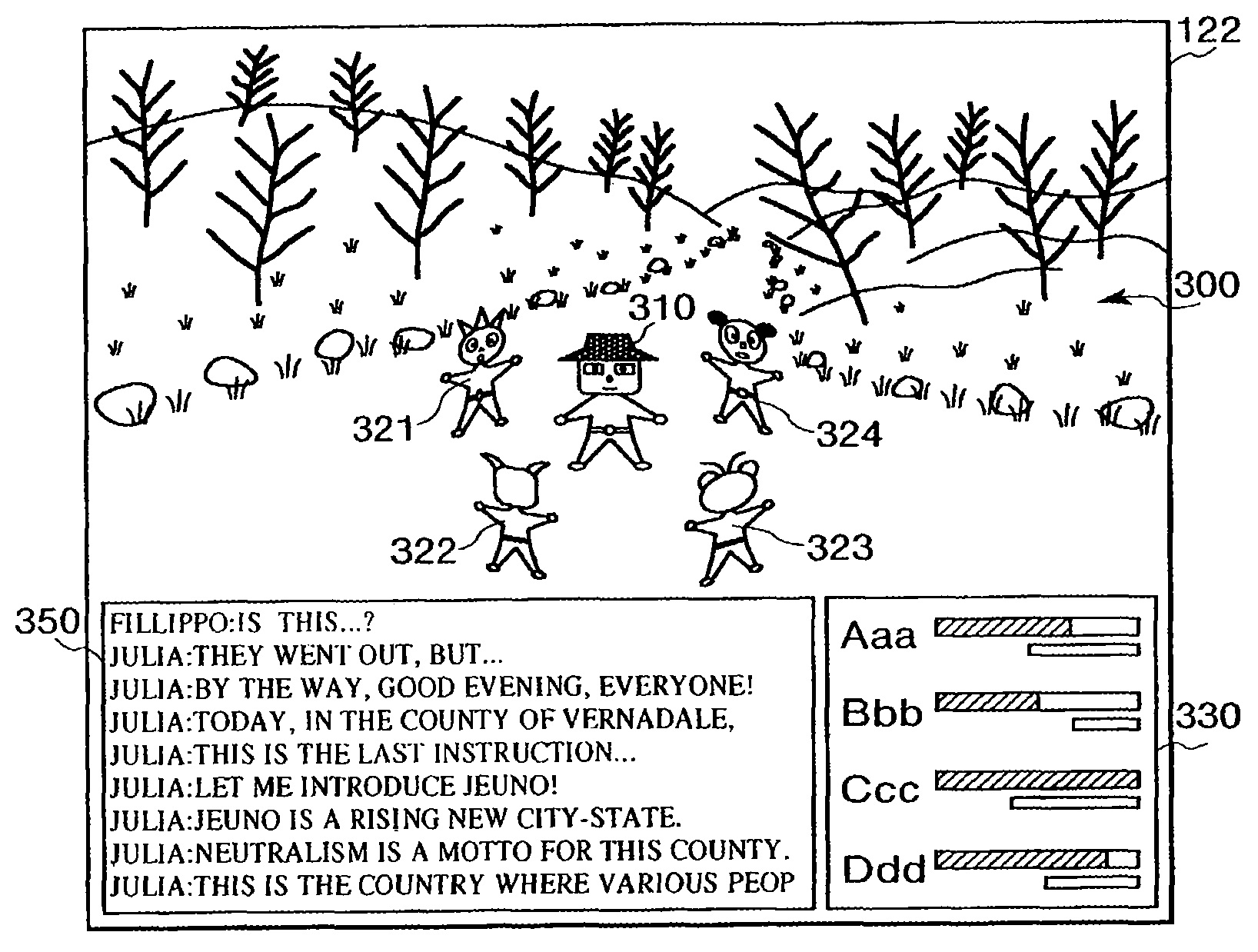
FIG. 4is a view showing an example of the display screen122displayed according to the progress of the game at the video game apparatus100. As illustrated in the figure, a field300, which serves as a space where characters (including player characters and non-player characters) can move, is displayed on the display screen122. The field300is composed of geographic data complying with each scene of the game. On the field300, there exist player characters321to324, which move when the users of four video game apparatuses100operate the input section161, and a non-player character310which appears by processing at the game server apparatus200. In some cases, the non-player character310is a character that provides information to the player characters321to324or an enemy character, which wages a battle with the player characters. All of the player characters321to324are not always displayed on the display screen122depending on the current progress of the game.
At the lower right side of the display screen122, a status window330, which displays current statuses of the player characters321to324, is provided. At the lower center to the left side of the display screen122, a chat window350is provided. In the chat window350, messages, which are sent to the video game apparatus100from the game server apparatus200according to the progress of the network game, are sequentially displayed and scrolled from bottom to top. One line at the lowest portion of the chat window350is used as a message input window when the player inputs a message from the input section161.
The messages sent from the game server apparatus200are displayed in the chat window350. The number of display lines in the chat window350can be changed as described later. The number of display lines in the chat window350gradually increases to the maximum number of lines (described later) every time a message is sent from the game server apparatus200. The number of display lines in the chat window350gradually reduces to the minimum number of lines (described later) every time a timer counts a predetermined interval time set by the player (described later) or the player operates the cross button of the input section161.
In the case where log messages (to be described later) are displayed, the chat window350enlarges up to the top portion of the display screen122according to the player's setting. In the case where the chat window350enlarges up to the top portion of the display screen122, the player operates the directional keys for upper and lower directions (hereinafter referred to as upper and lower keys) of the input section161and thereby scrolls the log messages.
FIG. 5is a view schematically showing a log message memory provided in the RAM105of the video game apparatus100. A log message memory500stores messages transmitted from the game server apparatus200, and is formed of a ring buffer as illustrated inFIG. 5. A pointer501, which points out the latest message of the stored messages, is also set. The log message memory500has a capacity that stores more messages than the maximum number of display lines can display in the chat window350at a normal time. In the log message of memory500ofFIG. 5, “1” indicates the latest message, “2” indicates the second latest message, and “X” is the oldest message.
FIG. 6Ais a view showing a chat window setting table provided in the RAM105of the video game apparatus100.FIG. 6Bis a chat window setting window for setting data in a chat window setting table400ofFIG. 6A. A chat window setting window410is displayed at the front side of a game screen ofFIG. 4in the display screen122. The chat window setting window410can be opened by selecting an item of a menu (not shown) that is displayed by operating the square button of the input section161. The chat window setting window410may be automatically opened on the screen at a log-in time.
Setting data such as the maximum number of lines401, the minimum number of lines402, a reduction speed403(one that is actually set is a time interval when the chat window350is reduced), and a screen width enlargement404are registered in the chat window setting window400. The chat window350can temporarily stop variable control, of enlargement/reduction by an instruction from the player.
When the screen width enlargement404is set to OFF, the number of display lines of the chat window350is enlarged to only a setting value of the maximum number of lines401at a variable control stopping time. When the screen width enlargement404is set to ON, the number of display lines of the chat window350is enlarged up to the limit of the width in the longitudinal direction of the display screen122beyond the setting value of the maximum number of lines401. When the screen width enlargement404is set to ON, log messages, which have been once erased, can be also displayed by scrolling. The setting value of the minimum number of lines402can be set to 0. When the setting value of the minimum number of lines402is set to 0, the chat window350is not displayed on the display screen122in some cases.
Setting data in the chat window setting table400can be changed on the chat window setting window410by the player. In a state that the chat window setting window410is opened, the player moves the cursor with the upper and lower keys of the input section161and selects any one of items411to414. Then, the player moves the cursor with directional keys for right and left directions (hereinafter referred to as right and left keys) of the input section161and changes the setting of the selected item411to414.
The following will explain processing in the network game system according to an embodiment. The network game progresses when the players exchange the messages. The messages input from the video game apparatuses100by the respective players are collected at the game server apparatus200, and they are transmitted to all video game apparatuses100from the game server apparatus200. In the progress of the game, the player characters321to324move on the field300according to the respective players' operations, and the non-player character310moves on the field by processing of the game server apparatus200. The game server apparatus200generates a predetermined event (such as a battle against the enemy characters, which are the non-player characters, etc.) according to the current progress of the game. At the event generating time, a message is transmitted to each video game apparatus100from the game server apparatus200as necessary.
Regarding the contents of messages and the current progress of the game, they do not directly relate to the present invention and the explanation thereof is omitted. An explanation will be given of only processing for displaying the messages in the chat window350. On the display screen122, the field300of the game, the non-player character310, the player characters321to324, and the status window330are displayed. However, they do not directly relate to the present invention and the explanation thereof is omitted. The following will illustrate only the display state of the chat window350.
FIG. 7is a flowchart showing exemplary processing that the control section203of the game server apparatus200executes. The control section203checks as to whether the communications interface215receives messages input from any one of the video game apparatuses100(step S101). When the communications interface215receives no messages from any video game apparatus100, the processing flow proceeds to step S103.
When the communications interface215receives messages from any one or more of the video game apparatuses100, the control section203causes the communications interface215to transmit all received messages to all video game apparatuses100in order of reception via the network151(step S102). After that, the processing flow proceeds to step S103.
In step S103, the control section203determines whether some event is generated by the operation of the player characters. If the event is generated, the control section203determines whether there is a message to be transmitted to the video game apparatus100in the event (step S104). If there is the message to be transmitted, the control section203causes the communications interface215to transmit the message to the video game apparatuses100of all players that perform message exchange via the network151(step S105). After that, the processing flow goes back to step S101. If no event is generated or an event is generated but there is no message to be transmitted therein, the processing flow goes back to step S101directly.
An explanation will be next given of processing at each video game apparatus100. In the each video game apparatus100, processing for enlarging the chat window350, processing for reducing (including erasing) the chat window350, and processing for displaying log messages in the chat window350are carried out. The enlargement processing for the chat window350, reduction processing for the chat window350, and log message display processing are started with fixed timing and carried out in parallel, respectively. A display mode of the chat window350on the display screen122is required to be preset, and setting processing for the chat window350is also executed by the video game apparatus100.
FIG. 8is a flowchart showing exemplary chat window setting processing that is executed by the control section103of the video game apparatus100. Processing of this flowchart is carried out as one procedure in log-in processing when the video game apparatus100logs in to the game server apparatus200. The player selects this processing according to the menu (not shown) by operating, for example, the square button of the input section161at arbitrary timing, so that the chat window setting processing can be started.
At the time of logging into the game server apparatus200, the control section103of the video game apparatus100first opens the chat window setting window410to be displayed on the display screen (step S201). In a state that the chat window setting window410is opened, the control section103determines whether the upper or lower keys of the input section161are operated by the player (step S202). If the upper or lower keys are operated, the control section103moves the cursor, which is displayed in the chat window setting window410, up or down in accordance with the operation of the upper or lower keys to select items411to414(step S203).
In the case where the upper or lower keys are not operated or after the selection of items411to414is moved, the control section103determines whether the right or left keys of the input section161are operated by the player (step S204). If the right or left keys are operated, the control section103moves the cursor right or left in the item411to414currently selected to change the setting of the corresponding item (step S205).
In the case where the right or left keys are not operated or after the setting of item411to414is changed, the control section103determines whether the cross button of the input section161is operated by the player (step S206). If the cross button is not operated, the processing flow goes back to step S202. If the cross button is operated, the control section103closes the chat window setting window410(step S207) and ends processing of this flowchart.
At the time of processing to this flowchart, the setting content may be transmitted to, for example, the game server apparatus200to store in a storage area of the game server apparatus200. The control section103of the video game apparatus100reads the corresponding setting content from the game server apparatus200at a next logging-in time, thereby making it possible to omit processing of this flowchart at the next logging-in time.
FIG. 9is a flowchart showing exemplary chat window enlargement processing that is executed by the control section103of the video game apparatus100. In the chat window enlargement processing, the control section103first determines whether the communications interface115receives a message transmitted from the game server apparatus200(step S301). If the communications interface115does not receive a message transmitted from the game server apparatus200, the chat window enlargement processing is ended.
If the communications interface115receives a message transmitted from the game server apparatus200, the control section103determines whether the current number of display lines in the chat window350is smaller than the value of the maximum number of lines401set in the chat window setting table400(step S302).
If the current number of display lines is smaller than the value of the maximum number of lines401, the control section103enlarges the chat window350by one line in an upper direction, scrolls the message already displayed in an upper direction, and displays the message newly received at the lowest line of the enlarged chat window350(step S303). After that, window enlargement processing is ended.
In the case where the current number of display lines has already been increased up to the setting value of the maximum number of lines401, the control section103deletes the oldest message placed at the uppermost position of the chat window350as the size of the chat window350is maintained as it is. Also, the control section103scrolls the other messages in the upper direction and displays the newly received message at the lowest line of the chat window350(step S304). After that, window enlargement processing is ended.
FIG. 10is a flowchart showing exemplary chat window reduction processing that is executed by the control section103of the video game apparatus100. In the chat window reduction processing, the control section103first determines whether the cross button of the input section161is operated by the player (step S401). If the cross button is not operated, the control section103determines whether a value counted by the timer reaches the interval time set as a reduction speed403in the chat window setting table400(step S402).
In the case where the cross button is operated in step S401or the value counted by the timer reaches the interval time set in step S402, the control section103determines whether the current number of display lines in the chat window350is larger than the value of the minimum number of lines402set in the chat window setting table400(step S403). In the case where the current number of display lines has already been reduced to the value of the minimum number of lines402, the processing flow directly proceeds to step S405.
In the case where the current number of display lines is larger than the value of the minimum number of lines402, the control section103deletes the oldest message placed at the uppermost position of the chat window350, and reduces the number of display lines in the chat window350by one line (step S404). After that, the processing flow directly proceeds to step S405.
In step S405, the control section103resets the value counted by the timer. The timer counts the value by a system clock or a timer interruption that is generated every predetermined time. When the value counted by the timer is reset, the window reduction processing is ended. In the case where the value counted by the timer does not reach the interval time set as the reduction speed403in step S402, the window reduction processing is directly ended.
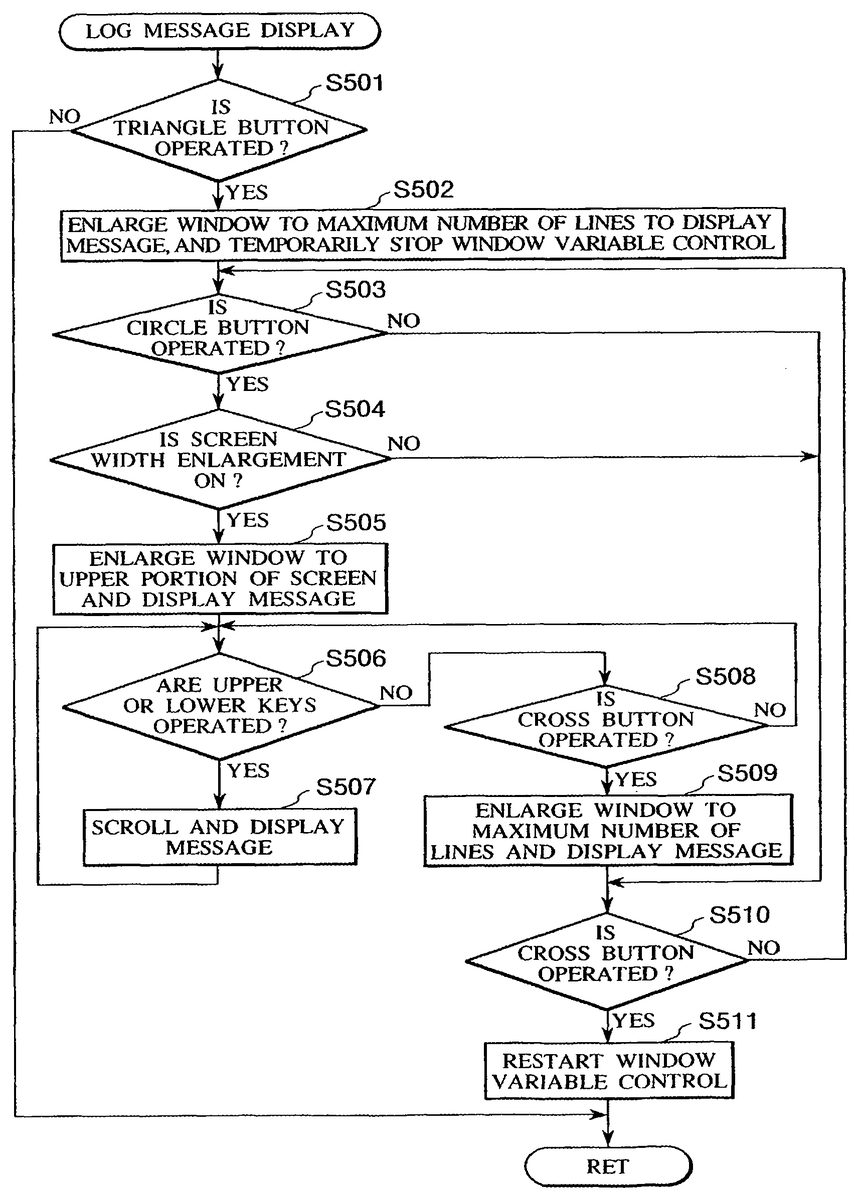
FIG. 11is a flowchart showing exemplary log message display processing that is executed by the control section103of the video game apparatus100. In the log message display processing, the control section103first determines whether the triangle button of the input section161is operated by the player (step S501). If the triangle button is not operated, the log message display processing is directly ended.
In the case where the triangle button is operated, the control section103enlarges the chat window350up to the maximum, number of lines401set in the chat window setting table400(in the case where the number of display lines has already reached the maximum number of lines401, the control section103does not enlarge the chat window350any more). Then, the control section103temporarily stops variable control of the chat window350(step S502). In the case where the number of display lines is increased, the control section103displays log messages above the messages currently displayed in the chat window350in chronological order of the log messages stored in the log message memory500.
The control section103determines whether the circle button of the input section161is operated by the player (step S503). In the case where the circle button is operated, the control section103further determines whether the screen width enlargement404is set to ON (step S504). If the screen width enlargement404is set to ON, the control section103enlarges the chat window350up to the upper portion of the display screen122and displays the log messages, which are stored in the log message memory500, above the message currently displayed in the chat window350in chronological order (step S505). After that, the processing flow directly proceeds to step S506.
In the case where the circle button is not operated or the screen width enlargement404is set to OFF though the circle button is operated, the control section103proceeds to processing in step S510, maintaining the number of display lines at the value of the maximum number of lines401in a state that variable control of the chat window350is continued to be temporarily stopped.
In step S506, the control section103determines whether the upper or lower keys of the input section161are operated by the player. If the upper or lower keys are operated, the control section103scrolls the log messages, which are stored in the log message memory500, in the chat window350in accordance with the operations of the upper or lower keys (step S507), and the processing flow goes back to step S506. If the upper or lower keys are not operated, the control section103determines whether the cross button of the input section161is operated by the player (step S508). In the case where the cross button is operated, the control section103resets the number of display lines in the chat window350to the value of the maximum number of lines401, maintaining the stop of variable control of the chat window350(step S509). After that, the processing flow proceeds to step S510.
In step S510, the control section103determines whether the cross button of the input section161is operated by the player. In the case where the cross button is not operated, the control section103goes back to processing in step S503, maintaining the number of display lines at the value of the maximum number of lines401in a state that variable control of the chat window350is continued to be temporarily stopped. In the case where the cross button is operated, the control section103restarts variable control of the chat window350that was temporarily stopped, and ends log message display processing.
The following specifically explains the chat window350and the display mode of the messages therein with reference to the drawings.FIGS. 12A to 12Fare views each explaining the enlargement of the chat window350by chat window enlargement processing ofFIG. 9.FIGS. 13A to 13Eare views each explaining the reduction of the chat window350by chat window reduction processing ofFIG. 10.FIG. 14Ato FIG.14C are views each explaining the log message display by log message display processing ofFIG. 11.
It is assumed that the value of the maximum number of lines401is set to “9”, and the value of the minimum number of lines402is set to “0” in the chat window setting table400. It is also assumed that one message can be displayed with one line.
As shown inFIG. 12A, the chat window350is not provided on the display screen122until the video game apparatus100receives a message from the game server apparatus200(or when all messages are deleted by chat window reduction processing). If the video game apparatus100receives a message in this state, the chat window350with one display line is provided on the display screen122and the received message is displayed as shown inFIG. 12B.
When the video game apparatus100further receives a new message before the cross button of the input section161is operated or the timer counts the value of the interval time, the number of display lines in the chat window350is increased to two lines and two messages including the new message are displayed in the enlarged chat window350as shown inFIG. 12C. When the video game apparatus100receives another new message before the cross button of the input section161is operated or the timer counts the value of the interval time, the number of display lines in the chat window350is increased to three lines and three messages including the new message are displayed in the enlarged chat window350as shown inFIG. 12D.
When the video game apparatus100receives a new message in a similar manner, the number of display lines in the chat window350is increased up to nine lines, which are the same as the value of the maximum number of lines401set in the table400, and nine messages including the new message are displayed in the enlarged chat window350as shown inFIG. 12E. Thereafter, when the video game apparatus100receives another new message before the cross button of the input section161is operated or the timer counts the value of the interval times, the oldest message displayed at the uppermost position of the chat window350is deleted as shown inFIG. 12F. In the chat window350, the entirety of the remaining messages is scrolled in the upper direction and the newly received message is displayed at the lowermost position of the chat window350.
It is assumed that the number of display lines in the chat window350has already been increased up to nine lines, which are the same as the value of the maximum number of lines401as shown inFIG. 13A. When the cross button of the input section161is operated or the timer counts the value of the interval time during a period when the video game apparatus100does not receive a new message, the oldest message displayed at the uppermost position of the chat window350is deleted and the number of display lines in the chat window350is reduced to eight lines as shown inFIG. 13B. When the cross button of the input section161is operated or the timer counts the value of the interval time during a period when the video game apparatus100does not receive a new message, the oldest message displayed at the uppermost position of the chat window350is deleted and the number of display lines in the chat window350is reduced to seven lines as shown inFIG. 13C.
When the cross button of the input section161is operated or the timer counts the value of the interval time during a period when the video game apparatus100does not receive a new message in a similar manner, the number of display lines in the chat window350is reduced to one line as shown inFIG. 13D. Under these circumstances, when the cross button of the input section161is operated or the timer counts the value of the interval time during a period when the video game apparatus100does not receive a new message, one line message displayed in the chat window350is also deleted and the chat window350is deleted as shown inFIG. 13E.
It is assumed that the messages are displayed in the chat window350while variable control of the chat window350is performed as shown inFIG. 14A. When the triangle button of the input section161is operated, the number of display lines in the chat window350is changed from six to nine lines, which is the value of the maximum number of lines401, as shown inFIG. 14B. The log messages stored in the log message memory500are added to the increased three lines and displayed in chronological order. In this state, variable control of the chat window350is temporarily stopped. In other words, the number of display lines in the chat window350is fixed to nine lines. In the case where the video game apparatus100receives a new message, the new received message is displayed at the lowermost position of the chat window350, and the oldest message is scrolled out upwardly and deleted from the display of the chat window350.
When the circle button of the input section161is operated in the state ofFIG. 14B, the chat window350is enlarged up to the upper portion of the display screen122as shown inFIG. 14C. In the enlarged portion, the log messages stored in the log message memory500are displayed in chronological order. The chat window350ofFIG. 14Cincludes a scroll bar351. The player operates the upper or lower keys of the input section161, thereby making it possible to scroll all log messages, which are stored in the log message memory500, in the chat window350. The scroll bar351can also be provided in the chat window350that is in a state ofFIG. 14B.
As explained above, in the network game system according to this embodiment, when the video game apparatus100receives a new message from the game server apparatus200, the chat window350enlarges up to the value of the maximum number of lines401set in the table400. An increase in the number of display lines in the chat window350makes it possible to ensure the time that passes from when the received message is displayed in the chat window350until the received message is scrolled out, so that the player can have enough time to see the messages. Since the number of display lines in the chat window350does not increase to more than the value of the maximum number of lines401, visibility of the game screen is not significantly impaired by the chat window350.
Upon each passage of the interval time set as the reduction time403, the number of display lines in the chat window350reduces until the number of lines reaches the value of the minimum number of lines402set in the table400. Also, when the player operates the cross button of the input section161, the number of display lines in the chat window350reduces until the number of lines reaches the value of the minimum number of lines402. If there is not a new message for the player to see, the chat window350can be sequentially reduced. For this reason, the player reduces the display lines of the chat window350to make it easy to visually identify the game screen including the field300of the game, the non-player character310and the player characters321to324. The value of the minimum number of lines402can be set to 0. For this reason, when the display of the message is not completely needed, the player erases the display of the chat window350to make it much easier to see the game screen.
In the video game apparatus100that is applied to this network game, when the need for the player to see the messages is high, it is possible to make the messages easier to see, and when the need for the player to see the messages is low, it is possible to make the game screen easier to see. Accordingly, the relationship between the display of messages and the display of the game screen is kept in balance so that the player can easily advance the game.
The reduction in the chat window350is carried out at the time when the player himself/herself operates the cross button of the input section161and at the time when the timer counts the value of the interval time set as the reduction speed403. The message, which the player himself/herself judges to be unnecessary, is low in the importance in the progress of the game. The message in which much time has been elapsed since the reception is low in the importance in the progress of the game, even if the player himself/herself does not judge the importance. In this network game, since the message with low importance in the progress of the game is erased to make it easy for the player to see the game screen, it is possible to advance the game smoothly.
The player can arbitrarily set the maximum number of lines401of the chat window350, the minimum number of lines402, and the reduction speed403in the chat window setting table400. For this reason, the chat window350is enlarged/reduced in accordance with the player's selection, and the relationship between the display of messages and the display of the game screen can be kept in balance in accordance with the individual player preferences. The chat window setting window410that changes the data of the chat window setting table400can be opened not only at a log-in time but also with arbitrary timing during the game. The player can change the balance between the display of messages and the display of the game screen in accordance with a sense of the game obtained when the player actually played the game.
A fixed number of log messages erased from the chat window350is stored in the log message memory500. The log messages can be scrolled and displayed in the chat window350any time when the player operates the triangle button and circle button of the input section161sequentially. Accordingly, the player can see the messages once erased whenever a need arises. This makes it possible to prevent occurrence of a case in which the player misses important messages thereby hindering progress of the game.
As to whether or not the size of the chat window350is enlarged to be more than the maximum number of lines401in the case of displaying the log messages stored in the log message memory500in the chat window, the player can decide the size of enlargement by setting the screen width enlargement404. Accordingly, the player can select either the way of making the messages, which are stored as a log, easy to be seen or the way of making the game screen easy to be seen, and the display balance therebetween can be set in accordance with each player preference.
The present invention is not limited to the aforementioned embodiment, and various modifications may be possible. The following will explain modifications of the above embodiment applicable to the present invention.
In the aforementioned embodiment, the control section103resets the value of the timer when the cross button of the input section161was operated or the timer counted the interval time set as the reduction speed403. In contrast to this, the control section103can reset the value of the timer even when a new message is received from the game server apparatus200. This makes it possible to prevent the chat window350from being reduced by the time counted by the timer immediately after the chat window350is enlarged by the reception of the new message.
The enlargement processing and reduction processing for the chat window350may be executed with the same routine. In this case, the control section103can reset the value of the timer when the cross button of the input section161is operated, the timer counts the interval time set as the reduction speed403, and a new message is received. In connection with the reduction processing for the chat window350, processing in the case where the cross button of the input section161is operated and processing in the case where the timer counts the interval time may be executed with a different routine. In this case, the control section103can reset the value of the timer only when the timer counts the interval time.
The aforementioned embodiment gave the explanation on the assumption that each message transmitted to the video game apparatus100from the game server apparatus200was able to be displayed with one line in the chat window350. However, a long message that cannot be displayed with one line may be transmitted in some cases. For example, in the case where the video game apparatus100receives a message that needs two lines to display, the number of display lines in the chat window350is increased by two lines (in this case, it is required to satisfy a condition that the value shall not exceed the maximum number of lines401set in the chat window setting table400) and the newly received message can be displayed in the enlarged chat window350in the chat window enlargement processing ofFIG. 9.
In the aforementioned embodiment, it was assumed that the reduction speed at which the chat window350was reduced was decided in accordance with the value set by the player in the chat window setting table400. In contrast to this, the speed at which the chat window350is reduced may be changed in accordance with an interval for receiving a new message and a time interval for operating the cross button. The reduction speed at which the chat window350is reduced may be delayed while a specific message is displayed.
In the aforementioned embodiment, it was assumed that the oldest message placed at the uppermost position was first deleted in the case of reducing the chat window350. In contrast to this, when the message placed at the uppermost position of the chat window350is a specific message, which has a high importance in the progress of the game, the second oldest message may be deleted to reduce the chat window350.
In the aforementioned embodiment, in order to display the log messages stored in the log message memory500, it was assumed that the number of display lines in the chat window350was increased up to the value of the maximum number of lines401by the operation of the triangle button thereafter being increased upwardly to the limit of the height of the display screen122by the operation of the circle button. However, the number of display lines in the chat window350may be increased up to the limit of the height of the display screen122directly by the operation of the circle button. When the player operates only the triangle button of the input section161, the number of display lines in the chat window350may be increased up to the setting value of the maximum number of lines401, and when the player operates the triangle button and circle button at the same time, the number of display lines in the chat window350may be increased up to the limit of the height direction of the display screen122beyond the maximum number of lines401. In this case, it is possible to improve the balance between the display of messages and the display of the game screen in accordance with the current progress of the game.
The aforementioned embodiment explained the example of the case in which the present invention was applied to the network game in which the respective players of the multiple video game apparatuses100moved their player characters321to324to advance the game. However, the present invention can be applied to the general network games in which the players advance the game while chatting via the network regardless of whether the player characters appear or not. Regarding the client-side apparatuses that the respective players use, there can be used dedicated video game apparatus, general-purpose computers or cellular phones having a network connection function and an application executing function. The types of client apparatuses that the respective players use may be mixed.
In the aforementioned embodiment, it was assumed that the program and data of the video game apparatus100were stored in the storage medium131and distributed. It was also assumed that the program and data of the game server apparatus200were stored in the storage medium231and distributed. In contrast to these, these programs and data may be stored to a fixed disk device that a Web server apparatus existing on the network151has. In accordance with a request from each of the video game apparatuses100or the game server apparatus200, the Web server apparatus may convert program data stored in the fixed disk device to a signal, and may superimpose the signal on a carrier wave to distribute to the video game apparatus100or the game server apparatus200via the network151.
In the video game apparatus100, the program and data, which the communications interface115has received from the Web server, can be stored in the HDD107and loaded on the RAM105at an executing time. In the game server apparatus200, the program and data, which the communications interface217has received, can be stored in the HDD207and loaded on the RAM205at an executing time.
Although the invention has been described with reference to several exemplary embodiments, it is understood that the words that have been used are words of description and illustration, rather than words of limitation. Changes may be made within the purview of appended claims, as presently stated and as amended, without departing from the scope and spirit of the invention in its aspects. Although the invention has been described with reference to particular means, materials and embodiments, the invention is not intended to be limited to the particulars disclosed; rather, the invention extends to all functionally equivalent structures, methods, and uses such as are within the scope of the appended claims.
Claims
- A video game apparatus connected, via a network, to a server apparatus, the server apparatus being connected to at least one other video game apparatus via the network, the video game apparatus comprising: a receiver that receives a message distributed from the server apparatus via the network;a provider that provides a chat window for displaying the message on a display screen in a case where the receiver receives the message;and a display device that displays a video game on the display screen and the message received by the receiver in the chat window, wherein when the video game apparatus receives a message from the at least one other video game apparatus via the server apparatus in a state that the chat window is not provided, the chat window is provided in an area of the display screen, wherein the chat window is deleted, and is not provided in the area of the display screen until the video game apparatus receives a message from the server apparatus, and wherein an oldest message may be selectively retained in the chat window instead of being deleted by chat window reduction processing, the chat window reduction processing sequentially deleting the oldest messages from the chat window when the oldest message is not a specific message identified with high importance, the chat window reduction processing deleting the second oldest message from the chat window when the oldest message is a specific message identified with high importance.
- The video game apparatus according to claim 1 , wherein the provider erases the chat window when a predetermined condition is satisfied after the receiver receives the message.
- The video game apparatus according to claim 2 , wherein the predetermined condition includes a condition that a predetermined time is elapsed since the receiver receives the message.
- The video game apparatus according to claim 3 , wherein the predetermined time can be set arbitrarily by a player's operation.
- The video game apparatus according to claim 1 , wherein the receiver receives the message distributed in accordance with progress of a video game.
- The video game apparatus according to claim 1 , wherein the provider provides the chat window having a size according to a player's operation on the display screen.
- The video game apparatus according to claim 1 , wherein the provider provides the chat window, in which message of the number of display lines according to a player's operation can be displayed, on the display screen.
- The video game apparatus according to claim 7 , wherein the provider erases the chat window in a case where the number of display lines is
- The video game apparatus according to claim 1 , wherein the display device sequentially deletes the oldest message of all messages displayed in the chat window and displays a newly received message in the chat window when the number of display lines of the message in the chat window reaches the maximum value and the receiver receives the newly received message from the server apparatus.
- The video game apparatus according to claim 1 , further comprising: a holder that holds the messages received by the receiver, wherein the display device enlarges the chat window when the messages held by the holder are displayed.
- The video game apparatus according to claim 10 , wherein the display device scrolls and displays the held messages in the enlarged chat window.
- The video game apparatus according to claim 10 , wherein the display device displays the messages of the number of display lines more than the number of display lines before the enlargement in the enlarged chat window.
- The video game apparatus according to claim 10 , wherein the provider maximizes a size of the chat window in a case where a predetermined operation by a player is received, and wherein the display device adds and displays the held messages in a case where the chat window is enlarged.
- The video game apparatus according to claim 10 , wherein the display device scrolls and displays the held messages in response to a player's operation.
- The video game apparatus according to claim 1 , wherein the receiver receives a message corresponding to an event that occurs in a video game.
- The video game apparatus according to claim 15 , wherein the event is an event that is generated by an operation of a player character.
- The video game apparatus according to claim 1 , further comprising: a time counter that counts a time;and a window reducing device that reduces or erases the chat window in a case where the time counter counts a predetermined time.
- The video game apparatus according to claim 17 , wherein the time counter starts counting a new time when receiving a message by the receiver.
- A non-transitory computer-readable storage medium on which a network game program for a video game apparatus is recorded, the video game apparatus being connected to a server apparatus via a network, the video game apparatus being also connected to at least one other video game apparatus via the network, the network game program causing the video game apparatus to execute: receiving a message distributed from the server apparatus via the network;providing a chat window for displaying the message on a display screen in a case where the message is received;and displaying a video game on the display screen and the received message in the chat window, wherein when the video game apparatus receives a message from the at least one other video game apparatus via the server apparatus in a state that the chat window is not provided, the chat window is provided in an area of the display screen, wherein the chat window is deleted, and is not provided in the area of the display screen until the video game apparatus receives a message from the server apparatus, and wherein an oldest message may be selectively retained in the chat window instead of being deleted by chat window reduction processing, the chat window reduction processing sequentially deleting the oldest messages from the chat window when the oldest message is not a specific message identified with high importance, the chat window reduction processing deleting the second oldest message from the chat window when the oldest message is a specific message identified with high importance.
- A network game system comprising a server apparatus and a plurality of client apparatuses each connected to the server apparatus via a network, comprising: a distributor that distributes a message, transmitted from any one the plurality of client apparatuses, to at least one other of the plurality of client apparatuses;a receiver that receives the message distributed via the network by the distributor;a provider that provides a chat window for displaying the message on a display screen in a case where the receiver receives the distributed message;and a display device that displays a video game on the display screen and the message received by the receiver in the chat window, wherein when the video game apparatus receives a message from the at least one other video game apparatus via the server apparatus in a state that the chat window is not provided, the chat window is provided in an area of the display screen, wherein the chat window is deleted, and is not provided in the area of the display screen until the video game apparatus receives a message from the server apparatus, and wherein an oldest message may be selectively retained in the chat window instead of being deleted by chat window reduction processing, the chat window reduction processing sequentially deleting the oldest messages from the chat window when the oldest message is not a specific message identified with high importance, the chat window reduction processing deleting the second oldest message from the chat window when the oldest message is a specific message identified with high importance.
Disclaimer: Data collected from the USPTO and may be malformed, incomplete, and/or otherwise inaccurate.