U.S. Pat. No. 9,586,148
RECORDING MEDIUM, GAME PROCESSING METHOD, GAME APPARATUS AND GAME SYSTEM
AssigneeNintendo Co Ltd
Issue DateApril 9, 2013
Illustrative Figure
Abstract
An example system includes an object controlling unit that controls operations of objects based on input manipulations, and a noncompetitive relationship setting unit that sets a noncompetitive relationship for two objects in the competition of the game when a predetermined operation is performed between these two objects. That system performs processing regarding the game in which plural objects compete in accordance with the input manipulations.
Description
DETAILED DESCRIPTION OF NON-LIMITING EXAMPLE EMBODIMENTS FIG. 1shows an example non-limiting block diagram for representing a configuration of a game system according to the present embodiment. The game system according to the present embodiment has a configuration that a stationary game apparatus1is connected to a display apparatus5through an image signal line or the like. The display apparatus5displays an image regarding a game output by the game machine1. The game apparatus1includes plural controllers3for accepting user's manipulations. The game apparatus1and each controller3transmit information through wireless communication. The game apparatus1accepts the user's manipulation obtained through each controller3. The game apparatus1performs several processing based on the accepted input manipulation, such as object control regarding the game and game determination. The game apparatus1generates a game image reflecting the processing result, and outputs the generated game image to the display apparatus5. The game apparatus1includes a processing unit10, image outputting unit11, recording medium attaching unit12, primary storage13, secondary storage14, communicating unit15, wireless communicating unit16and the like. The processing unit10of the game apparatus1is configured with an arithmetic processing unit, such as a CPU (Central Processing Unit). The processing unit10reads out a game program9stored in the secondary storage14or game program9stored in a recording medium7that is attached to the recording medium attaching unit12, onto the primary storage13and then executes the read game program9. Thus, the processing unit10can perform several information processing regarding the game. For example, the processing unit10performs processing for accepting the user's input manipulation obtained with the controller3. For example, the processing unit10performs processing for determining a game based on the accepted input manipulation. For example, the processing unit10performs processing for generating a game image displayed on the display apparatus5in response to the accepted input manipulation or events occurred in the game. The image outputting unit11converts the image generated by the processing unit10into image signals appropriate for the ...
DETAILED DESCRIPTION OF NON-LIMITING EXAMPLE EMBODIMENTS
FIG. 1shows an example non-limiting block diagram for representing a configuration of a game system according to the present embodiment. The game system according to the present embodiment has a configuration that a stationary game apparatus1is connected to a display apparatus5through an image signal line or the like. The display apparatus5displays an image regarding a game output by the game machine1. The game apparatus1includes plural controllers3for accepting user's manipulations. The game apparatus1and each controller3transmit information through wireless communication. The game apparatus1accepts the user's manipulation obtained through each controller3. The game apparatus1performs several processing based on the accepted input manipulation, such as object control regarding the game and game determination. The game apparatus1generates a game image reflecting the processing result, and outputs the generated game image to the display apparatus5.
The game apparatus1includes a processing unit10, image outputting unit11, recording medium attaching unit12, primary storage13, secondary storage14, communicating unit15, wireless communicating unit16and the like. The processing unit10of the game apparatus1is configured with an arithmetic processing unit, such as a CPU (Central Processing Unit). The processing unit10reads out a game program9stored in the secondary storage14or game program9stored in a recording medium7that is attached to the recording medium attaching unit12, onto the primary storage13and then executes the read game program9. Thus, the processing unit10can perform several information processing regarding the game. For example, the processing unit10performs processing for accepting the user's input manipulation obtained with the controller3. For example, the processing unit10performs processing for determining a game based on the accepted input manipulation. For example, the processing unit10performs processing for generating a game image displayed on the display apparatus5in response to the accepted input manipulation or events occurred in the game.
The image outputting unit11converts the image generated by the processing unit10into image signals appropriate for the display of the display apparatus5, and outputs the image signals. The recording medium attaching unit12can receive or release the recording medium7that is a disk type, card type or the like. The processing unit10can read out the game program9and other data from the recording medium7attached to the recording medium attaching unit12. The primary storage13is configured with a semiconductor memory element or the like. The primary storage13temporarily stores several data generated by the calculation processing of the processing unit10. The secondary storage14is configured with a non-volatile memory having a capacity larger than that of the primary storage13. The secondary storage14stores, for example, the game program9and other data. The communicating unit15performs data transmission with a server device, other game apparatus1or the like, through the network, such as the Internet or LAN (Local Area Network). For example, the game apparatus1can utilize the communication unit15to communicate with the server device for downloading the game program9, and can store it in the secondary storage14.
The wireless communicating unit16performs wireless transmission of information with plural controllers3included by the game apparatus1. For example, the controller3is composed of a housing that can be held by user's both hands and that has a manipulating unit, such as a push button and/or touch panel. The controller3includes a wireless communicating unit in the housing, and performs wireless transmission of information with the game apparatus1. The controller3gives wireless notification to the game apparatus1about the input manipulation applied on the manipulating unit. For example, the controller3notifies about information, such as press or release of the push button. The wireless communicating unit16of the game apparatus1notifies the processing unit10about the input manipulation received from each controller3. The game apparatus1includes plural controllers3, and thus plural users can simultaneously play the game with the game apparatus1.
The game apparatus1can make the processing unit10execute the game program9to implement an input manipulation accepting unit21, object control processing unit22, team setup processing unit23, game determination processing unit24, display processing unit25and the like, as function blocks in software. Alternatively, it may be configured that a part or the entire of the elements from the input manipulation accepting unit21to display processing unit25are implemented as functioning blocks in hardware.
The input manipulation accepting unit21of the processing unit10performs processing for accepting the user's input manipulation applied to each controller3, based on the information transmitted between the wireless communicating unit16and the controller3. For example, the input manipulation accepting unit21accepts an input manipulation based on the game contents, such as a manipulation for moving a player object and an action manipulation for attacking, jumping or the like. In the present embodiment, the term “player object” means an object of a character that is a target for the user's manipulation. The input manipulation accepting unit21distinguishes and accepts the input manipulations for each controller3.
The object control processing unit22of the processing unit10controls the object regarding the game based on the input manipulation that is accepted by the input manipulation accepting unit21. For example, the object control processing unit22makes the player object move, attack, jump or the like in accordance with the input manipulation. For example, the object control processing unit22additionally performs processing for generating, arranging, moving objects other than the player object, and the like. The objects other than the player object includes, for example, an enemy object, background object, obstacle object, a field object arranging these objects, and the like. In the present embodiment, the term “enemy object” means an object that is not a target of the user's manipulation.
The team setup processing unit23of the processing unit10performs a team setup for plural users in the game played by the game program9according to the present embodiment. The term “team setup for plural users” means a team setup for plural player objects. It will be described later about detailed processing performed by the team setup processing unit23.
The game determination processing unit24of the processing unit10performs several determination processing regarding the game. For example, the game determination processing unit24performs the processing for determining whether actions such as attack, avoidance or the like of the player object performed in accordance with the input manipulation succeeds or fails. For example, the game determination processing unit24determines whether a condition is satisfied for win, defeat or the like in the game.
The display processing unit25of the processing unit10performs processing for displaying a game screen on the display apparatus5, and the game screen is configured with objects arranged by the object control processing unit22. In other words, the display processing unit25performs processing for generating an image in which one or more arranged objects are drawn, and for giving the generated image to the image outputting unit11. The image outputting unit11converts the image given by the display processing unit25of the processing unit10into image signals suitable for displaying on the display apparatus5, and outputs the image signals. Thus, the game screen is displayed on the display apparatus5.
Next, an example is explained about the game played with the game program9regarding the present embodiment.FIGS. 2 and 3show examples non-limiting schematic view for representing game screens displayed by game program9regarding the present embodiment. In the game screens of the example, four combat vehicle objects101-104indicating player objects and plural obstacle objects105are arranged within a substantially rectangular field whose four sides are walled. Four combat vehicle objects101-104are differently colored, respectively. It should be noted that a different hatching in figures represents a different color for the combat vehicle objects101-104. Thus, it is possible to distinguish each of combat vehicle objects101-104from each other on the game screen displayed by the display apparatus5.
Four combat vehicle objects101-104are associated with four controllers3of the game apparatus1, in one-to-one correspondence. In the game of this example, each of plural users utilizes one controller3. Each user manipulates one associated combat vehicle object of the combat vehicle objects101-104. The game screen shown inFIG. 2represents a status before the game starts. In this status, the association between the combat vehicle objects101-104and controllers3is not shown. For example, the processing unit10of the game apparatus1in the game performs a random change of the association between the combat vehicle objects101-104and controllers3every time the game is played.
A user needs to recognize the user's combat vehicle object manipulated by the user's controller3among the combat vehicle objects101-104. For example, when a manipulation is performed on a cross key arranged on the controller3in the status before the game is started, an arrow mark106corresponding to a direction of the manipulated cross key is shown near one of the combat vehicle objects101-104, which is associated to the controller3. Each user adequately utilizes its own controller3to perform the manipulation for instructing the direction based on the cross key. Through seeing the arrow mark106shown at that time near each of combat vehicle objects101-104, the user can recognize its own combat vehicle to be manipulated among the combat vehicle objects101-104.
After the game starts, each user manipulates one of the combat vehicle objects101-104and attacks other ones of the combat vehicle objects101-104which are manipulated by other users. The game screen shown inFIG. 3represents a status after the game is started. Some combat vehicle objects101-104are attacking. For example, each user utilizes the cross key arranged on the controller3to perform movement manipulation of the combat vehicle objects101-104, and utilizes the push button to perform the attack (cannonade) manipulation for the combat vehicle objects101-104.
When the cannonade manipulation is performed, a cannonball108is launched by the combat vehicle object101-104. The launched cannonball108travels in a predetermined direction. When the cannonball108makes contact with other combat vehicle objects101-104, those combat vehicle objects101-104are destroyed and thus defeated in this game. When the cannonball108makes contact with an obstacle object105, the travel direction of the cannonball108is reflected at the contact point of the obstacle object105. Then, the cannonball108travels further in the reflected direction. After launched by the combat vehicle101-104, the cannonball108continues traveling within the field until a predetermined time (e.g., 10 seconds) elapses. After the cannonball108are in contact with other combat vehicle object101-104or the predetermined time elapses, the cannonball108disappears.
Each of the combat vehicle objects101-104can launch one cannonball108at the initial stage. Each of the combat vehicle objects101-104cannot launch next cannonball108until the current cannonball108disappears, for example, due to the elapse of the predetermined time. The display processing unit25of the processing unit10shows in a distinguishable manner any of the combat vehicle objects101-104that can launch the cannonball108and any of the combat vehicle objects101-104that has launched the cannonball108.
FIG. 4AandFIG. 4Bshow example non-limiting enlarged views for representing the combat vehicle object. It should be noted that each ofFIGS. 4A and 4Bshows one combat vehicle object104among the four combat vehicle objects101-104. The other combat vehicle objects101-103are also configured similarly, although colored differently. The combat vehicle object104includes a main body portion104ahaving caterpillars at both sides and a cannon barrel portion104barranged on the main body portion104a. When in the status that the cannonball108can be launched, the combat vehicle object104is shown with an inflated root portion of the cannon barrel portion104bas illustrated inFIG. 4A. The status in which the cannonball108can be launched is called as an attackable status. On the other hand, when the status that the cannonball108has been launched, the combat vehicle object104is shown with a contracted rod-like root portion of the cannon barrel portion104bas illustrated inFIG. 4B. The status in which the cannonball108has been launched is called as a non-attackable status. Through the cannon barrel portion104bof the combat vehicle object104shown by the display apparatus5, the user can recognize whether or not the combat vehicle object104can launch the cannonball108.
The user can manipulate each of the combat vehicle objects101-104to attack each other. The last one of the combat vehicle objects101-104which is not destroyed is treated as a winning object in this game.
In this example of the game, it is possible to make a temporal noncompetitive relationship between plural combat vehicle objects101-104after the game starts. The period after the game starts in the present embodiment means the period after it is in the status that each of the combat vehicle objects101-104can be operated for the movement, attack and the like. Additionally, the noncompetitive relationship is called as a team.
FIG. 5shows an example non-limiting schematic view for explaining a satisfied condition of the team. In the game of this example, when a predetermined condition is satisfied and then two cannon barrel portions101b,104bof combat vehicle objects101,104come in contact with each other, these two combat vehicle objects101,104are set as one team. As for the predetermined condition, the team setup processing unit23of the processing unit20determines conditions regarding positions and directions of two combat vehicle objects101,104.
As for the predetermined condition, the team setup processing unit23determines whether one of combat vehicle objects101,104exists in the attack range of the other one of combat vehicle objects101,104. In the example ofFIG. 5, the area surrounded by the dashed lines indicates the attack range A of the combat vehicle object104. It is determined that the cannonball108can hit (come in contact with) the combat vehicle object101when the combat vehicle object104launches the cannonball108in the attack range A shown in the figure. In addition, the team setup processing unit23compares attack directions or travel directions of two combat vehicle objects101and104. As for the predetermined condition, the team setup processing unit23determines whether the angle formed by two vectors indicating respective attack directions is, for example, not less than 140° and not more than 220° (i.e., in a range of 180°±40°).
The team setup processing unit23sets the team, when these two conditions are satisfied and then two cannon barrel portions101b,104bof the combat vehicle objects101,104make contact with each other. In other words, this predetermined condition is satisfied when two combat vehicle objects101,104exist in positions where they can attack each other and then two combat vehicle objects101,104make their own cannon barrel portions101b,104bcontact with each other. Just before their own cannon barrel portions101b,104bare in contact with each other, each of combat vehicle objects101,104can launch the cannonball108to destroy the other one. However, the combat vehicle object101shown inFIG. 5cannot perform an attack because the combat vehicle object101is in the status where the cannonball108has been launched. The team setup processing unit23sets the team, regardless of whether or not the combat vehicle objects101,104can launch the cannonball108.
When the team is set in response to the contact of the cannon barrel portions101b,104bas shown inFIG. 5, the display processing unit25changes the color applied to one of the cannon barrel portion101b,104bto the color applied to the other one of the cannon barrel portion101b,104b. InFIG. 5, the color applied to the cannon barrel portion104bof the combat vehicle object104is changed to the color applied to the cannon barrel portion101bof the combat vehicle object101. Based on the colors applied to the cannon barrel portions101b,104b, the user can recognize that the combat vehicle objects101,104are set as the same team.
For example, when the combat vehicle objects101,102are set as one team and then the combat vehicle objects101,104satisfying the predetermined condition make their own cannon barrel portions101b,104bbe in contact with each other, these three combat vehicle objects101,102,104are set as one team.
For example, two combat vehicle objects101,102are set as the first team and the other two combat vehicle objects103,104are set as the second team, the team setup processing unit23performs the following team setup. Particularly, when the combat vehicle objects101,104make contact with each other, the team setup processing unit2selects one of the combat vehicle objects101,104at random and changes the team of the selected object to be the other team. This results that, for example, three of combat vehicle objects101,102,104are set as the first team and only the combat vehicle object103is set as the second team. When the numbers of objects are equal in the teams including the contacted combat vehicle objects101,104, the team setup processing unit23moves any one of the combat vehicle objects101,104into the other team, at random.
For example, when five combat vehicle objects including the combat vehicle object101are set as the first team and three combat vehicle objects including the combat vehicle object104are set as the second team, the team setup processing unit23performs the following team setup. Particularly, when the combat vehicle objects101,104make contact with each other, the team setup processing unit23changes the team of the combat vehicle object104to be the first team. The team setup processing unit23moves the combat vehicle object104, set as the second team having a smaller number of combat vehicle objects, into the first team having a larger number of combat vehicle objects.
For example, when three combat vehicle objects101-103are set as one team and the combat vehicle objects101,104make contact with each other, the team setup processing unit23dissolves the team. The team setup processing unit23dissolves the team if all combat vehicle objects101-104not destroyed in the game will be set as one team.
When the team is set by the team setup processing unit23, the processing unit10disables the combat vehicle objects101-104set as one team for attacking each other. For example, when the combat vehicle objects101,102are set as one team and further the cannonball108launched by the combat vehicle object101come in contact with the combat vehicle object102, the combat vehicle object102is not destroyed and the cannonball108passes over the combat vehicle object102. This situation similarly occurs when the cannonball108launched by the combat vehicle object102makes contact with the combat vehicle object101. Each of the combat vehicle objects101-104will never destroyed by its own launched cannonball108, regardless of the team setup. In other words, the cannonball108launched by the combat vehicle objects101-104set as the same team with a specific combat vehicle object includes the cannonball108launched by the specific combat vehicle object.
When the team setup processing unit23sets the team, the processing unit10increases the attack power of the combat vehicle objects101-104included in the set team.FIG. 6shows an example non-limiting schematic view for explaining increase of attack power for the combat vehicle objects101-104. The top portion ofFIG. 6shows the initial status where the team is not set for the combat vehicle object101with the other combat vehicle objects102-104. When the user utilizes the controller3for performing the attacking manipulation in this status, the combat vehicle object101can launch one cannonball108. When the team is set for combat vehicle object101with another combat vehicle object102and thus the team includes two combat vehicle objects101,102, the number of cannonballs108is increased and thus the combat vehicle object101can launch two cannonballs108(see middle portion ofFIG. 6). When the team includes three combat vehicle objects101-103, the number of cannonballs108is increased and thus the combat vehicle object101can launch three cannonballs108(see bottom portion ofFIG. 6).
The processing unit10increases the attack power of combat vehicle objects101-104included in the team, based on the number of combat vehicle objects101-104included in the team. It should be noted that the method for increasing the attack power is not limited to the number increase of the cannonballs108. For example, it may alternatively change the size of the cannonball108to be larger or increase the strength of the cannonball108.
The processing unit10in the present embodiment does not decrease the attack power of the combat vehicle objects101-104even when the number of the combat vehicle objects101-104included in the team is decreased and when the set team is dissolved. Therefore, it is possible to prevent the user from feeling less excited in the game even when the number of not-destroyed combat vehicle objects101-104is decreased at the late time of the game. However, the processing unit10may be alternatively configured to decrease the attack power of the combat vehicle objects101-104.
In the game of the present embodiment, the user utilizes the controller3to perform manipulations, such as the moving manipulation and attacking manipulation of the combat vehicle objects101-104. Each user can attack other combat vehicle objects101-104, while setting the team with other combat vehicle objects101-104. Thus, the game runs. Eventually, the winning object is a remaining one combat vehicle object which is not destroyed among the combat vehicle objects101-104.
FIG. 7shows an example nonlimiting schematic view for representing the game screen after a win decision. The example in the figure shows a status where the combat vehicle object101eventually wins. When the game determination processing unit24of the processing unit10determines that the combat vehicle object101has won, the display processing unit25shows a message at the center of the game screen for notifying of the win decision. The message “user A wins!” is shown in the example of the figure. The explanation is based on the assumption that the combat vehicle101is manipulated by the user A. After the win decision, the display processing unit25shows recognizing information109near the combat vehicle object101which is for recognizing the user who manipulates the combat vehicle object101. In the example of the figure, the display processing unit25shows the user name, i.e., “user A”, within a substantially circular balloon as the recognizing information109. The user name shown as the recognizing information109is registered before the game starts. The information shown as the recognizing information109is not limited to the user name. For example, it may be an image such as a user's picture or user's portrait, or number applied to the controller3that is associated with the winning combat vehicle objects101-104.
When the game determination processing unit24determines that the combat vehicle objects101-104are destroyed and defeated, the display processing unit25similarly shows the recognizing information109that indicates the user regarding the defeated combat vehicle objects101-104. The example in the figure shows the status where the combat vehicle object104is destroyed and defeated. The defeated combat vehicle object104determined by the game determination processing unit24is shown by an image resembling a destroyed combat vehicle. The display processing unit25shows the recognizing information109near the combat vehicle object104which is for recognizing the user who manipulates the defeated combat vehicle object104.
The display processing unit25shows the recognizing information109for the defeated combat vehicle objects, not only at the time when the winning object is decided in the game. The display processing unit25shows the recognizing information109every time when it is decided that each of the combat vehicle objects101-104is defeated. The display processing unit25continues showing the recognizing information109during a predetermined time (e.g., 30 seconds) after the defeat decision, and then stops showing the defeated combat vehicle objects101-104and recognizing information109.
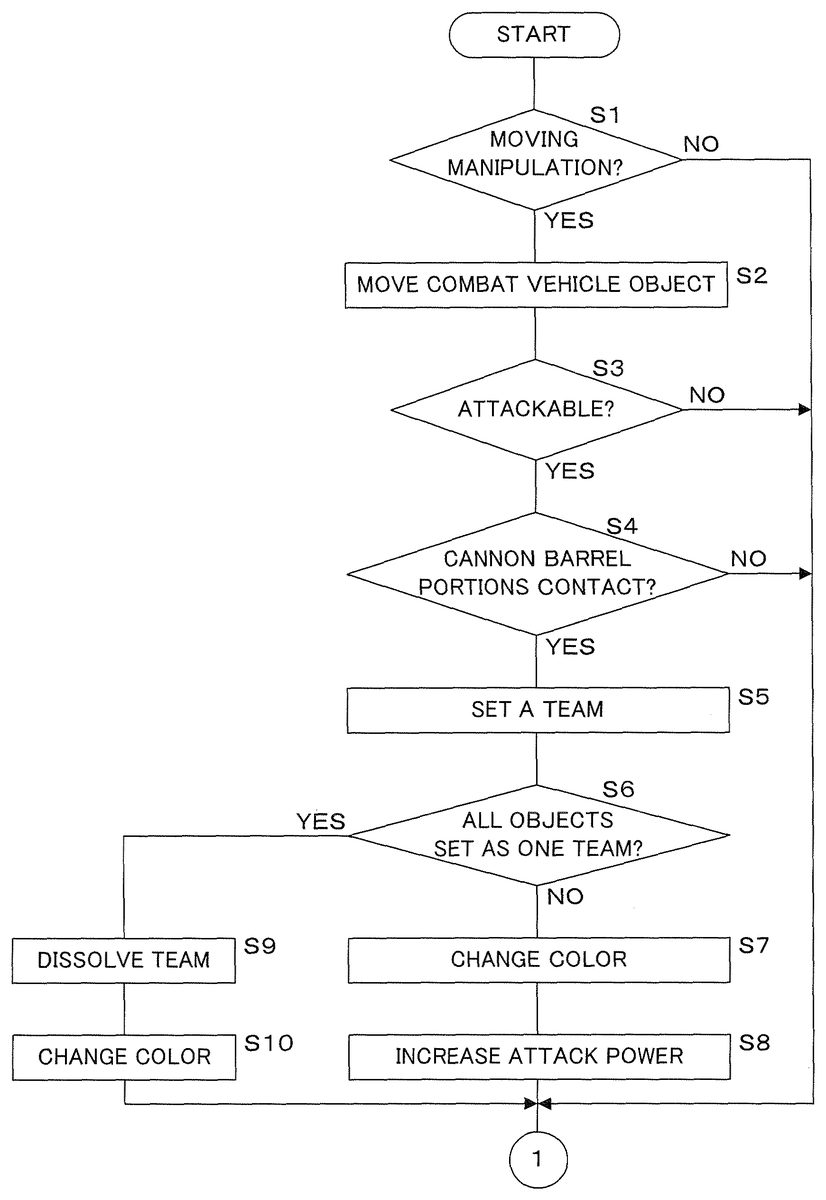
FIGS. 8-10show example non-limiting flowcharts for representing a procedure performed by the processing unit10based on the executed game program9. It should be noted that the procedure shown in figures is performed for each one of the combat vehicle objects101-104existing in the game. The processing unit10of the game machine1utilizes the input manipulation accepting unit21to determine whether the moving manipulation for moving the combat vehicle objects101-104is accepted by the controller3or not (step S1). When the moving manipulation is not accepted (S1: NO), the processing unit10proceeds the procedure to the step S11. When the moving manipulation is accepted (S1: YES), the object control processing unit22of the processing unit10moves a target one of the combat vehicle objects101-104in a field of the game, based on the accepted moving manipulation (step S2).
The team setup processing unit23of the processing unit10determines whether or not the target one of the combat vehicle objects101-104and other ones of the combat vehicle objects101-104are in a status attackable to each other (step S3). For determining at the step S3, the team setup processing unit23determines whether another one of the combat vehicle objects101-104exists near the target one of the combat vehicle objects101-104, and if it exists, determines whether the predetermined condition is satisfied for the position and direction of said existing another one of the combat vehicle objects101-104. When having determined that the status is not attackable (S3: NO), the processing unit10proceeds the procedure to the step S11.
When having determined that the status is attackable (S3: YES), the team setup processing unit23further determines whether the cannon barrel portion included by the target one of the combat vehicle objects101-104and the cannon barrel portion included by the adjacent another one of the combat vehicle objects101-104make contact with each other (step S4). When these cannon barrel portions do not make contact (S4: NO), the processing unit10proceeds the procedure to the step S11. When having determined that these cannon barrel portions make contact with each other (S4: YES), the team setup processing unit23sets two combat vehicle objects101whose cannon barrel portions make contact with each other as one team (step S5).
The team setup processing unit23determines whether or not all of the combat vehicle objects101-104not destroyed in the game are set as one team (step S6). When all of the combat vehicle objects101-104are not set as one team (S6: NO), the processing unit10changes the color applied to any one of cannon barrel portions, included in two combat vehicle objects101-104set as the same team, to the color applied to the other one of cannon barrel portions (step S7). In addition, the processing unit10increases the attack power of the combat vehicle objects101-104set as one team (step S8), and proceeds the procedure to the step S11. When all of the combat vehicle objects101-104are set as one team (S6: YES), the processing unit10utilizes the team setup processing unit23to dissolve the team (step S9). In addition, the processing unit10changes the color applied to the cannon barrel portion included in each of the combat vehicle objects101-104to be an individual color (step S10), and proceeds the procedure to the step S11.
The processing unit10utilizes the input manipulation accepting unit21to determine whether or not the attacking manipulation for the combat vehicle objects101-104is accepted by the controller3(step S11). When the attacking manipulation is not accepted (S11: NO), the processing unit10proceeds the procedure to the step S16. When the attacking manipulation is accepted (S11: YES), the processing unit10further determines whether or not the combat vehicle objects101-104are in the attackable status (step S12). When having determined that the combat vehicle objects101-104are not in the attackable status (S12: NO), the processing unit10proceeds the procedure to the step S16.
When the processing unit10has determined that the combat vehicle objects101-104are in the attackable status (S12: YES), the object control processing unit22of the processing unit10launches the cannonballs108of the number corresponding to the set attack power (step S13). In addition, the object control processing unit22sets the non-attackable status for the target one of the combat vehicle objects101-104(step S14). The processing unit10makes the display processing unit25show the target one of the combat vehicle objects101-104whose cannon barrel portion's shape is changed (step S15), and the processing unit10proceeds the procedure to the step S16. Although not shown in the flowcharts, the object control processing unit22sets the attackable status for the target one of the combat vehicle objects101-104after the non-attackable status is set for the target and then a predetermined time elapses. In addition, the display processing unit25restores the shape of the cannon barrel portion included in the target one of the combat vehicle objects101-104and then shows the target.
The game determination processing unit24of the processing unit10determines whether or not a cannonball108launched by another one of the combat vehicle objects101-104makes contact with the target one of the combat vehicle objects101-104(step S16). When the cannonball108does not make contact (S16: NO), the processing unit10proceeds the procedure to the step S25. When the cannonball108makes contact (S16: YES), the game determination processing unit24further determines whether the contacting cannonball108is launched by the target one or by another one of combat vehicle objects101-104set as the same team with the target (step S17). When having determined that the contacting cannonball108is launched by the target one or by another one of combat vehicle objects101-104set as the same team with the target (S17: YES), the game determination processing unit24disables the attack of that cannonball108(step S18) and proceeds the procedure to the step S25.
When having determined that the contacting cannonball108is not launched by the target and is not launched by other of combat vehicle objects101-104set as the same team with the target (S17: NO), the game determination processing unit24decides that the target one of the combat vehicle objects101-104is defeated (step S19). The team setup processing unit23of the processing unit10determines whether or not all of the combat vehicle objects101-104not yet decided as defeated are set as one team (step S20). When all of the combat vehicle objects101-104having no decision about the defeat are not set as one team (S20: NO), the processing unit10proceeds the procedure to the step S23.
When all of the combat vehicle objects101-104not yet decided as defeated are set as one team (S20: YES), the processing unit10utilizes the team setup processing unit23to dissolve the team (step S21). In addition, the processing unit10changes the color applied to the cannon barrel portion included in each of the combat vehicle objects101-104to be an individual color (step S22), and proceeds the procedure to the step S23.
The display processing unit25of the processing unit10shows the recognizing information109regarding the defeated combat vehicle objects101-104(step S23). The display processing unit25turns off the shown recognizing information109after a predetermined time elapses (step S24), and then proceeds the procedure to the step S25.
The game determination processing unit24of the processing unit10determines whether the target one of the combat vehicle objects101-104is the last one in the game or not (step S25). When the target is not the last one (S25: NO), the processing unit10ends the procedure. When the target is the last one (S25: YES), the game determination processing unit24decides that the target one of the combat vehicle objects101-104wins (step S26). The display processing unit25of the processing unit10shows the message notifying of the winning combat vehicle objects101-104(step S27). In addition, the display processing unit25shows the recognizing information109regarding the winning combat vehicle objects101-104(step S28), and then ends the procedure.
It should be noted that the processing unit10repeatedly performs the above procedure of the steps S1-S28from the game start to the decision time of the winning object.
The game apparatus1described above performs processing regarding the game in which plural combat vehicle objects101-104compete, in accordance with the input manipulation accepted by the controller3by the processing unit10executing the game program9. The term “compete” in the present embodiment means that plural combat vehicle objects101-105attack each other. In the processing unit10of the game apparatus1, the object control processing unit22controls the operation for the combat vehicle objects101-104, based on the input manipulation, such as moving and attacking accepted by the input manipulation accepting unit21. The processing unit10makes the team setup processing unit23set the noncompetitive relationship for the competition in that game, when a predetermined operation is performed, such as an operation making the cannon barrel portions included in two of the combat vehicle objects101-104make contact with each other. The term “noncompetitive relationship” in the present embodiment means that plural combat vehicle objects101-104are set as one team.
Therefore, the user can make one of the combat vehicle objects101-104manipulated by the user perform a predetermined operation after the game starts, and thus can set the team with another one of the combat vehicle objects101-104. Hence, it is not required for the user to decide and/or talk about the team setup before the game starts.
The team setup processing unit23of the processing unit10determines whether or not two of the combat vehicle objects101-104are at positions and in directions which allow the attack. When both two of the combat vehicle objects101-104exist at the positions and in the directions which allow the attack and then the predetermined operation is performed for the two of the combat vehicle objects101-104, the team setup processing unit23sets the team. When the two of the combat vehicle objects101-104exist at the positions and in the directions which allow the attack but the predetermined operation is not performed, these two of the combat vehicle objects101-104can attack each other.
Therefore, the user can enjoy tactics for selecting the attack or team setup between two of the combat vehicle objects101-104.
It should be noted that the predetermined operation for the team setup is not limited to the contact of cannon barrel portions included in the combat vehicle objects101-104. For example, the team may be set when two of the combat vehicle objects101-104come close to each other within a predetermined range, regardless of the cannon barrel portions' contact. The predetermined range for the team setup at that time may be narrower than the attackable range for each of the combat vehicle objects101-104. Alternatively, the team may be set when two of the combat vehicle objects101-104make contact with each other, regardless of the cannon barrel portions. Alternatively, the team may be set when the cannon barrel portions are in contact with each other, regardless of the positions and directions of said two of the combat vehicle objects101-104. Additionally, in the case that the object manipulated by the user is not a combat vehicle but a human type character having a weapon, such as a sword, the team may be set when the weapon objects held by the human type character objects make contact with each other, not when the human type character objects make contact with each other.
The processing unit10disables the attack performed between the combat vehicle objects101-104set as one team by the team setup processing unit23. In addition, the processing unit10increases the attack power of combat vehicle objects101-104, based on the number of the combat vehicle objects101-104included in the team. Therefore, the operation for setting the team by plural combat vehicle objects101-104lead to an advantage.
After the combat vehicle objects101-104launch the cannonballs108based on the attacking manipulation, the processing unit10sets these combat vehicle objects101-104as the non-attackable status until a predetermined time elapses. The display processing unit25of the processing unit10shows the combat vehicle objects101-104in a manner recognizable whether the attack is possible or impossible. Therefore, the user can move one of the combat vehicle objects101-104set in non-attackable status closer to another one of the combat vehicle objects101-104, for example, during the predetermined time after the attack, for indicating the intention of no attack, and urging to set the team with said another one of the combat vehicle objects101-104.
When the predetermined operation is performed between one of the plural combat vehicle objects101-104for which one team is set and another one of the combat vehicle objects101-104for which the team is not set, the team setup processing unit23of the processing unit10includes the above-described another one of the combat vehicle objects101-104belong in the team. In addition, when the predetermined operation is performed between one of the combat vehicle objects101-104included in the first team and one of the combat vehicle objects101-104included in the second team, the team setup processing unit23brings any one of these two among the combat vehicle objects101-104into the other team. When the number of the combat vehicle objects101-104included in the first team is equal to the number of the combat vehicle objects101-104included in the second team at that time, the team setup processing unit23randomly selects one of the combat vehicle objects101-104to be brought into the other team in response to the predetermined operation. When the numbers are not equal, the team setup processing unit23brings one of the combat vehicle objects101-104, included in the team having a smaller number of objects, into the other team having a larger number of objects.
This allows a larger number of combat vehicle objects101-104to set up teams and attack each other.
When the predetermined dissolution condition is satisfied, the team setup processing unit23of the processing unit10dissolves the team. When all combat vehicle objects101-104in the game are set as one team, the team setup processing unit23dissolves the team. However, it should be noted that the dissolution condition for the team is not limited to the above explanation. For example, when a predetermined time elapses after a team is initially set, the team setup processing unit23may dissolve the team. For example, when an item for resolving the team appears in the game and then the combat vehicle objects101-104get the item, the team setup processing unit23may dissolve the team.
The team dissolution described above can make a team temporal, and it is possible to implement the game in which eventually all combat vehicle objects101-104compete against each other.
The game determination processing unit24of the processing unit10determines the success or fail of the attack, based on whether the cannonball108launched by one of the combat vehicle objects101-104make contact with another one of the combat vehicle objects101-104. When having determined that the attack succeeds, the game determination processing unit24determines that said another one of the combat vehicle objects101-104with which the cannonball108is in contact is defeated. When the number of the not defeated combat vehicle objects101-104becomes one, the game determination processing unit24determines this one of combat vehicle objects101-104as the winning object.
The game apparatus1includes plural controllers3, and the input manipulation accepting unit21of the processing unit10accepts the input manipulations from plural users. The object control processing unit22controls the operation for the plural combat vehicle objects101-104based on the accepted input manipulation. The display processing unit25of the processing unit10displays the game screen in such a manner that the user who manipulates each of the combat vehicle objects101-104cannot be recognized. After the win or defeat is decided for the game, the display processing unit25shows the recognizing information109for recognizing the user who manipulates each of the combat vehicle objects101-104. Therefore, each user can attack or set the team, without taking into consideration of the user who manipulates each of the combat vehicle objects101-104.
Although the present embodiment is explained about the game played by executing the game program9in which plural combat vehicle objects101-104attack each other, the present technology is not limited to the explanation. Objects, such as an airplane, ship, robot, human or animal, may attack each other in the game. Plural objects in the game may perform competition, such as a race or sports, instead of the attack.
Although the present embodiment is explained about the game that four combat vehicle objects101-104attack each other, the present technology is not limited to the explanation. In the game, three or less combat vehicle objects101-104may attack each other, or five or more combat vehicle objects101-104may attack each other. The number of the combat vehicle objects101-104in the game can be increased and decreased adequately, in accordance with the number of users joining in the game, the number of the controllers3included in the game apparatus1, or the like. It may be configured that the processing unit10of the game apparatus1operates a part of plural combat vehicle objects101-104, instead of the user utilizing the controller3to manipulate all of the plural combat vehicle objects101-104.
Although the present embodiment is explained that the team setup processing unit23sets a team when the predetermined operation is performed between two of the combat vehicle objects101-104, the present technology is not limited to the explanation. For example, it may be configured that the team is set when the predetermined operation is performed between three or more of the combat vehicle objects101-104. The predetermined condition described above for setting the team and the dissolution condition described above for dissolving the team are not limited to the above but may be other various conditions.
Although the present embodiment is explained that the processing unit10of the game apparatus1executes the game program9to implement the elements from the input manipulation accepting unit21to display processing unit25in the processing unit10as software function blocks, the present technology is not limited to the explanation. For example, partial functions of the elements from the input manipulation accepting unit21to display processing unit25may be implemented as the function of OS (Operating System). Although the present embodiment is explained about the configuration that the game apparatus1performs wireless information transmission with the controller3, the present technology is not limited to the explanation. The game apparatus1and controller3may be connected with a wire. Although the present embodiment is explained about the configuration that the game apparatus1is stationary, the present technology is not limited to the explanation. The game apparatus may be portable. The game apparatus1may not be a game console. The game apparatus1may be some information processor that can execute the game program9, such as a PC (Personal Computer) or smartphone.
Although the present embodiment is explained about the configuration that one game apparatus1intensively performs processing regarding the game, the present technology is not limited to the explanation. For example, it is possible to utilize a game system where plural game apparatuses communicate with the server device through the network. In that game system, for example, each game apparatus accepts user's manipulation, and the contents of the accepted manipulation are sent to the server device. The server device performs the procedure shown inFIGS. 8-10, in accordance with the manipulation information sent from the plural game apparatuses. Then, the server device sends the results of the procedure to each game apparatus. Each game apparatus performs the display processing of the game screen, based on the result of the procedure sent from the server device. For example, it may be configured that the input manipulation accepting unit21and display processing unit25are applied to each game apparatus and the object control processing unit22, team setup processing unit23and game determination processing unit24are applied to the server device. It should be noted that the example configuration described above does not limit the functions distributed to each game apparatus and server device.
The network configuration for making plural game apparatus play the game through the network is not limited to the above configuration utilizing the server device. For example, it may be configured that one of plural game apparatuses performs the procedure performed by the server device described above. For example, it may be configured that each game apparatus communicates with other game apparatuses to exchange information, and each apparatus performs the processing regarding the game based on the obtained information.
It may be configured that not all of plural game apparatuses performing the game through the network are the same type. For example, several types of game apparatuses may be contained, such as a stationary game apparatus, portable game apparatus, PC with installed game program, and smartphone with installed game application.
Alternative Embodiment
FIG. 11shows an example non-limiting schematic view for representing a game screen regarding an alternative embodiment.FIGS. 12A and 12Bshow example non-limiting schematic views for representing an appearance of an object utilized in a game regarding the alternative embodiment. The game program9regarding the alternative embodiment is executed by the processing unit10of the game apparatus1for the game that develops not only the combat vehicle objects101-104manipulated by the user but also an enemy object110whose operation, such as move and attack, are manipulated by the processing unit10. The enemy object110is a combat vehicle object opposing all of the combat vehicle objects101-104. The shown appearance of the enemy object110is different from the shown appearance of the combat vehicle objects101-104. The enemy object110is set to have larger attack power than the combat vehicle objects101-104.
As shown inFIG. 12A, the enemy object110includes a main body portion110awhose both sides have caterpillars, and a canon barrel portion110bthat is arranged on the main body portion110a. The cannon barrel portion110bincludes three cannon barrels directed in the front, left and right directions. The enemy object110can launch three cannonballs111in the front, left and right directions, simultaneously. The cannonball111launched by the enemy object110is bigger than the cannonball108of the combat vehicle objects101-104manipulated by the user. When contacting with the obstacle object105arranged within the field, the cannonball111destroys a part of the obstacle object105without being reflected.
The operation for the enemy object110is controlled by the object control processing unit22of the processing unit10. The object control processing unit22performs the operation, such as move and attack, of the enemy object110, based on the algorithm set by the game program9. The enemy object110is opposed to all of the combat vehicle objects101-104, and cannot set the team with them. The game of the alternative embodiment may not always require destruction of the enemy object110. In the game of the alternative embodiment, the last one of combat vehicle objects101-104is treated as the winning object, regardless of whether the enemy object110is destroyed.
The combat vehicle objects101-104can obtain the ability of the enemy object110when having attacked and then destroyed the enemy object110. As shown inFIG. 12B, the combat vehicle104having destroyed the enemy object110is changed to have three cannon barrels at the cannon barrel portion104bthat are directed in the front, left and right directions. The combat vehicle object104having that shape can simultaneously launch three cannonballs111in the front, left and right directions, similarly to the enemy object110. The launched cannonball111has a bigger size and can destroy the obstacle object105, similarly to the cannonball111of the enemy object110. When that combat vehicle object104sets the team with other combat vehicle objects101-103, the number of cannonballs111to be launched from each cannon barrel included in said other combat vehicle objects101-103is increased.
As described above, the game contains the enemy object110that cannot be manipulated by the user and whose attack power is set higher. Thus, it is possible to widen the tactics that can be selected by the user, and to amuse the user much more. It is configured that the ability of the enemy object110is transferred to the combat vehicle objects101-104having destroyed the enemy object110to increase the attack power of the combat vehicle objects101-104. That configuration generates the advantage of destroying the enemy object110that does not directly relate to the win and defeat of the game.
It should be noted that the appearance, ability and the like of the enemy object110explained in the present alternative embodiment are mere examples, and that the present technology is not limited to the examples. For example, the enemy object110may be present at the time when the game starts. For example, the enemy object110may be developed, when a predetermined time elapses after the game starts. For example, the enemy object110may be developed, when the number of remaining combat vehicle objects101-104becomes a predetermined number. The enemy object110may be developed under a condition other than above. It may be configured to provide not all the ability of the enemy object110to the combat vehicle objects101-104having destroyed the enemy object110. For example, it may be configured to provide only the ability for launching the cannonballs108in three directions, to the combat vehicle objects101-104. For example, it may be configured to provide the combat vehicle objects101-104only with the ability for destroying the obstacle object105. It may be configured to provide the combat vehicle objects101-104with other abilities.
It should be understood that, in this specification, an element represented in a singular form with “a” or “an” put in front of a word does not exclude a plural form of such element.
The game system according to the present embodiment does not require to decide about the team setup before the game starts, and can decide the team setup after the game starts or during the game. The user can perform the manipulation for setting the team with another user after the game starts.
Claims
- A non-transitory recording medium recording a program that makes a computer of a game apparatus including a memory device configured to store a list of plural objects, a transceiver, and a display coupled to the computer, based on an input manipulation, by a plurality of users, of controllers coupled to the game apparatus, to perform processing regarding a game in which plural objects compete in a virtual space and attack each other, wherein the program makes the computer to perform at least: object controlling for controlling an operation of an object responsive to an input manipulation of a controller by a user;and noncompetitive relationship setting for setting a noncompetitive relationship between a first object, which is any object among said plural objects, and a second object, which is any object among said plural objects and which is different than said first object, which are in a competitive relationship in the virtual space about a competition in the game when a predetermined operation is performed for said first object relative to said second object, in response to a receipt by the transceiver of a signal corresponding to an input manipulation, wherein the noncompetitive relationship comprises said first and second objects being on the same team, and wherein the program makes the computer to perform noncompetitive-relationship resolving for resolving the noncompetitive relationship which is set between said first object and said second object by performing the predetermined operation, when a predetermined dissolution condition is satisfied, wherein by the predetermined operation, said first and second objects become close to each other in a predetermined range without attacking each other.
- The recording medium according to claim 1 , wherein plural objects attack each other in the game, and the program makes the computer to perform attack disabling for disabling an attack between said first and second objects for which the noncompetitive relationship is set.
- The recording medium according to claim 2 , wherein the program makes the computer to perform attack-ability determining for determining whether one of said first and second objects is in a range where the other one of said first and second objects can attack the one of said first and second objects, and the computer sets the noncompetitive relationship for said first and second objects, when it determines that one of said first and second objects is in a range where the other one of said first and second objects can attack the one of said first and second objects, and when the predetermined operation is performed for said first and second objects.
- The recording medium according to claim 3 , wherein in the attack-ability determining the computer makes a determination in accordance with a relative position of said first and second objects.
- The recording medium according to claim 3 , wherein in the attack-ability determining the computer makes a determination in accordance with an attack direction of said first and second objects.
- The recording medium according to claim 3 , wherein said first and second objects can attack each other, when the predetermined operation is not performed for said first and second objects in a case where in the attack-ability determining the computer determines that one of said first and second objects is in a range where the other one of said first and second objects can attack the one of said first and second objects.
- The recording medium according to claim 2 , wherein the program makes the computer to perform non-attack-ability setting for setting a non-attack-ability for a predetermined period to one of the plural objects, when said one of the plural objects attacks.
- The recording medium according to claim 7 , wherein the program makes the computer to perform object display processing for performing processing for displaying the object on the display, and in the object display processing the computer performs processing for displaying the object in a recognizable manner whether each object of the plural objects can attack or not.
- The recording medium according to claim 2 , wherein the program makes the computer to perform: attack determining for determining whether an attack of each object of the plural objects succeeds or fails;defeat determining for determining whether or not an attacked object is defeated in accordance with a determination result of the attack determining;and win determining for determining a winning object in the game in accordance with a determination result of the defeat determining.
- The recording medium according to claim 9 , wherein in the win determining the computer determines an object as the winning object when the object becomes an only one remaining undefeated.
- The recording medium according to claim 2 , wherein the program makes the computer to perform attack-power increasing for increasing an attack power of said first and second objects for which a noncompetitive relationship is set, when in the noncompetitive relationship setting the computer sets the noncompetitive relationship.
- The recording medium according to claim 11 , wherein in the attack-power increasing the computer increases the attack power based on a number of objects for which the noncompetitive relationship is set.
- The recording medium according to claim 2 , wherein the program makes the computer to perform enemy-object controlling for controlling an operation of an enemy object independently from the input manipulation and attacking the plural objects.
- The recording medium according to claim 13 , wherein the enemy object has an attack power higher than the plural objects.
- The recording medium according to claim 3 , wherein by the predetermined operation, said first and second objects become close to each other in a predetermined range smaller than the range with which the attack-ability determining makes a determination.
- The recording medium according to claim 1 , wherein by the predetermined operation, said first and second objects or pertaining objects respectively applied in a separable manner to the objects come into contact with each other.
- The recording medium according claim 1 , wherein in the noncompetitive relationship setting the computer sets the noncompetitive relationship for said first and second objects and another object different than said first and second objects, when the predetermined operation is performed in order for one object of said first and second objects for which the noncompetitive relationship is set and in order for said another object for which the noncompetitive relationship is not set.
- The recording medium according to claim 1 , wherein when the predetermined operation is performed for one of two or more objects for which a first noncompetitive relationship is set and for one of two or more objects for which a second noncompetitive relationship is set, in the noncompetitive relationship setting the computer sets the first noncompetitive relationship or the second noncompetitive relationship to said first and second objects for which the predetermined operation is performed.
- The recording medium according to claim 1 , wherein the dissolution condition indicates that one noncompetitive relationship is set for all the objects.
- The recording medium according to claim 1 , wherein the program makes the computer to perform input-manipulation accepting for accepting plural input manipulations, and in the object controlling the computer associates an accepted manipulation with the object, and controls an operation of the plural objects.
- The recording medium according to claim 20 , wherein the program makes the computer to perform object display processing for performing processing for displaying the object, and in the object display processing the computer performs display processing for displaying information for recognizing a manipulator of each object of the plural objects, after win or defeat for the game is decided.
- The recording medium according to claim 21 , wherein in the object display processing the computer performs processing for displaying the object in such a manner that a manipulator for each object of the plural objects cannot be recognized, before the win or defeat for the game is decided.
- The recording medium according to claim 20 , wherein in the input-manipulation accepting the computer accepts plural input manipulations through a network.
- A game processing method for performing processing, regarding a game in which plural objects compete in a virtual space and attack each other, with a game apparatus including a computer, a memory device configured to store a list of plural objects, a transceiver, and a display coupled to the computer, in accordance with an input manipulation, by a plurality of users, of controllers coupled to the game apparatus, the computer performing at least: controlling an operation of an object responsive to an input manipulation of a controller by a user;and setting a noncompetitive relationship between a first object, which is any object among said plural objects, and a second object, which is any object among said plural objects and which is different than said first object, which are in a competitive relationship in the virtual space about a competition in the game when a predetermined operation is performed for said first object relative to said second object, in response to a receipt by the transceiver of a signal corresponding to an input manipulation, wherein the noncompetitive relationship comprises said first and second objects being on the same team, and wherein the computer performs noncompetitive-relationship resolving for resolving the noncompetitive relationship which is set between said first object and said second object by performing the predetermined operation, when a predetermined dissolution condition is satisfied, wherein by the predetermined operation, said first and second objects become close to each other in a predetermined range without attacking each other.
- A game apparatus that performs processing regarding a game in which plural objects compete in a virtual space and attack each other, the game apparatus including a computer, a memory device configured to store a list of plural objects, a transceiver, and a display coupled to the computer, the computer, in accordance with an input manipulation, by a plurality of users, of controllers coupled to the game apparatus, configured to perform at least: object controlling for controlling an operation of an object responsive to an input manipulation of a controller by a user;and noncompetitive relationship setting for setting a noncompetitive relationship between a first object, which is any object among said plural objects, and a second object, which is any object among said plural objects and which is different than said first object, which are in a competitive relationship in the virtual space about a competition in the game when a predetermined operation is performed for said first object relative to said second object, in response to a receipt by the transceiver of a signal corresponding to an input manipulation, wherein the noncompetitive relationship comprises said first and second objects being on the same team, and wherein the computer performs noncompetitive-relationship resolving for resolving the noncompetitive relationship which is set between said first object and said second object by performing the predetermined operation, when a predetermined dissolution condition is satisfied, wherein by the predetermined operation, said first and second objects become close to each other in a predetermined range without attacking each other.
- A game system that performs processing regarding a game in which plural objects compete in a virtual space and attack each other, the game system including a computer, a memory device configured to store a list of plural objects, a transceiver, and a display coupled to the computer, the computer, in accordance with an input manipulation, by a plurality of users, of controllers coupled to the game apparatus, configured to perform at least: object controlling for controlling an operation of an object responsive to an input manipulation of a controller by a user;and noncompetitive relationship setting for setting a noncompetitive relationship between a first object, which is any object among said plural objects, and a second object, which is any object among said plural objects and which is different than said first object, which are in a competitive relationship in the virtual space about a competition in the game when a predetermined operation is performed for said first object relative to said second object, in response to a receipt by the transceiver of a signal corresponding to an input manipulation, wherein the noncompetitive relationship comprises said first and second objects being on the same team, and wherein the computer performs noncompetitive-relationship resolving for resolving the noncompetitive relationship which is set between said first object and said second object by performing the predetermined operation, when a predetermined dissolution condition is satisfied, wherein by the predetermined operation, said first and second objects become close to each other in a predetermined range without attacking each other.
Disclaimer: Data collected from the USPTO and may be malformed, incomplete, and/or otherwise inaccurate.