U.S. Pat. No. 9,555,334
SYSTEM AND METHOD FOR MANAGING VIRTUAL WORLDS MAPPED TO REAL LOCATIONS IN A MOBILE-ENABLED MASSIVELY MULTIPLAYER ONLINE ROLE PLAYING GAME (MMORPG)
AssigneeQUALCOMM Incorporated
Issue DateDecember 13, 2006
U.S. Patent no. 9,555,334: System and method for managing virtual worlds mapped to real locations in a mobile-enabled massively multiplayer online role playing game (MMORPG)
U.S. Patent no. 9,555,334: System and method for managing virtual worlds mapped to real locations in a mobile-enabled massively multiplayer online role playing game (MMORPG)
Issued January 31, 2017 to Qualcomm Inc.
Priority Date December 13, 2006
Summary:
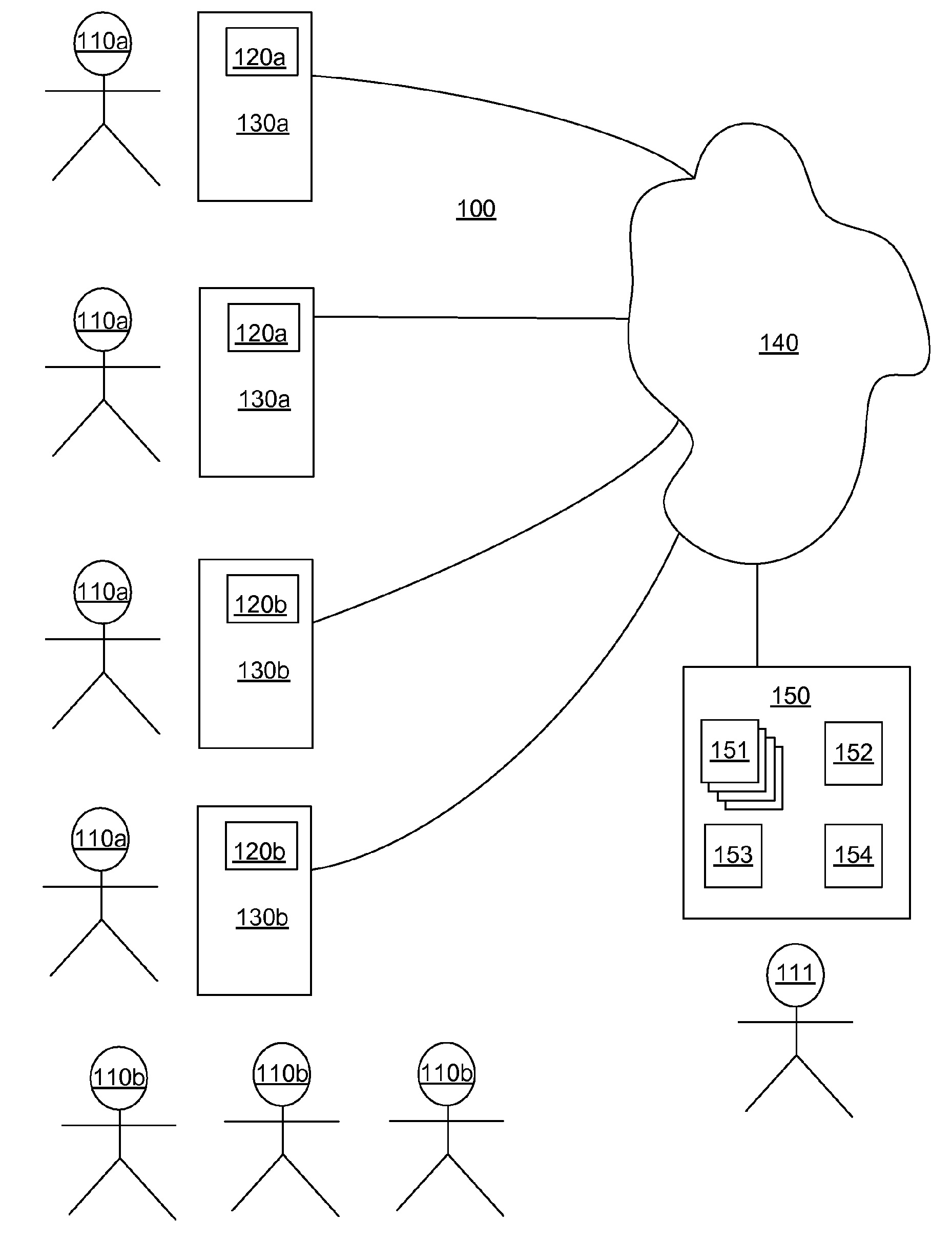
U.S. Patent No. 9,555,334 (the ‘334 Patent) relates to wireless communications on a mobile device for interacting with the virtual world in an MMORPG. MMORPGs are games designed to be played by a large number of people at once. In these games players can customize their character’s appearance and attributes. In these MMORPG video games players are able to interact with other players to advance their progress as well as engage in social and other events in the game world. MMORPGs exist in a persistent state where the game world is always active and other players are constantly playing the game. These games also typically feature Player versus Player as well as Player vs. Environment mode which allows players to play in either multiplayer or single player settings. The ‘334 Patent provides a method and apparatus for MMORPG players to access an aspect of the gameplay while using a mobile device. The wireless device runs a mobile version of the MMORPG server which would support at least one game mode available in the full version of the game. This system could also support location based gaming. The invention allows for new gameplay opportunities previously not possible before the advent of mobile gaming.
Abstract:
Apparatus and methods provide a player of a massively multiplayer online role playing game (MMORPG) to participate in at least one aspect of the MMORPG while using a wireless device. The wireless device executes a mobile MMORPG client, which interfaces with the game server(s) of the MMORPG via a mobile MMORPG server. A location based gaming mode for use with the wireless device is disclosed.
Illustrative Claim:
1. A method for location based gaming in a massively multiplayer online role playing game (MMORPG) supporting a virtual world, comprising: administrating, via a game server, a travel task portion of a quest by a player character in said MMORPG, said travel task portion requiring said player character to travel from a virtual world location A to a virtual world location B, said administrating comprising: receiving a real world location in a real world of a player of said player character; mapping, based on said real world location of said player a real world location A′ corresponding to said virtual world location A, a real world location B′ corresponding to said virtual world location B, wherein said real world locations A′ and B′ satisfy one or more distance criteria associated with said quest, wherein the mapping selects the real world location B′ for mapping to said virtual world location B based at least in part upon the real world location B′ being a point-of-interest for the player in the real world; monitoring said real world location of said player until said real world location of said player corresponds to said real world location A′; notifying said MMORPG that said player has reached the real world location A′; monitoring said real world location of said player until said real world location of said player corresponds to said real world location B′; notifying said MMORPG that said player has reached the real world location B′; and advancing the player character directly from the virtual world location A to the virtual world location B after said MMORPG is notified that said player has reached the real world location B′.
Illustrative Figure
Abstract
Apparatus and methods provide a player of a massively multiplayer online role playing game (MMORPG) to participate in at least one aspect of the MMORPG while using a wireless device. The wireless device executes a mobile MMORPG client, which interfaces with the game server(s) of the MMORPG via a mobile MMORPG server. A location based gaming mode for use with the wireless device is disclosed.
Description
DETAILED DESCRIPTION Now referring to the drawings, where like reference numerals designate like elements, there is shown inFIG. 2, a system200for permitting players to have increased interaction with an MMORPG in accordance with one embodiment of the present invention. System200includes a plurality of online players110aare playing the MMORPG by running a game client120aor120bon their computer130aor computer-like devices130b. The computer130aand computer-like devices130bare coupled to a network140, which in one embodiment may be the Internet, to communicate with a modified game system250. The modified game system250is illustrated to include a plurality of game servers151for supporting separate shards of the MMORPG, an authentication server152for validating users' log-ins, a messaging server153for providing chat and/or message board services, which are preferably web based, and a billing server154for billing the users who play the MMORPG, and for permitting users to enter contact and billing information via a secure web site. The modified gaming system250also includes a mobile MMORPG server251, which will be described in greater detail later, in connection withFIG. 5. Although no internal network connections are shown within the modified gaming system250in order to avoid cluttering the figure, it should be understood that each of the illustrated servers151,152,153,154,251are networked and thus messages may be passed between any of the illustrated servers151,152,153,154,251. While servers151,152,153,154, and251are represented as discrete servers, it should be recognized that any combination of the above noted servers may in fact be implemented as a distributed system of multiple servers, or conversely, the multiple servers may be implemented with a lesser number of servers, or even a single server, by using for example, server virtualization technology. Also while, the mobile MMORPG server251is illustrated as being a component of the game system250, and thus co-located with the other servers151,152,153, and154, one skilled in the art would recognize that the invention can be practiced using ...
DETAILED DESCRIPTION
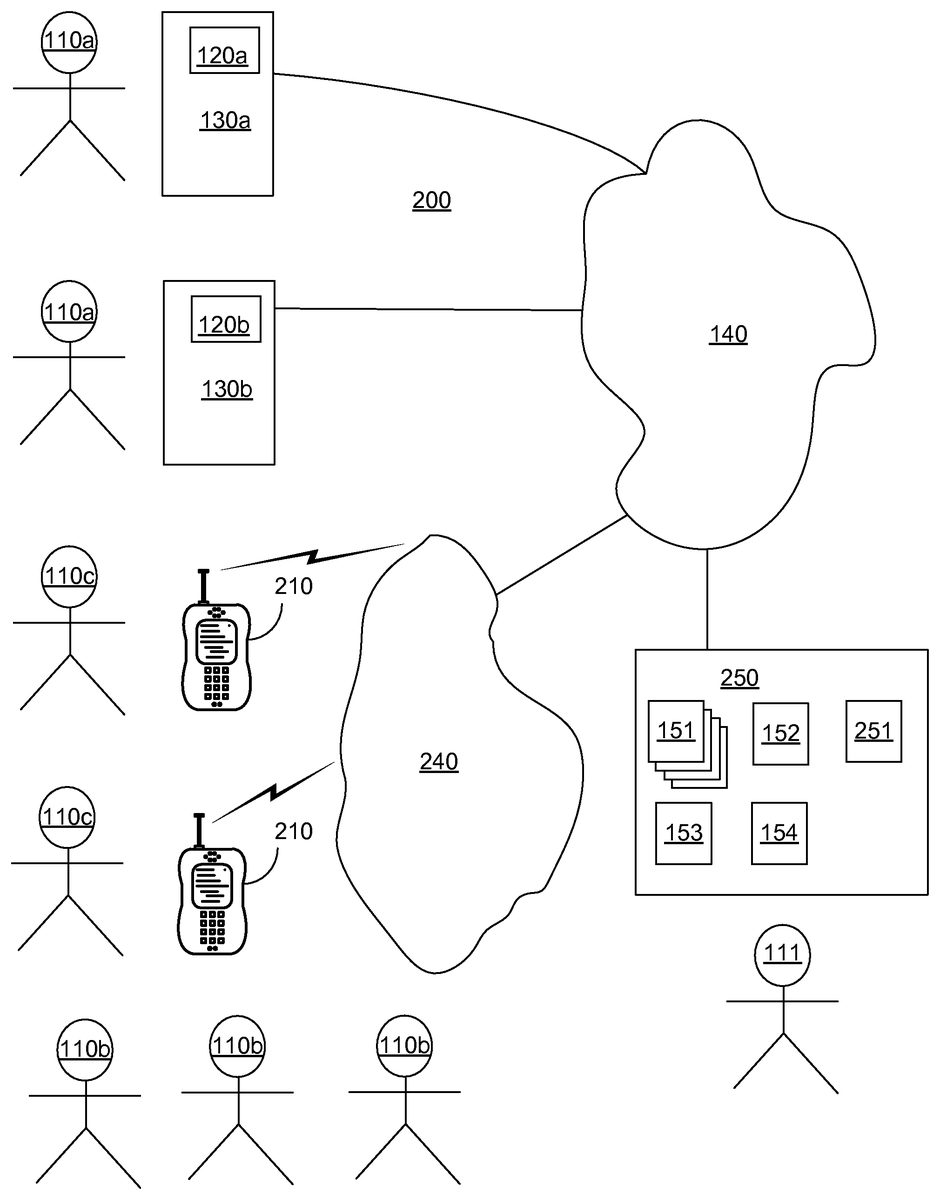
Now referring to the drawings, where like reference numerals designate like elements, there is shown inFIG. 2, a system200for permitting players to have increased interaction with an MMORPG in accordance with one embodiment of the present invention.
System200includes a plurality of online players110aare playing the MMORPG by running a game client120aor120bon their computer130aor computer-like devices130b. The computer130aand computer-like devices130bare coupled to a network140, which in one embodiment may be the Internet, to communicate with a modified game system250. The modified game system250is illustrated to include a plurality of game servers151for supporting separate shards of the MMORPG, an authentication server152for validating users' log-ins, a messaging server153for providing chat and/or message board services, which are preferably web based, and a billing server154for billing the users who play the MMORPG, and for permitting users to enter contact and billing information via a secure web site. The modified gaming system250also includes a mobile MMORPG server251, which will be described in greater detail later, in connection withFIG. 5. Although no internal network connections are shown within the modified gaming system250in order to avoid cluttering the figure, it should be understood that each of the illustrated servers151,152,153,154,251are networked and thus messages may be passed between any of the illustrated servers151,152,153,154,251.
While servers151,152,153,154, and251are represented as discrete servers, it should be recognized that any combination of the above noted servers may in fact be implemented as a distributed system of multiple servers, or conversely, the multiple servers may be implemented with a lesser number of servers, or even a single server, by using for example, server virtualization technology. Also while, the mobile MMORPG server251is illustrated as being a component of the game system250, and thus co-located with the other servers151,152,153, and154, one skilled in the art would recognize that the invention can be practiced using other configurations, for example, locating the mobile MMORPG server251in the wireless network240(such as at a wireless carrier's data center).
The system200also includes a plurality of offline players110b, and at least one game master111. As shown, the game master111may be proximately located to the game system250, thereby permitting the game master111to directly interact with the game system250. Alternatively, the game master111may be located at a remote location, such as an overseas call center, and may remotely interact with the game system250via a computer system coupled to the network140(not illustrated).
The system200further include players110c, who are no longer logged into the MMORPG, but unlike players110b, these players110cwish to continue to participate in the virtual world of the MMORPG. The system200enables such users to continue to interact with the MMORPG through the establishment of a mobile MMORPG game session. The mobile MMORPG session is supported by the modified game system250through the inclusion of a mobile MMORPG server251, which is in communication with the game servers151. The mobile MMORPG session is supported for the users through the inclusion of additional software modules to each user's wireless device210. Each user's wireless device210can communicate with the mobile MMORPG server251, and thus the game servers151, via the wireless network240and the network140.
In one embodiment, the wireless devices210are wireless telephones, such as cellular phones, which also support a computer platform for downloading and executing application programs at the phone. However, it should be understood that the principles of the present invention can also be applied to other types of mobile or portable communications device having a similar computer platform, such as some types of personal digital assistant (PDA), a two-way text pager, a laptop computer and a tablet computer.
Before describing the interaction of the players110cvia their wireless devices210with the game system250, it is helpful to review the operation of the wireless network240and the wireless device210.
FIG. 3is a more detailed illustration of the wireless network240. The wireless network240includes a plurality of base stations (BTS)320which are arranged to provide coverage over a geographic area. When in communication with the wireless network240, each wireless device210is typically in communication with a just one of the BTSs320. However, there may be some situations where a wireless device210is in communication with multiple BTSs320. Such situations may occur when the wireless device210transiting between the coverage areas of two BTSs320and the wireless network is using a soft hand-off technique for controlling the transition between two different BTSs320. Another example of such a situation may include calculating a geographic location of the wireless device210based upon the location of two or more BTSs320.
The wireless network240also includes a mobile switching center (MSC)330. The MSC is in communication with each of the BTSs320, as well as another network. As illustrated, the other network is the carrier network340of the wireless carrier operating the BTSs320and the MSC330. The carrier network340may include a router350, for coupling the carrier network340to another network, such as network140, which in one embodiment is the Internet.
Accordingly, the wireless network240provides the capability for routing data between the wireless devices210and servers on the Internet through the uses of its BTSs320, MSC330, carrier network340, and router350.
FIG. 4is a more detailed illustration of the wireless device210. The wireless device210includes a radio transceiver410for wirelessly communicating with one or more BTSs320(FIG. 3) of the wireless network240. The radio transceiver410is coupled to a bus450. The wireless device210also includes a user interface420, which is also coupled to the bus450. In one embodiment, the wireless device210is a cellular telephone and the user interface420includes a display, a small keyboard, a microphone, and a speaker. The wireless device210also includes a memory430, which is also coupled to the bus450. The memory430may store code for supporting an application programming interface (API)431. In one embodiment the API is the API associated with QUALCOMM®, Inc.'s BREW® platform, however, the wireless device may support other APIs.
The contents of the memory430also include a mobile client120c, a location based server (LBS) manager432, a presence manager433, and a privacy manager434, each of which are discussed in greater detail below. The wireless device210preferably supports the feature of downloadable applications. In one embodiment, the MMORPG mobile client120cis installed in the wireless device via an application download from the wireless network240. The wireless device210also include an application specific integrated circuit (ASIC)440, which controls the radio transceiver410, user interface420, and memory430via the bus450. The ASIC440preferably includes a position determination equipment (PDE)445for identifying a geographic location of the wireless device. The PDE445may determine the geographic location of the wireless using a variety of methods. For example, the PDE445may use signals transmitted from global positioning satellites (GPS) received by the radio transceiver410and convert the GPS signals into location data. Alternatively, the PDE445may use signals transmitted between the radio transceiver410and one or more BTSs320(FIG. 3) and use techniques based on some combination of triangulation, angle of arrival (AOA), time of arrival (TOA), or enhanced observed time difference (E-OTD), to determine the location of the wireless device210.
One skilled in the art would understand that the architecture of the wireless device210can be varied without departing from the scope of the invention. For example, some potential variations include having multiple radio transceivers410, having multiple memory units, including, for example, different memory units such as a DRAM base memory unit and a FLASH memory unit. In some embodiments, at least part of the memory430may be embodied on the ASIC440. Further, the ASIC440may be a plurality of ASICs or some combination of a non-ASIC chip and one or more ASICs. In particular, the PDE may be on its own chip, or alternatively, the PDE may be a software module residing in the memory430.
The Mobile Client120c
The mobile client120cis an important component of the system200for supporting players110cto continue to interact with the virtual world of the MMORPG. As with the regular client, the mobile client120cis an application which renders a view of the virtual world, and which provides a mechanism for the player110cto interact with the virtual world.
As previously noted, the detailed virtual worlds of the MMORPG are stored using a large amount of memory not normally available in wireless device. Accordingly, the quality of the view of the virtual world rendered by the mobile client120cand the level of player interaction permitted by the mobile client120cis typically a subset of what may be possible with the regular game client120a,120b. One example of such limitations may be that players110cusing the mobile client120cmay be limited to certain portions of the virtual world. Another example is that players110cusing the mobile client may be limited in their range of actions. Players110cmight not be able to engage in PvP action, or mobile MMORPG players110cmight only be able to engage in PvP action against other mobile MMORPG players110c, and not against players110ausing regular clients120a,120b.
Another example may relate to how or whether players110ausing regular clients120a,120bview or interact with players110cusing the mobile client120a. Since the players110cusing the mobile client120bare limited in their range of interaction, in one embodiment, the two types of online players, i.e., players110aand110c, are divorced from each other and one group of players cannot view or interact with another group of players. In such embodiments, certain portions of the virtual world may be restricted solely for use by player110cusing the mobile client120cwhile the remaining portions of the virtual world may be dedicated to players110ausing the regular client120a,120b.
Alternatively, players110aand110cmay be handled as normally as possible, thereby permitting interactions between the two groups of players110a,110c. Due to limitations associated with the mobile client120c, it may be necessary to place similar limitations on players110ausing the regular client120a,120b. In such embodiments, players110cusing the regular client120a,120bmay be restricted to certain portions of the virtual world, and if a player110ausing the regular client120a,120benters into the restricted area, that player110amay restricted to operate as if the player110awere running a mobile MMORPG client120c. As an example, a restriction on the mobile client120cmay be that full combat capability may not be supported, and a portion of the virtual world permitted for interaction between the two groups of players110a,110cmay be an auction house, which could be designated as a “no combat” zone in the game, thereby permitting players110a,110cto engage in commerce but not combat.
The LBS Manager432
The mobile MMORPG game supports one gaming mode not available to players110ausing the regular client120a,120b. This gaming mode is known as location based gaming, and takes advantage of the inherent mobility of mobile devices. Location based gaming will be discussed in greater detail below, in connection withFIG. 6. However, in order to support location based gaming, the mobile MMORPG client must have the capability of determining the physical location of the wireless device210in the real world. The LBS Manager432is responsible for providing the geographic location of the wireless device210to the mobile client120c. In one embodiment, the LBS Manager432may obtain geographic coordinates from the position determining equipment445.
The Presence Manager433
The presence manager433is used by players of the mobile MMORPG client120cto see other players of the mobile MMORPG client120c. More specifically, each player may also be flagged to indicate that the player is LFG, or wants to participate in location based gaming.
The Privacy Manager434
The privacy manager434is used to control a player110c's visibility to other players110a,110cand to determine whether the player is accepting game related messages from other players110a,110c. This is because there may be times when the player110cis unavailable to engage in MMORPG related activity. Under such circumstances, that player110clikely would not want to receive MMORPG related messages. Accordingly, the privacy manager434can be used to indicate that a player110cis not available for mobile MMORPG related activities. Further, the privacy manager can also be used to automatically reject messages related to the MMORPG (as a whole), or just to the mobile MMORPG portion of the MMORPG. Conversely, a player110cmay be actively looking for a group and can also use the privacy manager to flag himself so that other players110cwould notice that he is looking for a group. As discussed below with reference toFIG. 5, preferably, the game system150also implements a web page for the player to set his privacy level.
FIG. 5is a more detailed illustration of the mobile MMORPG server251. The mobile MMORPG server251includes a game master (GM) interface510, a mobile MMORPG quest database520, a location mapper530, a real geography database540, a virtual geography database550, a mobile MMORPG interface, and a Notification and Privacy Manager570, which are arranged as shown inFIG. 5. In the illustrated embodiment, there is one mobile MMORPG server251associated with all of the game servers151,152,153,154of the game system150. However, it should be understood that the invention may be practiced using other arrangements. For example, each game server may have integrated therein a version of the mobile MMORPG server251.
The GM Interface510
The GM interface510is a user interface module accessible by game masters of the mobile MMORPG. From this interface, game masters may design, modify, enable, disable, or delete mobile MMORPG quests. The GM interface510is in communication with the mobile MMORPG quest database520, as described in greater detail below. After designing and enabling a new mobile MMORPG quests, a GM may use the GM interface510to host the quest as a live event by making announcements and picking players who wish to join the new quest. Alternatively, the game master may use the GM interface510to bind the quest to an in-game object, such as a non-player character who gives interested players the quest, thereby permitting players to choose with who and at when they may wish to participate in the quest.
The Mobile MMORPG Quest Database
The mobile MMORPG quest database520is a database which stores the quests which are designed, modified, enabled, or disabled via the GM interface510. Existing quests may also be deleted from the quest database through the GM interface510. The mobile MMORPG quest database520is in communication with the GM interface510, described above, the location mapper530, described below.
The Real and the Virtual Geography Databases, and the Location Mapper540,550,530
The real geography database540, the virtual geography database550, and the location mapper530are used to support location based gaming, which is discussed in greater detail below in connection withFIG. 6. The real geography database540is a geographic database of the real world, and preferably include both geographic information mapping locations to coordinate, as well as a point-of-interest database, for locating specific types of locations. For example, a point-of-interest database might be able to locate coffee houses, restaurants, malls, stores, other publicly accessible commercial establishments, parks, libraries, museums, publicly accessible government facilities, etc. The virtual geography database550is a geography database of the virtual world. The location mapper530is capable of querying and receiving information from both the real and virtual geography databases540,550. The use of the databases540,550and the location mapper530will be discussed in connection withFIG. 6.
The Mobile MMORPG Interface560
The mobile MMORPG interface560is used by the mobile MMORPG server251to send and receive messages between the mobile MMORPG server251and the player's110cwireless device210. The mobile MMORPG interface560is also used by the mobile MMORPG server251to send and receive messages between the mobile MMORPG server251and servers151,152,153,154of the game system150.
The Notification and Privacy Interface570
The notification and privacy interface570is a component which interfaces with the mobile MMORPG interface560, and from the mobile MMORPG interface560, to the notification and privacy manager434of the wireless device210and the messaging server153of the gaming system150. The notification and privacy interface570provides an interface to accept notification and privacy information from the notification and privacy manager434of the wireless device210, as previously described. Additionally, the messaging server153of the gaming system150preferably also supports a web page for accepting similar information. The notification and privacy interface570therefore supports a wireless device210based method and a web based method for specifying whether a player110cwishes to participate in the mobile MMORPG game. Once the player's preference has been obtained, that information is communicated to the mobile MMORPG interface560and the appropriate game server151so that inappropriate messages are not sent players who choose not to participate in the mobile MMORPG game.
Questing, or the action of performing quests, is typically an important component of an MMORPG. A quest is a series of tasks which a player accepts. The quest is completed when the player finishes the entire series of tasks. Typically, the player is awarded with a reward for completing a quest. The series of task may be a single task or a plurality of tasks. Typically, at least one task of the quest will be a travel task for a player character to travel from a first point A to a second point B in the virtual world.
The mobile MMORPG supports location based gaming, which can be applied to any travel task undertaken in the MMORPG. Location based gaming will now be discussed in greater detail in relationship toFIGS. 6-7. More specifically,FIG. 6illustrates a process600for supporting location based gaming from the perspective of the mobile MMORPG server251, and encompasses the act the mobile MMORPG server251performs when creating and administering a quest having a single travel task. Similarly,FIG. 7illustrates a process700for supporting location based gaming in the same context, but from the perspective of the wireless device used the player110c.
Now referring toFIG. 6, the process600starts at step S0and ends at S11. Location based gaming is a mode of gaming not available to players110ausing the regular game client120a,120b. Location based gaming, as described below, takes advantage of the inherent mobility of wireless devices and permits real world travel and interaction to translate into a set of similar actions in the virtual world.
At step S1, a quest is created. As noted above, for the purposes of this example, the quest is a single travel task requiring the player's character to travel from a first point A to a second point B, where both points A and B are in the virtual world. Step S1is typically performed by a game master working on the GM interface510(FIG. 5). Alternatively, step S1may also be performed by a game designer, who might have his own interface to the quest database (not illustrated). The process600continues at step S2.
At step S2, a distance criteria relating to the real world is created and associated with each sequential pair of travel waypoints in the quest. In one embodiment, the distance criteria includes a parameter specifying an allowable range of distances for a player to travel to a first waypoint and a parameter for specifying an allowable range of distances for the player to travel between the first and a second waypoint. In other embodiments, the distance criteria may only specify an maximum allowable range (i.e., no minimum range requirement). Yet another embodiment may only specify the allowable range between the first and second waypoints without restricting the range between a player's current location and the first waypoint. Step S2may be performed by a game master working on the GM interface510(FIG. 5), although a game designer may also design the distance criteria as part of the design of MMORPG. The process600continues at step S3.
At step S3, the mobile MMORPG server251receives, at its mobile MMORPG interface560, a message from the wireless device210of the player110cwhich communicates the location of the wireless device210in the real world to the mobile MMORPG server251. The process600continues at step S4.
At step S4, the location mapper530(FIG. 5) is used to search the real geography database540(FIG. 5), to set a location A′ in the real world to correspond to point A in the virtual world. Preferably, the location is a point-of-interest, for example, a coffee house. The location mapper530then applies the distance criteria against location A′ to locate a real world location B′ which is assigned to correlate to position B in the virtual world. Preferably, the location B′ is a point-of-interest. In one embodiment, step S4is automatically performed by the location mapper530. In another embodiment, step S4is manually performed by a GM at the GM interface510(FIG. 5). The process600continues at step S5.
At step S5, the mobile MMORPG server251receives, at its mobile MMORPG interface560, a message from the wireless device210of the player110cwhich communicates the location of the wireless device210in the real world to the mobile MMORPG server251. The process600continues at step S6.
At step S6, the player's location in the real world is compared to the location A′ to determine whether the player has reached the starting point A′ associated with the quest. If so, the process600continues at step S7. If not, the process600returns to step S5.
At step S7, the mobile MMORPG server251communicates to the game server151that the player has reached location A′. This causes the game server151to advance the player's character in the virtual world to virtual world location A. The process continue at step S8.
At step S8, the mobile MMORPG server251receives, at its mobile MMORPG interface560, a message from the wireless device210of the player110cwhich communicates the location of the wireless device210in the real world to the mobile MMORPG server251. The process600continues at step S9.
At step S9, the player's location in the real world is compared to the location B′ to determine whether the player has reached the starting point B′ associated with the quest. If so, the process600continues at step S10. If not, the process600returns to step S9.
At step S10, the mobile MMORPG server251communicates to the game server151that the player has reached location B′. This causes the game server151to advance the player's character in the virtual world to virtual world location B, and the player, having just traveled from real world location A′ to real word location B′, has caused the player's characters to travel from virtual world location A to virtual world location B, thereby satisfying the travel task element of the quest created in step S1.
Now referring toFIG. 7, the process700starts at step S20and ends at S31.
At step S21, player110csigns on to MMORPG via a wireless device210. In one embodiment, the sign on request is sent to the mobile MMORPG server251, which communicates with the authentication server152on behalf of the player110c.
At step S22, the player character associated with the player110cinteracts with the MMORPG and obtains a quest enabled for location based gaming. The interaction for obtaining the quest may be any number of mechanisms, including, for example, the player character interacting with a non-player character, the player character traveling to a predetermined location in the virtual world, or the player character responding to a quest announcement made by a game master111.
At step S23, the wireless device210sends a message to the mobile MMORPG server251which communicates the location of the wireless device210in the real world to the mobile MMORPG server251. The process700continues at step S24.
At step S24, the wireless device210receives instruction from the mobile MMORPG server251directing the player to travel to point A′.
At step S25, the wireless device210sends a message to the mobile MMORPG server251which communicates the location of the wireless device210in the real world to the mobile MMORPG server251. The process700continues at step S26.
At step S26, the wireless device checks to see whether it received a message from the mobile MMORPG server indicating that point A′ has been reached by the player110c. If not, the process700continues at step S25. If so, the process continues with step S27.
At step S27, the player110cis notified as having reached, and the wireless device210receives instruction for the player to travel to real world location B′, and the instruction is displayed to the player110c. The process700continues at step S28.
At step S28, the wireless device210sends a message to the mobile MMORPG server251which communicates the location of the wireless device210in the real world to the mobile MMORPG server251. The process700continues at step S29.
At step S29, the wireless device checks to see whether it received a message indicating that point B′ has been reached by the player110c. If not, the process700continues at step S28. If so, the process continues with step S30.
At step S30, the player is informed that the travel from A′ to B′ has completed the travel task portion of the quest. The process700ends at S31.
Location based gaming, therefore, takes advantage of the mobile nature of wireless devices and maps virtual world locations to real world locations. The real world locations are preferably publicly accessible points of interest, thereby permitting players to perform travel components of quests in the real world. WhileFIGS. 6-7illustrate a simplified quest having only a travel task, many actual quests in MMORPG often include multiple travel segments and each travel segment can be handled in a manner similar to steps S2-S10. Additionally, at the beginning or end of each travel segment, the player character may be required to perform additional actions. These may include conversing with a non-player character, finding an item, killing a monster, etc. In location based gaming, tasks in the virtual world may also be mapped to a set of tasks in the real world, such that if the player performs a task in the real world, the mobile MMORPG server251would communicate to the game server151that the player character had performed the corresponding task in the virtual world.
Variations on the real world activity may include having two separate players which are within a predetermined proximity travel to a same destination in the real world and to interact with each other. For example, a first and a second player may each be assigned differing A′ locations but a same B′ location. The quest, or a portion thereof, can be satisfied once both players have traveled from their respective A′ locations to the B′ location.
Location based gaming may also apply to groups of players, where a plurality of players within a predetermined proximity could form a group in the virtual and real worlds, and would be assigned the same A′ and B′ locations.
The present invention is therefore directed in part to an apparatus and method for permitted players of a MMORPG to continue to interact with the virtual world of the MMORPG through their wireless devices. Each player's wireless device includes a mobile MMORPG client and associated modules related to location determination, privacy management, and presence management. Each player's wireless device interacts with a mobile MMORPG server, which also communications with the game servers of the MMORPG. The mobile MMORPG server preferably includes a mechanism for creating location based gaming scenarios, which can be stored as quests in a quest database of the mobile MMORPG, thereby permitting the players on the wireless devices to engage in location based gaming.
While the invention has been described in detail in connection with the exemplary embodiments, it should be understood that the invention is not limited to the above disclosed embodiments. Rather, the invention can be modified to incorporate any number of variations, alternations, substitutions, or equivalent arrangements not heretofore described, but which are commensurate with the spirit and scope of the invention. Accordingly, the invention is not limited by the foregoing description or drawings, but is only limited by the scope of the appended claims.
Claims
- A method for location based gaming in a massively multiplayer online role playing game (MMORPG) supporting a virtual world, comprising: administrating, via a game server, a travel task portion of a quest by a player character in said MMORPG, said travel task portion requiring said player character to travel from a virtual world location A to a virtual world location B, said administrating comprising: receiving a real world location in a real world of a player of said player character;mapping, based on said real world location of said player a real world location A′ corresponding to said virtual world location A, a real world location B′ corresponding to said virtual world location B, wherein said real world locations A′ and B′ satisfy one or more distance criteria associated with said quest, wherein the mapping selects the real world location B′ for mapping to said virtual world location B based at least in part upon the real world location B′ being a point-of-interest for the player in the real world;monitoring said real world location of said player until said real world location of said player corresponds to said real world location A′;notifying said MMORPG that said player has reached the real world location A′;monitoring said real world location of said player until said real world location of said player corresponds to said real world location B′;notifying said MMORPG that said player has reached the real world location B′;and advancing the player character directly from the virtual world location A to the virtual world location B after said MMORPG is notified that said player has reached the real world location B′.
- The method of claim 1 , further comprising: creating said quest, wherein said quest comprises at least one task, said at least one task comprising said travel task portion;creating said one or more distance criteria;and associating said one or more distance criteria with said quest.
- The method of claim 2 , wherein said one or more distance criteria comprises a parameter relating to a range requirement in the real world between the real world locations A′ and B′.
- The method of claim 2 , wherein said one or more distance criteria comprises a parameter relating to a range requirement in the real world between the real world location A′ and said real world location of said player.
- The method of claim 2 , wherein said one or more distance criteria comprises a parameter relating to a range requirement in the real world between the real world location B′ and said real world location of said player.
- The method of claim 1 , wherein said real world locations A′ and B′ are selected from publicly accessible points-of-interests.
- The method of claim 6 , wherein said publicly accessible points-of-interests are selected from at least one of: coffee houses, restaurants, malls, stores, parks, libraries, museums, and publicly accessible government facilities.
- The method of claim 1 , further comprising: setting a location of said player character to the virtual world location A when said real world location of said player corresponds to said real world location A′.
- The method of claim 1 , further comprising: setting a location of said player character to the virtual world location B when said real world location of said player corresponds to said real world location B′.
- The method of claim 1 , wherein said player character is offered said quest when said player character travels to a predetermined location in said virtual world for initiating location based gaming.
- The method of claim 1 , wherein said player character is not visible to other player characters in said MMORPG who are not participating in location based gaming.
- The method of claim 1 , wherein said player character is visible to other player characters in said MMORPG but marked as participating in location based gaming.
- The method of claim 1 , wherein the virtual world is not a representation of the real world.
- The method of claim 1 , wherein the virtual world corresponds to a fictional or fantasy world.
- The method of claim 1 , wherein said player character is visible to other player characters in said MMORPG.
- A method for location based gaming in a massively multiplayer online role playing game (MMORPG) supporting a virtual world, comprising: performing, via a game client device, a travel task portion of a quest by a player character in said MMORPG, said travel task portion requiring said player character to travel from a virtual world location A to a virtual world location B, said performing comprising: determining a real world location in a real world of a player of said player character;sending said real world location of said player to a server;receiving from said server, a real world location A′ mapped to the virtual world location A;periodically determining a real world location of said player while traveling toward said real world location A′ and sending said real world location of said player to said server, until receiving a message from said server indicating that the player has traveled to the real world location A′;receiving from said server, a real world location B′ mapped to the virtual world location B based at least in part upon the real world location B′ being a point-of-interest for the player in the real world;periodically determining a real world location of said player while traveling to the real world location B′ and sending said real world location of said player to said server, until receiving a message from said server indicating that the player has traveled to the real world location B′;and advancing the player character directly from the virtual world location A to the virtual world location B after said server determines that said player has reached the real world location B′.
- The method of claim 16 , wherein said real world locations A′ and B′ satisfy one or more distance criteria associated with said quest.
- The method of claim 16 , wherein said real world locations A′ and B′ are selected from publicly accessible points-of-interests.
- The method of claim 18 , wherein said publicly accessible points-of-interests are selected from at least one of: coffee houses, restaurants, malls, stores, parks, libraries, museums, and publicly accessible government facilities.
- A non-transitory machine-readable medium comprising instructions, which, when executed by a machine, cause the machine to perform operations, the instructions comprising: at least one instruction to administrate a travel task portion of a quest by a player character in a massively multiplayer online role playing game (MMORPG), said travel task portion requiring said player character to travel from a virtual world location A to a virtual world location B, said at least one instruction to administrate comprising: at least one instruction to receive a real world location of a player of said player character;at least one instruction to map, based on said real world location of said player, a real world location A′ corresponding to said virtual world location A, and a real world location B′ corresponding to said virtual world location B, wherein said real world locations A′ and B′ satisfy one or more distance criteria associated with said quest, wherein the at least one instruction to map selects the real world location B′ for mapping to said virtual world location B based at least in part upon the real world location B′ being a point-of-interest for the player in the real world;at least one instruction to monitor said real world location of said player until said real world location of said player corresponds to said real world location A′;at least one instruction to notify said MMORPG that said player has reached real world location A′;at least one instruction to monitor said real world location of said player until said real world location of said player corresponds to said real world location B′;at least one instruction to notify said MMORPG that said player has reached the real world location B′;and at least one instruction to advance the player character directly from the virtual world location A to the virtual world location B after said MMORPG is notified that said player has reached the real world location B′.
- A non-transitory machine-readable medium comprising instructions, which, when executed by a machine, cause the machine to perform operations, the instructions comprising: at least one instruction to perform a travel task portion of a quest by a player character in a massively multiplayer online role playing game (MMORPG) supporting a virtual world, said travel task portion requiring said player character to travel from a virtual world location A to a virtual world location B, said instructions to perform comprising: at least one instruction to determine a real world location in a real world of a player of said player character;at least one instruction to send said real world location in a real world of said player to a server;at least one instruction to receive from said server, a real world location A′ mapped to the virtual world location A;at least one instruction to periodically determine a real world location of said player while traveling towards said real world location A′ and sending said real world location of said player to said server, until receiving a message from said server indicating that the player has traveled to the real world location A′;at least one instruction to receive from said server, a real world location B′ mapped to the virtual world location B based at least in part upon the real world location B′ being a point-of-interest for the player in the real world;and at least one instruction to periodically determine a real world location of said player while traveling to the real world location B′ and sending said real world location of said player to said server, until receiving a message from said server indicating that the player has traveled to the real world location B′, wherein the player character is advanced directly from the virtual world location A to the virtual world location B after said server determines that the player has reached the real world location B′.
- An apparatus for location based gaming in a massively multiplayer online role playing game (MMORPG) supporting a virtual world, comprising: means for administrating a travel task portion of a quest by a player character in said MMORPG, said travel task portion requiring said player character to travel from a virtual world location A to a virtual world location B, said means for administrating comprising: means for receiving a real world location of a player of said player character;means for mapping, based on said real world location of said player, a real world location A′ corresponding to said virtual world location A, and a real world location B′ corresponding to said virtual world location B, wherein said real world locations A′ and B′ satisfy one or more distance criteria associated with said quest, wherein the means for mapping selects the real world location B′ for mapping to said virtual world location B based at least in part upon the real world location B′ being a point-of-interest for the player in the real world;means for monitoring said real world location of said player until said real world location of said player corresponds to said real world location A′;means for notifying said MMORPG that said player has reached the real world location A′;means for monitoring said real world location of said player until said real world location of said player corresponds to said real world location B′;means for notifying said MMORPG that said player has reached the real world location B′;and means for advancing the player character directly from the virtual world location A to the virtual world location B after said MMORPG is notified that said player has reached the real world location B′.
- The apparatus of claim 22 , further comprising: means for creating said quest, wherein said quest comprises at least one task, said at least one task comprising said travel task portion;means for creating said one or more distance criteria;and means for associating said one or more distance criteria with said quest.
- An apparatus for location based gaming in a massively multiplayer online role playing game (MMORPG) supporting a virtual world, comprising: means for performing a travel task portion of a quest by a player character in said MMORPG, said travel task portion requiring said player character to travel from a virtual world location A to a virtual world location B, said means for performing comprising: means for determining a real world location of a player of said player character;means for sending said real world location of said player to a server;means for receiving from said server, a real world location A′ mapped to the virtual world location A;means for periodically determining a real world location of said player while traveling toward said real world location A′ and sending said real world location of said player to said server, until receiving a message from said server indicating that the player has traveled to the real world location A′;means for receiving from said server, a real world location B′ mapped to the virtual world location B based at least in part upon the real world location B′ being a point-of-interest for the player in the real world;means for periodically determining a real world location of said player while traveling to the real world location B′ and sending said real world location of said player to said server, until receiving a message from said server indicating that the player has traveled to the real world location B′;and means for advancing the player character directly from the virtual world location A to the virtual world location B after said server determines that said player has reached the real world location B′.
- An apparatus for location based gaming in a massively multiplayer online role playing game (MMORPG) supporting a virtual world, comprising: a memory;and a processor coupled to the memory and configured to: administrate a travel task portion of a quest by a player character in said MMORPG, said travel task portion requiring said player character to travel from a virtual world location A to a virtual world location B, said administrating comprising: receiving a real world location of a player of said player character;mapping, based on said real world location of said player, a real world location A′ corresponding to said virtual world location A, and a real world location B′ corresponding to said virtual world location B, wherein said real world locations A′ and B′ satisfy one or more distance criteria associated with said quest, wherein the processor selects the real world location B′ for mapping to said virtual world location B based at least in part upon the real world location B′ being a point-of-interest for the player in the real world;monitoring said real world location of said player until said real world location of said player corresponds to said real world location A′;notifying said MMORPG that said player has reached the real world location A′;monitoring said real world location of said player until said real world location of said player corresponds to said real world location B′;notifying said MMORPG that said player has reached the real world location B′;and advancing the player character directly from the virtual world location A to the virtual world location B after said MMORPG is notified that said player has reached the real world location B′.
- An apparatus for location based gaming in a massively multiplayer online role playing game (MMORPG) supporting a virtual world, comprising: performing a travel task portion of a quest by a player character in said MMORPG, said travel task portion requiring said player character to travel from a virtual world location A to a virtual world location B, said performing comprising: determining a real world location of a player of said player character;sending said real world location of said player to a server;receiving from said server, a real world location A′ mapped to the virtual world location A;periodically determining a real world location of said player while traveling toward said real world location A′ and sending said real world location of said player to said server, until receiving a message from said server indicating that the player has traveled to the real world location A′;receiving from said server, a real world location B′ mapped to the virtual world location B based at least in part upon the real world location B′ being a point-of-interest for the player in the real world;and periodically determining a real world location of said player while traveling to the real world location B′ and sending said real world location of said player to said server, until receiving a message from said server indicating that the player has traveled to the real world location B′;and advancing the player character directly from the virtual world location A to the virtual world location B after said server determines that said player has reached the real world location B′.
Disclaimer: Data collected from the USPTO and may be malformed, incomplete, and/or otherwise inaccurate.