U.S. Pat. No. 9,526,993
SYSTEMS AND METHODS FOR ASSOCIATING PLAYERS OF ELECTRONIC GAMES
AssigneeGN Store Nord AS
Issue DateAugust 2, 2013
Illustrative Figure
Abstract
A system, processor or computer readable device that incorporates teachings of the present disclosure may include, for example, receiving a user attribute of a first user based on a record of stimulation of an electronic gaming accessory of the first user. The record of stimulation is determined responsive to game-related activity in an electronic game application. A first user record is updated responsive to the receiving of the user attribute of the first user, resulting in an updated first user record. The updated first user record is forwarded to a matching service, wherein the matching service matches the first user and a second user based on the updated first user record. Such matching can be used to associate players of electronic games, for example, as members of a team. Additional embodiments are disclosed.
Description
DETAILED DESCRIPTION The subject disclosure describes, among other things, illustrative embodiments for collecting, processing, cataloguing and presenting performances of gamers based on stimulus signal generated by accessory devices. Also disclosed are embodiments for facilitating social networking based on gamer proficiency in manipulating various features of a game controller. By way of example, such features of a game controller may relate to manipulation of a “fire” button in a shooting game, a strum button in a rhythm game, or a dance pedal in an exercise game. For example, a gamer's skill or proficiency can be based at least in part on a number of times a button is pressed, a rate at which the button is pressed, whether the correct button was pressed and so forth, according to a situational context of a game. Such game-related social network can be distinguished from typical social networking in that such social networks are based on game control stimulus signals rather than the results of such stimulus signals, such as game results alone. Such stimulus signals are typically provided to a game console or processor causing a result to occur within the course of progression of the game. Other embodiments are contemplated by the subject disclosure. One embodiment of the present disclosure can entail a process including receiving, by a system comprising a processor, a respective user attribute for each of a number of users, wherein the respective user attribute is based on a stimulation record of an electronic game control actuator of a corresponding user of the number of users. A team profile is determined, by the system, including a number of team-member profiles. Each team-member profile includes a respective team-member profile attribute. The team-member profile attribute of a select team-member profile is determined by the system. The respective user attribute for each ...
DETAILED DESCRIPTION
The subject disclosure describes, among other things, illustrative embodiments for collecting, processing, cataloguing and presenting performances of gamers based on stimulus signal generated by accessory devices. Also disclosed are embodiments for facilitating social networking based on gamer proficiency in manipulating various features of a game controller. By way of example, such features of a game controller may relate to manipulation of a “fire” button in a shooting game, a strum button in a rhythm game, or a dance pedal in an exercise game. For example, a gamer's skill or proficiency can be based at least in part on a number of times a button is pressed, a rate at which the button is pressed, whether the correct button was pressed and so forth, according to a situational context of a game.
Such game-related social network can be distinguished from typical social networking in that such social networks are based on game control stimulus signals rather than the results of such stimulus signals, such as game results alone. Such stimulus signals are typically provided to a game console or processor causing a result to occur within the course of progression of the game. Other embodiments are contemplated by the subject disclosure.
One embodiment of the present disclosure can entail a process including receiving, by a system comprising a processor, a respective user attribute for each of a number of users, wherein the respective user attribute is based on a stimulation record of an electronic game control actuator of a corresponding user of the number of users. A team profile is determined, by the system, including a number of team-member profiles. Each team-member profile includes a respective team-member profile attribute. The team-member profile attribute of a select team-member profile is determined by the system. The respective user attribute for each of the multiple users and the team-member profile attribute of the select team-member profile are correlated by the system. A select user of the multiple users is matched, by the system, with the select team-member profile of the multiple team-member profiles based on the correlating of the respective user attribute for each of the multiple users with the team-member profile attribute of the select team-member profile.
Another embodiment of the present disclosure can entail a device including a memory to store computer instructions and a processor in communication with the memory. The processor, responsive to executing the computer instructions, performs operations including receiving a respective user attribute for each of a number of users, wherein the respective user attribute is based on a stimulation record of an electronic gaming accessory of a corresponding user of the number of users. A target profile is determined comprising a target attribute. The respective user attribute for each of the number of users and the target attribute of the target profile are correlated. A select user of the number of users is matched to the target profile based on the correlation.
Yet another embodiment of the present disclosure can entail a computer-readable storage device including computer instructions, which responsive to being executed by a processor, cause the processor to perform operations including receiving a user attribute of a first user based on a record of stimulation of an electronic gaming accessory of the first user. The receiving of the user attribute is responsive to game-related activity in an electronic game application. A first user record is updated responsive to the receiving of the user attribute of the first user, resulting in an updated first user record. The updated first user record is forwarded to a matching service, wherein the matching service matches the first user and a second user based on the updated first user record.
FIG. 1depicts an illustrative embodiment of a Graphical User Interface (GUI)100generated by an Accessory Management Software (AMS) application according to the present disclosure. The AMS application can be executed by a computing device such as a desktop computer, a laptop computer, a server, a mainframe computer, a gaming console, a gaming accessory, or combinations or portions thereof. The AMS application can also be executed by portable computing devices (with computing resources) such as a cellular phone, a personal digital assistant, a tablet (such as an iPAD™), or a media player (such as an iPOD™). It is contemplated that the AMS application can be executed by any device with suitable computing resources to perform the embodiments described herein.
FIG. 2illustrates a number of embodiments for utilizing a wireless dongle203with gaming controller115or a gaming console (herein referred to as gaming console206). In the illustration ofFIG. 2, the USB portion of the dongle203can be physically engaged with the gaming controller115or the gaming console206. The dongle203in either of these configurations can facilitate wireless communications204between the gaming controller115and the gaming console206(e.g., WiFi, Bluetooth, ZigBee, or proprietary protocol). It is contemplated that functions of the dongle203can in whole or in part be an integral part of the gaming controller115or the gaming console206. It is also contemplated that the AMS application can in whole or in part be executed by computing resources of the dongle203.
In one embodiment, the gaming controller115can be tethered to a computing device such as the gaming console206by a cable (e.g., USB cable) as shown inFIG. 3to provide a means of communication less susceptible to electromagnetic interference or other sources of wireless interference. In one embodiment, the gaming controller115and the gaming console206can have an integrated wireless interface for wireless communications therebetween. It is contemplated that the AMS application can in whole or in part be executed by computing resources of the gaming controller115, the gaming console206, or combinations thereof.
FIG. 4depicts an illustrative embodiment of a communication device400. The communication device400can serve in whole or in part as an illustrative embodiment of the devices depicted inFIGS. 1-3. The communication device400can include a wireline and/or wireless transceiver402(herein transceiver402), a user interface (UI)404, a power supply414, a proximity sensor416, a motion sensor418, an orientation sensor420, and a controller406for managing operations thereof. The transceiver402can support short-range or long-range wireless access technologies such as Bluetooth, WiFi, Digital Enhanced Cordless Telecommunications (DECT), or cellular communication technologies, just to mention a few. Cellular technologies can include, for example, CDMA-1×, UMTS/HSDPA, GSM/GPRS, TDMA/EDGE, EV/DO, WiMAX, software defined radio (SDR), Long Term Evolution (LTE), as well as other next generation wireless communication technologies as they arise. The transceiver402can also be adapted to support circuit-switched wireline access technologies (such as PSTN), packet-switched wireline access technologies (such as TCP/IP, VoIP, etc.), and combinations thereof.
The UI404can include a depressible or touch-sensitive keypad408coupled to a navigation mechanism such as a roller ball, a joystick, a mouse, or a navigation disk for manipulating operations of the communication device400. The keypad408can be an integral part of a housing assembly of the communication device400or an independent device operably coupled thereto by a tethered wireline interface (such as a USB cable) or a wireless interface supporting for example Bluetooth. The keypad408can represent a numeric keypad, and/or a QWERTY keypad with alphanumeric keys. The UI404can further include a display410such as monochrome or color LCD (Liquid Crystal Display), OLED (Organic Light Emitting Diode) or other suitable display technology for conveying images to an end user of the communication device400.
In an embodiment where the display410is touch-sensitive, a portion or all of the keypad408can be presented by way of the display410with navigation features (e.g., an iPad™, iPhone™, or Android™ phone or tablet). As a touch screen display, the communication device400can be adapted to present a user interface with graphical user interface (GUI) elements that can be selected by a user with a touch of a finger. The touch screen display410can be equipped with capacitive, resistive or other forms of sensing technology to detect how much surface area of a user's finger has been placed on a portion of the touch screen display. This sensing information can be used to control the manipulation of the GUI elements.
The UI404can also include an audio system412that utilizes common audio technology for conveying low volume audio (such as audio heard only in the proximity of a human ear) and high volume audio (such as speakerphone for hands free operation, stereo or surround sound system). The audio system412can further include a microphone for receiving audible signals of an end user. The audio system412can also be used for voice recognition applications. The UI404can further include an image sensor413such as a charged coupled device (CCD) camera for capturing still or moving images and performing image recognition therefrom.
The power supply414can utilize common power management technologies such as replaceable or rechargeable batteries, supply regulation technologies, and charging system technologies for supplying energy to the components of the communication device400to facilitate long-range or short-range portable applications. Alternatively, the charging system can utilize external power sources such as DC power supplied over a physical interface such as a USB port or by way of a power cord attached to a transformer that converts AC to DC power.
The proximity sensor416can utilize proximity sensing technology such as an electromagnetic sensor, a capacitive sensor, an inductive sensor, an image sensor or combinations thereof. The motion sensor418can utilize motion sensing technology such as an accelerometer, a gyroscope, or other suitable motion sensing technology to detect movement of the communication device400in three-dimensional space. The orientation sensor420can utilize orientation sensing technology such as a magnetometer to detect the orientation of the communication device400(North, South, West, East, combined orientations thereof in degrees, minutes, or other suitable orientation metrics).
The communication device400can use the transceiver402to also determine a proximity to a cellular, WiFi, Bluetooth, or other wireless access points by common sensing techniques such as utilizing a received signal strength indicator (RSSI) and/or a signal time of arrival (TOA) or time of flight (TOF). The controller406can utilize computing technologies such as a microprocessor, a digital signal processor (DSP), and/or a video processor with associated storage memory such as Flash, ROM, RAM, SRAM, DRAM or other storage technologies.
Other components not shown inFIG. 4are contemplated by the present disclosure. For instance, the communication device400can include a reset button (not shown). The reset button can be used to reset the controller406of the communication device400. In yet another embodiment, the communication device400can also include a factory default setting button positioned below a small hole in a housing assembly of the communication device400to force the communication device400to re-establish factory settings. In this embodiment, a user can use a protruding object such as a pen or paper clip tip to reach into the hole and depress the default setting button.
The communication device400as described herein can operate with more or less components described inFIG. 4to accommodate implementations of the devices described by the present disclosure. These variant embodiments are contemplated by the present disclosure.
FIGS. 5-7depict processes500-700describing illustrative embodiments of the AMS application. A first process500can begin with step502in which the AMS application is invoked in a computing device. The computing device can be a remote server (not shown), the gaming console206ofFIGS. 2-3, or any other computing device with suitable computing resources. The invocation step can result from a user selection of the AMS application from a menu or iconic symbol presented on a desktop of the computing device by an operating system (OS) managing operations thereof. In step504, the AMS application can detect by way of drivers in the OS multiple operationally distinct accessories communicatively coupled to the computing device. The accessories can be coupled to the computing device by a tethered interface (e.g., USB cable), a wireless interface (e.g., Bluetooth or Wireless Fidelity—WiFi), or combinations thereof.
In the present context, an accessory can represent any type of device which can be communicatively coupled to the computing device (or an integral part of the computing device) and which can control aspects of the OS and/or a software application operating in the computing device. An accessory can represent for example a keyboard, a touch screen display, a gaming pad, a gaming controller, a tablet, a mouse, a joystick, a paddle, a steering wheel, pedals, a light gun, a microphone, or a headset with a microphone just to mention a few.
In step506, the AMS application presents a GUI101such as depicted inFIG. 1with operationally distinct accessories such as a keyboard108, and a gaming controller115. The GUI101presents the accessories108-116in a scrollable section117. One or more accessories can be selected by a user with a mouse pointer. In this illustration, the keyboard108and the gaming controller115were selected for customization. Upon selecting the keyboard108and the gaming controller115from the scrollable window of section117, the AMS application presents the keyboard108and the gaming controller115in split windows118,120, respectively, to assist the user during the customization process.
In step508, the AMS application can be programmed to detect a user-selection of a particular software application such as a game. This step can be the result of the user entering in a Quick Search field160the name of a gaming application (e.g., World of Warcraft™ or WoW). Upon identifying a gaming application, the AMS application can retrieve in step510from a remote or local database gaming application actions which can be presented in a scrollable section139of the GUI represented as “Actions”130. The actions can be tactical actions132, communication actions134, menu actions136, and movement actions138which can be used to invoke and manage features of the gaming application.
The actions presented descriptively in section130of the GUI can represent a sequence of accessory input functions which a user can stimulate by button depressions, navigation or speech. For example, depressing the left button on the mouse110can represent the tactical action “Reload”, while the simultaneous keyboard depressions “Ctrl A” can represent the tactical action “Melee Attack.” For ease of use, the “Actions”130section of the GUI is presented descriptively rather than by a description of the input function(s) of a particular accessory.
Any one of the Actions130can be associated with one or more input functions of the accessories being customized in windows118and120by way of a drag and drop action or other customization options. For instance, a user can select a “Melee Attack” by placing a mouse pointer133over an iconic symbol associated with this action. Upon doing so, the symbol can be highlighted to indicate to the user that the icon is selectable. At this point, the user can select the icon by holding the left mouse button and drag the symbol to any of the input functions (e.g., buttons) of the keyboard108or selectable options of the gaming controller115to make an association with an input function of one of these accessories. Actions of one accessory can also be associated with another accessory that is of a different category. For example, key depressions “Ctrl A” of the key board108can be associated with one of the buttons of the gaming controller115(e.g., the left button119).
In one embodiment, a Melee Attack action can be associated by dragging this action to either the left button119or right button121of the gaming controller115. Thus, when the selected button is depressed, the stimulus signal that is generated by the selected button of the gaming controller115can be substituted by the AMS application with the Melee Attack action. In another embodiment, the Melee Action can be associated with a combination of key button presses (e.g., simultaneous depression of the left and right buttons119,121, or a sequence of button depressions: two rapid left button depressions followed by a right button depression).
In yet another embodiment, the Melee Action can be associated with movement of the gaming controller115such as, for example, rapid movement or shaking of the gaming controller115. In a further embodiment, the AMS application can be adapted to make associations with two dimensional or three dimensional movements of the gaming controller115according to a gaming venue state. For example, suppose the player's avatar enters a fighter jet. In this gaming venue state, moving the left navigation knob forward can be associated by the AMS application with controlling the throttle of the jet engines. Rapidly moving the gaming controller115downward can represent release of munitions such as a bomb.
In a gaming venue state where the gamer's avatar has entered a building, lifting of the gaming controller115above a first displacement threshold can be associated with a rapid movement of the avatar up one floor. A second displacement threshold can be associated with a rapid movement of the avatar down one floor—the opposite of the first displacement threshold. Alternatively, the second displacement threshold could be associated with a different action such as jumping between buildings when the avatar is on the roof of a building.
The AMS application can associate standard stimuli generated by manipulating a gaming accessory with substitute stimuli that control gaming actions of a video game. The AMS application can be adapted to perform these associations based on a gaming venue state such as the ones described above. Accordingly, the associations made between stimuli supplied by an accessory such as the gaming controller115can be venue state dependent. The gaming venue state can be a description of a gaming state (e.g., entering a tank which requires the use of gaming controls for a tank), captured images of the gaming venue state (e.g., one or more still images of a tank, or a video of an avatar entering a tank), and/or application programming instructions (API) messages which can be received from the gaming application to enable the AMS application to identify the occurrence of a particular gaming venue state.
At step512the AMS application can also respond to a user selection of a profile. A profile can be a device profile or master profile invoked by selecting GUI button156or158, each of which can identify the association of gaming actions with input functions of one or more accessories. If a profile selection is detected in step512, the AMS application can retrieve in step514macro(s) and/or prior associations defined by the profile. The actions and/or macros defined in the profile can also be presented in step516by the AMS application in the actions column130of the GUI101to modify existing profile associations or create new associations.
In step518, the AMS application can also respond to a user selection to create a macro. A macro in the present context can mean any actionable command which can be recorded by the AMS application. An actionable command can represent a sequence of stimuli generated by manipulating input functions of an accessory, a combination of actions in the Action section130, an identification of a software application to be initiated by an operating system (OS), or any other recordable stimulus to initiate, control or manipulate software applications. For instance, a macro can represent a user entering the identity of a software application (e.g., instant messaging tool) to be initiated by an OS upon the AMS application detecting through speech recognition a speech command.
A macro can also represent recordable speech delivered by a microphone singly or in combination with a headset for detection by another software application through speech recognition or for delivery of the recorded speech to other parties. In yet another embodiment a macro can represent recordable navigation of an accessory such as a joystick of the gaming controller115, recordable selections of buttons of the gaming controller115, and so on. Macros can also be combinations of the above illustrations with selected actions from the Actions130menu. Macros can be created from the GUI101by selecting a “Record Macro” button148. The macro can be given a name and category in user-defined fields140and142.
Upon selecting the Record Macro button148, a macro can be generated by selection of input functions on an accessory (e.g., Ctrl A, speech, navigation knob movements of the gaming controller115, etc.) and/or by manual entry in field144(e.g., typing the name and location of a software application to be initiated by an OS, such as an instant messaging application, keyboard entries such as Ctrl A, etc.). Once the macro is created, it can be tested by selecting button150which can repeat the sequence specified in field144. The clone button153can be selected to replicate the macro sequence if desired. Fields152can also present timing characteristics of the stimulus sequence in the macro with the ability to modify and thereby customize the timing of one or more stimulations in the stimulus sequence. Once the macro has been fully defined, selection of button154records the macro in step520. The recording step can be combined with a step for adding the macro to the associable items Actions column130, thereby providing the user the means to associate the macro with input functions of the accessories (e.g., one or more keys of the keyboard108, buttons of the gaming controller115, etc.).
In step522, the AMS application can respond to drag and drop associations of actions and input functions of the keyboard108or the gaming controller115. Associations can also be made based on the two or three dimensional movements of the gaming controller115. If user input indicates that a user is performing an association, the AMS application can proceed to step524where it can determine if a profile has been identified in step512to record the association(s) detected. If a profile has been identified, the associations are recorded/stored in the profile in step526. If a profile has not been identified in step512, the AMS application can create a profile in step528for recording the detected associations. In the same step, the user can name the newly created profile as desired. The newly created profile can also be associated with one or more gaming software applications in step530for future reference. The AMS application can also record in a profile in step526associations based on gaming venue states. In this embodiment the same stimuli generated by the gaming controller115can result in different substitutions based on the gaming venue state detected by the AMS application.
The AMS application can be adapted to utilize image processing technology to detect a gaming venue state according to pre-stored images or video clips stored in the profile. For example, the AMS application can use image processing technology to identify an avatar of a gamer and track what the avatar does as directed by the gamer. For example, if the avatar enters a tank, the image processing technology of the AMS application can detect a gaming venue state associated with the use of a tank, and thereby identify associations between accessory stimuli and substitute stimuli according to the detected gaming venue state.
Referring back to step526, once the associations have been recorded in a profile, the AMS application can determine in step532which of the accessories shown illustratively inFIGS. 1-3are programmable and available for programming. If the AMS application detects that the accessories (e.g., keyboard108, gaming controller115) are communicatively coupled to a computing device from which the AMS application is operating (e.g., gaming console206) and programmable, the AMS application can proceed to step534ofFIG. 5where it submits the profile and its contents for storage in one of the accessories (e.g., the gaming controller115inFIGS. 2-3) or the dongle203. Once the gaming controller115, dongle203, or combinations thereof are programmed with the profile, such devices can perform stimuli substitutions according to the associations recorded by the AMS application in the profile. Alternatively, the AMS application can store the profile in the gaming console206ofFIGS. 2-3and perform substitutions of stimuli supplied by the gaming controller115according to associations recorded in the profile by the AMS application.
The GUI101ofFIG. 1presented by the AMS application can have other functions. For example, the GUI101can provide options for layout of the accessory selected (button122), how the keyboard is illuminated when associations between input functions and actions are made (button134), and configuration options for the accessory (button126). The AMS application can adapt the GUI101to present more than one functional GUI page. For instance, by selecting button102, the AMS application can adapt the GUI101to present a means to create macros and associate actions to accessory input functions as depicted inFIG. 1. Selecting button104can cause the AMS application to adapt the GUI101to present statistics from stimulation information and/or gaming action results captured by the AMS application. Selecting button106can also cause the AMS application to adapt the GUI101to present promotional offers and software updates.
The steps of process500in whole or in part can be repeated until a desirable pattern is achieved of associations between stimulus signals generated by accessories and substitute stimuli. It would be apparent to an artisan with ordinary skill in the art that there can be numerous other approaches to accomplish the embodiments described by process500or variants thereof. These undisclosed approaches are contemplated by the present disclosure.
FIG. 6depicts another process600for illustrating the operations of the AMS application for either of the configurations shown inFIGS. 2-3. In the configurations ofFIGS. 2-3, the AMS application can be operating in whole or in part from the gaming controller115, the dongle203, the gaming console206, a remote server (not shown), or a computing device such as a desktop computer (also not shown). For illustration purposes, it is assumed the AMS application operates from the gaming console206. The process600can begin with the AMS application establishing communications in steps602and604between the gaming console206and a gaming accessory such as the gaming controller115, and a headset114such as shown inFIG. 1. These steps can represent for example a user starting the AMS application from the gaming console206and/or the user inserting at a USB port of the gaming console206a connector of a USB cable tethered to the gaming controller115, which invokes the AMS application. In step606, the gaming controller115and/or headset114can in turn provide the AMS application one or more accessory ID's, or the user can provide by way of a keyboard or the gaming controller115user identification. With the accessory ID's, or user input the AMS application can identify in step608a user account associated with the gaming controller115and/or headset114. In step610, the AMS application can retrieve one or more profiles associated with the user account.
In step612, the user can be presented by way of a display coupled to the gaming console206profiles available to the user to choose from. If the user makes a selection, the AMS application proceeds to step614where it retrieves from the selected profiles the association(s) stored therein. If a selection is not made, the AMS application can proceed to step616where it can determine whether a software gaming application (e.g., video game) is operating from the gaming console206or whether the gaming console206is communicating with the software gaming application by way of a remote system communicatively coupled to the gaming console206(e.g., on-line gaming server(s) presenting, for example, World of Warcraft™). If a gaming software application is detected, the AMS application proceeds to step617where it retrieves a profile that matches the gaming application detected and the association(s) contained in the profile. As noted earlier, association(s) can represent accessory stimulations, navigation, speech, the invocation of other software applications, macros or other forms of suitable associations that result in substitute stimulations. The accessory stimulations can be stimulations that are generated by the gaming controller115, as well as stimulations from other accessories (e.g., headset114), or combinations thereof.
Once a profile and its contents have been retrieved in either of steps614or step617, the AMS application can proceed to step719ofFIG. 7where it monitors for a change in a gaming venue state based on the presentations made by the gaming application, or API messages supplied by the gaming application. At the start of a game, for example, the gaming venue state can be determined immediately depending on the gaming options chosen by the gamer. The AMS application can determine the gaming venue state by tracking the gaming options chosen by a gamer, receiving an API instruction from the gaming application, or by performing image processing on the video presentation generated by the gaming application. For example, the AMS application can detect that the gamer has directed an avatar to enter a tank. The AMS application can retrieve in step719associations for the gaming controller115for controlling the tank.
The AMS application can process movements of the gaming controller115forwards, backwards, or sideways in two or three dimensions to control the tanks movement. Similarly, rotating the gaming controller115or tilting the gaming controller115forward can cause an accelerometer, gyro or magnetometer of the gaming controller115to provide navigational data to the AMS application which can be substituted with an action to cause the tank to turn and/or move forward. The profile retrieved by the AMS application can indicate that the greater the forward tilt of the gaming controller115, the greater the speed of the tank should be moving forward. Similarly, a rear tilt can generate navigation data that is substituted with a reverse motion and/or deceleration of the forward motion to stop or slow down the tank. A three dimensional lift of the mouse can cause the tank to steer according to the three dimensional navigation data provided by the gaming controller115. For example, navigation data associated with a combination of a forward tilt and right bank of the gaming controller115can be substituted by the AMS application to cause an increase in forward speed of the tank with a turn to the right determined by the AMS application according to a degree of banking of the gaming controller115to the right. In the above embodiment, the three dimensional navigation data allows a gamer to control any directional vector of the tank including speed, direction, acceleration and deceleration.
In another illustration, the AMS application can detect a new gaming venue state as a result of the gamer directing the avatar to leave the tank and travel on foot. Once again the AMS application retrieves in step719associations related to the gaming venue state. In this embodiment, selection of buttons of the gaming controller115can be associated by the AMS application with weaponry selection, firing, reloading and so on. The movement of the gaming controller115in two or three dimensions can control the direction of the avatar and/or selection or use of weaponry. Once the gaming venue state is detected in step719, the AMS application retrieves the associations related to the venue state, and can perform substitutions of stimuli generated by the gaming controller115, and/or speech commands received by microphone of the headset114.
The AMS application can monitor in step720stimulus signals generated by the accessories coupled to the gaming console206. For example, the stimulus signals can be generated by the gaming controller115in response to a gamer manipulating the gaming controller115, and/or by generating speech commands detected by the headset114. If a simulation is detected at step720, the AMS application can determine in step722whether to forward the detected stimulation(s) to an Operating System (OS) of the gaming console206without substitutions. This determination can be made by comparing the detected stimulus signal(s) to association(s) in the profile. If the detected stimulus signal(s) match the association(s), then the AMS application proceeds to step740where it retrieves substitute stimulus signal(s) in the profile. In step742, the AMS application can substitute the detected stimulus signal(s) with the substitute stimulus signal(s) in the profile. In one embodiment, the AMS application can track in step744the substitute stimulus signals by updating these stimulus signals with a unique identifier such as a globally unique identifier (GUID). In this embodiment, the AMS application can also add a time stamp to each substitute stimulus to track when the substitution was performed.
In another embodiment, the AMS application can track each substitute stimulus signal according to its order of submission to the gaming application. For instance, sequence numbers can be generated for the substitute stimulus signals to track the order in which they were submitted to the gaming application. In this embodiment, the substitute stimulus signals do not need to be updated with sequence numbers or identifiers so long as the order of gaming action results submitted by the gaming application to the AMS application remain in the same order as the substitute stimulus signals that were originally submitted.
For example, if a first stimulus signal sent to the gaming application by the AMS application is a command to shoot, and a second stimulus signal sent to the gaming application is a command to shoot again, then so long as the gaming application provides a first a game action result for the first shot, followed by a game action result for the second shot, then the substitute stimulus signals will not require updating with sequence numbers since the game action results are reported in the order that the stimulus signals were sent. If on the other hand, the game action results can be submitted out of order, then updating the stimulus signals with sequence numbers or another suitable identifier is performed to enable the AMS application to properly track and correlate stimulus signals and corresponding gaming action results.
Once the stimulus signals received in step720have been substituted with other stimulus signals in step742, and the AMS application has chosen a proper tracking methodology for correlating gaming action results with stimulus signals, the AMS application can proceed to step748and submit the substitute stimulus signals to the OS of the gaming console206. If in step722the detected stimulus signal(s) do not match an association in the profile, then the AMS application proceeds to one of steps744or746in order to track the stimulus signals of the accessory. Once the AMS application has performed the necessary steps to track the stimulus signal as originally generated by the accessory, the AMS application proceeds to step748where it submits stimulus signals (with or without substitutions) to the OS of the gaming console206with or without tracking information as previously described.
In step734, the OS determines whether to invoke in step736a software application identified in the stimulation(s) (e.g., gamer says “turn on team chat,” which invokes a chat application), whether to forward the received stimulus signals to the gaming software application in step738, or combinations thereof. Contemporaneous to the embodiments described above, the AMS application can monitor in step750for game action results supplied by the gaming application via a defined API. The game action results can be messages sent by the gaming application by way of the API of the gaming application to inform the AMS application what has happened as a result of the stimulus signals sent in step738. For instance, suppose the stimulus signal sent to the gaming application in step738is a command to shoot a pistol. The gaming application can determine that the shot fired resulted in a miss of a target. The gaming application can respond with a message which is submitted by way of the API to the AMS application that indicates the shot fired resulted in a miss. If IDs such as GUIDs were sent with each stimulus signal, the gaming application can submit game action results with their corresponding GUID to enable the AMS application to correlate the gaming action results with stimulations having the same GUID.
For example, if the command to shoot included the ID “1234,” then the game action result indicating a miss will include the ID “1234,” which the AMS application can use in step752to identify the stimulation having the same ID. If on other hand, the order of game action results can be maintained consistent with the order of the stimulus signals, then the AMS application can correlate in step754stimulus signals with game action results by the order in which the stimulus signals were submitted and the order in which the game action results were received. In step756, the AMS application can catalogue stimulus signals and game action results. In another embodiment, the AMS application can be adapted to catalogue the stimulations in step760. In this embodiment, step760can be performed as an alternative to steps750through756. In another embodiment, step760can be performed in combination with steps750through756in order to generate a catalogue of stimulus signals, and a catalogue for gaming action results correlated to the stimulations.
FIGS. 8-9illustrate embodiments of a system with a corresponding communication flow diagram for correlating stimulus signals and gaming action results. In this illustration a user clicks the left button119of a hardware device802, such as the gaming controller115(FIG. 1). The gaming controller115can include firmware (or circuitry)804, which performs a create event function as depicted by event2inFIG. 8. The button depression and the event creation are depicted inFIG. 9as steps902and904. In step904, the firmware804of the gaming controller115can, for example, generate an event type “left button #3,” and a unique GUID with a time stamp, which is submitted to the AMS application. Referring back toFIG. 8, a catalog and/or remapping process806of the AMS application808catalogues event3, and if a substitute stimulus signal has been predefined, remaps the event according to the substitution. The substitution signal associated with the remapped event is then transmitted to an event processing module810of the gaming application812at event4. Event3ofFIG. 8is depicted as step906inFIG. 9. In this illustration, the AMS application808substitutes the “left button #3” depression stimulus signal with a “keyboard ‘F’” depression stimulus signal, which can be interpreted by the gaming application812as a “fire” command. The AMS application808in this illustration continues to use the same GUID, but substitutes the time stamp for another time stamp to identify when the substitution took place.
Referring back to event4, the gaming application812processes the event and in a reporting process module814sends back at event5a game action result to the AMS application808, which is processed by an AMS result processing application816at event6. The AMS application808then submits the results to an accessory result process module818at event7. Events4and5are depicted as step908inFIG. 9. In this step, the gaming application812processes the stimulus signal of the “keyboard F” as an action to fire the gamer's gun, and then determines from the action the result from logistical gaming results generated by the gaming application812.
In the present illustration, the action of firing resulted in a hit. The gaming application812submits to the AMS application808the result signal of type “Hit” with a new time stamp, while utilizing the same GUID for tracking purposes. At step910, the AMS application808correlates the stimulus signal “left button #3(and/or the substitute stimulus signal “keyboard F”) to the game result “Hit” and catalogues them in memory. The AMS application808then submits to the hardware device802(e.g., gaming accessory or controller115) in step910the game action result signal “Hit” with the same GUID, and a new time stamp indicating when the result signal was received. Upon receiving the message from the AMS application808, the game controller802in step912processes the “Hit” by asserting a red LED on the accessory (e.g., left button119illuminates in red or other LED of the gaming controller115illuminates in red) to indicate a hit. Other notification notices can be used such as another color for the LED to indicate misses, a specific sound for a hit, or kill, a vibration or other suitable technique for notifying the gamer of the game action result.
The system can include a performance evaluator820that allows for a collection and/or evaluation of stimulation records based on user stimulation of a game controller802. The performance evaluator820receives one or more stimulus signals from the game controller802of the user. Alternatively or in addition, when the system includes the AMS application808, the performance evaluator820can receive one or more substitute stimulus signals from the catalog and/or remapping process806of the AMS application808, when present. The performance evaluator820can generate or otherwise retain a stimulation record of some or all of the received stimulation signals. The performance evaluator820can be configurable or otherwise programmable at least with regard to generation of stimulation records and/or processing of one or more of the stimulus signals or stimulation record. In at least some embodiments, the performance evaluator820receives a game action result from the reporting process module814. The performance evaluator820can modify one or more of the stimulus signal, the substitute stimulus signal, or measures derived from one or more of the stimulus signal and the substitute stimulus signal.
In an embodiment where the AMS application808receives gaming results from a gaming application812via an API as described above, the communication flow diagram shown inFIG. 9can be modified with a more comprehensive protocol that includes a weapon type being monitored, misses, non-kill hits (i.e., a hit that does not result in a kill), kill hits, and loss of life rate.
Each of the AMS application808and the performance evaluator820can present performance factors of each gamer, and the type of weapons being tracked (e.g., sniper rifle, machine gun, hand gun). To identify which weapon is being used at any point in time during a gaming session, either of the AMS application808can highlight the weapon in a distinguishable color such as blue while keeping all other weapon rows in gray. The AMS application808and/or the performance evaluator820can calculate a metric related to stimulation record, such as an average hit rate from the misses, non-kill hits, and kill hits. The AMS application808or the performance evaluator820can generate user profiles that can be processed by a social gaming network, as disclosed herein, to match a user to other users and/or to one or more teams.
As the gamer is competing, the input functions of the gaming controller115can be highlighted and moved (in the case of knobs) to show the audience how the gaming controller115is being used by the gamer. The health of the gamer's avatar can be shown below the gaming controller115. In a tournament setting, such performance factors can be shown in side-by-side monitors, or together in a JumboTron™ display such as those used in sporting events or the like.
In an embodiment where the gaming application does not provide gaming action results (e.g., the video gaming application does not provide an API), either or both of the AMS application808and the performance evaluator820can be adapted to present a gamer's performance based on the stimulus signals generated, and where applicable, the substitute stimulus signals submitted to the gaming application. The performance of the gamers can be presented according to the type of weapons used, the key depressions invoking substitutions, the macros invoked, and the rate of transmission of stimuli to the gaming application.
For example, for gamer #1, the simultaneous depression of the up and down arrows invoked the macro team chat, while using the sniper rifle. The gamer shot the rifle 14 times with 4 shots in rapid succession. Upon depressing the left “1” button of a front section of the gaming controller115of gamer #1, the AMS application invoked substitute stimuli transmitted to the gaming application which switches the use of the sniper rifle to the machine gun. A subsequent depression of the same button can cause a substitute stimuli generated by the AMS application to return to the sniper rifle. A depression of the right “1” button by gamer #1resulted in substitute stimuli generated by the AMS application to call for air support. Gamer #2shows that s/he has not invoked substitute stimuli for the machine gun. This may be because the gamer has not pre-programmed the AMS application to associate stimuli generated by the gaming controller115with substitute stimuli, or because the gamer has chosen not to invoke substitute stimuli with a particular key depression (or sequence of key depressions).
In at least some embodiments, monitoring one or more of stimuli generation and substitutes can be used to rate players' performances. For example, a gamer that has a tendency to perform rapid fire on a machine gun without saving ammunition may be viewed as a poor game tactic. Comparing such statistics between gamers can be used to show performance lead factors between the gamers.
FIG. 10illustrates a block diagram of an example of a gaming system1000enabling an association of players. The gaming system1000includes a first user device, such as a first game controller1004ahaving a first actuator1006athat can be manipulated by a first user1002a. The gaming system1000also includes at least a second user device, such as a second game controller1004b, also having a first actuator1006athat can be manipulated by a second user1002b. It is understood that in at least some embodiments, either of the first and second game controllers1004a,1004b(generally1002) can include two or more actuators1006. It is also understood that the first and second game controllers1004a,1004bcan be identical or different. In at least some embodiments, the first game controller1004ais shared between the first and second users1002a,1002b.
Each of the game controllers1004is coupled to a respective game console1008a,1008b(generally1008). The controllers1004can be coupled to the respective game consoles by hardwired interface, a wireless interface, or a combination of hardwired and wireless as are generally well understood. Each of the game consoles1008is in communication with a game server1016through a network1014. Electronic games can be hosted on one or more of the game consoles1008and the game server1016allowing the users1002a,1002b(generally1002) to invoke and manage features of a gaming application, allowing the users to participate in a shared gaming experience. For example, the users1002can participate as independent players in multi-player games, as competitors in competitive games, or as cooperators, e.g., members of a team, in team-based multi-player games. One or more of the game consoles1008and the game server1016can maintain game state information, updating such information responsive to events, such as user input received through the game controllers1004and game action, including game action results responsive to user input. Game state information, e.g., including graphical representations, scores, chat, etc., can be shared with the users1002through one or more of the game console1008, the game server1016or other game-related components. In at least some embodiments, the game server1016is in communication with one or more storage devices1018that may be local or remote and configured to store information related to game application(s), users, rankings, and the like. It is understood that suitable combinations of game-related components, such as audio-visual displays, headsets and the like, although not illustrated here, are employed by the users during the course of game play.
Each of the game controllers1004can take any controller generally understood to allow for user interaction with an electronic activity, such as an electronic or computer game. By way of non-limiting example, each controller1004can include one or more of a keyboard, a touch screen display, a gaming pad, a gaming controller, a tablet, a mouse, a joystick, a paddle, a steering wheel, pedals, a light gun, a microphone, or a headset with a microphone, including any of the example controller or accessory devices disclosed herein.
In operation, the game controller1004provides one or more input functions that can be stimulated by a user to invoke and manage features of the gaming application. Stimulation can be accomplished by one or more of button depressions, motion of the game controller, e.g., Wii® remote controller for the Nintendo® Wii, or of an object moving in relation to the game controller, e.g., Xbox Kinect®, pointing, navigation or speech, rhythm, e.g., musical instrument controllers, such as a guitar controller of GuitarHero® of Harmonix® Music Systems, just to name a few.
In response to stimulation of the actuator1006, the game controller1004generates a stimulus signal. The stimulus signal can be indicative of the actuator1006, for example, providing an indication of which actuator1006of a multi-actuator game controller1004was stimulated. Alternatively or in addition, the stimulus signal can identify when the actuator was stimulated, e.g., by way of a time stamp, and/or in what order the actuator was stimulated, e.g., by way of a sequence reference or identification. The stimulus signal can be related to a game action, for example, by way of a look-up table, a predetermined mapping of stimulus signals to game actions, or the like. For example, depressing the left button on the mouse110(FIG. 1) can generate a stimulus signal indicative of the left button mouse click. Stimulation of the input function(s) can cause action to occur within a context of an electronic game. The stimulus signal can be represent a particular game action, such as a tactical action “Reload.” Likewise, a stimulation comprising a simultaneous keyboard depressions “Ctrl+A” can represent a tactical action referred to as a “Melee Attack.” It is understood that in at least some embodiments, the gaming system1000includes an AMS application associated with one or more of the game controllers1004that can operate as disclosed herein, e.g., to modify associations of stimulus signals and resulting game actions.
The gaming system1000can be combined with a social network that provides various services for assisting gamers in locating, and establishing contact relationships with, other gamers. For example, in one embodiment, gamers can identify other gamers based on their affiliations with particular games or other gaming skills. The system also provides a mechanism for a gamer to selectively establish contact relationships or connections with other gamers, and to grant permissions for such other gamers to view personal information of the gamer. The system may also include features for enabling gamers to identify contacts of their respective contacts. In addition, the system may automatically notify gamers of personal information updates, such as updated or revised performance measures as determined according to game-controller hardware statistics, made by their respective contacts.
A social network of an electronic gaming community, referred to herein as a social gamer network, provides an online environment for gamers to communicate and exchange personal information for team-building and collaborative purposes. Intentions can vary from looking for a one time affiliation (a trial gaming round), short-term relationships (a particular tournament or gaming event), and long-term relationships (affiliation as a permanent team member). A social gamer network may require gamers to give out certain pieces of information, such as game preferences, measure(s) of game performance, or other performance measures as determined according to game-controller hardware statistics. This usually includes a user's identity, e.g., an online persona or tag, preferred games and corresponding proficiency level, e.g., including identification of an independent rating source, location, e.g., nationality, region, city, gaming interests, and perhaps a graphical representation, such as a picture, logo, avatar. This allows other gamers, online gaming services, and others involved, e.g., game tournaments and/or leagues, to search or be searched by some sort of criteria. At the same time gamers participating in the social network can maintain a degree of anonymity similar to online dating services, e.g., by choosing to withhold identifying information, such as name, affiliation, location.
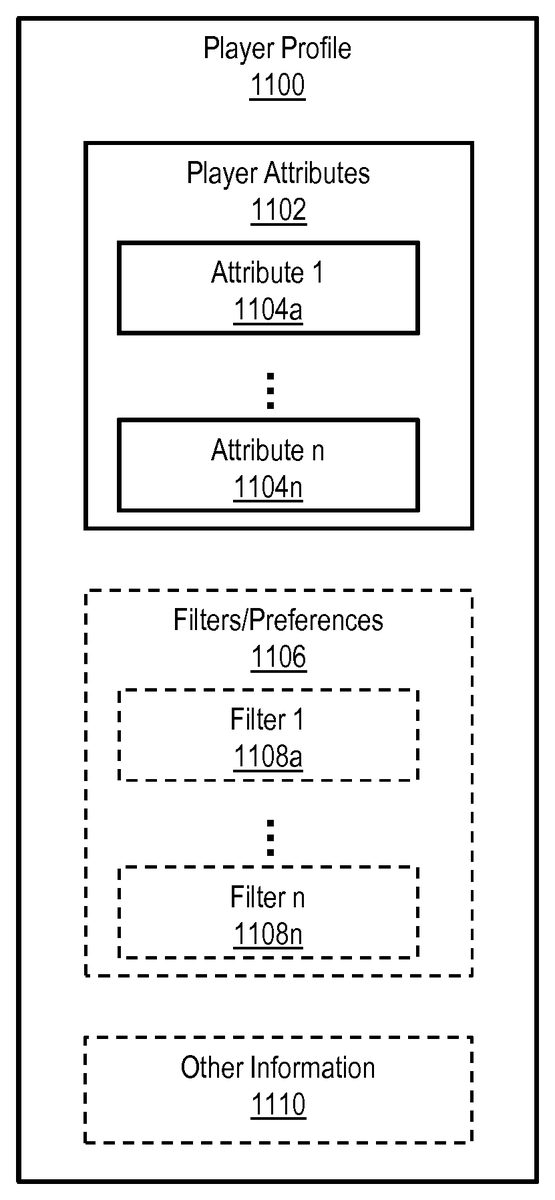
Gamers participating in a social gaming network can create personal profiles to meet and communicate with others. An example of such a profile is illustrated inFIG. 11, which depicts a schematic diagram of an illustrative embodiment of a data structure utilized in a social gaming network. A player profile1100includes one or more player attributes1102. In the illustrative embodiment, the player attributes1102can be differentiated into one or more individual attributes1104a,1104n(generally1104) that can be used, individually or in various combinations, to distinguish or otherwise differentiate players participating in the social gaming network. The player profile can optionally include one or more additional elements or components, such as filters and/or preferences1106and, more generally, other information1110(shown in phantom).
The player attributes1102can include a stimulation record of an electronic gaming accessory, such as an electronic game control actuator or controller. In at least some embodiments, the stimulation record is based on, so called, “raw” hardware data. The attributes1104, for example, can include a number of stimulations of a particular actuator1006(FIG. 10), or a rate of stimulations of the actuator1006. A number of stimulations can be a running or historical total, for example, measured or otherwise recorded during a definable time period, such as a minute, hour, day. Alternatively or in addition, the number of stimulations can be a total accrued since an occurrence of a particular event, such as initiation of a game, a tournament, a particular date, or lifetime. Stimulation records of rate information can include an average rate, for example, determined as the number of stimulations over a definable time period, such as a second, a minute, an hour, or in relation to an event, such as a game a tournament, and so forth.
As disclosed above, stimulus signals can be received from the game controller1004in response to user stimulations and recorded or otherwise processed. Processing of stimulation signals and/or stimulation records can include statistical processing. Thus, the stimulation signals and/or stimulation records can be collected, organized, analyzed, interpreted and presented as raw data and/or as statistical results, which refer to stimulation related quantities, such as a mean, median, mode, standard deviation, and so forth, calculated form a set of data derived from stimulation of the game controller1004.
In at least some embodiments, one or more of the user attributes1104include values indicative of a proficiency of the stimulation of the gaming accessory. Such results can be obtained, for example, by processing of one or more of the raw stimulation record results or the statistical results determined from the same. Measure, such as a user's proficiency or experience, can be estimated or otherwise inferred from the raw stimulation records and/or statistical data related to the same. By way of non-limiting example, a user's dexterity, proficiency can be concluded from a stimulation record of the game controller1004of the user reflecting a rate of stimulations. A rate above a particular threshold or range might indicate such dexterity and proficiency.
Collection and/or processing of stimulation records, for example, to determine user attributes1104, can be performed in one or more of the game controller1004, the social network client1010, the social network server1020, the game server1016(FIG. 10), the performance evaluator820, the accessory management system808, or other hardware device802(FIG. 8). One or more of the user attributes1104can be modified by game action results. For example, in addition to receiving stimulation signals indicative of use stimulation of the actuator during the course of a gaming application, collection and/or processing can include consideration of one or more game action results related to one or more of the stimulation signals. By way of non-limiting example, a stimulation signal indicative of a game action of shooting can result in a game action result of a hit, a kill or a miss. A miss can be inferred, in at least some instances, from a lack of receipt of any game action result of a hit or a kill. A user attribute related to the stimulation signal to shoot can be modified by the game action result, for example, to determine one or more of a percentage or ration of shoots that result in a hit, a kill and/or a miss. Once again, user proficiency and skill can be inferred in one or more of the user attributes from user attributes related to game-action modified stimulation records.
The filters/preferences1106can include information entered by the player, such as preferred games, preferred roles or characters within one or more games, preferred weapons or similar gaming implement, etc. Alternatively or in addition the filters/preferences1106can include information determined automatically and/or identified by a third party. By way of non-limiting example, filters can include in indication of experience, such as game playing time on average as may server to differentiate causal gamers from more experience, or so called “hard core” players. Other filters can identify a number or different games, or game categories, and the like, to provide an indication of how versatile a player might be. Still other filters can identify one or more player characteristics, such as aggressiveness, risk tolerance, accuracy, and combinations thereof. Still other filters can related more particularly to a player's stimulation of a game controller. For example, a filter can be established to differentiate among players and/or roles according to a threshold, e.g., a minimum threshold of player actions per minute. Filters and/or preferences1106, such as those disclosed herein, can be used to filter social interactions, e.g., matchmaking between players, players and teams, etc.
A social gaming network can include target profiles identifying a profile of a game player being sought after. An example of such a profile is illustrated inFIG. 12, which depicts a schematic diagram of an illustrative embodiment of another data structure utilized in a social gaming network. A team profile1150includes one or more roles1152a,1152n(generally1152). Each role1152includes a respective target profile1154a,1154n(generally1154). Each target profile, in turn, includes a collection of one or more target attributes1156a,1156n(generally1156). The target attributes1156can correspond to one or more of the user attributes1104disclosed herein. At least some of the target attributes1156can include a value and/or a range of values indicative of a threshold, e.g., minimum or maximum, or a preferred or optimal value of a user attribute sought for the particular role1152.
The illustrative example relates to a team profile1150. The particular roles1152can be determined, for example, as a minimum requirements for a team, e.g., a minimum number of roles, as an ideal or model team, or as an exceptional, e.g., “dream” team. It is conceivable that more than one team profiles1150can be established for a team in relation to the same gaming application. The one or more team profiles1150can be compared to one or more player profiles1100, for example, in order to identify or otherwise match one or more players to a particular team. Thus, an entity, such as an individual, a league, or other related organization, can use the social gaming network to create teams. Alternatively or in addition, existing teams can use the social gaming network to add and/or replace players, for example, to improve a team's performance and ranking. Associations of individual gamers to each other and/or to one or more teams can be stored in a record of such associations by the social network server1020, for example, in the storage device1022(FIG. 10).
In at least some embodiments, the social network clients1010can be used by a team, for example, to solicit one or more team members by creating or otherwise updating an individual and/or team target profile. For example, the social network client1010includes or is otherwise accessible by a user interface, such as a graphical user interface. The user interface can provide one or more controls to allow an individual and/or a team to create or otherwise modify a target profile. Once created/modified, the target profile can be submitted to the social network server1020for correlation with a collection of user profiles1100that are also stored on the storage device1022or otherwise accessible to the social network server1020. An example of operation of the social network server to match players to other players and/or teams is described in more detail below.
FIG. 13depicts a flow diagram of an illustrative embodiment of a process for profiling a player according to manipulation of gaming accessory. An indication of stimulus of a game accessory is obtained at step1202. In at least some embodiments, a time reference, such as a time stamp, can be added or otherwise associated with the stimulus at step1206(shown in phantom). Alternatively or in addition, a sequence number or other suitable reference suitable for distinguishing or removing ambiguity associated with the stimulus can be added or otherwise associated at step1206.
A user attribute can be updated at1208in response to the stimulus of the game accessory. For example, the performance evaluator820(FIG. 8) receives a stimulus signal from a game controller802indicating a particular actuator or key combination was initiated at the game controller of a user. When performed during the course of an electronic game, the stimulus signal causes a game action result. The game action result can be obtained at step1204. In at least some embodiments, a user profile is updated at1208in response to the indication of the stimulation of the game accessory in view of the game action result obtained at step1204.
A stimulation record can be updated responsive to receipt of one or more of the stimulus signal or the game action result. A user profile1100can be updated at step1210in response to the updated user attribute at step1208. Update of the user profile can include updating, changing, generating one or more player attributes1102of the player profile1100. Alternatively or in addition, one or more attributes1104are updated or otherwise modified based on one or more of the stimulus signal or the game action result. In at least some embodiments, one or more of the steps of the process1200are performed automatically without user intervention. In particular, one or more of the steps of the process1200can be guarded from alteration or other tampering using established techniques for securing or otherwise encrypting data. For example, one or more of the user attributes1104or the user profile1100can be stored in an encrypted fashion. The acts of updating at stems1208or1210can include unencrypting pre-stored attributes and/or profiles, updating and re-encrypting before storing again. In such a manner, integrity of at least some of the user attributes1104of the user profile1100can be maintained or otherwise assured to a community of the social gaming network.
By way of illustrative example, a stimulation of a gaming accessory, such as a game controller802, indicative of a shoot command in a context of a game is received at step1202. A record of the shoot command stimulus signal can be time stamped and/or associated with a sequence identifier at step1206. The shoot command, alone or together with one or more of the time stamp and the sequence identifier, is forwarded to one or more of a game console1008or a game application server1016. Depending upon a state of the game at the time of the command, as well as information related to the shoot command, e.g., aim, weapon, ammunition, health, progression of the game is altered. Such alternation, for example, can include a hit, a kill or a miss, a change in a state of ammunition, health, etc.
In some embodiments, the process1200is implemented responsive to each hardware stimulation of the game controller802. Namely, one or more user attributes and/or the user profile are updated in real time or near real time responsive to each stimulation of the game controller802. To the extent such immediately updated results are not necessary, a processing burden and possibly communication bandwidth, depending upon a division of labor, can be reduced by updating one or more of the user attributes or user profiles at intervals other than responsive to each hardware stimulation. For example, the indication of stimulus of a game accessory at step1202, with or without the timestamp and/or sequence identifier at step1206and any game input result at step1204can be stored in a record or otherwise buffered without updating either of the user attribute or the user profile. At an opportune time, e.g., after completion of a game, or a tournament, or perhaps at the end of a day, or upon initiation of a subsequent log on event, one or more of the user attribute or the user profile can be updated at steps1208,1210according to the stored or otherwise buffered results. The updated user profile can be forwarded to a social network server1020(FIG. 10) at step1212.
FIG. 14depicts a flow diagram of an illustrative embodiment of a process for associating players according to a player profiling as inFIG. 13. A player profile is determined at step1302. By way of non-limiting example, a player profile, such as the example player profile1100(FIG. 11) disclosed herein, can be determined by a social network server1020by one or more of retrieving the player profile1100from a storage device1022or receiving the player profile1100from a social network client1010.
A filter can be applied to the player profile1100at step1304. Parameters of the filter can be determined by one or more of preferences of a user associated with the player profile1100. Alternatively or in addition, filter parameters and/or preferences can be determined by one or more values determined from a respective role1152of a team profile1150. Such filters and or parameters can be implemented according to a predetermined logic. For example, conflicting preferences can be resolved according to Boolean logic, e.g., AND, OR, exclusive OR, Not and the like. One or more of the filters and/or parameters of either the player profile1100and the team profile1150can be predetermined to have priority over the other, essentially replacing the other in a circumstances of a conflict.
Examples of filtering parameters include game playing time on average, e.g., allowing for matches between players and/or teams to be determined based on experienced players having game playing time above a threshold value. Another example includes a versatility attribute. A players versatility can be ranked or otherwise scored ranging from a player that specializes in one game to a player that is experienced with many different games). Other filter parameters include weapon specifics. Thus, a player attribute may include a list of one or more weapons. A filter parameter may impose that any match include one or more required weapons. Other filter parameters include a measure of a player's aggressiveness and/or conservativeness, a player's character and/or weapon preference, a minimum threshold measure of hardware, e.g., stimulus, actions, such as player actions per minute. Such filter parameters add multiple dimensions that can be used in determining matches between players and other players and/or teams. For example, such multiple dimensions can be used to resolve conflicts or otherwise rank order among more than one possible matches. Thus, a matching process can select a preferred match from among a number of possible matches according to one or more of the filters/preferences.
Alternatively or in addition, filter results are evaluated at step1306prior to any correlation of the determined player profile and any target profile. Thus, only those player profiles determined to satisfy application of the filtering criteria at step1304are passed on at step1306for correlation. If the determined player profile is rejected or otherwise fails to satisfy the filtering criteria at step1306, another player profile can be determined at step1302and the process repeated.
A role or target profile is determined at step1308. The target profile can be obtained from a member of the social gaming network, such as a player, seeking an association with another player having attributes that satisfy the target profile, or a team seeking to identify a player matched to a particular team-member role. A correlation is performed at step1310between the determined player profile and the determined target profile. A result of the correlation is indicative of a suitability of the player represented by the determined player profile and the target profile determined at step1308.
A match can be determined at step1312. For example, a correlation having a value above a particular threshold value is deemed to be a suitable match. To the extent a correlation fails to satisfy criteria of a match at step1312, another player profile is determined at step1302and the process repeated until a suitable match is determined at step1312. To the extent that a correlation satisfies the match criteria at step1312, an association can be formed between the player represented by the determined player profile and the determined target or role profile. Such associations can be indicative of an association between players, or an association between a player and a team. Upon determination of an association, a social network server1020can record or otherwise retain the association, for example, storing a record of the association in the storage device1022. In at least some embodiments, the social network server1020reflects a change in an association status, e.g., other information1110(FIG. 11) of a user profile1100, and/or an associated player field1160of each role1152of a team profile1150.
In some embodiments, a player advertises himself/herself by requesting that the social network server1020identify a target profile of another player and/or team soliciting a particular role. In such an embodiment, the player profiles of steps1302and1304are replaced with target profiles and the determined role profile of step1308is replaced with the advertising player profile. Thus, filtering, matching and so forth are performed for different target profiles for the advertising player.
From the foregoing descriptions, it would be evident to an artisan with ordinary skill in the art that the aforementioned embodiments can be modified, reduced, or enhanced without departing from the scope and spirit of the claims described below.
For instance, one or more of the AMS application808, the performance evaluator820, the social network client1010and the social network server1020can record stimulus signals and/or gaming results for a game session and store this data for an extended period of time for each of a number of gamers. In addition, one or more of the AMS application808and the performance evaluator820, the social network client1010and the social network server1020can store multiple recorded game sessions for each gamer and can be adapted to compare a history of game sessions to assess how each gamer's performance has evolved. Each gamer's improvement or degradation detected by the AMS application808and/or the performance evaluator820, and the social network client1010over a number of gaming sessions can be reported to the social network server1020, e.g., by way of an updated user profile. The results can also be reported in a gaming tournament, on-line games, or other suitable setting.
One or more of the AMS application808and the performance evaluator820, the social network client1010and the social network server1020can compare a gamer's performance in a particular game to a gaming session recorded from a prior tournament for the same game or another game. Performance in the present context can mean a comparison of only stimulus signals (e.g., accessory-generated stimulus signals and/or substitute stimulus signals). This embodiment may be user-selectable (i.e., user selects stimulus analysis only) by way of a GUI presented by the AMS application808, or the performance evaluator820, the social network client1010and the social network server1020, or the AMS application808may apply this embodiment automatically in instances where the AMS application808does not receive gaming action results from the gaming application812due to a lack of an API or other suitable interface to receive gaming action results from the gaming application.
For any one of the foregoing embodiments, one or more of the AMS application808and the performance evaluator820, the social network client1010and the social network server1020can detect improvements or degradations in performance between a present tournament game and the previously recorded tournament game and report the results to the gamer and/or an audience of on-line gamers or a public audience at a tournament via display devices, such as monitors. The foregoing embodiments can be applied in a private setting (i.e., only visible to the gamer) and/or a social network of gamers who share and present results via the AMS application, the performance evaluator820, the social network client1010and the social network server1020or other, traditional social network such as FaceBook™ or other suitable social network platform.
In yet other embodiments, one or more of the AMS application808and the performance evaluator820, the social network client1010and the social network server1020can be adapted to associate a gamer with one or more of another gamer or a team according to the gamer's hardware performance. A gamer profile can be determined based on the gamer's hardware performance or proficiency. Once established, the gamer profile can be compared to other gamer profiles and/or to target profiles of gamers being sought or otherwise advertised for. In one embodiment, one or more of the AMS application808and the performance evaluator820, the social network client1010and the social network server1020can be adapted to present a GUI where it presents a list of gamers and a stimulus record and/or user attribute from each gamer of a group of gamers. The GUI can enable a user to select a particular gamer and a particular recorded gaming session of the selected gamer for comparison to a recorded (or live) gaming session of the user making the selection or another gamer of interest to the user (e.g., comparing the performance of two professional gamers).
It should be noted that gaming sessions recorded by one or more of the AMS application808and the performance evaluator820, the social network client1010can be locally stored on a gamer's computing device (e.g., desktop computer or gaming console) or on a remote server managed by a service provider of the AMS application, or the performance evaluator820, the social network client1010and the social network server1020, or by a service provider that provides “Cloud” storing services. User profiles and/or associations of users can similarly be stored on a gamer's local computing device or a remote server.
In yet other embodiments, one or more of the AMS application808and the performance evaluator820, the social network client1010and the social network server1020can be adapted to alert users when a particular gamer has achieved certain performance criteria established by a target profile. For instance, either or both of the AMS application808and the performance evaluator820, the social network client1010and the social network server1020can respectively present a GUI to a gamer to identify performance criteria of interest (e.g., number of kill hits, average hit rate for a particular weapon, a particular ranking of a gamer for a particular gaming application, etc.). The identified performance criteria can be monitored by one or more of the AMS application808and the performance evaluator820, the social network client1010and the social network server1020for the selected gamer and when one or more criteria have been achieved by the monitored gamer, either or both of the AMS application and the performance evaluator820, the social network client1010and the social network server1020can respectively alert the interested user by suitable communication means such as email, short messaging system (SMS) text message, or a GUI of the AMS application when the interested user is engaging the AMS application.
In other embodiments, one or more of the AMS application808and the performance evaluator820, the social network client1010and the social network server1020can compare the performance of the gamers to a community target profile localized to users of the gaming console206, or all or a portion of on-line users which can span a large community of users of the gaming application. For example, although an average hit rate of 5% for a sniper rifle may seem low for one gamer, when these statistics are compared to other members of a community (e.g., other professional players), either or both of the AMS application808and the performance evaluator820, the social network client1010and the social network server1020can respectively determine from prior performance records of members of the community (retrieved from a local or remote database) that the user's performance is in fact above average. Similar community comparisons can be performed for the weapon type “machine gun” and “hand gun.” Either or both of the AMS application808and the performance evaluator820, the social network client1010and the social network server1020can also monitor and track statistics of other gaming applications, which may have different weapon types. Similar statistics can be generated and compared to the performance of members of a community to which the gamer is associated.
In at least some embodiments, statistical results can be used to identify behavioral and/or skill patterns of a gamer. For instance, suppose a gamer appears to perform well as a sniper in one gaming application and bow and arrow marksman in a different gaming application. Either or both of the AMS application808and the performance evaluator820, the social network client1010and the social network server1020can be respectively adapted to detect these correlations to indicate a skill set of the gamer that may be consistent between different games. For example, a sniper and bowman have a similar trait that requires marksmanship, calm nerves, and knowing when to strike. This trait can be identified, e.g., by the AMS application and can be used to identify other games in which the gamer may perform well. This trait can also be advertised to other gamers to promote teams.
The processes depicted inFIGS. 5-7 and 12can be adapted to operate in whole or in part in a gaming accessory, in an operating system of a computer, in a gaming console, in a gaming application that generates the video game, in a dongle, or any other suitable software application and/or device.
The processes ofFIGS. 7 and 12-13can be adapted to ignore or filter game action results, which may not be relevant to the gamer or analysts. For instance, the either or both of the AMS application808and the performance evaluator820, the social network client1010and the social network server1020can be adapted to ignore (or filter) game action results relating to navigation of the avatar (e.g., turn around, jump, etc.). Either or both of the AMS application808and the performance evaluator820, the social network client1010and the social network server1020can also be adapted to ignore (or filter) game action results relating to preparatory actions such as reloading a gun, switching between weapons, and so on. In other embodiments, either or both of the AMS application808and the performance evaluator820, the social network client1010and the social network server1020can be adapted to selectively monitor only particular stimulus signals and/or game result actions such as misses, non-kill hits, kills, and life of the avatar. Either or both of the AMS application808and the performance evaluator820, the social network client1010and the social network server1020can also be adapted to monitor gaming action results with or without temporal data associated with the stimuli and game action results.
In some embodiments, either or both of the AMS application808and the performance evaluator820, the social network client1010and the social network server1020can be respectively adapted to track stimuli (or substitutions thereof) by submission order, and order of gaming action results supplied by the gaming application, and perform cataloguing thereof by the respective order of stimuli and gaming action results. The items can be respectively catalogued by each of the AMS application808and the performance evaluator820, the social network client1010and the social network server1020with or without temporal data.
In at least some embodiments, either or both of the AMS application808and the performance evaluator820, the social network client1010and the social network server1020can be adapted to collect gaming action results for “all” or a substantial portion of stimuli (or substitutions thereof) transmitted to the gaming application. In this embodiment, either or both of the AMS application808and the performance evaluator820, the social network client1010and the social network server1020can be adapted to enable a gamer to replay portions of the game to allow the gamer to visualize (in slow motion, still shots, or regular play speed) the actions taken by the gamer (i.e., accessory stimuli and/or substitute stimuli) to help the gamer identify areas of the game where his/her performance can be improved.
In at least some embodiments, either or both of the AMS application808and the performance evaluator820, the social network client1010and the social network server1020can be implemented as a distributed system (e.g., one or more servers executing one or more virtual machines) enabling multiples users to control aspects of either or both of the AMS application808and the performance evaluator820, the social network client1010and the social network server1020. For example, in a tournament setting, gaming analysts having access to the AMS application can request a replay of portions of the game to demonstrate exceptional plays versus missed plays at a JumboTron™ display. The gamers can access either or both of the AMS application808and the performance evaluator820, the social network client1010and the social network server1020to establish new substitute stimuli, perform calibrations on macros, or invoke or create additional gaming profiles. Portions of either or both of the AMS application808and the performance evaluator820, the social network client1010and the social network server1020can also be implemented by equipment of unaffiliated parties or service providers of gaming services.
In some embodiments, either or both of the AMS application808and the performance evaluator820, the social network client1010and the social network server1020can be respectively adapted to substitute an accessory stimulus (or stimuli) for a macro comprising a combination of substitute stimuli, and track the macro when gaming action results are received from the gaming application rather than track each individual substitute stimulus of the macro. Either or both of the AMS application808and the performance evaluator820, the social network client1010and the social network server1020can be adapted to monitor macros by tracking an order of stimuli (or substitutes) associated with the macro that are transmitted to the gaming application and by tracking an order of gaming action results received from the gaming application, which are associated with the macro. Alternatively, or in combination, either or both of the AMS application808and the performance evaluator820, the social network client1010and the social network server1020can add a unique identifier to the substitute stimuli to identify the stimuli as being associated with the macro.
Either or both of the AMS application808and the performance evaluator820, the social network client1010and the social network server1020can be adapted to catalogue the gaming action results associated with the macro in a manner that allows the gamer to identify a group of gaming action results as being associated with the macro. Either or both of the AMS application808and the performance evaluator820, the social network client1010and the social network server1020can also be adapted to collect sufficient data to assess each individual gaming action result of the macro (e.g., temporal data, hits, misses, etc.). The presentation of catalogued macro data can be hierarchical. For example, the AMS application can present a particular macro by way of a high level GUI that indicates the macro caused a kill. Either or both of the AMS application808and the performance evaluator820, the social network client1010and the social network server1020can be adapted to enable the gamer to select a different GUI that enables the user to visualize a gaming action result for each stimulus of the macro to determine how effective the macro was in performing the kill, and whether further adjustments of the macro might improve the gamer's performance.
In some embodiments, either or both of the AMS application808and the performance evaluator820, the social network client1010and the social network server1020can be respectively adapted to present more or less competitive information. In some embodiments, for example, either or both of the AMS application808and the performance evaluator820, the social network client1010and the social network server1020can be adapted to present competitive information without the virtual peripherals. In one example, the AMS application can be adapted to present scrollable pages of competitive information with or without the virtual peripherals. In other illustrations, either or both of the AMS application808and the performance evaluator820, the social network client1010and the social network server1020can be adapted to present competitive information without a viewing of the game or the gamer. Other variants of presenting competitive information or other data are contemplated by the present disclosure.
The foregoing embodiments are a subset of possible embodiments contemplated by the present disclosure. Other suitable modifications can be applied to the present disclosure.
FIG. 15depicts an exemplary diagrammatic representation of a machine in the form of a computer system1400within which a set of instructions, when executed, may cause the machine to perform any one or more of the processes and techniques discussed above. One or more instances of the machine can operate as any of devices depicted inFIGS. 1-3. In some embodiments, the machine may be connected (e.g., using a network) to other machines. In a networked deployment, the machine may operate in the capacity of a server or a client user machine in server-client user network environment, or as a peer machine in a peer-to-peer (or distributed) network environment.
The machine may comprise a server computer, a client user computer, a personal computer (PC), a tablet PC, a smart phone, a laptop computer, a desktop computer, a control system, a network router, switch or bridge, or any machine capable of executing a set of instructions (sequential or otherwise) that specify actions to be taken by that machine. It will be understood that a communication device of the present disclosure includes broadly any electronic device that provides voice, video or data communication. Further, while a single machine is illustrated, the term “machine” shall also be taken to include any collection of machines that individually or jointly execute a set (or multiple sets) of instructions to perform any one or more of the processes and techniques discussed herein, including processes and techniques related to the performance evaluator820, the social network client1010and the social network server1020.
The computer system1400may include a processor1402(e.g., a central processing unit (CPU), a graphics processing unit (GPU, or both), a main memory1404and a static memory1406, which communicate with each other via a bus1408. The computer system1400may further include a video display unit1410(e.g., a liquid crystal display (LCD), a flat panel, or a solid state display. The computer system1400may include an input device1412(e.g., a keyboard), a cursor control device1414(e.g., a mouse), a disk drive unit1416, a signal generation device1418(e.g., a speaker or remote control) and a network interface device1420.
The disk drive unit1416may include a tangible computer-readable storage medium1422on which is stored one or more sets of instructions (e.g., software1424) embodying any one or more of the processes, techniques or functions described herein, including those processes illustrated above. The instructions1424may also reside, completely or at least partially, within the main memory1404, the static memory1406, and/or within the processor1402during execution thereof by the computer system1400. The main memory1404and the processor1402also may constitute tangible computer-readable storage media.
Dedicated hardware implementations including, but not limited to, application specific integrated circuits, programmable logic arrays and other hardware devices can likewise be constructed to implement the processes and techniques described herein. Applications that may include the apparatus and systems of various embodiments broadly include a variety of electronic and computer systems. Some embodiments implement functions in two or more specific interconnected hardware modules or devices with related control and data signals communicated between and through the modules, or as portions of an application-specific integrated circuit. Thus, the example system is applicable to software, firmware, and hardware implementations.
In accordance with various embodiments of the present disclosure, the processes and techniques described herein are intended for operation as software programs running on a computer processor. Furthermore, software implementations can include, but not limited to, distributed processing or component/object distributed processing, parallel processing, or virtual machine processing can also be constructed to implement the processes and techniques described herein.
While the tangible computer-readable storage medium622is shown in an example embodiment to be a single medium, the term “tangible computer-readable storage medium” should be taken to include a single medium or multiple media (e.g., a centralized or distributed database, and/or associated caches and servers) that store the one or more sets of instructions. The term “tangible computer-readable storage medium” shall also be taken to include any non-transitory medium that is capable of storing or encoding a set of instructions for execution by the machine and that cause the machine to perform any one or more of the processes and techniques of the present disclosure.
The term “tangible computer-readable storage medium” shall accordingly be taken to include, but not be limited to: solid-state memories such as a memory card or other package that houses one or more read-only (non-volatile) memories, random access memories, or other re-writable (volatile) memories, a magneto-optical or optical medium such as a disk or tape, or other tangible media which can be used to store information. Accordingly, the disclosure is considered to include any one or more of a tangible computer-readable storage medium, as listed herein and including art-recognized equivalents and successor media, in which the software implementations herein are stored.
Although the present specification describes components and functions implemented in the embodiments with reference to particular standards and protocols, the disclosure is not limited to such standards and protocols. Each of the standards for Internet and other packet switched network transmission (e.g., TCP/IP, UDP/IP, HTML, HTTP) represent examples of the state of the art. Such standards are from time-to-time superseded by faster or more efficient equivalents having essentially the same functions. Wireless standards for device detection (e.g., RFID), short-range communications (e.g., Bluetooth, WiFi, Zigbee), and long-range communications (e.g., WiMAX, GSM, CDMA, LTE) are contemplated for use by computer system1400.
The illustrations of embodiments described herein are intended to provide a general understanding of the structure of various embodiments, and they are not intended to serve as a complete description of all the elements and features of apparatus and systems that might make use of the structures described herein. Many other embodiments will be apparent to those of skill in the art upon reviewing the above description. Other embodiments may be utilized and derived therefrom, such that structural and logical substitutions and changes may be made without departing from the scope of this disclosure. Figures are also merely representational and may not be drawn to scale. Certain proportions thereof may be exaggerated, while others may be minimized. Accordingly, the specification and drawings are to be regarded in an illustrative rather than a restrictive sense.
Although specific embodiments have been illustrated and described herein, it should be appreciated that any arrangement calculated to achieve the same purpose may be substituted for the specific embodiments shown. This disclosure is intended to cover any and all adaptations or variations of various embodiments. Combinations of the above embodiments, and other embodiments not specifically described herein, are contemplated by the present disclosure.
The Abstract of the Disclosure is provided with the understanding that it will not be used to interpret or limit the scope or meaning of the claims. In addition, in the foregoing Detailed Description, it can be seen that various features are grouped together in a single embodiment for the purpose of streamlining the disclosure. This method of disclosure is not to be interpreted as reflecting an intention that the claimed embodiments require more features than are expressly recited in each claim. Rather, as the following claims reflect, inventive subject matter lies in less than all features of a single disclosed embodiment. Thus the following claims are hereby incorporated into the Detailed Description, with each claim standing on its own as a separately claimed subject matter.
Claims
- A method for matching players in a social gaming network, comprising: intercepting, by a processing system including a processor, a plurality of stimulus signals of an electronic game control actuator based on stimulation of the electronic game control actuator by a user;evaluating, by the processing system, the plurality of stimulus signals based on the stimulation of the electronic game control actuator for a plurality of users;determining, by the processing system, a plurality of attributes of the plurality of users based on the evaluating of the plurality of stimulus signals;determining, by the processing system, a team profile comprising a plurality of team-member profiles, wherein a target team-member profile of the plurality of team-member profiles comprises a target team-member attribute that is lacking in the team profile, wherein the team profile is associated with a team comprising of a plurality of team members playing a video game on the social gaming network, and wherein the plurality of team members are at a plurality of geographic locations;receiving, by the processing system, a plurality of filter values of the plurality of users;correlating, by the processing system, the plurality of attributes with the target team-member attribute;and matching, by the processing system, a select user of the plurality of users with the target team-member profile based on the correlating of the plurality of attributes with the target team-member attribute and based on the plurality of filter values to incorporate the target team-member attribute into the team profile to improve game performance of the team.
- The method of claim 1 , wherein the plurality of attributes comprises one of a performance measure of strength, a performance measure of weakness, or a combination thereof.
- The method of claim 1 , wherein an attribute of the plurality of attributes is indicative of a proficiency corresponding to the plurality of stimulus signals of the electronic game control actuator of the corresponding user of the plurality of users.
- The method of claim 1 , wherein the correlating of the plurality of attributes with the target team-member attribute comprises: deriving, by the processing system, a measure of performance from the plurality of stimulus signals of the electronic game control actuator;and comparing, by the processing system, the measure of performance and a target range of performance associated with the target team-member attribute, wherein a correlation is determined according to the measure of performance falling within the target range of performance.
- The method of claim 1 , wherein the target team-member profile is one of a plurality of predetermined team-member profiles associated with the team.
- The method of claim 5 , wherein the target team-member profile of the plurality of team-member profiles corresponds to a first gaming application.
- The method of claim 6 , further comprising determining, by the processing system, a statistic based on a detection of a repeated stimulus signal of the plurality of stimulus signals of the electronic game control actuator, and wherein the plurality of filter values comprise individual preferences of the plurality of users.
- An apparatus for matching users of a social gaming network, comprising: a memory that stores executable instructions;and a processing system including a processor in communication with the memory, wherein the system responsive to executing the executable instructions, performs operations comprising: detecting a plurality of stimulus signals based on stimulation of an electronic gaming accessory of a corresponding user;determining a respective user attribute for each of a plurality of users, based on the plurality of stimulus signals of the electronic gaming accessory of the corresponding user of the plurality of users;determining a target profile comprising a target attribute that is lacking in a team profile, wherein the team profile is associated with a team comprising of a plurality of team members playing a video game on the social gaming network, and wherein the plurality of team members are at a plurality of geographic locations;receiving a plurality of filter values of the plurality of users;correlating the respective user attribute for each of the plurality of users with the target attribute of the target profile;and matching a select user of the plurality of users with the target profile based on the correlating of the plurality of the respective user attribute for each of the plurality of users and the target attribute of the target profile and based on the plurality of filter values to incorporate the target attribute into the team profile to improve game performance of the team.
- The apparatus of claim 8 , wherein the respective user attribute for each of the plurality of users is determined by ignoring a game action occurring in a gaming application in response to the stimulation of the electronic gaming accessory.
- The apparatus of claim 8 , wherein the target profile is a select team-member profile a plurality of team-member profiles, each team-member profile of the plurality of team-member profiles having a respective role identity and a corresponding role-specific proficiency threshold.
- The apparatus of claim 10 , further comprising assessing whether the respective user attribute for each of the plurality of users exceeds the role-specific proficiency threshold of the respective role identity, and wherein the plurality of filter values comprise user preferences.
- The apparatus of claim 11 , wherein the target profile corresponds to a first gaming application, and wherein the respective user attribute for each of the plurality of users corresponds to a stimulation record of the electronic gaming accessory of the corresponding user of the plurality of users in relation to a second gaming application.
- The apparatus of claim 10 , further comprising: comparing the respective user attribute to a corresponding role-specific proficiency threshold of the target profile;and identifying the respective user attribute as being indicative of a qualified team-member candidate responsive to the comparing of the respective user attribute indicating that the respective user attribute satisfies the corresponding role-specific proficiency threshold.
- The apparatus of claim 13 , further comprising: determining a respective supplemental user attribute characterizing an aspect of a user;and filtering the qualified team-member candidate responsive to the supplemental user attribute.
- A non-transitory machine-readable storage medium for use in a social gaming network, comprising executable instructions, which, responsive to being executed by a processing system including a processor, cause the processing system to perform operations comprising: detecting a plurality of stimulation signals based on stimulation of an electronic gaming accessory of a user;determining a proficiency attribute of a first user based on the plurality of stimulation signals of the electronic gaming accessory of the first user responsive to game-related activity in an electronic game application, wherein the proficiency attribute is lacking in a team profile, wherein the team profile is associated with a team comprising of a plurality of team members playing a video game on the social gaming network, and wherein the plurality of team members are at a plurality of geographic locations;receiving a preference of the first user;updating a first user record responsive to the receiving of the proficiency attribute of the first user and the receiving of the preference, resulting in an updated first user record;and forwarding the updated first user record to a matching service, wherein the matching service matches the first user and a second user based on the proficiency attribute and the preference of the updated first user record, wherein the second user is one of the plurality of team members, and wherein the proficiency attribute is incorporated into the team profile to improve game performance of the team.
- The non-transitory machine-readable storage medium of claim 15 , wherein the proficiency attribute is based on the plurality of stimulation signals of the electronic gaming accessory, modified by a game action result of the electronic game application responsive to the stimulation of the electronic gaming accessory.
- The non-transitory machine-readable storage medium of claim 15 , wherein the proficiency attribute is based on a statistic determined from the plurality of stimulation signals of the electronic gaming accessory.
- The non-transitory machine-readable storage medium of claim 15 , wherein the operations further comprise: receiving the team profile comprising a plurality of team-member profiles, each team-member profile of the plurality of team-member profiles having a respective role identity and a corresponding role-specific proficiency threshold;and assessing from the updated first user record, a suitability of the first user to participate as a team-member characterized by a team-member profile of the plurality of team-member profiles.
- The non-transitory machine-readable storage medium of claim 18 , wherein the team-member profile of the plurality of team-member profiles corresponds to a second gaming application, and wherein the proficiency attribute of the first user corresponds to a stimulation signal of the plurality of stimulation signals of the electronic gaming accessory in relation to a first gaming application.
- The non-transitory machine-readable storage medium of claim 18 , wherein the operations further comprise: comparing the updated first user record to the corresponding role-specific proficiency threshold of the team-member profile of the plurality of team-member profiles;and identifying the updated first user record as being indicative of a qualified team-member candidate responsive to the comparing of the updated first user record to the corresponding role-specific proficiency threshold.
Disclaimer: Data collected from the USPTO and may be malformed, incomplete, and/or otherwise inaccurate.