U.S. Pat. No. 9,522,334
Game Control Program, Game Device, Game Server, And Game Control Method
AssigneeSony Corporation; Sony Interactive Entertainment Inc.
Issue DateAugust 27, 2013
Illustrative Figure
Abstract
Methods and apparatus provide for managing multiplayer play among a first player and at least one second player, where a first mode of multiplayer play is defined such that a game server selects the second player by: (i) selecting candidates by consulting a player database of information concerning a plurality of other players, (ii) sending invitations to the selected candidates to be the selected second player, (iii) receiving acceptances of the invitations from the candidates; and (iv) selecting the second player from among the candidates from whom acceptances were received; and where a second mode of multiplayer play is defined such that the game server selects the second player by consulting a player database of information concerning the plurality of other players, without consideration of an invitation to, or an acceptance from, the selected second player.
Description
DETAILED DESCRIPTION OF THE PREFERRED EMBODIMENTS (First Embodiment) A description will be given of a technology according to an embodiment that provides the function of allowing players playing a game in parallel to exercise influence to each other directly or indirectly. To describe the embodiment, a role playing game will be discussed by way of example where a player controls a player's character in a hope to achieve a certain goal, traveling in a game field formed of multiple areas, fighting with an enemy character, picking up an item, clearing an event, etc. When a player's character dies by, for example, being defeated by an enemy character before achieving the goal, the game is re-started at a certain point in an area with the item that had been acquired being lost and the level of physical strength being reduced to half. The game server provides a means to allow the player to re-start the game without losing an item and so on. In other words, the player can seek relief from the game server to restore the player's character. The game server provides two methods of relief. One method is to allow the player to cooperate with a player to give relief and advance the game accordingly so that the player's character is restored by achieving the goal and clearing the area. Such a method will be referred to as “friendly mode”. Another is to restore the player's character by fighting with a player's character of a player to give relief and defeating the player. Such a method will be referred to as “hostile mode”. In the case of friendly mode, the game server requested by a player to relieve the player's character recruits a player to give relief. When a player to give relief is found, the player's character ...
DETAILED DESCRIPTION OF THE PREFERRED EMBODIMENTS
(First Embodiment)
A description will be given of a technology according to an embodiment that provides the function of allowing players playing a game in parallel to exercise influence to each other directly or indirectly. To describe the embodiment, a role playing game will be discussed by way of example where a player controls a player's character in a hope to achieve a certain goal, traveling in a game field formed of multiple areas, fighting with an enemy character, picking up an item, clearing an event, etc.
When a player's character dies by, for example, being defeated by an enemy character before achieving the goal, the game is re-started at a certain point in an area with the item that had been acquired being lost and the level of physical strength being reduced to half. The game server provides a means to allow the player to re-start the game without losing an item and so on. In other words, the player can seek relief from the game server to restore the player's character. The game server provides two methods of relief. One method is to allow the player to cooperate with a player to give relief and advance the game accordingly so that the player's character is restored by achieving the goal and clearing the area. Such a method will be referred to as “friendly mode”. Another is to restore the player's character by fighting with a player's character of a player to give relief and defeating the player. Such a method will be referred to as “hostile mode”.
In the case of friendly mode, the game server requested by a player to relieve the player's character recruits a player to give relief. When a player to give relief is found, the player's character of the player to give relief is located in the game field of the player that requested the relief. In the case of hostile mode, the game server automatically selects a player to give relief and causes the player's character of the requesting player to enter the game field of the selected player. A player can choose from either of the methods when the player's character dies and attempt to restore the player's character accordingly.
A player can play the game independently without connecting to the game server. By connecting to the game server to play the game, the player is given an opportunity to enjoy a multiplayer play with other players, as described above. Since a multiplayer play in the friendly mode does not occur unless the player requests relief or accepts to give relief to someone else, the player can enjoy a multiplayer play on its own pace. Sometimes, another player unexpectedly enters the player's field in the hostile mode. Therefore, the player can enjoy the playful tension.
The embodiment further provides various functions designed to help players to communicate with each other indirectly. For example, the play data of another player may be played back while the game is in progress, the position where the game was over for another player may be displayed, a message for other players may be left in the field, or a message left by another player is displayed. In this way, each player can collect information that serves as a hint to the progress of the game so that the convenience for the players is improved. By seeing other players' situations or viewing messages from them, sense of solidarity is created among players, bringing refined enjoyment to the players.
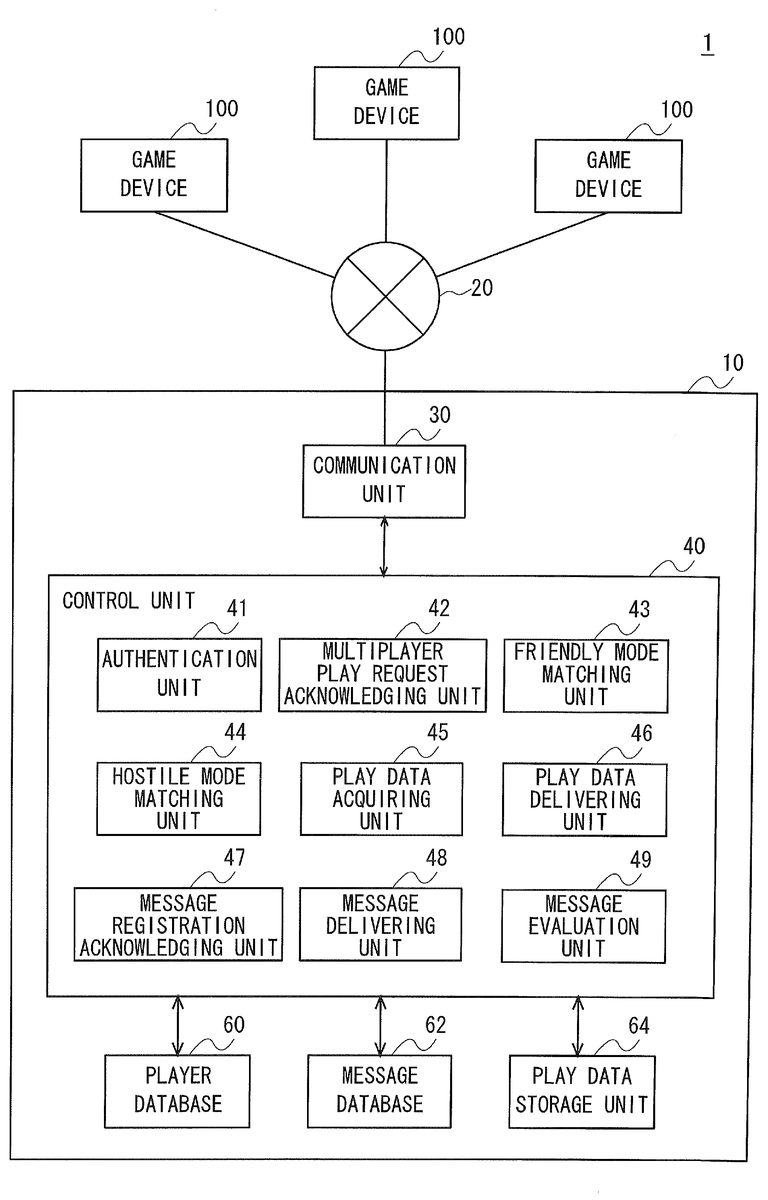
FIG. 1shows the configuration of a game system1according to the embodiment. In the game system1, a game device100that allows a player to play a game, and a server10controlling the game run in multiple game devices100are connected by a network such as the Internet20. The device100and the game server10exchange data via the Internet20.
The game server10is provided with a communication unit30, a control unit40, a player database60, a message database62, and a play data storage unit64. The configuration is implemented, in hardware components, by any CPU of a computer, a memory, and in software by a program or the like loaded into the memory.FIG. 1depicts functional blocks implemented by the cooperation of hardware and software. Therefore, it will be obvious to those skilled in the art that the functional blocks may be implemented in a variety of manners by hardware only, software only, or a combination of thereof.
The player database60stores information on players utilizing the service provided by the game server10.FIG. 2shows exemplary data stored in the player database60. The player database60is provided with a player ID column (fields)70, an authentication data column (fields)71, an IP address column (fields)72, a level column (fields)73, an area ID column (fields)74, a play data column (fields)75, a game over position column (fields)76, and a status column (fields)77. The player ID fields70store player IDs. The authentication fields71store data for authenticating the associated players. The IP address fields72store the IP addresses of the game devices of the associated players. The level fields73store the levels of the players' characters of the associated players. The area ID fields74store the IDs of the areas of the game fields in which the associated players are playing. The player data fields75store the name of the data files storing the play data of the associated players. The game over position fields76store the positions where the players' characters of the associated players die. The status fields77store the status of the associated players in the game. The status may be “running normal mode”, “requesting friendly mode”, “running friendly mode”, “requesting hostile mode”, “running hostile mode”, etc.
The message database62stores messages registered by players.FIG. 3shows exemplary data stored in the message database62. The message database62is provided with a message ID column (fields)80, an area ID column (fields)81, a position column (fields)82, a player ID column (fields)83, a message column (fields)84, and an evaluation column (fields)85. The message ID fields store the IDs of messages. The area ID fields81store the IDs of the areas of the game fields in which the associated messages are registered. The position fields82store the positions in the areas in which the associated messages are registered. The player ID fields83store the IDs of the players registering the associated messages. The message fields84store the content of the associated messages. The evaluation fields85store the evaluation given to the associated messages by other players.
The authentication unit41authenticates the player attempting to connect to the game server10. When the authentication unit41is requested by the game device100of the player to authenticate the device100for connection, the unit41demands the ID and authentication data from the player. The unit41refers to the player database60and authenticates the player ID and the authentication data thus acquired. When the player ID is not registered in the player database60, the authentication unit41acknowledges a request for registration from the player and registers the player ID and the authentication data in the player database60. When the authentication is successful, the authentication unit41acquires the IP address of the game device100and registers the address in the player database60. The unit41also acquires the level of the player and the ID of the area in which the player is playing and registers them in the player database60.
A multiplayer play request acknowledging unit42acknowledges a request for a multiplayer play from the game device100of the player. As mentioned before, the embodiment provides for a multiplayer play as a means of relief when the player's character dies. The multiplayer play request acknowledging unit42acknowledges a request for a multiplayer play in the friendship mode or in the hostile mode from the game device100of the player requesting the restoration of the dead player's character.
When the multiplayer play request acknowledging unit42acknowledges a request for a multiplayer play in the friendly mode, a friendly mode matching unit43selects a player with which the requesting player plays a multiplayer play. The friendly mode matching unit43acquires the level and the area ID of the player requesting a multiplayer play in the friendly mode from the player database60. The unit43searches the player database60for players playing in the same area and having a similar level. The friendly mode matching unit43selects players according to a predetermined condition or in a random fashion from the players identified by the search. The unit43transmits to the game devices100of the selected players data for inviting the selected players to a multiplayer play in the friendly mode. The friendly mode matching unit43determines a partner in the multiplayer play from the game devices100invited to the multiplayer play and accepting the invitation to the multiplayer play. The friendly mode matching unit43transmits, to the game device100of the player thus determined and to the game device100of the requesting player, the IP addresses of each other's game devices100.
For the purpose of increasing the likelihood of success of relief of the player's character in the friendly mode, a player having a higher level than the player requesting the relief may be selected as the one to give relief. In this way, the convenience for the player is improved. Conversely, a player having a lower level than the player requesting the relief may be selected as the one to give relief. In this way, the difficulty of the game is maintained at a high level and the enjoyment of the game is improved.
When the multiplayer play request acknowledging unit42acknowledges a request for a multiplayer play in the hostile mode, a hostile mode matching unit44selects a player with which the requesting player plays a multiplayer play. The hostile mode matching unit44acquires the level and the area ID of the player requesting a multiplayer play in the hostile mode from the player database60. The unit44searches the player database60for players playing in the same area and having a similar level. The hostile mode matching unit44selects players according to a predetermined condition or in a random fashion from the players identified by the search. The unit44notifies the game device100of the selected player of the start of a multiplayer play in the hostile mode. In other words, in the case of the hostile mode, the player's character of the requesting player enters the game field of the requested player regardless of whether the requested player likes it or not, whereupon a multiplayer play is started. The hostile mode matching unit44transmits, to the game device100of the requested player and to the game device100of the requesting player, the IP addresses of each other's game devices100.
For the purpose of increasing the likelihood of success of relief of the player's character in the hostile mode, a player having a lower level than the player requesting the relief may be selected as an opponent. In this way, the convenience for the player is improved. Conversely, a player having a higher level than the player requesting the relief may be selected as an opponent. In this way, the difficulty of the game is maintained at a high level and the enjoyment of the game is improved.
The friendly mode matching unit43or the hostile mode matching unit44may select multiple players as players in a multiplayer play. In this case, an upper limit may be set to the number of players that can participate in a multiplayer play in order to reduce the processing load of the game device100or the congestion in communication.
When a player in a multiplayer play is determined, exchange of data between the game devices100participating in a multiplayer play may be mediated by the game server10. Alternatively, the data may be exchanged using P2P communication between the game devices100. In the latter case, the data may be directly exchanged between the participating game devices10. Alternatively, a given game device100(e.g., the game device100originating the request) may serve as a host to mediate data exchange between the game devices100.
A play data acquiring unit45acquires data indicating the status of the game being run from the game device100of the player and stores the data in the play data storage unit64. The play data acquired may be moving image data capturing screen images and sound of the game being run, or data indicating the history of player control, or control parameters of the game. Alternatively, the play data may be replay data comprising coordinate data indicating the position of the player's character and data indicating the orientation of the player's character as recorded frame by frame or at intervals of a predetermined number of frames. What is essential is that the play data thus acquired can be played back in the game device100of another player. The play data includes data generated when the player's character is defeated to death by an enemy.
A play data delivering unit46delivers the play data stored in the play data storage unit64to the game device100of the player according to a predetermined timing schedule. The play data delivering unit46may read the play data stored in the play data storage unit64, select the game device100that should receive the play data, and deliver the data accordingly. Alternatively, the game device100may first determine the game device100that should receive the play data, then select the play data that should be delivered to the device100thus determined, and deliver the data accordingly.
In the former case, the play data delivering unit46selects and reads the play data stored in the play data storage unit64according to a certain condition or in a random fashion. Subsequently, the play data delivering unit46refers to the player database60, acquires the level and area ID of the player transmitting the play data thus read, and searches the player database60for players playing in the same area and having a similar level. Of the players identified by the search, the play data delivering unit46selects a player to deliver the data to according to a predetermined condition or in a random fashion. The unit46acquires the IP address of the game device100of the selected player and transmits the play data accordingly.
In the latter case, the play data delivering unit46selects the game device100to deliver the play data to according to a predetermined condition or in a random fashion. Subsequently, the play data delivering unit46refers to the play database60, acquires the level and area ID of the player of the game device100thus selected, and searches the player database60for players playing in the same area and having a similar level. Of the players identified by the search, the play data delivering unit46selects a player according to a predetermined condition or in a random fashion. The unit46reads the play data of the selected player from the play data storage unit64and transmits the data accordingly.
The play data delivering unit46may deliver the play data to the game device100periodically, deliver the data to the game device100of the other players when the play data acquiring unit45acquires the play data, or deliver the play data in an area collectively when the player starts playing in the area. The play data delivering unit46may provide an upper limit to the number of game devices100to collectively deliver the play data to, for the purpose of reducing the load of the game server10.
A message registration acknowledging unit47acknowledges a request for registration of a message from the game device100and registers the message thus acknowledged in the message database62. In addition to the content of the message, the message registration acknowledging unit47acquires from the game device100the ID of and position in the area in which to register the message and registers the ID and position in the message database62.
A message delivering unit48delivers the message registered in the message database62to the game device100of the player. When a player starts playing in an area, the message delivering unit48reads the message registered in the area from the message database62and delivers the message content and data indicating the position of registration to the recipient game device100. This allows the game device100to display the message in the game field.
The message delivering unit may additionally read the ID of the player registering the message or the evaluation of the message from the message database62and deliver it to the game device100. This allows the player to evaluate the reliability of the registered message in an objective manner.
An upper limit to the number of messages delivered may be set in consideration of the load of the game device100. The message delivering unit48may select a message to deliver by allowing for the level of the player registering the message and the level of the player to deliver the message to. For example, the unit may preferentially select a message registered by a player having a level different from that of the recipient player by a predetermined amount or less. This allows providing the player with a message such as a hint left by a player of a similar level so that the convenience for the player is improved.
A message evaluation unit49evaluates the message registered in the message database62. The message evaluation unit49may acquire the evaluation of the message from the game device100when the registered message is delivered to the game device100. The message evaluation unit49calculates a numerical score indicating the evaluation of the message and registers it in the message database62.
FIG. 4shows the configuration of the game device100according to the embodiment. The game device100is provided with a controller120, an input acknowledging unit122, a communication unit130, a control unit140, a parameter storage unit160, a screen generating unit166, and a display device168. The components may be implemented in a variety of manners by hardware only, software only, or a combination of thereof.
The input acknowledging unit122acknowledges a control signal from the controller120controlled by the player. The control unit140moves the player's character in an area forming the game field based on a control input from the player acknowledged by the input acknowledging unit122so as to advance the game. The parameter storage unit160stores various parameters necessary to advance the game such as the position of the player's character and an event flag. The screen generating unit166generates a screen of the game controlled by the control unit140and causes the display device168to display the screen. The communication unit130controls communication with the game server10via the Internet20.
A single player play control unit141runs the game program and controls the game in the normal mode played by a single player. The single player play control unit141moves the player's character in an area and controls the execution of a battle with an enemy character or of an event. The single player play control unit141manages acquisition, disposal, and use of an item, as well as controlling increase/decrease of the physical strength level of the player's character. When the physical strength level of the player's character becomes zero, the unit deletes the item in possession of the player, sets the physical value level to half the maximum value, moves the player's character to a predetermined position in the area where the player played, and re-starts the game.
A multiplayer play request transmitting unit142transmits data requesting a multiplayer play with another player to the game server10. As mentioned before, a multiplayer play is called for the purpose of restoring a dead player's character. The multiplayer play request transmitting unit142may request the game server10to run a multiplayer play when the player's character dies while the single player play control unit141is running a single player play. Alternatively, the unit142may request the game server10to run a multiplayer play when the game is re-started and then the player requests a multiplayer play by, for example, using an item for requesting a multiplayer play. The multiplayer play request transmitting unit142acknowledges a request from the player for a multiplayer play in the friendly mode or for a multiplayer play in the hostile mode. The unit142notifies the game server10of the mode of multiplayer play.
A multiplayer play control unit143controls a multiplayer play with the game device100with which to play the requested multiplayer play. The multiplayer play control unit142runs the requested multiplayer play with the game device100notified by the game server10. A multiplayer play may be started when the player controls the multiplayer play request transmitting unit142to request the game server10to offer a multiplayer play in the friendly mode or in the hostile mode. A multiplayer play may alternatively be started when the player accepts an invitation to a multiplayer play in the friendly mode from another player, or when the player's character of another player comes entering the field for a multiplayer play in the hostile mode initiated by the entering player.
When the multiplayer play request transmitting unit142of a device requests the start of a multiplayer play in the friendly mode, the multiplayer play control unit143of the requesting device terminates the multiplayer play when the player's character achieves a predetermined goal in the area. In this case, the player's character once dead is restored and the game is returned to a single player play. In the hostile mode, the multiplayer play control unit143terminates the multiplayer play when the player's character wins a battle with the player's character of the player in the multiplayer play. In this case, the player's character once dead is restored and the game is returned to a single player play. Second death of the player's character in a multiplayer play is processed in the same manner as death of the player's character in a single player play.
A play data transmitting unit144transmits the play data occurring in the game to the game server10at a predetermined timing schedule while the game is running. The play data transmitting unit144may transmit the play data periodically, i.e., at predetermined time intervals. Alternatively, the unit144may transmit the play data when a predetermined trigger (e.g., occurrence of an event or clearing) is generated.
A play data receiving unit145receives the play data of another game device100from the game server10. A play data playback unit146plays back the play data of another game device100received by the play data receiving unit145. For example, when the play data receiving unit145receives the play data comprising coordinate data indicating the position of the player's character of another game device100and data indicating the orientation of the player's character as recorded frame by frame, the play data playback unit146reads shape data of the player's character by referring to the data indicating the orientation so as to generate an image of the player's character and place the image on the game field by referring to the coordinate data.
The play data playback unit146may play back the received play data when the play data receiving unit145receives the play data. Alternatively, the unit146may store the play data received in the parameter storage unit160and reads the data from the parameter storage unit160and plays back the data accordingly when the player's character passes the position where the play data is recorded. This allows the player to feel the other player is playing in parallel and develop the sense of solidarity. Therefore, the enjoyment of the game is improved. Further, the player is provided with guidance to advance the game, by playing back the play of another player. Therefore, the convenience for the player is improved.
When the play data playback unit146receives data indicating the position where the player's character of another player dies, the unit146displays a mark (e.g., blood mark) at the associated position in the game field. When the player's character approaches the mark, the play data playback unit146inquires the player whether to play back the play data associated with the blood mark. When the unit146receives an instruction to play back the data, the unit146reads the associated play data from the parameter storage unit160and plays back the data. This allows the player to know where the game was over for another player and in what situation the game was over. Therefore, the convenience for the player is improved.
A message registration unit147acknowledges a request to register a message from the player and requests the game server10to register the message. The message registration unit147presents a screen to enter a message when the unit147acknowledges a request to register a message from the player. A template of the message may be stored in the parameter storage unit160so that the template is presented to acknowledge the entry of a message. Alternatively, a free text may be acknowledged. The message registration unit147transmits to the game server10the message thus acknowledged, the area ID in the game field in which to display the message, and information indicating the position in the area.
A message receiving unit148receives a message registered in the game server10from the game server10. The message receiving unit148may receive the message registered in the area before the player's character enters the area. Alternatively, the unit148may receive the message according to a predetermined timing schedule while the game is in progress. The message receiving unit148stores the received message in the parameter storage unit160.
A message displaying unit149displays the message received by the message receiving unit148. When the screen generating unit166generates a screen, the message displaying unit149reads the position where the message is registered from the parameter storage unit160and notifies the unit166accordingly. When the screen generated by the screen generating unit166includes the position where the message is registered, an icon or the like indicating that the message is registered is displayed in the neighborhood of the position. When the message displaying unit149acknowledges a request to display the message from the player, the unit149reads the associated message from the parameter storage unit160and displays the message. This allows the player to read a message left by another player. Therefore, the player is provided with guidance to advance the game and the convenience for the player is improved. Conventionally, information exchange between players is done via a bulletin board dedicated for the purpose. By providing the function to allow messages to be exchanged within the game, however, the player is capable of reading messages without taking the trouble of opening a bulletin board while the game is in progress and reading messages related precisely to the position in the game. Therefore, the convenience is further improved. The message displaying unit149may display only those messages evaluated at a level higher than a predetermined value. This improves the reliability of the message.
After presenting the message to the player, the message displaying unit149acknowledges evaluation of the message from the player and transmits the evaluation to the game server10. Many of the messages displayed relate to the game field ahead the point where the message is displayed. In this case, however, the player cannot evaluate the reliability of the message when the message is displayed. Therefore, the message displaying unit149may acknowledge from the player the evaluation of the message displayed in the past, when the player reaches a predetermined point in the game field or clears the area. In this way, the reliability of the message can be accurately reflected in the evaluation.
FIG. 5shows an exemplary screen displayed by the display device168. In addition to a player's character90and an enemy character, the screen shows a player's character91of another player, a blood mark92indicating the position where the other player's character dies, an icon93indicating a message left by the other player, and a blood mark94indicating that the other player is requesting a multiplayer play in the friendly mode.
The play data playback data146plays back the play data of the other player in, for example, a semi-transparent fashion so that the player's character91of the other player is visually distinguished from the player's character90of the player's device.
When the player's character91approaches the blood mark92, the play data playback unit146inquires the player whether the play data generated when the player's character associated with the blood mark92died should be played back. When the player requests that the data be played back, the play data playback unit146reads the play data from the parameter storage unit160and plays back the data.
When the player's character91approaches the icon93indicating the message, the message displaying unit149inquires the player whether the message associated with the icon should be displayed. When the player requests that the message be displayed, the message displaying unit149reads the message from the parameter storage unit160and displays the message. In this process, the unit149may request the player to provide an evaluation of the message. The evaluation of the message provided by the player is transmitted by the message registration unit147to the game server10.
When the player's character91approaches the blood mark94, the multiplayer play control unit143inquires the player whether the player accepts invitation to a multiplayer play in the friendly mode. When the player requests a multiplayer play, the multiplayer play control unit143notifies the game server10of the acceptance of the invitation to a multiplayer play. Upon being notified by the game device10of the IP address of the game device100of the other player in the requested multiplayer play, the multiplayer play control unit143starts the requested multiplayer play.
Services are widely used that provide a game field where multiple players can play a game simultaneously and in parallel via a network. Examples of network games include games where multiple players match up or games where multiple players cooperate to advance a game toward a certain goal.
However, the vivid pleasure of a game may be lost as the game is played repeatedly because the game itself remains unchanged even if the opponent in a match or the partner in cooperation changes. There is called for a technology to introduce a change in a game in order to prevent a user from feeling bored playing the game.
The present invention addresses this goal and a purpose thereof is to provide a game control technology capable of providing increased entertainment value.
One aspect of the second embodiment relates to a game control program product. The game control program product comprises: a module operative to communicate with game terminals of a plurality of players; a module operative to acquire a first parameter that varies with the progress of a game from the game terminals; a module operative to tally the first parameters from the game terminals in accordance with a tallying condition stored in a condition storage unit and calculate a second parameter indicating the overall pattern of the plurality of players; and a module operative to communicate a change of a third parameter for controlling the game to the game terminals, in accordance with a change condition stored in the condition storage unit and based on the second parameter thus calculated.
Another aspect of the second embodiment also relates to a game control program product. The game control program product comprises a module operative to control the progress of a game; a module operative to transmit a parameter that varies with the progress of the game to a game server adapted to manage a plurality of game terminals; a module operative to receive notification of a change of a parameter for controlling the game from the game server; and a module operative to change a parameter used by the module for controlling the progress of the game to control the game, in accordance with the notification of a change thus received.
Optional combinations of the aforementioned constituting elements, and implementations of the invention in the form of methods, apparatuses, and systems may also be practiced as additional modes of the present invention.
The second embodiment provides a game control technology capable of providing increased entertainment value.
(Second Embodiment)
A description will be given of a technology according to the second embodiment whereby the game server for management of a game played by multiple players acquires and tallies event information (an example of the first parameter that varies with the progress of the game) from the game terminals of the multiple players playing the game, calculates an attribute (an example of the second parameter indicating the pattern of the game world as a whole built by the game server), and changes a control parameter (an example of the third parameter for controlling the game in the game terminals) in accordance with the attribute thus calculated.
The attribute of the game world as a whole indicates “atmosphere” or “pattern” of the game world built by multiple participating players. The attribute reflects the way the game is advanced by the players connected to the game server, the progress of the game, the content, level, and nature of events, etc. For example, if there are a lot of players in a role playing game attempting to advance the game by cooperating with a friendly character and defeating an evil enemy character, the sense of justice prevails in the game world as a whole. In this case, the levels of friendly characters are increased, or a large number of valuable items are placed in the field, etc. Conversely, if there are a lot of players attempting to advance the game by diminishing a friendly character and cooperating with an evil enemy character, an evil atmosphere prevails in the game world as a whole. In this case, more evil enemy characters will present themselves, or items not available in a normal scenario are placed in the field, etc.
Since each player advances the game under the influence from multiple other players playing the game simultaneously and in parallel, the player can feel a sense of involvement and experience the pleasure that cannot be experienced in related-art games. Further, since the status of each player in the game is changed in accordance with the attribute of the game world as a whole, the player can experience a game that is rich in variations.
FIG. 6shows the configuration of a game server210according to the embodiment. The game server210is provided with a communication unit230, a control unit240, an attribute storage unit260, a tallying condition storage unit262, and a change condition storage unit264. The configuration is implemented, in hardware components, by any CPU of a computer, a memory, and in software by a program or the like loaded into the memory.FIG. 1depicts functional blocks implemented by the cooperation of hardware and software. Therefore, it will be obvious to those skilled in the art that the functional blocks may be implemented in a variety of manners by hardware only, software only, or a combination of thereof.
In this embodiment, each game terminal300runs a role playing game. A role playing game comprises multiple areas. When the player clears an area, the player is capable of moving to the next area. When the player logs into the game server210via the game terminal300before playing an area, the player is presented by the game server210with the current attribute of the area in the game world as a whole. When the player does not wish to play in the game world with the attribute thus presented, the player can log off from the game server210and play on an individual basis.
When the player chooses to play in the game world, the game server210determines control parameters of the area based on the current attribute of the area and the attribute of the player itself, and communicates the parameters thus determined to the game terminal300. The game terminal300controls the game based on the control parameters thus communicated. This allows the player to enjoy the game in which the attribute of the game world as a whole built by the game server210is reflected. The game terminal300transmits information on an event generated while the game is in progress to the game server210. The game server210calculates and records the attribute of the player by referring to the event information thus retrieved and causes the attribute to be reflected in the attribute of the game world as a whole. In this way the attribute of the game world as a whole varies minute by minute in accordance with events generated by individual players so that a change is introduced in the game.
A description will now be given of the operation of individual functional blocks with reference toFIG. 6. The communication unit230exchanges data with the game terminal300of the player via the Internet20, which is an example of a network.
The attribute storage unit260stores attributes calculated by tallying the parameters retrieved from the game terminals of the players. As described below, according to the embodiment, the game parameters are changed in consideration of both the attributes of individual players and the attribute of the game world as a whole. Therefore, the attribute storage unit260stores the attribute of the whole and those of individual players.
FIG. 7shows exemplary data stored in the attribute storage unit260. The attribute storage unit260is provided with a player ID column (fields)270, a recorded date and time column (fields)271, an area ID column (fields)272, a WB attribute column (fields), and an LR attribute column (fields)274. The player ID fields270store the IDs of players for which an attribute is recorded. The recorded date and time fields271store the date and time that the attribute is recorded. The area ID fields272store the IDs of areas in which the attribute is recorded. The WB attribute fields273and the LR attribute fields274store the attribute of the game worlds as a whole and those of individual players, respectively. The WB attribute is increased as players play more in the interest of justice and is decreased as players play evil characters. The LR attribute denotes affinity with a specific character. In this embodiment, the parameters for controlling the game are determined by referring to these two attributes. Alternatively, only one or three or more attributes may be provided.
The tallying condition storage unit262stores a tallying condition for tallying the event information and calculating the attribute.FIG. 8shows exemplary data stored in the tallying condition storage unit262. The tallying condition storage unit262is provided with an event column (fields)275, an area ID column (fields)276, a WB attribute column (fields)277, and an LR attribute column (fields)278. For example, when the player generates an event “defeat enemy character A in the castle” in an area identified by area ID “1”, “−10” is added to the WB attribute.
The change condition storage unit264stores a condition for changing the control parameters of the game in accordance with the attribute of the game world as a whole and the attributes of individual players.FIG. 9shows exemplary data stored in the change condition storage unit264. The change condition storage unit264is provided with an area ID column (fields)280, a WB attribute column (fields)281, an LR attribute column (fields)282, and a control parameter column (fields)283. For example, given that the WB attribute calculated by referring to the attribute of the game worlds as a whole and the attribute of the associated player is “+50” or greater, the “enemy character level”, one of the control parameters, is increased by an increment of “+1”.
An authentication unit241authenticates the game terminal300of the player. For example, the authentication unit241retrieves a player ID and a password for authentication from the game terminal300via the communication unit230, and authenticates the game terminal300of the player by referring to the player database (not shown). When the authentication is successful, the authentication unit241registers the IP address of the game terminal300of the player in the player database. The game server210retrieves the event information of the game from the game terminal300of the player successfully authenticated, as described later, and notifies the terminal of a change in the control parameters of the game.
An event information retrieving unit242retrieves event information that varies with the progress of the game from the game terminal300of the player successfully authenticated by the authentication unit241. A tallying unit243calculates the attribute from the event information retrieved by the event information retrieving unit242in accordance with the condition stored in the tallying condition storage unit262and stores the attribute in the attribute storage unit260. A parameter change communicating unit244calculates the game control parameters in the individual game terminals, by referring to the attribute calculated by the tallying unit243, and notifies the game terminal300of a change in the control parameters. The parameter change communicating unit244may communicate the attribute calculated by the tallying unit243to the game terminal300so that the game terminal300can calculate the control parameters for controlling the game and change the parameters.
An attribute presenting unit245reads the attribute of the game world as a whole from the attribute storage unit260and presents the attribute to the game terminal300. The attribute presenting unit245may present the attribute of the game world as a whole to the game terminal300before the parameter change communicating unit244communicates a change in the parameters to the game terminal300. This allows the player of the game terminal300to know the pattern underlying the game world as a whole beforehand and determine whether to accept the change in the parameters.
FIG. 10shows the configuration of the game terminal300according to the embodiment. The game device300is provided with a controller320, an input acknowledging unit322, a communication unit330, a control unit340, a parameter storage unit360, a screen generating unit366, and a display device368. The components may be implemented in a variety of manners by hardware only, software only, or a combination of thereof.
The input acknowledging unit322acknowledges a control signal from the controller320controlled by the player. The control unit340advances the game based on a control input from the player acknowledged by the input acknowledging unit322. The parameter storage unit360stores various parameters necessary to advance the game such as control parameters for controlling the game, event information that varies with the progress of the game. The screen generating unit366generates a game screen controlled by the control unit340and causes the display device368to display the screen.
A game control unit341runs the game program and controls the progress of the game. The game control unit341reads the control parameters of the game stored in the parameter storage unit360and controls the game. The game control unit341also stores parameters such as event information in the parameter storage unit360with the progress of the game.
An event information transmitting unit342transmits the event information stored in the parameter storage unit360to the game server210according to a predetermined timing schedule. The event information transmitting unit342may transmit the event information to the game server210periodically, i.e., at predetermined time intervals. Alternatively, the unit342may transmit the event information to the game server210when the player starts playing in the area or stops playing in the area, when an event occurs, or when the game is cleared, etc. In addition to the event information or instead of the event information, the event information transmitting unit342may transmit other parameter that varies with the progress of the game to the game server210.
A parameter change notification receiving unit343receives notification of a change of parameter from the game server210. A parameter changing unit344changes a game control parameter stored in the parameter storage unit360in accordance with the parameter change notification received by the parameter change notification receiving unit343. This changes the content of the game controlled by the game control unit341. Parameters changed include attributes such as the physical strength level, experience value, magic point, capability values, clothing, shape data of the player's character or the enemy character. Parameters may also or alternatively include: the configuration of the game field; the type, location, probability of occurrence of items or enemy characters located in the game field; the type, details, location, probability of occurrence of events generated in the game field; the date and time, or day of the week in the game field; or the type or brightness of the screen generated by the screen generating unit366.
Changing the parameters for controlling the game in accordance with notification of a change from the game server210allows the player to enjoy a game that is rich in variations. Thereby, a game is provided which arouses the player's interest and in which it less likely that the player feels bored.
An attribute presenting unit345retrieves from the game server210the attribute indicating the overall pattern of multiple game terminals300, which serves as a criterion to change the parameters for controlling the game and which is calculated by tallying the event information retrieved from the multiple game terminals300, and displays the parameter.
FIG. 11shows an exemplary screen presented by the attribute presenting unit345. When the game terminal300logs into the game server210, the attribute presenting unit345retrieves the attribute of the game world as a whole in the area in which the player attempts to play, displaying a graph representation of the attribute, plotting the WB attributes on the vertical axis and LR attribute on the horizontal axis. This allows the player of the game terminal300to know the pattern underlying the game world as a whole beforehand and determine whether to accept the change in the parameters.
Described above is an explanation based on an exemplary embodiment. The embodiment is intended to be illustrative only and it will be obvious to those skilled in the art that various modifications to constituting elements and processes could be developed and that such modifications are also within the scope of the present invention.
DESCRIPTION OF THE REFERENCE NUMERALS
10game server,20Internet,30communication unit, control unit,41authentication unit,42multiplayer play request acknowledging unit,43friendly mode matching unit,44hostile mode matching unit,45play data acquiring unit,46play data delivering unit,47message registration acknowledging unit,48message delivering unit,49message evaluation unit,60player database,62message database,64play data storage unit,100game device,140control unit,141single player play control unit,142multiplayer play request transmitting unit,143multiplayer play control unit,144play data transmitting unit,145play data receiving unit,146play data playback unit,147message registration unit,148message receiving unit,149message displaying unit,160parameter storage unit,166screen generating unit,168display device,240control unit,241authentication unit,242event information acquiring unit,243tallying unit,244parameter change communicating unit,245attribute presenting unit,260attribute storage unit,262tallying condition storage unit262change condition storage unit,300game terminal,330communication unit,340control unit,341game control unit,342event information transmitting unit,343parameter change notification receiving unit,344parameter changing unit,345attribute presenting unit,360parameter storage unit
The present invention can be used in a game device configured to control a game played by multiple players.
Claims
- A non-transitory, computer readable recording medium containing a computer executable program, the program comprising: a module operative to facilitate communication with a network server managing a plurality of participants in a multi-participant application program among a first participant using a user terminal device and at least one second participant among a plurality of other participants using other user terminal devices;a module operative to request via the communication that the network server select the second participant among the plurality of other participants with whom the first participant may engage in multi-participant interaction with the multi-participant application program;a module operative to select a first mode or a second mode of the multi-participant interaction in response to user-input from the first participant, and to notify the network server accordingly via the communication;a module operative to control the multi-participant interaction with the user terminal device of the selected second participant, where the module operative to control receives a participant notification from the network server via the communication, the participant notification including identification of the selected second participant and a designation of the user terminal device of the selected second participant, wherein: the first mode of multi-participant interaction is defined such that the network server selects the second participant by: (i) automatically selecting candidates from among the plurality of other participants by consulting a participant database of information concerning the plurality of other participants, (ii) automatically sending a respective invitation to each of the user terminal devices of the selected candidates to be the selected second participant, such that a group of invitations is sent out in parallel to the selected candidates, (iii) receiving a plurality of acceptances of the invitations from the user terminal devices of one or more of the candidates;and (iv) automatically selecting the second participant from among a plurality of candidates from whom the plurality of acceptances were received;and the second mode of multi-participant interaction is defined such that the network server automatically selects the second participant by consulting a participant database of information concerning the plurality of other participants, without consideration of an invitation to, or an acceptance from, the selected second participant.
- The recording medium according to claim 1 , wherein: when the first mode is selected, the module for controlling multi-participant interaction determines whether the multi-participant application program is successfully executed depending on whether a predetermined objective is achieved, and when the second mode is selected, the module for controlling multi-participant interaction determines whether the multi-participant application program is successfully executed depending on whether the first participant exceeds abilities of the second participant in the execution of the multi-participant application program.
- The recording medium according to claim 1 , the program further comprising: a module operative to control the multi-participant application program on the user terminal device of the first participant in a single participant mode, wherein: when the multi-participant application program in the single participant mode is over, the module operative to request sends a request to the network server via the communication to run the multi-participant interaction in order to re-start the multi-participant application program, and the module operative to control the multi-participant interaction in the single participant mode re-starts the multi-participant application program when the predetermined objective is achieved in the multi-participant interaction in the first mode or when the first participant exceeds abilities of the second participant in the execution of the multi-participant application program in the second mode.
- A game device, comprising: a communications unit operative to communicate with a network server managing a plurality of participants in a multi-participant application program among a first participant using a user terminal device and at least one second participant among a plurality of other participants using other user terminal devices;a multiplayer play requesting unit operative to request via the communication that the network server select the second participant among the plurality of other participants with whom the first participant may engage in multi-participant interaction with the multi-participant application program;a notification unit operative to select a first mode or a second mode of the multi-participant interaction in response to user-input from the first participant, and to notify the network server accordingly via the communications unit;a multiplayer play control unit operative to control the multi-participant interaction with the user terminal device of the selected second participant, where the multiplayer play control unit receives a participant notification from the network server via the communications unit, the participant notification including identification of the selected second participant and a designation of the user terminal device of the selected second participant, wherein: the first mode of multi-participant interaction is defined such that the network server selects the second participant by: (i) automatically selecting candidates from among the plurality of other participants by consulting a participant database of information concerning the plurality of other participants, (ii) automatically sending a respective invitation to each of the user terminal devices of the selected candidates to be the selected second participant, such that a group of invitations is sent out in parallel to the selected candidates, (iii) receiving a plurality of acceptances of the invitations from the user terminal devices of one or more of the candidates;and (iv) automatically selecting the second participant from among a plurality of candidates from whom the plurality of acceptances were received;and the second mode of multi-participant interaction is defined such that the network server automatically selects the second participant by consulting a participant database of information concerning the plurality of other participants, without consideration of an invitation to, or an acceptance from, the selected second participant.
- A game control method, comprising: communicating with a network server managing a plurality of participants in a multi-participant application program among a first participant using a user terminal device and at least one second participant among a plurality of other participants using other user terminal devices;requesting via the communicating step that the network server select the second participant among the plurality of other participants with whom the first participant may engage in multi-participant interaction with the multi-participant application program;selecting a first mode or a second mode of the multi-participant interaction in response to user-input from the first participant, and to notify the network server accordingly via the communicating step;controlling the multi-participant interaction with the user terminal device of the selected second participant, where the controlling step includes receiving a participant notification from the network server via the communicating step, the participant notification including identification of the selected second participant and a designation of the user terminal device of the selected second participant, wherein: the first mode of multi-participant interaction is defined such that the network server selects the second participant by: (i) automatically selecting candidates from among the plurality of other participants by consulting a participant database of information concerning the plurality of other participants, (ii) automatically sending a respective invitation to each of the user terminal devices of the selected candidates to be the selected second participant, such that a group of invitations is sent out in parallel to the selected candidates, (iii) receiving a plurality of acceptances of the invitations from the user terminal devices of one or more of the candidates;and (iv) automatically selecting the second participant from among a plurality of candidates from whom the plurality of acceptances were received;and the second mode of multi-participant interaction is defined such that the network server automatically selects the second participant by consulting a participant database of information concerning the plurality of other participants, without consideration of an invitation to, or an acceptance from, the selected second participant.
- A non-transitory, computer readable recording medium containing a computer executable program for execution by a network server, the program comprising: a module operative to communicate with a user terminal device of a first participant and at least one second participant among a plurality of other participants using other user terminal devices;a module operative to acknowledge a request received from the user terminal device of the first participant via the communications that the network server select the second participant among the plurality of other participants with whom the first participant may engage in multi-participant interaction in a multi-participant application program;a module operative to select a first mode or a second mode of multi-participant interaction based on a notification received from the user terminal device of the first participant, where the notification includes a selection of the first mode or the second mode of multi-participant interaction in response to user-input from the first participant;a module operative to select the second participant according to the selected first or second mode, wherein: the first mode of multi-participant interaction is defined such that the network server selects the second participant by: (i) automatically selecting candidates from among the plurality of other participants by consulting a participant database of information concerning the plurality of other participants, (ii) automatically sending a respective invitation to each of the user terminal devices of the selected candidates to be the selected second participant, such that a group of invitations is sent out in parallel to the selected candidates, (iii) receiving a plurality of acceptances of the invitations from the user terminal devices of one or more of the candidates;and (iv) automatically selecting the second participant from among a plurality of candidates from whom the plurality of acceptances were received;and the second mode of multi-participant interaction is defined such that the network server automatically selects the second participant by consulting a participant database of information concerning the plurality of other participants, without consideration of an invitation to, or an acceptance from, the selected second participant.
- A network server, comprising: a communications unit operative to communicate with a user terminal device of a first participant and at least one second participant among a plurality of other participants using other user terminal devices;a multiplayer play request acknowledging unit operative to acknowledge a request received from the user terminal device of the first participant via the communications unit that the network server select the second participant among the plurality of other participants with whom the first participant may engage in multi-participant interaction in a multi-participant application program;a mode selection unit operative to select a first mode or a second mode of multi-participant interaction based on a notification received from the user terminal device of the first participant, where the notification includes a selection of the first mode or the second mode of multi-participant interaction in response to user-input from the first participant;a player selection unit operative to select the second participant according to the selected first or second mode, wherein: the first mode of multi-participant interaction is defined such that the network server selects the second participant by: (i) automatically selecting candidates from among the plurality of other participants by consulting a participant database of information concerning the plurality of other participants, (ii) automatically sending a respective invitation to each of the user terminal devices of the selected candidates to be the selected second participant, such that a group of invitations is sent out in parallel to the selected candidates, (iii) receiving a plurality of acceptances of the invitations from the user terminal devices of one or more of the candidates;and (iv) automatically selecting the second participant from among a plurality of candidates from whom the plurality of acceptances were received;and the second mode of multi-participant interaction is defined such that the network server automatically selects the second participant by consulting a participant database of information concerning the plurality of other participants, without consideration of an invitation to, or an acceptance from, the selected second participant.
- A method, comprising: communicating with a user terminal device of a first participant and at least one second participant among a plurality of other participants using other user terminal devices;acknowledging a request received from the user terminal device of the first participant via the communicating step that a network server, which carries out the method, select the second participant among the plurality of other participants with whom the first participant may engage in multi-participant interaction in a multi-participant application program;selecting a first mode or a second mode of multi-participant interaction based on a notification received from the user terminal device of the first participant, where the notification includes a selection of the first mode or the second mode of multi-participant interaction in response to user-input from the first participant;selecting the second participant according to the selected first or second mode, wherein: the first mode of multi-participant interaction is defined such that the network server selects the second participant by: (i) automatically selecting candidates from among the plurality of other participants by consulting a participant database of information concerning the plurality of other participants, (ii) automatically sending a respective invitation to each of the user terminal devices of the selected candidates to be the selected second participant, such that a group of invitations is sent out in parallel to the selected candidates, (iii) receiving a plurality of acceptances of the invitations from the user terminal devices of one or more of the candidates;and (iv) automatically selecting the second participant from among a plurality of candidates from whom the plurality of acceptances were received;and the second mode of multi-participant interaction is defined such that the network server automatically selects the second participant by consulting a participant database of information concerning the plurality of other participants, without consideration of an invitation to, or an acceptance from, the selected second participant.
Disclaimer: Data collected from the USPTO and may be malformed, incomplete, and/or otherwise inaccurate.