U.S. Pat. No. 9,511,293
SYSTEM AND METHOD FOR INTERACTIVE MULTIPLAYER BROADCAST GAME
AssigneeTELEFUN TRANSMEDIA Pte Ltd; Sage Agent Networks Pte Ltd
Issue DateApril 11, 2014
Illustrative Figure
Abstract
There is provided a system and method for interactive multi-player broadcast game, the system comprising a plurality of controllers; each controller capable of providing a set of game inputs to a game server in response to the broadcast; wherein the game server is operable to control game play and scoring; the game server further operable to either calculate or receive the latency data associated with each game controller depending on the type of controller and offset the latency during a time-sensitive game play. The above system allows different controllers to be used without biasing against relatively ‘dumb’ controllers such as the Plain Old Telephone (POT). Further, the above system allows massively multiplayer game to be played in the context of an interactive TV broadcast game with POT as controllers.
Description
Other arrangements of the invention are possible and, consequently, the accompanying drawings are not to be understood as superseding the generality of the preceding description of the invention. DESCRIPTION OF EMBODIMENTS OF THE INVENTION In the context of the embodiments, a timing-based game and rhythm-based games are time-sensitive games and are described as follows:a. A timing-based game—typically comprises a question, such as that in a trivia game, which requires one answer. In such instances, the fastest respondent with the correct answer wins.b. Rhythm games—which may require patterns or sequences of timing-based player actions. In such instances, a rhythm game is essentially a pattern or sequential form of a timing-based game. In this sense a rhythm game may be regarded as a longer derivative of a timing-based game. Rhythm games may be musical in nature, examples of such play include Guitar Hero, Rock Band, Simon; Dance Aerobics; PaRappa the Rapper; Beatmania; GuitarFreaks; Pop'n Music, etc. In contrast to the above, games which are non time-sensitive do not:a. require players to compete in a way that the player with the fastest response time is deemed to be the winner, orb. require players to execute a series of patterns or sequences coinciding with a played series of patterns or sequences within a pre-determined time; done in a way that the player with the closest match with the series of patterns is deemed the winner. In accordance with an embodiment of the invention there is provided a system10for multi-player game play as illustrated inFIG. 3. The system10comprises a plurality of game controllers12corresponding to the number of players30in the system10. Each game controller12is configured to be in data communication with a game server16. The data communication with the game server16may include a response handler/aggregation server14capable of receiving inputs from the game controller12. The response handler/aggregation ...
Other arrangements of the invention are possible and, consequently, the accompanying drawings are not to be understood as superseding the generality of the preceding description of the invention.
DESCRIPTION OF EMBODIMENTS OF THE INVENTION
In the context of the embodiments, a timing-based game and rhythm-based games are time-sensitive games and are described as follows:a. A timing-based game—typically comprises a question, such as that in a trivia game, which requires one answer. In such instances, the fastest respondent with the correct answer wins.b. Rhythm games—which may require patterns or sequences of timing-based player actions. In such instances, a rhythm game is essentially a pattern or sequential form of a timing-based game. In this sense a rhythm game may be regarded as a longer derivative of a timing-based game. Rhythm games may be musical in nature, examples of such play include Guitar Hero, Rock Band, Simon; Dance Aerobics; PaRappa the Rapper; Beatmania; GuitarFreaks; Pop'n Music, etc.
In contrast to the above, games which are non time-sensitive do not:a. require players to compete in a way that the player with the fastest response time is deemed to be the winner, orb. require players to execute a series of patterns or sequences coinciding with a played series of patterns or sequences within a pre-determined time; done in a way that the player with the closest match with the series of patterns is deemed the winner.
In accordance with an embodiment of the invention there is provided a system10for multi-player game play as illustrated inFIG. 3. The system10comprises a plurality of game controllers12corresponding to the number of players30in the system10. Each game controller12is configured to be in data communication with a game server16. The data communication with the game server16may include a response handler/aggregation server14capable of receiving inputs from the game controller12. The response handler/aggregation server14may be an IVRS.
Each game controller12may be, but is not limited to, a POT.
The IVRS14aggregates the telephone calls from each POT12and responds to Dual-tone multi-frequency signaling (DTMF) tones or voice calls.
Game server16is arranged to record the input of each player30and offset the phone and display latency associated with the POT12of each player30arising from the number of hops or transmitter/receiver delays. Game server16is further enabled to calculate the score of each player depending on the type of game. As mentioned in the background section, latency may include display latency, which refers to the delay between the time the broadcast audio/video signal is transmitted from the broadcast facility and the time the signal is displayed at the player's30television; and/or phone latency, which refers to the delay between a player's action (key-press on a POT handset) and the time the input (in the form of a DTMF tone) is received and time-stamped at the receiving IVRS.
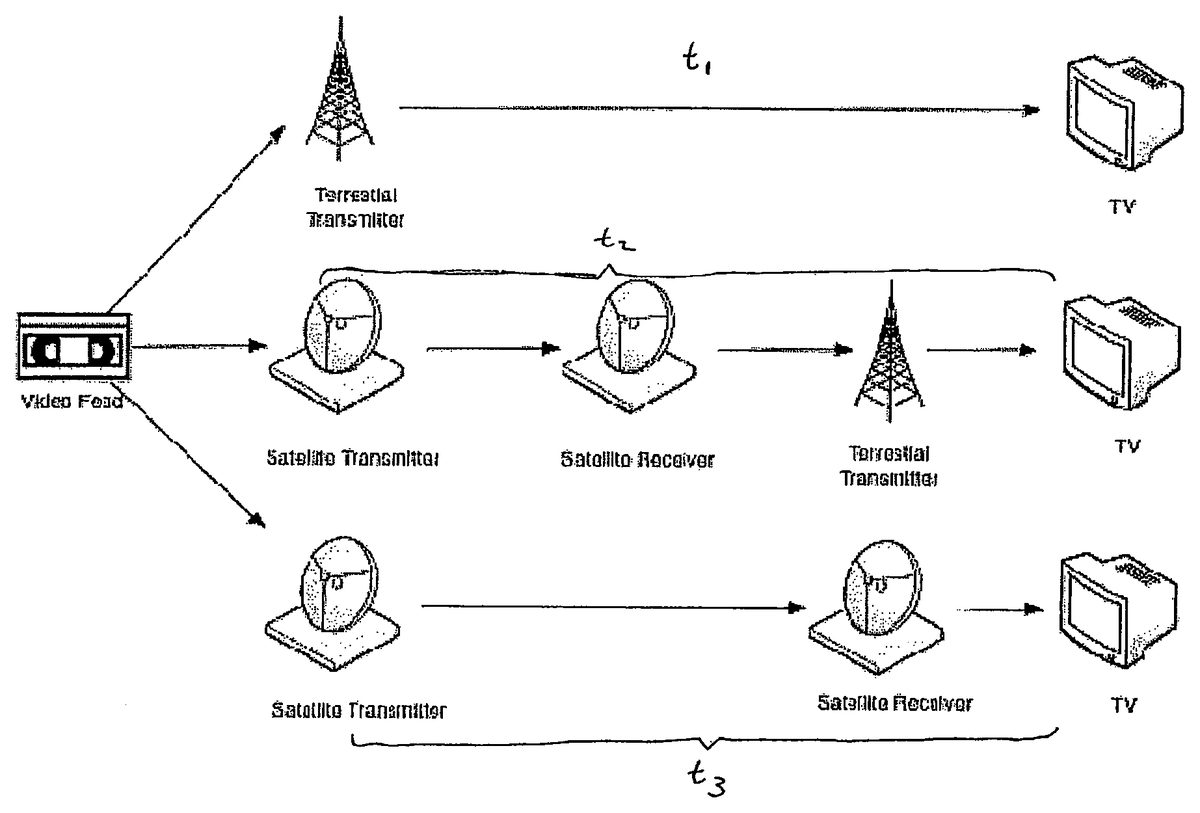
As an illustrative example where the game to be played is a TV broadcast time-sensitive game, the game's video graphics is broadcast from a television network onto the television set22of each player30via different transmission mechanisms as elaborated earlier and shown inFIG. 1. Such TV broadcast transmissions may be terrestrial TV, cable TV, satellite TV or Internet TV. Prior to and/or during actual game play, the game server16calculates the total latency (both phone and display latencies) via one of the three different ways as described in turn, as follows:a. Explicit—the determination of latency, without player inputb. Implicit—the determination of latency using player inputs; andc. Hybrid—the determination of latency using a hybrid of both explicit and implicit methods.
The explicit method of determining total latency includes obtaining a unique audio signature broadcasted from the television network. The audio signature comprises at least one marker(s) which will then be used to calculate the total latency. The marker(s) may be defined based on amplitude. An example of an audio signature broadcast with an amplitude based marker is illustrated inFIG. 4.
Upon broadcast of the audio signature, each player30is instructed to place his/her POT handset12close to the speaker of the television set to feed the audio signal into the mouthpiece of the POT handset12. Once the audio signal is received by the POT handset12, it is transmitted from the handset12to the IVRS14, where each player's30audio signature is recorded and analysed. Each audio signature may further be processed using known techniques such as noise reduction, amplitude normalization etc. At the IVRS14and game server16, the audio signature marker is identified and the signature marker's timestamp is determined. The total latency of each player30is calculated as the time difference between the time of marker broadcast and the time when the marker was recorded at the IVRS/Game Server. If the audio signature marker was broadcast at 12:10:08.060 p.m, and the audio signature of a particular player30is detected at 12:10:09:080 p.m, then there exists a total latency of 1.020 seconds or 1020 milliseconds. This total latency value is recorded and inputted in the game server16for the particular player30. The total latency values for every player participating in the game are similarly calculated.
The game server16is programmed to offset the total latency of each player30during the actual game play. Using the same total latency value (1020 milliseconds) above as an example, if player30key press is recorded on the game server at 12:30:10:040 p.m for instance, the game server automatically offsets or corrects the key press to 12:30:09:020 p.m.
As an alternative, the explicit method of calculating the total latency may be initiated by the game server16to detect the TV set's audio signature in the background, without the player30being explicitly prompted to do so.
The implicit method of calculating total latency requires a sequence of player input, which is more suited for rhythm game. The sequence of player actions is described as follows:i. A set of audio and/or video markers is broadcast from the television network to each player30. This is also known as the ‘signature sequence playback’ step. In the case of musical rhythmic games, at least one marker may be selected or predefined from a sequence of musical notes which is broadcast and displayed on the television screen of each player30, prior to the actual rhythm game itself, or during the song's introductory section. Each player30is then prompted to follow the pattern of notes according to a set of pre-defined rules. Each signature sequence has a distinct pattern. For instance, a rhythm game's signature sequence may require the player30to key “1-1-1-2” on their POT12, whereby the numbers are spaced evenly over time, half a second apart each for example.ii. Player action—Based on the above sample signature sequence, each player30is supposed to press the “1” telephone key three times, followed by a single “2” in a distinct rhythmic pattern. The player30inputs the sequence on their POT.iii. Sequence detection and identification—The inputs of each player30are transmitted to the IVRS14/Game Server16, recorded and analyzed. In the above sample sequence, “2” can be pre-defined as the marker; the three “1s” can be used merely to establish player rhythm to prepare them to hit the marker “2”. The choice of marker may be arbitrary. Using the above sample sequence as an example, the “1” prior to the “2” may actually be a more accurate marker because it requires no finger transfer to a new key. The principle, however, is that once a marker has been defined, it becomes the basis for latency determination. Similar to the explicit method, the implicit method entails the calculation of the time difference between the marker's broadcast time and each player's recorded market timestamp. If the marker was broadcast at 12:00:00.000 pm, and Player A's marker was recorded at 12:00.01.500 pm, then Player A's total latency is 1.5 seconds or 1500 milliseconds.iv. Offset calculation—As with the explicit method, offset is calculated similarly as described above. The total latency is deducted from each action's recorded time. The implicit method is particularly useful in rhythm games where players are required to input a sequence or patterns of actions. A player who does not follow the instructions, particularly for establishing the signature, may be disqualified from further game participation.
Hybrid Method—Hybrid latency determination combines both the explicit and implicit methods to more reliably measure latency. If, for instance, the explicit audio signature was too faint or distorted to be reliably used for marker identification and latency determination, the implicit method may be used as a fallback method, for example when the player30did not put the phone near the TV loudspeaker, or if the TV volume was not loud enough to be useful. In such a situation, the game server16is not able to determine a timestamp for the audio signature marker. The game server16may either prompt for a repeat or utilize the implicit method as discussed above as a fallback method. Alternatively, both explicit and implicit methods may be used to refine accuracy. As an example, the accuracy may be refined based on the following algorithm:a. if there are two latencies determined based on the explicit and implicit method, average the two latencies;b. if only one of two methods yield a latency figure, use that particular latency figure.c. If no latency figure or if no meaningful latency figure was obtained, the game server16may either use player's30previous latency if available or use a latency figure of a player with a similar profile based on location, controller type, connection, location of broadcast station etc.d. If all of the above is not obtained, the player30will be dropped from the game play.
The determination of the total latency or delay at the game server16allows the multiple players30to access the system10and resolve the bias against players30with high display and/or phone latency.
Further advantage of the system10is illustrated inFIG. 5wherein another embodiment, wherein like numerals reference like parts, permits different types of controllers12to be used. In this embodiment, players with intelligent controllers (including a mobile phone122; a computing device124; a smartphone126) may simultaneously compete against players30using POT12.
The mobile phone may access the IVRS14via a host mobile telecommunications network; and the computing device124and smartphone126may access the game server16directly via the Internet through Wi-Fi, GPRS, wired or other wireless communication means as known to a skilled person. The game server16calculates the total latency associated with each controller12regardless of whether it is a POT or other intelligent controller(s). Alternatively, as intelligent controllers122,124,126are capable of installing software with the synchronizing/latency algorithms, the total latency may alternatively be calculated at the intelligent controllers before transmitting the same to the game server16.
It is thus to be appreciated that as the game server16accounts for the latencies associated with each POT and other intelligent controllers in the system10, there is no unfair advantage provided for the more intelligent controllers, and that all players30are able to compete fairly independent of latencies.
It is to be understood that the above embodiments have been provided only by way of exemplification of this invention, such as those detailed below, and that further modifications and improvements thereto, as would be apparent to persons skilled in the relevant art, are deemed to fall within the broad scope and ambit of the present invention described.Mobile Phone—As all mobile phones122can send DTMF signals, they too can serve as game controllers12in this invention. In other words, this invention is not limited to POT as described in the further embodiment.Other DTMF Controllers—While the plain old telephone (POT) exemplifies a dumb game controller in this invention, alternative controllers include similar, computer-less devices (two-way radios) some of which can also send DTMF (dual-tone multi-frequency) signals. Examples of such devices include faux musical instruments (guitars, drum pads, dance pads) with DTMF capability.Instead of telephone key presses that send DTMF signals, voice may be used as the player action. In a timing game, for instance, a player who verbally answers correctly first is rewarded. This is similar to the TV Pow! game, except: 1) the response can be any word or phrase, not just “Pow!”; and 2) this is massively multiplayer. Another variant voice application that is being contemplated is karaoke, whereby players sing over the telephone and the Game Server16determines the winner based on pitch and timing accuracy. In these variants, the invention applies as well, since songs are pitches sung over time, hence, are affected by latency.Instead of telephone key presses that send DTMF signals, body motion/kinesthetics may also be used to trigger player action or responses, such as that employed by Microsoft's Kinect sensor.Player Registration—Player invitation/registration may be accomplished in several ways:1) Explicitly (i.e., player texts a particular keyword to a mobile operator short code, registration in a particular website, sends email address to a designated email server, invitation by a registered player, social network registration, etc.); or2) Implicitly, by social network association to a registered player.Telephone Connection The player's telephone connection to the Gaming Server is established in one of two ways: 1) the player dials into the IVRS; or 2) the IVRS calls system-selected players.Audio Signature—It is to be appreciated that amplitude is not the only means to define a marker in an audio signature. Frequency, audio signal patterns or other means may also be used to define a marker. In addition, audio signatures may be identified or established using Fourier Transform, Discrete Fourier Transform, Fast Fourier Transform and other similar signal processing algorithms known to those skilled in the art of audio and/or pattern recognition. Further, instead of using markers for determination, entire audio clip segments (also known as binary large objects or BLOB) may also be compared to a reference BLOB for pattern recognition and timing comparison, hence, latency determination.While the above embodiments have described one ‘marker’ to calculate latency, more markers may be used to more accurately determine latency. In these cases, the latency calculated based on each marker may be averaged based on a multi-marker latency calculation.Game server16may further include auxiliary display in addition to the video being broadcast, etc. For instance, the broadcast video may display nationwide winners, whereas “social network displays” may show players and winners within each player's social network.As mentioned in the further embodiment, the latency calculation mechanism may be implemented as an algorithm in the form of software installed on the more intelligent controllers122,124,126. The more intelligent controllers122,124and126may also be utilized for game controls and scoring for better load distribution, instead of these controls and scoring being performed at the game server16.The described embodiments are particularly suited for time sensitive multi-platform game play. Time sensitive game play requires synchronization and latency calculation to account for the use of different types of controllers as illustrated inFIG. 5or different delays or latencies associated with different POT system inFIG. 3. The calculation and offset of latencies ensure a fairer game play amongst different players. It is easily appreciated that for non-time-sensitive multi-platform game play, the calculation of latency and offset for the same could be easily bypassed. The controllers' inputs are aggregated by the IVRS14if necessary and sent to game server16for processing without calculation of latency.
Furthermore, although individual embodiments have been discussed it is to be understood that the invention covers combinations of the embodiments that have been discussed as well.
Claims
- A system for facilitating an interactive multi-player broadcast game, the system comprising: a plurality of game controllers, the plurality of game controllers comprise a Plain Old Telephone (POT) controller and an intelligent controller;a game server operable to receive from each of the plurality of controllers a set of game inputs in response to the broadcast game;and a broadcast network for transmitting a broadcast related to the interactive multi-player broadcast game;wherein the game server is operable to control game play and scoring, wherein the game server is further operable to determine latency data associated with the POT controller based on at least a marker that is sent over the broadcast network and offset the latency associated with the POT controller during game play;and wherein the game server is further operable to either calculated or received latency data associated with the intelligent controller and offset the latency associated with the intelligent controller during game play.
- The system according to claim 1 , wherein the determination of the latency associated with the POT controller comprises using either an audio marker that is sent over the broadcast network or a set of player inputs in response to a set of audio and/or visual markers that is sent over the broadcast network.
- The system according to claim 1 , wherein the broadcast network includes TV broadcast transmissions using terrestrial TV, cable TV, satellite TV or Internet TV.
- The system according to claim 1 , wherein where a game controller is POT, the game server is operable to calculate the latency associated with the POT;and where the game controller is an intelligent controller, the game server is operable to receive the latency data associated with the intelligent controller via a timestamp.
- The system according to claim 1 , wherein the latency data associated with the intelligent controller is computed by the intelligent controller.
- The system according to claim 1 , wherein the latency data associated with the intelligent controller is computed by the game server.
- The system according to claim 1 or 6 , wherein the calculation of latency includes the calculation of at least the display latency and controller latency.
- A method for facilitating an interactive multi-player broadcast game comprising the following steps: transmitting a broadcast related to the interactive multi-player broadcast game over a broadcast network;receiving at a game server a set of game inputs from a plurality of game controllers;the plurality of game controllers comprising a POT controller and an intelligent controller;controlling at the game server, the game play and scoring;determining latency data associated with the POT controller based on at least a marker that is sent over the broadcast network;offsetting the latency associated with the POT controller during game play;and wherein the game server is further operable to either calculated or receive latency data associated with intelligent controller and offset the latency associated with the intelligent controller during game play.
- The method according to claim 8 , wherein the step of determining the latency associated with the POT controller comprises using either an audio marker that is sent over the broadcast network or a set of player inputs in response to a set of audio and/or visual markers that is sent over the broadcast network.
- The method according to claim 9 , wherein the TV broadcast network include TV broadcast transmissions using terrestrial TV, cable TV, satellite TV or Internet TV.
- The method according to claim 8 , wherein where a game controller is POT, the game server is operable to calculate the latency associated with the POT;and where the game controller is an intelligent controller, the game server is operable to receive the latency data associated with the intelligent controller via a timestamp.
- The method according to claim 8 , wherein the latency data associated with the intelligent controller is computed by the intelligent controller.
- The method according to claim 8 , wherein the latency data associated with the intelligent controller is computed by the game server.
- The method according to claim 8 or 13 , wherein the calculation of latency includes the calculation of at least the display latency and controller latency.
Disclaimer: Data collected from the USPTO and may be malformed, incomplete, and/or otherwise inaccurate.