U.S. Pat. No. 9,457,276
COMPUTER GAME ELEMENTS, DEVICE AND METHODS THEREFOR
AssigneeKING.COM LTD.
Issue DateMarch 25, 2014
Illustrative Figure
Abstract
In an embodiment there is provided a computer implemented method of controlling a user interface responsive to user engagement with a displayed game area on the interface, the method comprising the following implemented by at least one processor of a device, displaying a game area having a plurality of first game objects on said display, providing one or more characteristics of said first game objects and one or more action characteristics of at least one second game object, displaying said at least one second game object at a position on said game area, detecting user input re-arranging one or more of said first game objects, and activating said action characteristics of the at least one second game object in dependence on said detected input re-arranging said one or more first game objects to provide a sequence of two or more first game objects having one or more of the same characteristics adjacent the position of the second game object, and wherein at least one of the action characteristics of the second game object comprises revealing a further game object when said sequence is detected.
Description
DETAILED DESCRIPTION OF SOME EMBODIMENTS The techniques described herein can be implemented in for instance a computer game which involves the matching or switching of first game objects displayed on a game area or game board and the elimination of such to complete a level or aim or target of such a game. The game may be a so-called “casual” or “social” game, wherein short periods of play are undertaken by the user whenever appropriate according to the user's schedule. Such games are increasingly offered and played by users on portable devices so as to fit in with the user's lifestyle and schedule. Such portable devices may have limited resources in terms of display screen size (“screen real-estate”), processing power and may be powered ostensibly by battery only thereby leading to a potentially short battery-life trade-off with use. Furthermore, the screen real-estate of such devices such as mobile phones may be limited. When such a screen is a so-called “touchscreen”, then the limited dimensions and sensitivity of the touchscreen may lead to control and input issues due to the limited resources available. Such issues may all too often lead to user frustration when using the device, and especially when using the device in the context of playing a game with an objective and which may provide prizes or social data. Given the user's lifestyle, and the potentially limited computing resources available, it can be a problem to motivate a user to complete a level of the game or fully explore the mechanics and rewards available without becoming frustrated. For example, in such games so called “boosters” are often introduced. Boosters typically provide a special effect that aids completion of the level. For example, a booster may have a “bomb” effect which explodes removing surrounding game objects in the vicinity of ...
DETAILED DESCRIPTION OF SOME EMBODIMENTS
The techniques described herein can be implemented in for instance a computer game which involves the matching or switching of first game objects displayed on a game area or game board and the elimination of such to complete a level or aim or target of such a game. The game may be a so-called “casual” or “social” game, wherein short periods of play are undertaken by the user whenever appropriate according to the user's schedule.
Such games are increasingly offered and played by users on portable devices so as to fit in with the user's lifestyle and schedule. Such portable devices may have limited resources in terms of display screen size (“screen real-estate”), processing power and may be powered ostensibly by battery only thereby leading to a potentially short battery-life trade-off with use. Furthermore, the screen real-estate of such devices such as mobile phones may be limited. When such a screen is a so-called “touchscreen”, then the limited dimensions and sensitivity of the touchscreen may lead to control and input issues due to the limited resources available. Such issues may all too often lead to user frustration when using the device, and especially when using the device in the context of playing a game with an objective and which may provide prizes or social data.
Given the user's lifestyle, and the potentially limited computing resources available, it can be a problem to motivate a user to complete a level of the game or fully explore the mechanics and rewards available without becoming frustrated. For example, in such games so called “boosters” are often introduced. Boosters typically provide a special effect that aids completion of the level. For example, a booster may have a “bomb” effect which explodes removing surrounding game objects in the vicinity of it. Other such boosters may provide line or row elimination effects, or object type effects. Other boosters may provide a score or bonus multiplier, or extra time in a time monitored or countdown level. Boosters may also provide extra moves in a game or level where moves are limited. Boosters may be offered for free, or appear during gameplay based on certain events, accomplishments or criteria, or be purchased from an online store for example.
The inventors have realised that even with the provision of boosters, it can be difficult to educate or motivate a user to explore the nature of such boosters. A proliferation of boosters may confuse a casual user, particularly considering the short periods of play undertaken by a user according to their busy schedule. This can lead to disengagement by the user, thereby preventing repeat play.
FIG. 1shows an example game board for display on a user device according to an embodiment. The game has a displayed game area100upon which are disposed first game objects110a,110b,110c,110dwhich may have varying characteristics. The characteristics may be one or more of colour, shape, and/or different types of objects. In this embodiment, the objects are differently coloured graphical representations of peppers or chilies.
The first game objects may have other characteristics defining graphical representations and shapes, and may represent different types of similar objects when displayed on the game area100.
In some embodiments, the game may be implemented so that a level or a game session is completed when all or designated first game objects110a,110b,110c,110don the game board100have been cleared or eliminated. The user may then progress to the next level.
First game objects110a,110b,110c,110dmay be removed from the game board100by user input switching first game objects120to create a sequence. The sequence may require two or three or more first game objects110aof the same type to be aligned in a row or column of said game area100.
The user or player may in some embodiments be rewarded for good gameplay. For instance a series of consecutive targeting of neighbouring first game objects sharing at least one of the one or more data characteristics may increase a bonus multiplier, provide a booster or provide extra points, moves or time.
The game may, in one embodiment, end if the player or user runs out of time or moves or shots before managing to reach a designated target (not shown inFIG. 1).
The game board100may have a plurality of first game objects110a,110b,110c,110dhaving different characteristics aligned in rows and columns or forming patterns on the game board100as shown inFIG. 1. Other grid sizes or patterns may be suitable.
The first game objects110a,110b,110c,110don the game board100may have four (or any other suitable number of) contact points with other neighbouring or adjacent first game objects.
Other game board layouts or configurations may be provided. For example, pyramidal, hexagonal, octagonal or other layouts comprising position spaces or tiles within the game board100may be provided for display.
In some embodiments the first game objects110a,110b,110c,110dmay be depicted as peppers or chillies of differing colours. The number of differing colours may for example be three or more colours.
A schematic view of a user or computing device200according to an embodiment is shown inFIG. 2. All of the blocks shown are implemented by suitable circuitry. The blocks may be implemented in hardware and/or software. The user device may have a control part210. The control part210has one or more processors215and one or more memories220. The control part210is also shown as having a graphics controller225and a sound controller230. It should be appreciated that one or other or both of the graphics controller225and sound controller230may be provided by the one or more processors215.
The graphics controller225is configured to provide a video output235. The sound controller230is configured to provide an audio output240. The controller210has an interface245allowing the device to be able to communicate with a network250such as the Internet or other communication infrastructure.
The video output235is provided to a display255. The audio output240is provided to an audio device260such as a speaker and/or earphone(s).
The device200has an input device265. The input device265can take any suitable format and can be one or more of a keyboard, mouse, touch screen, joystick or game controller. It should be appreciated that the display255may in some embodiments also provide the input device265by way of an integrated touch screen for example.
The blocks of the controller210are configured to communicate with each other by an interconnect such as a bus or any other suitable interconnect and/or by point to point communication.
It should be appreciated that in some embodiments, the controller210may be implemented by one or more integrated circuits, at least in part.
The user device200is shown by way of example only. In alternative embodiments, one or more of the parts may be omitted. Alternatively or additionally, some embodiments may comprise one or more other parts. Alternatively or additionally, one or more parts may be combined.
FIG. 3schematically shows a system300in some embodiments. The system300comprises a server320which may store databases of game players' details, profiles, high scores and so on. In practice, one or more databases may be provided. Where more than one server is provided, the database(s) may be provided in one database or across two or more servers320. The server320may also have a games data function. This may comprise a memory to store the computer game program and a processor to run the games program.
The server may communicate via for instance the internet310to one or more user devices305and may further provide connections to a social network330such as facebook™.
It should be appreciated that embodiments may be deployed in different system architectures. For example, the computer game may be implemented as a computer game that is stored in the memory220of the user device200and is run on the processor215of the user device200. However, the server320may handle some elements of the game in some embodiments. By way of example only, a Java game applet may be provided to the user device200and the locally running Java applet will generate, for example, the graphics, sounds, and user interaction for the game play on the user device200. Some data may be fed back to the server320to allow interaction with other players305. The data which is fed back may also allow scoring and/or cross platform synchronization.
In some embodiments, the game may be implemented as a computer program that is stored in a memory of the system, for example the server320, and which runs on a processor of the game server. Data streams or updates are supplied to the user device200to allow the user device200to render and display graphics and sounds in a browser of the user device200. Such an approach is sometimes referred to as a web services approach. It should be appreciated, however, that such an approach does not necessarily require the use of the Internet.
Embodiments will now be described with reference toFIG. 4.
FIG. 4shows a game board100having first game objects110a,110b,110c,110ddisposed in cells or tiles thereon in a grid. Also shown are second game object(s)400. In this embodiment second game object(s)400are depicted as crates. Other suitable graphical representations may be applied depending on the context of the game and the second game object'400actionable characteristics. The second game object may, in another embodiment be depicted as a safe, or a locked box. Such depictions are subject to the game designer and game context, and not limited to these examples alone.
An example actionable characteristic of the second game object will now be described with the aidFIG. 5andFIG. 6.
FIG. 5shows a game board100having first game objects110a,110b,110c,110ddisposed in cells or tiles thereon in a grid. Also shown are second game object(s)400. In this embodiment second game object(s)400are depicted as crates. Other suitable graphical representations may be applied depending on the context of the game and the second game object'400actionable characteristics.FIG. 5also depicts a selection switching indicator numeral410, as a circle with a pointer within. This is shown in the Figure for clarity of explanation, and may for example be applied in an embodiment as referred to previously with reference toFIG. 3comprising a web services or browser based personal computer or laptop300approach.
In other embodiments user devices200comprising touch or gesture or proximity enabled input means, such as a touchscreen, no selection indicator410may be visible or displayed to the user of that device200.
FIG. 6illustrates an actionable characteristic of a second game object400which depends on a switching or selecting rule. As can be seen in the Figure, a user selects410game object110aand subsequent input detected by the input265indicates a move or switch of the first game object110ato the position adjacent occupied by object110d.This is indicated in the Figure by arrow “a”.
Hence, the user performs a switch which places two or three or more matching first game objects110atogether in a sequence600. In this embodiment this matching sequence eliminates the three matching first game objects110aand provides a score to the user. Furthermore, in this embodiment the matching600adjacent second game object400has a further effect in causing the actionable characteristic (indicated by the arrow “b” in the Figure) of second game object400adjacent the matching three first game objects to be activated.
In one embodiment the actionable characteristic eliminates the second game object to reveal a further game object on the display255.
In one embodiment, this is to reveal a first game object110a,110b,110c,110d.
In another embodiment the revealed further game object400is provided dependent on a rule. The rule providing said revealed further game object for example comprises selecting from a store of one or more first game objects110a,110b,110c,110d,second game objects400and further game objects. There may be a weighting associated with each possible further game object. Alternatively or additionally the weighting may be based on game state or progress.
In some embodiments the game state comprises the frequency of the appearance of further game objects on the said game area prior to the selection.
In some embodiments the weighting may be based on a timer or target or move counter (or a combination of one or more of these) associated with the game or current game level. For example, if the time remaining to complete the level is diminishing, the generation of a second game object may be modified to aid the revealing of a further object. If the further object when activated reveals a booster, the booster may aid completion of the level by for example increasing the time remaining In this way, the user may be engaged to discover the effects of boosters, and hence encouraged to explore or play the game further.
In another embodiment, the weighting may be based on a move counter associated with the game or current game level. The weighting may be further based on a move counter passing a predefined threshold.
In some embodiments the weighting may be based on a random number function.
In some embodiments, the weighting may be dependent on the level of the game. For example, the weighting may depend on the overall ranking of the level (typically first encountered or lower levels are easier to complete and less challenging than later or higher levels). The weighting may alternatively or additionally depend on the number of levels completed in some embodiments.
In another embodiment, the weighting may depend on previously purchased boosters based on the user history stored in memory220. Alternatively or additionally the weighting may depend on an overall history of user purchases stored in server320and social network330of system environment300.
At least one of the one or more second game object400action characteristics may comprise said second game object400, when displayed, obscuring the or a further game object. Hence the second game object400“hides” the further game object and provides an incentive to the user to activate the second game object400to reveal the further object inside. An engaging mechanic may therefore be provided.
In an embodiment, the at least one action characteristic may comprise the second game object400revealing the further game object in dependence on a first detected input265forming a sequence of first game objects110a,110b,110c,110dhaving one or more of the same characteristics adjacent the second game object400, and may further depend on subsequent input re-arranging displayed first game objects110a,110b,110c,110dto provide a further sequence of two or more first game objects110a,110b,110c,110dhaving one or more of the same characteristics adjacent the second game object400. This provides a cascading effect which may further provide second game objects on the game area100.
The rule may, in some embodiments comprise providing the further game object in dependence on an algorithm. For example, the further game object may be selected from in dependence on the number of first game objects110a,110b,110c,110dcurrently displayed255.
In another embodiment, the algorithm may comprise providing the further game object in dependence on the frequency of previously generated and displayed first game objects110a,110b,110c,110dsharing the characteristics of the generated game object and/or second game object.
The algorithm providing a further game object may further comprise selecting from a store of first game objects110a,110b,110c,110dand/or second game objects based on a random number function to determine the provision.
In another embodiment, the rule or algorithm may determine that no further game object is revealed.
In the above an action characteristic of the second game object400may be triggered or activated by matching600a sequence of first game objects110aadjacent the second game object.
Other variations of action characteristics may be implemented in some embodiments.
For example, in an embodiment the action characteristic of the second game object400revealing the further game object may depend on a cascading sequence of matches caused by a first or successive matching sequence. For example, a first detected input forming a sequence of first game objects110a,110b,110c,110dhaving one or more of the same characteristics adjacent the second game object may be detected, and subsequent input re-arranging other first game objects to provide a further sequence of two or three or more first game objects110a,110b,110c,110dhaving one or more of the same characteristics adjacent the second game object400is required to cause the action characteristic to activate.
Thus, more than one sequence or event may be required to activate the second game object400. For example, the second game object may be graphically represented as a box or container with a lock, or a safe for instance, implying to the user that several events may be required to “unlock” the second game object. Hence a multi-step action characteristic for second game objects400is provided.
Second game objects400having differing action characteristics, as described above, may be provided in the same game and displayed on the same game board100to effect improved user engagement with the game.
The revealed further game object may comprise a second game object400, with the same or differing action characteristics therefore providing further challenge and engagement.
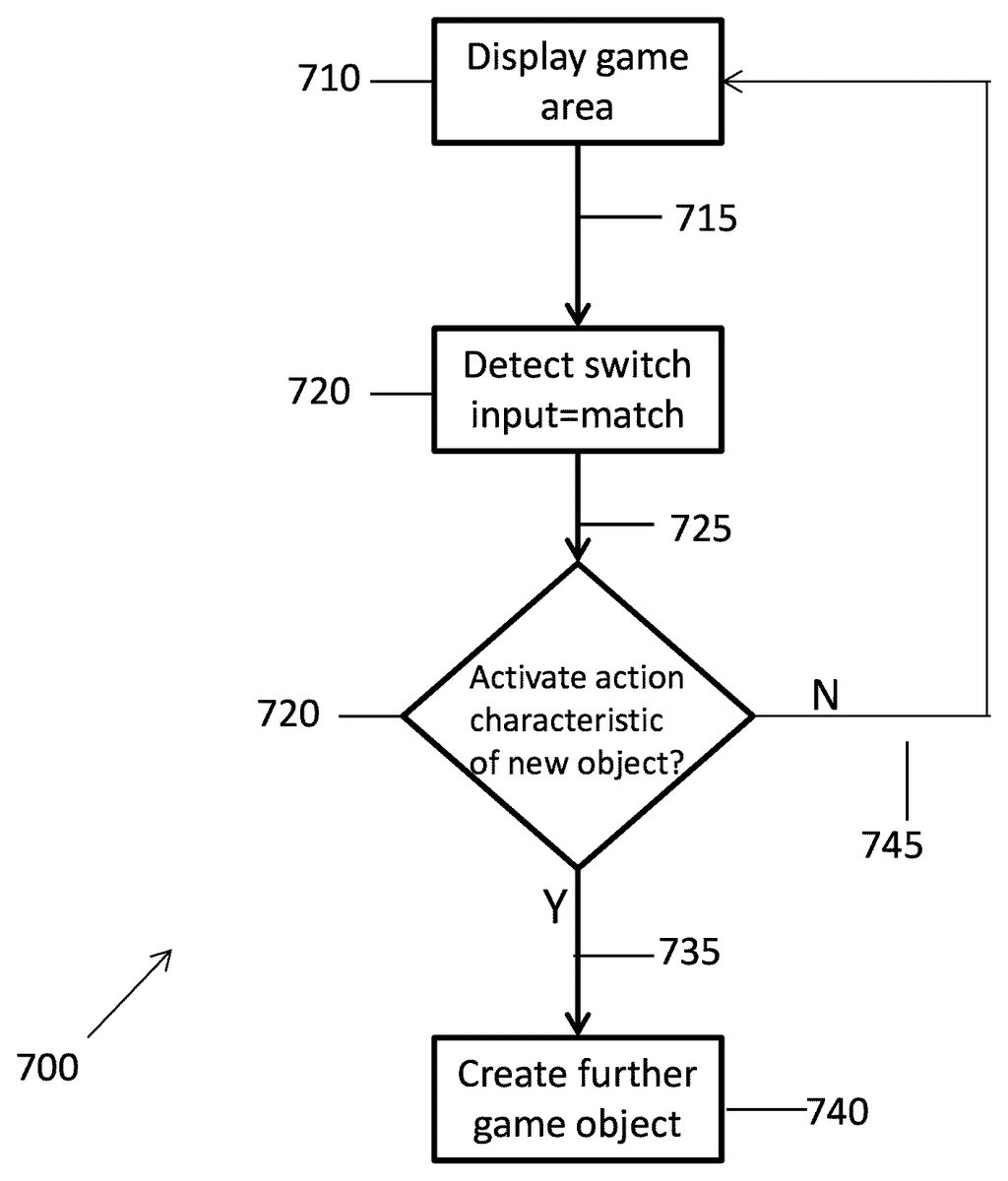
FIG. 7illustrates a flow chart700showing steps according to an embodiment. At step710a game area or game board100is displayed255on the user device200,305. At least one processor215,320subsequently monitors715user input and detects whether a user input provides a match at step720. On detection of a match or switch input the processor215,320analyses for a second game object400adjacent to, or in the vicinity (for example two cells or tiles of the game board100) of the matching first game objects110a,110b,110c,110d.If no such second game object400is adjacent to, or in the vicinity, process flow returns from step730to the start710via path745.
If there is such a second game object400adjacent to, or in the vicinity (for example two cells or tiles of the game board100) then the action characteristic of the second game object400is activated735in dependence on the user input satisfying the criteria of the action characteristic, and flow continues under control of the at least one processor215,320to step740where a further game object is created and revealed to the user.
The creation of the further game object may (not shown in the Figure) further depend on a rule. The rule may, in some embodiments comprise providing the further game object in dependence on an algorithm. For example, the further game object may be selected in dependence on the number of first game objects110a,110b,110c,110dcurrently displayed255.
In another embodiment, the algorithm may comprise providing the further game object in dependence on the frequency of previously generated and displayed first game objects110a,110b,110c,110dsharing the characteristics of the generated first game object and/or second game object.
The algorithm providing a further game object may further comprise selecting from a store of first game objects110a,110b,110c,110dand/or second game objects based on a random number function to determine the provision.
In some embodiments, the rule or algorithm may determine that no further game object is revealed or created as described hereinbefore.
Various methods and devices have been described. It should be appreciated that these methods may be implemented in apparatus or devices comprising any suitable circuitry. Some embodiments may be implemented by at least one memory and at least one processor. The memory is provided by memory circuitry and the processor is provided by processor circuitry. Some embodiments may be provided by a computer program running on the at least one processor. The computer program may comprise computer implemented instructions which are stored in the at least one memory and which may be run on the at least one processor.
It is also noted herein that while the above describes embodiments of the invention, there are several variations and modifications which may be made to the disclosed solution without departing from the scope of the present invention.
Claims
- A computer implemented method of controlling a user interface responsive to user engagement with a displayed game area on the interface, the method comprising the following implemented by at least one processor of a device: displaying a game area having a plurality of first game objects on said display, providing one or more characteristics of said first game objects and one or more action characteristics of at least one second game object, displaying said at least one second game object at a position on said game area, detecting user input re-arranging one or more of said first game objects, and activating said action characteristics of the at least one second game object in dependence on said detected input re-arranging said one or more first game objects to provide a sequence of two or more first game objects having one or more of the same characteristics adjacent the position of the second game object, and wherein at least one of the action characteristics of the second game object comprises revealing a further game object when said sequence is detected, wherein the revealed further game object is provided in dependence on on a rule, said rule providing said revealed further game object comprises selecting from a store of first game objects, second game objects and further game objects in dependence on a weighting, said weighting being based on one of: frequency of the appearance of further game objects on the said game area prior to the selection;a timer associated with the game;and a move counter associated with the game.
- A method according to claim 1 wherein the revealed further game object is a first game object.
- A method according to claim 1 , wherein said weighting is based on the frequency of the appearance of further game objects on the said game area prior to the selection.
- A method according to claim 1 , wherein said weighting is based on a timer associated with the game.
- A method according to claim 1 , wherein said weighting is based on a move counter associated with the game.
- A method according to claim 5 , wherein said weighting is based on a move counter passing a predefined threshold.
- A method according to claim 1 , wherein at least one of the one or more second game object action characteristics comprise said second game object, when displayed, obscuring a further game object.
- A method according to claim 1 , wherein the action characteristic comprises the second game object revealing the further game object in dependence on: a first detected input forming a sequence of first game objects having one or more of the same characteristics adjacent the second game object, and subsequent input re-arranging other first game objects to provide a further sequence of two or more first game objects having one or more of the same characteristics adjacent the second game object.
- A method according to claim 1 , wherein the action characteristics of said second game object comprise the second game object being graphically represented as a crate or box.
- A method according to claim 1 , wherein said further game object comprises a booster object providing an additional game function.
- A device having a user interface responsive to user engagement and input with a displayed game area on the interface, and comprising: a display to display said game area having a plurality of first game objects on said display, at least one memory storing said first game objects and one or more characteristics of said first game objects, second game objects, and one or more action characteristics of at least one second game object and further game objects, and at least one processor configured to: display said at least one second game object at a position on said game area on said display, detect user input re-arranging said first game objects, and process said action characteristics of the at least one second game object in dependence on said detected input re-arranging said first game objects to provide a sequence of two or more first game objects having one or more of the same characteristics adjacent the second game object, and wherein at least one of the stored action characteristics of the second game object comprises revealing a further game object when said sequence is detected, wherein said at least one processor is configured such that the revealed further game object is provided in dependence on a rule, said rule providing said revealed further game object comprises selecting from said memory of first game objects, second game objects and further game objects in dependence on a weighting, said weighting being based on one of: frequency of the appearance of further game objects on the said game area prior to the selection;a timer associated with the game;and a move counter associated with the game.
- A device according to claim 11 , wherein said processor is further configured to receive an algorithm stored in the at least one memory to control second and further game object generation.
- A device according to claim 11 , wherein said action characteristics of said second game object comprise that the displayed second game object is stationary with respect to said first game objects displayed on said game area.
- A device according to claim 11 wherein said further game object comprises a booster object providing an additional game function.
- A device according to claim 11 , wherein the action characteristic comprises the second game object revealing a further game object in dependence on: a first detected input forming a sequence of first game objects having one or more of the same characteristics adjacent the second game object, and subsequent input re-arranging other game objects to provide a further sequence of two or more first game objects having one or more of the same characteristics adjacent the second game object.
- A computer readable non-transitory storage medium carrying one or more sequences of instructions which, when processed by a processor, causes said processor to perform the following steps: displaying a game area having a plurality of first game objects on said display, providing one or more characteristics of said first game objects and one or more action characteristics of at least one second game object, displaying said at least one second game object at a position on said game area, detecting user input re-arranging said first game objects, and activating said action characteristics of the at least one second game object in dependence on said detected input re-arranging said first game objects to provide a sequence of two or more first game objects having one or more of the same characteristics adjacent the second game object, and wherein at least one of the action characteristics of the second game object comprises revealing a further game object when said sequence is detected, wherein the revealed further game object is provided in dependence on a rule, said rule providing said revealed further game object comprises selecting from a store of first game objects, second game objects, and further game objects in dependence on a weighting, said weighting being based on one of: frequency of the appearance of further game objects on the said game area prior to the selection;a timer associated with the game;and a move counter associated with the game.
Disclaimer: Data collected from the USPTO and may be malformed, incomplete, and/or otherwise inaccurate.