U.S. Pat. No. 9,446,312
VIDEO GAME SYSTEMS AND METHODS FOR PROTECTING GAME CHARACTERS DURING GAME PLAY
AssigneeNintendo Co., Ltd.
Issue DateFebruary 4, 2014
U.S. Patent No. 9,446,312: Video game systems and methods for protecting game characters during game play
U.S. Patent No. 9,446,312: Video game systems and methods for protecting game characters during game play

Summary:
U.S. Patent No. 9,446,312 helps both experts and beginners gamers play together. Often in a video game, if a player’s character hits an obstacle or fails a challenge, the character may lose health, return to the beginning of a level, or die. This becomes complicated if multiple players are playing a level together and the level is much too easy or difficult for certain players. It is neither enjoyable for a player if the game is much too easy or difficult for them.
A solution to this problem was shown at the E3 convention in 2009. During the demo for a Super Mario Bros. game, a character became encased in a protective bubble when the character lost a life. The character remained in the bubble until freed by another player. The character could not be harmed in the bubble, but also could not participate in the game. The player was penalized by not being able to participate directly but could continue playing once released from the bubble. This example helps to exemplify the ‘312 Patent. More generally, the patent outlines that if a certain condition is satisfied (a player dies, for example), the player’s game character is protected from harm for a period. Movements of the protected game character are controlled based on another player. In the example above, for instance, it is not until a non-protected character popped the bubble that the protected player could continue in the game.
Abstract:
Example systems and methods relate to playing a multi-player video game in which multiple players each supply inputs to a respective input device to control a corresponding game character in a game world displayed on a display screen. Movements of each game character in the game world are controlled in accordance with respective first game character control operations during the playing of the multi-player video game. In response to satisfaction of one or more conditions, one player’s game character is protected from harm in the game world, wherein one of the one or more conditions is a condition triggered voluntarily by the one player. Movements of the protected game character in the game world are controlled based on a position of another, unprotected game character.
Illustrative Claim:
1. A method for playing a multi-player video game, the method comprising: generating, in accordance with execution of a video game program by a computer, a virtual game world including multiple player-controllable game characters; generating, by the computer, images of the virtual game world for display on a display screen; receiving, by the computer, during the playing of the video game, game character movement control signals, the game character movement control signals being based on inputs to input devices, each used by a respective player, for controlling a corresponding game character in the virtual game world; controlling, by the computer, movements of each game character in the virtual game world in accordance with the respective game character movement control signals; in response to an input, predetermined by the video game program, to the input device of a first one of the players controlling a first one of the game characters during the playing of the multi-player video game, controlling, by the computer, the virtual game world so that the first game character becomes a protected game character protected from harm in the game world; and controlling, by the computer, movements of the protected first game character in the virtual game world based on a position of another, unprotected game character, wherein the first game character becomes a protected game character without a loss of vitality of the first game character or without a loss of life of the first game character.
Research By: Rachel Johns
Edited By: Andrew F. Thomas
Illustrative Figure
Abstract
Example systems and methods relate to playing a multi-player video game in which multiple players each supply inputs to a respective input device to control a corresponding game character in a game world displayed on a display screen. Movements of each game character in the game world are controlled in accordance with respective first game character control operations during the playing of the multi-player video game. In response to satisfaction of one or more conditions, one player's game character is protected from harm in the game world, wherein one of the one or more conditions is a condition triggered voluntarily by the one player. Movements of the protected game character in the game world are controlled based on a position of another, unprotected game character.
Description
DETAILED DESCRIPTION OF EXAMPLE EMBODIMENTS This application describes example systems and methods that relate to playing a multi-player video game in which multiple players each supply inputs to a respective input device to control a corresponding game character in a scrolling-type game world displayed on a display screen. The video game may be played using a video game console, a hand-held gaming device, a personal digital assistant, a cellular phone, a pad-type computer, a notebook computer, a personal computer and the like. Each player controls a game character in response to inputs supplied to the respective input device. The input device may include one or more of buttons, keys, sliders, joysticks, cross-switches and the like and may also sense motion or position change through the use of one or more of cameras, accelerometers, gyro sensors, ultrasonic transducers, magnetometers and the like. In response to a first predetermined input (e.g., a button press) from one of the players, that player's game character is protected from harm in the game world. This protected state may be shown by, for example, wrapping or encasing the game character in a bubble. The protected game character moves based on the scrolling/non-scrolling state of the game world determined in accordance with movement of one or more unprotected game characters. For example, if the game world is not scrolling, the protected game character may move generally toward the center of the currently displayed game world. If the game world is scrolling, the protected game character may move generally in the same direction as the game world background. The protecting of the game character is stopped in response to one or more protecting stopping conditions, whereby the game character is again fully controllable by the one player in response to inputs to the respective input device. By way ...
DETAILED DESCRIPTION OF EXAMPLE EMBODIMENTS
This application describes example systems and methods that relate to playing a multi-player video game in which multiple players each supply inputs to a respective input device to control a corresponding game character in a scrolling-type game world displayed on a display screen. The video game may be played using a video game console, a hand-held gaming device, a personal digital assistant, a cellular phone, a pad-type computer, a notebook computer, a personal computer and the like. Each player controls a game character in response to inputs supplied to the respective input device. The input device may include one or more of buttons, keys, sliders, joysticks, cross-switches and the like and may also sense motion or position change through the use of one or more of cameras, accelerometers, gyro sensors, ultrasonic transducers, magnetometers and the like.
In response to a first predetermined input (e.g., a button press) from one of the players, that player's game character is protected from harm in the game world. This protected state may be shown by, for example, wrapping or encasing the game character in a bubble. The protected game character moves based on the scrolling/non-scrolling state of the game world determined in accordance with movement of one or more unprotected game characters. For example, if the game world is not scrolling, the protected game character may move generally toward the center of the currently displayed game world. If the game world is scrolling, the protected game character may move generally in the same direction as the game world background.
The protecting of the game character is stopped in response to one or more protecting stopping conditions, whereby the game character is again fully controllable by the one player in response to inputs to the respective input device. By way of example, the protecting may be stopped when the protected game character contacts another, unprotected game character. By way of further example, the protecting may be stopped when the protected game character is hit by a projectile (e.g., a fireball, a shell, etc.), such as a projectile flung by another game character.
By allowing a player to voluntarily invoke the protection feature, the player's character can be protected during difficult parts of the game as determined by the player's own judgment and can follow along with the progress of a better player(s). This can make the playing of multi-player games among players of differing abilities more enjoyable.
FIG. 1shows a non-limiting example game system10in which the video game systems and methods described herein may be used. As shown inFIG. 1, example game system10includes a game console100, a television102and a controller107. WhileFIG. 1shows a video game console, the systems and methods described herein are in no way limited to this gaming environment and are also applicable to video games running on hand-held gaming devices, personal digital assistants, cellular telephones, pad-type computers, notebook computers, personal computers and the like.
Game console100executes a game program(s) or other software application(s) stored on optical disc104, which is inserted into slot105formed in housing110thereof. The result of the execution of the game program or other application is displayed on display screen101of television102to which game console100is connected by cable106. Audio associated with the game program or other application is output via speakers109of television102. While an optical disk is shown inFIG. 1, the game program or other application may alternatively or additionally be stored in whole or part on other removable or non-removable, non-transitory storage media such as semiconductor memories, magneto-optical memories, magnetic memories and the like.
Controller107is held in a player's hand and wirelessly transmits data such as game control data to the game console100. The game control data may be generated using an operation section of controller107having, for example, a plurality of operation buttons, a key, a stick and the like. Controller107may also wirelessly receive data transmitted from game console100. Any one of various wireless protocols such as Bluetooth (registered trademark) or Wi-Fi may be used for the wireless transmissions between controller107and game console100.
A “nunchuk” controller125may be connected to controller107. Although a wired connection is shown inFIG. 1between controller107and nunchuk controller125, alternatively, a wireless connection may be used. Nunchuk controller125may be held in the user's “other” hand (i.e., the hand not holding controller107) and provides additional game control data to video game console100.
Controller107also includes an imaging information calculation section (not shown) for capturing and processing images from light-emitting devices108aand108b. Although markers108aand108bare shown inFIG. 1as being above television100, they may also be positioned below television100. In one implementation, a center point between light-emitting devices108aand108bis substantially aligned with a vertical center-line of display screen101. The images from light-emitting devices108aand108bcan be used to determine a direction in which controller107is pointing as well as a distance of controller107from display screen101. Additional details of the imaging operation may be found in U.S. Patent Publication No. 2007-0066394 A1; U.S. Patent Publication No. 2007-0072674 A1; and U.S. Patent Publication No. 2007-0060228 A1. The entire contents of each of these applications are expressly incorporated herein.
Controller107also preferably includes an accelerometer(s) and/or a gyro sensor(s). For example, controller107may include a three-axis, linear accelerometer that detects linear acceleration in three directions, e.g., the up/down direction, the left/right direction, and the forward/backward direction. Linear accelerometers are only capable of detecting acceleration along a straight line corresponding to each axis thereof. In other words, the direct output of the accelerometer is limited to signals indicative of linear acceleration (static or dynamic) along each of the axes thereof. As a result, the accelerometer cannot directly detect movement along a non-linear (e.g. arcuate) path, rotation, rotational movement, angular displacement, tilt, position, attitude or any other physical characteristic. However, through additional processing of the linear acceleration signals output from the accelerometer, additional information relating to controller107can be inferred or calculated (determined). For example, by detecting static, linear acceleration (i.e., gravity), the linear acceleration output of the accelerometer can be used to determine tilt of the controller relative to the gravity vector by correlating tilt angles with detected linear acceleration. In this way, the accelerometer can be used in combination with a micro-computer (not shown) of controller107(or another processor such as a processor of the video game console100) to determine tilt, attitude or position of controller107. Similarly, various movements and/or positions of controller107can be calculated through processing of the linear acceleration signals generated by the accelerometer when controller107is subjected to dynamic accelerations by, for example, a user shaking or waving the controller.
Gyro sensors can be used in addition to, or in place of, the acceleration sensor for determining, for example, movement, tilt, etc. of the controller.
With reference to the block diagram ofFIG. 2, game console100includes a RISC central processing unit (CPU)204for executing various types of software applications including (but not limited to) video game programs. CPU204executes a boot program stored, for example, in a boot ROM to initialize game console100. CPU204can also execute a software application (or applications) stored on optical disc104, which is inserted in optical disk drive208, or in some other memory accessible to CPU204. User-accessible eject button210provided on housing110of game console100may be used to eject an optical disk from disk drive208.
CPU204is connected to system LSI202that includes graphics processing unit (GPU)216with an associated graphics memory220, audio digital signal processor (DSP)218, internal main memory222and input/output (IO) processor224.
IO processor224of system LSI202is connected to one or more USB ports226, one or more standard memory card slots (connectors)228, WiFi module230, flash memory232and wireless controller module240.
USB ports226are used to connect a wide variety of external devices to game console100. These devices include by way of example without limitation game controllers, keyboards, storage devices such as external hard-disk drives, printers, speakers, microphones, digital cameras, and the like. USB ports226may also be used for wired network (e.g., LAN) connections. In one example implementation, two USB ports226are provided.
Standard memory card slots (connectors)228are adapted to receive industry-standard-type memory cards (e.g., SD memory cards). In one example implementation, one memory card slot228is provided. These memory cards are generally used as data carriers but of course this use is provided by way of illustration, not limitation. For example, a player may store game data for a particular game on a memory card and bring the memory card to a friend's house to play the game on the friend's game console. The memory cards may also be used to transfer data between the game console and personal computers, digital cameras, and the like. Content such as photos and music contained on memory cards inserted into slot228may be accessed via the user interface of the console for output, for example, using the display screen101and speakers109of television102.
WiFi module230enables game console100to be connected to a wireless access point. The access point may provide internet connectivity for on-line gaming with players at other locations (with or without voice chat capabilities), as well as web browsing, e-mail, software downloads (including downloads of game software and other applications) and many other types of on-line activities. In some implementations, WiFi module230may also be used for communication with other game devices such as suitably-equipped hand-held game devices. Module230is referred to herein as “WiFi”, which is generally a designation used in connection with the family of IEEE 802.11 specifications (e.g., 802.11, 802.11a, 802.11b, 802.11g, 802.11n, etc.). However, game console100may of course alternatively or additionally use wireless modules that conform to other wireless standards.
Flash memory232stores, by way of example without limitation, game save data, system files, internal applications for the console and downloaded data (such as games).
Wireless controller module240receives signals wirelessly transmitted from one or more controllers107and provides these received signals to IO processor224. The signals transmitted by controller107to wireless controller module240may include signals generated by controller107itself (e.g., button press data, accelerometer data, gyroscope data, etc.) as well as signals generated by other devices such as nunchuk controller125that may be connected to controller107. Of course, in other implementations, nunchuk controller125may directly communicate signals (by wire or wirelessly) to wireless controller module240of console100. As mentioned above, the communications may use the Bluetooth protocol.
Wireless controller module240may also wirelessly transmit signals to controller107. By way of example without limitation, controller107(and/or another game controller such as nunchuk controller125connected thereto) may be provided with vibration circuitry and vibration circuitry control signals may be sent via wireless controller module240to control the vibration circuitry (e.g., by turning the vibration circuitry on and off). By way of further example without limitation, controller107may be provided with (or be connected to) a speaker (not shown) and audio signals for output from this speaker may be wirelessly communicated to controller107via wireless controller module240. By way of still further example without limitation, controller107may be provided with (or be connected to) a display device (not shown) and display signals for output from this display device may be wirelessly communicated to controller107via wireless controller module240. It will be appreciated that wireless controller module240can communicate signals to nunchuk125either directly or via controller107.
Proprietary memory card slots246are adapted to receive proprietary memory cards. In one example implementation, two such slots are provided. These proprietary memory cards have some non-standard feature(s) such as a non-standard connector and/or a non-standard memory architecture. For example, one or more of the memory card slots246may be adapted to receive memory cards used with the Nintendo GameCube platform. In this case, memory cards inserted in such slots can transfer data from games developed for the GameCube platform.
One or more controller connectors244are adapted for wired connection to respective game controllers. In one example implementation, four such connectors are provided for wired connection to game controllers for the Nintendo GameCube platform. Alternatively, respective wireless receivers may be connected to connectors244to receive signals from wireless game controllers. These connectors enable players, among other things, to use controllers for the Nintendo GameCube platform when an optical disk for a game developed for this platform is inserted into optical disk drive208.
A connector248is provided for connecting game console100to DC power derived, for example, from an ordinary wall outlet. Of course, the power may be derived from one or more batteries.
GPU216performs image processing based on instructions from CPU204. GPU216includes, for example, circuitry for performing calculations necessary for displaying three-dimensional (3D) graphics. GPU216performs image processing using graphics memory220dedicated for image processing and a part of internal main memory222. GPU216generates image data for output to television102by audio/video connector214via audio/video IC (interface)212.
Audio DSP218performs audio processing based on instructions from CPU204. The audio generated by audio DSP218is output to television102by audio/video connector214via audio/video IC212.
External main memory206and internal main memory222are storage areas directly accessible by CPU204. For example, these memories can store an application program such as a game program or other software application, applet, script, etc. read from optical disc104by the CPU204, a game program or other application, applet, script, etc. read from flash memory232by CPU204, various types of data and the like.
ROM/RTC238includes a real-time clock and preferably runs off of an internal battery (not shown) so as to be usable even if no external power is supplied. ROM/RTC238also may include a boot ROM and SRAM usable by the console.
Power button242is used to power game console100on and off. In one example implementation, power button242must be depressed for a specified time (e.g., one or two seconds) to turn the console off so as to reduce the possibility of inadvertently turn-off. Reset button244is used to reset (re-boot) game console100.
With reference toFIG. 4, example controller107includes a housing301on which operating controls302a-302hare provided. Housing301has a generally parallelepiped shape and is sized to be conveniently grasped by a player's hand. Cross-switch302ais provided at the center of a forward part of a top surface of the housing301. By actuating cross-switch302a, the player can, for example, move a character in different directions in a virtual game world.
Buttons (or keys)302bthrough302gare provided rearward of cross-switch302aon the top surface of housing301. Buttons302bthrough302gare operation devices that output respective signals when a player presses them. Generally, buttons302bthrough302gare assigned various functions in accordance with the application being executed by game console100. Button302his a power switch for remote on-off switching of the power to game console100.
A plurality (e.g., four) of LEDs304is provided rearward of button302con the top surface of housing301. Controller107is assigned a controller type (number) so as to be distinguishable from other controllers used with game console100and LEDs304may be used to provide a player a visual indication of this assigned controller number.
An example multi-player video game will now be described. The particular details of the example video game are provided by way of illustration and not limitation. The example video game uses side scrolling and vertical scrolling in which the screen scrolls forward and backward and up and down based on the movement direction and speed of the game characters. Of course, the systems and methods described herein are not limited to such games.
Program instructions for the video game may be encoded onto an optical disk104(i.e., a non-transitory computer readable medium), which is inserted in optical disk drive208of game console100. Alternatively, the program instructions may be downloaded to game console100(e.g., via a connection to the internet) and stored in on-board memory, such as flash memory232. In either case, these program instructions are executed by CPU204, and GPU216performs image processing based on instructions from CPU204. Images resulting from the image processing are displayed on television102. Audio DSP218performs audio processing for the game based on instructions from CPU204. Audio resulting from the audio processing is output via speakers109of television102.
The example video game selectively protects game characters by wrapping or surrounding them with a “bubble.” While a player's character is encased or enclosed in a bubble, the character cannot be freely manipulated by the player. For example, the player has limited movement control of the bubble-encased character and the player cannot control the bubble-encased character to perform actions such as weapon use, jumping and the like. In addition, the bubble-encased character is not affected by geographical objects in the game. For example, such a character may penetrate into and pass through surfaces such as the ground or walls.
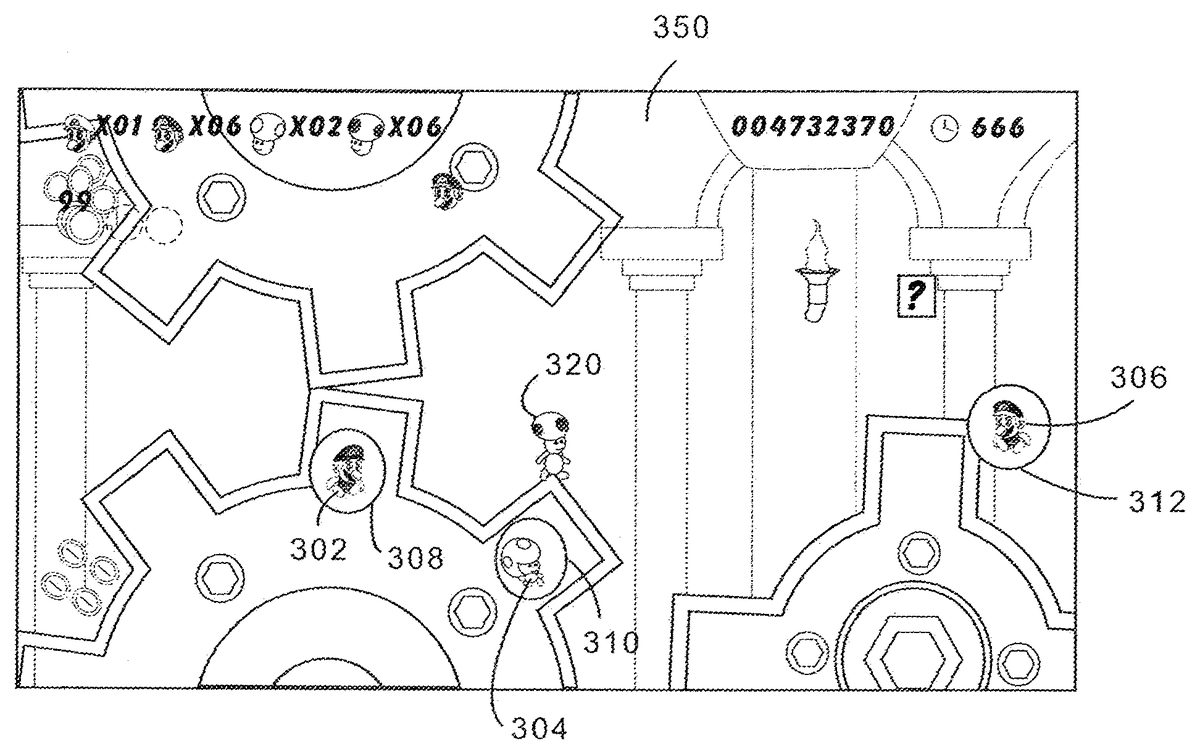
FIG. 3shows an example screen which includes game characters302,304and306encased in respective, transparent (or substantially transparent) bubbles308,310and312within a game world350. Game character320is not encased in a bubble. In theFIG. 3example, bubbles308,310and312are spherical bubbles that surround or wrap around game characters302,304and306. Other bubble shapes (e.g., cubes, ellipsoids, etc.) may be used. In addition or alternatively, other techniques may be used to indicate that a particular character is protected from harm in the game world (e.g., different color(s), highlighting, blinking, change in size and the like). A shield or a force field may also be used to show that a game character is in an invulnerable state.
A bubble-encased character is protected from or invulnerable to the effects of game objects (e.g., enemy characters or enemy attack objects) that might otherwise cause the game character to lose its life or to lose vitality.
The above-described behavior continues until the bubble is “burst” or “popped” (e.g., by contacting or touching another player's character or by being contacted or hit with a projectile such as a fireball or shell) from another player's character.
There are two ways for a game character to enter a bubble state in the example video game.
First, a player's character is automatically placed in a bubble by the game program when a player makes a mistake or error (or some number of mistakes or errors) or suffers some loss of vitality that would ordinarily cause game play to end for that player. Thus, for example, if a received blow or strike from a weapon or projectile would ordinarily cause a character to lose its life and end game play for that character, the character is instead encased in a bubble.
Second, a player's character may be encased in bubble by the game program when the player provides a predetermined input to controller107. By way of example and without limitation, the predetermined button may be button302don controller107shown inFIG. 4. Of course, other buttons, keys or actions may be used to cause a player's character to be placed in a bubble.
Thus, a character may enter a bubble involuntarily (when a player makes a mistake or error) or voluntarily (when the player provides a predetermined input). Because an encased, “in-bubble” character is in an invulnerable state, a player of lesser skill can voluntarily put his/her character in a bubble and “follow along” with a player of greater skill without being vulnerable to attack or vitality-reducing game world objects. Thus, a lesser skilled player can voluntarily place his/her game character in a protective bubble and allow a more skilled player to navigate through a difficult area of the game world, until the lesser skilled player's character arrives at a “safer” place. This makes the multi-player game more enjoyable for both greater- and lesser-skilled players.
In the example video game, at least one game character must not be in a bubble in order for the video game to proceed. Thus, if all players except one are in bubbles and the remaining player makes a mistake or error, the game program causes game play to end. In addition, if all players except one are in bubbles and the remaining player presses button30dto voluntarily enter a bubble, the game program causes game play to end.
If a player's character is wrapped in a bubble because of error or mistake or loss of vitality, the in-bubble character appears after a short lapse of time at a position displaced from the location of the error or mistake in the game progress (scrolling) direction. Thus, if the game is side-scrolling in a forward direction, the in-bubble character is displaced in the forward direction relative to the position at which the mistake or error occurred. This disappearance for a short period of time constitutes a penalty for the player and also signals to other players that an error or mistake was made. If a player presses button302dto enter a bubble, the in-bubble character appears immediately at the location of the character at the time the button was pressed.
If the game is transitioning from one level or area to another (e.g., via a door or portal) when the player's character enters a bubble either because of mistake or because of a button press, the bubble appears in new level or area.
When a player's character enters a bubble, the in-bubble character generally moves or floats toward the center of the screen if the screen is not scrolling.FIG. 5Ashows a non-scrolling screen and character502generally moves in the direction of arrow504toward the center of the screen. It is of course not necessary that the movement of the in-bubble character be toward the exact geometric screen center—the movement could simply be toward the vicinity of the screen center.
When the screen is scrolling, the in-bubble character moves or floats in the same direction as the background. With reference toFIGS. 5B and 5C, the screen530is scrolling up and thus the background and in-bubble character532moves in a downward direction as can be seen by comparing these two figures.
The moving in-bubble character acquires “inertia” so that a moving in-bubble character may continue to move even if, for example, the scrolling of the screen stops. Thus, referring toFIG. 5C, if the screen scrolling was to stop, the in-bubble character532would continue to move downward until it reached the edge554of the screen and then it would bounce off the screen edge554in a generally upward direction.
The in-bubble character may penetrate at least partly into geographic surfaces such as the ground or walls. As shown inFIG. 6, in-bubble character602has partially penetrated into wall604. The game program may be configured so that a certain amount of surface penetration occurs before the in-bubble character bounces off the surface or so that the in-bubble character penetrates or passes through the surface until a screen boundary is reached. Which of these configurations is used may be dependent, for example, upon the location of the geographic surface. For example, if the surface is a wall along the side of the screen, the in-bubble character may penetrate the wall a certain amount before bouncing away. If the surface is a ledge in the middle of the screen, the in-bubble character may pass through the ledge and continue movement until it collides with a screen edge or a wall along the side of the screen. If desired, the inertia of the in-bubble character may be reduced based on the amount of surface penetration. Thus, movement of an in-bubble character may be slowed down when it passes through or penetrates an object.
The player whose character is in a bubble has only limited control of the in-bubble character's motion. In particular, the movement control is limited to causing the in-bubble character to move in the direction of a character not in a bubble in response to a predetermined input using controller107. As explained below, if the in-bubble character contacts a character that is not in a bubble, the bubble pops or bursts. To effect this movement control in the example video game, the player waves controller107. The game program may be configured to require that the waving is in the form of a particular gesture (e.g., a sideways swipe) or any gesture sufficient to generate an acceleration that exceeds some threshold value. The accelerometer in controller107senses acceleration resulting from the waving and acceleration signals resulting from the sensed acceleration are supplied from controller107to console102. In response, the game program causes the bubble to begin to move at a fixed speed toward the closest character not wrapped in a bubble. In addition, the game program controls console102to send a signal to the waved controller so that a sound is emitted from that controller.
A bubble pops or bursts under two conditions. First, a bubble pops if it is directly contacted by another player's character that is not in a bubble. Second, a fireball or object can be flung by a character to burst a bubble. The following discussion describes the position at which a bubble bursts if either of the above conditions is met.
In a case in which an in-bubble character contacts a character that is not in a bubble, a collision check is performed between the in-bubble character, geographical feature objects on the screen and game characters other than the character contacted to pop the bubble. As noted above, in-bubble characters can at least partly penetrate geographical feature objects and the above-mentioned collision check is made so that the bubble does not burst while the in-bubble character penetrates a surface. There are various ways to perform such a collision check. For example, the collision check can be performed using a square box that surrounds the in-bubble character and determining whether this bounding box overlaps with (i.e., is colliding with) a surface of a geographical object and/or a game character other than the character causing the bubble to pop.
If the result of the collision check is negative (i.e., the in-bubble character is not penetrating the surface of a geographical feature object and is not in contact with a game character other than the character causing the bubble to burst), the bubble bursts immediately and the player's character can resume normal participation in the game.
If the result of the collision checks determines that the in-bubble character is penetrated within a surface, the game program moves the bubble in the direction of the character that touched it. The collision check is then repeated until the collision check is negative, at which time the bubble is burst and the player's character can resume normal participation in the game.
If the result of the collision check determines that the in-bubble character is contacting a game character other than the character causing the bubble to pop, the game program causes the bubble to pass through this other character before popping.
In a case in which the in-bubble character is contacted by a projectile (e.g., fireball or shell) flung from a character not in a bubble, a similar collision check is performed. If the result of the collision check is negative, the bubble bursts and the player's character resumes normal participation in the game. If the result of the collision check determines that the in-bubble character is penetrated into a surface, the bubble is not burst.
As described above, in the example video game described herein, a player of lesser skill can voluntarily put his/her character in a bubble and “follow along” with a player of greater skill without being vulnerable to attack or vitality-reducing game world objects. Thus, a lesser skilled player can allow a more skilled player to navigate through a difficult area of the game world until the lesser skilled player's character arrives at a “safer” place. This makes the multi-player game more enjoyable for both greater- and lesser-skilled players.
The described systems, methods, and techniques may be implemented in digital electronic circuitry, computer hardware, firmware, software, or in combinations of these elements. Apparatus embodying these techniques may include appropriate input and output devices, a computer processor, and a computer program product tangibly embodied in a non-transitory machine-readable storage device for execution by a programmable processor. A process embodying these techniques may be performed by a programmable processor executing a suitable program of instructions to perform desired functions by operating on input data and generating appropriate output. The techniques may be implemented in one or more computer programs that are executable on a programmable system including at least one programmable processor coupled to receive data and instructions from, and to transmit data and instructions to, a data storage system, at least one input device, and at least one output device. Each computer program may be implemented in a high-level procedural or object-oriented programming language or in assembly or machine language, if desired; and in any case, the language may be a compiled or interpreted language. Suitable processors include, by way of example, both general and special purpose microprocessors. Generally, a processor will receive instructions and data from a read-only memory and/or a random access memory. Non-transitory storage devices suitable for tangibly embodying computer program instructions and data include all forms of computer memory including, but not limited to, non-volatile memory, including by way of example semiconductor memory devices, such as Erasable Programmable Read-Only Memory (EPROM), Electrically Erasable Programmable Read-Only Memory (EEPROM), and flash memory devices; magnetic disks such as internal hard disks and removable disks; magneto-optical disks; and Compact Disc Read-Only Memory (CD-ROM). Any of the foregoing may be supplemented by, or incorporated in, specially-designed ASICs (application-specific integrated circuits).
The processing system/circuitry described in the specification (e.g., CPU104) is “programmed” to control the game process in accordance with the “logic” described in the specification. One of ordinary skill in the art will therefore recognize that, for example, a processing system including at least one CPU when executing instructions in accordance this logic operates as “programmed logic circuitry” to perform the operations defined by the logic.
While the systems and methods have been described in connection various embodiments, it is to be understood that the system and method are not to be limited to the disclosed embodiment, but on the contrary, are intended to cover various modifications and equivalent arrangements.
Claims
- A method for playing a multi-player video game, the method comprising: generating, in accordance with execution of a video game program by a computer, a virtual game world including multiple player-controllable game characters;generating, by the computer, images of the virtual game world for display on a display screen;receiving, by the computer, during the playing of the video game, game character movement control signals, the game character movement control signals being based on inputs to input devices, each used by a respective player, for controlling a corresponding game character in the virtual game world;controlling, by the computer, movements of each game character in the virtual game world in accordance with the respective game character movement control signals;in response to an input, predetermined by the video game program, to the input device of a first one of the players controlling a first one of the game characters during the playing of the multi-player video game, controlling, by the computer, the virtual game world so that the first game character becomes a protected game character protected from harm in the game world;and controlling, by the computer, movements of the protected first game character in the virtual game world based on a position of another, unprotected game character, wherein the first game character becomes a protected game character without a loss of vitality of the first game character or without a loss of life of the first game character.
- The method according to claim 1 , wherein the protected first game character is controlled so as to move in the direction of the other, unprotected game character.
- The method according to claim 1 , wherein the protected first game character is controlled so as to move in the direction of the other, unprotected game character in accordance with a predetermined control operation by the first player.
- The method according to claim 3 , wherein the predetermined control operation comprises shaking the input device.
- The method according to claim 1 , wherein the predetermined input comprises a button press.
- The method according to claim 1 , wherein the protected first game character is visually distinguished from other unprotected game characters.
- The method according to claim 6 , wherein the protected first game character is visually distinguished by an object which surrounds or wraps around the first game character.
- The method according to claim 1 , further comprising: stopping protecting of the first game character in response to satisfaction of any one of a plurality of protecting stopping conditions.
- The method according to claim 8 , wherein a first protecting stopping condition comprises contact between the protected first game character and an unprotected game character.
- The method according to claim 8 , wherein a first protecting stopping condition comprises contact between the protected first game character and a projectile.
- The method according to claim 8 , wherein the stopping of protecting is further conditioned on the protected first game character not penetrating a geographic surface feature in the virtual game world.
- A video game system comprising: input devices;and a processing system that executes a multi-player video game program in which multiple players each supply inputs to a respective input device to control a corresponding game character in a virtual game world displayed on a display screen, the video game program being stored on a non-transitory computer-readable medium and comprising instructions for: generating a virtual game world;generating images of the virtual game world for display on the display screen;receiving, during the playing of the video game, game character movement control signals, the game character movement control signals being based on inputs to the input devices;controlling movements of each game character in the virtual game world in accordance with the respective game character movement control signals;in response to an input, predetermined by the video game program, to the input device of a first one of the players controlling a first one of the game characters during the playing of the multi-player video game, controlling the virtual game world so that the first game character becomes a protected game character protected from harm in the virtual game world;and controlling movements of the protected first game character in the virtual game world based on a position of another, unprotected game character, wherein the first game character becomes a protected game character without a loss of vitality of the first game character or without a loss of life of the first game character.
- The video game system according to claim 12 , wherein the protected first game character is controlled so as to move in the direction of the other, unprotected game character.
- The video game system according to claim 12 , wherein the protected first game character is controlled so as to move in the direction of the other, unprotected game character in accordance with a predetermined control operation by the first player.
- A non-transitory computer-readable medium having encoded therein program instructions for a multi-player video game in which multiple players each supply inputs to a respective input device to control a corresponding game character in a virtual game world displayed on a display screen, the instructions comprising instructions for: generating a virtual game world;generating images of the virtual game world for display on the display screen;receiving, during the playing of the video game, game character movement control signals, the game character movement control signals being based on inputs to the input devices;controlling movements of each game character in the virtual game world in accordance with the respective game character movement control signals;in response to an input, predetermined by the video game program, to the input device of a first one of the players controlling a first one of the game characters during the playing of the multi-player video game, controlling the virtual game world so that the first game character becomes a protected game character protected from harm in the virtual game world;and controlling movements of the protected first game character in the virtual game world based on a position of another, unprotected game character, wherein the first game character becomes a protected game character without a loss of vitality of the first game character or without a loss of life of the first game character.
- The non-transitory computer-readable medium according to claim 15 , wherein the protected first game character is controlled so as to move in the direction of the other, unprotected game character.
- The non-transitory computer-readable medium according to claim 15 , wherein the protected first game character is controlled so as to move in the direction of the other, unprotected game character in accordance with a predetermined control operation by the first player.
- A video game apparatus for a multi-player video game program in which multiple players each supply inputs to a respective input device to control a corresponding game character in a virtual game world displayed on a display screen, the video game apparatus comprising: a processing system including at least one processor, the processing system configured to perform operations comprising: generating a virtual game world;generating images of the virtual game world for display on the display screen;receiving, during the playing of the video game, game character movement control signals, the game character movement control signals being based on inputs to the input devices;controlling movements of each game character in the virtual game world in accordance with the respective game character movement control signals;and in response to an input, predetermined by the video game program, to the input device of a first one of the players controlling a first one of the game characters during the playing of the multi-player video game, controlling the virtual game world so that the first game character becomes a protected game character protected from harm in the virtual game world;wherein the processing system is configured to control the virtual game world so that the first game character becomes a protected game character without a loss of vitality of the first game character.
- The video game apparatus according to claim 18 , wherein the protected first game character is controlled so as to move in the direction of another, unprotected game character.
- The video game apparatus according to claim 18 , wherein the protected first game character is controlled so as to move in the direction of another, unprotected game character in accordance with a predetermined control operation by the first player.
- The video game apparatus according to claim 18 , wherein the processing system controls the virtual game world so that, in response to the input predetermined by the video game program, the first game character becomes a protected game character substantially immediately.
- The video game apparatus according to claim 21 , wherein the processing system controls the virtual game world so that the protected first game character appears in the virtual game world at substantially the same location as the first game character at the time of the input predetermined by the video game program.
- The video game apparatus according to claim 18 , wherein the processing system is configured to perform further operations comprising, in response to a loss of vitality of the first game character, controlling the virtual game world so that the first game character becomes protected and appears in the virtual game world at a position displaced from the location of the first game character at the time of the loss of vitality.
- The video game apparatus according to claim 23 , wherein the processing system is configured to control the virtual game world so that, in response to the loss of vitality, the first game character becomes protected after a predetermined delay time.
- The video game apparatus according to claim 23 , wherein the processing system controls the virtual game world so that, in response to the input predetermined by the video game program, the first game character becomes a protected game character substantially immediately and appears in the virtual game world at substantially the same location as the first game character at the time of the input predetermined by the video game program.
Disclaimer: Data collected from the USPTO and may be malformed, incomplete, and/or otherwise inaccurate.