U.S. Pat. No. 9,445,949
SYSTEM AND METHOD FOR PROCESSING COMMANDS IN AN ONLINE GAME
AssigneeKABAM, INC.
Issue DateMay 31, 2013
Illustrative Figure
Abstract
One aspect of the disclosure relates to processing commands in an online game, and particularly for assigning an order for the execution of commands in the online game such that the commands are executed in that order by disparate servers. The online game may be played by a plurality of users via a respective plurality of client computing devices. Commands may be received at a plurality of game servers from a plurality of users via a plurality of client computing devices. A central server may receive the commands from the respective game servers and may assign sequence numbers for the received commands. The commands may be performed in sequential order. By executing commands in sequential order by the plurality of game servers, the virtual world of the online game may be presented in a consistent way to the plurality of users of the online game.
Description
DETAILED DESCRIPTION FIG. 1illustrates a system10configured to facilitate processing commands in an online game. In some implementations, system10may include a game server12and a central server32. The game server12may be configured to communicate with one or more client computing platforms14according to a client/server architecture. The users may access system10and/or the virtual space via client computing platforms14. The central server32may be configured to communicate with the game server12. The game server12may be configured to execute one or more computer program modules. The computer program modules may include one or more of a user module18, a space module20, a command reception module22, a command transmission module24, a command ordering module26, a command ordering module28, a command execution module28, and/or other modules. The user module18may be configured to access and/or manage one or more user profiles and/or user information associated with users of the system10. The one or more user profiles and/or user information may include information stored by game server12, one or more of the client computing platforms14, and/or other storage locations. The user profiles may include, for example, information identifying users (e.g., a username or handle, a number, an identifier, and/or other identifying information) within the virtual space, security login information (e.g., a login code or password), virtual space account information, subscription information, virtual currency account information (e.g., related to currency held in credit for a user), relationship information (e.g., information related to relationships between users in the virtual space), virtual space usage information, demographic information associated with users, interaction history among users in the virtual space, information stated by users, purchase information of users, browsing history of users, a client computing platform identification associated with a user, a phone number associated with a user, and/or other information related to users. The space module20may be configured to implement the instance of the ...
DETAILED DESCRIPTION
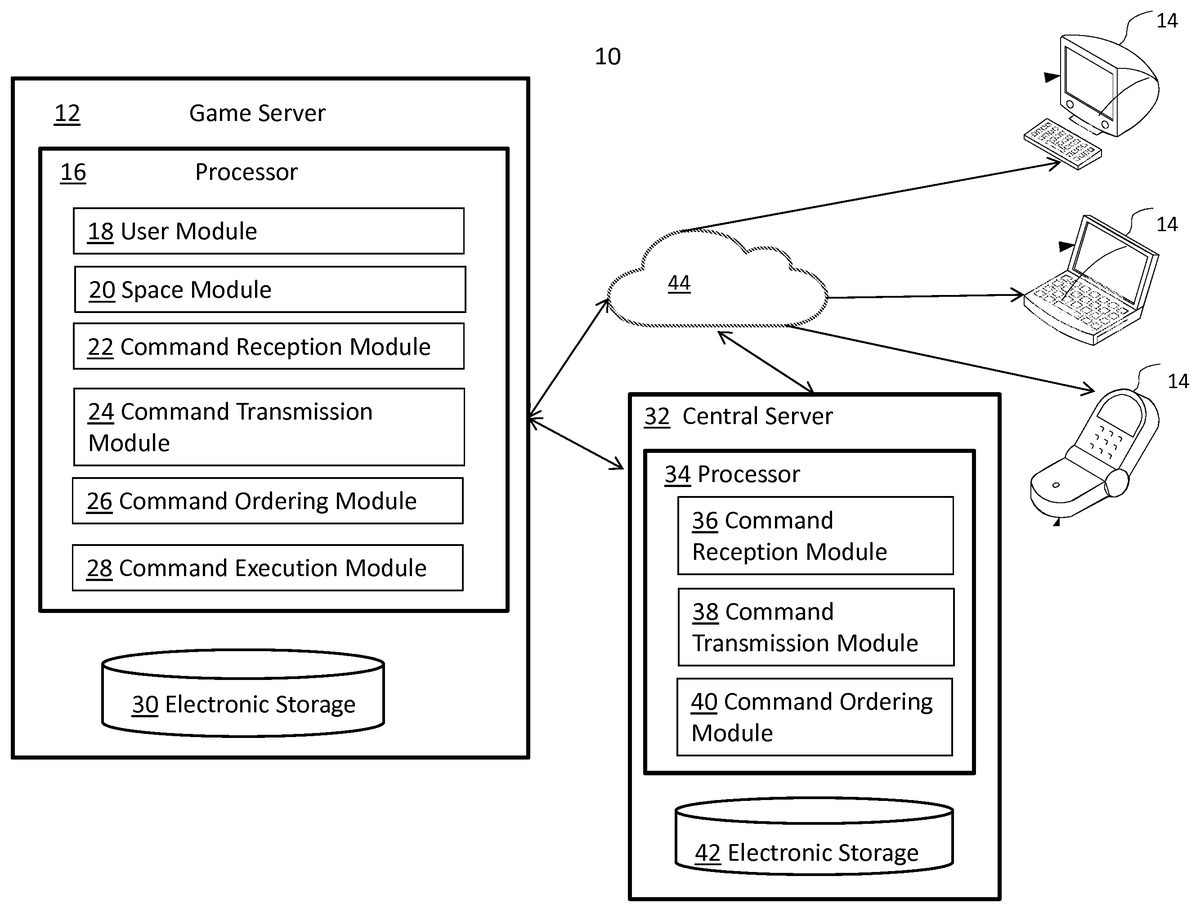
FIG. 1illustrates a system10configured to facilitate processing commands in an online game. In some implementations, system10may include a game server12and a central server32. The game server12may be configured to communicate with one or more client computing platforms14according to a client/server architecture. The users may access system10and/or the virtual space via client computing platforms14. The central server32may be configured to communicate with the game server12.
The game server12may be configured to execute one or more computer program modules. The computer program modules may include one or more of a user module18, a space module20, a command reception module22, a command transmission module24, a command ordering module26, a command ordering module28, a command execution module28, and/or other modules.
The user module18may be configured to access and/or manage one or more user profiles and/or user information associated with users of the system10. The one or more user profiles and/or user information may include information stored by game server12, one or more of the client computing platforms14, and/or other storage locations. The user profiles may include, for example, information identifying users (e.g., a username or handle, a number, an identifier, and/or other identifying information) within the virtual space, security login information (e.g., a login code or password), virtual space account information, subscription information, virtual currency account information (e.g., related to currency held in credit for a user), relationship information (e.g., information related to relationships between users in the virtual space), virtual space usage information, demographic information associated with users, interaction history among users in the virtual space, information stated by users, purchase information of users, browsing history of users, a client computing platform identification associated with a user, a phone number associated with a user, and/or other information related to users.
The space module20may be configured to implement the instance of the virtual space executed by the computer modules to determine state of the virtual space. The state may then be communicated (e.g., via streaming visual data, via object/position data, and/or other state information) from game server12to client computing platforms14for presentation to users. The state determined and transmitted to a given client computing platform14may correspond to a view for a user character being controlled by a user via the given client computing platform14. The state determined and transmitted to a given client computing platform14may correspond to a location in the virtual space. The view described by the state for the given client computing platform14may correspond, for example, to the location from which the view is taken, the location the view depicts, and/or other locations, a zoom ratio, a dimensionality of objects, a point-of-view, and/or view parameters of the view. One or more of the view parameters may be selectable by the user.
The instance of the virtual space may comprise a simulated space that is accessible by users via clients (e.g., client computing platforms14) that present the views of the virtual space to a user. The simulated space may have a topography, express ongoing real-time interaction by one or more users, and/or include one or more objects positioned within the topography that are capable of locomotion within the topography. In some instances, the topography may be a 2-dimensional topography. In other instances, the topography may be a 3-dimensional topography. The topography may include dimensions of the space, and/or surface features of a surface or objects that are “native” to the space. In some instances, the topography may describe a surface (e.g., a ground surface) that runs through at least a substantial portion of the space. In some instances, the topography may describe a volume with one or more bodies positioned therein (e.g., a simulation of gravity-deprived space with one or more celestial bodies positioned therein). The instance executed by the computer modules may be synchronous, asynchronous, and/or semi-synchronous.
The above description of the manner in which state of the virtual space is determined by space module20is not intended to be limiting. The space module20may be configured to express the virtual space in a more limited, or more rich, manner. For example, views determined for the virtual space representing the state of the instance of the virtual space may be selected from a limited set of graphics depicting an event in a given place within the virtual space. The views may include additional content (e.g., text, audio, pre-stored video content, and/or other content) that describes particulars of the current state of the place, beyond the relatively generic graphics. For example, a view may include a generic battle graphic with a textual description of the opponents to be confronted. Other expressions of individual places within the virtual space are contemplated.
Within the instance(s) of the virtual space executed by space module20, users may control characters, objects, simulated physical phenomena (e.g., wind, rain, earthquakes, and/or other phenomena), and/or other elements within the virtual space to interact with the virtual space and/or each other. The user characters may include avatars. As used herein, the term “user character” may refer to an object (or group of objects) present in the virtual space that represents an individual user. The user character may be controlled by the user with which it is associated. The user controlled element(s) may move through and interact with the virtual space (e.g., non-user characters in the virtual space, other objects in the virtual space). The user controlled elements controlled by and/or associated with a given user may be created and/or customized by the given user. The user may have an “inventory” of virtual goods and/or currency that the user can use (e.g., by manipulation of a user character or other user controlled element, and/or other items) within the virtual space.
The users may participate in the instance of the virtual space by controlling one or more of the available user controlled elements in the virtual space. Control may be exercised through control inputs and/or commands input by the users through client computing platforms14. The users may interact with each other through communications exchanged within the virtual space. Such communications may include one or more of textual chat, instant messages, private messages, voice communications, and/or other communications. Communications may be received and entered by the users via their respective client computing platforms14. Communications may be routed to and from the appropriate users through game server12(e.g., through space module20).
A command reception module22may be configured to receive a plurality of commands from individual ones of the client computing platforms14. The command reception module22may receive a command that based on an input of a user at a client computing platform14. The command may facilitate participation by a user in the instance of the virtual space by controlling one or more of the available user controlled elements in the virtual space. The command may comprise one or more instructions that control one or more of the available user controlled elements in the virtual space. The command may also comprise a time stamp indicating a time at which the command was received at the client computing platform14.
A command transmission module24may be configured to transmit the plurality of commands to the central server32. An individual command may be transmitted with a respective time stamp indicating a time at which the individual command was received.
A command ordering module26may be configured to receive a plurality of augmented commands from the central server32. The plurality of augmented commands correspond to the plurality of commands transmitted to the central server32by the command transmission module24. An individual augmented command may comprise an individual command that has been augmented with a sequence number indicating an order in which the individual command is to be executed. In some implementations, a first command and a second command of the plurality of commands received via the command reception module22may be augmented with a first sequence number and a second sequence number consecutive to the first sequence number. In some implementations, the second sequence number may not be consecutive to the first sequence number. In these implementations, the second sequence number may have a time stamp closest to the time stamp of the first sequence number.
A command execution module28may be configured to execute the plurality of augmented commands according to the respective plurality of sequence numbers. In some implementations, the command execution module28may be configured to receive a signal from the central server indicating that the first augmented command should be executed. In an implementation where the second sequence number is consecutive to the first sequence number, the command execution module28may execute the first augmented command, and execute the second augmented command associated with the second sequence number. In this implementation, the command execution module28may continue to execute augmented commands associated with respective consecutive sequence numbers until a next command to be executed does not have a consecutive sequence number to the previously executed command. Responsive to a determination that a next command to be executed does not have a sequence number consecutive to the previously executed command, the command execution module28may transmit a signal to the central server32indicating that the previously executed signal was executed. The command execution module28may wait to execute the next command until a signal is received from the central server32indicating that the next command should be executed. For example, in an implementation where the second sequence number is not consecutive to the first sequence number, the command execution module28may execute the first command, and transmit a signal to the central server32indicating that the first command was executed. Responsive to a determination that the command execution module28received a signal from the central server32indicating that the second command should be executed, the command execution module28may execute the second command.
In some implementations, regardless of whether sequence numbers associated with the first command and the second command are consecutive, the command execution module28may be configured to transmit a signal to the central server indicating that the first augmented command was executed responsive to a determination that the first augmented command was executed. In these implementations, the command execution module28may wait to execute the second command until the command execution module28receives a signal from the central server indicating that the second augmented command should be executed.
As mentioned above, the system10may also comprise a central server32comprising one or more physical processors configured to execute compute program modules. The computer program modules may comprise, for example, a command reception module36, a command ordering module38, a command transmission module40, and/or other computer program modules.
A command reception module36of the central server32may be configured to receive a plurality of commands from a plurality of game servers12. As mentioned above, an individual game server12may be configured to execute an instance of a virtual space and to implement the instance of the virtual space to facilitate participation by one or more users in the online game via respective one or more client computing platforms14.
A command ordering module38of the central server32may be configured to augment the plurality of commands received from the plurality of game servers12with a respective plurality of sequence numbers. The command ordering module38may augment an individual command with a respective sequence number which indicates an order in which the individual command is to be executed.
The command ordering module28may be configured to augment the plurality of commands with the respective plurality of sequence numbers based on a respective plurality of time stamps associated with the received plurality of commands. The sequence numbers assigned to the plurality of commands may be assigned regardless of whether the commands were received consecutively at a single game server12. For example, a first command with a first time stamp and a second command with a second time stamp may have been received at a first game server12and transmitted to the central server32. A third command with a third time stamp may have been received at a second game server12and transmitted to the central server. The third command may have a time stamp with a time of receipt at the second game server12that is between the first time stamp and the second time stamp. Accordingly, the command ordering module28may associate the first command with a first sequence number, the third command with a second sequence number consecutive to the first sequence number, and the second command with a third sequence number consecutive to the second sequence number.
In some implementations, the time stamp of the first command may match exactly the time stamp associated with the second command. In these implementations, the command ordering module may be configured to augment the first command and the second command based on one or more characteristics associated with the command, the originating game server12, and/or other attributes associated with the command. For example, the command ordering module12may augment the first command and the second command with sequence numbers based on one or more of: a type of command of the first command compared to a type of command of the second command, a type of game state attribute affected by the first command compared to a type of game state attribute affected by the second command, a number of commands received from the first game server compared to a number of commands received from the second game server, and/or other features of the first command and the second command.
A command transmission module40of the central server32may be configured to transmit the plurality of augmented commands to the corresponding game servers12.
The game server12may include electronic storage30, one or more processors16, and/or other components. The game server12may include communication lines, or ports to enable the exchange of information with a network and/or other computing platforms. Illustration of game server12inFIG. 1is not intended to be limiting. The game server12may include a plurality of hardware, software, and/or firmware components operating together to provide the functionality attributed herein to game server12. For example, game server12may be implemented by a cloud of computing platforms operating together as game server12.
Electronic storage30may comprise electronic storage media that electronically stores information. The electronic storage media of electronic storage30may include one or both of system storage that is provided integrally (i.e., substantially non-removable) with game server12and/or removable storage that is removably connectable to game server12via, for example, a port (e.g., a USB port, a firewire port, etc.) or a drive (e.g., a disk drive, etc.). Electronic storage30may include one or more of optically readable storage media (e.g., optical disks, etc.), magnetically readable storage media (e.g., magnetic tape, magnetic hard drive, floppy drive, etc.), electrical charge-based storage media (e.g., EEPROM, RAM, etc.), solid-state storage media (e.g., flash drive, etc.), and/or other electronically readable storage media. The electronic storage30may include one or more virtual storage resources (e.g., cloud storage, a virtual private network, and/or other virtual storage resources). Electronic storage30may store software algorithms, information determined by processor16, information received from game server12, information received from client computing platforms14, and/or other information that enables game server12to function as described herein.
Processor(s)16is configured to provide information processing capabilities in game server12. As such, processor16may include one or more of a digital processor, an analog processor, a digital circuit designed to process information, an analog circuit designed to process information, a state machine, and/or other mechanisms for electronically processing information. Although processor16is shown inFIG. 1as a single entity, this is for illustrative purposes only. In some implementations, processor16may include a plurality of processing units. These processing units may be physically located within the same device, or processor16may represent processing functionality of a plurality of devices operating in coordination. The processor16may be configured to execute modules18,20,22,24,26, and28. Processor16may be configured to execute modules18,20,22,24,26, and28by software; hardware; firmware; some combination of software, hardware, and/or firmware; and/or other mechanisms for configuring processing capabilities on processor16.
It should be appreciated that although modules18,20,22,24,26, and28are illustrated inFIG. 1as being co-located within a single processing unit, in implementations in which processor16includes multiple processing units, one or more of modules18,20,22,24,26, and28may be located remotely from the other modules. The description of the functionality provided by the different modules18,20,22,24,26, and28described below is for illustrative purposes, and is not intended to be limiting, as any of modules18,20,22,24,26, and28may provide more or less functionality than is described. For example, one or more of modules18,20,22,24,26, and28may be eliminated, and some or all of its functionality may be provided by other ones of modules18,20,22,24,26, and28. As another example, processor xx may be configured to execute one or more additional modules that may perform some or all of the functionality attributed below to one of modules18,20,22,24,26, and28.
The central server32may include electronic storage30, one or more processors16, and/or other components. The central server32may include communication lines, or ports to enable the exchange of information with a network and/or other computing platforms. Illustration of central server32inFIG. 1is not intended to be limiting. The central server32may include a plurality of hardware, software, and/or firmware components operating together to provide the functionality attributed herein to central server32. For example, central server32may be implemented by a cloud of computing platforms operating together as central server32.
Electronic storage42may comprise electronic storage media that electronically stores information. The electronic storage media of electronic storage42may include one or both of system storage that is provided integrally (i.e., substantially non-removable) with central server32and/or removable storage that is removably connectable to central server32via, for example, a port (e.g., a USB port, a firewire port, etc.) or a drive (e.g., a disk drive, etc.). Electronic storage42may include one or more of optically readable storage media (e.g., optical disks, etc.), magnetically readable storage media (e.g., magnetic tape, magnetic hard drive, floppy drive, etc.), electrical charge-based storage media (e.g., EEPROM, RAM, etc.), solid-state storage media (e.g., flash drive, etc.), and/or other electronically readable storage media. The electronic storage42may include one or more virtual storage resources (e.g., cloud storage, a virtual private network, and/or other virtual storage resources). Electronic storage30may store software algorithms, information determined by processor34, information received from central server32, information received from game servers12, information received from client computing platforms14, and/or other information that enables game server12to function as described herein.
Processor(s)34is configured to provide information processing capabilities in central server32. As such, processor34may include one or more of a digital processor, an analog processor, a digital circuit designed to process information, an analog circuit designed to process information, a state machine, and/or other mechanisms for electronically processing information. Although processor34is shown inFIG. 1as a single entity, this is for illustrative purposes only. In some implementations, processor34may include a plurality of processing units. These processing units may be physically located within the same device, or processor34may represent processing functionality of a plurality of devices operating in coordination. The processor16may be configured to execute modules36,38, and40. Processor34may be configured to execute modules36,38, and40by software; hardware; firmware; some combination of software, hardware, and/or firmware; and/or other mechanisms for configuring processing capabilities on processor34.
It should be appreciated that although modules36,38, and40are illustrated inFIG. 1as being co-located within a single processing unit, in implementations in which processor34includes multiple processing units, one or more of modules36,38, and40may be located remotely from the other modules. The description of the functionality provided by the different modules36,38, and40described below is for illustrative purposes, and is not intended to be limiting, as any of modules36,38, and40may provide more or less functionality than is described. For example, one or more of modules36,38, and40may be eliminated, and some or all of its functionality may be provided by other ones of modules36,38, and40. As another example, processor34may be configured to execute one or more additional modules that may perform some or all of the functionality attributed below to one of modules36,38, and40
FIG. 2illustrates a method50of facilitating processing commands in an online game. The operations of method50presented below are intended to be illustrative. In some embodiments, method50may be accomplished with one or more additional operations not described, and/or without one or more of the operations discussed. Additionally, the order in which the operations of method50are illustrated inFIG. 2and described below is not intended to be limiting.
In some embodiments, method50may be implemented in one or more processing devices (e.g., a digital processor, an analog processor, a digital circuit designed to process information, an analog circuit designed to process information, a state machine, and/or other mechanisms for electronically processing information). The one or more processing devices may include one or more devices executing some or all of the operations of method50in response to instructions stored electronically on an electronic storage medium. The one or more processing devices may include one or more devices configured through hardware, firmware, and/or software to be specifically designed for execution of one or more of the operations of method50.
At an operation52, an instance of a virtual space may be executed. In some implementations, operation52may be performed by a space module the same as or similar to space module20(shown inFIG. 1and described above).
At an operation54, the executed instance of the virtual space may be implemented to determine view information. The view information may define views to be presented to users via client computing platforms. In some implementations, operation54may be performed by a space module the same as or similar to space module20(shown inFIG. 1and described above).
At an operation56, a plurality of commands may be received. In some implementations, operation56may be performed by a command reception module the same as or similar to command reception module22(shown inFIG. 1and described above).
At an operation58, the plurality of commands may be transmitted to the central server32. In some implementations, operation58may be performed by a command transmission module the same as or similar to command transmission module24(shown inFIG. 1and described above).
At an operation60, a plurality of augmented commands may be received from the central server32. In some implementations, operation60may be performed by an command ordering module the same as or similar to command ordering module26(shown inFIG. 1and described above).
At an operation62, the plurality of augmented commands may be executed. In some implementations, operation62may be performed by a command execution module the same as or similar to command execution module26(shown inFIG. 1and described above).
FIG. 3illustrates a method70of facilitating processing commands in an online game. The operations of method70presented below are intended to be illustrative. In some embodiments, method70may be accomplished with one or more additional operations not described, and/or without one or more of the operations discussed. Additionally, the order in which the operations of method70are illustrated inFIG. 3and described below is not intended to be limiting.
In some embodiments, method70may be implemented in one or more processing devices (e.g., a digital processor, an analog processor, a digital circuit designed to process information, an analog circuit designed to process information, a state machine, and/or other mechanisms for electronically processing information). The one or more processing devices may include one or more devices executing some or all of the operations of method70in response to instructions stored electronically on an electronic storage medium. The one or more processing devices may include one or more devices configured through hardware, firmware, and/or software to be specifically designed for execution of one or more of the operations of method70.
At an operation72, a plurality of commands may be received from a plurality of game servers. In some implementations, operation72may be performed by a command reception module the same as or similar to command reception module36(shown inFIG. 1and described above).
At an operation74, the plurality of commands may be augmented. In some implementations, operation74may be performed by a command ordering module the same as or similar to command ordering module38(shown inFIG. 1and described above).
At an operation76, the plurality of augmented commands may be transmitted to respective game servers. In some implementations, operation76may be performed by a command transmission module the same as or similar to command transmission module40(shown inFIG. 1and described above).
At an operation78, the plurality of commands may be transmitted to the central server32. In some implementations, operation78may be performed by a command transmission module the same as or similar to command transmission module24(shown inFIG. 1and described above).
Although the present technology has been described in detail for the purpose of illustration based on what is currently considered to be the most practical and preferred implementations, it is to be understood that such detail is solely for that purpose and that the technology is not limited to the disclosed implementations, but, on the contrary, is intended to cover modifications and equivalent arrangements that are within the spirit and scope of the appended claims. For example, it is to be understood that the present technology contemplates that, to the extent possible, one or more features of any implementation can be combined with one or more features of any other implementation.
Claims
- A system configured to facilitate processing commands in an online game, the system comprising: a game server comprising one or more physical processors configured by machine-readable instructions to: execute an instance of a virtual space, and to implement the instance of the virtual space to facilitate participation by one or more users in the online game within the virtual space on one or more client computing platforms;receive a plurality of commands from individual ones of the client computing platforms, wherein the commands are based on inputs of one or more users at the one or more client computing platforms;transmit the plurality of commands to a central server, wherein the plurality of commands are transmitted with a time stamp indicating a time at which an individual order was received;receive a plurality of augmented commands from the central server, wherein an individual augmented command comprises an individual command that has been augmented with a sequence number indicating an order in which the individual command is to be executed, wherein a first augmented command is associated with a time stamp closest to a time stamp associated with a second augmented command of each of the plurality of augmented commands, and wherein a first sequence number associated with the first augmented command is not consecutive with a second sequence number associated with the second augmented command;and execute the plurality of augmented commands according to the respective plurality of sequence numbers.
- The system of claim 1 , wherein a first command of the plurality of augmented commands is associated with a first sequence number, and a second command of the plurality of augmented commands is associated with a second sequence number, wherein the first sequence number is consecutive to the second sequence number.
- The system of claim 2 , wherein the one or more processors are further configured by machine-readable instructions to: receive a signal from the central server indicating that the first augmented command should be executed;execute the first augmented command;execute the second augmented command associated with the second sequence number consecutive to the first sequence number associated with the first augmented command.
- The system of claim 3 , wherein a third augmented command of the plurality of augmented commands is associated with a third sequence number, wherein the third sequence number is consecutive to the second sequence number, and wherein a fourth augmented command of the plurality of augmented commands is associated with a fourth sequence number, wherein the fourth sequence number is not consecutive to the third sequence number, and wherein the one or more processors are further configured by machine-readable instructions to: execute the third augmented command associated with the third sequence number consecutive to the second sequence number;and transmit a signal to the central server indicating that the third augmented command was executed.
- The system of claim 1 , wherein the one or more processors are further configured by machine-readable instructions to transmit a signal to the central server indicating that the first augmented command was executed responsive to a determination that the first augmented command was executed.
- The system of claim 5 , wherein the one or more processors are further configured by machine-readable instructions to receive a signal from the central server indicating that the second augmented command should be executed.
- A computer-implemented method of processing commands in an online game, the method being implemented in a computer system comprising one or more physical processors, the method comprising: executing an instance of a virtual space, and to implement the instance of the virtual space to facilitate participation by one or more users in the online game within the virtual space on one or more client computing platforms;receiving a plurality of commands from individual ones of the client computing platforms, wherein the commands are based on inputs of one or more users at the one or more client computing platforms;transmitting the plurality of commands to a central server, wherein the plurality of commands are transmitted with a time stamp indicating a time at which an individual order was received;receiving a plurality of augmented commands from the central server, wherein an individual augmented command comprises an individual command that has been augmented with a sequence number indicating an order in which the individual command is to be executed, wherein a first augmented command is associated with a time stamp closest to a time stamp associated with a second augmented command of each of the plurality of augmented commands, and wherein a first sequence number associated with the first augmented command is not consecutive with a second sequence number associated with the second augmented command;and executing the plurality of augmented commands according to the respective plurality of sequence numbers.
- The method of claim 7 , wherein a first command of the plurality of augmented commands is associated with a first sequence number, and a second command of the plurality of augmented commands is associated with a second sequence number, wherein the first sequence number is consecutive to the second sequence number.
- The method of claim 8 , wherein executing the plurality of augmented commands comprises: receiving a signal from the central server indicating that the first augmented command should be executed;executing the first augmented command;executing the second augmented command associated with the second sequence number consecutive to the first sequence number associated with the first augmented command.
- The method of claim 9 , wherein a third augmented command of the plurality of augmented commands is associated with a third sequence number, wherein the third sequence number is consecutive to the second sequence number, and wherein a fourth augmented command of the plurality of augmented commands is associated with a fourth sequence number, wherein the fourth sequence number is not consecutive to the third sequence number, the method further comprising: executing the third augmented command associated with the third sequence number consecutive to the second sequence number;and transmitting a signal to the central server indicating that the third augmented command was executed.
- The method of claim 7 , further comprising: transmitting a signal to the central server indicating that the first augmented command was executed.
- The method of claim 11 , further comprising: receiving a signal from the central server indicating that the second augmented command should be executed.
- A non-transitory electronic storage media storing information related to facilitating processing commands in an online game, the stored information comprising: a memory configured to store information related to the online game;instructions configured to cause a client computing platform to: execute an instance of a virtual space, and to implement the instance of the virtual space to facilitate participation by one or more users in the online game within the virtual space on one or more client computing platforms;receive a plurality of commands from individual ones of the client computing platforms, wherein the commands are based on inputs of one or more users at the one or more client computing platforms;transmit the plurality of commands to a central server, wherein the plurality of commands are transmitted with a time stamp indicating a time at which an individual order was received;receive a plurality of augmented commands from the central server, wherein an individual augmented command comprises an individual command that has been augmented with a sequence number indicating an order in which the individual command is to be executed, wherein a first augmented command is associated with a time stamp closest to a time stamp associated with a second augmented command of each of the plurality of augmented commands, and wherein a first sequence number associated with the first augmented command is not consecutive with a second sequence number associated with the second augmented command;and execute the plurality of augmented commands according to the respective plurality of sequence numbers.
Disclaimer: Data collected from the USPTO and may be malformed, incomplete, and/or otherwise inaccurate.