U.S. Pat. No. 9,442,634
Localization System for Mounting Game in Portable Storage Device on Game Console and Method Therefor
AssigneePao-Chen Lin
Issue DateSeptember 21, 2015
Illustrative Figure
Abstract
A localization system for mounting a game includes at least a portable storage device, wherein each portable storage device comprising a target word unit, linked to small database having an identification code, wherein small database accesses a logic allocation unit comprising at least one file and each file comprises a file identification code; and a game console, comprising at least an interface, linked to a storage unit storing at least an application program for linking portable storage device and for downloading or overwriting existing file; and a central process unit; wherein the application program is utilized to access small database and display relevant information about file having file identification code corresponding to identification code of small database; wherein when game is selected to be executed, central process unit loads file of game into a free space in a main memory of game console and executes file of game.
Description
DETAILED DESCRIPTION The following descriptions are exemplary embodiments only, and are not intended to limit the scope, applicability or configuration of the invention in any way. Rather, the following description provides a convenient illustration for implementing exemplary embodiments of the invention. Various changes to the described embodiments may be made in the function and arrangement of the elements described without departing from the scope of the invention as set forth in the appended claims. As shown inFIGS. 1 and 2, a localization system according to an embodiment of the present invention contains a portable storage device1and a game console2. The portable storage device1can be a Multimedia Card (MMC), a Secure Digital (SD) card, a MINI card, a MD card, a FLASH memory, a hard disk, or a similar memory device capable of storing files. The portable storage device1contains a target word unit (i.e., target)11data-linked to a small database (i.e., header)12having an identification code. The small database12is data-linked to a configuration unit having a cover data, configuration data, etc. (not shown, and the cover data or configuration data can be directly encoded into the small database12). The small database12can access a logic allocation unit14which contains at least a file141. The file141has a game identification code corresponding to the identification code so that the small database12can precisely locate the file141. The file141also has a game title, a game program, or game sound data, or game graphic data, etc. The game console2can be a computer, a tablet computer, a smart phone, a XBOX, a XBOX 360, a Playstation2 (PS2), a Playstation3 (PS3), a Nintendo Wii, a Nintendo64 (N64), or a similar electronic appliance capable of interacting with user. The game console2contains at least an interface21for performing data transmission through WIFI, Bluetooth, USB, RS-454, IEEE1394, SATA, and Thunderbolt, Lighting, SD card socket (e.g., in ...
DETAILED DESCRIPTION
The following descriptions are exemplary embodiments only, and are not intended to limit the scope, applicability or configuration of the invention in any way. Rather, the following description provides a convenient illustration for implementing exemplary embodiments of the invention. Various changes to the described embodiments may be made in the function and arrangement of the elements described without departing from the scope of the invention as set forth in the appended claims.
As shown inFIGS. 1 and 2, a localization system according to an embodiment of the present invention contains a portable storage device1and a game console2.
The portable storage device1can be a Multimedia Card (MMC), a Secure Digital (SD) card, a MINI card, a MD card, a FLASH memory, a hard disk, or a similar memory device capable of storing files. The portable storage device1contains a target word unit (i.e., target)11data-linked to a small database (i.e., header)12having an identification code. The small database12is data-linked to a configuration unit having a cover data, configuration data, etc. (not shown, and the cover data or configuration data can be directly encoded into the small database12). The small database12can access a logic allocation unit14which contains at least a file141. The file141has a game identification code corresponding to the identification code so that the small database12can precisely locate the file141. The file141also has a game title, a game program, or game sound data, or game graphic data, etc.
The game console2can be a computer, a tablet computer, a smart phone, a XBOX, a XBOX 360, a Playstation2 (PS2), a Playstation3 (PS3), a Nintendo Wii, a Nintendo64 (N64), or a similar electronic appliance capable of interacting with user. The game console2contains at least an interface21for performing data transmission through WIFI, Bluetooth, USB, RS-454, IEEE1394, SATA, and Thunderbolt, Lighting, SD card socket (e.g., in a cellular phone), or any wired or wireless data transmission means. The interface21provides transmission functions such data downloading or overwriting existing files. The interface21is data-linked to a storage unit22which stores at least an application program. The application program is utilized to access the small database12and display the relevant information about the file141whose game identification code is corresponding to the identification code of the small database12. When a user wants to select a game to play, the user makes the selection through a controller23. A central process unit (CPU)24loads the file141into a free space in a main memory25of the game console2, and executes the file141. The interface21is able to data-link to at least a preset server3, and the application program is able to compare the small database12's game information with a game database in the server3. Based on the comparison result, a new file is downloaded or overwrites the existing file141.
Additionally, the game console2may contain at least an optional optical disk apparatus to access an optical-disk storage medium4and to download a file from the optical-disk storage medium4into the logic allocation unit14when a user selects and executes the installation of a game through the application program's menu. The cover data or configuration data in the optical-disk storage medium4is also downloaded into the configuration unit's respective blocks for the cover data or the configuration data. Relevant gaming information is also recorded in the small database12for increasing the speed of running a game.
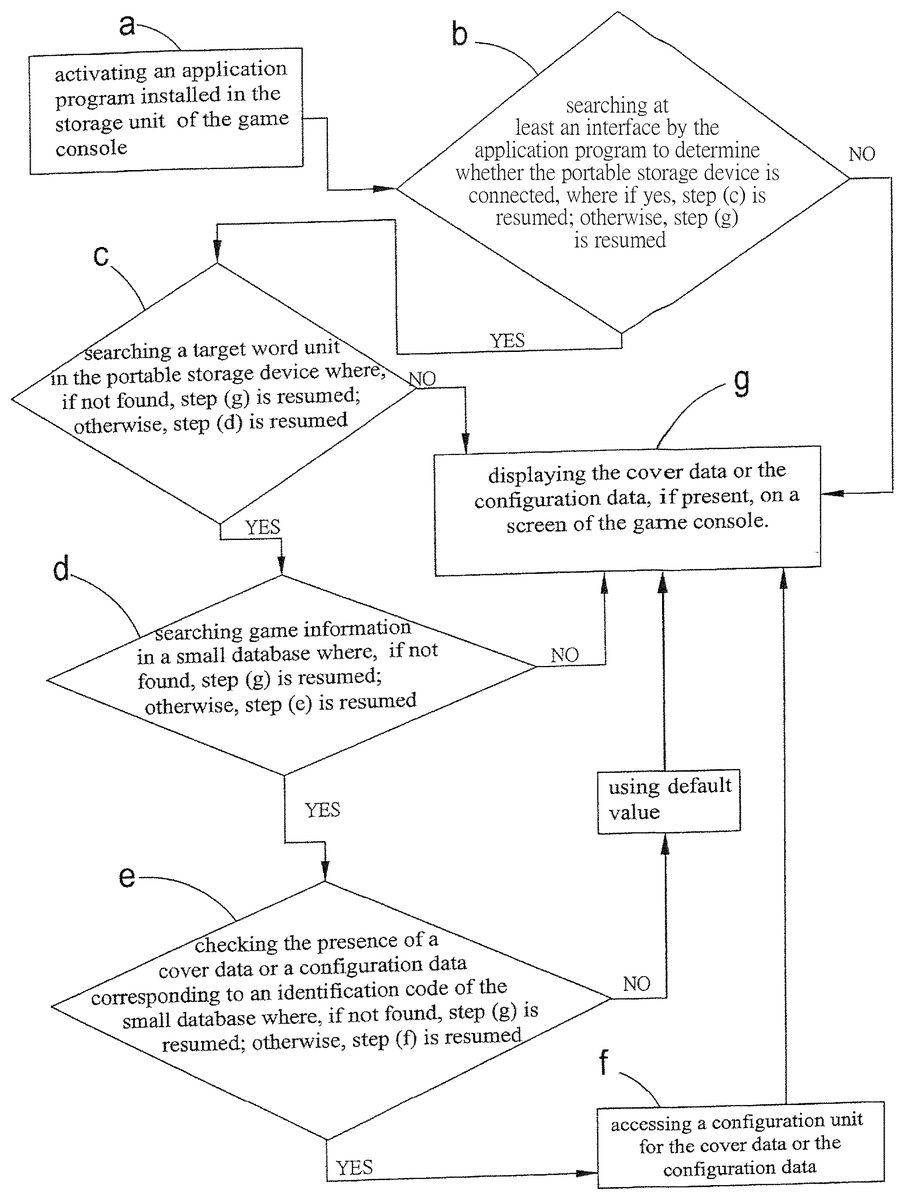
As shown inFIGS. 1 to 3B, a process of accessing the portable storage device1by the game console2contains the following steps.
In step (a), an application program installed in the storage unit22of the game console2is activated.
In step (b), the application program searches the at least one interface21to determine whether the portable storage device1is connected. If yes, the process enters the step (c). Otherwise, the process enters the step (g).
In step (c), the target word unit11stored in the portable storage device1is searched. If the target word unit11is found, the process enters the step (d). Otherwise, the process enters the step (g).
In step (d), game information in the small database12is searched. If found, the process enters the step (e). Otherwise, the process enters the step (g).
In step (e), the presence of a cover data or a configuration data corresponding to the identification code of the small database12is checked. If yes, the process enters the step (f). Otherwise, the process enters the step (g).
In step (f), a configuration unit is accessed for the cover data or the configuration data.
In step (g), the cover data or the configuration data, if present, is displayed by the application program on a screen of the game console2.
As shown inFIG. 4, after the game console2obtains the cover data or the configuration data in the portable storage device1, a user can pick and run a game from the screen. The process is as follows.
In step (10), the application program displays relevant game information in a menu on the screen.
In step (11), if the user picks a game to run, the process enters the step (12). Otherwise, the process returns to the step (10).
In step (12), the selected game's file141in the portable storage device1is accessed.
In step (13), the file141is executed.
As shown inFIG. 5, a process of accessing the portable storage device1by the game console2, which is a computer, contains the following steps.
In step (a), the application program is activated and the application program searches the at least one interface21to determine whether the portable storage device1is connected. If yes, the process enters the step (b). Otherwise, the process enters the step (e).
In step (b), the target word unit11stored in the portable storage device1is searched. If the target word unit11is found, the process enters the step (c). Otherwise, the process enters the step (c1).
In step (c1), whether the portable storage device1is formatted is checked. If yes, the process enters the step (c2). Otherwise, the process enters the step (e).
In step (c2), the target word unit11, the small database12, the logic allocation unit14, the cover block, or configuration block are established. The process enters the step (e).
In step (c), game information in the small database12is searched. If found, the process enters the step (d); otherwise, the process enters the step (e).
In step (d), whether the game identification code of the file141in the logic allocation unit14is corresponding to the identification code of the small database12is checked. If yes, the file141exists.
In step (e), the application program displays relevant game information on a screen of the computer.
In step (f), a game in the computer is selected.
In step (g), whether the game identification code of the game's file141in the computer is corresponding to the identification code of the small database12is checked. If yes, the process returns to the step (f). Otherwise, the process enters the step (h).
In step (h), the file141is transmitted to the logic allocation unit14or the configuration unit. The identification code is established in the small database12.
As shown inFIG. 6, after the portable storage device1is mounted onto (i.e., is connected to) the game console2and a selection from a menu displayed by the application program is made, the process of linking and downloading from the server contains the following steps:
In step (a), the application program has accessed the game information specified by the selection from the menu.
In step (b), a connection of the game console2to the server3is tried. If the connection is established, the process enters the step (c). Otherwise, the process enters the step (h).
In step (c), the game information in the portable storage device1is compared against a game database in the server3. If they are identical, the process enters the step (d). Otherwise, the process enters the step (f).
In step (d), a file is downloaded into the game console2.
In step (e), the file is downloaded into the logic allocation unit14of the portable storage device1. The game information is established in the small database12.
In step (f), whether the file has been updated is checked. If yes, the process enters the step (g). Otherwise, the process enters the step (h).
In step (g), the file is written into the logic allocation unit14or the configuration unit.
In step (h), the application program returns to show the menu.
As shown inFIG. 7, after the portable storage device1is mounted onto the game console2and a selection from a menu displayed by the application program is made, the process of updating the file contains the following steps.
In step (a), the application program has accessed the game information specified by the selection from the menu, and a menu is displayed.
In step (b), a menu item for checking or updating file is selected.
In step (c), a connection of the game console2to the server3is tried. If the connection is established, the process enters the step (d). Otherwise, the process enters the step (g).
In step (d), the game information in the portable storage device1is compared against a game database in the server3. If the game program is not present, the process enters the step (e). If game information in the server3and that in the game database are different, the file is not present and the process enters the step (e). If game information and the game database are the same, the file is present or the file is present but damaged, the process enters the step (f).
In step (e), the file is downloaded into the game console2from the server3. The process enters the step (g).
In step (f), the file is downloaded or is forcefully downloaded into the game console2. The process enters the step (f1).
In step (f1), the existing file is overwrote by the newly downloaded file.
In step (g), the application program returns to show the menu.
As shown inFIG. 8, in the main memory25of the game console2, there is at least a game information121which contains an identification code1211, and may further contain a game title1212, a file start section1213indicating a corresponding file's start location in the logic allocation unit14, and a cover data1214for the game. When a user picks a game to play from the menu provided by the application program, a file141in the logic allocation unit14having a game identification code corresponding to the identification code1211of the game information121therefore can be quickly located, loaded into a free space in the main memory25, and then executed. The file141also contains the game title, the game program, or the game sound data, or the game graphic data. For the other game information121that is not picked, they are ignored, thereby achieving the asynchronous localization.
As shown inFIG. 9, if viewed from the perspective of the storage medium, there are multiple files141in the logic allocation unit14. Each file141is packaged as a game block. When a file141is selected and unpacked, the game block contains a game identification code, a game title, a game program, or game sound data, or game graphic data. As shown inFIG. 10, if viewed from the perspective of the game console2, there are multiple game blocks. Each game block contains a game identification code, a game title, a game program, or game sound data, or game graphic data. Please note that the file can be a compressed file or any package file. Additionally, a file ofFIG. 9is basically identical to a game block ofFIG. 10as the difference only lies in the perspective. Therefore, accessing a file can be deemed as accessing game block.
As shown inFIG. 11, the localization method contains the following steps.
In step (a), an application program installed in an internal storage unit22of a game console2is activated.
In step (b), the application program searches through at least an interface21to determine whether a portable storage device1is connected. If yes, the process enters the step (c). Otherwise, the process enters the step (e).
In step (c), a target word unit11in the portable storage device1is searched. If not found, the process enters the step (e). Otherwise, the process enters the step (d).
In step (d), game information in a small database12of the portable storage device1is searched.
In step (e), the game information is returned to the application program and is displayed in a menu of the application program.
As shown inFIGS. 12 to 14, another embodiment of the localization method contains the following steps.
In step (a), an application program installed in an internal storage unit of a game console is activated.
In step (b), the application program searches through at least an interface to determine whether a portable storage device is connected. If yes, the process enters the step (c). Otherwise, the process enters the step (f).
In step (c), a target word unit in the portable storage device is searched. If not found, the process enters the step (f). Otherwise, the process enters the step (d).
In step (d), game information in a small database (i.e., header) of the portable storage device is searched. If the game information is found, the process enters the step (e). Otherwise, the process enters the step (f).
In step (e), whether the small database has user partitions is checked. If there is no user partition, a number of auxiliary small databases are produced. If a user partition is found, whether the user partition is in use is further checked. If the user partition is idle, the user partition is assigned to a new user.
In step (f), the game information is returned to the application program and is displayed in a menu of the application program.
Different from the previous embodiment, the present embodiment provides many-to-one or one-to-many scenarios. When a first user logs in, the small database5automatically updates the data in the auxiliary small databases6, and uses the first auxiliary small database6. Subsequently, when a second user logs in, a second auxiliary small database6can be used. As such, the first and second users do not have data conflict when they conduct their game playing. In other words, each user has his/her own small databases. If a third user logs in, then a third auxiliary small database6can be used, and so on. In this way, when multiple users log in for playing games, each user has proprietary small database5or auxiliary small database6for game-related operations, thereby avoiding data conflict from using a same small database. Subsequently, when the small database5is updated, the auxiliary small databases6can be updated synchronously so that each user is able to access the latest game menu.
While certain novel features of this invention have been shown and described and are pointed out in the annexed claim, it is not intended to be limited to the details above, since it will be understood that various omissions, modifications, substitutions and changes in the forms and details of the device illustrated and in its operation can be made by those skilled in the art without departing in any way from the spirit of the present invention.
Those skilled in the art will readily observe that numerous modifications and alterations of the device and method may be made while retaining the teachings of the invention. Accordingly, the above disclosure should be construed as limited only by the metes and bounds of the appended claims.
Claims
- A localization system for mounting a game, comprising: at least a portable storage device, wherein each of the portable storage device comprising: a target word unit, linked to a small database having an identification code, wherein the small database accesses a logic allocation unit comprising at least one file and the each of the at least one file comprises a file identification code;and a game console, comprising: at least an interface, linked to a storage unit storing at least an application program for linking the portable storage device and for downloading or overwriting the data;and a central process unit (CPU);wherein the application program is utilized to access the small database and display relevant information about the file having the file identification code corresponding to the identification code of the small database;wherein the CPU loads cover data or configuration data into a free space in a storage unit of the game console and displays the cover data or the configuration data to show a menu.
- The localization system according to claim 1 , wherein the at least one interface links with a preset server for downloading or for downloading or overwriting an existing file.
- The localization system according to claim 1 , wherein the small database is linked to a configuration unit;and the configuration comprises a cover block or a configuration block.
- The localization system according to claim 1 , wherein the file comprises a game identification code, a game title, a game program, or game sound data, or game graphic data.
- The localization system according to claim 1 , wherein the game console is a computer, a tablet computer, a smart phone, a XBOX, a XBOX360, a PS2, a PS3, a Wii, a N64, or a similar electronic appliance capable of user interaction;the portable storage device is a MMC card, a SD card, a MINI card, a MD card, a FLASH memory, a hard disk, or a similar memory device capable of storing files;and the interface provides Bluetooth, USB, RS-454, IEEE1394, SATA, Thunderbolt, Lighting, SD card socket, or any data transmission means.
- The localization system according to claim 1 , wherein the game console further comprises at least an optical disk apparatus to access an optical disk storage medium and to download files from the optical-disk storage medium into the logic allocation unit.
- The localization system according to claim 3 , wherein the steps of linking and downloading from the server comprises: (a) having accessed a game information in the portable storage device by the application program;(b) conducting a connection of the game console to the server;(c) comparing the game information in the portable storage device against a game database in the server;(f) checking whether the file has been updated;(g) writing the new file into the logic allocation unit or the configuration unit;and (h) returning to show the menu by the application program.
- The localization system according to claim 1 , wherein, after the portable storage device is mounted onto the game console and a selection from a menu displayed by the application program is made, the steps of updating the file comprises the steps of (a) accessing the game information specified by the selection from the menu and displaying a menu by the application program;(b) selecting a menu item for checking or updating the file;(c) conducting a connection of the game console to the server;(d) comparing the game information in the portable storage device against a game database in the server where, if identical, the file is present or the file is present but damaged, and step (f) is resumed;(e) downloading a new file into the game console and then entering step (g);(f) downloading or forcefully downloading a new file into the game console;(f1) overwriting the file by the new file;and (g) returning to show the menu by the application program.
- The localization system according to claim 7 , further comprising: (d) downloading a new file into the game console when the game information and the game database in the server are not identical;and (e) downloading the new file into the logic allocation unit or into the cover block or configuration block of the configuration unit, establishing the game information in the small database, and entering step (h).
- The localization system according to claim 1 , wherein a user picks and runs a game from a screen of the game console.
- A game console for accessing a portable storage device, wherein the steps of the game console accessing the portable storage device comprises: (a) activating the application program and searching the at least one interface to determine whether the portable storage device is connected;(b) searching the target word unit stored in the portable storage device where, if found, step (c) is resumed;(c) searching game information in the small database;(d) checking whether the file identification code of the at least one file in the logic allocation unit is corresponding to the identification code of the small database where, if yes, the at least one file is present;(e) displaying game information on a screen of the computer;(f) selecting a game in the computer;(g) checking whether the file identification code of the game's file in the computer is corresponding to the identification code of the small database where, if yes, step (f) is resumed;and (h) transmitting the file to the logic allocation unit or the configuration unit, and establishing the identification code in the small database.
- The game console according to claim 11 , further comprising: (c1) checking whether the portable storage device is formatted when the target word unit is not found in the portable storage device where, if not, step (e) is resumed;and (c2) establishing the target word unit, the small database, the logic allocation unit, the cover block, or the configuration block, and entering step (e).
- A localization method for mounting a game from a portable storage device onto a game console, comprising the steps of: (a) activating an application program installed in an internal storage unit of the game console;(b) searching at least an interface by the application program to determine whether the portable storage device is connected;(c) searching a target word unit in the portable storage device;(d) searching game information in a small database where;(e) checking whether the small database has user partitions where, if there is no user partition, a plurality of auxiliary small databases are produced;if a user partition is found, whether the user partition is in use is further checked;and, if the user partition is idle, the user partition is assigned to a new user;and (f) displaying game information, if present, on a screen of the game console.
- A localization method for mounting a game from a portable storage device onto a game console, comprising the steps of: (a) activating an application program installed in an internal storage unit of the game console;(b) searching at least an interface by the application program to determine whether the portable storage device is connected;(c) searching a target word unit in the portable storage device;(d) searching game information in a small database is searched;(e) checking the presence of a cover data or a configuration data corresponding to an identification code of the small database;(f) accessing a configuration unit for the cover data or the configuration data having a same identification code;(g) displaying the cover data or the configuration data, if present, on a screen of the game console;(h) having accessed the game information in the portable storage device by the application program;(i) conducting a connection of the game console to a server;(j) comparing the game information in the portable storage device against a game database in the server;(k) checking whether the file has been updated;(l) writing the new file into the logic allocation unit or the configuration unit;and (m) returning to show the menu by the application program.
- The localization method according to claim 14 , further comprising: (n) downloading a new file into the game console when the game information and the game database in the server are not identical;and (o) downloading the new file into the logic allocation unit or into the cover block or configuration block of the configuration unit, establishing the game information in the small database, and entering step (m).
- A localization method for mounting a game from a portable storage device onto a game console, comprising the steps of: (a) activating an application program installed in an internal storage unit of the game console;(b) searching at least an interface by the application program to see if the portable storage device is connected;(c) searching a target word unit in the portable storage device;(d) searching game information in a small database;(e) displaying game information, if present, on a screen of the game console;(f) having accessed the game information in the portable storage device by the application program;(g) conducting a connection of the game console to a server;(h) comparing the game information in the portable storage device against a game database in the server;(i) checking whether the file has been updated;(j) writing the new file into the logic allocation unit or the configuration unit;and (k) returning to show the menu by the application program.
- The localization method according to claim 16 , further comprising: (l) downloading a new file into the game console when the game information and the game database in the server are not identical;and (m) downloading the new file into the logic allocation unit or into the cover block or configuration block of the configuration unit, establishing the game information in the small database, and entering step (k).
Disclaimer: Data collected from the USPTO and may be malformed, incomplete, and/or otherwise inaccurate.