U.S. Pat. No. 9,433,865
GAME SYSTEM, GAME CONTROL METHOD, AND INFORMATION STORAGE MEDIUM FOR DISTRIBUTING A GAME PICTURE PLAYED BY A GIVEN USER TO ANOTHER USER FOR GAME PLAY
AssigneeKONAMI DIGITAL ENTERTAINMENT CO., LTD.
Issue DateAugust 7, 2013
Illustrative Figure
Abstract
A recording unit of a game system records a picture of a game that has been played by a user and a situation of the game at a given timing of the picture in a storage unit in association with each other. A display control unit displays the picture on a display unit corresponding to another user. A providing unit for provides the another user with the game starting from the given timing based on the situation of the game associated with the picture.
Description
DETAILED DESCRIPTION OF THE INVENTION 1. Hardware Structure of Game System Now, an embodiment of the present invention is described in detail with reference to the accompanying drawings.FIG. 1is a diagram illustrating an overall configuration of a game system according to the embodiment of the present invention. As illustrated inFIG. 1, a game system S includes, for example, a game server1(game device), a social networking service (SNS) server2, and a plurality of user devices3. The respective devices included in the game system S are connected to one another via a network so as to be able to perform data communications. The game server1is, for example, a known server computer. The game server1controls a game played by a user. As illustrated inFIG. 1, the game server1includes a control unit10, a storage unit12, and a communication unit14. Note that, in addition, the game server1may include a keyboard (not shown), a monitor (not shown), and a reading device (not shown) for an information storage medium. The control unit10includes, for example, a CPU. The control unit10executes programs stored in the storage unit12to perform various kinds of processing, and transmits/receives various kinds of data to/from the user device3via the communication unit14. The storage unit12includes, for example, a hard disk drive or a memory such as a RAM. The storage unit12stores various programs including a game program, various kinds of data, and the like. The communication unit14is, for example, a communication device such as a network card. The SNS server2is, for example, a known server computer. The SNS server2executes various kinds of processing that allow a plurality of users to communicate to/from one another. A control unit20, a storage unit22, and a communication unit24are the same hardware structures as the control unit10, the storage unit12, and the communication unit14, respectively, and hence descriptions thereof are omitted. ...
DETAILED DESCRIPTION OF THE INVENTION
1. Hardware Structure of Game System
Now, an embodiment of the present invention is described in detail with reference to the accompanying drawings.FIG. 1is a diagram illustrating an overall configuration of a game system according to the embodiment of the present invention. As illustrated inFIG. 1, a game system S includes, for example, a game server1(game device), a social networking service (SNS) server2, and a plurality of user devices3. The respective devices included in the game system S are connected to one another via a network so as to be able to perform data communications.
The game server1is, for example, a known server computer. The game server1controls a game played by a user. As illustrated inFIG. 1, the game server1includes a control unit10, a storage unit12, and a communication unit14. Note that, in addition, the game server1may include a keyboard (not shown), a monitor (not shown), and a reading device (not shown) for an information storage medium.
The control unit10includes, for example, a CPU. The control unit10executes programs stored in the storage unit12to perform various kinds of processing, and transmits/receives various kinds of data to/from the user device3via the communication unit14. The storage unit12includes, for example, a hard disk drive or a memory such as a RAM. The storage unit12stores various programs including a game program, various kinds of data, and the like. The communication unit14is, for example, a communication device such as a network card.
The SNS server2is, for example, a known server computer. The SNS server2executes various kinds of processing that allow a plurality of users to communicate to/from one another. A control unit20, a storage unit22, and a communication unit24are the same hardware structures as the control unit10, the storage unit12, and the communication unit14, respectively, and hence descriptions thereof are omitted. Note that, the storage unit22stores various kinds of information (including user IDs, personal information on the users, and details of the users' statements) necessary for the respective users to communicate to/from one another in SNS services.
The user device3is implemented by, a known computer. Examples of the user device3include a consumer game machine, an arcade game machine, a mobile phone (smartphone), and a personal computer. As illustrated inFIG. 1, the user device3includes a control unit30, a storage unit32, an operation unit34, a display unit36, an input unit38, and a communication unit40. Note that, the user device3may include other components (not shown).
The control unit30, the storage unit32, and the communication unit40are the same hardware structures as the control unit10, the storage unit12, and the communication unit14, respectively, and hence descriptions thereof are omitted. The operation unit34includes a controller and a keyboard, and transmits a description of the user's operation to the control unit10. The display unit36includes a liquid crystal display panel, and displays various screens in accordance with an instruction issued by the control unit10. The input unit38includes a DVD reproducer, and receives inputs of various kinds of data from an external storage device.
2. Game Executed in Game System
The game system S executes a in which characters perform actions (behaviors) in a game space. This embodiment is described by taking a case of executing a soccer game in which a plurality of characters perform actions in the game space representing a stadium for a soccer match. When the soccer game is started, for example, the game space is constructed in the storage unit12.
FIG. 2is a figure illustrating an example of the game space. A game space50is a virtual three-dimensional space in which three coordinate axes (Xw-axis, Yw-axis, and Zw-axis) that are orthogonal to one another are set. A position of each object placed in the game space50is identified by, for example, three-dimensional coordinates of a world coordinate system (Xw-Yw-Zw coordinate system).
As illustrated inFIG. 2, a field52being an object representing a soccer field is placed in the game space50. On the field52, a soccer match is played between a team operated by the user (hereinafter referred to as “user team”) and a team operated by an opponent (computer or another user) (hereinafter referred to as “opponent team”).
The field52has two goal lines54aand54b, two touchlines56aand56b, and a center line58. Placed on the field52are goals60being objects representing soccer goals, a character62being an object representing a soccer player belonging to the user team, a character64being an object representing a soccer player belonging to the opponent team, and a ball66being an object representing a soccer ball (moving object).
Note that, on the field52, there are arranged eleven characters62belonging to the user team and eleven characters63belonging to the opponent team, which are not shown inFIG. 2.
When the character62(64) and the ball66move towards and approach each other, those character62(64) and ball66are associated with each other under predetermined conditions. In this case, a moving action of the character62(64) is a dribble action. In the following, the state in which the character62(64) is associated with the ball66is described as “the character62(64) in possession of the ball66.”
Further, a virtual camera68(point of view) is set up in the game space50. The display unit36displays a game screen expressing how the game space50is viewed from the virtual camera68. The game screen is generated by coordinate-converting vertex coordinates of the respective objects arranged in the game space50from the world coordinate system into a screen coordinate system by using a predetermined coordinate conversion operation.
FIG. 3is a figure illustrating an example of the game screen displayed on the display unit36. As illustrated inFIG. 3, the respective objects included in a visual field of the virtual camera68are displayed on a game screen70. In this embodiment, any one of the characters62belonging to the user team performs a behavior based on the user's operation. In a state illustrated inFIG. 3, for example, the character62in possession of the ball66is set as an operation target of the user. A cursor72indicating that the character62is set as the operation target of the user is displayed above a head of the character62.
For example, the user performs a direction instruction operation by using the operation unit34, to thereby cause the character62being the operation target to move in an instructed direction. For example, when the character62is in possession of the ball66, the user uses the operation unit34to instruct the character62to dribble in a given direction or to kick the ball66in a given direction.
The respective characters62(64) arranged in the game space50that are not set as the operation target of the user autonomously behave in accordance with a predetermined behavior algorithm. For example, the characters62(64) other than the operation target of the user behave based on an operation performed by the computer.
In the game system S according to this embodiment, a picture of the game played by the user is stored under given conditions. Then, the stored picture is uploaded onto the SNS server2. The picture uploaded onto the SNS server2can be viewed by the user who uses the game system S. In other words, users other than the user who has uploaded the picture are also allowed to view the picture.
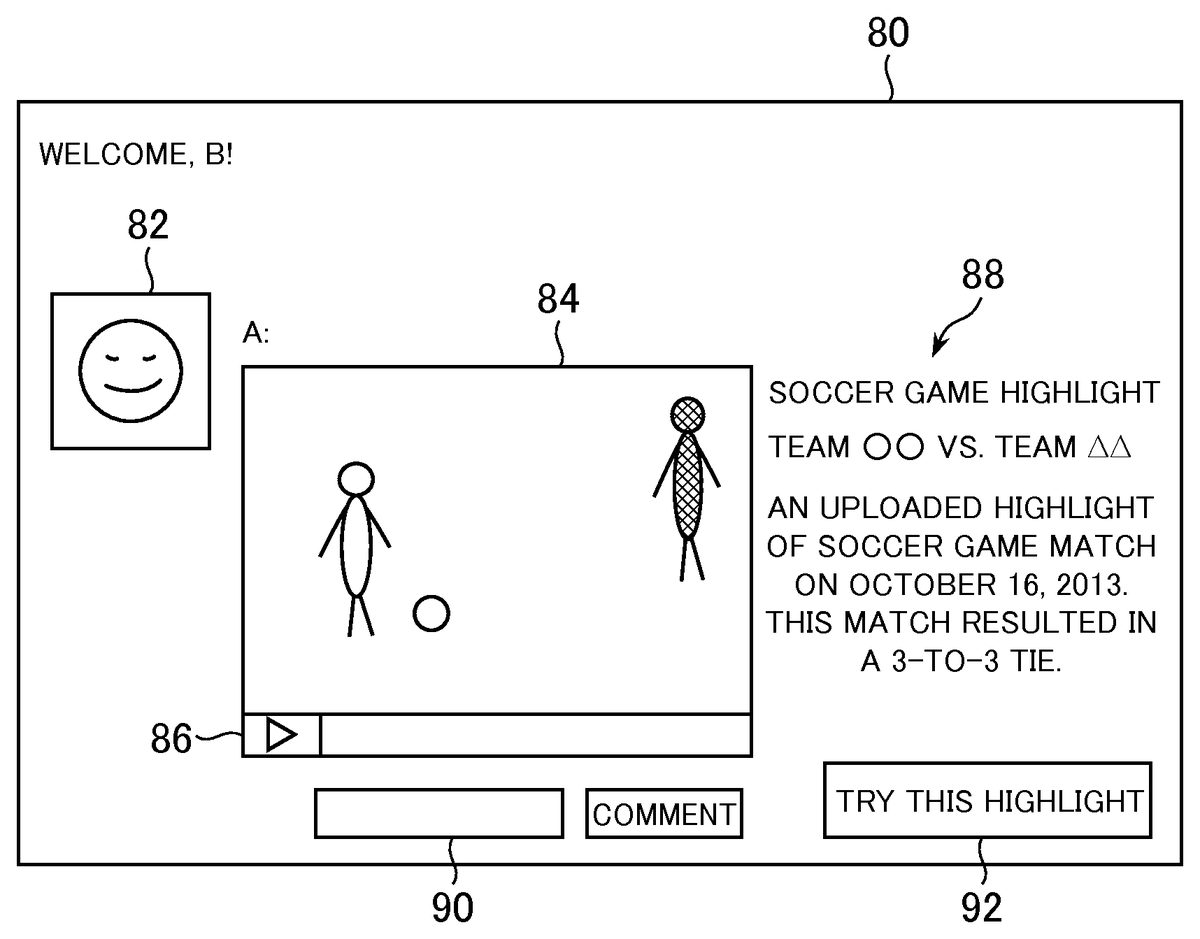
FIG. 4is a figure illustrating an example of an SNS screen displayed on the display unit36. An SNS screen80is, for example, a screen that allows one user to communicate to/from another user. As illustrated inFIG. 4, a user image82representing a photograph, an avatar image, or the like of another user and a display area84for displaying the picture uploaded by the another user are displayed on the SNS screen80.
When the user selects a playback button86, the picture obtained when another user played the soccer game (for example, scene in which the another user scored a goal) is played back in the display area84. Further, picture details information88indicating a description of the picture is displayed on the SNS screen80. The user may be allowed to leave a comment on the picture through an input thereof in a comment input field90.
Further, a start button92is displayed on the SNS screen80. In this case, a URL of the game server1is set in the start button92. Note that, the URL may be a URL with a parameter, and a parameter relating to the soccer game may be included in a link set in the start button92. In this case, when the user selects the start button92, the parameter included in the URL is transmitted to the game server1.
When the user selects the start button92, the user can play the soccer game starting from a situation corresponding to the picture displayed in the display area84. For example, even if the user who selects the start button92has not registered for the game, the user can try the soccer game. In this configuration, the user who has viewed the picture can start the game from the situation of the match at a start timing of the picture displayed in the display area84. This configuration is described below in detail.
3. Functions Implemented by Game System
FIG. 5is a functional block diagram of the game system S. As illustrated inFIG. 5, the game system S includes a game data storage unit100, a normal game executing unit102, a user situation determining unit104, a recording processing determination unit106, an association recording unit108, a highlight picture storage unit110, a highlight picture recording unit112, a display control unit114, a replay trial version providing unit116, a replay trial version executing unit118, an another user situation determining unit120, and an end determination unit122.
This embodiment is described by taking a case where the game server1implements the game data storage unit100, the normal game executing unit102, the user situation determining unit104, the recording processing determination unit106, the association recording unit108, the replay trial version providing unit116, the replay trial version executing unit118, the another user situation determining unit120, and the end determination unit122. In the game server1, those functions are implemented by the control unit10operating in accordance with the programs read from the storage unit12. The game data storage unit100is implemented mainly by the storage unit12, and the other respective functions are implemented mainly by the control unit10.
Further, this embodiment is described by taking a case where the SNS server2implements the highlight picture storage unit110, the highlight picture recording unit112, and the display control unit114. In the SNS server2, those functions are implemented by the control unit20operating in accordance with the programs read from the storage unit22. The highlight picture storage unit110is implemented mainly by the storage unit22, and the other respective functions are implemented mainly by the control unit20.
[3-1. Game Data Storage Unit]
The game data storage unit100stores various kinds of data relating to the game played by the user. The game data storage unit100stores user data relating to each of a plurality of users, game situation data indicating a situation of the game in execution, and picture-situation association data.
The information relating to each user who uses the game system S is stored as the user data. For example, the user data is associated with the user ID for identifying the user and various kinds of information (for example, personal information such as a user name) relating to the user.
The game situation data indicates the current situation of the soccer game. The game situation data includes a current state of the game space50, for example, includes a state of the object placed in the game space50(for example, position and posture of the character62(64)), parameters relating to the character62(64), a state of a movement subject (such as position and moving direction of the ball66), a current progress of the match (for example, scores of the teams), and an elapsed time of the match.
FIG. 6is a data storage example of the picture-situation association data. As illustrated inFIG. 6, an association between the picture of the game played by the user and the situation of the game at a given timing of the picture is stored in the picture-situation association data. The given timing represents, for example, the start timing of the picture or a time point a predetermined time before or after the start timing of the picture. It is assumed here that the picture and the situation of the game at the start timing of the picture are stored in the picture-situation association data in association with each other.
Note that, contents stored in the game data storage unit100are not limited to the above-mentioned example. It suffices that various kinds of data necessary to execute the game is stored in the game data storage unit100. Further, the game situation data on the game in execution does not necessarily match the game situation data stored in the picture-situation association data. Only necessary items of the data included in the game situation data on the game in execution (for example, only locations of the character (64) and the ball66) may be stored in the picture-situation association data.
[3-2. Normal Game Executing Unit]
The normal game executing unit102controls the game played by the user. Note that, a normal game represents, for example, a game starting from an initial state or a state saved by the user instead of the game starting from the situation associated with the picture. The normal game executing unit102acquires storage content of the game data storage unit100. Further, the normal game executing unit102executes the game while updating the game situation data. For example, the normal game executing unit102progresses the game by executing various kinds of processing described in the game program based on the user's operation, and updates the game situation data.
Further, in this embodiment, the normal game executing unit102generates the picture of the game played by the user. The normal game executing unit102generates an image expressing how the game space50is viewed from a given point of view, and displays the image on the game screen70. Further, the normal game executing unit102records the image expressing how the game space50is viewed from the given point of view in time series, to thereby store the picture of the game played by the user (in other words, picture displayed on the game screen70).
Note that, the processing executed by the normal game executing unit102is not limited to the above-mentioned example. The normal game executing unit102serves as an agent for executing the various kinds of processing relating to the game. In addition, for example, the normal game executing unit102distributes the game situation data and image data on the game screen70to the user devices3.
[3-3. User Situation Determining Unit]
The user situation determining unit104determines whether or not the situation of the game played by the user is a given situation. The given situation represents a situation in which the game situation data satisfies a predetermined condition, and is a state in which a value indicating the game situation data falls within a predetermined range. Further, in this specification, the “user” represents a user who has played the game regarding the picture, for example, a user who is to upload the picture.
For example, the user situation determining unit104determines whether or not a state of the game space50has become a given state, or determines whether or not the character62(64) placed in the game space50is to perform a given action. Further, for example, the user situation determining unit104may determine whether or not a position of the object (for example, ball66) placed in the game space50exists inside a predetermined area, or may determine whether or not a change in the position of the object (for example, ball66) placed in the game space50matches a given change.
In this case, it is determined that the situation of the game played by the user is the given situation, for example, when the score changes in the game, when the character62(64) is to perform a predetermined action (for example, when a free kick or a penalty kick is to be performed or when a pass is to be performed after the number of passes during a predetermined period has reached a reference number), when the ball66or the character62(64) in possession of the ball66moves into a predetermined area (for example, area within a predetermined distance from the goal60), or when a moving distance of the ball66or the character62(64) in possession of the ball66has become equal to or larger than a reference distance.
[3-4. Recording Processing Determination Unit]
The recording processing determination unit106determines, based on a determination result from the user situation determining unit104, whether or not recording processing is to be executed by the association recording unit108. The recording processing determination unit106causes the association recording unit108to execute the recording processing when it is determined that the situation of the game played by the user is the given situation, and inhibits the association recording unit108from executing the recording processing when it is determined that the situation of the game played by the user is not the given situation.
[3-5. Association Recording Unit]
The association recording unit108records the picture of the game played by the user and the situation of the game at the given timing of the picture in storage means (for example, game data storage unit100) in association with each other. In this case, the association recording unit108stores a picture ID for identifying the picture of the game played by the user and the situation of the game at the start timing of the picture in the picture-situation association data in association with each other.
Note that, in this case, the picture ID to be stored in the picture-situation association data is generated by the normal game executing unit102when the picture of the game played by the user is stored. Further, the situation of the game at the start timing is acquired by the association recording unit108from the game data storage unit100. The association recording unit108stores the generated picture ID and the acquired situation in the picture-situation association data in association with each other.
[3-6. Highlight Picture Storage Unit]
The highlight picture storage unit110stores the picture of the game played by the user. The highlight picture storage unit110stores, for example, picture data indicating the picture generated by the normal game executing unit102.
FIG. 7is a figure illustrating storage content of the highlight picture storage unit110. As illustrated inFIG. 7, the picture ID for identifying the picture data, the user ID of the user who has performed a gameplay regarding the picture, and the picture data are stored in association with one another. Note that, the storage content of the highlight picture storage unit110is not limited to the example illustrated inFIG. 7. In addition, for example, a thumbnail image of the picture displayed on the SNS screen80may be generated based on the picture data and stored. Further, the picture may be a moving image or a still image.
[3-7. Highlight Picture Recording Unit]
The highlight picture recording unit112records the picture of the game played by the user in the highlight picture storage unit110. The highlight picture recording unit112acquires the picture data indicating the picture generated by the normal game executing unit102, and records the picture data in the highlight picture storage unit110. In this case, the highlight picture recording unit112records the picture ID generated by the normal game executing unit102, the user ID acquired from the game data storage unit100, and the picture data in the highlight picture storage unit110in association with one another. For example, the highlight picture recording unit112records the picture data in the highlight picture storage unit110when the recording processing determination unit106determines that the picture is to be recorded.
[3-8. Display Control Unit]
The display control unit114displays the picture on display means corresponding to another user (for example, display unit36of the user device3operated by another user). The wording “another user” as used herein represents a user who plays the game from the situation associated with the picture, for example, a user who has viewed the picture on the SNS screen80. Further, the “display means corresponding to another user” represents the display unit36of the user device3that is different from the user device3that has uploaded the picture of the game onto the SNS server2, in other words, the display unit36of the user device3that is different from the user device3used for the gameplay regarding the picture.
The display control unit114causes the display unit36of the user device3to playback the picture data, to thereby display the picture thereon. In this case, the display control unit114transmits the picture data stored in the highlight picture storage unit110to the user device3, to thereby display the picture on the display unit36of the user device3.
[3-9. Replay Trial Version Providing Unit]
The replay trial version providing unit116provides another user with the game starting from the given timing based on the situation of the game associated with the picture. The replay trial version providing unit116provides another user with the game starting from the situation of the game associated with the picture displayed on the user device3. The wording “provides another user with the game” represents causing another user to play the game and progressing the game in response to the another user's operation.
[3-10. Replay Trial Version Executing Unit]
The replay trial version executing unit118executes the game starting from the given timing based on another user's operation. The replay trial version executing unit118progresses the game starting from the given timing by updating the game situation data associated with the picture based on the another user's operation.
[3-11. Another User Situation Determining Unit]
The another user situation determining unit120determines, when another user plays the game provided by the replay trial version providing unit116, whether or not the situation of the game is a given situation. The another user situation determining unit120determines whether or not the situation of the game provided to another user has become an ending situation for bringing the game to an end.
For example, the another user situation determining unit120determines whether or not the state of the game space50has become a given state, or determines whether or not the character62(64) placed in the game space50has performed a given action. Further, for example, the another user situation determining unit120may determine whether or not the position of the object (for example, ball66) placed in the game space50exists inside a predetermined area, or may determine whether or not a change in the position of the object (for example, ball66) placed in the game space50matches a given change.
In this case, the another user situation determining unit120determines, when another user plays the game provided by the replay trial version providing unit116, whether or not the elapsed time since the game is started reaches a reference time. When determining that the elapsed time has reached the reference time, the another user situation determining unit120determines that the situation of the game provided to the another user has become the ending situation for bringing the game to an end.
[3-12. End Determination Unit]
The end determination unit122determines whether or not to bring the game provided by the replay trial version providing unit116to an end based on a determination result from the another user situation determining unit120. The wording “bring the game to an end” as used herein represents canceling the provision of the game made by the replay trial version providing unit116and inhibiting the game from progressing in response to another user's operation.
The end determination unit122determines, when it is determined that the situation of the game is a given ending situation, that the game provided by the replay trial version providing unit116is to be brought to an end, and when it is not determined that the situation of the game is the given ending situation, that the game provided by the replay trial version providing unit116is to be continued without being brought to an end. In this embodiment, the end determination unit122determines, when it is determined that the elapsed time has reached the reference time, that the game provided by the replay trial version providing unit116is to be brought to an end.
4. Processing Executed in Game System
Next, a description is made of an example of processing executed in the game system S. The description is made below of picture accumulation processing for accumulating the picture of the game played by the user and game providing processing for providing the user who has viewed the picture with the game starting from the start timing of the picture. Each of the picture accumulation processing and the game providing processing is executed by the control unit10operating in accordance with the program read from the storage unit12, the control unit20operating in accordance with the program read from the storage unit22, and the control unit30operating in accordance with the program read from the storage unit32.
[4-1. Picture Accumulation Processing]
FIG. 8is a flowchart illustrating an example of the picture accumulation processing. As illustrated inFIG. 8, first, in the game server1, the control unit10determines whether or not a start request for the game has been made by the user based on a signal received from the user device3(S1). In Step S1, the control unit10determines whether or not a given signal indicating that the user has performed a given operation for starting the game has been received from the user device3.
Note that, in a case where the game server1or the SNS server2acquires information from the user device3, the user ID and the IP address are transmitted from the user device3. The game server1or the SNS server2identifies which user of which user device3has access thereto by receiving the user ID and the IP address.
When it is determined that the start request for the game has been made (Y in S1), the control unit10starts the game to be played by the user who has made the start request (S2). In Step S2, the control unit10constructs the game space50in the storage unit12, generates the game situation data, and stores the user ID of the user who has made the start request for the game and the generated game situation data in the storage unit12in association with each other. With this configuration, even when a plurality of users simultaneously play the game, the game server1can manage the game situation data on the respective users.
The control unit10generates the image data on the game screen70based on the game situation data stored in the storage unit12, and transmits the image data to the user device3(S3).
On the other hand, in the user device3, when receiving the image data, the control unit30displays the game screen70on the display unit36(S4). Note that, in execution of this processing, it is assumed that, in the user device3, the program stored in the storage unit32has been activated with the game prepared to start.
The control unit30transmits the description of the user's operation to the game server1(S5). In Step S5, based on the signal detected by the operation unit34, the control unit30transmits a signal indicating the operation state of the operation unit34to the game server1via the communication unit40.
In the game server1, the control unit10progresses the game based on an operation description received from the user device3(S6). In Step S6, the control unit10updates the game situation data based on the description of the user's operation. Note that, in this processing example, the description is made by taking a case where the image data on the game screen70is distributed (or streamed) to the user devices3at predetermined time intervals in Step S3, but the game situation data updated in Step S6may be distributed to the user devices3. In this case, in the user device3, the display control of the game screen70is executed based on the game situation data received from the game server1.
The control unit10determines whether or not the situation of the game in execution has become the given situation (S7). In Step S7, the control unit10determines whether or not the value of the game situation data falls within a predetermined range. For example, the control unit10determines whether or not a distance between the goal60and the ball66has become equal to or smaller than the reference distance. Note that, when storing of the picture is being executed at the current time point in processing of Step S9described later, the procedure advances to Step S8without executing the processing of Step S7.
When it is determined that the situation of the game in execution has become the given situation (Y in S7), the control unit10temporarily stores the current game situation data in the storage unit12(S8).
The control unit10records the picture of the game played by the user (S9). In Step S9, the control unit10records the picture of the game by recording the image data on the game screen70in time series in the storage unit12. In Step S3, a game screen is distributed from the game server1to the user devices3at given time intervals, and hence, in Step S9, the control unit10stores the image data distributed to the user devices3in time series in the storage unit12as it is.
The control unit10determines whether or not a given end timing has arrived (S10). As the end timing, any timing that is defined in advance may be used. For example, the control unit10determines whether or not a predetermined time has elapsed since the storing of the picture is started or whether or not the situation of the game in execution has become a predetermined situation for bringing the storing to an end.
When it is determined that the end timing has arrived (Y in S10), the control unit10brings recording of the picture to an end (S11). In Step S11, the control unit10generates the picture data in which the game screen70output after the start of the recording of the picture until the end thereof is stored in time series, and temporarily stores the picture data in the storage unit12.
The control unit10assigns the picture ID to the picture data recorded in the storage unit12(S12). The control unit10stores the picture ID generated in Step S12and the game situation data stored in Step S8in the picture-situation association data in association with each other (S13). The control unit10transmits the picture ID, the user ID of the user who has played the game, and the picture data to the SNS server2via the communication unit (S14).
In the SNS server2, when receiving the picture data from the game server1, the control unit20records the picture ID, the user ID, and the picture data in the storage unit22in association with one another (S15).
In the game server1, the control unit10determines whether or not an end condition for the game is satisfied (S16). As the end condition, any given condition for bringing the game to an end may be used. For example, the control unit10determines whether or not the user has performed an operation for bringing the game to an end or whether or not a given end time has arrived during the game in execution.
When it is determined that the end condition for the game is satisfied (Y in S16), the procedure is brought to an end. When it is not determined that the end condition for the game is satisfied (N in S16), the procedure returns to Step S3to continue the game.
By executing the picture accumulation processing in the above-mentioned manner, the picture of the game played by the user and the game situation data at the start timing of the picture are recorded in the storage unit12in association with each other.
[4-2. Game Providing Processing]
FIG. 9is a flowchart illustrating an example of the game providing processing. As illustrated inFIG. 9, first, in the SNS server2, the control unit20generates the image data on the SNS screen80, and transmits the image data to the user device3(S20). In Step S20, the control unit20generates display data on the SNS screen80based on storage content of the storage unit22.
In the user device3, when receiving the image data on the SNS screen80, the control unit30displays the SNS screen80on the display unit36(S21). Note that, it is assumed here that the picture ID of the picture displayed in the display area84has been transmitted as well from the SNS server2to the user device3. Further, here, the SNS screen80is displayed on a web browser that has been activated on the user device3. In other words, the control unit30displays the SNS screen80on the display unit36based on HTML data received from the game server1.
The control unit30determines whether or not the playback button86has been selected (S22). When it is determined that the playback button86has been selected (Y in S22), the control unit30transmits a notification that the playback button86has been selected to the SNS server2via the communication unit40(S23).
In the SNS server2, when receiving the notification that the playback button86has been selected, the control unit20transmits the picture data stored in the storage unit22to the user device3(S24).
In the user device3, when receiving the picture data, the control unit20plays back the picture in the display area84(S25). The control unit20determines whether or not the start button92has been selected (S26). When it is determined that the start button92has been selected (Y in S26), the control unit20transmits the notification that the start button92has been selected and the picture ID to the game server1via the communication unit40(S27).
In the game server1, when receiving the notification that the start button92has been selected and the picture ID, the control unit10refers to the picture-situation association data to acquire the game situation data associated with the picture ID (S28).
After that, the control unit10starts the game based on the game situation data acquired in Step S28. Steps S29to S32are the same as Steps S3to S6, respectively, and hence the description thereof is omitted. However, in Steps S29to S32, unlike Steps S3to S6, the game is started from the situation associated with the picture played back on the SNS screen80.
The control unit10determines whether or not the elapsed time since the game is started has reached the reference time (S33). Note that, it is assumed that the elapsed time since the game is started is appropriately updated while the processing of Steps S29to S32is executed.
When it is determined that the elapsed time has reached the reference time (Y in S33), the control unit10brings the game to an end (S34). When it is not determined that the elapsed time has reached the reference time (N in S34), the procedure returns to Step S29to continue the game.
According to the game system S described above, it is possible to cause another user to play the game based on the situation indicated by the picture of a game played by a given user. Further, when the situation of the game played by the given user becomes the given situation, the picture of the game and the situation are recorded in association with each other, which enables another user who has viewed the picture to play the situation.
Further, in a case where the user plays the game from a game situation associated with the picture, the game can be brought to an end when the game being played becomes the given situation. For example, a limitation can be imposed on playing of the game by allowing the game to be played for only a predetermined time.
5. Modified Examples
Note that, the present invention is not limited to the embodiment described above, and may be subjected to various modifications without departing from the gist of the present invention.
FIG. 10is a functional block diagram of first to fourth modified examples. As illustrated inFIG. 10, in addition to the functions according to the embodiment, the game system S according to each of the first to fourth modified examples includes an operation description recording unit124, an operation description display control unit126, and an evaluation unit128. A description is now made of a case where those respective functions are implemented by the game server1. The operation description recording unit124, the operation description display control unit126, and the evaluation unit128are implemented mainly by the control unit10.
(1) For example, the description of the user's operation performed in a case where the game regarding the picture is played may be accumulated on the game server1, and the operation description may be presented as an example to the user who is to play the game from the situation associated with the picture.
The game system S according to the first modified example includes the operation description recording unit124. The operation description recording unit124records the description of the user's operation corresponding to the picture in the storage means (for example, game data storage unit100). For example, the operation description recording unit124acquires the signal detected by the operation unit34, to thereby store the description of the user's operation in operation description data in time series.
FIG. 11is a data storage example of the operation description data. As illustrated inFIG. 11, an operation timing at which the user performs an operation and the operation description are stored in the operation description data in association with each other. For example, the operation description recording unit124stores the description of the user's operation acquired in Step S6in the operation description data in association with the elapsed time since the start timing.
The operation description display control unit126displays the description of the user's operation corresponding to the picture in the display means corresponding to another user when the another user is to play the game provided by the replay trial version providing unit116. In this case, the operation description display control unit126compares the current time point of the game played by the another user with the operation timing stored in the operation description data, and based on a comparison result thereof, displays the operation description stored in the operation description data.
For example, when the current time point is included in a guide subject period, the operation description display control unit126displays an image indicating the description of the user's operation on the game screen70. The guide subject period represents a period set based on the operation timing stored in the operation description data, and is a predetermined period including the operation timing. For example, the guide subject period is a period after a first time before the operation timing until a second time after the operation timing. It is assumed that the image indicating the operation description is stored in advance in the game data storage unit100.
According to the first modified example, the description of an operation of the user who has performed the gameplay regarding the picture can be presented to another user.
(2) Further, for example, the description of the user's operation stored in the operation description data may be compared with a description of an operation of another user who plays the game while viewing the picture, to thereby evaluate the gameplay of the another user.
In a case where another user plays the game provided by the replay trial version providing unit116, the evaluation unit128evaluates the gameplay of another user based on the comparison result between the description of the user's operation corresponding to the picture and the description of the another user's operation. The wording “evaluates the gameplay” represents determining whether or not the operation performed by another user is satisfactory, and when the gameplay is evaluated, for example, parameters regarding another user are changed, or given display control processing is executed on the game screen70.
For example, the evaluation unit128evaluates the gameplay of the another user based on a matching degree between the description of the user's operation and the description of the another user's operation. In this case, the evaluation unit128evaluates the gameplay of the another user based on whether or not the description of the user's operation matches the description of the another user's operation and whether or not a time lag between a timing of the user's operation and a timing of the another user's operation falls within a reference range.
In a case where there is a match between the description of the user's operation and the description of the another user's operation, the evaluation unit128gives more excellent evaluation to the another user than in a case where there is no match therebetween. Further, the evaluation unit128gives more excellent evaluation to the another user as the time lag between the timing of the user's operation and the timing of the another user's operation becomes smaller.
According to the second modified example, it is possible to evaluate the gameplay of another user by comparing the description of the operation of the user who has performed the gameplay regarding the picture with the description of the operation of the another user who performs the gameplay while viewing the picture.
(3) Further, for example, while the picture is being played back on the SNS screen80, the game server1may construct the game space50based on the situation associated with the picture to make a preparation to start the game while another user is viewing the picture.
The replay trial version providing unit116according to the third modified example makes a preparation to start the game to be provided to another user while the picture is being played back on the display means corresponding to another user (for example, display unit36of the user device3operated by another user). The wording “makes a preparation to start the game” represents executing loading of (read processing for) data necessary to start the game, and here refers to processing for reading the game situation data associated with the picture to construct the game space50.
For example, when receiving the notification that the playback button86has been selected from the user device3, the SNS server2transmits a notification that the game server1is to make a preparation to start the game and the picture ID of the picture to be played back to the game server1. In the game server1, when receiving the notification that the game server1is to make a preparation to start the game and the picture ID of the picture to be played back, the control unit10reads the game situation data associated with the picture ID from the storage unit12and constructs the game space50.
According to the third modified example, the game server1makes a preparation to start the game while the picture is being played back on the SNS screen80, and hence it is possible to start the game smoothly when another user selects the start button92.
(4) Further, for example, the description is made above by taking the case where the game situation data at the start timing of the picture is recorded, but the game situation data obtained a predetermined time before or after the start timing of the picture may be stored to cause another user to play the game from the above-mentioned situation. In addition, for example, the game situation data obtained after the start timing of the picture until the end timing thereof may be recorded in time series.
Further, for example, the description is made above by taking the case where another user who has viewed a highlight picture is provided with a trial version of the game, but the game provided to the another user is not limited to the trial version of the game. In other words, the another user may have already completed registration for use of the soccer game. Further, the picture displayed on the SNS screen80is not limited to the picture showing a highlight. It suffices that the picture of the game played by the user is displayed on the SNS screen80.
Further, for example, the data and the program described above as being stored in the storage unit12may be supplied to the game server1via an external storage medium, or may be supplied to the game server1from another device via the network.
Further, for example, at least two of the embodiment and the modified examples described above may be combined.
Further, the description of the embodiment is made above by taking the example in which the respective functions illustrated in the functional block diagrams are implemented by the game server1or the SNS server2. Each of the above-mentioned functions included in the game system S may be included in any one of the game server1, the SNS server2, and the user device3. In other words, the respective functions illustrated in the functional block diagrams may be shared among the game server1, the SNS server2, and the user device3. Each of the devices included in the game system S implements each of the above-mentioned functions appropriately by transmitting/receiving the data via the network or the like.
For example, the game data storage unit100, the normal game executing unit102, the replay trial version providing unit116, and the replay trial version executing unit118may be implemented by the SNS server2. In other words, the processing relating to the soccer game played by another user may be executed on the SNS server2instead of the game server1.
For example, the game data storage unit100, the normal game executing unit102, the replay trial version providing unit116, and the replay trial version executing unit118may be implemented by the user device3. In other words, the processing relating to the soccer game played by each user may be executed on the user device3of each user instead of the game server1. In this case, the picture-situation association data is stored in the storage unit12of the game server1, and the control unit10acquires storage content of the storage unit12. Then, the control unit10transmits the game situation data to the user device3.
Further, the description of the embodiment is made above by taking the example in which the game system S includes the game server1, the SNS server2, and the plurality of user devices3, but the game server1and the SNS server2may be combined into one server. Further, a place where the picture of the game played by the user is made public to other users is not limited to an SNS. The picture may be recorded in the game server1without existence of the SNS server2. In addition, for example, a moving image sharing server for sharing pictures uploaded by users may be used. Further, the game server1may include a plurality of servers.
Further, the description is made above by assuming the soccer game as the game executed in the game system S, but any game that can record the picture of the game screen may be used as the game executed in the game system S. Examples thereof may include an American football game, a basketball game, and a hockey game. Further, a game other than the sports games may be used, and examples thereof may include a first person shooting (FPS) game, a role-playing game, an action game, and a puzzle game.
While there have been described what are at present considered to be certain embodiments of the invention, it will be understood that various modifications may be made thereto, and it is intended that the appended claims cover all such modifications as fall within the true spirit and scope of the invention.
Claims
- A game system for controlling a game, the game system comprising: recording means for recording a picture of the game that has been played by a first user who has registered for use of the game and a situation of the game at a given timing of the picture in storage means in association with each other;means for sending the picture included in a message to a second user who has not registered for use of the game for display on a display of the second user, in order to alert the second user about the game and invite the second user to play the game online;providing means for providing the second user with the game starting from the given timing based on the situation of the game associated with the picture after the picture in the message is displayed, even though the second user has not registered for use of the game;second user situation determining means for determining, in a case where the second user plays the game provided by the providing means, whether or not the situation of the game is a given situation;end determination means for determining whether or not to bring the game provided by the providing means to an end based on a determination result from the second user situation determining means;means for determining whether or not the situation of the game played by the first user is a first situation;and means for determining that the game played by the first user is to be brought to an end in a case where it is determined that the situation of the game is the first situation, wherein: the second user situation determining means determines, in the case where the second user plays the game provided by the providing means, whether or not the situation of the game is a second situation that is different from the first situation, and the end determination means determines that the game provided by the providing means is to be brought to an end in a case where it is determined that the situation of the game is the second situation.
- The game system according to claim 1 , further comprising: user situation determining means for determining whether or not the situation of the game played by the first user is a given situation;and means for determining, based on a determination result from the first user situation determining means, whether or not recording processing is to be executed by the recording means.
- The game system according to claim 1 , wherein: the second user situation determining means determines, in the case where the second user plays the game provided by the providing means, whether or not an elapsed time since the game is started reaches a reference time;and the end determination means determines that the game provided by the providing means is to be brought to an end in a case where it is determined that the elapsed time has reached the reference time.
- The game system according to claim 1 , further comprising: means for recording a description of an operation of the first user corresponding to the picture in the storage means;and means for displaying, in a case where the second user plays the game provided by the providing means, the description of the operation of the first user corresponding to the picture in the display means corresponding to the second user.
- The game system according to claim 1 , further comprising: means for recording a description of an operation of the first user corresponding to the picture in the storage means;and means for evaluating, in a case where the second user plays the game provided by the providing means, a gameplay of the second user based on a comparison result between the description of the operation of the first user corresponding to the picture and a description of an operation of the second user.
- The game system according to claim 1 , wherein the providing means makes a preparation to start the game to be provided to the second user during a period in which the picture is being played back on the display means corresponding to the second user.
- The game system according to claim 1 , wherein the second situation is easier than the first situation in the game provided by the providing means.
- The game system according to claim 1 , wherein: the second user situation determining means determines, in the case where the second user plays the game provided by the providing means, whether or not a state of a game space becomes a given state;and the end determination means determines that the game provided by the providing means is to be brought to an end in a case where it is determined that the state of the game space has become the given state.
- The game system according to claim 1 , wherein: the second user situation determining means determines, in the case where the second user plays the game provided by the providing means, whether or not a character placed in a game space performs a given action;and the end determination means determines that the game provided by the providing means is to be brought to an end in a case where it is determined that the character has performed the given action.
- The game system according to claim 1 , wherein: the second user situation determining means determines, in the case where the second user plays the game provided by the providing means, whether or not a position of a object placed in a game space exists inside a predetermined area;and the end determination means determines that the game provided by the providing means is to be brought to an end in a case where it is determined that the position of the object has existed inside the predetermined area.
- The game system according to claim 1 , wherein: the second user situation determining means determines, in the case where the second user plays the game provided by the providing means, whether or not a change in a position of a object placed in a game space matches a given change;and the end determination means determines that the game provided by the providing means is to be brought to an end in a case where it is determined that the change in the position has matched the given change.
- The game system according to claim 1 , wherein the message is sent via a social networking service (SNS).
- A game control method for a game, the game control method comprising: acquiring, by at least one central processing unit (CPU), storage content of a storage for storing a picture of the game that has been played by a first user who has registered for use of the game and a situation of the game at a given timing of the picture in association with each other;sending a message including the picture to a second user who has not registered for the use of the game for display on a display of the second user, in order to alert the second user about the game and invite the second user to play the game online;providing, by at least one central processing unit (CPU), the second user with the game starting from the given timing based on the situation of the game associated with the picture after the picture in the message is displayed on a display corresponding to the another user, even though the second user has not registered for use of the game;determining, by at least one central processing unit (CPU) in a determination in a case where the second user plays the provided game, whether or not the situation of the game is a given situation;and bringing, by at least one central processing unit (CPU), the provided game to an end based on the determination, wherein determining in the determination comprises: determining whether or not the situation of the game played by the first user is a first situation;and determining that the game played by the first user is to be brought to an end in a case where it is determined that the situation of the game is the first situation, wherein: the determination further comprises, in the case where the second user plays the provided game, determining whether or not the situation of the game is a second situation that is different from the first situation, and bringing the provided game to an end comprises determining that the game provided by the providing means is to be brought to an end in a case where it is determined that the situation of the game is the second situation.
- A non-transitory computer-readable information storage medium having recorded thereon a program for causing a computer to perform a function of: acquiring storage content from a storage for storing a picture of a game that has been played by a first user who has registered for use of the game and a situation of the game at a given timing of the picture in association with each other;sending a message including the picture to a second user who has not registered for the use of the game for display on a display of the second user, in order to alert the second user about the game and invite the second user to play the game online;providing the second user with the game starting from the given timing based on the situation of the game associated with the picture after the picture in the message is displayed, even though the second user has not registered for use of the game;determining, in a case where the second user plays the provided game, whether or not the situation of the game is a given situation;and bringing the provided game to an end based on the determination, wherein determining in the determination comprises: determining whether or not the situation of the game played by the first user is a first situation;and determining that the game played by the first user is to be brought to an end in a case where it is determined that the situation of the game is the first situation, wherein: the determination further comprises, in the case where the second user plays the provided game, determining whether or not the situation of the game is a second situation that is different from the first situation, and bringing the provided game to an end comprises determining that the game provided by the providing means is to be brought to an end in a case where it is determined that the situation of the game is the second situation.
- A game system for controlling a game, the game system comprising at least one central processing unit (CPU) configured to: record a picture of the game that has been played by a first user who has registered for use of the game and a situation of the game at a given timing of the picture in a storage in association with each other;send a message including the picture to a second user who has not registered for the use of the game for display on a display of the second user, in order to alert the second user about the game and invite the second user to play the game online;provide the second user with the game starting from the given timing based on the situation of the game associated with the picture after the picture in the message is displayed, even though the second user has not registered for use of the game;determine, in a second user determination in a case where the second user plays the provided game, whether or not the situation of the game is a given situation;determine whether or not to bring the provided game to an end based on the second user determination;determine, in a first user determination, whether or not the situation of the game played by the first user is a first situation;and determine that the game played by the first user is to be brought to an end in a case where it is determined that the situation of the game is the first situation, wherein: the given situation is a second situation that is different from the first situation, and the provided game is determined to be brought to an end in a case where it is determined that the situation of the game is the second situation.
Disclaimer: Data collected from the USPTO and may be malformed, incomplete, and/or otherwise inaccurate.