U.S. Pat. No. 9,433,860
GAME SYSTEM, GAME PROCESSING METHOD, COMPUTER-READABLE STORAGE MEDIUM HAVING STORED THEREIN GAME PROGRAM, AND GAME APPARATUS
AssigneeNINTENDO CO., LTD.
Issue DateOctober 15, 2012
Illustrative Figure
Abstract
An example game system causes an image, based on an operation performed on a terminal apparatus including a display section, to be displayed on a stationary display apparatus separate from the terminal apparatus, and also causes an image based on an operation performed on a controller to be displayed on the display apparatus. Further, in the game system, an image based on the operation performed on the terminal apparatus is displayed on the display section of the terminal apparatus. In this case, when displayed on the stationary display apparatus, the image based on the operation performed on the controller is displayed so as to be larger than the image based on the operation performed on the terminal apparatus.
Description
DETAILED DESCRIPTION OF NON-LIMITING EXAMPLE EMBODIMENTS (Example of Configuration of Game System) With reference to the drawings, a game system1according to an exemplary embodiment is described below.FIG. 1is an external view of an example of the configuration of the game system1.FIG. 2is a block diagram showing an example of the configuration of the game system1. As shown inFIGS. 1 and 2, the game system1includes a stationary display apparatus (referred to as a “television”)2such as a television receiver, a stationary game apparatus3, an optical disk4, a controller5, and a terminal apparatus7. The game apparatus3includes a CPU10, a memory11, and the like. A program stored in a storage medium such as the optical disk4is loaded into the memory11. The CPU10executes the program loaded into the memory, thereby performing processing described later. Then, the game apparatus3generates images resulting from the processing, and outputs the images to the television2and the terminal apparatus7. The terminal apparatus7is a portable display apparatus of such a size that a user can hold it with one hand or both hands. The terminal apparatus7is operated by a first user. The first user can use the terminal apparatus7by moving it while holding it, or by placing it at any position. The terminal apparatus7includes an LCD (Liquid Crystal Display)71, which is a display apparatus, and an operation section72such as buttons and analog sticks for a game operation. The terminal apparatus7and the game apparatus3can communicate with each other using wireless communication. The terminal apparatus7receives, from the game apparatus3, data of an image generated by the game apparatus3, and displays the image on the LCD71. Further, the terminal apparatus7transmits, to the game apparatus3, operation data based on the operation performed on the terminal apparatus7(the operation performed on the operation section72or the like). The controller5is of such a size that a user can hold it. ...
DETAILED DESCRIPTION OF NON-LIMITING EXAMPLE EMBODIMENTS
(Example of Configuration of Game System)
With reference to the drawings, a game system1according to an exemplary embodiment is described below.FIG. 1is an external view of an example of the configuration of the game system1.FIG. 2is a block diagram showing an example of the configuration of the game system1. As shown inFIGS. 1 and 2, the game system1includes a stationary display apparatus (referred to as a “television”)2such as a television receiver, a stationary game apparatus3, an optical disk4, a controller5, and a terminal apparatus7.
The game apparatus3includes a CPU10, a memory11, and the like. A program stored in a storage medium such as the optical disk4is loaded into the memory11. The CPU10executes the program loaded into the memory, thereby performing processing described later. Then, the game apparatus3generates images resulting from the processing, and outputs the images to the television2and the terminal apparatus7.
The terminal apparatus7is a portable display apparatus of such a size that a user can hold it with one hand or both hands. The terminal apparatus7is operated by a first user. The first user can use the terminal apparatus7by moving it while holding it, or by placing it at any position. The terminal apparatus7includes an LCD (Liquid Crystal Display)71, which is a display apparatus, and an operation section72such as buttons and analog sticks for a game operation. The terminal apparatus7and the game apparatus3can communicate with each other using wireless communication. The terminal apparatus7receives, from the game apparatus3, data of an image generated by the game apparatus3, and displays the image on the LCD71. Further, the terminal apparatus7transmits, to the game apparatus3, operation data based on the operation performed on the terminal apparatus7(the operation performed on the operation section72or the like).
The controller5is of such a size that a user can hold it. The controller5is operated by a second user. The controller5includes an input section for a game operation.
It should be noted that the game system1shown inFIGS. 1 and 2is merely illustrative, and the processing described later may be performed by any apparatus.
(Overview of Game Processing)
Next, a description is given of an overview of the game processing performed by the game system1according to the exemplary embodiment. A game according to the exemplary embodiment is performed by a plurality of players. In the game according to the exemplary embodiment, for example, one terminal apparatus7and one controller5are connected to the game apparatus3using wireless communication, so that two players can play the game. Further, three players (or four players) can play the game using one terminal apparatus7and two (or three) controllers5, or one player can play the game using one terminal apparatus7.
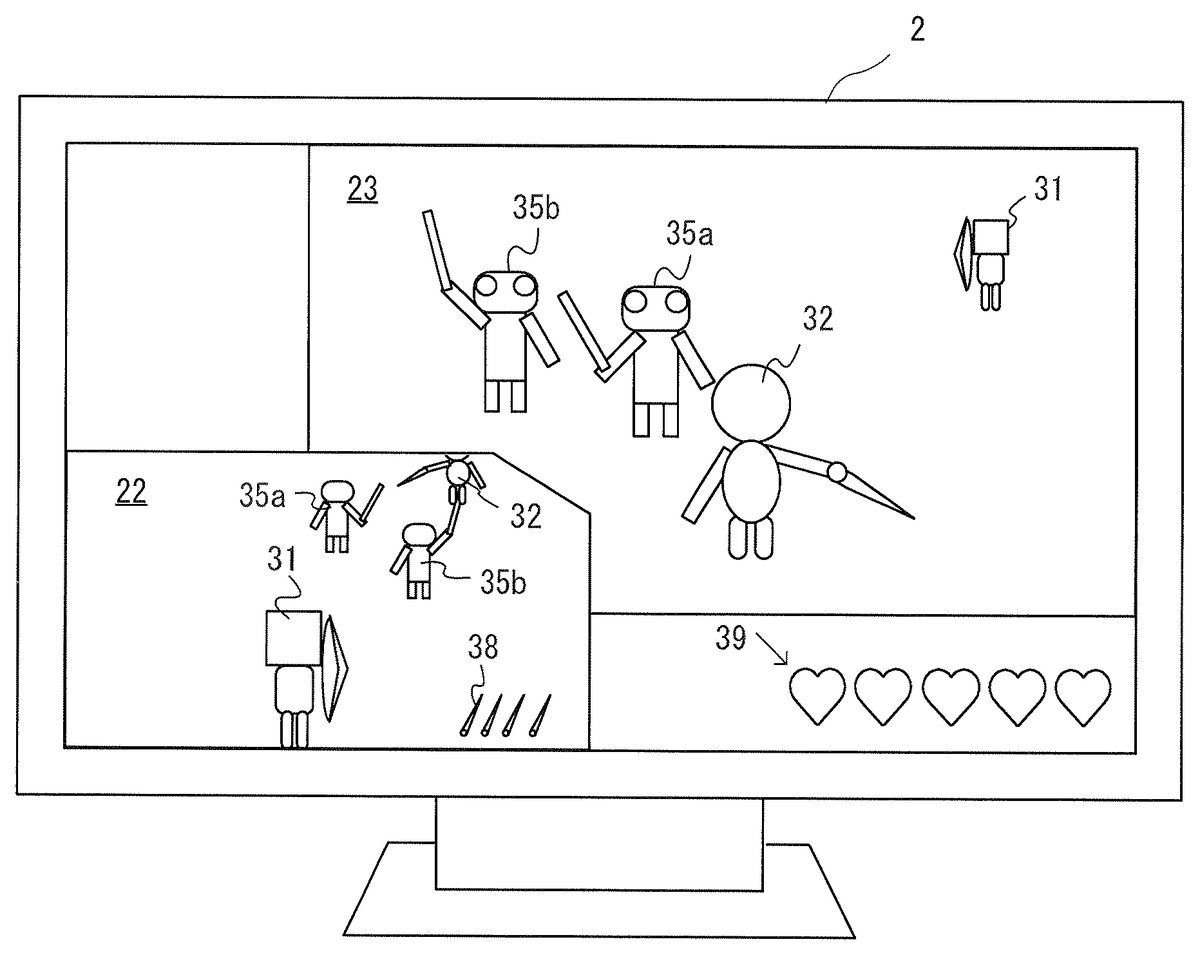
FIG. 3is a diagram showing examples of images displayed on the LCD71of the terminal apparatus7and the television2when the game is performed by two players. The case is described below where a first player operates the terminal apparatus7, and a second player operates a controller5a.
As shown inFIG. 3, when the game is performed by two players, an image22and an image23are displayed on the television2. The image22includes a player character31controlled by the first player. Further, inFIG. 3, the image22also includes an enemy character35aand an enemy character35bcontrolled by the game apparatus3, and a player character32controlled by the second player. Further, the image22shows the number of remaining arrow objects38used by the player character31to attack the enemy characters35. Meanwhile, the image23includes the player character32controlled by the second player. InFIG. 3, the image23also includes the enemy character35aand the enemy character35b, and the player character31.
The image22is one that changes in accordance with the operation performed on the terminal apparatus7, and the image23is one that changes in accordance with the operation performed on the controller5a. Specifically, the image22is one in which a game space is viewed from a first virtual camera set behind the player character31, and the image23is one in which the game space is viewed from a second virtual camera set behind the player character32.
For example, the image22changes in accordance with the operation performed on the operation section72of the terminal apparatus7, or changes in accordance with a change in the orientation of the terminal apparatus7. Further, the image23changes in accordance with the operation performed on the input section of the controller5a, or changes in accordance with a change in the orientation of the controller5a. It is possible to calculate the orientations of the terminal apparatus7and the controller5using, for example, the values detected by an inertial sensor (an acceleration sensor, an angular velocity sensor, or the like) included in each of the terminal apparatus7and the controller5.
In addition, as shown inFIG. 3, on the LCD71of the terminal apparatus7, an image21(a terminal image) is displayed in which the game space is viewed from the first virtual camera set behind the player character31. In the image21, an aim40as well as the objects displayed in the image22is displayed. The first player places the aim40on any one of the enemy characters35while viewing the image21, and performs the operation of making an attack, using the operation section72, thereby launching an arrow object38. The first player thus makes an attack on the enemy characters35.
Meanwhile, the second player operates the controller5awhile viewing the image23on the television2, thereby causing the player character32to swing a sword object. The second player thus makes an attack on the enemy characters35. The second player can know the situation of the first player by viewing the image22on the television2, and the first player can know the situation of the second player by viewing the image23on the television2. The first player and the second player enjoy the game by thus cooperating to defeat the enemy characters35. In the game according to the exemplary embodiment, all the player characters share lives39, so that, if the player character31and the player character32are attacked by the enemy characters35and the lives39become 0, the players lose.
As shown inFIG. 3, the image23based on the operation performed on the controller5ais larger than the image22based on the operation performed on the terminal apparatus7. That is, the first player basically plays the game while viewing the screen of the terminal apparatus7, and therefore, the image22displayed on the television2is displayed so as to be relatively small. On the other hand, the second player plays the game while viewing the television2, and therefore, the image23based on the operation performed on the controller5ais displayed so as to be relatively large.
FIG. 4is a diagram illustrating the sizes of the image22and the image23displayed on the television2. As shown inFIG. 4, the aspect ratio (the ratio of the horizontal to vertical size) of each of the image22and the image23is equal to the aspect ratio of the screen of the television2. That is, the horizontal size of the screen of the television2is H, and the vertical size of the screen of the television2is V; the horizontal size of the image22is H1, and the vertical size of the image22is V1; the horizontal size of the image23is H2, and the vertical size of the image23is V2. In this case, the ratio of H1to V1is equal to the ratio of H to V, and the ratio of H2to V2is equal to the ratio of H to V.
In addition, the sum of H1and H2is greater than H, and the sum of V1and V2is greater than V. Thus, as shown inFIG. 4, when the two images are displayed on the television2, display is performed such that a part of the image22and a part of the image23overlap each other. More specifically, display is performed such that a corner portion of the image22and a corner portion of the image23overlap each other. In the overlapping region of the two images, a part of the image22is displayed in a part of the overlapping region, and a part of the image23is displayed in the remaining part of the overlapping region. For example, as shown inFIG. 4, in the overlapping region of the two images, a corner portion of the image22is cut, and a part of the image23is displayed in the overlapping region of the cut portion.
Next, the case is described where the game is performed by three players.FIG. 5is a diagram showing examples of images displayed on the LCD71of the terminal apparatus7and the television2when the game is performed by three players. As shown inFIG. 5, on the television2, an image24as well as the image22and the image23is displayed. The image24is one that changes in accordance with the operation performed on a controller5bby a third player. The image24is one in which the game space is viewed from a virtual camera set behind a player character33controlled by the third player.
As shown inFIG. 5, the image23and the image24are displayed on the screen of the television2so as to overlap each other at their corner portions. The aspect ratio of each of the image23and the image24is equal to the aspect ratio of the screen. Specifically, the horizontal size H2of the image23is equal to a horizontal size H3of the image24, and the sum of H2and H3is greater than the horizontal size H of the screen. Further, the vertical size V2of the image23is equal to a vertical size V3of the image24, and the sum of V2and V3is greater than the vertical size V of the screen. Further, in an area of the screen of the television2other than the areas where the image23and the image24are displayed, the image22based on the operation performed on the terminal apparatus7is displayed.
Similarly to the two-person play, the image23and the image24based on the operations performed on the controllers5aand5b, respectively, are larger than the image22based on the operation performed on the terminal apparatus7, and the aspect ratio of each of the image23and the image24is equal to the aspect ratio of the screen of the television2. Thus, the image22is made smaller, while the image23and the image24are arranged so as to overlap each other at their corner portions. This makes it possible to maintain the aspect ratio of each image while securing relatively large display areas for the image23and the image24. For example, if three images are displayed while maintaining the aspect ratio of each image, the screen may be divide into four equal areas so that the images are displayed in the corresponding divided areas. In this case, the vertical and horizontal sizes of each of the image23and the image24are the same as those of the image22, which makes the image23and the image24smaller. This results in images that are difficult for the second player and the third player to view, the second and third players playing while viewing the television2. In the exemplary embodiment, however, as shown inFIG. 5, the screen is divided so that the image23and the image24are relatively large. This results in images that are easy for the second player and the third player to view. Meanwhile, the first player can basically play the game while viewing the screen of the terminal apparatus7, and therefore has no problem playing the game even if the image22of the television2is displayed so as to be relatively small.
It should be noted that, when the game according to the exemplary embodiment is performed by one player, an image shown inFIG. 6is displayed on the television2. When the game is performed by four players, images shown inFIG. 7are displayed on the television2.FIG. 6is a diagram showing an example of an image displayed on the television2when the game is performed by one player.FIG. 7is a diagram showing examples of images displayed on the television2when the game is performed by four players.
As shown inFIG. 6, when the game is performed by one player using the terminal apparatus7, the image22based on the operation performed on the terminal apparatus7is displayed on the entire screen of the television2. Further, although not shown in the figures, the image21that is the same as the image22is displayed also on the LCD71of the terminal apparatus7. In this case, the aspect ratio of the image22is equal to the aspect ratio of the screen.
In addition, as shown inFIG. 7, when the game is performed by four players, the screen of the television2is divide into four equal areas, so that the image22, the image23, the image24, and an image25based on the operation performed on a controller5coperated by a fourth player are displayed in the respective divided areas. The aspect ratio of each image on the television2is equal to the aspect ratio of the screen.
As described above, in the game of two-person play using one terminal apparatus7and one controller5, the image21based on the operation performed on the terminal apparatus7is displayed on the terminal apparatus7, and the image22based on the operation performed on the terminal apparatus7and the image23based on the operation performed on the controller5are displayed on the television2. The image23is larger than the image22, and therefore results in an image that is easy for the second player to view, the second player playing while viewing the image23. Specifically, the image22and the image23are displayed with the same aspect ratio as that of the screen, and the image22and the image23are displayed so as to overlap each other at their corner portions. This makes it possible to secure a larger display area for the image23.
Here, if two images are displayed on one screen, each image may be displayed in, for example, the corresponding one of two equal left and right areas, or two equal upper and lower areas, into which the screen is divided. In this case, to display each image in the corresponding one of the two equally divided areas, it is necessary to change the ratio of the horizontal to vertical size of the image by cutting both ends of the image in the left-right direction or the up-down direction, or enlarging or reducing the image in the horizontal direction or the vertical direction. This may result in an image that is difficult for the player to view. Thus, it is necessary to adjust the operability of the game and the level of difficulty of the game in accordance with a change in the field of view. In the exemplary embodiment, however, the aspect ratio of each of the image22and the image23is equal to the aspect ratio of the screen, and the image22and the image23are displayed so as to overlap each other at their corner portions. This makes it possible to maintain the aspect ratio of each image, while displaying the image23so as to be larger, which results in an image that is easy for the second player to view. Further, the field of view does not change, and therefore, it is not necessary to adjust the operability of the game and the level of difficulty of the game.
In addition, in the game of three-person play using one terminal apparatus7and two controllers5, the image21based on the operation performed on the terminal apparatus7is displayed on the terminal apparatus7. Further, the image22based on the operation performed on the terminal apparatus7is displayed on the television2, while the image23and the image24based on the operations performed on the respective controllers5are also displayed on the television2. In the game of three-person play, the image23and the image24are displayed so as to be larger than the image22. Further, the aspect ratio of each of the image22, the image23, and the image24is equal to the aspect ratio of the screen of the television2(equal to the aspect ratio of the image in one-person play or each image in four-person play), and the image23and the image24are displayed on the television2so as to overlap each other at their corner portions. Thus, also in the game of three-person play, it is possible to maintain the aspect ratio of each image while securing larger display areas for the image23and the image24, which results in images that are easy for the second player and the third player to view.
In addition, as shown inFIGS. 3 and 5, the lives39are displayed in an empty area other than the areas where the images for the respective players are displayed. The lives39are information to be shared among all the players. Such information is displayed in an empty area of the screen, which makes it possible to maximize the sizes of the images for the respective players, and also allow all the players to share the information.
(Variations)
It should be noted that the above embodiment is merely illustrative, and, for example, may be modified in various manners as described below.
For example, in the above embodiment, two images are displayed on the television2by diagonally cutting corner portions of the two images. Alternatively, in another embodiment, as shown inFIG. 8, corner portions of the two images may be cut in a stepped manner.FIG. 8is a diagram showing examples of images displayed on the television2when the game is performed by two players in another embodiment. As shown inFIG. 8, the image23is larger than the image22, and the aspect ratio of each of the image22and the image23is equal to the aspect ratio of the screen. Further, the sum of the vertical lengths of both images is greater than the vertical length of the screen, and the sum of the horizontal lengths of both images is greater than the horizontal length of the screen. Further, the image22and the image23overlap each other at their corner portions, and a part of the overlapping region is cut in a stepped manner.
Alternatively, in another embodiment, the two images may not need to overlap each other at their corner portions, but, as shown inFIG. 9, a part of the image22may overlap a part of the image23at a part of one of the short sides (or the long sides) of the image23.FIG. 9is a diagram showing examples of images displayed on the television2when the game is performed by two players in another embodiment. Also inFIG. 9, the image23is larger than the image22, and the aspect ratio of each image is equal to the aspect ratio of the screen. Further, the sum of the vertical lengths of both images is greater than the vertical length of the screen, and the sum of the horizontal lengths of both images is greater than the horizontal length of the screen.
In addition, in the above embodiment, the image21displayed on the terminal apparatus7and the image22displayed on the television2are images generated using the same virtual camera. Alternatively, in another embodiment, an image displayed on the terminal apparatus7(an image that changes in accordance with the operation performed on the terminal apparatus7) and an image displayed on the television2(an image that changes in accordance with the operation performed on the terminal apparatus7) may be images generated using different virtual cameras. In addition, in the above embodiment, images generated using the same virtual camera are displayed on the terminal apparatus7and the television2; however, an image not included in the image22displayed on the television2is displayed in the image21displayed on the terminal apparatus7(the lives39shown inFIG. 3are displayed in the image21on the terminal apparatus7but are not displayed in the image22on the television2). Alternatively, in another embodiment, these two images may be exactly the same image.
In addition, in the above embodiment, the game is performed by a plurality of players using the terminal apparatus7and the controller5. An image is displayed on the LCD71in accordance with the operation performed on the terminal apparatus7, and the image22, which is similar to the image displayed on the LCD71, is displayed also on the television2. Alternatively, in another embodiment, the image22based on the operation performed on the terminal apparatus7does not necessarily need to be displayed on the television2. Yet alternatively, the game may be performed by a plurality of players using a plurality of controllers5without using the terminal apparatus7, and images for the respective players may be displayed on the television2.
FIG. 10is a diagram showing examples of images displayed on the television2when the game is performed using two controllers5in another embodiment. InFIG. 10, the image23is one based on the operation performed on the controller5a, and the image24is one based on the operation performed on the controller5b. The game shown inFIG. 10is where one of the players operates the player character32using the controller5a, and the other player operates the player character33using the controller5b, so that the players cooperate to defeat the enemy characters35in the game space. The image22and the image23have the same size, and the ratio of the horizontal to vertical size (H2/V2) of the image22and the ratio of the horizontal to vertical size (H3/V3) of the image23are each equal to the ratio of the horizontal to vertical size of the screen. Further, the image22and the image23are displayed so as to overlap each other at their corner portions. Specifically, the sum of the horizontal size H2of the image22and the horizontal size H3of the image23is greater than the horizontal size H of the screen, and the sum of the vertical size V2of the image22and the vertical size V3of the image23is greater than the vertical size V of the screen. This makes it possible to maintain the ratio of the horizontal to vertical size of each of the two images, while displaying the two images so as to be larger.
In addition, in the above embodiment, two images are displayed on the television2so as to overlap each other such that a part of one of the two images is displayed in a part of the overlapping region, and a part of the other image is displayed in the remaining part of the overlapping region (for example, the two images are displayed by diagonally cutting corner portions of the two images, or by cutting corner portions of the two images in a stepped manner). Alternatively, in another embodiment, only a part of one of the two images may be displayed in the overlapping region, or the two images may be displayed so as to be semitransparent in the overlapping region. Alternatively, in another embodiment, in the overlapping region of the two images, one of the two images may change over time so as to be displayed with priority over the other image (the boundary between the two images may change over time).
Alternatively, in another embodiment, the size of each image displayed on the television2may be enlarged or reduced in accordance with the situation of the game.FIG. 11is a diagram showing the state where the size of each image displayed on the television2changes in another embodiment. For example, each image may become larger or smaller in accordance with the degree of success of the corresponding player (for example, a parameter whose value increases with an increase in the number of the enemy characters35the player defeats).
In addition, in the exemplary embodiment, the game progresses with the cooperation of a plurality of players. Alternatively, in another embodiment, the game may be where a plurality of players compete against each other. Further, the game may be any type of game so long as it is performed by a plurality of players.
(Flow of Processing)
Next, a description is given of the flow of the game processing performed by the game system1according to the exemplary embodiment. First, a description is given of various data stored in a memory.FIG. 12is a diagram showing various data stored in the game apparatus3.
As shown inFIG. 12, the memory11of the game apparatus3or the like stores: a game program100for performing the processing described later; operation data110representing the operations performed on the terminal apparatus7and the controllers5; terminal image data111representing a terminal image displayed on the LCD71of the terminal apparatus7; television image data112representing a television image displayed on the television2; and the like. The television image is an image including images generated by virtual cameras set behind the respective player characters. The memory also stores data representing the position and the orientation of each character in the game space, image data of each character, and the like, as well as the above.
(Description of Flow Chart)
Next, with reference toFIG. 13, a description is given of details of the processing performed by the game apparatus3(the CPU10).FIG. 13is a main flow chart showing the flow of the processing performed by the game apparatus3. It should be noted that the case is described below where three players play the game.
First, the game apparatus3acquires, from the terminal apparatus7and the controllers5(5a,5b), operation data representing the operations performed on the terminal apparatus7and the controllers5(step S1). Next, the game apparatus3performs game processing on the basis of the acquired operation data (step S2). In the game processing, for example, the game apparatus3causes the player character31to move in the game space on the basis of the operation data from the terminal apparatus7, causes the player characters32and33to move in the game space on the basis of the operation data from the controllers5, and causes these characters to take attacking actions.
Next, the game apparatus3performs the process of generating a terminal image (step S3). Here, the game apparatus3generates an image in which the game space is captured by the first virtual camera set behind the player character31, and superimposes images of the lives39and the arrow objects38on the generated image, thereby generating a terminal image (the image21).
Next, the game apparatus3performs the process of generating a television image (step S4). Here, the game apparatus3generates images (the image22, the image23, and the image24) in which the game space is captured by the respective virtual cameras set behind the player character31, the player character32, and the player character33, and arranges the generated images as shown inFIG. 5, thereby generating one television image.
Next, the game apparatus3transmits the terminal image generated in step S3to the terminal apparatus7, thereby performing a terminal image display process for displaying the terminal image on the LCD71of the terminal apparatus7(step S5). Then, the game apparatus3performs a television image display process (step S6). Here, the game apparatus3outputs the television image generated in step S4to the television2. This is the end of the processing.
It should be noted that the processing of the flow chart shown inFIG. 13is repeatedly performed. Further, the processes of all the steps in the flow chart are merely illustrative, and therefore, the processing order of the steps may be changed.
In addition, some of the processing described above may be performed by the terminal apparatus7. For example, the image21displayed on the terminal apparatus7may be generated by the terminal apparatus7.
In addition, the program may be executed not only by the game apparatus3described above, but also by any other information processing apparatus, and the other information processing apparatus may function as the game system described above. Possible examples of the other information processing apparatus include mobile phones, smartphones, PDAs, personal computers, tablet computers, and the like. The other information processing apparatus may function as the game apparatus3and/or the terminal apparatus7described above.
Alternatively, in another embodiment, in a game system including a plurality of apparatuses capable of communicating with each other, the plurality of apparatuses may share the execution of the game processing performed by the game apparatus3as described above. For example, the game system as described above may include a plurality of information processing apparatuses connected to a network such as the Internet.
In addition, in the above embodiment, the processing indicated in the flow chart described above is performed as a result of the CPU of the game apparatus3executing the program. Alternatively, in another embodiment, some or all of the processing described above may be performed by a dedicated circuit included in the game apparatus3, or may be performed by a general-purpose processor other than the dedicated circuit. At least one processor may operate as a “programmed logic circuit” for performing the processing described above.
The systems, devices and apparatuses described herein may include one or more processors, which may be located in one place or distributed in a variety of places communicating via one or more networks. Such processor(s) can, for example, use conventional3D graphics transformations, virtual camera and other techniques to provide appropriate images for display. By way of example and without limitation, the processors can be any of: a processor that is part of or is a separate component co-located with the stationary display and which communicates remotely (e.g., wirelessly) with the movable display; or a processor that is part of or is a separate component co-located with the movable display and communicates remotely (e.g., wirelessly) with the stationary display or associated equipment; or a distributed processing arrangement some of which is contained within the movable display housing and some of which is co-located with the stationary display, the distributed portions communicating together via a connection such as a wireless or wired network; or a processor(s) located remotely (e.g., in the cloud) from both the stationary and movable displays and communicating with each of them via one or more network connections; or any combination or variation of the above. The processors can be implemented using one or more general-purpose processors, one or more specialized graphics processors, or combinations of these. These may be supplemented by specifically-designed ASICs (application specific integrated circuits) and/or logic circuitry. In the case of a distributed processor architecture or arrangement, appropriate data exchange and transmission protocols are used to provide low latency and maintain interactivity, as will be understood by those skilled in the art. Similarly, program instructions, data and other information for implementing the systems and methods described herein may be stored in one or more on-board and/or removable memory devices. Multiple memory devices may be part of the same device or different devices, which are co-located or remotely located with respect to each other.
While certain example systems, methods, devices and apparatuses have been described herein, it is to be understood that the appended claims are not to be limited to the systems, methods, devices and apparatuses disclosed, but on the contrary, are intended to cover various modifications and equivalent arrangements included within the spirit and scope of the appended claims.
Claims
- A game system for performing a game using a first operation apparatus and a second operation apparatus, the first operation apparatus including a first display apparatus, the game system comprising a processor system including at least one processor, and the processor system being configured to at least: perform game processing based on operations performed on the first operation apparatus and the second operation apparatus;and on the basis of the game processing, cause a first image based on the operation performed on the first operation apparatus to be displayed on the first display apparatus, cause a second image based on the operation performed on the first operation apparatus to be displayed on a second display apparatus, and cause a third image based on the operation performed on the second operation apparatus to be displayed on the second display apparatus, the second display apparatus being separate from the first display apparatus, the third image being larger than the second image, the second image partially overlapping with the third image, wherein in a region where the second and third images overlap, a corner portion of the second image is removed, and a part of the third image removed corner portion of the second image.
- The game system according to claim 1 , wherein the second image and the third image are caused to be displayed on the second display apparatus such that a sum of horizontal lengths of the second image and the third image is greater than a horizontal length of a screen of the second display apparatus, and a sum of vertical lengths of the second image and the third image is greater than a vertical length of the screen of the second display apparatus.
- The game system according to claim 2 , wherein the second image and the third image are caused to be displayed on the second display apparatus such that a corner portion of the second image and a corner portion of the third image overlap.
- The game system according to claim 2 , wherein in the overlapping region of the second image and the third image, a part of one of the second and third images is caused to be displayed in a part of the overlapping region, and a part of the other one of the second and third images is caused to be displayed in the remaining part of the overlapping region.
- The game system according to claim 1 , wherein an aspect ratio of each of the second image and the third image is the same as an aspect ratio of a screen of the second display apparatus.
- The game system according to claim 1 , wherein the game system allows the game to be performed further using a third operation apparatus, and the processor system is further configured to cause a fourth image based on an operation performed on the third operation apparatus to be displayed on the second display apparatus so as to be larger than the second image.
- The game system according to claim 6 , wherein the processor system is further configured to cause the third image and the fourth image to be displayed on the second display apparatus such that a sum of horizontal lengths of the third image and the fourth image is greater than a horizontal length of a screen of the second display apparatus, and a sum of vertical lengths of the third image and the fourth image is greater than a vertical length of the screen of the second display apparatus, and also cause the second image to be displayed in an area other than areas where the third image and the fourth image are displayed.
- The game system according to claim 1 , wherein the game system allows the game to be performed by four players using third and fourth operation apparatuses in addition to the first operation apparatus and the second operation apparatus, and the processor system is further configured to when the game is performed by four players, cause images based on operations performed on the first through fourth operation apparatuses to be displayed on the second display apparatus, all the images having the same aspect ratio, and cause the images to be displayed on the second display apparatus such that the aspect ratio of each image displayed on the second display apparatus when the game is performed by the four players is the same as an aspect ratio of each of the second image and the third image.
- The game system according to claim 1 , wherein the processor system is further configured to cause information shared among more than one player to be displayed in an area of the second display apparatus other than areas where both the second and third images are displayed.
- The game system according to claim 1 , wherein the first image displayed on the first display apparatus includes an image not displayed in the second image displayed on the second display apparatus.
- The game system according to claim 1 , wherein the corner portion of the second image is removed diagonally.
- The game system according to claim 1 , wherein the corner portion of the second image is removed in a stepped manner.
- A game processing method performed by a game system for a plurality of players to perform a game using a first operation apparatus and a second operation apparatus, the first operation apparatus including a first display apparatus, the game processing method comprising: performing game processing based on operations performed on the first operation apparatus and the second operation apparatus;on the basis of the game processing, causing a first image based on the operation performed on the first operation apparatus to be displayed on the first display apparatus;and on the basis of the game processing, causing a second image based on the operation performed on the first operation apparatus to be displayed on a second display apparatus, and also causing a third image based on the operation performed on the second operation apparatus to be displayed on the second display apparatus, the second display apparatus being separate from the first display apparatus, the second image and the third image being caused to be displayed on the second display apparatus such that the third image is larger than the second image, wherein the second image partially overlaps with the third image, and in a region where the second and third images overlap, a corner portion of the second image is removed, and a part of the third image is displayed in at least a part of the removed corner portion of the second image.
- The game processing method according to claim 13 , wherein the corner portion of the second image is removed diagonally.
- The game processing method according to claim 13 , wherein the corner portion of the second image is removed in a stepped manner.
- A non-transitory computer-readable storage medium having stored therein a game program to be executed by a computer of an apparatus for a plurality of players to perform a game using a first operation apparatus and a second operation apparatus, the first operation apparatus including a first display apparatus, the game program causing the computer to execute: performing game processing based on operations performed on the first operation apparatus and the second operation apparatus;on the basis of the game processing, causing a first image based on the operation performed on the first operation apparatus to be displayed on the first display apparatus;and on the basis of the game processing, causing a second image based on the operation performed on the first operation apparatus to be displayed on a second display apparatus, and also causing a third image based on the operation performed on the second operation apparatus to be displayed on the second display apparatus, the second display apparatus being separate from the first display apparatus, the second image and the third image being caused to be displayed on the second display apparatus such that the third image is larger than the second image, wherein the second image partially overlaps with the third image, and in a region where the second and third images overlap, a corner portion of the second image is removed, and a part of the third image is displayed in at least a part of the removed corner portion of the second image.
- The non-transitory computer-readable storage medium according to claim 16 , wherein the corner portion of the second image is removed diagonally.
- The non-transitory computer-readable storage medium according to claim 16 , wherein the corner portion of the second image is removed in a stepped manner.
- A game apparatus for a plurality of players to perform a game using a first operation apparatus and a second operation apparatus, the first operation apparatus including a first display apparatus, the game apparatus comprising: a game processor configured to perform game processing based on operations performed on the first operation apparatus and the second operation apparatus;a first display controller configured to, on the basis of the game processing, cause a first image based on the operation performed on the first operation apparatus to be displayed on the first display apparatus;and a second display controller configured to, on the basis of the game processing, cause a second image based on the operation performed on the first operation apparatus to be displayed on a second display apparatus, and also cause a third image based on the operation performed on the second operation apparatus to be displayed on the second display apparatus, the second display apparatus being separate from the first display apparatus, the second display controller causing the second image and the third image to be displayed on the second display apparatus such that the third image is larger than the second image, wherein the second image partially overlaps with the third image, and in a region where the second and third images overlap, a corner portion of the second image is removed, and a part of the third image is displayed in at least a part of the removed corner portion of the second image.
- The game apparatus according to claim 19 , wherein the corner portion of the second image is removed diagonally.
- The game apparatus according to claim 19 , wherein the corner portion of the second image is removed in a stepped manner.
- A game system for a plurality of players to perform a game using a first operation apparatus and a second operation apparatus, the game system comprising a processor system including at least one processor, and the processor system being configured to at least: perform game processing based on operations performed on the first operation apparatus and the second operation apparatus;and on the basis of the game processing, cause a first image based on the operation performed on the first operation apparatus to be displayed on a display apparatus, cause a second image based on the operation performed on the second operation apparatus to be displayed on the display apparatus, and cause the first image and the second image to be displayed on the display apparatus such that a sum of horizontal lengths of the first image and the second image is greater than a horizontal length of a screen of the display apparatus, and a sum of vertical lengths of the first image and the second image is greater than a vertical length of the screen of the display apparatus, wherein the first image partially overlaps with the second image, and in a region where the second and third images overlap, a corner portion of the second image is removed, and a part of the third image is displayed in at least a part of the removed corner portion of the second image.
- The game system according to claim 22 , wherein an aspect ratio of each of the first image and the second image is the same as an aspect ratio of the screen of the display apparatus.
- The game system according to claim 22 , wherein the corner portion of the first image is removed diagonally.
- The game system according to claim 22 , wherein the corner portion of the first image is removed in a stepped manner.
Disclaimer: Data collected from the USPTO and may be malformed, incomplete, and/or otherwise inaccurate.