U.S. Pat. No. 9,424,688
METHOD FOR DISPLAYING A VIRTUAL WORLD IN WHICH THE AVATAR OF A USER OF A VIRTUAL-REALITY SERVICE EVOLVES
AssigneeAlcatel Lucent
Issue DateMarch 11, 2013
Illustrative Figure
Abstract
The invention pertains to a method for displaying a virtual world in which the avatar of a user of a virtual reality service evolves, said method being operative to use a standard mode for displaying said virtual world, to identify objects visible to the avatar within the displayed virtual world, and, for at least one of said identified objects, to determine whether a relationship exists within the virtual reality service's social network between said object and the user, and if so, to determine a display mode to apply to said object depending on said relationship, the display of said object being altered by applying said determined mood.
Description
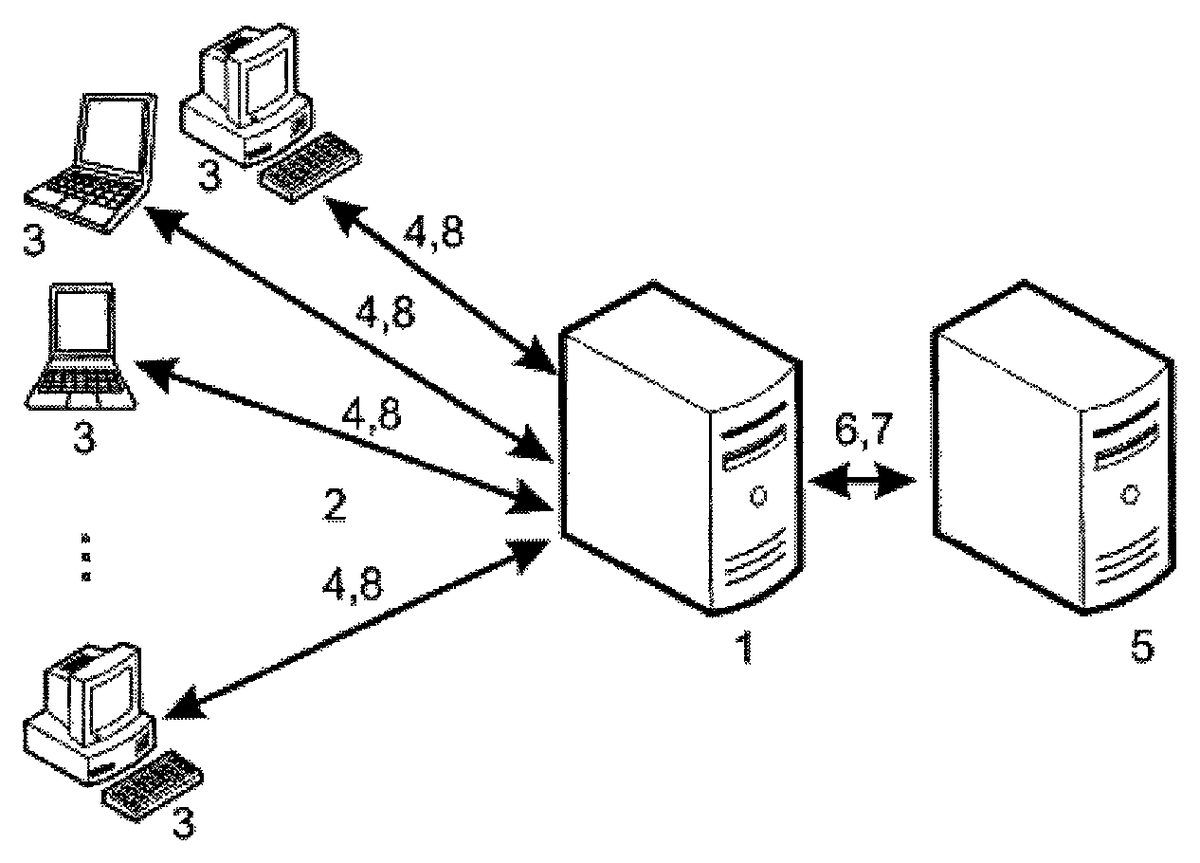
With respect to that FIGURE, a method for displaying a virtual world in which the avatar of a user of a virtual reality service evolves is described below. The virtual reality service is particularly delivered by a server1within a network22users connected to said service by means of their terminal3, said terminal potentially being, for example, a desktop or laptop computer, a personal digital assistant, or a smartphone. The server1may comprise means capable of executing an algorithm to implement the method for displaying the virtual world on the terminal3of a user, particularly when said user connects to the virtual reality service by means of said terminal. When the user connects to the virtual reality service, the method is operative to use a standard mode for displaying the virtual world in which said user's avatar evolves, said virtual world being displayed on the terminal3of said user. To do so, the server1comprises means for displaying the virtual world in a standard mode. In the standard display mode, the entire virtual world is displayed uniformly, meaning that the objects of said world and the avatars that evolve within said world are displayed the same way, particularly with the same display quality. According to one embodiment, the display method according to the invention may be an option of the virtual reality service that the user can turn on, for example once he or she is connected to said service and the virtual world in which his or her avatar evolves is displayed in a standard mode on his or her terminal3, or by editing his or her settings for using said service so that said option is turned on automatically when he or she connects to said service. With respect to the FIGURE, when this option is turned on, the user sends a request4by means ...
With respect to that FIGURE, a method for displaying a virtual world in which the avatar of a user of a virtual reality service evolves is described below. The virtual reality service is particularly delivered by a server1within a network22users connected to said service by means of their terminal3, said terminal potentially being, for example, a desktop or laptop computer, a personal digital assistant, or a smartphone.
The server1may comprise means capable of executing an algorithm to implement the method for displaying the virtual world on the terminal3of a user, particularly when said user connects to the virtual reality service by means of said terminal.
When the user connects to the virtual reality service, the method is operative to use a standard mode for displaying the virtual world in which said user's avatar evolves, said virtual world being displayed on the terminal3of said user. To do so, the server1comprises means for displaying the virtual world in a standard mode. In the standard display mode, the entire virtual world is displayed uniformly, meaning that the objects of said world and the avatars that evolve within said world are displayed the same way, particularly with the same display quality.
According to one embodiment, the display method according to the invention may be an option of the virtual reality service that the user can turn on, for example once he or she is connected to said service and the virtual world in which his or her avatar evolves is displayed in a standard mode on his or her terminal3, or by editing his or her settings for using said service so that said option is turned on automatically when he or she connects to said service.
With respect to the FIGURE, when this option is turned on, the user sends a request4by means of his or her terminal3to the server1delivering the virtual reality service, said server then continuing the implementation of the method.
The method is then operative to identify objects visible to the user's avatar within the displayed virtual world. To do so, the server1comprises means for identifying objects visible to the user, for example objects displayed on the terminal3of said avatar's user, or even objects closer to said avatar from among said displayed objects.
In particular, the means of identification may be capable of computing, for each displayed object, the distance between the avatar's current position within the displayed virtual world and said object, said object then being identified by said means if the computed distance is small enough.
The method is additionally operative, for at least one of the identified objects, to determine whether a relationship exists within the virtual reality service's social network between said object and the user. In particular, the method may be operative to determine whether a relationship exists between each of the user's identified objects.
To do so, the server1may comprise means for determining the existence of a relationship within the social network of said service between the identified objects and the user.
In particular, the relationship between an identified object and the user may pertain to the relationship within the social network between said user and said object's owner; the means for determining the existence of a relationship are in such a case capable of determining whether a relationship exists within the social network between said owner and said user.
The relationship between the user and an owner of an identified object may pertain to the existing social proximity between said user and said owner within the social network. For example, the owner of the identified object may be a direct contact of the user within the social network, such as a friend of said user, or an indirect contact, such as a friend of a contact of said user. Furthermore, the user may himself or herself be the owner of one of the identified objects.
If there is a relationship within the social network between an identified object and the user, the method is operative to determine a display mode to apply to said object depending on said relationship, the display of said object in such a case being altered by applying said determined mode.
To do so, the server1may comprise means for determining a display mode to apply to objects depending on their relationship with the user and means for altering the display of said objects by applying said determined mode.
According to one depicted embodiment, an outside server5may be implemented within the preexisting architecture for providing the virtual reality service, and may comprise an application comprising:means for determining the existence of a relationship within said service's social network between the identified objects and the user; andmeans for determining a display mode to apply to said objects.
With respect to the FIGURE, the server1may comprise means for sending to the server5, for each identified object, a request6in order to obtain the display mode to be applied to said object depending on its relationship with the user.
Additionally, the server5may comprise means for sending a notification7to the server1in response to each request6that is sent, said notification comprising the display mode determined by the application for the corresponding identified object.
According to another embodiment that is not depicted, the aforementioned application may be incorporated into the server1that provides the virtual reality service.
According to one embodiment, the method is operative to alter the display quality of an object depending on the determined relationship between said object and the user. For example, the server's1means for altering may be capable of altering the resolution of an identified object, or the quantity of said object's details, or the sharpness of said object, depending on the relationship between said object and the user.
In particular, the an object's display quality may be altered so as to improve the user's visual perception of said object depending on the degree of the relationship between said object and said user.
The degree of the relationship between an identified object and the user may, in particular, be linked to the level of social proximity between said user and the owner of said object, the means for determining the existence of a relationship being capable of determining said degree depending on said level, particularly along a predefined scale.
To do so, the means for determining the existence of a relationship may be capable of querying a database of the virtual reality service's social network in order to determine the degree of the relationship between an identified object and the user along a predefined scale.
According to one embodiment, the external server5may comprise a database within which the existing relationships between the different users of the virtual reality service are saved, the means for determining the existence of a relationship being capable of querying said base.
For example, if the owner of an identified object is an indirect contact of the user within the virtual reality service's social network, the degree of the relationship between said object and said user shall be medium.
Likewise, if the owner of an identified object is a direct contact of the user within the virtual reality service's social network, the degree of the relationship between said object and said user shall be high.
Additionally, if the owner of an identified object is the user himself or herself, the degree of the relationship between said object and the user will be very high.
Finally, if there is no relationship between the owner of the identified object and the user within the virtual reality service's social network, or if that relationship is too distant, the means for determining the existence of a relationship may be capable of determining that there is no relationship between said object and the user, and the method will not alter the display of said object.
Depending on the degree of the relationship between an object and the user, the means for determining a display mode are capable of determining the appropriate display mode to apply to said object in order to improve the user's visual perception of said object.
In particular, the display mode may be determined in such a way as to improve the display quality of an object in proportion to the degree of the relationship between said object and the user. Furthermore, display modes that each correspond to a degree of relationship between an object and the user may be predefined within the virtual reality service, the means for determining a display mode being capable of selecting one of said predefined modes as the display mode to apply to an object depending on the degree of its relationship with the user.
For example, if the degree of the relationship between an object and the user is very high, for example because the user is the owner of said object, the display mode to apply to said object will be the one that corresponds to the best display quality.
Likewise, if the degree of the relationship between an object and the user is high, for example because the owner of said object is a direct contact of said user, the display mode to apply to said object will be the one that corresponds to a good display quality.
Furthermore, if the degree of the relationship between an object and the user is medium, for example because the owner of said object is an indirect object of said user, the display mode to apply to said object will be the one that corresponds to a medium display quality.
Finally, if there is no relationship between an object and the user, or if the degree of said relationship is too low, the method will not alter the display of said object.
This way, the display method makes it possible, thanks to a technology based on adaptive streaming display, to improve the realism of the virtual world by imitating one of the primary mechanisms of human perception. By positively altering the display quality of the objects that are visible to the user's avatar and familiar to said user, the method enables said user to more easily spot said objects from among other, unfamiliar objects, said other objects being displayed in a basic-quality standard mode.
With respect to the FIGURE, after the server1receives a notification7comprising the display mode to apply to an object, the means for altering the display send a notification8to the terminal3of the user in order for said terminal's display means apply said mode to said object in order to alter the display of said object depending on its relationship with the user.
According to another embodiment, the method may be operative to alter the display quality of an object in a manner inversely proportional to the degree of its relationship with the user. For example, the predefined display modes may relate to an object's level of blur, said level of blur being inversely proportional to the degree of the relationship between said object and the user.
In particular, the virtual reality service may comprise a predefined scale for determining the degree of a relationship, the lowest level of said scale corresponding to the situation in which there is no relationship within said service's social network and the owner of an identified object, or the situation in which the relationship between said user and the owner of said object is too distant.
Claims
- A method for displaying a virtual world in which the avatar of a user of a virtual reality service evolves, said method being operative to use a standard mode for displaying said virtual world, to identify objects visible to the avatar within the displayed virtual world, and, for at least one of said identified objects, to determine whether a relationship exists within the virtual reality service's social network between an owner of said object within the virtual world and the user, wherein the objects are distinct from the avatar, if the relationship exists and an owner of the object within the virtual world is a direct contact of the user in the virtual reality service's social network, to determine a second display mode to apply to said object depending on said relationship wherein the second display mode is different from the standard display mode, and if the relationship exists and the owner of the object is an indirect contact of the user in the virtual reality service's social network, to determine a third display mode different from the standard and second display modes to apply to said object, the display of said object within the virtual world being altered by applying either one of said determined second and third display modes, wherein a resolution used in the standard display mode is lower than a resolution used in the second and third display modes, wherein the resolution of the second display mode is higher than the resolution of the third display mode, wherein an owner of said object is an avatar within the virtual world distinct from a creator of said object and the user, and wherein the indirect contact is a contact of the direct contact in the virtual reality's social network.
- A display method according to claim 1 , wherein it is operative to determine whether a relationship exists between each of the identified objects and the user, so as to alter the display of each of said objects by applying to it either one of the second and third display modes.
- A display method according to claim 1 , wherein it is operative to alter the display quality of the object depending on the determined relationship.
- A display method according to claim 3 , wherein the object's display quality is altered to improve the user's visual perception of said object depending on the degree of the relationship between said object and said user.
- The server according to claim 3 , wherein the object's display quality is altered to negatively impact the user's visual perception of said object depending on the degree of the relationship between said object and said user.
- A server delivering a virtual reality service, said service displaying, in a standard mode, a virtual world in which the avatar of a user of said service evolves, said server additionally comprising: an identifier configured to identify objects visible to the avatar within the displayed virtual world;a relationship determination component configured to determine the existence of a relationship within said service's social network between owners of said identified objects within the displayed virtual world and the user, wherein the objects are distinct from the avatar;a display mode determination component configured to: determine a second display mode to apply to said objects if the relationship exists and an owner of the said objects is a direct contact of the user within the virtual reality service's social network, wherein the second display mode is different from the standard display mode, and determine a third display mode to apply to said objects if the relationship exists and an owner of said objects is an indirect contact of the user within the virtual reality service's social network, wherein the third display mode is different from the second and standard display modes;and an alteration component configured to alter the display of said objects by applying said determined mode, wherein respective resolutions of the second and third display modes are higher than the resolution used in the standard display mode, wherein the resolution of the second display mode is higher than the resolution used in the third display mode, and wherein an owner of said object is an avatar within the virtual world distinct from a creator of said object and the user, and wherein the indirect contact is a contact of the direct contact in the virtual reality's social network.
- The server according to claim 6 , wherein the alteration component is configured to alter the display quality of objects depending on the determined relationship.
- The server according to claim 7 , wherein the alteration component is configured to positively alter the display quality of objects and negatively alter the display quality of objects corresponding to a level of social proximity between the owners of said objects and the user.
- A server for a virtual reality service, said server comprising an application, the application comprising: a relationship determination component configured to determine the existence of a relationship within a social network of said service between an owner of at least one identified object and a user, wherein the owner of said at least one identified object is an avatar within the virtual world distinct from the user and a creator of said at least one identified object, said at least one identified object being distinct from the avatar: and a display determination component configured to: determine a second display mode to apply to said at least one object displayed in a standard display mode if the relationship exists and an owner of the objects is a direct contact of the user in the social network of said service, determine a third display mode different from the standard display mode and the second display mode to apply to said at least one object displayed in a standard display mode if the relationship exists and the owner of the objects is an indirect contact of the user in the social network of said service, wherein the indirect contact is a contact of the direct contact in the virtual reality's social network, wherein a resolution used in the second display mode and a resolution used in the third display mode are higher than a resolution used in the standard display mode, and wherein the resolution of the second display mode is higher than the resolution of the third display mode.
- The server according to claim 9 , wherein the display determination component is configured to alter a display quality of the at least one object corresponding to a degree of the relationship between the owner of the at least one object and the user.
- The server according to claim 10 , wherein the display determination component is configured to alter the display quality of the at least one object inversely proportional to the degree of the relationship between the owner of the at least one object and the user.
Disclaimer: Data collected from the USPTO and may be malformed, incomplete, and/or otherwise inaccurate.