U.S. Pat. No. 9,424,537
System and Method for Item-Based Economy in a Virtual World
AssigneeDisney Enterprises, Inc.
Issue DateFebruary 22, 2012
Illustrative Figure
Abstract
There is provided a system and method for an item-based economy in a virtual world. There is provided a server for providing an item exchange for a virtual world lacking a common currency for item valuation, comprising a processor configured to receive a request from a client having an inventory to initiate the item exchange, present a user interface on a display of the client for the item exchange, receive a selection of either a second quantity of second items or a third quantity of third items for the item exchange from the client, remove from the inventory of the client a first quantity of tradable items defined by a first exchange value or a second exchange value based on the selection, and add the second quantity of second items or the third quantity of the third items to the inventory of the client based on the selection.
Description
DETAILED DESCRIPTION OF THE INVENTION The present application is directed to a system and method for an item-based economy in a virtual world. The following description contains specific information pertaining to the implementation of the present invention. One skilled in the art will recognize that the present invention may be implemented in a manner different from that specifically discussed in the present application. Moreover, some of the specific details of the invention are not discussed in order not to obscure the invention. The specific details not described in the present application are within the knowledge of a person of ordinary skill in the art. The drawings in the present application and their accompanying detailed description are directed to merely exemplary embodiments of the invention. To maintain brevity, other embodiments of the invention, which use the principles of the present invention, are not specifically described in the present application and are not specifically illustrated by the present drawings. FIG. 1presents a block diagram of a system for supporting an item-based economy in a virtual world, according to one embodiment of the present invention. Environment100ofFIG. 1includes server110, network140, input device145, display146, and client150. Server110includes processor111and memory115. Memory115includes online game service120, user account database125, and virtual world database130. Client150includes processor151and memory155. Memory155includes online game client160. Processor111of server110may execute online game service120stored in memory115to provide an online virtual world accessible by client150through network140. For simplicity, only a single server110and a single client150are depicted in environment100ofFIG. 1, but alternative embodiments may deploy multiple servers for load balancing and enhanced availability, and multiple clients may be connected to support a massively multiplayer online virtual world. Alternative data structures may also be used in conjunction with or in lieu of the databases shown in memory115for speed optimization or complexity management reasons. For example, some data stores may ...
DETAILED DESCRIPTION OF THE INVENTION
The present application is directed to a system and method for an item-based economy in a virtual world. The following description contains specific information pertaining to the implementation of the present invention. One skilled in the art will recognize that the present invention may be implemented in a manner different from that specifically discussed in the present application. Moreover, some of the specific details of the invention are not discussed in order not to obscure the invention. The specific details not described in the present application are within the knowledge of a person of ordinary skill in the art. The drawings in the present application and their accompanying detailed description are directed to merely exemplary embodiments of the invention. To maintain brevity, other embodiments of the invention, which use the principles of the present invention, are not specifically described in the present application and are not specifically illustrated by the present drawings.
FIG. 1presents a block diagram of a system for supporting an item-based economy in a virtual world, according to one embodiment of the present invention. Environment100ofFIG. 1includes server110, network140, input device145, display146, and client150. Server110includes processor111and memory115. Memory115includes online game service120, user account database125, and virtual world database130. Client150includes processor151and memory155. Memory155includes online game client160.
Processor111of server110may execute online game service120stored in memory115to provide an online virtual world accessible by client150through network140. For simplicity, only a single server110and a single client150are depicted in environment100ofFIG. 1, but alternative embodiments may deploy multiple servers for load balancing and enhanced availability, and multiple clients may be connected to support a massively multiplayer online virtual world. Alternative data structures may also be used in conjunction with or in lieu of the databases shown in memory115for speed optimization or complexity management reasons. For example, some data stores may be more readily and quickly implemented through a simple matrix array or linked list, rather than a fully featured database that may require high overhead. Additionally, database components may be modularized to several servers. For example, one dedicated server may host only virtual world database130, while another dedicated server may host only user account database125, and yet another dedicated server may host only online game service120.
Online game service120may comprise, for example, an executable program that can authenticate client150over network140by checking provided credentials against user account database125. User account database125may store a variety of data for each client registered for the virtual world, such as login and password, game state, activity history, and other data. After authentication, online game service120may consult virtual world database130to retrieve parts of the virtual world currently relevant to the user account retrieved from user account database125.
For example, if the user of client150last logged off while shopping in a town, data from virtual world database130may be retrieved pertaining to that town, including map data and rendering assets. Additionally, online game service120can check if other clients within user account database125are also located within the same town to provide player interactions accordingly, such as displaying their avatars and enabling group chat with fellow players. This retrieved data can then be provided to client150over network140, which may comprise a publicly accessible network such as the Internet, or a private network such as a local area network or a mobile broadband network.
Meanwhile, processor151of client150may execute online game client160in memory155, which may have been previously downloaded or installed to client150from physical media. Online game client160provides the means to communicate with online game service120via network140, receive inputs from input device145, and output images to display146, thereby providing an online virtual world experience. For example, client150may comprise a personal computer, game console, mobile Internet device (MID), notebook or laptop computer, or another interactive device for use by the user or player. Online game client160may comprise a native executable or bytecode to be interpreted by a web browser plug-in such as Java or Flash. Input device145may comprise a keyboard, mouse, gamepad, touchscreen, or other input device. Display146may comprise a computer monitor, a television, or a high definition television (HDTV) using cathode ray tube (CRT), plasma, liquid crystal display (LCD), or another display technology.
FIG. 2presents a block diagram of a server memory for supporting an item-based economy in a virtual world, according to one embodiment of the present invention. Server memory200includes online game service220, user account database225, and virtual world database230. User account database225includes user account226. Virtual world database230includes item database231, item combination database232, exchange value database235, non-player character (NPC) database236, and environment database237. With regards toFIG. 2, it should be noted that online game service220corresponds to online game service120fromFIG. 1, that user account database225corresponds to user account database125fromFIG. 1, and that virtual world database230corresponds to virtual world database130fromFIG. 1.
Server memory200shows in greater detail some exemplary components that may be stored in memory115of server110inFIG. 1. In particular, components supporting an item-based economy are shown by server memory200ofFIG. 2. Virtual world database230includes several item related components, including item database231, item combination database232, and exchange value database235. Item database231may contain, for example, records for every possible item in the virtual world, describing the characteristics of each item, their visual appearance, and other relevant data. Item combination database232may then define the different ways in which the items referenced in item database231can be combined to create new items. For example, the virtual world may offer various ways to combine items, such as character skills, jobs, alchemy, cooking, crafting, weaving, and other features that take one or more “tradable” items that can be transformed into a new item. The term “tradable” is used here in the sense that these items can be transformed into a new item, and not necessarily that they must be used in a bartering transaction. Item combination database232can store records defining all possible combinations from the various skills and items available to users of the virtual worlds.
Additionally, exchange value database235may store records pertaining to item valuations, where items have exchange values defined by quantities of items, rather than a common currency, such as money, gold or any other single item. In this manner, players and non-player characters (NPCs) can exchange items with each other even without a common currency such as money or gold. NPCs might comprise shopkeepers, virtual world citizens, and other characters that are not directly controlled by users but may respond to users through artificial intelligence algorithms of online game service220.
Moreover, item valuations may be specific to particular characters in the virtual world, where different characters may place different values on different items. For example, one non-player character (NPC) may particularly value high quality fruit, and may offer rare and desirable items in exchange for high quality fruit. Another NPC may dislike fruit and refuse to even trade for fruit, or may offer only token items for trade, like a type of flower easily found throughout the wilderness of the virtual world. NPC database236in conjunction with exchange value database235can store these and other NPC exchange value preferences to provide a more realistic item-based economy for the virtual world.
Moreover, these exchange values may dynamically change in response to conditions of the virtual world, such as reaching a predetermined date and/or time. For example, a processor of a server may implement behaviors where certain NPCs may offer discounts activated by particular days of the week, or a food vendor NPC may offer happy hour discounts at particular hours of the day. Larger events in the virtual world, like an annual festival, might trigger NPCs to provide discounts or festive items instead of their usual inventory. Seasonally available items, such as flowers that bloom only during the spring season, may replace other items as exchange values during the relevant season.
Additionally, clients may have inventories comprising a subset of items from a finite global inventory, introducing item scarcity into the virtual world economy. NPCs may thus adjust exchange values according to supply and demand or other factors, depending on the personality of the NPC. Environment database237may provide a repository for the finite global inventory, providing a geographic layout of the virtual world along with placement of items, buildings, structures, NPCs, and other features.
While virtual world database230may focus on data regarding the virtual world, user account database225may focus on data regarding user accounts. Besides containing authentication information, each user account may contain information regarding the user's status and relationship with the virtual world. Although only a single user account226is shown in server memory200ofFIG. 2, alternative embodiments may include several user accounts within user account database225to support massively multiplayer worlds. Although clients may partially cache the data contained in user account database225, user account database225might also be used as a master store to override local client data in situations where network disconnections or data discrepancies occur, preventing unauthorized data changes and other unwanted side effects. In this way, user account226of an associated client including inventory227may be stored on the server side, such as server110ofFIG. 1, where the memory on the client side is used primarily for holding temporary caching data.
Examining user account226, inventory227may contain a list of items carried by a client associated with user account226, equipped items228may indicate a list of items currently worn or used by an avatar associated with the client, and virtual property229may list areas and buildings for which user account226can claim private ownership within environment database237. By examining equipped items228, online game service220can properly render an avatar associated with user account226. For example, if equipped items228indicates that various avatar wearable components such as a green hat, a blue cape, and a red rod are worn on the user's avatar, then online game service220executing on a processor of a server can send a depiction of the avatar on a display of the client associated with user account226, where the green hat is shown on top of the avatar's head, the blue cape flutters behind the avatar in the wind, and the red rod is grasped in the right hand of the avatar. This depiction can then be processed by a program on the client side, such as online game client160ofFIG. 1, to output to a display such as display146, for viewing by the user. As the client creates or trades for more avatar wearable components, the client may mix and match avatar wearable components to create an avatar appearance suiting the user's personality and tastes.
Besides an avatar of the client, furnishings and accessories might also be rendered for virtual properties owned by the client. For example, virtual property229might indicate that the client owns a small house within a city, including a wooden table and a leather sofa. If the client returns to visit the small house in the city, a processor running online game service220may send a depiction of the small house with the wooden table and the leather sofa to the program on the client side for outputting to a display of the client. As the client creates or trades for additional furnishings, the client may request to place the additional furnishings in the virtual property, decorating the virtual property according to personal taste.
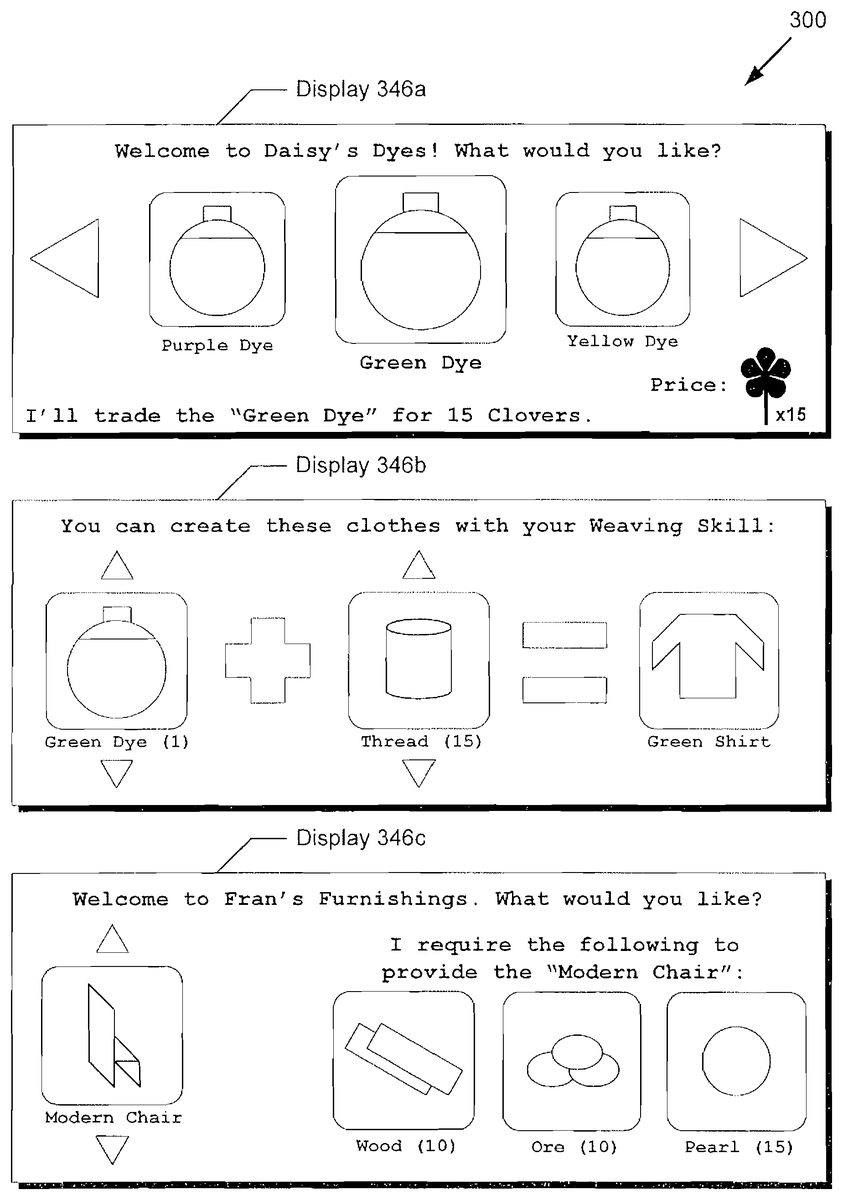
FIG. 3presents exemplary user interfaces for interacting with an item-based economy in a virtual world, according to one embodiment of the present invention. Diagram300ofFIG. 3includes displays346a-346c. With regards toFIG. 3, it should be noted that displays346a-346ccorrespond to display146fromFIG. 1.
Display346ashows a user interface where a client requests an item exchange or barter with a NPC of the virtual world, Daisy, who owns a storefront called “Daisy's Dyes.” Daisy's inventory of bottled colored dyes is navigable through a user interface shown on display346a, where the client can scroll left and right to browse Daisy's inventory. As shown by display346a, a first quantity of tradable items or “15 Clovers” is quoted for a first exchange value, which is also defined by a second quantity of second items, or a single bottle of “Green Dye.” Additionally, although not shown in display346a, if the client selects “Yellow Dye” for example, Daisy may instead quote a first quantity of tradable items as “20 Buttercup Blossoms” for a single bottle of “Yellow Dye.” In this manner, an alternative first quantity of “20 Buttercup Blossoms” has a second exchange value defined by a third quantity of third items, or a single bottle of “Yellow Dye.” Meanwhile, Daisy might request a different first quantity of tradable items for the “Purple Dye,” such as “10 Plums.” In this manner, the virtual world can support an item-based economy even without a common currency. Although the item exchanges used for the user interface of display346afocus on single item type exchanges, alternative embodiments may include several different tradable items and exchange values with several different types of items.
As previously discussed, a processor of a server supporting the virtual world may define exchange values on a global scale, or may be define exchange values as particular to individual NPCs of the virtual world. For example, the first exchange value and the second exchange value offered by Daisy may be defined as specific to Daisy herself, and other NPCs may offer to trade for a different quantity of tradable items even with the same bottle of dye. For example, in a remote area where bottled dyes and their constituent ingredients are difficult to procure, NPCs may be less willing to trade bottled dyes and may demand a larger quantity of items or rarer and more difficult to obtain items. Additionally, as previously discussed, NPC personalities, virtual world economics, timed events, and other factors may also influence NPC item valuations to provide a more realistic item-based economy. Since these factors may evolve and change over time, item valuations and their corresponding exchange values may be defined by fluctuating quantities of different items at different times. Administrators may also manually change item valuations to address economic or game imbalances and to improve the user experience.
Display346bshows a user interface where a client commands the use of a “Weaving” skill to create a new combination item, wherein the user interface presents a list of combination items possible from an inventory of the client. As previously discussed, other character skills and jobs such as alchemy, cooking, and crafting may also be used to create new combination items. As shown by the user interface of display346b, the client can select two items from the inventory of the client to “weave” a new item. The example shown in display346bprovides the combination where one bottle of “Green Dye” is combined with 15 units of “Thread” to weave a single “Green Shirt.” Although the example given in display346bonly has two types of items in the combination, alternative embodiments may use several different types of items for more complicated combinations. Moreover, the resulting item might depend on other variables, such as the client's level of weaving skill. For example, a low level weaving skill might result in a plain shirt, whereas a high level weaving skill might result in an enchanted shirt with special beneficial properties. One the avatar wearable clothes are created using the weaving skill, the user interface might prompt the client whether to don the newly created clothes. If the user decides to wear the newly created clothes, then a depiction of the user's avatar may change correspondingly on a display of the client. For example, the “Green Shirt” may look like a simple green shirt, whereas an enchanted shirt might glow and sparkle onscreen to indicate its beneficial properties.
Display346cshows a user interface where a client requests an item exchange or barter with a NPC of the virtual world, Fran, who owns a storefront called “Fran's Furnishings.” In contrast to Daisy's Dyes depicted in display346c, Fran asks for several different tradable item types rather than a single tradable item type in exchange for a second item comprising a single “Modern Chair.” These tradable items include 10 boards of Wood, 10 lumps of Ore, and 15 Pearls. These items might be scattered throughout the virtual world for users to gather, mine, and collect, and trade. Once enough tradable items are gathered, a client can exchange the tradable items for furniture at Fran's Furnishings for decorating virtual property. For example, after purchasing the “Modern Chair” by providing the requested items, the “Modern Chair” may be placed in the small house in the city owned by the client. The next time the client decides to visit the house, a processor of the server may provide a depiction of the house with the “Modern Chair” in addition to the already existing leather sofa and wooden table, which can then be sent to a client program for displaying on a display of the client. In this manner, the client can engage in economic transactions transforming the visual perception of the virtual world through the client without the use of a common currency such as money or gold for item valuation.
FIG. 4shows a flowchart describing the steps, according to one embodiment of the present invention, by which a server can provide an item exchange for a virtual world lacking a common currency for item valuation. Certain details and features have been left out of flowchart400that are apparent to a person of ordinary skill in the art. For example, a step may comprise one or more substeps or may involve specialized equipment or materials, as known in the art. While steps410through450indicated in flowchart400are sufficient to describe one embodiment of the present invention, other embodiments of the invention may utilize steps different from those shown in flowchart400.
Referring to step410of flowchart400inFIG. 4and environment100ofFIG. 1, step410of flowchart400comprises processor111of server110executing online game service120receiving a request from processor151of client150executing online game client160to initiate an item exchange. The exchange previously explained in conjunction with display346aofFIG. 3will be used as an example to illustrate steps410through450of flowchart400. Thus, the request of step410comprises a request to initiate an item exchange or barter with the NPC “Daisy” of the storefront “Daisy's Dyes” within a virtual world supported by game service120. As previously discussed, user account database125and virtual world database130provide resources for use by game service120to provide the virtual world to online game client160for rendering on display146. User input from input device145detected by online game client160may provide the initial action for initiating step410, for example by a user input comprising clicking on a depiction of Daisy on display146.
Referring to step420of flowchart400inFIG. 4and environment100ofFIG. 1, step420of flowchart400comprises processor111of server110presenting a user interface on display146of client150for the item exchange requested in step410, which corresponds to display346aofFIG. 3. As previously discussed, the user interface shown in display346aallows client150to browse through Daisy's inventory for item exchange or bartering. As with step410, input device145may be used in conjunction with online game client160to provide user input for interpretation by online game service120running on processor111of server110.
Referring to step430of flowchart400inFIG. 4and environment100ofFIG. 1, step430of flowchart400comprises processor111of server110receiving a selection of either a bottle of green dye or a bottle of yellow dye for the item exchange depicted by the user interface of step420from client150. As previously, input device145may be used in conjunction with online game client160request user input for the selection. Once a user of client150indicates the desired selection by clicking on a desired bottle for example, the selection may then be sent to processor111of server110through network140for receiving and further processing. For the purposes of the present example, it might be assumed that the user of client150selects the “Green Dye” depicted in display346aofFIG. 3.
Referring to step440of flowchart400inFIG. 4, environment100ofFIG. 1, and server memory200ofFIG. 2, step440of flowchart400comprises processor111of server110removing from inventory227of client150a first quantity of tradable items defined by an exchange value based on the selection of step430. To determine the exchange value, exchange value database235and NPC database236may be referenced to determine the first quantity of tradable items Daisy is willing to trade for the requested bottle of “Green Dye” from step430. As previously discussed, if player skills such as weaving or crafting are utilized instead of NPC bartering for the item exchange request, then other data sources such as item combination database232and environment database237may be consulted instead.
According to the results shown on display346aofFIG. 3, this first quantity of tradable items includes “15 Clovers.” However, if the user selected the “Yellow Dye” instead in step430, then step440may result in a first quantity of tradable items including “20 Buttercup Blossoms” as previously stipulated. Alternatively, if the user selected the “Purple Dye” instead in step430, then step440may result in a first quantity of tradable items including “10 Plums.” Thus, assuming that the “Green Dye” is selected in step430, then 15 Clovers are removed from inventory227in step440, where user account226corresponds to an account of client150ofFIG. 1.
Referring to step450of flowchart400inFIG. 4, environment100ofFIG. 1, and server memory200ofFIG. 2, step440of flowchart400comprises processor111of server110adding to inventory227of client150the items defined by the selection from step430. Since the “Green Dye” was selected in step430, one bottle of “Green Dye” may be added to inventory227in step450, thus completing the virtual world transaction without ever needing to use a common currency.
From the above description of the invention it is manifest that various techniques can be used for implementing the concepts of the present invention without departing from its scope. Moreover, while the invention has been described with specific reference to certain embodiments, a person of ordinary skills in the art would recognize that changes can be made in form and detail without departing from the spirit and the scope of the invention. As such, the described embodiments are to be considered in all respects as illustrative and not restrictive. It should also be understood that the invention is not limited to the particular embodiments described herein, but is capable of many rearrangements, modifications, and substitutions without departing from the scope of the invention.
Claims
- A server facilitating an item exchange in a virtual world, the server comprising: a processor configured to: receive a request from a client to initiate the item exchange, the client having a first inventory including a first quantity of first tradable items, wherein the first quantity of the first tradable items has an exchange value defined by a second quantity of second tradable items;present a user interface on a display of the client for the item exchange, the user interface comprising a second inventory including the second quantity of the second tradable items;receive a selection of the second quantity of the second tradable items from the client using the user interface;remove from the first inventory of the client the first quantity of the first tradable items defined by the exchange value, in response to the selection;add the second quantity of the second tradable items to the first the inventory of the client, in response to the selection, without using a common currency for the item exchange;and vary the exchange value globally and/or locally, based on a time of the exchange in the virtual world.
- The server of claim 1 , further comprising a memory storing the first inventory of the client, the first inventory comprising a subset of items from a finite global inventory.
- The server of claim 2 , wherein the memory includes an exchange value database including the exchange value, wherein the exchange value defined by the second quantity of the second tradable items is displayed in the user interface.
- The server of claim 2 , wherein the memory includes an item database having records of characteristics of the first tradable items and the second tradable items.
- The server of claim 2 , wherein the memory includes an item combination database defining a combination of one of the first tradable items and one of the second tradable items to create one of third tradable items.
- The server of claim 1 , wherein the processor is configured to vary the exchange value globally, and wherein the exchange value is defined by quantities of the tradable items, and not the common currency.
- The server of claim 1 , wherein the exchange value is defined to be particular to the client, and wherein the exchange value is defined by quantities of the tradable items, and not the common currency.
- The server of claim 1 , wherein the exchange value is adjusted based on economic fluctuations and timed events.
- The server of claim 1 , wherein the processor is further configured to vary the exchange value globally and/or locally, based on supply and demand in the virtual world.
- The server of claim 1 , wherein the user interface permits browsing of the second inventory of the second quantity of the second tradable items by the client, wherein the second inventory of the second quantity of the second tradable items belongs to a single Non Player Character (NPC).
- A method of facilitating an item exchange in a virtual world using a server having a processor, the method comprising: receiving, by the processor, a request from a client to initiate the item exchange, the client having a first inventory including a first quantity of first tradable items, wherein the first quantity of the first tradable items has an exchange value defined by a second quantity of second tradable items;presenting a user interface on a display of the client for the item exchange, the user interface comprising a second inventory of tradable items including the second quantity of the second tradable items;receiving a selection of the second quantity of second tradable items from the client using the user interface;removing from the first inventory of the client the first quantity of the first tradable items defined by the exchange value, in response to the selection;adding the second quantity of the second tradable items to the first inventory of the client, in response to the selection, without using a common currency for the item exchange;varying the exchange value globally and/or locally, based on a time of the exchange in the virtual world.
- The method of claim 11 , wherein the server further comprises a memory storing the first inventory of the client, the first inventory comprising a subset of items from a finite global inventory.
- The method of claim 12 , wherein the memory includes an exchange value database including the exchange value, wherein the exchange value defined by the second quantity of the second tradable items is displayed in the user interface.
- The method of claim 12 , wherein the memory includes an item database having records of characteristics of the first tradable items and the second tradable items.
- The method of claim 12 , wherein the memory includes an item combination database defining a combination of one of the first tradable items and one of the second tradable items to create one of third tradable items.
- The method of claim 11 , wherein the varying varies the exchange value globally, and wherein the exchange value is defined by quantities of the tradable items, and not the common currency.
- The method of claim 11 , wherein the exchange value is defined to be particular to the client, and wherein the exchange value is defined by quantities of the tradable items, and not the common currency.
- The method of claim 11 , wherein the exchange value is adjusted based on economic fluctuations and timed events.
- The method of claim 11 , wherein the user interface permits browsing of the second inventory of the second quantity of the second tradable items by the client, wherein the second inventory of the second quantity of the second tradable items belongs to a single Non Player Character (NPC).
Disclaimer: Data collected from the USPTO and may be malformed, incomplete, and/or otherwise inaccurate.