U.S. Pat. No. 9,421,463
VIDEO GAME PORTAL
AssigneeACTIVISION PUBLISHING, INC.
Issue DateMay 21, 2014
Illustrative Figure
Abstract
A peripheral device for use in video gameplay includes circuitry for reading information stored in memory of toys placed on the peripheral device, and for providing that information to a computer device upon which gameplay is provided. The peripheral device includes a feature for holding a portable computer device, for example a computer tablet, in a hands free manner during gameplay. The feature may be a notch in the peripheral device, and the notch may be in a protuberance extending from a housing forming the peripheral device. In addition, the housing may provide storage for storing a game controller for use with the video game.
Description
DETAILED DESCRIPTION FIG. 1illustrates a system including a peripheral device111in accordance with aspects of the invention, with the peripheral device supporting a computer tablet125having a touchscreen display129. The peripheral device is useful in playing video games played on the computer tablet, for example video games in which a player controls a video game character representative of a toy placed by the player on the peripheral device. In such video games, the toy may include computer readable information identifying the toy, and possibly characteristics of the video game character representative of the toy, and the peripheral device may read such information and provide the information to the computer tablet, for example by way of wireless communications such as Bluetooth or Bluetooth Low Energy communications, for use in gameplay. In some embodiments characteristics of the video game character may change during gameplay, and the peripheral device may receive the changed information and write the changed information to memory of the toy. In addition, although a computer tablet is illustrated in the system ofFIG. 1, in various embodiments other computer devices, for example a smartphone, smart television, or video game console, may be used. The peripheral device is in the form of a housing including a substantially flat upper surface113, coupled by a side wall115to a bottom surface (not visible inFIG. 1). The upper surface, or top, of the peripheral device generally includes a region for placement of toys used in gameplay. The bottom surface is generally configured for placement on a flat surface, for example a table top or floor, with the bottom surface providing a base for the peripheral device. As illustrated inFIG. 1, the peripheral device is substantially cylindrical in shape, although in various embodiments the peripheral device may have other shapes, for example ring shaped, parallelepiped, have a conical ...
DETAILED DESCRIPTION
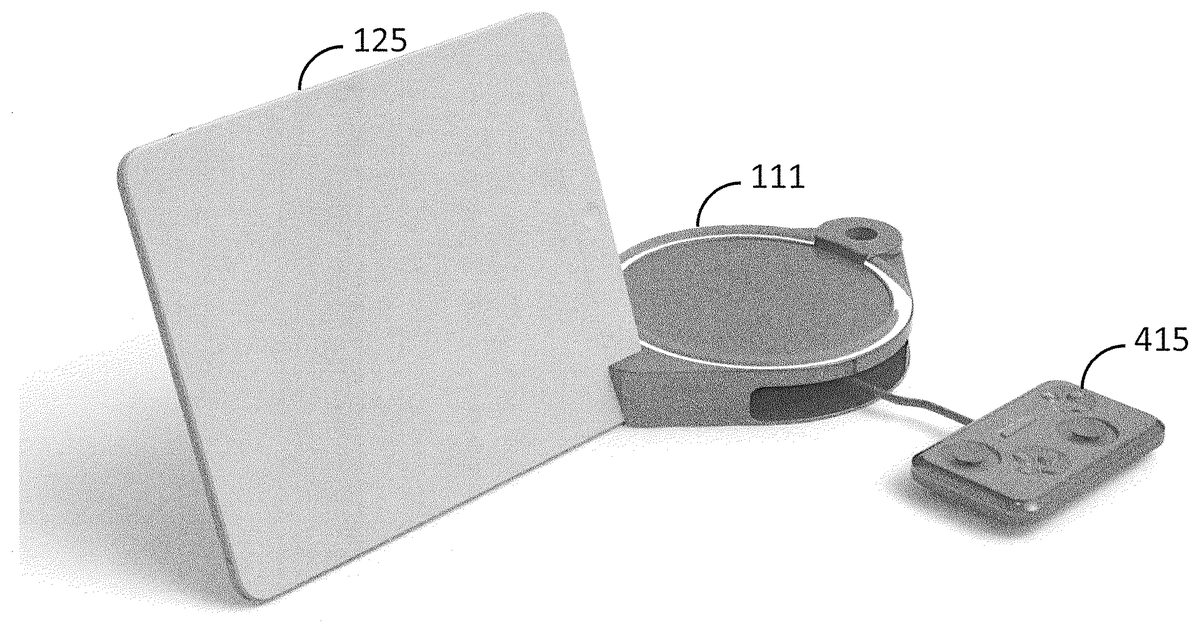
FIG. 1illustrates a system including a peripheral device111in accordance with aspects of the invention, with the peripheral device supporting a computer tablet125having a touchscreen display129. The peripheral device is useful in playing video games played on the computer tablet, for example video games in which a player controls a video game character representative of a toy placed by the player on the peripheral device. In such video games, the toy may include computer readable information identifying the toy, and possibly characteristics of the video game character representative of the toy, and the peripheral device may read such information and provide the information to the computer tablet, for example by way of wireless communications such as Bluetooth or Bluetooth Low Energy communications, for use in gameplay. In some embodiments characteristics of the video game character may change during gameplay, and the peripheral device may receive the changed information and write the changed information to memory of the toy. In addition, although a computer tablet is illustrated in the system ofFIG. 1, in various embodiments other computer devices, for example a smartphone, smart television, or video game console, may be used.
The peripheral device is in the form of a housing including a substantially flat upper surface113, coupled by a side wall115to a bottom surface (not visible inFIG. 1). The upper surface, or top, of the peripheral device generally includes a region for placement of toys used in gameplay. The bottom surface is generally configured for placement on a flat surface, for example a table top or floor, with the bottom surface providing a base for the peripheral device. As illustrated inFIG. 1, the peripheral device is substantially cylindrical in shape, although in various embodiments the peripheral device may have other shapes, for example ring shaped, parallelepiped, have a conical cross-section, or have a hexagonal cross-section, or have a form of a cross, star or other shape, and the housing may have a plurality of side walls.
The peripheral device includes a protuberance121along its side, with the protuberance including a notch123receiving a portion of the computer tablet, the portion being along a side127of the computer tablet as illustrated inFIG. 1. In some embodiments the peripheral device may not include the protuberance, with the notch simply extending into the housing of the peripheral device. Also, in the embodiment ofFIG. 1, the notch is canted with respect to a plane perpendicular to the top surface, with for example such a plane intersecting the notch to form an angle of fifteen degrees. In other embodiments the notch may be canted to a greater or lesser extent with the plane perpendicular to the top surface, and in some embodiments the notch may be perpendicular to the top surface.
In some embodiments the protuberance121may instead be two protuberances, with the two protuberances forming opposing walls of the notch. In addition, in some embodiments the protuberances may not for a notch, but instead simply provide opposing surfaces, between which the tablet computer may be placed. For example in some embodiments the protuberances may be in the form of a pair of digits, for example cylinders, or also form example tabs, extending from the housing, with the tabs spaced to receive the computer tablet therebetween. The tabs may extend from the housing each at the same height along the side wall of the housing, and spaced apart a distance so as to receive the portion of the computer tablet. Alternatively, the tabs may be at different heights, with for example one tab positioned higher along the housing than another tab, with increased horizontal space between the tabs to allow for canted positioning of the computer tablet.
In some embodiments the protuberance121may comprise or be coupled to a clamping mechanism (not shown) to secure the computer tablet therebetween. The clamping mechanism may be adjustable, lockable, and/or spring-loaded to allow for computer tablets of various widths. In some embodiments, the protuberance121may comprise padded components (not shown) which both allow for computer tablets of various widths and prevent unintentionally damage to the computer tablet from the protuberance.
In the embodiment ofFIG. 1, a plane defined by a surface of the computer tablet, for example the touchscreen display129, may be considered to generally vertically bisect the peripheral device, ignoring offsets from the vertical provided by the cant. Preferably a radial distance of the cylindrical housing, or corresponding distance if the housing is otherwise shaped, is sufficient such that a moment of inertia of the housing is sufficient to avoid toppling of the computer tablet when positioned in the notch. In this regard, in some embodiments the protuberance and/or the notch may have a position and/or orientation with respect to the housing such that the plane defined by the surface of the computer tablet does not bisect the housing. For example, in some embodiments, the plane defined by the surface of the computer tablet may be, in the view ofFIG. 1, forward of a center of the housing. In some embodiments the peripheral device may comprise a counterweight component (not shown) for counterbalancing the weight of the computer tablet. For example, in some embodiments the peripheral may include a discrete counterweight in a portion of the peripheral device that potentially may be tipped up through torque generated by the computer tablet, and in some embodiments the counterweight may be distributed in portions, or throughout, the peripheral device.
In the embodiment ofFIG. 1, the peripheral device also includes a second protuberance117on an opposite side of the protuberance121. The second protuberance includes, in its top surface, a cavity119, or trap, to receive a portion of physical objects, which also may be considered toys. The physical objects may include computer readable, and in some embodiments writable, memory for storing information of game characters.
FIG. 2illustrates a further view of the peripheral device ofFIG. 1. As may be seen inFIG. 2, the peripheral device includes the generally flat upper surface113for placement of toys during game play. As may be seen inFIG. 2, the upper surface113is bounded by a rim114. In various embodiments the housing of the peripheral device may be generally opaque to light, but with the rim114, and possibly some other portions, non-opaque to light. For example, in some embodiments the rim may be translucent. Also as may be seen inFIG. 2, the second protuberance117includes a raised lip surrounding the trap119.
More particularly with respect toFIG. 2, it may be seen that the protuberance121ofFIG. 1includes a first portion121aand a second portion121b, each of which may also be considered separate protuberances. The first and second portions separated by the notch123. In the embodiment illustrated inFIG. 2, the notch extends into the housing, has generally parallel, and largely vertical, side walls coupled by a largely vertical base, and is canted with respect to a plane perpendicular to the upper surface. A width of the notch is sufficient to receive an edge of the tablet computer, preferably in a snug fashion such that operation of the touchscreen of the tablet computer does not cause excessive movement of the tablet computer, for example movement sufficient to interfere with normal user engagement with the touchscreen.
FIG. 3illustrates a form of a cut-away side view of a peripheral device in accordance with aspects of the invention. The peripheral device includes a first end371and a second end375. Generally a notched portion is provided about the first end, although the notched portion is not visible inFIG. 3. In some embodiments, the peripheral device includes a substantially flat top373for placement of toys thereon, with a trap377extending inward into the peripheral device from the top373. As illustrated inFIG. 3, the trap is proximate the second end375. A first antenna391is under, and proximate, the flat top, with the antenna positioned so as to be able to wirelessly communicatively link the peripheral device and toys with appropriate electronics on the flat top. A second antenna393is placed about the trap377, so as to be able to wirelessly communicatively link a game piece, with appropriate electronics, at least partially inserted into the trap, with the peripheral device. The antennas are coupled by wires to a circuit board387within the peripheral device. The wires may, for example, be routed along sidewalls of the peripheral device, or alternatively the circuit board may be mounted proximate the flat top (and within the peripheral device). The circuit board provides for communications functions and other functions. In the embodiment ofFIG. 3, the second antenna is linked by a wire, or other electrically conducting item, to the first antenna, which in turn is electrically coupled to the circuit board. In other embodiments the reverse is true, and in some embodiments both antennas are individually electrically coupled to the circuit board. In some embodiments, the surface for placing toys may be at the base or a mid-portion of the peripheral. In some embodiments, no surface may be present, and the region for placing toys may be spatially delineated, for example, the area encircled by the sidewalls of the peripheral.
The peripheral device also includes light sources385a,b, for example LED light sources, within the peripheral device. The light sources may be driven by electronics of the circuit board. In the embodiment ofFIG. 3, one light source is shown as positioned under the flat surface, and a second light source is shown positioned under the trap, for example so as to be able to illuminate a lower portion of a game piece within the trap. Accordingly, a bottom surface of the trap is translucent, in some embodiments, or the trap may have no bottom surface at all, allowing for passage of light into the game piece. In some embodiments the top of the peripheral device, or portions thereof, may be translucent to light, allowing for visual effects from the peripheral and/or passage of light to the game piece, even in embodiments in which the bottom of the trap is not translucent. In some embodiments, a speaker for generating audio may also be within the peripheral device. The speaker may be driven, for example, by electronics of the circuit board.
FIG. 4illustrates a further view of the peripheral device111ofFIG. 1, with the view ofFIG. 4being what may be considered a semi-front view of the peripheral device. As may be seen inFIG. 4, an aperture411is provided in the side wall of the housing of the peripheral device, between the protuberance121and the second protuberance117. A door413blocks access to an interior of the housing through the aperture in the side wall. In the embodiment ofFIG. 4, the door is shown within the housing, but in various embodiments the door may be flush with the side wall, or exterior to the side wall and aperture.
FIG. 5illustrates the peripheral device111ofFIG. 1, with the tablet computer125positioned in the notch, and with the door413in a partially open position. With the door in the partially open position, a game controller415may be seen as stored within the housing of the peripheral device. The game controller may be so stored, for example, in a storage compartment of the peripheral device, which may be separated by internal walls from circuitry also within the peripheral device. In some embodiments, the peripheral device and the game controller may comprise complementary magnetic elements (e.g., one or more magnets in the peripheral device having corresponding magnets in the game controller arranged so that the magnets in the peripheral device and the magnets in the game controller have opposite polarities facing one another, or one or more magnets in one of the peripheral device and the game controller and one or more non-magnet magnetic elements in the other) such that the game controller is magnetically attached to the peripheral device when stored with the peripheral device's housing. In some embodiments, the peripheral device may comprise a clamping or locking mechanism for retaining the game controller.
FIG. 6illustrates the view ofFIG. 5, but with the door in a fully open position. As may be seen inFIG. 6, the computer tablet125is positioned in the notch of the peripheral device111, and the game controller415is stored within the peripheral device. The door is not visible inFIG. 6, with the door being a sliding door that slides along the interior of the side wall of the housing. In various embodiments the door instead may be hinged to the side wall, with the door for example opening outward, or the door may be removable from the side wall altogether, with the door normally held in place with clips or the like. In some embodiments, the peripheral device does not comprise a door, and the storage compartment may be left open.
FIG. 7also illustrates the game controller415removed from the peripheral device111, ready for use during gameplay. During gameplay a player may control a game character using the game controller, and may do so using both hands, while the tablet computer125is held, in a viewable position, in the notch of the peripheral device. Also as illustrated inFIG. 7, the game controller is coupled to the peripheral device by a cord. In some embodiments the cord is simply to securely link the game controller to the peripheral device, to help avoid loss of the game controller. In other embodiments, the cord may include electrical wiring, allowing for electrical communication of signals and/or power between the game controller and the peripheral device. In such embodiments, the peripheral device may communicate game controller signals to the computer device (e.g., tablet, smart phone, smart television, etc.).
FIG. 8illustrates a top perspective view of a game controller in accordance with, or useful with, aspects of the invention. The game controller includes a base811. The base is formed of a housing with a top wall813and a bottom wall (not visible inFIG. 8) coupled by side walls815. The game controller is generally dimensioned to fit within a peripheral device, and preferably removable through a doorway or other opening of the peripheral device. In some embodiments the base is substantially dimensioned to be similar in size and shape to a smartphone or other handheld display device. In some embodiments, the game controller comprises magnetic elements (not shown) that pair to magnetic elements within the peripheral device.
A plurality of user input devices extend through the top wall of the base. In the embodiment illustrated inFIG. 8, the input devices include a pair of analog sticks817a,b, a plurality of game pad buttons819, and a plurality of directional buttons821. The input devices are coupled to circuitry within the base. In some embodiments a battery or other power source may be within the base as well. In most embodiments the circuitry within the base communicates information as to the state of the input devices to a computer tablet, smartphone, or other computer device executing a game program. In some embodiments, the game controller includes wireless communication circuitry for communicating with the computer tablet, smartphone, or other computer device, for example using Bluetooth or Bluetooth Low Energy components. In some embodiments the game controller is connected by a wire (not shown inFIG. 8) to the peripheral device. In some embodiments the game controller is tethered to the peripheral device by cord, cable, or the wire. In most embodiments the circuitry within the base communicates information as to the state of the input devices to a computer tablet, smartphone, or other computer device executing a game program.
FIG. 9illustrates an offset rear view of the game controller ofFIG. 8.FIG. 9shows an embodiment of shape of the analog sticks. For example, for simplicity discussing only analog stick817bofFIG. 8, the analog stick includes a stem915extending from the top wall of the game controller to a lower convex surface915, which is mirrored by an outwardly concave top911. The concave top of the analog stick possibly may allow for increased user ease in operating the stick, with the shape of the stick as a whole allowing for decreased protrusion of the stick from the top wall of the game controller.
FIGS. 10 and 11depict another embodiment of the peripheral device disclosed herein. Common elements between the embodiment ofFIG. 1and the embodiment ofFIGS. 10 and 11share the same numerical designations. As shown, the embodiment ofFIGS. 10 and 11does not include an aperture in sidewall115for access to the storage compartment. Instead, as shown inFIG. 11, the peripheral device comprises a storage compartment that is accessed through an aperture1135in the bottom surface of the peripheral device. As with the embodiment ofFIG. 1, the storage compartment may or may not be covered by a door or cover, and in some embodiments the storage compartment may form a cavity in the bottom surface of the housing. Also as with the embodiment ofFIG. 1, the peripheral device and/or the game controller may comprise magnetic, clamping, or fastening elements for securing the game controller within the storage compartment of the peripheral device.
Although the invention has been discussed with respect to various embodiments, it should be recognized that the invention comprises the novel and non-obvious claims supported by this disclosure.
Claims
- A peripheral device for use in video game gameplay, comprising: a housing having a region for placement of at least one toy;wherein the housing includes a top surface and a bottom surface, the top surface and the bottom surface coupled by at least one side wall, with a storage compartment within a volume, defined by the top surface, at least a portion of the bottom surface, and the at least one sidewall, for storing a game controller;and circuitry within the housing for wireless communication with the at least one toy;the housing including a pair of surfaces for receiving a portion of a portable computer device therebetween.
- The peripheral device of claim 1 , wherein the pair of surfaces are opposing surfaces of a notch formed in the housing.
- The peripheral device of claim 2 , wherein the region for placement of at least one toy is on the top surface of the housing, and the notch formed in the housing extends from the top surface of the housing to the bottom surface of the housing.
- The peripheral device of claim 3 , wherein the top surface of the housing is substantially parallel to the bottom surface of the housing, and the notch is canted with respect to a plane perpendicular to a plane defined by the bottom surface of the housing.
- The peripheral device of claim 1 , wherein the storage compartment is accessible by way of an aperture in the bottom surface of the housing.
- The peripheral device of claim 5 , further comprising a door for the aperture in the bottom surface.
- The peripheral device of claim 1 , wherein the game controller is removable from the storage compartment.
- The peripheral device of claim 1 , wherein the storage compartment comprises a first cavity in the bottom surface of the housing.
- The peripheral device of claim 1 , wherein the peripheral device and the game controller comprise complementary magnetic elements.
- The peripheral device of claim 1 , wherein the housing includes a second cavity for receiving a portion of a toy.
- The peripheral device of claim 1 , wherein the housing includes a light source.
- The peripheral device of claim 1 , wherein the housing includes a speaker.
- The peripheral device of claim 1 , wherein the portable computer device is a tablet computer or a smartphone.
- A peripheral device for use in a video game, comprising: a housing circuitry for communication with a computer device and a toy storing information, the housing having a top surface, a bottom surface, the top surface and the bottom surface coupled by a side wall;the housing having a protuberance, the protuberance extending from the housing between the top surface and the bottom surface;the protuberance having a notch extending through the protuberance, the notch being canted with respect to the top surface of the housing and the bottom surface of the housing, the notch being dimensioned to receive a portion of a tablet computer;and an antenna coupled to the circuitry for communication, the antenna within the housing, the antenna for use in communications with the toy storing information when the toy is placed on the top surface of the housing.
- The peripheral device of claim 14 , further comprising a door in a side wall of the housing, the door providing access to a storage compartment within the housing.
- The peripheral device of claim 15 , wherein the storage compartment stores a game controller.
- The peripheral device of claim 16 , further comprising a cavity in the top surface for receiving a portion of a further toy.
- The peripheral device of claim 17 , further comprising a speaker and a light source within the housing, the housing having at least a portion of one surface non-opaque to light.
- The peripheral device of claim 18 , wherein the one surface is the top surface.
Disclaimer: Data collected from the USPTO and may be malformed, incomplete, and/or otherwise inaccurate.