U.S. Pat. No. 9,409,089
METHOD FOR IMPLEMENTING A COMPUTER GAME
AssigneeKING.COM LTD.
Issue DateSeptember 17, 2013
Illustrative Figure
Abstract
A method, implemented as computer code being executed by one or more processors, in which a computing device displays computer game graphics showing a score for a computer game, and in which, one or more of the processors are programmed to: (a) receive the score a player achieves while playing a game; and (b) visually indicate how this score relates to one or multiple pre-defined goals; (c) receive information about the high scores of different players of the game (d) compare the current score of the player, the previous high score of the player and the high scores of the different players; and (e) during the play of the game, visually represent the difference between the current score, the high scores of the different players and the pre-defined goal(s).
Description
DETAILED DESCRIPTION In the following description of various implementations of the invention, reference is made to the accompanying drawings which form a part thereof, and in which are shown by illustration various implementations in which the invention may be utilized. It is to be understood that other implementations may be utilized, and structural and functional modifications may be made without departing from the scope of the present invention. FIG. 1shows a schematic picture of a computing device, containing a Central Processing Unit and Random Access Memory. The CPU acts according to input given from input devices, such as a keyboard, mouse or touchscreen. Computer BUSes are used to communicate, both between input devices and the CPU, but also between different controllers within the computer device, such as the graphics controller and the network controller. These controllers in turn communicate with external devices, such as a monitor for video output with which the graphics controller communicates, and the network controller communicates with for instance the internet, through either wireless or wired connection. FIG. 2portrays an exemplary overall environment in which the present invention can be utilized. A virtual game is stored on, for instance, a game server210. The virtual game is to be played on a client device, such as a computer240,250or a smartphone260. The client device communicates with the game server210and a social network230, for instance through the Internet220. It should be understood that the social network230and the game server210does not have to be located in different places, they could be on the same server. An environment where the invention may be implemented is described in PCT/EP2013/060641 which is hereby incorporated by reference. People skilled in the art will understand that devices other than the exemplary ones listed can also be used, without departing from the spirit and scope of ...
DETAILED DESCRIPTION
In the following description of various implementations of the invention, reference is made to the accompanying drawings which form a part thereof, and in which are shown by illustration various implementations in which the invention may be utilized. It is to be understood that other implementations may be utilized, and structural and functional modifications may be made without departing from the scope of the present invention.
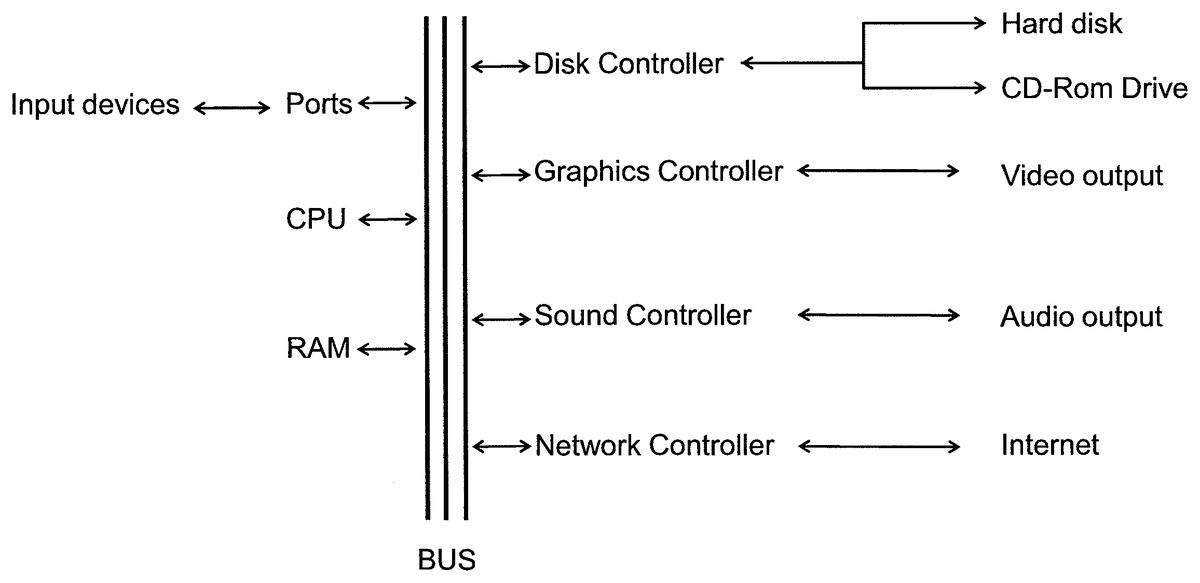
FIG. 1shows a schematic picture of a computing device, containing a Central Processing Unit and Random Access Memory. The CPU acts according to input given from input devices, such as a keyboard, mouse or touchscreen. Computer BUSes are used to communicate, both between input devices and the CPU, but also between different controllers within the computer device, such as the graphics controller and the network controller. These controllers in turn communicate with external devices, such as a monitor for video output with which the graphics controller communicates, and the network controller communicates with for instance the internet, through either wireless or wired connection.
FIG. 2portrays an exemplary overall environment in which the present invention can be utilized. A virtual game is stored on, for instance, a game server210. The virtual game is to be played on a client device, such as a computer240,250or a smartphone260. The client device communicates with the game server210and a social network230, for instance through the Internet220. It should be understood that the social network230and the game server210does not have to be located in different places, they could be on the same server. An environment where the invention may be implemented is described in PCT/EP2013/060641 which is hereby incorporated by reference. People skilled in the art will understand that devices other than the exemplary ones listed can also be used, without departing from the spirit and scope of the invention.
FIG. 3shows one implementation of the invention, when there is no available reference data from other players. The first part of the meter305reflects the current score of a game in progress. Signs such as stars,315,320,325can be used to indicate when a certain level of score has been reached. In one implementation, there are three levels of scores that are represented by one, two and three stars respectively. When a player passes a certain score level during the play of a game, that can be visually represented by the indicator of that score level being lit up such as star315is in the figure. The second part of the score meter310shows the best previous result of the player in a particular level of the game. This can be accompanied by, for instance, an encouraging message340.
FIG. 4shows an implementation of the invention where there is reference data from other players available. The present invention has ways of displaying indications of other players' previous scores, score indications, for instance through the use of pictures330associated with those players. These pictures can be accompanied by additional information, such as the absolute score that those players scored. It should be understood that other data can also be shown in relation to the score indications of other players, such as how long ago that score was achieved or how many tries it took to achieve it.FIG. 5shows a similar implementation to the one depicted inFIG. 4, but here there is no additional information accompanying the pictures associated with other players.
It should be understood that the invention is not limited to using stored scores to show the performance of other players. In one implementation, players can see the scores of other players currently playing the same level while they are playing it, making it so that the indications of other players' scores can be moving in real time during the play of a game.
FIG. 6shows another implementation of the present invention where time is measured instead of score, and where no information related to other players is used to compare with. People skilled in the art will recognise that measurement of time and score are not mutually exclusive, in other implementations both could be shown at the same time. Other variables than time and score can also be measured, such as the amount of times a player has played a level.
As in the implementation showing sore, the meter can have one portion305indicating the current time and another portion indicating the player's previously best time310. This can also be represented by an absolute value405. An encouraging message410can be shown in relation to for instance the player's previously best result.
FIG. 7andFIG. 8show two implementations of the invention where time is a measured variable and in which reference data from other players is available. The two shown implementations have score indications of other players415, but unlikeFIG. 4andFIG. 5, the score indications is related to time instead of points.
FIG. 9shows another exemplary implementation of the invention. In this implementation, the player can compare himself with the average scores of players having played the same level previously. These average scores can for instance be shown in percentages505,510,515. In some implementations, the player can choose to compare himself to for instance the average score of all players having played the level, friends from a social network, or to a select list of friends from a social network.
The representation of different score levels can be done in other ways than stars. For instance, the numeral value of a score520,525,530can be used to represent the different levels of scores, as shown inFIG. 10.
In one implementation, a result will be displayed to the player upon finishing a level.FIG. 11depicts one type of message535indicating how the player performed compared to other players who have previously played the level. In other implementations, the type of indication can be something other than the relative performance, such as the absolute score or the number of stars achieved. The basis for comparison can also differ, for instance it can be the result of a certain player, the average results of all players previously having played the level, or the average result of all friends from a social network.
FIG. 12andFIG. 13show two other implementations where the players score is compared with the average scores of other players, but in these implementations time is used rather than points. The current time of a player605, or score or other variables in other implementations, can be displayed during the play of a game.FIG. 13shows another implementation of a message indicating the performance of a player610.
FIG. 14shows a typical implementation where the invention is used in a ‘Match3’-game. The score meter705is vertical, as opposed to horizontal in the previous figures. However, it should be understood that it can be implemented in any number of other ways as well, such as slightly tilted or diagonally. Indicators are showing the number of moves left710and the current score of a player715can be displayed together with the score meter.FIG. 15shows another typical implementation of the invention in a game environment.
FIG. 16shows an exemplary ‘Match3’-game in which the invention is implemented.FIG. 17is a magnified picture of the score meter from the in-game screenshot with a score indication of another player1005.FIG. 18shows one implementation in which the score and the name of a player1010is shown by hovering over the score indication related to that player. There can be other information shown, for instance a nickname instead of a real name and the number of moves that player used to complete the level instead of the score. It should also be understood that hovering over the indication is only one way of implementing the invention. Other mechanisms to trigger the display of information can for instance be after a set period of time or when the player has used a certain amount of moves.FIG. 19shows a similar implementation toFIG. 18, but where reference data from more players is available and subsequently more score indications1005for other players are shown.
Claims
- A computer implemented method for displaying, on a display, computer game graphics comprising scores for a computer game, comprising executing on one or more processors the steps of: determining a current score of a player of the device;receiving from a server, information about high scores of different players of the game;and during the play of the game, displaying on the display a meter having a total extent, said meter comprising visual representations of: the current score with respect to a high score of the player of the device, the high scores of the different players of the game, and a pre-defined goal, wherein said high score of the player of the device, the high score of the different players of the game, and said predefined goal are represented along said total extent, wherein the current score is represented by a first extent of said total extent of said meter, said first extent being changed as the current score changes during said computer game.
- The method of claim 1 , wherein the step of receiving from a server, information about high scores of different players of the game comprises receiving said information for players of a social network of the user.
- The method of claim 1 , wherein the visual representation of the pre-defined goal comprises a plurality of stars.
- The method of claim 1 , wherein the visual representations of the high scores of the different players comprise the scored points of those players.
- The method of claim 1 , wherein the visual representations of the high scores of the different players comprise pictures associated with those players.
- The method of claim 1 , wherein the visual representations of the high scores of the different players comprise the names of those players.
- The method of claim 1 , further comprising comparing the current score of the player, the high score of the player, and the high scores of the different players.
- The method of claim 7 , wherein the comparison of scores is done on an absolute scale.
- The method of claim 7 , wherein the unit used for the comparison is in percentages.
- The method of claim 1 , further comprising displaying on said display the time for completing a level.
- The method of claim 1 , further comprising comparing a score of the player to the high scores of the different players of the game.
- The method of claim 1 , further comprising comparing the player's time for completing a level to the different players' time for completing said level.
- The method of claim 12 , wherein the comparing of times for completing a level is done on a relative scale.
- The method of claim 12 , wherein the comparing of times for completing a level is done on an absolute scale.
- The method of claim 1 , further comprising comparing scores of multiple players.
- The method of claim 1 , wherein said computing device is a handheld device.
- The method of claim 1 , further comprising producing an audible output when the current score of the player exceeds a previous score of another player.
- The method of claim 1 , further comprising displaying on said display a message when a performance measure of the player of the device is within a threshold of a performance measure of another player of the game.
- The method of claim 1 , further comprising visually representing the difference between the current score, the different high scores and the pre-defined goal by showing a linear bar divided into sections, wherein the long axis of the linear bar corresponds to an increasing score and the boundary between each section corresponding to a different performance level wherein the current score is shown as a coloured region of the bar and the high scores of the different players of the game are indicated on the bar.
- The method of claim 19 , further comprising indicating on the bar, the high scores of at least some of the player of the device's friends, wherein said indication comprises a thumbnail image used by said friend on their social network page.
- The method of claim 1 , wherein the player of the device and the different players of the game are connected to one another via a social network.
- The method of claim 1 , wherein the different players are friends of the player of the device on a social network.
- The method of claim 1 , further comprising downloading the game as an app, wherein the game is a casual, social game that can be accessed or played using a social network application or environment, wherein the computing device is either: a smartphone or a tablet computer.
- The method of claim 7 , wherein the comparison of scores is done on a relative scale.
- A computing device adapted to play a computer game, the device including a processor, a memory, a display, a touch screen or a cursor based input device, and computer code stored in device memory or on a remote server and executable by the device processor or a remote processor, and in which the computer code generates computer game graphics for the display on the device;and in which, one or more of the processors execute steps to: determine a current score of a player of the device;receive, from a server, information about high scores of different players of the game;and during the play of the game, display on the display a meter having a total extent, said meter comprising visual representations of: the current score with respect to a high score of the player of the device, the high scores of the different players of the game, and a pre-defined goal, wherein said high score of the player of the device, the high score of the different players of the game, and said predefined goal are represented along said total extent, wherein the current score is represented by a first extent of said total extent of said meter, said first extent being changed as the current score changes during said computer game.
- A non-transitory computer readable medium encoded with instructions for controlling a computer system to enable display of a game on a display, in which the instructions when executed on a processor enable the processor to: determine a current score of a player of the device;receive, from a server, information about the high scores of different players of the game;and during the play of the game, display on the display a meter having a total extent, said meter comprising visual representations of: the current score with respect to a high score of the player of the device, the high scores of the different players of the game, and a pre-defined goal, wherein said high score of the player of the device, the high score of the different players of the game, and said predefined goal are represented along said total extent, wherein the current score is represented by a first extent of said total extent of said meter, said first extent being changed as the current score changes during said computer game.
- A computer implemented method for displaying, on a display, computer game graphics comprising scores for a computer game, comprising executing on one or more processors the steps of: determining a current score of a player of the device;receiving from a server, during play of the game, the current scores of other players of the game;receiving from a server, information about high scores of different players of the game, wherein said different players are social network contacts of said player of the device;during the play of the game, displaying on the display a meter having a total extent, said meter comprising visual representations of: the current score with respect to a high score of the player of the device, the current scores of other players of the game, the high scores of the different players of the game, and a pre-defined goal, said meter comprising a linear bar divided into sections, a long axis of the linear bar corresponding to an increasing score, and the boundary between each section corresponding to a different performance level, wherein the visual representation of said predefined goal comprises at least one star;wherein said high score of the player of the device, the high score of the different players of the game, and said predefined goal are represented along said total extent, wherein the current score is represented by a first extent of said total extent of said meter, said first extent being changed as the current score changes during said computer game;wherein the high score of the player of the device is represented by a second extent of said total extent of said meter.
Disclaimer: Data collected from the USPTO and may be malformed, incomplete, and/or otherwise inaccurate.