U.S. Pat. No. 9,409,085
GAME SYSTEM, GAME CONTROL METHOD, GAME DEVICE, AND COMPUTER-READABLE STORAGE MEDIUM
AssigneeNintendo Co., Ltd.
Issue DateDecember 11, 2012
U.S. Patent No. 9,409,085: Game system, game control method, game device, and computer-readable storage medium
U.S. Patent No. 9,409,085: Game system, game control method, game device, and computer-readable storage medium
Summary:
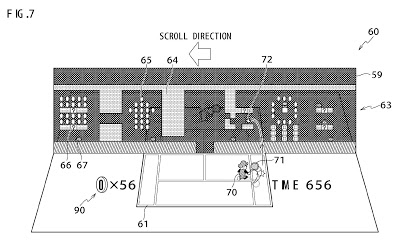
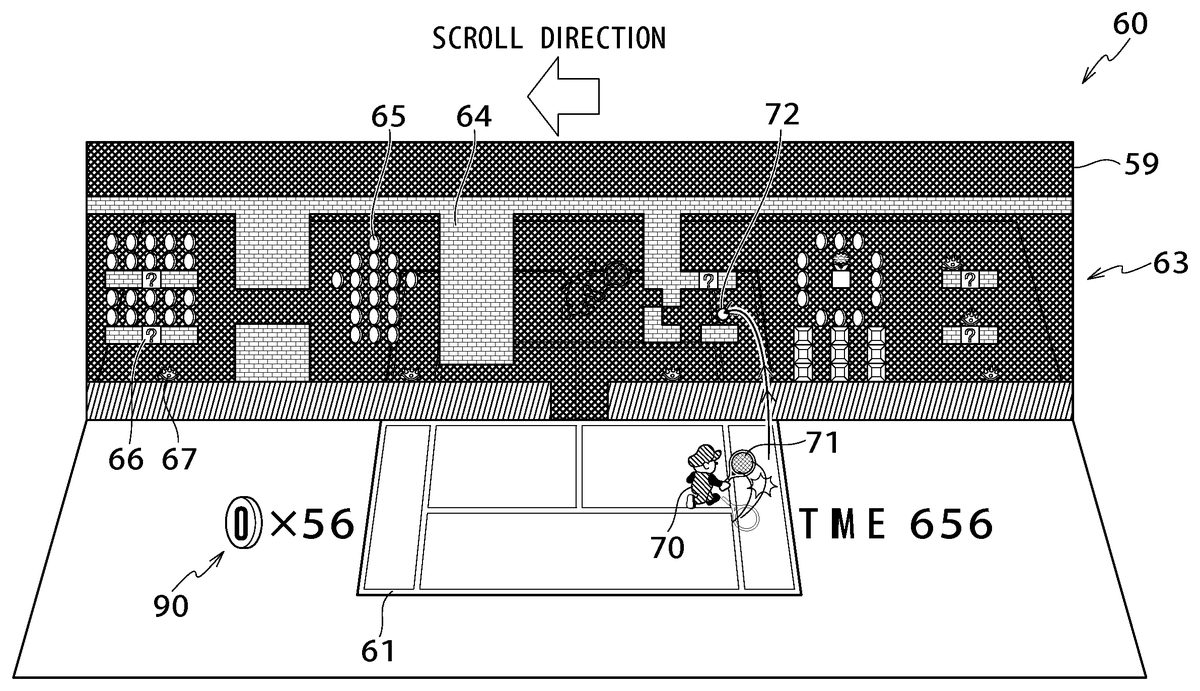
U.S. Patent No. 9,409,085 (the ‘085 Patent) describes a method to have an interactive background for a tennis video game. This gameplay mechanic is used in Mario Tennis Open’s Super Mario Tennis mode. In the mode, a player using a game character, like Mario, hits a tennis ball against a practice wall. Super Mario levels are superimposed onto the practice wall. The levels scroll like a Super Mario level and even feature classic Mario enemies like Bowser or Gumbas. Players can interact with the level by hitting the ball against the practice wall. Hitting different areas of the level will cause different effects. If the ball hits a Gumba, then the Gumba is squashed, and the player earns points. Hitting a box may cause a powerup to appear giving the players special powers. The player completes the mode like every other Mario game, defeating Bowser and rescuing Peach.
Abstract:
An exemplary embodiment sets the game background image with surface objects (bricks, coins, item closed box baffles, monsters, and the like) arranged therein in the middle of the tennis court within a virtual space for executing a tennis game containing the motion of hitting the tennis ball according to an operation by the player, and scrolls the surface objects arranged in the game background image. Then, there is provided an effect corresponding to the type of the surface object (benefit object, the hit map switching object, scoring object, or the like) arranged in a position of the game background image, where the tennis ball shot in response to a player-operation has reached.
Illustrative Claim:
1. A game system including a display device and a player operation inputting device, the game system configured to perform video game processing to execute and display a virtual ball game which takes place within a virtual space, comprising: one or more processors configured to interact with a user providing inputs via an operation inputting device and perform game processing to execute and display the virtual ball game which takes place within a virtual space, said one or more processors configured to perform functions and operate as: virtual ball movement processor which performs a game process wherein a virtual ball is moved within the virtual space in response to a hitting operation performed by a player using the operation inputting device; a virtual object setter configured to set a virtual three-dimensional object at a predetermined position in the virtual space, the virtual three-dimensional object having a surface where a virtual ball hit during the game process can reach; a virtual object surface image arranger configured to make one or more object surface images appear upon the surface of the virtual three-dimensional object; a virtual object surface image movement processor configured to move, within the surface of the virtual three-dimensional object, the one or more object surface images made to appear upon the surface of the virtual three-dimensional object; an effect processor configured to provide a predetermined effect in the game process, based on a condition that at least one of the object surface images made to appear upon the surface of the virtual three-dimensional object are present at a contact position of the virtual ball with a point on the surface of the virtual three-dimensional object, when a hit virtual ball reaches the surface of the virtual three-dimensional object; and a display processor configured to display the virtual space and the virtual ball game on the display device.
Illustrative Figure
Abstract
An exemplary embodiment sets the game background image with surface objects (bricks, coins, item closed box baffles, monsters, and the like) arranged therein in the middle of the tennis court within a virtual space for executing a tennis game containing the motion of hitting the tennis ball according to an operation by the player, and scrolls the surface objects arranged in the game background image. Then, there is provided an effect corresponding to the type of the surface object (benefit object, the hit map switching object, scoring object, or the like) arranged in a position of the game background image, where the tennis ball shot in response to a player-operation has reached.
Description
DETAILED DESCRIPTION OF NON-LIMITING EXAMPLE EMBODIMENTS (Embodiment) The following describes a game system1related to the present embodiment with reference to the drawings. (Structure of Game System1) As shown in the block diagram ofFIG. 1, the game system1includes a plurality of portable game devices10. The present embodiment deals with a case where the game system1includes two game devices10; however, the system may include three or more game devices10. In the game system1, the game devices10are connected to each other and are capable of conducting wireless communication. It is assumed that a plurality of players each use one game device10. It should be noted that, in the game system1of the present embodiment, the game devices10are connected to each other via wireless communication; however, the system is not limited to this, and the game devices10maybe connected to each other via a network such as the internet. Further, each game device10is structured so that a player is able to play a game alone (in the off-line mode). (Structure of Game Device10) Next, the following describes the structure of the game device10constituting the game system1, with reference toFIG. 1. The game device10includes: a CPU11, a main memory12, a sub data memory13, a memory card interface (memory card I/F)15, a communication module16, a display device18, a controller20, and an interface circuit (I/F circuit)21. The CPU11is connected, via not-shown buses, to the main memory12, the sub data memory13, the memory card I/F15, the communication module16, the display device18, the controller20, the I/F circuit21, and the like. The CPU11executes a predetermined process by running a predetermined program. For example, the CPU11runs a later-described tennis game program and a later-described wall-hitting tennis game program. The main memory12functions as a work area for the CPU11. In other words, the main memory12stores therein: a predetermined program or information data obtained by ...
DETAILED DESCRIPTION OF NON-LIMITING EXAMPLE EMBODIMENTS
(Embodiment)
The following describes a game system1related to the present embodiment with reference to the drawings.
(Structure of Game System1)
As shown in the block diagram ofFIG. 1, the game system1includes a plurality of portable game devices10.
The present embodiment deals with a case where the game system1includes two game devices10; however, the system may include three or more game devices10. In the game system1, the game devices10are connected to each other and are capable of conducting wireless communication. It is assumed that a plurality of players each use one game device10.
It should be noted that, in the game system1of the present embodiment, the game devices10are connected to each other via wireless communication; however, the system is not limited to this, and the game devices10maybe connected to each other via a network such as the internet.
Further, each game device10is structured so that a player is able to play a game alone (in the off-line mode).
(Structure of Game Device10)
Next, the following describes the structure of the game device10constituting the game system1, with reference toFIG. 1.
The game device10includes: a CPU11, a main memory12, a sub data memory13, a memory card interface (memory card I/F)15, a communication module16, a display device18, a controller20, and an interface circuit (I/F circuit)21.
The CPU11is connected, via not-shown buses, to the main memory12, the sub data memory13, the memory card I/F15, the communication module16, the display device18, the controller20, the I/F circuit21, and the like.
The CPU11executes a predetermined process by running a predetermined program. For example, the CPU11runs a later-described tennis game program and a later-described wall-hitting tennis game program. The main memory12functions as a work area for the CPU11. In other words, the main memory12stores therein: a predetermined program or information data obtained by the CPU11, from the outside via the memory card I/F15, the communication module16, and the like; and various data obtained through a predetermined process. For example, PSRAM (Pseudo-SRAM) is adoptable as this main memory12.
The sub data memory13is a rewritable and nonvolatile memory. As the sub data memory13, for example a NAND flash memory is adoptable. In this sub data memory13are stored a program for booting the game device10and various parameters, or the like.
To the memory card I/F15is detachably connected the memory card2. To and from this memory card2, the memory card I/F15writes and reads data according to instructions from the CPU11.
The communication module16has a function of conducting wireless communication with another game device10, in compliance with a communication standard of IEEE802.11b/g, or the like. Note that the game device10may conduct wired communication with another game device10, in place of or in addition to the wireless communication.
For example, the display device18is a liquid crystal display device having a liquid crystal display. The display device18in the present embodiment displays a game image of a tennis game carried out within a virtual space60(three-dimensional virtual space).
The controller20has one or more operation components which receives an operation by a player. For example, the controller20has a cross button, a start button, a select button, a confirm button, a cancel button, and further includes a touch panel which outputs signals to the I/F circuit21based on a touch operation by the player. The touch panel may be any given touch panel such as a resistive membrane panel, an optical touch panel (infrared touch panel), and a capacitive touch panel.
Further, the game device10has a microphone23, an amplifier24, and a speaker25, and the microphone23and the amplifier24are connected to the I/F circuit21.
The I/F circuit21includes an audio control circuit for controlling the microphone23and the amplifier24. The audio control circuit performs A/D conversion to audio signals from the microphone23, based on an instruction from the CPU11, and outputs the converted signals to the CPU11. Further, based on the instruction from the CPU11, the audio control circuit executes predetermined audio signal processing, followed by D/A conversion, to audio data input by the CPU11, and then outputs the converted audio data to the amplifier24to output a sound from the speaker25.
The microphone23collects sound and outputs audio signals based on the collected sound to the I/F circuit21. The amplifier24connects to the speaker25, amplifies the audio signals input via the I/F circuit21, and outputs the amplified signals to the speaker25. The speaker25outputs sound input from the amplifier24.
(Overview of Process for Setting Two-dimensional Virtual Space in Three-dimensional Virtual Space)
The following describes with reference toFIG. 7toFIG. 9, andFIG. 11, an overview of a process for setting a two-dimensional virtual space in a three-dimensional virtual space60, which is executed by the game device10.
The process for setting the two-dimensional virtual space in the three-dimensional virtual space60is executed in a later-described tennis game process. In the present embodiment, the game device10executes a tennis game in which an operation character70and an opponent character73compete against each other by alternately hitting a tennis ball72in a three-dimensional virtual space60(first virtual space). The operation character70is a character which moves in response to an operation by a player, and the opponent character73is a character which moves automatically or in response to an operation by another player, i.e., a communication partner.
In the virtual space60are arranged a tennis court61having an opponent character73side court and an operation character70side court, and a surface is set between the opponent character73side court and the operation character70side court. The expression “surface is set” means for example to arrange, in the three-dimensional virtual space60, an object (wall object59in the present embodiment: seeFIG. 7) having a surface on which a game background image63is pasted and which has surface objects. Then, a process for pasting the game background image63on the surface of the wall object59is executed. Although the present embodiment deals with a case where the surface is a flat plane, it is possible to adopt a curved surface. Note that an object having a flat plane is not limited to a wall object59, and may be any type of object (e.g., a plate polygon, or the like).
On the flat plane of the wall object59are arranged a plurality of surface objects each overlapped with the game background image63. These surface objects are two-dimensional objects having no thickness, and there are a plurality of types of these objects. The game background image63and the surface objects constitute a two-dimensional virtual space corresponding to the “second virtual space” of the present example. Hitting the surface object with the tennis ball72causes a predetermined game effect in the three-dimensional virtual space60. For example, the predetermined game effect is occurrence of a predetermined item as a new surface object or awarding of an item to the player. Further, for example, the predetermined game effect is switching over of the game background image63on the flat plane of the wall object59to another game background image63and changes in arrangement positions of the surface objects in the game background image63. The switching over of the game background image63on the wall object59and changing the surface objects corresponding to the game background image63switched over are expressed as “map switchover”.
This “map switchover” is specifically described. For example, as shown inFIG. 11, there are a plurality of game background images63(63A,63B,63C), and one of them is pasted on the surface of the wall object59. These game background images63are different maps (ground map63A, sky map63B, underground map63C). For example, suppose the game background image63corresponding to the ground map63A (the game background image63in the middle of the figure) is pasted on the surface of the wall object59. In this case, when the tennis ball72hits a predetermined item object (pea plant69A, earthen pipe69B), the game background image63B corresponding to the sky map63B or the game background image63C corresponding to the underground map63C replaces the game background image63on the wall object59. Further, switching over of the map also changes the surface objects corresponding to the type of the game background image63.
Meanwhile, in the virtual space60, there is executed a process (scroll process) for scrolling the game background image63and the surface objects (from the right towards left inFIG. 7toFIG. 9). The following describes this scroll process. As shown inFIG. 11, the game background image63as a whole has a size larger than a pasting region R on the flat plane of the wall object59. This pasting region R moves (slides) within the game background image63in a constant direction (from left to right inFIG. 11) by a constant amount per unit time. This enables the player to see the game background image63moving in the sliding direction (from the right to left in figures) as shown inFIG. 7andFIG. 8. The arrangement positions of the surface objects are also moved by a constant amount per unit time in the constant direction (from right to left in the figure). This is viewed by the player as the surface objects also scrolling along with the game background image63.
It should be noted that, in the following description, the wording “virtual space” means the “three-dimensional virtual space”, and not the “two-dimensional virtual space”.
(Memory Map of Main Memory12)
Next, the following describes programs and data stored in the main memory12. As shown inFIG. 2, the main memory12has a game program storage area30and a game data storage area40.
In the game program storage area30are contained a tennis game program31, a wall-hitting tennis game program32, or the like. The tennis game program31is a program for executing the later-described tennis game process. The wall-hitting tennis game program32is a program for executing a later-described wall-hitting tennis game process. The tennis game program31and the wall-hitting tennis game program32are read out from the memory card2shown inFIG. 1, and is stored in the main memory12. Needless to mention that the tennis game program31and the wall-hitting tennis game program32may be downloaded from a server or another game device10via a communication module16, and then stored in the main memory12.
On the other hand, in the game data storage area40are contained operation data41, transmission data42, reception data43, a coin counter44, background scroll data45, surface object scroll data46, transparency data47, operation-character image generating data48, opponent character image generating data49, wall object generating data50, and the like.
The operation data41indicates information regarding an input of operation to the controller20of the game device10. The operation data41indicates, for example, an operation status of each button of the controller20(indicates whether the button is pressed or not). The transmission data42is information data to be transmitted from the game device10to another game device10. The reception data43is information data having been transmitted from the other game device10to the game device10. The content of the reception data43is updated every time the information data is received from the other game device10. The coin counter44counts the number of coins65acquired.
The background scroll data45is information indicating the moving direction of the game background image63and an amount moved in a unit time (e.g. 1/60 sec) of the game background image63. The surface object scroll data46is information indicating the moving direction of the surface objects and an amount moved in a unit time (e.g., 1/60 sec) of the surface objects. The transparency data47indicates the transparency of the arrangement area of the game background image63on the wall object59and the surface objects. The operation-character image generating data48is for generating an image of the operation character70, and indicates the position, the direction, the posture (motion), and the like of the operation character70. The opponent character image generating data49is for generating the opponent character73, and indicates the position, the direction, the posture (motion), and the like of the opponent character73. The wall object generating data50is for generating an image of the wall object59, and indicates the position of the wall object59, a read-out position of the game background image63(the region to be pasted on the wall object59), and the coordinates (local coordinates) of the surface objects.
In addition to the above, the main memory12stores data needed for displaying a game image of the tennis game such as: data of a plurality of types of surface object images, data of a plurality of types of game background images63, initial position information of surface objects corresponding to the plurality of types of the game background images63, polygon models, textures, and the like.
(Processes Executed)
Next, the following describes a processes executed in the game device10.
(Tennis Game Process)
First, with reference to the flowchart ofFIG. 3, the following describes a tennis game process executed in the game device10(CPU11).
The tennis game process is executed by running a tennis game program.
When starting of the tennis game process is instructed by the player, the tennis game program is run to cause the CPU11to execute the following steps. First, the CPU11determines whether there is a reception of a player-selection of an online VS-mode which enables online competition between the player and another game device10(S10). When it is determined that the player-selection of the online VS-mode is received (S10: YES), the CPU11establishes communication with the other game device10, and sets the online VS-mode (S11). This enables the player to compete against an opponent character73which is controlled by the player of the communication partner game device10.
On the other hand, when there is no reception of the player-selection of the online VS-mode (S10: NO), the CPU11sets a VS mode in which the player compete against an automatically-operated opponent character73(S12).
After step S11or S12, the CPU11arranges a tennis court61within a virtual space60(S13).
Next, the CPU11arranges a wall object59in the middle of the tennis court61, and sets on the surface of the wall object59a game background image63(corresponding to the surface) (S14). The present embodiment adopts as the game background image63: a game background image63A shown in the middle ofFIG. 11which includes the ground, mountains, bushes, and clouds; a game background image63B shown in the upper part ofFIG. 11which renders an image of the sky scene; a dark game background image63C shown in the lower part ofFIG. 11which renders an image of the underground scene. Note that the CPU11functions as a surface setting component in step S14.
Next, the CPU11arranges within the game background image63various types of surface objects (bricks64, coins65, item closed box baffles66, monsters67, and the like) (S15). The surface objects include a fixed object whose arrangement position within the game background image63does not change; a moveable object capable of individually moving (changing the arrangement position in the game background image63); and an item object which gives a predetermined effect to the player. Examples of the fixed object include: bricks64, item closed box baffles66, or the like. Examples of the moveable object include a monster67, and examples of the item object includes: a benefit object68(mushroom68A, mushroom68B), a map switching object69(pea plant69A, earthen pipe69B), a scoring object (coins65or the like). Further, in step S15executed by the CPU11, the CPU11functions as an object arranger.
Next, the CPU11arranges in the tennis court61an operation character70operated by the player of the game device10; an opponent character73controlled by an online opponent or by the CPU; a tennis ball72; rackets71,74, and the like (S16). As described, initial setting (building of the virtual space) of the tennis game is executed through S13to S16.
The CPU11then repeats processes from the later-described S17to S21at every predetermined drawing cycle.
First, the CPU11executes the above described scroll process (S17). Specifically, as shown inFIG. 9, a process is executed by which the game background image63and the surface objects appear in the eyes of the player to move from the right side to the left side over the time. Note that in step S17by the CPU11, the CPU11functions as a motion processor.
Next, the CPU11executes a later-described character/ball control process (S18). Then, a later-described item/score process is executed (S19).
Next, a game image is generated based on the result of steps S17to S19, and is displayed on the display device18(S20).
Next, the CPU11determines whether a termination condition of the tennis game is satisfied (S21). When it is determined that the termination condition of the tennis game is satisfied (S21: YES), the CPU11ends the process. On the other hand, when it is determined that the termination condition of the tennis game is not satisfied (S21: NO), the CPU11causes the process to return to step S17. For example, the termination condition of the tennis game may be: mistakenly letting the tennis ball72go behind; or letting the tennis ball72bounce twice within the court before sending back the tennis ball72to the court of the opponent.
(Character/Ball Control Process1)
Next, with reference to the flowchart ofFIG. 4, the following describes a character/ball control process1executed in the tennis game process (S18). The character/ball control process1is a process executed in cases where the online VS-mode (S11) is set in the tennis game process.
First, the CPU11detects an operation input from the controller20(S30). Next, based on the operation input detected in step S30, the CPU11controls the position, the direction, and the motion (posture) of the operation character70(S31). Specifically, when the operation input is to move the operation character70, the operation character70is moved to a designated position. When the operation input is for causing the operation character70to hit the tennis ball72, the racket71is swung. If the racket71hit the tennis ball72, the moving direction and the speed of the tennis ball72are changed. Then, the tennis ball72is moved, based on the moving direction and the speed set for the tennis ball72. The information data generated in the motion control in step S31, such as the position data of the operation character70, the swing motion data of the racket71, data of the moving direction and speed of the tennis ball72hit by the operation character70with the racket71, and data generated based on the operation input by the player, is stored in the main memory12as the transmission data. Note that the moving direction and the speed of the tennis ball72may be changed every time the tennis ball72hit the tennis court61, the net or the surface object. Further, the step S31executed by the CPU11corresponds to the shot processor.
Next, the CPU11executes a transmission process (S32). Specifically, the CPU11transmits the information data stored as the transmission data43in step S31to the online opponent.
Next, the CPU11executes a reception process (S33). Specifically, the CPU11checks whether information data is received from the other game device10. When the information data is received, the information data received is stored as the reception data43in the main memory12. This reception data43contains the position data, the motion data of the opponent character73; the data of the position, the moving direction, and the speed of the tennis ball72; and other data generated based on an operation input by the player.
Next, the CPU11controls the position, the direction, and the motion (posture) of the opponent character73, based on the information data stored as the reception data43in the main memory12in step S33(S34). This causes the opponent character73to move or make the motion of swinging the racket74.
Further, the CPU11controls the position of the tennis ball72(S35). For example, when the tennis ball72hit the racket74of the opponent character73, the CPU changes the moving direction and the speed of the tennis ball72, and controls the position of the tennis ball72in the virtual space60based on the moving direction and the speed having been changed.
Next, the CPU11determines whether the tennis ball72hit back by the operation character70or the opponent character73reached an arrangement position of the game background image63(position in the surface of the wall object59) displayed as a two-dimensional surface in the middle of the tennis court61(S36).
When it is determined that the tennis ball72did not reach the arrangement position of the game background image63(S36: NO), the CPU11ends the process. On the other hand, when it is determined that the tennis ball72reached the arrangement position of the game background image63(S36: YES), the CPU11determines whether the tennis ball72came from the side of the operation character70to the game background image63, based on the moving direction of the tennis ball72at the time of reaching the arrangement position of the game background image63(S37).
When it is determined that the tennis ball72came from the side of the operation character70to the arrangement position of the game background image63(S37: YES), a process of raising the transparency of the game background image63is executed (S38). Specifically, the region of the wall object59having therein the game background image63is semi-transparent so that the objects or the like (opponent character73or the like) behind the wall object59are also visible by the player. Then, as shown inFIG. 7, when the tennis ball72reaches from the side of the operation character70to the game background image63, the transparency of the game background image63is raised so as to raise the visibility of the tennis court61and the opponent character73on the side of the opponent character73. Note that, after this, the transparency of the game background image63is set so as to increase in stepwise, taking a several frames, as shown inFIG. 8andFIG. 9.
With the process for raising the transparency of the game background image63, the player of the operation character70is able to concentrate on operation for aiming at a surface object the player wish to hit, because the opponent character73and the tennis court61on the side of the opponent character73are hardly visible while the tennis ball72is in the tennis court61on the side of the operation character70. Meanwhile, while the tennis ball72is in the tennis court61on the side of the opponent character73, the player of the operation character70needs to grasp the position and movement of the opponent character73and the position of the tennis ball72, in order to respond to the tennis ball72hit back by the opponent character73. To this end, the transparency of the game background image63is raised so that the player is able to grasp the position and the movement of the opponent character73and the position of the tennis ball72through the game background image63with an increased transparency.
In the above process of raising the transparency of the game background image63, the transparency is raised when the tennis ball72reaches the game background image63; however, the transparency of the game background image63may be raised when the operation character70hit the tennis ball72with the racket71. Further, for example, it is possible to set the opponent character73, an endline of the tennis court61, or the game background image63as a reference object, and change the transparency of the game background image63according to the distance between the reference object and the tennis ball72. Further, in the process of raising the transparency of the game background image63, the transparency of the game background image63is gradually raised from a point when the tennis ball72reaches the game background image63to a point when the opponent character73hit back the tennis ball72; however, the transparency of the game background image63may be maximized at a point where the tennis ball72reaches a predetermined position such as the game background image63.
The process ends after step S37.
On the other hand, when it is determined that the tennis ball72did not reach from the side of the operation character70to the game background image63(S37: NO), i.e., when it is determined that the tennis ball72reaches from the side of the opponent character73to the game background image63, a process of lowering the transparency of the game background image63is executed (S39). This process of lowering the transparency is a process opposite to the process of raising the transparency. Specifically, as shown inFIG. 9, while the tennis ball72is on the side of the opponent character73, the transparency of the game background image63is high, and the tennis court61on the side of the opponent character73and the opponent character73are highly visible. When the tennis ball72reaches the arrangement position of the game background image63, the visibility of the game background image63is raised (the transparency of the game background image63is lowered), as shown inFIG. 8. Note that, after this, the transparency of the game background image63is set so as to drop in stepwise, taking a several frames.
The process ends after step S38.
(Character/Ball Control Process2)
Next, with reference to the flowchart ofFIG. 5, the following describes a character/ball control process2executed in the tennis game process (S18). This character/ball control process2is a process executed in cases where the VS-CPU mode (S12) is set in the tennis game process. Note that the description overlapping with that of the character/ball control process1is omitted.
First, the CPU11detects an operation input from the controller20(S50), as in step S30. Next, based on the operation input detected in step S50, the CPU11controls the position, the direction, and the motion (posture) of the operation character70, as in step S31(S51).
Next, the CPU11controls the position, the direction, and the motion (posture) of the opponent character73, as in step S34(S52). Since this process is executed in the VS-CPU mode, the opponent character73is automatically moved by the CPU11. This causes the opponent character73to move or make the motion of swinging the racket74. Further, the CPU11controls the position of the tennis ball72as in step S35(S53).
Next, the CPU11determines whether the tennis ball72hit back by the operation character70or the opponent character73reached the game background image63displayed as a two-dimensional surface in the middle of the tennis court61(S54), as in step S36.
When it is determined that the tennis ball72did not reach the game background image63(S54: NO), the CPU ends the process. On the other hand, when it is determined that the tennis ball72reached the game background image63(S54: YES), the CPU11determines whether the tennis ball72came from the side of the operation character70to the game background image63, based on the moving direction of the tennis ball72at the time of reaching the game background image63(S55), as in step S37.
When it is determined that the tennis ball72came from the side of the operation character70to the game background image63(S55: YES), the CPU11executes a process of raising the transparency of the game background image63(S56), as in step S38. The process ends after step S56.
On the other hand, when it is determined that the tennis ball72did not reach from the side of the operation character70to the game background image63(S55: NO), i.e., when it is determined that the tennis ball72reaches from the side of the opponent character73to the game background image63, the CPU11executes a process of lowering the transparency of the game background image63(S57), as in step S39. The process ends after step S57.
(Item/Score Process)
Next, with reference to the flowchart ofFIG. 6, the following describes an item/score process executed in the tennis game process (S19). In the item/score process (S19), the CPU11functions as an effect processor.
First, the CPU11determines whether the tennis ball72hit back by the operation character70or the opponent character73hit a surface object arranged in the game background image63(S70). When it is determined that the tennis ball72did not hit the surface object (S70: NO), the CPU11ends the process.
On the other hand, when it is determined that the tennis ball72hit the surface object (S70: YES), the CPU11determines whether the surface object hit by the tennis ball72is a benefit object68(S71). When the surface object is a benefit object68(S71: YES), the CPU11awards an effect corresponding to the hit benefit object (S72). For example, when the hit benefit object68is a mushroom68A, the area of influence71A (collision determination area) where the tennis ball72is determined as to hit the surface object is expanded and becomes a powered-up area of influence71B, as shown inFIG. 10. In this case, if the player hit the tennis ball72against a single surface object, a surface object nearby the hit surface object is also regarded as to be hit, and the chances for various benefits are increased.
On the other hand, when the surface object hit by the tennis ball72is not a benefit object68(S71: NO), the CPU11determines whether the surface object hit by the tennis ball72is a map switching object69(S73). If it is a map switching object69(S73: YES), the CPU11switches the map to a map corresponding to the map switching object69(pea plant69A, earthen pipe69B), i.e., the CPU11executes the above-described switching over of the map (S74). Examples of maps in the present embodiment are: a ground map63A which is a game background image63A shown in the middle ofFIG. 11having the ground, mountains, bushes, and clouds and with various surface objects therein; a sky map63B which is a game background image63B shown in the upper part ofFIG. 11including various surface objects to render an image of the sky scene; and an underground map63C which is a game background image63C shown in the lower part ofFIG. 11including various surface objects to render an image of the underground scene.
For example, when the tennis ball72hits a pea plant69A in the ground map ofFIG. 11, the map switches over from the ground map to the sky map. Further, when the tennis ball72hits an earthen pipe69B in the ground map ofFIG. 11, the map switches over from the ground map to the underground map. This process ends after step S74.
On the other hand, if the surface object hit by the tennis ball72is not a map switching object69(S73: NO), the CPU11determines whether the surface object hit by the tennis ball72is a scoring object (S75). If the surface object is a scoring object (S75: YES), the CPU11awards a score corresponding to the scoring object (S76). For example, when the hit scoring object is a coin65, the coin65is counted as an earned coin count in the coin counter of the main memory12, and is displayed on the display device18as the earned coin count90(seeFIG. 7).
On the other hand, if the surface object hit by the tennis ball72is not a scoring object (S75: NO), the CPU11ends the process.
With the structure described above, it is possible to set the game background image63with surface objects arranged therein in the middle of the tennis court61within a virtual space60for executing a tennis game containing the motion of hitting the tennis ball72in response to an operation by the player, and move the surface objects arranged in the game background image63. For example, based on the surface object arranged in a position of the game background image63, where the tennis ball72hit in response to a player-operation has reached, an effect corresponding to the hit benefit object68, the hit map switching object69, or the hit scoring object is awarded to the player. Thus, the player of the tennis game is able to enjoy an additional game element which is to aim at a predetermined effect awarded by the moving surface object arranged in the game background image63while playing the tennis game within the virtual space60.
Further, with the above structure, it is possible to arrange a game background image63between the player and the opponent during a game within the tennis court61in the virtual space60, the background image63having surface objects arranged therein and letting the tennis ball72pass therethrough. This enables the player to enjoy the tennis game in which the player and the opponent hit the tennis ball72against each other over the game background image63with the moving surface objects arranged therein.
Further, in the above structure, the transparency of the game background image63while the tennis ball72is in the tennis court61on the side of the opponent character73can be made higher than that while the tennis ball72is in the tennis court61on the side of the operation character70. Since this enables the player of the tennis game to grasp the movement of the opponent character73or the position of the tennis ball72through the game background image63with an increased transparency while the tennis ball72is in the tennis court61on the side of the opponent character73, the player is able to smoothly conduct the next operation.
Further, with the above structure, a ball game executed in a virtual space60is enjoyed as a tennis game. Specifically, the tennis ball72serves as the ball, the racket71serves as a tool for hitting the tennis ball72in response to a player-operation, the tennis court61serves as the court, and the game background image63is arranged nearby the net.
Further, with the structure, when a surface object arranged in a position of the game background image63where the tennis ball72reached is an item object such as a benefit object68(mushroom68A, mushroom68B), a map switching object69(pea plant69A, earthen pipe69B), or a scoring object (coin65or the like), the player is able to obtain an effect or a score corresponding to the item object. This provides various developments of the game by awarding the player various benefits based on the item object or the score obtained by the player.
Further, in the structure, the map is switched over to another map when the surface object arranged in a position of the game background image63where the tennis ball72reached is a map switching object69(pea plant69A, earthen pipe69B). This enables the player to enjoy the tennis game with various maps.
Further, with the structure, the surface objects arranged in the game background image63are scrolled over time. Thus, the player is able to hit the tennis ball72, aiming at the surface objects successively supplied by scrolling. In other words, new surface objects are always provided to the player.
(Modification: Wall-Hitting Tennis Game)
Next, the following describes a modification of the present embodiment. The present embodiment deals with a case where the operation character70competes against the opponent character73. This modification on the other hand executes a wall-hitting tennis game in which the operation character70plays alone, assuming the game background image63with surface objects arranged therein as a wall. This wall-hitting tennis game process is described below with reference toFIG. 12toFIG. 14. Note that the description overlapping with that of the above-described tennis game process is omitted or simplified.
(Wall-Hitting Tennis Game Process)
As shown inFIG. 12, although the wall-hitting tennis game process include the similar steps as those of the above-described tennis game process, the wall-hitting tennis game process starts when the player of the game device10selects the wall-hitting tennis game mode, instead of steps S10to S12. Specifically, when the wall-hitting tennis game process starts, a wall-hitting tennis game program is run to cause the CPU11to execute the following steps. First, the CPU11determines whether the player of the game device10selected the wall-hitting tennis game mode by an operation input through the controller20(S80). When it is determined that the wall-hitting tennis game mode is not selected (S80: NO), the CPU11ends the process.
On the other hand, when it is determined that the wall-hitting tennis game mode is selected (S80: YES), the CPU11arranges a wall-hitting tennis court161in a virtual space160as shown inFIG. 14(S81).
Next, the CPU11arranges a wall object59in the wall-hitting tennis court161, and sets a game background image63(corresponding to the surface) on this wall object59(S82).
Next, the CPU11arranges within the game background image163various types of surface objects (bricks64, coins65, item closed box baffles66, monsters67, and the like) (S83).
Next, the CPU11arranges in the wall-hitting tennis court161an operation character70operated by the player, a tennis ball72, a racket71, and the like (S84).
After step S84, steps S85to S89are looped. In this loop of steps S85to S89, the operation character70moves and hit the tennis ball72to progress the tennis game, in response to operations by the player.
In the loop of steps S85to S89, the CPU11first executes the above-described scroll process (S85). Next, the CPU11executes a character/ball control process of the wall-hitting tennis game mode shown in the flowchart ofFIG. 13(S86). Specifically, the CPU11detects an operation input from the controller20(S100). Next, based on the operation input detected in step S100, the CPU11executes motion control of the operation character (S101), as in step S31. The CPU11further controls the position of the tennis ball72(S102), as in step S35.
Next, the CPU11determines whether the tennis ball hit by the operation character70reached the game background image163arranged in the wall-hitting tennis court161(S103).
When it is determined that the tennis ball72did not reach the game background image163(S103: NO), the CPU11ends the process. On the other hand, when it is determined that the tennis ball72reached the game background image163(S103: YES), the CPU11executes a ball-bounce-back process (S104). In the ball-bounce-back process, the game background image163serves as a surface on which the tennis ball72is bounced back, and a motion process is executed to bounce back the tennis ball72based on the moving direction and the speed of the tennis ball72, when the tennis ball72reaches the game background image163(seeFIG. 14). The process ends after step S104. Note that step S104executed by the CPU11corresponds to a bounce-back processor.
After the character/ball control process of the wall-hitting tennis game mode, an item/score process is executed as in step S19(S87).
Next, a game image is generated according to the result of steps S85to S87and is displayed on the display device18(S88).
Next, the CPU11determines whether the game is ended (S89). When it is determined that the game is not ended (S89: NO), the process returns to S85, and the loop of steps S85to S89is resumed.
On the other hand, when it is determined that the game is ended (S89: YES), the CPU11ends the wall-hitting tennis game process.
In the above structure, when the tennis ball72reaches the game background image163having surface objects arranged therein in the tennis game within the virtual space160, the tennis ball72is bounced back. Since the tennis ball72having reached the surface after being hit by a player-operation bounces back on the surface, the player needs to repetitively hit the tennis ball72, which consequently provides enjoyment of the wall-hitting tennis game.
(Alternative Embodiment)
The present embodiment deals with a case adopting tennis game as the ball game; however, the ball game may be squash, volleyball, beach volleyball, table tennis, or the like. Further, the present embodiment deals with a case where the game device10is portable; however, the game device10may be a stationary game device which is connected to a TV monitor when used. For example, the technology herein may include one or more servers taking at least a part of the process and a client terminal (game device10) which is connected and in communication with the one or more servers. Alternatively, the technology herein may be a distributed system including a plurality of game devices10connected to each other directly or via a network, each of which devices takes a part in the process.
In the present embodiment, the surface objects are scrolled on the surface of the wall object59; however, the technology herein is not limited to a structure of scrolling the surface objects as long as the surface objects are moved. In other words, the position of the surface objects may be changed by a method other than scrolling. Further, it is possible to keep the surface objects in the same positions and change the posture (motion), without changes in the positions.
In the present embodiment, the surface objects are arranged on the wall object59(two-dimensional virtual space is set within a three-dimensional virtual space); however, the technology herein is not limited to such a structure, and it is possible to arrange another three-dimensional virtual space within a predetermined area of the three-dimensional virtual space.
Further, the above embodiment may be paraphrased and redefined as a game system configured to perform a tennis game (game) within a virtual space60(first virtual space), in which system the tennis ball72(operation target) is controlled (target processor) within the virtual space60in response to a player-operation, a wall object59(screen area) is set in the middle (predetermined position) of the tennis court61within the virtual space60(screen setting component), a game background image63(second virtual space) which is different from the virtual space60is set (second virtual space setting component), a part of the game background image63is movably displayed on the wall object59(second virtual space drawing component), and a predetermined effect is given in the tennis game, based on the position in the game background image63, the position corresponding to the position of the tennis ball72at the point when the tennis ball72moving within the virtual space60reaches the wall object59(effect processor).
The detailed description above is mainly focused on characteristics of the technology for the sake of easier understanding. However, the technology is not limited to the disclosure of the detailed description above and the range of application thereof should be interpreted as broadly as possible. Further, the terms and phraseology used in the application are adopted solely to provide specific illustration of the technology, and in no case should the scope of the technology be limited by such terms and phraseology. Further, it will be obvious for those skilled in the art that other structures, systems, methods, programs, or the like are possible, within the spirit of the technology described in the application. The description of claims therefore shall encompass equivalent structures, unless otherwise such structures are regarded as to depart from the spirit and scope of the technology. To fully understand the object and effects of the technology, it is strongly encouraged to sufficiently refer to disclosures of documents already made available.
Claims
- A game system including a display device and a player operation inputting device, the game system configured to perform video game processing to execute and display a virtual ball game which takes place within a virtual space, comprising: one or more processors configured to interact with a user providing inputs via an operation inputting device and perform game processing to execute and display the virtual ball game which takes place within a virtual space, said one or more processors configured to perform functions and operate as: a virtual ball movement processor which performs a game process wherein a virtual ball is moved within the virtual space in response to a hitting operation performed by a player using the operation inputting device;a virtual object setter configured to set a virtual three-dimensional object at a predetermined position in the virtual space, the virtual three-dimensional object having a surface where a virtual ball hit during the game process can reach;a virtual object surface image arranger configured to make one or more object surface images appear upon the surface of the virtual three-dimensional object;a virtual object surface image movement processor configured to move, within the surface of the virtual three-dimensional object, the one or more object surface images made to appear upon the surface of the virtual three-dimensional object;an effect processor configured to provide a predetermined effect in the game process, based on a condition that at least one of the object surface images made to appear upon the surface of the virtual three-dimensional object are present at a contact position of the virtual ball with a point on the surface of the virtual three-dimensional object, when a hit virtual ball reaches the surface of the virtual three-dimensional object;and a display processor configured to display the virtual space and the virtual ball game on the display device.
- The game system according to claim 1 , further comprising a bounce-back processor configured to execute a process of bouncing back the virtual ball when the virtual ball reaches the surface of the virtual three-dimensional object.
- The game system according to claim 1 , wherein: the virtual ball game enables a player to compete against an opponent within a court in the virtual space;and the virtual three-dimensional object is a plane set in the middle of the court and is capable of letting the virtual ball pass therethrough.
- The game system according to claim 3 , further comprising a transparency processor configured to raise the transparency of at least a part of the surface of the virtual three-dimensional object when the virtual ball is within a court on a side of the opponent.
- The game system according to claim 1 , wherein the virtual ball game is a tennis game.
- The game system according to claim 1 , wherein the effect processor executes a process of awarding the player an item and/or a process of awarding the player a score, when at least one of the one or more object surface images appearing at a position within the surface of the virtual three-dimensional object where the virtual ball reaches is an image of a predetermined item object.
- The game system according to claim 1 , further comprising a plurality of maps which include one or more of the object surface images, wherein the effect processor switches over at least one of the plurality of maps to another one of the plurality of maps when at least one of the object surface images appearing at a position where the virtual ball has reached is a predetermined type of object surface image.
- The game system according to claim 1 , wherein the object processor scrolls over time at least one of the one or more object surface images within the surface of the virtual three-dimensional object.
- A game system including a display and a player operation inputting device and one or more processing components configured to perform game processing to execute and display a game which takes place within a first virtual space, the system comprising: a target processing component configured to control movement of an operation target within the first virtual space based on an operation by a user using the operation inputting device;a screen setting component configured to set a screen area in a predetermined position within the first virtual space, the screen area to be used for displaying an image;a second virtual space setting component configured to create a second virtual space which is distinct from the first virtual space;a second virtual space image displaying component configured to produce an image of a part of the second virtual space and display the image of the part of the second virtual space upon the set screen area while changing the part of the second virtual space which is being displayed upon the set screen area;and an effect processor configured to provide a predetermined effect in the game based on a condition that the position of the operation target is in correspondence at a point on the set screen area with an image of one or more objects which may be present in the displayed part of the second virtual space when the operation target is moved within the first virtual space.
- A video game operation method for conducting and controlling video game processing on an information processing system to execute and display a virtual ball game which takes place within a virtual space, the information processing system including one or more processors configured to perform game processing and to interact with a user providing inputs via an operation inputting device, and including a user interface having at least a display and an operation inputting device, the method comprising: using the information processing system to perform a virtual ball game process wherein a virtual ball is moved within in the virtual space in response to a hitting operation performed by a player using the operation inputting device;setting a virtual three-dimensional object at a predetermined position in the virtual space, the virtual three-dimensional object having a surface where a virtual ball hit during the game process can reach;making one or more object surface images appear upon the surface of the virtual three-dimensional object;moving, within the surface of the virtual three-dimensional object, the one or more object surface images made to appear upon the surface of the virtual three-dimensional object;using the information processing system to produce a predetermined effect in the game process, based on a condition that at least one of the object surface images made to appear upon on the surface of the virtual three-dimensional object is present at a contact position of the virtual ball with a point on the surface of the virtual three-dimensional object, when a hit virtual ball reaches the surface of the virtual three-dimensional object;and displaying the virtual space and the virtual ball game on the display.
- The method according to claim 10 , further comprising executing a process of bouncing back the virtual ball when the virtual ball reaches the surface of the virtual three-dimensional object.
- The method according to claim 10 , wherein: The virtual ball game enables a player to compete against an opponent within a court in the virtual space;and the virtual three-dimensional object is a plane set in the middle of the court and is capable of letting the virtual ball pass therethrough.
- The method according to claim 12 , further comprising increasing the transparency of at least a part of the surface of the virtual three-dimensional object when the virtual ball is within a court on a side of the opponent.
- The method according to claim 10 , wherein the virtual ball game is a tennis game.
- The method according to claim 10 , wherein producing a predetermined effect in the virtual ball game further includes performing a process of awarding the player an item and/or a process of awarding the player a score when at least one of the one or more object surface images appearing within the virtual three-dimensional object surface and present at a contact position where the virtual ball reaches is an image of a predetermined item object.
- The method according to claim 10 , further comprising producing a plurality of maps which include one or more of the object surface images, wherein, in producing a predetermined effect, at least one of the plurality of maps is switched over to another one of the plurality of maps, when at least one of the object surface images appearing in a position where the virtual ball reached is a predetermined type of object surface image.
- The method according to claim 10 , wherein moving one or more of the object surface images further includes a process of scrolling over time the object surface images within the surface of the virtual three-dimensional object.
- A display process control method implemented using an information processing system including a display and a user operation inputting device and one or more computer processors configured to perform processing to execute displayable processes which take place within one or more virtual space, the method comprising: using the information processing system to control movement of an operation target within a first virtual space based on an input operation performed by a user using the operation inputting device;setting a screen area in a predetermined position within the first virtual space, the screen area to be used for displaying an image;creating a second virtual space which is distinct from the first virtual space;using the processing system to produce an image of a part of the second virtual space and display the image of a part of the second virtual space upon the set screen area while changing the part of the second virtual space which is being displayed upon the set screen area;and using the processing system to provide a predetermined effect based on a condition that the position of the operation target is in correspondence at a point on the set screen area with an image of one or more objects which may be present in the displayed part of the second virtual space when the operation target is moved within the first virtual space.
- An apparatus for playing a game using a display device and a player operation inputting device, the apparatus having one or more processors configured to perform video game processing to execute and display a virtual ball game which takes place within a virtual space, said one or more processors configured to perform functions and operate as: a virtual ball movement processor which performs a game process wherein a ball is moved within the virtual space in response to a hitting operation performed by a player using the operation inputting device;a virtual object setter configured to set a virtual three-dimensional object at a predetermined position in the virtual space, the virtual three-dimensional object having a surface where a virtual ball hit during the game process can reach;a virtual object surface image arranger configured to make one or more object surface images appear upon the surface of the virtual three-dimensional object;a virtual object surface image movement processor configured to move, within the surface of the virtual three-dimensional object, the one or more object surface images made to appear upon the surface of the virtual three-dimensional object;an effect processor configured to provide a predetermined effect in the game process, based on a condition that at least one of the object surface images made to appear upon the surface of the virtual three-dimensional object are present at a contact position of the virtual ball with a point on the surface of the virtual three-dimensional object, when a hit virtual ball reaches the surface of the virtual three-dimensional object;and a display processor configured to display the virtual space and the virtual ball game on the display device.
- The apparatus according to claim 19 , wherein said one or more processors is configured to perform functions and operate as a bounce-back processor configured to execute a process of bouncing back the virtual ball when the virtual ball reaches the surface of the virtual three-dimensional object.
- The apparatus according to claim 19 , wherein: the virtual ball game enables a player to compete against an opponent within a court in the virtual space;and the virtual three-dimensional object is a plane set in the middle of the court and is capable of letting the virtual ball pass therethrough.
- A non-transitory storage medium storing a game program which when executed by a computer causes the computer to interact with a user and perform game program processing using a display and a player operation inputting device to execute and display a virtual ball game which takes place within a virtual space, the game program causing the computer to function and perform operations as: a virtual ball movement processor which performs a game process wherein a virtual ball is moved within the virtual space in response to a hitting operation performed by a player using the operation inputting device;a virtual object setter configured to set a virtual three-dimensional object at a predetermined position in the virtual space, the virtual three-dimensional object having a surface where a virtual ball hit during the game process can reach;a virtual object surface image object arranger configured to make one or more object surface images appear upon the surface of the virtual three-dimensional object;a virtual object surface image movement processor configured to move, within the surface of the virtual three-dimensional object, the one or more object surface images made to appear upon the surface of the virtual three-dimensional object;an effect processor configured to provide a predetermined effect in the game process, based on a condition that at least one of the object surface images made to appear upon the surface of the virtual three-dimensional object are present at a contact position of the ball with a point on the surface of the virtual three-dimensional object, when a hit virtual ball reaches the surface of the virtual three-dimensional object;and a display processor configured to display the virtual space and the virtual ball game on the display device.
- The non-transitory storage medium according to claim 22 , wherein the game program causes the computer to function and perform operations as a bounce-back processor configured to execute a process of bouncing back the virtual ball when the virtual ball reaches the virtual object surface.
- The non-transitory storage medium according to claim 22 , wherein the virtual ball game enables a player to compete against an opponent within a court in the virtual space;and the virtual three-dimensional object is a plane set in the middle of the court and is capable of letting the virtual ball pass therethrough.
Disclaimer: Data collected from the USPTO and may be malformed, incomplete, and/or otherwise inaccurate.