U.S. Pat. No. 9,409,083
SPAWNING NEW TIMELINES DURING GAME SESSION REPLAY
AssigneeAmazon Technologies Inc.
Issue DateJune 27, 2014
U.S. Patent No. 9,409,083: Spawning new timelines during game session replay
U.S. Patent No. 9,409,083: Spawning new timelines during game session replay

Summary:
Traditionally, to restart a multiplayer session requires that all the players begin anew. For co-op multiplayer games, restarting means starting from a point designated by the level designers. Restarting from a designated point can become frustrating when fighting a challenging boss. U.S. Patent No. 9,409,083 (the ‘083 Patent) describes an alternative method. Every gaming session is recorded by a game using the ‘083 Patent system. If the players were to die, the game would use the record to show the players a replay of their last session. The players can watch the replay and see the exact moment where things went wrong. Players can then decide to “step in” and start a new session from that point, creating a new timeline or universe that diverges from the original game session. The new (altered) gaming session will create a new record from which players can repeat the process.
Abstract:
A game system in which game sessions involving one or more players may be recorded and saved as game records. A previously recorded game session may be selected and replayed. However, in addition to providing a static replay of the game session, the game system may allow one or more players to step into and assume control of respective game characters at any point during the replay of the game session. When a player steps into and takes control of game a character during the playback, a new timeline is spawned from the original timeline with potentially different outcomes, and a new game record corresponding to the new timeline is generated and stored.
Illustrative Claim:
1. A system, comprising; one or more computing devices configured to implement a game system configured to: store game records comprising previously played game sessions, each game session involving one or more game characters acting within a game universe along a game session timeline; receive selection input from one of one or more client devices, said selection input selecting one of the stored game records for playback; begin playback of the game session as recorded in the selected game record to at least one client device; receive game input from a game client instance on one of the one or more client devices, said game input causing an action by one of the one or more game characters within the game universe; and in response to said game input, spawn a new game session timeline from the game session timeline as recorded in the selected game record and generate a new game record for the new game session timeline.
Illustrative Figure
Abstract
A game system in which game sessions involving one or more players may be recorded and saved as game records. A previously recorded game session may be selected and replayed. However, in addition to providing a static replay of the game session, the game system may allow one or more players to step into and assume control of respective game characters at any point during the replay of the game session. When a player steps into and takes control of game a character during the playback, a new timeline is spawned from the original timeline with potentially different outcomes, and a new game record corresponding to the new timeline is generated and stored.
Description
While embodiments are described herein by way of example for several embodiments and illustrative drawings, those skilled in the art will recognize that embodiments are not limited to the embodiments or drawings described. It should be understood, that the drawings and detailed description thereto are not intended to limit embodiments to the particular form disclosed, but on the contrary, the intention is to cover all modifications, equivalents and alternatives falling within the spirit and scope as defined by the appended claims. The headings used herein are for organizational purposes only and are not meant to be used to limit the scope of the description or the claims. As used throughout this application, the word “may” is used in a permissive sense (i.e., meaning having the potential to), rather than the mandatory sense (i.e., meaning must). Similarly, the words “include”, “including”, and “includes” mean including, but not limited to. DETAILED DESCRIPTION Various embodiments of methods and apparatus for replaying game sessions in computer-based games, including but not limited to multiplayer games, are described. Conventional multiplayer computer games may allow players to view static replays of recorded game sessions, or to restart a game from a given point (e.g., from the beginning of a level in a multi-level game). Embodiments of game methods and apparatus are described that allow players to store continuous records of the states of previously played game sessions in a game, for example in a multiplayer game. Each stored game session may be viewed as a separate game universe or timeline involving the game characters of the players that participated. A player may then access the stored state information for a previously played game session to watch a replay of the game. However, unlike conventional game systems in which the replay is static and can only be viewed, ...
While embodiments are described herein by way of example for several embodiments and illustrative drawings, those skilled in the art will recognize that embodiments are not limited to the embodiments or drawings described. It should be understood, that the drawings and detailed description thereto are not intended to limit embodiments to the particular form disclosed, but on the contrary, the intention is to cover all modifications, equivalents and alternatives falling within the spirit and scope as defined by the appended claims. The headings used herein are for organizational purposes only and are not meant to be used to limit the scope of the description or the claims. As used throughout this application, the word “may” is used in a permissive sense (i.e., meaning having the potential to), rather than the mandatory sense (i.e., meaning must). Similarly, the words “include”, “including”, and “includes” mean including, but not limited to.
DETAILED DESCRIPTION
Various embodiments of methods and apparatus for replaying game sessions in computer-based games, including but not limited to multiplayer games, are described. Conventional multiplayer computer games may allow players to view static replays of recorded game sessions, or to restart a game from a given point (e.g., from the beginning of a level in a multi-level game). Embodiments of game methods and apparatus are described that allow players to store continuous records of the states of previously played game sessions in a game, for example in a multiplayer game. Each stored game session may be viewed as a separate game universe or timeline involving the game characters of the players that participated. A player may then access the stored state information for a previously played game session to watch a replay of the game. However, unlike conventional game systems in which the replay is static and can only be viewed, a player can “step into” the player's game character at any point in the game and begin controlling the character. Upon the player taking over the player's game character and interacting with the game, a new game universe and timeline is spawned from the original game session. As the game session progresses on the new timeline, the new universe diverges from the universe of the original game session. Anywhere from slightly to drastically different outcomes of a game session may be achieved from even minor differences in game play on the new timeline. This new universe/timeline can be recorded and saved, replayed, and new universe/timelines may be spawned off of it. Similarly, the original universe/timeline can be persisted, can again be replayed, and other different universe/timelines can be spawned from it.
In at least some embodiments, various actions of a player when controlling the player's character in game sessions may be monitored and used to create (and update over time) a profile for the player's character that reflects or models the actual game play of the player when participating in the game as the character. In at least some embodiments, the game may include logic (e.g., an artificial intelligence (AI) engine) that can simulate game play of a given player by controlling the actions of the player's character according to the player's profile. When a player steps into a previously recorded game session, the actions of one or more other characters in the game may from that point forward at least initially be controlled by the game logic based on the characters' profiles. As the game deviates from the original universe/timeline, the simulated characters respond to events according to the corresponding players' live playing characteristics as recorded in the profiles. However, in at least some embodiments, another player can step into and take control of their respective character at any point during the game play.
In at least some embodiments, when a player replays a previously recorded game session or when a player steps into a previously recorded game session that is being replayed, one or more other players that were involved in the original game session may be notified that the game session involving their characters is being replayed, and may be invited to participate in the session. An invitation to participate may, for example, be initiated by the player who initiated the replay using one or more communications channels such as social media, text messaging, email, telephone, etc. In some embodiments, the game user interface may include a “notify other players” interface element that allows a player to optionally invite one or more of the other players to participate in the game replay. In some embodiments, the game system may automatically generate and send a notification to one or more of the other players via one or more communications channels (e.g., text messaging, alert messaging, email, etc.) when a replay of a stored game session is initiated by another player and/or when another player “steps into” their character in a previously recorded game session that is being replayed by the other player.
Embodiments may be used to record original game sessions in which multiple players control their game characters; the original game sessions may then be replayed, with one or more of the players stepping into and taking control of their characters at any point of the game session to generate a new universe/timeline for the game session from that point onward. In at least some embodiments, the game sessions are recorded according to the viewpoint of each player/character in the game so that the different perspectives of the players/characters in the game sessions can be viewed when the game sessions are played back. Once a new universe/timeline is spawned, one or more of the characters that are not being controlled by their corresponding players may instead be controlled by the game logic (e.g., via a player simulation or artificial intelligence (AI) component of the game system) according to the corresponding players' profiles.
In at least some embodiments, when a game session is being replayed from a game record, one or more of the players that participated in the game session may choose to watch the replay of the game session via respective client devices without actively participating in or controlling characters in the game session. Watching or viewing a replay without actively participating may be referred to as participating in “ghost” mode, or as ghosting. In at least some embodiments, the game system may play back the game session from one, two or more viewpoints or perspectives of the characters involved in the game which can be viewed in ghost mode. For example, a first player may view the replay from a perspective corresponding to the viewpoint of the first player's character, while a second player may view the replay from a different perspective corresponding to the viewpoint of the second player's character. In at least some embodiments, a player may be allowed to view the replay in ghost mode from the perspective of characters that are not associated with the player. In at least some embodiments, a player may select to view the replay from either a first person viewpoint (i.e., through the eyes) or third person viewpoint (e.g., above or behind the head) of a given character. Note that, once a player steps into and takes control of a character in the game session, the player is no longer viewing the game session in ghost mode. However, one or more other players may choose to continue viewing the game in ghost mode without actively participating, or one or more other players may join the replay to view the game in ghost mode without actively participating.
In at least some embodiments, a player may be allowed to “step out” of the player's game character that the player is actively controlling during game play. In at least some embodiments, the game logic (e.g., an AI component of the game system) may take over control of a player's game character if the player chooses to step out of the character during a game session.
In some embodiments, an original game session may be initiated in which one or more, or even all, of the characters participating in the game session are at least initially controlled by the game logic (e.g., by an AI component of the game system) according to the corresponding players' profiles. During the game session, one or more of the players with a character in the game may step into and take over control of their game characters.
In at least some embodiments, a player (for example, a skilled or known player for a particular online game) can record game sessions involving the player's game character and offer the recorded game sessions to others for replay and possible participation as other characters in the game playing against the original player's computer-controlled character. If a player steps into a game session so obtained by taking control of a character, a new universe/timeline may be spawned in which the player participates with the other player's character as controlled by the game logic according to the other player's profile provided with the recorded game session. These recorded game sessions may, for example, be offered online in exchange for virtual or real currency, or for free.
While embodiments are primarily described herein in the context of replaying game sessions in multiplayer game environments in which two or more players participate in a game session to generate game records which can then be replayed, it is to be noted that embodiments may also be applied in single-player game environments, as well as in multiplayer game environments, in which a single player plays in and generates a game record for the game session.
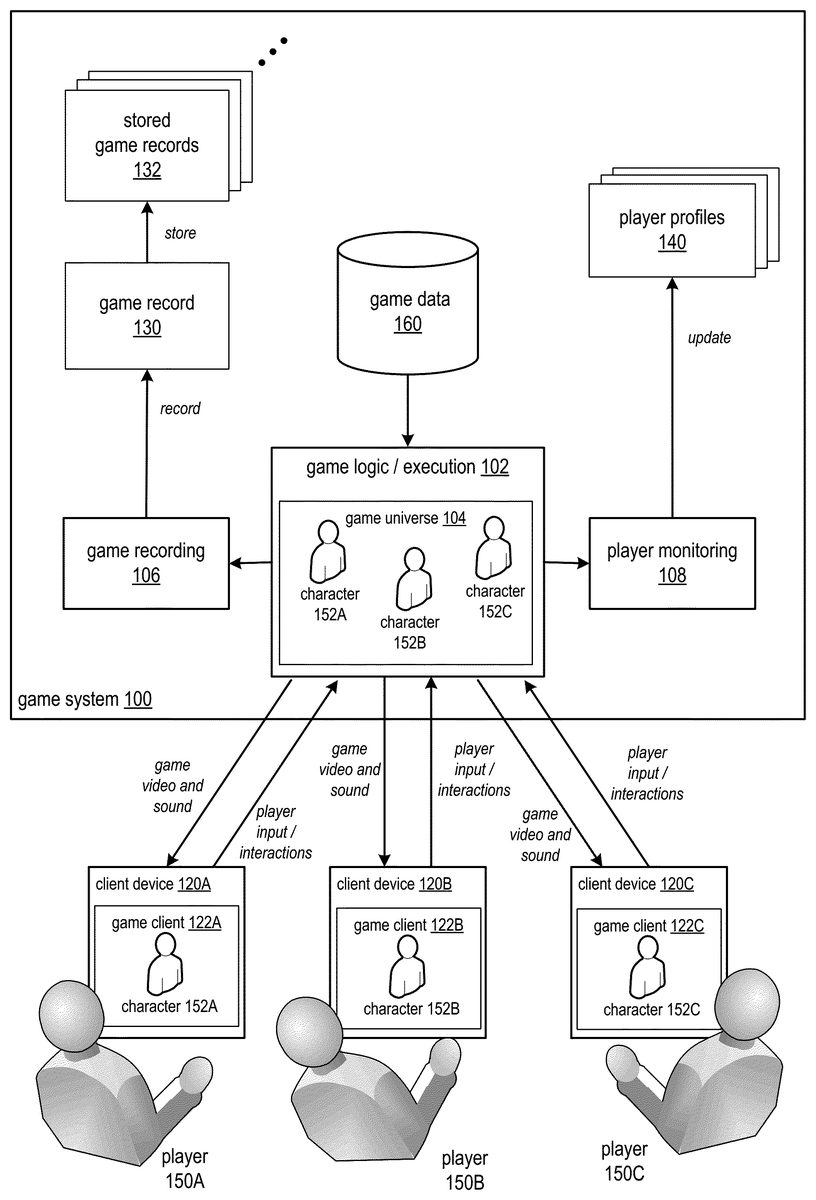
FIGS. 1A through 1Dare block diagrams that graphically illustrate methods and apparatus for replaying game sessions of a multiplayer game in an example computer-based multiplayer game environment, according to at least some embodiments. In at least some embodiments, a multiplayer game environment may include a multiplayer game system100and one or more client devices120. The multiplayer game system100stores game data and information, implements multiplayer game logic, and serves as an execution environment for the multiplayer game. In at least some embodiments, multiplayer game system100may include one or more computing devices, for example one or more server devices, that implement the multiplayer game logic, and may also include other devices including but not limited to storage devices that store game data160. However, in some embodiments, the functionality and components of game system100may be implemented at least in part on one or more of the client devices120. Game data160may, for example, store persistent and global data for constructing and rendering the game environment/universe, such as graphical objects, patterns, and so on. Game data160may also store player information for particular players150including but not limited to the player's registration information with the game system100, game character152information, client device120information, personal information (e.g., name, account number, contact information, etc.), security information, and preferences (e.g., notification preferences). In at least some embodiments, game data160may also store group information for games in which players may form or join game playing groups, which may be referred to as gaming groups. Game data160may also include other game-related information such as game records130that each store data from a previously played game session, and player profiles140that each model a particular player's game play either as a particular game character or as two or more game characters. An example computing device that may be used in a multiplayer game system100is illustrated inFIG. 17.
A client device120may be any of a variety of consumer devices including but not limited to desktop computer systems, laptop/notebook computer systems, pad/tablet devices, smartphone devices, game consoles, handheld gaming devices, and wearable gaming devices. Wearable gaming devices may include, but are not limited to, gaming glasses or goggles and gaming “watches” or the like that are wearable on the wrist, arm, or elsewhere. Thus, client devices120may range from powerful desktop computers configured as gaming systems down to “thin” mobile devices such as smartphones, pad/tablet devices, and wearable devices. Each client device120may implement an operating system (OS) platform that is compatible with the device120. A client device120may include, but is not limited to, input and output components and client software (game client122) for the multiplayer game via which respective players150can participate in a multiplayer game session currently being executed by the multiplayer game system100. The game client122on a particular client device120may be tailored to support the configuration and capabilities of the particular device120type and the OS platform of the device120. An example computing device that may be used as a client device120is illustrated inFIG. 17.
In at least some embodiments, the multiplayer game system100may implement an online multiplayer game, and the multiplayer game system100may be or may include one or more devices on a network of a game provider that implement the online multiplayer game logic and that serve as or provide an execution environment for the online multiplayer game. In these online multiplayer game environments, game clients120are typically remotely located from the multiplayer game system100and access the game system100via wired and/or wireless connections over an intermediate network or networks such as the Internet. Further, client devices120may typically each have both input and output capabilities for playing the online multiplayer game.FIG. 12illustrates an example network-based multiplayer gaming environment that includes a game system hosted on a provider network that may serve as an execution environment for a multiplayer online game.
However, in some embodiments, a multiplayer game system100may at least in part be implemented as or on one or more devices that locally implement game logic and that thus locally provide at least some execution of the multiplayer game, for example a gaming console that serves as an execution environment for a console-based multiplayer game installed on the console (or executed from media inserted into the console). In these multiplayer game environments, game clients120are typically local to the system100and access the system100via local wired or wireless connections. Further, in these local multiplayer game environments, the device(s) that hosts the multiplayer game (e.g., a gaming console) may generally include or couple to a display device such as a television or monitor for displaying game graphics, and client devices120may typically provide only control/input capabilities for playing the multiplayer game hosted by the device (e.g., the client devices120may be “game controllers” coupled to a console).
Note, however, that a multiplayer game system100such as a gaming console may connect via wired and/or wireless connections to one or more remote network sites, services, or devices, for example to a network-based storage service for storing and retrieving game data (e.g., game records130that each store a previously played game session), to a server or servers of the game provider for updates, game downloads, and other information, or to one or more other instances of the multiplayer game system100that host the multiplayer game if the multiplayer game environment allows players150to participate in a game session from multiple different multiplayer game system100instances via a network.
In some embodiments, instead of a game system implemented according to a client-server model or variation thereof in which one or more devices such as servers host most or all of the functionality of the game system, a game system may be implemented according to a distributed or peer-to-peer architecture, for example as shown inFIGS. 16A and 16B. For example, in a peer-to-peer game system architecture, at least some of the game functionality and components of a game system100as shown inFIG. 1A through 1Dmay be distributed among one, two, or more client devices120that collectively participate in a peer-to-peer relationship to execute, record, and replay game sessions.
Note that, inFIGS. 1A through 1Dand elsewhere in this document, the term “player” is generally used to refer to an actual human that participates in a multiplayer game, the term “client” (as in “client device” and “game client”) is generally used to refer to a hardware and/or software interface to a multiplayer game system via which a player interacts with the multiplayer game, and the term “character” or “game character” is generally used to refer to a player's in-game presence or “avatar” that the player may control via a game client on a client device to interact with other game characters, other game entities, and other objects within the game environment during a game session. Note that, in at least some embodiments, game characters may also be controlled by the game system, for example by an AI component of the game system according to respective player's profiles, during an original game session or during replay of a previously recorded game session.
Multiplayer games that may be implemented in a multiplayer game environment as described herein may vary from tightly scripted games to games that introduce varying amounts of randomness to the game play. The multiplayer game may, for example, be a game in which the players150(via their characters152) attempt to achieve some goal or overcome some obstacle, and may include multiple levels that the players150have to overcome. The multiplayer game may, for example, be a game in which the players150cooperate to achieve goals or overcome obstacles, or a game in which one or more of the players150compete against one or more other players150, either as teams or as individuals. Alternatively, a multiplayer game may be a game in which the players150may more passively explore and make discoveries within a complex game universe104without any particular goals in mind, or a “world-building” multiplayer game in which the players150may actively modify their environments within the game universe104. The multiplayer games may include everything from relatively simple, two-dimensional (2D) casual games to more complex 2D or three-dimensional (3D) action or strategy games, to complex 3D massively multiplayer online games (MMOGs) such as massively multiplayer online role-playing games (MMORPGs) that may simultaneously support hundreds or thousands of players in a persistent online “world”.
Recording Game Sessions
FIG. 2is a high-level flowchart of a method for recording game records and updating profiles of players during a game session in a multiplayer game system, according to at least some embodiments. As indicated at200, a new game session may be initiated by one or more players. For a particular game session, the game system may generate a game universe that includes the game session's context, characters, and environment. In at least some embodiments, each player that participates in the game session may assume a character in the game, and may control the character in the game universe using a game client instance on a client device. As indicated at202, the game play of the players during the game session may be recorded to a game record. Note that a game record may represent a particular timeline with a particular sequence of events that occurred in the game universe during the recorded game session. In at least some embodiments, the game system may record a view of the game universe from the perspective of each player's character to the game record.FIG. 6Ashows an example original timeline for a game session, andFIG. 7Ashows game session metadata from an example game record according to at least some embodiments. As indicated at204, in at least some embodiments, during game play, the game system may also update a player profile for each player according to the player's actions in the game session. As indicated at206, the game record may be stored once the player(s) have completed play in the game session.FIG. 7Ashows game session metadata from an example game record according to at least some embodiments. The elements ofFIG. 2are explained in more detail in reference toFIG. 1A.
FIG. 1Aillustrates recording a game record and updating profiles of players during a game session in a multiplayer game system, according to at least some embodiments. One or more players150may interact with game system100via respective client devices120to initiate a game session and to control the players' respective characters152in the game as it progresses.FIG. 1Ashows, as a non-limiting example, three players150A-15C that control their respective characters152A-152C via the game clients122A-122C on respective client devices120A-120C. In at least some embodiments, game system100may store player information for each player150including but not limited to the player's game character152information and security information for the player150. The security information for a player150may include information (as a simple and non-limiting example, a password) that can be used to authenticate a player150and to authorize the player's access to the game system and to the player's resources in the game system100such as the player's game character(s)152and gaming group(s) to which the player150may belong. The security information may, for example, be used to prevent one player150from controlling a character152of another player150without the other player's permission.
For a particular game session, game logic/execution102of the game system100may generate a game universe104that includes the game session's context, characters, and environment. The players150manipulate their characters152within this universe104via the client devices120. The game system100may generate and display a view of the game universe104from the perspective of each player's character152to the player150via the game client122on the player's respective client device120, and may receive player input to and interactions with the game universe104via the player's manipulation of each player's respective character152via the game client122on the player's respective client device120.
The following is a broad description of an example method for game execution, and is not intended to be limiting. Typically, game logic/execution102of the game system100is implemented according to event-driven architecture in which a game event loop monitors for and reacts to players' inputs to and interactions with the game universe104via their characters152as controlled by client devices120. Based upon the players' inputs and interactions with the universe104and on other game factors (e.g., scripted events and/or a randomness component) at iterations of the game event loop, the game session progresses along a game session timeline, with the game universe104being modified and updated accordingly. A graphical representation of an example game session timeline is provided inFIG. 6A.
In some embodiments, concurrent with the game event loop execution, game system100renders a 2D or 3D representation of the universe104based on the current state of the universe104, generates video and sound according to a video frame rate based upon the rendering, and sends or streams the video and sound output to the client devices120for display. Note that video and sound may be generated for and sent or streamed to each client device120according to a corresponding character152's current perspective or view of the universe104. These game clients may be referred to as “thin” game clients as the game clients may not implement a 2D or 3D rendering component.FIG. 14illustrates an example network-based gaming environment in which rendered game video and sound is streamed to thin game clients on client devices. However, in some embodiments, at least a portion of the actual rendering may be performed by “thick” game clients122on the client devices120that do implement a 2D or 3D rendering component. In these implementations, instead of the game system100performing the full rendering of the game universe104into video and sound and sending the video and sound to “thin” game clients on client devices120for display as shown inFIG. 14, the game system100may instead send universe104data to the client devices120from which thick game clients122can render and display video and sound.FIG. 13illustrates an example network-based gaming environment that uses thick game clients on client devices.
The game system100may include a game recording106component. During a game session, game recording106may record game information to a game record130for the session.FIG. 11shows an example game record, according to at least some embodiments.FIG. 7Ashows game session metadata from an example game record corresponding to the example timeline ofFIG. 6A. The game information that is recorded as game session metadata may include an initial game state from which the game universe104is initialized and from which the game timeline is launched. Game recording106may also periodically or aperiodically record entries in game record130each indicating a current game state at a specified time as the game session progresses. In at least some embodiments, game recording106may record metadata corresponding to the perspective of two or more player's characters152involved in the game session in the game record130. In some embodiments, game recording106may record game session video in the game record130instead of or in addition to game session metadata. In some embodiments, game recording106may record two or more different video streams each corresponding to the perspective of a different player's character152involved in the game session in the game record130. In some embodiments, game recording106may also store snapshots of the players' profiles140to the game record130during or at the end of the game session. In some embodiments, game recording106may also store game record information that includes information about the respective game session, for example game record information as illustrated inFIG. 10, to the game record130.
Once a game session is complete, the completed game record130may be stored to a collection of stored game records132. In at least some embodiments, the players150A-150C may be members of a gaming group for the multiplayer game system100, or may form or join a gaming group, and the record130for the game session may be stored to a collection that is specific to that gaming group. In at least some embodiments, game clients122may provide an interface via which player(s)150may, for example, choose to store a game record130, choose a location to store a game record130, name a game record,130, and otherwise view and manage game records stored in a collection or collections.
In at least some embodiments, the frequency of recording the current game state of a game session to a game record may depend on the type of game and the actual game implementation. Further, in some implementations, entries may only be recorded in response to detecting a change in the game universe104. However, note that the entries may generally be recorded at a rate that is at least sufficient to recreate the game universe104and to replay the game session from the game record. Further, the amount and type of information recorded as the current game states in the entries of a game record may also depend on the type of game and the actual game implementation. For example, a tightly scripted multiplayer game in which the players150follow a scripted path through the universe104many not require as much state information to be recorded as would a multiplayer game that includes a significant amount of randomness and/or that allows players150more freedom to explore the universe104. However, each entry may generally contain game state information that is sufficient to advance the game session and the game universe104during replay from its previous state on the game timeline to the current state on the game timeline.
The game system100may also include a player monitoring108component that may monitor various actions of the players150when controlling their respective characters152in the game universe104from the client devices120. The monitored actions of the players150may be used to create, and update over time, player profiles140for the respective players150that model the players' game play.FIGS. 8A and 8Billustrate examples of player profiles140, according to at least some embodiments. The examples given inFIGS. 8A and 8Bare not intended to be limiting. In at least some embodiments, each player profile140may store values for one or more game play attributes of the respective player150as determined from the actions of the player150when participating in the game. In at least some embodiments, the values for at least some the attributes that are stored in the profile140may be determined according to various statistical techniques. As just one example, the player monitoring108component may monitor reaction time of a player150to particular events in the game, and may maintain a value representing a running average of the player's reaction time in the player's profile140.
The types of actions that are monitored, and the types and numbers of game play attributes that are derived from the monitored actions, may depend upon the type of game. For example,FIG. 8Ashows example player attributes for a fighting game or “first person shooter” game according to some embodiments. In this example, a player's attributes that are tracked for a fighting game may include one or more of, but are not limited to, tendency to fight or flee, weapon preference, reaction time, accuracy, and shooting style (e.g., selective or spray). Note that the attributes that are tracked may be relatively few and at a relatively high level as shown inFIG. 8A, or may be more detailed. For example, one or more of a player's tendency to fight or flee, weapon preference, reaction time, accuracy, and shooting style may be separately tracked for different situations or scenarios in the game. Also note that, in games that allow a player150to establish multiple characters152in a game system100, a player's game play attributes using two or more characters152may be tracked and stored collectively in a player profile150, or alternatively game play attributes for the player150may be tracked and stored separately for each of the player's characters152in the game.
In at least some embodiments, a player150's game play attributes may be tracked across two or more different games, or even across different types of games, and used to build a common player profile140for the player150.FIG. 8Bshows an example player profile140that includes game play attributes for two or more different games and/or types of games. As shown, one or more attributes (e.g., reaction time) may be global attributes that are common to most if not all games or game types and that are tracked across two or more different games and collectively used to generate and refine the values for the global attributes the player's profile140. Other attributes may be game or game type specific. In this example, example game play attributes for a fighting game/game type A are shown, as well as example game play attributes (B1, B2. . . ) for a game/game type B. Game/game type B may, for example, be a driving or racing game or game type, and the attributes (B1, B2. . . ) may be driving attributes/preferences.
Playing Back Game Sessions and Spawning New Timelines During Game Session Replay
FIG. 3is a high-level flowchart of a method for playing back a previously recorded game record and for a player assuming control of a character during the playback, according to at least some embodiments. A player may select a game record to be replayed, for example from a collection of game records that belong to a particular gaming group that the player is a member of Note that a game record may represent a particular timeline with a particular sequence of events that occurred in the game universe during the recorded game session. As indicated at300, the player may begin playback of the previously played game session from the selected game record. In some embodiments, the game system may regenerate the game universe that includes the game session's context, characters, and environment from the information stored in the selected game record, and may begin playing back the game session as recorded (e.g., generating and rendering the state of the game universe as it progresses along the timeline indicated by the game record.)
The player may view the playback of the game session, for example via the player's game client on a client device, as if the player is watching a video of the game session. In some embodiments, the game system may display the replay of the game session from the perspective of the player's character on the client device. However, the game system may allow the player to step into and take control of the player's character at any time during the playback, thus spawning a new timeline in the game universe. As indicated at302, the game system may detect that the player has assumed control of the player's character in the game session being played back. As indicated at304, in response, the game system spawns a new game record and new timeline from the selected game record and original timeline, begins game execution for the new game session, and begins recording new game states to the new game record. (Note that the new game record may be the same as the original game record up until the time of the spawn event).FIG. 6Bshows an example of spawning a new timeline for a game session from an original timeline, andFIG. 7Bshows game session metadata from an example new game record spawned from an original game record as shown inFIG. 7Aaccording to at least some embodiments.
As indicated at306, in at least some embodiments, once a player steps into a game session being replayed, the game system may begin simulating actions of one or more other characters involved in the game session according to the player profiles corresponding to the characters. In at least some embodiments, upon detecting that the player has assumed control of the character in the game session being played back from the game record as indicated at302, the actions of one or more other characters in the original game session at the time of the spawn event may from that point forward at least initially be controlled by logic (e.g., artificial intelligence (AI) logic) of the game system according to the players' attributes as recorded in the player profiles corresponding to the characters.
In at least some embodiments, when a game session is being replayed from a game record, and either before or after a new timeline and new game session are spawned, one or more of the players that originally participated in the game session may choose to watch the replay of the game session via respective client devices in “ghost mode” without actively participating in or controlling characters in the game session. In at least some embodiments, the game system may regenerate different perspectives according to the characters in the game session so that each player may view the replay from the perspective of their respective character. In some embodiments, a player may be allowed to view the replay from the perspective of other characters if desired.
The above describes, at300, that the game system regenerates the game universe from the information stored in the selected game record to play back the respective game session. However, in some embodiments, a game record may include game session video, and playing back a game session from a game record may at least initially involve playing back the video as recorded in the game record. In some embodiments, the video may include two or more different video streams each corresponding to the perspective of a different player's character involved in the game session so that the different perspectives can be presented to the respective players during playback as necessary. At302and304, once a spawn event is detected and a new timeline and new game session are spawned, the game system may stop playback of the video and begin normal game execution for the new game session, with the game play of one or more characters simulated by the game system according to respective player profile(s) if necessary, as indicated at306.
The elements ofFIG. 3are explained in more detail in reference toFIGS. 1B and 1C.
FIG. 1Billustrates a player beginning playback of a previously recorded game record, according to at least some embodiments. Game records130for previously played game sessions may be stored to a collection of stored game records132. In at least some embodiments, players may be members of gaming groups for the game system100, and game records for game sessions played by members in a gaming group may be stored to a collection that is specific to that gaming group. In at least some embodiments, game clients122may provide an interface via which player(s)150may select game records for previously played game sessions that are stored in a collection or collections of game records132.FIG. 1Bshows that a player150B has selected a particular game record130A from stored game records132for replay via game client122B on client device120B.
Once a game record130A has been selected for replay, a game playback110component of game system100may facilitate playback of the recorded game session from the game record130A via game logic/execution102of the game system100. In at least some embodiments, playback of the game session may involve regenerating the initial game universe104state and evolving the game universe104along the game timeline according to the current game states as recorded in the game record. A graphical representation of an example game session timeline is provided inFIG. 6A.FIG. 7Ashows game session metadata from an example game record corresponding to the example timeline ofFIG. 6A. In some embodiments, as the game session is played back from the game record130A, game system100renders a 2D or 3D representation of the universe104based on the current state of the universe104, generates video and sound according to a video frame rate based upon the rendering, and sends the video and sound output to the client device120B for display. However, note that in some embodiments at least some rendering may instead be performed at the client device120B by a thick game client122B as previously described and as illustrated inFIG. 13.
In at least some embodiments, player150B may choose to simply watch the replay of the game session from the selected game record130A in “ghost mode” as if it was a static video. In at least some embodiments, the game system100may provide a playback control interface via game client122B to the player150B so that the player150B can control playback of the game session, for example via video playback controls such as jump back, jump forward, fast playback, slow playback, and so on.
However, instead of or in addition to allowing static playback of a game session, embodiments of game system100and game client122allow the player150B to “step into” the player's game character152B at any point in the replay of the game session from game record130and to begin controlling the character152B from client device150B.FIG. 1Cillustrates player150B stepping into the player's character152B during playback of a previously recorded game record130A, according to at least some embodiments. Game system100may provide an interface via game client122B that enables the player150B to step into and take control of the actions of game character152B during the replay of the game session if and when the player150B desires to do so.
In at least some embodiments, upon the player150B taking over the player's game character152B and interacting with the universe104of the previously played and recorded game session at some point of the game timeline as recorded in game record130A, a new timeline may be spawned from the original game session, and a new game record130B may be spawned from the original game record130A. From the point of the spawn, game recording106may begin recording new game state information for the new timeline to new game record130B.FIG. 6Bgraphically illustrates spawning a new timeline from an original timeline, according to at least some embodiments.FIG. 7Bshows game session metadata from an example new game record130B corresponding to the example new timeline ofFIG. 6B.
As can be seen by comparingFIG. 6BtoFIG. 6Aand comparingFIG. 7BtoFIG. 7A, the new timeline and the new game record130B may be the same as the original timeline and game record130A up until the time of the spawn event, after which the new timeline and corresponding game record130B diverge from the originals. For example, on the original timeline as shown inFIG. 6Aand as recorded as game session metadata in the game record ofFIG. 7A, events A and B occur on the original timeline prior to a point on the timeline where the player150B resumes control of the character152B, and events C, D, and E occur on the original timeline subsequent to the point on the timeline where the player150B resumes control of the character152B. On the new timeline as shown inFIG. 6Band as recorded inFIG. 7B, events A and B still occur, event C (shown as event C′) still occurs but is somewhat different, events D and E that occurred on the original timeline do not occur, and events F, G, and H that were not on the original timeline do occur.
Game Records and Game Session Trees
As shown inFIGS. 1C, 6B, and 7B, a new timeline may be spawned from an original game session being replayed from a game record130A in response to a player150B assuming control of a character152B in the game session, and a new game record130B corresponding to the new timeline may be created and stored. In turn, the original game session may again be replayed from the original game record130A, and another new timeline and game record may be spawned from it. In addition, the game session as recorded in game record130B may be replayed, and a new timeline and game record may be spawned from it. Thus, an original game session as recorded in an original game record may be replayed multiple times, with new timelines and new game records spawned off of the original game session. In addition, the game sessions as recorded in the new game records may be replayed, with new timelines and new game records spawned off of these replays as well. Over time, a tree of game sessions may be generated from an original or root game session, potentially with one or more game sessions spawned off of the original game record at a first level of the tree, one or more game sessions spawned off of the game sessions at the second level, and so on.
At least some embodiments of a game system as described herein may provide methods for players to store, view, manage, access, and replay previously played game sessions. In at least some embodiments, each game session may correspond to a particular game record, which may be viewed as a container for data that records the corresponding game session in format(s) that allow the game session to be replayed as described herein.FIG. 11illustrates an example game record, according to at least some embodiments. In at least some embodiments, the players may be members of a gaming group for the game system, or may form or join a gaming group, and the game records corresponding to the gaming group's game sessions may be stored to a collection that is specific to that gaming group. In at least some embodiments, the game system may provide methods for organizing, viewing, and accessing the game sessions according to game session trees as described above.
FIG. 9Agraphically illustrates an example game session “family” tree, according to at least some embodiments. Note that each game session in the tree may correspond to a game record. One or more players may have participated in an original game session900(which may be considered the parent game session) for which a game record was generated and stored. At some point, at least one of the players may begin a replay of the original game session900, and at some point on the original timeline that is being replayed a player may take control of a character in the game, thus spawning a new timeline and a new game record in which a new game session900A is recorded and stored. Similarly, during a subsequent replay of original game session900, another new game session900B may be spawned from the original game session900. Continuing, subsequent to game session900A being spawned, at least one of the players may begin a replay of the game session900A from its game record, and at some point on the timeline that is being replayed a player may take control of a character in the game, thus spawning a new timeline and a new game record in which a new game session900A1is recorded and stored. Similarly, during a subsequent replay of game session900A, another new game session900A2may be spawned from the game session900A. Thus, multiple child sessions may be spawned from a parent session, and additional descendant sessions may be spawned from child session(s).
In at least some embodiments, the game system may provide a user interface to the game clients via which the player(s) in a gaming group can view graphical and/or textual lists, views, or representations of the group's game session trees, or of other game session trees (e.g., game session trees of other gaming groups) to which the player(s) have appropriate access privileges. For example, in some embodiments, a graphical representation of a game session tree as illustrated inFIG. 9Amay be displayed to a client device via a game client interface.FIGS. 9B and 9Cillustrate some other example listings of game sessions, according to at least some embodiments. Note that the listings ofFIGS. 9B and 9Cmay be associated with a gaming group, for example a gaming group that includes players150A,150B, and150C as illustrated inFIGS. 1A through 1D, and may list some or all game sessions that have been played by the members of the gaming group. Further note that each game session shown in the listings may correspond to a particular game record.
FIG. 9Bshows an example game session listing in which the game sessions are shown in a hierarchical listing corresponding to the tree structure shown inFIG. 9A. This example game session listing allows the player(s) to easily view the family tree or history of one or more different original game sessions from which multiple descendant game sessions were spawned. For example, the example game session tree fromFIG. 9Ais shown as , with the several game sessions that have been spawned from the original game session900and its descendants (e.g.,900A,900A1, . . .900B,900B1, . . . ) displayed in a hierarchical structure under the heading. Two additional original game sessions (901and902) are also shown in the list, along with their descendants (if any).
FIG. 9Cshows another example game session listing in which the game sessions from game session tree(s) are listed under the headings of the player(s) that generated or spawned the games sessions. This listing may be provided in addition to, or as an alternative to, the listing shown inFIG. 9B. In this example, the eleven game sessions that are shown inFIG. 9Bare shown listed under the players that created or spawned the game sessions. For example, is listed under player150A; thus, player150A originated this game session900. In addition, , , and are listed under player150A, and thus player150A spawned these game sessions. Under player150B, and are listed, and thus player150B spawned these game sessions. In addition, is listed under player150B, and thus player150B originated this game session.
Note that the example graphical and/or textual lists, views, and representations as shown inFIGS. 9A through 9Care given by way of example and are not intended to be limiting. Game sessions and game session trees may be listed or displayed in various other formats than those shown, and may be sorted or organized according to one or more other properties than just family hierarchy or ownership, or by combinations of two or more properties. As examples, game sessions may be organized or sorted according to one or more time properties (e.g., creation date/time, play time (duration), etc.), or may be alphanumerically listed.
In some embodiments, the game system may list, or may provide one or more user interface elements at the game clients via which the player(s) can view, additional information for listed game sessions as shown inFIGS. 9A through 9C. For example, in some embodiments, a player may right-click on a listed game session and select a “show more info” or similar option from a popup menu. Again note that each game session shown in the listings may correspond to a particular game record.FIG. 10shows an example of additional information for a previously played game session as recorded in a game record, according to at least some embodiments, and is not intended to be limiting. This additional information about a game session may be stored to or with a corresponding game record, and may be referred to as game record information. As shown inFIG. 10, game record information may include one or more of, but is not limited to, the following:—A tag, name, or identifier that uniquely identifies this game session. In some embodiments, session tags may be specified by the players. However, in some embodiments, session tags may be automatically generated.—The player that created or spawned this game session.—A description of this game session. In some embodiments, a player or players may add or modify content to the description.—Real-world timestamp that, for example, indicates when this game session began.—Real-world duration of the game session.—A list of all of the players that participated (as game characters) in this game session.—Results of a game session may vary depending on the type of game. For example, in some games, session results may indicate a level or goal that was successfully reached or achieved in the game session. In some embodiments, session results may be or may include a chronological listing of significant events that occurred in the game session.—Data and statistics for a game session may vary depending on the type of game. For example, in some “shooting” games, data may include shots fired, hits, and kills, and statistics may include “kill” rates or ratios. Statistics may include collective statistics for the players and/or individual statistics for each player.—Identifies the game session from which this session was spawned (i.e., this session's parent), if any.—Identifies the point in the parent session at which this child session was spawned.—Lists one or more child sessions spawned from this session, if any.
Organizing and displaying game sessions hierarchically and in other forms as illustrated inFIGS. 9A through 9C, and displaying additional information for game sessions as illustrated inFIG. 10, may, for example, allow the players to view information on and analyze all game sessions played from an original game session. For example, a player may determine which player(s) have generated the most activity in game play. As another example, in games that involve strategy and in which the mechanics are relatively set or fixed, a hierarchical representation of game sessions may allow players to determine best strategies for game play by analyzing the branches of the hierarchy.
FIG. 11shows an example game record, according to at least some embodiments, and is not intended to be limiting. As previously noted, a game record1100viewed as a container for data that records the corresponding game session in format(s) that allow the game session to be replayed as described herein. Each game record1100may represent a particular timeline with a particular sequence of events that occurred in the game universe during the recorded game session. As shown inFIG. 11, in at least some embodiments, a game record1100may include one or more of, but is not limited to, game record information1110, player profile snapshots1120, game session metadata1130, and game session video1140.
As shown inFIG. 11, in at least some embodiments, a game record1100may include game record information1110that includes information about the respective game session, for example game record information as illustrated inFIG. 10.
In at least some embodiments, a game record1100may include game session metadata1130, for example game session metadata as illustrated inFIGS. 7A and 7B. In at least some embodiments, the game session metadata1130may include an initial game state from which the game universe is initialized and from which the game timeline is launched, and entries each indicating a current game state at a specified time as the game session progresses that may be used to regenerate the game session universe for display to the players via their respective game clients. In at least some embodiments, the game session metadata1130may include metadata corresponding to the perspective of two or more player's characters involved in the game session so that the different perspectives can be presented to the respective players during playback as necessary. In some embodiments, playing back a game session may involve playing back the game session to the client device(s) of one or more players according to the game session metadata1130from the game record1100until a spawn event generates a new timeline and new game session as illustrated inFIGS. 1B, 1C, 6A, and 6B. Upon the spawn event, the game system logic/execution component may begin normal game execution for the new game session, with the game play of one or more characters simulated by the game system according to respective player profile(s) if necessary.
In some embodiments, a game record1100may include game session video1140. In some embodiments, playing back a game session from a game record1100may at least initially involve playing back the video1140as recorded in the game record. In some embodiments, the video1140may include two or more different video streams each corresponding to the perspective of a different player's character involved in the game session so that the different perspectives can be presented to the respective players during playback as necessary. In some embodiments, playing back a game session may involve playing back the video1140to the client device(s) of one or more players until a spawn event generates a new timeline and new game session as illustrated inFIGS. 1B, 1C, 6A, and 6B. Upon the spawn event, the game system logic/execution component may begin normal game execution for the new game session, with the game play of one or more characters simulated by the game system according to respective player profile(s) if necessary.
In some embodiments, a game record1100may include one or more player profile snapshots1120that may be captured and stored to the game record1100during or at the end of the game session that is recorded. Each player profile snapshot1120may record the player profile, at the time of the game session, of a respective player that is involved in the game session. Example player profiles are illustrated inFIGS. 8A and 8B. The player profile snapshot(s)1120may, for example, be used in simulating the play of one or more respective characters in a game session being played back after a spawn event has generated a new timeline as illustrated inFIGS. 1C and 6B.
In some embodiments, when a player steps into and takes control of a character in the game session, the player inherits the attributes from the player's profile as recorded in the player profile snapshots1120at the time that the game session was originally played. As the player interacts with the game, the player's attributes in the previously recorded profile may be updated according to the player's game play. Alternatively, in some embodiments, when a player steps into and takes control of a character in the game session, the player assumes the attributes from the player's current profile rather than from the player profile snapshots1120.
In some embodiments, the game system may provide one or more interfaces via which players may view their respective player profiles at the times of past game sessions as recorded in the snapshots1120in the game records1100, and may compare their game playing attributes as recorded in the snapshots1120at the times of the past game sessions to their current player profiles if desired.
Character Simulation and Playback Notification
FIG. 4Ais a high-level flowchart of a method for notifying players of a game being played back and for player(s) assuming control of their character(s) during the playback, according to at least some embodiments. As indicated at400, a player or players may begin playback of a previously played game session from a selected game record. The game system may regenerate the game universe that includes the game session's context, characters, and environment from the information stored in the selected game record, and may begin playing back the game session as recorded (e.g., generating and rendering the state of the game universe as it progresses along the timeline indicated by the game record.) The player(s) may view the playback of the game session, for example via one or more client devices. In at least some embodiments, each of the players may view the playback in ghost mode from the perspective of their respective character. In ghost mode, a player views the replay of the game session without actively participating via their character.
As indicated at402, one or more players may be notified that the game session is being replayed from the game record. In at least some embodiments, the player(s) may be notified as soon as the replay has begun. Alternatively, as shown inFIG. 4B, player(s) may not be notified of the replay of a game session unless or until at least one other player assumes control of character(s) in the game universe, thus spawning a new timeline. In at least some embodiments, at least some of the notifications may be initiated by a player that initiated the replay of the game session, for example by text messaging the other player(s). Alternatively, at least some of the notifications may be automatically initiated by the game system upon detecting a particular event (e.g., initiation of replay of the game session from a selected game record, or alternatively the assumption of a character by a player during a replay). The game system may notify players using one or more communications channels (e.g., text messaging, alert messaging, email, etc.) In at least some embodiments, each of the players that is notified of the replay may choose to view the playback in ghost mode from the perspective of their respective character.
As indicated at404, the game system may detect that one or more players have assumed control of the players' characters in the game session being played back. As indicated at406, in response to the player(s) assuming control of their character(s), the game system spawns a new game record and new timeline from the selected game record and original timeline, and begins recording new game states to the new game record. As indicated at408, in at least some embodiments, once the player(s) steps into a game session being replayed and thus cause a spawn event, the game system may begin simulating actions of one or more other characters involved in the game session according to the player profiles corresponding to the characters. Note that, in at least some embodiments, other players may choose to view the playback in ghost mode from the perspective of their respective characters, or alternatively may choose to step into and take control of their characters in the new game session.
FIG. 4Bis a high-level flowchart of an alternative method for notifying players of a game being played back and for player(s) assuming control of their character(s) during the playback, according to at least some embodiments. As indicated at420, a player or players may begin playback of a previously played game session from a selected game record. The game system may regenerate the game universe that includes the game session's context, characters, and environment from the information stored in the selected game record, and may begin playing back the game session as recorded (e.g., generating and rendering the state of the game universe as it progresses along the timeline indicated by the game record.) The player(s) may view the playback of the game session, for example via one or more client devices. In at least some embodiments, the player(s) may at least initially view the playback in ghost mode from the perspective of their respective characters.
As indicated at422, the game system may detect that one or more players have assumed control of the players' characters in the game session being played back. As indicated at424, in response to the player(s) assuming control of their character(s), the game system spawns a new game record and new timeline from the selected game record and original timeline, and begins recording new game states to the new game record. As indicated at426, in at least some embodiments, once the player(s) steps into a game session being replayed and thus cause a spawn event, the game system may begin simulating actions of one or more other characters involved in the game session according to the player profiles corresponding to the characters.
As indicated at428, after detecting the spawn event at element424, one or more players may be notified that the game session is being replayed from the game record. In at least some embodiments, the notifications may be initiated by a player that has assumed control of a character in the game session. Alternatively, at least some of the notifications may be automatically initiated by the game system upon detecting that at least one player has assumed control of a character in the game session. In at least some embodiments, the notified players may choose to view the new game session in ghost mode from the perspective of their respective characters, or alternatively may choose to step into and take control of their characters in the new game session.
Referring toFIGS. 4A and 4B, in some embodiments, notifications may be generated upon initiation of a playback of a game session and upon spawning of a new game session during the playback of the game system. In some embodiments, the game system may allow players to configure notification options, for example via an interface presented to the players via a game client on their respective client devices. For example, the game system may allow a player to specify whether the player wants to be notified upon initiation of a replay of a game session and/or upon spawning of a new game session during a replay. As another example, the game system may allow a player to specify and configure preferred notification channels, e.g. email or text message.
The elements ofFIGS. 4A and 4Bare explained in more detail below in reference toFIGS. 1B, 1C, and 1D.
In at least some embodiments, game system100may include player simulation112logic (e.g., an artificial intelligence (AI) engine) that can simulate game play of a given player150in a game session by controlling the actions of the player's character152according to the player's profile140. Thus, as shown inFIG. 1C, when player150B steps into character152B in the previously recorded game session being played back from game record130A, spawning a new timeline and new game record130B, the actions of one or more other characters152in the game may from that point forward at least initially be controlled by player simulation112logic based on the player profiles140corresponding to the players150/characters152. In other words, after the spawn event, the characters' actions in the game are not played back from a previous recording, but are instead either controlled by an actual player150via a game client122or are simulated by player simulation112logic according to the respective players' profiles. In the example shown inFIG. 1C, after player150B steps into the game session, character152B is controlled by player150B via game client122B, while the actions of characters152A and152B are controlled by player simulation112logic according to the players' attributes as indicated in the profiles140of their corresponding players150(players150A and150C as shown inFIG. 1A). As the game play diverges from the original universe/timeline on the new timeline, the simulated characters152A and152B may respond to new events according to the corresponding player's actual, live playing characteristics and attributes as recorded in the profiles140.
In at least some embodiments, once a replay of a game session has been initiated from a game record130A by a player150A as illustrated inFIG. 1B, one or more other players150(e.g., players150A and150C) may also access and watch the replay from their respective client devices120. In at least some embodiments, the other players150may be allowed to take control of their respective characters152at some point during the replay if desired. In some embodiments, the other players150may not be allowed to take control of their characters152until (or after) the player150B that initiated the playback steps into and takes control of the player's character152B as illustrated inFIG. 1Cand thus spawns a new timeline. However, in some embodiments, the other players150may be allowed to take control of their characters152as soon as replay of the game session begins, whether or not the player150B that initiated the playback takes control of their character152B.
Referring toFIGS. 1B and 1C, in at least some embodiments, when a player150B replays a previously recorded game session from a game record130A, or alternatively when the player150B steps into the previously recorded game session that is being replayed, one or more other players150(e.g., players150A and150C ofFIG. 1A) that were involved in the original game session may be notified that a game session involving their respective game characters152is being replayed, and may be invited to participate in the replay session and thus in a new timeline that may be spawned from the original timeline as shown inFIG. 1C.
In at least some embodiments, an invitation to participate in a game session being replayed may be initiated by the player150B who initiated the replay using one or more communications channels such as social media, text messaging, email, telephone, etc. In some embodiments, the game client122may include a “notify other players” interface element that allows a player150to optionally invite one or more of the other players150to participate in the game replay if desired.
In some embodiments, the game system100may include a notification component that detects when a game session is being replayed from a game record130A by a player150B, determines one or more other players150that have characters152that were involved in the original game session (e.g., players150A and150C ofFIG. 1A), and automatically generates and sends a notification to the one or more other players150. The notification may invite the other players150to view the replay and/or may invite the other players150to assume control of their players in the game session being replayed. In some embodiments, the notification may include one or more hot links that a player150may select to automatically go to (or open) the game session on the player's client device120. In some embodiments, the notifications may be automatically generated and sent when the replay of the game session is initiated from the game record130A by the player150B as illustrated inFIG. 1B. Alternatively, in some embodiments, the notification may be automatically generated and sent only when the player150B steps into and takes control of their character152B in the game session and thus causes a new timeline to be spawned as illustrated inFIG. 1C. In at least some embodiments, to map characters152in a game session being replayed to particular players150, and to notify the identified players150of the replay, the game system100may access game data160to map characters152to players150and to locate each player150's information such as a preferred notification method (e.g., a phone number for text messaging), client device120information, and so on.
FIG. 1Dgraphically illustrates a second player150A stepping into the player's character152A during replay of a game session from a previously recorded and stored game record, according to at least some embodiments. Player150B may have initiated the playback of a game session from a game record130A as shown inFIG. 1A, and may have subsequently stepped into and taken control of game character152B in the game session, thus spawning a new timeline and a new game record130B, as shown inFIG. 1C. Player150A may have received a notification of the replay, either from player150B or as automatically generated by a notification component of game system100upon detecting replay of a game session involving player150A's character152A. In at least some embodiments, player150A may optionally choose to just watch the replay without actively participating via the player's character152A if desired. However, game system100may provide an interface via game client122A that enables the player150A to step into and take control of the actions of game character152A during the replay of the game session if and when the player150A desires to do so. Once the player150A takes control of character152A, player simulation112logic is no longer simulating game play of the player150A through character152A and according to player150A's profile140. Note that character152C may still be controlled in the game session by player simulation112logic based on the player profile140corresponding to player150C, even though player150A is controlling character152A via game client122A and player150B is controlling character152B via game client122B. However, player150C may join in the game session at any time by taking control of character152C if and when desired.
While not shown inFIGS. 1C and 1D, in at least some embodiments, once one or more players150step into a game session being replayed from a previously stored game record130A and thus spawn a new timeline and game record130B, a player monitoring108component of the game system100(as shown inFIG. 1A) may begin monitoring various actions of the players150that are actually controlling their respective characters152in the game universe104from the client devices120, and may update the respective player profiles140for the respective players150according to the monitored actions. However, note that the monitoring108component may not monitor and may not update the profiles140of any players150that are not currently controlling actions of their characters152through game clients122, since the game play of these players150is being simulated by player simulation112logic.
While not shown inFIGS. 1A through 1D, in at least some embodiments, a player150may choose to step out of a character152during a game session (either an initial game session or a game session that is being replayed) and thus relinquish control of the character to player simulation112logic.
Variations on Game Session Recording and Playback
FIGS. 1A through 1Dare primarily directed to recording and replaying game sessions originally involving one or more human players. For example, inFIG. 1A, players150A through150C are involved in the original game that is recorded to a game record130and stored to game records132. However, referring toFIG. 1Aand player simulation112fromFIG. 1C, in at least some embodiments, a game record130may be generated by initiating a game session in which one or more, or even all, of the characters152are at least initially controlled by the player simulation112logic according to the player's profiles140. For example, a player150may choose to generate an original game record130in which the player150controls a character playing against (or in cooperation with) one or more characters152whose actions are being simulated by the game system100according to the players' profiles140. As another example, a player150may choose to generate an original game record130in which all of the characters152, including the player's character152, are simulated by the game system100according to the players' profiles140. These game records so generated can be stored, selected and replayed as illustrated inFIGS. 1B through 1D, with the players150stepping into (or out of) their characters152as desired.
Game Session Marketing
A game system that implements an embodiment of the methods and apparatus for replaying game sessions as described herein in reference toFIGS. 1A through 4may allow players to offer or market recorded game sessions to other players. In at least some embodiments, a player (for example, a skilled or known player for a particular online game) can record game sessions involving the player's game character and offer the recorded game sessions to others for replay. In at least some embodiments, a player that obtains a recorded game session from another player may choose to participate in the replay by assuming control of a character in the game and playing against (or with, in cooperative games) the original player's character. In at least some embodiments, if a player steps into a game session so obtained by taking control of a character, a new universe/timeline may be spawned in which the player participates with the other player's character as controlled by the game logic according to the other player's profile. The other player's profile may be provided with the recorded game session or may be otherwise obtained or accessed. In at least some embodiments, these recorded game sessions may be offered online (or through other channels), for example via a website of the game developer. In some embodiments, replays of the game sessions may be offered for a fee, in exchange for virtual or real currency, or in some cases for free. Alternatively, in some embodiments, instead of or in addition to offering replays of game sessions from game records, copies of the game records themselves may be obtained in exchange for virtual or real currency, or in some cases for free.
FIG. 5is a high-level flowchart of a method for offering generated game records to other players for replay, according to at least some embodiments. As indicated at500, one or more players may play one or more sessions of a game implemented by a game system to generate and store one or more game records, for example according to the methods as illustrated inFIGS. 1A and 2. For a particular game session, the game system may generate a game universe that includes the game session's context, characters, and environment. In at least some embodiments, each of the one or more players that participate in the game sessions may assume a character in the game, and may control the character in the game universe using a game client instance on a client device. However, in at least some embodiments, at least one of the characters in a game session may instead be controlled by logic (e.g., artificial intelligence (AI) logic) of the game system. A game record may represent a particular timeline with a particular sequence of events that occurred in the game universe during the recorded game session.FIG. 6Ashows an example original timeline for a game session, andFIG. 7Ashows game session metadata from an example game record according to at least some embodiments.FIG. 11shows an example game record, according to at least some embodiments.
As indicated at502, one or more of the game records generated at500, or replays thereof, may be offered to, provided to, shared with, or marketed to, other players. As a non-limiting example, the game records may be offered online for downloading, or for replay from a remote network site, via a website of the game developer, a website of the player(s) that generated the game records, or a website of a third party. In at least some embodiments, the game records may be offered via a user interface through which potential clients can view graphical and/or textual lists of the offering player's game session trees. For example, in some embodiments, lists of a player or players' game sessions and/or game session tree(s) as illustrated inFIGS. 9A, 9B, and/or9C may be displayed to potential clients via a website or other channel; the website may include user interface elements that allow the client(s) to select and purchase replays of desired ones of the game sessions from the corresponding game records, or to select and purchase the game records themselves. As another example, the game records may be offered for sale on physical media such as CDs or DVDs by brick-and-mortar or online stores. In at least some embodiments, the game records, or replays of the game sessions in the game records, may be offered in exchange for virtual or real currency, or in some cases for free. In at least some embodiments, one or more of the game records may be offered as add-on game packages for the game, or may be bundled with a game upon purchase of the game. In at least some embodiments, a player or players may purchase or otherwise obtain rights to a particular game record or records that allow the player(s) to replay the game record(s) as often as desired. Alternatively, a player or players may purchase or obtain rights to one replay, or to a limited number of replays, of a given game record or records. As an alternative, in some embodiments, different gaming groups may be allowed to swap or trade game records so that the players in one gaming group can replay game sessions recorded by the other gaming group.
In at least some embodiments, player profile(s) for the player(s) that recorded the game record(s) may be bundled or provided with the game record(s) that are offered to, provided to, shared with, or marketed to, other players at502. Alternatively, the player profile(s) may not be provided with the game record(s), but may instead be accessed from a remote location (e.g., a website) where the player profile(s) are stored if necessary when replaying one of the game records.FIGS. 8A and 8Bshow example player profiles, according to at least some embodiments.
As indicated at504, one or more players may obtain an offered game record or records, or alternatively may obtain rights to replay the game record(s) one or more times. As just one example, a player may access a website via a client device, select a desired game record that records a game session played by a well-known player of the game, and purchase or otherwise obtain rights to replay the particular game session stored in the game record one or more times via a game client implementation on the client device (or on a different client device). Note that rights to replay a game session may allow two or more players to participate in a replay of the game.
As indicated at506, the one or more players may then replay the game session(s) one, two, or more times from the obtained game record(s) according to the obtained rights. In at least some embodiments, the player(s) may view the playback of a game session from an obtained game record as if watching a video of the original game session, for example as illustrated inFIG. 1B. In at least some embodiments, the player(s) may choose to participate in the replay of the game session by assuming control of a character or characters in the game and playing against (or with, in cooperative games) the original player's or players' character(s), for example as illustrated inFIGS. 1C, 1D, and 3. In at least some embodiments, once a player steps into and interacts with the game universe in the game session being replayed from an obtained game record, the game system begins simulating play of the original player(s) that recorded the game session according to the player profile(s). In at least some embodiments, if a player or players steps into a game session being replayed from an obtained game record by taking control of a character or characters, a new timeline may be spawned in the universe in which the player(s) participates with the original player's or players' character(s) as controlled by the game logic according to the original player's or players' profiles, and a new game record may be spawned off of the original game record.
In at least some embodiments, the players may be allowed to store, replay, and share new game records spawned from the obtained game records. However, in at least some embodiments, storing, replaying, and/or sharing of the new game records spawned from the obtained game records may be limited or restricted by the game system or by other entities to protect rights of the players that generated and offered the original game records.
Example Gaming Environments
Embodiments of game systems that implement the methods and apparatus for replaying game sessions as described herein in reference toFIGS. 1A through 11, for example game system100as illustrated inFIGS. 1A through 1D, may be implemented in the context of a service provider that provides virtualized resources (e.g., virtualized computing resources, virtualized storage resources, virtualized database (DB) resources, etc.) on a provider network to clients of the service provider, as illustrated inFIG. 12. Virtualized resource instances may be provisioned via one or more provider network services1510, and may be rented or leased to the clients of the service provider, for example to a game provider1590client. At least some of the resource instances on the provider network1500(e.g., computing resources1524) may be implemented according to hardware virtualization technology that enables multiple operating systems to run concurrently on a host computer, i.e. as virtual machines (VMs) on the host.
The provider network1500, via the services1510, may enable the provisioning of logically isolated sections of the provider network1500to particular clients as client private networks on the provider network1500. At least some of a client's resources instances on the provider network1500may be provisioned in the client's private network. For example, inFIG. 12, game system1520may be implemented as or in a private network of game provider1590that is provisioned on provider network1500via one or more of the services1510.
The provider network1500, via the services1510, may provide flexible provisioning of resource instances to clients in which virtualized resource instances can be automatically added to or removed from a client's configuration on the provider network1500in response to changes in demand or usage, thus enabling a client's implementation on the provider network1500to automatically scale to handle computation and/or storage needs. For example, one or more additional computing resources1524may be automatically added to game system1520in response to an increase in game client1580participation in the game implemented by game system1520; if and when usage drops below a threshold, the computing resources1524can be removed.
In at least some embodiments, game provider1590may access one or more of services1510of the provider network1500via application programming interfaces (APIs) to the services1510to configure a game system1520on the provider network1500, the game system1520including multiple virtualized resource instances (e.g., computing resources1524, storage resources1532, DB resources1534, etc.).
Virtualization services1512may include one or more of, but are not limited to, one or more hardware virtualization services for provisioning computing resource1524, one or more storage virtualization services for provisioning storage resources1532, and one or more database (DB) services for provisioning DB resources1534. In some implementations, game provider1590may access one or more of these virtualization services1512via respective APIs to provision and manage respective resource instances in game system1520. However, in some implementations, game provider1590may instead access another service (e.g., a game system service1514or streaming service1516) via an API to the service; the other service may then interact with one or more of the virtualization services1512on behalf of the game provider1590to provision resource instances in the game system1520.
The service provider may provide game system service(s)1514to clients of provider network1500. Game system service(s)1514may include one or more services that game provider1590may leverage to implement a network-based game as a game system1520on provider network1500. As noted above, game system service(s)1514may leverage virtualization services1512to provision various resources in game system1520.
In some embodiments, game system service(s)1514may include a game backend service for creating, deploying, and managing backend or server-side game components on provider network1500. In at least some embodiments, the game backend service may manage, for the client, the deployment, scaling, load balancing, monitoring, version management, and fault detection and recovery of the server-side game logic. In at least some embodiments, the game backend service may provide fully managed backend containers for server-side game components.
In some embodiments, game system service(s)1514may include a game engine service for creating, deploying, and running network-based games, including but not limited to game logic/execution1522components and game client1580components. The game engine service may include, but is not limited to, 2D and/or 3D game engines and an integrated development environment (IDE) for developing code for the 2D and/or 3D game engines. The game engine service may also include or may leverage the game backend service for provisioning and managing the backend, server-side components. Game provider1590may leverage one or more of game system services1514to implement an online game and to provision the game system1520on provider network1500for hosting the game. In at least some embodiments, the game engine service may also be leveraged by the game provider1590to develop and build game clients1580for various operating system (OS) platforms on various types of client devices (e.g., tablets, smartphones, desktop/notebook computers, etc.).
The service provider may also provide a streaming service1516to clients of provider network1500. Many consumer devices, such as personal computers, tables, and mobile phones, have hardware and/or software limitations that limit the devices' capabilities as game clients to process and render data in real time. In at least some embodiments, a streaming service1516may allow output of a resource-intensive game implemented by game system1520on provider network1500to be rendered on the provider network1500and streamed from the provider network1500to “thin” game clients implemented on consumer devices such as personal computers, tablets, and mobile phones. In at least some embodiments, each thin game client may implement a streaming service client interface1722as shown inFIG. 14for receiving and processing data received according to the streaming service1516on the client device1750. Using the streaming service1516, the game system1520can be scaled to handle computational and storage needs, regardless of the types of devices that the game clients1580are implemented on.FIG. 14illustrates an example network-based gaming environment in which a streaming service1516is used to provide rendered game video and sound to thin game clients, according to at least some embodiments.
As shown inFIG. 12, in some embodiments, the service provider may also provide a stream management service1518to clients of provider network1500. Game developers may leverage the stream management service1518in implementing a game system1520.FIG. 15is a high-level illustration of a gaming environment that leverages a stream management service1518, according to at least some embodiments. The stream management service1518may provide tools and interfaces including an application programming interface (API)1818via which a game developer may implement a game system1800that leverages one or more features of the stream management service1518via the API1818. In at least some embodiments, the stream management service1518is a fully managed service for real-time processing of streaming data at large scales. The game developer can leverage the stream management service1518via API1818to collect and process high volumes of data per hour from multiple data sources in real-time, thus allowing the game developer to easily build and implement a game system1800according to the stream management service API1818that processes information in real-time from multiple data sources when executing a game session according to a game logic/execution1802engine. The data sources may include sources on the provider network and/or sources external to the provider network. Provider network sources may, for example, include DB resources1834, storage resources1832, and/or other data sources1836such as computation resources. The stream management service API1818may also enable sending data (e.g., data streams) to one or more destinations, such as DB resources1834and/or storage resources1832on the provider network, as well as to game client(s)1852on client device(s)1850.
Referring toFIG. 12, game provider1590may develop and deploy an online game as game system1520, leveraging one or more of services1510to configure and provision game system1520. One or more computing resources1524may be provisioned and configured to implement game logic/execution1522. In some embodiments, as shown inFIG. 12, two or more computing resources1524may be configured to implement game logic/execution1522. However, in some embodiments, an instance of game logic/execution1522(e.g., a 2D or 3D game engine) may be implemented as or on each of one or more computing resource1524instances. For example, in some implementations, each computing resource1524instance may be a virtual machine instance that is spun up from a machine image of the game provider's game engine stored on storage resource(s)1532.
Storage resources1532and/or DB resources1534may be configured and provisioned for storing, accessing, and managing game data including but not limited to game records and player profiles as illustrated inFIGS. 1A through 11. Game system interface(s)1526may be configured to provide gaming I/O interfaces and protocols to the game clients1580. In at least some embodiments, the game system interface(s)1526may include or may leverage a streaming service1516interface as described above. Game clients1580may be developed and built for various operating system (OS) platforms on various types of client devices (e.g., tablets, smartphones, desktop/notebook computers, etc.). Game clients1580may include thick game clients as illustrated inFIG. 14and/or thin game clients as illustrated inFIG. 13.
Once game system1520is established, players can obtain game clients1580from game provider1590via one or more channels (e.g., downloading a game client from a game provider1590website or from a third party website such as an online site for acquiring and downloading various applications, including but not limited to games, for various types of consumer devices including but not limited to mobile devices. One or more players may then participate in game sessions as illustrated inFIG. 1Aand inFIG. 2by interacting with game system1520via game system interface(s)1526. Game logic/execution1522builds, maintains, and updates the game universe for a game session, the players interact in the game universe by controlling their characters using game clients1580on their client devices, the game system1520creates and stores the game record for the game session to game data1530, and the game system1520updated the players' profiles according to the players' game play in the session.
One or more players may also replay, and participate in the replay of, game sessions as illustrated inFIG. 1B through 1Dand inFIG. 3by interacting with game system1520via game system interface(s)1526to select a game session to be replayed, view a replay of the game session, and step into the game session to assume control of character(s) is so desired. In at least some embodiments, the game system1520spawns a new timeline and a new game record in response to at least one player assuming control of a character during playback. In at least some embodiments, the game system1520may automatically notify one or more players that a previously played game is being replayed from a stored game record, for example as illustrated inFIG. 4Aor inFIG. 4B.
In at least some embodiments, game records of game sessions may be generated by one or more players using game system1520, and the game records may then be provided to other players for replay, for example as illustrated inFIG. 5. As a non-limiting example, the game records may be offered online via a website of the game provider1590, a website of the player(s) that generated the game records, or a website of a third party. Players that obtain an offered game record may then replay the game session using game system1520. The players may view the playback of the game session as if watching a video of the original game session, or alternatively may choose to participate in the replay of the game session by assuming control of a character or characters in the game and playing against (or with, in cooperative games) the original player's character. In at least some embodiments, once a player steps into and interacts with the game universe in the game session being replayed from an obtained game record, the game system begins simulating play of the original player that recorded the game session according to the player's profile.
FIG. 13illustrates an example network-based gaming environment that uses thick clients, according to at least some embodiments. Game system1600may include game logic/execution1602component, front-end game system interface(s)1604for receiving game input from and sending game output to game clients1652, and backend data interface(s)1630for storing and retrieving game data1610including but not limited to game records and player profiles as described herein. Game logic/execution1602component may generate a game universe that includes the game session's context, characters, and environment. Based upon players' inputs and interactions with the game universe and on other game factors (e.g., scripted events and/or a randomness component), a game session progresses along a timeline, with the game universe being modified and updated by game logic/execution1602component accordingly.
A client device1650may implant a thick game client1652. Thick game client1652may implement a 2D or 3D rendering1606component. Rather than game logic/execution1602performing full rendering of the 2D or 3D game universe as the universe progresses along the timeline, game universe data may be periodically, aperiodically, or continuously sent to the thick game client1652via game system interface(s)1604. On the client device1650, the rendering1606component may render, display, and update a 2D or 3D representation or view of the game universe according to the received game universe data.
FIG. 14illustrates an example network-based gaming environment in which a streaming service is used to provide rendered game video and sound to thin game clients, according to at least some embodiments. Game system1700may include game logic/execution1702component, front-end game system interface(s)1704for receiving game input from game clients1752, and backend data interface(s)1730for storing and retrieving game data1710including but not limited to game records and player profiles as described herein. Game system1700may further include a 2D or 3D rendering1706component and a streaming service interface1720. The streaming service interface1720may, for example, be implemented according to a streaming service1516as illustrated inFIG. 12. Returning toFIG. 14, game logic/execution1702component may generate a game universe that includes the game session's context, characters, and environment. Based upon players' inputs and interactions with the game universe and on other game factors (e.g., scripted events and/or a randomness component), a game session progresses along a timeline, with the game universe being modified and updated by game logic/execution1702component accordingly.
Instead of implementing a thick game client as illustrated inFIG. 13, client device1750may implant a thin game client1752. Thin game client1752may implement a streaming service client interface1722. Rather than performing rendering of the 2D or 3D game universe on the client device1750, rendering1706component of game system1700may render a 2D or 3D representation or view of the game universe as the universe progresses along the timeline. Streaming service interface1720may generate video from the rendering of the game universe and stream the video and accompanying sound to the thin game client1752according to a streaming service protocol. At the client device1750, the streaming service client interface1722receives the stream from streaming service interface1720, and the thin game client1750displays the video to the client device1750.
Embodiments of a game system as described herein may be implemented according to a client-server model in which one or more devices (e.g., server devices) host most or all of the functionality of the game system and one or more client devices hosting game clients (the “clients”) access the game system (the “server”), for example via an intermediate network such as the Internet, to play game sessions. However, embodiments of the game system may be implemented according to other models, for example according to a peer-to-peer model.
FIGS. 16A and 16Billustrate example peer-to-peer gaming environments, according to at least some embodiments. In the peer-to-peer model, at least some of the game functionality and components of a game system100as shown inFIG. 1A through 1Dmay be distributed among one, two, or more game peers1922implemented on the players' devices1920. A device1920may be any of a variety of consumer devices including but not limited to desktop computer systems, laptop/notebook computer systems, pad/tablet devices, smartphone devices, game consoles, handheld gaming devices, and wearable gaming devices. Wearable gaming devices may include, but are not limited to, gaming glasses or goggles and gaming “watches” that are wearable on the wrist or arm. The game peers1922may participate in peer-to-peer relationships to execute game sessions, and each game peer1922may implement at least part of the game functionality and components of a game system100as illustrated inFIGS. 1A through 1D, for example game logic/execution102, game recording106, player monitoring108, game playback110, and player simulation112. In addition, one or more of the peered devices1920may store game data1960.
In some embodiments, different game peers1922may implement different parts of the game functionality and components of the game system. For example, in some embodiments, one of the game peers1922may perform game recording, while another game peer1922performs player monitoring. As shown inFIG. 16A, in some embodiments, one or more of the devices1920that are participating in the peer-to-peer model may serve as a store for game data1960. Game data1960may include but is not limited to game records and player profiles as described herein. As shown inFIG. 16B, in some embodiments, at least a portion of game data1960may be stored to one or more remote game data stores1980, for example using a storage virtualization service of a service provider network as illustrated inFIG. 12.
Illustrative System
In at least some embodiments, a computing device that implements a portion or all of the methods and apparatus for replaying game sessions in computer-based games as described herein may include a general-purpose computer system that includes or is configured to access one or more computer-accessible media, such as computer system2000illustrated inFIG. 17. In the illustrated embodiment, computer system2000includes one or more processors2010coupled to a system memory2020via an input/output (I/O) interface2030. Computer system2000further includes a network interface2040coupled to I/O interface2030.
In various embodiments, computer system2000may be a uniprocessor system including one processor2010, or a multiprocessor system including several processors2010(e.g., two, four, eight, or another suitable number). Processors2010may be any suitable processors capable of executing instructions. For example, in various embodiments, processors2010may be general-purpose or embedded processors implementing any of a variety of instruction set architectures (ISAs), such as the x86, PowerPC, SPARC, or MIPS ISAs, or any other suitable ISA. In multiprocessor systems, each of processors2010may commonly, but not necessarily, implement the same ISA.
System memory2020may be configured to store instructions and data accessible by processor(s)2010. In various embodiments, system memory2020may be implemented using any suitable memory technology, such as static random access memory (SRAM), synchronous dynamic RAM (SDRAM), nonvolatile/Flash-type memory, or any other type of memory. In the illustrated embodiment, program instructions and data implementing one or more desired functions, such as those methods, techniques, and data described above for replaying game sessions in computer-based games, are shown stored within system memory2020as code2025and data2026.
In one embodiment, I/O interface2030may be configured to coordinate I/O traffic between processor2010, system memory2020, and any peripheral devices in the device, including network interface2040or other peripheral interfaces. In some embodiments, I/O interface2030may perform any necessary protocol, timing or other data transformations to convert data signals from one component (e.g., system memory2020) into a format suitable for use by another component (e.g., processor2010). In some embodiments, I/O interface2030may include support for devices attached through various types of peripheral buses, such as a variant of the Peripheral Component Interconnect (PCI) bus standard or the Universal Serial Bus (USB) standard, for example. In some embodiments, the function of I/O interface2030may be split into two or more separate components, such as a north bridge and a south bridge, for example. Also, in some embodiments some or all of the functionality of I/O interface2030, such as an interface to system memory2020, may be incorporated directly into processor2010.
Network interface2040may be configured to allow data to be exchanged between computer system2000and other devices2060attached to a network or networks2050, such as other computer systems or devices as illustrated inFIGS. 1 through 15B, for example. In various embodiments, network interface2040may support communication via any suitable wired or wireless general data networks, such as types of Ethernet network, for example. Additionally, network interface2040may support communication via telecommunications/telephony networks such as analog voice networks or digital fiber communications networks, via storage area networks such as Fibre Channel SANs, or via any other suitable type of network and/or protocol.
In some embodiments, system memory2020may be one embodiment of a computer-accessible medium configured to store program instructions and data as described above forFIGS. 1 through 15Bfor implementing embodiments of methods and apparatus for replaying game sessions in computer-based games. However, in other embodiments, program instructions and/or data may be received, sent or stored upon different types of computer-accessible media. Generally speaking, a computer-accessible medium may include non-transitory storage media or memory media such as magnetic or optical media, e.g., disk or DVD/CD coupled to computer system2000via I/O interface2030. A non-transitory computer-accessible storage medium may also include any volatile or non-volatile media such as RAM (e.g. SDRAM, DDR SDRAM, RDRAM, SRAM, etc.), ROM, etc, that may be included in some embodiments of computer system2000as system memory2020or another type of memory. Further, a computer-accessible medium may include transmission media or signals such as electrical, electromagnetic, or digital signals, conveyed via a communication medium such as a network and/or a wireless link, such as may be implemented via network interface2040.
CONCLUSION
Various embodiments may further include receiving, sending or storing instructions and/or data implemented in accordance with the foregoing description upon a computer-accessible medium. Generally speaking, a computer-accessible medium may include storage media or memory media such as magnetic or optical media, e.g., disk or DVD/CD-ROM, volatile or non-volatile media such as RAM (e.g. SDRAM, DDR, RDRAM, SRAM, etc.), ROM, etc, as well as transmission media or signals such as electrical, electromagnetic, or digital signals, conveyed via a communication medium such as network and/or a wireless link.
The various methods as illustrated in the Figures and described herein represent exemplary embodiments of methods. The methods may be implemented in software, hardware, or a combination thereof. The order of method may be changed, and various elements may be added, reordered, combined, omitted, modified, etc.
Various modifications and changes may be made as would be obvious to a person skilled in the art having the benefit of this disclosure. It is intended to embrace all such modifications and changes and, accordingly, the above description to be regarded in an illustrative rather than a restrictive sense.
Claims
- A system, comprising;one or more computing devices configured to implement a game system configured to: store game records comprising previously played game sessions, each game session involving one or more game characters acting within a game universe along a game session timeline;receive selection input from one of one or more client devices, said selection input selecting one of the stored game records for playback;begin playback of the game session as recorded in the selected game record to at least one client device;receive game input from a game client instance on one of the one or more client devices, said game input causing an action by one of the one or more game characters within the game universe;and in response to said game input, spawn a new game session timeline from the game session timeline as recorded in the selected game record and generate a new game record for the new game session timeline.
- The system as recited in claim 1 , wherein, subsequent to said spawning a new game session timeline from the game session timeline as recorded in the selected game record, game play progresses on the new game session timeline according to additional game input received from at least one game client instance.
- The system as recited in claim 1 , wherein at least one game character in a given game session is controlled by player input to a game client instance on a client device.
- The system as recited in claim 1 , wherein the game system implements an online game, wherein the one or more computing devices that implement the game system are devices on a game provider network, and wherein the game client instances on the client devices access the game system via an intermediate network.
- The system as recited in claim 4 , wherein, to play back the game session as recorded in the selected game record to the at least one client device, the game system is further configured to render the game universe and stream video of the rendered game universe to the at least one game client instance over the intermediate network for display on respective client devices.
- The system as recited in claim 4 , wherein, to play back the game session as recorded in the selected game record to the at least one client device, the game system is further configured to send game universe data to the at least one game client instance over the intermediate network, wherein at least one game client instance is configured to render and display the game universe on the respective client device according to the received game universe data.
- The system as recited in claim 1 , wherein the selected game record includes video of the game session recorded from a plurality of different perspectives in the game universe, and wherein, in said playback of the game session as recorded in the selected game record, the game system is configured to stream the video from at least two of the different perspectives to respective ones of the client devices.
- The system as recited in claim 1 , wherein the selected game record includes game session metadata for the game session, and wherein, in said playback of the game session as recorded in the selected game record, the game system is configured to render at least two different perspectives of the game universe from the game session metadata and stream video from the different perspectives to respective ones of the client devices.
- The system as recited in claim 1 , wherein the game system implements a multiplayer game, wherein a game session on the game system involves two or more game characters, wherein a given game character in a game session corresponds to one of two or more players, and wherein at least one of the two or more game characters in a game session is controlled by respective player input to a game client instance on a client device.
- The system as recited in claim 1 , wherein the one or more computing devices that implement the game system include at least one of the one or more client devices.
- A method, comprising: replaying, by a game system implemented on one or more computing devices, at least a portion of a previously played game session;receiving, by the game system during said replaying, input from a game client to which the game session is being replayed, said input indicating an action by one of one or more game characters involved in the game session being replayed;and in response to said input, spawning a new game session from the previously played game session, wherein a timeline of the new game session diverges from a timeline of the previously played game session.
- The method as recited in claim 11 , wherein, subsequent to said spawning a new game session timeline from the previously played game session, game play progresses on the new game session timeline according to additional game input received from at least one game client, the additional game input indicating additional actions by at least one game character involved in the new game session.
- The method as recited in claim 11 , wherein a given game session involves at least one game character acting within a game universe along a game session timeline, wherein at least one game character in a given game session is controlled by player input to a game client instance on a client device.
- The method as recited in claim 11 , wherein the game system is configured to support multiplayer game play, wherein the previously played game session involves two or more game characters, wherein a given game character in a game session corresponds to one of two or more players, and wherein at least one of the two or more game characters in the previously played game session was controlled by respective player input to a game client instance on a client device.
- The method as recited in claim 11 , wherein the previously played game session is replayed from a previously stored game record, the method further comprising generating and storing a new game record for the new game session.
- The method as recited in claim 11 , further comprising storing a plurality of game records corresponding to a plurality of recorded game sessions, wherein the previously played game session is replayed from a selected one of the plurality of game records.
- The method as recited in claim 11 , further comprising displaying, to a game client, a hierarchical listing of previously recorded game sessions corresponding to a plurality of stored game records, wherein the hierarchical listing indicates one or more original game sessions and, for at least one original game session, one or more descendent game sessions spawned from the respective original game session.
- The method as recited in claim 11 , wherein said input from the game client indicates that a first player is assuming control of the respective game character in the game session being replayed using a client device that implements the game client.
- The method as recited in claim 18 , further comprising receiving additional input from another game client, said additional input indicating that a second player is assuming control of another game character in the new game session using a client device that implements the other game client.
- The method as recited in claim 18 , further comprising streaming a view of game play in the new game session from the perspective of another game character to another game client, wherein the other game client does not assume control of the other game character.
- The method as recited in claim 11 , wherein said replaying comprises streaming a plurality of views of the game session to a plurality of game clients on a plurality of client devices, wherein at least two of the views each correspond to a perspective of a different game character associated with the respective client device.
- A non-transitory computer-accessible storage medium storing program instructions computer-executable to implement a game system configured to: record and store game records for one or more game sessions each involving one or more game characters acting within a game universe along a game session timeline;play back at least a portion of a game session from a selected one of the game records to one or more game clients;receive input from one of the one or more game clients during said play back of the game session, said input indicating that the game client is assuming control of one of the one or more game characters in the game session being played back;and in response to said input, spawn a new game session from the game session being played back, wherein a timeline of the new game session diverges from a timeline of the game session as recorded in the respective game record.
- The non-transitory computer-accessible storage medium as recited in claim 22 , wherein the game system is further configured to generate and store a new game record for the new game session.
- The non-transitory computer-accessible storage medium as recited in claim 22 , wherein the game system is further configured to receive additional input from another one of the one or more game clients subsequent to said spawn, said input indicating that the other game client is assuming control of another game character in the new game session.
- The non-transitory computer-accessible storage medium as recited in claim 22 , wherein the game system is configured to support multiplayer game play, wherein the game session being played back involves two or more game characters each corresponding to a different one of two or more players.
- The non-transitory computer-accessible storage medium as recited in claim 22 , wherein the one or more game characters in the game session being played back each correspond to a different one of one or more players, and wherein the one or more game clients to which the game session is played back are implemented on one or more client devices associated with the one or more players.
Disclaimer: Data collected from the USPTO and may be malformed, incomplete, and/or otherwise inaccurate.