U.S. Pat. No. 9,399,167
VIRTUAL SPACE MAPPING OF A VARIABLE ACTIVITY REGION
AssigneeMICROSOFT TECHNOLOGY LICENSING, LLC
Issue DateOctober 14, 2008
Illustrative Figure
Abstract
An electronic game system and a method of its operation are provided for virtual space mapping of a variable activity region in physical space. A calibration input may be received from a positioning device of a game controller that indicates waypoints that define an activity region in physical space. A scale factor may be identified between the activity region and an interactive game region in virtual space based on the calibration input. Positioning information may be received from the positioning device that indicates a position of the positioning device within the activity region. The position of the positioning device within the activity region may be mapped to a corresponding virtual position within the interactive game region based on the scale factor.
Description
DETAILED DESCRIPTION Users having different ranges of mobility due to health constraints, personal preference, or physical limitations of the user's physical environment may utilize virtual space mapping of a variable activity region in physical space. As provided herein, user participation in an interactive game of an electronic game system may be personalized through virtual space mapping of a variable activity region in physical space to more suitably compliment the specific needs or preferences of each user and/or the physical space at which each user participates in an interactive game. FIG. 1shows an example embodiment of an electronic game system100configured to facilitate an interactive game. The term “interactive game” may refer generally to a structured activity, which may be undertaken by one or more users for enjoyment, exercise, education, and/or other suitable purpose through interaction with the electronic game system. Electronic game system100may include a computing device110. Computing device110may include memory120, logic subsystem130, and an input/output subsystem132, among other suitable components. In some embodiments, computing device110is provided as an electronic game console as depicted inFIGS. 3 and 4. Memory120may include one or more physical devices configured to hold data and/or instructions that, when executed by the logic subsystem, cause the logic subsystem to implement the herein described methods and processes. In some embodiments, instructions122may comprise one or more modules. As a non-limiting example, instructions122may comprise a game module124, a mapping module126, and a controller module128. However, alternative and/or additional modules may be provided. Instructions122are described in greater detail with reference to the method ofFIG. 2. Memory120may include removable media and/or built-in devices. Memory120may include optical memory devices, semiconductor memory devices, and/or magnetic memory devices, among others. Memory120may include portions with one or more of the following characteristics: volatile, nonvolatile, dynamic, static, read/write, read-only, random access, sequential access, location addressable, file addressable, ...
DETAILED DESCRIPTION
Users having different ranges of mobility due to health constraints, personal preference, or physical limitations of the user's physical environment may utilize virtual space mapping of a variable activity region in physical space. As provided herein, user participation in an interactive game of an electronic game system may be personalized through virtual space mapping of a variable activity region in physical space to more suitably compliment the specific needs or preferences of each user and/or the physical space at which each user participates in an interactive game.
FIG. 1shows an example embodiment of an electronic game system100configured to facilitate an interactive game. The term “interactive game” may refer generally to a structured activity, which may be undertaken by one or more users for enjoyment, exercise, education, and/or other suitable purpose through interaction with the electronic game system.
Electronic game system100may include a computing device110. Computing device110may include memory120, logic subsystem130, and an input/output subsystem132, among other suitable components. In some embodiments, computing device110is provided as an electronic game console as depicted inFIGS. 3 and 4.
Memory120may include one or more physical devices configured to hold data and/or instructions that, when executed by the logic subsystem, cause the logic subsystem to implement the herein described methods and processes. In some embodiments, instructions122may comprise one or more modules. As a non-limiting example, instructions122may comprise a game module124, a mapping module126, and a controller module128. However, alternative and/or additional modules may be provided. Instructions122are described in greater detail with reference to the method ofFIG. 2.
Memory120may include removable media and/or built-in devices. Memory120may include optical memory devices, semiconductor memory devices, and/or magnetic memory devices, among others. Memory120may include portions with one or more of the following characteristics: volatile, nonvolatile, dynamic, static, read/write, read-only, random access, sequential access, location addressable, file addressable, and content addressable. In some embodiments, logic subsystem130and memory120may be integrated into one or more common devices and/or computing systems.
Logic subsystem130may include one or more physical devices configured to execute one or more instructions (e.g., instructions122). For example, the logic subsystem may be configured to execute one or more instructions that are part of one or more programs, routines, objects, components, data structures, or other logical constructs. Such instructions may be implemented to perform a task, implement a data type, change the state of one or more devices, or otherwise arrive at a desired result. The logic subsystem may include one or more processors that are configured to execute software instructions. Additionally or alternatively, the logic subsystem may include one or more hardware or firmware logic machines configured to execute hardware or firmware instructions. The logic subsystem may optionally include individual components that are distributed throughout two or more devices, which may be remotely located in some embodiments. For example, logic subsystem130and logic subsystem172of hosting server170may cooperate to perform the herein described methods and processes.
Computing device110may communicate with other components of electronic game system100, including one or more of a game controller140, display device150, audio output device154, communication network160, hosting server170, and remote computing device180. It should be appreciated that communication between these and other components described herein may include one or more of wireless communication and wired communication via one or more personal area network, local area network, and/or wide area network.
Further, in some embodiments, input/output subsystem132may communicate with two or more game controllers, including a second game controller190as indicated at182. A non-limiting example of this configuration is depicted inFIG. 3. In other embodiments, second game controller190may communicate with remote computing device180as indicated at184. A non-limiting example of this configuration is depicted inFIG. 4. In each of these embodiments, two or more controllers may be provided to enable multi-user game interaction. While a second game controller is provided as an example, it is to be understood that the concepts described herein may be extended to virtually any number of different controllers and/or different activity regions.
Computing device110may communicate with game controller140by transmitting data to game controller140and/or by receiving data from game controller140. In some embodiments, computing device110may receive one or more of a calibration input and positioning information from a positioning device142of game controller140. The calibration input and positioning information will be described in greater detail with reference to the method depicted inFIG. 2. For example, positioning device142may be configured to provide an indication of a position and/or an orientation of game controller140to the computing device.
Positioning device142may comprise one or more accelerometers, one or more optical elements, one or more gyroscopes, and/or one or more light emitting elements that may be utilized individually or in combination with one or more optical elements and light emitting elements of input/output subsystem132to enable identification of a position and/or an orientation of game controller140relative to input/output subsystem132. While various examples are provided below for identifying a position and/or orientation of the game controller, it should be appreciated that any suitable approach may be used.
As one example, light emitted from light emitting elements of positioning device142may be captured at input/output subsystem132via one or more optical elements. For example, input/output subsystem132may include at least two optical elements that are spaced apart from each other for receiving the light emitted from one or more light emitting elements of positioning device142. In this way, computing device110may identify the position and/or orientation of game controller140relative to input/output subsystem132.
As another example, input/output subsystem132may include one or more light emitting elements, where light emitted from one or more of the light emitting elements of input/output subsystem132may be captured at positioning device142via one or more optical elements. For example, positioning device142may include one or more optical elements that enable positioning device142to identify a position and/or orientation of game controller140relative to input/output subsystem132. In these embodiments, positioning device142may communicate the identified position and/or orientation back to input/output subsystem132as one or more of the calibration input and the positioning information where it may be utilized by computing device110in accordance with the method ofFIG. 2.
In some embodiments, positioning device142may include one or more accelerometers that may output acceleration information that may be communicated to input/output subsystem132as one or more of the calibration input and the positioning information. In some embodiments, positioning device142may include a global positioning system (GPS) device. In some embodiments, signal triangulation may be utilized to identify a position and/or orientation of positioning device142. In some embodiments, positioning device142may additionally and/or alternatively include one or more gyroscopes that report angular motion information to input/output subsystem132. It should be appreciated that still other suitable approaches may be used to identify a position and/or orientation of the game controller.
It should be appreciated that input/output subsystem132and positioning device142may collectively utilize a combination of the approaches provided by the above examples for identifying the position and/or orientation of game controller140relative to input/output subsystem132. Further it should be appreciated that a similar approach may be utilized to identify a position and/or an orientation of second game controller190via second positioning device192. In this way, the position and/or orientation of one or more game controllers may be communicated to the computing device as one or more of a calibration input and positioning information.
Computing device110may also receive, via input/output subsystem132, user input submitted at user input device146of game controller140. User input device146may include one or more of a button, a joystick, a touch-sensitive surface, a microphone, or other suitable user input device. Similarly, user input may be submitted at a second user input device196of second game controller190.
Computing device110may also output an interactive game response via feedback device144of game controller140. Feedback device144may include one or more of an audio output device (e.g., audio speaker and/or audio amplifier), a display device (e.g., a light, graphical display, etc), and a haptic feedback device (e.g., a vibration module). In this way, computing device110may provide feedback to a user of the game controller via feedback device144. Similarly, computing device110may output a second interactive game response via second feedback device194of second game controller190. In embodiments where second game controller communicates with remote computing device180, remote computing device180may output the second interactive game response via second feedback device194.
Computing device110may also output the interactive game response via one or more of display device150and audio output device154. Display device150may include a graphical display configured to present a graphical user interface152. Audio output device154may include an audio speaker and an audio amplifier. In some embodiments, display device150and audio output device154may be combined as a common unit, such as a television. In some embodiments, the display device and/or the audio output device may be integrated within computing device110and/or game controller140.
Communication network160may include one or more of a local area network and a wide area network (e.g., the Internet). Computing device110may communicate with one or more of hosting server170and remote computing device180via communication network160. In some embodiments, the hosting server may be configured to host an interactive game session between two or more computing devices such as computing device110and remote computing device180as shown inFIG. 4. It should be appreciated that hosting server170may include memory174and a logic subsystem172as described with reference to memory120and logic subsystem130of computing device110. As such, the methods described herein, or portions thereof, may be performed at hosting server170in some embodiments through execution of instructions stored in memory174by logic subsystem172. In other embodiments, computing device110may self-serve a peer-to-peer interactive game.
In some embodiments, remote computing device180is similar to computing device110, in that it may also include memory, a logic subsystem, an input/output system, and may similarly interact with its own game controller(s) (e.g., second game controller190), audio output device, and/or display device.
For example, game controller140may be a first game controller of a plurality of game controllers that enable multi-player game interaction. Second game controller190may be provided that communicates with one or more of remote computing device180and computing device110. As such, the first game controller (e.g. game controller140) may include a first positioning device (e.g., positioning device142) and the second game controller may include a second positioning device (e.g., second positioning device192).
Second game controller190may be similar to game controller140in other respects. For example, in addition to the second positioning device, second game controller190may include one or more of a feedback device and a user input device. Where second game controller190communicates with input/output subsystem132of computing device110rather than remote computing device180, communication network160and hosting server170may be optionally omitted from electronic game system100as shown inFIG. 3, for example.
FIG. 2shows an example embodiment of a method for linking an activity region in physical space to an interactive game region in virtual space. At210, the method may include receiving a calibration input from a positioning device of a game controller. For example, computing device110may receive the calibration input from positioning device142of game controller140via input/output subsystem132.
In some embodiments, the calibration input indicates a plurality of waypoints defining an activity region in physical space. The term “physical space” is used herein to denote real two-dimensional or three-dimensional space in contrast to the term “virtual space” which is used herein to denote simulated or virtual two-dimensional or three-dimensional space.
Each waypoint indicated by the calibration input may correspond to a position in the physical space. For example, a user may define an activity region in the physical space within which the user may subsequently interact with the interactive game by moving the game controller between two or more different positions at which waypoints are set. In some embodiments, a waypoint may be set at a particular position responsive to a command issued by a user (e.g., pressing of a button). In other embodiments, waypoints may be automatically set responsive to the controller being moved to certain positions (e.g., a boundary waypoint may be automatically set to correspond to a northeast corner of the physical space responsive to the controller moving to its most-north and most-east observed position).
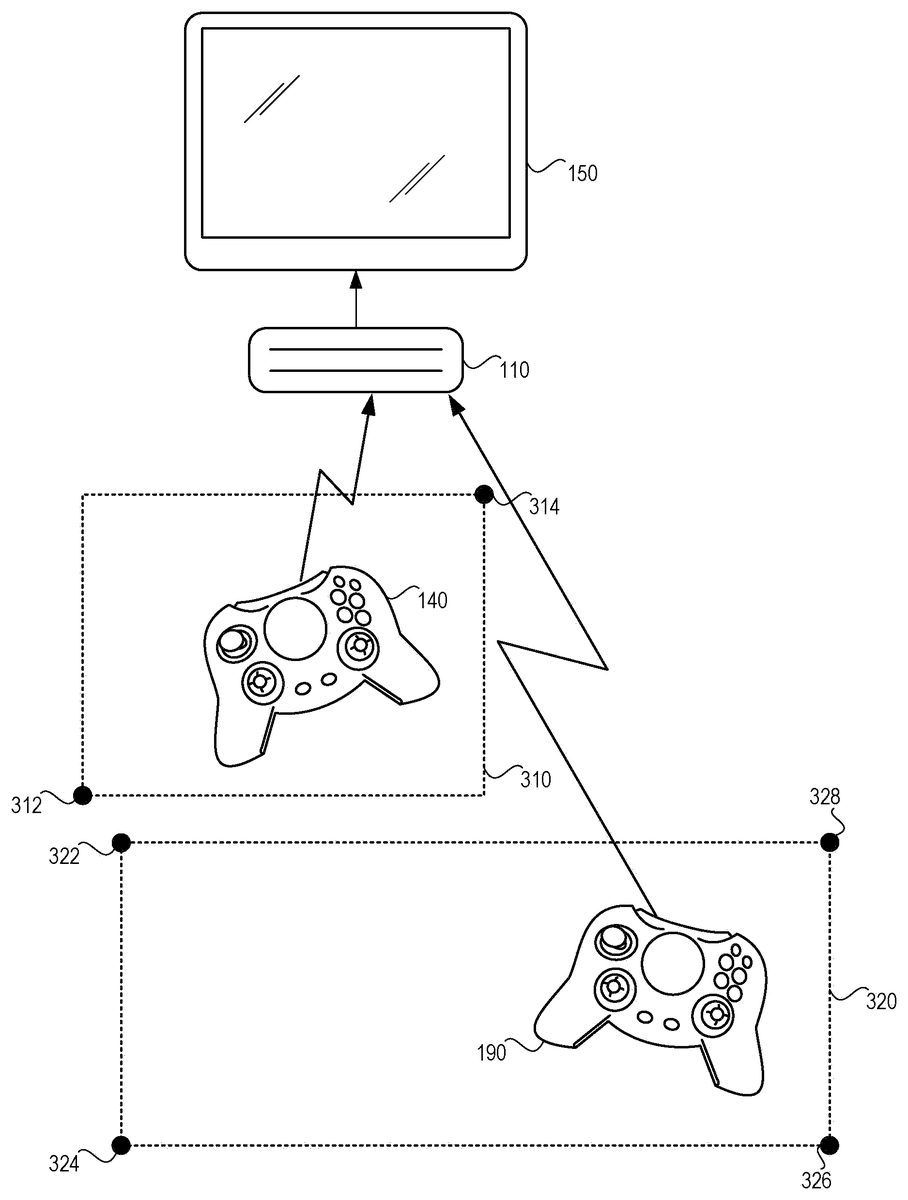
In some embodiments, the user may move the game controller between two or more different positions in two-dimensional or three-dimensional physical space to define the activity region. For example, referring toFIG. 3, a first activity region310is shown, which is defined by waypoint312and waypoint314. Further, a second activity region320is shown, which is defined by waypoints322,324,326, and328. As such, each waypoint of the plurality of waypoints indicated by the calibration input may define a different position of the game controller as it is moved to define the activity region.
In some embodiments, input/output subsystem132may forward the calibration input received at210to controller module128. The controller module may be configured to convert the calibration input into a format that is usable by the mapping module. For example, the controller module may be configured to convert the plurality of waypoints indicated by the calibration input into coordinates in one, two, or three dimensional space. The controller module may then forward the plurality of waypoints to the mapping module.
At220, the method may include identifying a scale factor between the activity region and an interactive game region in virtual space based on the calibration input received at210. In some embodiments, mapping module126may be configured to retrieve coordinates defining the interactive game region from game module124. The mapping module may then compare the coordinates defining the interactive game region to the plurality of waypoints indicated by the calibration input received from the controller module. Based on this comparison, the mapping module may identify a scale factor between the activity region and the interactive game region.
At230, the method may include receiving positioning information from the positioning device. The positioning information received at230may indicate a position of the positioning device within the activity region. In some embodiments, the positioning information received at230may be obtained in a similar manner as the calibration input that was received at210. For example, positioning device142may provide positioning information to controller module128via the input/output subsystem that is representative of the game controller position within the activity region of the physical space. Where the game controller is moved within the activity region, the positioning information received at the input/output subsystem may indicate a path of motion of the game controller within the activity region and/or be interpreted to deduce a path of motion of the game controller within the activity region.
At240, the method may include mapping the position of the positioning device within the activity region to a corresponding virtual position within the interactive game region based on the scale factor identified at220. In some embodiments, the mapping module may map the position of the positioning device to the corresponding virtual position by scaling the position of the positioning device within the activity region to the corresponding virtual position within the interactive game region based on the scale factor.
In some embodiments, the mapping module may submit coordinates indicating the corresponding virtual position to the game module. In response to receiving an indication of the corresponding virtual position, the game module may perform various actions in accordance with a particular interactive game of the game module.
For example, at250, the method may include outputting a graphical output to a display device. The graphical output may be configured to cause the display device to present a graphical user interface depicting one or more of the interactive game region and an indicator indicating the corresponding virtual position within the interactive game region. For example, the game module may represent the corresponding virtual position received from the mapping module as the indicator that is to be presented via graphical user interface152of display device150.
In some embodiments, the graphical output may be further configured to cause the display device to present the graphical user interface depicting an interactive game object within the interactive game region. For example, the game module may present one or more interactive game objects via the graphical user interface in addition to the indicator.
Furthermore, in some embodiments, the interactive game object may include a second indicator indicating a second corresponding virtual position within the interactive game region of a second positioning device associated with second game controller190.
In some embodiments, the interactive game object may be presented via the graphical user interface as a hidden interactive game object. For example, the hidden interactive game object may include a concealed secret passage or other suitable hidden object within the interactive game region that a user may be tasked with locating. As a non-limiting example, the electronic game system may provide a treasure hunt style interactive game.
At260, the method may include outputting an interactive game response if the corresponding virtual position within the interactive game region satisfies a pre-determined proximal relationship to the interactive game object located within the interactive game region. For example, the game module may compare the corresponding virtual position to a position of the interactive game object located within the interactive game region to determine whether the pre-determined proximal relationship is satisfied. If the per-determined proximal relationship is satisfied, then the game module may output the interactive game response via the input/output subsystem.
As a non-limiting example, the pre-determined proximal relationship may include a proximity threshold of the corresponding virtual position to the interactive game object. For example, as the game controller is moved closer to the interactive game object to satisfy the proximity threshold, the interactive game response may be initiated at one or more of the game controller, the display device, and the audio output device to provide notification that the user is near the interactive game object.
In some embodiments, outputting the interactive game response at260includes outputting haptic feedback via the game controller. For example, feedback device144may comprise a haptic feedback device that may be actuated by the game module via the input/output subsystem to cause vibration or other suitable haptic feedback of the game controller that may be perceived by the user. As a non-limiting example, the game controller may be caused to vibrate when the game controller is within a prescribed distance from a hidden interactive game object, thereby alerting the user of the game controller to the presence and proximity of the hidden interactive game object.
In some embodiments, outputting the interactive game response at260includes outputting visual feedback via a graphical display of the game controller. For example, feedback device144may comprise a light emitting element or other suitable graphical display that may be illuminated by the game module via the input/output subsystem to cause visual feedback to be outputted by the game controller that may be perceived by the user. For example, an LED or other suitable light emitting element of the game controller may be caused to light up and/or blink to notify the user when the game controller is near the interactive game object.
In some embodiments, outputting the interactive game response at260includes outputting visual feedback via a remote display device. For example, the game module may cause remote display device150to present visual feedback via graphical user interface152that may be perceived by the user.
In some embodiments, outputting the interactive game response at260includes outputting aural feedback via an audio output device of the game controller. For example, feedback device144of the game controller may comprise the audio output device, including one or more of an audio speaker and/or an audio amplifier. The game module may cause the audio output device of the game controller to output aural feedback that may be perceived by the user.
In some embodiments, outputting the interactive game response at260includes outputting aural feedback via a remote audio output device. For example, the game module may cause remote audio output device154to output aural feedback that may be perceived by the user.
In some embodiments, outputting the interactive game response at260further includes increasing an intensity of the interactive game response as the corresponding virtual position within the interactive game region approaches the interactive game object located within the interactive game region. Further still, the intensity of the interactive game response may be reduced as the corresponding virtual position moves away from the interactive game object.
As a non-limiting example, once the pre-determined proximal relationship between the corresponding virtual position and the interactive game object has been satisfied and the interactive game response has been outputted, the game module may cause the intensity of the interactive game response to increase as the proximity of the corresponding virtual position to the interactive game object decreases.
In some embodiments, the intensity of the interactive game response may be increased by increasing one or more of a volume of the aural output, a frequency and/or magnitude of the haptic feedback (e.g., vibrational frequency and/or vibrational magnitude), and a frequency and/or magnitude of the visual feedback provided via the graphical display of the game controller or the graphical user interface of the remote display device.
It should be appreciated that other characteristics of the interactive game response may be adjusted responsive to the proximity of the corresponding virtual position to the interactive game object. For example, different types of feedback may be initiated or discontinued at different pre-determined proximities as the corresponding virtual position approaches or moves away from the interactive game object.
The method ofFIG. 2may be performed by the electronic game system to provide one or more of the following user experiences.
In one example, a user tags a “hot spot” (i.e., the interactive game object), where the game module is configured to manipulate the hot spot (e.g., move the hot spot). In turn, the user may be tasked with interacting with the hot spot as it is manipulated by the game module. For example, the hot spot may be moved 5 feet to the left and 5 feet forward, whereby the user is prompted to move the game controller 5 feet to the left and 5 feet forward in the activity region.
As another example, a user is prompted by the game module to tag musical notes at different hot spots in the interactive game region, whereby the user is directed to move the game controller within the activity region to produce a song. Two or more users may compete to produce the most accurate representation of the song through movement of their respective game controller.
One or more users may be prompted to play a game of “hide and seek” where the interactive game response is outputted by the electronic game system to notify the users when they are near an interactive game object.
A user may be prompted to define a portion of a physical object in physical space to be represented as the interactive game object in the virtual space. For example, a user may mark the edges of a rug to equate to a wrestling ring in a sumo wrestling game, where moving the game controller outside of the wrestling ring equates to a disqualification of the user.
As another example, a user may define zones in their activity region to be a location of a target or other suitable object that is mapped into virtual space. A second user acting as an opponent may define a region using a second game controller to be a location of a salvo, whereby the game module compares the locations of the second game controller in virtual space to calculate if a hit of the target has been achieved.
As yet another example, a user may tag a physical object in physical space and declare it to equate to an interactive game object in the virtual world. For example, a coffee table in physical space may be tagged by the user as the interactive game object through manipulation of the game controller. A subsequent position of the game controller relative to this interactive game object in the physical space may be translated to an avatar location in the virtual space relative to the interactive game object.
Where the game controller (e.g., game controller140) is a first game controller of a plurality of game controllers, the method ofFIG. 2may be performed by the electronic game system for each game controller. For example, the calibration input received at210may be a first calibration input of a plurality of calibration inputs. As such, the method at210may include receiving a first calibration input from the first positioning device, where the first calibration input indicates a plurality of waypoints defining a first activity region in physical space. At210, the method may further include receiving a second calibration input from the second positioning device, where the second calibration input indicates a plurality of waypoints defining a second activity region in physical space.
FIG. 3shows an example of first activity region310defined by a plurality of waypoints indicated by the first calibration input received from game controller140.FIG. 3further shows an example of the second activity region320defined by a plurality of waypoints indicated by the second calibration input received from second game controller190.
It should be appreciated thatFIG. 3depicts an example embodiment where second game controller190communicates with computing device110as indicated at182ofFIG. 1. By contrast,FIG. 4depicts an example embodiment where second game controller190instead communicates with remote computing device180as indicated at184ofFIG. 1. As such,FIG. 4shows a first activity region410defined by waypoints412and414that are indicated by a first calibration input received at computing device110from game controller140.FIG. 4further shows a second activity region420defined by waypoints422,424,426, and428that are indicated by a second calibration input received at remote computing device180from second game controller190.
FIG. 4further shows computing device110and remote computing device180communicating with each other either directly (e.g., peer-to-peer via a local area network or wide area network) or via hosting server170.FIG. 4also depicts a remote display device450that may communicate with remote computing device180. In this way, two or more users may reside at different physical locations, but interact with one another in the same virtual space.
At220, the method may include identifying a first scale factor between the first activity region and an interactive game region in virtual space based on the first calibration input. At220, the method may further include identifying a second scale factor between the second activity region and an interactive game region in virtual space based on the calibration input.
At230, the method may include receiving positioning information from the first positioning device, where the positioning information received from the first positioning device indicates a position of the positioning device within the first activity region. The method at230may further include receiving positioning information from the second positioning device, where the positioning information received from the second positioning device indicates a position of the second positioning device within the second activity region.
At240, the method may include mapping the position of the first positioning device within the first activity region to a first corresponding virtual position within the interactive game region based on the first scale factor. The method at240may further include mapping the position of the second positioning device within the second activity region to a second corresponding virtual position within the interactive game region based on the second scale factor. In this way, a corresponding virtual position of game controller140within the interactive game region and a second corresponding virtual position of second game controller190within the interactive game region may be identified by the computing device.
In some embodiments, the second corresponding virtual position may define the location of the interactive game object within the interactive game region as previously described at250. For example, a user of the second game controller may manipulate the location of the interactive game object by moving the second game controller within the second activity region. The interactive game response may be outputted in accordance with the previously described predetermined proximal relationship, for example, if the first corresponding virtual position satisfies the predetermined proximal relationship to the second corresponding virtual position defining the location of the interactive game object.
In this way, the game module of the electronic game system may enable game play based on a calculation of a distance between and/or direction from a first game controller to a second game controller. For example, the game module may prompt two or more users to play an interactive game where users may pass a virtual baton in a relay race, play pin the tail on the donkey, or define an apparatus such as a limbo stick in a game of limbo where each end of the limbo stick is represented by a different game controller.
In some embodiments, the second corresponding virtual position may define one of a plurality of virtual positions that are received from the game controller, whereby the plurality of virtual positions define the interactive game object in virtual space. In this way, the game controller may be manipulated by the user within the activity region to define interactive game objects having one, two, or three dimensions in the interactive game region.
At250, the method may include outputting a graphical output to the remote display device, where the graphical output is configured to cause the remote display device to present a graphical user interface depicting the interactive game region and one or more of a first indicator indicating the first corresponding virtual position within the interactive game region and a second indicator indicating the second corresponding virtual position within the interactive game region. In this way, users may be provided with visual feedback as to their respective virtual positions within the interactive game region.
It should be appreciated that the methods provided herein, may be performed by the electronic game system by execution by a logic subsystem of instructions held in memory, including one or more of logic subsystem130, logic subsystem172, and a logic subsystem of remote computing device180. It should be understood that the configurations and/or approaches described herein are exemplary in nature, and that these specific embodiments or examples are not to be considered in a limiting sense, because numerous variations are possible. The specific routines or methods described herein may represent one or more of any number of processing strategies. As such, various acts illustrated may be performed in the sequence illustrated, in other sequences, in parallel, or in some cases omitted. Likewise, the order of the above-described processes may be changed.
The subject matter of the present disclosure includes all novel and nonobvious combinations and subcombinations of the various processes, systems and configurations, and other features, functions, acts, and/or properties disclosed herein, as well as any and all equivalents thereof.
Claims
- A method of linking an activity region in a physical space to an interactive game region in a virtual space, the method comprising: receiving at a computing device a first calibration input from a first positioning device of a first game controller, the first calibration input indicating a location of the first game controller in the physical space at each of a first plurality of different times;recognizing for each of the first plurality of different times, an associated waypoint of a first plurality of waypoints;defining a first activity region for the first game controller in the physical space, the first activity region bound by the first plurality of waypoints;receiving at the computing device a second calibration input from a second game controller, the second calibration input indicating a location of the second game controller in the physical space at each of a plurality of different times;recognizing for each of the second plurality of different times, an associated waypoint of a second plurality of waypoints;defining a second activity region for the second game controller in the physical space, the second activity region bound by the second plurality of waypoints;receiving by the computing device positioning information from the first positioning device, the positioning information indicating a position of the first positioning device within the first activity region between two or more of the recognized waypoints of the first plurality of waypoints;and mapping by the computing device the position of the first positioning device within the first activity region to a corresponding virtual position within an interactive game region in virtual space.
- The method of claim 1 , further comprising outputting a graphical output to a display device, the graphical output configured to cause the display device to present a graphical user interface depicting the interactive game region and an indicator indicating the corresponding virtual position within the interactive game region.
- The method of claim 2 , where the graphical output is further configured to cause the display device to present the graphical user interface depicting an interactive game object within the interactive game region as a hidden interactive game object.
- The method of claim 1 , further comprising outputting an interactive game response if the corresponding virtual position within the interactive game region satisfies a pre-determined proximal relationship to an interactive game object located within the interactive game region.
- The method of claim 4 , where outputting the interactive game response further includes increasing an intensity of the interactive game response as the corresponding virtual position within the interactive game region approaches the interactive game object located within the interactive game region.
- The method of claim 4 , where outputting the interactive game response includes outputting haptic feedback via the game controller.
- The method of claim 4 , where outputting the interactive game response includes outputting visual feedback via a graphical display of the game controller.
- The method of claim 4 , where outputting the interactive game response includes outputting aural feedback via an audio output device of the game controller.
- The method of claim 4 , where outputting the interactive game response includes outputting aural feedback via an audio output device.
- The method of claim 1 , where the interactive game region is provided by a game module of the electronic game system.
- The method of claim 1 , further comprising identifying by the computing device a scale factor between the first activity region and the interactive game region in virtual space based on the first calibration input, the first activity region being a different size than the interactive game region and a different size than the second activity region, and wherein mapping the position of the first positioning device comprises mapping the first positioning device within the first activity region to the corresponding virtual position within the interactive game region based on the scale factor.
- The method of claim 11 , identifying a second scale factor between the second activity region and the interactive game region based on the second calibration input;receiving positioning information from the second positioning device, the positioning information received from the second positioning device indicating a position of the second positioning device within the second activity region;and mapping the position of the second positioning device within the second activity region to a second corresponding virtual position within the interactive game region based on the second scale factor.
- The method of claim 12 , further comprising outputting an interactive game response if the corresponding virtual position within the interactive game region satisfies a pre-determined proximal relationship to an interactive game object located within the interactive game region;where the second corresponding virtual position defines a location of the interactive game object within the interactive game region.
- An electronic game system configured to facilitate an interactive game, comprising: a logic subsystem;memory holding instructions that, when executed by a logic subsystem, cause the logic subsystem to: receive a first calibration input from a first positioning device of a first game controller, the first calibration input indicating a location of the first game controller in the physical space at each of a first plurality of different times;recognizing for each of the first plurality of different times, an associated waypoint of a first plurality of waypoints;defining a first activity region in the physical space, the first activity region bounded by the first plurality of waypoints;receiving a second calibration input from a second game controller, the second calibration input indicating a location of the second game controller in the physical space at each of a plurality of different times;recognizing for each of the second plurality of different times, an associated waypoint of a second plurality of waypoints;defining a second activity region for the second game controller in the physical space, the second activity region being different than the first activity region and bound by the second plurality of waypoints;receive positioning information from the first positioning device, the positioning information indicating a position of the first positioning device within the first activity region between two or more of the recognized waypoints of the first plurality of waypoints;and map the position of the first positioning device within the first activity region to a corresponding virtual position within an interactive game region in virtual space.
- The electronic game system of claim 14 , the memory further holding instructions that, when executed by a logic subsystem, cause the logic subsystem to: output a graphical output to a display device, the graphical output configured to cause the display device to present a graphical user interface depicting the interactive game region and an indicator indicating the corresponding virtual position within the interactive game region.
- The electronic game system of claim 14 , the memory further holding instructions that, when executed by a logic subsystem, cause the logic subsystem to: output an interactive game response if the corresponding virtual position within the interactive game region satisfies a pre-determined proximal relationship to an interactive game object located within the interactive game region.
- The electronic game system of claim 16 , the memory further holding instructions that, when executed by a logic subsystem, cause the logic subsystem to: increase an intensity of the interactive game response as the corresponding virtual position within the interactive game region approaches the interactive game object located within the interactive game region.
- The electronic game system of claim 17 , the memory further holding instructions that, when executed by a logic subsystem, cause the logic subsystem to: output the interactive game response as haptic feedback via the game controller.
- The electronic game system of claim 14 , wherein the memory further holds instructions that, when executed by the logic subsystem, cause the logic subsystem to: identify a scale factor between the first activity region and the interactive game region in virtual space based on the first calibration input, the interactive game region being provided by a game module of the electronic game system, and wherein mapping the position of the first positioning device comprises mapping the position of the first positioning device within the first activity region to the corresponding virtual position within the interactive game region based on the scale factor.
- The electronic game system of claim 19 , the memory further holding instructions that, when executed by a logic subsystem, cause the logic subsystem to: identify a second scale factor between the second activity region and the interactive game region based on the second calibration input;receive positioning information from the second positioning device, the positioning information received from the second positioning device indicating a position of the second positioning device within the second activity region;and map the position of the second positioning device within the second activity region to a second corresponding virtual position within the interactive game region based on the second scale factor.
- The electronic game system of claim 20 , further comprising outputting an interactive game response if the corresponding virtual position within the interactive game region satisfies a pre-determined proximal relationship to an interactive game object located within the interactive game region;where the second corresponding virtual position defines a location of the interactive game object within the interactive game region.
- An electronic game system, comprising: a logic subsystem;a first game controller including a first positioning device;a second game controller including a second positioning device;memory holding instructions that, when executed by a logic subsystem, cause the logic subsystem to: receive a first calibration input from the first positioning device, the first calibration input indicating a location of the first game controller in the physical space at each of a first plurality of different times;recognizing for each of the first plurality of different times, an associated waypoint of a first plurality of waypoints;defining a first activity region in the physical space, the first activity region bound by the first plurality of waypoints;receive positioning information from the first positioning device, the positioning information received from the first positioning device indicating a position of the first positioning device within the first activity region between two or more fo the recognized waypoints of the first plurality of waypoints;and map the position of the first positioning device within the activity region to a first corresponding virtual position within an interactive game region in virtual space;receive a second calibration input from the second positioning device, the second calibration input indicating a location of the second game controller in the physical space at each of a plurality of different times;recognizing for each of the second plurality of different times, an associated waypoint of a second plurality of waypoints;defining a second activity region in the physical space, the second activity region bound by the second plurality of waypoints;receive positioning information from the second positioning device, the positioning information received from the second positioning device indicating a position of the second positioning device within the second activity region between two or more of the recognized waypoints of the second plurality of waypoints;map the position of the second positioning device within the second activity region to a second corresponding virtual position within the interactive game region;and output a graphical output to a display device, the graphical output configured to cause the display device to present a graphical user interface depicting the interactive game region and one or more of a first indicator indicating the first corresponding virtual position within the interactive game region and a second indicator indicating the second corresponding virtual position within the interactive game region.
- The electronic game system of claim 22 , wherein the memory further holds instructions that, when executed by the logic subsystem, cause the logic subsystem to: identify a first scale factor between the first activity region and an interactive game region in virtual space based on the first calibration input, and identify a second scale factor between the second activity region and the interactive game region in virtual space based on the second calibration input, wherein mapping the position of the first positioning device comprises mapping the position of the first positioning device within the first activity region to the first corresponding virtual position within the interactive game region based on the first scale factor, and wherein mapping the position of the second positioning device comprises mapping the position of the second positioning device within the second activity region to the second corresponding virtual position within the interactive game region based on the second scale factor.
Disclaimer: Data collected from the USPTO and may be malformed, incomplete, and/or otherwise inaccurate.