U.S. Pat. No. 9,387,406
APPARATUS, METHOD AND COMPUTER READABLE STORAGE MEDIUM FOR GUIDING GAME PLAY VIA A SHOW ME BUTTON
AssigneeZynga Inc.
Issue DateJuly 31, 2015
Illustrative Figure
Abstract
An apparatus, method and computer-readable storage medium for guiding a player to the completion of a task during game play. The player selects a control device in a graphical user interface device generated by a processor. In response to the selection, a hint is provided to the user in the graphical user interface that presents a game board to a player. The player may use the hint to accomplish the task.
Description
DETAILED DESCRIPTION Embodiments may be discussed herein that provide guidance to a player during game play that facilitates the player's accomplishment of a task. In an embodiment, an apparatus may be provided for guiding a player in the accomplishment of a task in an electronic game. The apparatus may include a graphical user interface to receive and respond to player inputs and present data to the player; a display device to present a graphical user interface; and a processor that executes computer instructions for responding player inputs and manipulating the presentation of data in the graphical user interface and causing the presentation of the data on the display device. The processor may be configured to present a game board in the graphical user interface on the display device. The game board may include an avatar, regions and objects within the regions. The avatar may move within the regions and interacts with the objects. The processor may also generate a task to be accomplished by a player via inputs to the graphical user interface. The inputs may control the actions of an avatar. The task may be presented in a task list in the graphical user interface. In response to an input selecting the task, a task menu containing a sub-task icon that illustrates a sub-task to be accomplished by the avatar may be presented in the graphical user interface. A show-me control button may be presented adjacent to the sub-task icon. The show-me control button when selected may provide a hint to the player on how to accomplish the sub-task by changing the presentation of the graphical user interface. Another embodiment provides a method for guiding a player in the accomplishment of a task in an electronic game. A game board may be presented in the graphical user interface on ...
DETAILED DESCRIPTION
Embodiments may be discussed herein that provide guidance to a player during game play that facilitates the player's accomplishment of a task. In an embodiment, an apparatus may be provided for guiding a player in the accomplishment of a task in an electronic game. The apparatus may include a graphical user interface to receive and respond to player inputs and present data to the player; a display device to present a graphical user interface; and a processor that executes computer instructions for responding player inputs and manipulating the presentation of data in the graphical user interface and causing the presentation of the data on the display device. The processor may be configured to present a game board in the graphical user interface on the display device. The game board may include an avatar, regions and objects within the regions. The avatar may move within the regions and interacts with the objects. The processor may also generate a task to be accomplished by a player via inputs to the graphical user interface. The inputs may control the actions of an avatar. The task may be presented in a task list in the graphical user interface. In response to an input selecting the task, a task menu containing a sub-task icon that illustrates a sub-task to be accomplished by the avatar may be presented in the graphical user interface. A show-me control button may be presented adjacent to the sub-task icon. The show-me control button when selected may provide a hint to the player on how to accomplish the sub-task by changing the presentation of the graphical user interface.
Another embodiment provides a method for guiding a player in the accomplishment of a task in an electronic game. A game board may be presented in the graphical user interface on a display device. The game board may include an avatar, regions and objects within the regions, wherein the avatar moves within the regions and interacts with the objects. A task to be accomplished by a player via inputs to the graphical user interface may be generated. The inputs to the graphical user interface may control the actions of the avatar. The task may be presented in a task list in the graphical user interface. In response to an input selecting the task, a task menu containing a sub-task icon that illustrates a sub-task to be accomplished by the avatar. A show-me control button may be presented adjacent to the sub-task icon. When selected, the show-me control button may provide a hint to the player on how to accomplish the sub-task by changing the presentation of the graphical user interface.
Another embodiment provides a computer readable medium containing computer readable program instructions that when executed by a processor performs the previously described method for guiding a player in the accomplishment of a task in an electronic game.
FIG. 1illustrates an exemplary view of a graphical user interface according to an embodiment of the present invention. The graphical user interface (GUI)100may be presented on a display device, e.g., computer monitor, tablet computer, television. The graphical user interface100may present a game board105that is an environment with which an avatar120interacts. For example,FIG. 1shows an archeologically-themed game board environment. Other themes, such as the “wild west”, underwater, extraterrestrial, frontier, fantasy-oriented themed game board environments may also be used. In addition, the GUI100may include tags103for navigating around the game board environment. The avatar120may be a character representation of a player, and may respond to inputs to the GUI100. The game board105may include indicators, such as a task list110, tool kits115, game progress indicators113. No matter the theme of the game board, the game boards, including game board105, may have in addition to an avatar120, paths130for traveling around the game board105, and objects140and150. The objects140and150may be obstacles, such as bushes, or traps, such as a banana peel that may cause the avatar120to slip. The obstacle objects140may be removed by player commanding the avatar120to perform some action, and the trap objects150may either be avoided or rendered ineffective by player commanding the avatar120. For example, the player may select a tool from the tool kit115, and the avatar120, in response to player inputs to the GUI100, may clear the bushes (obstacle object140) that block the path130. Alternatively, the player can select another tool from the tool kit115and pick up the banana peel (trap obstacle150). The task list110may present a number of tasks that are to be performed by the player via the avatar120during game play. Some of the tasks in the task list115, e.g., get to the lost temple, may be easily accomplished by the player, while others may be more challenging.
To assist a player in performing a task from the task list115, the GUI100may provide textual instructions, but may also provide a visual clue. To obtain the instructions, a player may select a particular task in the task list115. The selection of the task from the task list115may cause a processor executing the game instructions to generate another task GUI that may be task overview window displayed over the game board105. The task overview window will be described in more detail with respect toFIG. 2.
FIG. 2illustrates another graphical user interface that presents a graphical user interface presenting a task overview. The task250is an exemplary task and is not intended to limit the scope of the disclosed embodiment. The task overview GUI210may be presented over the game board205, and may be a GUI within the game GUI200. The task overview GUI210may include an overview of the task250as a textual description, or a graphical description, or both. The task overview may explain to the player the goal of the task250. The task overview GUI260may also include a hint260to the player on how to accomplish the task250. The task250may have sub-tasks, such as sub-tasks251,252, and252. Sub-task251may require the use of a tool that the player's avatar120may obtain, for example, from the tool kit115ofFIG. 1. While the sub-task252may require a player's avatar120(ofFIG. 1) to interact with certain objects from the game board205. In the example, the player's avatar is tasked with collecting 6 gold nuggets. The sub-task252could also have been to clear the bushes from the path, find the ruins, put a banana peel in the trash, and the like. Sub-task253is yet another action “craft the Key at the Smithy” to be performed by the player's avatar.
The sub-tasks251-253may include an additional control devices220,230,240in the GUI210that may be selected by the player. The addition control devices220,230,240, when selected may provide further hints related to completing the specific subtask. In sub-tasks251-253, the control devices220,230,240are illustrated as rectangular buttons with the words “Show me” on them. The control devices220,230,240may be any shape and may be located at any location within the task overview GUI210.
In addition, the control devices220,230,240are directed to providing hints for different aspects of the games. For example, the control device220, when selected, may provide hints about how to use a particular tool object, specifically, a metal detector tool. The control device230, when selected, may provide a hint of a region of a game board that an object, in this case, the gold nuggets, can be found. Meanwhile, the control device240, also when selected, may provide a hint about a particular object on the game board. For example, the control device240may show the “Smithy” object, so the key may be crafted. In addition, each of, or certain ones of, the control devices220-240may be locked, and may only be unlocked after the player or the player's avatar performs some action, for example, purchase access using fake game money, purchase access using real currency, earn access as a reward, or be given access as a gift by other players of the interactive game. The control device231indicates that control device230is “locked,” and can be unlocked with payment of 10 coins. Although shown as a rectangular block, control device231may be any shape and may be any location in the task overview GUI210so long as there is some indication to the player that the unlock control device231is associated with a specific sub-task, in this case, sub-task230.
Hints via the show-me button may be available to the player for showing hints related to a particular tool, a particular region of the game board related to the task, and a particular object in the game board related to the task. In response to the selection of any of the “show-me” buttons, the task overview GUI210will be taken down, and the player will be presented with a GUI containing a game board and a visual hint related to the specific sub-task. The system/processor response to the selection of the show me button will be described in more detail with reference toFIG. 3
FIG. 3illustrates an exemplary illustration of the show object hints according to an embodiment of the present invention. If a player selects the show me button230in the sub-task252, the task overview GUI210is taken down (i.e., no longer presented in the GUI200). The show me button230is associated with showing an object related to the sub-task252. Once the task overview GUI is completely taken down, the GUI300presents a game board305to the player. Recall inFIG. 1that the view presented to the player was the player's avatar's120location within the game board105. InFIG. 3, as a result of the selection of the object “show me” button230in the sub task251ofFIG. 2, the camera view of the game board305may have panned to and centered on the location in the game board where actions for the selected sub-task may be performed. The avatar320may or may not be placed in the location.FIG. 3shows the avatar320in the object's location on the game board. The location of the object is centered. The GUI300presents the task list310as well as the object330, in this example, “Smithy,” and an indicator331. The object330may be highlighted in a color that contrasts with the colors of the game board305. The indicator331, in this case, an arrow, may also be shown in the same highlighted color as the object330. The indicator331may also have some animation associated with it, such as flashing or oscillations, to insure that the player sees the object. The indicators331and highlighting of the object may remain until the user takes action on that object330or another show me is done.
FIG. 4illustrates an exemplary illustration of the show region hints according to an embodiment of the present invention. The selection of show me button240in the sub-task253may cause the task overview GUI210to be taken down (i.e., no longer presented in the GUI200). The show me button240is associated with showing a region related to the sub-task253. Once the task overview GUI210is taken down, GUI400is presented to the player. The GUI400may include the task list410and the game board405. The game board405is shown in the GUI400with regions420related to completing the sub-task253highlighted. In response to selection of the show me button240, the camera view of the game board405may pan/zoom from the previously shown game board location to the new location shown in the game board405. Alternatively, if the region420happens to be related to a previously selected show me button, the camera view may not change. The regions related to the sub-task253in the example may be rocks420in the game board405. The avatar (not shown) may take action with respect to the regions420. An indicator440may be presented to insure that a player sees the highlighted regions420. The indicator440may also have some animation associated with it, such as flashing or oscillations, to insure that the player sees the object. The indicator440and highlighting of the regions420may remain until the user takes action on that object or another show me is done.
FIG. 5illustrates an exemplary illustration of the show tool hints according to an embodiment of the present invention. The selection of show me button220in the sub-task251may cause the task overview GUI210to be taken down. The show me button220is associated with showing a tool related to the sub-task251. Once the task overview GUI210is taken down, GUI500is presented to the player. The GUI500may include the task list510and the game board505. The game board505may be shown in the GUI500with a tool550related to completing the sub-task251highlighted. In response to selection of the show me button220, the camera view of the game board505may pan/zoom from the previously shown game board location to the new location shown in the game board505. Alternatively, if the tool550happens to be related to a previously selected show me button, the camera view may not change, or change only slightly. The tool550related to the sub-task251in the present example may be the metal detector shown in tool kit515at the bottom of the game board505. The avatar520may use the tool550. An indicator551may be presented to insure that a player sees the highlighted tool550. The indicator551may also have some animation associated with it, such as flashing or oscillations, to insure that the player sees the object. In addition to the highlighted tool550, the game board505may show highlighted objects555that may be worked on by an avatar520using the tool550. In the present example, the highlighted objects555are shown beneath the ground and not readily visible on the game board505. Therefore, it would be easier to find the objects555using the metal detector tool550. The indicator551, highlighting tool550and highlighted objects555may remain until the user takes action on that object or another show me is done.
FIG. 6illustrates an exemplary illustration of after the show tool hint is used according to an embodiment of the present invention. The GUI600may include the game board605and a tool locker610that is associated with a tool from the tool kit615. In this example, the metal detector is the tool. The tool locker610may be used to store objects such as the objects555that were previously at the game board region655. An indicator661may be presented to insure that a player sees the highlighted location660in the tool locker610. The indicator551may also have some animation associated with it, such as flashing or oscillations, to insure that the player sees the object. The indicator660may The avatar620may also be present.
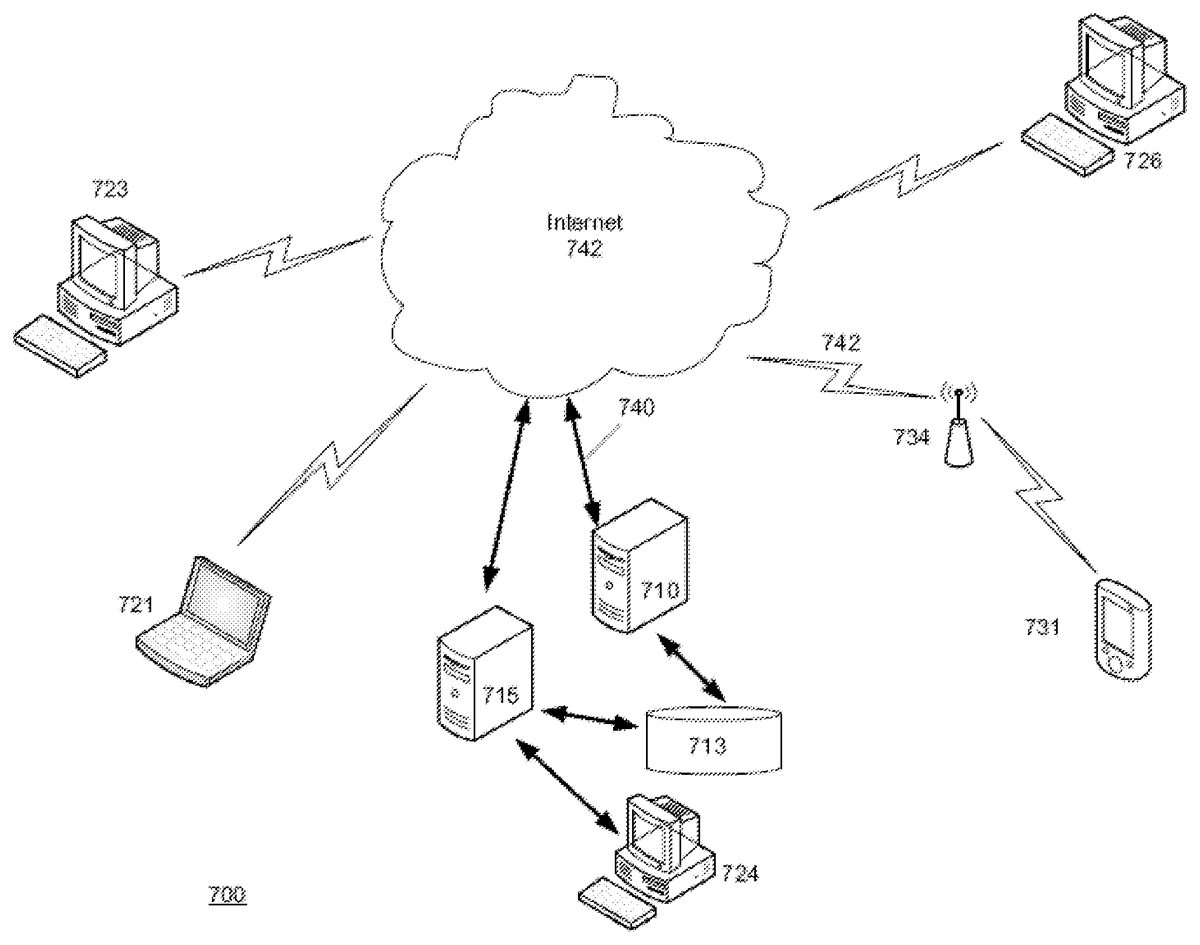
FIG. 7illustrates an exemplary hardware configuration for implementing a system according to an embodiment of the present invention. The system700may comprise one or more networked servers710and715, one or more player computers721,723,724and726, data storage devices713, wired and wireless communication links740,742, wireless access point734, and a portable device(s)731. The one or more networked servers710and715may execute a multi-application software system that may include a web server, gaming software applications and social networking applications. The servers710,715may include processor(s), internal memory and related computer program instructions (all not shown). The player computers721,723,724,726may include a processor, display device, and data storage device, such as a hard disk (all not shown).
The server710and/or715may provide connectivity between the players' computers721,723,724and726, and/or players' portable device(s)731over wired or wireless communication paths. The server710may access data storage device(s)713that store machine-readable software instructions for executing the described method may be accessed and executed by the processor(s) of the server710. The instructions for generating and presenting may be downloaded to players' computers721,723,724and726, and/or players' portable device(s)731over wired or wireless communication paths. The game software may execute on the processors in the players' computers721,723,724and726, and/or players' portable device(s)731.
The data storage device(s)713also may store data related to the players for future use. The data storage device713that may be a hard disk drive, non-volatile memory, flash memory, or any suitable device for storing electronic data, and may be organized as a object-oriented or relational database.
The servers710and715may communicate with client terminal(s)721,723,724,726and portable device(s)731via the internet742. The player computers721,723,724,726may include a processor, display device, and data storage device, such as a hard disk (all not shown). The client terminals721,723,724,726may participate in execution of program instructions. The portable device731may be a smartphone, personal digital assistant, tablet, notebook or mini-notebook computer capable of wired and/or wireless communication. The portable device731may include memory, a processor, input device, display, and devices that enable wired or wireless communication.
Several embodiments of the present invention are specifically illustrated and described herein. Those skilled in the art may appreciate from the foregoing description that the present invention may be implemented in a variety of forms, and that the various embodiments may be implemented alone or in combination. In other instances, well-known operations, components and circuits have not been described in detail so as not to obscure the embodiments. It can be appreciated that the specific structural and functional details disclosed herein may be representative and do not necessarily limit the scope of the embodiments. Therefore, while the embodiments of the present invention have been described in connection with particular examples thereof, the true scope of the embodiments and/or methods of the present invention should not be so limited since other modifications will become apparent to the skilled practitioner upon a study of the drawings, specification, and following claims.
Various embodiments may be implemented using hardware elements, software elements, or a combination of both. Examples of hardware elements may include processors, microprocessors, circuits, circuit elements (e.g., transistors, resistors, capacitors, inductors, and so forth), integrated circuits, application specific integrated circuits (ASIC), programmable logic devices (PLD), digital signal processors (DSP), field programmable gate array (FPGA), logic gates, registers, semiconductor device, chips, microchips, chip sets, and so forth. Examples of software may include software components, programs, applications, computer programs, application programs, system programs, machine programs, operating system software, middleware, firmware, software modules, routines, subroutines, functions, methods, procedures, software interfaces, application program interfaces (API), instruction sets, computing code, computer code, code segments, computer code segments, words, values, symbols, or any combination thereof. Determining whether an embodiment is implemented using hardware elements and/or software elements may vary in accordance with any number of factors, such as desired computational rate, power levels, heat tolerances, processing cycle budget, input data rates, output data rates, memory resources, data bus speeds and other design or performance constraints.
Some embodiments may be implemented, for example, using a computer-readable medium or article which may store an instruction or a set of instructions that, if executed by a machine, may cause the machine to perform a method and/or operations in accordance with the embodiments. Such a machine may include, for example, any suitable processing platform, computing platform, computing device, processing device, computing system, processing system, computer, processor, or the like, and may be implemented using any suitable combination of hardware and/or software. The computer-readable medium or article may include, for example, any suitable type of memory unit, memory device, memory article, memory medium, storage device, storage article, storage medium and/or storage unit, for example, memory, removable or non-removable media, erasable or non-erasable media, writeable or re-writeable media, digital or analog media, hard disk, floppy disk, Compact Disc Read Only Memory (CD-ROM), Compact Disc Recordable (CD-R), Compact Disc Rewriteable (CD-RW), optical disk, magnetic media, magneto-optical media, removable memory cards or disks, various types of Digital Versatile Disc (DVD), a tape, a cassette, or the like. The instructions may include any suitable type of code, such as source code, compiled code, interpreted code, executable code, static code, dynamic code, encrypted code, and the like, implemented using any suitable high-level, low-level, object-oriented, visual, compiled and/or interpreted programming language.
Claims
- A system for guiding a player in an electronic game comprising: a server for hosting an electronic game, the server configured for: outputting a game board for display on a user display device, the game board including an avatar, a plurality of regions and a plurality of objects disposed within the plurality of regions, wherein the avatar is movable within the plurality of regions and is capable of interacting with at least one of the plurality of objects;receiving an input from the user display device, the received input corresponding to an action of the avatar in the game board;responding to received inputs including manipulating a presentation of data in the game board displayed in the user display device;presenting a task in a task list in the game board displayed in the user display device;receiving a selection of the task in the server;presenting a task menu in the game board displayed in the user display device, the task menu including a sub-task icon that corresponds to a sub-task to be accomplished by the avatar;presenting a show-me control button adjacent to the sub-task icon in the game board displayed in the user display device;receiving a selection of the show-me control button in the server;and displaying a hint in at least one of the plurality of regions of the game board displayed in the user display device, the hint including an instruction how to accomplish the sub-task corresponding to the sub-task icon.
- The system of claim 1 , wherein the task menu is superimposed over at least one of the plurality of regions of the game board displayed in the user display device.
- The system of claim 1 , further comprising receiving an input in the server indicating the sub-task has been accomplished.
- The system of claim 3 , further comprising providing an indication in the game board displayed in the user display device, the indication indicating a selected one of the plurality of objects corresponding to the sub-task icon, the selected object being displayed within the game board displayed in the user display device.
- The system of claim 4 , wherein indicating the selected one of the plurality of objects corresponding to the sub-task icon includes displaying a zoomed in view of the corresponding one of the plurality of regions of the game board that includes the selected one of the plurality of objects displayed within the game board displayed in the user display device.
- The system of claim 4 , wherein indicating the selected one of the plurality of objects corresponding to the sub-task icon includes displaying a panned out view of the game board displayed in the user display device.
- The system of claim 3 , wherein the indication provided in the game board displayed on the user display device is an arrow-shaped indicator over the selected one of the plurality of objects.
- The system of claim 3 , wherein the indication provided in the game board displayed on the user display device is an oscillating indicator.
- The system of claim 3 , wherein the indication provided in the game board displayed on the user display device is a high contrast outlining one or more of the plurality of objects.
- A method for guiding a player in the accomplishment of a task in an electronic game comprising: outputting a game board from a server, the game board for display on a user display device, the game board including an avatar, a plurality of regions and a plurality of objects disposed within the plurality of regions, wherein the avatar is movable within the plurality of regions and is capable of interacting with at least one of the plurality of objects;receiving an input from the user display device, the received input corresponding to an action of the avatar in the game board;responding to received inputs including manipulating a presentation of data in the game board displayed in the user display device;presenting a task in a task list in the game board displayed in the user display device;receiving a selection of the task in the server;presenting a task menu in the game board displayed in the user display device, the task menu including a sub-task icon that corresponds to a sub-task to be accomplished by the avatar;presenting a show-me control button adjacent to the sub-task icon in the game board displayed in the user display device;receiving a selection of the show-me control button in the server;and displaying a hint in at least one of the plurality of regions of the game board displayed in the user display device, the hint including an instruction how to accomplish the sub-task corresponding to the sub-task icon.
- The method of claim 10 , wherein the task menu is superimposed over at least one of the plurality of regions of the game board displayed in the user display device.
- The method of claim 10 , further comprising receiving an input in the server indicating the sub-task has been accomplished.
- The method of claim 12 , further comprising providing an indication in the game board displayed in the user display device, the indication indicating a selected one of the plurality of objects corresponding to the sub-task icon, the selected object being displayed within the game board displayed in the user display device.
- The method of claim 13 , wherein indicating the selected one of the plurality of objects corresponding to the sub-task icon includes displaying a zoomed in view of the corresponding one of the plurality of regions of the game board that includes the selected one of the plurality of objects displayed within the game board displayed in the user display device.
- The method of claim 13 , wherein indicating the selected one of the plurality of objects corresponding to the sub-task icon includes displaying a panned out view of the game board displayed in the user display device.
- The method of claim 12 , wherein the indication provided in the game board displayed on the user display device is an arrow-shaped indicator over the selected one of the plurality of objects.
- The method of claim 12 , wherein the indication provided in the game board displayed on the user display device is an oscillating indicator.
- The method of claim 12 , wherein the indication provided in the game board displayed on the user display device is a high contrast outlining one or more of the plurality of objects.
- A non-transitory computer-readable storage medium embodied with program instructions for causing a processor to execute a method for guiding a player in the accomplishment of a task in an electronic game, the executed method comprising: outputting a game board from a server, the server including the processor, the game board for display on a user display device, the game board including an avatar, a plurality of regions and a plurality of objects disposed within the plurality of regions, wherein the avatar is movable within the plurality of regions and is capable of interacting with at least one of the plurality of objects;receiving an input from the user display device, the received input corresponding to an action of the avatar in the game board;responding to received inputs including manipulating a presentation of data in the game board displayed in the user display device;presenting a task in a task list in the game board displayed in the user display device;receiving a selection of the task in the server;presenting a task menu in the game board displayed in the user display device, the task menu including a sub-task icon that corresponds to a sub-task to be accomplished by the avatar;presenting a show-me control button adjacent to the sub-task icon in the game board displayed in the user display device;receiving a selection of the show-me control button in the server;and displaying a hint in at least one of the plurality of regions of the game board displayed in the user display device, the hint including an instruction how to accomplish the sub-task corresponding to the sub-task icon.
Disclaimer: Data collected from the USPTO and may be malformed, incomplete, and/or otherwise inaccurate.