U.S. Pat. No. 9,381,429
COMPOSITING MULTIPLE SCENE SHOTS INTO A VIDEO GAME CLIP
AssigneeVALVE CORPORATION
Issue DateFebruary 24, 2011
Illustrative Figure
Abstract
Embodiments are directed to compositing multi-dimensional video game world data obtained from execution of a video game world sequence. An animation editor records the video game world data within a plurality of data logs after execution of an animation component of the video game world and prior to providing the data to a material system and/or graphics device for rendering. The user may edit the recorded data to make modifications in the recorded game sequence, by compositing sequences with content such as other sequences, multiple composited recordings, and/or a modified camera perspective during the editing process. The composited modifications may then be fed back for re-recording the animation component.
Description
DETAILED DESCRIPTION The present disclosure will now be described more fully hereinafter with reference to the accompanying drawings, which form a part hereof, and which show, by way of illustration, specific exemplary embodiments by which the invention may be practiced. This invention may, however, be embodied in many different forms and should not be construed as limited to the embodiments set forth herein; rather, these embodiments are provided so that this disclosure will be thorough and complete, and will fully convey the scope of the invention to those skilled in the art. Among other things, the present invention may be embodied as methods or devices. Accordingly, the present invention may take the form of an entirely hardware embodiment, an entirely software embodiment or an embodiment combining software and hardware aspects. The following detailed description is, therefore, not to be taken in a limiting sense. As used herein, the term “motion capture” refers to a process of recording movement of a live actor, and translating that movement into a digital model. A used herein, the term “animation motion capture” refers to a process of recording movement and other components of a video game world for later use in re-computing a game state for playing and/or editing. Thus, animation motion capture is directed at overcoming at least some of the disadvantages of live motion capture involving a live actor, including, for example, being constrained by the laws of physics, an inability to modify a viewer's perspective of the video game world during a ‘playback,’ as well as other constraints that are discussed further below. As used herein, the term “character” refers to an object or a portion of an object that has multiple visual representations in an animation or animation frame. Examples of characters include a person, animal, hair of a character, ...
DETAILED DESCRIPTION
The present disclosure will now be described more fully hereinafter with reference to the accompanying drawings, which form a part hereof, and which show, by way of illustration, specific exemplary embodiments by which the invention may be practiced. This invention may, however, be embodied in many different forms and should not be construed as limited to the embodiments set forth herein; rather, these embodiments are provided so that this disclosure will be thorough and complete, and will fully convey the scope of the invention to those skilled in the art. Among other things, the present invention may be embodied as methods or devices. Accordingly, the present invention may take the form of an entirely hardware embodiment, an entirely software embodiment or an embodiment combining software and hardware aspects. The following detailed description is, therefore, not to be taken in a limiting sense.
As used herein, the term “motion capture” refers to a process of recording movement of a live actor, and translating that movement into a digital model. A used herein, the term “animation motion capture” refers to a process of recording movement and other components of a video game world for later use in re-computing a game state for playing and/or editing. Thus, animation motion capture is directed at overcoming at least some of the disadvantages of live motion capture involving a live actor, including, for example, being constrained by the laws of physics, an inability to modify a viewer's perspective of the video game world during a ‘playback,’ as well as other constraints that are discussed further below.
As used herein, the term “character” refers to an object or a portion of an object that has multiple visual representations in an animation or animation frame. Examples of characters include a person, animal, hair of a character, an object such as a weapon held by a person, clothes various anthropomorphized objects, or the like. A character has a visual representation on a computer display device. However, a character may have other representations, such as numeric, geometric, or a mathematical representation.
As used herein, the term “game,” or “video game” refers to an interactive sequence of images played back in time with audio to create a non-linear activity for the player. As used herein, the term “movie” refers to a fixed sequence of images played back in time with audio to create a linear narrative experience.
As used herein, the term “sequence” refers to a subset of a movie, that includes shots. Further, a sequence may be associated with a particular level.
As used herein, the term “level” refers to a virtual world as experience by a player of the game, usually including, for example, puzzles or objectives. A level may be composed of 3D representations of a sky, ground, ocean, buildings, plants, characters, sounds, or the like.
As used herein, the term “shot” refers to a subset of a sequence. Each shot includes a minimum of a time duration and a camera to view a game world. A shot further includes all the components in a scene, including, for example, characters, motions, and the like, as described further below. As used herein, the term “clip” refers to a shot.
As used herein, the term “time selection” refers to a duration of time. In one embodiment, the user may select a range of time within a shot over which to apply a modification of recorded animation. In one embodiment, a user can make an irregular motion, smooth by selecting the time selection and applying a smoothing operation. A time selection may also have fade in and fade out regions before and after the specified time selection to help create smooth transitions to/from the effected time region. This is referred to herein as time selection falloff.
As used herein, the term “animation” refers to a sequence of data that describes change over time of one or more images. The animation may be stored in a set of data formats within a plurality of distinct data logs such as Booleans (for components of the animation such as visibility, events, particles, or the like); integers (for components of the animation such as texture assignments or the like); floats (for components of the animation, such as light brightness or the like); vectors (for components of the animation, such as colors of the like); or quaternions (for transforms, or the like). Each data has a corresponding time that is then used to create a corresponding visual representation by evaluating the data at that time stamp and connecting various display components, such as those described further below.
As used herein, the terms “log” or “data log” refer to a collection of time value pairs used to store animation data. As described further below, the animation data is stored in a plurality of distinct data logs, such that a data log may correspond to a given frame within the animation.
As used herein, the term “frame” refers to a single visual representation of an image within a sequence of images. Thus, in one embodiment, an animation is represented by a sequence of frames.
As an example, then, a movie includes sequences. The sequence includes shots, which in turn includes frames. A frame then may be made by combining the game world data and, if available, any recorded data, which in turn is fed into a material system and associated hardware for display to a user.
Briefly stated, the present disclosure is directed towards providing an integrated video game and editing system for recording multi-dimensional video game world data that may be subsequently edited and fed back into a video game for modifying a display of a video game sequence. The multi-dimensional video game world data is recorded at a sufficiently early stage (or upstream of lower level rendering and output primitives) during execution of a video game such that a plurality of multi-dimensional video game world data components are recorded and made available for later editing. In one embodiment, the recording of the game world data is obtained from output of an animation system component of the video game, as described in more detail below in conjunction withFIG. 3.
In one embodiment, the multi-dimensional video game world data may be used to generate a composite of multiple scenes in a persistent virtual world/environment, such as an animation sequence in a video game. Generally, a sequence of frames may be selected for compositing that depicts a sequence of events or actions that have some relationship between them or share a common theme. For example, a chase sequence in a movie showing a segment of the movie involving a chase might be selected for compositing. Each sequence contributes a subset of the content useable for combining multiple sequences into a composite sequence. In one embodiment, a composite sequence may be created by traversing multiple cycles of a compositing process. Each cycle includes executing a video animation sequence, such as a video game, capturing the sequence as multi-dimensional video game world data, editing or replaying the captured animation sequence to add more content to over the animation sequence (e.g., creating a new sequence), and integrating (or compositing) the edited sequence back into a new animation sequence. Thus, the composite result is progressively built up one layer at a time by compositing multiple sequences, each sequence may be generated from a different cycle. In another illustrative embodiment, the sequences may be created during cycles performed in parallel. The resulting sequence may then be composited together to create the composite resulting new sequence. The composite sequence can thus be considered a union of the individual sequences.
It should be noted, however, that compositing may be performed over a sequence or any sub-set thereof. Thus, in one embodiment, the compositing may be performed over a single shot, or even a single frame, without departing from the scope of the invention.
In one embodiment, the recorded multi-dimensional video game world data represents a plurality of components of the game world such as motion data, state data, logical and/or physical physics data including collision data, events, character data, or the like. The recorded multi-dimensional video game world data however, might not be directly useable to render an animated image for display. Instead, the recorded multi-dimensional video game world data is arranged to be fed into a material system that is configured to perform such pre-rendering activities such as occlusion analysis, lighting, shading, and other actions upon the output from the video game. The output of the material system may then be rendered for display of a video game image or images (e.g., sequence). In one embodiment, the rendering may be performed using a graphics hardware card or other component of a computing device. By collecting the data used to compute the images rather than the images themselves, or the rendered data of the image, or even inputs to the video game, an editor (e.g., user) is afforded greater flexibility in manipulating or otherwise editing a video game play sequence. Based upon this, the data used to compute the images may be modified using the herein disclosed game recorder/editor (GRE).
In traditional filmmaking, video sequences are based on a sequence of two-dimensional images, such as video clips. When a filmmaker wants to change the image(s) within a video clip, often a regeneration of the video clip is required. That is, a live action filmmaker might have to re-assemble staff, equipment, actors, or the like, to recapture the image(s). For animated movies, the animators would have to start over again, as well, by replaying, modifying, rendering, and then re-recording the video sequence of images. In traditional animated movies, and/or live action filmmaking, the process of re-doing a video sequence can be expensive.
Unlike traditional approaches, the disclosed integrated video game and editing system fundamentally shifts the foundation of filmmaking away from two-dimensional video clips, and instead records data for a plurality of multi-dimensional video game world components that may then be fed back into the video game for use in computing data useable for a downstream rendering component to render the video sequence for display on a computer display device. Using the multi-dimensional video game world data, an editor may readily add characters, change animations, move camera perspectives, and the like, for a video sequence, without having to completely recreate the video sequence. Such approaches would not be feasible, for example, where the recorded sequence represents a streamed video sequence of images, or even data used by a rendering component to render the video sequence. Moreover, by recording the data used to compute the images rather than the images themselves, the GRE enables a user to modify a larger variety of details of a video game sequence. Additionally, in one embodiment, such modifications may be fed back into the video game to result in new computations of a video game sequence, thereby taking advantage of the animation system. By feeding the results back into the video game, compositing may be performed by adding to the new video game sequence, additional content within the replayed video game.
Although the disclosures discussed herein are focused on animations and more particularly on video games, those skilled in the art will appreciate that the systems, devices, and methods described may be output to create other media content, such as comic books, posters, movies, marketing materials, or combination of film and animation, or other applications to generate toys, without departing from the spirit of the disclosure. Moreover, the input may be from virtually any multi-dimensional input, such as simulation systems, architectural visualizations, or the like. Furthermore, the functionality of the invention may also be employed with a non-video game world system, that could include motion capture data and manual animation of characters, objects, events, and the like, for other types of applications e.g., movies, television, webcasts, and the like.
Illustrative Operating Environment
FIG. 1illustrates a block diagram generally showing an overview of one embodiment of a system in which the present invention may be practiced. System100may include many more components than those shown inFIG. 1. However, the components shown are sufficient to disclose an illustrative embodiment for practicing the present invention. As shown in the figure, system100includes local area networks (“LANs”)/wide area networks (“WANs”)-(network)105, wireless network110, client devices101-104, Game Record/Edit Server (GRES)106, and game server (GS)107.
Client devices102-104may include virtually any mobile computing device capable of receiving and sending a message over a network, such as network110, or the like. Such devices include portable devices such as, cellular telephones, smart phones, display pagers, radio frequency (RF) devices, infrared (IR) devices, Personal Digital Assistants (PDAs), handheld computers, laptop computers, wearable computers, tablet computers, integrated devices combining one or more of the preceding devices, or the like. Client device101may include virtually any computing device that typically connects using a wired communications medium such as personal computers, multiprocessor systems, microprocessor-based or programmable consumer electronics, network PCs, or the like. In one embodiment, one or more of client devices101-104may also be configured to operate over a wired and/or a wireless network.
Client devices101-104typically range widely in terms of capabilities and features. For example, a cell phone may have a numeric keypad and a few lines of monochrome LCD display on which only text may be displayed. In another example, a web-enabled client device may have a touch sensitive screen, a stylus, and several lines of color LCD display in which both text and graphics may be displayed.
A web-enabled client device may include a browser application that is configured to receive and to send web pages, web-based messages, or the like. The browser application may be configured to receive and display graphics, text, multimedia, or the like, employing virtually any web based language, including a wireless application protocol messages (WAP), or the like. In one embodiment, the browser application is enabled to employ Handheld Device Markup Language (HDML), Wireless Markup Language (WML), WMLScript, JavaScript, Standard Generalized Markup Language (SMGL), HyperText Markup Language (HTML), eXtensible Markup Language (XML), or the like, to display and send information. For example, in one embodiment, the browser may be employed to access and/or play a video game accessible over one or more networks from GS107and/or GRES106.
Client devices101-104also may include at least one other client application that is configured to receive content from another computing device. The client application may include a capability to provide and receive textual content, multimedia information, components to a computer application, such as a video game, or the like. The client application may further provide information that identifies itself, including a type, capability, name, or the like. In one embodiment, client devices101-104may uniquely identify themselves through any of a variety of mechanisms, including a phone number, Mobile Identification Number (MIN), an electronic serial number (ESN), mobile device identifier, network address, or other identifier. The identifier may be provided in a message, or the like, sent to another computing device.
Client devices101-104may also be configured to communicate a message, such as through email, Short Message Service (SMS), Multimedia Message Service (MMS), instant messaging (IM), internet relay chat (IRC), Mardam-Bey's IRC (mIRC), Jabber, or the like, between another computing device. However, the present invention is not limited to these message protocols, and virtually any other message protocol may be employed.
Client devices101-104may further be configured to enable a user to request and/or otherwise obtain various computer applications, including, but not limited to video game applications, such as a video game client component, or the like. In one embodiment, the computer application may be obtained via a portable storage device such as a CD-ROM, a digital versatile disk (DVD), optical storage device, magnetic cassette, magnetic tape, magnetic disk storage, or the like. However, in another embodiment, client devices101-104may be enabled to request and/or otherwise obtain various computer applications over a network, from such as GRES106and/or GS107, or the like.
Thus, for example, a user of client devices101-104might request and receive a computer game application, such as an online computer game, or the like. In one embodiment, the user may have the computer game execute a client management component on one of client devices101-104that may then be employed to communicate over network105(and/or wireless network110) with GS107, GRES106, and/or other client devices, to enable the gaming experience.
In another embodiment, client devices101-104may also be configured to play a video game that is hosted remotely at one or more of GRES106and/or GS107. In one embodiment, client devices101-104may further access a game recorder and/or game editor application that may be remotely hosted on GRES106. Thus, a user of client devices101-104may configure a video game for play, and record one or more sequences of video game play using the game recorder. In one embodiment, the game recorder is configured to record multi-dimensional video game world data including, but not limited to a plurality of joints over time for one or more video game characters, objects held by the video game characters, or any of a variety of other video game objects, including trees, vehicles, and the like. The user may also record various data used to generate various background components of the video game sequence, including, but not limited to buildings, mountains, sounds, various environmental data, timing data, collision data, and the like. The user may then use the game editor to edit portions of the recorded multi-dimensional video game world data.
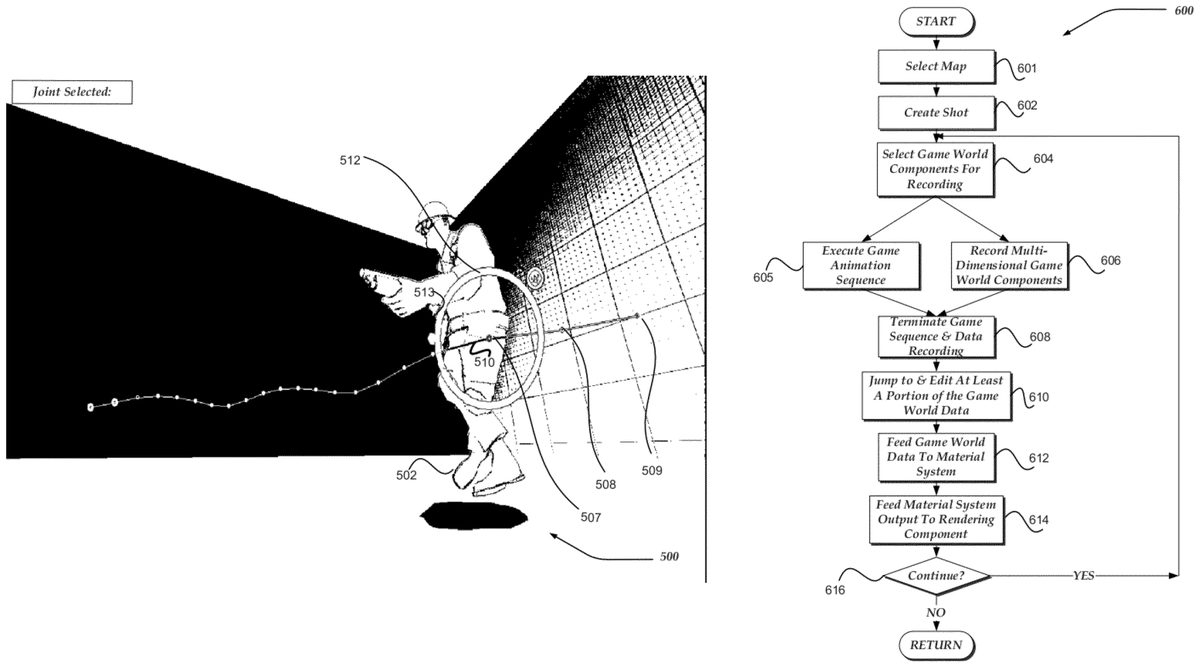
In one embodiment, the user may be provided with a user interface such as described below that is configured to enable the user to select various joints for display using a motion trail. As described further below, the motion trail represents positions, displayed as position indicators, within a computer video game sequence in which a joint may be located within a given frame within the sequence. An example of a motion trail with displayed position indicators is described in more detail in conjunction withFIG. 5below.
The user may modify the motion trail by replacing position indicators within the motion trail, deleting position indicators, adding new position indicators, and/or dragging position indicators to change a displayed location of the joint for one or more frames within the motion trail. By modifying the motion trail for one or more joints, the user may modify how an animated character within a game might be viewed. Moreover, in one embodiment, because multi-dimensional video game world data is recorded as that data used to compute a given image, rather than the video character image itself, the user may also change a viewing perspective of the animated scene, including the game character. For example, in a first execution and recording of the game, the user might display the game from a perspective of the game character. However, subsequent replaying and/or editing of the game based on the recorded multi-dimensional video game world data, the user may change the perspective to be watching the game character, in a third person perspective. In the third person perspective of the play of the recorded game based on the multi-dimensional video game world data, the user may select any of a variety of different views of the scene. Recording and editing of the recorded multi-dimensional video game world data is described in more detail below in conjunction withFIGS. 5-6.
Wireless network110is configured to couple client devices102-104with network105. Wireless network110may include any of a variety of wireless sub-networks that may further overlay stand-alone ad-hoc networks, or the like, to provide an infrastructure-oriented connection for client devices102-104. Such sub-networks may include mesh networks, Wireless LAN (WLAN) networks, cellular networks, or the like.
Wireless network110may further include an autonomous system of terminals, gateways, routers, or the like connected by wireless radio links, or the like. These connectors may be configured to move freely and randomly and organize themselves arbitrarily, such that the topology of wireless network110may change rapidly.
Wireless network110may further employ a plurality of access technologies including 2nd (2G), 3rd (3G), 4th (4G) generation radio access for cellular systems, WLAN, Wireless Router (WR) mesh, or the like. Access technologies such as 2G, 2.5G, 3G, 4G, and future access networks may enable wide area coverage for client devices, such as client devices102-104with various degrees of mobility. For example, wireless network110may enable a radio connection through a radio network access such as Global System for Mobile communication (GSM), General Packet Radio Services (GPRS), Enhanced Data GSM Environment (EDGE), Wideband Code Division Multiple Access (WCDMA), Bluetooth, or the like. In essence, wireless network110may include virtually any wireless communication mechanism by which information may travel between client devices102-104and another computing device, network, or the like.
Network105is configured to couple GRES106, GS107, and client device101w other computing devices, including potentially through wireless network110to client devices102-104. Network105is enabled to employ any form of computer readable media for communicating information from one electronic device to another. Also, network105can include the Internet in addition to local area networks (LANs), wide area networks (WANs), direct connections, such as through a universal serial bus (USB) port, other forms of computer-readable media, or any combination thereof. On an interconnected set of LANs, including those based on differing architectures and protocols, a router acts as a link between LANs, enabling messages to be sent from one to another, Also, communication links within LANs typically include twisted wire pair or coaxial cable, while communication links between networks may utilize analog telephone lines, full or fractional dedicated digital lines including T1, T2, T3, and T4, Integrated Services Digital Networks (ISDNs), Digital Subscriber Lines (DSLs), wireless links including satellite links, or other communications links known to those skilled in the art. Furthermore, remote computers and other related electronic devices could be remotely connected to either LANs or WANs via a modem and temporary telephone link. In essence, network105includes any communication method by which information may travel between computing devices.
GS107may include any computing device capable of connecting to network105to manage delivery of components of an application, such as a game application, or virtually any other digital content. In addition, GS107may also be configured to enable an end-user, such as an end-user of client devices101-104, to selectively access, install, and/or execute the application, such as a video game.
GS107may further enable a user to participate in one or more online games. Moreover, GS107might interact with GRES106to enable a user of client devices101-104to record and/or edit state data from a video game execution. GS107might receive a registration of a user, and/or send the user a list of users and current presence information, such as a user name (or alias), an online/offline status, whether a user is in a game, which game a user is currently playing online, or the like, to client devices101-104. In at least one embodiment, GS107might employ various messaging protocols to provide such information to a user. In one embodiment, GS107might further provide at least some of the information through a messaging session to one or more users. Thus, in one embodiment, GS107might be configured to receive and/or store various game data, user account information, game status and/or game state information, or the like.
One embodiment of a network device useable for GRES106is described in more detail below in conjunction withFIG. 2. Briefly, however, GRES106includes virtually any network computing device that is configured to enable a user to record video game state data as multi-dimensional video game world data during an animation motion capture, and to edit such recorded video game data. In one embodiment, GRES106may be configured to receive the video game state data from GS107. In another embodiment, however, GRES106may be configured to include a various video game components, such as described in more detail below in conjunction withFIG. 2to generate and/or play a video game. GRES106may record the multi-dimensional video game world data using a flat data structure. However, in another embodiment, the multi-dimensional video game world data may be recorded using a tree structure, a mesh structure, or the like, based on various components of a character, background, and/or other components within the video game world. GRES106may further enable a user to edit portions of the multi-dimensional video game world data using process such as described below in conjunction withFIG. 6.
Devices that may operate as GRES106and/or GS107include personal computers, desktop computers, multiprocessor systems, microprocessor-based or programmable consumer electronics, network PCs, servers, and the like.
Moreover, although GRES106and/or GS107are described as distinct servers, the invention is not so limited. For example, one or more of the functions associated with these servers may be implemented in a single server, distributed across a peer-to-peer system structure, or the like, without departing from the scope or spirit of the invention. Therefore, the invention is not constrained or otherwise limited by the configuration shown inFIG. 1.
Illustrative Network Device
FIG. 2shows one embodiment of a network device, according to one embodiment of the invention. Network device200may include many more components than those shown. The components shown, however, are sufficient to disclose an illustrative embodiment for practicing the invention. Network device200may represent, for example, GS107integrated into GRES106ofFIG. 1.
Network device200includes processing unit212, video display adapter & rendering component214, and a mass memory, all in communication with each other via bus222. The rendering component of video display adapter & rendering component214is configured to calculate effects in a video editing file to produce a final video output that may then be displayed on a video display screen. Video display adapter & rendering component214may use any of a variety of mechanisms in which to convert an input object into a digital image for display on the video display screen. Network device200also includes input/output interface224for communicating with external devices, such as a headset, or other input or output devices, including, but not limited, to joystick, mouse, keyboard, voice input system, touch screen input, or the like.
The mass memory generally includes RAM216, ROM232, and one or more permanent mass storage devices, such as hard disk drive228, and removable storage device226that may represent a tape drive, optical drive, and/or floppy disk drive. The mass memory stores operating system220for controlling the operation of network device200. Any general-purpose operating system may be employed. Basic input/output system (“BIOS”)218is also provided for controlling the low-level operation of network device200. As illustrated inFIG. 2, network device200also can communicate with the Internet, or some other communications network, via network interface unit210, which is constructed for use with various communication protocols including the TCP/IP protocol, Wi-Fi, Zigbee, WCDMA, HSDPA, Bluetooth, WEDGE, EDGE, UMTS, or the like. Network interface unit210is sometimes known as a transceiver, transceiving device, or network interface card (NIC).
The mass memory as described above illustrates another type of computer-readable media, namely computer storage media. Computer-readable storage media may include volatile, nonvolatile, removable, and non-removable media implemented in any method or technology for storage of information, such as computer readable instructions, data structures, program modules, or other data. Examples of computer-readable storage media include RAM, ROM, EEPROM, flash memory or other memory technology, CD-ROM, digital versatile disks (DVD) or other optical storage, magnetic cassettes, magnetic tape, magnetic disk storage or other magnetic storage devices, or any other medium which can be used to store the desired information and which can be accessed by a computing device.
The mass memory also stores program code and data. In one embodiment, the mass memory may include one or more applications250and one or more data stores260. Data stores260include virtually any component that is configured and arranged to store data including, but not limited to user preference data, log-in data, user authentication data, game data, recorded and/or edited multi-dimensional video game world data, and the like. Data store260also includes virtually any component that is configured and arranged to store and manage digital content, such as computer applications, video games, and the like. As such, data stores260may be implemented using a database, a file, directory, or the like.
One or more applications250are loaded into mass memory and run on operating system220via central processing unit212. Examples of application programs may include transcoders, schedulers, calendars, database programs, word processing programs, HTTP programs, customizable user interface programs, IPSec applications, encryption programs, security programs, VPN programs, SMS message servers, IM message servers, email servers, account management and so forth. Applications250may also include a Game Recorder/Editor (GRE)251, and material system262. As shown, in one embodiment, GRE251may include video game254, which includes various components including, but not limited to game logic255and animation system256.
One embodiment of GRE251and video game254are described in more detail below in conjunction withFIG. 3. Briefly, however, GRE251is configured to enable a user to capture video game data that may subsequently be manipulated (or edited). GRE251is configured to provide user interfaces that enable a user to select various aspects of a video game to record and/or edit using animation motion capture of multi-dimensional video game world data. As such GRE251may interact with video game254to enable the user to play a portion of an animated sequence for a game. The user might further interact with video game254to modify the animation sequence to be recorded. GRE251enables the user to identify what state information is to be recorded as multi-dimensional video game world data. For example, the user might select to record virtually every aspect of the animation sequence, including every joint of each character, or other object within the sequence, sounds, coloring, material and/or textual changes, flex weights (which specify a weighting to employ when blending various morph targets) related to changes in a joint, and/or a variety of other information.
GRE251may then record the identified state information while the animation sequence is played (executes). During execution of the sequence, the user may manipulate one or more characters and/or objects within the game. For example, in one non-limiting example, the user might select to operate in a first person perspective as one of the game characters, and control the movements of that game character during the recorded game sequence. In another embodiment, one or more other game characters may be controlled, and therefore perform movements based on instructions from video game254, and/or from another, previously recorded animation sequence.
The user may then employ GRE251to replay the game sequence that was recorded using the multi-dimensional video game world data. In one embodiment, the user may select to view the recorded game sequence from any of a variety of camera perspectives other than from that of the game character. For example, the user may change camera perspective while the recorded game sequence is being replayed. In one embodiment, the user may record the change to the camera perspective during the recorded game sequence, allowing for subsequent playback to appear to use a different camera perspective.
GRE251further provides user interfaces to enable the user to edit the recorded game sequence using a variety of techniques. Because the game sequence is recorded using multi-dimensional video game world data obtained as the data used to compute an image, rather than the image itself, the user may make a variety of changes to the recorded game sequence. For example, the user might select to display a frame of the recorded game sequence using the multi-dimensional video game world data to recreate the display of the game. The user may further select for display one or more joints from a plurality of joints that were recorded during the execution of the game sequence. The user may then have overlaid onto the display a motion trail for the joint that represents positions in game space of the selected joint over time. In one embodiment, position indicators, such as circles, dots, or other symbols, may be used to indicate on the motion trail, the joint position in game space for each recorded frame. One non-limiting example of such a motion trail using position indicators is illustrated inFIG. 5.
The user may then employ GRE251to select some portion of the motion trail over time From within GRE251, the user may further edit the motion trail, thereby changing the location of the joint in game space over time. For example, the user might select a position indicator on the motion trail, and drag the position indicator from a first position to a second position. In one embodiment, GRE251may smooth transitions between adjacent position indicators to the selected position indicator using a variety of mechanisms, including, but not limited to smoothing the transition between the underlying state data. For example, GRE251might automatically relocate adjacent position indicators based on a linear interpolation between position indicators on the motion trail. However, other mechanisms might also be used, including, but not limited to using a spike curve, a dome curve, a bell curve, ease in, ease out, ease in/out or the like, to smooth transitions between position indicators.
In one embodiment, GRE251automatically reflects the change in position by displaying in real-time, how the game character associated with the joint might appear in the second position. In one embodiment, the user may play, randomly access, or scrub forward or reverse, the selected sequence with the modification to view how the changed game sequence might now appear.
However, the invention is not limited to merely enabling the user to select and drag one or more position indicators on the motion trail. GRE251also enables the user to replace one or more portions of the motion trail with another game sequence, delete portions of the game sequence, insert other game sequences, or any of a variety of other game editing operations. For example, GRE251also enables a user to play a recorded game sequence using recorded multi-dimensional video game world data, and to composite one or more other characters onto the recorded game sequence during its execution. The composited game sequence may then be recorded using GRE251for subsequent editing using composited multi-dimensional video game world data.
Video game254is configured to manage execution of a video game for display at, for example, a client device, such as clients101-104ofFIG. 1. In one embodiment, components of video game254may be provided to the client device over a network. In another embodiment, video game254may be configured to execute a video game on network device200, such that a result of the execution of the video game may be displayed and/or edited at a client device.
Video game254includes game logic255and animation system256. However, video game254may include more or less components than illustrated. In any event, video game254may receive, for example, input events from a game client, such as keys, mouse movements, and the like, and provide the input events to game logic255. Video game254may also manage interrupts, user authentication, downloads, game start/pause/stop, or other video game actions. Video game254may also manage interactions between user inputs, game logic255, and animation system256. Video game254may also communicate with several game clients to enable multiple players, and the like. Video game254may also monitor actions associated with a game client, client device, another network device, and the like, to determine if the action is authorized. Video game254may also disable an input from an unauthorized sender.
Game logic255is configured to provide game rules, goals, and the like. Game logic306may include a definition of a game logic entity within the game, such as an avatar, vehicle, and the like. Game logic255may include rules, goals, and the like, associated with how the game logic character may move, interact, appear, and the like, as well. Game logic255may further include information about the environment, and the like, in which the game logic character may interact. Game logic255may also include a component associated with artificial intelligence, neural networks, and the like. As such, game logic255represents those processes by which the data found in multi-dimensional video game world data are evaluated to be at a correct state for a given moment of the video game world play, including which state should all the game world entities be in, which sound should be played, what score should a player have, what activities are the characters trying to act on, and the like.
Animation system256represents that portion of video game254that takes output of game logic255and poses animated elements in a state suitable for rendering. This includes moving character joints into a position to make it look like they are performing some action, or the like. As such, in one embodiment, animation system256may include a physics engine or subcomponent that is configured to provide mathematical computations for interactions, movements, forces, torques, flex weights, collision detections, collisions, and the like However, the invention is not so limited and virtually any physics subcomponent may be employed that is configured to determine properties of entities, and a relationship between the entities and environments related to the laws of physics as abstracted for a virtual environment. In any event, such computation data may be provided as output of animation system256for use by GRE251as portions of the plurality of multi-dimensional video game world data that may be recorded and/or modified.
In one embodiment, animation system256may include an audio subcomponent for generating audio files associated with position and distance of objects in a scene of the virtual environment. The audio subcomponent may further include a mixer for blending and cross fading channels of spatial sound data associated with objects and a character interacting in the scene. Such audio data may also be included within the plurality of multi-dimensional video game world data provided to GRE251.
Material system262is configured to provide various material aspects to a video input, including, for example, determining a color for a given pixel of a rendered object, or the like. In one embodiment, material system262may employ various techniques to create a visual look of game world surfaces to be rendered. Such techniques include but are not limited to shading, texture mapping, bump mapping, shadowing, motion blur, illuminations, and the like.
Non-Limiting Example of Data Flow Within A Video Game System
FIG. 3is a block diagram illustrating one embodiment of a relationship between various components within the network device ofFIG. 2that are used to capture a plurality of components of a video game world within a recorded video game sequence, modify at least some of the captured components, and to feed the modifications into the video game and/or a material system for use in modifying a display of the video game sequence. The components illustrated in system300ofFIG. 3may be implemented within GS107and/or GRES106ofFIG. 1.
System300may include more or less components than those shown. The components shown, however, are sufficient to disclose an illustrative embodiment for practicing the invention. Moreover, while system300discloses one embodiment of distributing functions of a video game system across different components, the invention is not to be construed as so limited. Other distributions of functions across components may also be employed. For example, one or more components illustrated may be combined into a single component. Moreover, one or more components might not be employed. For example, network component304might not be employed in another embodiment.
However, as illustrated system300includes I/O device input302, network304, video game254that includes game logic255and animation system256, GRE251, material system262, rendering component314, and computer display screen316, each of which are described in more detail above in conjunction withFIG. 2. For example, rendering component314represents the component of video display adapter & rendering component214ofFIG. 2that is useable to render an image to computer display screen316. Similarly, I/O device input302represents one embodiment of input/output interface224ofFIG. 2. Moreover, material system262, rendering component314and computer display screen316may collectively be referred to a display components320.
System300is intended to portray one embodiment of a flow of data through the various components for use in managing a video game play. That is, as shown, a user might employ various input devices, such as those described above, to input into various motions, actions, and the like for use by video game254. For example, in one embodiment, the user might move a mouse; enter data through a keyboard, touch screen, voice system, or the like; move a joystick; or any of a variety of other devices useable to manipulate a game state within a video game sequence. The input from the user is provided through I/O device input302over network304to video game254. In one embodiment, such user input may affect various states within the video game, resulting in updates by game logic255. Game logic255provides updates to the video game world state to animation system256which in turn is used to pose various characters based on the modified game logic output. As shown, GRE251may intercept output from the animation system that includes data for a plurality of multi-dimensional video game world components, including data used to compute a character image. By intercepting the data used to compute the character image rather than the image itself, GRE251provides a user more flexibility over traditional approaches in modifying a game state sequence.
Output from GRE251may be fed back into video game254, as shown by feedback311, for revising the image data as represented by the plurality of multi-dimensional video game world component data. Output from GRE251may also be provided to material system262where coloring, shading, and other texturing actions may be performed on the data. The output of material system262may then be provided to the rendering component314to render the data into an image for display by computer display screen316.
While GRE251is illustrated as capturing output from animation system256, the invention is not so limited, and GRE251may also capture data from other components as well, including, but not limited to I/O device input302, and/or game logic255.
Data flow through system300may be further described using as a non-limiting, non-exhaustive example, of a “first person shooter” type of game. In this game example, then, while watching computer display screen316, a user plays the first person shooter game using I/O device input302to provide inputs to the game. The user's inputs are then sent through network304to game logic255, which decides if the player hit a target within the game or not. Animation system256may then pose a skeleton of a game character, triggers the gunshot sound and starts a particle system within animation system256. All this information, including outputs from animation system256is then recorded by the GRE251before being passed to material system262. Material system262upon receiving the data from animation system256prepares the scene for the rendering component314by adding lights, textures, shaders, and the like, to the scene. All this data is then output back to computer screen316for the user to decide whether to shoot again, and/or to perform some other action using I/O device input302.
After the recording has stopped, the entire experience can be replayed, in one embodiment, by replacing the user's I/O device input302, network304data, and game logic255data with the recorded data as fed back using flow311. Although the experience is now a playback of an GRE recording, it remains representative of the original experience since the data is fed back to the same display systems as the original experience (e.g., components262,314and316).
In one embodiment, by replaying the video game employing previously recorded multi-dimensional video game world data, compositing may also be performed. That is, additional content may be overlaid onto the previously recorded multi-dimensional video game world data to create a new sequence that combines the previously recorded game world data with additional new content. Such iterations and layering of multiple sequences of game world data may be termed a compositing cycle.
Such compositing cycles include executing the video game254to initially generate a sequence of multi-dimensional video game world data. As noted, elsewhere, while sequence may employ a video game, other output sequences may be generated, including, for example, other multimedia presentations. In any event, the generated sequence may be used to create a movie, a poster, comics, or the like. For example, a sequence from a video game play may be captured and packaged as a movie clip, such as a car action sequence.
As noted above, the recorded multi-dimensional video game world data includes various audio-visual components of the video sequence, such as wireframe/skeleton of characters and objects, positional information, game states, motion curves and characteristics, object visibility status, start/stop timing of sounds, material changes, state of material, material texture, particle information, physics information, context, and timestamp data, among others.
In any event, once a sequence is recorded, a new game play may be created using GRE251. GRE251may use some or all of the multi-dimensional video game world data that was recorded. In one illustrative embodiment, a non-linear editor (NLE) action may be used to randomly edit different points of the recorded sequences, corresponding to different times, without having to sequentially rewind or move forward in a frame sequence. Other types of editors (or types of editing), such as a sample editor or an in-context editor may also be used.
The result of the editing of multi-dimensional video game world data is a new sequence combined with the previously recorded sequence. Continuing with the car racing game as an illustrative example, the captured sequence may show a yellow race car moving down the second lane. GRE2251may be used to create the new sequence having a red race car moving down on the fifth lane behind the yellow race car. Other aspects of the sequence may remain unchanged. That is, at least some of the previously recorded sequence may be considered as persistent from one compositing cycle to a next compositing cycle. Accordingly, the addition of the red race car in the new sequence might not alter anything about a position or other data relating to the yellow race car, For instance, if the tires of the yellow race car were smoking from acceleration in the captured sequence, the new sequence that now adds the red race car will include the yellow race car with smoking tires as well. In any event, in one embodiment, the addition of the red race car may be performed by a user by interacting with I/O device input302to control actions of the added race car. In this way, additional actions may be layered over the previously recorded and currently played sequence, so as to blend the current actions onto or with the previously recorded sequence.
After the new sequence is generated, a next step in the compositing cycle may include integration of the new sequence with the existing sequence(s). In one embodiment, each sequence may be converted to a new bitmap image layer that is superimposed on top of a previous image layer. Various techniques may be used to superimpose the different layers of images/graphics. Other processing may be performed on the image layers before integration with other layers. For example, layers may be alpha-blended for various degrees of transparency to show or hide backgrounds, various types of filters may be applied to enhance the image (for example, filters to smooth or clean up photographic images), and lighting and shading may be applied.
In another illustrative embodiment, the new sequence may be created and represented by vectors and be combined with other sequences using vector operations and transformations. Vector operations and transformations may include rotation, movement, mirroring, stretching, skewing, and/or various set operations such as unions, intersections, or the like. Different sequences may be integrated by combining vector representations of individual sequences.
In yet another embodiment, vector and bitmap graphics may be combined. This may be performed, for example, where the new sequences are initially generated using vector graphics and later are converted to a bitmap image for integration, display, storage, or the like.
The compositing cycle may then comes be repeated after the integration of the new sequence with the previous sequence(s). The compositing cycle described above may be repeated to layer or combine multiple sequences as often as desired to produce a composited sequence of multiple sequences.
Multi-Dimensional Video Game World Components
FIG. 4is one embodiment of non-limiting, non-exhaustive examples of a plurality of components of a video game world for which a plurality of multi-dimensional video game world data may be obtained. Components400may include many more components than those shown. The components shown, however, are sufficient to disclose an illustrative embodiment for practicing the invention.
Components400represents various components of game state data that may be obtained during animation motion capture. The recorded multi-dimensional video game world data typically is received from one or more components of a video game during execution of an animated motion sequence. In one embodiment, the multi-dimensional video game world data obtained for components400includes one or more sets of data such as polygonal mesh data, joint hierarchies, material settings, AI state, particle system data, sound effects, sound triggers, camera placements, and/or virtually any game world state data employable to generate a virtual game world experience. Thus, the components illustrated are not to be construed as limiting, and others may also be used.
In any event, components400includes, timing data411, material/textual changes412, physics state data413, visibility data414, sound data416, motion data417, collision data418, joint data419, flex weight data420, and other data415associated with the recorded game sequence. The other data415may include, but is not limited to wireframe/skeleton data, positional information, motion curve data, or the like. Virtually any data about the game scene over time may be recorded. As such, unlike merely recording triggers and events over time of a game sequence, components400represents a dense capture of multi-dimensional video game world data, in the sense that a large amount of details about a single component may be collected.
Thus, the multi-dimensional video game world data includes not only audio-visual aspects of the scene, but also other information such as wireframe/skeleton of characters and objects, positional information, game states, motion curves and characteristics, object visibility status, start/stop timing of sounds, material changes, state of material, material texture, particle information, physics information, context, and timestamp data, among others.
Besides the data used for creating the images and sounds that are captured, other data dimensions representing game state information such as motion, collision information, wireframe/skeleton data, timestamps, z-order of objects, and other such information may also be captured or extracted and stored for creating the new scene shot in a compositing cycle. The game state information generally includes information about objects and sounds included in the scene, and additionally, information about the scene itself that relate to all objects within the scene, such as scene location and time information.
Thus, such multi-dimensional video game world data enables a comprehensive and relatively easy and quick manipulation of objects and characters in the scene using the disclosed animation editor. Moreover, the captured data represented by components400may be stored in a file on a computer file system, or alternatively on an external computer-readable medium such as optical disks. In one embodiment, the multi-dimensional video game world data represented by components400may be initially recorded in a plurality of distinct data logs and then transferred and/or manipulated into another format, structure, or the like.
In one embodiment, components400may be implemented in a flat file format such that state data for each frame in the animated game sequence may be separately recorded. That is, the state data for any given frame is complete and independent of another set of state data from any other recorded frame. As such, a scene within the recorded game sequence may be fully recreated from the recorded state data for that frame. In one embodiment, multi-dimensional video game world data for each distinct frame may be stored in a distinct or different data log.
Non-Limiting Video Game Motion Trail
FIG. 5is a non-limiting, non-exhaustive example of one embodiment of a video game display illustrating a recording sequence for one joint over time using a motion trail. Display500may include many more components than those shown. The components shown, however, are sufficient to disclose an illustrative embodiment for practicing the invention.
As shown, game character502may be illustrated within a given scene, including backgrounds, and the like. In one embodiment, display500may represent a single frame from the recorded game sequence, recreated from the recorded multi-dimensional video game world data.
Further illustrated is motion trail510for a selected joint507. As seen, motion trail includes a plurality of position indicators, such as507-509indicating a location within game space of the selected joint507over time. In one embodiment, the motion trail510may represent changes of the selected joint507over the entire recorded game sequence, each change being recorded as multi-dimensional video game world data within a distinct data log for a given frame. However, in another embodiment, motion trail510may be a selected subset (e.g., a “time selection”) of the recorded positions of selected joint507. Motion trail510may be drawn onto display500to provide the user with a visual cue of transitions between position indicators. Computing motion trail510through the recorded positions of joint507as represented by the position indicators may be performed using virtually any mechanism.
As further shown, a user may be provided with a selector tool, such as selector ring512. The user may employ selector ring512to select a range of position indicators to manipulate, zoom in/out on, or the like. In one embodiment, selector ring512may include a pivot handle513useable to rotate, drag, or otherwise further manipulate one or more enclosed position indicators. For example, in one embodiment, selector ring512may be centered onto position indicator507, as shown by the rectangle over position indicator507. The user may then employ pivot handle513to drag position indicator507from a first location to a second location, thereby modifying the displayed motion trail510. As used herein, a “pivot” refers to a point around which a joint may rotate. By default, in one embodiment, the pivot or pivot point is the joint itself, but it can be moved to accommodate more complex rotations.
Thus, as illustrated, a user may select a specified frame based on a selected position indicator507-509within a recorded plurality of frames from within the recorded video game sequence that is stored within the plurality of distinct data logs. The user may then edit the sequence using the data log editor and such as described above, to edit at least some of the recorded multi-dimensional video game world data within at least one of the distinct data logs for a specified frame range. The user may then send the results to a material system and/or fed back the results of the editing to the animation system, and/or game logic components of the video game system to have the modified sequence displayed for the at least the specified frame range.
It should be noted, however, that the user is not limited to dragging position indicators within a motion trail. For example, the user may also select to delete position indicators, add position indicators, insert within a motion sequence into the recorded game sequence, or the like. Additionally, different types of manipulation may be selected by the user for the motion trail, including: (1) Replacement—an animation is replaced by a non-animated state such as a pose; (2) Transform—an animation is globally modified where the motion trail is shifted without changing the shape of the motion trail; and (3) Offset—an animation that is locally modified and where the motion trail is modified relative to itself.
Generalized Operation
The operation of certain aspects of the invention will now be described with respect to
FIG. 6.FIG. 6is a flow diagram illustrating one embodiment of an overview of a process useable for recording and editing multi-dimensional video game world data. Process600ofFIG. 6may be implemented within network device200ofFIG. 2, in one embodiment.
Process600begins, after a start block, at block601where a user selects a given map or video game to be played, including a game environment, such as a game scene, and one or more video game characters to be placed within the game scene for executing of a game sequence. Proceeding to block602, the user may then select or otherwise create a given video sequence to be shot. In one embodiment, the given video sequence may be a subset of the given map selected within block601. In at least another embodiment, each shot may be created with a separate map, and game world component data can be recorded multiple times into the same shot. Continuing to block604, the user may further select one or more joints for recording as multi-dimensional video game world component data. That is, in one embodiment, the user identifies a plurality of components to be recorded with the video game world of block601, where each component within the plurality is to be recorded within a distinct frame by frame data log to generate a plurality of different data logs.
In one embodiment, a default configuration may include recording of every joint within the game scene and/or on the game character. Such joints may be predefined during creation of the game character. For example, joints may be defined as pivot points between two ‘hands” of a skeleton structure. However, joints may also be defined by other desirable recording points on an animated structure. For example, for an leg, the joint points might include a knee control, but not be limited to the clothing, shoelaces, hemlines of a skirt, kneepads , or the like. For a vehicle, the joint points might include, but not be limited to several points along a radial arm of a tire, such as an outside point and/or a center point of a tire. Clearly, other joints may be identified than these examples illustrate, and thus the invention is not to be construed as being limited by such examples.
In any event, in one embodiment, the game character may be controlled by the user. That is, the user may provide various inputs using a mouse, keyboard, audio input, a joystick, or the like, to control movement of the game character. Movement of the game character is anticipated in resulting in movement of joints on the game character. In one embodiment, a display of the game sequence may be shown on the user's computer display device. In one embodiment, the game sequence may employ a first person perspective or camera position. That is, in one embodiment, the user may view actions of the game character from the perspective of the game character, in a perspective sometimes known as a first person “shooter” perspective.
Processing flows next to blocks605and/or606where the user may select to execute the game logic and game animation to enable a display on a computer display device a sequence of movements over a plurality of frames within the video game world. At block605, in at least one embodiment, the executing of the game animation and game logic may generate game world component data from the game. Also, in at least one embodiment, the game world component data may be imported as a sequence, e.g., copied from game assets in a manner similar to applying animation presets.
In one embodiment, the user may employ the game recorder, described above, to record some or all of the game animation as animation motion capture by recording multi-dimensional video game world component data, including the one or more selected joints. That is, in one embodiment, while executing the movements during the video game sequence of the video game, the user records within each of the distinct plurality of different data logs multi-dimensional video game world data for the identified plurality of components prior to rendering each frame.
Block606may be entered concurrent with block605, or subsequent to/ or even before execution of the game sequence. Moreover, the user may select to stop recording concurrent with, or even before completing execution of the game sequence.
Processing then flows to block608, where the user may terminate the game sequence and/or the recording of the multi-dimensional video game world component data. Processing continues next to block610, where the user may play back the recorded game sequence using the recorded multi-dimensional video game world component data. That is, in one embodiment, the user may perform a jump to a specified frame within the recorded plurality of frames from within the recorded video game sequence stored within the plurality of distinct data logs. As used herein, jumping refers to a process of selecting and accessing a specified frame based on some identifier, such as a time, play sequence identifier, or the like. It should be noted, however, that the user is not limited to proceeding to block610, and although not illustrated, the user may cycle through blocks605and/or606as often as desired, before selecting to play back the recorded game sequence. Moreover, the user may also loop back to block602and/or604to select different scenes, game characters, joints for recording, or the like, without departing from the scope of the invention.
In one embodiment, at block610, the user may replay the previously recorded game sequence while further adding additional characters, actions, or the like, over the previously recorded game sequence. In this manner the user may form a composite of the previously recorded game sequence with additional actions, characters, changes in a camera perspective, changes in positions of existing characters, changes in characteristics of a character such as facial expressions, explosions, water actions, or virtually any other video game data onto the previously recorded game sequence to generate a new sequence that composites the ‘new’ content, with the previously recorded game sequence.
In any event, at block610, the user may then select one or more portions of the recorded game sequence for editing. That is, using a data log editor such as described above, the user may edit at least some of the recorded multi-dimensional video game world data within at least one of the distinct data logs within the plurality of data logs for a specified frame range.
When the game sequence (e.g., movie) is ready to be published and distributed, we save out an image sequence for the entire movie and an associated audio file to be played in sync in commonly found venues, such as on the internet, television, theatres, DVDs, or the like. At this point, the process steps through the movie, frame by frame, constructing the final frame using the logic found in display components320inFIG. 3, and then saves the screen output into a single image file, which may then be saved to, such as data stores260ofFIG. 2, or other computer-readable storage medium.
The user may select any of a variety of editing mechanisms, including, but not limited to compositing the recorded game sequence with another game sequence and/or game characters, inserting a portion of a game sequence into the recorded game sequence, deleting portions of the recorded game sequence, and/or manipulating portions of the game sequence, for example, by modifying portions of a motion trail for a joint. A modification to one or more portions of the motion trail for the joint may include, but are not limited to, orientation, position, and rotation of the joint. As noted, however, the user is not limited to merely these manipulations, and others may also be performed, including modifying a camera perspective of the recorded game state data, for example. Thus, because the present invention is directed towards recording multi-dimensional video game world component data that includes that data used for calculating an image rather than the image itself, a plurality of different manipulations may be performed that might not otherwise be available by recording triggers and events from the triggers.
Proceeding to block612, the user may then have the results of the edits sent to the material system within the network computing device the recorded multi-dimensional video game world data within each of the distinct data logs including the at some edited data within at least one of the distinct data logs to display a modified video game sequence for the specified frame range. As noted above, however, the results may also be fed back to the animation system for further updates to the multi-dimensional video game world component data. Proceeding next, the output of block612may be sent to the block614to be rendered into an image.
Process600may then flow to decision block616, where a determination is made whether to continue recording and editing the multi-dimensional video game world component data. If so, then processing loops back to block604where the user may further select one or more joints for recording as multi-dimensional video game world component data. If process600is to be terminated, however, processing then may return to another process to perform other actions.
It will be understood that each block of the flowchart illustrations discussed above, and combinations of blocks in the flowchart illustrations above, can be implemented by computer program instructions. These program instructions may be provided to a processor to produce a machine, such that the instructions, which execute on the processor, create means for implementing the actions specified in the flowchart block or blocks. The computer program instructions may be executed by a processor to cause a series of operational steps to be performed by the processor to produce a computer-implemented process such that the instructions, which execute on the processor, provide steps for implementing the actions specified in the flowchart block or blocks.
Accordingly, blocks of the flowchart illustration support combinations of means for performing the specified actions, combinations of steps for performing the specified actions and program instruction means for performing the specified actions. It will also be understood that each block of the flowchart illustration, and combinations of blocks in the flowchart illustration, can be implemented by special purpose hardware-based systems, which perform the specified actions or steps, or combinations of special purpose hardware and computer instructions.
Illustrative Example of Compositing
FIGS. 7A-7Cillustrate one non-limiting, non-exhaustive example of compositing multiple sequences to generate a new composited sequence. Generally, a first sequence may be based on any multimedia content such as a video game. For example, as shown inFIG. 7A, the user may start with a sequence of a room708A that may include door704, window706, and a first character702sitting at table710. Such sequence might have been generated by performing blocks601-608of process600described above to record multi-dimensional video game world data for the illustrated sequence.
Then, the user may replay the recorded multi-dimensional video game world data while providing additional content and/or changes to the recorded multi-dimensional video game world data. For example, as illustrated inFIG. 7B, a user may create a new sequence during replay of the previously recorded sequence by, for example, adding a second character712that opens door704B, enters room708B. The user may perform various actions, such as layering another previously recorded sequence that includes the new second character712, or performs interactive actions to control movement of the second character using various I/O device inputs. Thus, for example, the user may have second character712enter the room and walk over to the table710.
While replaying the previously recorded sequence and adding the additional actions of the second character, a new sequence of actions may be created and thereby recorded as a composite of the combination. Thus, the new sequence may be constructed by the combination of the previously recorded with new actions.
This new composited sequence may be again replayed, to add and/or alter the newly recorded composited sequence. For example, as illustrated inFIG. 7C, another character may be added, cat714. In one embodiment, the user may again, select to employ various I/O input devices to control actions of cat714as the previously composited sequence is played. Further, the combination of the previously composited sequence with the now additional content may be recorded and/or otherwise combined to create yet another composited sequence. Using process600such layering of sequences may be performed as often as a user desires.
It should be noted that the invention is not limited to including a single character or varying a single portion of the sequence during each replay ,and multiple characters, actions, or the like, may be included during each re-play and compositing cycle. Moreover, in at least one embodiment, newly created content may be separately recorded from the previously recorded sequence. In this manner, the compositing may be performed as a separate action.
The above specification, examples, and data provide a complete description of the manufacture and use of the composition of the invention. Since many embodiments of the invention can be made without departing from the spirit and scope of the invention, the invention resides in the claims hereinafter appended.
Claims
- A method for compositing content for a video game world with a network device, the method enabling actions, comprising: identifying a plurality of components of video game world data for recording within the video game world;executing a sequence of animation for the video game world for subsequent display in a plurality of video game frames, wherein the sequence of animation includes at least one identified component;recording the video game world data for at least one of the identified plurality of components, wherein at least a portion of the video game world data is generated by the execution of the sequence of animation and recording the video game world data occurs prior to a rendering and display of the plurality of video game frames such that the recorded video game world data is to be rendered in order to generate a displayable video game image, wherein the video game world data associated with each video frame is stored in a flat file format, and wherein the video game world data associated with each video frame includes a distinct data log recording changes of a selected joint over a predetermined game sequence, wherein the video game world data is configured such that the distinct data log of a frame is independent from another frame;identifying the content for compositing on at least one video game frame;compositing at least one selected video game frame with the identified content;replaying and recording new video game world data generated by the execution of at least a portion of the sequence of animation corresponding to the at least one selected video frame composited with the identified content prior to rendering, recording and displaying the plurality of video game frames;and providing the newly recorded video game world data to a material system prior to a subsequent display of at least the portion of the sequence of animation that corresponds to the at least one selected video game frame composited with the identified content.
- The method of claim 1;wherein the video game world data comprises environment data, character data, physics data, game world motion data, sound data, event data, non-sampled parameter data, and timing data from the video game world prior to submission to the material system.
- The method of claim 1;wherein compositing further comprises layering another composited video game frame with the identified content with a previously composited video game frame.
- The method of claim 1 , further comprising: displaying a motion trail in the displayed plurality of video game frames for at least one selected joint of a video game character, wherein the motion trail further displays a change in at least one of a location and an orientation for the at least one selected joint over time.
- The method of claim 1;wherein the material system determines a change in shading of at least one object in the video game world based on the recorded video game world data.
- The method of claim 1;wherein the material system determines a change in occlusion of at least one object based on the new video game world data.
- A network device for compositing content for a video game world, comprising: a memory configured to store data;a processor that is operative to execute the data stored in the memory that enables actions to be performed, comprising: identifying a plurality of components of video game world data for recording within the video game world;executing a sequence of animation for the video game world for subsequent display in a plurality of video game frames, wherein the sequence of animation includes at least one identified component;recording the video game world data for at least one of the identified plurality of components, wherein at least a portion of the video game world data is generated by the execution of the sequence of animation and recording the video game world data occurs prior to a rendering and display of the plurality of video game frames such that the recorded video game world data is to be rendered in order to generate a displayable video game image, wherein the video game world data associated with each video frame is stored in a flat file format, and wherein the video game world data associated with each video frame includes a distinct data log recording changes of a selected joint over a predetermined game sequence, wherein the video game world data is configured such that the distinct data log of a frame is independent from another frame;identifying the content for compositing on at least one video game frame;compositing at least one selected video game frame with the identified content;replaying and recording new video game world data generated by the execution of at least a portion of the sequence of animation corresponding to the at least one selected video frame composited with the identified content prior to rendering, recording and displaying the plurality of video game frames;and providing the newly recorded video game world data to a material system prior to a subsequent display of at least the portion of the sequence of animation that corresponds to the at least one selected video game frame composited with the identified content.
- The device of claim 7;wherein the video game world data comprises environment data, character data, physics data, game world motion data, sound data, event data, non-sampled parameter data, and timing data from the video game world prior to submission to the material system.
- The device of claim 7;wherein compositing further comprises layering another composited video game frame with the identified content with a previously composited video game frame.
- The device of claim 7 , further comprising: displaying a motion trail in the displayed plurality of video game frames for at least one selected joint of a video game character, wherein the motion trail further displays a change in at least one of a location and an orientation for the at least one selected joint over time.
- The device of claim 7;wherein the material system determines a change in shading of at least one object in the video game world based on the recorded video game world data.
- The device of claim 7;wherein the material system determines a change in occlusion of at least one object based on the new video game world data.
- A processor readable non-transitory storage medium that includes data and instructions for compositing content for a video game world with a network device, wherein the execution of the instructions by a processor enables actions, comprising: identifying a plurality of components of video game world data for recording within the video game world;executing a sequence of animation for the video game world for subsequent display in a plurality of video game frames, wherein the sequence of animation includes at least one identified component;recording the video game world data for at least one of the identified plurality of components, wherein at least a portion of the video game world data is generated by the execution of the sequence of animation and recording the video game world data occurs prior to a rendering and display of the plurality of video game frames such that the recorded video game world data is to be rendered in order to generate a displayable video game image, wherein the video game world data associated with each video frame is stored in a flat file format, and wherein the video game world data associated with each video frame includes a distinct data log recording changes of a selected joint over a predetermined game sequence, wherein the video game world data is configured such that the distinct data log of a frame is independent from another frame;identifying the content for compositing on at least one video game frame;compositing at least one selected video game frame with the identified content;replaying and recording new video game world data generated by the execution of at least a portion of the sequence of animation corresponding to the at least one selected video frame composited with the identified content prior to rendering, recording and displaying the plurality of video game frames;and providing the newly recorded video game world data to a material system prior to a subsequent display of at least the portion of the sequence of animation that corresponds to the at least one selected video game frame composited with the identified content.
- The medium of claim 13;wherein the video game world data comprises environment data, character data, physics data, game world motion data, sound data, event data, non-sampled parameter data, and timing data from the video game world prior to submission to the material system.
- The medium of claim 13 : wherein compositing further comprises layering another composited video game frame with the identified content with a previously composited video game frame.
- The medium of claim 13 , further comprising: displaying a motion trail in the displayed plurality of video game frames for at least one selected joint of a video game character, wherein the motion trail further displays a change in at least one of a location and an orientation for the at least one selected joint over time.
- The medium of claim 13 : wherein the material system determines a change in shading of at least one object in the video game world based on the recorded video game world data.
- The medium of claim 13 : wherein the material system determines a change in occlusion of at least one object based on the new video game world data.
- A system for compositing content for a video game world, comprising: a first network device, including: a first memory configured to store data;a first display device;a first processor that is operative to execute the data stored in the first memory that enables actions to be performed, comprising: identifying a plurality of components of video game world data for recording within the video game world;executing a sequence of animation for the video game world for subsequent display in a plurality of video game frames, wherein the sequence of animation includes at least one identified component;recording the video game world data for at least one of the identified plurality of components, wherein at least a portion of the video game world data is generated by the execution of the sequence of animation and recording the video game world data occurs prior to a rendering and display of the plurality of video game frames such that the recorded video game world data is to be rendered in order to generate a displayable video game image, wherein the video game world data associated with each video frame is stored in a flat file format, and wherein the video game world data associated with each video frame includes a distinct data log recording changes of a selected joint over a predetermined game sequence, wherein the video game world data is configured such that the distinct data log of a frame is independent from another frame;identifying the content for compositing on at least one video game frame;compositing at least one selected video game frame with the identified content;replaying and recording new video game world data generated by the execution of at least a portion of the sequence of animation corresponding to the at least one selected video frame composited with the identified content prior to rendering, recording and displaying the plurality of video game frames;and providing the newly recorded video game world data to a material system prior to a subsequent display of at least the portion of the sequence of animation that corresponds to the at least one selected video game frame composited with the identified content;and a second network device, including: a second memory configured to store data;a second display device;a second processor that is operative to execute the data stored in the second memory that enables actions to be performed, comprising: executing the video game world based at least in part on the newly recorded video game world data;and rendering and displaying the portion of the sequence of animation that corresponds to the at least one selected video game frame composited with the identified content within at least a portion of the video game world that is displayed to a user.
- The system of claim 19;wherein the video game world data comprises environment data, character data, physics data, game world motion data, sound data, event data, non-sampled parameter data, and timing data from the video game world prior to submission to the material system.
- The system of claim 19;wherein compositing further comprises layering another composited video game frame with the identified content with a previously composited video game frame.
- The system of claim 19 , further comprising: displaying a motion trail in the displayed plurality of video game frames for at least one selected joint of a video game character, wherein the motion trail further displays a change in at least one of a location and an orientation for the at least one selected joint over time.
- The system of claim 19;wherein the material system determines a change in shading of at least one object in the video game world based on the recorded video game world data.
- The system of claim 19;wherein the material system determines a change in occlusion of at least one object based on the new video game world data.
Disclaimer: Data collected from the USPTO and may be malformed, incomplete, and/or otherwise inaccurate.