U.S. Pat. No. 9,372,534
INTERACTIVE WEARABLE VIDEOGAME THROUGH THE USE OF WIRELESS ELECTRONIC SENSORS AND PHYSICAL OBJECTS
Issue DateJuly 3, 2013
Illustrative Figure
Abstract
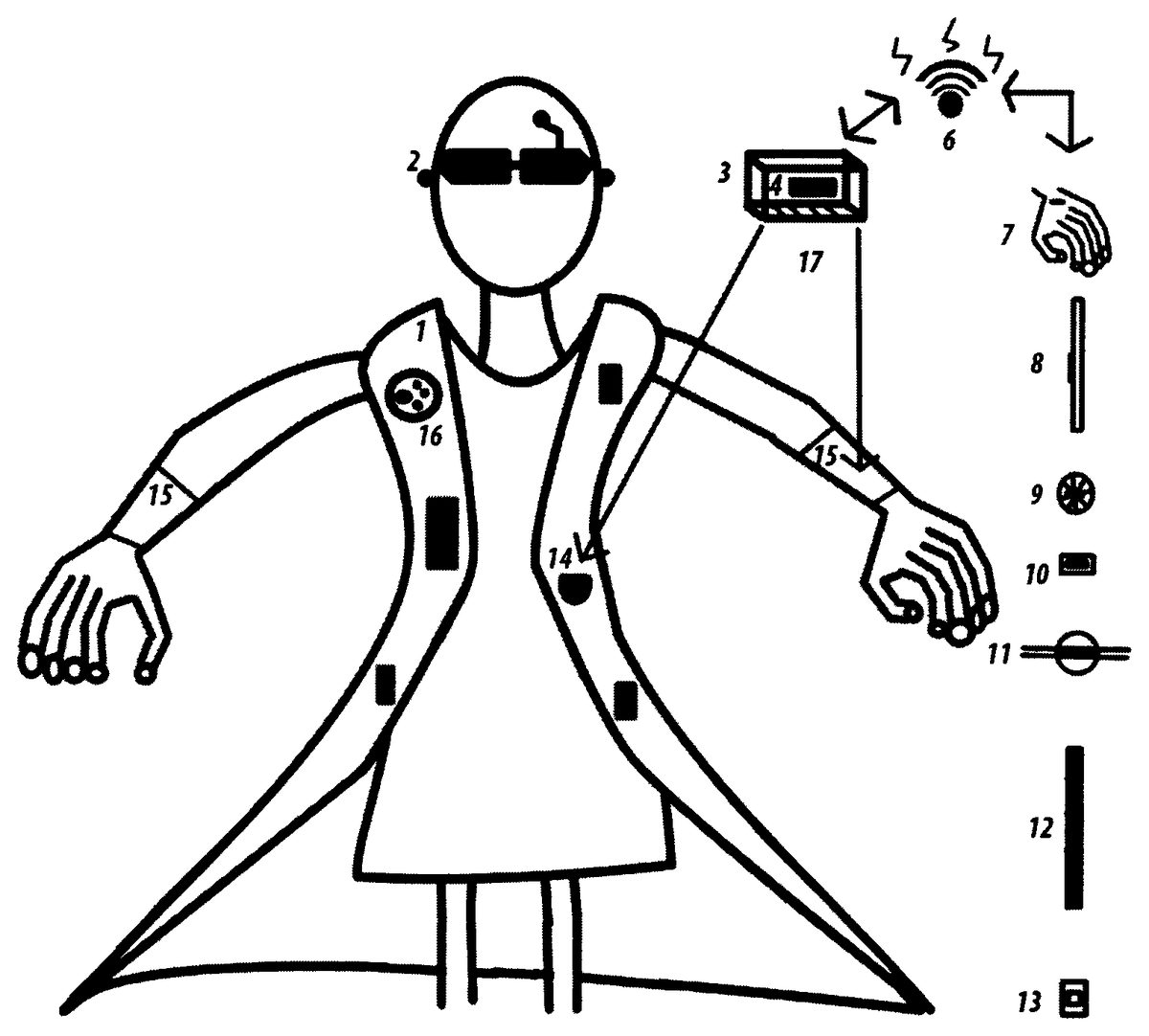
The invention is an interactive wearable video game (1), in which one or more players interact with physical objects through physical actions/contact/physiological signals to control a video game. The apparatus includes a series of wireless electronic sensors (7 to 16) to be placed in the user's body/surrounding environment, detecting the user's input actions in real time—output result is visualized on a binocular see-through display glasses system (2). The invention allows for the players to move around by connecting with the physical space, and to use their full bodies to control the game, exercise and share interactions. It allows for the connection between both virtual and physical realities—mixed reality concept by augmenting the user's perceptions among the surrounding environment. Users can either communicate from maximum physical proximity through a Web connection. The invention is rechargeable by converting produced solar energy into electric energy.
Description
DETAILED DESCRIPTION OF THE INVENTION Referring to the figures, will now be described a preferred embodiment of the invention, that the interactive wearable video game (1) is made of a rubber fabric with a membrane of micro holes that allows for the user's vapors (transpiration) to pass through, breathable and water resistant. The interactive wearable videogame (1) sustains the electronic components from the invention apparatus, namely the multi-touch video game portable console system (3) with its internal I/O board v2.0 Bluetooth® wireless (4) connection and its coupled micro solar battery system (17). This can be placed in the multi-touch video game portable console plastic pocket (14) or in the multi-touch video game portable console wrist neoprene pocket box (15). The multi-touch video game portable console system (3) have an I/O board v2.0 Bluetooth® wireless (4) that allows the connection with the electrical wireless sensors, this is, the wireless glove sensor (7), the wireless airflow straw sensor (8), the wireless turn button sensor (9), the wireless accelerometer sensor (10), the wireless heart beat and skin galvanic response wrist clock sensor (11), the wireless bar sensor (12), the wireless button sensor (13), the wireless LEDS sensor—with four colored LEDS (16) and the wireless electrical brain activity Bluetooth® box transmitter (18). The internal I/O board v2.0 Bluetooth® wireless (4) which is localized inside the multi-touch video game portable console system (3) establishes the connection with the electronic sensors wirelessly by connecting with its wireless Bluetooth® digitizers (20)—signal acquisition to maximum 100 meters distance. The Bluetooth® digitizers (20) in a micro plastic box format are coupled/attached to the electronic sensors via an internal connection with a 3-pin column input cable extremity (2.54 mm/0.1″ spaced), which is then connected to an I2C port placed inside the wireless Bluetooth® digitizers (20). The wireless Bluetooth® digitizers (20) ...
DETAILED DESCRIPTION OF THE INVENTION
Referring to the figures, will now be described a preferred embodiment of the invention, that the interactive wearable video game (1) is made of a rubber fabric with a membrane of micro holes that allows for the user's vapors (transpiration) to pass through, breathable and water resistant.
The interactive wearable videogame (1) sustains the electronic components from the invention apparatus, namely the multi-touch video game portable console system (3) with its internal I/O board v2.0 Bluetooth® wireless (4) connection and its coupled micro solar battery system (17). This can be placed in the multi-touch video game portable console plastic pocket (14) or in the multi-touch video game portable console wrist neoprene pocket box (15).
The multi-touch video game portable console system (3) have an I/O board v2.0 Bluetooth® wireless (4) that allows the connection with the electrical wireless sensors, this is, the wireless glove sensor (7), the wireless airflow straw sensor (8), the wireless turn button sensor (9), the wireless accelerometer sensor (10), the wireless heart beat and skin galvanic response wrist clock sensor (11), the wireless bar sensor (12), the wireless button sensor (13), the wireless LEDS sensor—with four colored LEDS (16) and the wireless electrical brain activity Bluetooth® box transmitter (18).
The internal I/O board v2.0 Bluetooth® wireless (4) which is localized inside the multi-touch video game portable console system (3) establishes the connection with the electronic sensors wirelessly by connecting with its wireless Bluetooth® digitizers (20)—signal acquisition to maximum 100 meters distance.
The Bluetooth® digitizers (20) in a micro plastic box format are coupled/attached to the electronic sensors via an internal connection with a 3-pin column input cable extremity (2.54 mm/0.1″ spaced), which is then connected to an I2C port placed inside the wireless Bluetooth® digitizers (20). The wireless Bluetooth® digitizers (20) are powered by a 9V battery, and its dimensions are 50×27×14 mm, each one weights 0.03 Kg.
The multi-touch video game portable console system (3) is prepared for anti-shock and anti-vibration with a MIL810F system (shock Mounted Hard Drive). It has a sunlight readable display and it's prepared for dust, waterproof and high and low temperatures resistance (40° C. to −50° C.).
The multi-touch video game portable console system (3) has an 800×600 display resolution with 24-bit true color and stereo sound speakers. Its dimensions are 44×74×21 mm, with a weight of 0.25 Kg—with 128 megabytes of RAM (3.2 GB/sec)/2 GB ROM SD card and GPS included.
The multi-touch video game portable console system (3) its coupled/attached to a micro solar battery system (17) that includes a powerful 1350 mAh high capacity rechargeable polymer, and that gives 2 hours of 5V power supply to the multi-touch video game portable console system (3)—it recharges from 8 to 10 hours under strong direct sun light.
The wireless glove sensor (7) when the user put the hand, where are in use, where are in rest position can be attached on the interactive wearable video game through the Velcro® system (5). The wireless glove sensor (7) it's connected to a singular Bluetooth® digitizer (20) and includes 6 pressure sensors—five on the fingertips and one on the palm. Each of these sensors responds to pressure from approx. 4 KPa (0.04 Kg/cm2, 0.6 PSI) to 981 KPa (10.0 Kg/cm2, 142 PSI) or a force of approx. 0.6 N (60 g, 0.13 lb) to 98 N (10 Kg, 22 lb) that's evenly applied across its active area, a 13 mm (0.51 inch) diameter disk in real-time.
The user is persuaded to use the wireless glove sensor (7) by doing pressure with these 6 sensors in a way to input triggers to the video game software tasks. The tasks goal is to establish a connection through manipulations with the surrounding environment in different contexts, other users/persons and objects. It has 95×85×41 cm and it weights 0.02 Kg.
The wireless airflow straw sensor (8) can be attached on the interactive wearable video game through the Velcro® system (5). The wireless airflow straw sensor (8) it's connected to a singular Bluetooth® digitizer (20) and measures the barometric air pressure from 15 to 115 kPa (150 to 1150 mBar) in real-time. The user is persuaded to use the wireless airflow straw sensor (8) by blowing it with its mouth, or connecting it to other physical objects that creates air in a way to input triggers to the video game software tasks—e.g. establish a connection with different physical objects like for e.g. an inflatable balloon to trigger inputs to the video game software. This sensor can be connected (to be placed in with the surrounding environment in different contexts, other users/persons and objects, besides the interactive wearable video game (1). It has 110×7.0×0.5 mm and it weights 0.01 Kg.
The wireless turn button sensor (9) can be attached on the interactive wearable video game through the Velcro® system (5). The wireless turn button sensor (9) ifs connected to a singular Bluetooth® digitizer (20) and measures a produced rotation angle from 0 to 360° (single-turn linear potentiometer) in real-time. The user is persuaded to use the wireless turn button sensor (9) by doing manipulations to control and select video-game software contents by accomplish tasks. This sensor can be connected to other physical objects, like for e.g. a mechanical lever, and can be connected (to be placed in) with the surrounding environment in different contexts, other users/persons and objects, besides the interactive wearable video game (1). It has 22×26×25 mm and it weights 0.02 Kg.
The wireless accelerometer sensor (10) it's connected to a singular Bluetooth® digitizer (20) and senses dynamic acceleration (or deceleration) and inclination (tilt, i.e. acceleration due to gravitation) in three dimensions simultaneously (x, y, z), at the same time it calculates the triple-axis earth's magnetic field intensity and acceleration allowing for identifying the user's/objects position in the spatial coordinates in real-time (e.g. rotations). This sensor can be connected to other physical objects like for e.g. action figures by calculating their real-time displacement—data results are to be visualized and controlled in the video-game software by accomplishing video game goal tasks—e.g. putting an avatar in the video-game software into movement with the user's real-time displacements. This sensor can be connected (to be placed in) with the surrounding environment in different contexts, other users/persons and objects, besides of calculating the user's displacement in the interactive wearable video game (1). It has 53×33×11 mm and it weights 0.02 Kg.
The wireless heart beat and skin galvanic response wrist clock sensor (11) is used in the wrist of the user and it's connected to a singular Bluetooth® digitizer (20) and it measures the user's heart rate (heart rate variability) and galvanic skin response (calculates the variations of user's emotional states) in real-time. The wireless heart beat and skin galvanic response wrist clock sensor (11) has two rectangular surfaces sensor pads that are made of electrical conductive material to measure skin temperature, heat flux and skin electrical conductivity. The data results are to be visualized and controlled in the video-game software by accomplish various tasks. The resulting data can be influenced by the connections between the user and the surrounding environment in different contexts, other users/persons and objects. It has 75×63×41 mm and it weights 0.04 Kg.
The wireless bar sensor (12) can be attached to the interactive wearable video game (1) and it's connected to a singular Bluetooth® digitizer (20) and it measures the contact position in a range of 100 mm (3.94 inch) in real-time linear resistive potentiometer. The user is persuaded to use the wireless bar sensor (12) by doing manipulations (sliding it) to control and select video-game software contents and to accomplish tasks. This sensor can be connected (to be placed in with the surrounding environment in different contexts, other users/persons and objects, besides the interactive wearable video game (1). It has 24×11×11 mm and it weights 0.02 Kg.
The wireless button sensor (13) can be attached to the interactive wearable video game (1) and it's connected to a singular Bluetooth® digitizer (FIG. 3:20) and it measures the displacement or force applied by the user in a range of 1 mm (0.04 inch) or 2.0 N (0.20 Kg, 0.45 lb) in real-time. The user is persuaded to use the wireless button sensor (13) by switch contact and select video-game software contents and to accomplish tasks. This sensor can be connected (to be placed in) with the surrounding environment in different contexts, other users/persons and objects, besides the interactive wearable video game (1). It has 30×15×5 mm and it weights 0.01 Kg.
The wireless LEDS sensor—with four colored LEDS (16) can be attached to the interactive wearable video game (1) and its connected to a singular Bluetooth® digitizer (20) and it produces light according to the proximity of the users in a multiplayer function using multiple interactive wearable video game (1). Each of the 4 lights turn “ON” when the proximity with an external user/person is increased in real-time, through a modulated infra-red light in a range of 5 cm to 200 cm (2.0 to 79 inch). This sensor can also communicate with the wireless heart beat and skin galvanic response wrist clock sensor (11) in a specific video game software function—by being activated (each of the 4 lights turns “ON” or “OFF”) according with the heart rate variability from the user (high or low Hear Beat values). This sensor has a 1.5V circular battery to put the lights activated. The user is persuaded to use the wireless LEDS sensor—with four colored LEDS (16) by reaching closest with the surrounding environment and this way accomplish software video game contents and tasks. This sensor can also be connected (to be placed in) with the surrounding environment in different contexts, other users/persons and objects, besides the interactive wearable video game (1). It has 60×41×8 mm and it weights 0.02 Kg.
The binocular see-through display glasses system (2) are placed in the head of the user and works with a see-thru quantum optics technology with a 43-inch virtual screen as viewed from ten feet (˜3 m) in a 23 degree diagonal field of view (16:9 aspect ratio WVGA—852×480; resolutions up to 1280×720), at 60 Hz progressive scan and 24-bit true color (16 million colors). This system works with a S-Video cable composite and component video input (21) connected to the multi-touch video game portable console system (3). The binocular see-through display glasses system (2) gives the user the possibility to control the visualized video game software image by placing it in the right eye, left eye or both—(e.g. through the use of the wireless turn button sensor (9), the wireless glove sensor (7), among the other apparatus wireless electronic sensors—since the user can change/personalize the wireless electronic sensor to perform a certain input action into the video game); In the binocular see-through display glasses system (2) is placed a single 1080p HD camera in the superior left corner that allows for 720p/1080p video capture with frame rates from 1 hz to 60 hz; and a head-tracking system with 6 degree of freedom (yaw, pitch, roll, x, y and z values) placed in the superior right corner of the of the binocular see-through display glasses system (2). The binocular see-through display glasses system (2) its powered through USB connection 2.0 send by the multi-touch video game portable console system (3). Its size its approximately 22 mm×10 mm×13 mm and weights 0.08 Kg.
The binocular see-through display glasses system (2) its placed in the user's head connected to a circular adjustable rubber strap (19)—the rubber strap adjustable (19) its connected and sustains the three wireless electrical brain activity sensor pads through the three plastic adjusters adjusted through the user's manipulations to be placed in the different parts of the head (three axis—x, y, and z values—through a micro circular spherical joint combined with the micro notch of the rubber strap). The binocular see-through display glasses system (2) also holds the wireless electrical brain activity Bluetooth® box transmitter (18) that its connected to the multi-touch video game portable console system (3) and internal I/O board v2.0 Bluetooth® wireless (4) via wireless v2.0 Bluetooth® connection (6) (9V battery powered)—transmitting digital messages in real-time from the wireless electrical brain activity sensor pads to the video game software (signal acquisition to maximum 100 meters of non-obstructed distance; 10 bits resolution).
The wireless electrical brain activity Bluetooth® box transmitter (18) sizes 81×41×24 mm and weights 0.03 Kg (including the internal 9V battery). Each one of the three wireless electrical brain activity sensor pads are connected to the wireless electrical brain activity Bluetooth® box transmitter (18) via a singular cable, which is placed inside the circular adjustable rubber strap (19)—with a 3-pin column input extremity (2.54 mm/0.1″ spaced) connected to an I2C port placed inside the wireless electrical brain activity Bluetooth® box transmitter (18).
The multiplayer function can be activated in the video game software and it allows for the user to start a connection with other players by playing a collective game: in the same location sharing the physical interactive wearable video game (1) and its components and also through GPS connection/Web server—sharing the virtual scenarios/game; in different geographical locations through a Web server connection allowing for the users to share the video game performances within various tasks and this way mixing game environments that can be controlled and visualized in the interactive wearable video game (1).
Lisboa, 4 Jan. 2012
Claims
- An interactive wearable video game apparatus, comprising: a plurality of wireless electronic sensors adapted to detect a user's physical actions and physiological signals in real-time, wherein the sensors are adapted to be placed directly in the apparatus, on physical objects in a surrounding physical environment, or on other users;a plurality of hook-and-loop fasteners adapted to be used to attach respective sensors to desired people and objects;a wireless communication protocol I/O board for capturing a user's physical and physiological actions in real-time from the plurality of electronic sensors, wherein the plurality of electronic sensors are configured to communicate wirelessly with the wireless communication protocol I/O board, wherein the wireless communication protocol I/O board further provides real-time sensory stimulus for the user within an interactive video game environment;and a binocular see-through display glasses system, wherein the binocular see-through display glasses system is configured to allow the interactive video game environment to be visualized through either a left eye, a right eye or both eyes of the user;wherein the plurality of electronic sensors include a wireless airflow straw sensor adapted to measure a barometric air pressure, wherein a passage of air within the airflow straw sensor triggers an input to the interactive video game environment.
- The interactive wearable video game apparatus of claim 1 , wherein the interactive wearable video game apparatus is configured to be worn by one or more users within the interactive video game environment.
- The interactive wearable video game apparatus of claim 1 , wherein the interactive video game apparatus is configured to provide a symbiosis real time connection from both real and virtual realities, which allows the user to build a personalized game environment and develop scenarios which combine a symbolic intention from a virtual scenario, and are applied in a real physical environment when the user plays a pre-established video game narrative.
- The interactive wearable video game apparatus of claim 1 further comprising a multi-touch video game portable console system, in which a video game runs, wherein the multi-touch video game portable console system is placed within a multi-touch video game portable console plastic pocket or within a multi-touch video game portable console wrist neoprene pocket box.
- The interactive wearable video game apparatus of claim 1 further comprising a multi-touch video game portable console system, wherein the multi-touch video portable console system includes an internal wireless communication protocol I/O board and a system of micro solar battery which powers all the electrical components of the interactive wearable video game apparatus.
- The interactive wearable video game apparatus of claim 1 wherein the interactive wearable video game apparatus further comprises an internal wireless communication protocol I/O board connected to the plurality of wireless electronic sensors, and one or more wireless communication protocol digitizers, which acquire the digital wireless signals.
- The interactive wearable video game apparatus of claim 1 , further comprising wireless communication protocol digitizers coupled to electronic sensors via an internal connection with a 3-pin column input cable extremity, which is then connected to a port placed inside the wireless communication protocol digitizers.
- The interactive wearable video game apparatus of claim 1 , wherein the interactive wearable video game apparatus plurality of wireless electronic sensors are detachable by a fastener system, which can be connected to all types of physical objects and produces input triggers that create a virtual output response within a video game software environment, and communicate with the interactive video game apparatus via one or more wireless communication protocol digitizers.
- The interactive wearable video game apparatus of claim 1 further comprising an internal wireless communication protocol I/O board that captures and translates the wireless electronic sensors input signals, with high resolution, into digitally computer-encoded messages for a multi-touch video game portable console system, and the input data from the wireless electronic sensors is transmitted to a software video game program inside the multi-touch video game portable console system, which are processed by software and converted to triggers within a video game environment.
- The interactive wearable video game apparatus of claim 1 , wherein a final result of a software process is transmitted, through a wireless system, from a multi-touch video game portable console system to the binocular see-through display glasses system that is placed on a users' head through a rubber strap that adjusts the glasses, and the see-through display allows for a video game image to be visualized and integrated with the real world, allowing a mix between virtual and real environments.
- The interactive wearable video game apparatus of claim 1 , further comprising the binocular see-through display glasses system, that works with an SVideo cable and a USB connection, the cable is composite and component of the video input connected to a multi-touch video game portable console system.
- The interactive wearable video game apparatus of claim 1 , wherein the binocular see-through display glasses system is powered through a USB connection connected to a multi-touch video game portable console system.
- The interactive wearable video game apparatus of claim 1 , wherein the binocular see-through display glasses system includes a circular adjustable rubber strap, that holds three electrical brain activity sensor pads through three plastic adjusters, which are connected to a wireless communication protocol transmitter box via a cable placed inside the circular adjustable rubber strap, and the wireless communication protocol transmitter box which picks up electrical signals from sensors that measure electrical brain activity and wirelessly transmits these signals to a multi-touch video game portable console system.
- The interactive wearable video game apparatus of claim 1 , wherein the binocular see-through display glasses system and circular adjustable rubber strap are connected to a multi-touch video game portable console system and to an internal wireless communication protocol I/O board, whereby the wireless communication protocol transmitter box transmits digital messages in real time from the pads of the electrical sensors that measuring brain electrical activity to the multi-touch video game portable console system.
- The interactive wearable video game apparatus of claim 1 , wherein the plurality of electronic sensors further comprises: a wireless glove sensor;a wireless turn button sensor;a wireless accelerometer sensor;a wireless heart beat and skin galvanic response wrist clock sensor;a wireless bar sensor;a wireless button sensor;and a wireless LEDS sensor—with four colored LEDS.
- The interactive wearable video game apparatus of claim 1 , further comprising detachable wireless electronic sensors used by the user to control, in the software of a video game, the intensity level of the wireless electronic sensors, the user may place the wireless detachable electronic sensors within any part of an interactive wearable video game environment through the use of a fastener system.
- The interactive wearable video game apparatus of claim 1 , further comprising detachable wireless electronic sensors that collect data for online sharing data results, game competitions and new games constructions, besides scientific data acquisition, all through a Web connection.
- The interactive wearable video game apparatus of claim 1 , wherein the detachable wireless electronic sensors collect data relating to body displacement on a spatial context, manipulations, physical objects contact and the users physical proximity;heart beat data, galvanic skin response data and brain electrical activity data.
- The interactive wearable video game apparatus of claim 1 , wherein interactive wearable video game apparatus allows the user to configure the level of intensity of the detachable wireless electronic sensors within the interactive wearable video game environment.
- The interactive wearable video game apparatus of claim 1 , further comprising a wireless electronic sensor that detects the proximity of other players in the same spatial field, which persuades the user to connect collaboratively with maximum physical proximity with the other players in the same spatial field.
- The interactive wearable video game apparatus of claim 1 , further comprising persuading the user to increase their physical activity levels and learning skills—provides motor and physiological data combined results based on an accurate real-time measurement of the user's body displacement on a spatial context, manipulations, physical objects contact, heart beat data, skin galvanic response data (emotional states), and brain electric activity data and the physical proximity of other players—and from which the interactive wearable video game apparatus will cause a software response which motivates the user to undertake a course of action within a narrative better suited to their physical, physiological and psychological needs.
Disclaimer: Data collected from the USPTO and may be malformed, incomplete, and/or otherwise inaccurate.